ABSTRACT
KALIA, ANUP KUMAR. Muon: Designing Multiagent Communication Protocols from Interaction Scenarios. (Under the direction of Munindar P. Singh.)
Designing a suitable communication protocol is a key challenge in engineering a multiagent system. This work proposes Muon, an approach that begins from representative samples of in-teractions orscenarios. Muon identifies key semantic structures and patterns based on (social) commitments to formally analyze the scenarios and offers a methodology for designing proto-cols that would meet stakeholder needs. Interestingly, Muon applies its formal representations to suggest ways to identify additional scenarios needed to address exceptions arising in the interactions.
c
Copyright 2013 by Anup Kumar Kalia
Muon: Designing Multiagent Communication Protocols from Interaction Scenarios
by
Anup Kumar Kalia
A thesis submitted to the Graduate Faculty of North Carolina State University
in partial fulfillment of the requirements for the Degree of
Master of Science
Computer Science
Raleigh, North Carolina
2013
APPROVED BY:
John Doyle Emerson Murphy-Hill
DEDICATION
BIOGRAPHY
ACKNOWLEDGEMENTS
I am deeply indebted to my advisor Professor Munindar Singh for his endless guidance, moti-vation, and support during this thesis work. Through this work he introduced me to the world of research especially in the area of multiagent systems that inspired me to enroll in the PhD program and further carry on the research work.
I am also thankful to my committee members Professor Jon Doyle and Professor Emerson Murphy-Hill for discussing and providing useful feedback for this work.
I am thankful to my colleagues (in no particular order) Pankaj Telang, Scott Gerard, Dhan-want Singh Kang, Chung-Wei Hang, Zhe Zhang, Guangchao Yuan, Pradeep M, and Nirav Ajmeri who have supported me in my research work through discussions and meetings.
I am thankful to my friends (in no particular order) Arpit, Anant, Ankita, Gaurav, Srikant, Heena, Haritha, Abhignya, Dileep, Shubham, Shilpa, Ankur, Harsh, Divya, Vandit, Neeraj, Abhinav, and Sanujit for making my life wonderful here in Raleigh.
I am thankful to two of my best friends Narottam and Priyanka who have always inspired me to do the thing I wanted and pursue my dream. Without their support I did not even think of doing a Masters in the US.
TABLE OF CONTENTS
LIST OF TABLES . . . vii
LIST OF FIGURES . . . viii
Chapter 1 Introduction . . . 1
1.1 Highlights of our Approach . . . 2
1.2 Running Example . . . 3
1.3 Contribution . . . 3
1.4 Organization . . . 4
Chapter 2 Model and Semantic Structures . . . 5
2.1 Background: Commitments and Operations on Them . . . 5
2.2 Message Meanings and Relationships . . . 6
2.2.1 Progress a Commitment . . . 7
2.2.2 Complete a Commitment . . . 8
2.2.3 Advance an Interaction . . . 9
2.2.4 Update: Complete plus Advance . . . 9
2.2.5 Grouping and Adequacy of the Semantic Structures . . . 9
2.2.6 Commitment-Causal Graphs . . . 11
Chapter 3 Pragmatic Patterns. . . 12
3.1 Accommodating Cancellation . . . 13
3.2 Accommodating Release . . . 13
3.3 Accommodating Delegation . . . 14
3.4 Accommodating Assignment . . . 16
Chapter 4 The Muon Methodology . . . 17
4.1 M1: Identify Stakeholders as Roles . . . 17
4.2 M2: Record One or More Typical Happy Path Scenarios . . . 19
4.3 M3: Record One or More Scenarios Demonstrating Exceptions . . . 21
4.4 M4: Annotate Messages in Scenarios . . . 21
4.4.1 M5: Verify Robustness of Scenarios . . . 23
4.5 M6: Map the Scenarios to a Commitment-Causal Graph . . . 25
4.5.1 M7: Generate a Protocol . . . 27
Chapter 5 Empirical Evaluation. . . 31
5.1 Results . . . 32
5.1.1 Flexibility . . . 33
5.1.2 Objective Quality . . . 33
5.1.3 Subjective Quality . . . 34
5.1.4 Hypotheses . . . 34
Chapter 6 Discussion . . . 38
6.1 Assessment of our Approach . . . 39
6.2 Related Work . . . 40
6.2.1 Commitments . . . 41
6.2.2 Other Frameworks . . . 42
6.3 Directions . . . 43
References. . . 44
Appendix . . . 49
Appendix A Appendix . . . 50
A.1 Appendix: A Complete Scenario . . . 50
A.2 Appendix: Empirical Study Details . . . 50
A.2.1 The ASPE Breast Cancer Diagnosis Case . . . 50
A.2.2 AGFIL Automobile Insurance Case . . . 53
A.2.3 Scenarios for the ASPE Case . . . 53
LIST OF TABLES
Table 4.1 A successful scenario for the AGFIL example. . . 20
Table 4.2 A scenario demonstrating an exception in the AGFIL example. . . 21
Table 4.3 I-An initial scenario for the AGFIL case that combines the happy path and exception scenarios. The annotations relate pairs of messages. (Here, A: advance; P: progress; U: update; C: complete; crt: create; det: detach; dis: discharge; cnl: cancel; rel: release; del: delegate; pdet: partial detach.) 22 Table 4.4 II-An initial scenario for the AGFIL case that combines the happy path and exception scenarios. The annotations relate pairs of messages. (Here, A: advance; P: progress; U: update; C: complete; crt: create; det: detach; dis: discharge; cnl: cancel; rel: release; del: delegate; pdet: partial detach.) 23 Table 4.5 Completeness check for the happy path for the AGFIL case. . . 24
Table 4.6 Completeness check for exceptions for the AGFIL case. . . 25
Table 5.1 Hypothesis testing. . . 36
Table A.1 I-A complete scenario for the AGFIL case. (A: advance; P: progress; U: update; C: complete; crt: create; det: detach; dis: discharge; cnl: cancel; rel: release; del: delegate; pdet: partial detach.) . . . 51
Table A.2 II-A complete scenario for the AGFIL case. (A: advance; P: progress; U: update; C: complete; crt: create; det: detach; dis: discharge; cnl: cancel; rel: release; del: delegate; pdet: partial detach.) . . . 52
Table A.3 The breast cancer case (happy path I). . . 53
Table A.4 The breast cancer case (exceptions I). . . 53
Table A.5 The breast cancer case (happy path II). . . 54
Table A.6 The breast cancer case (exceptions II). . . 54
Table A.7 The breast cancer case (happy path III). . . 55
Table A.8 The breast cancer case (exceptions III). . . 55
Table A.9 The breast cancer case (happy path IV). . . 56
Table A.10 The breast cancer case (exceptions IV). . . 57
Table A.11 I: A successful scenario for the AGFIL example. . . 57
Table A.12 I: A scenario of exceptions for the AGFIL example. . . 57
Table A.13 II: A successful scenario for the AGFIL example. . . 58
Table A.14 II: A scenario of exceptions for the AGFIL example. . . 58
Table A.15 III: A successful scenario for the AGFIL example. . . 59
LIST OF FIGURES
Figure 2.1 Semantic structures: create and progress. . . 8
Figure 2.2 Semantic structures: complete, advance, and update. . . 9
Figure 2.3 The life cycle of a commitment, enhanced from Singh et al. [2009]. Sec-tion 2.2.1 explains partial detach and partial discharge. . . 10
Figure 3.1 Pragmatic patterns: release and delegate. . . 14
Figure 4.1 Our methodology summarized. The last two are automatic steps but we include them here to provide a complete picture of our approach. . . 18
Figure 4.2 Algorithm: mapping conversation fragments to CC graph components. Each box shows a conversation fragment and the resulting CC graph component. The numbers on the CC graph components indicate ordering. 26 Figure 4.3 The CC graph for the example of Table A.2. . . 28
Figure 4.4 The generated protocol for the AGFIL case. . . 29
Figure 5.1 Flexibility, as judged based on objective criteria. . . 33
Figure 5.2 Objective measures of quality. . . 34
Chapter 1
Introduction
A time-honored approach to building a multiagent system is, first, to develop a communication protocol that identifies one or more roles and how they may exchange messages and, second, to develop agents who would play one or more roles in one or more protocols.
Currently dominant software engineering approaches emphasize procedural representations. Specifically, they focus on message occurrence and ordering, but neglect the meanings of the messages. The patterns they identify are likewise formulated at a low level, e.g., a request followed by a response. Hence, they fail to provide an adequate basis for a participant to act flexibly and yet be assured of the correctness of the interaction. A participant should be able to act flexibly, exercising its autonomy where its partners are not adversely affected. For example, a customer may wish to pay earlier than absolutely necessary to take advantage of tax laws regarding business expenses.
The multiagent systems community has developed a family of approaches under the rubric of commitment protocols [Yolum and Singh, 2002b], which tackle the challenge of specifying communication protocols purely or largely in terms of the meanings of the messages. These works face two challenges.
• How can we design protocols with some assurance of addressing stakeholder needs?
• How can we map a commitment protocol to an operational representation that could be absorbed into traditional software engineering processes?
sequence diagram notation as the output representation for protocols, but our approach would equally produce any other operational notation.
1.1
Highlights of our Approach
Our approach comprises two components: semantic structures and a methodology, both based on a conceptual model founded on agents creating and manipulating commitments to one another. An agent is an autonomous, active computational entity. A specification of a protocol involves one or moreroles, which an agent would adopt to participate in an enactment of a protocol.
Agents (and roles) capture the interacting parties enter into and manipulate publicly observ-ablecommitments to one another [Singh, 1999]. We understand a commitment as a conditional relationship directed from a debtor to a creditor (agents or roles, at run time and design time, respectively). C(debtor, creditor, antecedent, consequent) means that the debtor commits to the creditor to bring about the consequent provided the antecedent holds. In effect, if the com-mitment isdetached (i.e., its antecedent holds), the debtor becomes unconditionally committed to ensuring the consequent. For example, aquote message from a mechanic to a customer cre-ates a commitment from the mechanic (debtor) to the customer (creditor) that if the customer agrees to pay the quoted amount (antecedent), the mechanic will make the specified repairs (consequent). Our approach is minimalistic in that we allow important patterns of applying commitments, including reciprocity, but do not make them a mandatory part of the semantics. Singh (2012) provides additional conceptual motivation for commitments.
Our proposed model of protocols builds on commitments. Specifically, we formalize commu-nications in a way that captures the meanings of the messages along with any causal relation-ships among them. Importantly, commitments provide a basis for correctness: a sound protocol enactment must not violate any commitments. As in any approach to protocols, an autonomous agent may not comply: Nothing can force its compliance. Commitments provide a declarative basis for judging correctness, i.e., verifying compliance.
Based on the above model and semantic structures, the Muonmethodology helps specify protocols that address specific stakeholder needs. Early-stage specifications inherently require designer creativity, yet there are systematic ways to ensure that they capture the known needs of the stakeholders. Muon greatly expands on the well-known Class, Responsibility, and Col-laboration (CRC) card methodology for object-oriented analysis [Beck and Cunningham, 1989], especially as introduced to multiagent systems by Parunak (1996). Like the CRC methodology, Muon relies upon stakeholders playing roles to extract the requirements for a technical solution.
1.2
Running Example
We explain Muon using a car insurance claim handling case study that was introduced by Browne and Kellet (1999) from an analysis for the real-life operations of the Assurance General France Irish Life (AGFIL) Holding Company, a subsidiary of Allianz. This case has been used often in previous research.
Here, an insurance company (AGFIL itself, as the insurer) provides automobile insurance to an insured party, which means that the insurer will pay for any damage to the automobile if the insured files a claim, the damage does not total the automobile, and the repair is assessed as being acceptable by the insurer or its appropriate business partners. Typically, the insurer contracts out key functionalities to independent agencies. For example, it would outsource the handling of claims filed by the insured party and the verification of whether the reported damage is covered and whether the resulting repair costs are legitimate.
The following case fleshes out the elements of the case we consider here. AGFIL commits John Doe (JD) to provide insurance coverage for his car provided JD pays the premium. Sim-ilarly, JD commits to paying the premium provided AGFIL insures his car. When JD’s car is damaged in an accident, JD files an insurance claim with the call center, Europ Assist (EA), which helps JD in filing his claim. EA helps identify a mechanic M; asks JD to take the car to M; and informs AGFIL of the claim being filed and the mechanic being assigned. AGFIL turns over the claim handling to Lee Consulting Services (LCS). M estimates his charges for repairing JD’s car and informs LCS. If LCS accepts M’s estimates, it authorizes M to repair the car. In the meanwhile, as a way to reduce fraud, LCS may inspect the car at M’s premises. Once M repairs the car, he submits an invoice to LCS, which forwards it to AGFIL. If AGFIL agrees, it pays M for the car repair. M asks JD to come retrieve his car.
1.3
Contribution
informa-tion from annotated interacinforma-tion scenarios, thus inducing cleaner specificainforma-tions of roles and their interactions. In particular, Muon shows how to (1) ensure that stakeholder needs, expressed via illustrative scenarios by the stakeholders, are captured; (2) verify that such scenarios are com-pleted with respect to events pertaining to any commitment, including potentially its violation; and (3) produce modular protocols that can be systematically combined.
1.4
Organization
Chapter 2
Model and Semantic Structures
Muon’s model of protocols begins from the idea that each message in a protocol can be un-derstood in terms of the high-level or social actions it brings about. An important feature of Muon is that it assigns a declarative meaning to the messages in terms of their effects on the social state of an interaction, especially as the state is expressed via the commitments among the stakeholders. Section 2.1 provides the necessary background; the rest of this paper is new.
2.1
Background: Commitments and Operations on Them
We consider agents as autonomous, reflecting the autonomy of the parties they represent. Com-mitments are publicly observable means of modeling their mutual expectations, which are key to their being able to cooperate. Because each agent is autonomous, it can apply its internal policies to decide whether to commit to another agent and, once committed, whether to satisfy a commitment. A commitment doesn’t curtail an agent’s autonomy but provides a standard for judging whether an agent is compliant.
A commitmentc =C(debtor,creditor,antecedent,consequent) is as defined in Section 1.1. Typically, but not necessarily, the creditor would bring about the antecedent and the debtor would bring about the consequent. Quite often, the antecedent would be an environmental property describing when the given commitment would be detached. The following operations on commitments are based on [Singh, 1999]. We extend these in Muon through the introduction of partial detach and discharge [Singh, 2008].
1. Create(c) creates the commitmentc. This operation can be performed only byc’s debtor. An example is thequote message described above.
if a merchant fails to deliver the goods on time to a customer, we treat that failure as the merchant canceling a commitment. As we explain in connection with pragmatic patterns below, the cancellation of a commitment would often, but not always, be compensated for in business settings. The requisite compensations would be specified in a given protocol.
3. Release(c) releasesc’s debtor from commitmentc. This operation can only be performed by the creditor. The mechanic, for instance, can release the customer of its commitment to pay. A more typical case concerns a commitment that makes an offer. When the creditor rejects the offer, that corresponds to a release of the concomitant commitment.
4. Assign(c, z) replaceszasc’s creditor. This operation can only be performed by the cred-itor. For instance, the mechanic can assign the customer’s commitment to another party if the mechanic does not wish to carry out the repairs.
5. Delegate(c, z) replacesz asc’s debtor. The insurance company can delegate its commit-ment to pay the mechanic to a bank. Such a delegation can be done before or after the mechanic performs the ordered repairs.
6. Discharge(c) c’s debtor fulfills the commitment by bringing about the consequent. This operation is trivially performed when the consequent holds through environmental events or the actions of others.
Notice that the underlying formal semantics of commitments is not in the scope of the present paper. Singh (2008) provides a formal model-theoretic semantics as well as inference rules that are sound and complete for that semantics. This semantics provides a basis for (partial or full) detach and (partial or full) discharge, and also supports partial assignment and partial delegation. Specifically, a commitment whose consequent isp∧qcorresponds to two commitments of the same debtor and creditor, one forpand one forq. The debtor may delegate each of these commitments separately and the creditor may assign them separately. When p and q both come to hold, these two commitments as well as the originalp∧q commitment are discharged.
2.2
Message Meanings and Relationships
sending the messages, not to the meanings of the messages that it sends. Fixing such meanings across agents is essential for collaboration, and one of the key motivations behind specifying a protocol in the first place.
Below m(s, r) is a message fromsto r; for brevity, we omit the sender and receiver where they are understood. Below,x,y,z, andaare the participants in a protocol, andc=C(x, y, p, q) is a commitment.
We identify the following semantic relationships among messages. These relationships de-scribe the fundamentalsemantic structures since the messages are interpreted as operations on commitments and the relationships are based on the semantics of commitments. The seman-tic structures capture the elements of a protocol that reflect the essential logical content of a commitment. For example, let c = C(x, y, p, q). Now if q occurs, c is discharged: there is no choice about the discharge given our commitment semantics. A protocol specifies the meanings of its messages; an agent exercises its discretion to decide which messages to send. An agent may violate a commitment; another agent may seek to penalize it for doing so. For example, if a debtor cancels a commitment, the creditor may complain about it. Such a complaint is not a required part of the commitment semantics and so we classify it as a pragmatic pattern. Section 3 discusses pragmatic patterns.
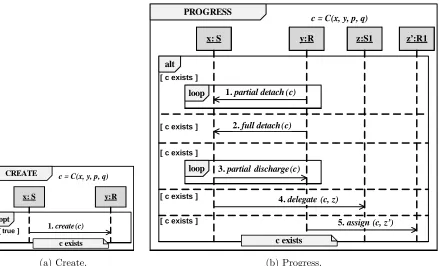
Figure 2.1a shows the elementary semantic structure of a commitment being created by an explicit create(·) message from its debtor. (We show the postcondition of each structure at the bottom of its diagram.) A commitment may also be created by the delegation or assignment of another commitment—we handle these cases separately since they presuppose an already existing commitment.
2.2.1 Progress a Commitment
Message mj progresses Message mi if and only if mj logically affects any commitments
refer-enced bymi but does not eliminate such commitments. Figure 2.1b illustrates this structure.
A commitment is (fully) detached when its antecedent becomes true. To accommodate practical cases, we introduce a partial detach as when the antecedent of a commitment is weakened but does not become true. Likewise, a partial discharge weakens the consequent of a commitment but does not make it true. Partial detach and discharge are respectively ways to bring about the antecedent and consequent in a “piecemeal” manner. We can think of a series of messages, each accomplishing a fraction of the total work, such as a shipment being completed in parts. In this case, each such message in essence modifies a commitment based on suitable logical operations [Singh, 2008], and is related to the initial creation via the Progress relationship.
x: S y:R
c = C(x, y, p, q)
CREATE
opt
1. create(c)
[ true ]
c exists
(a) Create.
x: S y:R
1. partial detach (c)
c = C(x, y, p, q)
PROGRESS
z:S1 z’:R1
3. partial discharge(c) loop
4. delegate (c, z) alt
2. full detach(c) loop
5. assign (c, z’)
[ c exists ]
c exists
[ c exists ]
[ c exists ]
[ c exists ]
[ c exists ]
(b) Progress.
Figure 2.1: Semantic structures: create and progress.
mi, thenmj progressesmi. Likewise,mj progressesmi ifmj delegates or assigns a commitment
created bymi.
2.2.2 Complete a Commitment
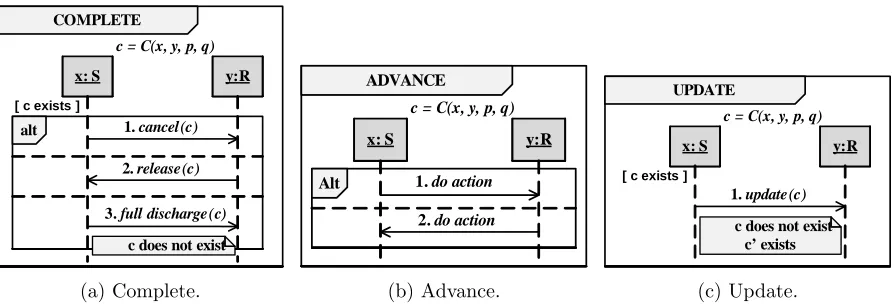
Message mj completes Message mi if and only if mj eliminates a commitment created or
progressed bymi, as shown in Figure 2.2a.
A commitment can simply be discharged by its debtor by performing the consequent. One can think of discharge as a message that finishes the job. Typically, but not necessarily, the debtor would discharge a commitment after the creditor brings about the antecedent. Note that although a full or partial detach and a partial discharge merely progress a commitment, a full discharge completes it.
Additionally, a commitment may be completed by its debtor canceling it or its creditor re-leasing it. Thus ifmj (fully) discharges, cancels, or releases a commitment created or progressed
bymi, thenmj completesmi. Any commitment created or progressed bymi is no longer active
x: S y:R
c = C(x, y, p, q)
COMPLETE
alt
2. release(c) 1. cancel(c)
3. full discharge(c)
[ c exists ]
c does not exist
(a) Complete.
x: S y:R
c = C(x, y, p, q)
ADVANCE
Alt
2. do action 1. do action
(b) Advance.
x: S y:R
c = C(x, y, p, q)
UPDATE
1. update(c)
[ c exists ]
c does not exist c’ exists
(c) Update.
Figure 2.2: Semantic structures: complete, advance, and update.
2.2.3 Advance an Interaction
Messagemj advances Messagemiif and only ifmi is causally prior tomj butmj does not affect
any commitment created by mi. That is, mj does not rely upon the commitment semantics.
For example, a price quote sent in response to a request for quotes (RFQ) advances the latter. In particular, we can understand the price quote as creating a commitment, which advances the prior RFQ. Figure 2.2b illustrates this structure.
2.2.4 Update: Complete plus Advance
Message mj updates Message mi if and only if mi is causally prior to mj and mj affects
a commitment created by mi extralogically, that is, an update is not based on the formal
semantics of commitments. Figure 2.2c illustrates this structure. The debtor of a commitment can update its antecedent or consequent. In essence, an update is equivalent to canceling the existing commitment and creating a new one. In terms of Figure 2.3, an update would affect two commitments, one being completed and one being created. A creditor may request an update, e.g., during negotiation. Such an update is equivalent to releasing the existing commitment and requesting a new one from the debtor. For instance, a mechanic may update its estimate and an insurance company may change its premium quote. Updating a commitment is distinct from causing the progress of that commitment.
2.2.5 Grouping and Adequacy of the Semantic Structures
Figure 2.3: The life cycle of a commitment, enhanced from Singh et al. [2009]. Section 2.2.1 explains partial detach and partial discharge.
otherwise, if the antecedent times out, the commitment transitions to theexpired state. From theactive state (a superstate of conditional and detached), if the consequent comes to hold, the commitment isdischarged. From the detached state, if the consequent fails to become true, the commitment is violated. The commitment transitions to theterminated state when it is either canceled by the debtor or released by the creditor.
Notice that our semantic relationships quite naturally help group messages. If a message progresses another, it must (partially or fully) detach, partially discharge, delegate, or assign it. If a message completes another, it must fully discharge, cancel, release, or update that message. If a message advances another, it could have any content. In particular, a creation of a commitment can only advance another message, if it relates to a prior message at all.
2.2.6 Commitment-Causal Graphs
We propose commitment-causal or CC graphs to capture the essential semantic and causal properties of an interaction scenario. CC graphs build on the notion of aDooley graph [Parunak, 1996], which places related messages close to each other, and places unrelated messages in disconnected components. Parunak’s approach, although a crucial precursor to Muon, suffers from significant limitations for our present purposes. Specifically, it considers a fixed set of message types and does not accommodate their meanings. Moreover, it organizes interactions in terms of fragments that involve exactly two parties. We exploit Singh’s (2000) modular approach for constructing Dooley graphs but we further introduce meanings and relationships based on meanings that are missing from Singh’s approach.
Chapter 3
Pragmatic Patterns
The semantic structures capture ways in which we might manipulate commitments that are determined based on the commitment semantics. The pragmatic patterns, in contrast, repre-sent the different optional or heuristic ways in which designers in an application domain may construct suitable protocols. For example, the designers may decide that the cancellation (1) of a typical commitment is addressed by the creditor escalating it to a specified authority, (2) of a delegated commitment by complaining to the original debtor, and (3) of an assigned commitment by informing the original creditor. We can thus identify three protocol patterns above that the designers could apply in the given domain in different settings. In general, there is a huge variety of such patterns and nowhere should one assume that a particular pattern must be applied. Such variety is reminiscent of situational method engineering (SME) [Chopra and Singh, 2011; Qumer and Henderson-Sellers, 2008], wherein a software design method com-prises reusable fragments selected based on application and organizational requirements. In the present setting, a selected set of pragmatic patterns can be thought of as a situation-specific set of methods for designing a protocol. For example, we may (or may not) capture that a creditor would escalate a canceled commitment.
Previous research has examined patterns for business processes from different perspectives. Van der Aalst et al. (2003) consider the operational structure of workflows, e.g., that two subworkflows may run in parallel or that one may invoke the other. These operational details apply closer to the implementation than does Muon. In contrast, Muon supports patterns expressed via commitments: not which workflow invokes another but which business partner delegates a commitment to another or escalates a commitment violation to another.
the interaction may be operationalized via messages. In contrast, here we seek patterns that apply to protocols. Thus, the Muon patterns go beyond Singh et al.’s approach by describ-ing how communications among the participants accomplish the corresponddescrib-ing business-level interaction.
We now introduce some important pragmatic patterns. Pragmatic patterns are potentially of unbounded variety here: disparate patterns appropriate for different domains. For each pattern, we provide six key attributes, loosely based on Gamma et al. (1995).
3.1
Accommodating Cancellation
A unilateral cancellation of a commitment would enable a debtor to simply exit midstream from an interaction. As an autonomous party, it can do so. However, since such an exit is usually not desirable, a protocol may include support for a jilted creditor to sanction a failing debtor, possibly by sending an escalation message to an appropriate authority, which might (or might not) proceed to sanction the errant debtor.
• Intent: The debtor no longer wishes to continue the commitment.
• Motivation: A buyer (debtor) cancels its commitment with its seller (creditor). On can-cellation, the buyer returns any goods that the seller has already delivered.
• Applicability: When a buyer changes its decision of buying goods.
• Consequences: The debtor can cancel its commitment at will. The creditor may attempt to impose sanctions on the debtor, such as by escalating a complaint to a higher authority if such exists.
• Implementation: The commitment enters a terminal state in its life cycle.
• Known uses: RosettaNet’s (2009) Request Shipping Order Cancellation (PIP 3B14), Re-quest Purchase Order Cancellation (PIP 3A23).
3.2
Accommodating Release
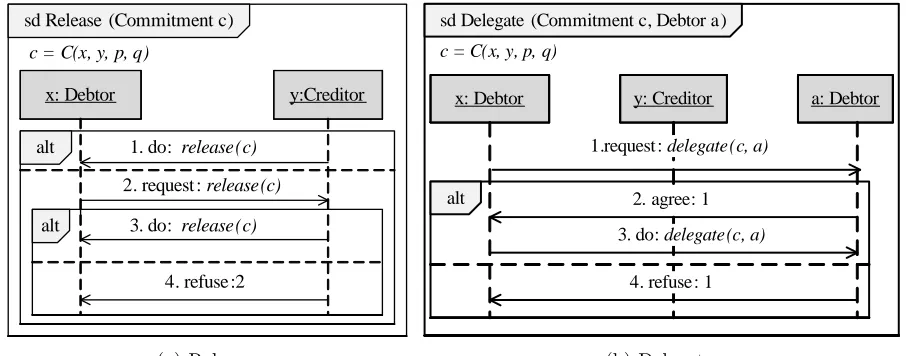
A release is the converse of a cancel. As in Figure 3.1a, the creditor may unilaterally release a commitment. Alternatively, the debtor can request a release from the creditor, in which case the creditor may release the debtor, or refuse the debtor’s request.
• Motivation: A buyer (debtor) rejects an offer from a seller or counters with another offer. The seller need no longer honor the original offer.
• Applicability: In negotiation, the parties may reject each other’s offers. Further, in e-commerce, when a buyer finds that the goods received are damaged, it can return the goods and request the release of the commitment to pay for them.
• Consequences: The creditor can release its commitments at its will or when the debtor requests the creditor for releasing the commitments.
• Implementation: The commitment enters a terminal state in its life cycle.
• Known uses: HL7’s [ISO/HL7, 2009] Cancel Admission (A11), Cancel Transfer (A12), and Cancel Discharge (A13) involve releasing a commitment.
x: Debtor y:Creditor
2. request : release(c)
alt
4. refuse:2
c = C(x, y, p, q)
sd Release (Commitment c)
3. do: release(c) alt 1. do: release(c)
(a) Release.
x: Debtor y: Creditor
c = C(x, y, p, q)
sd Delegate (Commitment c, Debtor a)
a: Debtor
alt
1.request: delegate(c, a)
2. agree: 1
4. refuse: 1 3. do: delegate(c, a)
(b) Delegate.
Figure 3.1: Pragmatic patterns: release and delegate.
3.3
Accommodating Delegation
• Intent: When a debtor delegates its commitment to another debtor and stays responsible for the satisfaction of the commitment.
• Motivation: The seller (debtor) delegates its commitment of delivering goods to a shipper. However, the seller remains committed to delivering the goods to the buyer (creditor). When the shipper delivers the goods, its commitment as well as the seller’s pending commitment are both discharged.
• Applicability: When a creditor does not have the capability to perform its committed task, it delegates its task to a third party, the delegatee.
• Consequences: This pattern presumes that suitable social relationships (other commit-ments) are in place between the delegator and the delegatee so that the delegation is successful.
• Implementation: When the creditor delegates its commitment to a delegatee, the original commitment becomes pending and a new commitment is created. Once the new commit-ment is discharged, the original commitcommit-ment is also discharged.
• Known uses: The MIT Process Handbook (MITPH) [Malone et al., 2003] includes business processes that demonstrate the delegate pattern, e.g., Deliver Stock Product (SCOR D1), where a seller outsources its shipping duty to a shipper or a carrier. Similarly, RosettaNet’s (2009) Request Shipping Order (PIP 3B12) and Notify of Shipping Order Confirmation (PIP 3B13) reflect the delegate pattern.
The explicit request would be redundant in cases where the delegator and delegatee have a prior organizational relationship that grants the delegator the power to perform the delegation. A useful variation of the above pattern is to have the delegator inform the creditor: doing so ensures the creditor knows who its current debtor is, which can facilitate compliance checking by the creditor.
3.4
Accommodating Assignment
Chapter 4
The Muon Methodology
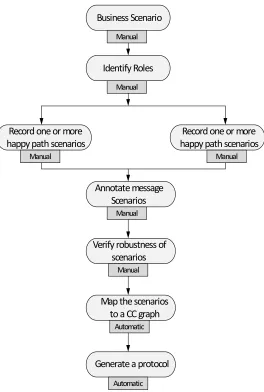
We now systematically describe the Muon methodology to guide designers of a cross-enterprise protocol. It presupposes expertise in the domain of the interaction being modeled, especially in capturing the meanings of a message. To illustrate our methodology, we adopt the AGFIL case introduced above. Figure 4.1 represents the flow of our overall methodology.
4.1
M1: Identify Stakeholders as Roles
The first step in our methodology is the identification of all the independent stakeholders involved in the interaction.
• Input: A business problem and domain expertise.
• Output: A set of autonomous entities whose interaction is being modeled.
• Description: Domain experts identify the independent stakeholders participating in the interaction. The key to identifying stakeholders is that they are autonomous and thus can enter into and modify social relationships with others. Specifically, they can create and otherwise manipulate their commitments.
The stakeholders are generalized into the roles they will play in the final protocol. The roles are groupings of stakeholders who engage in similar interactions. For example, if two stakeholders both handle insurance claims, we might combine them into the single role of call center.
We identify the following roles in the insurance case.
Insurer Insurance company or provider.
ƵƐŝŶĞƐƐ^ĐĞŶĂƌŝŽ
/ĚĞŶƚŝĨLJZŽůĞƐ
ZĞĐŽƌĚŽŶĞŽƌŵŽƌĞ ŚĂƉƉLJƉĂƚŚƐĐĞŶĂƌŝŽƐ
ZĞĐŽƌĚŽŶĞŽƌŵŽƌĞ ŚĂƉƉLJƉĂƚŚƐĐĞŶĂƌŝŽƐ
ŶŶŽƚĂƚĞŵĞƐƐĂŐĞ ^ĐĞŶĂƌŝŽƐ
sĞƌŝĨLJƌŽďƵƐƚŶĞƐƐŽĨ ƐĐĞŶĂƌŝŽƐ
DĂƉƚŚĞƐĐĞŶĂƌŝŽƐ ƚŽĂŐƌĂƉŚ
'ĞŶĞƌĂƚĞĂƉƌŽƚŽĐŽů ƵƚŽŵĂƚŝĐ
ƵƚŽŵĂƚŝĐ DĂŶƵĂů DĂŶƵĂů
DĂŶƵĂů DĂŶƵĂů
DĂŶƵĂů DĂŶƵĂů
Figure 4.1: Our methodology summarized. The last two are automatic steps but we include them here to provide a complete picture of our approach.
Call Center Customer-facing party that handles insurance claim requests.
Mechanic Estimator of repair costs and performer of any repairs.
4.2
M2: Record One or More Typical Happy Path Scenarios
Once the roles are identified, the protocol designers specify a typical successful orhappy path scenario as an instance of the interaction enacted by domain experts (in the spirit of role play-ing). This step follows the CRC methodology [Beck and Cunningham, 1989], wherein experts play act programming objects to be created. For example, an expert could play act a Bank Account object.
Our approach is neutral as to whether the experts belong to one organization or many, but it presumes that they have good knowledge of the stakeholders so that they can create realistic scenarios.
In this step, the experts record a suitable scenario.
• Input: The output of Step M1, the business problem, and domain expertise.
• Output: Illustrative scenarios of the interaction being modeled in terms of messages: one primary and zero or more secondary.
• Description: The experts enact the roles identified in these scenarios.
The primary scenario must be an exemplar. The role enactment must aim to reveal the most central instance of the interaction while also revealing important variations as secondary scenarios of reasonable complexity, as the following guidelines suggest:
• Represent a positive outcome. For example, we seek a scenario in which John Doe’s car is repaired and all payments are made. Such a scenario serves to capture desirable enactments and eliminate trivial ones that might not provide sufficient information to engineer a protocol. Specifically, a scenario in which the mechanic simply refuses to repair the car is less useful at this stage.
• Reflect the social or organizational relationships among the roles. These relationships specify the commitments among the roles. For example, it helps to capture that Europ Assist and Lee Consulting Services work for AGFIL.
• Omit messages that do not add to an observer’s knowledge of the interaction.In particular, we omit messages pertaining to other transactions, such as the mechanic repairing cars of customers unrelated to AGFIL. Doing so helps avoid spurious messages in the resulting protocol.
the enactment unless they add value to an observer’s knowledge of the interaction. If Eu-rop Assist getting estimates from multiple mechanics were relevant, we would show such mechanics, but otherwise not.
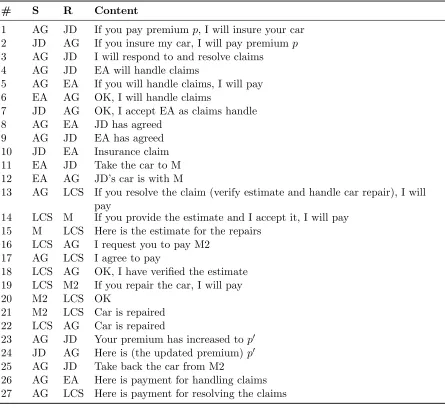
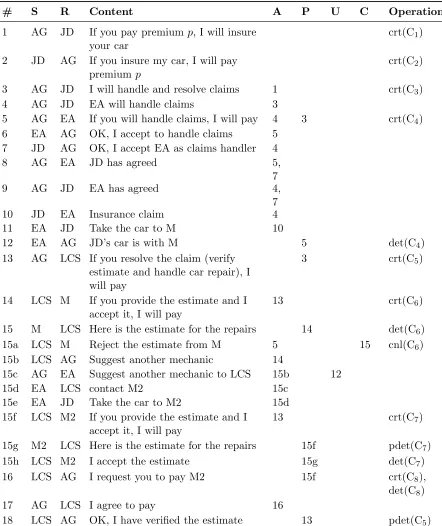
Table 4.1: A successful scenario for the AGFIL example.
# S R Content
1 AG JD If you pay premiump, I will insure your car 2 JD AG If you insure my car, I will pay premiump 3 AG JD I will respond to and resolve claims
4 AG JD EA will handle claims
5 AG EA If you will handle claims, I will pay 6 EA AG OK, I will handle claims
7 JD AG OK, I accept EA as claims handle 8 AG EA JD has agreed
9 AG JD EA has agreed 10 JD EA Insurance claim 11 EA JD Take the car to M 12 EA AG JD’s car is with M
13 AG LCS If you resolve the claim (verify estimate and handle car repair), I will pay
14 LCS M If you provide the estimate and I accept it, I will pay 15 M LCS Here is the estimate for the repairs
16 LCS AG I request you to pay M2 17 AG LCS I agree to pay
18 LCS AG OK, I have verified the estimate 19 LCS M2 If you repair the car, I will pay
20 M2 LCS OK
21 M2 LCS Car is repaired 22 LCS AG Car is repaired
23 AG JD Your premium has increased top0 24 JD AG Here is (the updated premium)p0 25 AG JD Take back the car from M2
26 AG EA Here is payment for handling claims 27 AG LCS Here is payment for resolving the claims
4.3
M3: Record One or More Scenarios Demonstrating
Excep-tions
Here, the domain experts identify one or more scenarios corresponding to exceptions.
• Input: The output of Step M2, business problem, and domain expertise.
• Output: Scenarios exhibiting exceptions in the interaction being modeled.
• Description: The experts identify possible exceptions that can occur in a previously de-termined typical scenario.
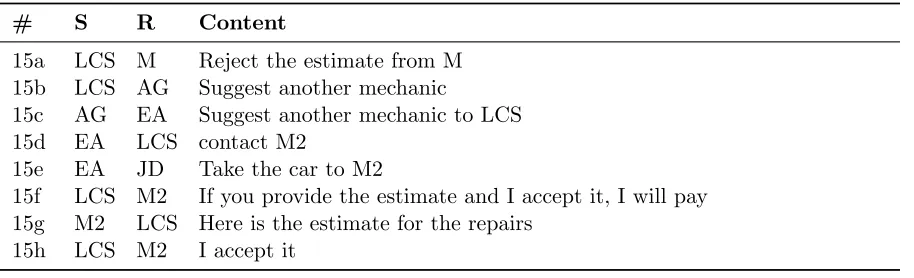
Table 4.2: A scenario demonstrating an exception in the AGFIL example.
# S R Content
15a LCS M Reject the estimate from M 15b LCS AG Suggest another mechanic
15c AG EA Suggest another mechanic to LCS 15d EA LCS contact M2
15e EA JD Take the car to M2
15f LCS M2 If you provide the estimate and I accept it, I will pay 15g M2 LCS Here is the estimate for the repairs
15h LCS M2 I accept it
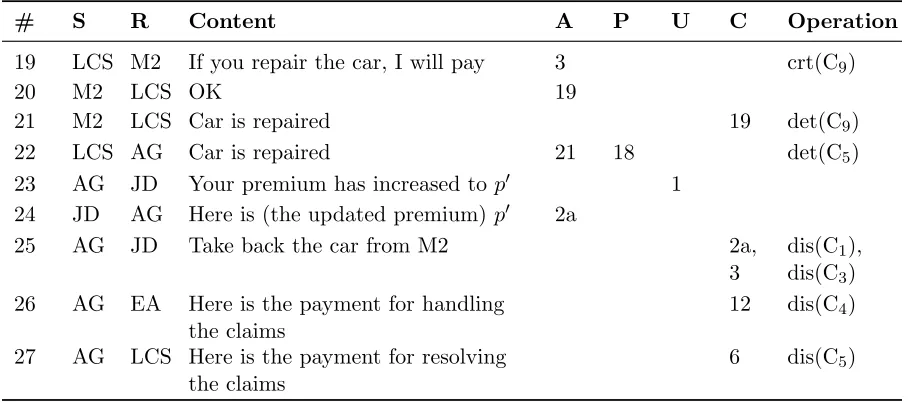
Table 4.2’s columns show an exceptional scenario. When M provides an estimate for repairing JD’s car to LCS, LCS may reject the estimate. LCS may find another mechanic M2. The rest of the scenario would proceed just as when LCS succeeds with M. Messages 15a to 15h represent a scenario to be merged with the scenario provided in Table 4.1. The merged scenarios are provided in Table 4.4(I) and (II).
4.4
M4: Annotate Messages in Scenarios
• Input: The outputs of Steps M2 and M3.
• Output: Annotations for each of the messages produced by Steps M2 and M3.
Table 4.3: I-An initial scenario for the AGFIL case that combines the happy path and exception scenarios. The annotations relate pairs of messages. (Here, A: advance; P: progress; U: update; C: complete; crt: create; det: detach; dis: discharge; cnl: cancel; rel: release; del: delegate; pdet: partial detach.)
# S R Content A P U C Operation
1 AG JD If you pay premiump, I will insure your car
crt(C1)
2 JD AG If you insure my car, I will pay premiump
crt(C2)
3 AG JD I will handle and resolve claims 1 crt(C3)
4 AG JD EA will handle claims 3
5 AG EA If you will handle claims, I will pay 4 3 crt(C4)
6 EA AG OK, I accept to handle claims 5 7 JD AG OK, I accept EA as claims handler 4
8 AG EA JD has agreed 5,
7
9 AG JD EA has agreed 4,
7
10 JD EA Insurance claim 4
11 EA JD Take the car to M 10
12 EA AG JD’s car is with M 5 det(C4)
13 AG LCS If you resolve the claim (verify estimate and handle car repair), I will pay
3 crt(C5)
14 LCS M If you provide the estimate and I accept it, I will pay
13 crt(C6)
15 M LCS Here is the estimate for the repairs 14 det(C6)
15a LCS M Reject the estimate from M 5 15 cnl(C6)
15b LCS AG Suggest another mechanic 14
15c AG EA Suggest another mechanic to LCS 15b 12
15d EA LCS contact M2 15c
15e EA JD Take the car to M2 15d
15f LCS M2 If you provide the estimate and I accept it, I will pay
13 crt(C7)
15g M2 LCS Here is the estimate for the repairs 15f pdet(C7)
15h LCS M2 I accept the estimate 15g det(C7)
16 LCS AG I request you to pay M2 15f crt(C8),
det(C8)
17 AG LCS I agree to pay 16
Table 4.4: II-An initial scenario for the AGFIL case that combines the happy path and ex-ception scenarios. The annotations relate pairs of messages. (Here, A: advance; P: progress; U: update; C: complete; crt: create; det: detach; dis: discharge; cnl: cancel; rel: release; del: delegate; pdet: partial detach.)
# S R Content A P U C Operation
19 LCS M2 If you repair the car, I will pay 3 crt(C9)
20 M2 LCS OK 19
21 M2 LCS Car is repaired 19 det(C9)
22 LCS AG Car is repaired 21 18 det(C5)
23 AG JD Your premium has increased top0 1 24 JD AG Here is (the updated premium)p0 2a
25 AG JD Take back the car from M2 2a,
3
dis(C1),
dis(C3)
26 AG EA Here is the payment for handling the claims
12 dis(C4)
27 AG LCS Here is the payment for resolving the claims
6 dis(C5)
Let us illustrate the message annotations. Message 1 is an offer from AG to JD to pay a premium. Message 15 progresses Message 14 by detaching the commitment. Message 3 advances Message 1 where AG commits to handling and resolving claims for JD. Message 25 completes Messages 1 and 3, where AG provides the repaired car when JD claims it.
4.4.1 M5: Verify Robustness of Scenarios
• Input: The annotations of Step M4 along with the scenarios of Steps M2 and M3.
• Output: Annotations on commitments that fail robustness checks.
• Description: Check if the scenarios produced in Steps M2 and M3 are complete given the annotations of Step M4. If not, iterate Steps M2, M3, and M4.
Real-world business interactions often exhibit modularity in that they naturally map to multiple self-contained scenarios. Because our approach, groups messages that create, progress, or complete a given commitment, we can determine whether a given scenario includes all op-erations that affect a commitment logically. If not, we can help the designers come up with additional scenarios to ensure completeness.
verifying a target protocol for robustness. Specifically, when designing such a protocol, for any scenario that involves the creation of a commitment we can ask what would happen if (1) the debtor canceled or updated it; (2) the debtor attempted to delegate to another party; or (3) the creditor attempted to release it or assign it to another party. The above questions arise naturally from the commitment life cycle we have adopted. They can be thought of as sanity checks on the given set of scenarios. Checks that are similar in spirit are applied in other repre-sentations as well: for example, one might check if a workflow handles the case when a condition may be false. Notice that this step does not capture advance messages because those are not constrained by the model.
In general, determining and addressing exceptions involves iterating over Steps M2 and M3 by recording multiple exceptional scenarios. In doing so, the designers would demonstrate how to handle exceptions and our approach would incorporate such exception handling into the resulting protocol. Note that our approach does not demand whether and how designers address exceptions. In particular, determining a suitable sanction for a particular domain requires some imagination and application-specific knowledge.
In Table 4.4, JD never pays the insurance premium. Therefore, in Table 4.4, we need to add Message 2a, which completes a commitment between JD and AGFIL. Similarly, in Table 4.4, LCS never pays M for the estimates and repairs. Hence, we need to include Message 22a, which completes the commitment between LCS and M.
Table 4.5: Completeness check for the happy path for the AGFIL case.
# S R Content A P U C Operation
2a JD AG Pay premiump 1 2 det(C1),
dis(C2)
22a LCS M2 Here is the payment for performing the repairs
21 dis(C9)
In Table 4.2, AG never pays for the estimate it obtains from M2. Therefore, we add Mes-sage 18a where AG makes the payment for the estimate, thereby discharging its commitment with M2 as well as discharging the commitment from LCS to M2.
Table 4.6: Completeness check for exceptions for the AGFIL case.
# S R Content A P U C Operation
18a AG M2 Here is the payment for the estimate
16, 15h
dis(C8),
dis(C7)
discharging it.
4.5
M6: Map the Scenarios to a Commitment-Causal Graph
This step is automatic and not carried out manually by the designers.
• Input: The output of Step M4.
• Output: A commitment-causal (CC) graph of the scenario, identifying semantic structures in the interaction.
• Description: Generate a CC graph from the annotated scenario based on producing some intermediate graph representations.
• From Step M4, we obtain a complete scenario containing the happy path and exception scenarios as in Table A.2 (included in the appendix).
• Identify one or more conversation graphs from the scenario.
– For convenience, interpret an annotated scenario as a graph whose vertices are mes-sages (associating a sender (S), receiver (R), message (ID), and message meaning) and whose edges are relationships between messages (such as P (progress), C (com-plete), A (advance), or U (update)). For example, if mj progresses mi, there is an
edge labeled P frommj tomi.
– A conversation graph G is a minimal graph (in its set of vertices) that contains at least one message and contains all the messages that relate via progress or com-pletion (and hence also update) to any message that occurs inG. Additionally, the messages in a conversation graph are partially ordered such that if mj progresses,
completes, advances, or updatesmi, thenmj is ordered aftermi. In intuitive terms,
a conversation graph is a logically coherent scenario fragment.
p create(c) S R q detach(c) R S P 2. q:detach(c) 1. p:create(c) S R 3. r:discharge(c) r discharge(c) S R
C S R
p create(c) S R C r release(c) R S 1. p:create(c) 2. q:release(c) S R p create(c) S R q cancel(c) S R C 2. q:cancel(c) 1. p:create(c) p create(c) S R q update(c) S R U 1. p:create(c) S R 2. q:update(c) S
1. p: create(c)
R
2. q: delegate(c’,S’) p create(c) S R q delegate(c) S S’ r discharge(c) S’ R S’ 4. s: discharge(c’)
3. p: create(c’)
S
1. p: create(c)
R
4. r: discharge(c’) p create(c) S R q assign(c) R R’ r discharge(c) S R’ R’ 2. q: assign(c’,R’)
3. p: create(c’) P C P C ;ĂͿ ;ďͿ ;ĐͿ ;ĚͿ ;ĞͿ ;ĨͿ
• Generate the CC graph of the scenario from its conversation graphs. The senders and receivers of messages become the vertices in the CC graph and the messages become the edges between the vertices. In a CC graph, the edges carry the meaning of commitment operations and are causally ordered. Figure 4.2 shows our modular algorithm for creating a CC graph, wherein it identifies the key roles involved in each component of a CC graph. Our algorithm applies to the appropriate fragments of a conversation graph and yields the corresponding CC component.
Importantly, we keep the roles identified in each conversation graph separate. Such split off roles are termedcharacters [Parunak, 1996]. Keeping the characters separate because we wish to modularize the protocol being produced. Thus a typical CC graph would contain multiple connected components. Each of the connected components originates from a conversation and yields a modular protocol. Each CC component aggregates characters and messages. Here, S and R are the characters andp,q, and r are the messages exchanged between the characters.
Figure 4.2 provides several patterns for the CC graph. For example, Figure 4.2(a) represents the pattern for commitment creation and discharge. Similarly, Figures 4.2(b), 4.2(c), and 4.2(d) represent how a commitment is canceled, released, or updated. Figures 4.2(e) and 4.2(f) rep-resent how a commitment is delegated or assigned. One can verify by inspection that these patterns cover the life cycle of a commitment discussed in Section 2.2.5 and the pragmatic patterns introduced in Section 3. Therefore, any other pattern would merely be a variation on the above patterns. For example, canceling a commitment after it is detached is a variation of Figure 4.2(b) wherein the commitment is canceled after the commitment is created. Similarly, the cancellation of a commitment after it is delegated or assigned is a variation of Figures 4.2(e) and 4.2(f), respectively, wherein a commitment is discharged after it is delegated or assigned. Figure 4.3 shows the CC graph for the AGFIL case.
4.5.1 M7: Generate a Protocol
This step is automatic and not carried out manually by the designers.
• Input: The output of Step M6.
• Output: A protocol based on the input CC graph.
• Description: Create a protocol from the generated CC graph by mapping the graphs to our structures.
AG
2a:
detach(C
1)
1:
create(C
1)
25:
discharge(C
1)
JD
LCS
15f:
create(C
7)
15h:
detach(C
7)
M2
16:
delegate(C
8,AG)
L
CS
14:
create(C
6)
M
15:
detach(C
6)
AG
18a:
discharge(C
8) ^
discharge(C
7)
15a:
cancel(C
6)
JD
2:
create(C
2)
2a:
discharge(C2)
AG
AG
3:
create(C
3)
25:
discharge(C
3)
JD
AG
12:
detach(C
4)
5:
create(C
4)
26:
discharge(C
4)
EA
AG
18:
pdetach(C
5)
13:
create(C
5)
27:
discharge(C
5)
L
CS
22:
detach(C
5)
L
CS
21:
detach(C
9)
19:
create(C
9)
22a:
discharge(C
9)
M2
Figure 4.3: The CC graph for the example of Table A.2.
the conversation initiated by Message 1 and matches a composition of the Create, Progress, and Complete structures introduced in Section 2.2. Figure 4.4 shows the protocols generated based on the CC graphs shown in Figure 4.3.
Define the protocol in terms of commitments among the independent entities and the restric-tions on the operarestric-tions that can be performed on those commitments. In the AGFIL example, we obtain:
• Create a commitment from the insurer AG to the insured JD:C(AG, JD, pay premium p, provide insurance).
• Create commitments from AG, to the claim handler EA and the estimate verifier LCS, respectively: C(AG, EA, handle claims, pay) and C(AG, LCS, resolve claims, pay).
AG JD
1:create(C1)
AG JD
opt
2a:detach(C1)
C1 ĞdžŝƐƚƐ
AG JD
opt C1 ĞdžŝƐƚƐ 25:discharge(C1)
LCS M2
15f: create(C7)
LCS M2
15h:detach(C7)
C7ĞdžŝƐƚƐ opt
LCS AG
C7ĞdžŝƐƚƐ opt
16: delegate(C8,AG)
LCS M
14:create(C6)
LCS M
15:detach(C6)
C6 ĞdžŝƐƚƐ opt
LCS M
C6ĞdžŝƐƚƐ
15a: cancel(C6)
C6ĚŽĞƐŶŽƚĞdžŝƐƚ
AG M2
C8 ĞdžŝƐƚƐ 18a:discharge(C8) opt
LCS M2
C7 ĞdžŝƐƚƐ 18a:discharge(C7)
opt
JD AG
2:create(C2)
JD AG
C2 ĞdžŝƐƚƐ 2a:discharge(C2) opt
AG JD
3:create(C3)
AG JD
C3 ĞdžŝƐƚƐ
25:discharge(C3)
opt
AG EA
5:create(C4)
AG EA
opt
12:detach(C4) C4 ĞdžŝƐƚƐ
AG JD
C4 ĞdžŝƐƚƐ 26:discharge(C4)
opt
AG LCS
13:create(C5)
AG EA
opt
18:pdetach(C5)
C5 ĞdžŝƐƚƐ
AG JD
C5 ĞdžŝƐƚƐ 27:discharge(C5)
22:detach(C5)
opt
opt
LCS M2
19:create(C9)
LCS M2
opt
21:detach(C9)
C9 ĞdžŝƐƚƐ
LCS M2
C9 ĞdžŝƐƚƐ 22a:discharge(C9) opt
• Create a commitment from AG to M:C(AG, M, repair, pay).
Chapter 5
Empirical Evaluation
We now describe a partial empirical evaluation that compared two approaches for creating a protocol: Muon and a traditional approach (dubbedTrad below) based on UML 2.0 Sequence Diagrams Object Management Group [2004]. AUML [Odell et al., 2001] introduced advanced sequence diagrams, adopted in UML 2.0, which match the notation we used for semantic struc-tures above. However, AUML and UML 2.0 provide no account of meaning underlying such diagrams, which we define. Further, we provide a methodology for developing protocols.
The idea of the study was to compare the quality of the protocols produced by the two approaches. For each approach, the output was a protocol expressed in UML Sequence Diagrams restricted to messages (no method calls). And, the input was a textual description as well as happy path and exception scenarios. (The appendix shows the provided inputs.)
• Trad: We asked subjects to combine the scenarios to create a final scenario; check its completeness with respect to the provided description; create a protocol.
• Muon: We asked subjects to create a protocol using Muon, described as slides (http: //research.csc.ncsu.edu/mas/code/chor/Methodology.pdf) outlining the steps.
The subjects were 58 computer science graduate students. We designed our study in a way as to eliminate the following threats.
• Expertise differences among the subjects may affect the study results. To eliminate this threat, we divided the 58 subjects into two sets (Group A and Group B) with an equal mean industry experience, which we obtained via a survey conducted prior to initiating the study.
studies: (1) the AGFIL case and (2) the ASPE case of breast cancer diagnosis [ASPE, 2010]. First, Group A designed a protocol for AGFIL and Group B for ASPE using the traditional method. Next, the groups applied our methodology, though with cases switched (Group A on ASPE and Group B on AGFIL).
• Instrumentation refers to the effect of tooling for each method. All the subjects used IBM Rational Software Architect 8.0.2 for developing UML sequence diagrams.
Statistical Measures
We measured the following dependent variables for each approach, and compared them via statistical significance tests.
• Flexibilitymeasures the number of possible executions.
– MSC count indicates modularity (higher is better).
– Count of alt,opt, and parfragments indicating the number of possible executions (higher is better).
• Objective quality measures model quality as assessed in objective terms.
– Missing number of guards on UML Sequence Diagram fragment, which indicate spu-rious enactments (lower is better).
– Errors in MSCs, indicating an attempt to tackle increased complexity of the MSCs (lower is better).
• Subjective qualitymeasures model quality as assessed subjectively.
– Scenario coverage is the distribution of subjects with respect to the coverage of the scenario ranging over high (entire scenario), medium, and low.
– Comprehensibility measures the rater’s ability to understand a protocol and ranges over high (easy to comprehend), medium, and low.
5.1
Results
5.1.1 Flexibility
Figure 5.1 shows boxplots of flexibility, as based on objective criteria. The median of the count of alt,opt,parin Muon is higher (11) than in Trad (6), indicating greater flexibility in Muon than Trad. The median number of MSCs for Trad (6) is slightly higher than Muon (5) though the third quartile value for Muon (12.45) is higher than Trad (10.22). A possible reason is that we specifically directed Trad subjects to produce modular diagrams, because of our experience in another settings wherein modelers tended to produce monolithic diagrams. Notice that the modularity of the Muon solution is encouraged by our method, without special attention by the developer. The median count for Trad-novice (6) is greater than Muon-novice. The median count for Trad-expert (4) is same as for Muon-expert (4).
0 5 10 15 20
Trad Muon Trad-novice Muon-novice Trad-expert Muon-expert
Number of MSCs.
0 5 10 15 20 25 30
alt+opt+parfragments.
Figure 5.1: Flexibility, as judged based on objective criteria.
5.1.2 Objective Quality
Figure 5.2 (left) shows the boxplots for the number of missing guards for Trad and Muon. The results show that the number of subjects with missing guards is lower (1) in case of Muon than Trad (3). We obtain similar results for Trad-novice, novice, Trad-expert, and Muon-expert.
0 5 10 Trad
Muon Trad-novice Muon-novice Trad-expert Muon-expert
Number of missing guards.
0 5 10
Incorrect MSCs.
Figure 5.2: Objective measures of quality.
5.1.3 Subjective Quality
Figure 5.3 shows the results for scenario coverage and comprehensibility, respectively. Scenario coverage is higher (57%) for Muon than for Trad (37%) and likewise for Muon-novice and Muon-expert over Trad-expert and Trad-novice, respectively. Comprehensibility is higher in Muon (44%) than Trad (31%) and likewise for Muon-novice and Muon-expert over Trad-expert and Trad-novice, respectively. Muon yields higher scenario coverage and comprehensibility.
5.1.4 Hypotheses
We now present the claims regarding the comparative effectiveness of Muon and Trad. The following are our alternative hypotheses, which claim that the means in the Muon and Trad distributions of the referenced variables are different.
• Muon yields higher mean MSC count.The mean number of MSCs generated using Muon is higher than for Trad. That is, Muon produces protocols of greater modularity than does Trad.
• Muon yields higher mean count of alt,opt,parfragments.The mean sum of alt,opt, and par fragments in Muon MSCs is higher than for Trad. That is, Muon yields more flexible MSCs than Trad.
0 20 40 60 80 100
Trad Muon Trad-novice Muon-novice Trad-expert Muon-expert
Scenario coverage.
0 20 40 60 80 100
Comprehensibility.
High Medium Low
Figure 5.3: Distributions of quality, as judged subjectively.
protocols than Trad.
• Muon yields lower mean count of errors in MSCs.The mean number of errors using Muon is smaller than using Trad. That is, Muon produces fewer incorrect protocols than Trad.
• Muon yields higher mean percentage of scenario coverage.The mean percentage of scenario coverage is higher using Muon than using Trad. That is, subjects model different aspects of a business scenario more in Muon and Trad.
• Muon yields higher mean percentage of comprehensibility. The mean percentage of com-prehensibility is higher using Muon than using Trad. That is, subjects models are more comprehensible for Muon than Trad.
Following standard practice, for each alternative hypothesis, we formulate a null hypothesis that there is no significant difference between the two means and apply Student’s t-test to determine whether each null hypothesis can be rejected at the 5% confidence interval.
Table 5.1 shows the p-values for the above hypotheses. It shows we reject all null hypotheses for ALT, OPT, PAR fragments count, missing guards count, and comprehensibility percentage. That is, we find that subjects employing Muon produce more flexible MSCs, with fewer missing guards, and comprehensible MSCs than subjects employing Trad. We accept null hypothesis for MSC count, incorrect MSCs count, and for the percentage of scenario coverage. That is, the number of MSCs and the percentage of scenario coverage are not significantly higher and the count of incorrect MSCs is not significantly lower among the Muon subjects.
Table 5.1: Hypothesis testing.
Hypothesis Muon Mean (µm)
Trad Mean (µt)
Alternative Hypothesis
Null Hy-pothesis [µm = µt]
p-value
Accepted at p-value 5%?
Muon yields higher mean MSC count
5.94 5.35 µm> µt p=0.14 X
Muon yields higher mean count of alt, opt,parfragments
10.21 6.93 µm> µt p=0.001 ×
Muon yields lower mean count of missing guards
1.26 2.89 µm< µt p=0.001 ×
Muon yields lower mean count of incorrect MSCs
1.21 1.16 µm< µt p=0.81 X
Muon yields higher mean percentage of scenario coverage
84.03 77.36 µm> µt p=0.24 X
Muon yields higher mean percentage of comprehensibility
(5.1100e−10) and for the percentage of comprehensibility (6.4482e−04) are extremely low. That is, the percentage of scenario coverage and comprehensibility both in Muon and Trad are not independent. This means that the measure of subjective quality for the subjects are not entirely different in Muon and Trad.
5.1.5 Threats to Validity
We briefly review the threats to validity of the above study. We described above how our study design mitigated the threats of expertise differences, learning effect, and instrumentation. An external threat is that our subjects are differently qualified and motivated than actual industry developers: most have less work experience and were required to try out Muon in this study.
Chapter 6
Discussion
Protocols have been used in cross-organizational settings for years. For example, RosettaNet (2009) originated in the 1990s and is a widely deployed standard that describes interactions for realizing supply chains. This work underlies well-known business process types such asQuote to Cash [Oracle, 2009], which is extensively used in practice. TWIST (2008) is an industry group formalizing foreign exchange processes, which are also naturally viewed as protocols. These domains are architecturally well-suited to multiagent systems, though advances such as Muon are needed to help bridge the gap in a way to bring the benefits of multiagent systems to such domains.
Muon is based on semantic structures that, unlike other approaches, relate naturally to meanings captured via commitments. Our high-level representation facilitates the partners flexibly implementing their internal policies and provides a meaningful basis for judging the correctness of a protocol. We go beyond previous work on commitments in expressing a core set of meaning-based and causal relationships among messages. As a result, Muon emphasizes meaning and deemphasizes operational details such as message ordering.
Capturing scenarios is a natural way to elicit stakeholder requirements and to provide a design rationale for the protocol. This is based on our intuition, reflected also in work on scenarios [Filippidou, 1998], that a bottom up approach is simpler: the designers first imagine some messages in a scenario; make the meanings of those messages explicit as commitments; use the robustness criteria to expand the scenarios; capture the causal structures, eventually producing a protocol. In other words, the concreteness of the scenarios helps in coming up with the commitments.
helping decide which pattern to apply. The semantic structures are used to generate modular protocols and are also used in Step M4 as a way for performing a sanity check.
Muon respects the intuition that mutually independent or nonoverlapping scenarios map to separate protocols. An interaction scenarioI1 that is causally affected by a message in another
scenarioI2 would yield a protocol that hangs off the protocol forI2. Thus, the advance
relation-ship would lead to such causally connected protocols, which can spawn off new commitments or perform other actions. Each such commitment would be treated in its own logical right. For example, the cancellation of a commitment might lead to the creditor sending an escalation message, which might lead the recipient of the message to create a new commitment, reflecting compensation for the creditor. There is thus a natural causal (and hence temporal) relationship between the cancellation and the escalation messages.
Protocols, in general, do not arise in a vacuum. The partners who specify and adopt a protocol would often have relevant internal processes already in place. Thus the choice of a protocol may be influenced by existing internal processes. However, the key idea is for a protocol not to expose such internal processes of one partner to another—doing so couples the partners’ implementations and makes it harder to evolve any of them independently of the others.
A traditional use of rules is to embed the semantics in the rules alone [Grosof and Poon, 2003] and to enable intelligent decision making. But unless the semantics is part of the protocol, the partners cannot use it to support their collaboration. And, revealing internal details–even if those details are expressed in high-level terms as rules—means the partners’ implementations are more tightly coupled than they should be. However, protocols can be naturally applied in combination with rules, e.g., as in [Desai et al., 2005].
A common challenge to all protocol approaches is one of perspective. That is, what should happen if the parties involved do not agree as to the facts? There is no fundamental solution to this challenge except to introduce some kind of synchronization or some kind of an authoritative party that can adjudicate such matters. This challenge, however, is orthogonal to our approach since we are concerned with specifying a protocol, and an appropriate protocol should reflect such considerations in its messages. Notice that our strong causal approach to patterns provides a natural way to create protocols that would avoid problems such as race conditions.
![Figure 2.3:The life cycle of a commitment, enhanced from Singh et al. [2009]. Section 2.2.1explains partial detach and partial discharge.](https://thumb-us.123doks.com/thumbv2/123dok_us/1596717.1197106/20.612.146.484.71.235/figure-commitment-enhanced-section-explains-partial-partial-discharge.webp)