ISSN(Online): 2319-8753 ISSN (Print): 2347-6710
I
nternational
J
ournal of
I
nnovative
R
esearch in
S
cience,
E
ngineering and
T
echnology
(A High Impact Factor & UGC Approved Journal) Website: www.ijirset.com
Vol. 6, Issue 8, August 2017
A Framework for Hierarchical Big Image
Data
Pavan Kumar E1, Chetana Prakash2
P.G. Student, Department of Computer Science & Engineering, BIET College, Davangere, Karnataka, India1
Head of the Department, Department of MCA, BIET College, Davangere, Karnataka, India2
ABSTRACT:This system presents a compelling preparing system designated ICP (Image Cloud Processing) to
effectively adapt to the information blast in image processing field. While most past experts concentrate on advancing the image processing algorithms to increase greater proficiency, this work focuses on giving a general structure to those algorithms that can be executed in parallel in order to achieve the goal. The ICP system comprises of two components, i.e. SICP (Static ICP) and DICP (Dynamic ICP). In particular, SICP is gone for handling the enormous picture information pre-put away in the dispersed framework and DICP is proposed for dynamic information. To finish SICP, two information portrayals such as P-Image and Big-Image are intended to coordinate with MapReduce to accomplish more advanced setup and greater profitability. DICP is executed via a parallel processing strategy working with the conventional handling technique of the appropriated framework.
KEYWORDS: Big data, Image processing, MapReduce, Distributed system, Cloud computing.
I. INTRODUCTION
.Over modern years, image processing has capture extensive consideration because of its incorporating applications in different regions for example, engineering, army, industrial manufacturing and health etc. In any case, regardless of its extensive advancement possibility, enormous amount of data move along and thus triggers acute conditions on information container and processing effectiveness, which calls for prompt answer to cause such conditions. Distinctly, web age and web crawler start to create and blast, most prominent genuine business web destinations. Besides, the benefit of big image information over modern years has surely expanded the test that present image processing field regularly confronts.
To recommend high efficiency image processing algorithms research fields have been built so far. The larger parts of these attempts are concentrated only on make use of the image processing techniques, while absolutely nonfeasance the characteristics lack of the one hub based handling method. Existing works have made a couple of headways to liberate the entanglements that the image processing methods, their presentation is generally restricted to a preferably low level because of the lack in processing in single machine. What must be watched in that enormous U.K expanse of image data are impossible to miss loaded in distributed system partnered by the developing big data.
Then again, cloud computing is one of the feature that assure to remove the requirement for conserving costly processing elements and it has examined the presentation of these administrations for legal figuring workloads and also it achieved the conclusion. Cloud computing facilities are inadequate for processing at huge; they may be a best response for the researchers who required assets quickly and incidentally.
ISSN(Online): 2319-8753 ISSN (Print): 2347-6710
I
nternational
J
ournal of
I
nnovative
R
esearch in
S
cience,
E
ngineering and
T
echnology
(A High Impact Factor & UGC Approved Journal) Website: www.ijirset.com
Vol. 6, Issue 8, August 2017
To improve the time efficiency all those algorithms can move nodes in simultaneously. Couple of common structures is obtained for such image processing methods that probably increased powerful execution for their parallelism. Haystack is not provided sensible answers for its missing of the capacity to properly process the big image data. A typical system aimed at both big image data container and methodological processing is heavily demanded. Finally, Mapreduce earns to be declared.
II. RELATEDWORK
Two novel information portrayal to coordinate with MapReduce to accomplish more upgraded setup and higher productivity. The two novel picture information portrayals such as, P-image and B-image which represents the attempts of MapReduce.
P-Image:
In P image p represents pure which consists of the imperative information includes filename, pixel value and width height of underlying image, all these are gotten by translating the fundamental information. The structure of p-image is shown in Fig 1.
1. The actual compressed variant of real image is P-Image, which just contains the important picture data acquired by decoding the initial input.
2. P-Image incorporates the filename, the pixel values, and the width height of the underlying picture.
3. The majority of the image processing algorithms in computer vision depend on pixel data.
4. P image consist of data that will not be lost hence time utilization will be incredibly diminished by keeping away repeated operations. Once consisted in P-Image, these data would not get lost and in this way, time utilization will be incredibly diminished by keeping away from the repeated decoding operations.
5. Finally there will be two dimensional lattices to keep pixel values.
Fig 1: The structure of P-Image
B-Image:
ISSN(Online): 2319-8753 ISSN (Print): 2347-6710
I
nternational
J
ournal of
I
nnovative
R
esearch in
S
cience,
E
ngineering and
T
echnology
(A High Impact Factor & UGC Approved Journal) Website: www.ijirset.com
Vol. 6, Issue 8, August 2017
2. The structure of Big-image which comprises of information document and a document record.
3. To save the memory space store p images in big images keep away from lost image data, and process tremendous measure of pictures at once.
4. The inventory of the index file is comprised of two fields, i.e. ID and Offset. The P-image ID is handled by the hash work with the p-image filename and offset means its relating zone in the data archive.
5. Indexing through the document utilizing the Id to get the looking offset, we can direct get the P-images stored in the information record to separate the required image data for resulting handling.
6. Big images are compared with the small images, it suitably avoids delay.
7. Clients can set a threshold controlling the measure of Big-image as showed by the real application. Another level of document is outlined if Big-image is greater than the threshold.
8. The record structure looks like that of the big image containing p image.
The structure of B-image is shown in Fig 2
The image data flow of P-Images and Big- Image is given in Fig 3.
1. Specifically, input images are translated to obtain p images at first and then save the basic data which includes filename, width and pixel values, then into big images store p image in resulting stages.
2. Refreshing the big image and producing the p images are executed parallel with image processing technique.
3. Producing P-image and refreshing Big-image can be executed in parallel with the image handling effectively in progress.
ISSN(Online): 2319-8753 ISSN (Print): 2347-6710
I
nternational
J
ournal of
I
nnovative
R
esearch in
S
cience,
E
ngineering and
T
echnology
(A High Impact Factor & UGC Approved Journal) Website: www.ijirset.com
Vol. 6, Issue 8, August 2017
5. Finally, small image files which were acting as inputs will be replaced by big image.
Fig 3: Image data flow of P-Image and Big-Image.
Big Image Data Processing on SICP
1. Producing P-Images. The greater part of the pictures are normally spoken to by the organized information subsequent to encoding, we initially create P-Images. Not the same as the customary picture preparing system, P-Image, which is made out of the separated fundamental data, effectively keeps away from the rehashed and tedious disentangling operation and in particular, it discharges memory requesting by putting away the various P-Images in the circle.
2. Producing Big-Image. Plan an extraordinary portrayal of document known as Big-Image for storing the majority of the picked up P-Images. Huge Image comprises of an information record to preserve the P-Images and a list document to preserve the comparing offset and ID. Attributable to the exquisite plan of the list structure, Big-Image provides a great deal too quickly find the P-Images needed for handling
3. Finally, Partitioning the Big-Image. The center of our SICP lies in the parallel handling on a bunch of mechanisms by using the figuring assets given by the disseminated framework. Along these lines, the single Big-Image should be parceled into a few gatherings to be handled parallel on many nodes. The P-Image sum in each gathering can be as per the genuine applications. Hunt the P-Images put away in the information record by means of their relating Offsets, and after that embed these P-Images into one gathering.
III. EXPERIMENTAL RESULTS
Admin module
ISSN(Online): 2319-8753 ISSN (Print): 2347-6710
I
nternational
J
ournal of
I
nnovative
R
esearch in
S
cience,
E
ngineering and
T
echnology
(A High Impact Factor & UGC Approved Journal) Website: www.ijirset.com
Vol. 6, Issue 8, August 2017
Fig 4 is the admin login page, here only admin can have the capability to login.
User module
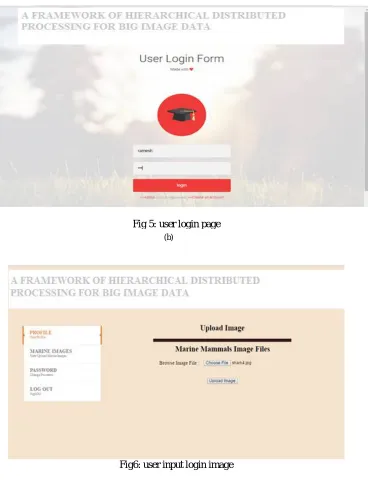
Fig 5: user login page
Fig6: user input login image
ISSN(Online): 2319-8753 ISSN (Print): 2347-6710
I
nternational
J
ournal of
I
nnovative
R
esearch in
S
cience,
E
ngineering and
T
echnology
(A High Impact Factor & UGC Approved Journal) Website: www.ijirset.com
Vol. 6, Issue 8, August 2017
Results with classification page:
Fig7: result classification page
In classification page it correctly classifies the marine images.
IV. CONCLUSION
.This system explains a compelling distributed processing structure names ICP planning to effectively process the extensive scale image information without bargaining the quality of the results. ICP consists of two sorts of processing components, i.e. SICP and DICP, to accomplish successful process on the static big image information and the dynamic info, individually. Depending upon two recently proposed strategies, significantly enhancing the time efficiency by using SICP to handle vast scale pictures put away in the appropriated structure when contrasted with conventional techniques upon single hub. If the upcoming images needed to be handled urgently, DICP takes into account quick reaction immediately to keep away from undetermined issues.
REFERENCES
[1] R. Hong, Y. Yang, M. Wang, X. Hua, “Learning Visual Semantic Relationships for Efficient Visual Retrieval,” IEEE Transactions on Big Data, vol.1, no.4, pp.152-161, 2015.
[2] K. Huang, C. Wang and D, Tao, “High-Order Topology Modeling of Visual Words for Image Classification,” IEEE Transactions on Image Processing, vol.24, no.11, pp.3598-3608, 2015.
[3] X. Tian, Y. Lu, N. Stender, L. Yang, D. Tao, “Exploration of Image Search Results Quality Assessment,” IEEE Transactions on Big Data, vol.1, no.3, pp.95-108, 2015.
[4] F. Wu, Z. Wang, Z. Zhang, Y. Yang, J. Luo, “Weakly Semi-Supervised Deep Learning for Multi-Label Image Annotation,” IEEE Transactions on Big Data, vol.1, no.3, pp.109-122, 2015.
[5] Y. Yang, F. Shen, H. T. Shen, H. Li, X. Li, “Robust Discrete Spectral Hashing for Large-Scale Image Semantic Indexing,” IEEE Transactions on Big Data, vol.1, no.4, pp.162-171, 2015.
[6] Y. C. Wang, C. C. Han, C. T. Hsieh, et al, “Biased Discriminant Analysis With Feature Line Embedding for Relevance Feedback Based Image Retrieval,” IEEE Transactions on Multimedia, vol.17, no.12, pp.2245-2258, 2015.
[7] J. S. Xu, Q.Wu, J. Zhang, F. Shen and Z. M. Tang, “Boosting Separability in Semi supervised Learning for Object Classification,” IEEE Trans. Circuits and Systems for Video Technology, vol.24, no.7, pp.1197 - 1208, 2014.
[8] L. Dong, J. Su and E. Izquierdo, “Scene-oriented Hierarchical Classification of Blurry and Noisy Images,” IEEE Trans. Circuits and Systems for Video Technology, vol.21, no.5, pp.2534-2545, 2012.
[9] L. Dong and E. Izquierdo, “A Biologically Inspired System for Classification of Natural Images,” IEEE Transactions on Image Processing, vol.17, no. 5, pp.590-603, 2007.