Genetic and Physical Interactions Between
DPB11
and
DDC1
in the Yeast
DNA Damage Response Pathway
Hong Wang* and Stephen J. Elledge*
,†,1*Verna and Marrs McLean Department of Biochemistry and Molecular Biology and Howard Hughes Medical Institute and †Department of Molecular and Human Genetics, Baylor College of Medicine, Houston, Texas 77030
Manuscript received October 2, 2001 Accepted for publication December 10, 2001
ABSTRACT
DPB11 is essential for DNA replication and S/M checkpoint control in Saccharomyces cerevisiae. The Dpb11 protein contains four BRCT domains, which have been proposed to be involved in protein-protein interactions. To further investigate the regulation and function of Dpb11, a yeast two-hybrid screen was carried out to identify proteins that physically interact with Dpb11. One positive clone isolated from the screen encoded a carboxyl-terminal fragment of Ddc1 (339–612 aa). Ddc1 is a DNA damage checkpoint protein, which, together with Mec3 and Rad17, has been proposed to form a PCNA-like complex and acts upstream in the DNA damage checkpoint pathways. We further determined that the carboxyl region of Dpb11 is required for its interaction with Ddc1.DDC1andDPB11also interact genetically. The⌬ddc1 dpb11-1double mutant is more UV and MMS sensitive than the ⌬ddc1 or thedpb11-1 single mutants. Furthermore, the double mutant is more hydroxyurea sensitive and displayed a lower restrictive tempera-ture than dpb11-1. These results suggest that DPB11 and DDC1 may function in the same or parallel pathways after DNA damage and thatDDC1may play a role in responding to replication defects.
I
N the budding yeast Saccharomyces cerevisiae, several Dpb11, also interacts with DNA polymerase ε (Maki-niemiet al.2001). DNA replication proteins have been shown to be
Dpb11 and its homologs containBRCA1carboxy-t er-essential for S/M checkpoint control, which inhibits
minal (BRCT) domains, a putative proteprotein in-mitotic entry before DNA replication during S-phase
teraction motif (Borket al.1997;Huytonet al.2000).
is completed (Elledge 1996;Lowndes andMurguia
BRCT domains have been identified in ⬎50 proteins
2000). InS. cerevisiae, the S/M checkpoint is assayed by
involved in DNA repair, recombination, or cell cycle examining the ability of cells to undergo anaphase-like
control. X-ray crystallography revealed the three-dimen-spindle elongation when DNA replication is blocked by
sional structure of the BRCT domain of XRCC1 as a hydroxyurea (HU). Pol2, the catalytic subunit of DNA
globular motif (Zhang et al. 1998). Accumulating
evi-polymerase II (ε), is required for the S/M checkpoint,
dence suggests that BRCT domains mediate homo/het-perhaps by acting as a sensor of DNA replication blocks
ero BRCT multimer formation, non-BRCT interactions, (Navaset al.1995). Dpb11 physically interacts with Pol2
and DNA end binding (Huytonet al.2000). For
exam-and is responsible for recruiting Pol2 to DNA replication
ple, XRCC1 forms a heterodimer via its BRCT domain
origins (Masumoto et al. 2000). Like Pol2, Dpb11 is
with DNA ligase III (Tayloret al.1998). Rad9, a DNA
also required for the S/M checkpoint (Arakiet al.1995;
damage checkpoint protein inS. cerevisiae, oligomerizes WangandElledge1999). Dpb11 associates with Drc1
after DNA damage through its BRCT domain (Soulier
(Sld2), another protein required for both DNA
replica-andLowndes1999). A yeast two-hybrid screen withS.
tion and S/M checkpoint control (Kamimuraet al.1998;
pombeCut5 led to the identification of the Crb2 protein, WangandElledge1999).
which is also a BRCT domain-containing checkpoint Dpb11 is an evolutionarily conserved protein. Cut5
protein (Sakaet al.1997). Recently, it has been shown inSchizosaccharomyces pombe (SakaandYanagida1993;
that TopBP1 interacts with the checkpoint protein Sakaet al.1994a,b), mus101 in Drosophila (Yamamoto
hRad9 through its BRCT domains (Makiniemi et al.
et al.2000), and human TopBP1 (Yamaneet al. 1997;
2001). YamaneandTsuruo1999;Makiniemiet al.2001) show
To fully understand the function of Dpb11 and to sequence and functional similarity to Dpb11. All of them
study the mechanism of the S/M checkpoint pathway, have been shown to be required for DNA replication
we carried out a yeast two-hybrid screen for proteins and with the exception of mus101 are also essential for
that physically interact with Dpb11. One of the putative the S/M checkpoint control. Moreover, TopBP1, like
Dpb11 interacting clones encoded the carboxyl termi-nus of a DNA damage checkpoint protein, Ddc1. We
focused our study on Ddc1 because theS. pombe
homo-1Corresponding author :T307, Baylor College of Medicine, 1 Baylor
Plaza, Houston, TX 77030. E-mail: [email protected] log of Dpb11, Cut5, was shown to be required for DNA
Yeast two-hybrid screen:The yeast two-hybrid screen was
damage checkpoint control (McFarlane et al. 1997;
performed as described (Baiand Elledge1997). Basically, Verkade andO’Connell1998). Therefore we wished
Y190 was sequentially transformed with pAS2-DPB11(pHW1)
to explore the potential role of Dpb11 in response to and aS. cerevisiaecDNA-GAL4 activation domain (AD) fusion
DNA damage in the context of DDC1. Moreover, the library. An estimatedⵑ1 million transformants were screened.
Yeast clones containing potential Dpb11 interacting proteins
function ofDDC1has been established to some extent.
were identified by growth on SC-Trp, Leu, His plates with
DDC1 belongs to the MEC3, RAD17, RAD24 epistasis
50 mm3-amino-1,2,4-triazole (3-AT) (A8056; Sigma, St. Louis)
group, which, together withRAD9, is proposed to act at
for HIS3 transcription. A total of 48 clones were obtained
the beginning of the DNA damage checkpoint pathways fromHIS3 selection and 12 of them also turned blue by X-gal
(Kondoet al.1999). However,⌬ddc1mutants are com- colony filter assay forLacZtranscription. To eliminate
false-positive clones, all the false-positive clones were transformed back
petent for the S/M checkpoint, although DDC1 is
re-into Y190 with either pAS2 empty vector or other bait plasmids
quired for slowing down DNA replication in the
pres-encoding Cdk2, Snf1, lamin, or p53, respectively (Baiand
ence of DNA damage (Longhese et al. 1997), also
Elledge1997). All of these combinations did not lead to the
known as the intra-S-phase checkpoint. Ddc1, Mec3, activation of either theHIS3orLacZreporter gene.
and Rad17 have been proposed to form a proliferating Construction of temperature-sensitive or HU-sensitive
dpb11mutants:pHW85 (pRS415-DPB11) was used as template
cell nuclear antigen (PCNA)-like complex. PCNA
func-to carry out the low-fidelity PCR reaction (WangandElledge
tions as the sliding clamp that tethers DNA polymerase
1999). Primers used in the mutagenesis PCR are as follows:
to its DNA template (Kondoet al.1999;Venclovasand
Dpb11-1-1, 5⬘-CTTCTATTTCTAGTATGGCAGG-3⬘(upstream of Thelen2000). On the basis of this structural similarity, DPB11 coding sequence); and Drc1-9, 5⬘-GTGAGTTACCTCA
it is proposed that the Ddc1-Mec3-Rad17 complex serves CTCATTAGGC-3⬘(pRS415 vector sequence;WangandElledge
1999). TheDPB11-mN library was generated by replacing the
as a structural mediator for initiation of checkpoint
sig-NdeI/PstI fragment of pHW85 (including the N-terminalⵑ770
naling and provides processivity for DNA repair proteins
bp ofDPB11) by the PCR products and theDPB11-mC library
(VenclovasandThelen2000).
was generated by replacing thePstI/SacI fragment of pHW85
We showed here that Ddc1 and Dpb11 not only physi- (including C-terminal ⵑ1.5 kb of Dpb11 coding sequence)
cally interact, but they also genetically interact with each by the PCR products.
The two libraries were screened in YHW186 as described
other. Thedpb11⌬ddc1double mutant is more sensitive
(WangandElledge1999). No temperature-sensitive mutants
to DNA damaging agents and DNA replication
inhibi-were isolated from theDPB11-mC library. Sevendpb11
temper-tors, suggesting that Dpb11 and Ddc1 might collaborate
ature-sensitive (ts) alleles, called pHW164 (dpb11-9), pHW165
in responding to DNA abnormalities. Deletion ofDDC1 (dpb11-13), pHW166 (dpb11-3), pHW167 (dpb11-2), pHW168
also lowers the restrictive temperature of thedpb11mu- (dpb11-11), pHW169 (dpb11-4), and pHW170 (dpb11-12), were
tant, implying thatDDC1is required for monitoring any isolated from theDPB11-mN library. Three of these were inte-grated into yeast strains, generating Y1198 (dpb11-2, ts at 34⬚),
DNA replication defects or DNA damage resulting from
Y1199 (dpb11-3, ts at 32⬚), and Y1200 (dpb11-4, ts at 30⬚). Four
dpb11mutation.
new HU-sensitive dpb11 alleles were isolated, two from the DPB11-mN library and two from theDPB11-mC library. They were named pHW160 (dpb11-5), pHW161 (dpb11-6), pHW 162 MATERIALS AND METHODS
(dpb11-7), and pHW163 (dpb11-8).
UV sensitivity measurement:Approximately 500 log-phase DNA plasmids: pHW1 (pAS2-DPB11) was constructed by
cells were spread on plates and then treated with different first engineering aNdeI site at the start codon ofDPB11and
doses of UV light. UV sensitivity was measured by counting then subcloning the entireDPB11coding sequence fromNdeI
the colonies formed after several days. (⫺3 bp) toSalI (2500 bp) into theNdeI/SalI site of the bait
vector, pAS2 (Bai and Elledge 1997). DPB11 coding se-quence was cloned into theSmaI/SacI site of pBAD98 (Desany
et al. 1998), generating pHW82 (pBAD98-DPB11). TheHin- RESULTS dIII/SacI fragment containing theDPB11coding region from
pHW82 was transferred to the HindIII/SacI site of pRS415 Dpb11 interacts with the C terminus of Ddc1:Dpb11
(Sikorski andHieter 1989), generating pHW84. The pro- contains four BRCT domains that are likely to mediate moter region ofDPB11, starting from a HindIII site (⫺680
protein-protein interactions. To explore possible
Dpb11-bp), was amplified by PCR and aNdeI site was engineered just
binding proteins, we carried out a yeast two-hybrid
at the start codon ofDPB11. The resulting PCR product was
screen for Dpb11. The bait plasmid, pAS2-DPB11, was
digested by HindIII andNdeI and cloned into the HindIII/
NdeI site of pHW84, generating pHW85 (pRS415-DPB11under constructed by fusing the entire Dpb11 protein to the
its own promoter). C terminus of the GAL4 DNA-binding (DB) domain.
Yeast strains:Yeast strains used in this study are isogenic
We first confirmed that the fusion protein encoded by
with the W303-derived Y300 strain. All derived strains were
pAS2-DPB11is properly expressed and functions as
wild-constructed using standard genetic crosses and are listed in
type Dpb11 because it could complement the growth
Table 1. Gene disruptions were performed by replacing one
copy of the target gene from a diploid wild-type genome with ofdpb11null cells (Figure 1A).
theHIS3 marker (Lorenzet al.1995) and the correct targeting A S. cerevisiae cDNA GAL4AD fusion library was events were confirmed by Southern blotting analysis. Y1187
screened. Twelve clones were isolated from an estimated
containing the hemagglutinin (HA)-tagged Ddc1 was
ob-ⵑ1 million transformants as positive for the reporter
tained by integratingPstI-cleaved pML119 (Longhese et al.
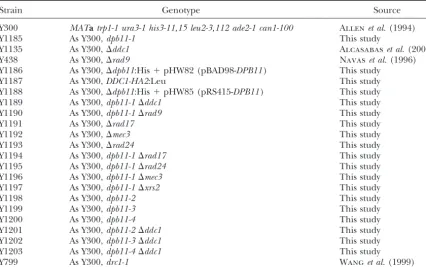
TABLE 1
Yeast strains used in this study
Strain Genotype Source
Y300 MATatrp1-1 ura3-1 his3-11,15 leu2-3,112 ade2-1 can1-100 Allenet al.(1994)
Y1185 As Y300,dpb11-1 This study
Y1135 As Y300,⌬ddc1 Alcasabaset al.(2001)
Y438 As Y300,⌬rad9 Navaset al.(1996)
Y1186 As Y300,⌬dpb11:His⫹pHW82 (pBAD98-DPB11) This study
Y1187 As Y300,DDC1-HA2:Leu This study
Y1188 As Y300,⌬dpb11:His⫹pHW85 (pRS415-DPB11) This study
Y1189 As Y300,dpb11-1⌬ddc1 This study
Y1190 As Y300,dpb11-1⌬rad9 This study
Y1191 As Y300,⌬rad17 This study
Y1192 As Y300,⌬mec3 This study
Y1193 As Y300,⌬rad24 This study
Y1194 As Y300,dpb11-1⌬rad17 This study
Y1195 As Y300,dpb11-1⌬rad24 This study
Y1196 As Y300,dpb11-1⌬mec3 This study
Y1197 As Y300,dpb11-1⌬xrs2 This study
Y1198 As Y300,dpb11-2 This study
Y1199 As Y300,dpb11-3 This study
Y1200 As Y300,dpb11-4 This study
Y1201 As Y300,dpb11-2⌬ddc1 This study
Y1202 As Y300,dpb11-3⌬ddc1 This study
Y1203 As Y300,dpb11-4⌬ddc1 This study
Y799 As Y300,drc1-1 Wanget al.(1999)
clones encoded the C-terminal 274 residues of Ddc1, but not GST, could bind HA-tagged Ddc1 from the yeast
extract (Figure 2A), indicating that Dpb11 interacts with named Ddc1-C (Figure 1B).
The C-terminal region of Dpb11 is responsible for Ddc1in vitro.
If Ddc1 physically interacts with Dpb11, we would its interaction with Ddc1: To identify the region of
Dpb11 that is responsible for its interaction with Ddc1, expect genetic interactions between them as well.
Therefore, we examined interactions between muta-two truncated forms of Dpb11 were fused to the
GAL4-DB domain. Each contains two BRCT domains and they tions ofDDC1andDPB11and other components of the
DPB11pathway. It has been shown that Dpb11 physically are named Dpb11-N [1–256 amino acids (aa)] and
Dpb11-C (251–764 aa), respectively (Figure 1C). By ex- interacts with Drc1, another DNA replication and S/M
checkpoint protein (Kamimura et al.1998;Wangand
amining the activation of the reporter genes, we found
that Dpb11-C, but not Dpb11-N, interacted with Ddc1. Elledge 1999). We observed that overexpression of
Ddc1 is toxic todrc1-1mutants and this toxicity can be Although no interaction between full-length Dpb11 and
Ddc1 could be detected, Dpb11-C interacts with both reversed when DPB11is co-overexpressed (Figure 2B).
The toxicity of overexpression of DDC1 is specific to
full-length Ddc1 and Ddc1-C. Interestingly, dpb11-1,
which encodes a C-terminal truncated protein (Kami- drc1-1cells.DDC1overexpression does not confer
toxic-ity in wild-type ordpb11-1cells (data not shown). Thus, mura et al. 1998), is also defective in interacting with
Ddc1. This result further supported the interpretation the toxicity is not general. A plausible explanation for
these observations is that Dpb11 interacts with both Ddc1 that the C terminus of Dpb11 is responsible for its
inter-action with Ddc1. and Drc1 and overexpressed Ddc1 competes with Drc1
for Dpb11, therefore resulting in toxicity in drc1-1. Co-Dpb11 and Ddc1 physically interact with each other
in vitro:To test if we could detect a physical association overexpression ofDPB11alleviates this competition and
relieves the toxicity.
between Dpb11 and Ddc1, we tried bothin vivoandin
vitromethods. We were unable to co-immunoprecipitate Genetic interactions betweenDPB11andDDC1:Ddc1 is essential for DNA damage checkpoint control and a
these proteins in vivo in untreated, methyl methane
sulfonate (MMS)-, or HU-treated cells. We reasoned ⌬ddc1mutant is very sensitive to UV irradiation (
Long-heseet al.1997).dpb11-1mutants have also been shown that their association might be too weak to survive
immu-noprecipitation conditions or it may occur on chromatin. to be slightly sensitive to UV (Araki et al. 1995). We
found that the⌬ddc1 dpb11double mutant is more UV
Thus we tested whether Dpb11 and Ddc1 interact with
each otherin vitro. An in vitroglutathione S-transferase and MMS sensitive than either single mutant (Figure
3A). To test ifDPB11andDDC1share some redundant
Figure2.—(A) Ddc1 interacts with Dpb11in vitro. GST or GST-Dpb11 was purified from baculovirus-infected insect cells using glutathione beads. Approximately 0.5 g of purified proteins bound on glutathione beads was incubated with 400g of yeast protein extract from Y1187 (DDC1-HA) at 4⬚ for 2 hr. Beads were washed and protein samples were analyzed by Western blotting. Ddc1 was detected using anti-HA antibod-ies. (B) Overexpression ofDDC1 indrc1-1 is toxic and this toxicity can be reversed by co-overexpression ofDPB11.drc1-1 (Y799) cells were transformed with vector alone or pGAL-DDC1 (pML109; Longhese et al. 1997). The transformants were grown on either glucose or galactose plates as indicated and incubated at 24⬚(top).drc1-1carrying pGAL-DDC1were transformed with pGAL-DPB11and the growth of the trans-formants was tested on either glucose or galactose plates as indicated (bottom).
Figure 1.—Dpb11 and Ddc1 interact with each other
through their C termini. (A) pAS2-DPB11, which encodes andDDC1function in the same or parallel pathways in the GAL4 DNA-binding domain-Dpb11 fusion protein, can
response to DNA damage.
suppress the lethality of ⌬dpb11. Y1186, a dpb11 null strain
Dpb11 is not essential for the DNA-damage-induced containing a pHW82 (pBAD98-DPB11, URA3) plasmid, was
transformed with pAS2 or pAS2-DPB11 and then streaked hyperphosphorylation of Ddc1:Ddc1 is
hyperphosphor-on SC-Trp or SC-Trp plates chyperphosphor-ontaining 5-fluoroorotic acid ylated after DNA damage in aMEC1-dependent manner (5-FOA). pAS2-DPB11could support this strain to grow on a (Longheseet al.1997;Paciottiet al.1998). To test if 5-FOA plate. (B) The C terminus of Ddc1 (339–612 aa)
inter-Dpb11 is required for the phosphorylation of Ddc1 after
acts with Dpb11 in the yeast two-hybrid system. Strain Y190
DNA damage, wild-type anddpb11-1cells were treated
carrying the plasmids encoding the bait and/or prey proteins
as indicated was incubated on SC-Trp, Leu, His plates con- with UV (50 J/m2), and then the extent of Ddc1 phos-taining 15 mm3-AT to test for activation of theHIS3reporter phorylation was examined by Western blot. However, and the colonies were also tested for LacZ transcription by
Ddc1 phosphorylation in dpb11-1mutants was not
re-X-gal assay. (C and D) The C-terminal region of Dpb11 is
duced compared to that in wild-type cells, suggesting
required for interaction with Ddc1. Strain Y190 was
trans-that Dpb11 is not essential for DNA damage-induced
formed with the constructs indicated in C. Protein-protein
interaction was assessed by the growth of transformants on Ddc1 phosphorylation and is not functioning upstream
15 mm3-AT and by X-gal assays. The results are listed in D. in that capacity (data not shown).
dpb11-1 mutants are proficient for the G2/M DNA
damage checkpoint: The genetic interaction between
DPB11andDDC1suggests that Dpb11 might play a role functions and might mutually suppress the defects of
in response to DNA damage. Pol2 has been shown to
each other, we overexpressedDPB11in⌬ddc1mutants
and vice versa. No suppression of the UV sensitivity of be important for the DNA damage checkpoint control
⌬ddc1was observed with overexpressedDPB11(data not in S-phase cells, while Rad9 mainly functions in cells
shown). WhenDDC1was overexpressed indpb11-1cells, outside of S-phase (Navas et al. 1996). It is possible
a partial suppression of the UV sensitivity of dpb11-1 that Dpb11 is also essential for DNA damage checkpoint
sitions after DNA damage could explain the UV sensitiv-ity ofdpb11-1in G2. To test this, wild-type,⌬ddc1, and
dpb11-1cells were arrested in G2 by nocodazole
treat-ment and shifted to 36⬚ for 30 min to inactivate the
dpb11-1mutant. Then, the cells were irradiated with UV and released at 36⬚. The percentage of cells that had one nucleus was counted to monitor the anaphase entry.
As reported previously (Longhese et al.1997), ⌬ddc1
is DNA damage checkpoint defective, asⵑ40% of cells
entered anaphase in the presence of DNA damage. In
contrast, dpb11-1 mutant cells behaved like wild-type
cells and maintained cell cycle arrest. Therefore, they are proficient for cell cycle arrest after DNA damage, and their UV-sensitivity phenotype during G2 is more likely to result from a DNA repair defect.
DDC1 plays a role in response to DNA replication defects: In experiments designed to examine genetic
interactions betweenDPB11andDDC1 in response to
S-phase stress, we observed that double mutants between
the DDC1 group of genes (DDC1,MEC3, and RAD17)
anddpb11-1are much more sensitive to HU than either
of the single mutants. In contrast to the DDC1group
of genes,⌬rad9 dpb11-1double mutants did not have a
dramatic additive HU-sensitive phenotype (Figure 5).
This observation suggested thatDDC1might play a role
in response to DNA replication defects.
In addition, mutations inDDC1lowered the restrictive
temperature ofdpb11-1(Figure 6), indicating that DNA
damage checkpoint or some aspect of Ddc1 function is required for the survival ofdpb11-1at higher
tempera-tures. Since DDC1has not been shown to be involved
in either DNA replication or the S/M checkpoint, it
is possible that the defects of dpb11-1 introduce DNA
damage during S-phase, which requires the DNA dam-age checkpoint response pathway. If this is the case, then proteins involved in DNA damage repair will also be required fordpb11-1’s survival. Double mutants
be-Figure3.—Genetic interactions betweenDPB11andDDC1.
(A)⌬ddc1 dpb11-1double mutants showed enhanced UV-sensi- tweendpb11 and⌬rad51or⌬xrs2, DNA damage repair
tive and MMS-sensitive phenotype. Log-phase (䉭) wild-type mutants, were constructed and observed for an exacer-(Y300), (䊊)⌬ddc1 (Y1135), (䊉) dpb11-1 (Y1185), and (䉱) bated phenotype. Thedpb11⌬xrs2double mutants did ⌬ddc1 dpb11-1(Y1189) cells were spread on YPD plates and
have a lower restrictive temperature thandpb11-1, but
UV irradiated at different doses. Viability was scored by
count-thedpb11 ⌬rad51mutants did not (Figure 6 and data
ing the colonies that grew up on the plates after 3 days at
24⬚(top). Log-phase wild-type (Y300), ⌬ddc1(Y1135),dpb11-1 not shown). However, in addition to its DNA damage
(Y1185), and⌬ddc1 dpb11-1(Y1189) cells were treated with repair function,XRS2has also been shown to be impor-0.01% MMS. Aliquots were withdrawn at the indicated times tant in some aspect of checkpoint control (D’Amours to test viability (bottom). (B) Overexpression ofDDC1slightly
andJackson2001;Grenonet al.2001;Usuiet al.2001).
suppresses the UV sensitivity ofdpb11-1cells. (䊉,䊊) Wild-type
Therefore, the genetic interactions we observed
be-(Y300), (䊏,䊐)dpb11-1(Y1185), and (䉱,䉭)⌬ddc1(Y1135) cells,
harboring either empty vector (solid) or GAL-DDC1(open), were tweenDPB11andXRS2might also be due to the
defec-cultured to log phase in galactose medium. Cells were spread tive checkpoint control inxrs2cells.
on SC-Ura, Gal plates and treated with different doses of UV Novel alleles ofDBP11reveal a linkage between DNA light and cell viability was determined as in A.
replication defects and S/M checkpoint defects: We wished to determine whether the genetic interactions
we observed betweendpb11-1and⌬ddc1 mutants were
or nocodazole-arresteddpb11-1cells were irradiated by UV
allele specific or reflected a general need for DDC1
light, they were still more sensitive to UV than to wild-type
function in response to an absence ofDPB11function.
cells (Figure 4A), suggesting that Dpb11 also functions
outside of S-phase. However, there was only one allele ofDBP11,dpb11-1,
which is both ts and HU sensitive. SinceDPB11functions
S. pombe Cut5 has been implicated in DNA damage
path-Figure4.—dpb11-1is proficient for the G2/M DNA damage checkpoint. (A) G1- and G2-arresteddpb11-1cells are UV sensitive.␣-factor or nocodazole-arrested wild-type (Y300) anddpb11-1 (Y1185) cells were cultured on YPD plates and UV irradiated at indicated doses. (B) Log-phase wild-type (Y300), dpb11-1 (Y1185), and ⌬ddc1 (Y1135) cells were arrested with 10g/ml noco-dazole and irradiated with 50 J/m2 UV. At the indicated times, the percentages of uninucleate large-budded cells were scored by 4⬘ ,6-diamidino-2-phenylindole staining.
ways in S. cerevisiae and the dpb11-1 allele is defective defective or DNA replication-defectivedpb11-1mutant
alleles, indicating that unlike Pol2, the DNA replication for both of these functions, it was unclear which of these
defects neededDDC1function. We thus carried out a function and S/M checkpoint function of Dpb11 are
unlikely to be separated by mutation. screen for additional dpb11 alleles, trying to separate
the two functions of Dpb11 by mutation. The genetic interactions between DPB11and DDC1
are not allele specific:With three new ts alleles available, We independently mutagenized the N terminus and
the C terminus of Dpb11 and the resulting mutagenized we then examined whether the genetic interactions
be-tween DPB11and DDC1are allele specific by crossing
libraries,DPB11-mN andDPB11-mC, were screened for
either ts or HU-sensitivedpb11mutants (seematerials dpb11-2,dpb11-3, and dpb11-4mutants with⌬ddc1
mu-tants. The resulting double mutants were each more and methods). Four HU-sensitive alleles were isolated
with similar HU sensitivity asdpb11-1; however, all were temperature sensitive than dpb11single mutants,
indi-cating that the interaction between these two genes is also ts (data not shown). Seven new ts alleles of dpb11
were isolated when theDPB11-mN library was used and not allele specific and reflects a general defect common
to eachdpb11 allele (Figure 6). all were HU sensitive. Three of them were integrated
into the genome. Interestingly, all three new ts alleles,
dpb11-2,dpb11-3, anddpb11-4, elongated their spindles
DISCUSSION
like dpb11-1 after 2 hr when cultured at 37⬚.
Further-more, all three mutants lost ⵑ90% viability after 4 hr Dpb11 is an essential gene that is required for both
DNA replication and S/M checkpoint controls (Araki
at 37⬚(data not shown). These results suggested that
they are also defective in the S/M checkpoint. et al. 1995; Wang and Elledge 1999). The fact that
we failed to separate these two functions of Dpb11 by
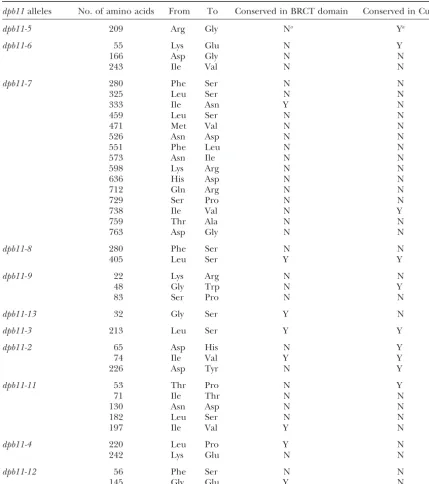
We mapped the mutation sites for all the dpb11-1
alleles we isolated (Table 2). However, no common resi- mutation strongly suggests that the two functions are
connected with each other. Our studies argue against dues were mutated in these mutants. Several of the
mutated amino acids are conserved residues in the the model that Dpb11 has two domains that have
sepa-rate and independent functions; instead, it is likely that BRCT domains and some are conserved between Dpb11
and Cut5. It is possible that the mutations at those sites the S/M checkpoint function of Dpb11 is directly linked
to its DNA replication function. In addition, as a number structurally interfere with the function of Dpb11.
Figure5.—Deletion ofDDC1,MEC3, andRAD17, but not RAD9, makesdpb11-1more HU sensitive. Cells of the indicated genotypes were cultured to log phase, and then 10-fold serial dilutions of cells were spotted onto either YPD plates or YPD with 0.1mHU and incubated at 24⬚for several days.
in initiation of DNA replication have S/M checkpoint defects when treated with HU, it is likely that the defi-ciency responsible for this is their defect in DNA replica-tion. One could envision a model in which fewer active replication forks give rise to a proportionally lower checkpoint signal. Once the level of DNA replication drops below the threshold needed to activate enough
Figure6.—DNA damage checkpoint genes and DNA
dam-Rad53 in response to HU to arrest the cell cycle, a age repair genes are required for the survival ofdpb11-1 at
checkpoint defect occurs. In this threshold model, these higher temperature. (A) Cells of the indicated genotypes were cultured to log phase, and then 10-fold serial dilutions of cells
initiator proteins would have only indirect roles in
trans-were spotted onto YPD plates and incubated at the indicated
ducing the replication stress signals.
temperatures. (B) Double mutants between⌬ddc1and
differ-Dpb11 contains four BRCT domains that are believed
entdpb11alleles are more temperature sensitive thandpb11
to be important for mediating protein-protein interac- single mutants.
tion. In an attempt to identify proteins that physically interact with Dpb11, we carried out a yeast two-hybrid
screen. One of the positive clones encodes the C termi- acts with Ddc1 in vitro, we speculate that the in vivo
nus of the DNA damage checkpoint protein Ddc1 interaction between Dpb11 and Ddc1 is normally
regu-(Longheseet al.1997). Ddc1 interacts with the C termi- lated and their interaction may occur only transiently
nus of Dpb11 containing the third and fourth BRCT under special circumstances, such as on chromatin at
repeats. Interestingly, thedpb11-1mutation, which en- a stalled replication fork.
codes a C-terminal truncated form of the Dpb11 pro- What is the significance of the interaction between
tein, is defective for the interaction with Ddc1, further Dpb11 and Ddc1? One possibility is thatDPB11plays a
supporting the notion that the C terminus of Dpb11 is role in response to DNA damage, where it utilizes Ddc1
important for its interaction with Ddc1. We failed to in some capacity.dpb11-1mutants are sensitive to various
detect an interaction between Dpb11 and Ddc1 by co- DNA damaging agents, such as UV and MMS, even
inter-TABLE 2
Mutation site-mapping results of the ts and HU-sensitivedpb11alleles
dpb11alleles No. of amino acids From To Conserved in BRCT domain Conserved in Cut5
dpb11-5 209 Arg Gly Na Ya
dpb11-6 55 Lys Glu N Y
166 Asp Gly N N
243 Ile Val N N
dpb11-7 280 Phe Ser N N
325 Leu Ser N N
333 Ile Asn Y N
459 Leu Ser N N
471 Met Val N N
526 Asn Asp N N
551 Phe Leu N N
573 Asn Ile N N
598 Lys Arg N N
636 His Asp N N
712 Gln Arg N N
729 Ser Pro N N
738 Ile Val N Y
759 Thr Ala N N
763 Asp Gly N N
dpb11-8 280 Phe Ser N N
405 Leu Ser Y Y
dpb11-9 22 Lys Arg N N
48 Gly Trp N Y
83 Ser Pro N N
dpb11-13 32 Gly Ser Y N
dpb11-3 213 Leu Ser Y Y
dpb11-2 65 Asp His N Y
74 Ile Val Y Y
226 Asp Tyr N Y
dpb11-11 53 Thr Pro N Y
71 Ile Thr N N
130 Asn Asp N N
182 Leu Ser N N
197 Ile Val Y N
dpb11-4 220 Leu Pro Y N
242 Lys Glu N N
dpb11-12 56 Phe Ser N N
145 Gly Glu Y N
aY, conserved; N, not conserved.
cycle arrest defects indpb11-1mutants after DNA dam- Our data and other published reports suggest that
Dpb11 might be involved in DNA repair. This is sup-age and there is no significant additive phenotype in
terms of activation of Rad53 phosphorylation indpb11-1 ported by several lines of evidence. First, Dpb11
physi-cally interacts with Pol2, the catalytic subunit of DNA
⌬ddc1 double mutants after DNA damage (data not
shown). These results indicate that Dpb11 is not essen- polymerase ε(Masumoto et al. 2000). Pol2 has been
shown to be involved in nucleotide excision repair, DNA
tial for DNA damage checkpoint signaling. TheS. pombe
homolog of Cut5 has been shown to be required for double-strand break repair, and other types of repair
(Wanget al.1993;Aboussekhraet al.1995;Buddand
DNA damage checkpoint signaling (McFarlane et al.
1997;Verkade andO’Connell1998). If DPB11plays Campbell 1995; Kramata et al. 1998; Holmes and
Haber 1999). Biochemical studies also indicate that a role in DNA damage checkpoint signaling, it is likely
to be minor and is unlikely to explain DBP11’s DNA Dpb11 is responsible for recruiting Pol2 to origins
dur-ing DNA replication (Masumoto et al.2000). Thus, it
is possible that Dpb11 collaborates with Pol2 during the checkpoint. However, shifting dpb11-1 mutant cells to the nonpermissive temperature does not result in a mo-DNA damage repair process or potentially recruits Pol2
to sites of damage. Second, our studies indicated strong bility shift of Rad53, Rad9, and Ddc1 proteins (data not
shown) that normally occurs when the DNA damage
genetic interactions betweenDPB11and DNA damage
checkpoint genes. Since thedpb11mutant appears pro- checkpoint is activated. This suggests that very little DNA
damage is generated indpb11 mutants at the
nonper-ficient for arresting the cell cycle after DNA damage,
dpb11-1’s DNA damage sensitivity suggests it is likely to missive temperature. However, we cannot rule out the
possibility that at intermediate temperatures indpb11
be involved in the damage repair process. Finally, it
has been shown that the human homolog of Dpb11, mutants, some DNA damage is made and requiresDDC1
-andRAD9-dependent checkpoint signaling for survival.
TopBP1, binds DNA breaks in vitro (Yamane and
Tsuruo 1999) and co-localizes with Brca1 after DNA In contrast, in the case of HU-induced DNA replica-tional stress, Ddc1 plays a role distinct from that of
damage in vivo (Makiniemi et al. 2001), suggesting a
role for TopBP1, and indirectly for Dpb11, in DNA Rad9. This role is more likely to be one of assisting
repair rather than controlling cell cycle arrest. repair. Interestingly, TopBP1 also physically interacts
with hRad9, the human homolog of Ddc1 (Makiniemi The models we have proposed are not mutually
exclu-sive; it is possible that they all partially reflect somein et al.2001). It has been proposed that after DNA
dam-age, the Ddc1/Mec3/Rad17 complex, in addition to vivosituations depending on cell cycle stages and
spe-cific environments. Our data have demonstrated impor-sensing the damage signal, might also recruit DNA
dam-age repair proteins to the sites of DNA damdam-age. There- tant physical and genetic interactions between Dpb11
and Ddc1. However, more detailed studies will be re-fore, given the finding that Ddc1 interacts with Dpb11,
it is possible that Dpb11 is one of the repair proteins quired to further understand the biochemical
signifi-cance of these interactions at the molecular level. that is recruited by Ddc1.
Another explanation for the Ddc1-Dpb11 interaction We thank H. Ariki, M.P. Longhese, and G. Lucchini for strains and is that Ddc1 might collaborate with Dpb11 in response plasmids. We thank members of the Elledge lab for comments, helpful discussion, and/or reagents. This work was supported by National to DNA replication defects. AlthoughDDC1is not
essen-Institutes of Health grant GM44664 (to S.J.E.). S.J.E is an Investigator tial for DNA replication, it was identified from a
syn-with the Howard Hughes Medical Institute and a Welch Professor of
thetic lethal screen with a primase subunit mutant, sug- Biochemistry.
gesting Ddc1 might have a role in monitoring DNA replication. Consistent with this model,⌬ddc1 dpb11-1
double mutants are much more HU sensitive than either
LITERATURE CITED
single mutant. This is true for other mutants in the
Aboussekhra, A., M. Biggerstaff, M. K. Shivji, J. A. Vilpo, V.
DDC1 epistasis group such as rad17, rad24, and mec3.
Moncollinet al., 1995 Mammalian DNA nucleotide excision
The need forDDC1could be explained if HU treatment repair reconstituted with purified protein components. Cell80: 859–868.
ofdpb11 mutants induced DNA damage and therefore
Alcasabas, A. A., A. J. Osborn, J. Bachant, F. Hu, P. J. H. Werler
requiredDDC1’s role in checkpoint control. However,
et al., 2001 Mrc1 transduces signals of DNA replication stress
rad9mutants, which are equally defective in DNA dam- to activate Rad53. Nat. Cell Biol.3:958–965.
Allen, J. B., Z. Zhou, W. Siede, E. C. FriedbergandS. J. Elledge,
age checkpoint control asddc1mutants, do not enhance
1994 The SAD1/RAD53 protein kinase controls multiple check-the HU sensitivity ofdpb11mutants, which suggests that
points and DNA damage-induced transcription in yeast. Genes
it is not the checkpoint function ofDDC1that is required Dev.8:2401–2415.
Araki, H., S. H. Leem, A. PhongdaraandA. Sugino, 1995 Dpb11,
for survival ofdpb11 mutants experiencing replication
which interacts with DNA polymerase II(epsilon) in Saccharo-stress. Instead these results argue that Ddc1 also plays
myces cerevisiae, has a dual role in S-phase progression and at a a role after DNA replication is compromised, and this cell cycle checkpoint. Proc. Natl. Acad. Sci. USA92:11791–11795.
Bai, C., andS. J. Elledge, 1997 Gene identification using the yeast
role is not related to cell cycle arrest. Therefore, we
two-hybrid system. Methods Enzymol.283:141–156.
suspect thatDDC1 is playing a role in some aspect of
Bork, P., K. Hofmann, P. Bucher, A. F. Neuwald, S. F. Altschul
repair at disrupted replication forks. The Ddc1-Mec3- et al., 1997 A superfamily of conserved domains in DNA damage-responsive cell cycle checkpoint proteins. FASEB J.11:68–76. Rad17 complex has previously been implicated in DNA
Budd, M. E., andJ. L. Campbell, 1995 DNA polymerases required
repair because rates of excision of DNA from telomere
for repair of UV-induced damage in Saccharomyces cerevisiae.
regions in cdc13 mutants are significantly reduced in Mol. Cell. Biol.15:2173–2179.
D’Amours, D., and S. P. Jackson, 2001 The yeast Xrs2 complex
mec3andrad17mutants (LydallandWeinert1995),
functions in S phase checkpoint regulation. Genes Dev.15:2238– suggesting they might recruit nucleases to telomeric
2249.
regions of DNA in the absence of Cdc13 function. Re- Desany, B. A., A. A. Alcasabas, J. B. BachantandS. J. Elledge, 1998 Recovery from DNA replicational stress is the essential cruitment of nucleases or other repair proteins such as
function of the S-phase checkpoint pathway. Genes Dev.12:2956– helicases could facilitate the repair of damaged
replica-2970.
tion forks. Elledge, S. J., 1996 Cell cycle checkpoints: preventing an identity
crisis. Science274:1664–1672. In contrast to the case of DNA replicational stress,
Grenon, M., C. Gilbertand N. F. Lowndes, 2001 Checkpoint
both DDC1andRAD9 are required for the survival of
activation in response to double-strand breaks requires the
dpb11 mutants at higher temperatures. This could be Mre11/Rad50/Xrs2 complex. Nat. Cell Biol.3:844–847.
Holmes, A. M., andJ. E. Haber, 1999 Double-strand break repair in
yeast requires both leading and lagging strand DNA polymerases. Saka, Y., P. Fantes, T. Sutani, C. McInerny, J. Creanoret al., 1994a Cell96:415–424. Fission yeast cut5 links nuclear chromatin and M phase regulator
Huyton, T., P. A. Bates, X. Zhang, M. J. Sternberg andP. S. in the replication checkpoint control. EMBO J.13:5319–5329.
Freemont, 2000 The BRCA1 C-terminal domain: structure and Saka, Y., P. Fantes andM. Yanagida, 1994b Coupling of DNA
function. Mutat. Res.460:319–332. replication and mitosis by fission yeast rad4/cut5. J. Cell Sci.18
Kamimura, Y., H. Masumoto, A. SuginoandH. Araki, 1998 Sld2, (Suppl.): 57–61.
which interacts with Dpb11 in Saccharomyces cerevisiae, is re- Saka, Y., F. Esashi, T. Matsusaka, S. MochidaandM. Yanagida, quired for chromosomal DNA replication. Mol. Cell. Biol. 18: 1997 Damage and replication checkpoint control in fission yeast 6102–6109. is ensured by interactions of Crb2, a protein with BRCT motif,
Kondo, T., K. MatsumotoandK. Sugimoto, 1999 Role of a com- with Cut5 and Chk1. Genes Dev.11:3387–3400.
plex containing Rad17, Mec3, and Ddc1 in the yeast DNA damage Sikorski, R. S., andP. Hieter, 1989 A system of shuttle vectors and checkpoint pathway. Mol. Cell. Biol.19:1136–1143. yeast host strains designed for efficient manipulation of DNA in
Kramata, P., K. M. DowneyandL. R. Paborsky, 1998 Incorpora- Saccharomyces cerevisiae. Genetics122:19–27.
tion and excision of 9-(2-phosphonylmethoxyethyl)guanine Soulier, J., andN. F. Lowndes, 1999 The BRCT domain of theS. (PMEG) by DNA polymerase delta and epsilon in vitro. J. Biol. cerevisiaecheckpoint protein Rad9 mediates a Rad9-Rad9 interac-Chem.273:21966–21971. tion after DNA damage. Curr. Biol.9:551–554.
Longhese, M. P., V. Paciotti, R. Fraschini, R. Zaccarini, P. Plev- Taylor, R. M., B. Wickstead, S. CroninandK. W. Caldecott, 1998
aniet al., 1997 The novel DNA damage checkpoint protein Role of a BRCT domain in the interaction of DNA ligase III-ddc1p is phosphorylated periodically during the cell cycle and alpha with the DNA repair protein XRCC1. Curr. Biol.8:877–880. in response to DNA damage in budding yeast. EMBO J.16: Usui, T., H. OgawaandJ. H. Petrini, 2001 A DNA damage
re-5216–5226. sponse pathway controlled by Tel1 and the Mre11 complex. Mol.
Lorenz, M. C., R. S. Muir, E. Lim, J. McElver, S. C. Weberet al.,
Cell7:1255–1266.
1995 Gene disruption with PCR products in Saccharomyces Venclovas, C., andM. P. Thelen, 2000 Structure-based predictions cerevisiae. Gene158:113–117.
of Rad1, Rad9, Hus1 and Rad17 participation in sliding clamp
Lowndes, N. F., andJ. R. Murguia, 2000 Sensing and responding
and clamp-loading complexes. Nucleic Acids Res.28:2481–2493. to DNA damage. Curr. Opin. Genet. Dev.10:17–25.
Verkade, H. M., andM. J. O’Connell, 1998 Cut5 is a component
Lydall, D., andT. Weinert, 1995 Yeast checkpoint genes in DNA
of the UV-responsive DNA damage checkpoint in fission yeast. damage processing: implications for repair and arrest. Science
Mol. Gen. Genet.260:426–433.
270:1488–1491.
Wang, H., and S. J. Elledge, 1999 DRC1, DNA replication and
Makiniemi, M., T. Hillukkala, J. Tuusa, K. Reini, M. Vaaraet al.,
checkpoint protein 1, functions with DPB11 to control DNA 2001 BRCT domain-containing protein TopBP1 functions in
replication and the S-phase checkpoint in Saccharomyces cerevis-DNA replication and damage response. J. Biol. Chem.6:6.
iae. Proc. Natl. Acad. Sci. USA96:3824–3829.
Masumoto, H., A. SuginoandH. Araki, 2000 Dpb11 controls the
Wang, Z., X. WuandE. C. Friedberg, 1993 DNA repair synthesis
association between DNA polymerases alpha and epsilon and the
during base excision repair in vitro is catalyzed by DNA polymer-autonomously replicating sequence region of budding yeast. Mol.
ase epsilon and is influenced by DNA polymerases alpha and Cell. Biol.20:2809–2817.
delta in Saccharomyces cerevisiae. Mol. Cell. Biol.13:1051–1058.
McFarlane, R. J., A. M. CarrandC. Price, 1997 Characterisation of
Yamamoto, R. R., J. M. Axton, Y. Yamamoto, R. D. Saunders, D. M.
the Schizosaccharomyces pombe rad4/cut5 mutant phenotypes:
Gloveret al., 2000 The Drosophila mus101 gene, which links
dissection of DNA replication and G2 checkpoint control
func-DNA repair, replication and condensation of heterochromatin tion. Mol. Gen. Genet.255:332–340.
in mitosis, encodes a protein with seven BRCA1 C-terminus
do-Navas, T. A., Z. ZhouandS. J. Elledge, 1995 DNA polymerase
mains. Genetics156:711–721. epsilon links the DNA replication machinery to the S phase
check-Yamane, K., and T. Tsuruo, 1999 Conserved BRCT regions of
point. Cell80:29–39.
TopBP1 and of the tumor suppressor BRCA1 bind strand breaks
Navas, T. A., Y. SanchezandS. J. Elledge, 1996 RAD9 and DNA
and termini of DNA. Oncogene18:5194–5203. polymerase epsilon form parallel sensory branches for
transduc-Yamane, K., M. KawabataandT. Tsuruo, 1997 A
DNA-topoisomer-ing the DNA damage checkpoint signal in Saccharomyces
cerevis-iae. Genes Dev.10:2632–2643. ase-II-binding protein with eight repeating regions similar to
Paciotti, V., G. Lucchini, P. PlevaniandM. P. Longhese, 1998 DNA-repair enzymes and to a cell-cycle regulator. Eur. J. Biochem.
Mec1p is essential for phosphorylation of the yeast DNA damage 250:794–799.
checkpoint protein ddc1p, which physically interacts with mec3p. Zhang, X., S. Morera, P. A. Bates, P. C. Whitehead, A. I. Coffer
EMBO J.17:4199–4209. et al., 1998 Structure of an XRCC1 BRCT domain: a new
protein-Saka, Y., andM. Yanagida, 1993 Fission yeast cut5⫹, required for protein interaction module. EMBO J.17:6404–6411.
S phase onset and M phase restraint, is identical to the