DOI: 10.1534/genetics.104.039024
Note
Kin Selection Is Implicated in Partial Sib-Mating Populations With
Constant Viability Differences Before Mating
Sabin Lessard
1De´partement de Mathe´matiques et de Statistique, Universite´ de Montre´al, Montreal, Quebec H3C 3J7, Canada Manuscript received November 29, 2004
Accepted for publication May 26, 2005
ABSTRACT
The change in the frequency of a rare mutant allele under constant sex-differentiated viability selection in an infinite, partial full-sib mating population is studied. The diplo-diploid and haplo-diploid polygynous models are considered with a Poisson distribution for the number of offspring produced by every mated female. Reproduction is followed by weak selection among the offspring and then mating to form the next generation. It is shown that the rate of change with respect to the frequency of the mutant allele and the intensity of selection can be expressed in terms of costs or benefits of substituting the mutant type for the wild type, which correspond to average excesses in viability in females and males, multiplied by coefficients of relatedness to the individuals affected by such a substitution and reproductive values associated to the sexes of these individuals. This reveals hidden interactions between mated individuals and between males for mating, the former having positive effects on the reproductive success of related individuals and the latter having negative effects. Such interactions are the result of reproductive constraints when a fixed proportion of females must mate with a male sib and all females are fertilized as long as one mate is available. However, they affect the change in allele frequency because there is inbreeding or relatedness between mates and more generally relatedness between interacting individuals. Surprisingly, the effects of these interactions cancel out in a diploid population when the number of offspring is large enough so that the possibility for a female to have no male sib to mate with can be neglected and the viability differences are the same in both sexes.
S
TUDYING the change in the frequency of an allele at one locus in a partial sib-mating population under weak viability selection, Pollak(1995) found adiscrep-ancy with the formula that is entailed by Wright’s (1942)
adaptive topography in the case of a partially inbred population that is close to equilibrium: the change ob-tained was actually given by Wright’s formula times one plus the correlation coefficient between the frequencies of the allele in mated individuals. Caballero(1996)
pointed out that Wright’s formula may not apply to Pollak’s model for the reason that it is a kind of fertility model with selection occurring after mating and showed that the formula should be fully valid if viability selection takes place before mating. Actually, with selection after mating, there is a kin selection effect (Hamilton1964)
due to the fact that mated individuals are related to one another and their reproductive success depends on the survival of both. This is the case even without interactions between kin affecting viability. The effects of such
interactions before or after mating with small differences among phenotypes or fitnesses were studied still recently (Lessardand Rocheleau2003, 2004) and led to the
introduction of generalized coefficients of relatedness conditional on the inbreeding state of the interacting individuals (extending coefficients proposed in Lessard
1992) to describe the underlying factors responsible for the change in allele frequency. But the results obtained did not actually challenge the validity of Wright’s for-mula when viability selection precedes mating, any kin selection effect seeming to disappear in the absence of interactions between related individuals affecting viabil-ity. In this model, however, differences in viability were assumed to be the same in both sexes. According to Uyenoyama(1984), sex-differentiated viabilities induce
multiplicative models even in the presence of inter-actions whose effects combine additively. The analysis of such models should require more intricate, and therefore less tractable, measures of relatedness (see,
e.g., Uyenoyamaand Feldman1982).
A sex-differentiated viability model without interac-tions between individuals affecting viability is consid-ered in this note. We also introduce stochastic variations 1Address for correspondence: De´partement de Mathe´matiques et de
Statistique, Universite´ de Montre´al, C.P. 6128, Succursale Centre-Ville, Montreal, QC H3C 3J7, Canada. E-mail: [email protected]
on the number of offspring. The first objective is to confirm that kin selection is at work when there is some level of inbreeding in the population even when selection precedes mating. The second objective is to understand how coefficients of relatedness come into play in such models and what exact factors can explain their presence. The partial full-sib mating model with single insemination of females and a number of off-spring following a Poisson distribution for diplo-diploid as well as haplo-diploid polygynous populations is used as an illustration but the conclusions should be extend-able to many other models.
MODEL AND RESULTS
Diplo-diploid population: We consider an infinite,
diploid population undergoing discrete, nonoverlap-ping generations and we assume viability selection before mating determined by two alleles at a single locus,A1andA2, such that the probability of surviving from conception to maturity associated to theAiAj geno-type isfij¼f(11uijs) in females andmij¼m(11vijs) in males, independently for all individuals. The parameter
s measures the intensity of selection. It is assumed throughout to be positive and small, which models weak selection.
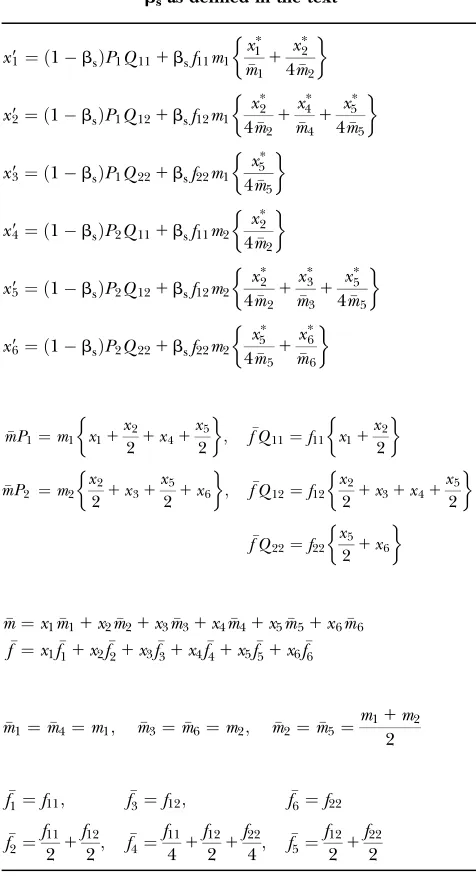
Following selection, every female mates with, and is inseminated once by, either a male chosen at random among its full-sibs with probabilitybor a male chosen at random among all males in the population at large with probability 1b. In the former case the female is said to be sib mated and in the latter randomly mated. Note that a female that has no male sib because none has been produced or has survived as a result of stochastic effects is assumed not to mate with probability b. To begin the next generation, every mated female pro-duces a random number of offspring that follows a Pois-son distribution of parameter 2l, the offspring being male or female with probability12independently of one another such that the numbers of male and female offspring are independent Poisson variables of meanl. Denoting byx1,x2,x3,x4,x5, andx6the frequencies of the mating types A1A13 A1A1,A1A1 3 A1A2, A1A1 3 A2A2, A1A2 3 A1A2, A1A2 3 A2A2, and A2A2 3 A2A2, respectively, in the current generation and assuming Mendelian segregation, the frequencies of the mating types in the next generation are given by the recurrence equations in Table 1.
Note that the expected contribution of a mated female in number of randomly mated female offspring is proportional to the mean viability of its female offspring, while this contribution in number of sib-mated female offspring is proportional to the mean viability of its female offspring times the probability that at least one male sib is produced and survives.
If the mated female is of type A1A2 3 A1A2, for instance, the numbers of its female and male offspring,
respectively, of genotypesA1A1,A1A2,A2A2, respectively, that survive to maturity are independent Poisson vari-ables of meansðl=4Þf11;ðl=2Þf12;ðl=4Þf22andðl=4Þm11;
ðl=2Þm12;ðl=4Þm22, respectively. Therefore, the number of its female offspring that mate with a random male in the population is a Poisson variable of meanð1bÞlf4, where f4¼1
4f11112f12114f22. On the other hand, the number of its female offspring that mate with a random sib is a Poisson variable of meanblf4 with probability
ð1elm4Þ and 0 with probability elm4, where m 4¼ 1
4m11112m12114m22. Moreover, given at least one mature male sib, such a sib chosen at random is of one of the genotypes A1A1,A1A2, A2A2with the probabilities
TABLE 1
Recurrence equations for the diplo-diploid model, with the notationx*
i ¼xið1elmiÞ=f*, and the quantitiesf*and bsas defined in the text
x91¼ ð1bsÞP11Q111bsf11m11 x* 1 m1 1 x * 2 4m2
1 x * 4 16m4
x92¼ ð1bsÞðP11Q121P12Q11Þ
1bsðf11m121f12m11Þ x*
2 4m2
1 x * 4 8m4
x93¼ ð1bsÞðP11Q221P22Q11Þ1bsðf11m221f22m11Þ x*
4 16m4
x94¼ ð1bsÞP12Q121bsf12m12 x*
2 4m2
1x * 3 m3 1 x * 4 4m4
1 x * 5 4m5
x95¼ ð1bsÞðP12Q221P22Q12Þ
1bsðf12m221f22m12Þ x*
4 8m4
1 x * 5 4m5
x96¼ ð1bsÞP22Q221bsf22m22 x*
4 16m4
1 x * 5 4m5
1x * 6 m6
mP11¼m11 x11
x2 21
x4 4
; f Q 11¼f11 x11
x2 21 x4 4
mP12¼m12
x2 21x31
x4 21
x5 2
; f Q 12¼f12
x2 21x31
x4 21 x5 2
mP22¼m22
x4 41
x5 21x6
; f Q 22¼f22
x4 41
x5 21x6
m¼x1m11x2m21x3m31x4m41x5m51x6m6
f ¼x1f11x2f21x3f31x4f41x5f51x6f6
m1¼m11; m3¼m12; m6¼m22
m2¼m11 2 1
m12 2 ; m4¼
m11 4 1
m12 2 1
m22 4 ; m5¼
m12 2 1
m22 2
f1¼f11; f3¼f12; f6¼f22
f2¼f11
2 1 f12
2; f4¼ f11
4 1 f12
2 1 f22
4; f5¼ f12
2 1 f22
ð1
4m11=m4Þ;ð 1
2m12=m4Þ;ð 1
4m22=m4Þ, respectively. (This is a
property of independent Poisson variables; see, e.g., Lemire and Lessard 1997 for a proof and another
application.) As a consequence, the mean number of
A1A1female offspring that mate with anA1A2male sib, for instance, is bðl=4Þf11ð1elm4Þ times ð12m12=m4Þ. The expected contributions of all other mating types in numbers of mated female offspring can be obtained in a similar way.
Observe that the proportion of sib-mated females in the next generation is
bs¼ bf
*
ð1bÞf1bf*; ð1Þ
where
f ¼x1f11 1x6f6 ð2Þ
and
f*¼x
1f1ð1elm1Þ1 1x6f6ð1elm6Þ; ð3Þ
withmi andfi being the mean viabilities of male and female offspring, respectively, produced by mated females of types labeled fromi¼1 toi¼6, respectively, as listed above. The proportionbsis less thanbsince a fraction of the female offspring do not have male sibs to mate with and it is frequency dependent unless there is no viability difference in males. In such a case, this proportion reduces to
b0¼bð1e lmÞ
1belm : ð4Þ
As l grows to infinity, bothbs and b0tend to b. The quantityb¼rb0, where
r ¼ lme lm
1elm; ð5Þ
also plays a role in the analysis. Actually, we have
b¼ blme lm
1belm; ð6Þ
and this can be interpreted as the rate of increase in the proportion of sib-mated female offspring produced by a mated female with respect to an increase in the viability of its male offspring.
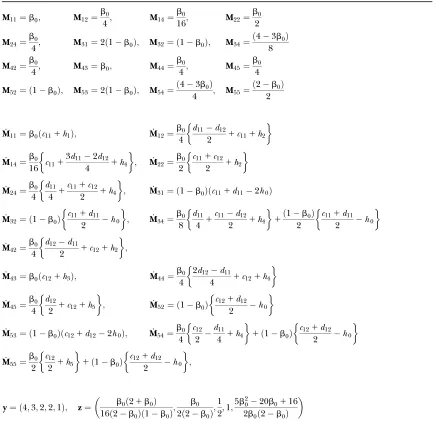
Assuming that alleleA1is a rare mutant, the frequen-ciesx1, x2, x3, x4, x5 are all close to 0 and their trans-formation from one generation to the next has a matrix of linear approximation whose value and derivative with respect tos evaluated at s ¼0, denoted by M andM˙, respectively, are given in Table 2. Observe that the matrix M is nonnegative and admits an eigenvalue 1 with associated left and right positive eigenvectors yand z, respectively, also given in Table 2. The entries ofyare proportional to the frequencies ofA1in the mating types
and the entries ofzare proportional to the frequencies of the mating types in the long run near the fixation state ofA2.
The frequency of allele A1, given by x1143x2112x31 1
2x4114x5, is represented by p. Its change from one generation to the next, after enough generations have passed and as long as A1remains rare and selection is weak, is approximated by the formula
DpLps; ð7Þ
where
L¼y TMz˙
yTz ; ð8Þ
with T denoting matrix transposition (see,e.g., Taylor
1985, 1989 for similar statements and Lessard and
Rocheleau2003 for a formal proof ). In this
approxi-mation, terms of order ps2or p2s as well as all smaller terms whenpandsare small are ignored. The quantityL
can be seen as a rate of change with respect to the frequency ofA1and the intensity of selection.
Using Table 2 and following tedious algebraic manip-ulations, the following expression,
L¼ f1 2RI/I1
1
2RI/IMgaðIÞ1f
1 2RJ/J
1
2RJ/SMgaðJÞ 1f1
2RJ/J1 1
2RJ/JMgbaðJÞ; ð9Þ
can be found, where
aðIÞ ¼Fðu11u22Þ1ð1FÞðu12u22Þ ð10Þ
and
aðJÞ ¼Fðv11v22Þ1ð1FÞðv12v22Þ; ð11Þ
with
F ¼ b0
43b0 ð12Þ
being the inbreeding coefficient under neutrality, that is, the probability that the two genes of an individual chosen at random in the population at equilibrium in the absence of selection (s¼0) are identical by descent (IBD). Moreover, we have
RI/I ¼RJ/J ¼1 ð13Þ
and
RI/IM¼RJ/SM¼RJ/JM¼ b0
2b0: ð14Þ
neutrality (Michodand Hamilton1980), which
corre-sponds in the case of the neutral partial full-sib mating model at hand to the expected fraction of genes inY
IBD to one or more genes inX independently of the event that the genes inXare IBD or not (Lessard1992).
On the other hand, the fraction 1
2 in front of these
coefficients in Equation 9 corresponds to the reproduc-tive value of the sex ofY(female ifIorJM, male ifJ,IM, or SM) in a neutral diplo-diploid population.
The quantities a(I) and a(J) multiplied by the in-tensity of selection give the average excesses in viability ofA1overA2in females and males, respectively, which are inbred with probabilityFand outbred with proba-bility 1F, when alleleA1is rare in the population, in
agreement with Fisher’s (1941) definition. They can be
interpreted as costs (if negative) or benefits (if positive) of substituting A1 for A2 in a female and a male, respectively, in a population fixed for alleleA2. An extra cost or benefit is given by ba(J) when there is some positive probability that no male sib is produced and survives, as a result of stochastic effects, to fertilize the females that must sib mate.
Haplo-diploid population:Assuming diploid females
and haploid males with viabilities fij¼ f(11uijs) and
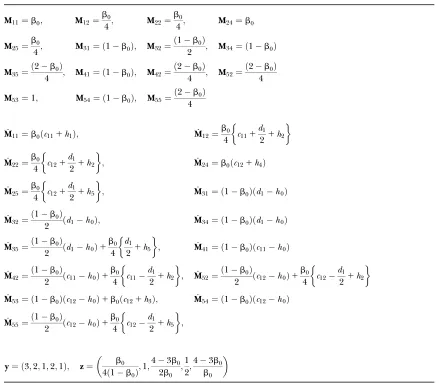
mi ¼ m(1 1 vis) for the genotypes AiAj and Ai, re-spectively, the recurrence equations for the frequencies of the mating typesA1A13 A1,A1A23 A1,A2A23 A1, A1A13A2,A1A23A2, andA2A23A2represented byx1, TABLE 2
Linear approximation of the transformation ofx1,x2,x3,x4,x5near 0 in the diplo-diploid model
M11¼b0; M12¼b0
4; M14¼
b0
16; M22¼
b0
2
M24¼b0
4; M31¼2ð1b0Þ; M32¼ ð1b0Þ; M34¼
ð43b0Þ
8
M42¼b0
4; M43¼b0; M44¼
b0
4; M45¼
b0
4
M52¼ ð1b0Þ; M53¼2ð1b0Þ; M54¼ð43b0Þ
4 ; M55¼
ð2b0Þ
2
˙
M11¼b0ðc111h1Þ; M12˙ ¼
b0
4
d11d12
2 1c111h2
˙ M14¼b0
16 c111
3d112d12 4 1h4
; M22˙ ¼b0
2
c111c12 2 1h2
˙ M24¼b0
4 d11
4 1 c111c12
2 1h4
; M31˙ ¼ ð1b0Þðc111d112h0Þ
˙
M32¼ ð1b0Þ c111d11
2 h0
; M34˙ ¼b0
8 d11
4 1
c11d12 2 1h4
1ð1b0Þ 2
c111d11 2 h0
˙ M42¼b0
4
d12d11
2 1c121h2
;
˙
M43¼b0ðc121h3Þ; M44˙ ¼
b0
4
2d12d11
4 1c121h4
˙ M45¼b0
4 d12
2 1c121h5
; M52˙ ¼ ð1b0Þ c121d12
2 h0
˙
M53¼ ð1b0Þðc121d122h0Þ; M54˙ ¼
b0
4 c12
2 d11
4 1h4
1ð1b0Þ c121d12
2 h0
˙ M55¼b0
2 c12
2 1h5
1ð1b0Þ c121d12
2 h0
;
y¼ ð4;3;2;2;1Þ; z¼ b0ð21b0Þ
16ð2b0Þð1b0Þ;
b0
2ð2b0Þ;
1 2;1;
5b2
020b0116 2b0ð2b0Þ
Nonnull entries are shown of the matrixMand its derivativeM˙ and left and right positive eigenvectors,yand z, associated to the eigenvalue 1 ofM, using the notationcij ¼uij u22,dij ¼vij v22, hi¼rvih0 with
x2,x3,x4,x5, andx6, respectively, are given in Table 3. This time, we find
L¼ 2 3RI/I1
1 3RI/IM
aðIÞ1 1 3RJ/J
1 3RJ/SM
aðJÞ
1 1
3RJ/J123RJ/JM
baðJÞ ð15Þ
(see Table 4), with the same definitions and expressions as previously for all coefficients but
aðJÞ ¼v1v2 ð16Þ
and
RJ/SM¼
b0ð2b0Þ
ð43b0Þ
; RJ/JM¼ b0 43b0
: ð17Þ
With 2 3 and
1
3 being the reproductive values of
fe-males (the sex ofIandJM) and males (the sex ofJ,IM, and SM), respectively, in a neutral haplo-diploid pop-ulation, the rateLfor a haplo-diploid population given in Equation 15 has the same structure as the rate given in Equation 9 for a diplo-diploid population.
INTERPRETATION AND DISCUSSION
The rate of change in the frequency of a rare mutant allele in a partial full-sib mating population under weak sex-differentiated viability selection taking place before mating reveals interactions between individuals affect-ing reproductive success even in the absence of inter-actions affecting viability. Actually, an increase in the viability of males or females increases the reproductive fitness of their mates, but such an increase in males also decreases the reproductive fitness of other males. This explains the signs, positive or negative, of the different factors in Equation 9 and Equation 15. The first effect is due to the assumption that all females that survive are fertilized as long as one mate is available, and the second is due to the ancillary fact that the males are in com-petition to fertilize the females. With partial full-sib mating, a fixed proportion of females are constrained to sib mate, which creates mate competition between male sibs if some are produced and survive. Moreover, the females are related to their mates, which is responsible for inbreeding, and the males are related to competitors for mating. As a result, any excess in viability in females or males carrying the rare mutant allele, which corre-sponds to a benefit if positive or a cost if negative, is increased or decreased by an additive factor given by some coefficient of relatedness to the individual af-fected by such an excess times the total reproductive value associated to the sex of that individual. Then, we are in a framework of kin selection (Hamilton 1964;
see also Hamilton1972 for haplo-diploid populations)
and it is revealed by sex differences in viability both in diplo-diploid and in haplo-diploid models.
When the number of offspring produced per mated female is small, the actual proportion of female off-spring that sib mate is determined not only by the probability of having to mate with a male sib but also by the probability of having at least one male sib to mate with, and this uncertainty has an effect on the repro-ductive success of males and also indirectly on the re-productive success of their mates. When the number of offspring becomes large, this stochastic effect disappears but not the kin selection effects caused by inbreeding and local mate competition unless the population is diploid and the viability differences are the same in both sexes. It might be for the same reason that kin selec-tion effects are not apparent in partial selfing models (Lessardand Rocheleau2003).
The interactions between mates have an effect on the allelic frequencies because there is inbreeding, while TABLE 3
Recurrence equations for the haplo-diploid model, with the notationxi*¼xið1elmiÞ=f*, and the quantitiesf*and
bsas defined in the text
x91¼ ð1bsÞP1Q111bsf11m1 x*
1
m1 1 x
* 2 4m2
x92¼ ð1bsÞP1Q121bsf12m1 x * 2 4m2
1x * 4
m4 1 x
* 5 4m5
x93¼ ð1bsÞP1Q221bsf22m1 x*
5 4m5
x94¼ ð1bsÞP2Q111bsf11m2 x*
2 4m2
x95¼ ð1bsÞP2Q121bsf12m2 x * 2 4m2
1x * 3
m3 1 x
* 5 4m5
x96¼ ð1bsÞP2Q221bsf22m2 x*
5 4m5
1x * 6
m6
mP1¼m1 x11
x2 21x41
x5 2
; f Q 11¼f11 x11
x2 2
mP2 ¼m2
x2 21x31
x5 21x6
; f Q 12¼f12
x2
21x31x41
x5 2
f Q22¼f22
x5 21x6
m¼x1m11x2m21x3m31x4m41x5m51x6m6
f ¼x1f11x2f21x3f31x4f41x5f51x6f6
m1¼m4¼m1; m3¼m6¼m2; m2¼m5¼ m11m2
2
f1¼f11; f3¼f12; f6¼f22
f2¼f11
2 1 f12
2; f4¼ f11
4 1 f12
2 1 f22
4; f5¼ f12
2 1 f22
related males interact because there is local mate com-petition. Each one of these factors was put forward to explain biased sex ratios in partial sib-mating popula-tions and more generally in structured populapopula-tions
(Hamilton 1967; Maynard Smith and Stenseth
1978; see,e.g., Karlinand Lessard1986 and references
therein). Our results enlighten the exact role of these factors in the change of allele frequencies at least in partial full-sib mating populations. Moreover, we have made some specific assumptions such as polygyny and single insemination. However, it is expected that the conclusions can be adapted to other models with dif-ferent mating assumptions and constraints. Allowing multiple insemination, for instance, might remove competition between males, while allowing a female to mate with a male in the population at large when no male sib is available might remove stochastic effects entailed by a small number of offspring. Nevertheless,
kin selection should be at work in a very wide range of models but be apparent only when there is some asymmetry between the sexes.
The coefficient of relatedness between the interacting individuals that comes into play in our analysis is the expected fraction of genes in the affected individual that are IBD to one or more genes in the affecting individual as originally proposed by Hamilton(1964)
(see,e.g., Michodand Hamilton1980 for more general
definitions) even if the effects of the interactions on reproductive success are nota prioriadditive and there is inbreeding in the population. But we have to remind ourselves that selection is assumed to be weak and that the linear approximation used under this assumption is tantamount to an additive model. Moreover, in partial full-sib mating populations, the coefficient of relat-edness of an individual to another turns out not to depend on whether the individual is inbred or outbred TABLE 4
Linear approximation of the transformation ofx1,x2,x3,x4,x5near 0 in the haplo-diploid model
M11¼b0; M12¼b0
4; M22¼
b0
4; M24¼b0
M25¼b0
4; M31¼ ð1b0Þ; M32¼
ð1b0Þ
2 ; M34¼ ð1b0Þ
M35¼ð2b0Þ
4 ; M41¼ ð1b0Þ; M42¼
ð2b0Þ
4 ; M52¼
ð2b0Þ
4
M53¼1; M54¼ ð1b0Þ; M55¼ð2b0Þ 4
˙
M11¼b0ðc111h1Þ; M12˙ ¼
b0
4 c111 d1
21h2
˙ M22¼b0
4 c121 d1
21h2
; M24˙ ¼b0ðc121h4Þ
˙ M25¼b0
4 c121 d1
21h5
; M31˙ ¼ ð1b0Þðd1h0Þ
˙
M32¼ð1b0Þ
2 ðd1h0Þ; M34˙ ¼ ð1b0Þðd1h0Þ
˙
M35¼ð1b0Þ
2 ðd1h0Þ1
b0
4 d1
21h5
; M41˙ ¼ ð1b0Þðc11h0Þ
˙
M42¼ð1b0Þ
2 ðc11h0Þ1
b0
4 c11 d1
21h2
; M52˙ ¼ð1b0Þ
2 ðc12h0Þ1
b0
4 c12 d1
21h2
˙
M53¼ ð1b0Þðc12h0Þ1b0ðc121h3Þ; M54˙ ¼ ð1b0Þðc12h0Þ
˙
M55¼ð1b0Þ
2 ðc12h0Þ1
b0
4 c12 d1
21h5
;
y¼ ð3;2;1;2;1Þ; z¼ b0
4ð1b0Þ;1;
43b0
2b0 ;
1 2;
43b0 b0
Nonnull entries are shown of the matrix M and its derivativeM˙ and left and right positive eigenvectors,yand z, associated to the eigenvalue 1 of M, using the notationcij ¼ uij u22, d1 ¼ v1 v2, hi¼rvih0, with
(Lessard1992). This is not generally the case in
struc-tured populations (Rocheleau2003), for which we may
have to resort to generalized coefficients of relatedness. Finally, we have focused on the change in the frequency of a rare mutant allele in an infinite pop-ulation for which approximations have been previously established (Lessardand Rocheleau2003). It might
be interesting to extend the analysis to the case of a mutant allele that has reached any frequency and even to the case of a finite population using related approx-imations as in Caballeroand Hill(1992) and Roze
and Rousset(2004).
I thank two anonymous referees for their comments on a previous version of this manuscript and one of them in particular for suggesting to look at the effect of a finite number of offspring. This research was supported in part by the National Sciences and Engineering Research Council of Canada.
LITERATURE CITED
Caballero, A., 1996 A note on the change in gene frequency of a
selected allele in partial full-sib mating populations. Genetics
142:649–650.
Caballero, A., and W. G. Hill, 1992 Effects of partial inbreeding
on fixation rates and variation of mutant genes. Genetics131:
493–507.
Fisher, R. A., 1941 Average excess and average effect of a gene
substitution. Ann. Eugen.11:53–63.
Hamilton, W. D., 1964 The genetical evolution of social behaviour,
I and II. J. Theor. Biol.7:1–52.
Hamilton, W. D., 1967 Extraordinary sex ratios. Science 156:
477–488.
Hamilton, W. D., 1972 Altruism and related phenomena, mainly in
social insects. Ann. Rev. Ecol. Syst.3:193–232.
Karlin, S., and S. Lessard, 1986 Theoretical Studies on Sex Ratio
Evolution.Princeton University Press, Princeton, NJ.
Lemire, M., and S. Lessard, 1997 On the non-existence of an
opti-mal migration rate. J. Math. Biol.35:657–682.
Lessard, S., 1992 Relatedness and inclusive fitness with inbreeding.
Theor. Popul. Biol.42:284–307.
Lessard, S., and G. Rocheleau, 2003 Change in frequency of a rare
mutant allele: a general formula and applications to partial inbreeding models. J. Math. Biol.46:71–94.
Lessard, S., and G. Rocheleau, 2004 Kin selection and coefficients
of relatedness in family-structured populations with inbreeding. Theor. Popul. Biol.66:287–306.
MaynardSmith, J., and N. C. Stenseth, 1978 On the evolutionary
stability of the female-biased sex ratio in the wood lemming (Myopus Schisticolor): the effect of inbreeding. Heredity 41:
205–214.
Michod, R. E., and W. D. Hamilton, 1980 Coefficients of
related-ness in sociobiology. Nature288:694–697.
Pollak, E., 1995 Some effects of selection when there is partial
full-sib mating. Genetics139:439–444.
Rocheleau, G., 2003 Effets de la consanguinite´ dans des mode`les
de se´lection pour des populations structure´es en familles. Ph.D. Thesis, Universite´ de Montre´al, Montre´al.
Roze, D., and F. Rousset, 2004 The robustness of Hamilton’s rule
with inbreeding and dominance: kin selection and fixation prob-abilities under partial sib mating. Am. Nat.164:214–231. Taylor, P., 1985 A general mathematical model for sex allocation.
J. Theor. Biol.112:799–818.
Taylor, P., 1989 Evolutionary stability in one-parameter models
under weak selection. Theor. Popul. Biol.36:125–143. Uyenoyama, M. K., 1984 Inbreeding and the evolution of altruism
under kin selection: effects on relatedness and group structure. Evolution38:778–795.
Uyenoyama, M. K., and M. W. Feldman, 1982 Population genetic
theory of kin selection. II. The multiplicative model. Am. Nat.
120:614–627.
Wright, S., 1942 Statistical genetics and evolution. Bull. Am. Math.
Soc.48:223–246.