ABSTRACT
STRAIN, ERROL ALAN. Plant Molecular Evolution. (Under the direction of Spencer Muse.)
The current dissertation looks at the molecular evolution of protein-coding genes in the flowering plant Arabidopsis thaliana and within two RNA viruses,
human-immunodeficiency virus (HIV) and Astroviridae.
We analyzed members of the receptor-like kinase (RLK) gene family in Arabidopsis thaliana for positive selection. Likelihood analysis found evidence for positive selection in 12 of the 52 RLK family sequences groups. These 12 groups represent 97 of the 403 sequences analyzed. The majority of genes in groups subject to positive selection have not been functionally characterized, but sites under selection are predominantly located in the extracellular region.
In HIV we use Akaike Information Criteria (AIC) based model averaging for models of nucleotide evolution to examine estimates of genetic distance and the ratio of transition/transversion (ts/tv). AIC weighted estimates of distance and ts/tv were shown to be robust relative to model assumptions. AIC weighted estimates of the ts/tv ratio in simulated HIV sequences generally had less variance than similar estimates made by selecting the single best scoring AIC model.
Plant Molecular Evolution by
Errol Alan Strain
A dissertation submitted to the Graduate Faculty of North Carolina State University
In partial fulfillment of the Requirements for the degree of
Doctor of Philosophy Bioinformatics
Raleigh, NC 2006 Approved by:
_____Spencer Muse_____ ______Jeff Thorne ____ Chair of Advisory Committee
___Michael Purugannan__ __Willaim Atchley____
BIOGRAPHY
CONTENTS
LIST OF TABLES……….v
LIST OF FIGURES……….………..vi
Chapter 1 Introduction and Background Material……… 1
Foreword………... 1
Chapter Overview ……… 1
Methodological Overview……… 3
Sequence Alignment………. 4
Likelihood………. 5
Models of Sequence Evolution………. 7
Distance Estimation………. 10
Rate Variation………... 12
Positive Selection………. 13
Model Averaging………. 14
Arabidopsis……….. 15
HIV……….. 16
Astroviridae ……….… 17
References……… 19
Chapter 2 Positive Selection in Arabidopsis RLK gene family………….. 24
Abstract……… 25
Introduction……….. 26
Materials and Methods……….… 29
Discussion………...…….…. 32
References………... 38
Appendices……… 44
Chapter 3 AIC Weighted Nucleotide Model Averaging………... 50
Abstract……….……… 51
Introduction……….………..… 52
Materials and Methods……….. 54
Results and Discussion………. 58
References………. 64
Appendices……… 68
Chapter 4 Molecular Evolution of Turkey Type-2 Astrovirus………. 77
Abstract……….… 78
Introduction………...…… 79
Materials and Methods………...….….. 80
Results……….. 82
Conclusions……….. 88
References……… 91
Appendices……….. 96
Chapter 5 Overview and General Discussion……….. 103
LIST OF TABLE Chapter 2
Table 1. Percentage of groups with best AIC score for each model………. 44
Table 2. Groups exhibiting positive selection ……….. 44
Chapter 3 Table 1. Best scoring AIC (BAIC) models……….. 68
Chapter 4. Table 1. Names and abbreviations for TAstV-2 isolates………. 96
Table 2. Codon models from Yang et al. 2000……… 96
Table 3. Pairwise similarities for TAstV-2 isolates………. 97
LIST OF FIGURES Chapter 1
Figure 1. Nucleotide Rate Matrices……….. 8
Chapter 2 Figure 1. Hierarchy of Models……… 45
Figure 2. NJ tree of Arabidopsis RLK sequence groups……….. 46
Figure 3a. Location and posterior probability of positively selected sites... 47
Figure 3b. Location and posterior probability of positively selected sites... 48
Figure 4. Sites under positive selection in LRR regions……….. 49
Chapter 3 Figure 1. Rate matrices……… 69
Figure 2. Best scoring AIC (BAIC) models in HIV1……….. 70
Figure 3. Best scoring AIC (BAIC) models in HIV2……….. 71
Figure 4. Bias, SD, and RMSE for genetic distance in HIV2………. 72
Figure 5. Bias, SD, and RMSE for ts/tv ratio in HIV2……… 73
Figure 6. RMSE for ts/tv ratio………. 74
Chapter 3 Supplementary Figures Figure 1. Bias, SD, and RMSE for genetic distance in HIV1 ……….. 75
Figure 2. Bias, SD, and RMSE for ts/tv ratio in HIV2……… 76
Chapter 4 Figure 1. NJ tree for astrovirus capsids……….. 99
Figure 2. NJ trees for TAstV-2 isolates……….. 100
CHAPTER 1 Foreword
This dissertation presents three studies of molecular evolution. Chapter 1 provides a general review of the statistical methods used estimate parameters in evolutionary models and a review of the biology for the three model organisms. Chapter 2 focuses on identifying positive selection in subfamilies within the large RLK gene family of Arabidopsis (published in JME, 2005, 61:325–332). Analysis of HIV1 and HIV2 sequences in chapter 3 looks at the effect of nucleotide model averaging on estimating substitution rates (manuscript in
preparation for JME). Chapter 4 gives a description of genomic sequence divergence within novel turkey astrovirus isolates using both nucleotide and codon models of evolution
(manuscript in preparation for Virus Research). The chapters are written in paper format with introductory material for the specific study given at the beginning of each chapter. Figures and tables are located either in the chapter text or in the appendix of the referring chapter.
Chapter Overviews
Molecular evolution has been defined as the synthesis of population genetics and molecular biology (Li 1997), and studies in the field of molecular evolution look at change in biomolecules over time. Population genetics theory describes the dynamics of genetic
protein-coding sequences within individual species. We want to understand how sequences are evolutionarily related and then use this information to make inferences about gene function. Similar approaches are also used to study evolutionary relationships between different species but those types of comparisons are not the focus of the current research.
The biological motivation for studying molecular evolution in the Arabidopsis RLK family is to try to understand how positive selection may affect sequence divergence of duplicated genes in a large gene family. The RLK family is too diverged for a gene length alignment to include every sequence, so we create a set of more closely related subfamily groupings that we use to test for selection. Differences in selective pressure among codons in RLK subfamily members may correspond to functional divergence of the proteins. Chapter 2 describes evidence for positive selection in several different RLK subfamilies and proposes putative functions for these genes.
The analysis of HIV in chapter 3 differs from the Arabidopsis and Astroviridae analyses in its focus on the forms of models for sequence evolution rather than parameter estimates resulting from application of the models. We want to look at how AIC model averaged estimates of genetic distance and the transition/transversion ratio compare to estimates from individual models. Previous studies have shown than phylogenetic estimates of tree topology and branch lengths can change depending upon the model of sequence evolution used for the analysis (eg Sullivan and Swofford 1997). Since model averaged estimates are derived from several different models they may be less susceptible to errors resulting from choosing either an overly simplistic or complex model. The results in chapter 3 show that estimates of genetic distance are relatively good whether they were made using model averaging or single model approaches. Model averaged estimates of the
transition/transversion ratio have less variance than estimates from a single model, indicating that model averaging may be more accurately recovering the underlying nucleotide
substitution rates.
Methodological Overview
Although studies of Arabidopsis, HIV and Astroviridae in chapters 2, 3 and 4 are focused on different biological questions, they do share some common methods for data analysis. In each study the first step is to align the sequences so that we can estimate pairwise distances and construct phylogenetic trees. Maximum likelihood is then used to estimate branch lengths and substitution rate parameters on the tree according to some model of sequence evolution. Inferences about gene function may be based on evolutionary
Background information in the following sections provides details on core methods used for analysis and includes sequence alignment, likelihood, models of sequence evolution, distance estimation, site-to-site rate variation, positive selection, AIC model averaging, Arabidopsis, HIV, and Astroviridae.
Sequence Alignment
Studies in the following chapters primarily look at sequence divergence in protein coding genes. Prior to making inferences about substitution rates and phylogenetic relationships the sequences must first be aligned, either at the nucleotide level for closely related sequences or using protein alignments for more diverged genes. Multiple gene alignments are made using CLUSTALX (Thompson et al. 1997). The alignment algorithm involves calculating a pairwise distance matrix, building a guide tree based on pairwise distances, and then progressively aligning sequences based on the topology of the tree. The CLUSTALX algorithm follows the basic form of the Feng-Doolittle (1987) algorithm for progressive alignment. Pairwise distances are calculated from a dynamic programming alignment of each sequence pair using some match/mismatch/gap scoring scheme.
CLUSTALX goes a step further and uses the alignment score to approximate an evolutionary distance in terms of substitutions per site. In the Feng-Doolittle algorithm a tree is then made using the Fitch-Margoliash (1967) method while CLUSTALX builds a tree using the
neighbor-joining (NJ) approach of Saitou and Nei (1987). Sequences are then added to the alignment starting with closely related sequences and working towards more distant ones. Output from CLUSTALX is examined manually and spurious alignments are edited by hand.
1996) and DIALIGN (Morgenstern 2004). The results of these different alignment methods on different standard datasets are available on the BAliBASE website (bips.ustrasbg.fr/fr/ Products /Databases/BAliBASE). While DIALIGN is superior for multiple local alignments, CLUSTAL performed well on the standard datasets of globally related sequences. The full length receptor-like kinase alignments within the subfamily groupings were global length alignments and CLUSTAL was appropriate for these datasets.
Likelihood
Estimates for parameters in evolutionary models are made using the method of maximum likelihood (ML). Given an aligned dataset (D) from above we maximize the probability of the data given a model for evolution and a phylogenetic tree (T). The accuracy of the tree is determined by the accuracy of the alignment. The likelihood function is
Prob( | , ) L= D θ T ,
where θ is the vector of parameters in the model of sequence evolution. The vector θ will
include parameters for: frequencies of nucleotides, codons, or amino acids; substitution rates; branch lengths; and for variation in substitution rates. The topology of tree T is estimated using the NJ algorithm with pairwise distances calculated according to one of the standard models of sequence evolution. More detailed descriptions of the specific parameters in θ
and the standard models are provided in the models of sequence evolution section. If computation time were not an issue then we could exhaustively examine all tree topologies and pick the tree that maximizes the likelihood of the data. On a personal
to be robust to minor inaccuracies in topologies (Yang et al. 1995). ML was used to estimate genomic and gene trees in chapter 4 and the topologies were either identical to NJ or had slight differences in branch points for two of the viral isolates (MN and PA). Since the NJ and ML astrovirus trees are similar and ML methods of phylogenetic construction are not common in the astrovirus community these trees are not included in the current manuscript.
We also assume that sites in a gene and all lineages in the tree are evolving independently, otherwise it is very hard to compute the probability for substitution state changes in the tree. Violation of the independence assumption can cause ML and other tree reconstruction methods to fail. Causes for dependence between sites include secondary structure in the RNA, physiochemical interactions between peptide residues, and
recombination. Unfortunately, relaxing the independence assumption for sites leads to an exponential increase in the number of states along a branch. For example, an independent nucleotide model has a 4x4 state matrix, dinucleotide models have 16x16, and in the case of dependence between all nucleotides in sequences of length N the matrix is 4Nx4N.
Accounting for dependence between lineages is also computationally expensive since we cannot decompose the probability of the tree into terms representing state changes along a branch. So, assuming independence of sites and branches, the likelihood function now becomes the product of the individual site likelihoods,
( )
1
Prob( | , ) N
i i
L D θ T
=
=
∏
,where D(i) is the data at the ith site in an alignment of length N.
likelihood (Lk) at each node (k) based on the likelihood of the descendant nodes (l and m).
Working back from the tips of a bifurcating tree we calculate the likelihood at each site,
( )i ( ) Prob( | , , ) ( )i ( ) Prob( | , , ) ( )i ( )
k l l m m
x y
L s =⎜⎛ x sθ t L x ⎞⎟⎛⎜ y sθ t L y ⎞⎟
⎝
∑
⎠⎝∑
⎠,where s is the state at the node, x and y are the states of the descendant nodes, and t is the branch length to the respective descendants. Probabilities at the descendant nodes are computed by summing over all possible states. In a 4x4 model of DNA evolution these states are either A, C, G, or T.
Models of Sequence Evolution
Sequence divergence is defined by the observed number of differences between sites in an aligned column in the set of sequences. Depending upon the question addressed in a particular study and level of divergence in the dataset we formally characterize divergence using some nucleotide, codon, or amino acid model of evolution. If we are interested in describing relatively ancient evolutionary relationships then protein sequence is conserved over longer periods of time than the underlying nucleotide sequence, and we should use an aligned set of amino acids. Similarly, evolutionary analysis of proteins would have little power to resolve recent divergence if the substitutions are synonymous and it would be more appropriate to use nucleotide sequence. The models of sequence evolution used in the current studies characterize divergence using either nucleotide or amino acid point substitutions. While other mutational processes, such as insertion, deletion, and
recombination also play a major role in sequence divergence and evolutionπi, those events
Nucleotide models usually have four states, representing four different nucleic acid bases. In DNA these bases are adenine (A), cytosine (C), guanine (G), and thymine (T) while RNA has A, C, G, and uracil (U). The models have different ways of accounting for changes between states and in allowing for different base frequencies. Most common models assume a Markov process of substitution events where rates and nucleotide frequencies are stationary over time and where the changes are reversible. Reversibility implies that the probability of starting with base i and going to base j in time t, ( | , )πiP j i t , is the same as
starting with base j and going to base i in time t, πjP i j t( | , ). Jukes-Cantor (1969) is the
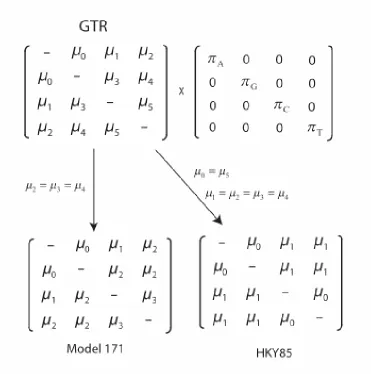
simplest model and has a single substitution rate and equal base frequencies. The F81 (Felsenstein 1981) model has a single substitution rate but relaxes the constraint of equal base frequencies. HKY85 (Hasegawa et al. 1985) has two substitution rates, one for transitions (A↔G and C↔T) and another for transversions (A↔C, A↔T, C↔G, and
G↔T). Figure 1 shows the parameterization for several common nucleotide models.
0 1 2
0 3 4
3 5 1 4 5 2 * * * *
C G T
A G T
C T A C G A C G A T A C G T µ π µ π µ π µ π µ π µ π µ π µ π µ π µ π µ π µ π
Figure 1. Rate matrix (R) showing instantaneous rates of change for nucleotide
models. πn is the frequency of nucleotide type n and µ is the reversible substitution
rate. Jukes-Cantor has µ0=µ1=µ2=µ3=µ4=µ5 and all π=0.25, Kimura's 2-paramter has
µ1=µ4, µ0=µ2=µ3=µ5 and all π=0.25, and HKY85 has µ1=µ4, µ0=µ2=µ3=µ5 and free π.
By exponentiating the rate matrix (R) from figure 1 we can compute the transition probability matrix (P) for a given amount of time (t) with
( ) Rt
P t =e .
Transitions in this context are simply a generic term for changes between states in a model and not necessarily transition substitution events in nucleotides.
While the 4x4 nucleotide models are appropriate for many evolutionary studies, they assume that all sites in a codon are evolving are the same rate. Empirical evidence shows that the first two positions of codon are more conserved than the third. Codon models, such as MG94 (Muse and Gaut 1994) and GY94 (Goldman and Yang 1994), allow for different nucleotide substitution rates at different positions in the codon. The MG and GY codon models have the form
0, if j and k differ at 2 nucleotide positions , if j to k is a synonymous change
, if j to k is a nonsynonymous change jk k k q απ βπ ≥ ⎧ ⎪ = ⎨ ⎪ ⎩
where qjkis the instantaneous rate at which a site goes from codon j to codon k, πk is the
frequency of the target nucleotide in MG94 and frequency of the target codon in GY94, α is
the rate of synonymous substitutions, and β is the rate of non-synonymous substitutions. The
MG94 and GY94 models only allow for one nucleotide substitution per instantaneous
Models for protein evolution, unlike the nucleotide and codon models, are often empirically derived. The PAM (Point Accepted Mutations) matrices of Dayhoff et al. (1978) and Jones-Taylor-Thorton (1992), and the BLOSUM matrices of Henikoff and Henikoff (1992) use sets of aligned proteins to calculate inferred substitution matrices. The different matrices are usually named according to percent identity of the aligned proteins. For
example, BLOSUM 62 refers to a matrix made from ungapped, local protein alignments with at least 62% identity. Amino acid matrices are often used for identifying homologous
proteins or conserved domains within proteins. Widely used search tools such as BLAST (Altschul et al. 1990) rely on matrices such as BLOSUM and PAM to find evolutionary related sequences.
Distance Estimation
Given a set of aligned sequences and a model for sequence evolution we can estimate the genetic distance between sequences. For the analyses of molecular evolution in this study we define genetic distance as the expected number of substitutions per site. Distance (d) is given by the sum of the product of time (t), nucleotide frequencies (π), and the
diagonals of substitution rate matrix (R) from figure 1:
4
1
i ii i
d t π R
=
= −
∑
We want to find the estimates for substitution rates (µ) in R that maximize the likelihood of
the observed data. In the case of two aligned sequences, an ancestral sequence a and descendant b, we find the value of ut that maximizes the likelihood
1
Prob( | , ) i
N
a i i
i
L π b a ut
=
where N is the length of the sequences, ai is the state at position i in sequence a, bi is the state
at position i in sequence b, and i
a
π
is the frequency of the state observed at ai. Thetransition probabilities come from matrix P in the models of sequence evolution section. Now that we have the ML estimates of the substitutions rates for the rate matrix R and time, the ML estimate of distance is
4
1
ˆ ˆ ˆ
i ii i
d t π R
=
= −
∑
.Extending this same idea to a tree involves summing over all possible states at interior nodes since ancestral sequences are generally not available. Closed-form solutions exist for
distance in some of the simpler standard models, such as Jukes-Cantor (JC) and Kimura-2-parameter (1980).
Deriving the JC distance for the two sequence case we start with the probability of nucleotide j going to a different nucleotide k in time t, given substitution rateµ, is
1 1 P ( )
4 4 jk
t
t = − e−µ .
The probability of observing a substitution event that changes the nucleotide at site i to one of the other 3 bases can be described using a Bernoulli distribution,
1
( ) (3 ( )) (1 3x ( )) x
jk jk
P X =x = P t − P t − ,
where x=0 if nucleotides ai and bi are the same and x=1 if they are different. Extending this to sequences of length N, the probability of observing x sites with differences follows a binomial distribution with
( ) (3 ( )) (1 3x ( ))N x
jk jk
N
P X x P t P t
x
−
⎛ ⎞
= =⎜ ⎟ −
where x=0,1,2,….N. We are interested in finding the value of t that maximizes this
probability. Solving the equation is easier if we transform to log space and the ln likelihood is now written as
3 3 1 3
ln ln ln ( ) ln
4 4 4 4
t t
N
L x e N x e
x µ µ − − ⎛ ⎞ ⎛ ⎞ ⎛ ⎞ = ⎜ ⎟+ ⎜ − ⎟+ − ⎜ + ⎟ ⎝ ⎠ ⎝ ⎠ ⎝ ⎠ .
Differentiating with respect to time (t) the dropping the constant terms we get
-
-ln x( ) (N x)( )
3 3 1 3
4 4 4 4
t t
t t
d L e e
dt e e µ µ µ µ − − − − = + − + .
Unfortunately substitution rates and time are confounded, so we must estimate the combined parameter µt, which is
l ln 1 4 3 x t N µ = − ⎛⎜ − ⎞⎟ ⎝ ⎠,
where x/N is the fraction of sites that differ between two sequences. Putting the µlt into the
rate matrix (R) from figure 1 we can then sum the diagonal elements to estimate distance (d) in terms of substitutions per site, where
m
4
1
3 4 x
ˆ ln 1
4 3 N
ii i
d π R
=
⎛ ⎞
= − = − ⎜ − ⎟
⎝ ⎠
∑
.A description of distance estimation for nucleotide models of evolution is also provided in chapter 3. Distance estimation under codon and amino acid models is the same as the nucleotide case except rate matrices are bigger and computation is more difficult. Rate Variation
sequence evolution described in the previous section only allow for one substitution rate across sites, a more biologically realistic model would allow for rate heterogeneity across sites. Methods developed to account for rate variation draw rates from either a continuous distribution (Uzzell and Corbin 1971; Yang 1993) or from discrete categories (Yang 1994; Wakely 1993). Fitting a continuous distribution to datasets with more than a few sequences requires extensive computation and most current applications use some form of rate
categories. In the current dissertation we account for rate variation using either discrete categories or the method of Yang (1994). The likelihood of the aligned dataset for a given topology is now computed by summing over K different rate classes,
( ) ( ) 1 ( ) K i i k k k
L w L µ
=
=
∑
,where wk is the weight, or frequency, of the rate class and L(i)(µk) is the likelihood of site i
given that the rate is µk. If all rate classes have an equal weight then each wk is 1/K. The
analysis of Arabidopsis RLKs allows codon substitution rates to vary according to a discretized beta distribution (Yang 1994).
Positive Selection
One possible cause of rate heterogeneity in proteins is that different sites may be under different selective pressures. We can use the codon models to compare selective pressure across sites by looking at the ratio of rate of synonymous (α) to non-synonymous
(β) substitutions (eg. Hughes and Nei 1988; Nielsen and Yang 1998). The ratio (β/α) is often
termed ω, with ω<1 indicating purifying selection, ω=1 for neutral substitutions, and ω>1 indicating diversifying selection (reviewed in Yang et al. 2000). The term positive selection
differs from population genetics where diversifying selection is where a relatively large number of alleles of a gene are maintained in a population (cf Hartl and Clark 1997).
Prior to analyses of positive selection, careful consideration should be given to the biological question being addressed and the sequences included in the aligned dataset. In the Arabidopsis RLK gene family we describe sequence divergence within sets of paralogous genes, while the analysis of turkey astrovirus looks at divergence in same gene from different viral isolates. One reasonable interpretation of positive selection in duplicated RLK genes is that we are identifying sites that are diverging in function and possibly involved in some type host-pathogen interaction. Positive selection in the turkey astrovirus capsid gene may be indicative of selection at an antigenic epitope, with changes across isolates being the result of an adaptive immune response to astroviral infection. While the studies of selection presented here look at genes involved in host-pathogen interactions, evidence for positive selection has also been seen genes involved in reproduction, dietary adaptation, sensory systems, and behavior (reviewed in Yang and Bielawski 2000).
Model Averaging
Chapter 3 compares model averaged estimates of genetic distance and the
transition/transversion ratio to estimates from single models. Model averaging approaches use multiple models to make inferences and avoid some of the drawbacks associated with choosing an incorrect model, such as incorrectly inferring tree topologies (Sullivan et al. 1995) and rate parameters (Wakeley 1994). Detailed information on model averaging using the Akaike Information Criteria (AIC) (Akaike 1974) is provided in chapter 3 and the topic is reviewed in the book by Burnham and Anderson (2002). Following the notation of Burnham
1 ˆ K k k k w θ θ = =
∑
,where wk is the weight of model k and θˆkis the estimate from model k. Models that fit the
data well will have high weights and models that fit poorly will have low weights. The weights are computed based on scores for either AIC, small sample AICc, quasi-likelihood
AIC (QAIC and QAICc), or the Bayesian Information Criteria (BIC) (reviewed in Burnham
and Anderson 2002). Weights are based on the differences between the scores from each individual model, Sk, and the best model, Sbest,
k Sk Sbest ∆ = − ,
where ∆k is the weight of model k. For AIC, the weight of model k in a set containing K
models is given by
1 1 exp 2 1 2 k k K i i w = ⎛− ∆ ⎞ ⎜ ⎟ ⎝ ⎠ = ⎛− ∆ ⎞ ⎜ ⎟ ⎝ ⎠
∑
.model averaging and conclude that Bayesian methods are more precise as long as the assumptions of the model are not violated. If model assumptions are not satisfied then AIC model averaging is more accurate.
Arabidopsis
The process of gene duplication and divergence in large plant multigene families is not well understood. New gene family members may arise from local duplications or through an increase in ploidy. The subsequent divergence of these duplicated genes can be influenced by many factors, including positive selection, neutral mutations, ectopic
expression and speciation events. Looking at phylogenetic relationships and rates of sequence change between gene family members may provide insight into why duplicated genes are retained and how they diverge in function (eg. Gaut and Doyle 2000). Previous approaches of the molecular evolution of plant genes families have described origins of new family members, presence of positive selection, heterogeneous substitution rates, divergence times, and the evolution of genome organization (reviewed in Wolfe and Li 2003).
Chapter 2 describes an analysis of positive selection in the receptor-like kinase (RLK) gene family of Arabidopsis. Although Arabidopsis is not of major agronomic importance, the availability of complete genomic sequence along with physical and genetic maps makes it feasible to identify and analyze members of large gene families. Background information on functions of RLK family members is provided in the introduction to chapter 2.
HIV
followed by the release of the viral RNA genome into the cytoplasm. The three largest open reading frames in HIV contain the gag, pol, and env products. At least six other genes have also been found in HIV (Korber et al 2005) but are not discussed here since they were not analyzed in the nucleotide model averaging study. The HIV gag gene encodes multiple protein products, including the viral capsid. The reading frame for HIV pol overlaps the gag gene and frameshifts during the transcription of gag produce a concatenated message that is translated into a GAG-POL polylprotein. POL is a RNA dependent DNA polymerase (RdDp) that synthesizes double stranded (ds) DNA from the positive, messenger sense RNA genome. The dsDNA is then transported to the nucleus where the viral integrase joins the viral dsDNA to host genomic DNA, resulting in a provirus. The HIV env encodes highly glycosylated proteins associated with the viral envelope (Fenouillet et al. 1989). The analysis of HIV in chapter 3 looks at estimates of nucleotide substitution rates across the entire genome, and separately in the gag and env genes. AIC model selection has previously been used to look at nucleotide model choice in HIV (Huelsenbeck 2004; Muse 1999) and these studies are discussed in chapter 3.
Astroviridae
Astroviridae are small, round RNA viruses (SRVs) that can infect birds and
disease is the lack of a small animal model for astrovirus. Identifying similarities or
differences in the molecular evolution of human and turkey astrovirus will give insight into the appropriateness of turkey as a model for the disease.
Astroviral genomes are composed of single stranded, messenger sense RNA
approximately 7kb in length with three overlapping open reading frames (ORFs) designated ORF1a, ORF1b, and ORF2. ORF1a and ORF1b are translated as a polyprotein with ORF1a containing a serine-protease and 1b containing an RNA-dependent RNA polymerase (RdRp). The presence of a heptameric ribosomal frameshifting site between 1a and 1b is a
distinguishing characteristic absent in other SRVs such as Calcinoviridae and Picornavirdae (Jiang et al. 1993). ORF2 encodes the capsid precursor (≈90kD), which is progressively
cleaved into 25-35kD units that make up the viral capsid (Matsui and Greenberg 1996). Another interesting feature of ORF2 is that it exists as both genomic and subgenomic RNA(Lewis et al. 1994). Subgenomic RNAs have been observed in other viruses
REFERENCES
Akaike H (1974) “A new look at the statistical model identification” IEEE Trans. Automat. Contrl., AC-19, No. 6, 716-723.
Alfaro ME, Huelsenbeck JP (2006). Comparative performance of Bayesian and AIC-based measures of phylogenetic model uncertainty Syst Biol. Feb;55(1):89-96.
Altschul SF, Gish W, Miller W, Myers EW, Lipman DJ (1990) Basic local alignment search tool. J Mol Biol. Oct 5;215(3):403-10.
Burnham KP, Anderson DR (2002) Model selection and multimodel inference: a practical information-theoretic approach. New York: Springer
Dayhoff, M. O., R. M. Schwartz and B. C. Orcutt. (1978) A model of evolutionary change in proteins. In Atlas of Protein Sequence and Structure Vol. 5 suppl. 2 (ed. M.O.
Dayhoff), pp. 345-352. National Biomedical Research Foundation, Washington DC. Felsenstein J (1981) Evolutionary trees from DNA-sequences—a maximum-likelihood
approach. J. Mol. Evol. 17:368–376
Fenouillet E, Clerget-Raslain B, Gluckman JC, Guetard D, Montagnier L, Bahraoui E. (1989) Role of N-linked glycans in the interaction between the envelope glycoprotein of human immunodeficiency virus and its CD4 cellular receptor. Structural enzymatic analysis. J Exp Med. 1989 Mar 1;169(3):807-22.
Fitch WM and Margoliash E (1967) Construction of phylogenetic trees, Science, 155, 279-284
Fitch WM and Markowitz E (1970) An improved method for determining codon variability in a gene and its application to the rate of fixation of mutations in evolution.
Gaut BS and Doyle JJ (2000) Evolution of genes and taxa: a primer. Plant Molecular Biology 42:1-23
Green P (1995) Reversible jump Markov chain Monte Carlo computation and Bayesian model determination, Biometrika, 82, 711-732
Goldman N and Yang Z (1994) A codon-based model of nucleotide substitution for protein-coding DNA sequences. Molecular Biology and Evolution 11:725-736.
Gotoh (1996) Significant improvement in accuracy of multiple protein-sequence alignments by iterative refinement as assessed by reference to structural alignments. J. Mol. Biol. 264, 823-838
Hasegawa, M., H. Kishino, and T. Yano (1985) Dating of the human-ape splitting by a molecular clock of mitchondrial DNA. J. Mol. Evol. 22:160-174.
Henikoff, S. and J. G. Henikoff (1992) Amino acid substitution matrices from protein blocks. Proc. Natl. Acad. Sci. USA 89:10915-10919
Huelsenbeck, J. P. (1995). The robustness of two phylogenetic methods: Four-taxon
simulations reveal a slight superiority of maximum likelihood over neighbor joining. Molecular Biology and Evolution 12(5):843-849
Huelsenbeck, J. P., B. Larget, and M. E. Alfaro (2004) Bayesian phylogenetic model
selection using reversible jump Markov chain monte carlo. Mol. Biol. Evol. 21:1123-1133
Jiang B, Monroe SS, Koonin EV, Stine SE, Glass RI (1993) RNA sequence of astrovirus: distinctive genomic organization and a putative retrovirus-like ribosomal
Jones, D. T., W. R. Taylor, and J. M. Thornton (1992) The rapid generation of mutation data matrices from protein sequences. Comput. Appl. Biosci. 8:275-282
Jukes, T. H. and C. Cantor (1969) Evolution of protein molecules. pp. 21-132 in Mammalian Protein Metabolism, ed. M. N. Munro. Academic Press, New York.
Kimura, M (1980) A simple model for estimating evolutionary rates of base substitutions through comparative studies of nucleotide sequences. J. Mol. Evol. 16:111-120. Koci, M. D., Seal, B. S., and Schultz-Cherry, S. (2000). Molecular Characterization of an
Avian Astrovirus. J Virol 74(13), 6173-6177
Korber B, Brander C, Haynes BF, Koup R, Moore JP, Walker BD, and Watkins DI. (2005) HIV Molecular Immunology 2005, Publisher: Los Alamos National Laboratory, Theoretical Biology and Biophysics, Los Alamos, New Mexico.
Lewis, T.L., Greenberg, H.B., Herrmann, J.E., Smith, L.S. and Matsui, S.M. (1994). Analysis of astrovirus serotype 1 RNA, identification of the viral RNA-dependent RNA
polymerase motif, and expression of a viral structural protein. J. Virol. 68: 77-83 Li, Wen Hsiung (1997) Molecular Evolution Sinauer Associates Sunderland
Matsui, SM; Greenberg, HM (1996) Astroviruses, In: Fields Virology, Third Edition. Fields, BN; Knipe, DM; Howley, PM (eds.). Raven Press, Ltd., New York, pp. 811-824. Morgenstern B. (2004) DIALIGN: Multiple DNA and Protein Sequence Alignment at
BiBiServ. Nucleic Acids Research 32, W33-W36
Muse, S. V. (1995) Evolutionary analyses of DNA sequences subject to constraints on secondary structure. Genetics, 139:1429-1439.
Muse SV and Gaut BS (1994) A likelihood approach for comparing synonymous and non-synonymous nucleotide substitution rates with application to the chloroplast genome. Mol. Biol. Evol. 11
Nei, M. and T. Gojobori. (1986). Simple methods for estimating the numbers of synonymous and nonsynonymous nucleotide substitutions. Mol. Biol. Evol. 3 418-426:715-724. Nielsen, R., and Z. Yang. (1998). Likelihood models for detecting positively selected amino
acid sites and applications to the HIV-1 envelope gene. Genetics, 148: 929-936. Notredam C and Higgins DG (1996) SAGA: Sequence Alignment by Genetic Algorithm.
Nuc. Acids. Res. 24, 1515 – 1524
Saitou N and Nei M (1987). The neighbour-joining method: a new method for reconstructing phylogenetic trees. Mol. Biol. Evol. 4:406-425.
Sattentau QJ, Dalgleish AG, Weiss RA, Beverley PC. (1986) Epitopes of the CD4 antigen and HIV infection. Science. Nov 28;234(4780):1120-
Schlesinger, S. and Schlesinger, M.J. (1996) Replication of Togaviridae in FIELDS VIROLOGY, 3rd Ed Lipincott - Raven Press, Philadelphia 825-841
Strimmer, K., and A. von Haeseler (1996) Quartet puzzling: A quartet maximum likelihood method for reconstructing tree topologies. Mol. Biol. Evol. 13: 964-969
Sullivan, J., K. E. Holsinger, and C. Simon (1995) Among-site rate variation and
phylogenetic analysis of the 12S rRNA in Sigmodontine Rodents. Molecular Biology and Evolution 12:988-1001.
Thompson JD, Gibson TJ, Plewniak F, Jeanmougin F, Higgins DG (1997) The CLUSTAL_X windows interface: flexible strategies for multiple sequence alignment aided by quality analysis tools. Nucleic Acids Res. Dec 15;25(24):4876-82.
Thorne JL, Kishino H, Felsenstein J (1991) An evolutionary model for maximum likelihood alignment of DNA sequences. JME 33:114-124
Wakeley J (1993) Substitution rate variation among sites in hypervariable region 1 of human mitochondrial DNA. J Mol Evol 37:613–623
Wakeley, J. (1994) Substitution-rate variation among sites and the estimation of transition bias. Mol. Biol. Evol. 11:436-442
Wolfe KH and Li WH (2003) Molecular evolution meets the genomics revolution. Nature Genetics Supplement 33:255-265
Yang, Z. 1993. Maximum likelihood estimation of phylogeny from DNA sequences when substitution rates differ over sites. Molecular Biology and Evolution 10:1396-1401. Yang Z (1994) Maximum likelihood phylogenetic estimation from DNA sequences with
variable rates over sites: approximate methods. Journal of Molecular Evolution 39:306-314
Yang, Z., and B. Bielawski. 2000. Statistical methods for detecting molecular adaptation. Trends in Ecology and Evolution 15: 496-503
Yang, Z., N. Goldman, and A. E. Friday. 1995. Maximum likelihood trees from DNA sequences: a peculiar statistical estimation problem. Systematic Biology 44:384-399 Yang, Z., R. Nielsen, N. Goldman, A.-M. K. Pedersen. 2000. Codon-substitution models for
CHAPTER 2
Positively Selected Sites in the Arabidopsis Receptor-Like Kinase Gene Family
Errol Strain and Spencer Muse
Bioinformatics Research Center, Campus Box 7566 North Carolina State University
Raleigh, NC 27695-7566 Corresponding Author: Spencer Muse
[email protected] (919)515-1948 (Voice)
Abstract
We analyzed members of the receptor-like kinase (RLK) gene family in Arabidopsis thaliana for positive selection. Likelihood analysis found evidence for positive selection in 12 of the 52 RLK family sequence groups. These 12 groups represent 97 of the 403
sequences analyzed. The majority of genes in groups subject to positive selection have not been functionally characterized, but sites under selection are predominantly located in the extracellular region. The pattern of selection in the extracellular leucine rich repeat (LRR) motif of groups 14 and 51 is similar to those of previous studies where positively selected positions are located in a solvent exposed β-strand that may determine disease specificity, raising the possibility that some RLK genes function in a similar role.
Introduction
The receptor-like kinase gene family accounts for nearly 2.5% of Arabidopsis protein coding genes (Arabidopsis Genome Initiative 2000). Analysis of the Arabidopsis genome has identified at least 610 putative members of this family through conservation of their serine/threonine kinase domain (Shiu and Bleecker 2003). RLKs can be split into two major groups based on the presence or absence of an extracellular domain (Shiu and Bleecker 2001b). Most are single pass transmembrane proteins that contain an extracellular ligand binding domain, a membrane α-helix and a cytoplasmic kinase domain (Hardie 1999). Also included in our analysis are receptor-like cytoplasmic kinases (RLCKs) that lack an
extracellular domain. Phylogenetic analysis of Arabidopsis kinases shows RLKs form a monophyletic group distinct from other Arabidopsis kinases (Shiu and Bleecker 2001b). RLKs can be classified into at least 16 major subfamilies based on the structure of their extracellular domain (Shiu and Bleecker 2001a; Shiu and Bleecker 2003). The LRR subfamilies with 239 members and the RLCK subfamilies with 135 members contain the majority of genes. The remainder are split among the lectin-binding group with 47 members, DUF26 group (Domain of Unknown Function) with 45 members, S-glycoprotein group with 40 members, wall-associated kinase (WAK) type with 25 members, PERK (PRKR-like endoplasmic reticulum kinase) type with 19 members, CFRLK1-like with 15 members, CR4-like with 8 members and several smaller groups with less than 6 members (Shiu and Bleecker 2001a).
signal transduction across the cell membrane (Saterlee and Sussman 1998). If the
mechanism of RLK action follows animal receptor models, then the binding of a ligand is followed by homo-dimer or hetero-dimer formation, which allows the autophosphorylation of a serine/threonine residue. Subsequent signaling steps are not well defined but are thought to resemble signal transduction in mammalian receptor tyrosine kinases (RTKs). In RTKs ligand binding and subsequent phosphorylation of the cytoplasmic domain allow proteins with an SH2 domain (Src Homology 2) to bind and form complexes at the membrane that continue the signal cascade (Hardie 1999).
Classical genetics approaches have been used to identify several RLKs involved in plant signaling processes. There are RLKs that function in brassinosteroid signaling (BRI1), meristem development (CLV1), leaf development, disease resistance (rice Xa21), and self incompatibility (brassica SRK1) (McCarty and Chory 2000; Saterlee and Sussman 1998). Though a large number of RLKs have been successfully cloned there are relatively few known receptor ligands or proteins that interact with the cytoplasmic domains. Ligands for SRK (Kachoo et al. 2001; Takayama et al. 2001) and BRI1 (Wang et al. 2001) have been identified and CLV3 appears to be a good candidate for interacting with CLV1 (Lanhard and Laux 2003). CLV2 is an LRR membrane bound protein that complexes with CLV1. This complex is thought to then bind a ligand that includes the secreted protein CLV3 (Lenhard and Luax 2003). Mutations in the CLAVATA genes result in the enlargement of shoot and floral meristems (Brand et al. 2000).
a mechanism for studying the evolution of duplicated genes. After duplication one of the gene paralogs can diverge and acquire a novel function (Ohno 1970). The presence of positively selected sites may provide one way to detect this divergence. Shiu et al. (2004) did a sliding window analysis of the synonymous /nonsynonymous rate of RLK genes and found a higher rate of nonsynonymous substitution in the extracellular region. The study reported here examined the location of positively selected sites within RLK genes to characterize specific positions in extracellular receptor domains and cytoplasmic kinase domains. This basic approach has previously been used by Mondragon-Palomino et al. (2002) to study Arabidopsis gene families involved in disease resistance. Members of the Arabidopsis nucleotide binding site (NBS)-LRR gene family encode putative intracellular receptors thought to interact with pathogen molecules. Sites in the LRR domain identified as positively selected were predominantly located in regions that were likely to be solvent-exposed (Mondragon-Palomino et al. 2002). Mondragon-Palomino et al. propose that these sites may interact with pathogen ligands to determine disease specificity.
Codon positions where the rate of nonsynonymous substitution (dN) was greater than
the rate of synonymous substitution (dS) have been defined as positively selected (Hughes
and Nei 1988, 1989; Nielsen and Yang 1998; Yang and Bielawski 2000). The ratio between these rates is defined as ω = dN/dS. In the RLK studies that follow, we analyze the data set
under several statistical models that allow for different ω classes (Yang and Bielawski 2000). The fits of models that did not allow for positive selection (ω<=1) were compared to
candidates for plant resistance genes based on the presence of an extracellular LRR region and previous examples of selection of LRR resistance genes in plants.
Materials and Methods
RLK and RLCK DNA sequences
Previous analysis of the Arabidopsis genome identified more than 610 putative members of the RLK and RLCK family (Shiu and Bleecker 2001). The coding sequences of these genes were obtained from the TAIR database (www.arabidopsis.org) and GenBank (www.ncbi.nlm.nih.gov). RPS-blast (Altschul et al. 1997) was used to identify the conserved serine-threonine kinase domain (Smart accession no. 00220) in these sequences. Kinase domains were aligned at the amino acid level using CLUSTALW (Thompson et al. 1994) and the alignment was improved manually. Accession numbers and alignments are available at http://statgen.ncsu.edu/estrain/RLK.
Phylogenetic Analysis
A neighbor joining tree (Saitou and Nei 1987) of the kinase domain was constructed with the PHYLIP program NEIGHBOR (Felsenstein 1989) using the Jones-Taylor-Thornton (Jones et al. 1992) amino acid distance matrix. Following Shiu and Bleecker (2001b), the kinase domain of APH3_k from Staphylococcus (Swissprot accession no. P00554) was used to root the tree. It was necessary to subdivide the tree into related sequences groups because the power of the LRT test to detect positive selection decreases if the distance between the sequences becomes too large (Anismova et al 2001, 2002). Additionally, it was difficult to reliably align the full coding sequences of a large number of RLK genes because of
within-group similarity greater than 70%. Identity and similarity statistics were calculated using GENEDOC (Nicholas et al. 1997). Theses groupings were in general agreement with the subfamily designations of Shiu and Bleecker (2001a). 207 orphan sequences that did not fit into any of the groups were eliminated. The final dataset consisted of 403 sequences where the average length was generally between 1000 and 1500 nucleotides for each group.
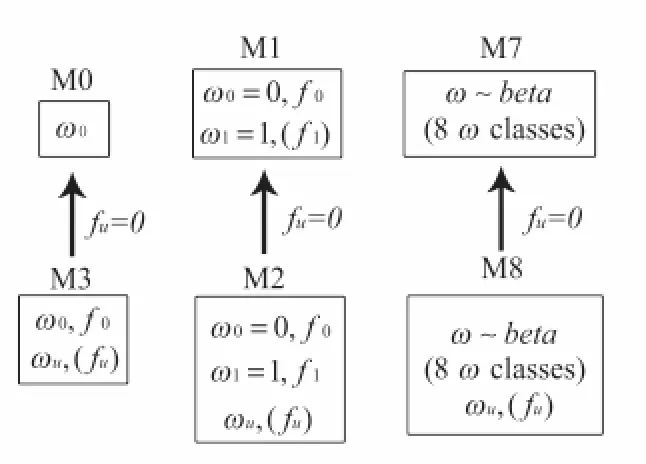
The full coding regions of the genes within each group were aligned. Alignment columns with gaps present in more than 50% of group members were deleted from the alignment. The 52 groups were then analyzed with PAML (Yang 1997) to identify sites that experienced positive selection. The Codeml program from the PAML package calculated the maximum likelihood (ML) for each group under several different codon models: M0 (one-ratio), M1 (neutral), M2 (selection), M3 (discrete), M7 (beta) and M8 (beta+ω) (see Yang el al. 2000 for detailed descriptions of models). The models differ in their distribution of sites in the various ω classes: M0 assumes all sites have the same ω value and ω<1; M1 uses a class of neutral sites (ω=1) along with a class of invariant sites (ω=0); M7 has 8 classes (ω<1) partitioned according to a discretized beta distribution. M2, M3 and M8 are similar to M1, M0 and M7 but with the addition of a class that allows ω greater than one. The nested relationship of the models is shown in figure 1. The positive selection models (M2, M3, and M8) and their corresponding restricted models (M0, M1, M7) were compared using the LRT where the test statistic is distributed as a chi-square. After fitting the models Codeml calculates the Bayesian posterior probability of individual sites belonging to each ω
ambiguous were removed and the analysis was repeated. Positively selected sites identified but not used for further analysis because of alignment uncertainty are available on the “AllSites” sheet at http://statgen.ncsu.edu/estrain/RLK/Like_Sites.xls.
Results
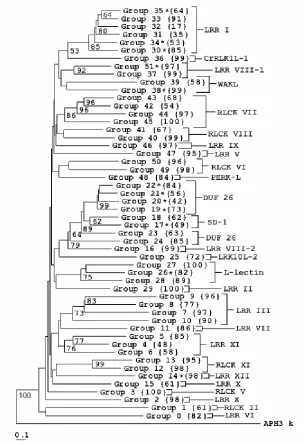
The topology of the neighbor joining tree of the kinase domains given in figure 2 is generally similar to the tree reported by Shiu and Bleecker (2001b). Only 403 of the 610 sequences in their phylogeny were used for analysis of positive selection in this study. The kinase domains of the remaining 207 genes were too divergent from other RLK family members to assign to a group. The classification scheme of Shiu and Bleecker (2001a) was used to assign groups to their respective subfamilies. Most of the genes in the RLK family are not well characterized but several known genes are present: CLV1 (group 4); HAESA (group 6); BRI1 (group 15); RLK6 (group 22); RKF2 (group 24); PR5K (group 25); LECRK1 (group 26); BAK1 (group 29); WAK1, WAK2, WAK3, WAK4, WAK5 (group 38); APK1A (group 42) and TMK1 (group 46). The bootstrap (Felsenstein 1985) values for the tree indicate the groups are generally well supported although values for the deep internal nodes are weak. The bootstrap value for the node identifying each group was above 50% for 47 of the 52 groups. Groups identified by phylogenetic relationships in their kinase domain also had similar extracellular domains (results not shown). The subfamily classification for each group is labeled in figure 2.
additional ω class in M3 was greater than one. The M0-M3 comparison shows variable selective pressure across sites but is not necessarily a good indicator of positive selection (Yang and Nielsen 2002). Forty-eight of the groups fit the M2 model better than the M1 and in 7 of these cases the M2 ω estimate was greater than one. The results of the M1-M2
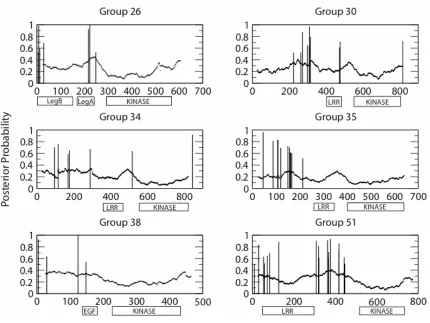
comparison are similar to M0-M3 in that a more complex model is needed to describe the heterogeneous levels of selective pressure across sites. Five groups fit M8 fit significantly better than M7. The ω estimates for these five groups were greater than one, suggesting M7-M8 comparisons may be more useful when testing for positive selection than the previous tests since the null model (M7) is flexible enough to account for the variable levels of selection across sites. The fits of the different models were also evaluated according to their AIC values. In 46 of 52 groups the best AIC score belonged to the beta models M7 or M8 (34 and 12 respectively). The 8 ω classes in the M7 and M8 models fit the varying levels of purifying selection better than the simpler models. The percentage of groups with the best AIC score for each model is shown in Table 1. After reviewing the LRT tests, AIC values and Bayesian posterior probabilities for sites under selection, there are 12 groups showing evidence of positive selection: 14, 17, 19, 20, 21, 22, 26, 30, 33, 34, 35, 38 and 51. The ω
estimates in the positively selected groups under their optimal model according to AIC are given in Table 2. Likelihoods for each group under the different models along with AIC scores and LRT tests are available at http://statgen.ncsu.edu/estrain/RLK/Like_Sites.xls.
Discussion
in host-pathogen interactions. A 1996 survey of 3,595 homologous gene groups derived from 19,987 DDBJ (DNA Data Bank of Japan), EMBL, and Genbank sequences found only 17 groups that were subject to positive selection (Endo et al. 1996). Antigenic surface proteins of viruses and parasites accounted for 9 of the 17 groups. Similarly, a number of plant genes showing positive selection function in pathogen resistance. Disease resistance genes in the NBS-LRR family of Arabidopsis and the Xa21 gene cluster of rice are under diversifying selection (Ellis et al. 2000). Xa21 is an RLK with a LRR receptor domain that confers resistance to Xanthomaonas oryzae pv oryzae (Song 1995). Approximately 25% (12 of 52 groups, see Table 2) of the RLK genes analyzed in the current study show positive selection. It is tempting to speculate that the Arabidopsis DUF26 and LRR RLK groups showing positive selection function in pathogen recognition, with positively selected sites important in determining disease specificity.
The presence of positive selection could help determine the function of
accession no. 007090). The number of LRR copies varies from 3 copies in the LRR I subfamily to 20 in the LRR XII subfamily. Evidence of positive selection was found in groups 30, 34, and 35 of the LRR I subfamily, group 14 of the LRR XII subfamily and group 51 of the LRR VIII-1 subfamily. None of the 25 genes in these five groups have been
functionally characterized, but LRR domains are involved in protein-protein interactions (Kobe and Deisenhofer 1994) and are common in plant resistance genes.
The three remaining groups under positive selection have extracellular domains that resemble those of known signaling or receptor kinases. Group 17 has B_lectin and S-locus glycoprotein domains in the receptor region. B_lectin domains are specific for binding mannose and are involved in a diverse range of processes ranging from plant defense (Barre et al. 2001) to cell motility (Barre et al. 1999), and S-locus domains are involved in a self/non-self recognition (Matton et al. 1994). Sato (2002) has previously described diversifying selection in S-locus Brassica genes. Group 26 has the alpha and beta legume lectin domains (pfam accession nos. 00138 and 00139) that possibly play a role in the
transduction of oligosaccharide and hormone signals (Herve´ et al. 1996). Members of group 38 contain an EGF-like (Epidermal Growth Factor) calcium-binding domain and belong to the WAKL subfamily (Wall-Associated Kinase Like).
pattern of selection is also seen in the NBS-LRR family of Arabidopsis and lettuce, where most of the diversity is in the LRRs (Mondragon-Palomino et al. 2002; Meyers et al. 1998). The NBS effector domains show the highest level of purifying selection across the gene, and the lack of positive selection is consistent with the effector regions having a conserved ligand. In contrast, the positively selected solvent-exposed sites in the LRR receptor region interact with pathogen ligands. In the Mondragon-Palomino (2002) study the LRR domains were also analyzed independently of the NBS domain, and positively selected sites identified were nearly identical to the whole sequence analyses. In the current study only whole
sequence analyses were reported. Shorter sequences reduce the power of the LRT and Bayesian procedures to detect positive selection (Anisimova et al. 2001, 2002), and may also affect codon frequency estimates made using the 3x4 model of Yang (1997).
The pattern of positive selection in the LRR domain of groups 14 and 51 is similar to patterns of selection in the LRR domain of NBS-LRR genes (Mondragon-Palomino et al. 2002). Groups 14 and 51 have multiple copies of a 24 amino acid LRR (Interpro accession no. 007090), and the amino acid variation is most often found in the x residues of the
xxLxLxx motif (Ellis et al. 2000) within the LRR. The first four residues in the motif form a
region could affect the binding specificity, the majority of sites under selection were in the β -strand/turn between residues 4 and 12. Also shown in figure 4 are the results of positive selection analysis of two groups of rice RLK genes (Genbank protein accession nos. AAL82659, BAC24921, BAC10699, BAC10698, AAF34426, BAB78678; BAB03631, BAB03627, BAB44009, BAB03629, BAB03621) homologous to RLK group 14. These genes have not been functionally characterized, but the locations of positively selected sites in their LRR region is similar to RLK groups 14 and 51. In rice 12 of the sites under positive selection were at residue 6, and 34 of 46 sites identified were between residues 4 and 12 in the β-strand/turn. The concentration of positively selected sites in the β-strand/turn is interesting because these sites are potentially solvent exposed in the binding domain and could affect ligand specificity. Literature searches for functional significance of residue six have revealed no information with regard to plant resistance. Systematic mutagenisis of the LRR in CCR4 of S. cerevisiae showed residue six was important for the binding of CCR4 to CAF1, and mutations in this site resulted in reduced deadenylase activity (Clark et al. 2004).
5% to 10% of the sites under positive selection, while the RLK groups in this study generally had 1% to 5%. The smaller proportion of sites under positive selection in RLK sequences could cause models with ω > 1 (M2, M3, M8) not to score significantly better than
alternative models (M1, M0, M7), making it more difficult to detect positive selection. Also, it has been shown that high levels of recombination can increase the type I error rate of the LRT to detect positive selection (Anisimova et al. 2003). The effective rate of recombination in the selfing Arabidopsis thaliana is much lower than the viral sequences tested in
Anisimova et al. 2003 and recombination should be less of a concern. Even though the tests of selection may be somewhat conservative almost 25% of the 403 RLK sequences belonged to positively selected groups. The concentration of positively selected sites in the
extracellular region as opposed to the kinase domain is consistent with these genes having a role in pathogen resistance. In particular, the sites identified in the LRR of groups 14 and 51 along with their homologs in rice may make interesting candidates for site directed
mutagenisis.
REFERENCES
Akaike H (1974) “A new look at the statistical model identification” IEEE Trans. Automat. Contrl., AC-19, No. 6, 716-723.
Altschul S, Madden T, Schäffer A, Zhang J, Zhang Z, Miller W, and Lipman D (1997) “Gapped BLAST and PSI-BLAST: a new generation of protein database search programs” Nucleic Acids Res. 25:3389-3402.
Anisimova M, Bielawski J, Yang Z (2002) “Accuracy and Power Bayes Prediction of Amino Acid Sites Under Positive Selection” Mol. Biol. Evol. 19(6):950-958
Anisimova M, Bielawski J, Yang Z (2001) “Accuracy and Power of the Likelihood Ratio Test in Detecting Adaptive Molecular Evolution” Mol. Biol. Evol. 18(8):1585-1592 Anisimova M, Nielsen R and Yang Z (2003) “Effect of Recombination on the Accuracy of
the Likelihood Method for Detecting Positive Selection at Amino Acid Sites” Genetics 164:1229-1236
Barre A, Van Damme E, Peumans W and Rougé P (1999) “Homology modeling of the core domain of the endogenous lectin comitin: structural basis for its mannose-binding specificity” Plant Molecular Biology 39: 969–978,
Barre A, Bourne Y, Van Damme E, Peumans W and Rougé P (2001) “Mannose-binding plant lectins: Different structural scaffolds for a common sugar-recognition process” Biochimie. 83:645-651
Bielawski J and Yang Z (2003) “Maximum likelihood methods for detecting adaptive evolution after gene duplication” Journal of Structural and Functional Genomics 3:201-212,
Brand U, Fletcher J, Hobe M, Meyerowitz E and Simon R (2000) “Dependence of Stem Cell Fate in Arabidopsis on a Feedback Loop Regulator by CLV3” Science 289:617-619 Clark L, Viswanathan P, Quigley G, Chiang Y, McMahon J, Yao G, Chen J, Nelsbach A, and
Denis C (2004) “Systematic Mutagenesis of the Leucine-rich Repeat (LRR) Domain of CCR4 Reveals Specific Sites for Binding to CAF1 and a Separate Critical Role for the LRR in CCR4 Deadenylase” Activity Journal of Biological Chemistry Vol. 279, No. 14, Issue of April 2, pp. 13616–13623
Ellis J, Dodds P and Pryor T (2000) “The generation of plant disease resistance gene specificities” Trends in Plant Science 5:373-379
Endo T, Ikeo K, Gojobori T (1996) “Large-Scale Search for Genes on Which Positive Selection May Operate” Mol. Biol. Evol. 13(5):685-690
Felsenstein J (1985) “Confidence limits on phylogenies: An approach using the bootstrap” Evolution 39:783-791.
Felsenstein J (1989) “PHYLIP -- Phylogeny Inference Package (Version 3.2)” Cladistics 5: 164-166.
Fitch W (1971) “Rate of change of concomitantly variable codons” J. Mol. Evol. 1:84-96 Hardie D (1999) “Plant Protein Serine/Threonine Kinases: Classification and Functions”
Herve´ C, Dabos P, Galaud J-P, Rouge´ P and Lescure B (1996) “Characterization of an Arabidopsis thaliana Gene that Defines a New Class of Putative Plant Receptor Kinases with an Extracellular Lectin-like Domain” J. Mol. Biol. 258, 778–788 Hochberg Y (1988) “A sharper Bonferroni procedure for multiple tests of significance”
Biometrika 75:800-802
Hughes A and Nei M (1988) “Nucleotide substitution at major histocompatibility complex loci reveals overdominant selection” Nature 335:167-170
Hughes A and Nei M (1989) “Nucleotide substitution at major histocompatibility complex class II loci: evidence for overdominant selection” PNAS 86:958-962
Jones D, Taylor W and Thornton J (1992) “The rapid generation of mutation data matrices from protein sequences” Comput. Appl. Biosci. 8: 275-282.
Kachroo A, Schopfer C, Nasrallah M, Nasrallah J (2001) “Allele-specific receptor-ligand interactions in Brassica self incompatibility” Science 293:1824-1826
Kobe B, Deisenhofer J (1994) “The leucine-rich repeat: a versatile binding motif” Trends Bio. Sci. 19:415-421
Lenhard M and Laux T (2003) “Stem cell homeostasis in the Arabidopsis shoot meristem is regulated by intracellular movement of CLAVATA3 and its sequestration by
CLAVATA1” Development 130:3163-3173
Matton D, Nass N, Clarke AE, Newbigin E (1994) “Self-incompatibility: how plants avoid illegitimate offspring” Proc Natl Acad Sci U S A. 91(6):1992-7
Meyers B, Shen K, Rohani P, Gaut B, Michelmore R (1998) “Receptor-like Genes in the Major Resistance Locus of Lettuce are Subject to Divergent Selection” Plant Cell 11:1833-1846
Mondragon-Palomino M, Meyers B, Michelmore R, Gaut B (2002) “Patterns of Positive Selection in the Complete NBS-LRR Gene Family of Arabidopsis Thaliana” Genome Research 12:1305-1315
Nei M, Gojobori T (1986) “Simple Methods for Estimating the Numbers of Synonymous and Nonsynonymous Nucleotide Substitutions” Mol. Biol. Evol. 3(5):418-426
Nicholas K, Nicholas H Jr and Deerfield D II (1997) EMBnet News, 4, 14.
Nielsen R, and Yang, Z (1998) “Likelihood models for detecting positively selected amino acid sites and applications to the HIV-1 envelope gene” Genetics 148:929-936
Ohno S (1970) Evolution by gene duplication. New York: Springer
Ronald P, Salmeron J, Carland F, Staskawicz B (1992) “The cloned avirulence gene avrPto induces disease resistance in tomato cultivars containing the Pto resistance” J Bacteriol. Mar;174(5):1604-11
Saitou N and Nei M (1987) “The Neighbor-joining Method: A New Method for Reconstructing Phylogenetic Trees” Mol. Biol. Evol. 4(4):406-425
Sato K, Nishio T, Kimura R, Kusaba M, Suzuki T, Hatakeyama K, Ockendon D and Satta Y (2002) “Coevolution of the S-Locus Genes SRK, SLG, and SP11/SCR in Brassica oleracea and B. rapa” Genetics 162:931-940
Shiu S and Bleecker A (2001a) “Plant Receptor-Like Kinase Gene Family: Diversity, Function and Signaling” Science’s STKE 113:re22
Shiu S and Bleecker A (2001b) “Receptor-like kinases from Arabidopsis form a
monophyletic gene family related to animal receptor kinases” PNAS Vol 98, no 19:10763-10768
Shiu S and Bleecker A (2003) “Expansion of the Receptor-Like Kinase/Pelle Gene Family and Receptor-Like Proteins in Arabidopsis” Plant Physiology 132:530-543
Shiu S, Karlowski W, Pan R, Tzeng Y, Mayer K and Li WH (2004) “Comparative Analysis of the Receptor-Like Kinase Family in Arabidopsis and Rice” The Plant Cell
16:1220-1234
Song W, Wang G, Chen L, Kim H, Pi L, Holsten T, Gardner J, Wang B, Zhai W, Zhu L, Fauquet C and Ronald P, (1995) “A receptor kinase-like protein encoded by the rice disease resistance gene, Xa21” Science 270: 1804-1806.
Takayama S, Shimosato H, Shiba H, Funato M, Che FS, Watanbe M, Iwano M and Isogai I (2001) “Direct ligand-receptor complex interaction controls Brassica
self-incompatibility” Nature 413:534-538
The Arabidopsis Genome Initiative (2000) “Analysis of the genome sequence of the flowering plant Arabidopsis thaliana” Nature vol 408:796-815
Uzzell T CorbinKW (1971) Fitting discrete probability distributions to evolutionary events.Jun 11;172(988):1089-96.
Wang Z, Fujioka S, Yoshida S and Chory J (2001) “BRI1 is a critical component of a plasma-membrane receptor for plant steroids” Nature 410:380-383
Yang Z (1997) “PAML: A program package for phylogenetic analysis by maximum likelihood” CABIOS 13:555-556
Yang Z and Bielawski J (2000) “Statistical Methods for detecting molecular adaptation” TREE 15:496-503
Yang Z and Nielsen R (2002) “Codon-Substitution Models for Detecting Molecular
Adaptation at Individual Sites Along Specific Lineages” Mol. Biol. Evol. 19(6):908-917
APPENDICES
Table 1. Percentage of groups with best AIC score for each model
Table 2. Groups exhibiting positive selection
1ω values for site class exhibiting positive selection 2 proportion of sites under positive selection
3 optimal model under AIC 4 subfamily classification
Optimal Model % Groups M0 (one-ratio) 0.0
M1 (neutral) 0.0 M2 (selection) 3.5 M3 (discrete) 7.0 M7 (beta) 59.7 M8 (beta+ω) 21.1
Group ω1 p2 Model3 Subfamily4
14 2.662 0.04647 M8 LRR
17 3.104 0.00406 M8 SD-1
19 2.015 0.11169 M8 DUF26
20 2.918 0.03429 M8 DUF26
21 4.294 0.02254 M3 DUF26
22 3.992 0.02845 M8 DUF26
26 9.835 0.00984 M8 L-lectin
30 9.757 0.01781 M8 LRR
34 2.364 0.01869 M8 LRR
35 4.141 0.03355 M8 LRR
38 1.804 0.01068 M8 WAKL
Figure 1. Hierarchy of Models where ω =dn/ds, ω0 and ω1∈(0,1), ωuis the
unrestricted ω class that can be greater than one and f is the proportion of sites in each
CHAPTER 3
AIC Weighted Averaging and Model Selection for Models of Nucleotide Substitution in
HIV Sequences
Errol Strain and Spencer Muse
Bioinformatics Research Center, Campus Box 7566 North Carolina State University
Raleigh, NC 27695-7566 Corresponding Author: Spencer Muse
[email protected] (919)515-1948 (Voice)
Abstract
Akaike Information Criteria (AIC) based model averaging and model selection of 203 reversible models of nucleotide evolution were used to examine estimates of genetic distance and the ratio of transition/transversion (ts/tv) rate parameters in HIV sequence data.
Estimates of distance and ts/tv were shown to be robust relative to model assumptions. AIC model selection of HIV1 and HIV2 datasets indicates nucleotide models allowing for multiple transversion rates are important when analyzing HIV sequences. The use of this exhaustive set of models reveals several non-standard models that consistently score well by AIC in pairwise comparisons of HIV1 and HIV2. Additionally, AIC weighted estimates of the ts/tv ratio in simulated HIV sequences generally had less variance than similar estimates made by selecting the single best scoring AIC model.