ABSTRACT
AVERY, MATTHEW ROGERS. New Techniques for Functional Data Analysis: Model Selection, Classification, and Nonparametric Regression. (Under the direction of Hao Helen Zhang and Yichao Wu.)
Functional data, such as curves and images, are increasingly collected in many research
dis-ciplines due to rapid advances in computers and modern scientific technologies. Compared to
traditional scalar- or vector-data, functional data are inherently infinite-dimensional and more
complex, and the observations from random trajectories are often sparse and irregularly
sam-pled. In such cases, traditional statistical methods can not be directly applied, and new methods
must be developed. Here, we study three problems related the functional data.
First, we look at the problem of sparse regression for functional data. In traditional settings,
sparse regression refers to model selection problems where a subset of ap×1vector of predictor variables is chosen to model the response. In functional data, we consider a model with a scalar
response, Y and associated functional predictorX(t) observed over some domain T. In this context, a sparse model is one in which the coefficient functionβ(t)forX(t)is set identically to 0over some subset of T. Rather than choose a subset of predictor variables, we choose a subset of the domain of a single functional predictor. We propose a method for sparse regression
using the Fused LASSO with a 1st order b-spline basis. This two-stage method is flexible and
can be used in conjunction with all methods for functional regression.
Next, we consider the problem of classification for functional data, which has important and
broad applications in practice. A new discriminant analysis approach is developed and studied.
(FPCA) and then conduct linear discriminant analysis (LDA) based on the FPCA scores.
Com-pared with existing functional data classification methods, the new procedure is conceptually
much simpler, easier and faster to implement, and competitive in performance. The demanded
programming effort is minimal, as the procedure can take advantages of existing software
pack-ages. Theoretical justifications are provided for the procedure in terms of its classification
con-sistency under certain conditions.
Finally, we consider nonlinear functional regression for sparse and irregular data. As in the
traditional setting, most methods for functional regression impose specific model assumptions
on the data. If the true relationship between predictor and response does not conform to these
assumptions, the resulting estimates may be poor. We propose a nonlinear regression method
for functional data. Unlike other nonparametric methods discussed in the literature, ours can be
applied to sparse and irregularly sampled data because it uses PACE to estimate the predictor
trajectories. We compare our method to existing parametric methods on simulated data as well
© Copyright 2012 by Matthew Rogers Avery
New Techniques for Functional Data Analysis: Model Selection, Classification, and Nonparametric Regression
by
Matthew Rogers Avery
A dissertation submitted to the Graduate Faculty of North Carolina State University
in partial fulfillment of the requirements for the Degree of
Doctor of Philosophy
Statistics
Raleigh, North Carolina
2012
APPROVED BY:
Daowen Zhang Ana-Maria Staicu
Hao Helen Zhang
Co-chair of Advisory Committee
Yichao Wu
BIOGRAPHY
Matthew Avery was born in Davis, CA to Joy and Michael Avery. He grew up in Gainesville,
FL, graduating from Eastside High School with an IB Diploma in 2002. He received his
Bach-elor of Arts Degree in Economics from New College of Florida in 2006 after completing his
dissertation,The Welfare Effects of Direct to Consumer Advertising in Prescription Drug
Mar-kets. He began studying statistics at NCSU in 2006, and now moves on to pursue a career at
ACKNOWLEDGEMENTS
It has taken the efforts of many people for me to reach this point, and here I give an incomplete
list. My family, Mom, Dad, and Lily, have constantly cheered for me and pushed me forward. I
wouldn’t be here without them. I got some great help as an undergraduate, particularly from my
adviser, Dr. Richard Coe, as well as Dr. Catherine Elliott. I’m not sure anyone has done more to
spur my interest in learning and academics than Dr. Elliott. There’s no way I would’ve gotten
through graduate school without the encouragement and support of my friends and classmates,
Justin, Paul, Malorie, Laura, David, Adam, Frank and Carrie. Special thanks to Kat for her
notes and suggestions. Finally, this dissertation would not have come together without my
advisers, Dr. Helen Zhang and Dr. Yichao Wu, who’ve given me good direction at every turn.
TABLE OF CONTENTS
List of Tables . . . vi
List of Figures . . . vii
Chapter 1 Introduction . . . 1
1.1 Regression . . . 2
1.1.1 Penalization Methods . . . 3
1.1.2 Nonparametric Regression . . . 5
1.2 Functional Data . . . 6
1.2.1 Regression for functional data . . . 8
1.2.2 Notation for functional data . . . 8
1.2.3 Functional Principal Components . . . 11
1.2.4 FPC for Sparse and Irregularly Sampled Data . . . 13
1.2.5 Fitting Functional Regression Models . . . 15
1.3 Dissertation Outline . . . 18
Chapter 2 Model Selection for Functional Data. . . 20
2.1 Motivation . . . 20
2.2 Functional Regression . . . 22
2.2.1 General Approach . . . 22
2.2.2 Existing Methods . . . 24
2.3 New Methods . . . 25
2.3.1 Two-stage fitting . . . 27
2.3.2 Sparsely Observed Trajectories and Measurement error . . . 29
2.3.3 Summary of Algorithm . . . 31
2.4 Computational issues . . . 32
2.4.1 Tuning forλ1 andλ2 . . . 32
2.4.2 Numerical integration and other issues . . . 34
2.5 Simulations . . . 36
2.5.1 Assessing the quality of a fit . . . 37
2.5.2 Simulation Results . . . 39
2.5.3 Sparely Observed Curves with Measurement Error . . . 46
2.6 Discussion . . . 48
Chapter 3 Classification for Functional Data . . . 49
3.1 Introduction . . . 49
3.2 New Methodology . . . 53
3.2.1 General Setup and Notations . . . 53
3.2.3 Uncentered Approach . . . 57
3.2.4 Summary of Algorithms . . . 60
3.3 Consistency and Computation Issues . . . 61
3.3.1 Consistency of estimated FPC scores . . . 61
3.3.2 Consistency of classification rule . . . 62
3.3.3 Computation . . . 63
3.4 Simulation . . . 64
3.4.1 Case 1 . . . 64
3.4.2 Case 2 . . . 66
3.4.3 Multiclass simulations:K >2 . . . 68
3.5 Real data . . . 72
3.6 Discussion . . . 76
Chapter 4 Functional Nonlinear Regression . . . 78
4.1 Introduction . . . 78
4.2 Parametric Methods . . . 80
4.3 Functional Nonlinear Regression . . . 82
4.4 Tuning . . . 85
4.5 Simulation . . . 86
4.6 Real Data . . . 89
4.7 Discussion . . . 91
References . . . 92
Appendices . . . 96
Appendix A Fused LASSO Model . . . 97
LIST OF TABLES
Table 2.1 Simulation results for all methods withβ(t)Unimodal,n= 50,p= 35 . 40 Table 2.2 Simulation results unimodal coefficient function for different values of
nwith EBIC tuning. (p= 35) . . . 43
Table 2.3 Simulation results for Z coefficient function for different values of n with EBIC tuning. (p= 35) Note: Trimmed means reported. . . 44
Table 2.4 Simulation results for bimodal coefficient function for different values ofnwith EBIC tuning. (p= 35) . . . 45
Table 2.5 Error rates for Unimodal coefficient with measurement error . . . 46
Table 2.6 Error rates for Z coefficient function with measurement error . . . 47
Table 3.1 Classification errors for Case 1 (computation time in minutes) . . . 66
Table 3.2 Classification errors for Case 2 (computation time in minutes) . . . 68
Table 3.3 Classification errors 3-class simulation (computation times in minutes) . 70 Table 3.4 Classification errors for 4-class simulation (computation times in minutes) 71 Table 3.5 Classification errors for 5-class simulation (computation time in minutes) 72 Table 3.6 Classification errors for “real world” data sets . . . 74
Table B.1 Simulation results for triangle coefficient function for different values of nwith EBIC tuning. (p= 35) . . . 99
Table B.2 Simulation results for Valley coefficient function for different values of nwith EBIC tuning. (p= 35) . . . 100
LIST OF FIGURES
Figure 1.1 Three types of functional data . . . 9
Figure 1.2 Gene expression data before and after smoothing with PACE . . . 16
Figure 2.1 Canadian Weather Data . . . 21
Figure 2.2 Two sets of basis functions . . . 24
Figure 2.3 Initial and second stage stage fits . . . 30
Figure 2.4 Submanifold . . . 37
Figure 2.5 Example curves . . . 38
Figure 2.6 Sparse fits for different coefficient functions . . . 41
Figure 2.7 Sparse fits for different coefficient functions . . . 42
Figure 3.1 Example curves from gene expression and spinal bone mineral density data sets . . . 50
Figure 3.2 Case 1 mean functions and simulated data points . . . 65
Figure 3.3 Case 2 mean functions and simulated data points . . . 67
Figure 3.4 Multiclass mean functions and simulated data points . . . 73
Figure 3.5 Gene expression data: Raw data, estimated FPC curves, and smoothed estimates of data . . . 75
Figure 4.1 Boxplots of average squared prediction errors. The top row is the reg-ular case, and the bottom row is the sparse case. The first column uses modelF1 and the second column uses modelF2. . . 90
Chapter 1
Introduction
As technology progresses and more and more data becomes available, statistical methods must
keep up. In particular, new data types, such as images and functions, come with new challenges.
Functional MRIs produce images that neuroscientists and psychologists would like to use to
learn about psychological diseases and neural connectivity. Data that might previously have
been treated as longitudinal is now being treated as functional data. In such situations, new
methods must be devised that leverage the unique characteristics of the data.
For standard data, common problems include model selection, classification, and
nonparamet-ric regression. Model selection techniques are employed in a variety of cases, such as when
one is unsure which predictors are (most) important for modeling the response. These methods
choose a subset of predictors, resulting in a sparse model that is generally easier to interpret
than the full model. We frame the model selection problem as choosing a subset of the
do-main of a functional predictor rather than a subset of different predictors. By identifying such
Also, interpreting the predictor’s relationship with the response may be simpler, since it will
be defined only over a certain range.
For standard data, k-class classification is well-studied, but this problem also arises when the
predictors are curves. Particularly when the observed data are sparsely and irregularly sampled,
simple methods for classification are desirable. Similarly, while linear and quadratic regression
have been proposed for functional data, both methods rely on a specified parametric model.
When the data does not conform to this model (as in the case of a complex nonlinear
relation-ship), the resulting estimators may not be consistent. A more general approach, particularly in
the case of sparse and irregularly sampled data, may be able to model such relationships more
accurately.
1.1
Regression
The standard linear regression model fornobservations andppredictors can be written as
y=Xβ+, (1.1)
whereyis a vector ofnresponse variables,X is ann×pdesign matrix whoseith row,xTi = [xi1, xi2], . . . , xip, consists of the values of the p predictor variables for the ith observation,
β is a vector of coefficients for the p predictors, and is an n×1 vector of random errors. When necessary, we will assumeX has been normalized and the responses centered. That is, Pn
From this general framework, many methods have been developed for estimating the
coeffi-cients, β. The simplest method is to chooseβ to minimize the residual sum of squares. That
is, minimize
||y− p X
j=1
xjβj||2. (1.2)
This is commonly known as Ordinary Least Squares (OLS) regression.
1.1.1
Penalization Methods
While OLS works well in simple cases, it may not always be appropriate. For example, whenp is large, the model may be difficult to interpret as well as over-fit. A common approach in such
cases is penalized regression, where rather than minimize 1.2, we minimize
||y− p X
j=1
xjβj||
2+P
λ(β), (1.3)
where Pλ(β) is a penalization function with parameter λ whose argument is the coefficient vector. Common examples of penalty functions include the Ridge Regression penalty (Hoerl
and Kennard, 1970), which is the L2 norm of the coefficient vector, and the LASSO (Least
||y− p X
j=1
xjβj||
2+λ||β||.
(1.4)
These penalization methods yield coefficient estimates that have simpler interpretations than
the standard OLS fit. For example, when a regression problem has many predictor variables
(that is, p is large), many of the estimated coefficients may be small. Small marginal effects can be difficult to interpret, since while they may be “statistically significant”, they may not be
significant in a practical sense. The LASSO addresses this issue by setting these small marginal
effects to be exactly zero. The resulting fit is simpler to interpret than the OLS fit. Indeed, the
LASSO is performing variable selection, since relatively few predictors are “selected” to be
in the estimated model. The resulting model is called “sparse”, since many predictor variables
have been weeded out, and we are left with a smaller “sparser” model.
Since the LASSO was first described, numerous methods have been devised using this
penal-ized regression framework. The Adaptive LASSO (Huang et al., 2006) uses weights from, for
example, the standard OLS fit to scale the penalty applied to each predictor coefficient. The
Adaptive LASSO also enjoys the Oracle property, which the standard LASSO does not. The
Elastic Net (Zou and Hastie, 2005) is useful for selecting groups of highly correlated variables.
While the standard LASSO will typically select only one of these predictors and exclude the
rest, the Elastic Net is designed to include the whole group in the estimated model.
Finally, the Fused LASSO (Tibshirani et al., 2005) finds sparse fits for models where
con-secutive predictors may be included in the model. This is done by penalizing the differences
between consecutive coefficients in addition to penalizing the coefficients directly. For this
ap-proach, we must presuppose that the predictor variables conform to an underlying structure
predicting the response,y, then we believe the(j −1)th and(j+ 1)th variables may also be important. This occurs when the predictor variables have some relevant ordering to them, such
as the case when the predictors represent observations at consecutive time points. Alternatively,
the ordering can be constructed by placing correlated predictors near one another. (Tibshirani
et al., 2005) To fit the Fused LASSO, we minimize
||y− p X
j=1
xjβj||
2
+λ1||β||+λ2||βdif f||, (1.5)
whereβdif f = (β2−β1, β3−β2, . . . , βp −βp−1)andλ1, λ2are penalization parameters. The
resulting fits are characterized by large ranges of consecutive coefficients set identically to 0.
The Fused LASSO has applications for functional data which will be explored in Chapter 2.
1.1.2
Nonparametric Regression
The previous discussion has focused on the subset of regression models where a particular
relationship between the predictors and the response is assumed prior to model fitting. While
this has the advantage of producing good model estimates when the true relationship is
consis-tent with the model assumptions, when these assumptions are violated, the resulting estimates
may be biased. One solution to this is nonparametric regression. In this approach, the only
assumption is that
Once again,xi is a vector of predictor variables foryi, and i is the random error for the ith observation. To estimateµ(·), a common approach is kernel regression. LetK(·)be a suitable (non-negative, symmetric, withR K(t)dt = 1) kernel andhnbe an associated bandwidth. Then a nonparametric estimator fory∗ with associated predictor vectorx∗is
Pn
i=1YiK(x ∗−x
i
hn )
Pn i=1K(
x∗−x
i
hn )
. (1.7)
This is the multivariate version of the Nadaraja-Watson estimator. See also Fan and Gijbels
(1996). The choice of bandwidth and kernel function are important, and have been discussed
in Rice (1984) and Fan and Gijbels (1992).
1.2
Functional Data
In both genetics and biostatistics, multiple observations on a single subject over time are
in-creasingly being treated as realizations from a single underlying process. This so-called
func-tional data has motivated numerous new techniques that leverage its unique characteristics to
fit more accurate models. A general overview of functional data analysis including some
fun-damental methods was given by Ramsay and Silverman (2005).
Generally, a functional variable can be defined as a smooth process that occurs over some
domain, typically time. When modeling functional data, both response variables as well as
predictors can be functional, though we focus here on the case of a scalar response with an
Ideally, we would want to observe the functional variable over its entire domain. This is the
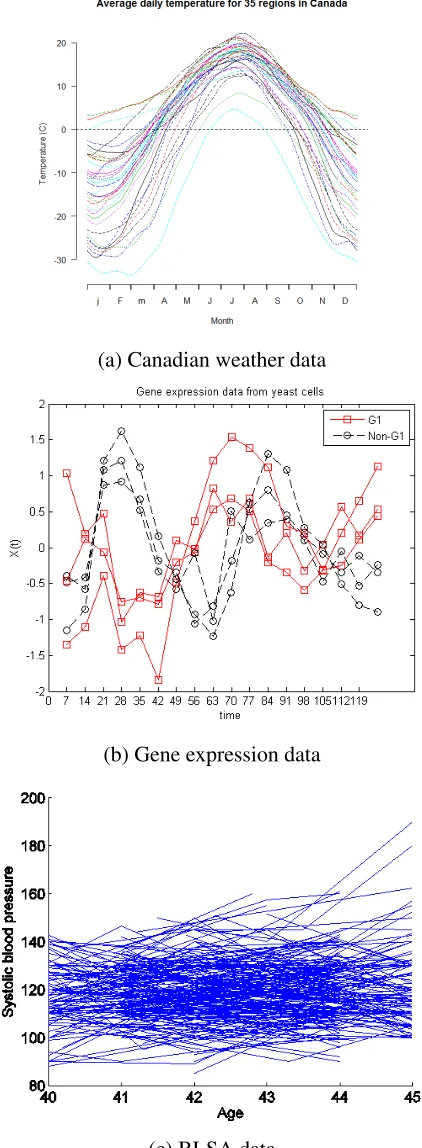
case with Canadian weather data discussed in Ramsay and Silverman (2005). For each of 35
regions, average daily temperatures are recorded, giving us a temperature trajectory over the
course of a full year. In this case, the trajectories are said to be regularly observed on a dense
grid of time points. These curves are given in Figure 1.1a.
The Canadian weather data is an ideal situation where the grid of observed points is sufficiently
dense that the underlying process can easily be interpolated. It is more common to observe
fewer points for each trajectory. For example, Spellman et al. (1998) look at temporal gene
expression data from yeast cells. (See Figure 1.1b.) In this case, for each gene, the expression
level is observed at a total of 18 time points over the course of roughly 2 hours. Once again,
the grid of observed points is fixed, but unlike the Canadian weather data, there are many fewer
observations. In this case, the underlying process must be estimated through some process,
such as smoothing splines.
In the case of longitudinal data, even less information may be available. Particularly when the
subjects involved are people, it may not be possible to observe the subject at regular intervals,
and some times, subjects may only be observed as few as one or two times. Data of this type is
referred to as sparse, irregularly sampled data, since times at which observations are made are
not fixed and the number of observations for some subjects may be very few. This is typical of
longitudinal studies such as the Baltimore Longitudinal Study of Aging, where values such as
blood pressure were measured on subjects when they visited the Gerontology Research Center.
(Shock et al., 1984) Since subjects would drop out of the study or miss appointments, not
all individual trajectories were frequently observed or observed over the full time frame of
the study. Similarly, Bachrach et al. (1999) observed spinal bone mineral densities for males
many of the subjects only a few observations were made. (In some cases, as few as one or two
observations were recorded.) From Figure 1.1c, we can see that these data look quite different
from the previous examples.
1.2.1
Regression for functional data
Consider the functional linear regression model
Yi =β0+
Z
T
Xi(t)β(t)dt+i, i= 1, . . . , n. (1.8)
Here, the scalar response, Yi is modeled using a functional predictor variable,Xi(t), defined over some domain, T ∈ R. Often times for simplicity, T will be scaled to [0,1]. The rela-tionship betweenyiandXi(t)is determined by the coefficient function,β(t), andi is random error. We assume that the predictor curves,Xi(t)and the coefficient function,β(t)are square-integrable functions onT.
1.2.2
Notation for functional data
Typically, the full curve,Xi(t)is not observed. Rather, for the ith curve, we observeX(t)at some numberNi >0of discrete time points,Ti1, ..., TiNiordered such thatTij < Ti(j+1), where
(a) Canadian weather data
(b) Gene expression data
studies, e.g. Rhein and Strimmer (2006) and Spellman et al. (1998)) or it may be randomly
determined (e.g.James and Hastie (2001), Bachrach et al. (1999), Rice and Wu (2001)).
Additionally, we assume these observations are made with some measurement error, denoted
δij. Let the observed value for theith curve at timeTij beUij =Xi(Tij)+δij. The measurement errors are assumed be independent both between and within curves with mean0andvar(δij)< ∞. Our regression model requires the full curve,Xi(t)to findYi. Thus, we must estimate the full curve using the available data before performing functional regression.
It is useful then to think of functional data as being one of two types. For the case where we have
fixed time points, the straightforward approach of using a local smoother over the observed
time points can be employed provided the grid of observations is sufficiently dense. (Ramsay
and Silverman, 2005) Other approaches are necessary when the data is sparsely sampled at
irregular time points. One such method is Principal component Analysis through Conditional
Expectation or PACE, (Yao et al., 2005b) which can be applied to irregularly sampled data with
very few observations per time point. The resulting estimated principal component functions
and scores can be used to estimate the underlying curves,Xi(t). We will discuss PACE further in the next section.
Once we have estimated the predictor curves, we perform regression and estimate the
coeffi-cient function. If we restrictβ(t)to the space of smooth functions with no further assumptions, identifiability is an insurmountable problem. One approach to dealing with this is to perform
regression with a smoothness penalty. That is, we chooseβb(t)to minimize
X
Yi− Z
T
Xi(t)βb(t)dt
+λ
Z
T
b
whereβ(d)(t)is the dth derivative of β(t) andλ is a penalty term. Thus, the estimated
func-tion is chosen to have smooth dth derivative. A more common method is to assume that the coefficient function can be decomposed using some orthogonal basis such that the first p basis functions can well-approximate β(t). Then we write β(t) = B(t)Tη, where B(t) =
[b1(t), b2(t), . . . , bp(t)]T, and η is a vector of coefficients. Thus, the regression problem be-comes
Yi =β0+xTi η+i, (1.10)
wherexij = R
T Xi(t)bj(t)dt. We can now find estimates forηusing any number of traditional
methods, such as OLS described above. When we employ this basis decomposition approach,
the choice of orthogonal basis,B(t)is of paramount importance. If we use PACE to estimate the curves, the principal component basis makes the most sense. In this case, the FPC scores
become the design matrix,X.
1.2.3
Functional Principal Components
Functional Principal Components (FPC) is a useful method for analyzing functional data.
Recall that for standard data, principal components is a nonparametric method used for
ex-ploratory data analysis and dimension reduction. For the regression model defined in Eq. 1.2,
letX be a normalized design matrix. Then(XTX)−1 is the corresponding scaled covariance
matrix. We can find the principal components by calculating the eigenvectors fromXTX. Note that these eigenvectors will be mutually orthogonal and form a complete basis for the vector
that solves
argmax
x
ggTl (XTX)gl, s.t. glTgl = 1andgTlgm = 0∀m < l. (1.11)
That is, thelth principal component will be the unit vector in the direction of maximal variation forXTX that is orthogonal to the firstl−1eigenvectors.
Once we have found the eigenvectors, we can calculate the principal component scores for
each observation by finding linear combination of the eigenvectors that returns its original
co-efficients. For each eigenvector, there is an associated eigenvalue,λl, which corresponds to the variability ofXexplained by the eigenvalue. It is standard to order the eigenvectors/eigenvalues such thatλ1 ≥ λ2 ≥ . . . ≥ λp. The dimension of the problem can be reduced by choosing a subset of eigenvectors, l = 1, . . . , K such thatPKl=1λl is sufficiently close to
Pp
l=1λl. The reduced model is then
y=XDβ∗+, (1.12)
whereXD is the matrix of the firstK principal component scores for each observation, andβ∗
is the coefficient vector for the eigenvectors.
Functional principal components can be defined through analogy to the standard principal
com-ponents method described above. Under the functional regression model given in Eq. 1.8, the
argmax
φl(t)
Z
T
Z
T
φl(s)V(s, t)φl(t)dsdt s.t. Z
T
φl(t)φl(t)dt= 1, Z
T
φl(t)φm(t)dt= 0∀m < l. (1.13)
Then, the lth eigenfunction is the normalized function that captures the most variability from V(s, t) and is orthogonal to all previous eigenfunctions. Unlike in the traditional principal components case, this is not a finite basis, and l = 1,2, . . .. Typically, this expansion is trun-cated afterK eigenfunctions such thatPKl=1λl is sufficiently close to P
∞
l=1λl, where thelth
eigenvalue,λlis defined as
λl = Z
T
Z
T
φl(s)V(s, t)φk(t)dsdt. (1.14)
We can write our data using the Karhunen-Lo`eve representation and the FPC basis as
Xi(t) =µ(t) +
∞
X l=1
ξilφl(t), (1.15)
whereµ(t)is the mean function of {Xi(t)}ni=1,ξil is the lth FPC score for theith curve, and V ar(ξl) =λl.
1.2.4
FPC for Sparse and Irregularly Sampled Data
Many examples are given in the literature for finding the eigenfunctions, eigenvalues, and FPC
these methods are focused on the case when the predictor curves are sampled over a dense grid.
When data is sparsely sampled at irregular intervals, finding consistent estimators for the FPC
scores can be challenging. Principal components Analysis through Conditional Expectation
(PACE, Yao et al. (2005b)) offers a way to find these estimates when some curves are observed
as few as one or two times.
Suppose instead of observing the predictor curves on a dense grid they are observed sparsely
and irregularly, as in the case of the BLSA data from Figure 1.1c. In this scenario, curveXi(t)is observed at time pointsTi1, ..., TiNiwith measurement errorδij, such that at timeTijwe observe
Uij =Xi(Tij) +δij. LetTi andUi denote the vectors of time points and observed values for theith curve respectively. Using local polynomial smoothers (see, for example, Fan and Gijbels (1996)), we can estimate the mean function for the data,µ(t)as well as the covariance surface, V(s, t). Consistent estimates for the lth FPC score for the ith curve conditional on the time points observed can be written as
˜
ξil =E(ξil|Ui,Ti) =λlφTilΣ
−1
Ui(Ui −µi). (1.16)
In this expression,ΣUi = V(Ti,Ti), φil = φl(Ti), and µi = µ(Ti)respectively. These are all estimated using the estimated version of these processes found earlier. Along with thelth estimated eigenvalue, we can plug in these estimates to find our estimator for the(i, l)th FPC score. The PACE estimate for theith curve is then
b
Xi(t) =µb(t) +
K X
l=1
b
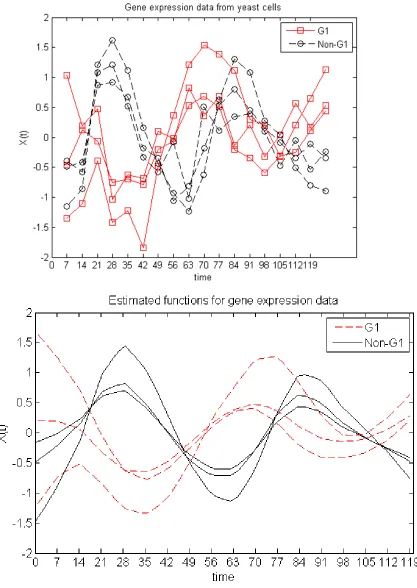
whereK is chosen via some algorithm. (BIC is suggested by Yao et al. (2005b).) Figure 1.2 shows the gene expression data discussed above as well as the estimated curves using PACE.
1.2.5
Fitting Functional Regression Models
Once the true curves are estimated, the regression model must be fit. The functional linear
regression model (Yao et al. (2005a) and Ramsay and Dalzell (1991), for example) use the
model
E(Y|X) = β0 +
Z
T
β(t)XC(t)dt, (1.18)
whereXC(t) =X(t)−µ
X(t)is the centered predictor function andβ(t)is the corresponding coefficient function. This coefficient function is analogous to the coefficient vector in a multiple
linear regression, where instead of a functional predictor we have a vector of predictor variables
associated with each response.
Much like linear regression in traditional settings, functional linear regression may be too
re-strictive to accurately model the relationship between the predictor and the response. Yao and
M¨uller (2010) introduced functional quadratic regression and general functional polynomial
regression which allow for more flexible fits. The functional quadratic regression model
as-sumes
E(Y|X) = β0+
Z
T
β1(t)XC(t)dt+
Z
T
Z
T
with similar extensions possible for higher-order terms. By including a quadratic term, this
model is capable of accurately modeling a larger set of relationships between the predictor and
response than linear regression.
The approach to estimation is similar for both of these models. First, an appropriate basis is
chosen. Yao et al. (2005a) and Yao and M¨uller (2010) use PACE to estimate the functional
principal component basis and corresponding FPC scores, but when full curves are observed,
other bases are viable. For estimablity, we truncate the chosen basis afterpbasis functions. De-note this truncated basis asB(t) = [b1(t), b2(t), . . . , bp(t), ...]T. Then the coefficient function can be approximated as β(t) = B(t)Tη, whereη is a vector of coefficients. Thus, the linear regression problem becomes
Yi =β0+xiη+i, (1.20)
wherexij = R
T Xi(t)bj(t)dt. We can estimateηusing any of the traditional methods described above, such as OLS.
The process is similar for functional quadratic regression, with
β2(x, t) =
p X m=1
m X
l=1
ηlmφl(s)φm(t)
1.3
Dissertation Outline
The remainder of this dissertation is organized in three main sections. Each section introduces
a new method for analysis of functional data. In Chapter 2, we discuss sparse functional linear
regression. The problem of interest is to identify regions on the domain, T of the functional predictor, X(t), such that ∀ t ∈ T0 ⊂ T, β(t) = 0. We propose a two stage method that
uses the Fused LASSO with a 1st order b-spline basis to identify these regions. This method
is flexible in that it can be applied after any method is used to find an initial (not necessarily
sparse) fit.
Chapter 3 addresses the problem of classification for functional data. There are examples in the
literature (including the spinal bone mineral density data discussed above) where curves come
from two or more classes. In such cases, identifying the differences between these classes and
being able to classify new curves is useful. We propose a method motivated by linear
discrim-inant analysis to address these issues. Our method is generally simpler in its application than
other methods, can be generalized to cases with three or more classes, and is computationally
efficient. Additionally, it can be applied to sparse and irregularly sampled data since it is based
on PACE.
Finally, Chapter 4 introduces a method for nonlinear functional regression. Functional linear
regression and functional quadratic regression have both been discussed in the literature, but
both methods rely on parametric models. If the relationship between the predictor and response
do not conform to the assumed model, these methods can produce poor results. Other
nonpara-metric models for functional data exist in the literature, but these assume that the predictor
curve is fully observed. Our method does not rely on parametric model assumptions, so it is
Chapter 2
Model Selection for Functional Data
2.1
Motivation
Model selection is an important area in traditional statistical analysis. Methods such as the
LASSO are used to choose models that simultaneously capture the relationship between the
response and covariates and ensure a sparse fit. These two characteristics are also desirable
when considering functional data, but the notion of “sparsity” may look somewhat different
in this setting. When multiple covariates are considered, analysis similar to the scalar case
may be appropriate, but for a single functional predictor, “sparsity” can viewed relative to the
domain of the covariate. A“sparse” model can be defined as one with a coefficient function,
β(t), that takes the value zero over a subset of the domain, T, of X(t). That is for some T0 ⊂ T,β(t) = 0∀t∈ T0. Typically, we assumeT0 consists of a small number of contiguous
(a) Average daily temperatures at 35 different weather stations
(b) Estimated coefficient function for Cana-dian weather data
Figure 2.1: Canadian Weather Data
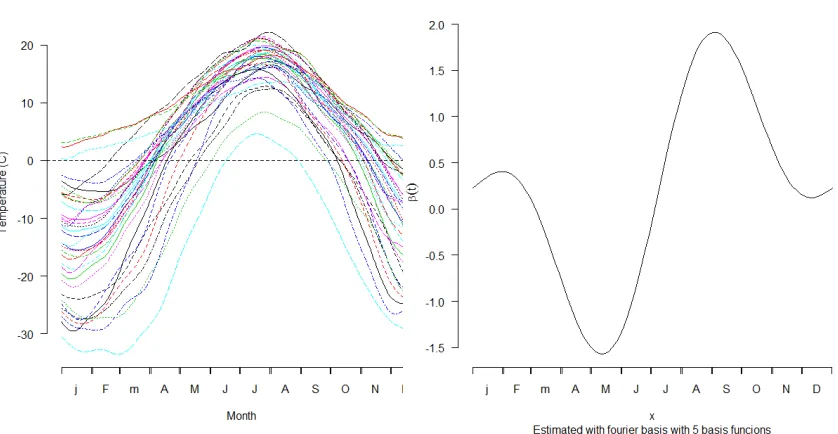
For example, consider the Canadian weather data discussed in Ramsay and Silverman (2005).
Average daily temperatures over nearly four decades are treated as predictors for annual rainfall
in 35 distinct regions in Canada. A plot of the predictor curves is given in Figure 2.1a. Using
standard functional regression techniques, we can estimate a coefficient function relating the
daily temperatures to the annual rainfall of a region. Figure 2.1b shows an estimate for β(t)
using functional linear regression with a fourier basis. This fit shows two major peaks (one in
the spring, the other in the fall) but does not identify any regions where there is no relationship
between average daily temperature and rainfall. A sparse fit would ideally retain as non-zero
the regions where the relationship between temperature and annual rainfall was strongest but
also identify other regions where the relationship may not be relevant.
functional regression and existing methods for sparse functional regression. Section 3
intro-duces our new method for sparse functional regression, and Section 4 discusses computational
issues. We demonstrate the effectiveness of this method through simulation in Section 5 and
show the performance of our method on the Canadian weather data set. Section 6 concludes
with a brief discussion.
2.2
Functional Regression
2.2.1
General Approach
A standard approach to functional regression is to assume that the coefficient function can
be decomposed using some orthogonal basis such that the first p basis functions can well-approximateβ(t). Then we writeβ(t) =B(t)Tη, whereB(t) = [b
1(t), b2(t), . . . , bp(t)]T and
ηis a vector of coefficients. Thus, the regression problem becomes
Yi =β0+xiη+i, (2.1)
wherexij = R
T Xi(t)bj(t)dt. We can now estimateηusing any number of traditional methods,
such as OLS described above. When we employ this basis decomposition approach, the choice
of orthogonal basis,B(t)is of paramount importance.
This is especially true for the problem of sparse regression, since our goal is to find a sparse fit.
functions should be included in the model (or equivalently, which should have their coefficients
set equal to 0). B-splines are well-suited for this, since they are only defined on relatively small
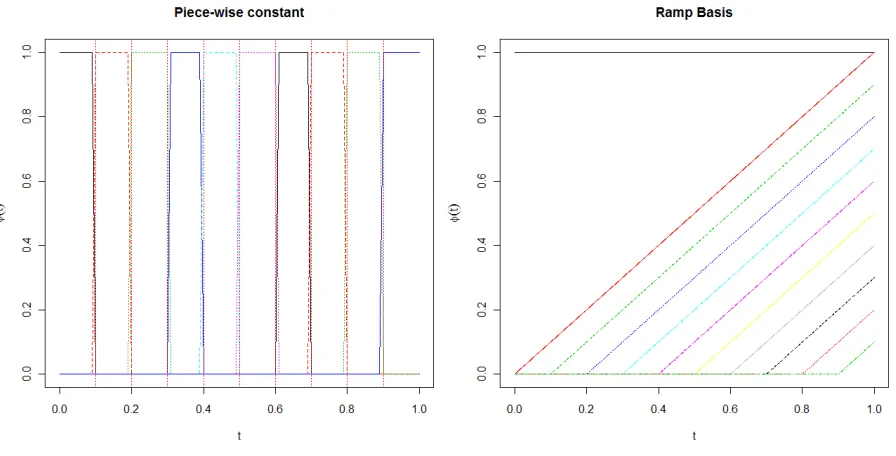
intervals onT. For the simplest case, we can assume thatβ(t)is a step function and choose a 1st order b-spline basis to model it. Thus, we rewrite the regression function as
Yi = p X
j=1
βj Z
bj(t)X(t)dt, (2.2)
where
bj(t) = I(t∈Tj). (2.3)
Eachbj(t)takes nonzero values only on the regionTj whereTj = [t∗j−1, t∗j)forj = 1, . . . , p−1 andTp = [t∗p−1, t∗p]. While this basis may be used to find a sparse fit, step functions may not be flexible enough to accurately model the function. To fit more complex models, a linear fit may
be desired. The “ramp” basis may be useful for such cases. We define the “ramp” basis as
bj(t) = I(t∈[t∗j−1,1])∗(t−t
∗
j−1). (2.4)
Note that for the “ramp” basis, it is necessary to include an additional basis function,b0whose
(a) 1st order b-spline basis (b) Ramp basis
Figure 2.2: Two sets of basis functions
2.2.2
Existing Methods
Example of sparse functional regression are not prevalent in the literature. Functional Linear
Regression That’s Interpretable (FLiRTI, James et al. (2009)) was designed to find estimates of
coefficient functions that were easy to interpret. The authors proposed to find estimated
coeffi-cient functions that did not make large, rapid shifts. As such, they restrict certain derivatives of
the coefficient function to be sparse and estimate the restricted model using either the LASSO
or Dantzig selector. (Both approaches are endorsed by the authors.) The derivative on which the
restriction is placed can be thought of as a tuning parameter as well as a limit on the complexity
Lee and Park (2012) focus on limiting the number of basis functions included in the final
model rather than finding large regions onT that are necessarily zero. As such, they arrive at sparsity indirectly. By choosing a b-spline basis with a high initial number of basis functions
and then using any one of a variety of traditional variable selection techniques, they arrive at
an estimated coefficient function that is zero for a substantial portion of its domain. While this
method is novel in its assumption of a finite but unknown number of basis functions in the true
model, it does not require the included basis functions to adhere to any sort of pattern. This
could lead to fits that while sparse, may be difficult to interpret.
2.3
New Methods
For vector data, one of the most common methods for model selection is the least absolute
shrinkage and selection operator (LASSO, Tibshirani (1994)). The objective function for the
lasso is
Lλ1(y,X,η) = .5(y−Xη)
T(y−Xη) +λ
1
p X
j=1
|ηj|. (2.5)
Since for our case, a natural ordering exists for our coefficients (they correspond to basis
func-tions that represent consecutive subintervals on the domain ofX(t)), the fused lasso (Tibshirani et al., 2005), which penalizes adjacent terms for “jumps”, should also be considered. By
(a) 1st order b-spline fits using the Fused
LASSO (b) Ramp basis fits using the Fused LASSO
Lλ1,λ2(y,X,η) = .5(y−Xη)
T(y−Xη) +λ
1
p X
j=1
|ηj|+λ2
p X
j=2
|ηj−ηj−1|. (2.6)
The Fused LASSO takes advantage of the structure of the basis functions discussed above, all
of which have a natural ordering. For the 1st order b-spline basis, ifβi = 0thenβb(t) = 0for the subinterval associated withφi(t). Thus, by fusing together adjacent coefficients, we are forcing
b
β(t)to take constant values across subintervals of its domain. Since the lasso penalty tends to push individual coefficients towards 0, the result is large subintervals over which βb(t) = 0, giving us the sparse result we desire. Estimated coefficient functions fit using the fused LASSO
and 1st order b-spline basis on five simulated data sets are shown in Figure 2.3a.
Fits generated using the 1st order b-spline basis are not ideal. By construction, the fitted
tion must be a step function and will not be continuous. Moreover, if the true coefficient
A more flexible basis may be able to do a better job. In the case of the “ramp” basis, fusing
the coefficients results in a fit whose first derivative is constant over a subinterval. Estimated
fits from five simulated data sets are shown in Figure 2.3b. While this can make for an
easy-to-interpret function, it does not necessarily result in sparsity.
Full details for these fitting of these models is given in the Appendix.
2.3.1
Two-stage fitting
To find a model that will simultaneously be sparse while retaining the flexibility to estimate
complex functions, we take a two-stage approach. The first stage will give us an initial fit that
does a good job of modeling the function irrespective of sparsity. The second stage will alter
this initial fit to add sparsity.
The first stage is to estimate a coefficient function as accurately as possible using any method.
For example, first stage fit could be estimated using functional linear regression with the “ramp”
basis or a fourier basis. Define this estimate asβe(t). For this first step, we do not consider the sparsity of the fit, instead aiming to capture the shape of the true coefficient function. Using
e
β(t), we generate a new design matrix,X∗:
X∗i,j =
Z
T
Xi(t)βe(t)bj(t)dt, (2.7)
wherebj(t)is thejbasis function from the 1st order b-spline basis.
Lλ1,λ2(y,X
∗
, θ) =.5(y−X∗θ)T(y−X∗θ) +λ1
p X
j=1
|θj|+λ2
p X
j=2
|θj −θ(j−1)|. (2.8)
This is the fused lasso model from Eq. 2.6. We choose the penalty terms,λ1 andλ2via
cross-validation.
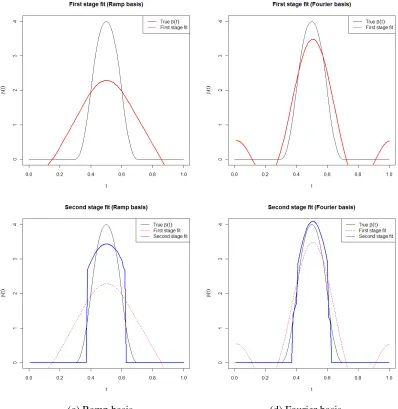
The second stage design matrix,X∗, incorporates the information from the first stage fit. If the coefficient function was estimated accurately, thenθ =1T should do a good job of minimizing Eq. 2.8. If there are regions onβ(t)that can be set to 0 without hurting prediction, the second stage should identify them, giving us a sparse fit. And if the first stage fit is not scaled correctly,
the second stage will modify it to give us a more accurate final result. The final 2-stage estimate
is computed by taking the point-wise product of the two estimated coefficient functions
b
β(t) =βe(t)∗θe(t), (2.9)
whereθe(t) = Pp
j=1θejφj(t), and the{φj(t)}is the 1st order b-spline basis.βb(t)will be set to exactly 0 over intervals where the second-stage selector has specified a region to be 0. By using
this two stage approach, we utilize the sparsity from the Fused LASSO and 1st order b-spline
basis while retaining the good fit from generated in the first stage. The result is that we have
the flexibility to model the coefficient function accurately while still ending up with a sparse
fit.
Also, note that this two stage technique can be applied to any first-stage fit estimate in order to
e
β(t)and then estimateθe(t). Examples of this method using the “ramp” basis to estimateβe(t) are given in Figure 2.3.
2.3.2
Sparsely Observed Trajectories and Measurement error
To this point, we haven’t addressed how to estimate the predictor trajectories, Xi(t). If the curves are fully observed, this is unnecessary. Consider the Canadian weather data. We observe
each trajectory 365 times, making this a close approximation of the ideal situation when the
full curve is observed. In many other applications, substantially less data may be available and
some consideration must be given for finding estimates,Xb(t)of the full curves.
When data is regularly observed on a relatively dense grid, it is possible to smooth each curve
individually. In this case, many options are available. Various scatter plot smoothing methods
(see Cleveland (1979) and Fan and Gijbels (1996) among others) as well as smoothing splines
(Green and Silverman, 1994) are available for this type of analysis. When the data is sparse
and irregularly sampled, estimating the individual curves can be more difficult. In such cases,
it may be better to estimate all of the curves simultaneously. Principal components Analysis
through Conditional Expectation (PACE, Yao et al. (2005b)) is one method for doing this. Once
the principal component functions and scores have been estimated, estimates for the individual
curves can be recovered.
Measurement error adds another level of complexity to the issue. Many of the issues associated
with measurement error for vector data are also relevant to functional data. Particularly, while
it may be possible to find unbiased estimates for each trajectory using smoothing splines as
(c) Ramp basis (d) Fourier basis
estimated with these curves,βb(t), will be biased. When the level of measurement error is very small, effect on the estimator may not be great, but with even modest levels of measurement
error, the estimated coefficient function will be poor. In these cases, a calibration step should
be used when estimating the predictor curves. Zhang et al. (2007) describe a nonparametric
calibration approach which could be used to estimate the predictor trajectories. PACE (Yao
et al., 2005b) is another possibility.
2.3.3
Summary of Algorithm
We summarize our method in three steps:
• Step 0: If necessary, find good estimates for the predictor curves,Xbi(t).
• Step 1: Obtain a good estimate forβ(t). (This can be done using any method; sparsity it not a concern.) Denote this asβe(t)
• Step 2: CreateX∗ and estimate sparsity function,eθ(t).
2.4
Computational issues
2.4.1
Tuning for
λ
1and
λ
2The lasso and fused lasso penalties, λ1 and λ2 respectively, (denoted together as λ) must be
tuned appropriately to get a good fit. For standard penalized regression methods, many
cri-terion for tuning penalty terms exist. In early work, we considered four methods including
Akaike Information Criterion (AIC, Akaike (1974)), Bayesian Information Criterion (BIC,
Schwarz (1978)), Extended Bayesian Information Criterion (EBIC, Chen and Chen (2008)),
and cross-validation (CV). Each has its own unique objective function which we minimize to
find “optimal” values forλ. For cross-validation, we chooseλto minimize the cross-validation
squared prediction error. The squared prediction error for theith observation is
(Yi−Ybiλ)2, (2.10)
whereYbiλis the predicted response for theith curve for a given value ofλ. LetF1, F2, . . . , FK be randomly selected sets such thatF1 ∪F2 ∪. . .∪FK = {1,2, . . . , n} andFk∩Fm = ∅, where1≤m6=k≤n. LetFC
k ={1,2, . . . , n}/Fkbe the compliment ofFk. Then for a given
λ, theK-fold cross-validation squared prediction error is
Errorλ=
K X k=1
X i∈Fk
(Yi−YbFλC
k,i
)2, (2.11)
whereYbλ FC
k,idenotes the predicted response for the
and the smoothing parameter,λ.
Alternatively, we can chooseλbased on any of a few popular tuning criteria. For example, for AIC, we chooseλto maximize
AIC =nlog(bσ2) + 2df, (2.12)
whereσb2 = P
(Yi−Ybi)2 anddf is the model degrees of freedom, defined as the number of unique values taken by theβbin the fused LASSO regression. Similarly, for BIC and EBIC, we have
BIC =nlog(bσ2) +log(n)df, (2.13)
and
EBIC =nlog(bσ2) + (log(n) +log(p))df. (2.14)
These two methods increase the penalty on using more degrees of freedom when the sample
size becomes large with the objective of preventing over-fitting. In the case of EBIC, models
that include larger numbers of basis functions are also penalized for overfitting. This criterion
was originally devised with genome-wide association studies in mind. In that situation,
overfit-ting can lead to high false discovery rates. This can be thought of as analogous to our situation,
To chooseλ, the relevant objective function is optimized using a Newton-related method in the
functionoptim with R (R Development Core Team, 2011). Based on early simulation results
not reported here, cross-validation, BIC, and EBIC are roughly equivalent, with each showing
marginally better performance in some situations. Optimization through cross-validation takes
substantially longer than the alternatives. For the results reported below, EBIC was used to tune
λ.
2.4.2
Numerical integration and other issues
Regardless of whether the curves are fully observed or estimated by smoothing or another
method, it is necessary to integrate the basis functions so that the design matrices can be
pop-ulated. For numerical integration, we use Gaussian quadrature through the gauss.quad.prob
function in the statmod package (with contributions from Yifang Hu et al., 2011). For each
integration, 200 evaluation points are used. The primary reason for using quadrature over the
integratefunction is computation speed. When we treat the full curves as observed (in other
words, we assume no measurement error and perform no smoothing), populating the design
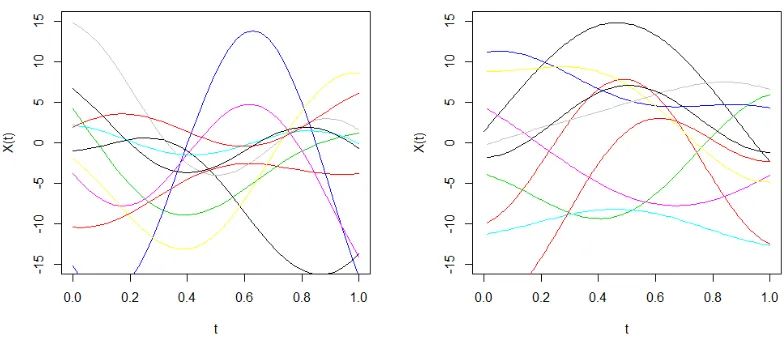
matrix is straightforward for simulated data. If we generate curves,Xi(t) =PKk=1ξikφk(t), for the basis{bj(t)}pj=1, theijth element of the design matrix is
Xij = Z
T
Xi(t)bj(t)dt =
Z
T
K X
k=1
ξikφk(t)bj(t)dt=
K X k=1
ξik Z
T
φk(t)bj(t)dt. (2.15)
X∗i,j =
Z
T
Xi(t)βe(t)bj(t)dt,= K X k=1
ξik Z
T
φk(t)βe(t)bj(t)dt, (2.16)
which once again only requires solvingK×pintegration problems.
When the predictor curves are estimated, each one must be treated individually and, we must
solve
Xij = Z
T
b
Xi(t)bj(t)dt (2.17)
for each observation. This requiresi×K×psteps, requiring substantially more computation time. The same issue occurs when finding the matrix for the second stage estimate. (Note that
this is less of a problem when the predictor curves are estimated using PACE, since each curve
is written using an estimated principal component basis of finite dimension. Quadrature speeds
up this process substantially, and the high number of evaluations ensures that the integral is
accurate.
Finally, the Fused LASSO is fit using quadratic programming. The specifics of how the the
Fused LASSO can be written as a quadratic programming problem are given in the Appendix.
In R, solutions to quadratic programming problems can be found using thesolve.QPfunction
in thequadprogpackage (original by Berwin A. Turlach R port by Andreas Weingessel, 2011).
For the simulations with measurement error, the curves are estimated usingsmooth.splineinR.
2.5
Simulations
We discuss two cases here. In the first case, the data was treated as if the full curve was observed
and there was no measurement error. This is analogous to the Canadian weather data example
discussed earlier. Since the entire curve was observed, the data was not smoothed. To generate
the data, we used five basis functions:
φ0(t) =1 (2.18)
φ1(t) = sin(πt) (2.19)
φ2(t) = cos(πt) (2.20)
φ3(t) = sin(2πt) (2.21)
φ4(t) = cos(2πt), (2.22)
where Xi(t) = P4
k=0ξikfk(t). The ξik are independent and normally distributed with µ =
[0,0,0,0,0]T and variance42 for each coefficient. The recorded response variables are
Yi =
4
X k=0
ξik Z
T
φk(t)β(t)dt+i, (2.23)
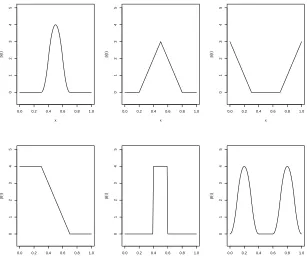
where T = [0,1] and i ≈ N(0, σ2 = 12). The coefficient function, β(t) is one of the six coefficient functions shown in Figure 2.4.
0.0 0.2 0.4 0.6 0.8 1.0 0 1 2 3 4 5 x β ( t )
0.0 0.2 0.4 0.6 0.8 1.0
0 1 2 3 4 5 x β ( t )
0.0 0.2 0.4 0.6 0.8 1.0
0 1 2 3 4 5 x β ( t )
0.0 0.2 0.4 0.6 0.8 1.0
0 1 2 3 4 5 x β ( t )
0.0 0.2 0.4 0.6 0.8 1.0
0 1 2 3 4 5 x β ( t )
0.0 0.2 0.4 0.6 0.8 1.0
0 1 2 3 4 5 x β ( t )
Figure 2.4: Unimodal, Triangle, Valley, Z, Step, and Bimodal coefficient functions (from left to right starting with the top row)
measurement error was present. For this case, we observed 36 time points on a fixed grid such
that Tj = j35−1, j = 1, . . . ,36. At each point, we observe Uij = Xi(Tj) + δij, where δij is measurement error with mean0and variancevar(δij) =γ2. We then smooth each curve using the functionsmooth.splinein R. (R Development Core Team, 2011) As in the case where the
full curve is observed, the response is calculated using the true curve.
2.5.1
Assessing the quality of a fit
In motivating this work, we described two goals. The first was to find a good estimate for the
(a) Without measurement error (b) With measurement error (var(δ) = 0.012)
Figure 2.5: Example curves
the true coefficient function our estimate is. That is, measure the squared difference between
β(t)andβb(t). We denote thisM ISE1 and define it as
M ISE1 =
Z
T
β(t)−βb(t) 2
dt. (2.24)
While this tells us how close our estimate was to the true coefficient function, the utility of
regression also lies in how accurate predictions from the fitted model are. Thus, we also require
a good fit to produce accurate estimates of the response variable. Therefore, we defineM ISE2
to be
M ISE2 =n−1
n X
i=1
Z
T
β(t)Xi(t)dt− Z
T
b
β(t)Xi(t)dt 2
This is similar to the mean squared prediction error except instead ofYiwe use R
T β(t)Xi(t)dt=
Yi−i. SoM ISE2is equivalent to the squared prediction error after removing random error.
The second motivating criterion was to find a fit that was sparse and accurately identified
regions T0 on T where β(t) = 0∀t ∈ T0. Ideally, ∀t ∈ T s.t.β(t) = 0, we would want
b
β(t) = 0as well, and similarly,∀t∈ T s.t.β(t)6= 0, we would wantβb(t)6= 0. We define Type I error rate to be the proportion of points on a fine grid whereβ(t) = 0butβb(t)6= 0, and Type II error rate to be the proportion of points on a fine grid whereβ(t)6= 0butβb(t) = 0. In other words,
T ypeIError =p−11X i∈Ω1
(1−1βb(t
i)=0) (2.26)
T ypeIIError =p−21 X i∈Ω2
(1−1βb(t
i)6=0), (2.27)
whereΩ1andΩ2are the set of indices whereβ(ti) = 0andβ(ti)6= 0respectively, andn1and
n2 are the total time points observed in each of these groups. Note that the Fused LASSO does
not set points to exactly zero but rather to be numerically 0. Thus, we treat any point where
|βb(t)|<10−10as a “zero”. A total of 1000 grid points were used to calculate these error rates.
2.5.2
Simulation Results
For the case where each curve is fully observed, we consider estimates from a variety of
meth-ods. First, we look at the Fused LASSO fit using the 1st order b-spline basis. This can be
viewed as a “baseline” sparse fit using the Fused LASSO. Next, we considered two two-stage
regression with a Fourier basis were considered. For both of these, a second stage estimate was
computed which added sparsity. Finally, we look at the FLiRTI fits withd = 1,2for compar-ison. The result is a total of seven models for each data set, five of which are sparse fits. (The
first stage “ramp” and Fourier fits are non-zero everywhere except where they cross the y-axis.)
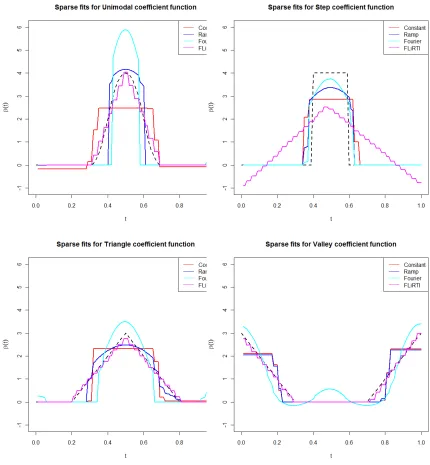
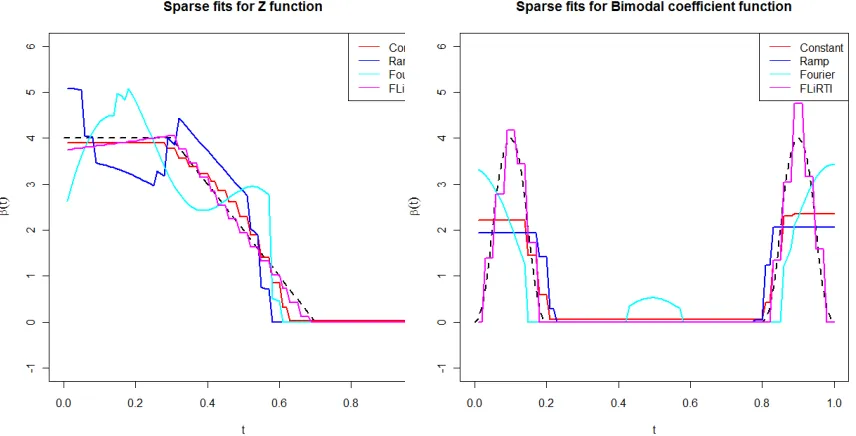
Six coefficient functions defined onT = [0,1]are considered. These can be seen in Figure 2.4. For each coefficient function, we consider sample sizes ofn = 50,100,200,500. Example fits using n = 50 from the 1st order b-spline basis, second stage “ramp”, second stage Fourier, and FLiRTI (d = 2) are given in Figure 2.6 and Figure 2.7. Table 2.1 shows results for all
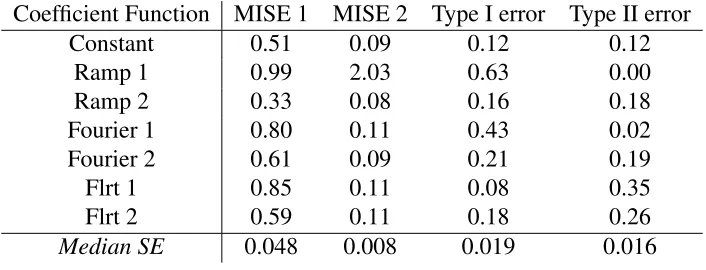
seven fits (including first stage fits that are not sparse) for the unimodal coefficient function
with n = 50. As we can see from this table, the second stage improves over the first stage forM ISE1 andM ISE2 for both cases. The Type I error rate also improves, while the Type
II error rate gets worse. This same trend was observed across all coefficient functions and all
levels ofn. As such, we do not give results for these first stage estimates in the summaries of results that follow. Additionally, the FLiRTI results withd= 2were generally a bit better than ford= 1, so once again in the interest of space, we only report the FLiRTI results ford= 1.
Table 2.1: Simulation results for all methods withβ(t)Unimodal,n= 50,p= 35
Coefficient Function MISE 1 MISE 2 Type I error Type II error
Constant 0.51 0.09 0.12 0.12
Ramp 1 0.99 2.03 0.63 0.00
Ramp 2 0.33 0.08 0.16 0.18
Fourier 1 0.80 0.11 0.43 0.02
Fourier 2 0.61 0.09 0.21 0.19
Flrt 1 0.85 0.11 0.08 0.35
Flrt 2 0.59 0.11 0.18 0.26
Figure 2.7: Sparse fits for different coefficient functions
From Table 2.2, we can see that the second stage ramp fit appears to be best overall when the
sample size is smallest. Asnincreases from 50, however, the FLiRTI method improves quickly at identifying the zero-regions, while the two second stage fits from both the ramp and Fourier
basis struggle. Indeed, we see the Type II error rates for both increase while the Type I error
rates stay largely the same. The best overall method may be the single stage fit using the 1st
order b-spline basis with the Fused LASSO. This method consistently has the lowest Type I
error rate, and its Type II error rate is always first or second best. This comes at a price in terms
of MISE 1, but MISE 2 for this method is competitive with the alternatives.
When we look at the fit for the Z coefficient function, (see Table 2.3) we again see the Fused
LASSO methods generally outperforming FLiRTI in terms of MISE 1. This means that these
methods are doing a better job of finding the shape of the Z coefficient function than FLiRTI.
Table 2.2: Simulation results unimodal coefficient function for different values of n with EBIC tuning. (p= 35)
Error Type Fit n=50 100 200 500
Piecewise Constant 0.51 0.43 0.41 0.32
Ramp 0.33 0.31 0.24 0.22
MISE 1 Fourier 0.61 0.38 0.31 0.17
FLiRTI (d= 2) 0.59 0.41 0.27 0.20
Median SE 0.044 0.037 0.035 0.023 Piecewise Constant 0.09 0.05 0.02 0.01
Ramp 0.08 0.04 0.02 0.009
MISE 2 Fourier 0.09 0.05 0.02 0.01
FLiRTI (d= 2) 0.11 0.05 0.03 0.01
Median SE 0.007 0.004 0.002 0.001 Piecewise Constant 0.12 0.07 0.07 0.06
Type I Ramp 0.16 0.19 0.18 0.20
error Fourier 0.21 0.21 0.16 0.14
FLiRTI (d= 2) 0.18 0.11 0.11 0.13
Median SE 0.020 0.017 0.018 0.016 Piecewise Constant 0.12 0.16 0.15 0.16
Type II Ramp 0.18 0.20 0.23 0.21
error Fourier 0.19 0.17 0.22 0.20
FLiRTI (d= 2) 0.26 0.22 0.18 0.18
Median SE 0.018 0.017 0.015 0.015
fit with the 1st order b-splines has substantially lower Type II error rates than the others, but it
also has the worst Type I error rates. FLiRTI and the second stage ramp fit appear to find the
best balance of the two types of error for the Z coefficient function.
Also, note that for this table, the results reported are the trimmed means for3%trim on either
side. This is due to the fact that the “ramp” basis produced some large outliers withM ISE2
error rates roughly 4 orders of magnitude larger than the other observations. Due to this
excep-tionally poor first order fit, the second order fit was similarly poor. This is indicative of a larger
to be somewhat unstable and will occasionally produce large outliers such as those observed
here. While we didn’t find outliers like this with other coefficient functions, the standard errors
for the ramp basis fits tended to be higher than other methods. The take away is that while the
two stage fitting process can improve poor first order fits, if the initial fit is bad enough, the
second stage fit will also be poor. More succinctly, “garbage in, garbage out.”
Table 2.3: Simulation results for Z coefficient function for different values of n with EBIC tuning. (p= 35) Note: Trimmed means reported.
Error Type Fit n=50 100 200 500
Piecewise Constant 0.11 0.10 0.09 0.10
Ramp 0.39 0.11 0.25 0.20
MISE 1 Fourier 1.09 0.66 0.57 0.57
FLiRTI (d= 2) 0.69 0.69 0.88 1.13
Median SE 0.112 0.074 0.069 0.078 Piecewise Constant 0.11 0.05 0.02 0.01
Ramp 1.48 0.05 0.02 0.01
MISE 2 Fourier 0.12 0.05 0.02 0.01
FLiRTI (d= 2) 0.11 0.06 0.03 0.01
Median SE 0.012 0.005 0.002 0.001 Piecewise Constant 0.31 0.34 0.48 0.55
Type I Ramp 0.24 0.15 0.24 0.19
error Fourier 0.12 0.06 0.06 0.07
FLiRTI (d= 2) 0.19 0.15 0.13 0.13
Median SE 0.033 0.033 0.033 0.033 Piecewise Constant 0.06 0.05 0.03 0.03
Type II Ramp 0.10 0.08 0.06 0.07
error Fourier 0.19 0.10 0.22 0.21
FLiRTI (d= 2) 0.08 0.07 0.10 0.12
Median SE 0.06 0.08 0.06 0.08
The Bimodal coefficient function proves difficult for the Fused LASSO-based methods to
model. This is to be expected, since these methods penalize large jumps in coefficient value,
method. However, MISE 2 is nearly equal across the board, and Type I and Type II error rates
show divergent results, with FLiRTI having very low Type I error but correspondingly high
Type II error, and the Fused LASSO based methods showing the opposite.
Results for the Step, Triangle, and Valley coefficient functions are given in the Appendix.
Table 2.4: Simulation results for bimodal coefficient function for different values of n with EBIC tuning. (p= 35)
Error Type Fit n=50 100 200 1000
Piecewise Constant 0.88 0.85 0.81 0.84
MISE 1 Ramp 0.94 0.86 0.84 0.78
Fourier 1.42 1.04 0.92 0.89
FLiRTI (d= 2) 0.86 0.75 0.63 0.61
Median SE 0.038 0.033 0.023 0.021 Piecewise Constant 0.11 0.05 0.02 0.01
Ramp 0.14 0.08 0.03 0.01
MISE 2 Fourier 0.12 0.06 0.02 0.01
FLiRTI (d= 2) 0.12 0.06 0.03 0.01
Median SE 0.009 0.005 0.002 0.001 Piecewise Constant 0.14 0.16 0.13 0.18
Type I Ramp 0.18 0.21 0.16 0.15
error Fourier 0.28 0.23 0.27 0.23
FLiRTI (d= 2) 0.22 0.19 0.13 0.09
Median SE 0.018 0.024 0.022 0.021 Piecewise Constant 0.01 0.01 0.00 0.00
Type II Ramp 0.01 0.01 0.01 0.02
error Fourier 0.06 0.03 0.01 0.00
FLiRTI (d= 2) 0.06 0.09 0.14 0.21
2.5.3
Sparely Observed Curves with Measurement Error
The previous results assumed the curves were fully observed, which is often unrealistic in
functional data analysis. Here, we perform simulations where each curve is observed sparsely
with small measurement error. On a grid of36fixed time points, we observeUij =Xi(Tij)+δij, where δij ≈ N(0, γ2). Below, we report results from simulations using the Unimodal and Z coefficient function with γ = 0.01,0.025. We estimate each curve using a smoothing spline over the observed time points.
Simulations using the Unimodal coefficient function show that the FLiRTI (d = 2) method is
probably the best of the four estimates looked at. (See Table 2.5.) For this coefficient function,
only the single stage Fused LASSO fit with the 1st order b-spline basis was competitive.
How-ever, note that as the measurement error was increased fromγ = 0.01to0.025, the difference between these two became closer, with the Fused LASSO performing better inM ISE2 and
Type II error and FLiRTI performing better in the other categories.
Table 2.5: Error rates for Unimodal coefficient with measurement error
γ Fit MISE1 MISE2 Type I errror Type II error
Fused Lasso 0.272 0.028 0.291 0.128
0.01 2nd Stage Ramp 0.353 0.035 0.149 0.258
FLiRTI 1 0.458 0.037 0.085 0.331
FLiRTI2 0.268 0.041 0.166 0.158
Fused Lasso 0.361 0.037 0.362 0.123
0.025 2nd Stage Ramp 0.540 0.059 0.207 0.273
FLiRTI 1 0.622 0.065 0.161 0.303
FLiRTI2 0.357 0.068 0.198 0.204
the Fused LASSO-based methods perform much better than both FLiRTI methods across the
board. Between the two-stage “ramp” basis fit and the single stage 1st order b-spline fit, it is
unclear which is the best. Both have similar M ISE2s, and while the single stage method is
substantially better forM ISE1, its Type I error rate is much worse than the two stage
alter-native. Together with the results from the Unimodal coefficient function simulation, we can
say that the two-stage Fused LASSO method works with some degree of success for data with
measurement error. While its performance relative to FLiRTI clearly depends on the coefficient
function, a single stage fit using 1st order b-splines and the Fused LASSO appears to always
perform pretty well.
Table 2.6: Error rates for Z coefficient function with measurement error
γ Fit MISE1 MISE2 Type I errror Type II error
Fused Lasso 0.182 0.074 0.477 0.011
0.01 2nd Stage Ramp 0.492 0.079 0.099 0.032
FLiRTI 1 1.363 0.106 0.854 0.074
FLiRTI2 0.909 0.108 0.559 0.045
Fused Lasso 0.209 0.090 0.422 0.014
0.025 2nd Stage Ramp 0.518 0.096 0.145 0.035
FLiRTI 1 1.419 0.130 0.791 0.072
FLiRTI2 0.929 0.126 0.555 0.045
For this simulation, the measurement error included was very small. (The standard deviation
ofγ was0.01,0.025 compared to a standard deviation of4for the basis function coefficients used to generate the curves.) Since the error was small, the results were still reasonable, but we