ISSN(Online) : 2319-8753 ISSN (Print) : 2347-6710
International Journal of Innovative Research in Science,
Engineering and Technology
(An ISO 3297: 2007 Certified Organization)
Vol. 5, Issue 3, March 2016
Developing an Appropriate Critical Chain
Project Management System to MRTS
Elevated Station Platform Structure at
Adampakkam
D.Pragadeesh Kumar1, L.Sabari Giri Vasan2
M. Tech, Department of Civil Engineering, SRM University, Chennai, India1 Assistant Professor, Department of Civil Engineering, SRM University, Chennai, India2
ABSTRACT: Critical chain project management is a new, popular project management paradigm for planning and managing the project. CCPM differs from the traditional methods that derives from critical path method (CPM) and program evaluation review technique (PERT) algorithms which emphasizes the task order and rigid scheduling. In critical chain project management, the uncertainty is aggregated into buffers at the end of the activity path. The project buffers protect the overall project completion on the critical path and feeding buffers protect the critical chain from path merging. Critical chain project management is adopted in these project to reduce the time duration of the project so that the time delay and cost incurred due to delay can be reduced and the project can be finished within the due date. Project that use critical chain project management have a greatly improved record of schedule, cost and scope performance. Experience with critical chain project management projects demonstrates completion is less than one half the time of the project using pervious planning and controlling methods.
KEYWORDS: Critical chain project management, Buffers.
I. INTRODUCTION
Project management is a process and activity of planning, organizing, motivating and controlling the resource, procedures to achieve specific goal. There are number of approach available for managing project activities. Critical chain project management is one of the approach for managing project activities. Critical chain project management (CCPM) is a method of planning and managing project that emphasizes the resources (people, equipment, physical space) required to execute project tasks. A critical chain project network strives to keep resources levelled, and requires that they be flexible in start times. Critical chain project management is derived from the Theory of Constraint. The idea was introduced by Eliyahu M. Goldratt in 1997. Theory of Constraint is a tool for managing repetitive production system based on the principle that every system has a constraint and system performance can only be improved by enhancing the performance of constraining resource. critical chain project management is an extension of theory of constraint designed specially for project environment. To minimize constraints and work more efficiently toward accomplishing your goals by working through these steps:
1.Identify the constraint. 2. Manage the constraint. 3. Evaluate performance. These are the three steps to be followed to minimize the constraints and work more efficiently to achieve our goal.
II. LITERATURE SURVEY
ISSN(Online) : 2319-8753 ISSN (Print) : 2347-6710
International Journal of Innovative Research in Science,
Engineering and Technology
(An ISO 3297: 2007 Certified Organization)
Vol. 5, Issue 3, March 2016
management enhances measurement and decision making for project control. Eliyahu Goldratt,M.(1997).book titled. explains Critical chain project management is a methodology for planning, executing and managing project in single and multi-project environment. It was developed in response to many projects being dogged by poor performance manifested in longer than expected duration, frequently missed deadlines, increased cost in excess of budget and substantially less deliverables than original promised. Eliyahu goldratt,m.(1997). problems with traditional project management” explains for a project, plan is taken, estimate is prepared. The accurate estimate give confidence that the project can finish within the schedule. The additional time or safety buffers in the task make the workers to feel following way Students syndrome means Not starting the task until the last moment. Parkinson law means delaying the completion of the task. Dropped Baton means the time gained from starting and completing an activity early could be wasted if the next group of workers who is responsible for receiving the output of the activity work is not ready. Eliyahu Goldratt,M.(1984).book titled. The Goal explains Critical chain project management is derived from Theory of Constraint. There is least one constraint that will stop in achieving the goal. Theory of constraint uses focusing process to identify the constraint and restructure the rest of the organization around it. The focusing process are Identify the system constraint, Exploit the system constraint Subordinate everything else to the system constraint, Evaluate the system constraint. If in previous step, a new constraint has been uncovered, repeat the process.
III. AN OVERVEIW OF THE CRITICAL CHAIN PROJECT MANAGEMENT
ISSN(Online) : 2319-8753 ISSN (Print) : 2347-6710
International Journal of Innovative Research in Science,
Engineering and Technology
(An ISO 3297: 2007 Certified Organization)
Vol. 5, Issue 3, March 2016
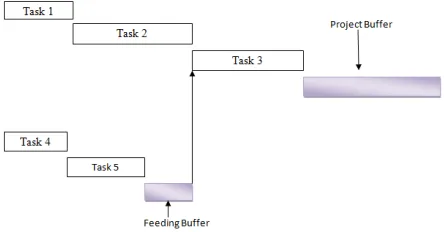
Figure 1 Explains the buffers of ccpm and traditional approach.
The buffers, which were previously hidden in each task, have been made explicit and pooled. This pooled buffer is called the “Project Buffer”. Note that by calculating the project buffer the total duration of the project did not increase: Under CCPM the project buffer is considered part of the project and as such must be scheduled and assigned resources. Also, a Gantt chart showing the project buffer serves to communicate the inherent uncertainty in the project, as opposed to a conventional Gantt chart that presents a spurious air of certainty. It is improbable that all the critical chain tasks will exceed their 50% likelihood duration estimates: under the assumption of statistical independence, about half will complete over while the other half will complete under. By pooling together the safety margins of the individual task, the protection against uncertainty is improved, so CCPM suggests that the combined project buffer can be less than the sum of the safety margins of the individual tasks. This argument is supported by statistical theory that states that the standard deviation of the sum of a number of mutually independent random variables (in this case, the actual durations of the tasks on the path) is less than the sum of the individual standard deviations. Although the assumption of statistical independence of tasks durations is questionable, in theory this justifies reducing the overall duration of the project. In practice, it may be easier to gain task owners’ acceptance of pooling their individual task buffers if the total is not reduced. The same process of making safety margins explicit and pooling them can be applied to non-critical paths. As before, the safety margin in each task is identified, taken out, and pooled at the end of the path. Because this buffer is placed where the path feeds back into the critical chain path, it is called “Feeding Buffer”.
Figure 2 Explains the buffer is feeded in critical chain path.
ISSN(Online) : 2319-8753 ISSN (Print) : 2347-6710
International Journal of Innovative Research in Science,
Engineering and Technology
(An ISO 3297: 2007 Certified Organization)
Vol. 5, Issue 3, March 2016
assigned is due to start shortly. According to CCPM, this “wakeup call” will cause the critical resource to wrap up any non-critical work that it is involved with, and to be ready to start work on the critical chain task as soon as its predecessors are completed. The resource buffer does not actually consume any resource, and it adds neither time nor cost to the project. At this point CCPM has created a new project schedule, which consists of the original tasks with reduced durations, and various types of buffers: the project buffer, the feeding buffers and the resource buffers. For the execution of the project plan, CCPM prescribes the following principles.
• Resources working on critical-chain tasks are expected to work continuously on a single task at a time. They do not work on several tasks in parallel, or suspend their critical tasks to do other work.
• Further, resources are to complete the task assigned as soon as possible, regardless of the dates on the schedule. • If the task is completed ahead of schedule, then work on its successor is to begin immediately. If the task successor utilizes a critical resource for which a resource buffer has been defined, then advance warning is provided to that resource at the point in time where the
resource buffer begins.
• If the task is completed past its planned completion date as shown on the CCPM schedule, then this is no reason for immediate concern, as the buffer on the chain on which the task is situated will absorb the delay.
As progress is reported the CCPM schedule is recalculated, keeping the final due date of the project constant by adjusting buffer sizes. Project control focuses on consumption of the buffer. If buffer consumption is out of proportion then this becomes a clear indication for implementing corrective actions, such as reassignment of resources to the tasks on the chains leading to the buffer in question. In this manner, the extent of buffer utilization serves to monitor the likelihood of project completion by its committed due date.
ISSN(Online) : 2319-8753 ISSN (Print) : 2347-6710
International Journal of Innovative Research in Science,
Engineering and Technology
(An ISO 3297: 2007 Certified Organization)
Vol. 5, Issue 3, March 2016
The methodology involved in collection of data from the site required for project. The data include general information about project, plan etc. after that work breakdown structure of activity or task is prepared. According to PMBOOK work break down structure is defined as deliverable orientated hierarchical decomposition of work to be executed by the project team. Next step is estimation. Estimation is done to find out how much quantity of work to be done. Next step is scheduling. In scheduling duration of the task, resources required for the activity or task which is arranged in sequence manner is determined. After that Using network diagram critical path is determined. Next critical chain project management technique is applied and compare the difference in time taken traditional approach and critical chain project management approach.
V. APPLYING CCPM TECHNIQUE
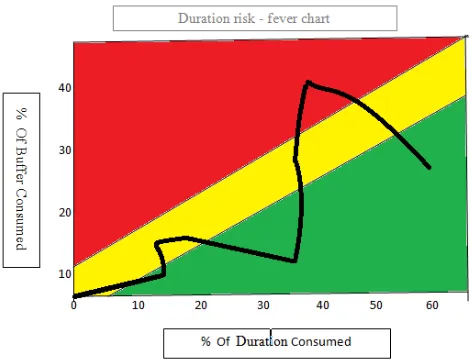
Before applying critical chain project management, list of task along with their duration estimate and dependencies are determined. After that ccpm technique is applied. First step in ccpm technique is cut off the original time duration calculated in every task or activity by 20%. For example 10 hours duration is allocated to complete a activity. It should be cut off to 8hours. However due to complexity of particular task it may not possible to cut off the time estimate by 20%. In that situation time estimate should not be removed off. The difference between the original time and new cut off time duration is called as project buffer. For example excavation of pile cap ( where excavation is activity and pile cap is milestone) is delayed by 2 days means the delayed 2 days should be added to project buffer. CCPM adds on provide a useful feature to track the project in graphical manner. It is divided into three zones. The three zones are green, yellow, red. These chart signify the progress of the project by measuring the delay which is pooled into project buffer. The project is in green zone the project is under control. The project is in yellow zone the project is under control. However the manager should look for the issue that cause the delay. The project is in red zone means the project is not under control. so some necessary steps to be taken to bring back the project under control.
Fig 3 Explains duration risk chart
VI. CONCLUSION
ISSN(Online) : 2319-8753 ISSN (Print) : 2347-6710
International Journal of Innovative Research in Science,
Engineering and Technology
(An ISO 3297: 2007 Certified Organization)
Vol. 5, Issue 3, March 2016
MILESTONE ACTIVITY
TRADITIONAL APPROCH
(days)
CRICTICAL CHAIN PROJECT MANAGEMENT(days)
Pile phase 1.2 1 pile cap pc1 9.5 7.7 Pile cap pc1e 9.5 7.7 pile cap pc2 9 7.3 pile cap pc2e 9.5 7.7 pile cap pc3 10.5 8.5 column first
level 5 4 Mezzanine
beam 17 13.5 column second
level 5 4 platform floor
beam 15 12 column third
level 5 4 Total days 96.2 77.4 The essential changes introduced by Critical Chain Project Management are:
Development of the Critical Chain, using both activity logic and resource constraints.
Reduction of activity estimated times to 50% probability estimates to account for aggregation of
The activity contingency times.
Addition of a Project Buffer to protect completion of the Critical Chain.
Addition of Critical Chain Feeding Buffers to immunize the Critical Chain from delays in the
Feeding chains and merging effects.
Using buffer management as the primary tool for project management and control.
Using behaviors conducive to the global project optima, such as roadrunner activity performance
REFERENCES
1. Goldratt, Eliyachu M. (1984) “the goal” Newyork: North River Press, Cronton-on-Hudson. 2. Goldratt, Eliyachu M.(1990) “the haystack syndrome” Newyork: North River Press, Cronton-on-Hudson. 3. Leach, L.(1999) “critical chain project management improves project performance” Project management journal, 30(2), 39-51.