
Study of Servo Drive Press Technology – A
Review
Priya Vhangade1, D.S.S. Sudhakar2, Rajeev Solanki3
M.E. CAD/CAM & Robotics Student, Department of Mechanical Engineering, Fr. CRCE, Bandra, Mumbai, India1 Associate Professor, Department of Mechanical Engineering, Fr. CRCE, Bandra, Mumbai, India2
Manager, Department of New Product Engineering, M/S Larsen & Toubro, Powai, Mumbai, India3
ABSTRACT: Various metal forming presses that utilize the mechanical servo-drive technology are being developed by several press builders today. The reason being the advanced and better results obtained from the servo press as compared to the mechanical and hydraulic presses solely. Hence, in short the servo press can produce combined results of a mechanical and hydraulic press. The servo drive presses use servo motors which are used for angular positioning; hence flexible slide movements can be achieved with the help of suitable programming. Servo presses are proving to be a revolutionary change in the manufacturing industry. Servo presses have the capability to improve the product quality, productivity and the process conditions as well in the metal forming industry. In the future the servo presses are going to be vastly used by many industries due to its added advantages and for making the metal forming process a lot more easier and efficient. This review paper has given emphasis on recent development and research work in the area of servo press technology and its major applications in the sheet metal forming.
KEYWORDS:Servo press, sheet metal forming, flexibility, slide motion, dwell.
I. INTRODUCTION
Electro-mechanical servo-drives are being used in machine tools for several decades. Many press builders, mainly in japan [2, 3] and Germany [1] have developed different types of servo-drive presses for sheet metal forming processes. Since long the mechanical and hydraulic presses are vastly being used in the stamping industry. But they had some limitations which the servo press is able to cover up to quite some extent. The servo drive presses offer the speed, accuracy and reliability of a mechanical press along with the flexibility of a hydraulic press (that is providing position control at any ram position) [1]. For many years stampers have known the advantages of the ability to adjust the ram speed during the ram stroke and the stroke length in the metal forming process [4].
ISSN(Online) : 2319-8753 ISSN (Print) : 2347-6710
I
nternational
J
ournal of
I
nnovative
R
esearch in
S
cience,
E
ngineering and
T
echnology
(An ISO 3297: 2007 Certified Organization)
Vol. 5, Issue 4, April 2016
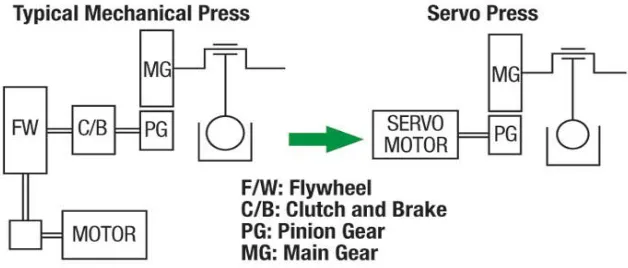
Thus in several applications the hydraulic press capability of providing programmable slide stroke along with the mechanical presses with linkage drives have been used. The hydraulic press can provide maximum tonnage at any point and at any speed in the stroke. The mechanical presses have a variable stroking rate, but the slide motion versus stroke is fixed, although the stroke length and position can be adjusted. The mechanical press designs have variety of drive options such as knuckle-joint, crank, eccentric or link [5]. The mechanical servo press has a simple driving chain without flywheel, brake and clutch that are essential in a conventional mechanical press, as seen in figure 1. Hence all the press motions such as starting, stopping and velocity change are done only by the servo motor in the servo press [6].
The characteristics of servo press that help in optimizing the press forming operations are as follows [1]:
i. To control the velocity of punch during forming, which results in reduced friction and heat generation as well it reduces scrap rates and improves quality.
ii. Adjustable stroke length (BDC and TDC)
iii. To improve part dimensions by dwelling at the BDC (bottom dead center) during the slide stroke and to reduce springback.
iv. To increase productivity by increasing the stroking rate.
v. To improve edge quality in shearing and blanking and also to increase tool life.
vi. Allow other secondary options in the same press by slowing down or stopping the press slide anywhere during the slide stroke to allow for additional tool motions such as assembly, heat forming, in-die operations etc.
vii. To reduce the impact speed and noise [1]. viii. Considerable savings in energy.
ix. Maximum motor torque can be available during the entire stroke.
Thus, these characteristics make the servo press different from the conventional press and they have the capability to bring over a significant change in the manufacturing industry. In a servo press, we can optimize the press cycle for different applications by adjusting the slide motion. This we can see in figure 1(a) [7], where the press cycle of a mechanical press is compared conceptually with that of a servo press.
Figure 1(a). Slide motion flexibility in servo drive presses [7, 1].
Figure 1(b). Typical slide motions of servo-press [8].
Almost all the motions can be realized by the servo presses, the following merits are considered to be brought about by choosing a motion according to the purpose [6, 8].
1. The characteristic motions of link press and crank press can be duplicated by a servo press due to its flexible motions.
2. The working limit can be extended by using an oscillating or pulsating slide motion and lubrication can also be improved.
3. As the touching speed of the tool to the workpiece can be reduced; the tool life is extended and impact loading can also be avoided.
4. Break-through noises are reduced as the slide speed can be reduced or it can also be stopped.
5. The vibration and friction of sheet metal can be reduced by optimizing the slide motion and a stabilized shape can be achieved.
6. By choosing an optimum slide motion and by controlling the slide parallelism the accuracy of the product can be improved.
7. Higher productivity is possible as we can shorten the forming cycle with a partial short stroke around the bdc and set a high speed return motion, hence reducing the total time and increasing the productivity [6].
II. LITERATURE REVIEW
T. Altan, A. Groseclose (2009) [1] studied and reviewed the servo drive presses and their capability to improve productivity and to improve process conditions in metal forming. He has also elaborated about the applications of these presses in various sheet metal forming processes such as deep drawing, blanking, warm forming etc. the literature also describes about various press designs and major applications.
Kozo Osakada, D.,; Ken-ichiro Mori, Dr.; Taylan Altan, Dr.; Peter Groche, Dr. (2011) [6] conducted study on the mechanical servo drive presses. They also studied about the flexibility and slide control of ram motion in the servo press. Hence, because of which various problems in sheet metal processes can be solved and the applications are explained in detail.
OmidMajidi, Myoung-Gyu Lee, Frederic Barlat. (2014) [19] studied the U-draw bending of a DP780 sheet using a direct-drive digital servo-press.The results were formulated by drawing tests conducted in a conventional mode and a non-conventional mode. Fe simulations were performed to simulate the results.
ISSN(Online) : 2319-8753 ISSN (Print) : 2347-6710
I
nternational
J
ournal of
I
nnovative
R
esearch in
S
cience,
E
ngineering and
T
echnology
(An ISO 3297: 2007 Certified Organization)
Vol. 5, Issue 4, April 2016
Soo-Young Kim*, Kaoru Tsuruoka, Tadashi Yamamoto, (2014) [21] investigated the process design method for precision forging combined with flexible and complex motions realized using servo press machine with the aid of design of experiment study and CAE technology. The study provides useful information on the effects of press motion for important process outputs, such as forming load and deformation behaviour of workpiece.
Hence, from above discussion and findings it is clear that researchers are finding wide scope in the sheet metal forming method using the servo-drive presses. It is also clear that by using the servo press various defects or sheet metal forming problems can be overcome by combining it with smart selection of the tool geometry and materials. The servo press would hence increase productivity as well as the quality of the products.
III.SERVO PRESS-DRIVE MECHANISMS
Servo press drives can be mainly classified into two types, namely drive systems that use [1] 1) low torque-high speed servo motors or 2) high torque-low speed servo motors.
3.1 Drive mechanism with “low torque high-speed” motors
High speed motors were used in the first generation servo presses. This drive configuration makes use of linkage, belt and ball screw drives to transform the rotational motion into the linear motion of the press slide as shown in figure 3.1 [7,1].
Figure 3.1. Servo presses with high speed-low torque servo motors with belt and ball screw drive [7].
This drive allows for an efficient and compact motor, but has drawbacks. The need to down-gear a high-RPM motor to generate torque requires additional drive components and belts, increasing service requirements and maintenance. Also, because of the knuckle or link-style drive train, the mechanical linkages generate the required thrust, which can negatively affect torque and tonnage, especially high in the stroke.
3.2 Drive mechanism with “high torque low-speed” motors
Figure 3.2. Direct gear driven gap press with servo drive, where the press drive shaft is directly coupled to the high torque servo motor [4, 18].
The servo drive presses offer considerable energy savings, especially in large capacity presses along with providing flexibility of controlling the slide motion. In servo presses, the installed motor power is larger than in comparable capacity mechanical presses. However the servo motor power is only used when the press is operated to conduct a stamping operation (blanking, deep drawing, coining), since there is no clutch/brake mechanism as well as no continuously rotating flywheel. Furthermore, during the dynamic braking operation of the servo-motors, the braking energy is re-fed into the power system. Also it is possible to install an external energy storage capability to compensate for energy peak requirements and reduce the nominal power drawn from the local power supply system [1].
IV.SERVO MOTOR DRIVEN PRESS DESIGNS
Conventional presses are classified into energy controlled presses (hammer, screw press) stroke controlled presses (crank press, linkage press, knuckle-joint press) and force controlled presses (hydraulic press) [9]. The common feature of these presses is that the rotational movement of motor is mechanically converted into the linear slide movement. But to carry the metal forming operations huge amount of power is required which cannot be directly achieved by the conventional motor, hence the energy supplied by the motor is stored into the flywheel as the rotating kinetic energy and is released in a short time when forming is carried out [6]. Hence compared to using the conventional motor, using the servo motor would be more efficient andbeneficial as it eliminates the flywheel and clutch brake arrangement. Plus more flexible movements of the slide stroke can be achieved by using the servo motor. Hence some of the types of presses driven by servo-motors are as follows [6]:
a) Servo-motor and ball screw driven presses. b) Servo-motor driven linkage presses. c) Servo-motor driven crank presses.
d) Hybrid servo press with ball screw and knuckle- joint. e) Servo-motor driven hydraulic press.
V. APPLICATIONS
ISSN(Online) : 2319-8753 ISSN (Print) : 2347-6710
I
nternational
J
ournal of
I
nnovative
R
esearch in
S
cience,
E
ngineering and
T
echnology
(An ISO 3297: 2007 Certified Organization)
Vol. 5, Issue 4, April 2016
[10]. The in-die operations included hot stamping, assembly, in-die heating etc. Major applications have emerged as the research groups and industries are exploring the uses of servo presses [1, 6].
5.1. Deep drawing
5.1.1 Deep drawing with variable blank holder force
It is possible to vary the blank holder force (BHF) during a process by combining a hydraulic and a servo press or servo motor driven die cushions [11]. Changing the blank holder force helps to prevent wrinkling of flange while moving the cushion with the same speed as slide. Hence for avoiding wrinkling and fracture during large deformation in deep drawing, it is necessary to maintain optimum BHF according to the different operations being carried [12].
5.1.2 Deep drawing with different slide motions
During deep drawing it’s important to reduce the friction so as to achieve a successful deep drawing operation. By applying the stepwise or varying drawing force, friction could be reduced producing better deep drawing results. Also it was found that wrinkling in deep drawing could also be prevented by the stepwise drawing motion [13]. Thus the variable slide motions of the servo press yield better results compared to the conventional press.
5.2 shearing
With the help of variable punch speed there was a reduction in noise during shearing. Because of the variable slide motion the punch could be stopped midway during shearing and then accelerated to finish shearing in a servo press [14]. In the shearing of sheets and plates if the shearing direction is reversed twice, then it can prevent the burr formation too [15].
5.3 Burr-Free Blanking
Burr free blanking could also be obtained by using the appropriate slide motion. For e.g. one can bring down the slide up to half distance at a particular speed and then travel with a higher speed. Also the die punch clearance and the punch edge radius play an important role in obtaining burr free blanking.
5.4 Improvement of Die Life in Blanking
Studies show that we obtain better die life in servo press compared to conventional mechanical press using the same tools. The actual blanking velocity in the servo press was considerably reduced compared to the mechanical press, whereas the strokes per minute in both presses where kept approximately same [7]. Hence, the punch in the mechanical press needed regrinding after blanking much before that of the servo press punch.
5.5 Reduction in Springback
Springback mostly happens in high strength steels or alloys. It is very important to reduce springback. The variable slide motion/velocity with different BDC positions plays an important role in reducing the springback effect.
5.6 bending
5.7 ironing
“Vibratory ironing” a new method, where by one could apply a stepwise motion to the ironing of cups [16]. By the vibratory ironing method, a larger reduction in thickness was attained.
5.8 hot stamping
The problems encountered in forming of higher strength steel sheets can be effectively solved by hot stamping. Heating the sheets improve formability, reduces spring-back and forming load is also lowered [6]. In-die hot stamping of sheet metals is a very important application, as many operations can be covered up within one press. Also it saves time, increases the productivity and eases the manufacturing process.
VI.INDUSTRIAL TREND
In the sheet metal forming industry, servo presses are used mainly to improve the dimensional accuracy of the product, to improve productivity and the forming limit. Tandem press lines for stamping of automobile bodies have been built to attain better productivity and greater formability [6]. Some of the modern stamping lines using large servo-drive presses are as follows [17]:
(1) HONDA - Suzuka (Japan) – AIDA 2009 – 2500 ton tandem line – 18 SPM.
(2) BMW- Leipzig & Regensburg (Germany) – SCHULER 2009 - 2500 ton servo-drive drawing press - 17 SPM. (3) Kamtek/COSMA – AIDA 2011 - 3,000 ton, 30 strokes/min.
(4) Honda-America – Ohio and Alabama - AIDA 2012 - 2,500 ton tandem lines.
(5) BMW – Leipzig, Regensburg and Shenyang (China) – SCHULER – 2012 – 7 tandem lines on order. (6) Hyundai – Korea – ROTEM 2012 – 1000 ton Tandem line.
Hence the benefits obtained by using servo press are huge, as they have a growing number of applications and will also improve the quality of product as well as increase productivity.
VII. FUTURE SCOPE
Servo presses have large scope into the manufacturing systems due to the continuous change in the manufacturing/production industry. The future scope will vary and grow by the various factors in the manufacturing industry. Following are some of the scopes [6]:
(1) The combination of various manufacturing processes can be made possible by integrating the servo presses accordingly.
(2) The number of driving axes of each servo press can be increased, and also the majority of the presses would be replaced by servo presses.
(3) By using the multiple driving axes and flexible slide motion different innovative and efficient forming methods can be developed.
(4) Computer simulation of forming processes could be carried out to optimize the complicated slide motion of servo presses.
(5) As servo presses do not cause impact noises and strong vibrations they can be used on the same floor as the cutting machine tools to make smooth production lines and to make handling of both machines easy.
ISSN(Online) : 2319-8753 ISSN (Print) : 2347-6710
I
nternational
J
ournal of
I
nnovative
R
esearch in
S
cience,
E
ngineering and
T
echnology
(An ISO 3297: 2007 Certified Organization)
Vol. 5, Issue 4, April 2016
VIII. CONCLUSION
This review is attempting to summarize the information on servo-drive presses and to know about its growing importance and its various applications in the manufacturing industry. The link-assisted and direct drive servo press technologies are discussed. An overview of the types of servo motors, various servo press designs and hence their apparent advantages is summarized in short.
The programmable slide motions of the servo press are its unique and important feature. Because of which various problems such as shearing, wrinkling, thinning etc. can be overcome by varying the velocity and motion of the slide stroke. Along with this the ability to dwell at the BDC which helps in performing in-die operations is an important feature of the servo press as it helps in reducing the number of forming steps and also allow forming of more complex parts in one press [1]. Thus if the servo press controls are combined together with good die/tool design strategy, it will help in increasing the productivity as well as in saving time. Because of all these advantages many industries are now opting for the servo press and within some years the servo press would be used globally for production processes.
REFERENCES
[1] Altan, T., Groseclose, A., 2009, Servo-Drive Presses – Recent Developments.
[2] Ando, H., 2004, Application of Servo System in Recent Press Machines, Journal of the Japan Society for Technology of Plasticity, 45/526:
877-882. (In Japanese)
[3] Japan Machinery Federation, Japan Forming Machinery Association, 2005, Standardization of Servo-Motor Drive Press Machines. (In
Japanese)
[4] Boerger, D., “Servo Technology Meets Mechanical Presses”, Stamping Journal, 32-33, Nov/Dec. 2003.
[5] Osborn, J. and Stephan, P., “Servo Press Technology – Drive Design and Performance”, Metal forming, p.18, August 2008.
[6] K. Osakada, K. Mori, T. Altan, P. Groche, “Mechanical servo press technology for metal forming”, CIRP annals-Manufacturing Technology,
2011.
[7] Miyoshi, K., “Current Trends in Free Motion Presses”, Proceedings of the 3rd Japan Society for Technology of Plasticity (JSTP), Int. Seminar
on Precision Forming, March 2004.
[8] Amada Co., Ltd. HP: http://www.amada.co.jp/english/
[9] Lange, K., 1985, Handbook of Metal Forming, McGraw-Hill, 8.3.
[10] Huelshorst, J., “Merging Manufacturing Processes (MMP)”, (in German) Proceedings of the 19th Forming Technology Conference, p.161,
2008, Hannover, Germany.
[11] Ando, H., Development of Press Machine and Introduction of Examples by Servo Press, 55th JSTP Hokuriku Branch Seminar, 1-22, 2005. (in
Japanese)
[12] Yossifon, S., Messerly, D., Kropp, E., Shivpuri, R., Altan, T., A Servo-motor Driven Multi-action Press for Sheet Metal Forming,
International Journal of Machine Tools and Manufacture, 31/3: 345-359, 1991.
[13] Komatsu, I., Murakami, T., Practical Use of Servo Press, TheNikkan Kogyo Shimbun, Ltd., 48-49, 2009. (in Japanese)
[14] Otsu, M., Yamagata, C., Osakada, K., Reduction of Blanking Noise by Controlling Press Motion, CIRP Annals – Manufacturing Technology,
52/1:245-248, 2003.
[15] Maeda, T., Reciprocating Blanking, Science of Machine, 10/1:140-144, 1958. (in Japanese)
[16] Koga, N.,Asaga, M., Junlapen, K., Deep-drawing and Ironing of 1050 Aluminum Sheets Loaded with Vibration Using NC Servo Press
Machine, Journal of Japan Institute of Light Metals, 57/6: 240-244, 2007. (in Japanese)
[17] Hyunok Kim, Taylan Altan, Use of servo-drive presses with AHSS and Al alloys, EWI Forming Center, OSU - Center for Precision Forming
(CPF), October 15th, 2014.
[18] Dennis Boerger., “The modern mechanical press”, stamping journal, July 2006.
[19] OmidMajidi, Myoung-Gyu Lee, Frederic Barlat, “U-draw bending of DP780 in non-conventional drawing mode using direct-drive digital
servo-press”, 11th International Conference on Technology of Plasticity, ICTP 2014, 19-24, October 2014.
[20] Jun-Ku Lee, Hyun–Cheol Kim, “The optimization of servo press method for sheet metal forming”, Theme engineering, Inc., 13th international
LS-DYNA users conference, 2011.
[21] Soo-Young Kim*, Kaoru Tsuruoka, Tadashi Yamamoto, “Effect of forming speed in precision forging process evaluated using CAE
![Figure 1(a). Slide motion flexibility in servo drive presses [7, 1].](https://thumb-us.123doks.com/thumbv2/123dok_us/1648331.1206317/2.595.149.444.513.678/figure-slide-motion-flexibility-servo-drive-presses.webp)
![Figure 1(b). Typical slide motions of servo-press [8].](https://thumb-us.123doks.com/thumbv2/123dok_us/1648331.1206317/3.595.179.418.180.360/figure-b-typical-slide-motions-servo-press.webp)
![Figure 3.2. Direct gear driven gap press with servo drive, where the press drive shaft is directly coupled to the high torque servo motor [4, 18]](https://thumb-us.123doks.com/thumbv2/123dok_us/1648331.1206317/5.595.189.419.189.372/figure-direct-driven-directly-coupled-torque-servo-motor.webp)