Available online: https://edupediapublications.org/journals/index.php/IJR/ P a g e | 430
Design & Development of Unique Models of Large Scale Networks for
Effective Performance and Operational Efficiency
Dammati Pavan Kumar
1, Prof.Dr.G.Manoj Someswar
21. Assistant Professor, Department of CSE, Tirumala Engineering College, Guntur,
Andhra Pradesh, India.
2. Principal & Professor, Dept. of CSE, NRI Institute of Technology, Greater
Hyderabad, Telangana State, India
.
Abstract:
Performance appraisal and analysis methods are principal to the procedure of system convention plan and operations. An assortment of methods have been utilized by specialists as a part of various settings: scientific models eg: TCP models, web models, self-comparative models, topology models, re-enactment stages eg: ns-2, SSFnet, GloMoSim, Genesis, prototyping stages eg: MIT Click Router toolbox [9], XORP, apparatuses for efficient outline of-analyses and investigating parameter state spaces eg: Recursive Random Search, STRESS, trial copying stages eg: Emulab, genuine overlay sending stages eg., Planetlab and true estimation and information sets eg.,CAIDA, Rocket fuel.
The abnormal state inspiration driving the utilization of these instruments is straightforward: to increase fluctuating degrees of subjective and quantitative comprehension of the conduct of the framework under-test. This abnormal state reason converts into various particular lower-level destinations, for example, approval of convention plan and execution for an extensive variety of parameter qualities (parameter affectability), comprehension of convention solidness and flow and examining highlight collaborations between conventions. Extensively, we may outline the target as a mission for general invariant connections between system parameters and convention flow.
Available online: https://edupediapublications.org/journals/index.php/IJR/ P a g e | 431
measurements. We design our research work on an effective inquiry calculation called Recursive Random Search for huge dimensional parameter enhancement and exact displaying of convention execution attributes particularly in attractive regions of the parameter state space. The consequence of this work incorporates a brought together pursuit, observational displaying and streamlining system with exhibited capacity to posture significant vast scale arrangement of configuration addresses and give proper design patterns to unique models effectively.
Keywords: Recursive Random Search, Kernel Processes(KP), Legitimate Procedure (LP), Network
Atomic Operation (NAO), Central Composite Design (CCD), Robust Parameter Design(RPD), Border Gateway Protocol(BGP), Open Shortest Path First (OSPF) protocol, Interior Gateway Protocol (IGP), Internet Protocol(IP), Random Early Detection(RED)
INTRODUCTION
This part concentrates on the inspiration for the
research work, represents the extent of the
postulation and presents the principle
commitments. This definitely includes
motivation to a very great extent.
Motivation
Before we can convey new system conventions
or adjustments to substantial scale
arrangements, certain affirmations of outline,
adaptability and execution must be met. The
systems administration group needs execution
investigation instruments that will help us to
configure, break down, comprehend and work,
thus organizing conventions on a vast scale and
in heterogeneous passage settings. Three
reasons why mimicking the huge scale systems
is troublesome are: scale, heterogeneity and
quick change. Despite the fact that devices like
ns-2 and SSFnet are mainstream for little scale
execution investigation, consolidated with
testbed offices like Emulab and Planetlab, we
trust that quick execution of research on the
extensive scale will require adaptable facility
coupled with meta-reproduction instruments for
vast scale trials, outline and experimental
demonstration of conventional procedures.
On account of the size and extent of such
expansive systems as the Internet or corporate
WANs, presenting new system conventions or
setups can be hazardous. Issues may emerge
coming about because of unforeseen component
connections. Reenactment assumes a urgent part
in permitting system architects to lead
Available online: https://edupediapublications.org/journals/index.php/IJR/ P a g e | 432
regarding new conventions and setups
preceding arrangement. Meta-recreation goes
above and beyond by giving a system to
distinguishing the more noteworthy issues that
emerge from the connections amongst new and
old advancements. Meta-recreation is based on
the top of reproducing experimentation by
making outlines of research work which
prompts to a more mind boggling critical
thinking.
Reenactment frames the reason for testing and
improvement of new system technologies. In
any case, reenactment has been hampered by an
absence of adaptability. Recreation of
substantial scale systems may require
mimicking many thousands to a large number
of independent PCs running different
applications and conventions. [1] In view of
their size, these systems are once in a while
statically decided. Or maybe, they are
continually changing, experiencing equipment
disappointments, convention glitches and
physical connection blackouts. Scaling the
recreation analysis is just a single measurement
of the issue; past scale, we likewise require
models of the dynamic way of such vast scale
systems. Late work in system reenactment has
concentrated for the most part on scale while
dismissing quick change. Normal models
executing in polynomial memory regularly
encounter exponential in-wrinkles in memory
utilization when fast change is displayed.
In the past instances, we additionally required
devices for comprehension the mind boggling
nature of extensive scale systems from an
abnormal state perspective. Deciding merging
rates, throughput, interface clog and bundle
deferrals and system layer reachability data are
all run of the mill cases of execution
measurements. [2] Past estimation of these
measurements, a more itemized examination
incorporates how much certain system
convention parameters have on these impacts.
Notwithstanding essential parameter impacts,
we might likewise want to portray the impacts
between parameters crosswise over
conventions and applications.
We have built up an experimentation stage
called ROSS.Net to take care of a large portion
of these issues. ROSS.Net empowers, in the
zone of reproduction displaying, (i) a hopeful
parallel reenactment motor that influences
memory-proficient reversible calculation as
opposed to utilizing customary state-sparing to
bolster rollback recuperation (ii) systemic
Available online: https://edupediapublications.org/journals/index.php/IJR/ P a g e | 433
development utilizing a blend of library
interfaces to key information structure
calculations. The ultimate objective is for the
scientist to consolidate topology, parameter
setup of data and specifically make a set out of
analyses that execute space and time through
effective models, bringing about exact
responses to the inquiries as done by a model
designer.
To address the issues of understanding of
results, we grew huge scale explore
configuration apparatuses that permitted us to
display and enhance convention reaction. When
all is said in done the convention reaction is a
component of a substantial vector of
parameters, i.e., is a reaction surface in an
expansive dimensional parameter space. We use
the results produced at Global Research
Academy, Hyderabad, Telangana State, India
on a productive hunt calculation (called
Recursive Random Search) for substantial
dimensional parameter enhancement. The
consequence of this research work will
incorporate a brought together hunt,
improvement and displaying system with
exhibited capacity to posture important huge
scale configuration addresses and provide better
and efficient models quickly.
The general objective is to give devices that
drastically enhance the way we concentrate on
system conventions. The stage is fit for
reenacting full convention and parcel level
progression of extensive systems on items
pertaining to uni-processor or multi-processor
equipment.
Essential commitments are made in two
noteworthy regions: adaptable recreation and
substantial scale test outline. This work
additionally has a quick effect in applications
extensively in the region of PC frameworks
where vast scale configuration is vital (eg:
working frameworks, circulated frameworks,
PC design). In any case, we likewise foresee
affect in ranges a long way from PC organizing.
For instance, the extensive scale test plan
systems could be connected to ranges as
differing as modern quality control, farming,
protein collapsing (bioinformatics) and
hypothetical software engineering. These future
applications come from the quick estimate and
displaying elements of our strategies. We take
note of that this postulation interfaces its
extension to accomodate the PC space
arrangement.[3]
Available online: https://edupediapublications.org/journals/index.php/IJR/ P a g e | 434
Three noteworthy commitments are introduced
in this theory. Every commitment finishes a
noteworthy stride forward towards the double
objectives of versatile system reproduction and
vast scale try plan and examination. These
objectives address the bigger points of scale,
heterogeneity and fast change.
The first commitment is in the domain of huge
scale test plan and investigation or
meta-recreation. This commitment gives an
investigation apparatus called ROSS.Net, which
efficiently plans and arranges different
reenactment, explores in the journey of the
general invariant connections amongst
parameters and convention execution reaction.
ROSS.Net unites the four primary regions of
system research: re-enactment, conventional
configuration, organization, display,
estimation and investigation outline. ROSS.Net
is meant to give a good empirical evaluation for
our research work.
ROSS.Net is based upon the second real
commitment of this proposition, ROSS:
Rensselaer's Optimistic Simulation System.
ROSS shows for the first time that stable,
exceedingly proficient execution utilizing little
memory above what the consecutive model
would require is workable for low-occasion
granularity reenactment models. The main
thrust behind these superior and low memory
usage results is the coupling of an effective
pointer-based execution system, Fujimoto's
quick GVT (Global Virtual Time)
calculation[4] for shared memory
multiprocessors, turn around calculation and the
presentation of Kernel Processes (KPs). KPs
bring down fossil gathering overheads by
amassing prepared occasional records. This
perspective permits fossil accumulation to be
finished with more noteworthy recurrence,
accordingly bringing down the general memory
important to maintain steady, effective parallel
execution. These qualities make ROSS a perfect
framework for use in vast scale organization of
reproduction models.
The third significant commitment presents
another conveyed GVT actualization inside
ROSS, warmly named the Seven O' Clock GVT
(Global Virtual Time) calculation. We
formalize the possibility of a Network Atomic
Operation (NAO), which empowers a zero-cost
cut instrument which incredibly streamlines
Available online: https://edupediapublications.org/journals/index.php/IJR/ P a g e | 435
environment. We show its lessened multifaceted
nature by extending Fujimoto's shared memory
calculation to work dispersed over a group of
shared-memory multiprocessors.[5]
Scaling the reproduction stage is only one
measurement of our examination. Reviewing
that past minor scaling of reenactment stages,
we require meta-recreation capacities to remove
and translate significant execution information
from the after effects of various reproductions.
Notwithstanding, there has been little
consideration by the systems administration
look into group on this imperative space of
meta-reenactment, i.e., picking tests, creating
valuable translations and convention execution
displaying. The motivation behind vast scale
test configuration is to methodical detail and
compose various reproduction explores in the
journey of the general invariant connections
amongst parameters and convention execution
reaction, and models of convention conduct in
expansive dimensional parameter state spaces.
Design of Experiments and Empirical
Models
It is necessary to understand that the experiment
design or the design of various experiments
relates various models and balancing out the
difference of the reaction. On the off chance
that the fundamental reaction structure is not
direct, one approach is to construct bring down
request models worked with partial factorial
tests to achieve fascinating ranges where more
itemized (higher-arrangement) demonstrating is
finished. Understood little polynomial-arrange
reaction surface techniques incorporate Central
Composite Design (CCD) (i.e., professional
slicing of second request models),
Box-Behnken plans, Robust Parameter Designs
(RPDs) for holding settings for controllable
factors that minimized the fluctuation
transmitted to the reaction from uncontrolled or
problematic factors have been proposed by
earlier researchers that have been credited for
setting off a quality-control transformation in
the 1980s-90s. [6] In previous research, RPDs
utilize profoundly fractionated factorial plans
and other partial outlines acquired from
orthogonal exhibits.
Shockingly, customary test outlines don't scale
to vast parameter state spaces. Like the region
of huge scale information mining, we keep
running into the supposed revival of
dimensionality which is a hyperspace that turns
out to be restrictively vast to be examined (and
consequently demonstrated) at fine granularity.
Available online: https://edupediapublications.org/journals/index.php/IJR/ P a g e | 436
conduct of intra-space and between area
movement promises given the settings of many
BGP parameters and OSPF interface weights.
We need to settle for sparse experimental
models that specimen at better granularity just
in chose areas of the state space that are found
to give a lot of enthusiasm for our research
work as per a pre-indicated set of
Available online: https://edupediapublications.org/journals/index.php/IJR/ P a g e | 437
Meta-Simulation By Adopting Heuristic Approach
(a) Experiment design in ROSS.Net
(b) Multi-Abstraction paradigm of
Ross.Net
Figure 1: ROSS.Net Modeling and Simulation Concepts
Heuristic Problem Solving and
Black-Box Optimization Approaches
A stage weaker than experimental displaying
(i.e., creating input-yield relapse models) is
enhancement, i.e., to decide the area of the
parameter state space that prompts to the best
execution reaction. Since the reaction surface is
obscure, this question falls into the wide range
of efficient, heuristic critical thinking. The
principle issues in critical thinking includes
building up a comprehension of the trouble of
an issue: size of the hunt space, precision and
simplicity of the assessment work, and the way
of the issue limitations.
The speculation of the reaction surface
improvement is called discovery streamlining
utilizing heuristic hunt strategies. Specifically,
an assortment of system parameter streamlining
inquiries can be scientifically figured (accepting
minimization) and comprehended by such
strategies.
Available online: https://edupediapublications.org/journals/index.php/IJR/ P a g e | 438
x¤ = arg min f(x) (2.1)
x2D
where x is the parameter vector to be
streamlined, D is the parameter space, more
often than not a minimal set in Rn. In these
issues, the target work f(x) is regularly
diagnostically obscure and the capacity
assessment must be accomplished through PC
reenactment or other circuitous ways. This sort
of issues are thus called "discovery"
advancement issues where the target volume is
displayed as a parameter of black-box.
Since little knowledge from the earlier
information is expected, these discovery
advancement issues are viewed as difficult to
settle. Likewise, since the target capacities are
frequently non-straight and multi-modular, this
kind of advancement are additionally called
worldwide streamlining rather than
neighborhood enhancement which has just a
single extraordinary in f(x) and is much simpler
to explain. A large portion of discovery
advancement issues are NP-hard and must be
tackled for close ideal arrangements with
heuristic pursuit calculations. In this class of
strategies, an assortment of exploration
procedures supplement the express
lower-arrangement demonstrating specificity in the
initial part of our research work. In areas of
intrigue, a neighborhood buffer system is
utilized to locate the nearby extrema. Numerous
heuristic transformative pursuit calculations
have been proposed and shown to be
exceptionally effective practically speaking, for
example, multi-begin slope climbing
hereditary/developmental calculations and
reproduced tempering. In any case, there has
been no predictable provide details regarding
their execution. Truth be told, the No Free
Lunch Theorem has hypothetically shown that
regardless of what execution metric is utilized,
no single enhancement calculation can reliably
perform preferred in all issue classes over the
others. The normal execution of any calculation
is the same over all classes of issues; however
there might exist calculations that perform
extremely well for an expansive number of
classes. At the end of the day, there exists no
broad universally handy streamlining
calculation. For one particular class of issues, its
characteristic properties must be precisely
researched to perform productive improvement.
In our research work, we have co-outlined
Available online: https://edupediapublications.org/journals/index.php/IJR/ P a g e | 439
Random Search (RRS) for extensive scale
arrange parameter advancement, depends on the
underlying high-productivity highlight of
irregular examining (i.e., the consequences of
arbitrary inspecting enhances quickly amid
early samples). RRS keeps up this underlying
high-productivity include by always restarting
irregular examining with balanced (i.e.,
re-scaled) specimen spaces. In the explore stage,
RRS takes N tests (N relies on a certainty level,
eg: 95%) and after that progressively restarts
and rescales the hunt in the region of the best
discovered result (exploit stage) to zoom into
find a neighborhood ideal. As appeared in
Figure 2, the best nearby ideal location is then
utilized with future randomized explore tests to
choose where to re-scale (i.e., endeavor) and
search for new neighborhood optima. The RRS
calculation beat conventional pursuit procedures
in different benchmarks and has been
effectively connected in various system
administration circumstances utilizing on-line
recreation eg: OSPF, BGP, RED. For example,
RRS is tried on Schwefel work which is shown
in Figure 3(b) and search methods like
Multi-Start Pattern Search and Controlled Random
Search as shown in Figure 3(a). The figures
demonstrate the normal change with more than
a few keeps running, with tight certainty
interims in the best neighborhood optima (i.e.,
most reduced metric esteem) found as a
component of the combined number of analyses
utilized.
Other than the high productivity in vast
dimensional parameter spaces, the RRS
calculation is powerful to the impact of arbitrary
commotion in the target work due to its premise
in irregular testing and it can consequently bar
immaterial parameters from the streamlining
procedure. These elements are critical for the
efficient enhancement of system convention
arrangement.
RRS: Recursive Random Search
Parameter Space
R
2
R
3 R4Available online: https://edupediapublications.org/journals/index.php/IJR/ P a g e | 440
C
2 C 1
Figure 2: 2D Parameter Space showing RRS Process
In our research work, we have composed
another heuristic hunt calculation, Recursive
Random Search (RRS), for huge scale organize
parameter advancement which depends on the
underlying high-productivity highlight of
irregular inspecting i.e., the consequences of
arbitrary testing enhances quickly amid early
samples. RRS keeps up this underlying
high-proficiency include by always restarting
arbitrary inspecting with balanced ie., re-scaled
example spaces. In the explore stage, RRS
takes N tests (N relies on a certainty level, eg:
95%) and after that progressively restarts and
rescales the inquiry in the region of the best
discovered result namely exploit stage, to zoom
into a nearby ideal location. As indicated in
Figure 2, the best neighborhood ideal location
is then utilized with future randomized explore
tests to choose where to re-scale (i.e., endeavor)
and search for new nearby optima.[7] The RRS
calculation outflanked customary pursuit
procedures in different benchmarks and has
been effectively connected in numerous system
administration circumstances utilizing on-line.
Other than the high proficiency in extensive
dimensional parameter spaces, the RRS
calculation is vigorous to the impact of irregular
clamor in the target work in view of its premise
in arbitrary testing and it can naturally prohibit
insignificant parameters from the streamlining
procedure. These components are essential for
the efficient improvement of system convention
Av ail ab le on lin e:
ht tp s: // e d u p e di a p u bli ca ti o ns .o
Available online: https://edupediapublications.org/journals/index.php/IJR/ P a g e | 442
200-dimensional Schwefel function
85000
Recursive Random Search
80000 Multistart Pattern Search
R
esult
75000
Controlled Random Search
70000
O p t i m i z a t i o n
65000
60000
55000
50000
45000
0 500 1000 1500 2000
Number of function evaluations
(b) Tests on 200-dimensional
Schwefel function
Figure 3: Tests on Schwefel function using Recursive Random Search (RRS)
ROSS.Net Network Modeling and
Simulation Platform
As of now, the systems administration explore
group has built up various demonstrating and
recreation investigate ventures. Current stages
incorporate SSFNet, DaSSF, JavaSIM , Ns and
GloMoSim. There are additionally between
operability stages, for example,
PDNS/Backplane and Genesis which
consolidates these current stages with the end
goal of model reuse and to empower
adaptability through dispersed execution. [8]
Also, the organized Social Networking
Service(SNS), endeavors to reuse calculation in
the area of remote networks. In wired systems,
lining insights are the prevailing calculations
and not radio impedance computations. In this
manner, in light of the fact that a line can
change in flighty ways, we don't trust this
method which will be by and large pertinent in
this space. So then what else is deficient in
these stages? Our response to this question
advocates that the present best in class in
successive, parallel or conveyed stages fail to
address scalability in the following
measurements.
1. Memory Efficient Parallel Models: It
was reported by Nicol that Ns expends 93 KB
for each TCP association, SSFNet (Java
variant) devours 53 KB, JavaSim expends 22
KB for every association and SSFNet (C++
form) devours 18 KB for a dumbbell model
which contains just two switches. Switch states
in models, for example, OSPF and BGP are
fundamentally bigger than for a solitary TCP
association. [9] In this manner, to bolster
million hub topologies, super-PC estimate
addresses spaces are required to execute
Available online: https://edupediapublications.org/journals/index.php/IJR/ P a g e | 443
2. Scalable Performance Under Realistic
Topologies: While reasonable Internet
topologies are being utilized, to date it has not
been demonstrated that current stages can scale
when genuine situations are utilized. For
instance, defeating strength concentrates on
the model requiring to progressively change to
the large scale arrangement of topology (i.e.,
more noteworthy than 1 million hubs) as an
outcome of connection problems, dissent of
administration assaults or switch reboots.
Current successive plat-structures, for example,
Ns and JavaSim, can't execute models much
bigger than couple of thousand hubs.[10] The
current ways to deal with parallel execution, for
example, SSFNet, and DaSSF are attached to
the fundamental static topology structure. The
purpose behind this is on account of these
calculations misuse the dormancy of
connections as a major aspect of the
synchronization calculation. The base inertness
characterizes the degree to which demonstrated
parallelism can be exploited.
In this way, as connections go down, these
parallel methodologies should either square and
be straightened out to prohibit those fizzled
interfaces with a specific end goal to acquire
ideal synchronization overheads or execute
expecting those connections are accessible
however to the detriment of superfluous
synchronization overheads. In either case, it is
misty how these methodologies will scale under
elemental changes in topology.
3. Flexible Subscription of Model
Components: Current demonstrating plat-frames
trade a static model pecking order which adjusts
to the exact specification of utilization as well
as conventions including all sub-layers. For
instance, inside Ns, a TCP model will comprise
of a host reflection, session deliberation (both
beneficiary and sender sides) and in addition an
IP layer.[11] While these layers are fundamental
for copies, an expansive scale reenactment does
not require these deliberations and layers to
deliver a measurably legitimate result. Thusly,
the static chain of importance results in models
that are altogether more overwhelming weight
and on a very basic level less versatile.
Later methodologies incorporate partial breed
liquid stream models which permit a far more
noteworthy measure of foundation for TCP
activity. Be that as it may be, these models
experience the ill effects of an unbounded
blunder rate and can't be dependably utilized
when performing search enhancements.
Ordinarily search enhancements require
Available online: https://edupediapublications.org/journals/index.php/IJR/ P a g e | 444
goal to produce non-irregular results, i.e., the
black-box advancement must be deterministic.
Current Research in Network Modeling
and Simulation
We are driving a push to comprehend the
execution for further reach of a propelled
parallel and disseminated discrete-occasion
re-enactment framework. This study is led with
regards to huge scale arrangement of models.
In these models, the system components (i.e.,
hosts and switches/switches) are separated into
a stack of legitimate procedures (LPs). These
LPs impart by trading time stamp occasional
messages. Such a message is utilized to indicate
the entry of a bundle at a switch or switch
component.
The significant issue when executing such a
model in parallel is guarantee that all occasions
are handled in timestamp arrange. To manage
this synchronization issue there are to a great
extent two classes of methodologies:
traditionalist and idealistic. With regards to
network models, preservationist approaches
either hindrance synchronize LPs at very much
characterized focuses in reenacted time, misuse
the slack time between LPs or some blend of
two varieties. The synchronization recurrence
either hindrance or slack time based is
determined utilizing the base system spread
deferral from an approaching connection to a
host/switch hub. Subsequently, as past noticed,
every single traditionalist method must
influence exact topology structure so as to
accomplish great execution. Owing to that
structure change, the pointless overheads can
come about.
In the momentum of our research work, we
adopt a fundamentally unique strategy which
depends on the theoretical or idealistic
preparing of occasions. Here, processors
execute LP occasions locally in timestamp
arrange. Be that as it may be ought to fit an
occasion from another LP processor touch base
in the goal LP's past, the LP will rollback and
undo any progressions made to its state.
Generally, the fix operation has been sup-ported
by state-sparing. Here, a LP will make either an
entire or fractional duplicate of state factors as
every occasion is handled and re-established in
the right form of state in mimicked time by
moving back.
The key favorable position of a hopeful
approach is that it works in-ward of the basic
system topology. Along these lines, it keeps on
Available online: https://edupediapublications.org/journals/index.php/IJR/ P a g e | 445
notwithstanding amid element changes in
topology. In any case, beforehand, this
provision has been the state-sparing overheads
rule by reducing the estimated costs, bringing
about next to zero increment in execution in
contrast with successive model execution.
To address this issue, we are using another
approach called invert calculation for
understanding the fix operation. [12] Under turn
around calculation, the move back component
in the hopeful test system is acknowledged not
by exemplary state-sparing, but rather by truly
permitting to the best conceivable degree
occasions to execute in reverse. In this manner,
as models are created for parallel execution,
both the forward and turn around execution
code must be composed.
Network Protocol Feature Interactions
Examination of collaborations amongst between
and intra-space directing conventions has been
an alluring exploration theme. In this research
work, through examination of information from
AT&T's BGP (Border Gateway Protocol) and
OSPF (Open Shortest Path First) protocols’
movement estimations, creators demonstrated
that larger part of BGP redesigns are a result of
Hot Potato basic leadership practices of ISPs.
[13] The real test they confronted in their
investigation was to appropriately arrange Hot
Potato BGP redesigns from alternate overhauls
and to precisely coordinate interior OSPF
interface changes as activating occasions to
outside BGP upgrades. Through a period based
coordinating calculation, they numbered BGP
upgrades inferable from Hot Potato impacts in
the ISP's OSPF organize. The principle
distinction in our work is that we needn't bother
with any coordinating or estimation system to
decide OSPF-brought about BGP redesigns or
the other way around. Since our substantial
scale recreation environment is completely
controlled, we can without much of a stretch
follow the reasons for upgrades.
In our research work, as a follow-up to the past
work, creators displayed affectability of BGP
(Border Gateway Protocol) and the system
when all is said to be done with reference to
IGP-brought about Hot Potato changes. At the
point when constructing a scientific model for
dissecting impacts of intra-space Hot Potato
steering changes on between area directing, the
creators got enlivened by multidimensional
information examination of database
frameworks. All the more particularly, they
displayed BGP's affectability to IGP (Interior
Available online: https://edupediapublications.org/journals/index.php/IJR/ P a g e | 446
conceivable IGP (Interior Gateway Protocol)
changes on an information 3D square with three
measurements: (i) IP prefixes, (ii) organize
changes a specific kind of progress, for
example, interface disappointment or
connection weight change, and (iii) areas - the
switch where the change happened. A
component of the shape is set if the relating
departure point for the IP prefix changes
because of the related system change at the
related switch. Like our work, this sort of
information examination is to be sure another
method for communicating every single
conceivable parameter that we use in the trial
outline structure.
The main issue is to identify all conceivable Hot
Potato IGP changes to perform BGP
examination.
Another significant work on examination of
OSPF and BGP connections was displayed in
this connection. As opposed to the investigation
course on breaking down impacts of intra-area
changes on between space directing as in the
fundamental objective of the work in was to
figure out whether BGP flow impact intra-area
steering conduct and thus impact the movement
designing of it. The primary inspiration was to
distinguish if movement grid (which is a major
segment for intra-space activity building) is
Av ail ab le on lin e:
ht tp s: // e d u p e di a p u bli ca ti o ns .o
Sparse Model with 50 Samples 1500
1000
500
0
-500
-1000
-1500
-2000 -1800 -1600 -1400 -1200 -1000 -800 -600 -400 -200 0
(a) The sparse model with 50 samples.
Sparse Model with 200 Samples
2000
1500 1000
500
0
-500 -1000 -1500
-2000 -1800 -1600 -1400 -1200 -1000 -800 -600 -400 -200 0 (b) The sparse model with 200 samples.
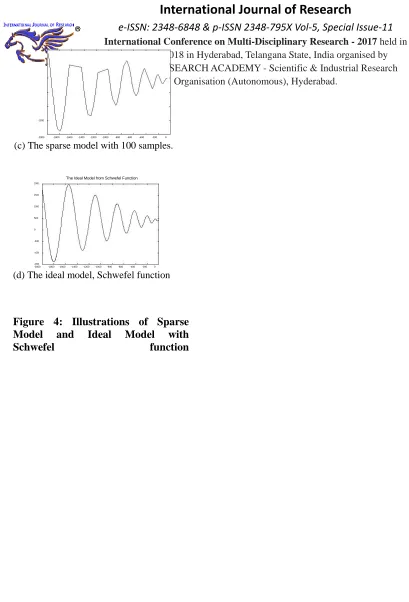
parse Model with 100 Samples
1500
Available online: https://edupediapublications.org/journals/index.php/IJR/ P a g e | 448
-1500
-2000 -1800 -1600 -1400 -1200 -1000 -800 -600 -400 -200 0
(c) The sparse model with 100 samples.
The Ideal Model from Schwefel Function
2000
1500 1000 500 0 -500 -1000 -1500
-2000 -1800 -1600 -1400 -1200 -1000 -800 -600 -400 -200 0
(d) The ideal model, Schwefel function
Figure 4: Illustrations of Sparse Model and Ideal Model with
Available online: https://edupediapublications.org/journals/index.php/IJR/ P a g e | 449
Our research work considered size of the
movement shifts, notwithstanding the tally of
related OSPF and BGP redesigns. We utilized
estimation information from Sprint's BGP
switches, e.g. they watched 133
overhauls/minute for the BGP directing tables of
Sprint. An intriguing perception they have made
is that, contrasted with the aggregate activity, the
measure of volume move due to BGP overhauls
is little. Likewise, earlier researchers found that
BGP overhauls are not disseminated equally over
the steering table, i.e., IP prefixes. Or maybe,
they watched that more drawn out prefixes (i.e.,
littler ASes) get a greater amount of the BGP
redesigns.[14] Essentially, they demonstrated
that elephants (or substantial hitter long
movement streams) are bothered not as much as
mice from BGP overhauls.
Large-Scale Experimental Analysis,
Design and Interpretation incorporating
Meta Simulation Technique
In this research work, we present ROSS.Net. We
lead a contextual investigation of the OSPFv2
organize convention and research co-operations
amongst OSPFv2 and the BGP4 net-work
conventions. Our case arrange concentrated on
AT&T's North American system, which we
considered as a solitary OSPF territory
containing more than 11,000 switches. We figure
a full factorial plan of examinations that
describes a lot of the model space. We contrast
this and the model produced by the Random
Recursive Search (RRS) calculation. The
aftereffects of our correlation underscore RRS's
capacity to produce great results quick by
diminishing the quantity of examinations
gathered from more than 16,000 to 750 with a
difference of just 7% in the reaction plane nearby
minima.[15] We delineate how, by utilizing
ROSS.Net, we could process a basic way
investigation of the OSPF arrange which
prompts to a 100-overlap change in the
inspecting rate.
In our research interpretation of BGP and OSPF
collaborations the case system is extended to 5
little self-sufficient frameworks with OSPF as
the intra-space convention, and BGP as the
between area convention. We indicate
communications between the two as a
correspondence of the impacts between the two
spaces. For instance, if a connection bombs
inside an AS, does this bring about a move in the
reachability of data amongst ASes or the other
way round need to be taken into account.
Explore, Design and Analysis
Execution of investigation procedures are
crucial to the process of convention design and
system operations . The abnormal state
inspiration of these procedures is basic: to
increase fluctuating degrees of subjective and
quantitative comprehension of the conduct of a
framework under-test. Various particular
Available online: https://edupediapublications.org/journals/index.php/IJR/ P a g e | 450
outline and execution for an extensive variety of
parameter qualities (parameter affectability),
comprehension of convention solidness and
progression, and considering highlight
co-operations between conventions.
Comprehensively, we may condense the goal as
a mission for general invariant connections
between system parameters and convention
progression.
Methodical outline of investigations is an all
around examined range of measurements and
execution examination offering direction in this
viewpoint. An overview of significant papers in
the systems administration field recommends
that such methodical strategies (e.g.: factorial
plans, substantial scale seek) have not been
utilized as a part of the convention configuration
process or system operations prepare with the
exception of potentially by estimation masters.
This specially appointed way to deal with sorting
out reenactment or proving ground tests has
worked when we plan and look at a little number
of components, system situations and parameter
settings. In any case, this strategy is probably
going to be untenable as we outline more current
conventions that will quickly be sent on an
expansive scale, or need to manage a
combinatorial blast of highlight associations in
huge operational between systems. The
requirement for adaptable re-enactment and
meta-recreation apparatuses is certain in our
research work. It is difficult to reproduce
systems of that size with reference to worldwide
Internet. At the same time, irrespective of the
possibilities that we would be able to scale or
perceive, we may not have the accurate devices
to decipher the realistic results significantly in
the true sense.
Past minor scaling of recreation stages, our next
need is meta-reproduction abilities, i.e.,
expansive scale analysis plan. Measurable trial
configuration considers the framework under-test
as a black-box that changes input parameters to
yield measurements. The objective of trial
configuration is to maximally portray the
black-box with the base number of tests. Another
objective is vigorous portrayal, i.e., one that is
insignificantly influenced by outer wellsprings of
fluctuation and wild parameters, and can be
determined at a level of certainty. Beyond
portrayal, the technique intends to improve the
framework, i.e., permits one to locate the fitting
information parameter vector that inspires the
best yield reaction. The basic introduce of trial
configuration is that every analysis (e.g.: a
reproduction run) has a non-immaterial cost.
While relapse models for little dimensional
parameter spaces can be fabricated utilizing
straightforward factorial strategies, these
techniques don't increase to substantial scale
circumstances. For the most part as the extent of
a model is expanded in either space or number of
parameters, the modeler ordinarily withdraws to
a sub-objective of portrayal, and rather
Available online: https://edupediapublications.org/journals/index.php/IJR/ P a g e | 451
discovery improvement). Subsequently, we
supplant point by point relapse like portrayal
with heuristic hunt strategies. In this class of
strategies, an assortment of investigation
systems are utilized to discover districts of
premium. For instance, slope climbing is utilized
to locate the nearby extrema. Numerous heuristic
inquiry calculations have been proposed, for
example, multi-begin slope climbing, hereditary
calculations and re-enacted strengthening.
While these procedures incline toward the
worldwide optima in the point of confinement,
they don't have the property of discovering great
results rapidly, i.e., they need early-arrange
productivity. We have used a productive pursuit
calculation called Recursive Random Search
for effective extensive dimensional heuristic
parameter improvement. This approach up to this
point has yielded extremely positive outcomes
about discovering great worldwide minima with
few re-enactment runs.
Here we apply this meta re-enactment procedure
to inspect OSPFv2 meeting times amid system
connect disappointments. This study
incorporates OSPF improvements for sub-second
union, adjusted from. Here, merging is
determined to be time at which all switches in
the system have a synchronized steering table or
put another way, a reliable perspective of the
directing tables is shared by all switches.[17] We
investigate the cases , i.e., expansive scale
explore outline and discovery improvement (i.e.,
substantial dimensional parameter state space
look) utilizing sensible topologies with data
transmission and defer measurements to break
down union of system course ways in the Open
Shortest Path First (OSPFv2) convention.
By utilizing Recursive Random Search (RRS)
way to deal with plan of analyses, we found: (i)
that the quantity of reenactment examinations
that must be run is diminished by a request of
extent when contrasted with full-factorial outline
approach, (ii) it permitted the disposal of
superfluous parameters, and (iii) it empowered
the quick comprehension of key parameter
communications. From this outline of test
approach, we could extract away huge segments
of the OSPF display that result in a 100 overlap
change in re-creation of execution time.
The reason for the extensive scale explore plan
territory of our examination is to deliberately
detail and arrange different reproduction tests in
the mission of the general invariant connections
amongst parameters and convention execution
reaction. To this end, we bring the discussion
with an outline of full-factorial plan of analyses
which are essential pre-requisite for our research
methodology.
Findings & Conclusion
We have exhibited the adequacy of the
Recursive Random Search (RRS) method when
connected to expansive scale meta-reproduction
of complex OSPFv2 steering systems. We found
Available online: https://edupediapublications.org/journals/index.php/IJR/ P a g e | 452
1. the number of re-enactment
investigations is diminished by a request of
greatness when contrasted with full-factorial
plan approach
2. this approach empowered the quick end
of superfluous parameters, and
3. RRS empowered the fast comprehension
of key parameter communications.
RRS empowered us to make a basic way
investigation and mention the fascinating
objective fact that when displaying just OSPF
control-plane flow we could shrivel the number
hubs down to that subset that was required for
deciding meeting times. This diminishment
brought about models that execute 100 times
speedier than their full topology partners while
in the meantime increasing more prominent
detail in the regions of intrigue. ROSS.Net gave
excellent outcome about quick choosing of
reaction plane: OSPF switch merging.
Additionally, we have utilized an examination
configuration way to deal with describe OSPF
and BGP conduct in blend and in addition their
communications. In view of the Rocket-fuel
information vault, we have built up a practical
extensive scale reproduction of these two
predominant between intra-space directing
conventions. We then utilized an effective test
plan system ROSS.Net, to hunt down best
convention parameter settings. The convention
parameters we explored included OSPF clocks,
BGP clocks and BGP decision making traits.
We characterized the quantity of steering
redesigns as the metric to minimize in our
heuristic look for the best parameter settings. We
likewise analyzed by grouping redesigns into
four classes to outline our analyses all the more
adaptable and understandable.
We trust that efficient trial configuration
methodologies can be utilized in a few expansive
scale organizing issues. Future work incorporates
examination of the means of BGP while
addressing decision making algorithm or
Available online: https://edupediapublications.org/journals/index.php/IJR/ P a g e | 453 REFERENCES
[1] C. D. Carothers, D. Bauer, and S.
Pearce, \ROSS: A High-performance,
Low Memory, Modular Time Warp
System", Journal of Parallel and
DistributedComputing, 2002.
[2] K. Fall and S. Floyd, \Simulation-based
comparison of Tahoe, Reno, and Sack
TCP", Computer Communication
Review, vol. 26, pp. 5{21, 1996.
[3] K. S. Permalla C. D. Carothers and
R. M. Fujimoto, \The E®ect of
State-saving on a Cache Coherent,
Non-uniform Memory Access
Architecture", Proceedings of the
1999 Winter Simulation Conference (WSC'99), December 1999.
[4] R. Jain, \The Art of Computer Systems
Performance Analysis: Techniques for
Experimental Design, Measurement,
Simulation, and Modeling", Wiley -
Interscience, 1991.
[5] S. Floyd and V. Paxson, \Di±culties in
simulating the internet", IEEE/ACM
Transactions on Networking, February 2001.
[6] S. Floyd, \Simulation is crucial", IEEE
Spectrum, January 2001.
[7] SSFnet",http://www.ssfnet.org.
[8] Glomosim",http://pcl.cs.ucla.edu/projects/glo
mosim.
[9] E. Kohler, R. Morris, B. Chen, J. Jannotti, and
M. F. Kaashoek, \The click modular router",
ACM Transactions on Computer Systems, vol. 18, no. 3, pp. 263{297, 2000.
[10] Mark Handley, Orion Hodson, and
Eddie Kohler, \XORP: Open platforms
for network research", First Workshop
on Hot Topics in Networks (HotNets-I), October 2002.
[11] D. C. Montgomery, Design and Analysis
of Experiments, John Wiley and Sons, 2001.
[12] T. Ye and S. Kalyanaraman,
\A recursive random search
algorithm for large-scale
network parameter
con¯guration", Proceedings of
ACM SIGMETRICS (part of FCRC), 2003.
[13] A. Helmy, D. Estrin, and S. Gupta,
\Systematic testing of multicast routing
protocols: Analysis of forward and backward
Available online: https://edupediapublications.org/journals/index.php/IJR/ P a g e | 454
onComputer Communications and Networks (ICCCN), 2000.
[14] NMS (Network Modeling and Simulation
DARPA Program) baseline model. See web
site at
http://www.crhc.uiuc.edu/»jasonliu/projects/
ssfnet/dmlintro/baseline-dml.htm
[15] R. M. Fujimoto, K. S. Perumalla, A. Park, H.
Wu, M. H. Ammar, G. F. Riley. \Large-Scale
Network Simulation: How Big? How Fast?",
MASCOTS 2003.