© 2014, IJCSMC All Rights Reserved
853
Available Online atwww.ijcsmc.comInternational Journal of Computer Science and Mobile Computing
A Monthly Journal of Computer Science and Information Technology
ISSN 2320–088X
IJCSMC, Vol. 3, Issue. 10, October 2014, pg.853 – 859
RESEARCH ARTICLE
Integration of Struts, Spring and
Hibernate for an E-Commerce System
Neha Munsi
1, Nidhi Sehrawat
2, Mahak Jain
3¹Computer Science and Engineering & Maharshi Dayanand University, India
²Computer Science and Engineering & Maharshi Dayanand University, India
3Computer Science and Engineering & Maharshi Dayanand University, India
1[email protected];
2[email protected];
3[email protected]
Abstract
This paper presents the concept of the Spring framework which is widely used in making enterprise wide Applications along with other frameworks. Spring framework insists that ordinary java beans can be used with slight modifications to them. This framework is used within J2EE architecture to make it easier to develop large scale java applications. This paper presents the architecture overview of spring framework along with the features of the framework that have made the framework useful for using it along with struts and hibernate. The integration of various frameworks for an E-commerce system such as university system has also been discussed in the paper. The Spring MVC framework as an important part is also discussed along with struts mvc.
This paper has a proposed architecture for a website based system using the integration of Spring, Hibernate and Struts framework.
Keywords—Dispatcher, E-commerce, Hibernate, Integration, JavaEE, Mapping file, MVC, Spring, Struts
I. INTRODUCTION
© 2014, IJCSMC All Rights Reserved
854
the Inventory management system in order to reduce unnecessary data's duplication for input and output and ensure time consistency between the two systems described above. In today’s world, with the introduction of information technology and communication media many of the companies use frameworks for making the development of their applications easier. The business today demands web applications to advertise its company so it is very important to take care of the architecture used in development of the application. Framework can be considered as a set of functions helping the developers in creating the applications. The Spring Framework is an application type framework that helps to customize java applications effectively. Spring framework when used with JavaEE makes the development easier. Spring is a layered architecture so whenever an E- commerce system is developed using spring it has clear separation of layers.
II. SPRINGFRAMEWORK
A. Architecture of Spring Framework
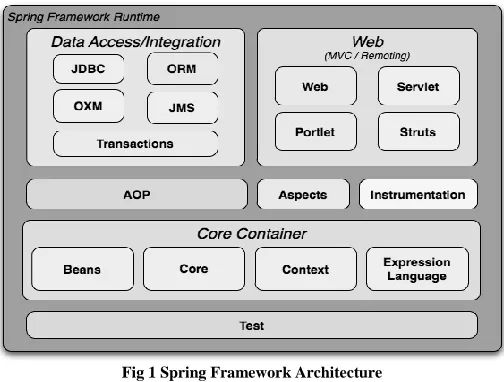
The Spring framework provides one-stop shop for java based application on all layers (one tier- stand alone java application, web tier- in web application and enterprise tier tier- Enterprise Java Beans). It is modular, means choose spring module based on requirements, It does not inforce to add all the library files in your project classpath.: All the features of Spring framework are organized into 20 modules. The diagrammatic architecture as follows :
Fig 1 Spring Framework Architecture
Spring Core: It is core part of Spring and consists of the following modules – Core, Beans, Context and Expression Language. The brief description is as follows:
Core: It is fundamental module of the framework with IOC and Dependency Injection with singleton design pattern.
Beans: This module is implementation of the factory design pattern through BeanFactory. The BeanFactory applies IOC to separate the application’s configuration and dependency specification from actual program logic.
Context: It (ApplicationContext) extends the concept of BeanFactory, adding support for - Internationalization (I18N) messages, Application lifecycle events and Validation. Also includes Enterprise services such as E-mail, JNDI access, EJB integration, Remoting, and Scheduling.
© 2014, IJCSMC All Rights Reserved
855
Language(EL). It is used to write expression language querying various beans, accessing and manipulating their properties and invoking the methods.
Data Access : It is fundamental part of database access layer and consists of the following modules – JDBC, ORM, OXM, JMS and Transaction management module.
The brief description is as follows :
JDBC: The JDBC modules provides a JDBC-abstraction layer that removes the complexity of the traditional JDBC code and parsing of database-vendor specific error code.
ORM: The ORM module provide consistency/portability to your code regardless of data access technologies based on object oriented mapping concept like Hibernate, JPA, JDO and iBatis. It provides code without worrying about catching exceptions specific to each persistence technology (ex: SQLException thrown by JDBC API).
OXM: The OXM introduces in Spring3.0 as separate module. It is used to converts object into XML format and vice versa. The Spring OXM provides a uniform API to access any of these OXM(Castor, XStream, JiBX, Java API for XML and XmlBeans) framework.
JMS : The JMS module provides by reducing the number of line of code to send and receive messages. The API take car of JMS workflow and exception handling.
Transaction : The Transaction module supports programmatic and declarative transaction management for POJO classes. All the enterprise level transaction implementation concepts can be implement in Spring.
Web : It is core part of Web layer and consists of the following modules – Web, Servlet, Struts and Web-Portlet. The brief description is as follows :
Web : This module provides basic web-oriented integration features such as multipart file-upload functionality and the initialization of the IoC container using servlet listeners and a web-oriented application context.
Web-Servlet : The Web-Servlet module contains model-view-controller (MVC) based implementation for web applications. It provides all other features of MVC including UI tags and data validations.
Web-Struts: The Web-Struts module contains the support classes for integrating a classic Struts web tier within a Spring application. It contains the classes to integrate Struts1.x and Struts2.
Web-Portlet : The Web-Portlet module provides the MVC implementation to be used in a portlet environment and mirrors the functionality of Web-Servlet module.
Others : There are few other important modules in Spring, which plays vital role in the framework to use all the features in various scenario. The modules are AOP, Aspect, Instrumentation, and Test.
AOP : It contains API for AOP Alliance-complaint aspect-oriented programming implementations on various layers. You can introduce new functionalities into existing code without modifying it.
Aspectj : The separate Aspects module provides integration with AspectJ.
© 2014, IJCSMC All Rights Reserved
856
B. Features of Spring Framework
Spring is a free, open source framework that offers a lot of functions to programmers. It was created by Rod Johnson and Juergen Hoeller. The most important features are the Inversion of Control, Aspect oriented programming and Spring MVC. Spring has its own MVC framework that can be used with other frameworks. The Aspect oriented programming, IoC and MVC are the important features.
Aspect oriented Programming: With the help of AOP the various concerns present in a system can be separated easily. In spring aspects are joined together with the help of spring xml file and coding is well modularized.
C. Spring MVC Model
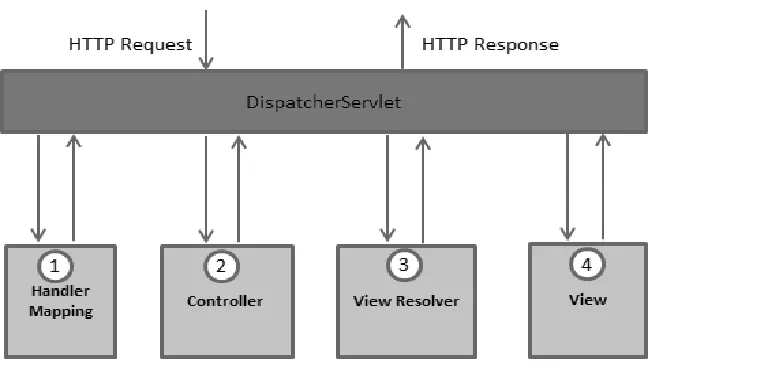
The Spring web MVC framework provides model-view-controller architecture and ready components that can be used to develop flexible and loosely coupled web applications. The MVC pattern results in separating the different aspects of the application (input logic, business logic, and UI logic), while providing a loose coupling between these elements.
1) The Model encapsulates the application data and in general they will consist of POJO.
2) The View is responsible for rendering the model data and in general it generates HTML output that the client's browser can interpret.
3) The Controller is responsible for processing user requests and building appropriate model and passes it to the view for rendering.
© 2014, IJCSMC All Rights Reserved
857
III. E-COMMERCESYSTEMUSINGSPRINGANDOTHERFRAMEWORKS
Spring framework can be used with many other frameworks for making of an E-commerce application such as struts and hibernate.
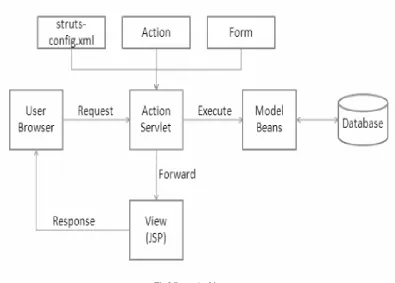
Struts framework: This framework divides web system into three layers: Model, View and Controller. Model consists of JavaBeans, EJB; View consists of JSP files; Controller is carried out by Actions.
Struts architecture can be shown as below:
Fig 3 Struts Architecture
Hibernate framework: This framework reduces the complexity and difficulty while manipulating the JDBC and
SQL data. It maps Java classes to database tables efficiently. It is mainly associated with databases.
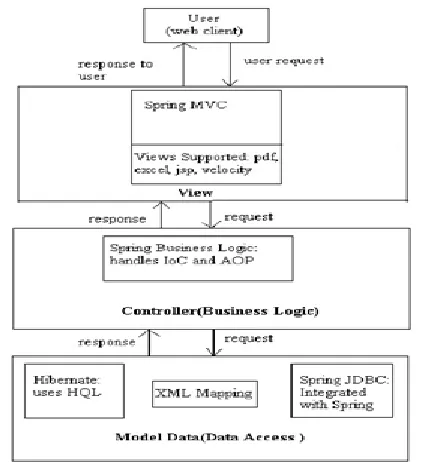
A. Integration of Struts, Spring and Hibernate
© 2014, IJCSMC All Rights Reserved
858
Fig 4 Integration of SSH FrameworkIV. PROPOSEDSYSTEM
© 2014, IJCSMC All Rights Reserved
859
Fig 5 Proposed Architecture of E-Commerce SystemV. CONCLUSION
Spring is a powerful framework for building enterprise applications. It can also be easily integrated with struts and hibernate frameworks for developing efficient enterprise applications thereby reducing the coupling and clear separation of layers. Due to its lightweight feature it is easy to use. Simple web server such as Tomcat can also be used during integration of spring with other frameworks. Considering the present scenario wherein there is struts2 framework that can be used for web tier spring framework can be used effectively for all the three tiers to build an efficient enterprise application. The Spring framework can be easily integrated with any ORM tool such as Hibernate with the help of XML mapping.
ACKNOWLEDGEMENT
This research paper is made possible through the help and support from everyone, including: parents, teachers, family, friends, and in essence, all sentient beings. I dedicate my acknowledgment of gratitude towards my co-Authors Neha Munsi and Mahak Jain for supporting me and guiding me.
REFERENCES
[1] Rod Johnsonet," Professional Java Development with the Spring Framework", Publications John Wiley & Sons [2] Praveen Gupta, Prof. M.C. Govil," MVC Design Pattern for the multi framework distributed applications using
XML, spring and struts framework" , International Journal on Computer Science and Engineering, Vol. 02, No. 04, 2010, 1047-1051