Implementation of Face Detection System Using Future
Extraction
Kiran Kumar.Jampani & K.Mohan Ram
1M.Tech – Scholar, Department of E.C.E, Sri ChundiRanganayakulu Engineering College, Guntur,AP, India
2Associate Professor, Department of E.C.E, Sri ChundiRanganayakulu Engineering College, Guntur,AP, India
ABSTRACT: Face detection and clustering is more significant in the Image sequence because human faces have unlimited orientations and positions. This paper proposed a Spatio Temporal method for clustering human faces from the image sequence. The proposed method has three main stages. Initially a face detector is used to localize faces in all frames of the video and extract several features of the detections. Viola jones detector and SURF detector both are used for face detection and feature extraction respectively. Optical flow estimation is utilized for computing the movement among any of two frames. Pyramidal version of lucas kanade algorithm is used in optical flow estimation. This estimation is used to determine a dissimilarity matrix like appearance dissimilarity and time dissimilarity. Clustering tracks the same faces from the image sequence but it may have different pose, image orientation. Finally, an optimization method involved in clustering of faces.
Keywords: Face Detection, Clustering, Tracking, Optical Flow, Dissimilarity.
I. INTRODUCTION
Iris Detection is one of the major applications for eye detection. Other application of eye detection algorithm can be used in cell phone, security system, safe driving etc. Eye portion in an image is identified as low illumination, higher density edges, more contrast in comparison with rest part of the face. Face detection is main part of the developed algorithm. Face detection is done by utilizing skin detection method. Skin detection method is an extraction of skin color pixels and regions from an image.
Various approaches that are utilized for detecting human faces are feature based, appearance based, and color based.
Skin detection method is an effective method to detect face regions due to its low computational requirements and ease of implementation. Compared to the featured based method, the skin detection method required very little process.
Different approaches that are used to detect human faces are feature based, appearance based, and color based. The feature based method detects a human’s face depends on human facial features. Because of its complexity, this method requires lots of computing and memory resources. Color based method is more reasonable for applications that require low computational effort. In general, each method has its own advantages and disadvantages.
More complex algorithm typically gives very high accuracy rate but also requires lots of computing resources. Skin detection method is an effective method to detect face regions due to its low computational requirements and ease of implementation. Compared to the featured based method, the skin detection method required very little process. This paper focuses on algorithm of the Eye Detection System by using Hardware Description Language.
Available online: https://edupediapublications.org/journals/index.php/IJR/ P a g e | 2579
The algorithm of the eye detection system is shown in below fig 1. To store the text file, memory is created. Then image is converted into luminance and chrominance domain to detect the skin pixels. Face is extracted using skin detection method. Then image is
converted into a binary image.
Morphological operation is performed to remove the unnecessary pixels. Horizontal location of eye is always at a fixed position with respect to face.
FIG. 1. EYE DETECTION SYSTEM
Eye portion can be extracted by using face proportion rules to detect the status of eye. The flow chart of eye detection system is shown in Fig. 1. The Input image is taken in the form of three separate Red, Green and Blue (RGB) images. The RGB is an additive color model used to detect RGB values differently. The original image and RGB images are shown in Fig. 2.
Fig. 2(a). Original Image
Fig. 2(b). RGB Images
FIG. 2 ORIGINAL IMAGE AND RGB IMAGES B. CONVERTING IMAGE INTO TEXT FILE
The text file contains all pixel values of an image and when it stored into test bench then only image processing will be done. After image is converted into text files, these files are stored in Verilog directory path because we can’t read image directly in Verilog HDL. By seeing scroll bar in text file, can identified as a large text file.
III.PROPOSED SYSTEM
FIG. 3 BLOCK DIAGRAM OF PROPOSED SYSTEM
LOAD IMAGE: Load the Image by utilizing the JPEG method. Read the image file
various boosting variants for learning. The cascade learning algorithm is same as the decision tree learning.
FEATURE EXTRACTION: Initially, we utilize a face detector for localizing faces in all frames of the image and extracting different features of the detections. These features are then utilized to compute a dissimilarity matrix depends on appearance and space–time. Here we are extracting the feature of the image by spatio temporal algorithm. Initially, we choose candidate points depends on the SURF detector. We calculate the variation between the each frame. These values will be used as feature values of image. Initially, from a given image I, SURF establishes the integral image according to SURF uses the above approximation, for calculating pixel position at x = (x; y) and scale σ.
OPTICAL FLOW: There are various methods for computing an optical flow between two frames. One of the major issues is to perform a large scale of displacements. A pyramidal version of the Lucas– Kanade algorithm is employed for symbolized both small and large displacements. In each frame having detection, computing the optical flow from the previous to the current frame and from the current to the next frame, then these two optical flows is averaged. The resulting speed vector of detection is obtained by taking the most representative flow vector in the detection area.
CLUSTERING: Clustering is performed based on feature extraction and output dissimilarity. This method is used to cluster the faces among multiple faces presented in the image. Faces may have different position and orientation this method effectively clusters the faces.
IV. SYSTEM OVERVIEW
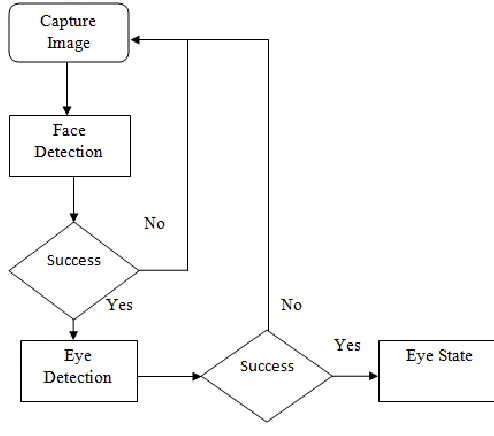
In this section, we present the proposed state detection system which consists of four portions: face detection, eye detection, iris detection based on CHT and eye state analysis. Fig. 4 shows the algorithm of the proposed system. In this proposed system, after capturing the image, the system will firstly detect the face. Secondly, after the face is detected, then it will detect the eye on the face region. After the eyes are successfully detected then the CHT will detect circular shape of the eye which represented as an iris. Then finally, the system will determine the status of the eye.
FIG. 4 ALGORITHM
A. Face and Eye Detection
Available online: https://edupediapublications.org/journals/index.php/IJR/ P a g e | 2581
2384 positive images and 6749 negative images for closed eye.
B. Iris Detection
After the eyes are detected by the classifiers, then the iris will be detected. In this system, CHT is used to detect the circular shape of the eye.
C. Eye State Detection
While the eye is detected and classified by opened eye classifier, the state of the eye will automatically determine as opened, and if the eye is detected and classified by closed eye classifier then the state of the eye is determined as closed. But in some cases, the classifier is not correctly classifying so it will give the wrong result of eye state. To address this, after the eye is detected and classified by the classifier then CHT was called to detect the circular shape on the eye region, and find the iris. In that sense the state of the eye will not be wrong anymore and the state of eye will be determined as opened, or vice versa.
V. RESULTS
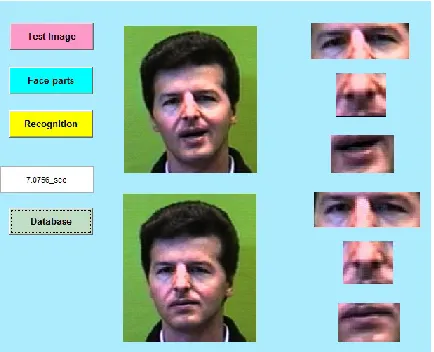
FIG. 5 INPUT IMAGE
FIG. 6 DETECTED OUTPUT
VI.CONCLUSION
A method is proposed to cluster faces in image sequences. Viola-jones detector is utilized for face detection. Then feature extraction is done by the SURF detector. Pyramidal lucas-kanade algorithm is utilized for measuring Optical flow estimation. Feature extraction is utilized for identifying the faces from the image sequence and then
result clustering is performed.
Spatiotemporal clustering method provides the efficient cluster for the face.
This paper can be utilized in various applications like gesture understanding, disabled-helping domain, and so on. Therefore, this project has been successfully implemented by utilizing Matlab and Xilinx ISE tools.
VII.REFERENCES
[1] Samir Palnitkar,Verilog HDL A guide Digital Design and Synthesis 1996.
[2]Rainer Lienhart, Alexander Kuranov, and Vadim Pisarevsky,Empirical analysis of detection cascades of boosted classifiers for
rapid object detection.In DAGM’03,
Available online: https://edupediapublications.org/journals/index.php/IJR/ P a g e | 2582
IEEE transaction on pattern analysis and
machine intelligence. 25(9):1063-
1074,2003.
[4] J Marzat, Y Dumortier, A Ducrot, Real-time dense and accurate parallel optical flow using cuda.In Proceedings of The 17th InternationalConference in Central Europe on Computer Graphics, Visualization andComputer Vision (WSCG). (WSCG, 2009). [http://www.wscg.eu/]
[5] Edmund Spinella SANS GSEC,” Biometric Scanning Technologies: Finger, Facial and Retinal Scanning”, San Francisco, 28 May 2003
[6] Zahid Riaz, Suat Gedikli, Micheal Beetz and Bernd Radig “A Uni_ed Features Approach to Human Face Image Analysis and Interpretation”, 85748 Garching, Germany
[7] Z Lu, MA Carreira-Perpin,Constrained
spectral clustering through affinity
propagation in IEEE International
Conference on Computer Vision.(Portland, 23-28 June 2008
[8] T Brox, C Bregler, J Malik, Large displacement optical flow. in IEEE Conference on Computer Vision and Pattern Recognition. (Berkeley, 20-25June2009),pp. 41–48.
J. KIRAN KUMAR studied
B.Tech at guntur engineering
college, guntur and pursing M.tech
at S.C.R Engineering College,
chilakaluripet. His area of interest is VLSI Design.
K. MOHAN RAM studied B.Tech at
Anna University, Chennai and M.Tech (Applied Electronics) at M.G.R University, Chennai. He has 12.5 years of teaching experience, At present working as H.O.D-E.C.E at
S.C.R Engineering College,
chilakaluripet and pursuing PhD in