
Wireless Information and Power Transfer: Spectral Efficiency
Optimization for Full-duplex System
Sindhu Priya Bolla & Ms.Lavanya Musunuri
M.Tech (ECE), Department of Electronics & Communication Engineering, Helapuri Institute of Technology and Science, Eluru, A.P.
Assistant Professor, Department of Electronics & Communication Engineering, Helapuri Institute of Technology and Science, Eluru, A.P.
Abstract: In terms of modern applications of wireless sensor networks in smart cities, relay terminals can be employed to simultaneously deliver both information and energy to a designated receiver by harvesting power via radio frequency (RF). In this paper, we propose time switching aware channel (TSAC) protocol and consider a dual-hop full-duplex (FD) relaying system, where the energy constrained relay node is powered by RF signals from the source using decode-and-forward (DF) relaying protocols. In order to evaluate system performance, we provide an analytical expression of the achievable throughput of two different communication
modes, including instantaneous
transmission and delay-constrained
transmission. In addition, the optimal harvested power allocation policies are studied for these transmission modes. Most importantly, we propose a novel energy harvesting (EH) policy based on FD relaying which can substantially boost the system throughput compared to the conventional half-duplex (HD) relaying architecture in other transmission modes. Numerical results illustrate that our proposed protocol outperforms the
conventional protocol under the optimal received power for energy harvesting at relay. Our numerical findings verify the correctness of our derivations and also prove the importance of FD transmission mode.
Keywords: Energy harvestingFull-duplexDecode-and-forwardOutage
capacityDelay-constrained
1 Introduction
It is undoubted that wireless communication systems have attracted much research interest in recent years. In particular, energy-aware radio access solutions can be implemented to deal with the massive increase in the consumption of energy in telecommunication networks and the efficient use of power is important for
energy optimization. In addition,
Since energy harvesting plays an important role in relaying regardless of power optimization at relays which are assumed to be powered by ideal power sources. In sensor networks and cellular networks, wireless devices using rechargeable or replaceable batteries are often out of order in a short period of time, as the battery powered devices in such wireless networks usually suffer from limited operating times.
Unlike portable devices, the maintenance cost of sensor nodes is often higher in case they are replaced or recharged. Additionally, it is noted that it may be dangerous to replace batteries in toxic environments and powering medical sensors implanted inside human bodies is also challenging. To supply a perpetual power in such networks, energy harvesting is considered as a potential method to prolong lifetime of wireless
devices [1, 2]. To take advantage of information transfer over wireless channels, receivers can scavenge power from the transmitted signal. Since ambient radio signals can carry energy and information, energy harvesting brings more major advantages compared to the conventional grid power supply [3].
Since radio frequency (RF) signals are capable of carrying both information and energy, a new concept in green wireless communications was put forward, namely simultaneous wireless information and power transfer (SWIPT). To take advantage of SWIPT, more practical receiver architectures have been developed with two separated circuits to carry out energy harvesting and information decoding [4, 5]. There are two major schemes in the receiver, including time switching and power splitting. The authors in [4] presented performance of system under capability of energy harvesting applied in a simple single-input single-output scenario while multiple-input multiple-output (MIMO) broadcasting scenarios was introduced in [6].
In order to obtain practical insights in term of optimal time and power allocation. The work in [7] focused on time allocation policy for the two transmitters in case the efficiency of energy transfer is maximized by an energy beamformer under the impact of Channel State Information (CSI) received in the uplink by the energy transmitter. Furthermore, in [8], the time fraction in TSR impacts on the optimal throughput and such parameter can be found in a numerical method.
respectively, and the expressions of the transmission rate and outage probability were presented under the impact of remote energy transfer. In addition, relay selection is considered as solution to determine a tradeoff between the efficiency for the information transmission and the amount of energy forwarded to the energy receivers [14, 15, 16].
Furthermore, full-duplex (FD) mode was evaluated, in which it allows transmitting and receiving signals at the same frequency band at the same time slot. Various theoretical analysis and practical designs have been conducted in terms of FD networks like in [17, 18, 19, 20, 21]. Thanks to the use of FD mode, the resources are utilized more efficiently and it can double the spectral efficiency compared to half-duplex (HD) mode. However, due to practical constraints, the performance of FD communication can be affected by the self-interference (SI) stemming from FD node transmission.
In addition, energy harvesting along with throughput optimization has been mentioned in previous works. In [22] and [23], throughput optimization with constraints was studied under a static channel condition for obtaining best efficiency of energy harvesting transmitters.
Moreover, energy harvesting based on power control policies for wireless powered transmission over fading channels suffer from several problems, i.e., the randomness
of RF energy source, wireless fading channels and the maximum power constraints. To address this situation, several existing works have considered offline optimal power control designs for fading channels [24, 25]. The work in [25] considered that the offline optimization in an efficient optimal solution was presented to achieve optimal energy efficiency. Although the authors in [26] investigated the offline
scheduling and formulated the
corresponding performance optimization problems of two-way relay networks, the statistics of energy and fading channels are assumed to be parameters at the transmitter, and optimal function can be derived in a numerical manner under high computation.
The authors in [27] considered that the optimal time splitting coefficients for the full-duplex dual-hop relaying lead to
enhance the system throughput in
adaptively selected based on channel state information (CSI), accumulated energy, and threshold signal-to-noise ratio (SNR) [31, 32] and [33].
Motivated from the previous works [27], we focus on optimal throughput of a two-hop case, where RF energy harvesting powers the relay. In this paper, the impact of FD transmission is investigated in terms of the system throughput to determine the performance of RF energy harvesting
relaying system. The two-antenna
configuration is proposed in the FD mode, where the relay is equipped with two antennas, one for transmitting signal and the
other one for receiving signal
simultaneously. In this paper, two different transmission modes are investigated, namely instantaneous transmission and delay-constrained transmission. Furthermore, we examine the throughput of DF relaying protocols and characterize the fundamental trade-off between energy harvesting and system throughput. In order to compare with the effect of the FD relaying architecture, the HD relaying architecture is also investigated. The main aim of this paper is that FD relaying is an attractive and
promising solution to enhance the
throughput of RF energy harvesting-based relaying systems.
Comparing to [27] and [28], although this work consider a same system model with those works, our investigation also design a novel wireless power transfer strategy to improve the system performance. The authors in [27] consider a conventional time
splitting protocol, in which relay switches from energy harvesting to information transfer with fixed EH fraction time allocated. While [28] design a self-energy recycling strategy for energy harvesting at relay, this EH manner can collect transmitted signal itself and scavenge to energy. Contrarily, our work redesigns the conventional time switching protocol as in [27] to a novel EH schedule. The proposed EH will acquire the channel state information (CSI) to allocate amount of EH time. In particular, the relay transmission power can be preset level. The magnitude of self interference at relay thus can be controlled based on relay transmitted power, which can improve the system performance.
The main contributions of our paper are summarized as follows: A new protocol for wireless power transfer called time switching aware channel protocol (TSAC) is proposed in FD DF relaying networks and further analysis is presented as well. We
provide analytical expressions in
instantaneous transmission mode for both cases, i.e., one antenna and dual antennas at relay node in EH-based networks. The outage probability and average throughput for delay-constrained transmission mode are derived in closed-form expressions for tractable computation. The optimal values can be achieved in various simulation results. The advantages of the proposed protocol are also compared with the
previous works. The most critical
systematically validated via comparative simulations.
2 System model and energy harvesting protocol
2.1 System model
As shown in Fig. 1a, we consider a two-hop
relaying network consisting of one source denoted by SS, one destination denoted by DD, and one intermediate node denoted as RR. It is assumed that the source and destination node are equipped with single antenna, i.e., SS and DD are provided with single antenna, while RR is equipped with two antennas, and operated in FD mode. In addition, the relay node is assumed to have no extra embedded energy sources so it requires to harvest energy from the received RF signal from the source node [2, 5, 8, 14, 20, 27, 28, 29, 32]. The TSAC
protocol is shown in Fig. 1b, in which the
relay adjusts EH time to meet the installed transmit power every block time. Therefore,
at time slot ith, the relay node will energy
harvesting with αiT seconds.
Figure 2 shows basic block diagram for the
SWIPT system, where TSAC is deployed. The system has one switching unit and one combining unit compared to conventional
systems as Fig. 2a or as system models
introduced in [5, 27]. As illustrated in
Fig. 2b, we design an architecture
exploiting dual antennas to harvest energy at relay during the energy harvesting phase as
[27]. In this scheme, we consider WPT
phase in which the switching units change the role of both transmitting and receiving
antenna to receive energy via RF signal as
[27, 30]. Then, those RF signals are
combined and used to feed the energy harvester. It is worth noting that case 2 is a natural choice, since it fully exploits the available hardware resources (i.e., antenna components in input multiple-output (MIMO) systems) to collect more
energy [30]. Nevertheless, due to its
straightforward implementation, case 1 could be more practical in certain applications.
Fig. 1 :Two-hop relaying networks in
full-duplex communication with
SWIPT. a Describing two phases of
cooperative relay energy harvesting
communications with two scenarios of
energy harvesting at relay node. b TSAC
Fig. 2 Receiver architecture of relay with
energy harvesting. a Relay node with single
antenna EH. b Relay node with dual
antennas EH
2.2 Channel model
We assume that
the S→RS→R and R→DR→D channel links include both large-scale path loss and
statistically independent small-scale
Rayleigh fading. We denote d1 is distance
between source and relay node and d2 is
distance between relay and destination node. We also denote the main channels such
as h and k are the links from the source to
first antenna and second antenna at relay,
respectively, and g is the channel from relay
to destination node. It is also assumed that the main channels experience Rayleigh fading and remain constant over the block
time T and varies independently and
identically from one block to the other.
In this paper, we also use character f to
represent the SI link at relay node as normal manner. Due to the short distance of this link, the line-of-sight (LoS) path is likely to represent to SI channel; hence, it can be
shown that the Rician distribution can
handle such SI channel as [18]. However,
due to the complicated Rician fading probability density function (PDF), the analytical expressions become extremely difficult. Fortunately, the alternative model
of the Nakagami-m fading distribution
provides a very good approximation to the Rician distribution. Motivated by this, and to simplify in the analysis, we adopt the
Nakagami-m fading with fading severity
factor mfand mean λfto model the loop
interference channel in this paper.
So that |h|2 and |k|2 are independent and
identically distributed (i.i.d.), exponential
random variables with mean λhand λk,
where λh=λk, |g|2 is exponentially
distributed with mean λg. The
self-interference power link at relay, i.e., |f|2, is a
Gamma random variable distributed
as Γ(mf,λf/mf), in this paper we also
assume mfis an integer number.
The transmit power of source and relay are
represented by PSPS and PRPR,
respectively. Due to the shadowing effect, the direct transmission between source node and destination node does not exist
[2, 5, 8, 20, 27, 29, 32]. The FD mode
causes self-interference, which can be addressed by the novel methods in the
literature as [17, 19] and these algorithms
paper, we mainly focus on the impact of the
residual self-interference on system
performance in terms of the harvested power.
2.3 TSAC protocol description
In this subsection, the energy harvesting
protocol is presented. In spirit of [31, 32, 33]
suggesting adaptive time switching
strategies for SWIPT system, we redesigned TS protocol related to CSI for FD relay transmission mode, named TSAC protocol. The detail of modified TSAC protocol is described as below. The harvested energy is stored in a rechargeable battery and then totally used to feed power circuits and transmit information to the destination node. Particularly in TSAC policy, each communication block time is slit into two slots, including wireless power transfer (WPT) slot and wireless information transfer
(WIT) slot as mentioned in
[4, 5, 6, 7, 11, 12, 27, 31, 32, 33]. In each block time, WPT slot represents the
first αiT of block time while the WIT slot
stands for the rest of (1−αi)T of block time.
During WIT phase, the source transmits its symbol toward the intermediate relay simultaneously, the cooperative relay
retransmits its decoded symbol to
destination at the same time and bandwidth. The relay thus suffers from loop interference (LI).
Before further description, some important
symbols are listed and defined in Table 1.
Moreover, regarding the proposed WPT policy, RR will operate with the preset transmit power, PRPR, and thus RR node
needs to exactly determine the time duration for WPT to harvest a sufficient amount of preset energy, Ei=PR(1−αi)TEi=PR(1−αi)T.
This process can be done as steps below. Because relay only harvests sufficient
amount of
energy, EEHi=f(αi)EiEH=f(αi)(where f(αi)
means that function of αi), one can exactly
determine the EH time by equaling amount of harvested energy and that of preset energy, i.e., EEHi=EiEiEH=Ei. Finally, the
EH time duration, αi, is derived. It is noted
that the suggested TSAC protocol does not require more additional time slot since the total frame for communication is the same
as [27] (see Remark 1), and the preset relay
transmit power is a constant value (PRPR) while the EH time is a function of the random variable WPT channel gain(s) as [31, 32, 33].
As aforementioned, to exactly determine this duration of energy harvesting time, channel gain(s) of WPT link is an important parameter(s). Therefore, we assume that the channel state information (CSI) during the first hop is available at source and relay node, which can be obtained by using novel estimation algorithm. Interestingly, the TSAC protocol adjusts the WPT time
duration, αi, in each time slot to satisfy
amount of installed power PRPR. In contrast, the fixed-time allocation protocol
in [5, 27], the harvested power, PRPR, vary
in each block based on channel gain.
In this section, numerical simulation results are demonstrated to validate analytical expressions as concerns in the previous section, and the impact of key system parameters is investigated in detail in terms of system throughput. The energy harvesting
efficiency is set η=0.8, while the path loss
exponent is set m=3. The
distances, d1 and d2are normalized values
which are set d1=3 and d2=1, respectively.
The simulation environments are associated
with the detailed parameters
as γ0=10 dB,λf=0.01,λh=1,λk=1,λg=1,PS=2 6 dBγ0=10 dB,λf=0.01,λh=1,λk=1,λg=1,PS
=26 dB and noise terms
as σ2D=−5 dB,σ2R=−10 dBσD2=−5 dB,σR 2=−10 dB. In this subsection, we present simulation results to verify the analytical results. The throughput performance is calculated by averaging the throughput values over a 100,000 blocks, while fading channels for each block is perfectly independent.
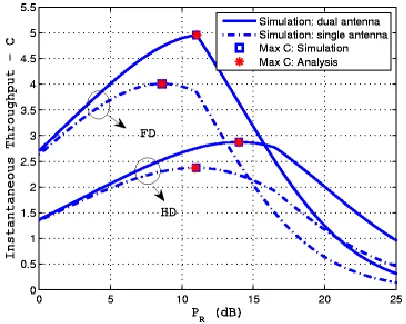
Figure 3 illustrates the impact of received
power at relay node on the instantaneous throughput. To compare the performance of
FD and HD relay, we set
|f|2=0.05,|h|2=1.2,|g|2=1.4,|k|2=1. The figure proves that the analytical results based on curves match well with the simulation results. It is noted that the optimal received power at relay for single antenna in HD case and FD case is smaller than those schemes with dual antennas, and the highest instantaneous throughput of FD case outperforms the HD case. When the received power is small, more energy can be collected to facilitate the information
transmission while more received power or strong loop-back interference is produced such as the excessive amount of harvested energy, which is the primary cause of worse system performance.
Fig. 3 Instantaneous throughput versus the received power at the relay
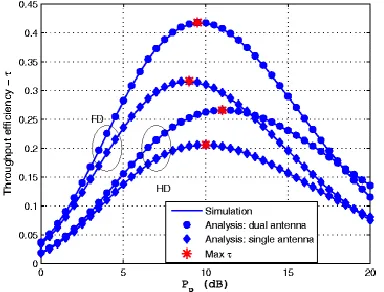
The average throughput in delay constraint
mode is presented in Fig. 4. It can be
observed that the dual antenna case outperforms the single antenna case in terms of the received power at relay. In fact, the dual antennas case can harvest more energy with less transmit power. However, when the transmit power is larger than the optimal harvested power, it results in lower average
throughput caused by loop-back
throughput. As the previous illustration, it is confirmed that FD relay is better than HD relay when the received power at relay is small.
Fig. 4Throughput efficiency versus PRPR in
FD relay with mf=1
Next, it can be observed that throughput performance improves as increasing transmit
power of the source node as in Fig. 5. To
evaluate the impacts of the factor mfin
Nakagami channel of SI on system performance, in this experience we
set λf=0.1 and PR=PS−10PR=PS−10 (dB).
The smallest of mfbrings the highest
throughput performance. A general
observation is that the dual antenna model significantly outperforms the single antenna counterpart at any values of transmit power of the source. Interestingly, when the transmit power overcome about 40 dB, the throughput still remain the peak value in stable floor.
Fig. 5 Throughput efficiency
versus PSPS with difference case
of mf, λf=0.1
and PR=PS−10PR=PS−10 (dB)
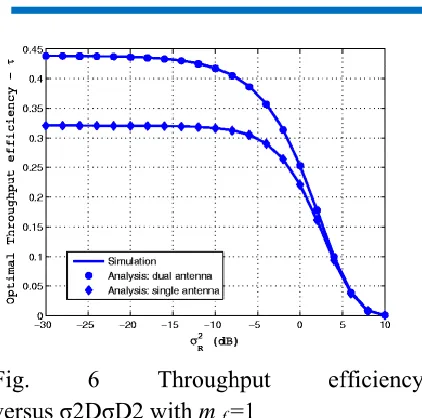
To illustrate the impact of noise variance at relay and destination node in case of optimal
throughput, Figs. 6 and 7also show that dual
antennas in FD mode outperform FD single antenna. This can be explained as follows: A lower noise variance decreases the outage probability and and hence we obtain more throughput. Conversely, as for higher noise variance, the outage probability increases while the throughput falls dramatically. Thus, the system performance is affected more by erroneous information processing, leading to a waste of resources during the whole block time. In addition, it can be seen that the impact of noise term at relay affects the noise term at destination more. As a
result, throughput performance in
Fig. 7 declines sharply when noise varies
Fig. 6 Throughput efficiency
versus σ2DσD2 with mf=1
In Fig. 8, the simulation results present the
throughput efficiency versus γ0 and
compare with existing protocols in [27] and
[28]. The main observation is the effect of
threshold SNR on throughput in delay constraint mode using TSAC, which is investigated with different quantities of antennas, especially in comparison with traditional energy harvesting protocols. The
simulation parameters are installed
as α=0.2,PR=10 dBα=0.2,PR=10 dB. The
throughput in case of TSAC is better than the traditional case due to optimal time for energy harvesting which is solved in the
proposed TSAC. In case of γ0 described
below 14 dB, the proposed protocol related to the optimal throughput efficiency
outperforms the existing protocols.
However, in high threshold regime, the
self-energy recycling protocol proposed in [28]
is slightly better than those schemes. In general, this figure reveals that the FD relay has worse performance at higher threshold SNR, which means the system may require higher bit per channel.
Fig. 8 Throughput efficiency versus γ0 and
the comparison with existing protocols in
[27, 28] with λf=−20dB and mf=1
As depicted in Fig. 9, the dual antenna FD
relay based on TSAC outperforms the single antenna in terms of residual interference. When the residual self-interference is greater than −5 dB, throughput decreases significantly, since this loop-back noise impairs the overall
performance. Therefore, the
self-interference should be remained lower than
acceptable value to satisfy system
performance and the FD transmission is only beneficial, if the loop-back noise is eliminated. When SI factor ranges from −20 to −5 dB, the performance of TSAC scheme is superior to the existing protocols, but when SI parameters are greater than −5 dB, the optimal throughput of the proposed
protocol in [28] is a prime candidate. Thanks
to the EH protocol proposed in [28], the
Fig. 9 The impact of residual self-interference on the throughput and in comparison with existing protocols in
[27, 28] with γ0=5 dB and mf=1
4 Conclusion
In this paper, the throughput of FD and HD relaying in RF energy harvesting systems is investigated. Interestingly, the number of antennas equipped at each relay has
significant influence to throughput
performance due to the harvested energy at the relay node. Regarding optimal throughput, analytical expressions for the outage probability and throughput capacity of the system were derived. Therefore, the optimal time switching of energy harvesting was comprehensively evaluated. It is confirmed that by employing dual antennas at relay for energy harvesting is beneficial, and the throughput gain is significant when transmit power at source and the received power at relay are carefully calculated. In addition, in comparison with HD relaying networks, our results indicate that FD relaying can substantially boost the system throughput with optimal power allocation
policy at energy harvesting-enabled relay. Via mathematical and numerical analysis, the optimal throughput in both instantaneous transmission mode and delay constraint transmission mode can be obtained. More importantly, in order to compute optimal time switching fractions in energy h
References
[1] H Chingoska, Z Hadzi-Velkov, I
Nikoloska, N Zlatanov, Resource
Allocation in Wireless Powered
Communication Networks With Non-Orthogonal Multiple Access. IEEE Wirel.
Commun. Lett. 5(6), 684–687 (2016).
[2] D-T Do, Energy-Aware Two-Way
Relaying Networks under Imperfect Hardware: Optimal Throughput Design and
Analysis. Telecommun. Syst.
(Springer). 62(2), 449–459 (2015).
[3] LR Varshney, in Proc. of IEEE
International Symposium in Information Theory. Transporting information and energy simultaneously (Toronto, 2008), pp. 1612–1616.
[4] X Zhou, R Zhang, CK Ho, Wireless
information and power transfer:
Architecture design and rate-energy
trade-off. IEEE Trans. Wirel. Commun. 61(11),
4754–4767 (2013).
[5] AA Nasir, X Zhou, S Durrani, RA
Kennedy, Relaying protocols for wireless
energy harvesting and information
processing. IEEE Trans. Wirel.
[6] R Zhang, CK Ho, MIMO broadcasting for simultaneous wireless information and power transfer. IEEE
Trans. Wirel. Commun. 12(5), 1989–2001
(2013).
[7] X Chen, C Yuen, Z Zhang, Wireless
energy and information transfer tradeoff for limited feedback multi-antenna systems with energy beamforming. IEEE Trans.
Veh. Technol. 63(1), 407–412 (2014).
[8] KT Nguyen, DT Do, XX Nguyen,
NT Nguyen, DH Ha, in Proc. of AETA 2015: Recent Advances in Electrical
Engineering and Related Sciences.
Wireless information and power transfer for full duplex relaying networks: performance analysis (Ho Chi Minh, 2015), pp. 53–62.
[9] HS Nguyen, DT Do, M Voznak,
Two-Way Relaying Networks in Green
Communications for 5G: Optimal
Throughput and Trade-off between Relay Distance on Power Splitting-based and Time Switching-based Relaying SWIPT.
AEU Int. J. Electron. Commun. 70(3),
1637–1644 (2016).
[10] DT Do, HS Nguyen, A Tractable
Approach to Analyze the Energy-Aware Two-way Relaying Networks in Presence of Co-channel Interference. EURASIP J. Wirel. Commun. Netw. 271: (2016).
[11] DWK Ng, ES Lo, R Schober,
Wireless information and power transfer: energy efficiency optimization in OFDMA
systems. IEEE Trans. Wirel.
Commun.12(12), 6352–6370 (2013).
[12] X Chen, C Yuen, Z Zhang, Wireless
energy and information transfer tradeoff for limited feedback multi-antenna systems
with energy beamforming. IEEE
Trans.Veh. Technol. 63(1), 407–412
(2014).
[13] G Yang, CK Ho, YL Guan, Dynamic
resource allocation for multiple-antenna wireless power transfer. IEEE Trans. Signal
Process. 62(14), 3565–3577 (2014).
[14] DS Michalopoulos, HA Suraweera,
R Schober, Relay selection for
simultaneous information transmission and wireless energy transfer: A tradeoff
perspective. IEEE J. Sel. Areas
Commun. 33(8), 1578–1594 (2015)
[15] Z Ding, I Krikidis, B Sharif, HV
Poor, Wireless information and power transfer in cooperative networks with spatially random relays. IEEE Trans. Wirel.
Commun. 13(8), 4440–4453 (2014)
[16] I Krikidis, Relay selection in
wireless powered cooperative networks with energy storage. IEEE J. Sel. Areas
Commun. 33(12), 2596–2610 (2015).
[17] L Chen, S Han, W Meng, C Li,
Optimal Power Allocation for Dual-Hop Full-Duplex Decode-and-Forward Relay.
IEEE Commun. Lett. 19(3), 471–474
(2015).
[18] M Duarte, C Dick, A Sabharwal,
full-duplex wireless systems. IEEE Trans.
Wirel. Commun. 11(12), 4296–4307
(2012).
[19] Y Hua, P Liang, Y Ma, AC Cirik, Q
Gao, A method for broadband full-duplex MIMO radio. IEEE Signal Process.
Lett. 19(12), 793–796 (2012).
[20] H Liu, KJ Kim, KS Kwak, HV Poor,
Power Splitting-Based SWIPT With
Decode-and-Forward Full-Duplex
Relaying. IEEE Trans. Wirel.
Commun. 15(11), 7561–7577 (2016).
[21] I Krikidis, HA Suraweera, PJ Smith,
C Yuen, Full-duplex relay selection for amplify-and-forward cooperative networks.
IEEE Trans. Wirel. Commun. 11(12),
4381–4393 (2012).
[22] K Tutuncuoglu, A Yener, Optimum
transmission policies for battery limited energy harvesting nodes. IEEE Trans.
Wirel. Commun. 11(3), 1180–1189 (2012).
[23] J Yang, S Ulukus, Optimal packet
scheduling in an energy harvesting communication system. IEEE Trans.
Commun. 60(1), 220–230 (2012).
[24] F Yuan, Q Zhang, S Jin, H Zhu,
Optimal harvest-use-store strategy for energy harvesting wireless systems. IEEE
Trans. Wirel. Commun. 14(2), 698–710
(2015).
[25] J Xu, R Zhang, Throughput optimal
policies for energy harvesting wireless transmitters with non-ideal circuit power.
IEEE J. Select. Areas Commun. 32(2),
322–332 (2014).
[26] Z Chen, Y Dong, P Fan, KB Letaief,
Optimal Throughput for Two-Way
Relaying: Energy Harvesting and Energy Co-Operation. IEEE J. Sel. Areas
Commun. 34(5), 1448–1462 (2016). C
Zhong, HA Suraweera, G Zheng, I Krikidis, Z Zhang, Wireless information and power transfer with full duplex
relaying. IEEE Trans. Commun. 62(10),
3447–3461 (2014).
[27] Y Zeng, R Zhang, Full-duplex
wireless-powered relay with self-energy
recycling. IEEE Wirel. Commun.
Lett. 4(2), 201–204 (2015).
[28] M Mohammadi, BK Chalise, HA
Suraweera, C Zhong, G Zheng, I Krikidis, Throughput analysis and optimization of wireless-powered multiple antenna full-duplex relay systems. IEEE Trans.
Commun. 64(4), 1769–1785 (2016).
[29] Z Ding, C Zhong, DWK Ng, M
Peng, HA Suraweera, R Schober, HV Poor, Application of smart antenna technologies in simultaneous wireless information and
power transfer. IEEE Commun.
Mag. 53(4), 86–93 (2015).
[30] X Ji, J Xu, YL Che, Z Fei, R Zhang,
Adaptive Mode Switching for Cognitive
Wireless Powered Communication
Systems. IEEE Wirel. Commun.
Letters. 6(3), 386–389 (2017).
[31] H Ding, X Wang, DB da Costa, Y
Based Energy Harvesting Relaying
Protocols. IEEE Trans. Commun. 65(7),
2821–2837 (2017).
[32] AA Nasir, X Zhou, S Durrani, RA
Kennedy, Wireless-powered relays in
cooperative communications:
Time-switching relaying protocols and
throughput analysis. IEEE Trans.
Commun. 63(5), 1607–1622 (2015).
[33] RM Corless, GH Gonnet, DE Hare,
DJ Jeffrey, DE Knuth, On the Lambert W
function. Adv. Comput. Math. 5(1), 329–
359 (1996).
[34] A Jeffrey, D Zwillinger, Table of


![Fig. 9 The impact of residual self-interference on the throughput and in comparison with existing protocols in [27, 28] with γ 0=5 dB and m f =1](https://thumb-us.123doks.com/thumbv2/123dok_us/1968538.1259707/11.612.77.288.96.265/fig-impact-residual-interference-throughput-comparison-existing-protocols.webp)