www.euacademic.org DRJI Value: 5.9 (B+)
Calculations of Energies of Atoms (H, He) by
Variational Method in Linear and Nonlinear
Approximations
SYED NASEEM HUSSAIN SHAH Department Of Physics Federal Urdu University of Art, Sciences & Technology Karachi, Pakistan V.E. ARKHINCHEEV Buryat Science Center of SB Russian Academy of Sciences Ulan-Ude, Russia G. S. AKRAM ALI SHAH Department Of Physics Federal Urdu University of Art, Sciences & Technology Karachi, Pakistan SAIF UR REHMAN Department Of Physics Federal Urdu University of Art, Sciences & Technology Karachi, Pakistan SYED REHAN ALI Department Of Physics Federal Urdu University of Art, Sciences & Technology Karachi, Pakistan YASMEEN BIBI Department Of Chemistry Federal Urdu University of Art, Sciences & Technology, Karachi, Pakistan
Abstract:
approximation result, the new difference in the ground state energy of atoms was obtained. This gave us the new difference between the energies of different wave functions. From our theoretical result, the changes in energies were due to nonlinear behavior of particles and particularly in bosons particles.
Key words: state energy, celestial body, wave function, Hamiltonian, nonlinearity
1. Introduction
The Variation method is one of the most useful approximation method in estimating the energy eigen values of the ground state and the first few excited states of a system which we only have a qualitative idea about the wave function. When the system contains a single particle the exact solution of Schrodinger wave equation is possible, as in the case of hydrogen like atom. However, if several particles are involved, the exact solution is not possible and approximation methods are used. The variation method is most useful in the treatment of chemical bonding. The Variation method is one of the most useful approximation method in estimating the energy eigen values of the ground state and the first few excited states of a system which we only have a qualitative idea about the wave function.
From Schrodinger equation we have
than ; although it is not a correct wave function, it will at least, tell us which of the several trial wave functions is close to the true wave function in the series of giving the best energy.
Schrodinger [1] first formulated the new mechanics as a variational principle and for many purposes, particularly where approximate solutions are being sought, this is the most convenient form of the theory to use.
The Schrodinger differential equation describes the motion of the wave packet . The wave associated with a free moving non relativistic particle of well defined momentum “P” and energy “E” is represented by
(2)
Where and , is propagation vector and is angular velocity.
(3)
Equation (3) is the discrete Schrodinger wave equation for free particle in the non-relativistic approximation. Where is the Laplacian operator.
In the case of external forces that may be acting on the particle, we assume that these forces such that they are derivable from a real P.E function i.e
(4)
The above equation describes the motion of the particle of mass “m” in a force field ( and it can also be written as
.
Where , and is called linear
Hamiltonian operator which gives the total energy of the particle when operates on .
particles participate in any single scattering event is consistent with the assumption that the characteristic length scales of the system are much larger than the range of the particle scattering potential. Thus we have calculated the matrix elements using any alternate theory which accurately reproduces the effects of the particle interactions at the macroscopic scale.
Our interest lies not with the microscopic details of the scattering, but instead with the macroscopic effects of the scattering on the mode amplitudes. Thus rather than considering matrix elements in terms of the scattering potential, we can treat the scattering in terms of the two-body matrix, which gives the probability amplitude that a scattering event between two particles will lead to transitions into a particular set of modes. The non linear Hamiltonian is obtained by treating the scattering in terms of a two-body matrix, rather than via the bare interaction potential. Thus the contact potential is introduced not as a direct approximation to the interaction potential but rather as a form of two-body operator.
The nonlinear Schrodinger equation is derived independently by Gross [2] and Pitaevskii [3,4]. The Gross-Pitaevskii equation (GPE) has proven extremely successful in reproducing many experimentally observed Bose-Einstein condensate behaviors, yet it fails to account for the quantum-statistical effects required for treating spontaneously initiated processes[ 5,6].
In addition, Hamiltonian operator of the time-independent GPE is used to calculate the ground state of different wave functions. It is therefore both useful and instructive to devote some space to this very successful equation.
Where Plank’s constant and m is the mass of the boson. The time dependent G.P.E is
(6)
In the case of G.P.E the Hamiltonian operator becomes nonlinear
(7)
2. Case of Linear Hamiltonian
Linear method is one of the familiar methods to find the solution of any mathematical equation or physical system. This method gives us an exact solution. The ground state energy of the atoms can be calculated with the help of linear Schrodinger equation.
Here the linear Hamiltonian operator is used. i.e.
,
2.1 Hydrogen Atom
In this case the wave function is of the general form (8)
For the ground state of hydrogen atom, the potential energy
will be and hence the value of Hamiltonian operator will be
Where is the volume of spherical shell at distance and from the nucleus. The limit of integration varies from 0 to as goes from zero to infinity. As the energy occurs in the radial equation, we need only to consider the radial part of the Laplacian operator .
And also the volume element in the radial case will be . So the energy equation for hydrogen will be
Now we choose in such a manner as to give a minimum energy. Thus equation
implies that
, Substituting the value of in equation , we get
This is the ground state energy of hydrogen atom.
2.2 Helium Atom
in figure 1.
Fig: 1
In this case the trial wave function is of the general form
Where j=1, 2……
and the total wave function is where
The potential energy of the system is given by
(12)
In which and are the distances of electrons from the nucleus and is the separation of two electrons. The Hamiltonian operator is given by
Similarly we can calculate
So we get
Although it is not easy to estimate the inaccuracy in the function so obtained, something can be said about the energy values [7, 8].
It can be shown that the characteristic solutions of given wave function for energy is
For minimum values which implies that So
(13)
3. Case of Non Linear Hamiltonian
In this case of the G.P.E has been used to derive the Hamiltonian operator which becomes non linear.
3.1 Hydrogen Atom
We consider the hydrogen atom as system of two interaction point particles (nucleus and electron). The interaction arises due to Coulomb attraction of electric charges. Let the charge on nucleus be , and the charge on electron is . The non linear Hamiltonian for hydrogen atom is
From the variation method the energy can be calculated as
Applying the relation Where
As , Substituting the value of in equation , we get
Where and is the scattering length
for hydrogen atom.
So the ground state energy for hydrogen atom in the case of non linear Hamiltonian is
3.2 Helium Atom
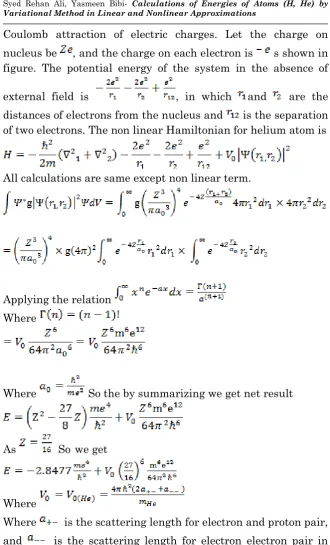
Coulomb attraction of electric charges. Let the charge on nucleus be , and the charge on each electron is s shown in figure. The potential energy of the system in the absence of
external field is , in which and are the distances of electrons from the nucleus and is the separation of two electrons. The non linear Hamiltonian for helium atom is
All calculations are same except non linear term.
Applying the relation Where
Where So the by summarizing we get net result
As So we get
Where
helium atom.
(17)
4. Results
The differences between the linear and non linear methods for the ground state energies calculation of hydrogen and helium atom are found.
For hydrogen atom
and for helium atom
We have seen the difference between these energies calculated by Schrodinger equation and by the Gross-Pitaevskii equation as given. This gives us the new difference between the energies of different wave functions. These new differences of the ground state energy may tell us which method is good to find the accurate energies of different wave functions.
The linear Schrodinger equation and non linear Gross-Pitaevskii equation have been used to find the ground state energy of various wave functions as discussed. By using non linear Hamiltonian, it is clear that there is one additional term in each case, this term may give the precise value of energy which may be close to the experimental value.
important calculations have been calculated first time.
This change in energy is due to nonlinear behavior of particles which is found at a very low temperature, i.e. in Bose Einstein condensation.
As the slowing of atoms by the use of cooling produces a singular quantum state, this is known as a Bose condensate or Bose–Einstein condensate. The result of the struggle of Bose and Einstein is based on the concept of a Bose gas which is governed by the Bose Einstein statistics and that describes the statistical distribution of indistinguishable particles with integer spin and well known as bosons. The boson particles consist of the photons as well as atoms such as helium-4 and they are allowed to share quantum states with each other. Einstein speculated that the bosonic atoms cooling to a very low temperature would cause them to fall (condense) into the very low quantum state and in resulting this, the concept of a new form of matter would appear.
In Bose Einstein condensation at very low temperature all atoms go to single state and become one atom which is called super atom. There is too much interaction between the particles at this single state due to which the above change in energy may occur.
Our research is theoretical and in future these results may be verified experimentally. Methods used for the ground state energy calculation of Helium atom can extend to solving many-electron atoms.
BIBLIOGRAPHY:
Eckart, C. 1930. Phys. Rev. 36: 878. [7]
Edwards, M. and K. Burnett. 1995. Phys. Rev. A 51: 1382. [6] Fetter, A. L. and J. D. Walecka. 1971. Quantum Theory of
Many-Particle Systems. McGraw-Hill. [5]
Gross, E. P. 1961. “Structure of a Quantized Vortex in Boson Systems." Nuovo Cimento 20: 454. [2]