Available online: https://edupediapublications.org/journals/index.php/IJR/ P a g e | 624
An Experimental Analysis on Properties of Self Curing
Concrete Using PEG4000 and PVA
1
M. Chandra Sekhar,
2S.Shamshad Begam,
3E.Sreenivasulu
1 M.Tech Student, Dept of CIVIL Engineering, INTELL College, Affiliated to JNTUA, AP, India.
2Assistant Professor, Dept of CIVIL Engineering ,INTELL College, Affiliated to JNTUA, AP, India.
3Associate Professor & HOD, Dept of CIVIL Engineering, INTELL College, Affiliated to JNTUA, AP, India
Abstract: Curing is the process of controlling the rate and extent of moisture loss from concrete during cement hydration. It may be either after it has been placed in position there by providing time for the hydration of the cement to occur. Since the hydration of cement does take time – days, and weeks rather than hours – curing must be undertaken for a reasonable period of time if the concrete is to achieve its potential strength and durability.
The concept of self-curing agents is to reduce the water evaporation from concrete and hence increase the water retention capacity of the concrete compared to conventional concrete. The purpose of this project is to study the effect of PVA (Poly Vinyl Alcohol, a water retaining alcohol) in curing process of concretes. The PVA& PEG are mixed of a sand concrete in various proportions 0%, 1%, 2%, 3% polyvinyl alcohol by the weight of cement.
I. INTRODUCTION
It was found that water soluble alcohols can be used as self curing agents in concrete. The use of self-curing admixtures is very important from the point of view that water resources are getting valuable every day (i.e. each 1m3 of concrete requires about 3m3 of water for construction most of which is for curing).
The benefit of self-curing admixtures is more significant in desert areas (e.g. Rajasthan) where water is not adequately available. Curing is the most important step in concrete construction.
Lack of curing has significant impact on concrete strength and durability. Self--curing concrete is designed to hold water and reduce water evaporation while increasing water retention capacity.
Hydrophilic water--soluble polymers can be used as self--curing agents in concrete as they can absorb water and keep the surrounding medium moist so that water can be used later by cement.
There is much published works on self curing concrete using materials like limestone powder, kiln ash, clinkers and some other chemical admixtures.
II. LITERATURE REVIEW
Nagesh Tatoba and Suryawanshi has studied on assessment of the properties of Self-Cured Concrete. In this study Compressive and tensile strength of self-curing concrete for 7 and 28days is found out and compared with conventional concrete of similar mix design. The durability of self curing concrete is found out by exposing concrete cubes to chloride environment and effect of the same on strength of cubes is determined by finding out compressive strength of cubes. The results indicated that Water retention for the concrete mixes incorporating self-curing agent is higher compared to conventional concrete mixes, as found by the weight loss with time. The result also showed that compressive, tensile and flexural strength of self curing concrete is found to be higher than conventional concrete.
Self-Curing Concrete was studied by Tarun R. Naik and FethullahCanpolat. They studied on Curing is the maintaining of a satisfactory moisture content and temperature in concrete during its early stages so that desired properties (of concrete) may develop. Curing is essential in the production of concrete that will have the desired properties.
Available online: https://edupediapublications.org/journals/index.php/IJR/ P a g e | 625
humidity, and temperature are sufficiently favourable to curing. Otherwise, specified curing measures shall start as soon required. To achieve good cure, excessive evaporation of water from a freshly cast concrete surface should be prevented. Curing can be performed in a number of ways to ensure that an adequate amount of water is available for cement hydration to occur. In this study the primary emphasis was placed upon an investigation of the effects of the replacement level of normal weight coarse aggregates by saturated lightweight ones, and the degree of water saturation of lightweight aggregate. These parameters provided the means to control the effectiveness of autogenous curing.
El-Sarayat St., Abbasia are studied on Self-curing concrete by using Water retention, hydration and moisture transport. Water retention of concrete containing self-curing agents is investigated. Concrete weight loss, and internal relative humidity measurements with time were carried out, in order to evaluate the water retention of self-curing concrete. Non-evaporable water at different ages was measured to evaluate the hydration. Water transport through concrete is evaluated by measuring absorption%, permeable voids%, water sorptivity, and water permeability. The water transport through self-curing concrete is evaluated with age. The effect of the concrete mix proportions on the performance of self-curing concrete were investigated, such as, cement content and w/c ratio.
Erik Schlangen and SenotSangadji was studied on self healing concrete. Concrete is complex composite material which undergoes changes during its lifetime. To optimize its durability effectively healing intervention at the right time and location is needed. One of the proposed ideas at Micro lab TU Delft is to make a porous layer inside of concrete structure that can be infused with healing material. By studying bone structure we can mimic bone morphology and produce what we call „porous network concrete‟. PVA dissolving plastic was used to keep prefabricated porous concrete porous while self compacting concrete was casted around it. Tensile test was applied to create crack close to notch in the middle of sample height.
Then an epoxy-based healing material was filled into the porous layer to make it dense and seal the crack completely.
The test results are discussed using image of longitudinally (vertical) cross section of sample to see how epoxy filled pore spaces and cracks. So far this new concept is patent pending.
Investigations and study on the effect of AR glass polymer fibres in self-compacting self-curing concrete was studied by S. U. Kannan ;Selvamony C. ; M. S. Ravi Kumar ; S. Basil Gnanappa. This experimental study is exposing the relationship between permeability and compression strength of AR Glass fibre-reinforced concrete. In addition, it inspects the influence of AR Glass fibre reinforcement on concrete permeability. The AR Glass fibres decrease permeability of specimens with increased volume of fibres. Here an attempt is made to study the permeability of super plasticised concrete with different types of fibres. The fibres are added at the percentages varying from 0.2% to 1.0% by weight of cement at intervals of 0.20%. To maintain a good workability, super plasticiser is added at the dosages of 0.8% by weight of cement. The dosage is arrived considering the workability and strength on simultaneous reduction of cement and water content ranging from 5% to 20% of the reference concrete. The experiment was conducted in a six cell permeability cell at the pressure of 10 kg/cm2 for 100 hours. Water permeability test is conducted as per IS: 3085-1987 and it is found that on addition of fibres, the co-efficient of permeability of concrete is reduced considerably.
Available online: https://edupediapublications.org/journals/index.php/IJR/ P a g e | 626
In this study, the effect of replacing the cement, coarse aggregate and fine aggregate by limestone powder (LP) with silica fume, quarry dust and clinkers respectively and their combinations of various proportions on the properties of SCC has been compared. Fresh properties, flexural and compressive strengths and water absorption properties of Concrete were determined.
M. S. Ravi Kumar, Selvamony C., S. U. Kannan and S. Basil Gnanappa are studied by “Behaviour Of Self Compacted Self Curing Kiln Ash Concrete With Various Admixtures” .In this study, self-compacting concrete (SCC) has gained wide use for placement in congested reinforced concrete structures with difficult casting conditions. For such applications, the fresh concrete must possess high fluidity and good cohesiveness. The use of fine materials such as kiln ash can ensure the required concrete properties. The initial results of an experimental program aimed at producing and evaluating SCC made with high-volumes of kiln ash are presented and discussed. Ten SCC mixtures and one control concrete were investigated in this study. Fresh properties, flexural and compressive strengths of self compacted concrete were determined. The use of SF in concrete significantly increased the dosage of super plasticiser (SP). At the same 1 constant SP dosage (0·8%) and mineral additives content (30%), KA can better improve the workability than that of control and fine aggregate mixtures by (5 % to 45 %). However, the results of this study suggest that certain QD, SF and KA combinations can improve the workability of SCCs, more than QD, SF and KA alone. KA can have a positive influence on the mechanical performance at early strength development while SF improved aggregate-matrix bond resulting from the formation of a less porous transition zone in Concrete. SF can better reducing effect on total water absorption while QD and KA will not have the same effect, at 28 days.
III. DESIGN METHODOLOGY
In this Analysis an attempt has been made to study the effect of PVA on physical properties of concrete. The
properties of concrete used, the procedure used for concrete mixing and tests conducted are represented in this chapter. The mixing has been done in the laboratory. The properties considered in this study are strength and workability.
The experimental Program is broadly divided into following categories, viz,
1. Workability characteristics 2. Strength characteristics
RESULTS AND DISCUSSION SLUMP
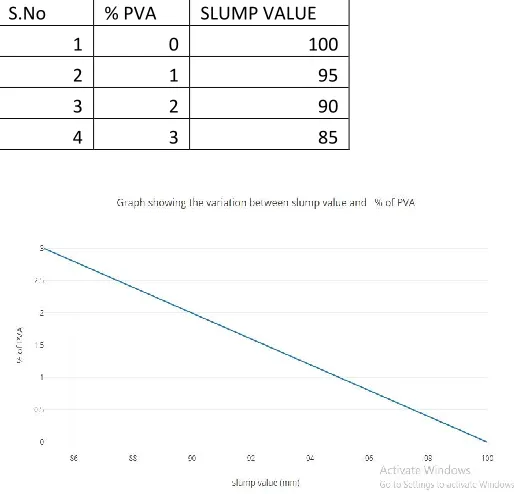
There‟s an increase in stoop values of the concrete with develop furthermore of % of PVA through weight of cement up to 3% of PVA but decreases with broaden in % of PEG. Best stoop value of concrete is observed by means of addition of 1% PVA.
Table: .1 Slump characteristics:
S.No % PVA SLUMP VALUE
1 0 100
2 1 95
3 2 90
4 3 85
Available online: https://edupediapublications.org/journals/index.php/IJR/ P a g e | 627 COMPRESSIVE STRENGTHS
The compressive strengths of the concrete regularly increased with develop in %of PVA and PEG used as a self curing agent up to 1 % of PVA after which decreases with increase in % of PVA and PEG.
The compressive strength is highest when the 1% of PVA by using weight of cement used as a self curing agent
Table 2.
Compressive Strength of Sample (a)
S.No % of PEG
Compressive strength (N/mm2)
1 0 35
2 1 35
3 2 33.5
4 3 31.5
Fig 2. Graph Showing the variation between compressive strength and % of PVA
of Sample (a)
Table 3.
Compressive Strength of Sample (b)
S.No % of PVA
Compressive strength (N/mm2)
1 0 35
2 1 35.8
3 2 28
4 3 27.3
Fig 3. Graph Showing the variation between compressive strength and % of PVA of sample (b)
SPLIT TENSILE STRENGTHS
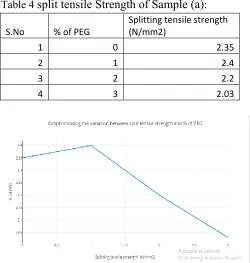
The ability of a material to withstand a drive that tends to pull it aside. It is often expressed as the measure of the most important force that can be utilized on this means before the material breaks aside.
Table 4
split tensile Strength of Sample (a)
:S.No % of PEG
Splitting tensile strength (N/mm2)
1 0 2.35
2 1 2.4
3 2 2.2
4 3 2.03
Available online: https://edupediapublications.org/journals/index.php/IJR/ P a g e | 628
Table 5
split tensile Strength of Sample (b)
:S.No % of PVA
Splitting tensile strength (N/mm2)
1 0 2.35
2 1 2.7
3 2 2.5
4 3 2.2
Fig 5Graph showing the variation between split tensile strength and % of PVA of sample(b)
FLEXURAL STRENGTHS
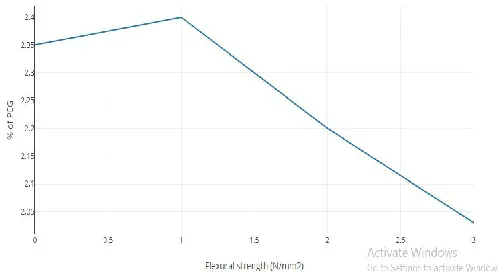
Flexural force, often referred to as modulus of rupture, bend strength, or fracture force a mechanical parameter for brittle material, is defined as a material's potential to resist deformation under load.
Table 6
Flexural Strength of Sample (a)
S.No % of PEG
Flexural strength (N/mm2)
1 0 2.35
2 1 2.4
3 2 2.2
4 3 2.03
Fig 6 Graph showing the variation between flexural strength and % of PVA.
of Sample (a)
Table 7
Flexural Strength of Sample (b)
S.No % of PVA Flexural strength (N/mm2)
1 0 2.35
2 1 2.4
3 2 2.2
4 3 2.03
Fig 7 Graph showing the variation between flexural strength and % of PVA.
of Sample (b)
IV. CONCLUSION
Available online: https://edupediapublications.org/journals/index.php/IJR/ P a g e | 629
values are high when compared to traditional mix.The concrete mix all set by way of addition of 1% of PVA with the aid of weight of cement can be used the place water is scarce and unavailable.Addition of 1 %PVA to the concrete mix by using the weight of cement offers the compressive strength identical because the traditional mix and extra conceivable than conventional combine.In the end the concrete combine with 1% of PVA gives the pleasant self curing concrete combine with excessive compressive strength with high workability.
REFERENCES
[1] Richart, F. E., Brandtzaeg, A. & Brown, R. L. (1928): A Study of the Failure of Concrete under Combined Compressive Stresses, Bulletin No. 185, University of Illinois, Engineering Experimental Station, Urbana, Illinois, USA, November, 104 pp. Schneider, S. P. (1998): “Axially Loaded Concrete-Filled Steel Tubes.” Journal of Structural Engineering, Vol. 124, No. 10, October, pp. 1125-1138.
[2] Tomii, M. Y., Yoshimura, K&Morishita, Y. (1977): “Experimental Studies on Concrete Filled Steel Tubular Columns under Concentric Loading.” Proc. Int. Colloquium on Stability of Structures Under Static and Dynam
[3] Titford, E.M. The Golden Age of Concrete. London 1964 British Standards Institution. BS 1881: Part 2: 1970. Testing Fresh Concrete. British Standards Institution. BS 1881: Part 102: 1983. Testing Concrete. Method of determination of Slump.
[4] Abrams, D.A. Experimental Studies of Concrete. Chicago 1918 Neville, A.M. Properties of Concrete 4th Edition. London 2005 Neville, A.M. & Brooks J.J. Concrete Technology 2nd Edition. London 1987 British Standards Institution. BS 8500-1: 2006. Method of Specifying and Guidance for the Specified.
[5] British Standards Institution. BS EN 12350-2: 2009. Testing Fresh Concrete – Part 2: Slump Test.
[6] American Society of Testing Materials. C143/C143M – 10a. Test for the Slump of Hydraulic Cement Concrete. [7] American Society of Testing Materials C94/C 94 M-07.
Specification for Ready Mixed Concrete.