Quantum homomorphic encryption
for circuits of low
T
-gate complexity
Anne Broadbent∗ and Stacey Jeffery†
Abstract
Fully homomorphic encryption is an encryption method with the property that any com-putation on the plaintext can be performed by a party having access to the ciphertext only. Here, we formally define and give schemes forquantum homomorphic encryption, which is the encryption of quantum information such that quantum computations can be performed given the ciphertext only. Our schemes allow for arbitrary Clifford group gates, but become inefficient for circuits with large complexity, measured in terms of the non-Clifford portion of the circuit (we use the “π/8” non-Clifford group gate, also known as theT-gate).
More specifically, two schemes are proposed: the first scheme has a decryption procedure whose complexity scales with the square of the number of T-gates (compared with a trivial scheme in which the complexity scales with the total number of gates); the second scheme uses a quantum evaluation key of length given by a polynomial of degree exponential in the circuit’s T-gate depth, yielding a homomorphic scheme for quantum circuits with constant T-depth. Both schemes build on a classical fully homomorphic encryption scheme.
A further contribution of ours is to formally define the security of encryption schemes for quantum messages: we define quantum indistinguishability under chosen plaintext attacks in both the public- and private-key settings. In this context, we show the equivalence of several definitions.
Our schemes are the first of their kind that are secure under modern cryptographic defi-nitions, and can be seen as a quantum analogue of classical results establishing homomorphic encryption for circuits with a limited number ofmultiplication gates. Historically, such results appeared as precursors to the breakthrough result establishing classical fully homomorphic en-cryption.
∗
Department of Mathematics and Statistics, University of Ottawa, Ottawa, Ontario, Canada;
Institute for Quantum Information and Matter, California Institute of Technology, Pasadena, California, USA;
Contents
1 Introduction 3
1.1 Summary of Contributions and Techniques . . . 3
2 Preliminaries and Notation 5 2.1 Notation . . . 5
2.2 Quantum Circuits . . . 6
2.3 Quantum One-time Pad . . . 7
3 Definitions 7 3.1 Classical and Quantum Homomorphic Encryption . . . 7
3.2 Security of Quantum Homomorphic Encryption . . . 8
3.3 Correctness and Compactness of Quantum Homomorphic Encryption . . . 10
3.4 Indivisible Schemes . . . 11
3.5 Quantum Homomorphic Encryption in the Symmetric-Key Setting . . . 12
4 Main Contributions 14 5 SchemeCL: Homomorphic Encryption for Clifford Circuits 15 5.1 Analysis ofCL . . . 17
6 SchemeEPR: T-gate Computation Using Entanglement 19 6.1 Analysis ofEPR. . . 22
7 SchemeAUX: T-gate Computation Using Auxiliary States 22 7.1 Analysis ofAUX . . . 26
8 Conclusions and Open Problems 30
Acknowledgements 30
References 30
A Classical Fully Homomorphic Encryption 33
B Equivalence of Definitions for q-IND-CPA 34
C Key Update Rules for Stabilizer Elements 37
D Correctness of the T-gate Gadget 38
1
Introduction
An encryption scheme is homomorphic over some set of circuits S if any circuit in S can be evaluated on an encrypted input. That is, given an encryption of the messagem, it is possible to produce a ciphertext that decrypts to the output of the circuitC on input m, for any C∈ S. In
fully homomorphic encryption (FHE),S is the set of all classical circuits. FHE was introduced in 1978 by Rivest, Adleman and Dertouzos [RAD78], but the existence of such a scheme was an open problem for over 30 years. Some early public-key encryption schemes were homomorphic over the set of circuits consisting of only additions [GM84, Pai99] or over the set of circuits consisting of only multiplications [ElG85]. Several steps were made towards FHE, with schemes that were ho-momorphic over increasingly large circuit classes, such as circuits containing additions and a single multiplication [BGN05], or of logarithmic depth [SYY99], until finally in 2009, Gentry established a breakthrough result by giving the first fully homomorphic encryption scheme [Gen09b]. Follow-up work showed that FHE could be simplified [DGHV10], and based on standard assumptions, such as
learning with errors[BV11]. The advent of FHE has unleashed a series of far-reaching consequences, such as delegating computations in a cloud architecture, and functional encryption [GKP+13]. For a survey on fully homomorphic encryption, see [Vai11].
Quantum cryptography is the study of cryptography in light of quantum information. One branch of quantum cryptography revisitsclassical primitives in the light of quantum information, establishing either no-go results (e.g. [LC97, May97]), or qualitative improvements achieved with quantum information (e.g. [BB84]). Another branch of quantum cryptography seeks to establish
quantum cryptographic functionality, for instance in multiparty quantum computation [BOCG+06] or quantum message authentication [BCG+02]. The study of quantum cryptography is notorious for its subtleties and challenges, ranging from dealing with “purification attacks” [LC97, May97] to dealing with situations that are unique to the quantum world (such as “quantum rewinding” [Wat06, Unr12]).
A number of works have studied the cryptographic implications of the secure delegation of quantum computation, including: Childs [Chi05]; Broadbent, Fitzsimons and Kashefi [BFK09]; Aharonov, Ben-Or and Eban [ABOE10]; Vedran, Fitzsimons, Portmann and Renner [VFPR14]; Broadbent, Gutoski and Stebila [BGS13]; Fisher et al. [FBS+14]; and Broadbent [Bro15]. None of these works, however directly address the question of quantum homomorphic encryption, since they are interactive schemes, and the work of the client is proportional to the size of the circuit being evaluated (and thus, they do not satisfy the compactness requirement of fully homomorphic encryption, even if we allow interaction). Non-interactive approaches are given by Arrighi and Salvail [AS06], Rohde, Fitzsimons and Gilchrist [RFG12] and Tan, Kettlewell, Ouyang, Chen and Fitzsimons [TKO+14]. However, none of these approaches are applicable to universal circuit fam-ilies. Furthermore, in the case of [AS06], security is given only in terms of cheat sensitivity, while both [RFG12] and [TKO+14] only bound the leakage of their encoding schemes.
Recent work by Yu, P´erez-Delgado and Fitzsimons [YPDF14] examines the question of perfect security and correctness for quantum fully homomorphic encryption (QFHE), concluding that the trivial scheme is optimal in this context. In light of this result, it is natural to consider compu-tational assumptions in achieving QFHE. Indeed, the question of compucompu-tationally secure QFHE remains an open problem; our contribution makes progress in this direction by presenting the first schemes that are homomorphic for a large class of quantum circuits.
1.1 Summary of Contributions and Techniques
We introduce schemes for quantum homomorphic encryption (QHE), the quantum version of ho-momorphic encryption; we are thus interested in establishing functionality for the evaluation of
first definition of quantum homomorphic encryption (QHE) in the computational setting, in the case of both public-key and symmetric-key cryptosystems. As a consequence, we give the first formal definition (and scheme) for the public-key encryption of quantum information, where secu-rity is given in terms of quantum indistinguishability under chosen plaintext attacks—for which we show the equivalence of a number of definitions, including security for multiple messages. Prior work considered the computational setting for quantum encryption of classical plaintexts only [OTU00, Kos07, XY12].
In terms of QHE schemes, we start by using straightforward techniques to construct a scheme that is homomorphic for Clifford circuits (or, more generally, stabilizer circuits). This can be seen as an analogue to a classical scheme that is homomorphic for linear circuits (circuits performing only additions). While Clifford circuits are not universal for quantum computation, this already yields a range of applications for quantum information processing, including encoding and decoding into stabilizer codes. Our quantum key encryption scheme is a hybrid of a classical public-key fully homomorphic encryption scheme and the quantum one-time pad [AMTW00]. Intuitively, the scheme works by encrypting the quantum register with a quantum one-time pad, and then encrypting the one-time pad encryption keys with a classical public-key FHE scheme. Since Clifford circuits conjugate Pauli operators to Pauli operators, any Clifford circuit can be directly applied to the encrypted quantum register; the homomorphic property of the classical encryption scheme is used to update the encryption key. Of course, we specify that the classical FHE scheme should be secure against quantum adversaries. By using,e.g., the scheme from [BV11], we get security based on thelearning with errors (LWE) assumption [Reg05, Reg09]; this has been equated with worst-case hardness of “short vector problems” on arbitrary lattices [MR09], which is widely believed to be a quantum-safe (or “post-quantum”) assumption.
For universal quantum computations, we must evaluate a non-Clifford gate, for which we choose the “T” gate (also known as “R” or “π/8”). Applying the above principle we run into trouble, since TXaZb = XaZa⊕bPaT. That is, conditioned on the quantum one-time pad encryption key a, b ∈ {0,1}, the output picks up an undesirable non-Pauli error. Our main contribution is to present two schemes, EPRand AUX, that deal with this situation in two different ways:
EPR: The main idea of EPR(named after the famous Einstein-Podolski-Rosen trio [EPR35]) is to use entangled quantum registers to enable correctionswithin the circuit at the time of decryp-tion. This scheme is efficient for any quantum circuit, however, it fails to meet a requirement for fully homomorphic encryption called compactness, which requires that the complexity of the decryption procedure be independent of the evaluated circuit. More specifically, the com-plexity of the decryption procedure forEPRscales with the square of the number ofT-gates. This gives an advantage over the trivial scheme whenever the number ofT-gates in the eval-uated circuit is less than the squareroot of the number of gates. (Thetrivial scheme consists of appending to the ciphertext a description of the circuit to be evaluated, and specifying that it should be applied as part of the decryption procedure.)
The two main schemesEPRandAUXare incomparable; for some circuits,EPRis more desirable, while for others, it is preferable to useAUX. The schemeEPRbecomes lesscompact (and therefore less interesting, since it approaches the trivial scheme), as the number of T-gates increases, while the schemeAUXbecomes inefficient (extremely rapidly) as thedepth of T-gates increases.
Our results can be viewed as a quantum analogue of precursory results to classical fully ho-momorphic encryption, which established the hoho-momorphic property of encryption schemes that tolerate a limited amount of operations. One difference is that, while these schemes started with the modest goal of just asingle multiplication (the addition operation being “easy”), we have already allowed for at the very least aconstant number, and, depending on the circuit, up to a polynomial number of “hard” operations, namely of T-gates.
Our schemes use the existence of classical FHE, although at the expense of a slightly more complicated exposition, a classical scheme that is homomorphic only for linear circuits would ac-tually suffice. We see the relationship between our schemes and classical FHE as a strength of our result, via the following interpretation: classical FHE is sufficient to enable QHE for a large fam-ily of circuits, and perhaps by taking greater advantage of thefully homomorphic property of the classical scheme in some as yet unknown way, our ideas might be extended to larger classes of quan-tum circuits. With this in mind, and for ease of exposition, we use a classical fully homomorphic encryption scheme for all of our quantum homomorphic encryption schemes.
An additional contribution of ours is conceptual: in the context of quantum circuits, it had been known for some time now that the non-Clifford part of a quantum computation is the “difficult” one (this phenomena appears, e.g.in the context of quantum simulations [Got98], fault-tolerant quan-tum computation [BK05] and quanquan-tum secure function evaluation [DNS10, DNS12, BOCG+06]). This has motivated a series of theoretical work seeking to optimize quantum circuits in terms of their
T-gate complexity [Sel13, KMM13]. In particular, Amy, Maslov, Mosca, and Roetteler [AMMR13] recently proposed T-depth as a cost function, the idea being to count the number of T-layers in a quantum circuit and optimize over this parameter. Our contribution adds to this understanding, showing that, in the context of quantum homomorphic encryption, the main challenge is to evaluate non-Clifford gates, the bottleneck being, more precisely, thedepth of theT-gate part of the circuit.
Organization. Some preliminaries and notation are given in Sec. 2. We give formal definitions of quantum homomorphic encryption and related concepts, including security definitions, in Sec. 3; this allows us to formally state our results in Sec. 4. Sec. 5 contains a basic quantum homomorphic encryption scheme, CL, for Clifford circuits that is used as a basis for EPR, the entanglement-based quantum homomorphic encryption scheme (Sec. 6), and for AUX, the auxiliary-qubit based quantum homomorphic encryption scheme (Sec. 7).
2
Preliminaries and Notation
2.1 Notation
A negligible function,η(·), is a function such that for every polynomialp(·), there exists anN such that for all integers n > N it holds thatη(n) < p(1n). As a convention, ifais a classical plaintext, we denote its encryption by ˜a. Throughout this work we use κ to indicate the security parameter. For a detailed and rigorous introduction to quantum information theory, we refer the reader to [Wat13]. In the remainder of this section, we give a brief overview of some of the necessary concepts, as well as our specific notation.
positive semidefinite operators, called density operators, on X, where X is a complex Euclidean space. We denote the set of density operators on any space X by D(X).
Quantum registers are denoted with calligraphic typeset, such asX,Y. Two (or more) quantum systems, X and Y, form a composite system by the tensor product of the subsystems, X ⊗ Y. If ρ∈D(X ⊗ Y) is a state on the joint system, we write ρX to denote TrY(ρ). IfX and Y have the
same dimension, we denote this byX ≡ Y.
The trace distance between two states,ρ and σ, is defined ∆(ρ, σ) := Trp(ρ−σ)†(ρ−σ).
A density matrix that is diagonal in the computational basis corresponds to a classical random variable. For a random variable X on some set ΣX, we define ρ(X) :=
P
x∈ΣXPr[X = x]|xihx|, the density matrix corresponding to X. A classical-quantum state is a state of the form ρMA =
P
xPr[X=x]|xihx|
M⊗ρA
x.
One special quantum state on any system X is the completely mixed state, dim1XIX, which we
will sometimes denote by $ (whereX should be implicit from the context). WhenX is interpreted asCS for some finite setS, then $ corresponds to the uniform distribution onS.
A quantum channel Φ :D(A)→D(B) refers to any physically-realizable mapping on quantum registers. The identity channel on registerRis denotedIR. Let Φ be a quantum channel acting on
registerA, andρAE a quantum system held in the joint registersA ⊗ E. Then to simplify notation, when it is clear from the context, we write Φ(ρAE) to mean (Φ⊗I)(ρAE).
We mention a special type of channel, a conditional quantum channel, which, on input the classical-quantum stateP
xPr[x]|xihx|
M⊗ρA
x, outputs the quantum state:
TrM
X
x
Pr[x]|xihx|M⊗Φx(ρAx)
!
for quantum channels Φx:D(A)→D(B).
Unless otherwise specified, a quantum measurement refers to a measurement in the compu-tational basis. A quantum algorithm is a polynomial-time uniform family of quantum circuits, implementing a family of quantum channels.
2.2 Quantum Circuits
We work with the set of quantum gates consisting of single-qubit preparation in the |0i state, single-qubit measurements, as well as the gates the following unitary gates:
X=
0 1 1 0
, Z=
1 0
0 −1
, P=
1 0 0 i
, T=
1 0
0 eiπ/4
,
H= √1 2
1 1
1 −1
, and CNOT=
1 0 0 0
0 1 0 0
0 0 0 1
0 0 1 0
.
The set {X,Z,P,CNOT,H} applied to arbitrary wires (redundantly) generates the Clifford group, and adding any non-Clifford gate, such as T, gives a generating set for all quantum circuits. We note the following relations between these gates:
XZ=−ZX, T2=P, P2 =Z, HXH=Z, TP=PT, PZ=ZP.
work, a natural quantum analogue of ‘+’ gates are Clifford group gates, while the analogue of the ‘×’ gate is the T-gate.1 Thus, a layered quantum circuit consists of alternating layers of either
all Clifford group gates, or T-gates. Then the T-depth of a layered quantum circuit is the number of such Tlayers [AMMR13].
2.3 Quantum One-time Pad
For a single-qubit system ρ in register R, and a, b ∈ {0,1}, we denote by QEnca,b : R → R the
quantum one-time pad encryption and by QDeca,b : R → R the quantum one-time pad
decryp-tion [AMTW00], namely:
QEnca,b:ρ7→XaZbρZbXa and QDeca,b:ρ7→XaZbρZbXa. (1)
It is easy to see that QDeca,b◦QEnca,b=IR. By specifying that (a, b) be chosen uniformly at
random, we get that the encryption maps any input to the completely mixed state (from the point of view of the adversary), since for allρ,
1 4
X
a,b
XaZbρZbXa= I2
2 . (2)
3
Definitions
In this section, we formally define QHE schemes and their properties. In Sec. 3.1, we first review classical FHE, and then define QHE in the public-key setting. Sec. 3.2 carefully defines the security of QHE, by considering two definitions for security under chosen plaintext attacks, and showing that they are equivalent. Sec. 3.3 defines correctness and compactness for QHE, culminating in a complete definition of quantum fully homomorphic encryption (Def. 3.8). Sec. 3.4 deals with an important subtlety that arises in the quantum case: due to the no-cloning theorem, when a large system is encrypted with some auxiliary quantum information needed for decryption, that auxiliary information cannot be copied and given to every subsystem, but rather, the system must now be decrypted as a whole, rather than subsystem-by-subsystem. We also define compactness and quasi-compactness in this context. Finally, for technical reasons, one of our schemes (AUX) must be used in the symmetric-key setting, which we define in Sec. 3.5. We do not address the issue of circuit privacy [GHV10], leaving this question for future work.
3.1 Classical and Quantum Homomorphic Encryption
Our schemes rely on a classical fully homomorphic encryption scheme; for completeness, we include a definition in App. A. Since our adversaries are modelled as being quantum polynomial-time, we need a further security guarantee on the classical scheme, namely that it is secure againstquantum
adversaries (see Def. 3.1). Fortunately, much of classical fully homomorphic encryption uses lattice-based cryptography, which exploits one of the few conjectured “quantum-safe” assumptions [MR09]. Among all known solutions, the scheme of [BV11] appears to be the best for our purposes, as it bases its security on the learning with errors (LWE) assumption [Reg05, Reg09], which has been equated with worst-case hardness of “short vector problems” on arbitrary lattices.
1
Definition 3.1 (q-IND-CPA). A classical homomorphic encryption scheme HE is q-IND-CPA secure if for any quantum polynomial-time adversary A, there exists a negligible function η such that for (pk, evk, sk)←HE.Keygen(1κ):
|Pr[A(pk, evk,HE.Encpk(0)) = 1]−Pr[A(pk, evk,HE.Encpk(1)) = 1]| ≤η(κ).
We note that a number of recent works examine the security of classical schemes against quantum superposition attacks [Zha12, BDF+11, BZ13]. In this context, our definition of q-IND-CPA above models security for classical plaintexts only (with an arbitrary learning phase, since the public key is given). Furthermore, we note that a classical homomorphic encryption scheme that is q-IND-CPA, is also IND-CPA. The converse, however, may not be true (in particular, if the IND-CPA property depends on a computational assumption that is broken by quantum computers). Note, however, that any proof that a scheme is IND-CPA can potentially be turned into a proof for q-IND-CPA if all statements still hold when “probabilistic polynomial-time adversary” is replaced by “quantum polynomial-time adversary” (see [Son14]).
We now give our new definitions for quantum homomorphic encryption. In our definitions, both pk, the public encryption key, and sk, the secret decryption key, are classical, whereas the evaluation key is allowed to be a quantum state. This choice is simply based on what is needed by our schemes.
Definition 3.2 (QHE). A quantum homomorphic encryption scheme is a 4-tuple of quantum algorithms (QHE.KeyGen,QHE.Enc,QHE.Eval,QHE.Dec):
Key Generation. QHE.KeyGen: 1κ →(pk, sk, ρevk). This algorithm takes a unary representation
of the security parameter as input and outputs a classical public encryption key pk , a classical secret decryption key sk and a quantum evaluation key ρevk ∈D(Revk).
Encryption. QHE.Encpk :D(M) → D(C). For every possible value of pk, the quantum channel
Encpk maps a state in the message space Mto a state (the cipherstate) in the cipherspaceC.
Homomorphic Evaluation. QHE.EvalC:D(Revk⊗ C⊗n)→D(C0⊗m
). For every quantum circuit
C, with induced channel ΦC:D(M⊗n)→D(M⊗m), we define a channelEvalC that maps an n-fold cipherstate to anm-fold cipherstate, consuming the evaluation key in the process.2
Decryption. QHE.Decsk :D(C0) → D(M). For every possible value of sk, Decsk is a quantum
channel that maps the state in D(C0) to a quantum state in D(M).
3.2 Security of Quantum Homomorphic Encryption
We now define a notion of security for QHE analogous to the classical notion of indistinguishability under chosen plaintext attack. As in the classical case, there are several possible definitions, rang-ing from a relatively simple experiment (Def. 3.3) to multiple messages (Def. 3.4). As evidence of the robustness of these definitions, we show that they are equivalent; this strengthens our results since security in the most general case follows from security for the simplest definition. The proof of equivalence is similar to the classical case (see, e.g.[KL08]), and is included in App. B for com-pleteness. We note that, by taking the evaluation key to be empty, our definitions and theorems are trivially applicable to the scenario of quantum public-key encryption (i.e.without a homomorphic property).
2Since we have not specified any requirement on the behaviour of this channel, we can defineEvalCto have some
CPA security. The CPA indistinguishability experiment is given below and illustrated in Fig. 1. The experiment interacts with an adversary A, which is a pair of polynomitime quantum al-gorithms (A1,A2) (which we also refer to as adversaries). The first algorithm A1 implements a
quantum channel D(Revk)→ D(M ⊗ E) conditioned onpk, where E is an arbitrary environment. The second algorithmA2 maps D(C ⊗ E) to a bit.
KeyGen
(1
κ) pk
Revk
pk A1 M
E
Ξcpa,rQHE C
A2 r0
Ξcpa,QHE0: M |0iMEncpk C
Ξcpa,QHE1: M Encpk C
Figure 1: The quantum CPA indistinguishability experiment.
The quantum CPA indistinguishability experiment PubKcpaA,QHE(κ)
1. KeyGen(1κ) is run to obtain keys (pk, sk, ρevk).
2. AdversaryA1 is given (pk, ρevk) and outputs a quantum state onM ⊗ E.
3. For r∈ {0,1}, let Ξcpa,rQHE :D(M) →D(C) be: ΞQHEcpa,0(ρ) =QHE.Encpk(|0ih0|) and Ξcpa,QHE1(ρ) =
QHE.Encpk(ρ). A random bitr ∈ {0,1}is chosen and Ξcpa,rQHE is applied to the state inM(the
output being a state inC).
4. AdversaryA2 obtains the system in C ⊗ E and outputs a bitr0.
5. The output of the experiment is defined to be 1 ifr0 =r and 0 otherwise. In case r=r0, we say that A wins the experiment.
Definition 3.3 (Quantum Indistinguishability under Chosen Plaintext Attack (q-IND-CPA)). A quantum homomorphic encryption scheme QHE is q-IND-CPA secure if for any quantum poly-nomial-time adversary A = (A1,A2) there exists a negligible functionη such that:
Pr[PubKcpaA,QHE(κ) = 1]≤ 1
2+η(κ).
CPA-mult security. The CPA-mult indistinguishability experiment is similar to the CPA sce-nario above, but in this case the adversary chooses twot-tuples of messages, for anyt≥1, and the challenger returns encryptions corresponding to one of the t-tuples. The adversary’s task is then to guess which of the twot-tuples of messages has been encrypted. The experiment is given below; the illustration follows closely the one in Fig. 12 of App. B (but with single messages replaced by t-fold messages).
The quantum CPA-mult indistinguishability experiment PubKcpaA,QHE-mult(κ)
1. KeyGen(1κ) is run to obtain keys (pk, sk, ρevk).
2. For r ∈ {0,1}, and t ∈O(poly(κ)), let Mr =M1
r⊗ · · · ⊗ Mtr, where Mi0 ≡ Mi1 ≡ M (for
all i). Adversary A1 is given (pk, ρevk) and outputs a quantum state ρ inM0⊗ M1⊗ E.
3. For r∈ {0,1}, let ΞQHEcpa-mult,r :D(M0⊗ M1)→ D(C1⊗ · · · ⊗ Ct) be given by ΞcpaQHE-mult,0(ρ) =
TrM1(Enc ⊗t
pk ⊗IM1)(ρ) and Ξ
cpa-mult,1
QHE (ρ) = TrM0(IM0 ⊗Enc ⊗t
pk)(ρ). A random bitr ∈ {0,1}
4. AdversaryA2 obtains the system in C⊗t⊗ E and outputs a bitr0.
5. The output of the experiment is defined to be 1 ifr0 =r and 0 otherwise. In case r=r0, we say that A wins the experiment.
Definition 3.4 (Quantum Indistinguishability under Multiple Chosen Plaintext Attack). A quan-tum homomorphic scheme QHE is q-IND-CPA-mult secure if for all quantum polynomial-time adversaries A = (A1,A2) there exists a negligible functionη such that:
Pr[PubKcpaA,QHE-mult(κ) = 1]≤ 1
2 +η(κ).
Theorem 3.5 (Equivalence of q-IND-CPA and q-IND-CPA-mult). Let QHE be a quantum homo-morphic encryption scheme. Then QHE is q-IND-CPA if and only if QHE is q-IND-CPA-mult.
The proof of Thm. 3.5 is given in App. B.
3.3 Correctness and Compactness of Quantum Homomorphic Encryption
Next, we give, in Def. 3.6, a notion that encapsulates correctness of both encryption and evaluation, with respect to a classS of quantum circuits (when S is a strict subset of all computations, the literature sometimes refers to this as a “somewhat homomorphic” scheme). In the classical context, it is common to restrict attention to circuits that output a single bit, since any deterministic string can be computed bit-by-bit. We cannot do this quantumly, as a quantum state cannot be described, or generated, qubit-by-qubit. We therefore consider correctness as a global property of the output. Furthermore, as quantum data can be entangled, we require that a correct scheme preserve this entanglement and thus explicitly include an auxiliary space in the definition below.
Definition 3.6 (S-homomorphic). Let S = {Sκ}κ∈N be a class of quantum circuits. A
quan-tum encryption scheme QHE is S-homomorphic (or homomorphic for the class S) if for any sequence of circuits {Cκ ∈ Sκ}κ with induced channels ΦCκ :M
⊗n(κ) → M⊗m(κ), and input ρ ∈
D(M⊗n(κ)⊗ E), there exists a negligible functionη such that for(pk, sk, ρ
evk)←QHE.Keygen(1κ):
∆QHE.Decsk⊗m(κ)QHE.EvalCκρ
evk,QHE.Enc⊗pkn(ρ)
,ΦCκ(ρ)
=η(κ). (3)
We point out two properties of the above definition. First, we do not require that ciphertexts be decryptable themselves, only that they become decryptable after homomorphic evaluation, however, as long as QHE is homomorphic for the class of identity circuits, we can effectively decrypt a ciphertext by first homomorphically evaluating the identity. Second, we do not require that the output of QHE.Eval be able to undergo additional homomorphic evaluations; indeed, in the case that the evaluation keyρevk is quantum, it will in general be “consumed” by theQHE.Evalprocess,
rendering any future applications ofQHE.Eval impossible.
Analogously to the classical case, we define compactness (also parametrized by a class of cir-cuitsS), which requires that the complexity ofQHE.Dec be independent of the evaluated circuit, ruling out trivial quantum fully homomorphic encryption schemes where applying the circuit is delayed until after decryption (see the text following Def. 3.10 for an informal description of the trivial scheme,TRIV).
Definition 3.7 (S-compactness). Let S ={Sκ}κ∈N be a class of quantum circuits. A quantum
encryption scheme QHE isS-compactif there exists a polynomial p such that for any sequence of circuits {Cκ ∈Sκ}κ, the circuit complexity of applying QHE.Dec to the output ofQHE.EvalCκ is at
If QHE isS-compact forS the class of all quantum circuits over some universal gate set, then we simply say that QHE is compact.
Although this work leaves open the central problem of quantum fully homomorphic encryption, we have established all the machinery relevant for a formal definition, which we include below.
Definition 3.8 (Quantum Fully Homomorphic Encryption). A scheme is a quantum fully homo-morphic encryption scheme if it is both compact and homomorphic for the class of all quantum circuits over some universal gate set.
3.4 Indivisible Schemes
In general, a quantum system is not equal to the sum of its parts. Because of this, for one of our schemes (as given in Sec. 6), it is convenient (if not necessary, by the no-cloning theorem [WZ82]) to define the output ofQHE.Evalas containing, in addition to a series of cipherstates corresponding to each qubit, some auxiliary quantum register, possibly entangled with each cipherstate. Then the decryption operation,QHE.Decmust operate on the entire quantum system, rather than qubit-by-qubit. This is in contrast to a classical scheme, in which we could make a copy of the auxiliary register for each encrypted bit, enabling the decryption of individual bits, without decrypting the entire system.
Definition 3.9. An indivisible quantum homomorphic encryption scheme is a quantum homomor-phic encryption scheme with QHE.Eval and QHE.Dec re-defined as:
Homomorphic Evaluation. QHE.EvalC : D(Revk ⊗ C⊗n) → D(R
aux ⊗ C0⊗m). Compared to
QHE.Evalin a standard QHE, this algorithm outputs an additional auxiliary quantum register
Raux. This extra information is used in the decryption phase. Since the state of Raux may
be entangled with the state of each C0, the system inRaux⊗ C0⊗m can no longer be considered
subsystem-by-subsystem.
Decryption. QHE.Decsk :D(Raux⊗ C0⊗m)→D(M⊗m). For every possible value of sk,Decsk is
a quantum channel that maps an auxiliary register, together with anm-fold cipherstate, to an
m-fold message in D(M⊗m).
We need to define compactness for an indivisible scheme (recall that here, there is no notion of separating the individual output systems).
Definition 3.10 (S-compactness for an indivisible scheme). Fix a class of quantum circuits,
S = {Sκ}κ∈N. An indivisible quantum homomorphic encryption scheme QHE is S-compact
if there exists a polynomial p such that for any sequence of circuits {Cκ ∈ Sκ}κ with induced
channels ΦCκ:M
⊗n(κ)→ M⊗m(κ), the circuit complexity of applying QHE.Dec⊗m(κ) to the output
of QHE.EvalCκ is at mostp(κ, m(κ)). (That is, the circuit complexity of decryption does not depend
on the circuit complexity ofCκ).
The trivial quantum fully homomorphic encryption scheme, TRIV, is easily phrased as an indi-visible scheme. Informally, TRIV is the following:
1. The algorithmsTRIV.KeyGen andTRIV.Enc are taken from any quantum public-key encryp-tion scheme.
2. The algorithm TRIV.Evalsimply setsRaux to be the target circuit,C, and otherwise outputs
3. The algorithmTRIV.Decfirst decrypts the cipherstates, then appliesCand outputs the result.
Clearly,TRIV is homomorphic, but it is not compact, since TRIV.Dec must evaluate the quantum circuitC, and so its complexity scales with G(C), the number of gates in C.
Although a decryption procedure with any dependence onG, or any other property ofC, is not compact, it is still interesting to consider schemes whose decryption procedure has complexity that scales sublinearly inG(such schemes are calledquasi-compactschemes [Gen09a]). We give a formal definition that quantifies this notion for indivisible quantum homomorphic encryption schemes.
Definition 3.11(quasi-compactness). LetS ={Sκ}κbe the set of all quantum circuits over some
fixed universal gate set. Let f : S → R≥0 be some function on the circuits in S. An indivisible quantum homomorphic encryption scheme QHE is f-quasi-compact if there exists a polynomial p
such that for any sequence of circuits {Cκ ∈Sκ}κ with induced channelsΦCκ :M
⊗n(κ)→ M⊗m(κ),
the circuit complexity of decrypting the output of QHE.EvalCκ is at most f(C
κ)p(κ, m(κ)).
This definition allows us to consider schemes whose decryption complexity scales with some property of the evaluated circuit. We consider such a scaling non-trivial when it is smaller thanG(C), the number of gates in C.
3.5 Quantum Homomorphic Encryption in the Symmetric-Key Setting
We have defined quantum homomorphic encryption as a public-key encryption scheme. For tech-nical reasons, our final scheme, AUX is given in the symmetric-key setting, so in this section we define functionality and security for symmetric-key quantum homomorphic encryption. In the case of classical fully homomorphic encryption, symmetric-key encryption is known to be equivalent to public-key encryption [Rot11]. In the quantum case, this is not known. This section also con-tains the definition of abounded QHE scheme, which we again require for technical reasons in our symmetric-key scheme, AUX.
Definition 3.12. A symmetric-key quantum homomorphic encryption scheme is a quantum ho-momorphic encryption scheme with QHE.KeyGen and QHE.Enc re-defined as:
Key Generation. QHE.KeyGen : 1κ → (sk, ρevk). This algorithm takes a unary representation
of the security parameter as input and outputs a secret encryption/decryption key sk and a quantum evaluation key ρevk ∈D(Revk).
Encryption. QHE.Encsk : D(M) → D(C). For every possible value of sk, the quantum channel
Decsk maps a state in the message space Mto a state (the cipherstate) in the cipherspaceC.
Next, we define a quantum homomorphic encryption scheme that is bounded byn, which forces the number of ciphertexts encrypted bysk to be at most n. Furthermore, the scheme maintains a counter,d, of the number of previous encryptions, which can be thought of as allowing the scheme to avoid key reuse.
Definition 3.13. A bounded symmetric-key quantum homomorphic encryption scheme is a sym-metric-key quantum homomorphic encryption scheme with QHE.KeyGen, QHE.Enc, and QHE.Dec
re-defined as:
Key Generation. QHE.KeyGen: (1κ,1n)→(sk, ρevk).
Encryption. QHE.Encsk,d : D(M) → D(C). Every time QHE.Encsk,d is called, the register
con-taining dis incremented: d←d+ 1. Ifd > n, QHE.Encsk,d outputs ⊥, indicating an error.
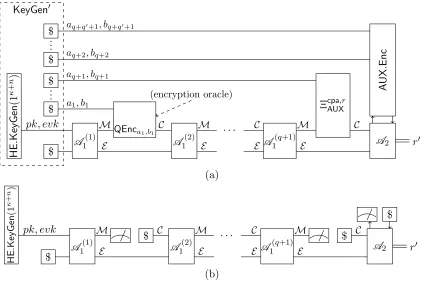
Security of Symmetric Key Schemes. In order to define indistinguishability under chosen plaintext attacks in the symmetric-key setting, we must equip the adversary with an encryption oracleEncsk(·). Anadversary with access to an encryption oracle,A is a tuple of quantum channels
(A(1), . . . ,A(q+1)), such that A(1) : D(X) → D(M ⊗ E) for some space X, for i = 2, . . . , q, A(i):D(C ⊗ E)→D(M ⊗ E), andA(q+1):D(C ⊗ E)→D(Y) for some spaceY. The interaction of
the adversary and the encryption oracle is shown in Fig. 2, and for the case of a bounded encryption scheme, in which the oracle also updates a counter, in Fig. 3.
QHE . Enc A sk sk X Y := sk X A(1) M E QHE . Enc sk C A(2) M E QHE . Enc sk C . . . . . . . . . sk M E QHE . Enc sk C
A(q+1) Y
Figure 2: An adversary A that makes at most q encryption oracle calls is a list of quantum channelsA(1), . . . ,A(q+1) such that forj= 1, . . . , q,A(j)sends a message to an encryption oracle, and A(j+1) receives the output. The full interaction is shown on the right, but we use the figure on the left as a short-hand for this interaction.
QHE
.
Enc
A
sk sk
d d+q
X Y := sk d X A(1) M E QHE . Enc sk d+ 1
C A(2) M E QHE . Enc sk C . . . . . . . . . . . . d+ 2
sk M E QHE . Enc sk d+q
C
A(q+1) Y
Figure 3: An adversary A that makes at mostq encryption oracle calls to a bounded encryption oracle is a list of quantum channels A(1), . . . ,A(q+1) with the interaction shown on the right. We use the figure on the left as a short-hand for this interaction.
Just as in the public-key setting, we can define a quantum CPA indistinguishability experiment for the symmetric-key setting, SymKcpaA,QHE(κ). An adversary forSymKcpaA,QHE(κ) is a pair of
adver-saries with access to an encryption oracle A = (A1,A2) = (A (1) 1 , . . . ,A
(q+1) 1 ,A
(1)
2 , . . . ,A (q0+1)
2 )
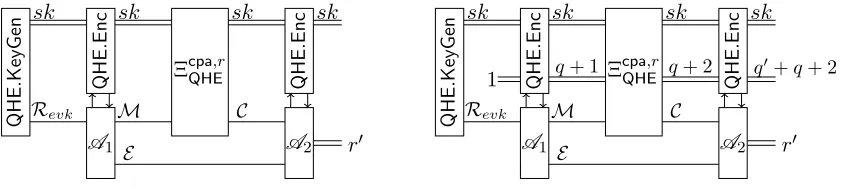
(q is the number of oracle calls before the challenger is called, andq0 is the number of oracle calls after the challenger is called). The experimentSymKcpaA,QHE(κ) is defined below, and shown in Fig. 4.
The quantum symmetric-key CPA indistinguishability experiment SymKcpaA,QHE(κ)
1. KeyGen(1κ) is run to obtain keys (sk, ρevk).
2. A1 is given ρevk, and may make a polynomial number of calls to an encryption oracle
QHE.Encsk before outputting a quantum state in message space M and environment
reg-isterE.
3. A random bit r ∈ {0,1} is chosen and Ξcpa,rQHE is applied to the state in M (the output being a state in C).
4. Adversary A2 obtains the system C ⊗ E and may make a polynomial number of calls to an
5. The output of the experiment is defined to be 1 ifr =r0 and 0 otherwise. In case r=r0, we say that A wins the experiment.
QHE
.
KeyGen
sk
Revk
QHE
.
Enc
A1
sk
M
E
Ξcpa,rQHE sk
C
QHE
.
Enc
A2
sk
r0
QHE
.
KeyGen
sk
1
Revk
QHE
.
Enc
A1
sk
q+ 1
M
E
Ξcpa,rQHE sk
q+ 2
C
QHE
.
Enc
A2
sk
q0+q+ 2
r0
Figure 4: The quantum CPA experiment for key systems (left) and bounded symmetric-key systems (right).
Definition 3.14 (Quantum Indistinguishability under Chosen Plaintext Attack (q-IND-CPA) for Symmetric Key Schemes). A symmetric-key quantum homomorphic encryption scheme QHE
is q-IND-CPA secure if for all quantum polynomial-time adversaries with oracle access, A = (A1(1), . . . ,A1(q+1),A2(1), . . . ,A2(q0+1)), there exists a negligible function η such that:
Pr[SymKcpaA,QHE(κ) = 1]≤ 1
2 +η(κ).
Similar to the case of public-key encryption (Sec. 3.2), it is straightforward to give the seemingly stronger variant of q-IND-CPA,q-IND-CPA-mult, which is defined identically to the public-key case (Def. 3.4) but with an adversary having access to an encryption oracle. However, just as in the public-key case, it turns out that these definitions are equivalent.
Theorem 3.15 (Equivalence of q-IND-CPA and q-IND-CPA-mult in symmetric-key schemes). Let
QHE be a symmetric-key quantum homomorphic scheme. Then QHE is q-IND-CPA if and only if
QHE is q-IND-CPA-mult.
The proof of Thm. 3.15 is virtually identical to that of Thm. 3.5, given in App. B.
4
Main Contributions
We now formally state our main results (formal schemes and proofs are given in Sec. 5–7). Our first theorem, Thm. 4.1, establishes quantum homomorphic encryption for Clifford circuits.
Theorem 4.1. (Clifford scheme, CL) Let S be the class of Clifford circuits. Then assuming the existence of a classical fully homomorphic encryption scheme that is q-IND-CPA secure, there exists a quantum homomorphic encryption scheme that is q-IND-CPA, compact and S-homomorphic.
Theorem 4.2. (entanglement-based scheme, EPR) Let S be the set of all quantum circuits over the universal gate set {X,Z,P,H,CNOT,T}(as well as single-qubit preparation and measurement). Then assuming the existence of a classical fully homomorphic encryption scheme that is q-IND-CPA secure, there exists an indivisible quantum homomorphic encryption scheme that is q-IND-CPA,S -homomorphic and R2-quasi-compact, whereR(C) is the number of T-gates in a circuit C.
The compactness of the scheme EPRis nontrival for all circuits in which R2 G, where G is the number of gates.
Our second scheme, formally defined in Sec. 7, is based on the use of auxiliary qubits to im-plementT-gates, resulting in a quantum homomorphic encryption scheme that is homomorphic for circuits with constant T-depth, as described in the following theorem:
Theorem 4.3. (auxiliary-qubit scheme, AUX) Fix a constant L. Let S be the set of quantum circuits over the universal gate set {X,Z,P,H,CNOT,T} (as well as single-qubit preparation and measurement) with T-depth at most L. Then assuming the existence of a classical fully homomor-phic encryption scheme that is q-IND-CPA secure, there exists a bounded symmetric-key quantum homomorphic encryption scheme that is q-IND-CPA, S-homomorphic and compact.
The QHE scheme in Thm. 4.3 can be seen as somewhat analogous to an important building block in classical fully homomorphic encryption: a levelled fully homomorphic scheme, which is a scheme that takes a parameter L, which is an a-priori bound on the depth of the circuit that can be evaluated. However, we note that in contrast to a levelled fully homomorphic scheme, in which operations are polynomial inL, the complexity of our scheme is a polynomial of degree exponential inL, so we really require Lto be constant.
As previously noted, Thm. 4.2 and 4.3 are complementary: the scheme EPR becomes less compact as thenumber ofT-gates increases, while the schemeAUXbecomes inefficient as thedepth
of T-gates increases.
5
Scheme
CL
: Homomorphic Encryption for Clifford Circuits
In this section, we presentCL, a compact quantum homomorphic encryption scheme for stabilizer circuits, which consist of Clifford circuits combined with measurements and single-qubit prepara-tion. This is a building block for the schemes that follow in Sec. 6 and 7. The main theorem we prove is Thm. 4.1, which follows directly from Thm. 5.1, 5.2 and 5.3.
By definition, Clifford circuits conjugate Pauli operators to Pauli operators [Got98]. In other words, for any Clifford C, and any Pauli,Q, there exists a PauliQ0 such that CQ=Q0C. Further-more, applying a random Pauli operator is a perfectly secure symmetric-key quantum encryption scheme: the quantum one-time pad (see Sec. 2.3). Combining these observations, we see that it is possible to perform any Clifford circuit on quantum data that is encrypted using the quantum one-time pad. We can apply the desired Clifford, C, to the encrypted state Q|ψi to get Q0(C|ψi). Now decrypting the state requires applying the PauliQ0. If Q can be described by the encryption key (a1, . . . , an, b1, . . . , bn) — that is, Q = Xa1Zb1 ⊗ · · · ⊗XanZbn — then Q0 can be described by
some key (a01, . . . , a0n, b01, . . . , bn0 ) depending on C and (a1, . . . , an, b1, . . . , bn). We describe this
de-pendence by a functionfC :F22n→F22n, which we call akey update rule. We need only consider key
update rules for each gate in our gate set, which consists of single-qubit measurement, single-qubit preparation, and the one- and two-qubit gates in {X,Z,P,CNOT,H}. For a single-qubit gate C, since the only keys that are affected are those corresponding to the wire to whichC is applied, an update rule can be more succinctly described by a pair of functions faC, fbC : F22 → F2 such that
XaiZbi|ψi C Xai0Zb0iC|ψi ai ←a0
i=faC(ai, bi), bi ←b0i =fbC(ai, bi)
For the two-qubitCNOT-gate, the update rule is described by a 4-tuple of functions, since CNOT
acts on two wires. We give the key update rules for all gates in App. C. By applying these rules after each gate, we can update the key so that the output is correctly decrypted. Such a technique was already used,e.g. in [Chi05, FBS+14, Bro15].
This solution, however, requires that the key updates be executed by the party holding the en-cryption keys: an “easy” classical computation, but nevertheless a computation that is polynomial in the size of the circuit. In the context of quantum homomorphic encryption, the challenge is therefore to allow the execution of arbitrary Clifford circuits, while maintaining the compactness condition. Here, we present a quantum public-key encryption scheme which is a hybrid of the quantum one-time pad and of a classical fully homomorphic encryption scheme. This encryption scheme is used to perform key updates on encrypted quantum one-time pad keys, enabling the com-putation of arbitrary Clifford group circuits on the encrypted quantum states, while maintaining the compactness condition. More precisely, to homomorphically evaluate a Clifford circuit consist-ing of a sequence of gates c1, . . . ,cG, we apply the gates to the quantum one-time pad encrypted
message, and homomorphically evaluate the functionfc1◦ · · · ◦fcG on the encrypted one-time pad keysa1, . . . , an, b1, . . . , bn, where◦denotes function composition. To accomplish this, we keep track
of functions for each bit of the quantum one-time pad encryption key, {fa,i, fb,i}ni=1. Since each
of the key update rules presented in App. C is linear, each fa,i and fb,i is a linear polynomial in
F2[a1, . . . , an, b1, . . . , bn] (from the perspective of the evaluation procedure,a1, . . . , an, b1, . . . , bnare
unknowns), so we refer to them askey-polynomials. Before we begin to evaluate the circuit, the key polynomials are the monomialsfa,i=ai andfb,i =bi. As we evaluate each gatecj, we update the
key-polynomials corresponding to the affected wires by composing them with the key update rules. To compute the new encrypted one-time pad keys once the circuit is complete, we homomorphically evaluate each key-polynomial on the old encrypted one-time pad keys. It is interesting to note that since the key update rules (App. C) for stabilizer circuit elements are all linear, for the schemeCL, the underlying classical fully homomorphic scheme only needs to be additively homomorphic.
We define our scheme CL as a QHE scheme. Here and throughout, we assume HE to be a classical fully homomorphic encryption scheme that is q-IND-CPA secure (see Def. 3.1 and App. A). As noted, such a scheme (based on the LWE assumption) could be derived from [BV11]. All of our schemes operate on qubit circuits, and encrypt qubit-by-qubit. Thus we fix M = C{0,1}.
Ciphertexts consist of quantum states inC{0,1}, combined with classical strings. Specifically, ifCis
the output space ofHE.Enc, andC0 is the output space of HE.Eval, then we defineC=CC×C⊗ X,
whereX ≡C{0,1}, and C0 = CC
0×C0
⊗ X.
Key Generation. CL.KeyGen(1κ). For key generation, execute (pk,sk,evk) ← HE.Keygen(1κ). Output the obtained secret key, sk, and public key, pk. The evaluation key ρevk takes the
value of the classical stateρ(evk).
Encryption. CL.Encpk : D(M) → D(C). Encryption is defined as the quantum channel that
outputs the classical-quantum state:
CL.Encpk(ρM) =
X
a,b∈{0,1}
1
4ρ(HE.Encpk(a),HE.Encpk(b))⊗QEnca,b(ρ
M).
Homomorphic Evaluation. CL.EvalC:D(Revk⊗ C⊗n)→D(C0⊗m
Suppose C =c1, . . . ,cG is a Clifford circuit. For every j = 1, . . . , G such that cj initializes
a fresh qubit, we initialize a new qubit CL.Encpk(|0ih0|) and append it to the system. Let ρ∈D(X1⊗ · · · ⊗ Xm), be the composite system consisting of the input quantum system and
the initialized qubits.
1. For alli∈[n], setfa,i, fb,i∈F2[a1, . . . , an, b1, . . . , bn] asfa,i←ai,fb,i←bi.
2. Forj= 1, . . . , G such thatcj is a gate or a measurement:
(a) Apply the gate cj to the state: ρ←cjρc−1j .
(b) Compose the key update rules with the key-polynomials of the affected wires: ifcj
is a single qubit gate or measurement acting on theith wire, update as (fa,i, fb,i)←
(fa,i◦facj, fb,i◦f cj
b ). Otherwise, ifcj is aCNOT-gate acting on wiresiandi
0, update
(fa,i, fa,i0, fb,i, fb,i0) analogously.
3. Update the classical encryptions by computing
ci = (HE.Eval fa,i
evk(˜ai),HE.Eval fb,i evk(˜bi)).
4. Output (c1, . . . , cm, ρ) (with registers permuted to fit the prescribed form).
Decryption. CL.Decsk :D(C0)→ D(M). For ˜a,˜b∈C0, the output space ofHE.Eval, decryption
is given by the conditional quantum channel:
CL.Decsk :|˜aih˜a| ⊗ |˜bih˜b| ⊗ρX 7→QDecHE.Decsk(˜a),HE.Decsk(˜b)(ρX),
which can be implemented by first decoding the classical registers to obtaina=HE.Encsk(˜a)
and b=HE.Encsk(˜b), applyingQDeca,b, and then tracing out CC 0×C0
.
We have chosen to present CL.Encpk and CL.Decsk as quantum channels, since they are easily
seen to be polynomial-time implementable. Note, however, that for more complicated quantum channels such asCL.Evalwe will generally prefer their description in terms of a high-level algorithmic description.
5.1 Analysis of CL
We now analyse the various properties ofCL.
Theorem 5.1. Let S be the class of Clifford circuits. Then CL isS-homomorphic.
Proof. This follows from the circuits in App. C, as well as the homomorphic property of HE. In particular, since the decrypted values of the ciphertexts are correct (except with exponentially small probability), then Equation (3) is satisfied.
Theorem 5.2. CL is compact.
Proof. Letpbe a polynomial such that the complexity of applyingHE.Decto the output ofHE.Eval
is at most p(κ) — such a polynomial exists by the compactness of HE. Then decrypting a single qubit of the output of CL.Eval has complexity at most 2p(κ) + 2, since we must decrypt two keys aand band then applyXa and Zb, soCL is also compact.
Proof. The main part of this proof will be to show that the classical ciphertexts HE.Encpk(a) and
HE.Encpk(b) give at most a negligible advantage. We will then see that without these classical
ciphertexts, the quantum CPA Indistinguishability experiment is independent of r from the per-spective of the adversary.
Let CL0 be the quantum homomorphic encryption scheme with CL0.KeyGen = CL.KeyGen,
CL0.Eval=CL.Eval,CL0.Dec=CL.Dec, and
CL0.Encpk(ρ) =
X
a,b∈{0,1}
1
4ρ(HE.Encpk(0),HE.Encpk(0))⊗(X
aZbρZbXa)
=ρ(HE.Encpk(0),HE.Encpk(0))⊗
1 2I2.
LetA = (A1,A2) be an adversary forPubKcpaA,CL(κ). We will define an adversaryA0 = (A10,A20)
for PubKcpaA0,HE-mult(κ). Essentially, A0 will simulate PubK
cpa-mult
A,CL (κ), except that when it simulates
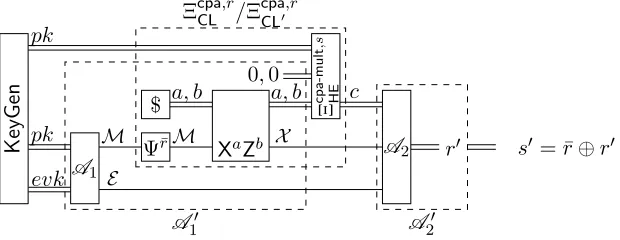
Ξcpa,rCL , it will use Ξcpa-mult,sHE in place of HE.Enc, so that it will actually be running either Ξcpa,rCL (if s= 1) or Ξcpa,rCL0 (ifs= 0) (see Fig. 5).
KeyGen
pk
pk
evkA1
M
E
$
Ψr¯ a, b
M
XaZb
0,0 a, b
X
Ξ
cpa-mult
,s
HE c
A2 r0 s0 = ¯r⊕r0
A0
1 A20
Ξcpa,rCL /Ξcpa,rCL0
Figure 5: The new adversaryA0 forPubKcpa-multA0,HE , where Ψ is the channel that replaces the system with |0ih0|. Here $ denotes the channel that outputs a completely mixed state, or equivalently, a uniform random variable. If s= 1, the middle dashed box is Ξcpa,rCL , and if s= 0, Ξcpa,rCL0 .
A0
1(pk, evk): RunA1(pk, evk) to get a stateρME. Choose a uniform random bitr. Ifr= 0, discard
theMsubsystem and replace it with the state |0ih0|. Choose uniform random bits a andb, and apply QEnca,b, the quantum one-time pad, toM, relabelling the resulting system byX.
Input (a, b) and (0,0) to Ξcpa-mult,sHE .
A0
2: Run A2 to get a bitr0. Output 1 if r=r0 and 0 otherwise.
We now compute the probability that A0 correctly guesses s, which we know must be at most
1
2 +η(κ) for some negligible function, since HE is q-IND-CPA. If s = 1, then A
0 is simulating
PubKcpaA,CL, so the probability that r0=r (and thus that s0 = 1 =s) is Pr[PubKcpaA,CL(κ) = 1]. On the other hand, ifs= 0,A2 gets encryptions of 0 rather thanHE.Enc(a),HE.Enc(b), soA0 is
simulatingPubKcpaA,CL0, so the probability thatr6=r0, and thuss0 = 0 =s, is Pr[PubKcpaA,CL0(κ) = 0]. Then since the total probability that s=s0 is at most 12 +η(κ), we have:
1
2Pr[PubK
cpa
A,CL(κ) = 1] +
1
2Pr[PubK
cpa
A,CL0(κ) = 0]≤
1
2+η(κ) Pr[PubKcpaA,CL(κ) = 1] + 1−Pr[PubKAcpa,CL0(κ) = 1]≤1 + 2η(κ)
We complete the proof by noting that when s= 0, sincec = (HE.Encpk(0),HE.Encpk(0)), it is
independent ofa, b (see Fig. 6).
KeyGen
pk
pk
evkA1
M
E
$
Ψr¯ a, b
M
XaZb
0,0
X
HE
.
Enc c
A2 r0
Figure 6: When s= 0, A0 is simulating PubKcpaA,CL0. In this case, c is independent ofa, b, and so the only dependence on a, bis the quantum-one-time-pad encrypted message in X.
Then from the perspective of A2, since a, b is uniform random, the system X just contains the
completely mixed state $ (see Fig. 7).
KeyGen
pk
pk
evkA1
M
E
Ψr¯M $
0,0
X
HE
.
Enc c
A2 r0
Figure 7: The circuit from Figure 6 is equivalent to the above circuit, in which the system in M is replaced with the completely mixed state. Then from the perspective of A, the experiment is independent ofr.
Since the experiment PubKcpaA,CL0 is independent of r from the perspective of A, it follows that Pr[PubKcpaadvA,CL0(κ) = 1] = 12. Combining this with Equation (4), we get
Pr[PubKcpaA,CL(κ) = 1]≤ 1
2+ 2η(κ),
which completes the proof, since 2η is still a negligible function.
6
Scheme
EPR
:
T
-gate Computation Using Entanglement
In order to achieve universality for quantum circuits, we need to add a non-Clifford group gate, such as the T-gate. As noted in Sec. 1.1, if we apply the same technique as in Sec. 5 (i.e. to apply theT-gate on the encrypted quantum data) we run into a problem, since:
TXaZb =XaZa⊕bPaT. (5)
That is, conditioned ona, the output picks up an undesirable P error, which cannot be corrected by applying Pauli corrections. In [Chi05], Childs arrives at the same conclusion, and makes the observation that, in the case where a = 1, the evaluation algorithm could be made to correct
T XaZb|ψi
Pa Zk
|+i (k∈R{0,1})
c
Xa⊕cZa⊕b⊕k⊕a·cT|ψi
Figure 8: Functionality of theT-gate gadget.
Xfa,iZfb,i|ψiXi T c
Xfa,i⊕cZfa,i⊕fb,i⊕kt⊕cfa,iT|ψi
Xi |Φ+i
Rt
ft←fa,i
V ←V ∪ {kt}
fa,i←fa,i⊕c
fb,i ←(1⊕c)fa,i⊕fb,i⊕kt
Pft H kt
(Part of decryption)
Figure 9: Evaluation protocol for the tth T-gate, applied to theith wire. The key-polynomials fa,i
and fb,i are in F2[V]. After the protocol, V gains a new variable corresponding to the unknown
measurement resultkt. The dashed box shows part of the decryption procedure, which happens at
some point in the future, after the complete evaluation is finished.
algorithm does not find out if this correction is being executed or not, security holds. The solution in [Chi05] involves quantum interaction; this was recently improved to a single auxiliary qubit, coupled with classical interaction [FBS+14, Bro15]. In this section, we base the evaluation of the
T-gate on a modification of this technique, as presented in Fig. 8. The modification is that we allow the auxiliary qubit to be prepared in a state dependent on theX-encryption key, whereas [FBS+14, Bro15] explicitly avoids this since it requires the auxiliary qubits to be prepared independently of the computation. Correctness of Fig. 8 is proven in App. D.
As a proof technique (for establishing security), [FBS+14, Bro15] considers an equivalent, entanglement-based protocol. Here, we use the idea of exploiting entanglement in order to de-lay the correction required for the evaluation of the T-gate on encrypted data. The protocol is illustrated in Fig. 9.
Fig. 9 shows that, using the entangled state|Φ+i= √1
2(|00i+|11i), the conditionalPcorrection
can be delayed. The cost of this is that the value of the measurement result,kt, on auxiliary register Rt, is undetermined until later, when it is measured as part of the decryption algorithm. Thus we
view the key updates as a symbolic computation: each time a T-gate is applied, an extra variable, kt, is introduced.
For the first T-gate evaluation (t= 1), the evaluation procedure does not have the knowledge to evaluate f1 = fa,i, where i is the wire upon which the gate is performed, in order to perform
the correction. It is possible (using the classical scheme HE), to compute a classical ciphertext
e
f1 that decrypts to f1(a1, b1, . . . , an, bn). Thus, for this T-gate, the output part of the auxiliary
system contains both fe1 and the register R1. As part of the decryption operation, compute f1 ←
HE.Dec(fe1), and applyPf1 onR1 before measuring in the Hadamard basis and obtainingk1. From
the point of view of the evaluation procedure,k1 is unknown and so it becomes anunknown part of
continues in this fashion for values oftup toR; each time, the set of unknown variables increasing by one. Note that, according to Fig. 9, as well as the linearity of the key update rules, for all t, ft ∈ F2[a1, . . . , an, b1, . . . , bn, k1, . . . , kt−1] is linear (since c is a known constant), so we can write
ft=ftk+ftab forftk∈F2[k1, . . . , kt−1] and ftab∈F2[a1, . . . , an, b1, . . . , bn].
The cost of this construction is that each T-gate adds to the complexity of the decryption procedure, since, in particular, for each T-gate, we must perform a possible P-correction and a measurement on an auxiliary qubit. In addition, we cannot evaluate the key-polynomials, nor the ft, until the variables kt have been measured, so this evaluation must take place in the decryption
phase, increasing the dependence onR, the number ofT-gates, toO(R2) We make this dependence precise in Thm. 6.3.
We now formally define the indivisible quantum homomorphic encryption scheme, EPR. As in
CL, we have message space M =C{0,1} and cipherspace C = CC×C⊗ X, where C is the output
space of HE.Enc and X ≡C{0,1}. Since EPR is indivisible, the output space ofEPR.EvalC has the
form Raux⊗ C0⊗m. We require an indivisible scheme, because decryption of any one of the output
qubits requires access to the auxiliary system. In our case, we have Raux = R1 ⊗ · · · ⊗ RR⊗
(C{0,1}
R+1
)⊗R⊗(CC 0
)⊗R, whereRis the number ofT-gates inC,C0 is the output space ofHE.Eval, and Rt ≡C{0,1} for each t. The classical parts of the auxiliary space allow us to outputR linear
polynomials inF2[k1, . . . , kR] corresponding to{ftk}Rt=1, each of which can be represented withR+1
bits; as well asR HE.Eval outputs, corresponding to encryptions of{fab
t (a1, . . . , an, b1, . . . , bn)}Rt=1.
Similarly, we have C0 = ( C{0,1}
R+1
)⊗2⊗CC0×C0
⊗ X.
Key Generation. EPR.KeyGen(1κ). The key generation procedure is the same asCL.KeyGen(1κ).
Encryption. EPR.Encpk :D(M)→D(C). The encryption procedure is the same as CL.Encpk.
Evaluation. EPR.Evalevk. As in CL, apply gates in {X,Z,P,H,CNOT} directly on the encrypted
quantum registers. For the T-gate, use the gadget defined in Fig. 9. This gadget differs from previous gadgets in that it uses an auxiliary Bell state,|Φ+i. After the system of theith wire,Xi,
is measured, relabel half of the Bell state asXi, and the other half asRt, which is returned as part of Raux. The full evaluation procedure is as follows.
1. SetV ← {ai, bi}i∈[n], and ∀i∈[n], setfa,i, fb,i∈F2[V] asfa,i←ai,fb,i ←bi.
2. Letg1, . . . ,gGbe a topological ordering of the gates in C. Forj= 1, . . . , G, evaluategj using
the appropriate gadget.
3. Let S be the set of output wires. Let L be the set of labels L = {(a, i),(b, i) : i ∈ S} ∪ {1, . . . , R}. For eachα∈ L, we want to homomorphically evaluatefαto obtain the actual
(en-crypted) key, but we can only actually evaluate the part offαthat is in the variables{ai, bi}i
— the {kt}tare still unknown. Recall that we can writefα =fαk+fαab forfαk ∈F[k1, . . . , kR]
and fαab∈F2[a1, . . . , an, b1, . . . , bn]. Computeffαab←HE.Evalf
ab α
evk(˜a1, . . . ,˜an,˜b1, . . . ,˜bn).
4. Output:
• The m =|S|qubit registers {Xi :i∈S} corresponding to the encrypted output of the circuit;
• TheRqubit registersR1, . . . ,RRcorresponding to auxiliary states created byT-gadgets; • The polynomials {fk
α}α∈L⊂F2[k1, . . . , kR] and the homomorphically evaluated
polyno-mials {ffab
α }α∈L.
1. Fort= 1, . . . , R:
(a) Decryptftab←HE.Decsk(ffab
t ).
(b) Compute a←ftk(k1, . . . , kt−1)⊕ftab and apply HPa toRt.
(c) MeasureRt to getkt.
2. LetS be the set of indices of the output qubit registers. Fori∈S:
(a) Decryptfa,iab ←HE.Decsk(ffab
a,i) and fb,iab←HE.Decsk(ffab
b,i).
(b) Compute ai ←fa,ik (k1, . . . , kt)⊕fa,iab and bi←fb,ik(k1, . . . , kt)⊕fb,iab.
3. To each registerXi, apply the mapQDecai,bi. Output registers X1, . . . ,Xm.
6.1 Analysis of EPR
We now analyse the various properties of EPR. Since the scheme EPR uses the same KeyGen and
Enc procedures asCL, the following theorem follows from Thm. 5.3.
Theorem 6.1. If HE is q-IND-CPA secure, then EPRis q-IND-CPA secure.
The next theorem shows the homomorphic property for all circuits (recall that this property is independent of compactness).
Theorem 6.2. Let S be the class of all quantum circuits. Then EPR isS-homomorphic.
The proof follows from the circuits in App. C, Fig. 9, as well as the homomorphic property of HE.
Since the complexity of the decryption procedure depends on R, the number of T-gates in the circuit, it is clear that the scheme EPR is not compact. However, by analysing the circuit’s dependence on R, we can see that for a very large class of quantum circuits, EPR is non-trivially quasi-compact. The following theorem is immediate from the decryption procedure.
Theorem 6.3. Let p be a polynomial such that HE.Dec has complexityO(p(κ)). Then the decryp-tion procedure EPR.Dec has complexity O(R2+Rp(κ) +mp(κ) +mR).
Thus, the dependence of the complexity of EPR.Dec on the evaluated circuitC isR2:
Corollary 6.4. Let R(C) denote the number of T-gates in a circuit C. Then EPR is R2
-quasi-compact.
This beats the compactness of the trivial scheme for all circuits C such that the number of
T-gates is less than the squareroot of the number of gates; that is R√G.
7
Scheme
AUX
:
T
-gate Computation Using Auxiliary States
In the previous QHE scheme, we solved the problem of performing the P correction (Eq. (5)) by
delaying the correction via entanglement. In this section, we present a quantum homomorphic encryption scheme, AUX, that takes a more proactive approach to dealing with the P correction. At a high level,AUXcan be understood as the following: as part of the evaluation key,AUX.Keygen
Xi
Xfa,iZfb,i T c
|+fa,i,ki
XiX
fa,i⊕cZfa,i⊕fb,i⊕k⊕cfa,iT
fa,i←fa,i⊕c
fb,i←fa,i⊕fb,i⊕k⊕cfa,i
V ←V ∪var(k)
Figure 10: AT-gadget for the scheme AUXconsists of the above circuit and key-update rules. We use var(k) to denote the set of variables in the polynomialk, which depends on the construction of the auxiliary state |+fa,i,ki, described below.
as |+a,ki := ZkPa|+i (where k is a random bit and a is an encryption key) that are useful for
the evaluation of the T-gate (see Fig. 10). In general (after having applied prior gates), the exact auxiliary state will not be available; instead, the Eval procedure combines a number of auxiliary states in order to create a single copy of a state that is useful for performing the correction. This combination operation, however, is expensive as it introduces new unknowns (in terms of new variables as well as “cross-terms”), that need to be corrected in any future T-gate. Thus the size of the evaluation key grows rapidly, as a polynomial whose degree is exponential in the T-depth. We can thus tolerate only a constant T-gate depth for this scheme to be efficient.
We further specify thatAUXis a symmetric-key encryption scheme. This is becauseAUX.KeyGen
generates auxiliary qubits that depend on the quantum one-time pad encryption keys. Also,KeyGen
takes an extra parameter 1n, where n is an upper bound on the total number of qubits that can be encrypted (AUX acts much like a classical one-time pad scheme that picks a fixed-length encryption key ahead of time). After this bound on the number of encryptions has been attained, no further qubits can be encrypted. We will suppose without loss of generality that a circuit being homomorphically evaluated is on n wires. Furthermore, the number and type of auxiliary qubits will depend on the T-depth of the circuit to be evaluated, L. The scheme will not be able to homomorphically evaluate circuits with T-depth greater than L. We will see that the number of required auxiliary states grows super-exponentially in L, so we will require that L be a constant. Fix a constantL. We will now define a schemeAUX=AUXL that is homomorphic for all circuits
withT-depth at most L.
Auxiliary Qubit Construction. In general, providing the necessary auxiliary states for each
T-gate would require advance knowledge of the key fa,i at the time a T-gate is applied to the ith
wire. Since this depends on both the circuit being applied and on the prior measurement results, we appear to be at an impasse. The key observation that allows us to continue with this approach is that, given auxiliary states|+f1,k1iand|+f2,k2i, we can combine them to get|+f1⊕f2,ki, for some
k, using the following circuit:
|+f1,k1i
|+f2,k2i
|+f1⊕f2,k1⊕k2⊕(f1⊕c)f2i
c
By iterating this procedure, given auxiliary states|+f1,k1i, . . . ,|+fr,kri, we can construct the auxil-iary state |+f1⊕···⊕fr,ki, where k =
Lm
i=1ki ⊕ Lr
i=2cifi ⊕ Lr
i=1 Li−1
j=1fifj for known values ci.
Thus, if we give many initial auxiliary states of the form {|+ai,ka,ii,|+bi,kb,ii}i (with different keys for different copies), we can construct |+f,ki for f a linear function of {ai, bi}i∈[n].
How-ever, using an auxiliary state |+fa,i,ki to facilitate a T-gate on the i
th wire introduces the
un-known k into fb,i. In particular, suppose fa,i = Ljr=1tj for some monomial terms tj ∈ F2[V].
Then we will need to construct it from auxiliary states |+t1,k1i, . . . ,|+tr,kri, to get |+fa,i,ki for
k=Lm
i=1ki⊕Lri=2citi⊕Lri=1 Li−1
j=1titj. Thus, after theT-gadget, the new keysfa,i0 , fb,i0 are in



![Figure 9: Evaluation protocol for the tth T-gate, applied to the ith wire. The key-polynomials fa,iand fb,i are in F2[V ]](https://thumb-us.123doks.com/thumbv2/123dok_us/7933277.1317237/20.612.90.527.70.308/figure-evaluation-protocol-gate-applied-wire-polynomials-iand.webp)