SoK: Modular and Efficient Private Decision Tree Evaluation
?´
Agnes Kiss1, Masoud Naderpour2, Jian Liu3, N. Asokan4, Thomas Schneider1
1
TU Darmstadt
{kiss, schneider}@encrypto.cs.tu-darmstadt.de 2
University of Helsinki
University of California, Berkeley??
Aalto University
Abstract. Decision trees and random forests are widely used classifiers in machine learning. Service providers often host classification models in a cloud service and provide an interface for clients to use the model remotely. While the model is sensitive information of the server, the input query and prediction results are sensitive information of the client. This motivates the need for private decision tree evaluation, where the service provider does not learn the client’s input and the client does not learn the model except for its size and the result.
In this work, we identify the three phases of private decision tree evaluation protocols: feature selection, comparison, and path evaluation. We systematize constant-round protocols for each of these phases to identify the best available instantiations using the two main paradigms for secure computation: garbling techniques and homomorphic encryption. There is a natural tradeoff between runtime and communication considering these two paradigms: garbling techniques use fast symmetric-key operations but require a large amount of communication, while homomorphic encryption is computationally heavy but requires little communication.
Our contributions are as follows: Firstly, we systematically review and analyse state-of-the-art protocols for the three phases of private decision tree evaluation. Our methodology allows us to identify novel combinations of these protocols that provide better tradeoffs than existing protocols. Thereafter, we empirically evaluate all combinations of these protocols by providing communication and runtime measures, and provide recommendations based on the identified concrete tradeoffs.
Keywords: Privacy-preserving protocols, secure computation, homomorphic encryption, decision tree evaluation, machine learning
1
Introduction
Machine learning is pervasively being applied in various real-world scenarios. All major IT companies, including Amazon, Apple, Google, Facebook and Microsoft, are working on and use machine learning technologies. First, atraining phase takes place where a model is trained on a large dataset so that later it can make predictions on an input, which happens in theevaluation phase. One of the most commonly used predictive models are decision trees, whose extension to random forests – sets of smaller decision trees trained on different random subsets of features – is considered to be among the most accurate classification models [DCBA14].
In many scenarios, predictive models such as decision trees and neural networks are trained or queried on sensitive data and should be handled in a private manner [WGC18]. Solutions forprivate training of decision trees exist that have been heavily optimized [LP00, LP02, VC05, VCKP08, BS09, FW12].
In this work, we focus on theprivate evaluation of decision trees with security against passive adversaries. In this scenario, the server holds a decision tree and offers its evaluation as a service to its client with
?Please cite the conference version of this work to appear in PoPETs’19(2). ??
Sub-protocol PathH PathG
SelH + CompG HGH§4.1 HGG [BFK+09]
SelG + CompG GGH§4.1 GGG [BFK+09]
SelH + CompH HHH [TMZC17] HHG§4.1
SelG + CompH × ×
Table 1: Combinations of sub-protocols for private decision tree evaluation ABC = SelA + CompB + PathC. SelH/SelG denotes oblivious feature selection, CompH/CompG oblivious comparison, and PathH/PathG oblivious path evaluation with homomorphic encryption (H) and garbling techniques (G).
sensitive input to the decision tree. Moreover, the model may leak information about the training data used for its generation, which is a valuable asset of the server. The server’s goal is to offer the service without compromising the client’s input, or the client learning anything about the decision tree (beyond its size and the result).
Note that recent works [TZJ+16, PMG+17, SSSS17, JSD+18] have shown that it is possible for an attacker who has only blackbox oracle access to prediction APIs of machine learning models to succeed in learning model parameters by repeated adaptive queries to the API. Defending against such attacks is an active area of research and several proposals have already appeared, e.g., [TZJ+16, KMAM18, JSD+18]. We deem dealing with blackbox attacks out of scope for this paper.
1.1 Applications
Cloud-hosted evaluation of machine learning models is a widely used service that companies such as Amazon, Google or IBM provide to their customers. While doing so [Bar15], Amazon Web Services (AWS) recognizes that their clients care about the privacy of their data [Ser18]. These services can be enhanced by using private evaluation of machine learning models to allow for providing a service while violating the privacy of neither the resulting model nor the customers’ input features. Most machine learning APIs such as BigML [Big18], MLJAR [MLJ17], Wise.io [Wis18], or Azure Machine Learning Studio [Mic18] support decision tree or random forest classifiers. Decision tree evaluation has a tremendous amount of applications, and is being used by companies such as Facebook [IK17] and Microsoft [RG16].
Private decision tree evaluation can provide a solution for private medical diagnosis [TASF09], such as electrocardiogram classification [BFK+09, BFL+11], where the medical history and genomic data of the patient are sensitive information. Decision trees and random forests can be applied for malware [AM18], and text classification [RMD18]. Moreover, decision trees and random forests have been successfully used for detecting insider threat [MAAG15] and multimedia protocol tunneling [BSR18], as well as spam campaign-ers [GKG+18], and predicting the interruptability intensity of mobile users [YGL17], data hotspots in cellular networks [NIZ+16], and even private interactions in underground forums [OTGM18]. Private evaluation of decision trees and random forests can enhance the privacy that these techniques provide, while protecting the sensitive business information of the service provider. Recently, secure evaluation of branching programs, an extension of decision trees, has also been utilized in a protocol for private set intersection [CO18].
1.2 Outline and Our Contributions
There exist two main paradigms for secure computation: homomorphic encryption, which often has little communication but high computation complexity, andgarbling techniques, which require more communication, but utilize efficient symmetric-key primitives. In this work, we systematically analyze the state-of-the-art constant-round protocols for private decision tree evaluation that make use of these paradigms. We explore the tradeoffs and combinations of the identified sub-protocols, compare the performance of all combinations and identify the most efficient constant-round private decision tree evaluation protocols to date.
In more details, our contributions are as follows:
S Server (holds decision tree)
CClient (holds input features) T Decision tree
nDimension of feature vector tBitlength of a feature mNumber of decision nodes
m0Number of depth-padded decision nodes
mNumber of possibly depth-padded decision nodes, i.e.,morm0, depend-ing on the underlydepend-ing protocol
dDepth of decision tree
x={x1, . . . , xn}Client’s feature vector
y={y1, . . . , ym}Server’s thresholds for (padded) decision nodes
κSymmetric security parameter (= 128) sStatistical security parameter (= 40) τsymSize of symmetric ciphertext (= 128)
τElGamalSize of ciphertext in lifted ElGamal (= 514)
τPaillier Size of ciphertext in Paillier (= 4096)
τDGKSize of ciphertext in DGK encryption (= 2048) Table 2: Notations used throughout the paper.
of the decision nodes, the second is private comparison, and the third is private evaluation of the path corresponding to the given input in the decision tree. We analyze the state-of-the-art techniques for these sub-protocols that use additively homomorphic encryption (H) as well as those using garbling techniques (G). We denote the different approaches for oblivious selection, comparison, and path evaluation by SelH/SelG (§3.1), CompH/CompG (§3.2), and PathH/PathG (§3.3), respectively, and describe their efficient instantiations.
Protocols for private decision tree evaluation (§4).We show that different sub-protocols can be combined efficiently, resulting in the six protocols shown in Tab. 1. We adapt all resulting protocols to an offline-online setting, where all operations independent of the input features are precomputed in an offline phase, which results in a more efficient online phase (§4.1). Thereafter, we present protocol extensions for some of our protocols (§4.2).
Empirical evaluation (§5).We evaluate the performance of the resulting private decision tree evaluation protocols and study the tradeoff between runtime and communication on example real-world datasets. We show the competitive performance of general-purpose secure two-party computation protocols for sub-protocols of private decision tree evaluation that has been claimed to be inefficient in [WFNL16, TMZC17].
Improvements and recommendations (§6). We show that our identified hybrid protocols that combine homomorphic encryption with garbling techniques achieve an order of magnitude runtime improvement over state-of-the-art protocols. We provide recommendations for different settings based on our findings.
Related work (§7) and open questions.Finally, we discuss our results in relation to related work. The protocol based solely on garbling techniques can easily be extended to security against malicious clients (cf.§4.1). Tai et al. [TMZC17] propose the same (more costly) extension using zero-knowledge proofs for the protocol based solely on homomorphic encryption. As interesting future work, one could study and extend the security of hybrid protocols against malicious clients.
2
Preliminaries
In this section, we detail necessary preliminaries to our work. The notations we use are summarized in Tab. 2.
2.1 Decision Trees
x2 ?
< y1
x1 ?
< y2
0 1
0 1
v1
v2 v3
(a) Decision tree with m= 2.
x2 ?
< y1
x1 ?
< y2
0 1
0 1
1 0
v1 v2 v3
(b) Depth-padded decision tree withm0= 3.
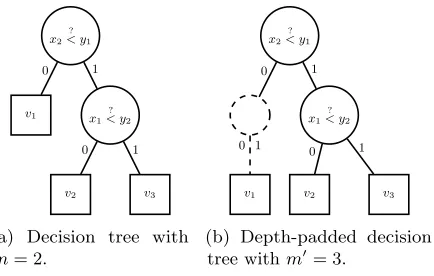
Fig. 1: Decision trees with depth d= 2.
v={v1, . . . , vm+1}. A decision tree has a threshold vectory={y1, . . . , ym}and receives ann-dimensional feature vectorx={x1, . . . , xn} as input. At thejth decision node (j∈ {1, . . . , m}), a comparison between
anxi andyj takes place (i∈ {1, . . . , n}), whereσ:m→ndenotes the mapping for input selection. Decision
tree evaluationT(x) means evaluating the comparisons at each decision node of a path, the result of which defines the branch taken next. When a leaf node is reached on the path, the corresponding classification is outputted. Thedepthdof the decision tree is the length of the longest path between the root and any leaf. Additionally, we definedepth-padding, where dummy decision nodes are introduced at every leaf until depthdis reached in order for each path to have the same depth. A dummy node has one outgoing edge, i.e., independently from the comparison result it leads to the same node as shown in Fig. 1b. The number of these dummy nodes, which depends on the structure of the tree, is at mostPm−1
i=1 i, i.e., the number of decision nodes in the depth-padded tree ism≤m0 ≤1
2m(m+ 1). From here on, we usem whenever bothm orm0 can be used in a protocol.
Real-world datasets.In this paper, we use the real-world datasets summarized in Tab. 3 for which we trained decision trees usingscikit-learn[sld17]. These datasets are taken mostly from the UCI machine learning repository [Lic18]: the classicalirisdataset for pattern recognition of the iris flower, thewineand
(breast) cancerdatasets for classification based on the chemical analysis of wines and the characteristics
of a diagnostic image, resp., as well as theboston dataset that includes house prices, thedigitsdataset that contains images of hand-written digits, which has been used by NIST [GBC+97], and the
diabetes
dataset that includes automatic and paper records of diabetes patient glucose measurements for classification.
The linneruddataset has been used in [Ten98] for regression and includes physiological measurements. The
decision trees are of varying sizes and depths which allows us to study the behaviour of our identified protocol combinations. In Tab. 3, we show the values ofn(number of input features),d(depth),m(number of decision nodes), andm0 (number of depth-padded decision nodes).
2.2 Cryptographic Techniques
Private decision tree evaluation protocols can be constructed based on both paradigms for secure computation: homomorphic encryption and garbling techniques. We detail the techniques used in this work.
Oblivious transfer. 1-out-of-2 oblivious transfer (OT) allows a sender to obliviously send one of two messagesm0, m1to a receiver according to the receiver’s selection bitb, without the receiver learning anything aboutm1−b or the sender learningb. OT generally requires expensive public-key operations [IR89]. However,
Dataset n d m m0 Source
iris 3 5 8 19 UCI [Lic18]
wine 7 5 11 26 UCI [Lic18]
linnerud 3 6 19 47 [Ten98]
(breast) cancer12 7 21 66 UCI [Lic18]
digits 47 15 168 1,161 UCI [Lic18]
diabetes 10 28 393 6,432 UCI [Lic18]
boston 13 30 425 6,768 UCI [Lic18]
Table 3: Example decision trees of varying sizes withninput features,mdecision nodes,m0 padded decision nodes, andddepth for real-world datasets, trained using scikit-learn[sld17] which contains a library with these datasets.
actual messages and choice bits. To retrieve the output of the OT in the online phase, the parties blind their messages using inexpensive XOR operations, and require|m0|+|m1|+ 1 bits of communication, whereas all cryptographic operations are shifted to the offline phase, which requiresτsym bits of communication per random OT [ALSZ13].
Yao’s garbled circuit protocol. Secure two-party computation allows two parties to compute an arbitrary functionality on their private inputs without learning anything about the other party’s input (beyond the output). Yao’s garbled circuit (GC) protocol [Yao82, Yao86] is one of the most widely used solutions for secure two-party computation. Yao’s protocol works as follows: one of the parties acts as the garbler, who garbles the circuit, i.e., assigns two random keys corresponding to 0 and 1 to each of its wires and encrypts the gates using these keys. The garbler sends this garbled circuitGC to the other party, the evaluator, who evaluates it after having obliviously received the keys corresponding to its input bits from the garbler through OTs. The protocol therefore relies on OTs linear in the input length of the evaluator and symmetric-key operations linear in the size of the Boolean circuit describing the function. Various optimizations exist including point-and-permute [BMR90], free-XOR [KS08a], fixed-key AES garbling [BHKR13], and half-gates [ZRE15], while at the implementation level Single Instructions Multiple Data (SIMD) operations can be used [BJL12]. All these state-of-the-art optimizations are implemented in the ABY framework [DSZ15], which we use in our implementation. With all these optimizations, each AND gate of the circuit needs 2τsym bits of communication.
Additionally, we use the point-and-permute technique in our protocols [BMR90]. In the classic garbling scheme, each wireihas two labels (ki0for 0 andk1i for 1) associated with it. In order to hide the truth values of these wires with minimal overhead, acolor bit can be appended to each label (opposite color bits for 0 and 1). The relation of the color bits and the truth values are known only to the garbler, while the evaluator holds one label from each wire, the color bit of which it can use to proceed with evaluation. In the end of the protocol, the evaluator possesses the wire labels for the output value, which have the color bits appended to them.
We use the following notations for the garbling scheme: (GC,out0,out1)←Garble(C,in0,in1) denotes the garbling method that returns the garbled circuitGC, including the output wire keys (out0, out1) for both the 0 and 1 values, respectively. It gets as input circuitC and input wire key pairs (in0, in1) for the evaluator’s input wires. (GC,color)←Garble’(C,in0,in1) denotes the same garbling method but returns the color bits along withGC.out←Eval(GC,in) denotes GC evaluation where the evaluator inputs his input wire keysin(received via OTs from the garbler), and receives the output wire keysoutcorresponding to the output bits. The actual output remains oblivious to the evaluator, since he does not learn the values the wire keys correspond to.out’←Eval’(GC,in) denotes a similar method, where the evaluator receives blinded output bitsout’, i.e., the color bits of the outputs.
Homomorphic encryption. Additively homomorphic encryption allows anyone holding the public key pk to calculate [x1+x2] = [x1][x2], given two ciphertexts [x1] :=Encpk(x1) and [x2] := Encpk(x2).
Ideal functionalityFPDTE.
1. Private input of S: decision treeT.
2. Private input of C: inputsx={x1, . . . , xn}.
3. Compute: evaluatev=T(x). 4. Output of C: classification resultv.
Fig. 2:FPDTE– Ideal functionality for private decision tree evaluation (PDTE). A decision treeT is defined by its topology, input selection σ : m → n, thresholds y = {y1, . . . , ym} and classification values v = {v1, . . . , vm+1}.
We use semantically secure additively homomorphic encryption schemes. More specifically, we use Paillier encryption with packing [Pai99, DJ01], DGK encryption [DGK08], and Lifted ElGamal encryption [ElG85]. With a plaintext space of ZN, the ciphertext space of Paillier and DGK encryption are Z∗N2 and Z∗N, respectively, whereN is an RSA modulus. Paillier encryption allows for packing of plaintexts and ciphertexts when the encrypted values are smaller than the plaintext space. We use ciphertext packing since the ciphertext [x] in our case is much larger than the plaintext x. Thus, we can packnciphertexts [x1], ...,[xn] into a single one: [X] = [xn||xn−1||...||x1], and reduce the communication fromn·τPaillier to n·τPaillier/|xi|. Lifted ElGamal encryption is similar to the classical ElGamal scheme, with the exception that the plaintext message is in the exponent, i.e.,mis replaced bygm, where gis the group generator. This allows for additive
homomorphism but makes decryption more difficult due to the discrete logarithm that needs to be solved. Lifted ElGamal can be instantiated using elliptic curve (EC) cryptography, where the ciphertext is represented by two EC points. This scheme is thus very efficient but can only be used when the encrypted plaintext values are in a known small subset of the plaintext space.
3
Protocol Building Blocks
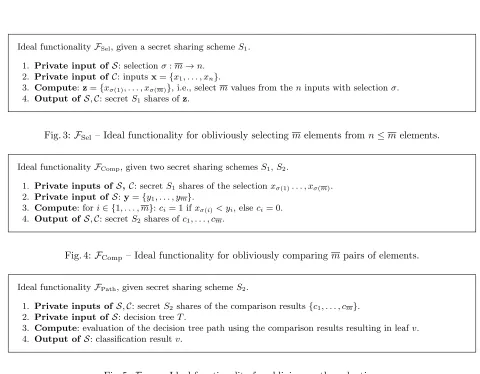
Private decision tree evaluation is run between two parties: a serverS holding a classification treeT (with threshold vectory, input selectionσand classification valuesv) and a clientC providing its input feature vectorx. After the protocol evaluation,C obtains the classification result, without learning any information about the tree beyond its size and the output, andSlearns nothing aboutC’s input features. The corresponding ideal functionalityFPDTEis depicted in Fig. 2.
In this section, we recapitulate the state-of-the-art sub-protocols for private decision tree evaluation with security against semi-honest adversaries. We describe each protocol and refer to the original publications for specific details on each construction. In §3.1, we detail two protocols for privately selecting features fromninput features that are assigned to a decision node to be compared at (selection phase). In§3.2, we recapitulate two sub-protocols for private comparison (comparison phase): one based on garbled circuits and another one based on additively homomorphic encryption. Thereafter in§3.3, we provide protocols for obliviously evaluating the path to the classification leaf based on the results of the previous phase (path evaluation phase).
In all sub-protocols presented in this section, the number of decision nodes in decision treeT is eitherm
or the number of decision nodesm0 after depth-padding (cf.§2.1). This is according to the approach chosen for path evaluation (§3.3). We usemdecision nodes in our description, where possiblym=morm=m0.
Ideal functionalityFSel, given a secret sharing schemeS1.
1. Private input of S: selectionσ:m→n. 2. Private input of C: inputsx={x1, . . . , xn}.
3. Compute:z={xσ(1), . . . , xσ(m)}, i.e., selectmvalues from theninputs with selectionσ.
4. Output of S,C: secretS1 shares ofz.
Fig. 3:FSel – Ideal functionality for obliviously selectingmelements from n≤melements.
Ideal functionalityFComp, given two secret sharing schemesS1,S2.
1. Private inputs of S,C: secretS1shares of the selectionxσ(1). . . , xσ(m).
2. Private input of S:y={y1, . . . , ym}.
3. Compute: fori∈ {1, . . . , m}:ci= 1 ifxσ(i)< yi, elseci= 0.
4. Output of S,C: secretS2 shares ofc1, . . . , cm.
Fig. 4:FComp – Ideal functionality for obliviously comparingmpairs of elements.
Ideal functionalityFPath, given secret sharing schemeS2.
1. Private inputs of S,C: secretS2 shares of the comparison results{c1, . . . , cm}.
2. Private input of S: decision treeT.
3. Compute: evaluation of the decision tree path using the comparison results resulting in leafv. 4. Output of S: classification resultv.
Fig. 5:FPath – Ideal functionality for oblivious path evaluation.
3.1 Selection Phase
The selection phase obliviously selects from thenfeatures of the clientC a value for each of themdecision nodes (where they are to be compared to thresholds) according to the selectionσ:m→nof the serverS. The ideal functionalityFSel that describes this selection is shown in Fig. 3. We identify two ways to instantiate it, one based on additively homomorphic encryption (SelH), and another one based on the secure evaluation of a Boolean selection network using garbled circuits (SelG). In both protocols, the outputs of the parties are secret shares of the result: none of the parties learns any information about the output, but they are able to continue secure computation with it.
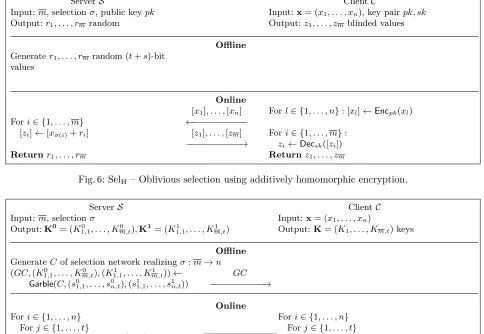
Selection using additively homomorphic encryption (SelH, Fig. 6). Additively homomorphic
encryption has been used to perform oblivious selection in [BPSW07, BFK+09]. In the protocol, the clientC encrypts its inputs, and sends the ciphertexts to the serverS.Sthen selects the values according to selectionσ
and homomorphically blinds these with statistical blinding using fresh randomness (pads are longer than the plaintext value bysbits, wheresis the statistical security parameter).Sthen sends these to C, who decrypts them, retrieving a blinded selection of its inputs. In this sub-protocol, we use either Paillier encryption with ciphertext packing for themciphertexts to reduce the communication to (n+m/(t+s))·τPaillierbits (cf.§2.2), or DGK encryption with smaller ciphertexts and (n+m)·τDGK bits of communication.
Selection using a garbled selection network (SelG, Fig. 7).An alternative for obliviously selecting
ServerS ClientC
Input:m, selectionσ, public keypk Input:x= (x1, . . . , xn), key pairpk, sk
Output:r1, . . . , rm random Output:z1, . . . , zmblinded values
Offline
Generater1, . . . , rmrandom (t+s)-bit
values
Online
[x1], . . . ,[xn] Forl∈ {1, . . . , n}: [xl]←Encpk(xl)
Fori∈ {1, . . . , m} ←−−−−−−−−−−−
[zi]←[xσ(i)+ri] [z1], . . . ,[zm] Fori∈ {1, . . . , m}: −−−−−−−−−−−→ zi←Decsk([zi]) Returnr1, . . . , rm Returnz1, . . . , zm
Fig. 6: SelH– Oblivious selection using additively homomorphic encryption.
ServerS ClientC
Input:m, selectionσ Input:x= (x1, . . . , xn)
Output:K0= (K01,1, . . . , Km,t0 ),K
1
= (K1,11 , . . . , Km,t1 ) Output:K= (K1, . . . , Km,t) keys
Offline
GenerateC of selection network realizingσ:m→n (GC,(K1,10 , . . . , Km,t0 ),(K1,11 , . . . , Km,t1 ))← GC
Garble(C,(s0
1,1, . . . , s0n,t),(s11,1, . . . , s1n,t)) −−−−−−−−−−−→
Online
Fori∈ {1, . . . , n} Fori∈ {1, . . . , n}
Forj∈ {1, . . . , t} Forj∈ {1, . . . , t}
s0
i,j, s1i,j−−−−−−−−→
OT ←−−−−−−−−xi,j
−−−−−−−−→sxi,j
i,j
ReturnK0= (K1,10 , . . . , Km,t0 ), Return(K1,1, . . . , Km,t)←
K1= (K1
1,1, . . . , Km,t1 ) Eval(GC,(s
x1,1 1,1 , . . . , s
xn,t
n,t ))
Fig. 7: SelG – Oblivious selection using a garbled selection network.
OTs for each bit of the client’s input. In most cases,n≤m, since features are used more than once. The size of a selection network that mapsn≤m t-bit elements tomelements is t·Sn
m≥n=t·(0.5(n+m) log(n) + mlog(m)−n+ 1) [KS16, Appendix C]. The communication of this protocol is (n+ 2Sn
m≥n)t·τsymbits offline andnt(2τsym+ 1) bits online.
3.2 Comparison Phase
This section details two oblivious comparison protocols, the ideal functionalityFCompof which is given in Fig. 4. The outputs ofS,C are secret shares of the result. The first uses homomorphic encryption (instantiating both SelH and CompH), the second uses Yao’s GC (CompG).
Comparison (including selection) using additively homomorphic encryption (SelH+ CompH,
ServerS Client C
Input:y= (y1, . . . , ym), selectionσ, public keypk Input:x= (x1, . . . , xn), key pairpk, sk
Output:a1, . . . , amshare Output:b1, . . . , bm share
Online
Generatea1, . . . , amrandom bits Fori∈ {1, . . . , n}
Forj∈ {1, . . . , t}
[x1,1], . . . ,[xn,t] [xi,j] =Encpk(xi,j)
Fork∈ {1, . . . , m} ←−−−−−−−−−−−
Fori∈ {1, . . . , t}
rk,i←Z∗p, [ck,i] = [rk,i·(fk,i(xσ, y)−2ak)] [c1,1], . . . ,[cm,t] Fork∈ {1, . . . , m}
Return(a1, . . . , am) −−−−−−−−−−−→ If∃i∈ {1, . . . , t}:Decsk([ck,i]) = 0 thenbk= 1
elsebk= 0 Return(b1, . . . , bm)
Fig. 8: SelH+CompH – Oblivious selection and comparison using additively homomorphic encryption from [WFNL16, TMZC17].
ServerS ClientC
Input:y= (y1, . . . , ym),K0,K1 Input:K= (K1,1, . . . , Km,t) keys
Output: (a)a= (a1, . . . , am) share Output:(a)b= (b1, . . . , bm) share
Output: (b)k0= (k01, . . . , km0),k1= (k11, . . . , k1m) Output: (b)k= (k1, . . . , km) keys
GenerateC ofm t-bit comparisons withy
(a) (GC,(a1, . . . , am))←Garble’(C,K0,K1) GC
(b) (GC,(k0
1, . . . , k0m),(k11, . . . , k1m))← −−−−−−−−−−−→
Garble(C,K0,K1)
Return(a) color bitsa= (a1, . . . , am), Return(a)b= (b1, . . . , bm)←Eval’(GC,K) Return(b)k0= (k0
1, . . . , k0m),k1= (k11, . . . , km1) Return(b)k= (k1, . . . , km)←Eval(GC,K)
Fig. 9: CompG – Oblivious comparison using garbled circuits.
already includes the oblivious selection protocol of§3.1 for free (cf. Tab. 1). It is observed in [DGK07] that
x < yis true if and only if ∃i∈ {1, . . . , t}such thatfi(x, y) =xi−yi+ 1 + 3P
j<i(xj⊕yj) = 0.Cencrypts
each bit of its input with an additively homomorphic encryption scheme (cf.§2.2), and sends the ciphertexts toS, who chooses the appropriate feature to compare with at each decision node and generates a random bitak for each comparison (k∈ {1, . . . , m}). Then, the above comparison is performed that outputs a blinded ciphertext [ri·fi(x, y)] for each bit of each feature. If any of these ciphertexts decrypts to zero, thenxi< yi. The comparison bit is not revealed to the client in clear, but is secret shared between the parties (S holds random bitak,C holds the result blinded by ak, i.e., bk =ak⊕[xσ,k< yk]). The efficient lifted ElGamal encryption scheme can be used here (cf.§2.2), since the client needs only to check if the result isg0 or not. The communication in this variant is (n+m)t·τElGamal bits.
Joye and Salehi [JS18] present an optimization of the DGK comparison protocol that improves the communication roughly by factor two when comparing two values with each other. However, as opposed to the DGK comparison protocol presented in Fig. 8, it does not allow for including the selection step when more values are compared. This incurs an overhead when the client encrypts its elements, i.e., it now needs to encryptminstead ofnelements. However, Joye and Salehi also propose a private decision tree evaluation protocol that uses their protocol such that onlydcomparisons between two values are performed as in plain decision tree evaluation. We compare with this protocol in§4.2.
Comparison using garbled circuits (CompG, Fig. 9).All oblivious comparisons can also be
ServerS ClientC
Input:a= (a1, . . . , am), public keypk Input:b= (b1, . . . , bm), key pairpk, sk
Output:⊥ Output: classificationv
Offline
Forj∈ {1, . . . , m+ 1}:rj←RZ∗p,r
0
j←RZ∗p
Online
[bi] Fori∈ {1, . . . , m}: [bi]←Enc(bi)
Fori∈ {1, . . . , m} ←−−−−−−−−−−−
[Bi]←[bi⊕ai], [eci,0]←[Bi], [eci,1]←[1−Bi]
Forj∈ {1, . . . , m+ 1}
[pcj]←[
P
ej,k∈Pecj,k],
[pcj]←[rj·pcj], [vj]←[rj0·pcj+vj] Permuted [pcj],[vj] Forj∈ {1, . . . , m+ 1} −−−−−−−−−−−→ IfDecsk([pcj]) = 0 then
Returnv←Decsk([vj])
Fig. 10: PathH– Oblivious path evaluation using additively homomorphic encryption from [TMZC17].
ServerS ClientC
Input:k0= (k01, . . . , km00),k1= (k11, . . . , km10) Input:k= (k1, . . . , km0)
Output:⊥ Output: classificationv
Offline
DT ←DepthPad(DT)
GDT ←Garble(DT ,k0,k1) GDT
−−−−−−−−−−−→
Online
Returnv←Eval(GDT,k)
Fig. 11: PathG – Oblivious path evaluation using a garbled decision tree.
in [BPSW07, BFK+09]. Yao’s garbled circuit is particularly efficient for private comparison, and requires t
AND gates pert-bit comparisons [KSS09]. Therefore,mcomparisons require 2mt·τsymbits communication. Variant (a) of this comparison protocol outputs the Boolean shares of the output of the comparisons, i.e., the color bits in Yao’s GC protocol (cf.§2.2). Variant (b) outputs the keys that correspond to the output wires: the server holds key pairs for both 0 and 1, while the client holds the keys for the output wires (without knowing the values they correspond to).
3.3 Path Evaluation Phase
This section describes two path evaluation protocols, the first using homomorphic encryption (PathH) and the second using a garbled decision tree (PathG). The ideal functionalityFPath is given in Fig. 5.
Path evaluation using additively homomorphic encryption (PathH, Fig. 10).The path
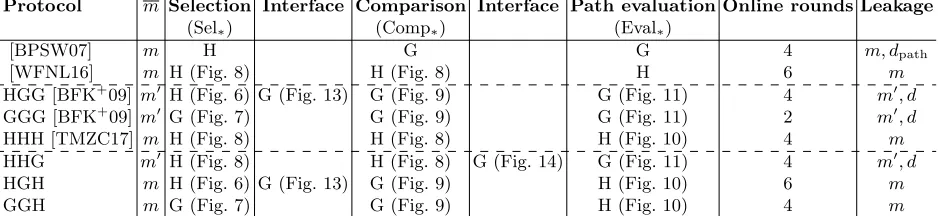
Protocol m Selection Interface Comparison Interface Path evaluation Online rounds Leakage
(Sel∗) (Comp∗) (Eval∗)
[BPSW07] m H G G 4 m, dpath
[WFNL16] m H (Fig. 8) H (Fig. 8) H 6 m
HGG [BFK+09] m0
H (Fig. 6) G (Fig. 13) G (Fig. 9) G (Fig. 11) 4 m0, d
GGG [BFK+09]m0 G (Fig. 7) G (Fig. 9) G (Fig. 11) 2 m0, d
HHH [TMZC17] m H (Fig. 8) H (Fig. 8) H (Fig. 10) 4 m
HHG m0 H (Fig. 8) H (Fig. 8) G (Fig. 14) G (Fig. 11) 4 m0, d
HGH m H (Fig. 6) G (Fig. 13) G (Fig. 9) H (Fig. 10) 6 m
GGH m G (Fig. 7) G (Fig. 9) H (Fig. 10) 4 m
Table 4: Concrete protocols based on the presented sub-protocols for selection, comparison and path evaluation, where m denotes either the number of decision nodes m or padded decision nodesm0 in the protocols. Round complexity and leakage of different private decision tree evaluation protocols based on homomorphic encryption H and garbling techniques G.
byS using fresh randomness, and sent to the clientC. If the path cost decrypts to zero,C can decrypt the classification label. This path evaluation protocol has (3m+ 2)·τElGamalbits of communication.
Path evaluation using a garbled decision tree (PathG, Fig. 11). The method for garbled
deci-sion tree (GDT) evaluation is analogous to Yao’s garbled circuit technique [Yao86] described in§2.2, but
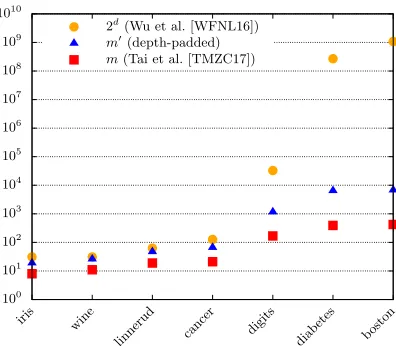
Eval(GDT,in) returns the output classification in the clear. Our description is similar to that of [BPSW07] that has been improved in [Sch08, BFK+09, BFL+11]. It relies on the idea of encrypting two keys at each decision node, one to the left and one to the right child nodes, along with their node indices, such that the evaluatorC cannot deviate from the path corresponding to the comparison results with his input vectorx. We introducedummy decision nodes for hiding the length of the path to the classification node. Revealing this length would reveal information about the topology of the tree, especially when multiple protocol runs with the same model are possible. Alternatively, one can use full decision trees [BPSW07], but then the overhead is exponential in the depthd. This is much higher for large trees than using depth-padding withm0 decision nodes (cf.§2.1) as shown in Fig. 12. Moreover, we reveal only the depth-padded number of decision nodesm0, and nothing aboutmsince both of them would reveal information about the tree topology.
The server randomly permutes the nodes and garbles the decision tree so that each node has an index i
and an encryption keyki corresponding to it. At each node, the keys and indices of the child nodes are stored in an encrypted manner using the key of the node and keysk0i orki1 depending on the comparison result. This means that at node i,Encki,k0
i(kl||l) andEncki,k1i(kr||r) are stored, wherel is the index of the node on
the left andris the index of the node on the right. The order of the two ciphertexts is permuted according to the color bits ofk0
i andk1i. The server sendsGDT to the client, who can evaluate it by decrypting one path
leading to the leaf node storing the classification. The communication in this protocol is sending theGDT, each node of which stores twoτsym-bit values and two indices, i.e., 2m0·(τsym+ log2(m0+ 1)). An extension of this protocol presented in§4.2 reduces the client’s computation toO(dt) symmetric key operations.
4
Protocols for Private Decision Tree Evaluation
In this section, we discuss all possible combinations of the sub-protocols from§3 that result in private decision tree evaluation protocols. We assess these in Tab. 4, which is an extended version of Tab. 1. In addition to the sub-protocols, we recapitulate the number of online rounds and the leakage about the model. In private decision tree evaluation, the client only learns the result and some information about the size of the server’s decision tree: either the number of decision nodesm or the number of padded decision nodes m0
100 101 102 103 104 105 106 107 108 109 1010
iris wine
linnerud cancer digits diab etes
boston 2d(Wu et al. [WFNL16])
m0(depth-padded)
m(Tai et al. [TMZC17])
Fig. 12: Number of decision nodes in the different protocols for the decision trees trained on real-world datasets from Tab. 3. Note that they-axis is in logarithmic scale.
independent from the client’s input, while in sub-protocols based on garbling techniques, we can perform the base OTs and precompute OTs (cf.§2.2).
Security guarantees.We combine sub-protocols secure against passive adversaries with secret shared output between the two parties. The outputs of our primitives for selection (SelHand SelG) and comparison (CompH and CompG) as well as the inputs for comparison and path evaluation (PathHand PathG) are secret shared as indicated in Figs. 3-5, i.e., the parties do not learn any information by themselves. The secret sharing technique is either XOR-sharing, additive blinding or garbled inputs/outputs with the corresponding key(s). Therefore, our sequentially composed protocols remain secure against passive adversaries.
Selection and Comparison Strategy.For oblivious selection and comparison, the state-of-the-art protocols use additively homomorphic encryption SelH(Fig. 6) [BFK+09] and CompH(Fig. 8) [TMZC17]. This strategy is beneficial when it comes to communication and storage, but implies an increased runtime compared to garbling techniques. Garbling techniques have been used for oblivious selection SelG (Fig. 7) [BFK+09] and comparison CompG (Fig. 9) [BFK+09]. Thereafter, these techniques have been claimed to be inefficient in [WFNL16, TMZC17]. However, our experiments in§5 show that they have a very efficient online phase, and perform better than the method based only on homomorphic encryption [TMZC17] with respect to total runtime in most cases as well.
Path Evaluation Strategy. As discussed in§3.3, the path evaluation sub-protocol of [TMZC17] using homomorphic encryption via PathH(Fig. 10) depends only on the number of decision nodesmand is therefore especially efficient with sparse and large decision trees. When this sub-protocol is used,m=min all preceding sub-protocols. This has been a tremendous improvement for real-world decision trees over the path evaluation method of Wu et al. [WFNL16], which depends exponentially on the depthdof the tree, due to expanding the tree to a full decision tree.
As opposed to this, in PathG (Fig. 11) the paths need to have the same length in order to hide the tree topology. Therefore, the tree is depth-padded tom=m0 decision nodes. m0 depends on the topology of the decision tree, i.e., the level of all leaves (cf.§2.1).
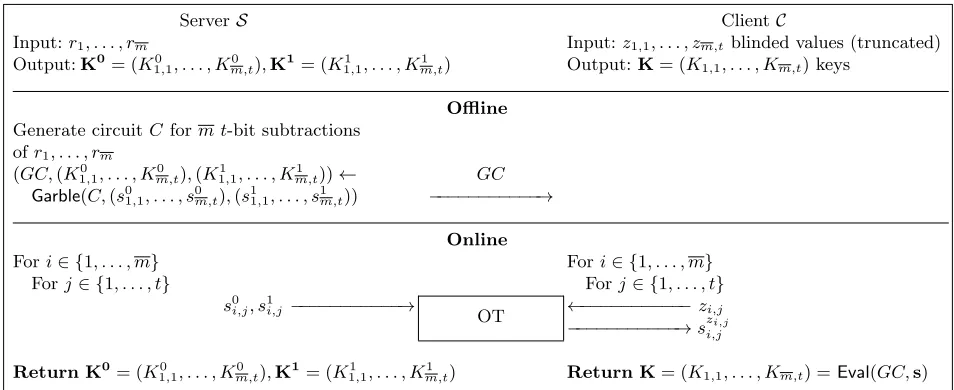
ServerS Client C
Input:r1, . . . , rm Input:z1,1, . . . , zm,t blinded values (truncated)
Output:K0= (K0
1,1, . . . , Km,t0 ),K1= (K1,11 , . . . , Km,t1 ) Output:K= (K1,1, . . . , Km,t) keys
Offline
Generate circuitC form t-bit subtractions ofr1, . . . , rm
(GC,(K0
1,1, . . . , Km,t0 ),(K1,11 , . . . , Km,t1 ))← GC
Garble(C,(s01,1, . . . , s0m,t),(s11,1, . . . , s1m,t)) −−−−−−−−−−−→
Online
Fori∈ {1, . . . , m} Fori∈ {1, . . . , m}
Forj∈ {1, . . . , t} Forj∈ {1, . . . , t}
s0i,j, s 1
i,j −−−−−−−−−−−→ OT ←−−−−−−−−−−−zi,j −−−−−−−−−−−→szi,j
i,j
Return K0= (K1,10 , . . . , Km,t0 ),K
1
= (K11,1, . . . , Km,t1 ) Return K= (K1,1, . . . , Km,t) =Eval(GC,s)
Fig. 13: SelH→CompG – Interface between the instantiation for SelH (Fig. 6) and CompG (Fig. 9).
4.1 Protocol Combinations
In this section, we describe all protocols resulting from valid combinations of sub-protocols presented in§3, and adapt them to the offline-online setting. Here, all operations that depend only on the input of the serverS’s decision tree are performed in the offline phase, whereas all operations that depend on the clientC’s input are performed in the online phase. Protocols that are efficient in the online phase are especially important in applications where the client uses a computationally weak device. Most of the computation can be done offline, when the device is idle, and the query itself triggers the online phase, which is performed more efficiently. We show that protocols based on garbling techniques are especially efficient in this setting, whereas the sub-protocols based on homomorphic encryption require the input directly at the start and therefore only few of the computationally intense tasks can be performed offline. ABC denotes the protocol that uses SelA for selection, CompB for comparison and PathCfor path evaluation.
HHH: SelH+ CompH+ PathH [TMZC17].The state-of-the-art protocol using only homomorphic
encryption for all three sub-protocols was presented in [TMZC17], the comparison protocol of which was first used for private decision tree evaluation in [WFNL16]. We recapitulate it here as a combination of the homomorphic sub-protocol SelH+ CompH(Fig. 8) with PathH (Fig. 10). The advantage of this protocol is that very low communication is necessary between the two parties and the selection happens along with the comparison. However, most computationally expensive cryptographic operations must be computed online, since the computation depends on the client’s input.
HGH: SelH+ CompG+ PathH.An oblivious comparison protocol that can be used to output shares
of the comparison bits is Yao’s GC protocol is shown in CompG (Fig. 9). Here,mgarbled comparison circuits can be precomputed in an offline phase. Thereafter, the client evaluates these in the online phase (using SIMD in parallel as described in§2.2) to retrieve the comparison color bits that are shares of the output bits. However, this comparison protocol requires a selection sub-protocol to chooseminputs to themcomparisons from the client’sn≤minputs. In this protocol, we use SelHwith Paillier or DGK encryption (cf. Fig. 6) in order to achieve linear complexity. When combining these approaches, the result of SelH is not the same as the input of CompG, so the interface described below and depicted in Fig. 13 is inserted to obliviously unblind the output. After the comparison, the path evaluation PathH of [TMZC17] can be used as before (cf. Fig. 10).
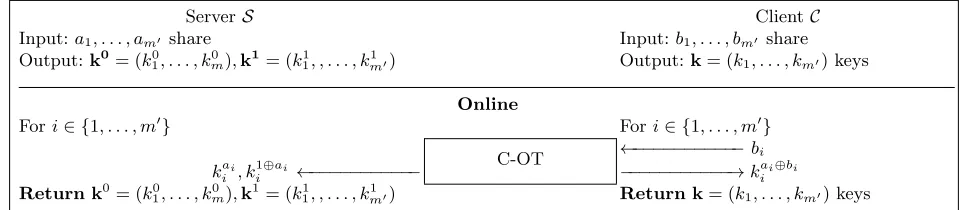
ServerS ClientC
Input:a1, . . . , am0 share Input:b1, . . . , bm0 share
Output:k0= (k0
1, . . . , k0m),k1= (k11, , . . . , k1m0) Output:k= (k1, . . . , km0) keys
Online
Fori∈ {1, . . . , m0} Fori∈ {1, . . . , m0}
C-OT ←−−−−−−−−−−−bi kai
i , k 1⊕ai
i ←−−−−−−−−−−− −−−−−−−−−−−→k
ai⊕bi
i
Return k0= (k01, . . . , k0m),k1= (k11, , . . . , k1m0) Return k= (k1, . . . , km0) keys
Fig. 14: CompH→PathG – Interface between the instantiation for CompH (Fig. 8) and PathG (Fig. 11).
each random value obliviously [BFK+09]. The subtractions are performed ont-bit values, since the most significantsbits of the blinded values can be dropped. The keys corresponding to the result are used in CompG (cf. Fig. 9). Overall, themgarbled subtraction circuits require 2mt·τsymbits offline communication,mt·τsym
bits for precomputing random OTs, andmt(2τsym+ 1) bits online communication for the OTs.
GGH: SelG+ CompG+ PathH.Instead of instantiating the selection with homomorphic encryption,
one can use SelG, a selection network (with O(mtlogm) complexity) using garbled circuits (cf. Fig. 7). Here, most of the selection phase can be computed offline due to precomputed OTs and the independence of the GC from the client’s inputs. Then, CompG (Fig. 9) can be directly performed, and the path evaluation sub-protocol PathHof [TMZC17] (Fig. 10) is used as before. The advantage of this protocol is that though the offline communication is higher than in the previous protocols due to the selection network with superlinear complexity, it performs well in the online phase and due to the path evaluation phase, it depends only on the number of decision nodesm, since depth-padding is not required.
HGG: SelH+ CompG+ PathG [BFK+09].Homomorphic selection SelH(Fig. 6) and garbled
compar-ison CompG (Fig. 9) (with the interface from Fig. 13 between) can also be combined with the path evaluation technique PathG (Fig. 11). This induces overhead in the number of decision nodes, since the depth-padded decision tree has a larger number of internal nodes m0 ≥m (cf. Fig. 12). However, this path evaluation protocol can more efficiently be transformed to an offline-online setting, since the GCs for comparison and the garbled decision tree can be sent offline.
GGG: SelG+ CompG+ PathG [BFK+09].This protocol consists exclusively of sub-protocols that
use garbling techniques: selection SelG (Fig. 7) and comparison CompG (Fig. 9) with garbled circuits, and garbled path evaluation PathG (Fig. 11). It has the highest communication, though most data can be sent in the offline phase.
Another advantage of this protocol is that it can be easily extended to provide security against a malicious client: Since the only messages sent by the client are in the OTs, one can use OT extension with security against malicious clients, e.g., [ALSZ15, KOS15, ALSZ17], which are only slightly less efficient than OT extension with passive security. This adds little overhead, whereas securing the other solutions against malicious clients needs more expensive conditional OTs or zero-knowledge proofs, e.g., as for HHH [TMZC17].
HHG: SelH+ CompH+ PathG.Due to the worse efficiency of the homomorphic selection and
com-parison SelH+ CompH (Fig. 8) and the high number of decision nodesm0 for the garbled path evaluation method PathG (Fig. 11), this protocol combination is the least efficient. Moreover, it requires an interface of OTs described below and depicted in Fig. 14.
4.2 Protocol Extensions
In this section, we describe protocol extensions, including a natural modification of the HGG and GGG protocols, which allows the client to perform less computation and evaluate the decision tree in a similar manner as in plain evaluation with onlyO(dt) cryptographic operations. We compare this method with the protocol of [JS18] that has the same asymptotic complexity.
Path evaluation with computationally restricted client. A natural extension of HGG and GGG is to perform only the requireddcomparisons during the path evaluation phase as in the case of plain evaluation, instead of doing allm0 comparisons in advance. This improves computation, though we cannot use SIMD operations for the comparisons anymore, since the GCs are evaluated sequentially along the evaluation path. Similarly, the client can decrypt onlyd(instead ofm0) homomorphically encrypted blinded values in HGG in SelH(cf. Fig. 6) before these comparisons. However, the communication remains unchanged, since the actual evaluation path taken needs to remain oblivious to the server.
Joye and Salehi present a similar protocol in [JS18]. In their protocol, full decision trees are utilized to hide the topology of the tree, and a 1-out-of-2i OT is performed at theith level (i∈ {1, . . . , d}). However, the full tree can be replaced with the depth-padded tree described in§2.1, in which case 1-out-of-m0 OTs are sufficient for levels where m0 <2i. Though the communication of this protocol (O(n+d(t+m0))) is better than that of HGG (O(n+m0t)) for small decision trees, its dependency on the depth makes it worse for larger examples such as the bostondataset (cf. §2.1). Moreover, it has O(d) online rounds instead of the constant number of 4 rounds provided by HGG. Therefore, we conclude that our HGG protocol is more efficient in most scenarios.
Other extensions. In§B.1, we describe modifications for categorical variables, and in§B.2 for securely evaluating random forests. Classification confidence values (correctness probabilities), can be appended to the classification labels in a straightforward manner.
5
Performance Evaluation
In this section, we compare the runtime and communication of all resulting protocols from §4. In our implementation, we instantiate primitives corresponding to security levelκ= 128 (andκ= 112 for public-key primitives) as recommended by NIST for use until 2030 [BBB+16], and statistical security parameter
s= 40, and as in prior work, we set the bitlength tot= 64.τ∗denotes the ciphertext sizes:τsym= 128 for symmetric-key encryption,τPaillier = 4096 for Paillier encryption,τDGK = 2048 for DGK encryption, and
τElGamal= 514 for ElGamal encryption with elliptic curves and point compression.
The underlying frameworks for our open-source implementation that can be found athttps://encrypto.
de/code/PDTEare the ABY secure two-party computation framework [DSZ15]1 and the mcl library2that
includes a highly optimized lifted ElGamal implementation. ABY implements the state-of-the-art optimiza-tions of Yao’s garbled circuit protocol described in§2.2. In addition, we implement an analogues technique to that of point-and-permute in order to avoid trial decryption of garbled nodes in oblivious path evalua-tion PathG [Sch08]. We precompute OTs and homomorphic encryption when possible (i.e., Figs. 6, 7, 8, 10, 14). We give further details on our implementation in §C. We show the performance of the protocols for the datasets from Tab. 3 as well as for a full treefull(13)withd=n= 13 for a comparison for dense trees.
Communication. The offline, online, and total communication of the protocols is given in Fig. 15a, Fig. 15b, and Fig. 15c, resp. We observe that garbling techniques allow for precomputation and offline communication, but require more communication in total. Homomorphic encryption-based methods have less communication, however, almost all expensive computation and all communication happen in the online phase. Methods using PathH (i.e., GGH, HGH and HHH [TMZC17]) have a clear advantage for large sparse trees, which is lost in case extremely dense trees are considered (such as our example full treefull(13)). For these kind of trees, Wu et al.’s protocol [WFNL16] has lower communication as discussed in§7.
1
https://github.com/encryptogroup/ABY 2
100 101 102 103 104 105 106 iris wine
linnerud cancer digitsdiab
etes
boston full(13)
GGG [BFK+
09]
HGG [BFK+
09] GGH HGH HHG
(a) Offline communication in KBytes.
100 101 102 103 104 105 106 iris wine
linnerud cancer digitsdiab
etes
boston full(13) HHG
HGG [BFK+
09] HHH [TMZC17] HGH
GGH
GGG [BFK+09]
(b) Online communication in KBytes.
100 101 102 103 104 105 106 iris wine
linnerud cancer digitsdiab
etes
boston full(13)
GGG [BFK+
09]
HGG [BFK+
09] HHG GGH HGH
HHH [TMZC17]
(c) Total communication in KBytes.
Fig. 15: Communication of protocols using the example datasets from Tab. 3. Note that the y-axis is in logarithmic scale. 100 101 102 103 104 105 iris wine
linnerud breast digitsdiab
etes
boston full(13)
HGG [BFK+
09]
GGG [BFK+
09] HGH GGH (HHG) HHH [TMZC17]
(a) Offline runtime in milliseconds.
100 101 102 103 104 105 iris wine
linnerud breast digitsdiab
etes
boston full(13) (HHG)
HGG [BFK+
09] HHH [TMZC17] HGH
GGG [BFK+09]
GGH
(b) Online runtime in milliseconds.
100 101 102 103 104 105 iris wine
linnerud breast digitsdiab
etes
boston full(13) (HHG)
HGG [BFK+
09] HHH [TMZC17]
GGG [BFK+09]
HGH GGH
(c) Total runtime in milliseconds.
Fig. 16: Runtime of protocols using the example datasets from Tab. 3. Note that they-axis is in logarithmic scale.
Runtime.For our benchmarks we use two machines equipped with an Intel Core i7-4790 CPU @ 3.6 GHz and 32 GB of RAM that support Intel’s AES-NI for fast AES operations. Our benchmarks are run in a LAN setting with 1 Gbit/s and 0.5 ms latency. Runtimes are reported from an average of 10 executions. In our experiments, we neglect the costs for the base OTs and for generating the keypair for additively homomorphic encryption, since they are a one-time expense that can be re-used over multiple protocol executions. We also neglect the cost for trial decryption of the classification value in PathH, and note that for a 16-bit value it is around 40 ms on average.
The offline runtimes are given in Fig. 16a, the online runtimes are given in Fig. 16b, while the total runtimes are depicted in Fig. 16c. We can see that homomorphic encryption-based methods (SelHandCompH) perform an order of magnitude worse than their garbling technique-based alternatives (SelG and CompG). However, we observe the advantage of the homomorphic encryption-based path evaluation technique (PathH), where the number of decision nodesm is unchanged, whereas in the path evaluation method using a garbled decision tree (PathG) depth-padding increases the number of decision nodes tom≤m0≤ 1
100 101 102 103 0 10 0 10 1 10 2 10 3 Run time in ms
Communication in KBytes
GGG [BFK+09]
GGG [BFK+09] HHH [TMZC17]
HHH [TMZC17]
HGG [BFK+09]
HGG [BFK+09]
GGH
GGHHGH
HGH
(HHG)
(HHG)
(a) Tradeoff for small datasetwine.
101 102 103 104 105 10 0 10 1 10 2 10 3 10 4 10 5 10 6 Run time in ms
Communication in KBytes
GGG [BFK+09]
GGG [BFK+09]
HHH [TMZC17]
HHH [TMZC17]
HGG [BFK+09]
HGG [BFK+09]
GGH
GGH HGH
HGH
(HHG)
(HHG)
(b) Tradeoff for large datasetboston.
Fig. 17: Tradeoff between communication (x-axis) and runtime (y-axis). The figures show the offline (unfilled squares) and online (filled squares) complexities (connected with a line). Note that both axes are in logarithmic scale, with an additional 0 on thexaxis for depicting the offline communication of the HHH protocol. Pareto points, i.e., protocols where one property (computation or communication) cannot be improved without the other property becoming worse, for online complexities are marked in bold.
protocols based on garbling techniques is an order of magnitude lower than that of the protocols based on homomorphic encryption in the LAN setting.
Tradeoff.In order to show the communication (x-axis) vs. computation (y-axis) tradeoff of all resulting protocols, we give figures for decision trees trained on two example real-world datasets: a small datasetwine, and our largest datasetboston.
While the number of input featuresnis relatively small for all datasets, the number of (potentially padded) decision nodes significantly affects the efficiency of our sub-protocols. We depict in Fig. 17a and Fig. 17b the tradeoff between offline and online runtime and communication for all protocols for the wineandboston
datasets, respectively, while Fig. 18a and Fig. 18b depict the corresponding total complexities.
The larger the dataset, the more dummy nodes are introduced during depth-padding (cf. §2.1) when PathGis used for path evaluation. Moreover, the selection network in SelG has superlinear sizeO(mlogm), which implies a significant overhead in offline communication. This gap can be observed on the figures: the protocols using garbling techniques for path evaluation lose their performance advantage with growing number of dummy nodes, and the protocols using garbling techniques for selection become less practical due to the largely increased amount of offline communication for transmitting the selection network (which implies storage requirements as well). For instance, our largest decision tree trained on thebostondataset requires around 1.8 MBytes of total communication with HHH, 3 MBytes with HGH, 9 MBytes with GGH, and more than 200 MBytes with GGG. The designer of an application using private decision tree evaluation can consider these tradeoffs and choose the best suited protocol.
6
Concrete Improvements and Recommendations
100 101 102 103 0 10 0 10 1 10 2 10 3 T otal run time in ms
Total communication in KBytes
GGG [BFK+
09]
HHH [TMZC17]
HGG [BFK+09]
GGH
(HHG)
HGH
(a) Tradeoff for small datasetwine.
101 102 103 104 105 0 10 1 10 2 10 3 10 4 10 5 10 6 T otal run time in ms
Total communication in KBytes
GGG [BFK+09]
HHH [TMZC17]
HGG [BFK+09]
GGH
(HHG)
HGH
(b) Tradeoff for large datasetboston.
Fig. 18: Tradeoff between total communication (x-axis) and runtime (y-axis). Note that both axes are in logarithmic scale, with an additional 0 on thexaxis for depicting the offline communication of the HHH protocol. Pareto points are marked in bold.
In Figs. 17 and 18, we mark in bold pareto points for online and total tradeoffs, respectively, i.e., we bold the protocols where there is no possibility to improve one property without the other property becoming worse.
Tradeoff with HHH [TMZC17]. The improvement in total and online runtime of GGH over HHH is more than an order of magnitude for our examples with increased total communication by 2-5x. HGH improves over HHH in total and online runtime by 2-5x with only slightly increased total communication. The online communication is better for both GGH and HGH than for HHH.
Tradeoff with GGG [BFK+09]. GGH improves over GGG for large datasets by an order of magnitude in all complexities due to the fact that it does not need any padding for the decision nodes. For small datasets, GGG is better than GGH in online runtime and communication by up to a factor of 2, but is worse in both total complexities. HGH improves even more (by 5-73x) for our datasets over the communication of GGG due to the difference in the number of decision nodes. The online runtimes of HGH are larger by 2-18x for real-world datasets, and the total runtimes are also larger by a factor of 5 for small datasets. However, it gets better with larger (sparse) datasets due to the increasing number of decision nodes in the depth-padded tree.
Recommendations. We identify the following aspects to take into consideration when deciding which protocol to use for an application: thedataset size, and the boundaries oncommunication and computational power (e.g., network throughput and client storage capacity). When the client has high storage capacity, protocols GGG [BFK+09] or GGH from §4.1 provide the best online performance, depending on the dataset size. The former may have a slightly more efficient online phase, but higher communication due to its selection protocol (cf.§3.1). When the client is computationally bounded and has little storage capacity, our protocols HGH and GGH from§4.1 provide the best solutions.
The state-of-the-art protocol HHH of [TMZC17] has the lowest total communication, but uses computa-tionally heavy public-key operations that depend almost entirely on the client’s input and hence do not allow for much offline precomputation. Our protocols HGH or GGH from§4.1 that combine its path evaluation with garbling techniques yield an order of magnitude faster runtimes while slightly increasing communication.
7
Related Work
use additively homomorphic encryption to evaluate the decision tree expressed as a polynomial [BPTG15]. Recently, Wu et al. [WFNL16], Tai et al. [TMZC17] and Joye and Salehi [JS18] improved the state-of-the-art of private decision tree evaluation protocols. These works rely on additively homomorphic encryption using the Diffie-Hellman assumption and present protocols that achieve security against semi-honest adversaries or malicious clients. Tai et al. [TMZC17] eliminate the exponential dependency on the depth of the tree that was present in [WFNL16] by representing decision trees as linear functions. This implies enormous improvement when large decision trees are considered. These, in practice, are usually not very dense, and therefore, we use this protocol to instantiate HHH. Wu et al.’s protocol [WFNL16] would perform better than HHH for circuits withm∼2d [TMZC17]. However, already for a very dense tree withm= 2d−2, HHH has about half the communication compared to [WFNL16], whereas the necessary computation is around the same.
The protocols of [WFNL16] and [TMZC17] use the DGK comparison protocol [DGK07]. Joye and Salehi present an optimization on the DGK protocol and a private decision tree evaluation protocol with O(d) rounds in [JS18] (cf.§3.2). For private decision tree evaluation with constant rounds, their optimization on the DGK protocol is not applicable. The alternative solution to the DGK protocol of [LZS18] uses fully homomorphic encryption and performs well for small bitlengthstof the features and inputs.
A different solution for evaluating full private decision trees using the so-called commodity-based model was proposed in [CDH+17], where correlated randomness is distributed by a trusted authority to the computing parties or pre-computed during the offline phase, which are used in the online phase.
In concurrent and independent related work Tueno et al. [TKK19] represent the decision tree as an array, and implement oblivious array indexing. For this, they use either garbled circuits, oblivious transfer or oblivious RAM (ORAM), the latter of which results in a protocol with sub-linear complexity in the size of the decision tree. Their protocols requiredtcomparisons as that of [JS18] and our protocol extension for GGG and HGG§4.2, but require at leastO(d) rounds of communication [TKK19, Tab. 2].
Alternatively, private decision tree evaluation can be solved using generic private function evaluation (PFE) protocols such as [KM11, MS13, MSS14]. However, these solutions utilize Boolean circuits as the underlying representation of the functionality. Transforming the decision tree into a Boolean circuit would imply additional unnecessary overhead on the size of the function (i.e., O(tmlogm) gates for the selection of inputs as in SelG in §3.1). Secure evaluation of universal circuits (UCs) is an equivalent solution for PFE [Val76, KS08b, KS16, GKS17]. UC- and OT-based PFE protocols [KS08b, MS13, KS16, GKS17] need O((tmlogm) log(tmlogm)), and HE-based protocols [KM11, MS13, MSS14] needO(tmlogm) computation and communication. These complexities are larger than that of protocols designed specifically for DTs.
There are alternative approaches for classification based on machine learning, such as deep neural networks, that can be evaluated in a private manner [SS08,BFL+11,LJLA17,MZ17,RWT+18,JVC18,BFR+18,BDK+18]. Private evaluation of machine learning models incur a natural overhead, but they can perform classifications of real-world datasets in the order of seconds.
Acknowledgements
References
ALSZ13. Gilad Asharov, Yehuda Lindell, Thomas Schneider, and Michael Zohner. More efficient oblivious transfer and extensions for faster secure computation. InACM Computer and Communications Security (CCS’13), pages 535–548. ACM, 2013.
ALSZ15. Gilad Asharov, Yehuda Lindell, Thomas Schneider, and Michael Zohner. More efficient oblivious transfer extensions with security for malicious adversaries. InAdvances in Cryptology – EUROCRYPT’15, volume 9056 ofLNCS, pages 673–701. Springer, 2015.
ALSZ17. Gilad Asharov, Yehuda Lindell, Thomas Schneider, and Michael Zohner. More efficient oblivious transfer extensions. J. Cryptology, 30(3):805–858, 2017.
AM18. Bushra A. AlAhmadi and Ivan Martinovic. Malclassifier: Malware family classification using network flow sequence behaviour. In2018 APWG Symposium on Electronic Crime Research (eCrime’18), pages 1–13. IEEE, 2018.
Bar15. Jeff Barr. Amazon machine learning – make data-driven decisions at scale. aws.amazon.com/blogs/aws/ amazon-machine-learning-make-data-driven-decisions-at-scale, 2015. Accessed: 2018-08-19. BBB+16. Elaine B. Barker, William C. Barker, William E. Burr, W. Timothy Polk, and Miles E. Smid. Sp 800-57.
recommendation for key management, part 1: General (revised). Technical report, Gaithersburg, MD, United States, 2016.
BDK+18. Niklas B¨uscher, Daniel Demmler, Stefan Katzenbeisser, David Kretzmer, and Thomas Schneider. HyCC: Compilation of hybrid protocols for practical secure computation. InACM Computer and Communications Security (CCS’18), pages 847–861. ACM, 2018.
Bea95. Donald Beaver. Precomputing oblivious transfer. InAdvances in Cryptology – CRYPTO’95, volume 963 ofLNCS, pages 97–109. Springer, 1995.
BFK+09. Mauro Barni, Pierluigi Failla, Vladimir Kolesnikov, Riccardo Lazzeretti, Ahmad-Reza Sadeghi, and Thomas Schneider. Secure evaluation of private linear branching programs with medical applications. InEuropean Symposium on Research in Computer Security (ESORICS’09), volume 5789 of LNCS, pages 424–439. Springer, 2009.
BFL+11. Mauro Barni, Pierluigi Failla, Riccardo Lazzeretti, Ahmad-Reza Sadeghi, and Thomas Schneider.
Privacy-preserving ECG classification with branching programs and neural networks. IEEE Transactions on Information Forensics and Security, 6(2):452–468, 2011.
BFR+18. Ferdinand Brasser, Tommaso Frassetto, Korbinian Riedhammer, Ahmad-Reza Sadeghi, Thomas Schneider, and Christian Weinert. Voiceguard: Secure and private speech processing. InAnnual Conference of the International Speech Communication Association (INTERSPEECH’18), pages 1303–1307. ISCA, 2018. BHKR13. Mihir Bellare, Viet Tung Hoang, Sriram Keelveedhi, and Phillip Rogaway. Efficient garbling from a
fixed-key blockcipher. InIEEE Symposium on Security and Privacy (S&P’13), pages 478–492. IEEE, 2013. Big18. Inc. BigML. Machine learning made easy, beautiful and understandable. https://bigml.com/, 2018.
Accessed: 2018-08-24.
BJL12. Dan Bogdanov, Roman Jagom¨agis, and Sven Laur. A universal toolkit for cryptographically secure privacy-preserving data mining. In Pacific Asia Workshop on Intelligence and Security Informatics (PAISI’12), volume 7299 ofLNCS, pages 112–126. Springer, 2012.
BMR90. Donald Beaver, Silvio Micali, and Phillip Rogaway. The round complexity of secure protocols (extended abstract). InACM Symposium on Theory of Computing (STOC’90), pages 503–513. ACM, 1990. BPSW07. Justin Brickell, Donald E. Porter, Vitaly Shmatikov, and Emmett Witchel. Privacy-preserving remote
diagnostics. InACM Computer and Communications Security (CCS’07), pages 498–507. ACM, 2007. BPTG15. Raphael Bost, Raluca Ada Popa, Stephen Tu, and Shafi Goldwasser. Machine learning classification over
encrypted data. InNetwork and Distributed System Security Symposium (NDSS’15). The Internet Society, 2015.
BS09. Justin Brickell and Vitaly Shmatikov. Privacy-preserving classifier learning. InFinancial Cryptography and Data Security (FC’09), volume 5628 ofLNCS, pages 128–147. Springer, 2009.
BSR18. Diogo Barradas, Nuno Santos, and Lu´ıs Rodrigues. Effective detection of multimedia protocol tunneling using machine learning. InUSENIX Security Symposium’18, pages 169–185. USENIX, 2018.
CO18. Michele Ciampi and Claudio Orlandi. Combining private set-intersection with secure two-party computation. InSecurity and Cryptography for Networks (SCN’18), volume 11035 ofLecture Notes in Computer Science, pages 464–482. Springer, 2018.
DCBA14. Manuel Fern´andez Delgado, Eva Cernadas, Sen´en Barro, and Dinani Gomes Amorim. Do we need hundreds of classifiers to solve real world classification problems? Journal of Machine Learning Research, 15(1):3133–3181, 2014.
DGK07. Ivan Damg˚ard, Martin Geisler, and Mikkel Krøigaard. Efficient and secure comparison for on-line auctions. InAustralasian Conference on Information Security and Privacy (ACISP’07), volume 4586 of LNCS, pages 416–430. Springer, 2007.
DGK08. Ivan Damg˚ard, Martin Geisler, and Mikkel Krøigaard. Homomorphic encryption and secure comparison.
International Journal of Applied Cryptography, 1(1):22–31, 2008.
DGK09. Ivan Damg˚ard, Martin Geisler, and Mikkel Krøigaard. A correction to ’Efficient and secure comparison for on-line auctions’.International Journal of Advanced Computer Technology (IJACT), 1(4):323–324, 2009. DJ01. Ivan Damg˚ard and Mads Jurik. A generalisation, a simplification and some applications of Paillier’s
probabilistic public-key system. InPublic Key Cryptography (PKC’01), volume 1992 ofLNCS, pages 119–136. Springer, 2001.
DSZ15. Daniel Demmler, Thomas Schneider, and Michael Zohner. ABY - A framework for efficient mixed-protocol secure two-party computation. InNetwork and Distributed System Security Symposium (NDSS’15). The Internet Society, 2015.
ElG85. Taher ElGamal. A public key cryptosystem and a signature scheme based on discrete logarithms. In
Advances in Cryptology – CRYPTO’85, volume 196 ofLNCS, pages 10–18. Springer, 1985.
FW12. Pui Kuen Fong and Jens H. Weber-Jahnke. Privacy preserving decision tree learning using unrealized data sets.IEEE Transactions on Knowledge and Data Engineering, 24(2):353–364, 2012.
GBC+97. Michael D. Garris, James L. Blue, Gerald T. Candela, Patrick J. Grother, Stanley Janet, and Charles L. Wilson. NIST form-based handprint recognition system (release 2.0). Interagency/Internal Report (NISTIR) - 5959, 1997.
GKG+18. Srishti Gupta, Abhinav Khattar, Arpit Gogia, Ponnurangam Kumaraguru, and Tanmoy Chakraborty. Collective classification of spam campaigners on Twitter: A hierarchical meta-path based approach. In
World Wide Web Conference on World Wide Web (WWW’18), pages 529–538. ACM, 2018.
GKS17. Daniel G¨unther, ´Agnes Kiss, and Thomas Schneider. More efficient universal circuit constructions. In
Advances in Cryptology – ASIACRYPT’17, volume 10625 ofLNCS, pages 443–470. Springer, 2017. HEK12. Yan Huang, David Evans, and Jonathan Katz. Private set intersection: Are garbled circuits better than
custom protocols? InNetwork and Distributed System Security Symposium (NDSS’12). The Internet Society, 2012.
IK17. Aleksandar Ilic and Oleksandr Kuvshynov. Evaluating boosted decision trees for billions of users. https://code.facebook.com/posts/975025089299409/evaluating-boosted-decision-trees-for-billions-of-users, 2017. Accessed: 2018-08-19.
IKNP03. Yuval Ishai, Joe Kilian, Kobbi Nissim, and Erez Petrank. Extending oblivious transfers efficiently. In
Advances in Cryptology – CRYPTO’03, volume 2729 ofLNCS, pages 145–161. Springer, 2003.
IP07. Yuval Ishai and Anat Paskin. Evaluating branching programs on encrypted data. InTheory of Cryptography Conference (TCC’07), volume 4392 ofLNCS, pages 575–594. Springer, 2007.
IR89. Russell Impagliazzo and Steven Rudich. Limits on the provable consequences of one-way permutations. In
ACM Symposium on Theory of Computing (STOC’89), pages 44–61. ACM, 1989.
JS18. Marc Joye and Fariborz Salehi. Private yet efficient decision tree evaluation. InData and Applications Security and Privacy (DBSec’18), volume 10980 ofLNCS, pages 243–259. Springer, 2018.
JSD+18. Mika Juuti, Sebastian Szyller, Alexey Dmitrenko, Samuel Marchal, and N. Asokan. PRADA: protecting against DNN model stealing attacks. CoRR, abs/1805.02628, 2018.
JVC18. Chiraag Juvekar, Vinod Vaikuntanathan, and Anantha Chandrakasan. GAZELLE: A low latency framework for secure neural network inference. InUSENIX Security Symposium’18, pages 1651–1669. USENIX, 2018. KM11. Jonathan Katz and Lior Malka. Constant-round private function evaluation with linear complexity. In
Advances in Cryptology – ASIACRYPT’11, volume 7073 ofLNCS, pages 556–571. Springer, 2011. KMAM18. Manish Kesarwani, Bhaskar Mukhoty, Vijay Arya, and Sameep Mehta. Model extraction warning in mlaas
paradigm. InAnnual Computer Security Applications Conference (ACSAC’18), pages 371–380. ACM, 2018.
![Table 3: Example decision trees of varying sizes with n input features, m decision nodes, m′ padded decisionnodes, and d depth for real-world datasets, trained using scikit-learn [sld17] which contains a library withthese datasets.](https://thumb-us.123doks.com/thumbv2/123dok_us/7967836.1321446/5.612.212.401.71.159/example-decision-features-decision-decisionnodes-datasets-withthese-datasets.webp)
![Fig. 8: SelH+CompH – Oblivious selection and comparison using additively homomorphic encryptionfrom [WFNL16,TMZC17].](https://thumb-us.123doks.com/thumbv2/123dok_us/7967836.1321446/9.612.69.544.279.417/selh-comph-oblivious-selection-comparison-additively-homomorphic-encryptionfrom.webp)
![Fig. 10: PathH – Oblivious path evaluation using additively homomorphic encryption from [TMZC17].](https://thumb-us.123doks.com/thumbv2/123dok_us/7967836.1321446/10.612.71.542.76.258/pathh-oblivious-evaluation-using-additively-homomorphic-encryption-tmzc.webp)