arXiv:cond-mat/0203552v1 [cond-mat.mtrl-sci] 27 Mar 2002
A first principles study of sub-monolayer Ge
on Si(001)
J. Oviedo
1, D.R. Bowler
∗
and M.J. Gillan
Department of Physics and Astronomy, University College London, Gower Street, London WC1E 6BT, UK
Abstract
Experimental observations of heteroepitaxial growth of Ge on Si (001) show a (2×n) reconstruction for sub-monolayer coverages, with dimer rows crossed by missing-dimer trenches. We present first-principles density-functional calculations designed to elucidate the energetics and relaxed geometries associated with this tion. We also address the problem of how the formation energies of reconstruc-tions having different stoichiometries should be compared. The calculareconstruc-tions reveal a strong dependence of the formation energy of the missing-dimer trenches on spacing
n, and demonstrate that this dependence stems almost entirely from elastic relax-ation. The results provide a natural explanation for the experimentally observed spacings in the region of n≃8.
Key words: Density functional calculations, surface stress, silicon, germanium, semiconductor-semiconductor thin film structures
1 Introduction
Understanding the heteroepitaxial growth of Ge on Si(001) is vitally impor-tant for two reasons: first, it is a prototypical system for strained, Stranski-Krastanow growth; second, it has great potential for growing new semiconduc-tor devices while remaining compatible with existing Group IV technology. We
∗ Corresponding author
Email addresses: [email protected](J. Oviedo), [email protected] (D.R. Bowler),[email protected](M.J. Gillan).
URL: http://www.cmmp.ucl.ac.uk/∼drb/research.html(D.R. Bowler). 1 Present address: Nanoscale Physics Research Laboratory, School of Physics and
z
x y
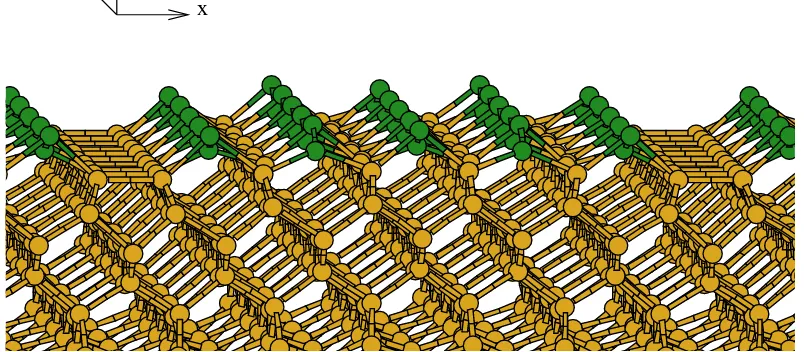
Fig. 1. Geometry of the (2×n) reconstruction of Ge on Si(001) for the casen= 6, with light and dark coloured spheres representing Si and Ge. Dimer rows, miss-ing-dimer trenches and normal to the surface lie along mutually perpendicular x, y and z directions.
present here a first-principles investigation of the energetics of the (2×n)
re-construction observed at low Ge coverage, with the aim of explaining why the periodicity n has the values observed experimentally; we also present an interpretation of the energetics in terms of the relaxed atomic geometries.
The clean Si (001) surface shows the well-known reconstruction due to the for-mation of rows of Si dimers. During the early stages of solid-source molecular beam epitaxy (SSMBE) of Ge on Si (001), the growth is remarkably simi-lar to that of Si itself, with rows of dimers forming on the surface. As the coverage approaches one monolayer, however, the system shows the effects of strain due to the mismatch of the Si and Ge lattice parameters, and trenches of missing dimers appear (see Fig. 1). These trenches are oriented at right angles to the axis of the dimer rows, and there is a fairly regular spacing n
between trenches [1–6]. This is the (2×n) reconstruction, with n observed
to be about 8, though the distribution of n is fairly broad and somewhat de-pendent on growth conditions, with values up to 12 being reported. A similar reconstruction is observed during gas-source MBE (GSMBE) [7–9], though there are small differences due to the presence of hydrogen on the surface.
This forms when a further layer of Ge grows on a (2×n) surface, and does not fill in the trenches in the surface. The increased strain in the new layer gener-ally means that the new periodicity (m) is less than the old (n). On Si (001), there are two step types: parallel to the dimer rows (A-type, generally smooth) and perpendicular to the dimer rows (B-type, generally rough) [10,11]. After one or two monolayers of Ge have been deposited, this roughness is seen to first equalise and then reverse [7,12]. Finally, large scale features form along the elastically soft (100) and (010) directions: “hut” pits and clusters [1,7,8,13]. Although the work reported here focuses only on the (2×n) reconstruction,
it provides the foundation for investigating the other more complicated recon-structions. In particular, we will report elsewhere [14] on tight-binding inves-tigations of the (m×n) reconstruction, which use the present first-principles
calculations to validate a tight-binding parameterisation of the Si/Ge system for this kind of application.
The calculations to be presented are based on density-functional theory (DFT) in the generalized-gradient approximation (GGA), implemented with pseu-dopotentials and plane-wave basis sets. Starting from the perfect Ge mono-layer as point of reference, we have calculated the formation energy and relaxed structure of missing-dimer trenches having spacings n ranging from 4 to 12. By calculating the trench formation energy both with and without atomic relaxation, we shall show that the strong dependence of formation energy on
n arises almost entirely from relaxation effects. We shall also show that, in a sense that is appropriate to the usual experimental conditions, this formation energy is a minimum for a value of n in the experimentally observed range.
There has been previous modelling of the Si/Ge (2×n) reconstruction, but only using empirical potentials, such as the Stillinger-Weber and modified Keating forms [2,3,5]. These also studied atomic relaxation and strain effects, relating these to the periodicity of the reconstruction, and found results in broad agreement with experiment. Our calculations provide support for the physical mechanisms that emerged from these empirical studies. One problem addressed in the earlier work, but in our opinion not fully resolved, was that of comparing the energies of surface structures having different stoichiometries. This problem necessarily arises if one wishes to compare the energies of (2×n) reconstructions having different n values, since removal or addition of Ge is needed to go from one to the other. The solution to this problem is equivalent to assigning an appropriate chemical potential to Ge, and different ways of doing this have been proposed. Since the predicted equilibrium value of n
the growth of the first monolayer, such effects are expected to be small, and we neglect them in the present work.
Technical details of our calculations are summarised in the next Section. We then present (Sec. 3.1) our results for energetics and relaxed geometry, first of the perfect Ge monolayer, and then of the missing-dimer trenches, including our analysis of the trench formation energy into electronic and relaxation contributions. Sec. 3.2 outlines our arguments about the correct Ge chemical potential to use in determining the equilibrium inter-trench spacing, and gives our numerical result for this, which is close to the experimental value n ≃ 8. The paper ends with a summary of our conclusions.
2 Computational Methods
The fundamental ideas of DFT [15,16] have been extensively reviewed (see e.g. Refs. [17,18]), as have the pseudopotential and plane-wave techniques [18]. The present calculations were performed using the VASP code [19], and employ the standard ultra-soft pseudopotentials [20] that form part of the code. The ap-proximation we use for exchange-correlation energy is the generalised-gradient approximation (GGA) due to Perdew and Wang (PW91) [21,22]. The choice of GGA rather than the local-density approximation (LDA) is deliberate. Since the energetics that interests us here depends quite sensitively on bonding and rebonding effects, and since the errors in bond energies are generally much larger with LDA than with GGA (LDA generally overbinds significantly), we regard the use of GGA as essential in this work.
DFT/pseudopotential/plane-wave calculations are most easily performed in periodic boundary conditions, and we therefore adopt the periodic slab geo-metry usually employed for surface-science work. The scientific issues we are addressing require the accurate treatment of quite small energy differences (typically on the order of 100 meV), and we have made efforts to ensure that the calculations are fully converged with respect to the thickness of the slabs and the width of the vacuum layer separating neighbouring slabs. For an eight layer (2×1) reconstructed slab, we found that the total energy was converged
to better than 1 meV for a vacuum layer of 5 ˚A (compared to 8 ˚A). For this vacuum width, we found that the change in surface energy in going from an eight layer slab to a twelve layer slab was less than 1 meV per dimer. (Both tests were conducted with a plane-wave cutoff energy Ecut of 225 eV and a
Brillouin-zone sampling is also essential. In general, Ecut was chosen to be 225 eV, and k-point sampling was performed using the 4×4×1 Monkhorst-Pack mesh, but detailed evidence will be presented below about the convergence of our results with respect to these parameters.
3 Results
3.1 Energetics and geometries
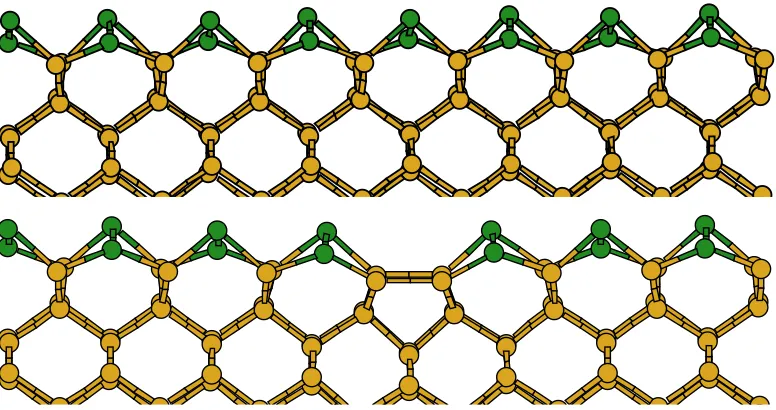
We begin by summarising the structure and energetics of the system having a perfect Ge monolayer in the p(2×2) reconstruction (Fig. 2(a)). For the fully relaxed system, we find the following structural parameters (results from Refs. [24–28] in parentheses): Ge-Ge bond length 2.55 ˚A (2.38−2.44 ˚A);
Ge-dimer tilt angle 19.2◦ (14.2
−18.5◦); up and down Ge-Si bond lengths 2.48 and
2.39 ˚A (2.42 and 2.34 ˚A). We note that the methods used to obtain the earlier results compared with here differ from ours in two significant ways: first, they used LDA rather than GGA; second, they used the (2×1) rather than the
p(2×2) reconstruction. Both of these factors may have an appreciable effect on the structure of the monolayer; we note particularly that use of the (2×1)
reconstruction may well prevent the favourable relaxations along the dimer row allowed by p(2× 2). Given these differences, we regard the agreement with previous results as reasonable.
For comparison, we note the corresponding parameters for thep(2×2) recon-struction on the clean Si (001) surface, obtained using the same GGA, and with the GGA lattice parameter for Si (a0 = 5.45 ˚A, corresponding to a bulk
bond length of 2.36 ˚A): dimer Si-Si bond length 2.36 ˚A; dimer-second layer up and down bond lengths 2.40 and 2.34 ˚A. The Ge-Ge dimer bond is elongated (actually beyond the bulk bond length, which we found to be 2.49 ˚A), with the extra freedom to relax allowing the substrate to take on more bulk-like lengths and angles.
We also report here the Ge monolayer formation energy per Ge dimer, denoted by Em, since it will be needed later. We define this to be the energy change
per Ge dimer when we start with the perfect relaxed Si (001) 2×2 surface and bring isolated Ge atoms from infinity to form the perfect relaxed 2×2 Ge
monolayer. We find the value Em=−9.64 eV, and we have checked that this
is converged within 0.01 eV with respect to slab thickness, plane-wave cut-off and k-point sampling.
Fig. 2. Calculated structures for (a) (top) a perfect Ge monolayer and (b) (bottom) a relaxed Ge layer with the spacingn= 8 between missing-dimer trenches. In both structures, darker atoms (top surface) are Ge and all other atoms are Si.
cell contains a single missing-dimer trench, with spacings n = 4, 6, 8, 10 and 12 between trenches. In all cases, the repeating cell is orthorhombic. Referring to Fig. 1 and denoting the lengths of the three cell edges byX(along the dimer rows), Y (along the missing-dimer trenches) and Z (normal to the surface), these lengths are: X = (n/√2)a0, Y =
√
2a0, and Z = 15.88 ˚A, where a0 =
5.44 ˚A. The value of Z is appropriate to the eight-layer slab with vacuum width of 5.0 ˚A used in all the calculations (see Sec. 2).
We first report values for the fully relaxed missing-dimer formation energy
Ef(n), defined as the energy per removed Ge-dimer needed to form an array of
missing-dimer trenches with spacing n. In this process, we start from Si (001) with a non-defective monolayer of Ge, and the removed Ge atoms are taken to infinity, where they are isolated atoms in free space. In computational terms, we express Ef(n) as the difference Efin − Einit of the fully relaxed energies
per repeating cell of two systems, both having the same orthorhombic cell of dimensions (X, Y, Z). The initial system (energy Einit) is the slab with a
single non-defective monolayer of Ge on one face. The final system (energy
Efin) is formed from the initial system by removing one Ge-dimer from each
repeating cell to create an array of infinite missing-dimer trenches with spacing
n. We use exactly the same orthorhombic cells for the two systems, with the same plane-wave cut-off and k-point sampling, because this aids cancellation of errors.
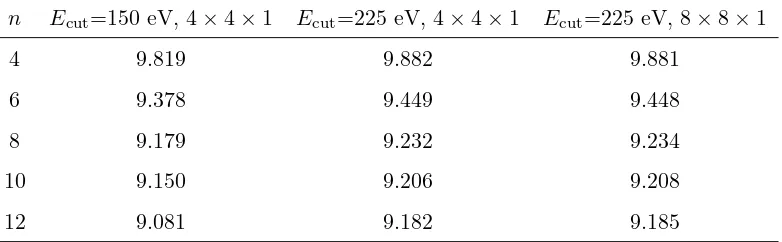
We report in Table 1 our values for Ef(n) for the series of n values. All the
Table 1
Calculated values (eV units) of the fully relaxed missing-dimer trench formation energyEf(n) as a function of inter-trench spacingn(see text for detailed definition). Results are given for different values of plane-wave cut-off energy Ecut and for different k-point sampling meshes.
n Ecut=150 eV, 4×4×1 Ecut=225 eV, 4×4×1 Ecut=225 eV, 8×8×1
4 9.819 9.882 9.881
6 9.378 9.449 9.448
8 9.179 9.232 9.234
10 9.150 9.206 9.208
12 9.081 9.182 9.185
with respect to basis-set completeness andk-point sampling, we report values of Ef(n) for a moderate (150 eV) and a large (225 eV) plane-wave cut-off
energy Ecut and for twok-point sets (4×4×1 and 8×8×1). It is clear that Ef(n) is converged to within a few meV with respect tok-point sampling and
plane-wave cut-off when we use a 4×4×1 k-point mesh and a plane-wave cut-off of 225 eV. We note that Ef(n) is a monotonically decreasing function
of n, which attains a plateau value for n > 8. Its overall variation with n is very substantial, since it is nearly 1 eV higher forn= 4 than for n= 12. This effective repulsion between missing-dimer trenches for spacings below n ∼ 8 has been found before in calculations based on empirical models [2,3,5]. Its consequence is that for a given overall density of trenches they will tend to become equally spaced.
Previous work [2,3,5] suggests that the effective repulsion between trenches stems from the elastic relaxation field surrounding each missing dimer. To test this, we have repeated the calculations of Ef(n), but without relaxation
(we denote the unrelaxed value by E0
f(n)). As before, we start from the fully
relaxed initial system, but when the Ge atoms are removed, all atoms are held fixed in their initial positions. The resulting E0
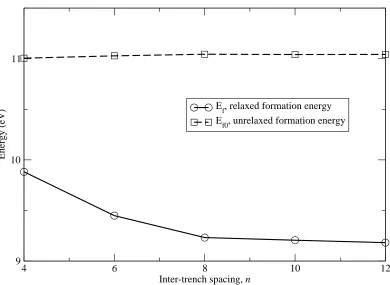
f(n) values are reported as a
function of n in Fig. 3, and we see that their variation with n is extremely small. This means that all the variation in the fully relaxedEf(n) values comes
from the relaxation of the final system with respect to the initial system. The relaxation energy Ef −Ef0 has a magnitude of nearly 2 eV for widely spaced
missing dimers.
4 6 8 10 12 Inter-trench spacing, n
9 10 11
Energy (eV)
Ef, relaxed formation energy Ef0, unrelaxed formation energy
Fig. 3. Calculated values of relaxed (circles, solid line) and unrelaxed (squares, dashed line) formation energiesEf andEf0 of missing-dimer trenches in a Ge mono-layer on Si(001).
is interesting to compare this result with the single missing dimer in Si(001), which has an identical structure, apart from the Ge in the top layer. There, the bonds across the trench have a length of 2.56 ˚A [29,30]; the similarity suggests that the limiting factor on the relaxation in both cases is the Si-Si distance. The Ge dimers neighbouring the trench show an inward relaxation of 0.65 ˚A from their positions in the perfect monolayer. The up and down Si–Ge bond lengths neighbouring the trench are 2.58 and 2.45 ˚A, so that there is a significant lengthening compared with the perfect Ge monolayer. As expected, for smaller values of n, the relaxation around the trench is less pronounced. For example, in the n = 4 case, the Si–Si separation across the trench is 2.63 ˚A, and the inward relaxation of the Ge dimers neighbouring the trench is 0.48 ˚A. The suppression of relaxation for small spacings is clearly responsible for the strongn-dependence ofEf(n), corresponding to the effective repulsion
between trenches.
3.2 The experimental missing-dimer trench spacing
We now want to use our results for Ef(n) to clarify why the missing-dimer
We assume that the surface is in thermal equilibrium, so that, for a given number of Ge atoms on the surface, the probability of finding any particular arrangement γ of these atoms is proportional to exp(−Eγ/kBT), where Eγ is
the energy of γ. (Strictly speaking, Eγ should be a non-configurational free
energy, but here we take it to be the equilibrium energy of γ.) Our thermal equilibrium assumption means that we are ignoring kinetic effects. We will discuss the validity of this assumption in Sec. 4.
Since our approach is to discuss the arrangements that will be seen in thermal equilibrium for a givennumber of Ge atoms on the surface, and we need only know howEγ varies as we go from one arrangement of these atoms to another,
the energy zero chosen for Eγ is irrelevant. However, it will be convenient to
relateEγ values to the energy of one particular arrangement of Ge, which we
call the ‘reference’ arrangement, whose energy isEref. We choose this to be the
arrangement in which all Ge atoms form perfect dimers, which are arranged to make a non-defective monolayer covering a certain area of the surface. The shape of the boundary of this area does not make any difference, but the following arguments become simpler if it is rectangular.
We now consider the energies of arrangements created from the reference ar-rangement by the formation of missing-dimer trenches. For definiteness, let there beLdimer rows each containingP dimers in the reference arrangement. We form Q equally spaced missing-dimer trenches by removing QL dimers, replacing them at the boundary of the monolayer, and allowing the whole sys-tem to relax. It is convenient to divide this process into two parts: (i) the prior fetching of 2QLGe atoms from infinity and their deposition at the boundary of the reference system, in such a way that each dimer row is increased in length from P dimers to P +Q dimers, the number of dimer rows remain-ing the same; (ii) the subsequent formation of the missremain-ing-dimer trenches by the removal of QL Ge dimers and their separation to infinity. We write the energy in process (i) as QLEp, where Ep is a constant energy that will be
discussed further below. The energy change in process (ii) is QLEf(n), where Ef(n) is the trench formation energy defined above, with the spacingn given
by n = (P +Q)/Q. The total energy change ∆E is therefore:
∆E =QL(Ef(n) +Ep) = LP
n−1(Ef(n) +Ep) =LP ζ(n), (1)
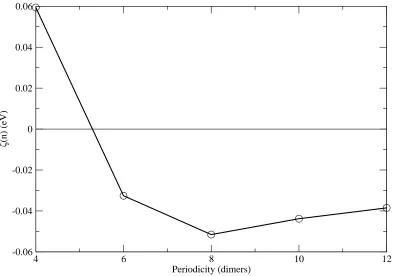
whereζ(n) = (Ef(n) +Ep)/(n−1). The energetically most favorable value of n is therefore obtained by minimizing ζ(n) with respect to n
In fact, the energy Ep of process (i) is the same as the monolayer formation
energyEm already discussed in Sec. 3.1. The reason is that the energy change
4 6 8 10 12 Periodicity (dimers)
-0.06 -0.04 -0.02 0 0.02 0.04 0.06
ζ
(n) (eV)
Fig. 4. Calculated values (eV units) of ζ(n)≡(Ef(n) +Em)/(n−1) as a function of inter-trench spacingn, with Ef(n) the formation energy of missing-dimer defect trenches andEm the Ge monolayer formation energy (see Eq. 1 and text).
atoms to the boundary of a pre-existing piece of monolayer. (This assumes, of course, that we ignore edge effects, which is an appropriate approximation here.)
We now use our calculated Em = −9.64 eV/dimer (see above, Sec. 3.1) to
obtain numerical values for ζ(n), which we present in Fig. 4. We note that
ζ(n) is negative for large n, so that it is energetically favourable to form widely spaced missing dimers. However, the repulsion between rows causes
ζ(n) to increase at small n, and it has a minimum at n≃8. This optimum n
value corresponds well to the typical spacing observed experimentally.
4 Discussion and conclusions
A number of key points have emerged from our first-principles calculations on the (2×n) reconstruction of sub-monolayer Ge on Si (001). First, we have
yield the estimate n ≃ 8, in respectable agreement with the typical values observed experimentally. Third, we have shown that the effective repulsion is entirely due to elastic relaxation effects: the energy lowering due to relaxation is greatest when the strain fields of different trenches do not overlap, and de-creases asndecreases. Fourth, we have seen that for largenthere is significant rebonding between Si atoms in the trench, and this is probably essential in making trench formation energetically favourable.
The picture we have established is not entirely new. The work based on empir-ical models[2,3,5] referred to in Sec. 1 came to essentially the same conclusion about the important role of elastic effects. The more fundamentally based first-principles calculations presented here therefore provide support for the earlier models. However, we have emphasised that a correct identification of the appropriate Ge chemical potential is crucial in understanding the ener-getic stabilisation that results from trench formation, as well as the equilib-rium value ofn. In earlier work, it was suggested that this chemical potential should be identified with the energy of bulk unstrained Ge (for large, fully re-laxed islands), or else Ge biaxially strained to the Si lattice constant (for wide, coherent islands) [2]. We have argued here that the formation energy of the perfect Ge monolayer provides the experimentally relevant point of reference in fixing this chemical potential.
Our reasoning is based on the assumption of full thermal equilibrium, and we have not attempted to account for kinetic effects. Since we are only trying to investigate the observed spacing n of the reconstruction, this is reasonable. Although a variety of kinetic effects are observed during the formation of the (2×n) reconstruction (including the “displacive incorporation” growth model) [31], once the complete layer is formed it is stable, and kinetic effects are unlikely to play a role. We can also consider the limit of slow growth conditions, where thermal equilibrium will be a valid assumption [2]. The observed range ofn is rather broad (roughly from 8 to 12), in part depending upon growth conditions; this is perfectly consistent with our results, which show only a weak increase in formation energy beyond the spacing n = 8 at which it is a minimum. We also expect the temperature at which the growth occurs and the growth source to have an effect. We have also deliberately ignored intermixing between Ge and Si layers. There is MEIS evidence showing that for 1ML coverage (i.e. equivalent to the (2×n) surface we are modelling) at low temperatures (up to 500◦C) there is little intermixing [31,32], though
recent measurements and calculations [33] indicate intermixing starting at about 500◦C. Nevertheless, the simplest model is one without intermixing,
Acknowledgements
JO and DRB thank EPSRC for funding through grants M01753 and M71640. DRB also thanks the Royal Society for funding through a University Re-search Fellowship. Calculations were performed on the Manchester CSAR ser-vice, through an allocation of time to the UKCP consortium (EPSRC grant M01753) and at the HiPerSPACE Centre at UCL (JREI grant JR98UCGI).
References
[1] U.K¨ohler, O.Jusko, B.M¨uller, M. von Hoegen, M.Pook, Ultramicroscopy 42-44 (1992) 832.
[2] J.Tersoff, Phys. Rev. B 43 (1991) 9377.
[3] J.Tersoff, Phys. Rev. B 45 (1992) 8833.
[4] X.Chen, F.Wu, Z.Zhang, M.G.Lagally, Phys. Rev. Lett. 73 (1994) 850.
[5] F.Liu, M.G.Lagally, Phys. Rev. Lett. 76 (1996) 3156.
[6] B.Voigtl¨ander, M.K¨astner, Phys. Rev. B 60 (1999) R5121.
[7] I.Goldfarb, J.H.G.Owen, P.T.Hayden, D.R.Bowler, K.Miki, G.A.D.Briggs, Surf. Sci. 394 (1997) 105.
[8] I.Goldfarb, P.T.Hayden, J.H.G.Owen, G.A.D.Briggs, Phys. Rev. Lett. 78 (1997) 3959.
[9] K.-H.Huang, T.-S.Ku, D.-S.Lin, Phys. Rev. B 56 (1997) 4878.
[10] D.J.Chadi, Phys. Rev. Lett. 59 (1987) 1691.
[11] D.R.Bowler, M.G.Bowler, Phys. Rev. B 57 (1998) 15385.
[12] F.Wu, X.Chen, Z.Zhang, M.G.Lagally, Phys. Rev. Lett. 74 (1995) 574.
[13] Y.-W.Mo, M.G.Lagally, J. Cryst. Growth 111 (1991) 876.
[14] K.Li, D.R.Bowler, M.J.Gillan to be published.
[15] P.Hohenberg, W.Kohn, Phys. Rev. 136 (1964) B864.
[16] W.Kohn, L.J.Sham, Phys. Rev. 140 (1965) A1133.
[17] R.O.Jones, O.Gunnarsson, Rev. Mod. Phys. 61 (1989) 689.
[18] M.C.Payne, M.P.Teter, D.C.Allan, T.A.Arias, J.D.Joannopoulos, Rev. Mod. Phys. 64 (1992) 1045.
[20] D.Vanderbilt, Phys. Rev. B 41 (1990) 7892.
[21] Y.Wang, J.P.Perdew, Phys. Rev. B 44 (1991) 13298.
[22] J.P.Perdew, J.A.Chevary, S.H.Vosko, K.A.Jackson, M.R.Pederson, D.J.Singh, C.Fiolhais, Phys. Rev. B 46 (1992) 6671.
[23] H.J.Monkhorst, J.D.Pack, Phys. Rev. B 13 (1976) 5188.
[24] J.-H.Cho, M.-H.Kang, Phys. Rev. B 49 (1994) 13670.
[25] S. J.-H.Cho, M.-H.Kang, Phys. Rev. B 50 (1994) 17139.
[26] P.Kr¨uger, J.Pollmann, Phys. Rev. Lett 72 (1994) 1130.
[27] S.Tang, A.J.Freeman, Phys. Rev. B 50 (1994) 10941.
[28] S.J.Jenkins, G.P.Srivastava, J. Phys.:Condens. Matt. 8 (1996) 6641.
[29] J.Wang, T.A.Arias, J.D.Joannopoulos, Phys. Rev. B 47 (1993) 10497.
[30] J.H.G.Owen, D.R.Bowler, C.M.Goringe, K.Miki, G.A.D.Briggs, Surf. Sci. Lett. 341 (1995) L1042.
[31] R.M.Tromp, Phys. Rev. B 47 (1993) 7125.
[32] M.W.Copel, M.C.Reuter, M. von Hoegen, R.M.Tromp, Phys. Rev. B 42 (1990) 11682.