Statistical Concurrent Non-malleable Zero-knowledge
from One-way Functions
Susumu Kiyoshima
NTT Secure Platform Laboratories, Japan [email protected]
December 18, 2015
Abstract
Concurrent non-malleable zero-knowledge(CNMZK) protocols are zero-knowledge proto-cols that provides security even when adversaries interacts with multiple provers and verifiers simultaneously. It is known that CNMZK arguments for NP can be constructed in the plain model. Furthermore, it was recently shown thatstatisticalCNMZK arguments forNPcan also be constructed in the plain model. However, although the former requires only the existence of one-way functions, the latter requires the DDH assumption.
In this paper, we construct a statistical CNMZK argument forNPassuming only the existence of one-way functions. The security is proven via black-box simulation, and the round complex-ity is poly(n). Under the existence of collision-resistant hash functions, the round complexity is reduced to ω(logn), which is essentially optimal for black-box concurrent zero-knowledge protocols.
1
Introduction
Zero-knowledge(ZK)proofsandargumentsare protocols that enable the prover to convince the ver-ifier of the correctness of a mathematical statement while providingzero additional knowledge. This “zero additional knowledge” property is formalized by using thesimulation paradigm: An interactive proof or argument is said to be zero-knowledge if for any adversarial verifier there exists asimulator
that can output a simulated view of the adversary. In the original definition of the ZK property, the adversary interacts with a single prover at a time. In other words, in the original definition, the ZK property is considered in the stand-alone setting.
Non-malleable zero-knowledge(NMZK) [DDN00] andconcurrent zero-knowledge(CZK) [DNS04] are two well-known notions of the ZK property in the concurrent setting. Specifically, NMZK is a no-tion of the ZK property in the setting where the adversary concurrently interacts with a honest prover in theleft sessionand a honest verifier in theright session, and CZK is a notion of the ZK property in the setting where the adversary concurrently interacts with unbounded number of honest provers.
As a security notion that implies both NMZK and CZK, Barak et al. [BPS06] proposedconcurrent non-malleable zero-knowledge(CNMZK). CNMZK guarantees the ZK property in the setting where the adversary concurrently interacts with many provers in the left sessions and many verifiers in the right sessions. In particular, it guarantees that receiving proofs in the left session does not help the adversary to give proofs in the right sessions—that is, it guarantees that if the adversary can prove some statements in the right sessions while receiving proofs in the left sessions, the adversary could prove the same statements even without receiving proofs in the left sessions. In the definition of CNMZK, this guarantee is formalized as the existence of asimulator-extractorthat can simulate the adversary’s view in the left and right sessions while extracting witnesses from the adversary in the simulated right sessions.
The first CNMZK argument forNPwas constructed by Barak et al. [BPS06]. Subsequently, a computationally efficient construction was shown by Ostrovsky et al. [OPV10]. The first CNMZK
proof was constructed by Lin et al. [LPTV10], and a variant of their protocol was shown to be secure with adaptively chosen inputs by Lin and Pass [LP11a]. Additionally, a CNMZK argument that is secure with “fully” adaptively chosen inputs was recently constructed by Venkitasubramaniam [Ven14].
Very recently, Orlandi et al. [OOR+14] constructed the firststatisticalCNMZK argument, i.e., a CNMZK argument such that the simulator-extractor outputs view that is statistically indistinguishable from the adversary’s real view. Statistical CNMZK is clearly of great interest since it guarantees quite strong security in the concurrent setting. However, statistical CNMZK is hard to achieve, and the existing techniques of computational CNMZK protocols seem to be insufficient for constructing statistical CNMZK protocols (see Section 2.1).
An important open question on statistical CNMZK protocols is what hardness assumption is needed for constructing them. The statistical CNMZK argument of Orlandi et al. [OOR+14] was constructed under the DDH assumption (or the existence of dense cryptosystems). Hence, we already know that statistical CNMZK protocols can be constructed under standard assumptions. However, since the existence of one-way functions is known to be sufficient for constructing both statistical ZK protocols and computational CNMZK protocols [HNO+09, BPS06], it is important to study the following question.
1.1 Our Result
In this paper, we answer the above question affirmatively.
Theorem 1. Assume the existence of one-way functions. Then, there exists a statistical concurrent non-malleable zero-knowledge argument for NP with round complexity poly(n). Furthermore, if there exists a family of collision-resistant hash functions, the round complexity can be reduced to
ω(logn).
The round complexity of our statistical CNMZK argument—poly(n) rounds when only the ex-istence of one-way functions is assumed and ω(logn) rounds when the existence of a family of collision-resistant hash functions is assumed—is the same as the round complexity of the known statistical CZK arguments [GMOS07]. Thus, our result closes the gap between statistical CNMZK arguments and statistical CZK arguments. Furthermore, since the security of our statistical CNMZK protocol is proven via black-box simulation, the logarithmic round complexity of our hash-function-based protocol is essentially tight due to the lower bound on black-box CZK protocols [CKPR02].
2
Techniques
In this section, we give an overview of our techniques.
2.1 Previous Techniques
We start by describing the difficulty of constructing statistical CNMZK protocols with the techniques of existing computational CNMZK protocols [BPS06, LPTV10].
First, let us recall the protocols of [BPS06, LPTV10]. The definition of CNMZK requires the existence of a simulator-extractor that simulates the adversary’s view while extracting the witnesses for the statements proven by the adversary in the simulated view. To satisfy this definition, protocols need to satisfy the following properties: (i) the proofs in the left sessions can be simulated for the ad-versary, and (ii) even when the adversary receives simulated proofs in the left sessions, the witnesses can be extracted from the adversary in the right sessions. In the protocol of [BPS06, LPTV10], the simulatability of the left sessions is guaranteed by requiring the verifier to commit to a random trap-door by using aconcurrently extractable commitment schemeCECom [MOSV06]. The committed values ofCEComcan be extracted by a rewinding extractor even in the concurrent setting, and there-fore the proofs in the left sessions can be simulated by extracting the trapdoors fromCECom. On the other hand, the witness-extractability of the right sessions is guaranteed by requiring the prover to commit to the witness with a non-malleable commitment schemeNMCom[DDN00] and additionally designing the protocols so that the following hold.
1. When the adversary receives honest proofs in the left sessions, the committed value of the
NMComcommitment is indeed a valid witness in every accepted right session.
2. When the proofs in the left sessions are switched to the simulated ones, the committed values of theNMComcommitments do not change in the right sessions due to the non-malleability of
NMCom.
As mentioned in Introduction, the techniques of [BPS06, LPTV10] alone seem to be insuffi -cient for constructing statistical CNMZK protocols. The main obstacle is that the techniques of [BPS06, LPTV10] requires the prover to commit to the witness by usingNMCom, which is only computationally hiding.1 Since the committed values of NMCom in the left sessions need to be switched to another values (e.g., 0n) in the simulation, the simulated view can be only computational indistinguishable from the real view.
Recently, Orlandi et al. [OOR+14] constructed a statistical CNMZK protocol by modifying the CNMZK protocol of [BPS06] withmixed non-malleable commitment schemeMXNMCom.MXNMCom
is parametrized by a string and is either statistically hiding or non-malleable depending on the string.2 Very roughly speaking, Orlandi et al. circumvent the above problem by carefully switching the pa-rameter string ofMXNMComin the security proof—when proving the statistical indistinguishability of the simulation, the string is set so thatMXNMComis statistically hiding, and when proving the non-malleability, the string is set so thatMXNMComis non-malleable. The use ofMXNMCom, how-ever, requires assumptions that are seemingly stronger than the existence of one-way functions (such as the DDH assumption or the existence of dense cryptosytems). Thus, the technique of Orlandi et al. cannot be used to construct statistical CNMZK protocols from one-way functions.
2.2 Our Technique
Since the reason why the techniques of [BPS06, LPTV10] cannot be used for statistical CNMZK protocols is that the committed values ofNMComneed to be switched during the simulation, one po-tential strategy for constructing statistical CNMZK is to construct a protocol such that the adversary’s view can be simulated without switching the committed value ofNMCom(and of any other compu-tationally hiding commitment). However, when the simulator commits to the same value inNMCom
as a honest prover, it is not clear how non-malleability ofNMComcan be used in the security proof. Below, we show that the CNMZK property can be shown even in this case if we use a stronger variant ofNMCom.
A key technical tool in our technique is CCA-secure commitment schemes[CLP10], which is a stronger variant of (concurrent) non-malleable commitment schemes. Roughly speaking, CCA secu-rity guarantees that the scheme is hiding even against adversaries that have access to the committed-value oracle, which receives concurrent commitments from the adversary and returns their committed values to the adversary. (In non-malleability, the oracle receives only parallel commitments from the adversary and returns the committed values only after the adversary finishes the interaction with the committer.) Several CCA-secure commitment schemes were constructed from one-way functions [CLP10, LP12, Kiy14, GLP+15]; furthermore, although CCA security itself does not provide any extractability, all of these schemes satisfy concurrent extractability as well.
Using CCA-secure commitment schemes, we consider the following protocol as a starting point.
Stage 1. (Vcommits to trapdoor)
1. The verifierV chooses random rV ∈ {0,1}n and commits to rV by using a statistically binding commitment scheme Com, which can be constructed from one-way functions [Nao91, HILL99]. Let (rV,d) be the decommitment.
1NMComneed to benon-malleable w.r.t. commitment[DDN00], which roughly says that the committed value of the
commitment that the man-in-the-middle adversary gives is independent of the committed value of the commitment that adversary receives. Since the definition of non-malleability w.r.t. commitment is meaningless when the committed values cannot be uniquely determined,NMComcannot be statistically hiding.
2Specifically, Orlandi et al. [OOR+14] used the scheme such that (i) when the string is sampled from a uniform
2. V commits to (rV,d) by usingCCA-CECom, whereCCA-CEComis a CCA-secure com-mitment scheme that is also concurrent extractable [CLP10, LP12, Kiy14, GLP+15].
Stage 2. (Pprovesx∈Lor knowledge of trapdoor) The prover Pproves that it knows a witness for x ∈ Lor a valid decommitment (rV,d) of the Comcommitment thatV gives in Stage 1.
P proves this statement by using a statistical witness-indistinguishable argument of knowl-edge sWIAOK, which can be constructed from one-way functions by instantiating Blum’s Hamiltonian-cycle protocol with the statistically hiding commitment scheme of [HNO+09].
In this protocol, the verifier’s view can be statistically simulated by a simulator that extracts (rV,d) fromCCA-CEComand uses it as a witness insWIAOK. (During the extraction in Stage 1, the sim-ulator interacts with the verifier honestly; thus, even if computationally hiding commitment schemes are used as building blocks inCCA-CECom, the simulator commits to the same values as a honest prover in these schemes.) Also, intuitively this protocol seems to be CNMZK from the following reasons.
• The CCA security ofCCA-CEComguarantees that the trapdoors of the right sessions are hid-den from the adversary even when the trapdoors of the left sessions are extracted from the adversary.
• Then, since the simulated proofs are generated in the left sessions by extracting the trapdoors of the left sessions, the trapdoors in the right sessions are hidden from the adversary even when the adversary receives simulated proofs in the left sessions.
• Thus, even when the adversary receives the simulated proofs in the left sessions, the adver-sary cannot “cheat” in the right sessions, and therefore witnesses for the statements must be extractable fromsWIAOKin the right sessions.
Of course, to formally prove the statistical CNMZK property, we need to show a simulator-extractor that statistically simulates the adversary’s view and also extracts witnesses for the statements in the right sessions.
As the simulator-extractor, we consider the followingSE.
1. First,SEsimulates the view of the adversaryAby executing the following simulatorS: Sim-ulator S internally invokes A and interacts with it in the left and right sessions honestly as provers and verifiers except that in each left session,Sextracts (rV,d) by using the concurrent extractor ofCCA-CEComand uses it as a witness insWIAOK.
2. After simulating the view ofAas above,SEextracts witnesses from the right sessions by doing the following for each right session. First,SErewindsSuntil the point just beforeSsends the challenge message of sWIAOKtoA.3 Then,SE repeatedly executesS from this point with flesh randomness until it obtains another accepted transcript ofsWIAOK. After obtaining an-other accepted transcript,SEextracts a witness by using the argument-of-knowledge property ofsWIAOK.
It is not hard to see thatSEstatistically simulates the real view ofA.4 Thus, it remains to show that SEextracts witnesses for the statements in the right sessions.
To show the witness extractability of SE, a natural approach is to follow the above-mentioned approach of [BPS06, LPTV10] and show the following.
3SinceSrewindsAduring the concurrent extraction ofCCA-CECom,Smay send the challenge message ofsWIAOK
of a right session toAmultiple times. Here,SErewindsSuntil the point just beforeSsends it toAon the “main thread.”
4Formally, we need to show that in theCCA-CEComcommitment of the left session,Acommits to a valid
1. WhenA receives honest proofs in the left sessions, a witness for the statement is extracted from thesWIAOKproof in every accepted right session.
2. When the honest proofs in the left sessions are switched to the simulated ones, the value ex-tracted fromsWIAOKdoes not change in every accepted right session.
Note that here we argue about the extracted values instead of the committed values. At first sight, it seems that this is not a big difference and therefore it seems that the above can be shown by using an argument similar to the one used in [BPS06, LPTV10].
However, this approach does not work. In particular, we do not know how to prove the second part—that is, we cannot show that the extracted values remain to be the same when the honest proofs in the left sessions are switched to the simulated ones. To see this, observe the following. Since the witnesses used in sWIAOK are switched in the simulated proofs, we need to use the witness indistinguishability ofsWIAOK of the left sessions to show the indistinguishability of the extracted values. However, sinceAis rewound during the witness extraction of thesWIAOKproofs of the right sessions, if the left and the right sessions are scheduled so that thesWIAOKproofs of the left sessions are executed in parallel with thesWIAOKproofs of the right sessions, thesWIAOKproofs of the left sessions are also rewound, and thus we cannot use their witness indistinguishability.5
Thus, we instead use the following approach. Informally, the above approach does not work because the honest proofs and the simulated proofs are “too different.” We thus introduce a hybrid experiment in whichAreceiveshybrid proofsin the left sessions, where a hybrid proof is generated by extracting (rV,d) by brute force and using it as a witness in sWIAOK. (Notice that the only difference between the hybrid proofs and the simulated proofs is how the trapdoors are extracted.) We then show that (i) witnesses for the statements are extracted in the right sessions whenAreceives hybrid proofs in the left sessions, and (ii) when hybrid proofs are switched to the simulated ones, the extracted values do not change. More precisely, our analysis proceeds as follows.
• First, we show the second part, i.e., we show that the values extracted in the right sessions do not change when the proofs in the left sessions are switched from the hybrid proofs to the simulated ones. Since the only difference between the hybrid proofs and the simulated ones is how the committed values of theCCA-CEComcommitments are extracted (by brute-force or by the concurrent extractability), we can show this by using the concurrent extractability of CCA-CECom. We note however that there is a subtlety since CCA-CECom in the left sessions can be rewound not only by the concurrent extractor ofCCA-CECombut also by the extractor ofsWIAOK. Nonetheless, by carefully using a standard technique (the “good prefix” argument), we can show that the concurrent extractor ofCCA-CEComworks even in this case. • Next, we show that in the hybrid experiment, witnesses for the statements are extracted from the right sessions. Since the simulated proofs can be efficiently generated given access to the committed-value oracle ofCCA-CECom, at first sight it seems that this follows directly from the CCA security of CCA-CECom and argument-of-knowledge property of sWIAOK—if a witness for the statement is not extracted, (rV,d) must be extracted, and thus we can break the CCA security ofCCA-CECom. However, there are two problems.
1. Since CCA-CECom in the left sessions can be rewound during the witness extraction ofsWIAOKof the right sessions, the hybrid experiment cannot be emulated even given
access to the committed-value oracle ofCCA-CECom. Hence, the CCA-secure commit-ments in the right sessions may not be hiding in the hybrid experiment.
2. Since the adversary obtains hybrid proofs, which are generated in super-polynomial time, the argument-of-knowledge property ofsWIAOKmay not hold in the hybrid experiment. We remark that although existing CCA-secure commitment schemes provides robust-ness, which guarantees that arbitrary “small”-round protocol remains secure even when adversaries have access to the committed-value oracle, we cannot use robustness here sinceCCA-CEComin the left sessions can be rewound during the witness extraction of
sWIAOK of the right sessions and therefore the hybrid experiment cannot be emulated even given access to the committed-value oracle.
Because of these problems, we cannot use the security ofCCA-CEComdirectly in the analysis. Thus, instead of using existing CCA-secure commitment schemes in a modular way, we directly use their building blocks in the protocol and directly use their proof technique in the analysis. (In particular, we use the robust concurrent extraction technique of [GLP+15] and a one-one CCA-secure commitment scheme of [KMO14].) The proof techniques of existing CCA-secure commitment schemes are strong enough to solve the above problems, and thus we can show that witnesses for the statements are extracted in the hybrid experiment.
From the above two, it follows that even whenAreceives simulated proofs in the left session, valid witnesses are extracted in right sessions. This completes the overview of our techniques.
3
Preliminaries
3.1 Notations
We usento denote the security parameter. For anyk ∈ N, let [k] def= {1, . . . ,k}. For any two-party protocol⟨A,B⟩, we useviewB[A(x)↔B(y)]to denote a random variable representing the view of B in the interaction betweenAandBwith input xandyrespectively, and useoutputA,B[A(x)↔B(y)] (resp.,outputB[A(x)↔B(y)]) to denote a random variable representing the joint output ofAandB
(resp., the output ofB) in the interaction betweenAandBwith inputxandyrespectively.
3.2 Commitment Schemes
Recall that commitment schemes are two-party protocols between the committerCand the receiver
R. A transcript of the commit phase isvalidif there exists a valid decommitment of this transcript. It is known that a two-round statistically binding commitment schemeComSBcan be constructed from one-way functions [Nao91, HILL99]. It is also known that apoly(n)-round statistically hiding commitment scheme can be constructed from one-way functions [HNO+09] and a constant-round one can be constructed from a family of collision-resistant hash functions [NY89, DPP98].
3.3 Concurrently Extractable Commitment Schemes
Roughly speaking, a commitment scheme isconcurrently extractableif there exists a polynomial-time extractor such that for any adversarial committer that concurrently commits to many values by using the scheme, the extractor can extract the committed value from the adversarial committer in every valid commitment.
Micciancio et al. [MOSV06] proposed a ω(logn)-round concurrently extractable commitment
protocol of [PRS02] and can be constructed from one-way functions. The extractor ofCECom per-forms the extraction by rewinding the adversarial committer according to the rewinding strategy of [PRS02, PTV12]. Specifically, while interacting with the adversarial committerC∗ on the “main thread” as honest receivers, the extractor rewinds the main thread and generates many “look-ahead threads” on which it interacts withC∗again as honest receivers with flesh randomness; at the end of each commitment on each thread, the extractor extracts the committed values by using the information collected on the other threads.
CEComcan be seen as a concurrent execution of the extractable commitment schemeExtCom
in Figure 2, which consists of three stages—commit,challenge, andreply—and can be con-structed from one-way functions.
Commit Phase
The committerCand the receiverRreceive common input 1nand parameterℓ. (In [MOSV06],
ℓ =ω(logn).) To commit tov ∈ {0,1}n, the committerC commits tovconcurrentlyℓtimes by usingExtComas follows.
1. CandRexecutecommitstage ofExtComℓtimes in parallel. 2. For each j∈[ℓ] in sequence,CandRdo the following.
(a) Rsends thechallengemessage ofExtComfor the j-th session. (b) Csends thereplymessage ofExtComfor the j-th session.
Decommit Phase
CsendsvtoRand decommits all theExtComcommitments.
Figure 1: Concurrently extractable commitmentCECom[MOSV06].
Robust Concurrent Extraction.
On the concurrently extractable commitment schemeCEComof [MOSV06], Goyal et al. [GLP+15] showed a very useful lemma called the robust concurrent extraction lemma. Roughly speaking, this lemma states that even when the adversarial committer additionally participates in an external “small”-round protocol, the committed values can be extracted from the adversarial committer with-out rewinding the external protocol. More precisely, consider anypptadversarial committerAthat
Commit Phase
The committerCand the receiverR receive common inputs 1n. To commit tov ∈ {0,1}n, the committerCdoes the following with the receiverR.
commitstage.
For eachi∈[n], the committerCchooses a pair of randomn-bit strings (a0i,a1i) such that
a0i ⊕a1i = v. Then, for eachi∈[n] in parallel,Ccommits toa0i anda1i by usingComSB. For eachi∈[n] andb∈ {0,1}, letcbi be the commitment toabi.
challengestage.
Rsends randomn-bit stringe=(e1, . . . ,en) toC.
replystage.
For eachi∈[n],Cdecommitscei
i toa ei
i . Decommit Phase
CsendsvtoRand decommitscbi toabi for alli∈[n] andb∈ {0,1}. Rchecks whethera01⊕a11 =
· · ·=a0n⊕a1n=v.
Figure 2: Extractable commitmentExtCom[PW09], which is used as a building block in the concur-rently extractable commitment schemeCEComof [MOSV06].
3.4 (One-one) CCA-secure Commitment Schemes
We recall the definition of (one-one) CCA security andκ-robustness of commitment schemes [CLP10, LP12, KMO14].
(One-one) CCA security. Roughly speaking, a tag-based commitment scheme⟨C,R⟩(i.e., a com-mitment scheme that takes ann-bit string—atag—as an additional input) isCCA-secureif it is hiding even against adversaryAthat interacts with the followingcommitted-value oracle: The committed-value oracleO interacts with A as an honest receiver in many concurrent sessions of the commit phase of⟨C,R⟩using tags chosen adaptively byA; at the end of each session, if the commitment of this session is invalid or has multiple committed values,Oreturns⊥toA; otherwise,Oreturns the unique committed value toA.
More precisely, CCA-secure commitment schemes are defined as follows. Consider the following probabilistic experiment INDb(⟨C,R⟩,A,n,z) for eachb ∈ {0,1}. On input 1n and auxiliary inputz, adversaryAOadaptively chooses a pair of challenge valuesv0,v1∈ {0,1}nand ann-bit tagid∈ {0,1}n.
Then,AOinteracts with the challenger and obtains a commitment tovbwith tagid. Letybe the output ofA. The output of the experiment is⊥if during the experiment,AsendsOany commitment using tagid. Otherwise, the output of the experiment isy. LetINDb(⟨C,R⟩,A,n,z) denote the output of experiment INDb(⟨C,R⟩,A,n,z).
Definition 1. Let⟨C,R⟩be a tag-based commitment scheme andObe the committed-value oracle of
⟨C,R⟩. Then,⟨C,R⟩isCCA-secure (w.r.t the committed-value oracle)if for anypptadversaryA, the
following are computationally indistinguishable:
• {IND0(⟨C,R⟩,A,n,z)}n∈N,z∈{0,1}∗
If⟨C,R⟩ is CCA secure only against adversaries that start a single session withO, we say that ⟨C,R⟩isone-one CCA secure. That is, one-one CCA security is defined as follows. Letone-session committed-value oraclebe an oracle that is the same as the committed-value oracle except that it interacts with the adversary only in a single session of the commit parse of⟨C,R⟩. Then, one-one
CCA security is defined by replacing the committed-value oracle in the definition of CCA security with the one-session committed-value oracle.
Robustness. Roughly speaking, a tag-based commitment scheme isκ-robustif for any adversaryA and any ITMB, the joint output of aκ-round interaction betweenAOandBcan be simulated without Oby apptsimulator.
Definition 2. Let⟨C,R⟩be a tag-based commitment scheme andObe the committed-value oracle of
⟨C,R⟩. For any constantκ ∈ N, we say that⟨C,R⟩ isκ-robust (w.r.t. the committed-value oracle)
if there exists apptoracle machine (calledsimulator)Ssuch that for anypptadversaryAand any
κ-roundpptITM B, the following are computationally indistinguishable:
• {outputB,AO
[
B(1n,x,y)↔ AO(1n,x,z)]}
n∈N,x,y,z∈{0,1}n
• {outputB,SA
[
B(1n,x,y)↔ SA(1n,x,z)]}
n∈N,x,y,z∈{0,1}n
^ Intuitively, theκ-robustness guarantees that the security of anyκ-round protocol (say, the hiding property of aκ-round commitment scheme) holds even against the adversary that interacts withO. In fact, it is easy to see that the following proposition holds.
Proposition 1. Let⟨C,R⟩be aκ-robust commitment scheme for a constantκ ∈N, and let B be any
κ-roundpptITM. Then,for every two sequences{y1n}n∈Nand{y2n}n∈Nsuch that for everypptadversary
A′it holds that • {outputB,A′
[
B(1n,x,y1n)↔ A′(1n,x,z)]}
n∈N,x,y,z∈{0,1}n and
• {outputB,A′
[
B(1n,x,y2n)↔ A′(1n,x,z)]}
n∈N,x,y,z∈{0,1}n
are computationally indistinguishable, then it also hold that for everypptadversaryA,
• {outputB,AO
[
B(1n,x,y1n)↔ AO(1n,x,z)]}
n∈N,x,y,z∈{0,1}n and
• {outputB,AO
[
B(1n,x,y2n)↔ AO(1n,x,z)]}
n∈N,x,y,z∈{0,1}n
are computationally indistinguishable.
Proof. From the definition ofκ-robustness, there existspptSsuch that for eachb∈ {1,2}, the
follow-ing are computationally indistfollow-inguishable. • {outputB,AO
[
B(1n,x,ybn)↔ AO(1n,x,z)]}
n∈N,x,y,z∈{0,1}n
• {outputB,SA
[
B(1n,x,ybn)↔ SA(1n,x,z)]}
n∈N,x,y,z∈{0,1}n
Also, from the assumption of the proposition, the following are computationally indistinguishable. (Notice thatSA ispptsince bothAandSareppt.)
• {outputB,S[B(1n,x,y1n)↔ SA(1n,x,z)]}
n∈N,x,y,z∈{0,1}n
• {outputB,S[B(1n,x,y2n)↔ SA(1n,x,z)]}
n∈N,x,y,z∈{0,1}n
The scheme we use. From a result shown in [GLP+15], we can obtain a constant-roundκ-robust one-one CCA-secure commitment scheme from one-way functions for every constantκ ∈ Nas fol-lows. In [GLP+15], Goyal et al. constructed aω(logn)-round CCA-secure commitment scheme from one-way functions. This scheme hasω(logn) rounds becauseCEComwith parameterℓ = ω(logn) is used as a building block. The reason whyℓis set to beω(logn) is that in the security analysis, the committed values ofCEComneed to be extracted when polynomially manyCECom commitments are concurrently executed. In the setting ofone-one CCA security, however, the security analysis works even if the committed values ofCEComare extractable only when a singleCECom commit-ment is executed. Hence, by settingℓ:=O(1), we can obtain a constant-round one-one CCA-secure commitment scheme. For completeness, we give the protocol and the proof of one-one CCA security in Appendix B.
3.5 Witness Indistinguishable Proofs and Arguments, and Special Soundness
Definition 3. An interactive proof (or argument) system⟨P,V⟩for anNPlanguage L with witness relationRLis said to bewitness indistinguishableif for every probabilistic polynomial-time
adver-sarial verifier V∗ and for every two sequences {w1x}x∈L and{w2x}x∈L such that w1x,w2x ∈ RL(x), the
following ensembles are computationally indistinguishable.
• {viewV∗
[
P(x,w1x)↔V∗(x)]} x∈L • {viewV∗
[
P(x,w2x)↔V∗(x)]} x∈L
If the above ensembles are statistically indistinguishable,⟨P,V⟩is said to bestatistically witness
indistinguishable. ^
We can obtain a four-round witness-indistinguishable proof systemWIPOKfrom one-way func-tions by executing Blum’s Hamiltonian-cycle protocol in parallel. Recall thatWIPOKconsists of three stages—commit, challenge, and response—and has a useful property calledspecial soundness: Given two accepting transcripts⟨α1, α′1, β1, γ1⟩and⟨α2, α′2, β2, γ2⟩of statement x ∈ L such thatα1 = α2,
α′
1 =α′2, andβ1,β2, we can compute a valid witness forx∈L.
We can obtain a statistical witness-indistinguishable argument systemsWIAOKfrom any cal hiding commitment scheme by instantiating Blum’s Hamiltonian-cycle protocol with the statisti-cally hiding commitment scheme. It is easy to see that this argument system satisfies special sound-ness in the following sense: Let us say that two accepting transcripts⟨−→α1, β1, γ1⟩and⟨−→α2, β2, γ2⟩are
admissibleif→−α1 =→−α2andβ1 , β2; then, given admissible transcripts that are generated in
polyno-mial time, we can compute a valid witness. In particular, given admissible transcripts⟨−→α, β1, γ1⟩and
⟨−→α, β2, γ2⟩, we can compute a valid witness or we can decommit a commitment given in→−α to two
different values.
3.6 Statistical Concurrent Non-malleable Zero-knowledge Arguments
andAprior to the experiment. In contrast, the statements proven in the right interaction,ex1, . . . ,exm, and the identities used in the left and the right interactions,id1, . . . ,idmandeid1, . . . ,eidm, are chosen byAduring the experiment. LetviewA(n,x1, . . . ,xm,z) be a random variable representing the view ofAin the above experiment. Then, roughly speaking,⟨P,V⟩isstatistical concurrent non-malleable zero-knowledge(statistical CNMZK) if for any adversaryA, there exists a ppt machine called the
simulator-extractorthat can statistically simulate the view ofA in the above experiment while ex-tracting witnesses for the statements proven byAin the accepted right interactions that use different identities from the left interactions. The formal definition is given below.
Definition 4. An interactive proof⟨P,V⟩for language L with witness relationRLis said to be
statis-tical concurrent non-malleable zero-knowledgeif for every polynomial m(·)and every probabilistic polynomial-time man-in-the-middle adversaryAthat participates in at most m = m(n)concurrent executions, there exists a probabilistic polynomial-time machineSEcalledsimulator-extractorsuch that the following hold.
1. Letsim-view(n,x1, . . . ,xm,z)be a random variable representing the first output ofSE(n,x1, . . . ,
xm,z). Then, the following ensembles are statistically indistinguishable. • {viewA(n,x1, . . . ,xm,z)}n∈N,x1,...,xm∈L∩{0,1}n,z∈{0,1}∗
• {sim-view(n,x1, . . . ,xm,z)}n∈N,x1,...,xm∈L∩{0,1}n,z∈{0,1}∗
2. For every n∈N, x1, . . . ,xm∈L∩{0,1}n, and z∈ {0,1}∗, the following holds. Let(view,{wei}i∈[m])
denote the output ofSE(n,x1, . . . ,xm,z). Letex1, . . . ,exmbe the statements of the right
interac-tion in view, and letid1, . . . ,idm andide1, . . . ,idem be the identities of the left and the right
in-teractions inview, respectively. Then, except with negligible probability, we have(exi,wei)∈RL
for every i ∈ [m]such that the i-th right interaction is accepting andidei , idjholds for every
j∈[m]. ^
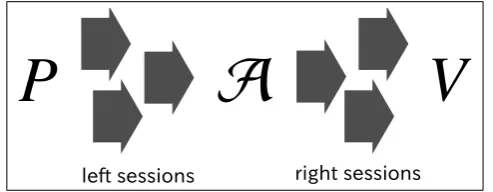
left sessions right sessions
Figure 3: Left sessions and right sessions.
4
Our Statistical Concurrent Non-malleable ZK Argument
We show that a statistical concurrent non-malleable zero-knowledge argument can be constructed from any statistically hiding commitment scheme.
Theorem 2. Assume the existence of statistically hiding commitment schemes with round complex-ity RSH(n). Then, there exists an ω(RSH(n) logn)-round statistical concurrent non-malleable
zero-knowledge argumentsCNMZK.
Proof of Theorem 2. InsCNMZK, we use the following building blocks. • Two-round statistically binding commitment schemeComSB.
• Constant-round 4-robust one-one CCA-secure commitment schemeCCACom1:1.
• Four-round witness-indistinguishable proof of knowledgeWIPOK, which is a parallel version of Blum’s Hamiltonian-cycle protocol.
• (RSH(n)+2)-round statistical witness-indistinguishable argument of knowledgesWIAOK, which
is a parallel version of Blum’s Hamiltonian-cycle protocol that is instantiated with a RSH(n
)-round statistically hiding commitment schemeComSH.
• ω(RSH(n) logn)-round concurrently extractable commitment schemeCECom, which is the scheme
of [MOSV06] with parameter ℓ = ω(RSH(n) logn). From the robust concurrent extraction
lemma [GLP+15], we can extract the committed values from any adversarial committer even when it additionally participates in anyO(RSH(n))-round external protocol.
As explained in Section 3, all of the above building blocks can be constructed fromRSH(n)-round
statistically hiding commitment schemes (or from one-way functions, which can be obtained from statistically hiding commitment schemes).
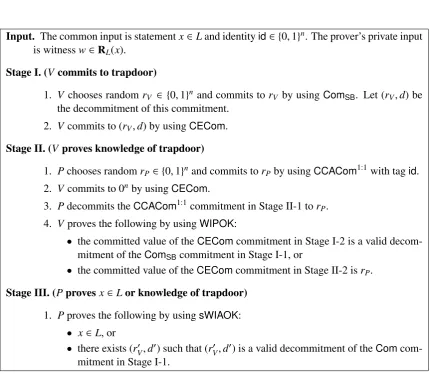
Protocol sCNMZK is shown in Figure 4. We prove its soundness in Section 4.1 and prove its statistical CNMZK property in Section 4.2.
4.1 Proof of Soundness
Lemma 1. ProtocolsCNMZKis sound.
Proof . Assume for contradiction that there exists an adversarial proverP∗that breaks the soundness ofsCNMZK. It follows from the argument-of-knowledge property of sWIAOKthat we can extract
rV from P∗in Stage III with non-negligible probability, whererV is the value committed to by the verifier in Stage I-1. In the following, we consider a sequence of hybrid experiments in which the verifier is gradually modified so thatP∗receives no information aboutrV in the last hybrid, and then we derive a contradiction by showing thatrV is still extractable with non-negligible probability in the last hybrid.
HybridH0 is an experiment in which a honest verifier interacts withP∗ and then a witness is
ex-tracted in Stage III by the knowledge extractor ofsWIAOK. The output of H0 is the witness
extracted in Stage III. From the above observation, the output of H0isrV with non-negligible probability.
HybridH1 is the same asH0except that (i) the committed valuerPof theCCACom1:1commitment in Stage II-1 is extracted by the one-session committed-value oracleOofCCACom1:1 and (ii) the committed value of theCEComcommitment in Stage II-2 is switched from 0ntorP. Note that, basically, the only difference between H0 and H1 is the value committed to with
CECom in Stage II-2. However, since the execution ofH1involves a super-polynomial-time
computation (i.e., the extraction of rP), we cannot directly use the hiding property ofCECom to argue that the output of H1 is indistinguishable from that of H0. Nevertheless, since H1
can be executed in polynomial-time given access to the one-session committed-value oracle of
CCACom1:1, we can show the indistinguishability between the output ofH1and that ofH0by
Input. The common input is statementx∈Land identityid∈ {0,1}n. The prover’s private input is witnessw∈RL(x).
Stage I. (V commits to trapdoor)
1. V chooses randomrV ∈ {0,1}n and commits torV by usingComSB. Let (rV,d) be the decommitment of this commitment.
2. Vcommits to (rV,d) by usingCECom. Stage II. (Vproves knowledge of trapdoor)
1. Pchooses randomrP ∈ {0,1}nand commits torP by usingCCACom1:1with tagid. 2. Vcommits to 0nby usingCECom.
3. Pdecommits theCCACom1:1commitment in Stage II-1 torP. 4. Vproves the following by usingWIPOK:
• the committed value of theCEComcommitment in Stage I-2 is a valid decom-mitment of theComSBcommitment in Stage I-1, or
• the committed value of theCEComcommitment in Stage II-2 isrP. Stage III. (Pprovesx∈Lor knowledge of trapdoor)
1. Pproves the following by usingsWIAOK: • x∈L, or
• there exists (rV′,d′) such that (rV′,d′) is a valid decommitment of theCom com-mitment in Stage I-1.
Comment: Formally, sinceCCACom1:1is robust only w.r.t. 4-round protocols, we need to
con-sider a sequence of intermediate hybrids in which theCEComcommitment is gradually mod-ified by switching the committed values of theExtCom commitments one by one inCECom. SinceExtComhas only four rounds, the 4-robustness ofCCACom1:1 guarantees that the out-puts of these intermediate hybrids are indistinguishable.
HybridH2 is the same as H1 except that the WIPOKproof in Stage II-4 is computed by using a
witness for the fact that the committed value of theCEComcommitment in Stage II-2 isrP. Similar to the above, the indistinguishability between the output ofH2 and that ofH1follows
from the witness-indistinguishability ofWIPOKand the robustness ofCCACom1:1.
HybridH3 is the same asH2except that in Stage I-2, the committed value of theCECom
commit-ment is switched from (rV,d) to (0|rV|,0|d|).
The indistinguishability between the output of H3andH2 follows from the hiding property of
CECom(or, more precisely, the hiding property ofExtComused inCECom) and the robustness ofCCACom1:1.
HybridH4 is the same asH3except that in Stage I-1, the committed value of theComSBcommitment is switched fromrV to 0n.
The indistinguishability between the output ofH4and that ofH3follows from the hiding
prop-erty ofComSBand the robustness ofCCACom1:1.
From the above, the probability that the output of H4 is rV is non-negligible. However, since P∗ receives no information aboutrV inH4, this probability must be negligible. Thus, we reach a
contra-diction. □
4.2 Proof of Statistical CNMZK Property
Simulator-extractorSE.
Recall that to prove the statistical CNMZK property, we need to show a simulator-extractor that statistically simulates the view of the adversaryAwhile extracting a witness in every accepted right session. We construct our simulator-extractor step by step. First, we construct a super-polynomial-time simulator ˆSthat simulates the view of A but does not extract witnesses in the right seasons. Next, we construct a super-polynomial-time simulator-extractor ˆSEthat simulates the view ofAby executing ˆSand then extracts the witnesses by rewinding ˆS. Finally, we construct a polynomial-time simulator-extractorSEthat emulates the execution of ˆSEin polynomial time.
Remark1. In the following, we use the hat symbol in the names of simulators and simulator-extractors if they run in super-polynomial time (e.g., ˆSand ˆSE).
Remark2. In the following, we use the tilde symbol in the names of the messages ofsCNMZKif they are the messages of the right sessions (e.g.,erV anderP). If necessary, we use subscript to denote the index of the session.
Super-polynomial-time simulator Sˆ. First, the simulator ˆS simulates the view of A in super-polynomial time as follows. ˆSinternally invokesAand interacts withAas provers and verifiers in the following way.
brute force. (If the committed value is not uniquely determined, (rV,d) is defined to be (⊥,⊥).) In Stage III, ˆSchecks whether (rV,d) is a valid decommitment of theComSBcommitment in Stage I-1; if so, ˆSgives asWIAOKproof by using (rV,d) as a witness; otherwise, ˆSterminates with outputfail.
• In each right session, ˆSinteracts withAin the same way as a honest verifier.
Finally, ˆSoutputs the view of internalA. Notice that ˆSdoes not rewindA.
Super-polynomial-time simulator-extractorSEˆ . Next, the simulator-extractor ˆSE simulates the view ofAin super-polynomial time and extracts witnesses in the accepted right sessions as follows. First, ˆSEsimulates the view ofA by executing ˆS. We call this execution of ˆSthewi-main thread.
Next, for eachi∈[m], if thei-th right session is accepted on thewi-main thread and uses a different
identity from every left session, ˆSEextracts a witness from this session as follows.
• SEˆ rewinds thewi-main thread until the point just before the challenge message ofsWIAOKof thei-th right session is sent. Then, from this point, ˆSEexecutes ˆSagain with flesh randomness (i.e., interacts with A as ˆSdoes with flesh randomness). SEˆ repeats this rewinding until it obtains another accepting transcript of thei-th right session. We call each execution of ˆSin this step awi-auxiliary thread.
• After obtaining two accepting transcripts of thei-th right session (one is on thewi-main thread
and the other is on anwi-auxiliary thread), ˆSEextracts a witness fromsWIAOKby using the
witness extractability of sWIAOK. If ˆSEfails to extract a witness forexi ∈ L (the statement proven in the i-th right session), ˆSE terminates with output failWI. Otherwise, let wei be the extracted witness.
If thei-th right session is not accepted or uses the same identity as a left session, definewei
def
= ⊥. The output of ˆSEis (view,{ewi}i∈[m]), whereviewis the view ofAon thewi-main thread.
Polynomial-time simulator-extractorSE. Finally, the simulator-extractorSEemulates the execu-tion of ˆSEin polynomial time as follows. First,SEemulates thewi-main thread in polynomial time
as follows.
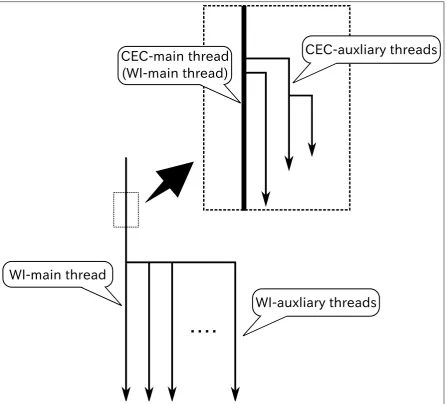
• SEinternally invokesAand interacts withA as ˆS does except that in each left session,SE extracts (rV,d) by using the concurrent extractability of CECom instead of by brute force. Recall that a concurrent extraction of CECom involves the generation of a main thread and many look-ahead threads. We call the main thread generated during the concurrent extraction ofCEComthecec-main thread, and call the look-ahead threads generated during the concurrent
extraction ofCEComthecec-auxiliary threads.6(See Figure 5.)
Next, for eachi∈[m], if thei-th right session is accepted on the emulatedwi-main thread and uses a
different identity from every left session,SEemulateswi-auxiliary threads as follows.
• SErewinds the emulation of thewi-main thread until the point just before the challenge
mes-sage ofsWIAOKof thei-th right session is sent on thecec-main thread. Then, from this point,
ˆ
SE emulates the wi-main thread again with flesh randomness (i.e., generates the rest of cec
-main thread andcec-auxiliary threads with flesh randomness).SErepeats this rewinding until it
obtains another accepted transcript of thei-th right session on an emulatedwi-auxiliary thread.
Let (view,{ewi}i∈[m]) be the output of the emulated ˆSE. Then,SEoutputs (view,{ewi}i∈[m]).
6Note that the
WI-main thread
WI-auxliary threads
CEC-main thread
(WI-main thread)
CEC-auxliary threads
Analysis of poly-time simulator-extractorSE.
To prove the statistical CNMZK property, we show thatSEstatistically simulates the view ofAand also extracts witnesses for the statements in the right sessions.
Lemma 2. The view of A simulated by SE is statistically indistinguishable from the view of A in the real experiment. Furthermore, except with negligible probability, SE outputs witnesses for the statements proven byA in the accepted right sessions that use different identities from the left sessions.
Proof . In this proof, we use the following claim, which states that the super-polynomial-time simulator-extractor ˆSEstatistically simulates the view ofAand also extracts the witnesses from the right ses-sions.
Claim 1. The view ofAsimulated bySEˆ is statistically indistinguishable from the view ofAin the real experiment. Furthermore, except with negligible probability,SEˆ outputs witnesses for the state-ments proven byAin the accepted right sessions that use different identities from the left sessions.
Before proving this claim, we finish the proof of Lemma 2. Given Claim 1, we can prove Lemma 2 by showing that the output ofSEis statistically indistinguishable from that of ˆSE. Roughly speaking, this indistinguishability can be shown by observing the following.
• InSE, the emulation of ˆSEis perfect if in every left session that reaches Stage III, the value ex-tracted by the concurrent extractability ofCEComis equal to the value that would be extracted by brute force.
• In every such left session, the value extracted by the concurrent extractability of CECom is indeed equal to the value that would be extracted by brute force except with negligible proba-bility. This is because theCEComcommitment in Stage I-2 is valid in every such left session except with negligible probability, which in turn is because of the soundness of WIPOK in Stage II-4 and the hiding property ofCCACom1:1in Stage II-1.
We note that there is a subtlety since the concurrent extraction ofCECom itself is rewound inSE when the witnesses are extracted from the right sessions. A formal argument is given below.
LetCEC-BADbe the event that during the execution of SE, in a left session that reaches Stage III, the value extracted from theCECom commitment in Stage I-2 is different from the value that would be extracted by the brute-force extraction. Letϵ be the probability thatCEC-BADoccurs during
the emulation of the wi-main thread (i.e., during the emulation of the execution of ˆS). From the
concurrent extractability ofCECom, if the CECom commitment in Stage I-2 is valid except with negligible probability,CEC-BADoccurs only with negligible probability. Hence, we obtainϵ =negl(n) from the following claim.
Claim 2. In Sˆ, the following holds except with negligible probability: In every left session that reaches Stage III, the CECom commitment in Stage I-2 of this session is valid and its committed value is a valid decommitment of theComSBcommitment in Stage I-1.
The proof of Claim 2 is given after this proof.
To show the indistinguishability between the output of ˆSEand that ofSE, we consider the fol-lowing hybrid simulator-extractor ˆSE′andSE′.
First, we show that the output of ˆSE and that of ˆSE′ are statistically indistinguishable. From the definition of ˆSE′, this indistinguishability holds if ˆSE′ outputstime-outwith at most negligible probability. Thus, to show this indistinguishability, it suffices to show that the probability that ˆSE rewinds wi-main thread more than 1/ϵ1/4 times during the witness extraction of a right session is
negligible. To show that this probability is negligible, we do the following. For eachi∈ [m], letTi be the random variable representing the number of rewinding during the witness extraction of thei-th right session in ˆSE. From a standard “p×1/p” argument, we can show that we have E [Ti] = 1 for everyi∈[m].7Thus, from Marcov’s inequality, we have
Pr[Ti >1/ϵ1/4
]
≤ϵ1/4=negl(n)
for everyi∈[m]. Thus, from union bound, we have
Pr[∃i∈[m] s.t.Ti >1/ϵ1/4
]
≤m·negl(n)=negl(n) .
As noted above, this implies that the output of ˆSEand that of ˆSE′are statistically indistinguishable. Next, we show that the output of ˆSE′and that ofSE′are statistically indistinguishable. Since the only difference between ˆSE′andSE′ is how the committed values are extracted fromCECom, this indistinguishability holds ifCEC-BADoccurs inSE′ with at most negligible probability. Forℓ ∈ N, letS Tℓ be the random variable representing the internal state ofSE′ at the time thatAhas sent the
ℓ-th messages on thecec-main thread during the emulation ofwi-main thread. LetCEC-BADmainbe the
event thatCEC-BADoccurs during the emulation of thewi-main thread. We say that an internal state
stofSE′isgood w.r.t.ℓif we have Pr [CEC-BADmain |S Tℓ=st] ≤ ϵ1/2. LetGOODℓbe the event that
S Tℓ =stholds for an internal statestthat is good w.r.t.ℓ. Then, for anyℓ, we have
Pr [CEC-BADmain]≥Pr [CEC-BADmain| ¬GOODℓ] Pr [¬GOODℓ]≥ϵ1/2·Pr [¬GOODℓ] .
Then, since we have Pr [CEC-BADmain]=ϵ from the definition ofϵ, we have
Pr [¬GOODℓ]≤ϵ1/2=negl(n) for everyℓ. Thus, from union bound, we have
Pr
∨
ℓ
¬GOODℓ
≤negl(n) . (1)
LetGOODbe the event thatGOODℓoccurs for everyℓ. Then, from Equation (1), we have Pr [GOOD]≥ 1−negl(n). Fori∈[m], letCEC-BADibe the event thatCEC-BADoccurs during the witness extraction of thei-th right session. Then, since the emulation of eachwi-auxiliary thread proceeds identically with
that of thewi-main thread, and since for eachi ∈ [m] there are at most 1/ϵ1/4 wi-auxiliary threads
during the witness extraction of thei-th right session, we have
Pr [CEC-BADi |GOOD]≤ 1
ϵ1/4 ·ϵ
1/2=ϵ1/4 .
7 For any prefix ρof the transcript immediately before the challenge message of sWIAOKof the i-th right
ses-sion, let p be the probability that thei-th right session is accepted when the prefix of the transcript isρ. Then, we have E[Ti|prefixρ
]
= p·1/p = 1, whereprefixρ is the event that the prefix of the transcript is ρ. Thus, we have E [Ti]=
∑ ρE
[
Ti|prefixρ
]
Thus, we have
Pr [CEC-BAD]=Pr [CEC-BADmain]+
m
∑
i=1
Pr [CEC-BADi]
≤Pr [CEC-BADmain]+ m
∑
i=1
(Pr [¬GOOD]+Pr [CEC-BADi |GOOD])
≤ϵ+
m
∑
i=1
(negl(n)+ϵ1/4)
=negl(n) .
As noted above, this implies that the output of ˆSE′and that ofSE′are statistically indistinguishable. Finally, we show that the output ofSE′and that ofSEare statistically indistinguishable. Since the output of ˆSE′and that ofSE′are statistically indistinguishable and since ˆSE′outputstime-outwith at most negligible probability,SE′outputstime-outwith at most negligible probability. Then, since SE′is identical toSEunlessSE′outputstime-out, the output ofSE′and that ofSEare statistically
indistinguishable. □
Proof of Claim 2. Recall that Claim 2 states that during the execution of ˆS, in every left session that reaches Stage III, theCEComcommitment in Stage I-2 is valid and its committed value is a valid decommitment of theComSBcommitment in Stage I-1.
Let us say that a left session isbadif it reaches Stage III and either theCEComcommitment in Stage I-2 is invalid or its committed value is not a valid decommitment of theComSB commitment in Stage I-1; a left session isgoodif it is not bad. What we need to prove is that every left session is good except with negligible probability.
Roughly speaking, the proof proceeds as follows. From the soundness ofWIPOK, if a left session is bad, then in Stage II-2 of this left session, the committed value of the CECom commitment is
rP, which is the committed value of theCCACom1:1 commitment in Stage II-1; thus, beforerP is decommitted to in Stage II-3, we can obtain rP by extracting the committed value from CECom in Stage II-2. This itself does not contradict the hiding property of CCACom1:1 since ˆS runs in super-polynomial time in the brute-force extraction ofCECom. Thus, we consider a hybrid simulator in which the brute-force extraction ofCEComis replaced with the concurrent extraction ofCECom. Here, since we want to use the hiding property ofCCACom1:1, we use the robust concurrent extraction ofCECom so that theCCACom1:1 commitment in a left session is not rewound. For details, see below.
Assume for contradiction that there existsi∈ [m] such that thei-th left session is bad with non-negligible probability. (Here, the indices of the left sessions are defined by the order in which Stage II-3 begins; the reason why we define the indices in this way will become clear later.) Then, there existsi∗ ∈ [m] such that the first (i∗−1) left sessions are good except with negligible probability but thei∗-th left session is bad with non-negligible probability. Note that from the soundness of
WIPOK, when thei∗-th left session is bad, then theCEComcommitment in Stage II-2 of thei∗-th left session is valid and its committed value isrPexcept with negligible probability, whererPis the value committed to in Stage II-1 of thei∗-th left session. In the following, we useBADto denote the event that thei∗-th left session is bad, and use CHEATto denote the event that the committed value of the
CEComcommitment in Stage II-2 isrPin thei∗-th left session. Then, let us consider the following hybrids.
HybridSˆ0 is the same as ˆS. From our assumption,BADoccurs in ˆS0with non-negligible probability.
HybridSˆ1 is the same as ˆS0except that ˆS1terminates just before Stage II-3 of thei∗-th left session
begins. Clearly,CHEATstill occurs in ˆS1with non-negligible probability.
HybridS1 emulates ˆS1in polynomial time as follows.
• At the beginning, a random left session sis chosen. (Here, we guess that sessionsis the
i∗-th left session.)
• In every left session, in Stage I-2, the committed value (rV,d) is extracted by the ro-bust concurrent extractor ofCEComin such a way that theCCACom1:1 commitment of session sis not rewound. In addition, in the left session s, the committed value is also extracted from theCEComcommitment in Stage II-2.
Note that in every left session in which Stage III is executed, theCEComcommitment in Stage I-2 is valid except with negligible probability (since such a session is one of the first (i∗−1) left sessions and therefore it is good except with negligible probability). Thus, the values extracted from the concurrent extractor are equal to the values that would be extracted by the brute-force extraction except with negligible probability; therefore,S1statistically emulates ˆS1, andCHEAT
occurs inS1with non-negligible probability.
Note that sessionsis thei∗-th left session with non-negligible probability. Then, sinceCHEAToccurs inS1with non-negligible probability, the value extracted from theCEComcommitment in Stage II-2
of sessionsisrPwith non-negligible probability, whererPis the value committed to in Stage II-1 of sessions. Then, since theCCACom1:1commitment in Stage II-1 of session sis not rewound inS1,
we can break the hiding property ofCCACom1:1. Thus, we reach a contradiction. □
Analysis of super-poly-time simulator-extractorSEˆ .
It remains to prove Claim 1, which states that (i) super-polynomial-time simulator-extractor ˆSE sta-tistically simulates the real view ofAand (ii) ˆSE also extracts a valid witness from every accepted right session in the simulated view.
Proof of Claim 1. First, we observe that the output of ˆS is statistically indistinguishable from the real view ofA. Since ˆSEsimulates the view ofAby executing ˆS, this implies that ˆSEstatistically simulates the real view ofA. Recall that in ˆS, each left session is simulated by extracting (rV,d) from theCECom commitment in Stage I-2 and giving asWIAOKproof in Stage III with witness (rV,d). From Claim 2 (which states that theCECom commitment in Stage I-2 is a valid commitment to a valid decommitment of theComSBcommitment in Stage I-1 in every session that reaches Stage III), the value (rV,d) that is extracted from theCEComcommitment in Stage I-2 is a valid decommitment of theComSB commitment of Stage I-1 in each left session that reaches Stage III. Thus, from the statistical witness indistinguishability of sWIAOK, the output of ˆSis statistically indistinguishable from the real view ofA.
Next, we show that ˆSE outputs failWI with at most negligible probability. Since ˆSE outputs
failWI when it fails to extract a witness in an accepted right session, this implies that ˆSE extracts a valid witness from every accepted right session except with negligible probability. Assume for contradiction that there existsei∗ ∈ [m] such that ˆSEoutputs failWI during the witness extraction of the ei∗-th right session with non-negligible probability. Then, let us consider the following hybrid simulator-extractor ˆSEei∗.
• SEˆ e
i∗is the same as ˆSEexcept that ˆSEie∗tries to extract a witness only from theei∗-th right session (and therefore rewinds thewi-main thread only from the challenge message ofsWIAOKof the e
Clearly, ˆSEei∗ outputsfailWIwith non-negligible probability. Then, we reach a contradiction roughly as follows.
Step 1. First, we show that in ˆSEei∗, the probability thaterVis extracted as a witness during the witness extraction of theei∗-th right session is non-negligible, whereerV is the value chosen by the verifier in Stage I-1 of theei∗-th right session.
Step 2. Next, we define a sequence of hybrid simulator-extractors, where the first hybrid is the same as ˆSEie∗, and we gradually modify the ei∗-th right session so that it is independent oferV in the last hybrid.
Step 3. Finally, we show that even in the last hybrid, the probability thaterV is extracted during the witness extraction of the ei∗-th right session is non-negligible. Since theei∗-th right session is independent oferV in the last hybrid, we reach a contradiction.
Details are given below.
Step 1. Prove thatSEˆ ei∗ extractserV. We first prove the following claim.
Claim 3. LeterV be the value chosen by the verifier in Stage I-1 of theei∗-th right session. If SEˆ ei∗
outputsfailWIwith non-negligible probability, then inSEˆ ei∗ the probability thaterV is extracted during
the witness extraction of theei∗-th right session is non-negligible.
Proof . Assume for contradiction thaterV is extracted during the witness extraction of theei∗-th right session with at most negligible probability. Then, since we assume that ˆSEie∗ outputs failWI with non-negligible probability, the following occurs in ˆSEei∗ with non-negligible probability:
• SEˆ e
i∗ obtains two accepting transcript of theei∗-th right session (and therefore that ofsWIAOK) such that the commit-messages ofsWIAOKare the same,8but
• from these two transcript, ˆSEei∗ fails to extract any witness fromsWIAOK (i.e., a witness for
exei∗ ∈Lor a valid decommitment of the Stage I-1 commitment).
We first show that when the above occurs, the two acceptingsWIAOKtranscripts are admissible ex-cept with negligible probability. (Recall that a pair of acex-cepted transcripts ofsWIAOKare admissible if their commit-messages are the same but their challenge-messages are different.) Toward this end, it suffices to show that ˆSEie∗ chooses the same challenge-message ofsWIAOKon thewi-main thread
and awi-auxiliary thread with at most negligible probability. This can be shown as follows.
• From a standard argument, we can show that the expected number of rewinding of thewi-main
thread is 1 in ˆSEei∗.9 Thus, the probability that ˆSEei∗ rewinds thewi-main thread more than 2n/2 times is at most 2−n/2. Furthermore, under the condition that ˆSEei∗rewinds thewi-main thread at
most 2n/2times, the probability that ˆSEei∗ chooses the same challenge-message on thewi-main
thread and awi-auxiliary thread is at most 2n/2·2−n = 2−n/2. Thus, the probability that ˆSEei∗ chooses the same challenge-message on thewi-main thread and awi-auxiliary thread is at most
2−n/2+2−n/2=negl(n).
Thus, with non-negligible probability ˆSEei∗obtains two admissible transcripts ofsWIAOKfrom which no witness can be computed.
We then reach a contradiction as follows. SincesWIAOKis a parallel version of Blum’s Hamiltonian-cycle protocol, if no witness is extracted from two admissible transcripts ofsWIAOK, aComSH com-mitment in the commit-messages is decommitted to two different values in the transcripts. Thus, we derive a contradiction by breaking the binding property ofComSH using ˆSEei∗. A problem is that since ˆSEei∗runs in super-polynomial time, thecomputationalbiding property ofComSHmay not hold in ˆSEei∗. To overcome this problem, we consider hybrid simulator-extractorSEei∗ that emulates the execution of ˆSEei∗ in polynomial time. Specifically,SEei∗ emulates ˆSEie∗ in the same way asSE emu-lates ˆSE(i.e., by using the concurrent extractability ofCECominstead of the brute-force extraction) except for the following.
• During the emulation of thewi-main thread, the value (rV,d) is extracted in Stage I-2 of each left session by using therobustconcurrent extractability ofCEComso that the commit-message ofsWIAOKin theei∗-th right session is not rewound.
As in the proof of Lemma 2, we can show thatSEei∗statistically emulates the execution of ˆSEei∗. Thus, with non-negligible probability, SEei∗ obtains two valid decommitments of a ComSH commitment (in the commit-messages ofsWIAOK of the ei∗-th right session) such that decommitted values are different. Then, sinceSEei∗ runs in polynomial time and since the commit-messages ofsWIAOK(and therefore theComSHcommitment) of theei∗-th right session is not rewound inSEie∗,10we can break the binding property ofComSH. Thus, we reach a contradiction. □
Step 2. Introduce hybrid simulator-extractor. Next, we introduce hybrid simulator-extractors. To clarify the exposition, we first define a sequence of hybrid simulators by gradually modifying ˆS and then define the hybrid simulator-extractors by using them. Below, when we refer to a particular stage ofsCNMZK, we always means the corresponding stage ofsCNMZKin theei∗-th right session. Hybrid simulatorh-Sˆ0 is identical with ˆS.
Hybrid simulatorh-Sˆ1 is the same ash- ˆS0 except thaterP is extracted by brute force in Stage II-1 and the committed value of theCEComcommitment in Stage II-2 is switched from 0ntoerP. Hybrid simulatorh-Sˆ2 is the same ash- ˆS1except that in Stage II-4, theWIPOKproof is computed
by using a witness for the fact that the committed value of theCEComcommitment in Stage II-2 iserP.
Hybrid simulatorh-Sˆ3 is the same as h- ˆS2 except that in Stage I-2, the committed value of the
CEComcommitment is switched from (erV,de) to (0|erV|,0|ed|).
Hybrid simulatorh-Sˆ4 is the same as h- ˆS3 except that in Stage I-1, the committed value of the
ComSBcommitment is switched fromerV to 0n.
Then, for eachk∈ {0, . . . ,4}, hybrid simulator-extractorh- ˆSEkis defined as follows.
Hybrid simulator-extractorh-SEˆ k is the same as ˆSEei∗ except that the execution of ˆS is replaced with that ofh- ˆSk. The output ofh- ˆSEk is the value extracted during the witness extraction of theei∗-th right session.
Note that the valueerV is not used anywhere inh- ˆSE4.