Scouting Robot for Wireless Border
Surveillance System
Dr S Sumathi1, S Rajesh Kumar2, G Tamilmani3, M Vijayakumar4, R Yogesh5
Head of the Department, Department of ECE, Adhiyamaan College of Engineering, Hosur, Tamilnadu, India 1
U.G. Student, Department of ECE, Adhiyamaan College of Engineering, Hosur, Tamilnadu, India2,3,4,5
ABSTRACT:The proposed robotic unit is used for video surveillance of place by remotely control of the unit using Wi-Fi as medium. ARM cortex serve the purpose of server as well as the microprocessor for the system. Video is captured through the night vision webcam placed on the robotic unit and lively transmitted to the remote end. Controls are provided on the monitoring side wherever one will see the live streaming still as will manage the movement of robotic unit. This project gives an approach towards video surveillance and control using advanced processor like ARM cortex. The information concerning the detection of living objects by PIR sensing element is shipped to the users through the webpage and visual modality camera capture the moving object. The user in management can able to access the motion of wheel drive control buttons on the control system. The movement of the robot is additionally controlled mechanically through obstacle
detective work sensors to avoiding collision. This closed-circuit television mistreatment reconnaissance
mission robot will be custom-builtfor varied fields like industries, banks and malls.
KEYWORDS: Border security, Scouting Robot, PIR sensor, Proximity detector, Catalytic gas sensor, Obstacle Detecting Sensor.
I. INTRODUCTION
In today’s world the AI field is growing exponentially and a few of the popular robotic product are used mostly by the industries, defence, educational and analysis communities. The design and implementation cost of a robot is very less than hiring a human caregiver. The robots can be reprogrammed faster and more efficient. The robot has sufficient intelligence to cover the largest area to provide a secured space. The intelligent robots can perform preferred tasks in unstructured environments with or without human direction [1].
II. SYSTEM OVERVIEW
Basically, two gear motors are sufficient to produce the movement of scouting robot and the motor driver module is used to supply enough current to drive two gear motors which protects the microprocessor from the damage. The major advantage of using the minimum number of gear motor is minimizing the power consumption. Power source for the robotic unit has been given from the rechargeable battery which recharging by solar panel so, there is no need to worry about the power source of the system. Robot has two infraredsensors which are used to sense the obstacles coming on both sides of robot path. It will move in a particular direction and when the obstacle coming in its path, it will turn to the opposite direction. Except, the PIR sensor is used to detect the presence of livelihood in the surrounding environment, which in turn used to triggers the visual sensor (night vision camera) then capture the image or video and sends it to the nearest monitoring system. An autonomous platform for the scouting robot is a machine that can be operated from human-made environment by using control buttons available on control system.
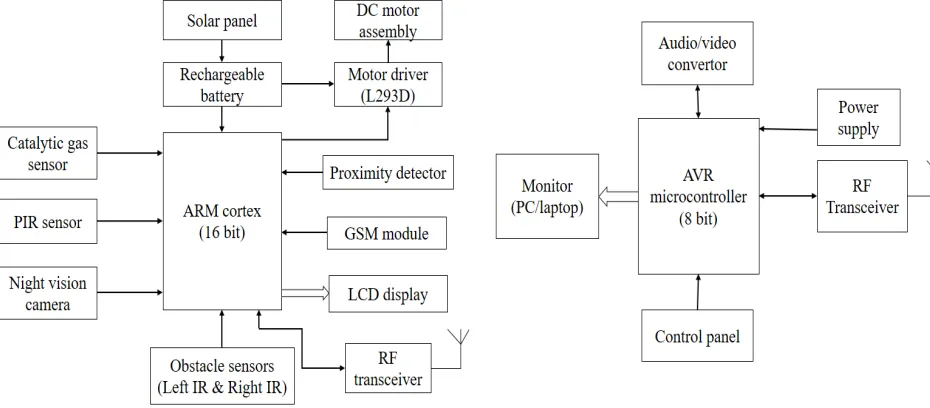
Now-a-days various kind of microprocessors and microcontrollers has been widely used to make projects in various fields like medical, defence, agriculture and industries [8]. The scouting robot is designed with processing unit which having an inbuiltwireless controller, Bluetooth controller and night vision camera support. It repeatedly monitors the surrounding areas for the presence of unwarranted and unapproved people and to detect any appearance and residence of enemies at the border.The user will be observing this image data on the monitor at the control room. Controlling unit communicates with scouting robotic unit with the help ofInternet. This application is developed by Keil µvision software. The proposed system has no limitation which is more suitable for almost flat surface on which the robot can operate. This design would be suitable for rough terrain environments like rocky or hilly terrain due to their wheeled mechanisms. In international border areas, threat to soldiers is very high so, in case of using man work in this system robot can be used with attachment of proximity detector (metal detector). In any kind of situation, if robot cannot be able access, then we trace out movement of robot using GPS system which present in the system.In the robotGPS system is used to share the geographic location of the robot while RF transceivers are used to control the movements of the robot.Figure 1 shows the block diagram of the scouting robot for a surveillance system. Figure 2 shows the block diagram of control system.
III. HARDWAREANDDESIGNIMPLEMENTATION
The entire proposed system consists of a Processing unit, PIR and IRs sensors, Proximity sensor, Catalytic gas sensor, GPS system, L298N motor driver, Solar panel, Rechargeable battery and robot chassis.ARM cortex M4 could be a processor developed to handle digital signal management and signal process capabilities. The combination of high-efficiency signal process practicality with the low-power, low value and ease-of-use advantages of the cortex-M family processors is intended to satisfy the rising class of versatile solutions specifically targeting the control, automotive, power management, embedded audio and industrial automation markets. It has designed with Armv7E-M Harvard architecture and 3-stage + branch speculation pipelining. DSP extension of Single cycle 16/32-bit waterproof, Single cycle twin 16-bit waterproof and 8/16-bit SIMD arithmetic Hardware Divide (2-12 cycles) area unit supplied with it.The GPIO18 (Physical pin 12) of processor is connected to the PIR motion sensor. The GPIO23 (Physical pin 16) and the GPIO24 (Physical pin 18) are connected to the Left IR sensor, and Right IR sensor respectively.
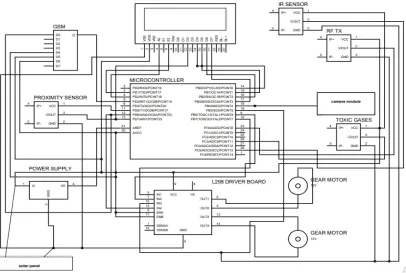
The motors assembly includes the golem chassis and 2 DC double-geared motors. The L293D IC may be a twin H-bridge motor controller, that is often accustomed management the motor speed and direction.This driver module is supplies a high current and high voltage to connected DC motors [12]. It can drive up to two DC motors 1A each.The schematic diagram ofthe scouting robot for a surveillance system is shown in Figure 3. The major intention of this system is to capture images when the human-being is present in the Robot’s ambient and transmit it as soon as possible to the storage. The Robot is developed by using DC geared motors, which is controlled through the GPIO pins of the ARM cortex M4. The embedded programming language is used to operate the robot. Furthermore, the PC is used to monitor the status of the sensors and the action of scouting robot is controller though transmitter and receiver.
The Night visioncamera continuously captures the image and sends it to the PC and storing in it. This image and video is displayed on the monitor of the PC. Buttons for every function have been created. When a button is clicked upon, the corresponding macro is called and corresponding GPIOs being made LOW or HIGH. Then the IR sensors determine the obstacles and show the status of each IR, and according to the state of the obstacle the robot moves the opposite direction. In any kind of situation, if robot cannot be able access, then we trace out movement of robot using GPS system which present in the system. In the robot GPS system is used to share the geographic location of the robot while RF transceivers are used to control the movements of the robot. In addition, the night vision camera can capture the image and videos in both the day and night time.
IV. SOFTWAREDESIGNANDIMPLEMENTATION
The entire system is based on the ARM cortex processing unit platform. The programming language which is utilized for coding is Embedded-C language. Embedded-C language mentioned as a high-level artificial language for general purpose programming. Embedded C programming is that the soul of the processor functioning within the system. Embedded C language is that the most often won’t to program the microcontroller and microchip [13].
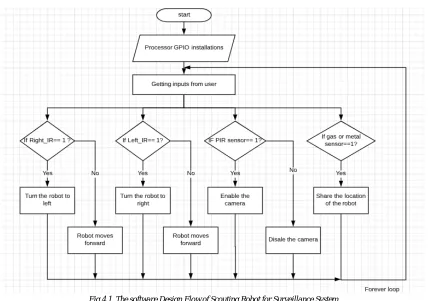
Fig 4.1. The software Design Flow of Scouting Robot for Surveillance System
When the user giving inputs from the control system, it will take similar actions respective to that. At robotic end the chip running on the embedded C script which can browse the file and execute the command according the user inputs. The microprocessor is connected to the H Bridge IC L293D which will control the direction of motors based on command received from user. From the control system, the user clicks on the forward button, the robot moves forward and similar movements are achieved for reverse, left and right. Once scouting robot gets turned on, user can see the photograph of moving living objects in monitor which are taken by camera. Figure 4 shows the software program flow design of the scouting robot.
V. EXPERIMENTALRESULTSANDDISCUSSION
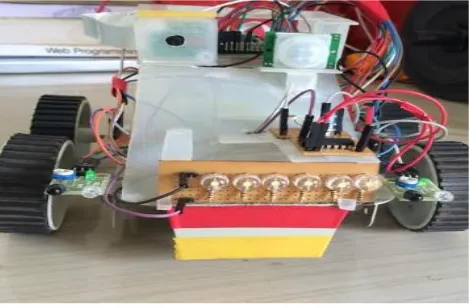
Fig 5.1. The Front View of the Scouting Robot for Surveillance System
VI. CONCLUSIONANDFUTUREENHANCEMENT
The Scouting Robot used for this secure purpose can operate effectively in order to collect various types of information that required by users. For instance, the presence or absence of the unwanted folks in war areas whose are not allowed in such areas can be determined by the PIR sensor which sends a signal to the microprocessor when a human - being is in the ambient of the Robot. In turn, the processor triggers the camera module immediately to capture an image and send it to the control system. The PIR sensor and proximity sensors are activated depend on external stimuli via RF transceivers. The control room collects this information for later reference. The brain of the scouting robot is the ARM cortex M4.The Robot is operated by three modes. Firstly, only run the code and leave the Robot to navigate freely based on the sensor status. Secondly,management the moving to a particular direction by the user victimisation controller. Thirdly, monitor the information available on the PC, and control accordingly with various buttons.
REFERENCES
[1] J. Zhang, G. Song, G. Qiao, T. Meng and H. Sun, "An indoor security system with a jumping robot as the surveillance terminal," in IEEE Transactions on Consumer Electronics, vol. 57, no. 4, pp. 1774-1781, November 2011.
[2] C. Micheloni, G. L. Foresti, C. Piciarelli and L. Cinque, "An Autonomous Vehicle for Video Surveillance of Indoor Environments," in IEEE Transactions on Vehicular Technology, vol. 56, no. 2, pp. 487- 498.
[3] K. S. Kumar, S. Prasad, P. K. Saroj and R. C. Tripathi, "Multiple Cameras Using Real Time Object Tracking for Surveillance and Security System," 2010 3rd International Conference on Emerging Trends in Engineering and Technology, Goa, 2010, pp. 213-218. [4] R. Ikhankar, V. Kuthe, S. Ulabhaje, S. Balpande and M. Dhadwe, "Pibot: The raspberry pi controlled multi-environment robot for
surveillance & live streaming," 2015 International Conference on Industrial Instrumentation and Control (ICIC), Pune, 2015, pp. 1402- 1405.
[5] A. Imteaj, T. Rahman, M. K. Hossain and S. Zaman, "IoT based autonomous percipient irrigation system using raspberry Pi," 2016 19th International Conference on Computer and Information Technology (ICCIT), Dhaka, 2016, pp. 563-568.
[6] A. Jaiswal, S. Domanal and G. R. M. Reddy, "Enhanced Framework for IoT Applications on Python Based Cloud Simulator (PCS)," 2015 IEEE International Conference on Cloud Computing in Emerging Markets (CCEM), Bangalore, 2015, pp. 104-108.
[7] R. Karthikeyan, S. Karthik, Prasanna Vishal TR and S. Vignesh, "Snitch: Design and development of a mobile robot for surveillance and reconnaissance," 2015 International Conference on Innovations in Information, Embedded and Communication Systems (ICIIECS), Coimbatore, 2015, pp. 1-4.
[8] W. F. Abaya, J. Basa, M. Sy, A. C. Abad and E. P. Dadios, "Low cost smart security camera with night vision capability using Raspberry Pi and OpenCV," 2014 International Conference on Humanoid, Nanotechnology, Information Technology, Communication and Control, Environment and Management (HNICEM), Palawan, 2014, pp. 1-6.
[9] A. U. Bokade and V. R. Ratnaparkhe, "Video surveillance robot control using smartphone and Raspberry pi," 2016 International Conference on Communication and Signal Processing (ICCSP), Melmaruvathur, 2016, pp. 2094-2097.
[10] Basics and Structure of Embedded C program with examples for beginners https://www.elprocus.com/basics-and-structure-of-embedded-c-program-with-examples-for-beginners/