Workload in Outsourced Attribute-Based
Encryption Scheme
Fei Meng, Leixiao Cheng, and Mingqiang Wang? School of Mathematics, Shandong University, Jinan 250100, China Key Laboratory of Cryptologic Technology and Information Security, Ministry of
Education, Jinan 250100, China
School of Mathematical Sciences, Fudan University, Shanghai 200433, China [email protected]
Abstract. Attribute-based encryption (ABE) is a cryptographic tech-nique known for ensuring fine-grained access control on encrypted data. One of the main drawbacks of ABE is the time required to decrypt the ciphertext is considerably expensive, since it grows with the complexity of access policy. Green et al. [USENIX, 2011] provided the outsourced ABE scheme, in which most computational overhead of ciphertext de-cryption is outsourced from end user to the cloud. However, their method inevitably increases the computational burden of the cloud. While mil-lions of users are enjoying cloud computing services simultaneously, it may cause huge congestion and latency.
In this paper, we propose a heuristic primitive calledreverse outsourc-ing to reduce the cloud’s workload. Specifically, the cloud is allowed to transform the ciphertext decryption outsourced by the end user into sev-eral computing tasks and dispatches them to idle users, who have some smart devices connected to the internet but not in use. These devices can provide computing resources for the cloud, just like the cloud hires many employees to complete the computing work. Besides, the comput-ing results returned by the idle users should be verified by the cloud. We propose a reverse outsourced CP-ABE scheme in the rational idle user model, where idle users will be rewarded by the cloud after returning the correct computing results and they prefer to get rewards instead of saving resources. According to the Nash equilibrium, we prove that the best strategy for idle users is to follow our protocol honestly, because the probability of deceiving the cloud with incorrect computing results is negligible. Therefore, in our scheme, most computational overhead of ciphertext decryption is shifted from the cloud to idle users, leaving a constant number of operations for the cloud.
Keywords: Fine-grained access control·Attribute-based encryption ·
Cloud computing·Reverse outsourcing.
?
1
Introduction
Cloud computing is widely used to store or share data and provide computing services. However, data and services on the cloud are usually open and acces-sible to anyone, so data owners are often advised to encrypt their data before uploading it to the cloud to protect sensitive information. In many application s-cenarios, such as in industrial, academic and medical fields, it is necessary for the data owner to establish a specific access control policy to decide who can decrypt the ciphertext. To solve these problems, attribute-based encryption (ABE) [18], initially introduced by Sahai et al., is an expansion of public key encryption that allows users to encrypt and decrypt data based on user attributes. There are two types of ABE schemes, key-policy ABE (KP-ABE) [7] and ciphertext-policy ABE (CP-ABE) [3, 19]. In CP-ABE, the data owner embeds an access policy in the ciphertext and the private key of end user is associated with an attribute set. A user can decrypt the ciphertext if his/her attributes satisfy the access policy. It is on the contrary for the KP-ABE. Since the access policy is defined by the data owner, CP-ABE is more suitable for the data sharing scenario than KP-ABE.
Currently, ABE schemes with various functionalities have been widely con-structed, e.g., supporting regular languages [1, 20], with unbounded attribute size [1, 13, 17], with constant-size ciphertext [2], with multi-authority [4, 5, 12], and with adaptive security [11, 14, 16].
Although in the outsourced ABE schemes [8, 15, 21], the cloud is supposed to have almost unlimited computing capabilities, it is obviously not the case in reality. Outsourcing technique inevitably increases the computational burden of cloud computing, especially when millions of users are simultaneously connected to cloud server to enjoy data processing services, which may cause huge network congestion and delays and cloud server crashes. However, little efforts has been paid to reduce the burden on cloud server. There are countless smart devices in the world connected to the Internet, such as smart home appliances, smart cars, and even our personal computers. These devices have certain computing power and maybe not in use most of the time. Is there any way to aggregate these devices to provide computing services for the cloud?
1.1 Contribution
Motivated by the above issues, we initially introduced the primitive of reverse outsourcing to reduce cloud’s workload. Specifically, the main contribution of our paper are briefly shown as follows:
In this paper, we propose a heuristic primitive calledreverse outsourcing to reduce the cloud’s workload which means that the cloud is allowed to transform the ciphertext decryption outsourced by the end user into several computing tasks and dispatches them to idle users (with smart devices online but not in use). The cloud should verify the computing results returned by idle users and reward them if the results are valid. We also propose the rational idle user model [9], in which idle users prefer to get rewards instead of saving resources.
To demonstrate how reverse outsourcing works, we apply reverse outsourcing to our proposed reverse outsourced CP-ABE scheme. Using Game theory [10] and Nash equilibrium to analyze each rational idle user’s strategy, we prove that the best strategy for idle users is to follow our protocol honestly, since the probability of deceiving the cloud by incorrect computing results is negligible. When and only when all idle users follow our protocol honestly, each one can get the maximum benefit.
In the outsourced ABE schemes [8, 15, 21], the number of pairing operations to partially decrypt a ciphertext is linear to the complexity of the access policy. In our reverse outsourced CP-ABE scheme, most computational overhead of ciphertext decryption is shifted from the cloud to idle users, leaving a constant number of operations for both the cloud and the end user. As far as we know, this work is the first attempt to reduce the workload of the cloud in ABE.
1.2 Organization
2
Preliminaries
2.1 Access Structures
Definition 1 (Access structure [3]). Let {P1, P2, . . . , Pn} be a set of
par-ties. A collection A⊆ 2{P1,P2,...,Pn} is monotone if ∀B, C: if B ∈
A andB ⊆
C then C ∈ A. An access structure (respectively, monotone access structure)
is a collection (respectively, monotone collection) A of non-empty subsets of
{P1, P2, . . . , Pn}, i.e., A ⊆ 2{P1,P2,...,Pn} \ {∅}. The sets in
A are called the
authorized sets, and the sets not inAare called the unauthorized sets.
In this paper, attributes take the role of the parties and we only focus on the monotone access structureA, which consists of the authorized sets of attributes. Obviously, attributes can directly reflect a user’s authority.
Definition 2 (Access tree [3]). Let T be a tree representing an access struc-ture. Each non-leaf node of the tree represents a threshold gate, described by its children and a threshold value. If nx is the number of children of a nodexand
kx is its threshold value, then 0≤kx≤nx. When kx= 1, the threshold gate is
an OR gate and when kx=nx, it is an AND gate. Each leaf nodexof the tree
is describe by an attribute and a threshold valuekx= 1.
We introduce some functions that will be used in scheme construction and security proof. parent(x) denotes the parent of the node x in the access tree. att(x) is defined only if x is a leaf node and denotes the attribute associated with the leaf node x in the tree. The access tree T also defines an ordering between the children of every node, that is, the children of a node are numbered from 1 to nx. The functionindex(x) returns such a number associated with the node x, where the index values are uniquely assigned to nodes in the access structure for a given key in an arbitrary manner.
Definition 3 (Satisfying an access tree [3]). Let T be an access tree with root r. Denote by Tx the subtree of T rooted at the node x. Hence T is the
same as Tr. If a set of attributes γ satisfies the access tree Tx, we denote it as
Tx(γ) = 1. We compute Tx(γ) recursively as follows. If x is a non-leaf node,
evaluate Tx0(γ) = 1 for all children x0 of nodex.Tx(γ) returns 1 if and only if
at leastkxchildren return 1. Ifxis a leaf node, thenTx(γ)returns 1 if and only
if att(x)∈γ.
2.2 Bilinear Map and DBDH Assumption
Algorithms in our scheme are mainly implemented by bilinear maps, which is presented as follows:
LetG0andGT be two multiplicative cyclic groups of prime orderp. Letgbe a generator ofG0andebe a efficient computable bilinear map,e:G0×G0→GT. The bilinear map ehas a few properties: (1) Bilinearity: for all u, v ∈ G0 and
that G0 is a bilinear group if the group operation inG0 and the bilinear map
e : G0×G0 → GT are both efficiently computable. Notice that the map e is symmetric since e(ga, gb) =e(g, g)ab=e(gb, ga).
The security of our scheme is based on the decisional bilinear Diffie-Hellman (DBDH) assumption, which is defined as follows: Given the bilinear map pa-rameter (G0,GT, p, e, g) and three random elements (x, y, z) ∈ Z3p, if there is no probabilistic polynomial time (PPT) adversary B can distinguish between (g, gx, gy, gz, e(g, g)xyz) and (g, gx, gy, gz, ϑ), we can say that the DBDH as-sumption holds, where ϑ is randomly selected from GT. More specifically, the advantageofBin solving the DBDH problem is defined as
Pr[A(g, g
x, gy, gz, Z=e(g, g)xyz) = 1]−Pr[A(g, gx, gy, gz, Z=R) = 1]
. (1)
Definition 4 (DBDH). We say that the DBDH assumption holds if no PPT algorithm has a non-negligible advantage in solving DBDH problem.
3
System and Security Model
This section describes the fundamental descriptions of system parties, system model, threat model and security model.
3.1 System Parties
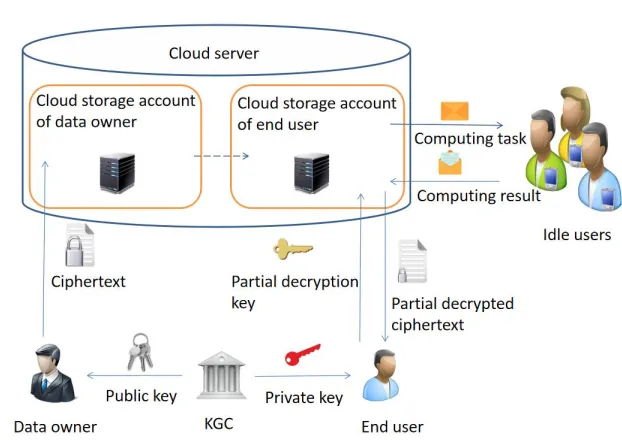
As shown in Fig. 1, our proposed reverse outsourced CP-ABE scheme requires the following five parties: Key Generation Center (KGC), Data Owner (DO), Cloud Server (CS), End User (EU), and Idle Users (IU). The specific role of each party is given as follows:
• Key Generation Center (KGC): The KGC is a fully trusted party which is in charge of generating public parameters and secret keys.
• Data Owner (DO): TheDOowns data files. He/She encrypts the data with a specific access structure and uploads the ciphertext to the his/her own cloud storage account.
• Cloud Server (CS): TheCSis an entity that provides computing and storage services. In this paper, we assume that the computational power of theCSis huge but not unlimited. The CS can help end user to partially decrypt the ciphertext added in his/her cloud storage account. The CS may choose to accomplish this computing task on its own or assign it to idle users and it also needs to check whether the results returned by idle users are correct or not.
• End User (EU): The end user can select and save the ciphertext in theDO’s storage account into his / her own storage account. If his/her authority satisfies the access structure embedded in the given ciphertext, he/she can decrypt it and obtain the plaintext. Moreover, the EU is allowed to submit a partial decryption key to theCSto help him/her partially decrypt the ciphertext.
Fig. 1.System description of reverse outsourced CP-ABE scheme.
3.2 System Model
The proposed reverse outsourced CP-ABE scheme mainly consists of the following five fundamental algorithms:
• Setup(1λ,L) → (P K, M SK): Given security parameter λ and a set of all possible attributesL, theKGCruns this algorithm to generate the public key
P K and the master secret keyM SK.
• KeyGen(M SK, S) → SK: On input the master secret key M SK and an attribute setS, theKGCruns this algorithm and returnsSKto theEU, where the partial decryption keySKpd in contained inSK.
• Enc(P K,A, M)→CT: On inputP K, an access structureAand the message
M, theDOruns this algorithm to generate the ciphertext CT.
• Tran(CT) → CT0: On input CT, the CS runs this algorithm to randomize
CT to generateCT0.
• PreDec(CT0, SKpd)→CT0 or⊥: On inputCT0andSKpd, theCSruns this algorithm to partially decrypt CT0 and outputs CT00, if the attribute set S
contained inSKpdsatisfies the access structureAembedded inCT. Otherwise,
⊥. This algorithm consists of the following two steps:
1. Reverse outsource: TheCSdivides the partial decryption task into several parts and assigns them to theIU;
2. Verification: Gathering the results returned byIU, theCSchecks whether the partial decryption task is accomplished correctly.
• Dec(CT00, SK) → M: On input CT00 and SK, the EU decrypts CT00 and outputsM if his/her attribute setS satisfies the access structureAembedded
3.3 Threat Model
In this paper, we assume that the KGC is a fully trusted third party, while theCSis an honest-but-curious entity, which exactly follows the protocol speci-fications but also are curious about the sensitive information of ciphertext.EUis not allowed to collude withCS. Nevertheless, malicious users may collude with each other to access some unauthorized ciphertexts. IUare rational and selfish, which means that they may cheat, but they are more willing to get rewards than to save computing resources and they are also not allowed to collude withCS.
3.4 Security Model
Our proposed scheme achieves chosen plaintext security, and the security game between a PPT adversaryAand the challengerC is as follows.
• Initialization: Achooses and submits a challenge access structure A∗ to its challengerC.
• Setup:C runsSetupalgorithm and returns the public key P K toA.
• P hase1:A adaptively submits any attribute setS to C with the restriction thatSdoesn’t satisfyA∗. In response,CrunsKeyGenalgorithm and answers
Awith the correspondingSK.
• Challenge: A submits two equal-length challenge messages (m0, m1) to C.
ThenCpicks a random bitϑ∈ {0,1}and runsEncalgorithm to generate the challenge ciphertextCT∗ofmϑ.
• P hase2: This phase is the same as Phase 1.
• Guess: A outputs a guess bit ϑ0 of ϑ. We say that A wins the game if and only if ϑ0 = ϑ. The advantage of A to win this security game is defined as
Adv(A) =
Pr[ϑ
0 =ϑ]−1 2
.
Definition 5. The proposed scheme achieves IND-CPA security if there exist no PPT adversary winning the above security game with a non-negligible advantage under the DBDH assumption.
4
Reverse Outsourcing
4.1 Definitions
We found that some computing tasks of theCS could be assigned toIU to reduce its own overhead, which we called reverse outsourcing.IU are those idle users with online smart devices that are not in use. Each of them can provide a small amount of computing resources for the cloud, but if millions these re-sources are brought together, the computing power will be considerable. Here, we formally introduce the concept ofreverse outsourcing.
While receiving the computing assignments from theCS, the IU should fol-low protocol specifications. If the results they returned are valid, they will be rewarded by the CS. In this paper, the reverse outsourcing is applied to the
rational idle user model, which is defined as follows.
Definition 7 (Rational Idle User Model).Rational idle user is selfish, lazy and always attempts to maximize his/her own profits, which means that he/she prefers to get rewards from the cloud rather than save the computing resources of his/her smart devices. Therefore, for each rational idle userIUi, it holds that
ut++i > ut+i > ut−i > ut−−i , where
• ut++i is the utility of IUi when he/she gets rewards without following the
pro-tocol specification.
• ut+i is the utility ofIUi when he/she follows the protocol specification and gets
rewards.
• ut−i is the utility of IUi when he/she doesn’t get rewards without following the
protocol specification.
• ut−−i is the utility of IUi when he/she follows the protocol specification but
doesn’t get rewards.
In the rational idle user model, anyone is independent from another. Since the performance of IUi satisfies ut++i > ut
+
i > ut − i > ut
−−
i , he/she may try to defraud rewards without following the protocol, for example, by returning a random result, or he/she may collude with others to trick the cloud with the wrong results. So each IUi has two strategies: follow the protocol or not. In order to analyze the best strategy for each IUi, we formalize the reverse
outsourcing game by means of Game theory [10] and introduce the notion of Nash equilibrium.
Definition 8 (Reverse Outsourcing Game).The reverse outsourcing game is a tuple GRO={IU, T, ST, R, V}, where
• IU={IU1,IU2, . . . ,IUk}is the set of k rational idle users, wherek≥1.
• T is a computing task, which can be divided into ksub-tasks {T1, T2, . . . , Tk}.
Each sub-taskTi is assigned toIUi and the entire task T can be completed by
completing eachTi.
• ST ={st1, st2, . . . , stk} is the set of rational idle users’ strategies inGRO. In
particular, sti ∈ {st0i, st
1
i} is the set of IUi’s strategies. st0i denotes that IUi
wants to be rewarded without following the protocol specification; st1
i denotes
thatIUi follows the protocol honestly.
• R is the computational result of T, which can be obtained by gathering each sub-resultRi ofTi.
• V is a verification algorithm to check whetherR is valid or not. IfR is valid, every rational idle user will get the same reward. Otherwise, none of them will get reward.
Definition 9 (Nash Equilibrium of GRO). For a given strategy ST∗ = (st∗1, st∗2, . . . , stk∗),ST∗ is Nash equilibrium forGRO, if and only if for any
andi∈[1, k], it holds that
uti(st∗i |ST∗\ {st∗i})≥uti(sti |ST∗\ {st∗i}), (2)
wherest∗i ∈ {st0
i, st1i}.
4.2 Construction of Reverse Outsourced CP-ABE Scheme
Without loss of generality, we suppose that there are n possible attributes in total and L = {a1,a2, ...,an} is the set of all possible attributes. Assume G0,GT are multiplicative cyclic groups with prime orderpand the generator of G0isg. Letλbe the security parameter which determines the size of groups. Let
e:G0×G0→GT be a bilinear map andH :{0,1}∗−→Zpbe a hash function which maps any string to a random element ofZp. Set the Lagrange coefficient as∆i,L(x) =Qj∈L,j6=i
x−j
i−j, wherei∈Zp and a set,L, of elements inZp. We extract the notion that we called Lagrange-route product from [3]. Actually in [3], the calculation of the lagrange-route product is implied in the decryption process of ciphertexts.
Definition 10 (Lagrange-Route Product). For an access tree T and each leaf nodeyofT, there is only one route fromyto the root nodeR. We define the route as a setSy→R= (yo, y1, y2, . . . , yR−1), wherey0 =y andyi−1 is the child
node of yi, yR is the root node R. Then, the Lagrange-route product is defined
as:
πy=
Y
x∈Sy→R
∆i,qx(0), (3)
where qx is a polynomial and its definition will be given in the following Enc algorithm. The details of our improved scheme are shown as follows.
• Setup(1λ,L)→(P K, M SK): Given a security parameter λand all possible attributesL, this algorithm chooses a bilinear groupG0 of prime orderpwith
generatorg. Next it picks random exponents α, β, vj ∈RZ∗p, wherej ∈[1, n]. The public key is generated as:
P K =G0, g, h, gα, e(g, g)β, e(g, h)β,{P Kj =gvj | ∀aj ∈ L} , (4) and the master key as:
M SK=
α, β,{vj}j∈[1,n] . (5)
• KeyGen(M SK, S)→ SK: While receiving an attribute set S from the EU, the key generation algorithm is run by KGC to output a key that identifies withS. The algorithm randomly choosesr, r0x0, y0, z0 ∈RZ∗p. Then it returns the partial decryption keySKpd as
SKpd=
SK0=x0+y0, SK1=g(β+αr)x
0+z0
, SK2=g(β+αr)y
0
,
SK3= (gh)z
0
, SK4=gαrx
0
hr0x0, SK5=gr
0x0
,
n
SK1,j =g αrx0
vj , SK
2,j =g αry0
vj ·h αr(x0+y0)
vj | ∀a j ∈S
and the user secret key
SK={x0, z0, SKpd}. (7)
• Enc(P K, M,T)→CT: The encryption algorithm encrypts a message M un-der the tree access structureT. The algorithm first chooses a polynomial qx for each nodex(including the leaves) inT. These polynomials are chosen from the root nodeRin a top-down manner: for each nodexofT, the degree ofqx isdx=kx−1, wherekx is the threshold value ofx; beginning with root node
R, it pickss1, s2∈R Z∗p, setsqR(0) =s1 and randomly chooses dR =kR−1 other points of qR to define the polynomial completely; for any other node
x, it sets qx(0) =qparent(x)(index(x)) and choosesdx other points to defineqx completely. Let, Y be the set of all leaf nodes in T and X be the set of all attributes inT. The algorithm computes {πy| ∀y∈Y}. Then the ciphertext is constructed as
CT =
(
T,C˜=M·e(g, g)βs2, C=e(g, gh)βs1, gs1, gs2, hs1, hs2,
{Cy=gvjqy(0)πy | ∀y∈Y,aj=att(y)∈ X }
)
. (8)
• Tran(CT)→CT0: TheCSpicksd1, d2∈R Z∗p. For eachCT uploaded by the DO, theCSgeneratesCT0by only replacingCyofCT with{Cy,1, Cy,2}, where
Cy,1=Cyd1 andCy,2=Cyd2.
• PreDec(SKpd, CT0)→CT00or⊥: To partially decryptCT00in the end user’s storage account, which would like to be decrypted by theEU, the algorithm conducts as follows.
InT, for each leaf node y ∈ Y, let aj = att(y) ∈ X. The the CS picks out the minimized set Y0 ⊆Y such that{att(y)}
y∈Y0 ⊆STX and {att(y)}y∈Y0 satisfies T. If there is no such set, the algorithm returns ⊥. Otherwise, it conducts the following steps:
1. Reverse outsource: For each i ∈ [1,2], we define the function Fi,y as
Fi,y(Cy,i, SKi,j, y) = e(Cy,i, SKi,j). TheCS sets the computing task T =
{Ti}i∈[1,2], where each sub-task Ti = (Fi,y,{Cy,i, SK1,j}aj=att(y),y∈Y0) is assigned to the corresponding idle userIUi.
Given assignment as above, theIUjcomputes and returns the sub-resultRi to theCS, where
Ri =
Y
aj=att(y),y∈Y0
Fi,y(Cy,i, SKi,j, y). (9)
Receiving each Ri outputted by IUi, the CS computes the resultR corre-sponding with the original taskT, where
R= Y
i∈[1,2]
R
1 di
i . (10)
(1) TheCSinteractsCT0 andSKpd to computeAandA0 as:
A=e(gs1hs1, SK
1)·e(gs1hs1, SK2)
=e(gs1hs1, g(αr+β)x0+z0)·e(gs1hs1, g(αr+β)y0) =e(g, gh)(αr+β)(x0+y0)s1+z0s1.
(11)
A0=e(gs2, SK
1)·e(gs2, SK2) =e(g, g)(αr+β)(x
0+y0)s
2+z0s2 (12) (2) The resultRis valid only if the following equation holds,
A
R =C
SK0·e(gs1,SK
3). (13)
For each i ∈ [1,2], if each IUi follows the protocol specification and outputs the correct sub-resultRi, which means that
R1=
Y
y∈Y0
F1,y(Cy,1, SK1,j, y) =
Y
y∈Y0
e(gvjqy(0)πyd1, g αrx0
vj )
=e(g, g)
αrx0d1 P y∈Y0
qy(0) Q x∈Sy→R
∆i,qx(0)
=e(g, g)αrx0s1d1,
(14)
and similarly,
R2=
Y
y∈Y0
F2,y(Cy,2, SK2,j, y) =
Y
y∈Y0
e(gvjqy(0)πyd2, g αry0
vj ·h αr(x0+y0)
vj )
=e(g, g)αry0s1d2·e(g, h)αr(x0+y0)s1d2
(15) ThenR is valid, since
A
R =
e(g, gh)(αr+β)(x0+y0)s1+z0s1
e(g, g)αrx0s
1·e(g, g)αry0s1·e(g, h)αr(x0+y0)s1 =e(g, gh)β(x0+y0)s1·e(g, gh)z0s1
=CSK0·e(gs1, SK
3).
(16)
TheCS rewards every idle user involved in this computing task and com-putesB as
B= e(SK4, g s1gs2)
R
1 d1
1 ·e(SK5, hs1hs2)
= e(g
αrx0hr0x0, gs1gs2)
e(g, g) αrx0s1d1
d1 ·e(gr0x0
, hs1hs2) =e(g, g)αrx0s2.
3. Finally, the CS submits the partial decrypted CT00 = {C, g˜ s2,A0
B} to the EU.
• Dec(CT00, SK)→M: TheEUderivesM as ˜
C
( A0 B·e(gs2,gz0))
1 x0
= M ·e(g, g) βs2 (e(g,g)(αr+β)x
0s2 +z0s2
e(g,g)αrx0s2·e(gs2,gz0)) 1 x0
=M. (18)
Remark 1. Compared with the traditional CP-ABE schemes, we introduce the concept of Lagrange-route product into the encryption algorithm, which will cause the DOto increase operations of multiplication while encrypting the da-ta, but greatly reduce exponential operations when the EU decrypts the data. Because EUdoesn’t need to recursively conduct the exponential operations as-sociated with the Lagrange coefficients during the decryption process.
Remark 2. In the algorithmTran, theCSpicks d1, d2 to randomizeCy ofCT. It actually increases the computational overhead of the CS because of a lot of additional exponential operations. However, this algorithm can be run at any time before the ciphertext needs to be partially decrypted, such as after uploading the ciphertext or when the cloud’s computing pressure is not high. Moreover, each ciphertext only needs to be randomized once, instead of being randomized each time it is decrypted. The randomization process is necessary. If theCSdoesn’t do so, thenR=R1·R2 and theIUmight compute the correct
R1, R2 and deceive the CS with R01 = R1 ·R3 and R02 = R2·R3−1, where
R3∈RG∗T
Remark 3. In many practical situations, the end user will first save the cipher-text that may be used in the future in his/her storage account, and then decrypt it when it is actually used later. In this case, the CScan reverse outsource the randomized ciphertext to idle users for partial decryption. However, in other application scenarios, the end user needs the cloud to partially decrypt the se-lected ciphertext immediately. In this case, theCSdirectly performs the partial decryption operations on the randomized/unrandomized ciphertext by its own just like [8].
5
Analysis of Reverse Outsourced CP-ABE Scheme
In this section, we provide a security analysis of our proposed reverse out-sourced CP-ABE scheme and demonstrate its performance from in a theoretical point of view.
5.1 Security Analysis
Proof. Given the bilinear map parameter (G0,GT, p, e, g). The DBDH challenger
C selectsa0, b0, c0 ∈Zp, θ∈ {0,1}, R ∈GT at random. Let Z =e(g, g)a0b0c0, if
θ = 0,R else. Next,C sends B the tuplehg, ga0, gb0, gc0,Zi. Then, B plays the role of challenger in the following security game.
• Initialization:Asubmits a challenge access structureA∗ toB.
• Setup: B chooses β0, t∈Zp at random and sets h=gt, gα =ga 0
,e(g, g)β =
e(g, g)β0+a0b0 = e(g, g)β0e(ga0, gb0), e(g, h)β = (e(g, g)β)t. For each attribute
aj ∈ L,Bpicks a randomsj∈Zp. Ifaj ∈A∗, setP Kj=gvj =g a0
sj; otherwise,
P Kj=gvj =gsj. Then,BsendsP K={G0, g, h, gα, e(g, g)β, e(g, h)β,{P Kj |
∀aj∈ L}} toA.
• P hase 1: A adaptively submits any attribute set S ∈ L to B with the re-striction that S 2 A∗. In response, B picks ˆr,r, x˜ 0, y0, z0 ∈R Zp at random, and computes gr = ggbrˆ0 = gr−bˆ
0
, SK0 = x0 +y0, SK1 = g(β+αr)x
0+z0 =
g(β0+a0b0+a0(ˆr−b0))x0+z0
= (gβ0+a0ˆr)x0 ·gz0, SK
2 = g(β+αr)y
0
= (gβ0+a0rˆ)y0,
SK3 = (gh)z
0
=g(1+t)z0,SK4 =gαrx
0
hr0x0 =gα0rxˆ 0hrx˜ 0,SK5 =gr
0x0
= grx˜ 0. For eachaj∈S, ifaj∈A∗,BcomputesSK1,j =g
αr0x0
vj =gsjx0˜randSK
2,j =
g
αr0y0 vj h
αr0(x0+y0)
vj = gsjy0r˜hsj(x0+y0)˜r; otherwise, SK
1,j = g αr0x0
vj = ga 0˜rx0 sj and
SK2,j =g α˜ry0
vj h
αr0(x0+y0) vj =g
a0˜ry0 sj h
a0˜r(x0+y0) sj .
Afterwards,BanswersAwith the corresponding secret keySK= (x0, z0, SKpd),
where the partial decryption keySKpd ={SK0, SK1, SK2, SK3, SK4, SK5,{SK1,j, SK2,j |
∀aj ∈S}}.
• Challenge: A submits two equal-length challenge messages (M0, M1) to B.
Then, B describes the challenge access structure A∗ as an access tree T∗, picks s1 ∈R Zp and sets gs2 = gc0, hs2 = gtc0, e(g, g)βs2 = Z ·e(g, g)β0c0,
e(g, h)βs2 =Zt·e(g, g)β0c0t,e(g, gh)βs2 =e(g, g)βs2(1+t).
Finally,B randomly picks θ0 ∈R {0,1}, and the challenge ciphertext CT∗ is constructed asnT∗,C˜∗=M
θ0·e(g, g)βs2, C∗=e(g, gh)βs1, gs1, gs2, hs1, hs2,{Cy∗=
gvjqy(0)πy | ∀y∈Y∗,a
j=att(y)∈ X∗}
o
.
• P hase2: This phase is the same as Phase 1.
• Guess: A outputs a guess bit θ00 of θ0. If θ00 = θ0, B guesses θ = 0 which indicates thatZ=e(g, g)a0b0c0 in the above game. Otherwise,Bguessesθ= 1 i.e.,Z=R.
IfZ=e(g, g)a0b0c0, thenCT∗ is available andA0sadvantage of guessingθ0 is
. Therefore,B0sprobability to guessθcorrectly is
PrhBg, ga0, gb0, gc0,Z=e(g, g)a0b0c0= 0i=1
2 +. (19)
ElseZ=R, thenCT∗is random from the view ofA. Hence,B0sprobability to guess θcorrectly is
PrhBg, ga0, gb0, gc0,Z=R= 1i= 1
In conclusion,B0sadvantage to win the above security game is
Adv(B) =1 2
PrhBg, ga0, gb0, gc0,Z=e(g, g)a0b0c0= 0i + PrhBg, ga0, gb0, gc0,Z=R= 1i −1
2 = 1 2.
(21)
u t
5.2 Strategy Analysis
Theorem 2. In our reverse outsourced CP-ABE scheme, R = Q
i∈[1,2]Ri 1 di,
the probability that IU does not follow the protocol but returns the sub-results
{R∗i}i∈[1,2] such that {Ri∗6=Ri}i∈[1,2] andR=Qi∈[1,2]R∗i 1
di is negligible.
Proof. Without loss of generality, we assume that idle users{IUi} generate two computing resultsR∗1andR∗2to deceive theCS. Sinced1, d2∈RZ∗pare kept secret andR=Q
i∈[1,2]Ri 1
di is random in the view of idle users, they can successfully trick theCSwith the following probability
Pr R∗
i∈G∗T\Ri,i∈[1,2]
[R= Y i∈[1,2]
R∗idi1]
= X
t∗
1∈G∗T\{R1}
Pr[R∗1=t∗1]·Pr[R2∗= ( R
R∗1d11
)d2 |R∗
1=t∗1]
= 1
p−1.
(22)
u t
In our reverse outsourced CP-ABE scheme, if anyIUi cheats, for example, submitting an incorrect sub-result, the cheating behavior can be detected by the CS. Then, all participants {IUi}i∈[1,2] will not be rewarded. Thus, the utility of
IUi for choosing a strategysti∈ {st0i, st1i} satisfies
uti(sti|ST\ {sti}) =
ut+i , sti=st1i and∀stj=st1j forstj∈ST\ {sti};
ut−i , sti=st0i or ∃stj=st0j forstj∈ST \ {sti}. The utility ofIUi reaches the maximum when all participants{IUi}i∈[1,2] follow
6
Conclusion
In this paper, we propose a heuristic primitive called reverse outsourcing, and we also provide a reverse outsourcing CP-ABE scheme. In our scheme, the decryption work is outsourced from end user to the cloud and then to idle users, who have some online devices with a certain amount of computing power and not in use. A challenging issue is how to ensure that idle users return the correct computing results. To deal with this issue, we apply our scheme to the rational idle user model, in which idle users will be rewarded if they all return correct results and they prefer earning rewards to saving computing power, and the ciphertext will be randomized by the cloud so that any idle user cannot deceive the cloud. Therefore, the computational overhead at both end users and cloud sides is being minimized. During this paper, we only focus on reverse outsourced CP-ABE. The same approach applies to reverse outsourced KP-ABE, which we will omit here in order to keep the paper compact.
Acknowledgments
The authors are supported by National Cryptography Development Fund (Grant No. MMJJ20180210) and National Natural Science Foundation of China (Grant No. 61832012 and No. 61672019).
References
1. Attrapadung, N.: Dual system encryption via doubly selective security: Framework, fully secure functional encryption for regular languages, and more. In: Nguyen, P.Q., Oswald, E. (eds.) Advances in Cryptology - EUROCRYPT 2014 - 33rd An-nual International Conference on the Theory and Applications of Cryptographic Techniques, Copenhagen, Denmark, May 11-15, 2014. Proceedings. Lecture Notes in Computer Science, vol. 8441, pp. 557–577. Springer (2014)
2. Attrapadung, N., Libert, B., de Panafieu, E.: Expressive key-policy attribute-based encryption with constant-size ciphertexts. In: Catalano, D., Fazio, N., Gennaro, R., Nicolosi, A. (eds.) Public Key Cryptography - PKC 2011 - 14th International Conference on Practice and Theory in Public Key Cryptography, Taormina, Italy, March 6-9, 2011. Proceedings. Lecture Notes in Computer Science, vol. 6571, pp. 90–108. Springer (2011)
3. Bethencourt, J., Sahai, A., Waters, B.: Ciphertext-policy attribute-based encryp-tion. In: 2007 IEEE Symposium on Security and Privacy (S&P 2007), 20-23 May 2007, Oakland, California, USA. pp. 321–334 (2007)
4. Chase, M.: Multi-authority attribute based encryption. In: Vadhan, S.P. (ed.) The-ory of Cryptography, 4th TheThe-ory of Cryptography Conference, TCC 2007, Ams-terdam, The Netherlands, February 21-24, 2007, Proceedings. Lecture Notes in Computer Science, vol. 4392, pp. 515–534. Springer (2007)
6. Gamal, T.E.: A public key cryptosystem and a signature scheme based on discrete logarithms. In: Blakley, G.R., Chaum, D. (eds.) Advances in Cryptology, Pro-ceedings of CRYPTO ’84, Santa Barbara, California, USA, August 19-22, 1984, Proceedings. Lecture Notes in Computer Science, vol. 196, pp. 10–18. Springer (1984)
7. Goyal, V., Pandey, O., Sahai, A., Waters, B.: Attribute-based encryption for fine-grained access control of encrypted data. In: Proceedings of the 13th ACM Con-ference on Computer and Communications Security, CCS 2006, Alexandria, VA, USA, Ioctober 30 - November 3, 2006. pp. 89–98 (2006)
8. Green, M., Hohenberger, S., Waters, B.: Outsourcing the decryption of ABE ci-phertexts. In: 20th USENIX Security Symposium, San Francisco, CA, USA, August 8-12, 2011, Proceedings (2011)
9. Halpern, J.Y., Teague, V.: Rational secret sharing and multiparty computation: extended abstract. In: Proceedings of the 36th Annual ACM Symposium on Theory of Computing, Chicago, IL, USA, June 13-16, 2004. pp. 623–632 (2004)
10. Kol, G., Naor, M.: Cryptography and game theory: Designing protocols for ex-changing information. In: Theory of Cryptography, Fifth Theory of Cryptography Conference, TCC 2008, New York, USA, March 19-21, 2008. pp. 320–339 (2008) 11. Lewko, A.B., Okamoto, T., Sahai, A., Takashima, K., Waters, B.: Fully secure
functional encryption: Attribute-based encryption and (hierarchical) inner prod-uct encryption. In: Gilbert, H. (ed.) Advances in Cryptology - EUROCRYPT 2010, 29th Annual International Conference on the Theory and Applications of Crypto-graphic Techniques, Monaco / French Riviera, May 30 - June 3, 2010. Proceedings. Lecture Notes in Computer Science, vol. 6110, pp. 62–91. Springer (2010) 12. Lewko, A.B., Waters, B.: Decentralizing attribute-based encryption. In: Paterson,
K.G. (ed.) Advances in Cryptology - EUROCRYPT 2011 - 30th Annual Interna-tional Conference on the Theory and Applications of Cryptographic Techniques, Tallinn, Estonia, May 15-19, 2011. Proceedings. Lecture Notes in Computer Sci-ence, vol. 6632, pp. 568–588. Springer (2011)
13. Lewko, A.B., Waters, B.: Unbounded HIBE and attribute-based encryption. In: Paterson, K.G. (ed.) Advances in Cryptology - EUROCRYPT 2011 - 30th Annual International Conference on the Theory and Applications of Cryptographic Tech-niques, Tallinn, Estonia, May 15-19, 2011. Proceedings. Lecture Notes in Computer Science, vol. 6632, pp. 547–567. Springer (2011)
14. Lewko, A.B., Waters, B.: New proof methods for attribute-based encryption: Achieving full security through selective techniques. In: Safavi-Naini, R., Canet-ti, R. (eds.) Advances in Cryptology - CRYPTO 2012 - 32nd Annual Cryptology Conference, Santa Barbara, CA, USA, August 19-23, 2012. Proceedings. Lecture Notes in Computer Science, vol. 7417, pp. 180–198. Springer (2012)
15. Li, J., Chen, X., Li, J., Jia, C., Ma, J., Lou, W.: Fine-grained access control sys-tem based on outsourced attribute-based encryption. In: Crampton, J., Jajodia, S., Mayes, K. (eds.) Computer Security - ESORICS 2013 - 18th European Sym-posium on Research in Computer Security, Egham, UK, September 9-13, 2013. Proceedings. Lecture Notes in Computer Science, vol. 8134, pp. 592–609. Springer (2013)
Pro-ceedings. Lecture Notes in Computer Science, vol. 7658, pp. 349–366. Springer (2012)
17. Rouselakis, Y., Waters, B.: Practical constructions and new proof methods for large universe attribute-based encryption. In: Sadeghi, A., Gligor, V.D., Yung, M. (eds.) 2013 ACM SIGSAC Conference on Computer and Communications Security, CCS’13, Berlin, Germany, November 4-8, 2013. pp. 463–474. ACM (2013) 18. Sahai, A., Waters, B.: Fuzzy identity-based encryption. In: Advances in Cryptology
- EUROCRYPT 2005, 24th Annual International Conference on the Theory and Applications of Cryptographic Techniques, Aarhus, Denmark, May 22-26, 2005, Proceedings. pp. 457–473 (2005)
19. Waters, B.: Ciphertext-policy attribute-based encryption: An expressive, efficient, and provably secure realization. In: Public Key Cryptography - PKC 2011 - 14th International Conference on Practice and Theory in Public Key Cryptography, Taormina, Italy, March 6-9, 2011. Proceedings. Lecture Notes in Computer Science, vol. 6571, pp. 53–70. Springer (2011)
20. Waters, B.: Functional encryption for regular languages. In: Safavi-Naini, R., Canetti, R. (eds.) Advances in Cryptology - CRYPTO 2012 - 32nd Annual Cryp-tology Conference, Santa Barbara, CA, USA, August 19-23, 2012. Proceedings. Lecture Notes in Computer Science, vol. 7417, pp. 218–235. Springer (2012) 21. Yu, S., Wang, C., Ren, K., Lou, W.: Achieving secure, scalable, and fine-grained