Inverting the nal exponentiation of Tate pairings
on ordinary elliptic curves using faults
Ronan Lashermes1,2, Jacques Fournier1, and Louis Goubin2
1 CEA-TechReg, Gardanne, France
[email protected], [email protected]
2 UVSQ-PRiSM, Versailles, France
Abstract. The calculation of the Tate pairing on ordinary curves in-volves two major steps: the Miller Loop (ML) followed by the Final Exponentiation (FE). The rst step for achieving a full pairing inversion would be to invert this FE, which in itself is a mathematically di-cult problem. To our best knowledge, most fault attack schemes pro-posed against pairing algorithms have mainly focussed on the ML. They solved, if at all, the inversion of the FE in some special `easy' cases or even showed that the complexity of the FE is an intrinsic countermeasure against a successful full fault attack on the Tate pairing. In this paper, we present a fault attack on the FE whereby the inversion of the nal exponentiation becomes feasible using3independent faults.
Keywords: Tate pairing, Ate pairing, nal exponentiation, fault attacks.
1 Introduction
Pairing-Based Cryptography (PBC) uses bilinear mappings (or pairings) to con-struct cryptographic schemes. Identity-Based Encryption (IBE) [1], anonymous IBE, one round Die-Hellman key exchanges or searchable encryption [2] con-stitute the scope of promising applications of PBC, accentuating the need for secure implementations. An exhaustive literature is currently available on the choice of curves and associated parameters for secure ecient PBC implemen-tations as well as analyses covering the issues linked to the resistance of such implementations against side channel and fault attacks [3, 4]. A pairing calcu-lation consists of two major steps namely the Miller Loop (ML) and the Final Exponentiation (FE). Most of the existing work covering fault attacks against pairing calculations focuses on the ML [57], even stating in some cases that in practice the presence of the complex FE after the ML reduces the practical signicance of such fault attacks [6, 7].
involved in this second part of a pairing calculation, thus opening the way to the future building of complete fault attack schemes against Tate-like pairings over ordinary curves.
We rst begin by laying some of the basic notations and concepts used to describe PBC. We then detail the structure of the Tate pairing before reviewing existing fault attack schemes in order to understand how our scheme comple-ments them. After that we explain our attack, review some of the limitations that we have identied (up to now), discuss its practical feasibility before proposing countermeasures and concluding the paper.
2 Pairing Based Cryptography
Detailed descriptions of the ins and outs of a pairing implementation can be found in [9]. Below we shall introduce the notations and concepts required to understand the proposed fault attack scheme against the Tate pairing on ordi-nary curves.
Letpbe a big prime number andE(Fp)an ordinary elliptic curve over Fp.
Letrbe a prime divisor ofcard(E(Fp)). We dene the embedding degreekofE
with respect toras the smallest integer such thatr|pk−1. Additionally,r|Φ k(p),
withΦk thek-th cyclotomic polynomial [10, 11].
A pairing maps two points over subgroups of order r of an elliptic curve E Fpk
to the multiplicative eldF∗pk. As an example, the Tate pairing is dened
as
h., .ir:E(Fp)[r]×E(Fpk)/([r]E(Fpk))→F∗pk/
F∗pk
r
In order to work with actual values rather than equivalence classes (i.e. guarantee the uniqueness of the pairing result), the output of the Tate pairing is mapped to
µr with a nal exponentiation to the power of p
k−1
r . The groupµris formed by
ther-th roots of unity inFpk:µr={x∈F∗pk|x
r= 1}. All Tate pairing outputs
in the same equivalence class are mapped to a unique value in µr. The reduced
Tate pairing is then dened as
tr:E(Fp)[r]×E(Fpk)/([r]E(Fpk))→µr
(P, Q)7→ hP, Qipkr−1
r
The evaluation ofhP, Qiris called the Miller Loop (ML) and the exponentiation
to the power pk−1
r is the Final Exponentiation (FE). Several other pairings on
3 The security of PBC from a fault attack perspective
In a practical case, like in Boneh & Franklin's IBE [1], the decryption scheme in-volves the calculation of a pairing between a `public' point and a `secret' one. The attacker's aim in this case is to recover the secret point in order to impersonate the legitimate owner of the secret key. The security of a pairing implementa-tion is usually measured by the ability for an attacker to recover one of the two input points, knowing the second input point and the pairing result. This prob-lem is called Fixed Argument Pairing Inversion (FAPI) which can in-turn be subdivided into two problems: rst the Exponentiation Inversion (EI) problem which consists in recovering the output of the ML; then the Miller Inversion (MI) problem which aims at recovering the target point knowing the result of the ML. These problems have been recently studied in [14] and [15] based on the previous works of [16] and [17].
The EI problem can be stated as nding the unique correct preimage of the reduced Tate pairing under the FE knowing one input point and the reduced nal result. Indeed, one may nd the correct preimage knowing the nal reduced result with the additional information brought by the Miller Loop and the knowledge of one input point.
Here we will not discuss about the Miller Loop and we will consider only the nal exponentiation on a random elementf ofF∗pk. In this context, knowing
the result of the exponentiation does not allow an attacker to recoverf purely
mathematically since he cannot distinguish the correct preimagef from all other
preimages in this many-to-one relationship (with as many as p12−1
r preimages,
e.g. ≈22816preimages fork= 12).
To nd the result of the Miller Loop is not enough to solve the FAPI problem since the MI problem still needs to be solved. But our approach brings us a step closer to achieving the full pairing inversion by showing that it is possible to invert the nal exponentiation with fault attacks.
3.1 Fault attacks against PBC
Our attack exploits the information brought by faults injected during the exe-cution of the FE on a computing device.
A fault attack aims at disrupting the expected behaviour of an algorithm. Such an attack may alter the data ow (corrupting a data) or the control ow (e.g. modifying the number of iterations in a loop). Fault injection techniques range from clock glitches, voltage glitches to more advanced techniques such as the use of a laser beam or an electromagnetic pulse. A fault injection is not an easy task as several parameters (intensity, spatial localisation, time of injec-tion. . . ) have to be monitored in order to achieve the desired faulty behaviour without damaging the target [18, 19].
strategies to invert the FE: they consider pairings with either a simple FE [5] or without any FE [6] at all, which are not relevant to Tate-like pairings on ordinary curves. For the latter situation, the authors in [6] even conclude that the complex FE is an inherent deterrent to the use of fault attacks on the entire pairing scheme over ordinary curves since the exponentiation could not be reversed. For such a situation, in [7], the authors propose to short-circuit the entire exponentiation routine but this approach is tricky as it means that the attack must not only bypass an entire routine but must at the same time have access to the result of the Miller Loop. In this paper we propose what is in our opinion a more realistic approach where, by using3independent faults (on3executions of the same pairing calculation), the FE itself can be reversed.
3.2 Fault model
In the binary representation, a fault eect can be represented with a bit-XOR operation (bit-ip faults), bit-AND (stuck at zero faults) or bit-OR (stuck at one faults) on the data (or control) value. One has then to translate the fault eect as a valid mathematical operation in our eld. As a consequence a fault value is intrinsically dependent on the binary representation of an element in that eld. A fault must have a manageable limited eect. Typically, a simple fault model is to consider random faults on a machine word-size data. An example would be a random single-byte fault on an8-bit microcontroller. Such a simple model is compatible with some of the latest fault injection techniques proposed in the literature: for example in [19], the authors illustrate how an electromagnetic pulse might corrupt the execution of an instruction, modelled by an instruction skip. With this method we can adopt a fault model where a data corruption, of the size of a machine word, can be achieved by the skipping of an instruction. To accommodate the diversity of existing platforms, we chose to consider a random fault value on one word of an l-bit architecture. It can be modelled
as the addition with e where −2l < e < 2l if the fault occurs on the least signicant word of the binary representation of the eld element. If a fault occurs on another word (e.g. on the i-th word), the fault valueeshould be multiplied
by 2i·l to model the fault eect correctly (it may be necessary if the attacker wants to inject two dierent fault values on the same intermediate result using instruction skips).
For clarity, from now on we shall consider the fault model to be such that 0< e <2l (it is a valid model for random stuck at1 faults on one word). The
extension of our fault attack to negative error values is straight forward since we guess the value ofein our equations.
3.3 Motivations for fault attacks against the FE
Several elements hint at the potential eciency of a fault attack on the FE. First the result of the reduced Tate pairing is inµrwhich containsrelements. But this
result is represented as an element of the fullFpkeld. To give an example, on a
log2(r)≈256 bits of information but it is represented over12·log2(p)≈3072 bits! This means that3072−256 = 2816bits are redundant.
A tempting approach for the attacker would be to use these bits to learn information about the targeted preimage by inducing a fault that diverts inter-mediate values from their subgroup.
4 Inverting the FE using fault attacks
As mentioned in [6], the FE in Tate-like pairings is a complex calculation. We show how precisely chosen faults can help in nding the critical intermediate values to nally reverse the entire exponentiation.
Our work is based on the algorithms proposed by Scott et al. in [10]. It focuses on FE in elds with an even embedding degree. We shall write d =
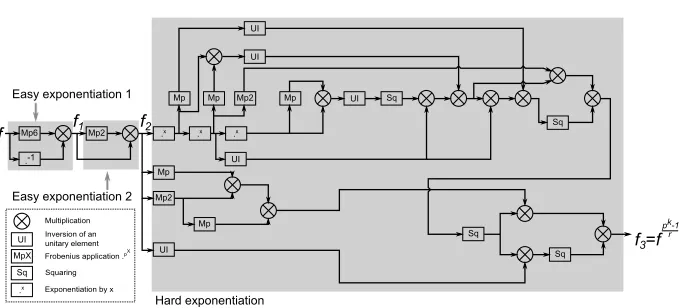
k/2. The optimisation technique described in [10], still widely used in pairing implementations, is based on the decomposition of the FE into three stages. As pk−1
r can be re-written as pk−1
r = p
d−1 · pd+1
Φk(p) ·
Φk(p)
r , the FE can be
performed as a succession of three exponentiations. Two are easy (with pd−1
and pd+1
Φk(p)) since they rely on exponentiations to the powerp
n for some n and
can hence be computed with the help of the Frobenius endomorphism which has a low computational cost. The last step is the so-called hard exponentiation (because it cannot rely on the use of the Frobenius) and is the exponentiation to the power Φk(p)
r . For example, withk= 12, we have
p12−1
r = p
6−1
· p2+ 1·p
4−p2+ 1
r (1)
Let f, the result of a Miller Loop, be a random value in F∗pk. We name these
intermediate results of each exponentiation
f1=fp
d−1
;f2=f
pd+1
Φk(p)
1 andf3=f
Φk(p)
r
2 (2)
The attacker knows the result f3 and wants to recoverf. Note that f1,f2 and
f3 belong to dierent subgroups ofF∗pk. Sincef ∈F
∗
pk, the following equations
hold
fpk−1= 1 ;f1pd+1= 1;fΦk(p)
2 = 1 andf r
3 = 1 (3)
Thus f1 ∈µpd+1, f2 ∈µΦk(p) andf3 ∈µr. These subgroups have sizes p
d+ 1,
Φk(p)andr respectively. As an example fork= 12, f1 contains≈1536bits of
information, f2 contains≈1024bits of information and f3 contains≈256 bits
of information.
4.1 Recovering f1
In this section we shall show how a fault on the intermediate value f1 can help
f
.-1
Mp
UI Mp2
Mp
Mp Mp Mp2 Mp
UI UI
UI
UI Sq
Mp6 Mp2 .x .x .x
Sq
Sq
Sq f3=f
pk-1 r
f1 f2
Easymexponentiationm1
Easymexponentiationm2
Hardmexponentiation
UI MpX
.x Sq
Inversionmofmanm unitarymelement Multiplication
Frobeniusmapplicationm.pX
Squaring
Exponentiationmbymx
Fig. 1. Algorithm for the FE inFp12.xis a public parameter of the curve.
Extracting a candidate We rst have the following lemma.
Lemma 1. Let Fpk = Fpd[w]/(w2 −v) be the construction rule for the Fpk
extension eld.vis a quadratic nonresidue inFpd and is a public parameter. Let
x∈Fpk be such thatx=g+h·wwithg, h∈Fpd. Thenxp d+1
=g2−v·h2∈Fpd.
Proof. We havexpd
=g−h·wsincexpd
= (g+h·w)pd
=gpd
+hpd
·wpd
=g+h·
(−w). As a resultxpd+1=xpd·x= (g−h·w)·(g+h·w) =g2−w2·h2=g2−v·h2
sincew2=v ut
Letf1=g1+h1·wwithg1, h1∈Fpd. We have
f1pd+1=f3r= 1 (4) Thus by Lemma 1
g21−v·h21= 1 (5)
But equation (4) holds only becausef1∈µpd+1. Lete∈Fpd be a fault injected
on f1 (say during the multiplication producing f1 or during the loading of f1
for the second easy exponentiation - see Fig. 1.) such that the faulty valuef1∗
equals
f1∗=f1+e6∈µpd+1 (6)
We consider that the fault eoccurs only on the g1 component3 (which is
com-patible with our fault model if2l< p6), i.e
f1∗= (g1+e) +h1·w (7)
3 If onh
(f1∗)p
d+1
can be computed by the attacker using the measured faulty result f3∗
sinceris public knowledge
(f1∗)pd+1= (f3∗)r∈Fpd (8)
Using Lemma 1 and equations (5) and (7) we have
(f1∗)pd+1= (g1+e)2−v·h21
=g12−v·h12+ 2·e·g1+e2
= 1 + 2·e·g1+e2
Finally,g1 can be written as:
g1=
(f1∗)pd+1−1−e2
2·e (9)
Two possible values forh1can hence be calculated using equation (5):
h+1 =
r
g2 1−1
v ;h
−
1 =−
r
g2 1−1
v (10)
Verifying the candidates The two candidates f1+ = g1+h+1 ·w and f
−
1 =
g1+h−1 ·wcan thus be veried by checking if (f + 1)
pd+1
r =f3 or(f−
1 )
pd+1
r =f3.
If the value ofeis unknown, the attacker must guess the injected fault. For each
guess, two candidates are computed and checked. A candidate is equal to the correctf1 only when the correcteis guessed.
In our fault model, 0 < e < 2l thus 2l−1 attempts have to be made to
nd f1 with 100%certainty. At this stage one may wonder what is the chance
that the attacker nds a valid f1 candidate (and an error value) which ts all
his observations but is not equal tof1(i.e. a false positive). Thef1candidate is
notedf1c and the corresponding error guessed isec.
f1pcd+1= 1 (11) (f1c+ec)p
d+1
= (f3∗)r (12)
But, the attacker observes f3 =f
pd+1
r
1 andf3∗ = (f1+e)
pd+1
r . The question is
what is the probability thatf1c 6=f1but that
f3=f
pd+1
r
1c (13)
f3∗= (f1c+ec)
pd+1
Using equation (11), the probability that equation (14) is veried can be inferred as being equal to1/r for a random f1c in µpd+1. Indeed we already know that
f
pd+1
r
1c is inµrand1/ris the probability that one random element inµpd+1maps
to a xed valuef3 in µr. Similarly, from equation (12), we can deduce that the
probability for equation (13) to be veried is equal to 1/r for a random f1c in
F∗pk since (f3∗)r = (f1c+ec)p
d+1
∈ µpd−1. Thus f3∗ ∈ µr·(pd−1) and (f3∗)r has
r preimages inµr·(pd−1). As a consequence, the probability that we obtain the
correct preimage is1/r.
We can combine these two probabilities and evaluate the probability of hav-ing an incorrect candidate forf1 that matches the attacker's observations. The
probability that a random candidate satisfying equations (11) and (12) also sat-ises equations (13) and (14), corresponding to the observations of the attacker, is equal to1/r2. In the case wherek= 12, typicallyr≈2256, the probability of
nding a valid candidate which is not equal to f1 is1/2512.
Hence we have shown how a fault injected onf1 can be used to recover the
latter's value, with a high probability, using the correct outputf3and the faulty
one f3∗ of the FE.
4.2 Recovering f
Knowing the value off1, we shall now see how to recoverf.
Extracting a candidate The strategy is to use similar equations to the ones used previously and to include the new information about f1 obtained by the
attacker. Proof of the lemma is in Appendix A. Lemma 2. Let f =g+h·w,f−1=g0+h0·wandf
1=g1+h1·w.
Then g1−1 v·h1 =
h0 g0 =−
h
g ⇔f1=f pd−1.
In the following, letK be the known value (known because we knowg1and h1
fromf1found previously) K=gv1·h1−1 =−hg.
As a consequence, the knowledge off1 allows to nd random preimages by
tak-ing a randomg∈Fpd and choosingh=−K·g.
To recoverf, the attacker creates a new faulte2 ∈Fpd during the inversion
in the rst easy exponentiation (see Fig. 1.). Then
f1=fp
d−1
= ¯f·f−1and f1∗= ¯f ·(f−1+e2)
Let∆f1 be the dierence:∆f1 =f
∗
1 −f1= ¯f ·e2. Since e2∈Fpd, we can write
∆f1 =∆g1+∆h1·wwith
∆g1 =e2·g and∆h1 =−e2·h
Asf1∗ is not inµpd+1 with a high probability equal to (1− 1
2pd−1), the attacker
can compute(f1∗)pd+1= (f∗
In this case
(f1∗)pd+1= (g1+∆g1)
2−v·(h
1+∆h1) 2
= (g1+e2·g)2−v·(h1−e2·h)2
which gives the quadratic equation (using the relation h=−g·K)
g2·e22·(1−v·K2) +g·2·e2·(g1−v·K·h1) + 1−(f1∗)
pd+1= 0 (15)
We then solve this equation to obtain two solutions forg:
g+=
v·K·h1−g1+
q
(g1−v·K·h1) 2
−(1−v·K2)· 1−(f∗
1)p
d+1
e2·(1−v∗K2)
g−=
v·K·h1−g1−
q
(g1−v·K·h1) 2
−(1−v·K2)· 1−(f∗
1)p
d+1
e2·(1−v∗K2)
h can be computed with g and K: h = −g·K. Thus we have two potential
candidates forf.
Verifying the candidates Even if e2 is unknown, this procedure gives two
candidates by guessing e2. Now, whether this guess is correct or wrong, every
potential candidate fc has the following property: fp
d−1
c = f1 and therefore
f
pk−1
r
c = f3. The attacker has found several valid preimages of f3 and has to
decide which is the correct one. By checking whether( ¯fc·(fc−1+e2))
pd+1
r is equal to the faulty resultf3∗allows
to eliminate one of the two candidates for this guess ofe2. We nally obtain one
candidate for eache2 guessed and this candidate satises all observations made
by the attacker. Finally we obtain a set of candidates of the same size as the set of possible error values.
The attacker has then to generate a third faulte3, dierent frome2, at the
same location as the last one and intersect the two sets of candidates to nd the correct one. Unfortunately, this intersection does not necessarily contain only one element. We can evaluate the size of this intersection set.
First we can neglect the probability that a random element ofF∗pk maps to
f1 (the probability is1/(pd+ 1)). Equation (15) outputs onef candidatefc1by
guessinge2= 1. Then the set of candidates for this error is{fc1, fc2, . . . , fc(2l−1)}
with fci corresponding to the guess e2 =i. If we replace the product g·e2 by g
i ·(i·e2)in equation (15), we can see that the previous set can be rewritten as
{fc1,fc21, . . . ,2flc−11}.
Similarly with e3, equation (15) outputs one f candidate fc01 by guessing
e3= 1and thenfci0 =fc01/i. The second set of candidates is{fc01, fc01
Lete2tande3tbe the two faults truly injected. Since the correct valuef is in
the two sets of candidates, rst equal tofc1/e2tthen equal tofc01/e3t, we have
f = f 0
c1
e3t
= fc1
e2t
(16)
Writing a = e2t
e3t, equation (16) can be transformed into f
0
c1 =fc1/a. The
sec-ond set of candidates can be rewritten as {fc1 a ,
fc1 2a, . . . ,
fc1
(2l−1)a}. Thus a same
candidate is in the two sets each time the equation
a·i=j (17)
is satised with i, j ∈ [[1,2l −1]]. In our fault model, we can take e 2t and
e3t as elements in N and the number of solutions to this equation becomes j
(2l−1)· gcd(e2t,e3t)
max(e2t,e3t)
k
as shown in Appendix B.
Finally the size of the intersection, which also contains the correct candidate, is
#intersection=
(2l−1)· gcd(e2t, e3t)
max(e2t, e3t)
(18)
and the number of wrong candidates is
#intersection−1 =
(2l−1)· gcd(e2t, e3t)
max(e2t, e3t)
−1 (19)
The intersection of the sets of candidates obtained withe2 and withe3contains
at least one element if we get the two guesses correct once.
The computational cost off recovery is low since the attacker has to use
the procedure to recover a candidate through equation (15) only once per fault injected with guessese2= 1ande3= 1.
Then he stores the corresponding candidates and computes the ratio a =
fc1/fc01. Finally he solves equation (17), trying all i ∈[[1,2l−1]] and checking
that a·i∈[[1,2l−1]], which provides e
2t ande3t (only solutions if there is no
wrong candidate). With e2t, he computesf =fc1/e2t. The memory used in the
recovery off is just one element ofFpk per fault injected.
We cannot avoid the occurrence of wrong candidates. In order to conclude our attack we must have a unique candidate which satises all our observations. If more than one candidate is contained in the intersection of the two sets then other faults must be generated at the same location until one candidate only matches all the observations of the attacker.
4.3 Summary of our fault attack on the Tate pairing's FE
At least four executions of the same pairing on the computing device are required to perform our attack.
1. The computation is executed normally. The attacker stores f3 the correct
2. A rst fault is created onf1according to Section 4.1. The attacker memorizes
f3∗, a rst faulted result. f1 is found using equations (9) and (5).
3. A second fault e2 is created during the inversion in the rst easy
exponen-tiation according to Section 4.2. The attacker storesf3∗, the faulted result
and extracts a candidate fc1 forf guessinge2 = 1 with equation (15) and
Lemma 2.
4. Similarly to the previous step, a third fault e3 6= e2 is created. With the
faulted resultf3∗, the attacker extracts a new candidatefc01 for f guessing e3= 1. The valuea=fc1/fc01is then computed. A pair(i, j)solution to the
equationa∗i=j withi, j∈[[1,2l−1]]allows him to computef =fc1/j.
If several pairs(i, j)are found, more faults may be needed to ensure the unique-ness of the candidate for f. The important feature of this scheme is that only
one fault per execution is needed to recoverf, no double or triple faults.
4.4 Practical feasibility of our attack
This attack scheme has been experimentally checked with Sagemath [20] inFp12
with parameters identical to [9]. Our fault model was the injection of a random
ewith0< e <2l.
For a randomf ∈F∗pk, we simulated 1000fault injections for f1 recovery
with a random fault e∈[[1,210−1]] and we made 210−1 guesses on the fault
value per injection. As a result,f1 was correctly found for every fault injection
and no wrong candidate was observed.
Similarly, we simulated f recovery knowing f1. Two dierent errors in
[[1,2l−1]] were injected for 100 fault injections, rst for l = 7 and then for
l= 10. The number of wrong candidates reached, in average,4.87forl= 7and 5.66forl= 10. These examples show that even when we loosen the constraints on the possible errors (from27to210) the number of wrong candidates, on
aver-age, does not increase dramatically. But of course, the computational cost of the attack increases with2l. A detailed example of an implementation of the attack
is presented in Appendix C.
5 Countermeasures
So far in the literature, most countermeasures proposed against fault attacks on pairings focus on protecting the Miller Loop for the good reason that it has been the main target of the fault attacks [5, 21, 22]. With our attack on the FE, we hope that other ecient countermeasures shall be proposed by the community in addition to the suggestions made below.
Inversion of unitary elements: In some implementations, an ecient coun-termeasure is already present. Indeed since normally f1 ∈ µpd+1, this element
is called unitary and has the following property:f1−1= ¯f1. As a consequence,
simple conjugation which has a far lower computational cost. As a consequence a fault injected onf1cannot be exploited since the resulting output is not equal
to the expected value(f1∗)pdr+1. The conclusion is that implementations should
ensure that the inversions of unitary elements are always replaced with conjuga-tions. Additionally, the use of a Boolean variable stating if the element is unitary and deciding which code (inversion or conjugation) is used for the inversion of an element should be avoided since this could then become a target in order to allow our fault injection. As an example, this latter Boolean variable is imple-mented in the classic Miracl library [23].
Compressed representation: A generalization of the previous countermea-sure is to use a compressed representation of the elements during the exponenti-ation as shown in [24, 25]. The eect is similar to the previous countermeasure. A fault attack on an implementation with the compressed representation would have to be specically designed in order to work.
Checking subgroup membership: It is possible to deter this attack by check-ing the subgroup membership of intermediate values. As an example,f1should
be in µpd+1. To check this membership (checkingf
pd+1
1 = 1), one has to
com-pute f1pd+1 at the price of a conjugation and a multiplication in F∗pk. Similarly
it should be possible to check thatfΦk(p)
2 = 1andf3r= 1.
6 Conclusion and perspectives
The possibility to invert the nal exponentiation with a fault attack has been shown. Even if we don't have any strong restriction on the errors injected, recov-ering the input of the FE with a high probability is feasible. Our experimenta-tions with Sagemath [20] allowed us to propose bounds on the number of wrong candidates obtained with this attack.
To settle the feasibility of inverting the FE with a fault attack, we must now demonstrate that our attack scheme can be implemented in practice.
The next step from an attacker's perspective would be to perform a full attack on pairing which would denitely settle pairings vulnerability to fault attacks. One possibility to achieve this is to consider double faults - two faults during one execution of the pairing: one to invert the Miller Loop according to [5] or [7] and another in the FE to access the faulted value of the Miller Loop. The possibility of this attack scheme is yet to be proven but does not seem out of reach [26].
Acknowledgements
References
1. Boneh, D., Franklin, M.: Identity-Based Encryption from the Weil pairing. SIAM J. of Computing 32(3) (2003) 586615
2. Dutta, R., Barua, R., Sarkar, P.: Pairing-Based Cryptographic Protocols : A Sur-vey. Cryptology ePrint Archive, Report 2004/064 (2004) http://eprint.iacr.org/. 3. El Mrabet, N., Di Natale, G., Flottes, M.L., Rouzeyre, B., Bajard, J.C.: Dierential
Power Analysis against the Miller Algorithm. Technical report (August 2008) Published in Prime 2009, IEEE Xplore.
4. Whelan, C., Scott, M.: Side channel analysis of practical pairing implementations: Which path is more secure? In Nguyen, P., ed.: Progress in Cryptology - VI-ETCRYPT 2006. Volume 4341 of Lecture Notes in Computer Science. Springer Berlin Heidelberg (2006) 99114
5. Page, D., Vercauteren, F.: A Fault Attack on Pairing-Based Cryptography. Com-puters, IEEE Transactions on 55(9) (sept. 2006) 1075 1080
6. Whelan, C., Scott, M.: The Importance of the Final Exponentiation in Pairings when considering Fault Attacks. In: Pairing-Based Cryptography Pairing 2007. Volume 4575 of LNCS. Springer (2007) 225246
7. El Mrabet, N.: What about Vulnerability to a Fault Attack of the Miller's algo-rithm During an Identity Based Protocol? In: Advances in Information Security and Assurance. Volume 5576 of LNCS. Springer (2009) 122134
8. Vercauteren, F.: The Hidden Root Problem. In: Proceedings of Pairing '08. (2008) 9. Beuchat, J.L., González-Díaz, J., Mitsunari, S., Okamoto, E., Rodríguez-Henríquez, F., Teruya, T.: High-Speed Software Implementation of the Optimal Ate Pairing over BarretoNaehrig Curves. In: Pairing-Based Cryptography - Pair-ing 2010. Volume 6487 of LNCS. SprPair-inger (2010) 2139
10. Scott, M., Benger, N., Charlemagne, M., P., D., Kachisa, E.: On the Final Expo-nentiation for Calculating Pairings on Ordinary Elliptic Curves. In: Pairing-Based Cryptography Pairing 2009. Volume 5671 of LNCS. Springer (2009) 7888 11. Barreto, P., Kim, H., Lynn, B., Scott, M.: Ecient algorithms for pairing-based
cryptosystems. Advances in Cryptology CRYPTO 2002 (2002) 354369
12. Hess, F., Smart, N., Vercauteren, F.: The Eta Pairing Revisited. Information Theory, IEEE Transactions on 52(10) (oct. 2006) 4595 4602
13. Vercauteren, F.: Optimal Pairings. Information Theory, IEEE Transactions on 56(1) (jan. 2010) 455 461
14. Kim, S., Cheon, J.H.: Fixed Argument Pairing Inversion on Elliptic Curves. Cryp-tology ePrint Archive, Report 2012/657 (2012) http://eprint.iacr.org/.
15. Kanayama, N., Okamoto, E.: Approach to Pairing Inversions Without Solving Miller Inversion. IEEE Transactions on Information Theory 58(2) (feb. 2012) 12481253
16. Galbraith, S., Hess, F., Vercauteren, F.: Aspects of Pairing Inversion. IEEE Trans-actions on Information Theory 54(12) (dec. 2008) 5719 5728
17. Satoh, T.: On Pairing Inversion Problems. In: Pairing-Based Cryptography Pairing 2007. Volume 4575 of LNCS. Springer (2007) 317328
18. Bar-El, H., Choukri, H., Naccache, D., Tunstall, M., Whelan, C.: The Sorcerer's Apprentice Guide to Fault Attacks. Proceedings of the IEEE 94(2) (February 2006) 370382
20. Stein, W., et al.: Sage Mathematics Software (Version 5.5). The Sage Development Team. (2012) http://www.sagemath.org.
21. Ozturk, E., Gaubatz, G., Sunar, B.: Tate Pairing with Strong Fault Resiliency. In: Proceedings of FDTC '07, IEEE Computer Society (2007) 103111
22. Ghosh, S., Mukhopadhyay, D., Chowdhury, D.: Fault Attack and Countermeasures on Pairing Based Cryptography. International Journal Network Security 12 (Jan. 2011) 2128
23. Certivox: Miracl library (v 5.6.1) (2012) https://certivox.com/solutions/miracl-crypto-sdk/.
24. Naehrig, M., Barreto, P., Schwabe, P.: On compressible pairings and their com-putation. In Vaudenay, S., ed.: Progress in Cryptology AFRICACRYPT 2008. Volume 5023 of Lecture Notes in Computer Science. Springer Berlin Heidelberg (2008) 371388
25. Aranha, D., Karabina, K., Longa, P., Gebotys, C., López, J.: Faster explicit for-mulas for computing pairings over ordinary curves. In Paterson, K., ed.: Advances in Cryptology EUROCRYPT 2011. Volume 6632 of Lecture Notes in Computer Science. Springer Berlin Heidelberg (2011) 4868
26. Van Woudenberg, J., Witteman, M., Menarini, F.: Practical Optical Fault Injection on Secure Microcontrollers. In: 2011 Workshop on Fault Diagnosis and Tolerance in Cryptography (FDTC). (sept. 2011) 91 99
A Proof of Lemma 2
f1=fp
d−1
⇒ g1−1 v·h1 =
h0 g0 =−
h g
Proof.
f1= ¯f·f−1= (f−2·h·w)·f−1=f·f−1−2·h·w·f−1= 1−2·h·w·(g0+h0·w)
Thus
g1= 1−2·h·h0·w2= 1−2·h·h0·v
h1=−2·h·g0
Finally
g1−1
v·h1
= −2·h·h 0·v
−2·h·v·g0 =
h0 g0 Moreover
g0 = g
g2−v·h2
h0= −h
g2−v·h2
So
g1−1
v·h1
=−h
g
u t
g1−1 v·h1 =
h0 g0 =−
h
Proof. We write ¯
f·f−1= (g−h·w)·(g0+h0·w) (20)
=g·g0−v·h·h0+ (g·h0+h·g0)·w (21)
with
g0= g
g2−v·h2 =
1
g(1−v·K2) andh
0= −h
g2−v·h2 =
1
h(v−1/K2) (22)
As a consequence:
g·g0−v·h·h0= 1 +v·K
2
1−v·K2 =
v·h2
1+g12−2·g1
v·h2
1−g21+ 2·g1−1
=2·g1·(g1−1) 2·(g1−1)
=g1
And
g·h0+h·g0= K 1−v·K2 −
1
K·(v−1/K)=
2·K
1−v·K2
= 2·(g1−1)·h1
v·h2
1−g12+ 2·g1−1
= 2·(g1−1)·h1 2·(g1−1)
=h1
u t
B Size of the intersection set for the candidates in
f
recovery
Let e2t and e3t be in our fault model: 0 < e2t, e3t <2l−1 and p >> 2l. Let
a= e2t
e3t ∈Fp, we want to nd the number of pairs(i, j)solutions to equation (17):
a·i=j withi, j∈[[1,2l−1]].
We can write
e2t
e3t
= j
i
This fraction can be rewritten as u
v, reducing it to lowest terms:
u= e2t
gcd(e2t, e3t)
v= e3t
gcd(e2t, e3t)
All pairs solutions to equation (17) can be written as(k·u, k·v),k ∈N+.
The conditions i, j∈[[1,2l−1]] are equivalent tok≤ 2l−1
u and k≤ 2l−1
v which
combined givek≤ 2l−1
By the denition ofuandv, we have:max(u, v) =max(e2t,e3t)
gcd(e2t,e3t).
Finally, we have a solution for each integerkin the range
[[1,(2l−1)· gcd(e2t, e3t)
max(e2t, e3t)
]]
The upper bound gives us the number of possible solutions to our equation (17).
C Attack example
In this section, we provide the numerical values for an attack that was success-fully simulated based on the methodology proposed in this paper. We used the same pairing parameters as in [9]. Our simulated fault injection creates error values in[[1,24−1]] (l= 4).
Let the secret value be
f= ( 15E4F6523E7C5649E05B9FB24E3C212274A268F39E5034331ED5071CFBDF3A05·v5
+ 1672D105A344B97BFBB195D6AAAAB2E1912272E000432FD0866F789DB489165B·v4
+ 21D0D8EFDE1A9DDC227267B13D7EE703699B5E3293BCE339DF0CB70AC4D0D099·v3
+ 13A0D208C4134E0012166F8E7813A8D1FFB69CEBE0AD873426C181A95A5087C8·v2
+ 037A116F6C8A9CC97A775F672E751B3999D246DA5B056D417DE18891ED95EAE6·v
+ 05A9CC966050A3477C3510DAD85A6A31253203446D8907E228602D0E2AC27060)·w
+ 06C9FA931438FD7122C35411049BE0D95CB2A1955AA51A653547560D8D01CD72·v5
+ 174072170F5121FE3658BE0CC4449CC7BBDA2298E5A3077885424861A9FD3DC2·v4
+ 13DED9A829FAD5568B466E7DFC42ECA52D8F6BCE25C635CE8A6E79155C56347F·v3
+ 20ECF9E9ED0A46FE32A4B5481C5D54A15C879B88B4A81C0AAE1254EEEAA4F226·v2
+ 147B7E0F2849E818D758194E503F0F691CC76207BF27065FDB18030E469F6533·v
+ 164C79AEC143A16DC5276597A89DFBF4D893B5D09D4A325301ACB45863A52AC0
C.1 Step 1: Normal execution
First the attacker runs a normal execution, giving
f3= ( 14FF0ED863C56B2CF6790E35919CF0A8D33877A282EDC87C8574597257487813·v5
+ 1A59AE711E38EEA5D384214718CE68315AD9996B2CBFD7ACEDA5F1958E9C7CF8·v4
+ 04147EDBE3C5643AC6028BC597E9665D7B07C948DF7BB6CC3E367ACA223B29E4·v3
+ 1F23F4F893B297ED3EB321AF4AD3F17AA580B4D5D80CE54AA42E826738271689·v2
+ 100B00759CADCB5221D4B7CCC5C68B7980A53CD947452FB94D1B969F40624AC9·v
+ 0CBEE77D4398468DC63D8A13175B2E4FCCA9E4790A471B3F86D835C25E0D1FC0)·w
+ 18C04751B8DFEA8F9CD7C813F15B5B37FB09738B04389D9CFBCBA4EABA9BB10E·v5
+ 21B35F3CA37C92BD73F88FA0249D736CF909208C12C32B5C22E42586E11B518E·v4
+ 09D3C014FE5AAA1F7F74AB0CC51793BFDA2551AC15B5040AF19586B22B6BA360·v3
+ 11A4EAB896B1C6D0F4D701D48C5C6F0D9D1148DE267A4A90A9258E0D112FDA23·v2
+ 13D2014FCE1AE043A88A108C969F9D658246962132901BAE75872DE5736ECF7D·v
+ 17C81BD9014A90D8964B3B864ABB83DF1225F513E49DD432D9459F22D4EBF7ED
C.2 Step 2: f1 recovery
f3∗= ( 14878AB9DA8D626472C222486B6BEAFCBB9D552E42C4A95F57CBE5DE0EB58A2B·v5
+ 1869B2D29B7B9DF5F28DC92904EE751125E223938C87C836102954D49D1BDDB1·v4
+ 073C8E8ECA143AC26ACC2B4738414098EEADA9DD198390C6FD49567873224085·v3
+ 1F3FE27B71407EF9DBD68E5AD408F94941A11DE9B27B20DF3894E7711E2C4572·v2
+ 018CA3F1F35B050D25191996940189F351942EE6DD0D10F0FE63B7DBC8C2417A·v
+ 0DE59F30BBE780A0D738E3B707C0A48F8C600E63857D31DDB78D0852476DB845)·w
+ 18AD1088312DE86A6668FDA07CEEEE01137D06FF6F5402DD820B471FF42E2CDC·v5
+ 173D1A8CC7143964B7C6B3B17A5B14ABE25F22FBB74F779749FBE0DAE044D29B·v4
+ 023DACB18FBCAD8484A8FA8F35DDD57B124F48DF3B5676995821880FD6DD6485·v3
+ 08774A2A16C9CC6CA30D8BE07717B1234D075307097FC34F47DF6CB32CFF8B22·v2
+ 12AA1927DF8D8AD9DDD59A883D5918F685AAFB9ED2B196A16F0F3F8B8312F9AE·v
+ 0414DD150D1CA399A3AF8E5FD647423F9AD4A05624D74966835FE27ECAC42C9D
For each error guess e1∈[[1,24−1]],g1 is computed using equation (9) andh+1
and h−1 with equation (5). Then f1+ = g1+h+1 ·w and f
−
1 =g1+h−1 ·w are
constructed and checked against the observedf3=f
pd+1
r
1 andf3∗= (f1∗)
pd+1
r . A
f1 is found which satises these criteria for errore1= 7:
f1= ( 1E6BC8B6919346B74846AF6D4303D1A79D229A442435EA28865BD478D31AB1A2·v5
+ 221EA2429ED6254894C99D32D5BBCA06F5018B9C64F9A62051C4919EA815B097·v4
+ 200C76138D0DACBE0C6BC874CB0548D84A5C367C7665A7EFA14309F52B955502·v3
+ 1446D8D4F4D3892C42B72799B17AF78E4570319545EA24A19B96B8E937E14E0F·v2
+ 02FFF74B0C285EF8CC82010A422E0ADD0300E6C67C362E220ABA9CECEC20E051·v
+ 0F1CEA1EF6E3CA90D3FEBB5B2954A90A3F96F036138766370C1CD161D83F1768)·w
+ 1DA86D419A0A0D17F20F0A96A2022160A35EAC0AC80B962A009908805CC5C8FE·v5
+ 02A30BA4FBE1821C659E5235C3375C55A5F715F521F6E32549A7314CE3C774AC·v4
+ 14297ECE1671FD16C3E57EB95F8DB69A53EEADBA16859E5EBC2184707BFBA1C2·v3
+ 17E7030B5FD4558F002D1F387B4180B9B989C813AF6B75FA5C4468297BF251A1·v2
+ 0270B45A029B9326291540F57B19A4093D197AA17BE66939EC67569EDE0168A3·v
+ 12065E0EFCFF4E4E25C594BCDC23F5D076FDC8003CB3F27618B523A6163D097A
C.3 Step 3: f recovery
Two faults are injected according to Subsection 4.2. The observed faulty values are
f3∗= ( 16F28C152154059E9DE6E9195258B8FC99E356EB1D9AEF299AC8FA826B33BBC6·v5
+ 08351B505C701E6E76CFFFB9877BE4B514A8138C1E0823860CF48777C359F5C5·v4
+ 20F5B35DD04E60CC85CB1AB1707C4045C19774512303F07BA4C259E545D2F9A1·v3
+ 22F43AF3353F93A45AF088D788D6EC32D0ADCF32CDB43B3C50378097B4665D46·v2
+ 2100931B1712BE28ECA6F35DF909828627C41AFB2352EA38E5D690526464B54A·v
+ 0AF16AD93F1FB968CC2C59FB0019982395985A10E8DEFAA7C11C18DF841ABB9E)·w
+ 223879E599390FD4DC285C9BA14BC1BAE64227C196B22CA2CF02DFA95AFC8E9B·v5
+ 0C78B0BB70A87D8BBCC72E84BA382FD4EC60AA11869D37BDAC82B639F9869B7B·v4
+ 1AE1AEA4A7B18D01340EB6017B5F7D0FD6134B07D764E819B64F529F07D6F980·v3
+ 1954E832F272C86EACA35DECC0A3F5CDA59E9D7A5F9C9EC7EF0FF51BC15DC125·v2
+ 151EF27A88585E1A229E81877B895642580D0623ED0BA264EF9DEA90E7FAECB1·v
+ 0A0BC9599DF18B044DE6522EE18E036DD76E875AC4E2C9007885C9F009F1E716
f30 ∗= ( 23571DDFC0C6B8509B84F49A969AB7F7BA38A5D071BFA339AF5078303D7F92BB·v5
+ 152F585FE7767B3A185C3BFE5BFC9A69C9AB0089BE6CAD2BA4A2382AC1E5CCE6·v4
+ 09C432E52552CF26B4484ED21B37B5C73E389299673EF9490ED5C63DCD1936DC·v3
+ 1DD38AA3691BD907A78DDFC4FDB1270E1D192E97DF6ECFD49BC63EC156BBBFB8·v2
+ 1B7D2A41682147DCA380B21CFBED319F3AEEF3C01F1E986E22E50E9167858663·v
+ 003B7A90812730447FDF12CE78075BE98399209D5AFB602FDD5A5E84DBA98979)·w
+ 1377A70C46F2A429C0FD87941DEA17C3CCB29E84187D0952DCD9684651EC62B3·v5
+ 0F686B68CF92E4677259166B8D4C7F67E0DBAF18358826CFDF8462CF3E5BB747·v4
+ 015CCDF3776A4F4FDA9E02DF07C9F90E3D765C12DB3D25D49BC2CFF9401B105A·v3
+ 0FEB0A0E9229D1111C8BF20AE3A2638EB6FA4313020D2B341102CC6CC8F91560·v2
+ 0F72717DF131B16A8C69EC07A2EAE763DA688086C528EE7A9C09443B1BC0E4E0·v
+ 181A35AE9376E2DF2AA9BE6EA9807D24CEC537E834C9E80DDF5E810C84CD3AF6 By guessing that e2 = e3 = 1 and checking against observedf3∗ and f
0∗
3 , two
candidates forf are saved using equation (15) and Lemma 2:
fc1= ( 13D7C1CD2019B9E15AEA184A1DA41EEEA8AA745018D1D5C49CFB6004DAD90A28·v5
+ 18D4721BAB2536A450EFBF915D873EA6A92ACD9F8A5CAE4D41695D8B58D1C92E·v4
+ 14CFC849E4E70ECAC254D076F24E0D12CE6455C671A3FCFCE36F6F60EB575559·v3
+ 22E3763C6FA97F0768F181A01D1CE65C0962874A8619C0CF62CC0EF42CD4C604·v2
+ 1F4A9CEAD0DF83154E325AA0A21DF50668647DAD3330D74D6CEDCD215A454216·v
+ 0F873644C594ADC50F677D191448B978D1BFDE27C1D146F1ECE1357F80D5F35F)·w
+ 19A8D42718BFD93BEA67DA00A295E562C5456F0017CDED8D6101A679F5103901·v5
+ 200F1BB87794E33860D0297843F077BE299FFB1F9ABB433536D2AB6EF9E72BCD·v4
+ 01A0BFD2678C31535D2B5D733BE1468728FF8DFEDBF7E43B656061C03F07D872·v3
+ 0CCCF1146B5400FD54198AC4C81FE7A058B27DCD99E8FC542AA1FC663FCC834E·v2
+ 072287715853DA2809CA5EC62FBE7F6A91F73605405F39573B563B807B9A8EC6·v
+ 177B600DB91B5E2466140D5A4B14D0542C2628150F9BC4E39690771B80CE80BB and
fc01= ( 2163C67F7EDE7355C9049330564D000DB10A4A9C9281A192FCA6B8E7DEF9D024·v5
+ 0261A11607E07D28553E29BAB2DC8BC518085ABF8A197E7CBAF9E4EDA448B2D3·v4
+ 166FEA5EA40D80ACEE58835E3BB42850E1CB36D3F5E719C482E31856268684C1·v3
+ 0F42A433AB96310756DB1211A5093D8A09ABEA5EA56C399B3C0A8D4AD2843E3C·v2
+ 1BD08B7B6454E64BD3BAFB3973A8D9CCCE9236D2D82B6A0BEF0C448F6CAF5730·v
+ 09DD69AE65440A7D93326C3E3BEE4F47AC8DDAE354483F0FC4810871561382FF)·w
+ 12DED9940486DBCAC7A485EF9DFA04896892CD6ABD28D3282BBA506C680E6B8F·v5
+ 08CEA9A16843C13A2A776B6B7FABDAF66DC5D886B5183BBCB190630D4FE9EE0B·v4
+ 1132E12EDAD26BBB205B098DC6835C2378726170CE31AE6E597248AAE2B1A3F4·v3
+ 0F50F22F1B8AC9BD6FEAF01532A79540792D2184FD40E04AFB10077755279129·v2
+ 16180466CD4B01CD80E8601066647242F232133D993832F8DEBE987234FB2994·v
+ 012EE65EF7D7BCB6A0ECA7C2A276D45F539272447251929094E3C2C31D2955FB The ratio a=fc1
f0
c1 is computed:
a=1F02DBA40998EDC684A75745760861F94D61F758150000014EB0540000000002