Preserving Authentication Protocol
?Aydin Aysu1, Ege Gulcan1, Daisuke Moriyama2, Patrick Schaumont1, and Moti Yung3
1 Virginia Tech, USA {aydinay,egulcan,schaum}@vt.edu
2
NICT, Japan [email protected] 3
Google Inc. and Columbia University, USA [email protected]
Abstract. We demonstrate a prototype implementation of a provably secure protocol that supports privacy-preserving mutual authentication between a server and a constrained device. Our proposed protocol is based on a physically unclonable function (PUF) and it is optimized for resource-constrained platforms. The reported results include a full pro-tocol analysis, the design of its building blocks, their integration into a constrained device, and finally its performance evaluation. We show how to obtain efficient implementations for each of the building blocks of the protocol, including a fuzzy extractor with a novel helper-data construction technique, a truly random number generator (TRNG), and a pseudo-random function (PRF). The prototype is implemented on a SASEBO-GII board, using the on-board SRAM as the source of entropy for the PUF and the TRNG. We present three different implementations. The first two execute on a MSP430 soft-core processor and have a secu-rity level of 64-bit and 128-bit respectively. The third uses a hardware accelerator and has 128-bit security level. To our best knowledge, this work is the first effort to describe the end-to-end design and evaluation of a privacy-preserving PUF-based authentication protocol.
Keywords: Physically Unclonable Function, authentication, privacy-preserving protocol, implementation
1
Introduction
Physically Unclonable Functions (PUFs) have been touted as an emerging tech-nology to support authentication of a physical platform. However, the design of PUF-based authentication protocols is complicated, and many pitfalls have been identified with existing protocols [10]. First, many protocols are ad-hoc designs. In the absence of a formal adversary model, one can only hope that no security
?
holes are left. Second, while theoretical security models may provide assurance on the achieved level of security, these models typically lack a consideration of implementation issues. The cryptographic engineering of a PUF-based authen-tication protocol requires more than a formal proof. Finally, typical PUF-based protocol designs assume ideal PUF behaviors. They make abstraction of complex noise effects that come with real PUF. The actual performance of these protocol designs, and often also their implementation cost, remains unknown.
We believe that these issues can be systematically addressed, by combining a theoretical basis with sound cryptographic engineering [6]. In this paper, we aim to demonstrate this for a PUF-based privacy-friendly authentication protocol.
There are many PUF-based protocols that claim privacy [7, 25, 37, 21, 23]. We observed that most of these earlier proposals do not have a formal proof of security and privacy. In our opinion, a formal basis is required to clarify the assumptions of the protocol. For example, a recent analysis by Delvaux et al. [10] showed that only one [37] of these privacy-claiming PUF protocols actually provides privacy. Furthermore, none of the earlier proposed PUF-based protocols disclosed an implementation and a performance evaluation. This is required, as well, because the security and privacy properties of a PUF-based protocol are directly derived from the PUF design. These two reasons are the direct motivation for our protocol design, and its evaluation.
A PUF, a central element of our design, returns noisy data and uses a fuzzy extractor (FE) to ensure a reliable operation. The fuzzy extractor associates helper data with every PUF output to enable reconstruction of later noisy PUF outputs. However, the generation of helper data (Gen) and the reconstruction of a PUF output (Rec) are algorithms with asymmetric complexity: helper data generation has lower complexity than PUF output reconstruction. Realizing this property, van Herrewegeet al.proposed reverse fuzzy extractors, which place the helper data generation within the constrained device [38]. However, the original reverse fuzzy-extractor protocol does not offer privacy. To achieve this objective, we rely on a protocol design by Moriyama et al. [30]. Assuming that a PUF is tamper-proof, their design leaves no traceable information within the device. This is achieved by using a different PUF output at every authentication, and thus by changing the device credential after every authentication.
Our proposed protocol starts from this design, and adapts it for a reverse fuzzy-extractor implementation. We maintain the formal basis of the protocol, but we also provide a detailed implementation and evaluation.
We note that there are contextual elements to privacy that are not addressed by our protocol. For example, we cannot offer privacy against an adversary who can physically trace every device in between authentications, or who can use other (non-cryptographic) mechanisms to identify a device [26]. These are context-dependent elements which have to be addressed by the application.
End-to-end Design.We demonstrate a complete design trajectory, from prov-ably secure protocol specification towards performance evaluation. We are not aware of any comparable efforts for other protocols. While other authors have suggested possible designs [29, 27, 38], the actual implementation of such a pro-tocol has, to our knowledge, not yet been demonstrated.
Interleaved Error Correction. We present a novel technique for efficient helper data generation using an interleaved BCH code, as well as its security analysis. Our decoding strategy is computationally simple, and enables the use of a single BCH(63,16,23) primitive while still achieving 10−6overall error rate. The end-to-end design of a PUF-based protocol covers protocol design, pro-tocol component instantiation, architecture design, and finally evaluation of cost and performance. We build our prototype on top of a SASEBO-GII board, us-ing the resources available on the board to construct the PUF and the protocol engine. We use the 2Mbit SRAM on the SASEBO-GII board as the source of entropy. We construct the following protocol components: an SRAM PUF, an SRAM TRNG, a pseudorandom function (PRF) design using the SIMON block cipher, and a fuzzy extractor based on an interleaved BCH error corrector and a PRF based strong extractor. We provide a design specification at two security levels, 64-bit and 128-bit.
Next, we implement these protocol components using an MSP430 processor (mapped as a soft-core on the SASEBO-GII board), an SRAM and a non-volatile memory. We also design a hardware accelerator to handle all cryptographic steps of the protocol, including the PRF, message encryption, and PUF output coding. Then, we implement the server-functionality on a PC connected to the SASEBO-GII board, and characterize the performance of the implementation under an actual protocol execution.
The remainder of this paper is organized as follows. Section 2 introduces the privacy preserving authentication protocol, describing its security assumption and important features. Section 3 describes the design of the protocol compo-nents: the SRAM PUF, the SRAM TRNG, the PRF, and the fuzzy extractor. Section 4 discusses the prototype implementation of the protocol, covering the system-level (server and device), the device platform, and the accelerator hard-ware engine. Section 5 presents the results, including implementation complexity and cost. We conclude the paper in Section 6.
2
Secure and Private PUF-based Authentication Protocol
In this section, we describe the protocol notation, the assumed trust model, and the flow of the overall PUF protocol. We describe its main features in this section and security analysis of this protocol including security proof is found in Appendix A.
2.1 Notation
xis assigned toy. WhenAis a probabilistic machine or an algorithm,y←R A(x) denotes thatyis randomly selected fromAaccording to its distribution. HD(x, y) denotes the Hamming distance betweenxandy. ¯H∞(x) denotes the min-entropy
of x. In addition, we use the following notations for cryptographic functions throughout the paper.
(Truly Random Number Generator)TRNGderives a truly random num-ber sequence.
(Physically Unclonable Functions)f :K × D → Rwhich takes as input a physical characteristicx∈ Kand messagey∈ Dand outputsz∈ R. (Symmetric Key Encryption) SKE := (SKE.Enc,SKE.Dec) denotes the
symmetric key encryption.SKE.Enc takes as input secret keyskand plain-text m and outputs ciphertextc. SKE.Dec decrypts the ciphertextc using the same secret keyskto generate plaintext m.
(Pseudorandom Function) PRF,PRF0 : K0× D0 → R0 takes as input
se-cret key sk ∈ K0 and message m ∈ D0 and provides an output which is
indistinguishable from random.
(Fuzzy Extractor) FE := (FE.Gen,FE.Rec) denotes a fuzzy extractor. The FE.Genalgorithm takes as input a variablezand outputs randomnessrand helper datahd. TheFE.Recalgorithm recoversrwith input variablez0 and hd if HD(z, z0) is sufficiently small. If HD(z, z0) ≤ d and ¯H
∞(z) ≥ h, the
(d, h)-fuzzy extractor provides r which is statistically close to random in
{0,1}|r|even if hdis exposed. The fuzzy extractor is usually constructed by
combining an error-correction mechanism and a strong extractor.
2.2 Parties and Trust Model
We make assumptions comparable to earlier work in Authentication Protocols for constrained devices [30, 37, 38]. A trusted server and a set of num deployed devices will authenticate each other where devices require anonymous authen-tication. Before deployment, the devices are enrolled in a secure environment, using a one-time interface. After deployment, the server remains trusted, but the devices are subject to the actions of a malicious adversary (which is defined further).
Within this hostile environment, the server and the devices will authenticate each other such that the privacy of the devices is preserved against the adversary. The malicious adversary cannot determine the identity of the devices with a probability better than the security bound, and the adversary cannot trace the devices between different authentications.
[31], side-channel analysis [11, 35, 32] and fault injection [12]. However, these attacks do not invalidate the protocol itself, and these attacks can be addressed with countermeasures at the level of the device.
2.3 Secure and Privacy-preserving Authentication Protocol
We propose a new authentication protocol by combining the privacy-preserving authentication protocol of Moriyamaet al.[30] with the reverse fuzzy extractor mechanism of van Herrewegeet al.[38].
The reverse fuzzy extractor works as follows [38]. The verifier sends a chal-lengec to a PUF-enabled device. The device applies the challenge as input to a PUF, and obtains a noisy output z0. The device then computes helper datahd for this noisy output, and returns the helper datahd and a hash of the output z0 to the verifier. The verifier, who has previously enrolled the device, knows at least one output z corresponding to the same challenge. The verifier can thus reconstruct z0 using the helper datahd and the previous output z. While this protocol moves the computationally expensive reconstruction phase to the veri-fier, the protocol does not maintain privacy. The device discloses its identity in order to allow the verifier to find a previous PUF outputz.
Moriyamaet al.proposed a PUF-based protocol that provides provably se-cure and private authentication [30]. Different from the existing PUF-based pro-tocols, their protocol has a key updating mechanism that changes the shared secret key between the server and the device after each authentication. Fur-thermore, the secret key is derived from the PUF output. The Moriyamaet al. protocol however places the PUF output reconstruction in the device.
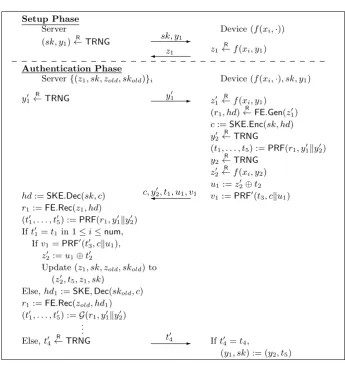
The proposed protocol combines these two ideas into a merged protocol, illus-trated in Fig. 1. We claim the same formal properties for the proposed protocol as for [30]. It works as follows. Each device is represented as a combination of a secret keyskand a PUF challenge y1. During secure initialization, the server initializes the secret keysk1in the device, and extracts the first PUF responsez1 from the device. The server keeps two copies of this information for each device in the database to support resynchronization. An authentication round proceeds as follows. First, the server sends a nonce to the device. The device extracts a first PUF output to construct an authentication field c and a key r1. The de-vice then extracts a second PUF outputz20, which will be used during the next authentication round. The device encrypts this output (intou1) and computes a MAC over it (into v1 via PRF). The server will now try to authenticate the device. Initially, the server reconstructs the key r1 using the reverse fuzzy ex-traction scheme. The server then performs an exhaustive search over the entire database in order to find a valid index. In case no match is found, the server will perform the same exhaustive search over the set of previous PUF outputs. If any match is found, the server will update its database to the next PUF output, and acknowledge the device. However, if both searches fail, the server will reply a random value. In the final step, the device verifies completion of authentication and updates its key tuple stored in non-volatile memory in case of acceptance.
Setup Phase
Server Device (f(xi,·))
(sk, y1)←R TRNG sk, y1
-z1←R f(xi, y1) z1
Authentication Phase
Server{(z1, sk, zold, skold)}i Device (f(xi,·), sk, y1)
y10
R
←TRNG y10
- z10
R
←f(xi, y1) (r1, hd)←R FE.Gen(z1)0 c:=SKE.Enc(sk, hd) y20
R
←TRNG
(t1, . . . , t5) :=PRF(r1, y1ky0 0
2) y2←R TRNG
z20
R
←f(xi, y2) u1:=z20 ⊕t2 v1:=PRF0(t3, cku1) c, y02, t1, u1, v1
hd:=SKE.Dec(sk, c)
r1:=FE.Rec(z1, hd) (t01, . . . , t
0
5) :=PRF(r1, y
0
1ky
0
2) Ift01 =t1 in 1≤i≤num,
Ifv1=PRF0(t03, cku1), z20 :=u1⊕t02
Update (z1, sk, zold, skold) to (z20, t5, z1, sk)
Else,hd1:=SKE,Dec(skold, c) r1:=FE.Rec(zold, hd1) (t01, . . . , t05) :=G(r1, y01ky0
2) .
. . Else,t04
R
←TRNG t
0
4
- Ift
0
4=t4,
(y1, sk) := (y2, t5)
Fig. 1.The proposed PUF-based authentication protocol
Key Derivation via PUF with reverse FE.In the setup phase, the server stores the PUF output z1 in the database. For each authentication, the device reads the PUF output z10 ←R f(xi, y1) with physical characteristic
xi and generates helper data as (r1, hd)
R
←FE.Gen(z10). The helper data is encrypted and sent to the server asc:=SKE.Enc(sk, hd). The server decrypts it and executes verification with the shared secretr1:=FE.Rec(z1, hd).
va-lidity check valuev1.v1serves as a MAC and prevents any modifications to the message (c, u1) since the server checksv1=PRF0(t03, cku1).
Key Update Mechanism. During the authentication, the device reads the PUF output twice, for different challenges. The second PUF output will be used to update the database if the authentication is successful. Upon verification of the device, the server updates the database with (z20, t5). The last secret key (zold, skold) is still kept in the database and used for provision against the desynchronization attack. Even ift04 is erased by an adversary, the reader can still trace and check the tag in the next protocol invocation. Exhaustive Search. The device does not contain a fixed unique number of identity. Instead, the server launches an exhaustive search within the database to find an index i ∈ {1, . . . ,num} which corresponds to the de-vice. Thisauthenticate-before-identify strategy [10] is a widely-known tech-nique especially for anonymous lightweight authentication protocols (e.g., RFID authentication in [22]) to offer privacy. The search should execute in constant-time to avoid the abuse of a timing side-channel in a realistic usage. This is not hard to achieve but requires careful implementation of the server.
We have now identified the following protocol building blocks and demon-strate how to implement them in the next section.
– Physically unclonable function (e.g.,z10 ←R f(xi, y1)) – Random number generator (e.g.,y20 ←R TRNG)
– Symmetric key encryption (e.g.,c:=SKE.Enc(sk, hd)) – Pseudorandom function (e.g., (t1, . . . , t5) :=G(r1, y10ky02)) – Fuzzy extractor (e.g., (r1, hd)
R
←FE.Gen(z10))
3
Instantiation of Protocol Components
The protocol in the previous section assumes a generic security level. In this section, we discuss the instantiation of the main protocol components, assuming a security level of 128 bits. Our evaluation (Section 5) will show results for 64-bit as well as for 128-bit security.
3.1 Architecture Assumptions
3.2 Design of SRAM PUF
The source of entropy in the design is an SRAM. We choose the SRAM for this role as the SRAM PUF is considered to be one of the most cost-efficient designs among recently proposed PUFs [27, Chapter 4]. It also offers reasonable noise levels. We are not aware of modeling attacks against SRAM PUF [34], and the known physical attacks against it are rather expensive [31, 17]. Furthermore, while we acknowledge the diversity of possible PUF designs for FPGA’s [15, 1, 20, 24], the use of an SRAM PUF with simple power-cycling will yield a prototype that is less platform-specific. Our first step is to analyze the min-entropy, and the distribution of the startup values of the SRAM.
Min-entropy of SRAM. The min-entropy of the SRAM determines how many bytes of SRAM will be needed to construct one PUF output byte. We estimate the min-entropy of the SRAM empirically as follows. We collected the startup values of 90 SRAMs, collected from 90 different SASEBO-GII boards, each mea-sured over 11 power cycles (990 x 2Mbit).
We then analyzed the Shannon Entropy as well as the min-entropy. Given a source ofnsymbols with probabilitiesbi, the efficiency of the source as measured in Shannon Entropy is computed asPn
i=0−bilog(bi)/n×100. At the bit-level, we found an efficiency of 34 to 46%, depending on the board. This means that a bit on the average only holds between 0.34 and 0.46 bit of information, and indicates significant bias. We confirmed that there was bias according to the even and odd positions of the SRAM bytes.
We designed our PUF using the min-entropy, which is a worst-case metric. In this case, the min-entropy rate is computed as n×min{−bilog(bi)}i×100. When we analyzed the SRAM data at the byte level, we found a min-entropy of 5 to 15%, which appeared to be caused by the abundance of the byte 0xaa at many SRAM locations. We did not investigate the cause of this bias, but we found that its effect can be considerably reduced by XORing adjacent bytes, and operation we will call 2-XOR. In this case the worst-case min-entropy rate becomes 26%4. We designed our PUF based on this value. In other words, we will use about 8 bytes of SRAM data to obtain one byte of entropy. The min-entropy estimate accounts for correlation between bits in a byte, which is more accurate than previous publications that used bit-level min-entropy estimates (e.g., 76% min-entropy rate in [8]).
Distribution of SRAM Data. A second important factor is the expected noise level for each SRAM, and the expected average Hamming distance between different SRAMs. We analyzed our data set over the different measurements per
4
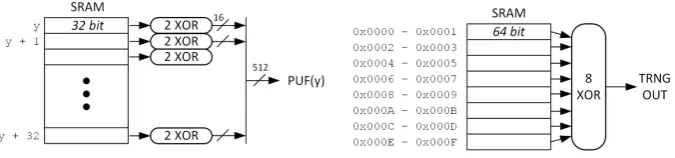
Fig. 2.(left) Design of the SRAM-PUF (right) Design of the SRAM-TRNG
SRAM. After applying the 2-XOR operation on the data, we found an average Hamming distance between same SRAM outputs of about 6.6 bit per word of 64 bit, which translates to a noise level of 10%. When the SRAM outputs from different boards are compared, we found an average Hamming distance of 31.9 bit between words at the same address.
3.3 Design of SRAM TRNG
During authentication, the device requires a source of randomness. We reuse the SRAM as a random number generator, in order to minimize the device implementation cost. To obtain a noisy SRAM output, we XORed SRAM bytes multiple times. For each level of XORing, the noise level of the data is increased. We found that, after 8-fold XORing, the SRAM data passes all experiments in the NIST statistical Test Suite [36]. Hence, to generate a 128-bit random string from the device, we use 1024 bits of raw SRAM data. We can generate as much truly random data as there are available SRAM locations. One iteration of our protocol requires 652 random bits (see Table 1), which are extracted out of 5,216-bit of SRAM data. Of course, the SRAM needs to be power-cycled after each iteration of the protocol.
Practical RAM organization. Figure 2 shows how the SRAM is used as a PUF and as a TRNG. In order to avoid direct correlation between PUF and TRNG data, we maintain separate address spaces for the PUF and the TRNG. In the prototype implementation, we allocate the first 256 SRAM words (of 32 bit each) for TRNG, while the remaining 65,280 words are used for the PUF. This means that the SRAM holds sufficient space for 2,040 PUF outputs (2,040 authentications). The input challenge to the PUF is therefore a 12-bit value y, which is transformed into a base address for a block of 32 addresses by multi-plying it with 32 and adding 0x100.
3.4 Symmetric Key Encryption and PRF
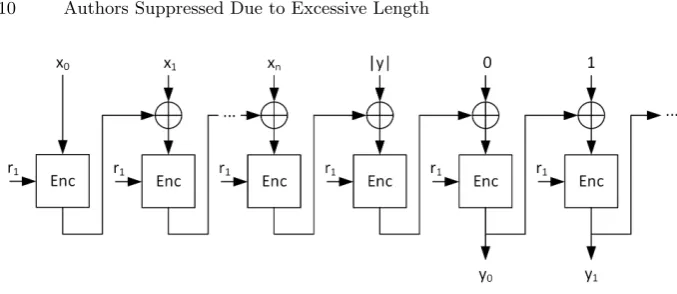
Fig. 3. PRF based on a block cipher in CBC mode. The variable-length message x0, .., xnis expanded using a secretr1 into a message of length|y|
security. Using SIMON is neither a limitation nor a requirement of the prototype and it can be replaced with a secure symmetric-key cipher algorithm (e.g., AES) which supports the required security level.
Figure 3 shows how a PRF can be created using a block cipher in CBC mode. We assume SIMON does not provide any bias and the ciphertext is in-distinguishable from random. An input message x:= (x0, . . . , xn) is encrypted with secret key r1, then expanded into the output sequence y := (y0, y1, . . .) by encrypting a counter value. The insertion of the output length parameter
|y|ensures that, even when the input and secret is identical, the PRF produces independent output sequences when the specified output size is different.
3.5 Design of Fuzzy Extractor
In this section, we describe the design of the fuzzy extractor, including the error correction and the strong extractor.
Error Correction. Various techniques for error correction have been proposed in recent years, with mechanisms based on code-offset [13], index-based syndrome coding [39], and pattern matching [33]. We adopt the following code-offset mech-anism using a BCH(n1, k1, d1) code [13]. The code allows to correct errors up to
b(d1−1)/2c-bit within an1-bit block. Two procedures,BCH.GenandBCH.Dec, represent encoding and decoding respectively:
Encode(a):δ←R TRNG∈ {0,1}k1, cw:=BCH.Gen(δ)∈ {0,1}n1, hd:=a⊕cw Decode(a0, hd):cw0 :=a0⊕hd, cw:=BCH.Dec(cw0), a:=cw⊕hd
The PUF outputa is XORed with a random codewordcw to constructhd. Whilehd is not secret, the PUF outputamust remain secret. We consider the complexity of finding a. For a single block, this complexity is 2k1. For a PUF output z1 mapped into multiple n1-bit blocks, the complexity is 2k1·|z1|/n1. It should be higher than the selected security level of 128 bit.
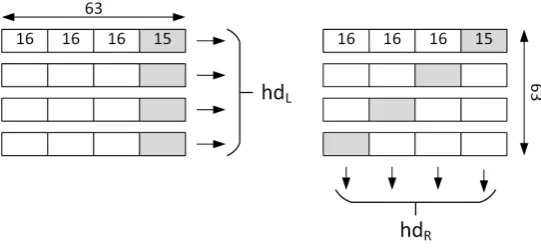
Fig. 4.Helper data construction. A 252-bit field is split into 4 63-bit blocks and encoded ashdL. Next, each block is left-rotated over 0, 16, 32 and 48 bits respectively. Finally, 4 63-bit columns are encoded to producehdR. A 504-bit field (needed for the 128-bit security level) is encoded by applying this construction twice.
up to 17.5% noisy bits, which appears to be above the observed SRAM noise level of 10.0%. However, this is too optimistic. If we assume that a single bit flips with a probability of 10.0%, then there is a 2.36% probability that 12 bits or more will flip in a 63-bit block, and thus produce a non-correctable error. This translates to a probability of only (1−0.0236)8×100≈82.6% that 8 blocks of a 504-bit PUF output can be fully corrected. Therefore, we need a better error correction mechanism.
We apply an interleaved coding technique as illustrated in Figure 4. A 252-bit data field is organized as a matrix with fields of{16,16,16,15}bits per row. The encoding of each 63-bit row yields helper datahdL. Next, each row of the matrix is rotated over a multiple of 16-bits, such that 63-bit columns are obtained. The encoding of the columns now yields helper data hdR. The overall helper data is hdL||hdR. To encode a 504-bit field, we apply this construction twice. Compared an earlier interleaved-coding design by Gassend [14], our technique accommodates odd-sized rows and columns.
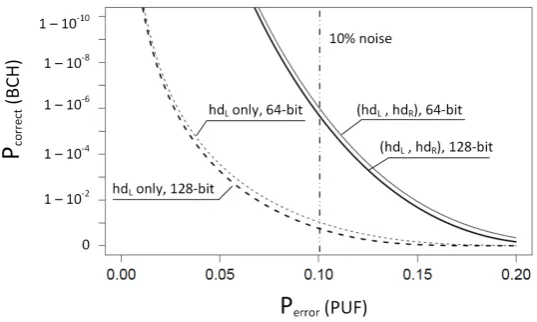
Error decoding is performed adaptively. We first correct the rows, then decode remaining faulty bits over the columns. Figure 5 plots the probability of a faulty output after the error decoding as a function of the error probability of the PUF output. The residual error rate is 1−1.92×10⁻⁶, which is comparable to the acceptable error rate for standard performance levels in [27]. Several authors have proposed techniques to improve the reliability of SRAM PUF with respect to environmental conditions and aging [9, 28]. These techniques, when applied to our design, may allow to reduce the complexity of the error correction code.
Fig. 5. Probability for a faulty PUF output using the proposed interleaved coding technique.
do not explicitly leak PUF data, and it employs the working heuristic that these combinations are ’random enough’. We experimentally verified that the 216 possible BCH code words, parsed into {16,16,16,15}-bit fields, show no collisions within a field. Thus 216 us the security level per code word5. The entire matrix is covered by four independent code words over the rows, and four independent code words over the columns. An attack of 264 complexity, is to guess four code words and then use the helper data to estimate the PUF output. Since every element of the matrix holds different PUF output bits, the adversary must find at least the code words overallthe rows, or the code words over theall columns. That is a lower bound for this attack strategy, because four codewords over a combination of rows and columns cannot cover the complete matrix, and therefore cannot recover all PUF output bits. As noted above, the dependency hdL⊕cwL=hdR⊕cwR, cannot reduce the complexity of the search below 264, since every single code word has security level 216, and since the smallest number of code-words required to recover the PUF output data is four6.
Strong Extractor. The role of strong extractor is to reduce the non-uniform data (PUF output data) to the required entropy level. We assume the proposed PRF works as a strong extractor. As discussed earlier, the PRF still uses a
5
One may think that the helper data from a (63,16,23)-BCH code decreases the min-entropy by 63−16 = 47-bit. This means that the PUF’s data must always have full-entropy (i.e., min-entropy rate is 1) from the view point of information theory. Instead, we evaluate the computational complexity that the adversary can really guess the PUF’s original data by observing the helper data.
secret key. The secret key sk0 is pre-shared and updated after every successful authentication. The strong extractor is a probabilistic function, and requires a random inputrnd. Following H˚astadet al.[16], we select the size ofrndto be twice the security level. For 128-bit security,|rnd|= 256 is sufficient to derive 128-bit randomness with input 128-bit min-entropy data (i.e. 504-bit PUF’s outputz10).
3.6 Relevant Data Sizes and Key Lengths in Protocol
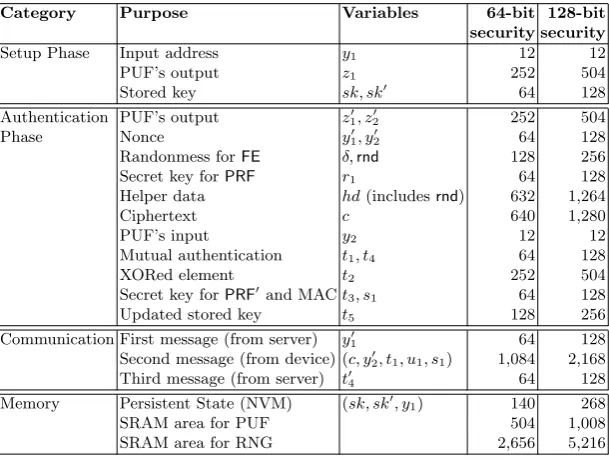
From the above analysis and instantiation, we summarize the length for each variable for 64-bit and 128-bit security in Table 1.
Table 1.Key Length and Data Sizes (in bits) for the proposed protocol
Category Purpose Variables 64-bit 128-bit
security security
Setup Phase Input address y1 12 12
PUF’s output z1 252 504
Stored key sk, sk0 64 128 Authentication PUF’s output z01, z02 252 504 Phase Nonce y01, y20 64 128 Randonmess forFE δ,rnd 128 256 Secret key forPRF r1 64 128 Helper data hd(includesrnd) 632 1,264
Ciphertext c 640 1,280
PUF’s input y2 12 12
Mutual authentication t1, t4 64 128 XORed element t2 252 504 Secret key forPRF0and MACt
3, s1 64 128
Updated stored key t5 128 256 Communication First message (from server) y01 64 128 Second message (from device) (c, y02, t1, u1, s1) 1,084 2,168 Third message (from server) t0
4 64 128
Memory Persistent State (NVM) (sk, sk0, y1) 140 268 SRAM area for PUF 504 1,008 SRAM area for RNG 2,656 5,216
4
Architecture Design
In this section, we describe the architecture design of the implementation. We introduce the overall design, discuss the detailed implementation of the crypto-graphic accelerator, and finally discuss the prototype evaluation.
4.1 System Design
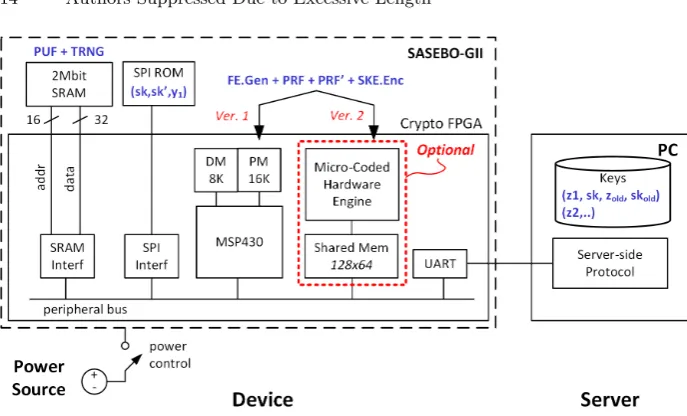
Fig. 6.System Architecture of the Device and Server
device is an MSP430 Microcontroller mapped as a soft-core into the Crypto FPGA of the SASEBO-GII board. The design integrates an SRAM, a non-volatile memory, a UART, and optionally a hardware accelerator. The MSP430 core has its own program memory and data memory; the SRAM is used solely as a source of entropy. The power source to the device is controlled as part of the testing environment.
The server manages a database with secret keys and PUF responses. For each device authenticated through this server, the database stores two pairs of keys and PUF responses, one for the current authentication (z1, sk), and one from the previous authentication (zold, skold). The communication between the device and the server is implemented through a serial connection.
The 16-bit MSP430 microcontroller is configured with 8KByte of data mem-ory and 16KByte of program memmem-ory. We will discuss the detailed memmem-ory re-quirements of the protocol in Section 5. We implement two different versions of this design. In the first version, the protocol is mapped fully in C and executed on the MSP430. In the second version, the major computational bottlenecks, including Fuzzy Extractor Generation (FE.Gen), PRF computation (PRF and PRF0) and Encryption (SKE.Enc) are executed in the hardware engine. In this configuration, the MSP430 is used as a data multiplexer between the UART, the SRAM, the non-volatile memory and the hardware engine.
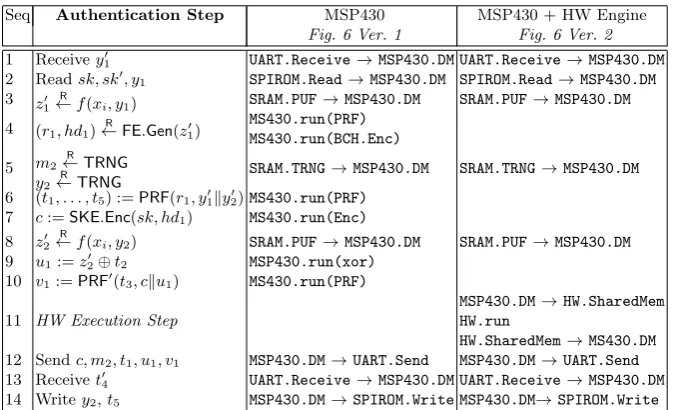
shown for the software-only implementation (Ver. 1) as well as for the hardware-engine enabled implementation (Ver. 2). Table 2 demonstrates the principal data flows in the architecture. For example, “SPIROM.Read→MSP430.DM” means that data is copied from the SPI-ROM to the MSP430 data memory.
Table 2. Principal Data Flows during Execution of the Authentication Protocol on the Device. Dataflow notationA.a → B.bindicates that data fromA(port/methoda) is forwarded toB(port/methodb)
Seq Authentication Step MSP430 MSP430 + HW Engine
Fig. 6 Ver. 1 Fig. 6 Ver. 2
1 Receivey01 UART.Receive→MSP430.DM UART.Receive→MSP430.DM 2 Readsk, sk0, y1 SPIROM.Read→MSP430.DM SPIROM.Read→MSP430.DM 3 z0
1
R
←f(xi, y1) SRAM.PUF→MSP430.DM SRAM.PUF→MSP430.DM 4 (r1, hd1)
R
←FE.Gen(z0
1)
MS430.run(PRF) MS430.run(BCH.Enc)
5 m2
R
←TRNG SRAM.TRNG→MSP430.DM SRAM.TRNG→MSP430.DM y2
R
←TRNG
6 (t1, . . . , t5) :=PRF(r1, y01ky02)MS430.run(PRF) 7 c:=SKE.Enc(sk, hd1) MS430.run(Enc) 8 z20
R
←f(xi, y2) SRAM.PUF→MSP430.DM SRAM.PUF→MSP430.DM 9 u1:=z20⊕t2 MSP430.run(xor)
10 v1:=PRF0(t3, cku1) MS430.run(PRF)
11 HW Execution Step
MSP430.DM→HW.SharedMem HW.run
HW.SharedMem→MS430.DM 12 Sendc, m2, t1, u1, v1 MSP430.DM→UART.Send MSP430.DM→UART.Send 13 Receivet04 UART.Receive→MSP430.DM UART.Receive→MSP430.DM 14 Writey2,t5 MSP430.DM→SPIROM.Write MSP430.DM→SPIROM.Write
Fig. 7.Block Diagram of the Hardware Engine
4.2 Hardware Engine
The purpose of the hardware engine is to accelerate the PRF computation, BCH encoding, and SIMON encryption. Indeed, our profiling results (discussed fur-ther, Table 5) show that these operations constitute to 88% of the total execution time. The protocol can be realized with a small and fixed microprogram so we applied a micro-coded design methodology. Moreover, since it is efficient to use a RAM to store the protocol variables, the very same memory can also store the micro-coded instructions. Although this design is prototyped on FPGAs, it can also target dedicated hardware. By changing the microprogram, we can extend this architecture to other protocols as well.
Figure 7 shows the block diagram of the hardware engine. It uses the round-serial version of SIMON 128/128 for the PRF and encryption operations, and an LFSR-based implementation of the BCH encoding for the error correction part of the FE.Gen. Therefore, it takes 68 clock cycles to encrypt one 128-bit block and 16 clock cycles to encode one 16-bit block.
The shared memory between the MSP430 and the micro-coded hardware engine is a single memory element which has a word size of 72-bits. The least significant 64-bits of each word store the data, while the most significant 8-bits store the micro-coded instruction. Since these instructions are fixed at design time, this section of the memory is treated as a ROM. After the hardware engine reads a word from the memory, it decodes the micro-coded instruction. Then based on the decoded value, the controller selects which operation to run with the associated data and updates the value of the program counter.
5
Evaluation
Table 3.MSP430 Memory Footprint. Data area includes Global and Local Variables (stack,bssanddata).
Category 64-bit 128-bit 128-bit Unit
MSP430 MSP430 HW engine + MSP430
Text
HW Abstraction 1,022 1,022 1,398 bytes Communications 496 644 628 bytes SIMON PRF 1,604 2,440 0 bytes BCH Encoding 1,214 1,214 0 bytes PUF + Fuzzy Extr 562 646 590 bytes
TRNG 396 456 396 bytes
Protocol 1,568 1,682 1,908 bytes
Overall Text 6,862 8,104 4,920 bytes
DataVariables 424 656 656 bytes Constants 197 197 73 bytes
Overall Data 621 853 729 bytes
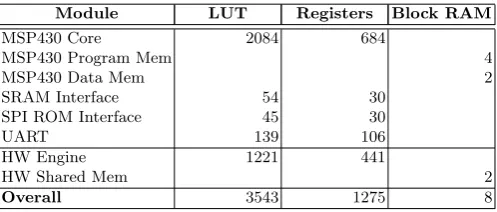
Table 4.Hardware Utilization (Xilinx XC5VLX30-1FFG324 System Clock 1.846 MHz)
Module LUT Registers Block RAM
MSP430 Core 2084 684
MSP430 Program Mem 4
MSP430 Data Mem 2
SRAM Interface 54 30 SPI ROM Interface 45 30
UART 139 106
HW Engine 1221 441
HW Shared Mem 2
Overall 3543 1275 8
5.1 Implementation Cost
Table 3 shows the memory footprint required for each version, including the size of the MSP430 object code, and the data-memory requirements. We used the GNUgcc version 4.6.3to compile C for the MSP430 at optimization level 2. As our main objective was to demonstrate the implementation of the complete protocol, we did not use low-level programming techniques. However, the data indicates that the protocol already fits into a small microcontroller. When the hardware engine is enabled, the tasks of the MSP430 reduce to interfacing the SRAM, NVM and UART. We envisage that it is feasible to completely remove the MSP430 microcontroller by having the hardware engine directly access these peripherals.
Table 5.Implementation Performance in System Clock Cycles.
Protocol Step Implementation 64-bit 128-bit 128-bitw.
Target HW Engine
Fig. 6 Ver. 1 Fig. 6 Ver. 1 Fig. 6 Ver. 2
Readsk, sk0, y1 Read ROM (SPI) 31,356 61,646 61,646
y02
R
←TRNG,y2
R
←TRNG SRAM TRNG 11,552 23,341 22,981
z01
R
←f(xi, y1),z02
R
←f(xi, y2) SRAM PUF 4,384 9,082 8,741 (r1, hd)
R
←FE.Gen(z10)
BCH Encoder 268,820 485,094 Strong Extractor 28,691 205,080 (t1, . . . , t5) :=PRF(r1, y10ky20) PRF 44,355 299,724
c:=SKE.Enc(sk, hd) Encryption 39,583 252,829
v1:=PRF0(t3, cku1) PRF’ 57,601 394,126
18,597
Overall 486,343 1,730,922 111,965
Writey2,t5 Write ROM (SPI) 76,290 128,829 128,849
5.2 Performance
Table 5 lists the performance of our design, measured in system clock cycles. We implemented this design at a System Clock of 1.846 Mhz to reflect the constrained platform for the device. The hardware engine can drastically reduce the cycle count of the implementation. The cycle count shown for the hardware engine includes the overhead of preparing data; the actual compute time is only 4,486 cycles.
5.3 Related Work
The comparison of this design to related works is not obvious because previous publications did not implement an end-to-end demonstrator. Table 6 presents a comparison of related realizations. We emphasize our design has many advan-tages (such as flexibility, formal properties, full implementation) that cannot be expressed as a single quantity.
5.4 Benchmark Analysis
We analyzed our protocol with respect to a recently published benchmark for PUF based protocols [10]. Our protocol is implemented using a weak PUF. The protocol requiresn+ 1 challenge-response pairs fornauthentications. The total number of PUF responses depends on the anonymity needs of the application.
Table 6.Comparison with previous work
Reference PUFKY[27] Slender[29] Reverse-FE[38] This work
Operation Key generation Protocol Protocol Protocol
Privacy No No No Yes
Security flaws No Major [10] Minor [10] No Implemented N/A Device Device Device,
Parties Server
Communication Yes: Bus No No Yes: Bus, UART Interface
Flexibility Low Low Low High
Reconfiguration Redesign Redesign Redesign Modify Software, Method Hardware Hardware Hardware Update Microcode Demonstrator FPGA FPGA FPGA FPGA + PC Security-level 128-bits 128-bits 128-bits 64,128-bits Execution time 55,310 - - 18,597 (clock cycles)
Logic Cost 210 Slices 144 LUT, 658 LUT, 1221 LUT, (w/o PUF) 274 Register 496 Register 441 Register PUF-type Strong-PUF Strong-PUF - Weak-PUF PUF-instance RO-PUF XOR-Arbiter - SRAM Hardware Platform XC6SLX45 XC5VLX110T XC5VLX50 XC5VLX30
6
Conclusion
We demonstrated the challenging path from the world of protocol theory to concrete software/hardware realization for the case of a privacy preserving au-thentication protocol. We observe that bringing all components of a protocol together in a single embodiment is a vital and important step to check its feasi-bility. Furthermore, the formal basis of the protocol is crucial to preventcutting cornersin the implementation.
Even though we claim this work is the first demonstration of a PUF-based protocol with a formal basis, there is always room for improvement. First, the current implementation can be optimized at the architectural level, for through-put, area, or power [3]. Second, new components and algorithms, such as novel PUF architectures [19] or novel coding techniques [18], may enable us to revisit steps within the protocol itself.
References
1. Anderson, J.H.: A PUF design for secure FPGA-based embedded systems. In: ASP-DAC 2010. pp. 1–6. IEEE (2010)
2. Aysu, A., Gulcan, E., Moriyama, D., Schaumont, P., Yung, M.: End-to-end design of a PUF-based privacy preserving authentication protocol. In: G¨uneysu, T., Hand-schuh, H. (eds.) CHES 2015. LNCS, vol. 9293, pp. 556–576. Springer, Heidelberg (2015)
3. Aysu, A., Gulcan, E., Schaumont, P.: SIMON says: Break area records of block ciphers on FPGAs. Embedded Systems Letters 6(2), 37–40 (2014)
4. Beaulieu, R., Shors, D., Smith, J., Treatman-Clark, S., Weeks, B., Wingers, L.: The SIMON and SPECK families of lightweight block ciphers. IACR Cryptology ePrint Archive 2013, 404 (2013)
5. Becker, G.T.: Personal communication (2015)
6. Bernstein, D.J.: Error-prone Cryptographic Designs. Real World Cryp-tography Workshop (January 2015), http://cr.yp.to/talks/2015.01.07/ slides-djb-20150107-a4.pdf
7. Bolotnyy, L., Robins, G.: Physically unclonable function-based security and privacy in RFID systems. In: PerCom 2007. pp. 211–220. IEEE (2007)
8. Claes, M., van der Leest, V., Braeken, A.: Comparison of SRAM and FF PUF in 65nm technology. In: Laud, P. (ed.) NordSec 2011. LNCS, vol. 7161, pp. 47–64. Springer, Heidelberg (2011)
9. Cortez, M., Hamdioui, S., van der Leest, V., Maes, R., Schrijen, G.J.: Adapting voltage ramp-up time for temperature noise reduction on memory-based PUFs. In: HOST 2013. pp. 35–40. IEEE (2013)
10. Delvaux, J., Gu, D., Peeters, R., Verbauwhede, I.: A survey on lightweight en-tity authentication with strong PUFs. IACR Cryptology ePrint Archive 2014, 977 (2014),http://eprint.iacr.org/2014/977
11. Delvaux, J., Verbauwhede, I.: Side channel modeling attacks on 65nm arbiter PUFs exploiting CMOS device noise. In: HOST 2013. pp. 137–142. IEEE (2013) 12. Delvaux, J., Verbauwhede, I.: Fault injection modeling attacks on 65 nm arbiter and
RO sum PUFs via environmental changes. IEEE Trans. on Circuits and Systems 61-I(6), 1701–1713 (2014)
13. Dodis, Y., Ostrovsky, R., Reyzin, L., Smith, A.: Fuzzy extractors: How to generate strong keys from biometrics and other noisy data. SIAM J. Comput. 38(1), 97–139 (2008)
14. Gassend, B.: Physical Random Fuctions. Master’s thesis, Massachusetts Institute of Technology (2003)
15. G¨uneysu, T.: Using data contention in dual-ported memories for security applica-tions. Signal Processing Systems 67(1), 15–29 (2012)
16. H˚astad, J., Impagliazzo, R., Levin, L.A., Luby, M.: A pseudorandom generator from any one-way function. SIAM J. Comput. 28(4), 1364–1396 (1999)
17. Helfmeier, C., Boit, C., Nedospasov, D., Seifert, J.: Cloning physically unclonable functions. In: HOST 2013. pp. 1–6. IEEE (2013)
18. Herder, C., Ren, L., van Dijk, M., Yu, M.M., Devadas, S.: Trapdoor compu-tational fuzzy extractors. IACR Cryptology ePrint Archive 2014, 938 (2014), http://eprint.iacr.org/2014/938
20. Hori, Y., Kang, H., Katashita, T., Satoh, A., Kawamura, S., Kobara, K.: Evaluation of physical unclonable functions for 28-nm process field-programmable gate arrays. JIP 22(2), 344–356 (2014)
21. Jin, Y., Xin, W., Sun, H., Chen, Z.: PUF-based RFID authentication protocol against secret key leakage. In: Sheng, Q.Z., Wang, G., Jensen, C.S., Xu, G. (eds.) APWeb 2012, LNCS, vol. 7235, pp. 318–329. Springer, Heidelberg (2012)
22. Juels, A., Weis, S.A.: Defining strong privacy for RFID. ACM Trans. Inf. Syst. Secur. 13(1) (2009)
23. Jung, S.W., Jung, S.: HRP: A HMAC-based RFID mutual authentication protocol using PUF. In: ICOIN 2013. pp. 578–582. IEEE (2013)
24. Krishna, A.R., Narasimhan, S., Wang, X., Bhunia, S.: MECCA: A robust low-overhead PUF using embedded memory array. In: Preneel, B., Takagi, T. (eds.) CHES 2011. LNCS, vol. 6917, pp. 407–420. Springer, Heidelberg (2011)
25. Kulseng, L., Yu, Z., Wei, Y., Guan, Y.: Lightweight mutual authentication and ownership transfer for RFID systems. In: INFOCOM, 2010 Proceedings IEEE. pp. 251–255. IEEE (2010)
26. Lee, M.Z., Dunn, A.M., Katz, J., Waters, B., Witchel, E.: Anon-pass: Practical anonymous subscriptions. IEEE Security & Privacy 12(3), 20–27 (2014)
27. Maes, R.: Physically Unclonable Functions - Constructions, Properties and Appli-cations. Springer (2013)
28. Maes, R., van der Leest, V.: Countering the effects of silicon aging on SRAM PUFs. In: HOST 2014. pp. 148–153. IEEE (2014)
29. Majzoobi, M., Rostami, M., Koushanfar, F., Wallach, D.S., Devadas, S.: Slen-der PUF protocol: A lightweight, robust, and secure authentication by substring matching. In: IEEE Security & Privacy. pp. 33–44. IEEE (2012)
30. Moriyama, D., Matsuo, S., Yung, M.: PUF-based RFID authentication secure and private under complete memory leakage. IACR Cryptology ePrint Archive 2013, 712 (2013),http://eprint.iacr.org/2013/712
31. Nedospasov, D., Seifert, J., Helfmeier, C., Boit, C.: Invasive PUF analysis. In: Fischer, W., Schmidt, J. (eds.) FDTC 2013. pp. 30–38. IEEE (2013)
32. Oren, Y., Sadeghi, A., Wachsmann, C.: On the effectiveness of the remanence decay side-channel to clone memory-based PUFs. In: Bertoni, G., Coron, J. (eds.) CHES 2013. LNCS, vol. 8086, pp. 107–125. Springer, Heidelberg (2013)
33. Paral, Z.S., Devadas, S.: Reliable and efficient PUF-based key generation using pattern matching. In: HOST 2011. pp. 128–133. IEEE (2011)
34. R¨uhrmair, U., S¨olter, J., Sehnke, F., Xu, X., Mahmoud, A., Stoyanova, V., Dror, G., Schmidhuber, J., Burleson, W., Devadas, S.: PUF modeling attacks on simu-lated and silicon data. IEEE Transactions on Information Forensics and Security 8(11), 1876–1891 (2013)
35. R¨uhrmair, U., Xu, X., S¨olter, J., Mahmoud, A., Majzoobi, M., Koushanfar, F., Burleson, W.P.: Efficient power and timing side channels for physical unclonable functions. In: Batina, L., Robshaw, M. (eds.) CHES 2014. LNCS, vol. 8731, pp. 476–492. Springer, Heidelberg (2014)
38. Van Herrewege, A., Katzenbeisser, S., Maes, R., Peeters, R., Sadeghi, A., Ver-bauwhede, I., Wachsmann, C.: Reverse fuzzy extractors: Enabling lightweight mu-tual authentication for PUF-enabled RFIDs. In: Keromytis, A.D. (ed.) FC 2012. LNCS, vol. 7397, pp. 374–389. Springer, Heidelberg (2012)
39. Yu, M.D., M’Ra¨ıhi, D., Devadas, S., Verbauwhede, I.: Security and reliability prop-erties of syndrome coding techniques used in PUF key generation. In: 38th GO-MACTech conference. pp. 1–4 (2013)
A
Security Analysis
A.1 Security Model for Anonymous Authentication Protocols
We follow the security model in [30] and describe the theoretical security and privacy.
Communication Model. Consider that there is one trustworthy serverS and n devices. We denote a set of device by Dev := {Dev0, . . . ,Devn}. For initial-ization, the server runs a setup algorithm Setup(1k) and generates public pa-rameter pp and secret keys sk. In some cases, the server communicates with devices in a secure environment and transfers the critical information to start the authentication. When the authentication phase is started, these parties in-teract in an insecure network and authenticate each other. Finally, the parties output 1 (acceptance) or 0 (rejection) as the authentication result, respectively. A communication sequence between them is called a session, and each session is distinguished by session identifier sidwhich contains a series of communication message. We say that a session has a matching session if the communication messages generated by the server and the device are honestly transferred until they authenticate each other.
Security. The well-known highest security level for authentication protocols is the resilience to the man-in-the-middle attack. The authentiation results for both parties becomes 1 if and only if the communication message is honestly transferred. In addition to the canonical security requirement for the man-in-the-middle attack, we allow the adversary can obtain the memory content in the non-volatile memory before and after the session (authentication) in our model. In a theoretical level, the security is evaluated by the following experiment between a challenger and adversaryA.
ExpSecΠ,A(k)
(pp, sk)←R Setup(1k); (Devi,sid∗)
R
← A1Launch,SendServer,SendDev,Result,Reveal(pp,S,Dev); b:=Result(Devi,sid∗);
Outputb
– Launch(1k ): Launch the server to start a new session. – SendServer(m): Send arbitrary messagemto the server.
– SendDev(Devi, m): Send arbitrary messagemto the deviceDevi∈Dev. – Result(P,sid): Output whether the sessionsidofP is accepted or not where
P∈ {S,Dev}.
– Reveal(Devi): Output whole information contained in the memory in Devi.
The advantage of adversaryAagainst Π, AdvSecΠ,A(k), is defined by probability thatExpSecΠ,A(k) outputs 1 on the condition thatsid
∗
ofPhas no matching session.
Definition 1. An authentication protocol Π holds the security against man-in-the-middle attack with key compromise if for any probabilistic polynomial time adversaryA,AdvSecΠ,A(k)is negligible ink (for large enoughk).
Privacy. The privacy definition described in [30] is based on the indistinguishability-based privacy such that the adversary selects two devices and tries to distinguish the communication derived from one of the two devices. The privacy experiment between a challenger and adversaryA:= (A1,A2,A3) is the following:
ExpINDΠ,A∗-b(k)
(pp, sk)←R Setup(1k); (Dev∗0,Dev∗1, st1)
R
← A1Launch,SendServer,SendDev,Result,Reveal(pp,S,Dev); b← {U 0,1},Dev0 :=Dev\ {Dev∗0,Dev∗1};
π0
R
←Execute(S,Dev∗0), π1
R
←Execute(S,Dev∗1); st2
R
← ALaunch2 ,SendServer,SendDev,Result,Reveal(S,Dev0,I(Dev∗b), π0, π1, st1):
π00←R Execute(S,Dev∗0), π10 ←R Execute(S,Dev∗1);
b0 ← AR 3Launch,SendServer,SendDev,Result,Reveal(S,Dev, π00, π01, st2);
After the setup phase, the adversary issues the oracle queries as the security experiment and submits (Dev∗0,Dev∗1) to the challenger. The challenger flips a bit b← {U 0,1}and allows the adversary to interact with Dev∗b in an anonymous way. This anonymous interaction is accomplished by adding a special identity
I who honestly transfers the communication message betweenA andDev∗b. To avoid a trivial attack in the symmetric key based construction, both Dev∗0 and Dev∗1 execute a honest session with the server denoted by Execute before and after the anonymous interaction and its transcripts are sent to the adversary. The advantage of the adversary is defined as
AdvINDΠ,A∗(k) :=|Pr[ExpINDΠ,A∗-0(k)→1]−Pr[ExpΠ,INDA∗-1(k)→1]|.
A.2 Formal Security Definition for Building Blocks
Toward the provable security, we show the detailed security definition for each building blocks used in our protocols.
Physically Unclonable Functions (PUFs). f :K × D → Ris a physically unclonable function which takes as input a physical chatacterics implemented in the device x ∈ K and input message y ∈ D and outputs z ←R f(x, y). To dinstinguish multiple devices, we denote PUF as f(x1,·), f(x2,·), . . .. We say that the PUF is (n, `, d, h, )-secure PUF if the following conditions hold:
1. For any PUF f(x1,·) and for any inputy1∈ D,
Pr[HD(f(x1, y1), f(x1, y1))< d] = 1−.
2. For any PUFs f(x1,·), f(x2,·) and for any inputy1∈ D,
Pr[HD(f(x1, y1), f(x2, y1))> d] = 1−.
3. For any PUF f(x1,·) and for any inputsy1, y2∈ D,
Pr[HD(f(x1, y1), f(x1, y2))> d] = 1−.
4. For any PUFs f(x1,·), . . . , fxn,·)and for any inputsy1, . . . , t`∈ D,
Pr[ ˜H∞(f(xi∗, yj∗){f(xi, yj)}≤n,≤j≤`,i6=i∗,j6=j∗> h] =−.
These formulations provide that the intra-distance is smaller than d, inter dis-tance (from two metrics) is larger than dand (conditional) min-entropy of the PUF is always larger thanh.
Definition 3. A PUF satisfies (n, `, d, h, )-secure PUF if all the above condi-tions hold.
Fuzzy Extractor. A (d, h, )-fuzzy extractorFEconsists of two algorithms: key generation algorithm FE.Genand reconstruction algorithmFE.Rec. TheFE.Gen algorithm takes as input a variablezand output a keyrand helper datahd. For correctness,FE.Recrecovers the keyrfrom the input variablezand helper data hd if the hamming distance betweenz andz0 is at mostd. The fuzzy extractor satisfies security if the min-entropy of inputzis at leasth,ris statistically-close to a uniformly random variable in{0,1}k, even if the helper data is disclosed.
Definition 4. A fuzzzy extractor satisfies(d, h, )-fuzzy extractor if the following conditions hold:
1. Pr[r:=FE.Rec(z0, hd)|(r, hd)←R FE.Gen(z),HD(z, z0)≤d] = 1. 2. IfH˜∞(z)≥h,(r, hd)
R
Pseudorandom Function (PRF). A pseudorandom functionPRF:{0,1}k×
{0,1}∗ → {0,1}k0
which takes as input a secret key sk ∈ {0,1}k and input m∈ {0,1}∗ and provides an arbitrary stringPRF(sk, m) which is
indistinguish-able from random string. The security of the PRF is defined by the following experiment between a challenger and adversary A. First, the challenger selects coinb← {U 0,1}and secret keysk← {U 0,1}k. The challenger also prepares a truly random functionRF. The adversaryAcan adaptively issue a oracle query to the challenger to obtain a response of a function. WhenAsends m, the challenger respondsPRF(sk, m) ifb= 1. On the other hand, ifb= 0, the challenger inputs m to RF and responds its result. Finally, the adversary outputs a guess b0. If b0 = b, the adversary wins the experiment. The advantage of the adversary to win the experiment is defined byAdvPRFA (k) =|2·Pr[b0=b]−1|.
Definition 5. A PRF is -secure PRF for any probabilistic polynomial time adversaryA,AdvPRFA (k)≤holds.
A.3 Security Proof for the Proposed Protocol
Theorem 1. Let PUFf be a(n, `, d, h, 1)-secure PUF,FEbe a(d, h, 2)-fuzzy
extractor, PRFbe a 3-secure PRF. Then our protocolΠ holds security against
man-in-the-middle attack with key compromise. Especially, we have AdvSecΠ,A ≤ `n(1+2+3).
Proof. The goal of the adversaryAis to violate the security experiment and it means that the server or the device accepts the session without maching session. LetSibe the advantage that the adversary wins the game in Gamei. We consider the following game transformations.
Game 0.This is the original game between the challenger and the adversary. Game 1. The challenger randomly guesses the device Dev∗ ←U Dev. If Dev∗
does not participate insid∗ , the challenger aborts the game.
Game 2.Assume that`is the upper bound of the sessions that the adversary can establish in the game. For 1≤j≤`, we transform the variables related to the the session between the server andDev∗up to the `-th session as the following.
Game 2-j-1. The challenger evaluates the output from the PUF imple-mented inDev∗at thej-th session. If the intra-distance is larger thand, inter-distance is smaller thand or min-entropy of the output is smaller thand, the challenger aborts the game.
Game 2-j-2. The output from the fuzzy extractor r1 is changed to a random variable.
Game 2-j-3.The output from the PRFPRF(r1,·) is derived from a truly random function.
Game 2-j-4.The output from the PRFPRF(rold,·) is derived from a truly random function.
Game 2-j-5. We change the XORed output u1 := t2⊕z20 to randomly chosenu1
U
Game 2-j-6.The output from the PRFPRF0(t3,·) is derived from a truly random function.
Lemma 1. S0=n·S1 (wherenis the number of devices).
The violation of security means that there is a session which the server or device accepts the session while the communication is modified by the adversary. Since we assume that the number of device is at mostn, the challenger can correctly guess the related session with probability at least 1/n.
Lemma 2. |S1−S2-1-1| ≤1and|S2-(j−1)-6−S2-j-1| ≤1 for any2≤j ≤` if
the PUF is(n, `, d, h, 1)-secure PUF.
We now assume that the PUF satisfies (n, `, d, h, 1)-secure PUF in advance. This means the intra-distance is less thand, inter-distance is larger thandand min-entropy of the PUF is always larger thanhexcept the negligible probability . SinceS1 andS2-(j−1)-6 assume the condition except the negligible probability
and S2-1-1 and S2-j-1 requires the condition with probability 1, respectively, the gap between them is bounded by1.
Lemma 3. ∀1 ≤ j ≤ `, |S2-j-1−S2-j-2| ≤ 2 if the FE is a (d, h, 2)-fuzzy
extractor.
From the proof of Lemma 2, we can assume that the PUF provides enough min-entropy h. Then the property of the (d, h)-fuzzy extractor guarantees that the output for the fuzzy extractor is statistically close to random and no adversary can distinguish the difference between the two games.
Lemma 4. ∀1≤j≤`, |S2-j-2−S2-j-3| ≤AdvPRFB (k)for a PPT algorithmB.
Lemma 5. ∀1≤j≤`, |S2-j-3−S2-j-4| ≤AdvPRFB (k)for a PPT algorithmB.
If there is a difference between these games, we construct the algorithmBwhich breaks the security or PRF G. B can access the real PRF PRF(r1,·) or truly random functionRF.Bsets up all secret keys and simulates our protocol except the n-th session. When the adversary invokes the n-th session, B sends y1
U ← {0,1}k as the output of the server. WhenAsendsy∗
1 to a deviceDevi,Bselects
y20 and issuesy∗1ky02to the oracle instead of the normal computation ofG. Upon receiving (t1, . . . , t5),B continues the computation as the protocol specification and outputs (c, y20, t1, u1, v1) as the device’s response. When the adversary sends (y2∗, t∗1, u∗1, v∗1),Bissuesy1ky∗2 to the oracle and obtains (t01, . . . , t05).
IfBaccesses the real PRF, this simulation is equivalent to Game 2-j-2. Oth-erwise, the oracle query issued byBis completely random and this distribution is equivalent to Game 2-j-3. Thus we have|S2-j-2−S2-j-3| ≤AdvPRFB (k).
Lemma 6. ∀1≤j≤`, S2-j-4=S2-j-5.
Lemma 7. ∀1≤j≤`, |S2-j-5−S2-j-6| ≤2·AdvPRF 0
B (k)for a PPT algorithm
B.
Consider an algorithm Bwhich interacts with PRFPRF0(t3,·) or random func-tionRF.Bruns setup algorithm and simulates the protocol up to then-th session. After computing (c, u1) and issuescku1to the oracle.Bgenerates the other vari-ables as the previous game and sends (c, y20, t1, u1, v1) as the device’s output after it obtains v1 from the oracle. If the server receives (c∗, y2∗, t∗1, u∗1, v1∗), B checks that (c∗, y∗2) = (c, y02). If so,B issues c∗ky∗1 to the oracle to check whether its response is identical tov1∗.
IfBaccesses the real PRF, this simulation is equivalent to Game 2-j-5. Oth-erwise, B’s simulation is identical to Game 2-j-6. Thus the difference between these games are bounded by the security of PRFG0. Similarly, we can evaluate
the gap betweenPRF0(t03,·) andRF.
Since the above game transformation is bounded by certain assumptions (for PUF, fuzzy extractor and PRFs), we can transform Game 0 to Game 2-` -6. When we consider Game 2-`-6, it is impossible for the adversary to violate the security. Consider the case that the server accepts the session which is not actually derived the device. Assume that the adversary obtains (c, y0
2, t1, u1, v1) from the device. To mount the man-in-the-middle attack, the adversary must modify at least one of these variables. Even when the adversary issues the reveal query and obtains (sk, y1) before the session, it only reveals hd1 decrypted by
c and it is hard for the adversary to estimater1from the property of the fuzzy extractor. While the adversary can select arbitrary messagehd0 and compute a ciphertextc0 :=SKE.Enc(sk, hd0) which is actually decrypted by the server, it is hard for the adversary to generate validv10 =PRF0(t3, c0ku1) withoutt3 (due to the pseudorandomness from PRF). Similarly, if the adversary changesy02oru1, the pseudorandom function is already changed to the truly random function and it is infeasible for the adversary to generate a valid (t1, v1) directly corresponding to these variables. Therefore, no adversary cannot mount the man-in-the-middle
attack in our protocol. ut
Theorem 2. Let PUFf be a(n, `, d, h, 1)-secure PUF,FEbe a(d, h, 2)-fuzzy
extractor and PRF be a 3-secure PRF. Then our protocol holds forward and
backward privacy.
Proof. The proof we provide here is similar to that for Theorem 1. We first assume that our protocol holds security. Otherwise, the adversary desynchro-nizes the secret key between the server and gadget over the resynchronization capability. Then the server continuously reject message came from the gadgets and the adverary easily distinguishes the server interacts with the ligitimate or desynchronized device. Since we already proved Theorem??, this concern is cleared.
biased information which identifies the challenger’s coin is leaked. Again, memory content (sk, y1) does not provide any information about the target device since it is generated by PRF or selected from random. The challenger can estimate (Dev∗0,Dev
∗
1) with probability at least 1/n2so the game transformation is finished within a polynomial time. Therefore. we can say that the proposed protocol