Cryptanalysis of
MORUS
?Tomer Ashur1, Maria Eichlseder2, Martin M. Lauridsen, Ga¨etan Leurent3, Brice Minaud4, Yann
Rotella3, Yu Sasaki5, and Benoˆıt Viguier6
1 imec-COSIC, KU Leuven, Belgium 2
Graz University of Technology, Austria
3 Inria, France 4
Royal Holloway University of London, United Kingdom
5 NTT, Japan
6
Radboud University, Netherlands
[email protected],[email protected],[email protected],
[email protected],[email protected],[email protected],[email protected],
Abstract. MORUS is a high-performance authenticated encryption algorithm submitted to the CAESAR competition, and recently selected as a finalist. There are three versions of MORUS:
MORUS-640with a 128-bit key, andMORUS-1280with 128-bit or 256-bit keys. For all versions the security claim for confidentiality matches the key size. In this paper, we analyze the components of this algorithm (initialization, state update and tag generation), and report several results. As our main result, we present a linear correlation in the keystream of fullMORUS, which can be used to distinguish its output from random and to recover some plaintext bits in the broadcast setting. ForMORUS-1280, the correlation is 2−76, which can be exploited after around 2152encryptions, less than what would be expected for a 256-bit secure cipher. ForMORUS-640, the same attack results in a correlation of 2−73, which does not violate the security claims of the cipher.
To identify this correlation, we make use of rotational invariants inMORUSusing linear masks that are invariant by word-rotations of the state. This motivates us to introduce single-word versions of
MORUS calledMiniMORUS, which simplifies the analysis. The attack has been implemented and verified onMiniMORUS, where it yields a correlation of 2−16.
We also study reduced versions of the initialization and finalization ofMORUS, aiming to evaluate the security margin of these components. We show a forgery attack when finalization is reduced from 10 steps to 3, and a key-recovery attack in the nonce-misuse setting when initialization is reduced from 16 steps to 10. These additional results do not threaten the fullMORUS, but studying all aspects of the design is useful to understand its strengths and weaknesses.
Keywords: MORUS, CAESAR, Authenticated Encryption, Nonce Respecting, Linear Cryptanal-ysis, Confidentiality.
1
Introduction
Authenticated Encryption (AE) schemes combine the functionality of symmetric encryption schemes and message authentication codes. Based on a shared secret key K, they encrypt a plaintext message
M to a ciphertext C and authentication tag T in order to protect both the confidentiality and the authenticity of M. Most modern authenticated encryption algorithms are nonce-based schemes with associated data (AEAD), where (C, T) additionally depends on a unique nonceN (or initialization value IV) and optional associated metadata A. One of the most prominent standardized AEAD designs is AES-GCM[MV04,Dwo07], which is widely deployed in protocols such asTLS(since v1.2).
To address the growing need for modern authenticated encryption designs for different application scenarios, the CAESAR competition was launched in 2013 [CAE13]. The goal of this competition is to select a final portfolio of AEAD designs for three different use-cases: (1) lightweight hardware character-istics, (2) high-speed software performance, and (3) robustness. The competition attracted 57 first-round submissions, 7 of which were recently selected as finalists in the fourth selection round.
MORUS is one of the three finalists for use-case (2), together with OCBand AEGIS. This family of authenticated ciphers by Wu and Huang [WH16] provides three main variants:MORUS-640with a 128-bit
?c
key andMORUS-1280with either a 128-bit or a 256-bit key. The design approach is reminiscent of classical stream cipher designs and continuously updates a relatively large state with a few fast operations.MORUS can be efficiently implemented in both software and hardware; in particular, the designers claim that the software performance even surpasses AES-GCM implementations using Intel’s AES-NI instructions, and that MORUSis the fastest authenticated cipher not usingAES-NI[WH16].
Related Work. In the MORUS submission document, the designers discuss the security of MORUS against several attacks, including algebraic, differential, and guess-and-determine attacks. The main focus is on differential properties, and not many details are given for other attack vectors. In third-party analysis, Mileva et al. [MDV15] propose a distinguisher in the nonce-reuse setting and practically evaluate the differential behaviour of toy variants of MORUS. Shi et al. [SGLZ16] analyze the differential properties of the finalization reduced to 2 out of 10 steps, but find no attacks. Dwivedi et al. [DKM+16] discuss the applicability of SAT solvers for state recovery, but the resulting complexity of 2370 for
MORUS-640 is well beyond the security claim. Dwivedi et al. [DMW17] also propose key-recovery attacks for MORUS-1280if initialization is reduced to 3.6 out of 16 steps, and discuss the security ofMORUSagainst internal differentials and rotational cryptanalysis. Salam et al. [SSB+17] apply cube attacks to obtain
distinguishers for up to 5 out of 16 steps of the initialization of MORUS-1280with negligible complexity. Additionally, Kales et al. [KEM17] and Vaudenay and Viz´ar [VV17] independently propose state-recovery and forgery attacks onMORUS in a nonce-misuse setting with negligible data and time complexities.
Finally, a keystream correlation similar in nature to our main attack was uncovered by Minaud [Min14] on the authenticated cipherAEGIS[WP16,WP13], another CAESAR finalist.AEGIS shares the same overall structure asMORUS, but uses a very different state update function, based on the parallel application of AES rounds, rather than the shift/AND/XOR operations used in MORUS. Similar to our attack, the approach in [Min14] is to build a linear trail linking ciphertext bits, while canceling the contribution of inner state bits. How the trail is built depends primarily on the state update function, and how it lends itself to linear cryptanalysis. Because the state update function differs significantly between AEGIS and MORUS, the process used to build the trail is also quite different.
Our Contributions. Our main contribution is a keystream distinguisher on full MORUS-1280, built from linear approximations of its core StateUpdatefunction. In addition, we provide results for round-reducedMORUS, targeting both the initialization or finalization phases of the cipher.
In more detail, our main result is a linear approximation [Mat93,MY92] linking plaintext and cipher-text bits spanning five consecutive encryption blocks. Moreover, the correlation does not depend on the secret key of the cipher. In principle, this property could be used as a known-plaintext distinguisher, or to recover unknown bits of a plaintext encrypted a large number of times. ForMORUS-1280with 256-bit keys, the linear correlation is 2−76 and can be exploited using about 2152 encrypted blocks.
To the best of our knowledge, this is the first attack on fullMORUSin the nonce-respecting setting. We note that rekeying does not prevent the attack: the biases are independent of the secret encryption key and nonce, and can be exploited for plaintext recovery as long as a given plaintext segment is encrypted sufficiently often, regardless of whether each encryption uses a different key. A notable feature of the linear trail underpinning our attack is also that it does not depend on the values of rotation constants: a very similar trail would exist for most choices of round constants.
To obtain this result, we propose a simplified abstraction ofMORUS, calledMiniMORUS.MiniMORUS takes advantage of certain rotational invariants in MORUS and simplifies the description and analysis of the attack. We then show how the attack can be extended from MiniMORUS to the real MORUS. To confirm the validity of our analysis, we practically verified the correlation of the full linear trail for MiniMORUS, as well as the correlation of trail fragments for the fullMORUS. Our analysis is also backed by a symbolic evaluation of the full trail equation and its correlation on all variants of MORUS.
In addition to the previous attack on fullMORUS, we provide two secondary results: (1) we analyze the security of MORUS against forgery attacks with round-reduced finalization; and (2) we analyze its security against key recovery in a nonce-misuse setting, with round-reduced initialization. While this extra analysis does not threaten full MORUS, it complements the main result to provide a better overall understanding of the security of MORUS. More precisely, we present a forgery attack for round-reduced MORUS-1280 with success probability 2−88for a 128-bit tag if the finalization is reduced to 3 out of 10
result targets round-reduced initialization with 10 out of 16 steps, and extends a state-recovery attack (which can be mounted e.g. in a nonce-misuse setting) into a key-recovery attack.
Outline. This paper is organized as follows. We first provide a brief description ofMORUSin Section2. In Section3, we introduceMiniMORUS, an abstraction of MORUSbased on a certain class of rotational invariants. We analyze this simplified scheme in Section4and provide a ciphertext-only linear approxima-tion with a weight of 16. We then extend our result to the full scheme in Secapproxima-tion5, showing a correlation in the keystream over 5 steps, and discuss the implications of our observation for the security of MORUSin Section6. In Section7, we present our results on the security ofMORUSwith round-reduced initialization (in a nonce-misuse setting) or finalization. We conclude in Section8.
2
Preliminaries
MORUSis a family of authenticated ciphers designed by Wu and Huang [WH16]. An instance ofMORUS is parametrized by a secret key K. During encryption, it takes as input a plaintext messageM, a nonce
N, and possibly some associated data A, and outputs a ciphertext C together with an authentication tag T. In this section, we provide a brief description of MORUS and introduce the notation for linear approximations.
2.1 Specification of MORUS
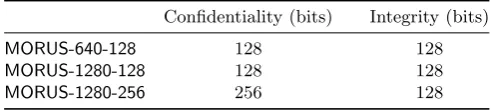
The MORUS family supports two internal state sizes: 640 and 1280 bits, referred to as MORUS-640 and MORUS-1280, respectively. Three parameter sets are recommended: MORUS-640 supports 128-bit keys andMORUS-1280 supports either 128-bit or 256-bit keys. The tag size is 128 bits or shorter. The designers strongly recommend using a 128-bit tag. With a 128-bit tag, integrity is claimed up to 128 bits and confidentiality is claimed up to the number of key bits (Table1).
State. The internal state of MORUS is composed of five q-bit registers Si, i ∈ {0,1,2,3,4}, where
q= 128 forMORUS-640andq= 256 forMORUS-1280. The internal state ofMORUSmay be represented asS0kS1kS2kS3kS4. Registers are themselves divided into fourq/4-bitwords. Throughout the paper, we
denote the word size byw=q/4, i.e.,w= 32 forMORUS-640andw= 64 forMORUS-1280.
The encryption process of MORUS consists of four parts: initialization, associated data processing, encryption, and finalization. During the initialization phase, the value of the state is initialized using a key and nonce. The associated data and the plaintext are then processed block by block. Then the internal state undergoes the finalization phase, which outputs the authentication tag.
Every part of this process relies on iterating theStateUpdatefunction at the core ofMORUS. Each call to theStateUpdatefunction is called a step. The internal state at steptis denoted byS0tkS1tkS2tkS3tkS4t,
where t=−16 before the initialization andt= 0 after the initialization.
The StateUpdate Function. StateUpdatetakes as input the internal stateSt=S0tkS1tkS2tkS3tkS4t and
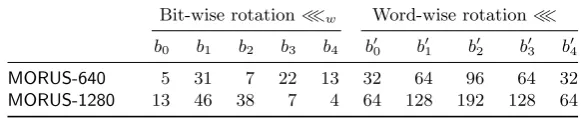
an additionalq-bit valuemt(recall thatqis the size of a register), and outputs an updated internal state. StateUpdate is composed of 5 rounds with similar operations. The additional input mt is used in rounds 2 to 5, but not in round 1. Each round uses the bit-wise rotation (left circular shift) operation inside word, denoted ≪w in the following andRotl xxx yy in the design document. It divides a q-bit register value into 4 words of w= q/4 bits, and performs a rotation on each w-bit word. The bit-wise
Table 1: Security goals of MORUS.
Confidentiality (bits) Integrity (bits)
MORUS-640-128 128 128
MORUS-1280-128 128 128
Table 2: Rotation constantsbi for≪wandb0i for≪in roundiof MORUS.
Bit-wise rotation≪w Word-wise rotation≪
b0 b1 b2 b3 b4 b00 b01 b02 b03 b04 MORUS-640 5 31 7 22 13 32 64 96 64 32
MORUS-1280 13 46 38 7 4 64 128 192 128 64
rotation constants bi for round i are defined in Table 2. Additionally, each round uses rotations on a whole q-bit register by a multiple of the word size, denoted≪ in the following and <<<in the design document. The word-wise rotation constantsb0i are also listed in Table 2.
St+1←StateUpdate(St, mt) is defined as follows, where·denotes bit-wise AND,⊕is bit-wise XOR, andmi is defined depending on the context:
Round 1: S0t+1←(S0t⊕(S1t·S2t)⊕S3t)≪wb0, S3t←S
t
3≪b00.
Round 2: S1t+1←(S1t⊕(S2t·S3t)⊕S4t⊕mi)≪wb1, S4t←S
t
4≪b
0
1.
Round 3: S2t+1←(S2t⊕(S3t·S4t)⊕S0t⊕mi)≪wb2, S0t←S
t
0≪b02.
Round 4: S3t+1←(S3t⊕(S4t·S0t)⊕S1t⊕mi)≪wb3, S1t←S
t
1≪b
0
3.
Round 5: S4t+1←(S4t⊕(S0t·S1t)⊕S2t⊕mi)≪wb4, S2t←S
t
2≪b04.
Initialization. The initialization of MORUS-640starts by loading the 128-bit keyK128 and the 128-bit
nonce N128into the state together with constantsc0, c1:
S0−16=N128, S1−16=K128, S2−16= 1
128, S−16
3 =c0, S4−16=c1.
Then, StateUpdate(St,0) is iterated 16 times fort=−16,−15, . . . ,−1. Finally, the key is XORed into the state again with S0
1←S10⊕K128.
The initialization of MORUS-1280 differs slightly due to the difference in register size and the two possible key sizes, and uses either K =K128kK128 (for MORUS-1280-128) or K =K256 (for
MORUS-1280-256) to initialize the state:
S0−16=N128k0128, S1−16=K, S
−16 2 = 1
256, S−16 3 = 0
256, S−16
4 =c0kc1.
After iteratingStateUpdate16 times, the state is updated withS0
1 ←S10⊕K.
Associated Data Processing. After initialization, the associated data A is processed in blocks of
q∈ {128,256} bits. For the padding, if the last associated data block is not a full block, it is padded to
q bits with zeroes. If the length ofA, denoted by|A|, is 0, then the associated data processing phase is skipped; else, the state is updated as
St+1←StateUpdate(St, At) fort= 0,1, . . . ,d|A|/qe −1.
Encryption. Next, the message is processed in blocksMtofq∈ {128,256}bits to update the state and produce the ciphertext blocks Ct. If the last message block is not a full block, a string of 0’s is used to pad it to 128 or 256 bits for MORUS-640 and MORUS-1280, respectively, and the padded full block is used to update the state. However, only the partial block is encrypted. Note that if the message length denoted by|M|is 0, encryption is skipped. Letu=d|A|/qeandv=d|M|/qe. The following is performed fort= 0,1, . . . , v−1:
Ct←Mt⊕S0u+t⊕(S1u+t≪b02)⊕(S
u+t
2 ·S
u+t
Finalization. The finalization phase generates the authentication tag T using 10 more StateUpdate steps. We only discuss the case where T is not truncated. The associated data length and the message length are used to update the state:
1. L ← |A| k |M| for MORUS-640 or L ← |A| k |M| k 0128 for MORUS-1280, where |A|,|M| are
represented as 64-bit integers. 2. S4u+v←S4u+v⊕S0u+v.
3. Fort=u+v, u+v+ 1, . . . , u+v+ 9,computeSt+1←StateUpdate(St, L).
4. T =Su0+v+10⊕(S1u+v+10≪b02)⊕(S2u+v+10·S3u+v+10), or the least significant 128 bits of this value in case of MORUS-1280.
2.2 Notation
In the following, we use linear approximations [Mat93] that hold with probability Pr(E) = 12 +ε, i.e., they are biased with bias ε. The correlation cor(E) of the approximation and itsweight weight(E) are defined as
cor(E) := 2 Pr(E)−1 = 2ε ,
weight(E) :=−log2|cor(E)|,
where log2() denotes logarithm in base 2. By the Piling-Up Lemma, the correlation (resp. weight) of an XOR of independent variables is equal to the product (resp. sum) of their individual correlations (resp. weights) [Mat93].
We also recall the following notation from the previous section, where an encryption step refers to one call to theStateUpdatefunction:
Ct : the ciphertext block output during thet-th encryption step.
Cjt : thej-th bit ofCt, with C0t being the rightmost bit.
St
i : thei-th register at the beginning oft-th encryption step.
St
i,j: thej-th bit ofSti, withSi,t0 being the rightmost bit.
In the above notation, bit positions are always taken modulo the register sizeq, i.e.,q= 128 for MORUS-640 andq= 256 forMORUS-1280.
For simplicity, in the remainder, the 0-th encryption step will often denote the encryption step where our linear trail starts. Any encryption step could be chosen for that purpose, as long as at least four more encryption steps follow. In particular the 0-th encryption step from the perspective of the trail does not have to be the first encryption step after initialization.
3
Rotational Invariance and
MiniMORUS
To simplify the description of the attack, we assume all plaintext blocks are zero. This assumption will be removed in Section 5.3, where we will show that plaintext bits only contribute linearly to the trail. Recall that the inner state of the cipher consists of five 4w-bit registersS0, . . . , S4, each containing four w-bit words.
3.1 Rotationally Invariant Linear Combinations
We begin with a few observations about the StateUpdatefunction. Besides XOR and AND operations, theStateUpdatefunction uses two types of bit rotations:
1. bit-wise rotations perform a circular shift on each word within a register; 2. word-wiserotations perform a circular shift on a whole register.
The second type of rotation always shifts registers by a multiple of the word size w. This amounts to a (circular) permutation of the words within the register: for example, if a register contains the words (A, B, C, D), and a word-wise rotation bywbits to the left is performed, then the register now contains the words (B, C, D, A).
Definition 1 (Rotational Invariance). Recall thatwdenotes the word size in bits, and4wis the size of a register. A linear combination of the form:
Si,jt (0)⊕Si,jt (1)⊕ · · · ⊕Si,jt (k)
is said to be rotationally invariantiff the set of bitsSt
i,j(0), . . . , S
t
i,j(k) is left invariant by a circular shift by wbits; that is, iff:
{j(i) :i≤k}={j(i) +wmod 4w:i≤k}.
Example.The following linear combination is rotationally invariant forMORUS-640, i.e.w= 32:
S0t,0⊕S0t,32⊕S0t,64⊕S0t,96. (1)
This definition naturally extends to a linear combination across multiple registers, and also across ciphertext blocks. The value of such a linear combination is unaffected by word-wise rotations, since those rotations always shift registers by a multiple of the word size. On the other hand, since bit-wise rotations always shift all four words within a register by the same amount, bit-wise rotations preserve the rotational invariance property. Moreover, the XOR of two rotationally invariant linear combinations is also rotationally invariant.
This naturally leads to the idea of building a linear trail using only rotationally invariant linear combinations, which is what we are going to do. As a result, the effect of word-wise rotations can be ignored. Moreover, since all linear combinations we consider are going to be rotationally invariant, they can be described by truncating the linear combination to the first word of a register. Indeed, an equivalent way of saying a linear combination is rotationally invariant, is that it involves the same bits in each word within a register. For example, in the case of (1) above, the four bits involved are the first bit of each of the four words.
3.2 MiniMORUS
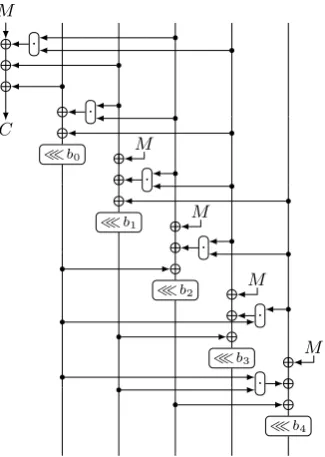
In fact, we can go further and consider a reduced version of MORUS where each register contains a single word instead of four. TheStateUpdate function is unchanged, except for the fact that word-wise rotations are removed: see Figure 1. We call these reduced versionsMiniMORUS-640 and MiniMORUS-1280, forMORUS-640andMORUS-1280respectively. Since registers inMiniMORUScontain a single word, bit-wise and word-wise rotations are the same operation; for simplicity we write≪for bit-wise rotations. Since the trail we are building is relatively complex, we will first describe it onMiniMORUS. We will then extend it to the fullMORUSvia the previous rotational invariance property.
4
Linear Trail for
MiniMORUS
In this section, we describe how we build a trail forMiniMORUS, then compute its correlation and validate the correlation experimentally.
4.1 Overview of the Trail
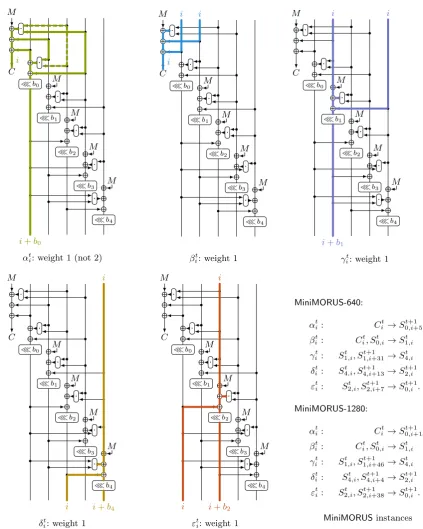
To build a linear trail for MiniMORUS, we combine the following five trail fragments αt
i, βit, γit, δit, εti, where the subscripti denotes a bit position, and the superscriptt denotes a step number:
– αt
i approximates (one bit of) state wordS0 using the ciphertext;
– βitapproximatesS1usingS0and the ciphertext;
– γit approximatesS4 using two approximations ofS1in consecutive steps;
– δt
i approximatesS2using two approximations ofS4 in consecutive steps;
– εt
i approximatesS0 using two approximations ofS2 in consecutive steps.
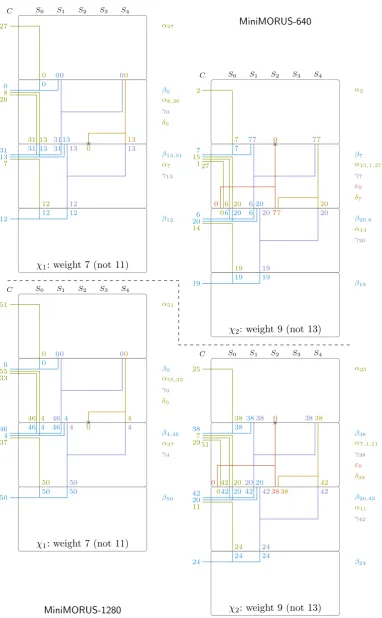
The trail fragments are depicted on Figure2. In all cases exceptαt
i, the trail fragment approximates a single AND gate by zero, which holds with probability 3/4, and hence the trail fragment has weight 1. In the case ofαt
·
M
C
≪b0
·
≪b1
·
≪b2
·
≪b3
·
≪b4
·
M
M
M
M
Fig. 1:MiniMORUSstate update function.
cases the other entry also has a linear contribution to the trail, which results in an overall contribution of the form (see [AR16, Sec. 3.3])
x·y⊕x·z⊕y⊕z= (x⊕1)·(y⊕z).
As a result, the trail fragment αt
i also has a weight of 1. Another way of looking at this phenomenon is that the trail holds for two different approximations of the AND gates: the alternative approximation is depicted by a dashed line on Figure2.
The way we are going to use each trail fragment may be summarized as follows, where in each case, elements to the left of the arrow→are used to approximate the element on the right of the arrow:
αti : Cit→S0t+1,i+b
0
βti : Cit, St0,i→S1t,i
γti : S1t,i, S1t+1,i+b
1 →S
t
4,i
δti : S4t,i, S4t+1,i+b
4 →S
t+1 2,i
εti : S2t,i, S2t+1,i+b
2 →S
t+1 0,i .
In more detail, the idea is that by using αt
i, we are able to approximate a bit of S0 using only a
ciphertext bit. By combiningαt i with β
t+1
i+b0, we are then able to approximate a bit of S1 (at stept+ 1)
using only ciphertext bits from two consecutive steps. Likewise, γt
i allows us to “jump” from S1 to S4,
i.e. by combiningαt
i withβitandγitwith appropriate choices of parameterstandi for each, we are able to approximate one bit ofS4 using only ciphertext bits. Notice however thatγitrequires approximating
S1 in two consecutive steps; and so the previous combination requires usingαti andβ t
i twice at different steps. In the same way, δit allows us to jump fromS4 to S2; andεti allows jumping from S2 back to S0.
Eventually, we are able to approximate a bit of S0 using only ciphertext bits via the combination of all
trail fragments αt
i,βit,γit,δit, andεti.
However, the same bit of S0 can also be approximated directly by using αti at the corresponding step. Thus that bit can be linearly approximated from two different sides: the first approximation uses a combination of all trail fragments, and involves successive approximations of all state registers (exceptS3)
spanning several encryption steps, as explained in the previous paragraph. The second approximation only involves usingαt
·
M
C
≪b0
·
≪b1
·
≪b2
·
≪b3
·
≪b4
· M M M M i
i+b0
αti: weight 1 (not 2)
·
M
C
≪b0
·
≪b1
·
≪b2
·
≪b3
·
≪b4
· M M M M i i i
βti: weight 1
·
M
C
≪b0
·
≪b1
·
≪b2
·
≪b3
·
≪b4
· M M M M i i
i+b1
γt
i: weight 1
·
M
C
≪b0
·
≪b1
·
≪b2
·
≪b3
·
≪b4
· M M M M i
i i+b4
δti: weight 1
·
M
C
≪b0
·
≪b1
·
≪b2
·
≪b3
·
≪b4
· M M M M i
i i+b2
εti: weight 1
MiniMORUS-640:
αti: C t i →S
t+1 0,i+5
βit: C t i, S
t 0,i→S
t 1,i
γit: S t 1,i, S
t+1 1,i+31→S
t 4,i
δit: S t 4,i, S
t+1 4,i+13→S
t+1 2,i
εti: St2,i, S2t+1,i+7→S t+1 0,i .
MiniMORUS-1280:
αti: C t i →S
t+1 0,i+13
βit: C t i, S
t 0,i→S
t 1,i
γit: S t 1,i, S
t+1 1,i+46→S
t 4,i
δit: S t 4,i, S
t+1 4,i+4→S
t+1 2,i
εti: S t 2,i, S
t+1 2,i+38→S
t+1 0,i .
MiniMORUSinstances
Of course, the overall trail resulting from all of the previous combinations is quite complex, especially since γt
i, δti, and εti each require two copies of the preceding trail fragment in consecutive steps: that is, εt
i requires two approximations of S2, which requires using δti twice; and δti in turn requires using
γt
i twice, which itself requires using αit and βit twice. Then αit is used one final time to close the trail. The full construction with the exact bit indices forMiniMORUS-640andMiniMORUS-1280is illustrated in Figure 3, where the left and right half each show half of the full trail. One may naturally wonder if some components of this trail are in conflict. In particular, products of bits from registers S2 and S3 are approximated multiple times, by αti, β
t i and γ
t
i. To address this concern, and ensure that all approximations along the trail are in fact compatible, we now compute the full trail equation explicitly.
4.2 Trail Equation
The equation corresponding to each of the five trail fragmentsαt
i,βit,γit,δit,εti may be written explicitly as At
i,Bti, Cti, Dti, Eti as follows. For each equation, we write on the left-hand side of the equality the biased linear combination used in the trail; and on the right-hand side, the remainder of the equation, which must have non-zero correlation (in all cases the correlation is 2−1).
Ati : Cit⊕S0t+1,i+b
0 =S
t
1,i⊕S t
3,i⊕S t
1,i·S t
2,i⊕S t
2,i·S t
3,i
Bti : Cit⊕S0t,i⊕S1t,i=St2,i·S3t,i
Cti : S1t,i⊕S1t+1,i+b
1⊕S
t
4,i=S t
2,i·S t
3,i
Dti : S4t,i⊕S4t+1,i+b
4⊕S
t+1 2,i =S
t+1 0,i ·S
t+1 1,i
Eti : S2t,i⊕S2t+1,i+b
2⊕S
t+1 0,i =S
t
3,i·S t
4,i
From an algebraic point of view, building the full trail amounts to adding up copies of the previous equations for various choices oftandi, so that eventually allSy,zx terms on the left-hand side cancel out. Then we are left with only ciphertext terms on the left-hand side, while the right-hand side consists of a sum of biased expressions. By measuring the correlation of the right-hand side expression, we are then able to determine the correlation of the linear combination of ciphertext bits on the left-hand side. We now set out to do so.
In order to build the equation for the full trail, we start withE2 0:
S22,0⊕S32,b
2⊕S
3 0,0=S
2 3,0·S
2 4,0.
In order to cancel theS3
0,0 term on the left-hand side, we add to the equation A2−b0 (where the sum of
two equations of the form a=b andc=dis defined to bea+c=b+d). This yields:
S22,0⊕S23,b
2⊕C
2
−b0
=S32,0·S42,0⊕S12,−b0⊕S32,−b0⊕S12,−b0·S22,−b0⊕S22,−b0·S32,−b0.
We then need to cancel two terms of the formSt
2,i. To do this, we add to the equationsDtifor appropriate choices of tandi. This replaces the twoSt
2,iterms by fourS4t,i terms. By using equationBti four times, we can then replace these four St
4,i terms by eight S1t,i terms. By applying equation Bti eight times, these eightSt
1,i terms can in turn be replaced by eight S0t,i terms (and some ciphertext terms). Finally, applying At
i eight times allows to replace these eight S0t,i terms by only ciphertext bits. Ultimately, for MiniMORUS-1280, this yields the equation:
C510 ⊕C01⊕C251 ⊕C331 ⊕C551 ⊕C42⊕C72⊕C292 ⊕C372
⊕C382 ⊕C462 ⊕C512 ⊕C113 ⊕C203 ⊕C423 ⊕C503 ⊕C244
=S10,51·S20,51⊕S20,51·S30,51⊕S10,51⊕S30,51 weight 1
⊕S11,25·S21,25⊕S21,25·S31,25⊕S11,25⊕S31,25 weight 1
⊕S11,33·S21,33⊕S21,33·S31,33⊕S11,33⊕S31,33 weight 1
⊕S11,55·S21,55⊕S21,55·S31,55⊕S11,55⊕S31,55 weight 1
S0 S1 S2 S3 S4 C 27 0 α27 0 0 0 β0 8 13
α8,26
26 31 0 31 0 γ0 0 13 0 × δ0
31 31 31
β13,31 13 13 13 7 12 α7 13 12 13 γ13 12 12 12 β12
χ1: weight 7 (not 11)
S0 S1 S2 S3 S4
C 2 7 α2 7 7 7 β7 15 20
α15,1,27
1 6 27 0 7 6 7 γ7 7 20 7 δ7 0 × 7 0 ε0
6 6 6 β
20,6 20 20 20 14 19 α14 20 19 20 γ20
19 19 19 β19
χ2: weight 9 (not 13) MiniMORUS-640
S0 S1 S2 S3 S4
C 51 0 α51 0 0 0 β0 55 4
α55,33
33 46 0 46 0 γ0 0 4 0 × δ0
46 46 46 β
4,46 4 4 4 37 50 α37 4 50 4 γ4
50 50 50 β50
χ1: weight 7 (not 11)
MiniMORUS-1280
S0 S1 S2 S3 S4
C 25 38 α25 38 38 38 β38 7 20
α7,1,51
29 42 51 0 38 20 38 γ38 38 42 38 δ38 0 × 38 0 ε0
42 42 42
β20,42 20 20 20 11 24 α11 42 24 42 γ42 24 24 24 β24
χ2: weight 9 (not 13)
Fig. 3:MiniMORUS: two approximations forS22,0. Numbers in each diagram denote bit positions used in the linear approximation, i.e. subscripts ofα, β, γ, δandε.χ1andχ2are two halves of the full trail which
⊕S12,29·S22,29⊕S22,29·S32,29⊕S12,29⊕S32,29 weight 1
⊕S12,37·S22,37⊕S22,37·S32,37⊕S12,37⊕S32,37 weight 1
⊕S12,51·S22,51⊕S22,51·S32,51⊕S12,51⊕S32,51 weight 1
⊕S13,11·S23,11⊕S23,11·S33,11⊕S13,11⊕S33,11 weight 1
⊕S02,0·S21,0 weight 1
⊕S22,46·S32,46 weight 1
⊕S32,0·S24,0 weight 1
⊕S03,38·S13,38 weight 1
⊕S23,20·S33,20 weight 1
⊕S23,50·S33,50 weight 1
⊕S24,24·S34,24 weight 1
The equation forMiniMORUS-640is very similar, and is given in AppendixA.
4.3 Correlation of the Trail
In the equation for MiniMORUS-1280from the previous section, each line on the right-hand side of the equality involves distinct Si,jt terms (in the sense that no two lines share a common term), and each line has a weight of 1. By the Piling-Up Lemma, it follows that if we assume distinct St
i,j terms to be uniform and independent, then the expression on the right-hand side has a weight of 16. Hence the linear combination of ciphertext bits on the left-hand side has a correlation of 2−16. The same holds for
MiniMORUS-640.
The correlation is surprising high. The full trail uses trail fragmentsεt
i,δit,γti,βti, andαti, once, twice, 4 times, 8 times, and 9 times, respectively. Since each trail fragment has a weight of 1, this would suggest that the total weight should be 1 + 2 + 4 + 8 + 9 = 24 rather than 16. However, when combining trail fragments βi and γi, notice that the same AND is computed at the same step between registersS2 and S3 (equivalently, notice that the right-hand side of equations Bti and Cti is equal). In both cases it is approximated by zero. When XORing the corresponding equations, these two ANDs cancel each other, which saves two AND gates. Sinceγitis used four times in the course of the full trail, this results in saving 8 AND gates overall, which explains why the final correlation is 2−16 rather than 2−24.
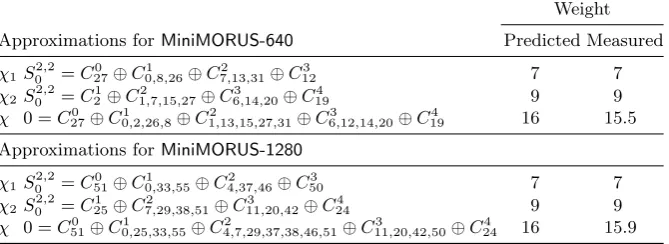
4.4 Experimental Verification
To confirm that our analysis is correct, we ran experiments on an implementation of MiniMORUS-1280 and MiniMORUS-640. We consider two halves χ1 and χ2 of the full trail (depicted on Figure3), as well
as the full trail itself, denoted by χ. In each case, we give the weight predicted by the analysis from the previous section, and the weight measured by our experiments. Results are displayed on Table3. While our analysis predicts a correlation of 2−16, experiments indicate a slightly better empirical correlation of 2−15.5 forMORUS-640. The discrepancy of 2−0.5 probably arises from the fact that register bits across different steps are not completely independent.
The programs we used to verify the bias experimentally are available at: https://github.com/ildyria/MorusBias
5
Trail for Full
MORUS
In the previous section, we presented a linear trail for the reduced ciphersMiniMORUS-1280and MiniMORUS-640. We now turn to the full ciphersMORUS-1280andMORUS-640.
5.1 Making the Trail Rotationally Invariant
Table 3: Experimental verification of trail correlations.
Weight
Approximations forMiniMORUS-640 Predicted Measured
χ1S02,2=C 0
27⊕C01,8,26⊕C72,13,31⊕C312 7 7
χ2S02,2=C 1
2⊕C12,7,15,27⊕C63,14,20⊕C194 9 9
χ 0 =C270 ⊕C01,2,26,8⊕C12,13,15,27,31⊕C63,12,14,20⊕C194 16 15.5
Approximations forMiniMORUS-1280
χ1S02,2=C 0
51⊕C01,33,55⊕C42,37,46⊕C503 7 7
χ2S02,2=C 1
25⊕C72,29,38,51⊕C113,20,42⊕C244 9 9
χ 0 =C510 ⊕C01,25,33,55⊕C42,7,29,37,38,46,51⊕C113,20,42,50⊕C244 16 15.9
one-word registers of MiniMORUS to the four-word registers of full MORUS, we make every term St i,j and Ct
j rotationally invariant, in the sense of Section3. That is, for everySi,jt (resp.Cjt) component in every trail fragment and every equation, we expand the term by adding in the terms St
i,j+w, Si,jt +2w,
St
i,j+3w(resp.Cjt+w,Cjt+2w,Cjt+3w), where as usualwdenotes the word size. For example, ifw= 64 (for MORUS-1280), the term S23,0is expanded into:
S32,0⊕S23,64⊕S23,128⊕S23,192.
Thus, translating the trail from one of the MiniMORUS ciphers to the corresponding full MORUS cipher amounts to making every linear combination rotationally invariant—indeed, that was the point of introducing MiniMORUS in the first place. Concretely, in order to build the full trail equation for MORUS, we write rotationally invariant versions of equationsAt
i,Bti,Cti,Dti,Eti from Section4.2, and then combine them in exactly the same manner as before. This way, the biased linear combination on MiniMORUS-1280given in Section4.2, namely:
C510 ⊕C01⊕C251 ⊕C331 ⊕C551 ⊕C42⊕C72⊕C292 ⊕C372
⊕C382 ⊕C462 ⊕C512 ⊕C113 ⊕C203 ⊕C423 ⊕C503 ⊕C244
ultimately yields the following biased rotationally invariant linear combination on the fullMORUS-1280:
C510 ⊕C1150 ⊕C1790 ⊕C2430 ⊕C01⊕C251 ⊕C331 ⊕C551 ⊕C641 ⊕C891
⊕C971 ⊕C1191 ⊕C1281 ⊕C1531 ⊕C1611 ⊕C1831 ⊕C1921 ⊕C2171 ⊕C2251 ⊕C2471
⊕C42⊕C72⊕C292 ⊕C372 ⊕C382 ⊕C462 ⊕C512 ⊕C682 ⊕C712 ⊕C932
⊕C1012 ⊕C1022 ⊕C1102 ⊕C1152 ⊕C1322 ⊕C1352 ⊕C1572 ⊕C1652 ⊕C1662 ⊕C1742
⊕C1792 ⊕C1962 ⊕C1992 ⊕C2212 ⊕C2292 ⊕C2302 ⊕C2382 ⊕C2432 ⊕C113 ⊕C203
⊕C423 ⊕C503 ⊕C753 ⊕C843 ⊕C1063 ⊕C1143 ⊕C1393 ⊕C1483 ⊕C1703 ⊕C1783
⊕C2033 ⊕C2123 ⊕C2343 ⊕C2423 ⊕C244 ⊕C884 ⊕C1524 ⊕C2164
We refer the reader to AppendixAfor the corresponding linear combination onMORUS-640.
5.2 Correlation of the Full Trail
The rotationally invariant trail on fullMORUSmay be intuitively understood as consisting of four copies of the original trail on MiniMORUS. Indeed, the only difference between fullMORUS (for either version of MORUS) and four independent copies of MiniMORUScomes from word-wise rotations, which permute words within a register. But as observed in Section 3, word-wise rotations preserves the rotational in-variance property; and so, insofar as we only ever use rotationally invariant linear combinations on all registers along the trail, word-wise rotations have no effect.
·
M
C
≪b0
·
≪b1
·
≪b2
·
≪b3
·
≪b4
·
M
M
M
M
i
i i
i+b1
=
MiniMORUS: weight 0 (not 2)
·
M
C
≪b0
·
≪b1
·
≪b2
·
≪b3
·
≪b4
·
M
M
M
M
i
i i
i+b1
MORUS: weight 4×1 (not 4×2)
Fig. 4: Weight ofβti⊕γitforMiniMORUSandMORUS.
To understand why that might be the case, assume a nonlinear termS0
2,0·S30,0arising from some part
of the trail, and another term S0
2,0·S30,w arising from a different part of the trail (wherewdenotes the word size). Then when we XOR the various trail fragments together, inMiniMORUSthese two terms are actually equal and will cancel out, since word-wise rotations by multiples ofwbits are ignored. However in the real MORUSthese terms are of course distinct and do not cancel each other.
In the actual trail for (either version of) fullMORUS, this exact situation occurs when combining trail fragmentsβt
i andγit. Indeed,βitrequires approximating the termS2t,i·S3t,i, whileγtirequires approximating the term St
2,i·S3t,i−w (cf. Figure4). While inMiniMORUS, these terms cancel out, in the fullMORUS, when adding up four copies of the trail to achieve rotational invariance, we end up with the sum:
S2t,i·S3t,i⊕S3t,i·S2t,i+w⊕S2t,i+w·S3t,i+w⊕S3t,i+w·St2,i+2w
⊕S2t,i+2w·S3t,i+2w⊕S3t,i+2w·St2,i+3w⊕St2,i+3w·S3t,i+3w⊕S3t,i+3w·St2,i. (2)
It may be observed that the products occurring in the equation above involve eight terms forming a ring. The weight of this expression can be computed by brute force, and is equal to 3.
ForMORUS-1280, since the trail fragmentγt
i is used four times, this phenomenon adds a contribution of 4·3 = 12 to the overall weight of the full trail. This results in a total weight of 4·16 + 12 = 76 (recall that the weight of the trail onMiniMORUS-1280is 16). We have confirmed this by explicitly computing the full trail equation in Appendix A, and evaluating its exact weight like we did for MiniMORUS in Section 4.3. That is, since the equation is quadratic, we may view it as a graph, which we split into connected components; we then compute the weight of each connected component separately by brute force, and then add up the weights of all components per the Piling-Up Lemma. Overall, the full trail equation given in AppendixAyields a weight of 76 for the full trail onMORUS-1280.
In the case of MORUS-640, collisions between rotation constants further complicate the analysis. Specifically, when using trail fragment βt
i, the termS2t,i·St3,i occurs. As explained previously, a partial collision with the termSt
2,i·S3t,i−wfrom trail fragmentγitresults in Equation (2). However trail fragment
αt
i+dis once used in the course of the full trail with an offset ofd=b1+b4−b0−b2(relative toγti), which in the case of MORUS-640is equal to 31 + 13−5−7 = 0 mod 32. This creates another termSt
5.3 Taking Variable Plaintext into Account
In our analysis so far, for the sake of simplicity, we have assumed that all plaintext blocks are zero. We now examine what happens if we remove that assumption, and integrate plaintext variables into our analysis. What we show is that plaintext variables only contribute linearly to the trail. In other words, the full trail equation with plaintext variables is equal to the full trail equation with all-zero plaintext XORed with a linear combination of plaintext variables.
To see this, recall that plaintext bits contribute to the encryption process in two ways (cf. Section2.1):
1. They are added to some bits derived from the state to form the ciphertext.
2. During each encryption step, theStateUpdatefunction adds a plaintext block to every register except
S0.
The effect of Item1is that whenever we use a ciphertext bit in our full trail equation, the corresponding plaintext bit also needs to be XORed in. Because ciphertext bits only contribute linearly to the trail equation, this only adds a linear combination of plaintext bits to the equation.
Regarding Item2, recall that the full trail equation is a linear combination of (the rotationally invariant version of) equations At
i, Bti, Cti, Dti, Eti in Section 4.2. Also observe that in each equation, state bits that are shifted by a bit-wise rotation only contribute linearly. Because plaintext bits are XORed into each register at the same time bit-wise rotation is performed, this implies that plaintext bits resulting from Item 2 also only contribute linearly. In fact in all cases, it so happens that updating the equation to take plaintext variables into account simply involves XORing in the plaintext bitMt
i.
It may be observed that message blocks in theStateUpdatefunction only contribute linearly to the state, and in that regard play a role similar to key bits in an SPN cipher; and indeed in SPN ciphers, it is the case that key bits contribute linearly to linear trails [Mat93]. In this light the previous result may not be surprising.
In the end, with variable plaintext, our trail yields a biased linear combination of ciphertext bits and plaintext bits. In regards to attacks, this means the situation is effectively the same as with a biased stream cipher: in particular if the plaintext is known we obtain a distinguisher; and if a fixed unknown plaintext is encrypted multiple times (possibly also with some known variable part) then our trail yields a plaintext recovery attack.
6
Discussion
We now discuss the impact of these attacks on the security of MORUS.
Keystream Correlation. We emphasize that the correlation we uncover between plaintext and cipher-text bits is absolute, in the sense that it does not depend on the encryption key, or on the nonce. This is the same situation as the keystream correlations in AEGIS [Min14]. As such, they can be leveraged to mount an attack in the broadcast setting, where the same message is encrypted multiple times with different IVs and potentially different keys [MS01]. In particular, the broadcast setting appears in prac-tice in man-in-the-browser attacks against HTTPS connections following the BEAST model [DR11]. In this scenario, an attacker uses Javascript code running in the victim’s browser (by tricking the victim to visit a malicious website) to generate a large number of request to a secure website. Because of details of the HTTP protocol, each request includes an authentication token to identify the user, and the attacker can target this token as a repeated plaintext. Concretely, correlations in the RC4 keystream have been exploited in this setting, leading to the recovery of authentication cookies in practice [ABP+13].
Data Complexity. The design document of MORUSimposes a limit of 264encrypted blocks for a given
key. However, since our attack is independent of the encryption key, and hence immune to rekeying, this limitation does not apply: all that matters for our attack is that the same plaintext be encrypted enough times.
With the trail presented in this work, the data complexity is clearly out of reach in practice, since exploiting the correlation would require 2152encrypted blocks forMORUS1280, and 2146encrypted blocks
trail in parallel on the same encrypted blocks (recall that wis the word size, and the trail is invariant by rotation by w bits). This would save a factor 25 on the data complexity for MORUS640, and 26 for
MORUS1280; but the resulting complexity is still out of reach.
However,MORUS1280with a 256-bit key claims a security level of 256 bits for confidentiality, and an attack with complexity 2152 violates this claim, even if it is not practical.
Design Considerations. The existence of this trail does hint at some weakness in the design ofMORUS. Indeed, a notable feature of the trail is that the values of rotation constants are mostly irrelevant: a similar trail would exist for most choices of the constants. That it is possible to build a trail that ignores rotation constants may be surprising. This would have been prevented by adding a bit-wise rotation to one of the state registers at the input of the ciphertext equation.
7
Analysis on Initialization and Finalization of Reduced
MORUS
The bias in the previous sections analysed the encryption part of the MORUS. In this section, for com-prehensive security analysis of MORUS, we provide new attacks on reduced version of the initialization and the finalization. We emphasize that the results in this section do not threaten any security claim by the designers. However, we believe that investigating all parts of the design with different approaches from the existing work on MORUS provides a better understanding and will be useful especially when the design will be tweaked in future.
7.1 Forgery with Reduced Finalization
We present forgery attacks on 3 out of 10 steps ofMORUS-1280that claims 128-bit security for integrity. The attack only works for a limited number of steps, while it works in the nonce-respecting setting. As far as we know, this is the first attempt to evaluate integrity of MORUSin the nonce-respecting setting.
Overview. A general strategy for forgery attacks in the nonce-respecting setting is to inject some difference in a message block and propagate it so that it can be canceled by a difference in another message block. However this approach does not work well against MORUS due to its large state size which prevents an attacker from easily controlling the differences in different registers.
Here we focus on the property that the padding for an associated data A and a message M is the zero-padding, henceAandA0=Ak0∗andMandM0=Mk0 result in identical states after the associated data processing and the encryption parts, as long as A, A0 andM, M0 fit in the same number of blocks. During the finalization, sinceA, A0 (resp.M, M0) have different lengths, the corresponding 64-bit values
|A|(resp.|M|) are different, which appears as∆|A|(resp.∆|M|) during the finalization, and is injected through the message input interface. Our strategy is to propagate this difference to the 128-bit tags T
and T0 such that their difference∆T appears with higher probability than 2−128. All in all, the forgery
succeeds as long as the desired ∆T is obtained or in other words, the attacker does not have to cancel the state difference, which is the main advantage of attacking the finalization part of the scheme.
Note that if the attacker uses different messagesM, M0, not only the new tagT0but also new ciphertext
C0 must be guessed correctly. Because the encryption of MORUS is a simple XOR of the key stream,C0
can be easily guessed. For this purpose, the attacker should first query a longer message M0=Mk0∗ to obtainC0. Then,C can be obtained by truncatingC0.
Differential Trails. Recall that the message input during the finalization ofMORUS-1280is|A| k |M| k
0128where|A|and|M|are 64-bit strings. We set∆|A|to be of low Hamming weight, e.g.,0x0000000000000001.
This difference propagates through 3 steps as specified in Table 4.
Recall that each step consists of 5 rounds and the input message is absorbed to the state in rounds 2 to 5. The trail in Table4initially does not have any difference and the same continues even after round 1. Differences start to appear from round 2 and they will go through the bitwise-AND operation from round 4. We need to pay 1 bit to control each active AND gate. The probability evaluation for round 15 can be ignored since in this round onlyS4is non-linearly updated, whileS4is never used for computing the tag.
thus the number of active AND gates should be counted only for those bits. As shown in Table4, we can have a particular tag difference∆T with probability 2−88. Thus after observingAand correspondingT, Ak0 and (T⊕∆T) is a valid pair with probability 2−88.
Remarks. The fact that theS4is updated in the last round but is not used in the tag generation implies
that the MORUS finalization generally includes unnecessary computations with respect to security. It may be interesting to tweak the design such that the tag can also depend on S4. Indeed in Table 4, we
can observe some jump-up of the probability in the tag computation. This is because the non-linearly involved terms areS2·S3, andS3 that was updated 2 rounds before has a high Hamming weight. In this
sense, involvingS4in non-linear terms of the tag computation imposes more difficulties for the attacker.
7.2 Extending State Recovery to Key Recovery
Kales et al. [KEM17] showed that the internal state of MORUS-640 can be recovered under the nonce-misuse scenario using 25 plaintext-ciphertext pairs. As claimed by [KEM17] the attack is naturally
ex-tended toMORUS-1280though Kales et al. [KEM17] did not demonstrate specific attacks. The recovered state allows the attacker to mount a universal forgery attack under the same nonce. However, the key still cannot be recovered because the key is used both at the beginning and end of the initialization, which prevents the attacker from backtracking the state value to the initial state. In this section, we show that meet-in-the-middle attacks allow the attacker to recover the key faster than exhaustive search for a relatively large number of steps, i.e., 10 out of 16 steps inMORUS-1280.
Overview. We divide the 10 steps of the initialization computation into two subsequent parts F0 and F1. (We later set thatF0is the first 4 steps andF1is the last 6 steps.) LetS−10be the initial state value
before setting the key, i.e.,S−10= (N k0128,0256,1256,0256, c0kc1). Also let S0 be 1280-bit state value
after the initialization, which is now assumed to be recovered with the nonce-misuse analysis [KEM17]. We then have the following relation.
F1◦F0 S−10⊕(0, K,0,0,0)
⊕(0, K,0,0,0) =S0.
We target the variant MORUS-1280-128, whereK=K128kK128.
Here, our strategy is to recoverK128 by independently processingF0 and F1−1 to find the following
match.
F0(S−10⊕(0, K128kK128,0,0,0)) ?
=F1−1(S0⊕(0, K128kK128,0,0,0)).
To evaluate the attack complexity, we consider the following parameters.
– G0: a set of bits ofK128 that are guessed for computingF0.
– G1: a set of bits ofK128 that are guessed for computingF1−1.
– G2: a set of bits in the intersection ofG0 andG1.
– xbits can match after processingF0 andF1−1.
Suppose that the union ofG0andG1covers all the bits ofK128. The attack exhaustively guessesG2 and
performs the following procedure for each guess.
1. F0 is computed 2|G0|−|G2|times and the results are stored in a tableT. (Because|G1| − |G2|bits are
unknown, only a part of the state is computed.)
2. F1−1is computed 2|G1|−|G2|times and for each result we check the match with any entry inT.
3. The number of possible combinations is 2|G0|−|G2|+|G1|−|G2|, and the number of valid matches reduces
to 2|G0|−|G2|+|G1|−|G2|−xafter matching thexbits.
4. Check the correctness of the guess by using one plaintext-ciphertext pair.
In the end,F0is computed 2|G2|·2|G0|−|G2|= 2|G0|times. Similarly,F1−1is computed 2|G1|times. The
number of the total candidates after thex-bit match is 2|G2|·2|G0|−|G2|+|G1|−|G2|−x= 2|G0|+|G1|−|G2|−x.
Hence, the key K128 is recovered with complexity
Table 4: Differential propagation through 3 Steps. Five lines for roundidenote the difference ofS0,· · ·, S4
after the round itransformation.
Round State difference Weight Accumulated probability
0000000000000000 0000000000000000 0000000000000000 0000000000000000 0
0000000000000000 0000000000000000 0000000000000000 0000000000000000 0
Ini 0000000000000000 0000000000000000 0000000000000000 0000000000000000 0 − 0000000000000000 0000000000000000 0000000000000000 0000000000000000 0
0000000000000000 0000000000000000 0000000000000000 0000000000000000 0
0000000000000000 0000000000000000 0000000000000000 0000000000000000 0
0000000000000000 0000000000000000 0000000000000000 0000000000000000 0
1 0000000000000000 0000000000000000 0000000000000000 0000000000000000 0 1
0000000000000000 0000000000000000 0000000000000000 0000000000000000 0
0000000000000000 0000000000000000 0000000000000000 0000000000000000 0
0000000000000000 0000000000000000 0000000000000000 0000000000000000 0
0000400000000000 0000000000000000 0000000000000000 0000000000000000 1
2 0000000000000000 0000000000000000 0000000000000000 0000000000000000 0 1
0000000000000000 0000000000000000 0000000000000000 0000000000000000 0
0000000000000000 0000000000000000 0000000000000000 0000000000000000 0
0000000000000000 0000000000000000 0000000000000000 0000000000000000 0
0000400000000000 0000000000000000 0000000000000000 0000000000000000 1
3 0000004000000000 0000000000000000 0000000000000000 0000000000000000 1 1
0000000000000000 0000000000000000 0000000000000000 0000000000000000 0
0000000000000000 0000000000000000 0000000000000000 0000000000000000 0
0000000000000000 0000000000000000 0000000000000000 0000000000000000 0
0000000000000000 0000000000000000 0000400000000000 0000000000000000 1
4 0000004000000000 0000000000000000 0000000000000000 0000000000000000 1 1
0020000000000080 0000000000000000 0000000000000000 0000000000000000 2
0000000000000000 0000000000000000 0000000000000000 0000000000000000 0
0000000000000000 0000000000000000 0000000000000000 0000000000000000 0
0000000000000000 0000000000000000 0000400000000000 0000000000000000 1
2−1 5 0000000000000000 0000000000000000 0000000000000000 0000004000000000 1
0020000000000080 0000000000000000 0000000000000000 0000000000000000 2
0000040000000010 0000000000000000 0000000000000000 0000000000000000 2
0000000000100004 0000000000000000 0000000000000000 0000000000000000 2
0000000000000000 0000000000000000 0000400000000000 0000000000000000 1
2−3
6 0000000000000000 0000000000000000 0000000000000000 0000004000000000 1
0000000000000000 0000000000000000 0000000000000000 0020000000000080 2
0000040000000010 0000000000000000 0000000000000000 0000000000000000 2
0000000000100004 0000000000000000 0000000000000000 0000000000000000 2
0004400001000000 0000000000000000 0000000010000000 0000000000000000 4
2−6 7 0000000000000000 0000000000000000 0000000000000000 0000004000000000 1
0000000000000000 0000000000000000 0000000000000000 0020000000000080 2
0000000000000000 0000000000000000 0000040000000010 0000000000000000 2
0000000000000000 0000000000100004 0000000000000000 0000000000000000 2
0004400001000000 0000000000000000 0000000010000000 0000000000000000 4
2−10
8 0400014000000000 0000000000000000 0000000000000000 0000000000001000 4
0000000000000000 0000000000000000 0000000000000000 0020000000000080 2
0000000000000000 0000000000000000 0000040000000010 0000000000000000 2
0000000000000000 0000000000100004 0000000000000000 0000000000000000 2
0000000010000000 0000000000000000 0004400001000000 0000000000000000 4
2−14
9 0400014000000000 0000000000000000 0000000000000000 0000000000001000 4
0220000080000080 0000000000000000 0000000800000000 1000000000004000 7
0000000000000000 0000000000000000 0000040000000010 0000000000000000 2
0000000000000000 0000000000100004 0000000000000000 0000000000000000 2
0000000010000000 0000000000000000 0004400001000000 0000000000000000 4
2−20 10 0000000000000000 0000000000000000 0000000000001000 0400014000000000 4
0220000080000080 0000000000000000 0000000800000000 1000000000004000 7
4000140000000010 0000000000000000 0000400000000100 0000000000010000 7
0000100000100044 0000000200008000 0001000000000000 0000000008000200 9
0000000010000000 0000000000000000 0004400001000000 0000000000000000 4
2−28
11 0000000000000000 0000000000000000 0000000000001000 0400014000000000 4
0000000000000000 0000000800000000 1000000000004000 0220000080000080 7
4000140000000010 0000000000000000 0000400000000100 0000000000010000 7
0000100000100044 0000000200008000 0001000000000000 0000000008000200 9
0004500005000400 0000000000000000 0040000100000040 4000000000000000 10
2−39 12 0000000000000000 0000000000000000 0000000000001000 0400014000000000 4
0000000000000000 0000000800000000 1000000000004000 0220000080000080 7
0000400000000100 0000000000010000 4000140000000010 0000000000000000 7
0000000008000200 0000100000100044 0000000200008000 0001000000000000 9
0004500005000400 0000000000000000 0040000100000040 4000000000000000 10
2−53
13 0400114000040000 0020000000000080 0004000000400000 0000800100005002 14
0000000000000000 0000000800000000 1000000000004000 0220000080000080 7
0000400000000100 0000000000010000 4000140000000010 0000000000000000 7
0000000008000200 0000100000100044 0000000200008000 0001000000000000 9
0040000100000040 4000000000000000 0004500005000400 0000000000000000 10
2−69
14 0400114000040000 0020000000000080 0004000000400000 0000800100005002 14
0228000280020080 0000040000000000 2000008000202008 1000004000004021 18
0000400000000100 0000000000010000 4000140000000010 0000000000000000 7
0000000008000200 0000100000100044 0000000200008000 0001000000000000 9
0040000100000040 4000000000000000 0004500005000400 0000000000000000 10
15 0020000000000080 0004000000400000 0000800100005002 0400114000040000 14 − 0228000280020080 0000040000000000 2000008000202008 1000004000004021 18
0000400000000100 0000000000010000 4000140000000010 0000000000000000 7
Suppose that we choose |G0|and|G1|to be balanced i.e.,|G0|=|G1|. Then, the complexity is
max(2|G0|,22|G0|−|G2|−x).
Two terms are balanced whenx=|G0| − |G2|. Hence, the number of matched bits in the middle of two
functions must be greater than or equal to the number of independently guessed bits to compute F0 and F1−1.
In the attack below, we choose |G0| = |G1| = 127 and |G2| = 126 (equivalently |G2| − |G0| = |G2| − |G1|= 1) in order to aimx= 1-bit match in the middle, which maximizes the number of attacked
rounds.
Full Diffusion Rounds. We found thatStepUpdatewas designed to have good diffusion in the forward direction. Thus, once the state is recovered, the attacker can perform the partial computation in the backward direction longer than the forward direction. We setG0 andG1as follows.
G0={1,2,· · ·,127} Bit position 0 is unknown.
G1={0,1,· · ·,7,9,10,· · ·,127} Bit position 8 is unknown.
Those will lead to 4 matching bits after the 4-step forward computation and the 6-step backward com-putation. The analysis of the diffusion is given in Table5. In the end,K128can be recovered faster than
the exhaustive search by 1 bit, i.e., with complexity 2127.
Remarks. The matching state does not have to be a border of a step. It can be defined on a border of a round, or even in some more complicated way. We did not find the extension of the number of attacked steps even with this way.
As can be seen in Table5, the updated register in stepiis independent of the update function in step
i+ 1 in the forward direction, and starts to impact from stepi+ 2. By modifying this point, the diffusion speed can increase faster, which makes this attack harder.
8
Conclusion
This work provides a comprehensive analysis of the components of MORUS. In particular, we show that MORUS-1280’s keystream exhibits a correlation of 2−76 between certain ciphertext bits. This enables a
plaintext recovery attack in the broadcast setting, using about 2152 blocks of data. While the amount of
data required is impractical, this seems to violate the security claims of MORUS-1280because the attack works even if the key is refreshed regularly. Moreover, the broadcast setting is practically relevant, as was shown with attacks against RC4 as used in TLS [ABP+13].
We have shared an earlier version of this paper with the authors of MORUSand they agree with the technical details of the keystream bias. However they consider that it is not a significant weakness in practice because it requires more than 264 ciphertexts bits. In the context of the CAESAR competition,
we believe that certificational attacks such as this one should be taken into account, in order to select a portfolio of candidates that reflects the state of the art in terms of cryptographic design.
Table 5: Analysis of the diffusion and matching bits over 10 steps. ‘0’ and ‘1’ denote that the state bit can and cannot be computed from a partial knowledge ofK128, respectively. After the partial computations
from each direction, 4 bits ofS−6can match.
Round State Difference
0000000000000000 0000000000000000 0000000000000000 0000000000000000
S−10⊕K128
0000000000000000 0000000000000001 0000000000000000 0000000000000001 0000000000000000 0000000000000000 0000000000000000 0000000000000000 0000000000000000 0000000000000000 0000000000000000 0000000000000000 0000000000000000 0000000000000000 0000000000000000 0000000000000000 0000000000002000 0000000000000000 0000000000002000 0000000000000000 0000000000000000 0000400000000000 0000000000000000 0000400000000000
1 0008000000000000 0000000000000000 0008000000000000 0000000000000000 0000000000100000 0020000000000000 0000000000100000 0020000000000000 0000000000020000 0084000000000000 0000000000020000 0084000000000000 0800000000000004 0000000204000001 0800000000000004 0000000204000001 8000000a00000000 0000002110000004 8000000a00000000 0000002110000004
2 0400010221000000 008000400a000081 0400010221000000 008000400a000081 1000050001000244 4200118a08000280 1000050001000244 4200118a08000280 880004a0a0200858 4840123350000050 880004a0a0200858 4840123350000050 023d63c00050a850 00a1442000489380 023d63c00050a850 00a1442000489380 02b63380056aaa48 00b5563005dcd6c0 02b63380056aaa48 00b5563005dcd6c0
3 d42ab556bf5dfcd6 5a26f633a8556aaa d42ab556bf5dfcd6 5a26f633a8556aaa 5fbbf556bd556c65 7aab99aaee6bea2c 5fbbf556bd556c65 7aab99aaee6bea2c abff7f3ad7feafad cfff777ffddffd6d abff7f3ad7feafad cfff777ffddffd6d fff77dfffffdcf57 fefad7efffdffbf7 fff77dfffffdcf57 fefad7efffdffbf7 ffffffffffffbfff fffbf7fffddfff77 ffffffffffffbfff fffbf7fffddfff77
4 ffffffffffffffff ffffffffffffffff ffffffffffffffff ffffffffffffffff ffffffffffffffff fffbffffefffffff ffffffffffffffff fffbffffefffffff ffffffffffffffff ffffffffffffffff ffffffffffffffff ffffffffffffffff
2-bits match 2-bits match
ffffffffffffffff ffffffffffffffff ffffffffffffffff ffffffffffffffff ffffffffffffffff ffffffffffffffff ffffffffffffffff ffffffffffffffff
5 ffffffffffffffff ffffffffffffffff ffffffffffffffff ffffffffffffffff fffff7ffedfffff7 ffffffffedffffff fffff7ffedfffff7 ffffffffedffffff ffffffffedffffff fffff7ffedfffff7 ffffffffedffffff fffff7ffedfffff7 ffffffffedffffff fffff7ffedfffff7 ffffffffedffffff fffff7ffedfffff7 fffbf5e7cdfffbf7 fffff7bfcdfff757 fffbf5e7cdfffbf7 fffff7bfcdfff757
6 fffbf5e7cdfffbf7 fffff7bfcdfff757 fffbf5e7cdfffbf7 fffff7bfcdfff757 7ffd75b6cdfff357 fffbf5a6ccfcfb73 7ffd75b6cdfff357 fffbf5a6ccfcfb73 7ffbf5a6ccfcf373 7ff975b6ccfff353 7ffbf5a6ccfcf373 7ff975b6ccfff353 7efbf5a6cc7cf353 7fd975a6cceff353 7efbf5a6cc7cf353 7fd975a6cceff353 7eb950a4cc78e353 7dd07184cced7153 7eb950a4cc78e353 7dd07184cced7153
7 7eb950a4cc78e353 7dd07184ccec7153 7eb950a4cc78e353 7dd07184ccec7153 7cd051044c6c3153 3e985024cc48a313 7cd051044c6c3153 3e985024cc48a313 3c905004cc482313 7c9051044c6c2113 3c905004cc482313 7c9051044c6c2113 2c905004c4482113 7c9050040c682113 2c905004c4482113 7c9050040c682113 2810100444082112 5c1010040c402113 2810100444082112 5c1010040c402113
8 2810100444082112 1c1010040c402113 2810100444082112 1c1010040c402113 0c00100404400113 2800000404082112 0c00100404400113 2800000404082112 0800000404002112 0800100404400113 0800000404002112 0800100404400113 0800000404002112 0800100004000112 0800000404002112 0800100004000112 0000000404000102 0000100004000110 0000000404000102 0000100004000110
9 0000000404000102 0000000004000110 0000000404000102 0000000004000110 0000000004000110 0000000000000102 0000000004000110 0000000000000102 0000000000000100 0000000004000110 0000000000000100 0000000004000110 0000000000000100 0000000004000100 0000000000000100 0000000004000100 0000000000000000 0000000004000100 0000000000000000 0000000004000100
10 0000000000000000 0000000000000100 0000000000000000 0000000000000100 0000000000000100 0000000000000000 0000000000000100 0000000000000000 0000000000000000 0000000000000100 0000000000000000 0000000000000100 0000000000000000 0000000000000000 0000000000000000 0000000000000000
S0⊕K 128