Feedback Sentiment Analysis for Teachers
Recommendation using Data Mining
Ms Swati Meshram
Assistant Professor, P.G. Department of Computer Science, SNDT Women‟s Unviersity, Mumbai India.
ABSTRACT: University development is directly affected by the teaching and research carried out by the university teachers. It mainly depends on teachers‟ performance. A tangible measure of teaching performance is feedback, collected from the stakeholders in natural language. A tool for comprehensive analysis and evaluation of teaching using data mining approach is designed. Classification of feedback opinions based on sentimental analysis of natural language processing and random forest is adopted. Further, the classification will draw attention to the areas which need transformation to improve the university level teaching.
.
KEYWORDS: Text analysis, data mining, natural language processing, random forest, cluster.
I. INTRODUCTION
A teacher is a person who helps others to acquire knowledge, competence, values. Teachers spend majority of time with students in the classroom. Teachers play a very vital role in education system. Teacher‟s effectiveness can be found through students achievement in the academic growth. The indicators of Teachers Quality are educational degrees, certifications, years of teaching experience. These are direct observation measures. The other indirect measures are fluency and vocabulary of the language used for instruction, ease in making the concept clear. However there are certain factors that influence the performance of a student which cannot be controlled by a teacher.
Sentiment analysis It is useful in getting insights of opinions. We can understand how a student feels after analysis of their feedback comments. What they like and dislike about the teacher and learning environment. On this basis we can have recommendation system for the professional growth of the teacher and institution. In NLP the parts of speech is identified. Sentiments of the natural language sentences are determined
The Feedback:
A feedback system or performance review is a method to document, review, and evaluate the performance of an employee at work. The teachers' feedback system is important in higher education as it provides reflection on strengths and weaknesses. If the teachers' feedback is structured it provides an opportunity to transform their weaknesses into strengths and enhance their personality. It guides the teacher to adapt and transform teaching to incorporate students‟ needs. The feedback also helps to gauge the teacher‟s competency which is critical to the progress of the institution. We take the feedback from students and peers.
The feedback describes opinions on several aspects and we come to know the competency and understanding of the teacher for the progress of the Institution. The feedback should be clear, specific, focused, polarity or valence, tone may be supportive, criticism etc.
Opinions are key influencers of behaviors. Opinions are subjective. An opinion from a single person is often not sufficient for action. We need opinions from many people and so opinion summarization is required.
Data Mining :
Data Mining is analysis of large voluminous data to discover knowledge in the form of patterns. A model is constructed based on training data and is used for classification and prediction.
Natural Language Processing :
Natural language processing(NLP), a datamining approach is interaction of computers and natural languages for processing large amount of natural language data. Sentiment analysis is process of determining opinions or feelings of a text in NLP. We humans are good at sentiment analysis.
Why feedback for performance evaluation and recommendation:
Teachers spend majority of time in classroom. They need to maintain healthy association, share information, and work together to fully support in students learning. Teachers effectiveness and Communicating clear information of progress is very important here. Recommender as a means of assisting teachers, institution based on the opinions of the students and peers.
Feedback and Recommendation system is a formative process which evolves over time with feedback giving positive result for the teacher‟s development. Teachers who are experiencing difficulties may benefit from the suggestion for improvement. Also it gives the institution an insight of the strength and areas that need development about teachers. It serves an important input to guide them in their professional development.
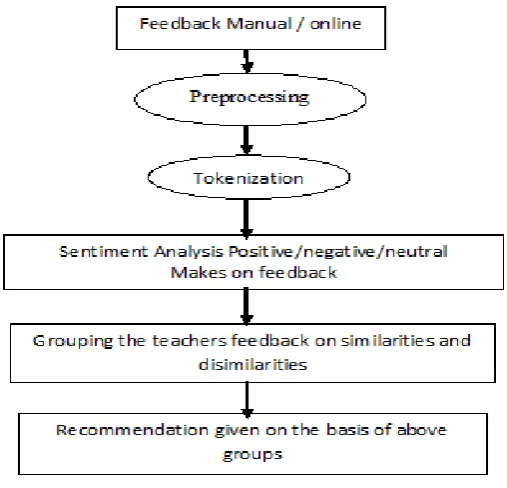
Figure 1 Workflow for teachers feedback and recommendation system
A recommendation system provides it‟s uses/teachers corrected with personalized content/recommendation which highlights the teacher‟s strengths, potentials, characteristics, reactions & gives suggestion in order to transform the weakness into strength. This on weak area in a guide for professional development input. The figure 1 shows the steps followed in Recommendation system.
II. RELATEDWORK
1. Rachael K.F., Iong, Sarah I Fan, Wu, Michelle Xiao Yu and Wang, Susan ShuYang dida study of teaching as a service and students as a customer has been done[2]. It derives five PLZ service quality dimensions to predict satisfaction to teaching performance and overall course evaluation.Which are Assurance, Empathy, Reliability, Responsiveness, Tangible.
2. MehtabulAzamGeetaKingdonin their paper said that Teachers play critical role in student achievement. The impact created by a high quality teacher to low quality teacher adds 0.475 of standard deviation to the score of student [3].
3. FezileMatsebula, Ernest Mnkandladid a survey of various learning anlaytics tools to track the students progress is carried[4]. The use of these tools will help in anlaysis of higher education data which is useful in decision making.
4. AlzainMeftahAlzain,SteveClark,GrenIreson, Ali Jwaid, implemented a LAES an adaptive education based system for learners with different learning needs enhances their knowledge.[5]
5. Nina N. Aniskina, Irina O. Melnik develop a model to highlight the leadership, entrepreneurship qualities and other competencyqualities of teachers are identified to motivate the teachers for continuing education.[6] 6. TetaliSai Krishna Chaitanya, Vakkalanka Sri Harika, Prabadevi.B develop a model for analyzing a given
sentence/paragraph which has multiple subjects, objects, verbs, adjectives and adverbs. A relationship is established between subject(s) with the respective object(s) based on the verb(s) and their adverb(s)[7]
III.TEACHERFEEDBACKEVALUATIONANDRECOMMENDATIONFRAMEWORK
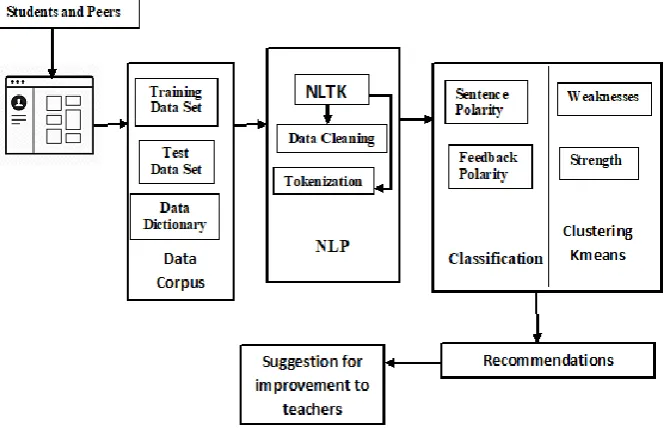
This framework model will tell the feedbacks are positive or negative based on the text. We have set of training data and test data.
Step 1: Preprocessing of data.
Read the training data set from the database. Convert the text so that it is easier to process. Understand the boundaries of the sentences. Apply normalization so that a word which has multiple variants need to represent the context to avoid confusion. Aggressive words are normalize. Stemming where words like computer and computation are put into same category like compute.
Morphological analysis deals with same inflection like car/cars where cars is pure form of car are nouns.
Capitalization : Every sentence often begins with a capital letter or noun emphasis. Convert everything into lowercase letter. Now /NOW where Now is adverb and NOW is National organization for women. Removal of misspelled words for unfamiliar input by matching to dictionary words or words accidentally omitted.
Stop word Removal : Remove the stop word like he, she, we, and, did, to, of, the, his, her etc These are insignificant words.
Iterate through every review in the training data set to form clean reviews. This framework model will output the feedbacks are positive or negative based on the text.
Step 2: Tokenization
Tokenization is process of breaking a sentence into a set of words or tokens whereas eliminating certain characters example punctuation marks. Tokens are sequence of characters treated as semantic unit used for further processing.Use the word-tokenize() module for tokenization in the natural language tool kit (NLTK). In the next step nouns, pronouns, verbs, adverbs and adjectives are found [7].To form an array of words from the piece of text we count the frequency of each word in the text to create a dictionary of them in the tokenization process in NLP. Now the we have every feedback represented as a profile of weighted vector. It contains the features and its associated frequency. We set the maximum features to be 5000.
Step 3: Classifier for sentiment analysis.
A Classifier is a machine learning model used for classification.Random Forest Tree is a classification and regression tree constructed in the training phase that outputs mode of the classes for classification and mean prediction for regression.
Ho proposed in his paper[8], forest tree generated by splitting of oblique hyperplanes provides better accuracy as the tree grows and is not affected by overtraining.
Here a Classifier classifies the text for sentiment as positive, negative or neutral. Random Forest Tree algorithm for classification is used. Random forest is a decision tree which models a graph of certain text with possibilities of certain outcomes. For example a word „good‟ occurring more than 20 times in a review can increase the probability that the review is positive to 80%. And with the others words occurring we can increase or decrease the probability of that review till we reach the leaf of the tree. This is done for the training data which creates ML model on which the test data has to be classified. And make the prediction that the feedback is positive or negative.
Step 4: Clustering
Further k-means clustering form cluster of positive feedbacks and negative feedbacks and outliers‟ represents the number of clusters. Here similarities and dissimilarities among the feedback‟s can be found.
Step 5: Recommendations
In content based recommendation system now the teacher‟s profile(a set of discrete attributes and features) within the system with its polarity as positive or negative is ready. It now has the profile based on weighted vector of features. Further analyses each feature depending on the probability as strength or weakness is done. On this basis recommendation about the teacher are suggested.
Different approaches should be considered for different professionals and students
1.subject knowledge : deep knowledge-which has significant know your subject impact on student learning targeted help for teachers, giving them understanding of particular areas where their knowledge is weak, could be effective.
2.Instruction/teaching matters : quality of teaching, effective questioning and assessment are very important in teaching. Teacher has to give enough time for children to practice new skills and introducing learning progressively. Student progress is one of the essential element of teacher quality assessment.
3. Teacher‟s beliefs : it means the teachers ideas about how student learn and their role in that process is an important factor in finding teachers effectiveness.
4. Teacher-student relationship : the interactions between teachers and student has a big impact on learning and the classroom climate. the teachers should create a classroom environment that constantly demands more a student success is achieved more by efforts than ability.
5. How well a teacher makes use of lesson time with the resources available. The feedback conveys the student classroom experience with teacher. It gives an idea of how the teacher performs in a classroom. These recommendations serve a different purpose which provides a broader view of the teachers.
All of the attributes may not have equal weightage for consideration. Some would be considered to be essential or important qualities which have to be assigned higher importance than others. Depending on this we can give recommendation to the teacher for the improvement as follows :
1. Development by providing rigorous opportunities to learn content related to the courses they teach ,or how to teach to that effective ways.
2. Professional development : suggests development of sufficient duration to allow teachers to deepen their content knowledge and practice new instructional methods in the classroom will improve instruction and student achievement. 3.Higher education.
4.Advanced certification.
5.Orientation, Induction programs for the early teachers.
6.Coaching and Mentoring to those interested teachers who want to improve their teaching skills. 7. Reducing Workload.
8.Improvement on voice, tone, positive attitude.
9.learning through professional learning communities, professional networks.
10.Advising the management to extend the support to teachers for professional learning, both individually and collectively.
IV.CONCLUSIONANDFUTUREWORK
REFERENCES
[1] B. Liu, “Sentiment analysis and opinion mining,” Synthesis Lectures on Human Language Technologies, pp. 1–167, 2012.
[2]. A preliminary study on teaching quality assessment from the perspective of “students as customers”Ip, Rachael K.F., Iong, Sarah I Fan, Wu, Michelle Xiao Yu and Wang, Susan Shu Yang in 2017 IEEE International Conference on Teaching, Assessment, and Learning for Engineering (TALE)
[3]Assessing Teacher Quality in India, MehtabulAzamGeetaKingdon, IZA DP No. 8622
[4]Information Systems Innovation Adoption in Higher Education: Big Data and Analytics, FezileMatsebula, Ernest Mnkandla,IEEE
[5]LAES: An Adaptive Education System Based on Learners‟ Learning Styles,AlzainMeftahAlzain,SteveClark,GrenIreson, Ali Jwaid, 2017 2nd International Conference on Knowledge Engineering and Applications,IEEE
[6] Management of Development of Teachers‟ Continuing Education in the SVE System on the Basis of Process Approach,Nina N. Aniskina, Irina O. Melnik
[7]A Sentiment Analysis approach by identifying the subject object relationship,TetaliSai Krishna Chaitanya, Vakkalanka Sri Harika, Prabadevi.B, Proceedings of the 2nd International Conference on Communication and Electronics Systems (ICCES 2017)