The Multiplicative Complexity of 6-variable Boolean
Functions
\c
Ca\u gda\c s \c Cal{\i}k \cdot Meltem S\"onmez Turan \cdot Ren\'e Peralta
Abstract The multiplicative complexity of a Boolean function is the mini-mum number of AND gates that are necessary and sufficient to implement the function over the basis (AND, XOR, NOT). Finding the multiplicative complexity of a given function is computationally intractable, even for func-tions with small number of inputs. Turan et al. [1] showed that n-variable Boolean functions can be implemented with at most n - 1 AND gates for
n\leq 5. A counting argument can be used to show that, forn\geq 7, there exist
n-variable Boolean functions with multiplicative complexity of at least n. In this work, we propose a method to find the multiplicative complexity of Bool-ean functions by analyzing circuits with a particular number of AND gates and utilizing the affine equivalence of functions. We use this method to study the multiplicative complexity of 6-variable Boolean functions, and calculate the multiplicative complexities of all 150 357 affine equivalence classes. We show that any 6-variable Boolean function can be implemented using at most 6 AND gates. Additionally, we exhibit specific 6-variable Boolean functions which have multiplicative complexity 6.
Keywords Affine equivalence \cdot Boolean functions \cdot Circuit complexity \cdot Cryptography\cdot Multiplicative complexity
Mathematics Subject Classification (2000) 94A60\cdot 06E30
\c
Ca\u gda\c s \c Cal{\i}k
National Institute of Standards and Technology Tel.: +1-301-975-4024
Fax: +1-301-975-8670
Meltem S\"onmez Turan
National Institute of Standards and Technology \& Dakota Consulting Inc.
Ren\'e Peralta
1 Introduction
Multiplicative complexity is a complexity measure defined as the minimum
number of multiplications (AND gates) that are necessary and sufficient to implement a function with a circuit over the basis (AND, XOR, NOT). In many protocols for multi-party computation (e.g., [2]), fully homomorphic encryption (e.g., [3]), and zero-knowledge proofs (e.g., [4]), processing AND gates is more expensive than processing XOR gates. Moreover, the cost of some of the countermeasures against side channel attacks is related to the number of AND gates in the implementation. For example, the complexity of higher-order masking schemes for S-boxes mainly depends on themasking complexity, which is defined as the minimum number of nonlinear field multiplications required to evaluate a polynomial representation of an (n, m)-bit S-box over\BbbF 2n [5].
The multiplicative complexity of a random n-variable Boolean function is at least 2n/2 - O(n) with high probability [6]. Determining the multiplicative complexity of a given function is computationally intractable, even for small number of variables. It is known that if one-way functions exist, then given a truth table for a Boolean function of n bits, it is not possible to compute the multiplicative complexity in polynomial time in the size of the truth table [7]. Turan and Peralta [1] showed that n-variable Boolean functions can be implemented with at mostn - 1 AND gates for n\leq 5. Using a counting ar-gument, Codish et al. [8] showed that there existn-variable Boolean functions with multiplicative complexity at least n, for n \geq 7. It is also known that the multiplicative complexity of functions having algebraic degreedis at least d - 1. This is called thedegree bound. There are very few classes of functions for which lower bounds better than the degree bound are known (see [9]). Prior to our present work, no specificn-variable function had been proven to have multiplicative complexity larger thann - 1.
2 Preliminaries on Boolean Functions
Let\BbbF 2be the finite field with two elements and let\BbbF n2 denote then-dimensional
vector space over\BbbF 2. Ann-variable Boolean functionf is a mapping from\BbbF n2
to \BbbF 2. LetBn be the set of n-variable Boolean functions, clearly | Bn| = 22 n
. A Boolean function f \in Bn can be represented uniquely by the multivariate
polynomial defined by
f(x1, . . . , xn) = \bigoplus
u\in \BbbF n2
auxu (1)
where au\in \BbbF 2 and xu =xu11x
u2
2 \cdot \cdot \cdot xunn is a monomial composed of the
vari-ables for which ui = 1. This polynomial is called the algebraic normal form
(ANF) of f. Thedegree of a Boolean function is the highest number of vari-ables in a monomial for whichau= 1 in its ANF representation. The Boolean
functions of the formf(x) =a1x1+. . .+anxn+a0, whereai\in \BbbF 2, are called
affine functions. Ifa0= 0, f is called alinear function.
TheWalsh transform of ann-variable Boolean Functionf at pointw\in \BbbF n2
is defined as
Wf(w) = \sum
x\in \BbbF n2
( - 1)f(x)\oplus w\cdot x, (2)
wherew\cdot xis the inner productw1x1+. . .+wnxn. The vector [Wf(0), . . . , Wf(2n - 1)]
is called theWalsh spectrum off.
Theautocorrelation of ann-variable Boolean Functionf at pointw\in \BbbF n2
is defined as
Rf(w) = \sum
x\in \BbbF n2
( - 1)f(x)\oplus f(x\oplus w). (3)
The vector [Rf(0), . . . , Rf(2n - 1)] is called theautocorrelation spectrum off. Definition 1 An affine transformation (A, a, b, c) from f to g in Bn is a
mapping of the formg(x) =f(Ax+a) +b\cdot x+c, whereAis a non-singular
n\times n matrix over \BbbF 2, and a, b \in \BbbF n2 and c \in \BbbF 2. We call (A, a) the inner
transformation and (b, c) theouter transformation.
Two functionsf, gareaffine equivalentif there exist affine transformations between them. Affine equivalence is an equivalence relation. An algorithm to check whether two functions are equivalent is given in [10]. This algorithm also outputs an affine transformation between the input functions, if one exists. Constructing all equivalence classes is feasible forn\leq 6. In 1972, Berlekamp and Welch [11] described the 48 classes on 5-variable Boolean functions. In 1991, Maiorana [12] classified the 150 537 classes on 6-variable Boolean func-tions. This result was independently verified by Fuller [10] and Braeken et al. [13]. Forn= 7, Hou [14] determined the number of equivalence classes to be \approx 265.78.
values in the autocorrelation spectrum remain unchanged after applying an affine transformation. These properties are said to be affine invariant [15] and they provide a useful tool for showing whether two functions are affine equivalent or not.
3 Boolean Circuits and Topologies
Definition 2 A Boolean circuit C with ninputs and 1 output is a directed acyclic graph where the inputs and the gates are the nodes, and the edges correspond to the Boolean-valuedwires. Thefaninandfanout of a node is the number of wires going in and out of the node, respectively. The nodes with fanin zero are called the input nodes and are labeled with an input variable from Xn =\{ x1, . . . ,xn\} . The circuits we consider here have exactly one node
with fanout zero, which is called theoutput node. AND gates have fanin two. XOR gates have fanin one or more.
Each Boolean circuit C with ninput nodes computes a Boolean function f \in Bn. When a Boolean vector \=x \in \{ 0,1\} n is fed to the input nodes, the
logic gates compute the function where the output node gets the valuef(\=x). Any Boolean function can be evaluated using the basis\Omega =\{ AND (\wedge ), XOR (\oplus ), NOT (\neg )\} . Since\neg x=x\oplus 1, it is also possible to replace the NOT gates with XOR gates, when the constant1is allowed to be used as an input node. It is not hard to verify that a circuit computing the functionf can be put in the following canonical form without changing the number of AND gates (see figure 3b for an example).
1. the circuit output is an XOR gate;
2. outputs of AND gates are inputs to XOR gates, and never inputs to AND gates; 3. inputs of AND gates are outputs of XOR gates;
4. inputs of XOR gates are either inputs to the circuit or outputs of AND gates; 5. there are no negation gates;
6. iff(0) = 0 then the constant1is not used;
7. iff(0) = 1 then the constant1 is an input to the output XOR gate. This is the
only use of the input1in the circuit;
8. the set of AND gates is labeled asA=\{ a1, . . . ,ak\} ;
9. the AND gates are numbered topologically, with no gate being an ancestor of a lower-numbered gate;
10. XOR gates have fanout one (for intermediate gates) or zero (for the output gate);
11. the set of XOR gates is labeled asB=\{ b1, . . . ,b2k+1\} ;
12. aihas inputsb2i - 1andb2i, and the output node isb2k+1.
Fig. 1:Canonical form for a circuit computing the functionf
LetSibe the set of AND gates that are inputs to theith XOR gatebi. LetLibe the
set of inputs tobinot inSi. Note that the elements ofLiare either input nodes or the
constant1.
Fig. 2:The L and S sets
Notation:Given a set V of nodes, let\scrX V denote the Boolean function
com-puted as\bigoplus
v\in V v.
1The output of thei-th XOR gate isF
bi =\scrX Li\oplus \scrX Si, and
the output of thei-th AND gate is
Fai = (\scrX L2i - 1\oplus \scrX S2i - 1)\wedge (\scrX L2i\oplus \scrX S2i). (4) Definition 3 Given a circuit, the ordered list (L1, . . . , L2k+1, S1, . . . , S2k+1) is
called thetrace of the circuit. The ordered list [(S1, S2),(S3, S4). . . ,(S2k - 1, S2k)]
shows the relations between the AND gates, and is called the topology of the circuit. The ordered list (L1, . . . , L2k+1) shows the linear inputs to the XOR
gates, and is called theinput to the topology.S2k+1 is called theoutput mask.
Note that the trace of a circuit does not contain all the information about the circuit. So it is not possible to reconstruct a circuit from its trace.
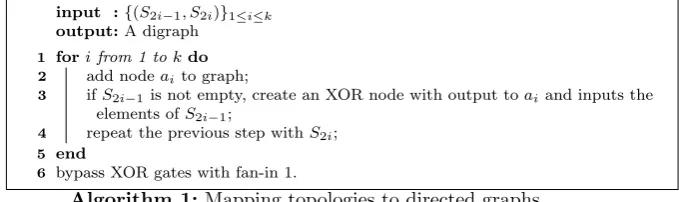
By using the gate numbering given in Figure 1, the topology of the circuit can be expressed in graphical form. We use the procedure of Algorithm 1.
input :\{ (S2i - 1, S2i)\} 1\leq i\leq k
output:A digraph
\bfone forifrom 1 tokdo
\bftwo add nodeaito graph;
\bfthree ifS2i - 1is not empty, create an XOR node with output toaiand inputs the
elements ofS2i - 1;
\bffour repeat the previous step withS2i;
\bffive end
\bfsix bypass XOR gates with fan-in 1.
Algorithm 1:Mapping topologies to directed graphs
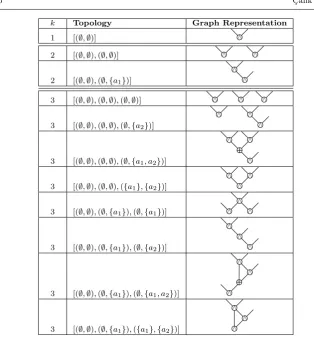
Our depictions of topologies will not show the direction of edges (they point down) or the labels of gates (we are only interested in the structure of each graph). Table 1 contains topologies with 3 AND gates, along with their graphical representation.
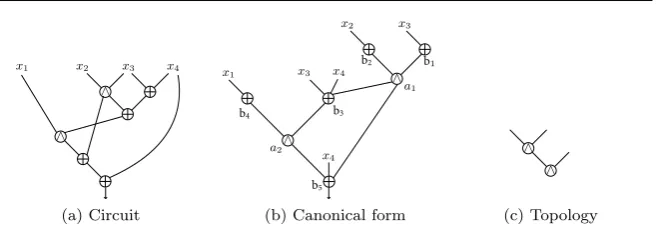
Example 1 The function f = x1x2x3+x1x3+x1x4+x2x3+x4 has
multi-plicative complexity 2, as is clear fromf =x1(x2x3+x3+x4) +x2x3+x4. A
circuit in canonical form that computesf is depicted in figure 3b. The trace for that circuit is
(\{ x3\} ,\{ x2\} ,\{ x3, x4\} ,\{ x1\} ,\{ x4\} ,\emptyset ,\emptyset ,\{ a1\} ,\emptyset ,\{ a1, a2\} ).
k Topology Graph Representation
1 [(\emptyset ,\emptyset )] ∧
2 [(\emptyset ,\emptyset ),(\emptyset ,\emptyset )] ∧ ∧
2 [(\emptyset ,\emptyset ),(\emptyset ,\{ a1\} )]
∧
∧
3 [(\emptyset ,\emptyset ),(\emptyset ,\emptyset ),(\emptyset ,\emptyset )] ∧ ∧ ∧
3 [(\emptyset ,\emptyset ),(\emptyset ,\emptyset ),(\emptyset ,\{ a2\} )]
∧ ∧
∧
3 [(\emptyset ,\emptyset ),(\emptyset ,\emptyset ),(\emptyset ,\{ a1, a2\} )]
∧ ∧
∧
3 [(\emptyset ,\emptyset ),(\emptyset ,\emptyset ),(\{ a1\} ,\{ a2\} )]
∧ ∧
∧
3 [(\emptyset ,\emptyset ),(\emptyset ,\{ a1\} ),(\emptyset ,\{ a1\} )] ∧ ∧
∧
3 [(\emptyset ,\emptyset ),(\emptyset ,\{ a1\} ),(\emptyset ,\{ a2\} )]
∧ ∧
∧
3 [(\emptyset ,\emptyset ),(\emptyset ,\{ a1\} ),(\emptyset ,\{ a1, a2\} )]
∧
∧
∧
3 [(\emptyset ,\emptyset ),(\emptyset ,\{ a1\} ),(\{ a1\} ,\{ a2\} )]
∧ ∧
∧
Table 1: List of topologies with up to 3 AND gates
The topology of the circuit is [(\emptyset ,\emptyset ),(\{ a1\} ,\emptyset )]. The input to the
topol-ogy is (\{ x3\} ,\{ x2\} ,\{ x3, x4\} ,\{ x1\} ,\{ x4\} ), and the output mask is\{ a1, a2\} . The
graphical representations of the circuit and its topology are given in Figure 3.
Definition 4 Given a circuit in canonical form, a numbering of the AND gates is aproper numbering, if no gate is an ancestor of a lower-numbered gate (i.e. if the numbering does not violate topological ordering).
Definition 5 Two topologies are said to be isomorphic if one results from a proper re-numbering of the AND gates of the other.
Definition 6 A Boolean function f is computable by a topology T if it is computable by a circuit whose topology is T. The set of Boolean functions that are computable by a topologyT is denoted B(T).
∧
x2 x3 x4 x1
∧
(a) Circuit
x2 x3
∧
∧
x1 x3 x4
x4
a1
a2
b1 b2
b3
b4
b5
(b) Canonical form
∧
∧
(c) Topology
Fig. 3: Circuit and topology computingf.
Proposition 1 If topologiesT andT\prime are isomorphic, then B(T) =B(T\prime ).
3.1 Evaluating Topologies
Without loss of generality, the remainder of this paper only considers functions f for which f(0) = 0. These functions have negation-free circuits that are optimum with respect to multiplicative complexity. Any function for which f(0) = 1 is of the formf(\=x) =g(\=x) + 1 whereg(0) = 0.
The aim of this section is to construct the set of Boolean functions that are computable by a topology T = [(S1, S2), . . . ,(S2k - 1, S2k)]. The setB(T) can
be obtained by exhaustively evaluating the following family of circuit traces (L\ast 1, . . . , L\ast 2k+1, S1, . . . , Sk, S2\ast k+1),
whereL\ast i is any subset of\{ x1, . . . ,xn\} andS2\ast k+1is any subset of\{ a1, . . . ,ak\} .
However, going over all possibleL\ast
i's fori= 1, . . . ,2k+ 1 and S2\ast k+1 quickly
becomes inefficient, since there are (2n)2k+1\times 2k = 22kn+k+n possible choices
for these sets (e.g., there are 271choices for a topology with 5 AND gates when
n= 6).
Theorem 1 Let f \in Bn be computable by a topologyT. If f\prime is affine
equiv-alent tof, thenf\prime is also computable byT.
Proof Let C = (L1, . . . , L2k+1, S1, . . . , S2k+1) be the trace of a circuit with
topology T that computes f. If f\prime is affine equivalent to f, then there exists
an affine transformation(A, a, b, c)satisfyingf\prime (x) =f(Ax+a) +bx+c. The
circuit generated by applying the inner transformation Ax+a to the inputs
\{ x1, . . . ,xn\} , and adding outer transformationbx+c toL2k+1 constructs f\prime .
Since the topology of the circuit is not affected by the affine transformation,f\prime
is computable by T. \sqcap \sqcup
Theorem 1 implies that either all or none of the functions in an equivalence class are computable by a topology T. We say that the equivalence class of
f \in Bniscomputable by a topologyT, iff is computable byT. Hence, in order
Corollary 1 Consider two circuits with traces
(L1, . . . , L2k+1, S1, . . . , Sk, S2k+1)and
(L\prime 1, . . . , L\prime 2k+1, S1, . . . , Sk, S2k+1).
If there exists an inner transformation (A, a) that transforms \scrX Li \rightarrow \scrX L\prime i for
i= 1, . . . ,2k, then the circuits compute affine equivalent functions.
To see why the corollary holds, note that the outer transformation (b, c) affecting \scrX L\prime
2k+1 is a specific case of an affine transformation and hence does
not change the equivalence class of a function.
Corollary 1 implies that it is not necessary to evaluate an input to a circuit if a respectively affine equivalent input has already been evaluated, because the computed functions will be from the same equivalence class. Thus, the problem is to find a maximal set of inputs (L1, . . . , L2k) such that no two are affine
equivalent with respect to an inner transformation. This problem corresponds to enumerating allm-dimensional subspaces in a 2k-dimensional vector space, wherem varies depending onk. The number of subspaces of dimensionm in a vector space of dimension 2kover a finite field of 2 elements is equal to the Gaussian binomial coefficient\bigl( 2k
m \bigr)
2 [16]. This is approximately 2
26 inputs for
m= 6,k= 5. The algorithm to construct the subspaces is given in [17]. In its simplest form, to generate a sufficient set of inputs of dimensionm, for each component in an input we either introduce a new variable, or choose a linear combination of the previously used variables, by taking into account that the exact number of variables to be used ism.
Example 2 Consider the vector space consisting of all linear functions on
vari-ables x1, x2, x3, x4. Denote by (a1, a2, a3, a4) the subspace generated by all
linear functions\sum 4
i=1aixi where ai\in \{ 0,1\} . A maximal set of 3-dimensional
subspaces in a 4-dimensional vector space (m= 3, 2k= 4) is as follows: (a1, a2, a3,0), (a1, a2, a3, a1), (a1, a2, a3, a2),
(a1, a2, a3, a1+a2), (a1, a2, a3, a3), (a1, a2, a3, a1+a3),
(a1, a2, a3, a2+a3), (a1, a2, a3, a1+a2+a3), (a1, a2,0, a3),
(a1, a2, a1, a3), (a1, a2, a2, a3), (a1, a2, a1+a2, a3),
(a1,0, a2, a3), (a1, a1, a2, a3), (0, a1, a2, a3)
Notation: In,k denotes the set of subspaces of\{ 0,1\} 2k of dimension at most
min\{ n,2k\}
3.2 Constructing Topologies
All topologies with k AND gates have the form [(S1, S2), . . . ,(S2k - 1, S2k)],
where S2i - 1, S2i \subseteq \{ a1, . . . ,ai - 1\} . The setsS2i - 1 and S2i can take 2i - 1
dif-ferent values, so the total number of topologies withkAND gates is
k \prod
i=1
However, this formula counts many topologies redundantly in the sense that there are many topologies computing the same set of Boolean functions. In addition to isomorphic topologies, redundant topologies can result from some transformations on pairs (S2k - 1, S2k) corresponding to the AND gates that
define the output of AND gate ai (see equation 4). Next, we derive some of
these transformations.
Notation: Given two sets Si, Sj \subseteq \{ a1, . . . ,ak\} of AND gates, we denote by
Si\oplus Sj the symmetric difference ofSiandSj, i.e., the set of elements that are
contained inSi or Sj but not in both.
Remark 1 Leth= (f+l1)(g+l2) with f, g, l1, l2 \in \scrB n. Let l3 = 1 +l1+l2.
Then it follows that
h= (f+l1)(f+g+l3)
h= (f+g+l3)(g+l2)
Proposition 2 Let T = [(S1, S2), . . . ,(S2k - 1, S2k)] be a topology. Let T\prime be
the topology formed by replacing (S2i - 1, S2i) by (S2i - 1, S2i - 1\oplus S2i), and let
T\prime \prime be the topology formed by replacing(S2i - 1, S2i)by(S2i - 1\oplus S2i, S2i).Then
B(T) =B(T\prime ) =B(T\prime \prime ).
Proof LetFai = (\scrX L2i - 1\oplus \scrX S2i - 1)\wedge (\scrX L2i\oplus \scrX S2i)be a function generated by
AND gate ai. Then,
Fa\prime
i= (\scrX L2i - 1\oplus \scrX S2i - 1)\wedge (1\oplus \scrX L2i\oplus \scrX L2i - 1\oplus \scrX S2i\oplus \scrX S2i - 1) and
Fa\prime \prime i
= (1\oplus \scrX L2i\oplus \scrX L2i - 1\oplus \scrX S2i\oplus \scrX S2i - 1)\wedge (\scrX L2i\oplus \scrX S2i)
are the same functions by Remark 1. \sqcap \sqcup
Proposition 2 implies that for any pair (S2i - 1, S2i) in a topology, any choice
of two input pairs from the set\{ S2i - 1, S2i, S2i - 1\oplus S2i\} for AND gateai will
not change the set of functions computable by the topology. This motivates the following definition.
Definition 7 The following six pairs are said to be equivalent.
(S2i - 1, S2i)
(S2i, S2i - 1)
(S2i - 1, S2i - 1\oplus S2i)
(S2i - 1\oplus S2i, S2i - 1)
(S2i - 1\oplus S2i, S2i)
From now on we will identify the pair (S2i - 1, S2i) with AND gateaiwhere
doing so will not cause confusion.
We represent a set S \subseteq \{ a1, . . . ,ak\} by a k-bit mask (v1, . . . , vk), each
vi denoting the existence of ai in S. Since each gate has two sets of inputs,
(S2i - 1, S2i) is represented by a 2k-bit vector.
Definition 8 The minimal representation of an AND gateai = (S2i - 1, S2i)
in a topology is the lexicographically smallest among the set of equivalent gates listed in Definition 7.
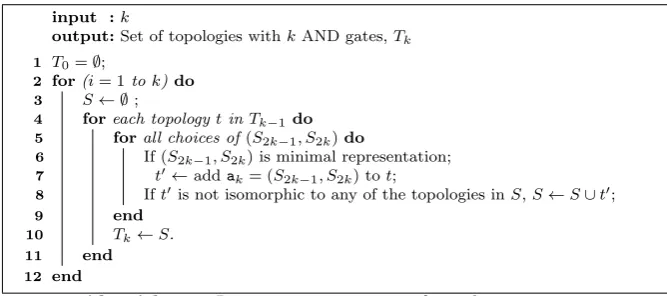
We use Algorithm 2 to construct the set of topologies withk AND gates. The exhaustive list of topologies having up to 3 AND gates after removing the redundant ones is shown in Table 1.
input :k
output:Set of topologies withkAND gates,Tk
\bfone T0=\emptyset ;
\bftwo for(i= 1tok)do
\bfthree S\leftarrow \emptyset ;
\bffour foreach topology tinTk - 1do
\bffive forall choices of(S2k - 1, S2k)do
\bfsix If (S2k - 1, S2k) is minimal representation;
\bfseven t\prime \leftarrow addak= (S2k - 1, S2k) tot;
\bfeight Ift\prime is not isomorphic to any of the topologies inS,S\leftarrow S\cup t\prime ;
\bfnine end
\bfone \bfzero Tk\leftarrow S.
\bfone \bfone end
\bfone \bftwo end
Algorithm 2:Iterative construction of topologies
3.3 Finding the Multiplicative Complexity of a Boolean Function
In this section, we propose an algorithm to find the multiplicative complexity of a given Boolean function. Let f \in Bn be a Boolean function with degree
d. It is known that the multiplicative complexity of f is at least d - 1. The first step of the algorithm is to use Algorithm 2 to construct the topologies with k =d - 1 AND gates. Then, the set of \bigl( 2k
m \bigr)
2 inputs for the topologies
are constructed as explained in Section 3.1. If f is computable by any of the topologies, the algorithm outputsk, elsekis incremented by one, and a new
k 1 2 3 4 5 6
| Tk| 1 2 8 84 3 170 475 248
input :Boolean functionf
output:Multiplicative complexity off
\bfone d\leftarrow degree off;
\bftwo k\leftarrow d - 1;
\bfthree while(true)do
\bffour ConstructTkusing Algorithm 2;
\bffive ConstructIn,k;
\bfsix foreach topology tinTkdo
\bfseven foreach input(L1, . . . , L2k)inIn,kdo
\bfeight foreachS2k+1\subseteq \{ a1, . . . ,ak\} do
\bfnine C\leftarrow (L1, . . . , L2k,0, S1, . . . , S2k+1);
\bfone \bfzero f\prime \leftarrow the Boolean function thatCcomputes;
\bfone \bfone if f\prime is affine equivalent tof then
\bfone \bftwo returnk;
\bfone \bfthree end
\bfone \bffour end
\bfone \bffive end
\bfone \bfsix end
\bfone \bfseven k=k+ 1;
\bfone \bfeight end
Algorithm 3: Finding the multiplicative complexity of a Boolean function
set of topologies is evaluated, untilf is computable by one of the topologies, as given in Algorithm 3.
The algorithm is practical when the numberkof AND gates is small. The algorithm can also be used for providing lower bounds on the multiplicative complexity of a given function, when it does not find a solution up to a par-ticular value ofk, establishing a lower bound of k+ 1.
4 Multiplicative Complexity of 6-bit Boolean Functions
In this section, our aim is to find the multiplicative complexities of all Bool-ean functions in 6-variables. The number of affine equivalence classes in\scrB 6 is
known to be 150 357. In this work, we use the representative functions com-puted in [10].
from the set of input functions. The construction of topologies, described in Section 3.2, is independent of the number of variables the topology will be evaluated for. The input generation and determining the affine equivalence classes of functions is described in Sections 4.2 and 4.1, respectively.
It should be noted that an equivalence class may be generated by distinct topologies having a different number of AND gates. An equivalence class is assigned a multiplicative complexity valuek, if it was generated by a topology having k AND gates and was not previously generated with a topology that had less than k AND gates. This is guaranteed by processing the topologies in order with respect to the number of AND gates.
input :n, Set of representatives of\scrB 6\{ f1, . . . , f150357\}
output:Multiplicative complexity ofM C[fi]
\bfone k= 1;
\bftwo S\leftarrow \{ f1, . . . , f150357\} ;
\bfthree while (S\not =\emptyset )do
\bffour ConstructTkusing Algorithm 2;
\bffive ConstructIn,k;
\bfsix foreach topology [(S1, S2), . . . ,(S2k - 1, S2k)]inTkdo
\bfseven foreach input(L1, . . . , L2k)inIn,kdo
\bfeight foreachS2k+1\subseteq Ado
\bfnine C\leftarrow (L1, . . . , L2k,0, S1, . . . , S2k+1);
\bfone \bfzero f\prime \leftarrow the Boolean function thatCcomputes;
\bfone \bfone if f\prime is affine equivalent anfi\in Sthen
\bfone \bftwo M C[fi] =k;
\bfone \bfthree RemovefifromS;
\bfone \bffour if S=\emptyset then
\bfone \bffive returnM C[f1],. . . ,M C[f150357];
\bfone \bfsix end
\bfone \bfseven end
\bfone \bfeight end
\bfone \bfnine end
\bftwo \bfzero end
\bftwo \bfone k=k+ 1;
\bftwo \bftwo end
Algorithm 4: Finding Multiplicative Complexity of 6-bit Boolean Functions
4.1 Determining the Equivalence Classes of Functions
Deciding on whether or not two given functions are affine equivalent is done by making use of the affine transformation invariant properties of functions, i.e., algebraic degree, absolute Walsh spectrum distribution, and absolute auto-correlation spectrum distribution. We call the values these three metrics take
thesignature of a function. Forn\leq 5, the signature of a function is sufficient
to determine its class because the signatures of functions in different classes are different. However, for n= 6 there are a total number of 30 883 distinct signatures, which is less than the number of equivalence classes, implying that some equivalence classes have the same signature. Indeed, 17 234 of the sig-natures belong to a unique class, whereas the remaining 13 649 sigsig-natures are shared by two or more classes, with the maximum number of classes having the same signature being 564.
Suppose we want to determine the equivalence class of a function f. That is, we want to know which of the 150 357 representatives is affine equivalent to f. If the signature off is among the 17 234 signatures that uniquely identifies its class, then the representative is the one associated with the signature. Otherwise, it is the case thatfis affine equivalent to one of the representatives, sayf1, ..., . . . , fm,m\geq 2, whose signatures are equal to that off's. Then, we
use the methods described in [10], namely the local connectivity and indicator functions to eliminate the representatives that could not be affine equivalent to f until we're left with a single candidate, which will be the representative thatf is affine equivalent to.
4.2 Evaluating Topologies
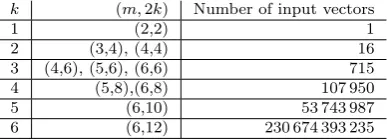
As described in Section 3.1, for a given n, the inputs to a topology with k AND gates are the functions that correspond to the subspaces of dimension min a vector space of dimension 2k, where 1\leq m\leq min(2k, n). In [1], it was shown that any Boolean function onn-variables has multiplicative complexity at most n - 1 forn\leq 5. This implies that if we want to evaluate a topology
withk\leq 5 AND gates, the functions generated by this topology must be affine
equivalent to a function that has at most k+ 1 variables. This observation lets us reduce the number of dimensions m that must be considered when generating the inputs. Table 3 provides the list of dimensions m in a vector space of dimension 2kforn= 6.
Table 3: Size of the input combinations for evaluating topologies.
k (m,2k) Number of input vectors
1 (2,2) 1
2 (3,4), (4,4) 16
3 (4,6), (5,6), (6,6) 715
4 (5,8),(6,8) 107 950
5 (6,10) 53 743 987
4.3 Results
The algorithms for constructing and evaluating the topologies have been im-plemented in the C++ programming language. The construction of topologies up to 5 AND gates took less than a minute on a standard desktop PC, whereas topologies with 6 AND gates could be generated in approximately one day. The task of identifying the equivalence classes generated by the topologies de-manded more computation due to the large number of input combinations to be evaluated. We exploited the inherent parallelism of this process by running it on a cluster, with each node processing a certain subset of the topologies. The nodes in the cluster had dual Intel Xeon E5-2630 v3 processors2 (3.20
GHz, 8 cores) and 64 GB memory. The total computation took 38 422 core hours.
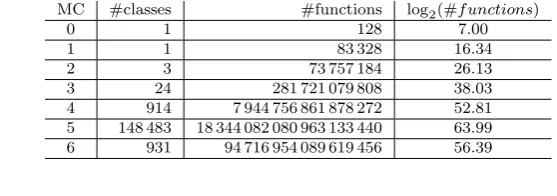
Table 4 shows the results of the computation. The number of functions having a particular multiplicative complexity was calculated by adding the total number of functions in each equivalence class. After running Algorithm 4 up to 5 AND gates, there were still 931 equivalence classes on 6-variables that could not be generated, implying that their multiplicative complexity should be at least 6. The task of evaluating all topologies having 6 AND gates with all possible inputs was not feasible due to the large number of topologies and input combinations. Therefore, we randomly picked a subset of those topologies, and computed the remaining set of equivalence classes. This process completed in the order of hours as it was sufficient to generate one function from each class to conclude that these functions had multiplicative complexity 6.
The results can be accessed online at [18], which contains one representative from each affine equivalence class, along with a circuit for that function with a minimum number of multiplications.
Table 4: Multiplicative complexity distribution of the equivalence classes and functions forn= 6.
MC \#classes \#functions log2(\#f unctions)
0 1 128 7.00
1 1 83 328 16.34
2 3 73 757 184 26.13
3 24 281 721 079 808 38.03
4 914 7 944 756 861 878 272 52.81
5 148 483 18 344 082 080 963 133 440 63.99
6 931 94 716 954 089 619 456 56.39
2 Commercial equipment and software referred to in this paper are identified for
Among the set of functions having multiplicative complexity 6, we list below all representatives with degree 4:
f1=x3x5+x3x4+x2x4+x2x3x6+x2x3x4x5+x1x6+x1x5+x1x4x5+x1x3+x1x3x4
+x1x3x4x6+x1x2x5x6
f2=x4x5+x3x4x5+x2x5+x2x4+x2x4x6+x1x5x6+x1x4+x1x3+x1x2x4x5
+x1x2x3x6
f3=x3x5+x3x4+x2x4+x2x3x6+x2x3x4x5+x1x4+x1x4x5+x1x3+x1x3x4
+x1x3x4x6+x1x2x5x6
f4=x3x5+x3x4+x2x4+x2x3+x2x3x6+x2x3x4x5+x1x6+x1x5+x1x4x5
+x1x3x4+x1x3x4x6+x1x2+x1x2x5x6
f5=x4x6+x4x5+x3x5+x2x3x6+x2x3x4x5+x1x5+x1x3+x1x3x5+x1x3x4
+x1x3x4x6+x1x2+x1x2x5x6+x1x2x4
5 Conclusion
We explored the multiplicative complexity of 6-variable Boolean functions and showed that they can be implemented using at most 6 AND gates. More specif-ically, we computed the distribution of affine equivalence classes and the num-ber of Boolean functions with multiplicative complexity k for k = 0, . . . ,6. We were able to exhibit specific 6-variable functions which have multiplicative complexity 6.
6 Acknowledgments
We thank Ray Perlner for his suggestions on enumerating the subspaces of a vector space, and Lu\'{\i}s Brand\~ao for helpful comments and suggestions.
References
1. Meltem Turan S\"onmez and Ren\'e Peralta. The Multiplicative Complexity of Boolean
Functions on Four and Five Variables, pages 21--33. Springer International Publishing,
Cham, 2015.
2. Vladimir Kolesnikov and Thomas Schneider. Improved garbled circuit: Free XOR gates
and applications. In Luca Aceto, Ivan Damg\r ard, Leslie Ann Goldberg, Magn\'us M.
Halld\'orsson, Anna Ing\'olfsd\'ottir, and Igor Walukiewicz, editors,Automata, Languages
and Programming, 35th International Colloquium, ICALP 2008, Reykjavik, Iceland, July 7-11, 2008, Proceedings, Part II - Track B: Logic, Semantics, and Theory of
Pro-gramming \& Track C: Security and Cryptography Foundations, volume 5126 ofLecture
Notes in Computer Science, pages 486--498. Springer, 2008.
3. Zvika Brakerski, Craig Gentry, and Vinod Vaikuntanathan. (leveled) fully
homomor-phic encryption without bootstrapping. In Shafi Goldwasser, editor,Innovations in
Theoretical Computer Science 2012, Cambridge, MA, USA, January 8-10, 2012, pages
4. Joan Boyar, Ivan Damg\r ard, and Ren\'e Peralta. Short non-interactive cryptographic
proofs. J. Cryptology, 13(4):449--472, 2000.
5. Claude Carlet, Louis Goubin, Emmanuel Prouff, Micha\"el Quisquater, and Matthieu
Rivain. Higher-order masking schemes for s-boxes. In Anne Canteaut, editor,Fast
Soft-ware Encryption - 19th International Workshop, FSE 2012, Washington, DC, USA,
March 19-21, 2012. Revised Selected Papers, volume 7549 ofLecture Notes in Computer
Science, pages 366--384. Springer, 2012.
6. Joan Boyar, Ren\'e Peralta, and Denis Pochuev. On the multiplicative complexity of
Boolean functions over the basis (\wedge ,\oplus , 1).Theor. Comput. Sci., 235(1):43--57, 2000.
7. Magnus Gausdal Find. On the complexity of computing two nonlinearity measures.
InComputer Science - Theory and Applications - 9th International Computer Science
Symposium in Russia, CSR 2014, Moscow, Russia, June 7-11, 2014. Proceedings, pages
167--175, 2014.
8. Michael Codish, Lu\'{\i}s Cruz-Filipe, Michael Frank, and Peter Schneider-Kamp. When
six gates are not enough.CoRR, abs/1508.05737, 2015.
9. J. Boyar and R. Peralta. Tight bounds for the multiplicative complexity of symmetric
functions.Theoretical Computer Science, 396(1-3):223--246, 2008.
10. Joanne Elizabeth Fuller. Analysis of affine equivalent boolean functions for
cryptogra-phy. PhD thesis, Queensland University of Technology, 2003.
11. Elwyn R. Berlekamp and Lloyd R. Welch. Weight distributions of the cosets of the (32,
6) Reed-Muller code.IEEE Transactions on Information Theory, 18(1):203--207, 1972.
12. James A. Maiorana. A classification of the cosets of the Reed-Muller code\scrR (1,6).Math.
Comput., 57(195):403--414, 1991.
13. An Braeken, Yuri Borissov, Svetla Nikova, and Bart Preneel.Classification of Boolean
Functions of 6 Variables or Less with Respect to Some Cryptographic Properties, pages
324--334. Springer Berlin Heidelberg, Berlin, Heidelberg, 2005.
14. Xiang-Dong Hou. AGL (m, 2) acting on R (r, m)/R (s, m). Journal of Algebra,
171(3):927--938, 1995.
15. Claude Carlet. Boolean functions for cryptography and error correcting codes. In
Y. Crama and P.L. Hammer, editors,Boolean Models and Methods in Mathematics,
Computer Science and Engineering, chapter 8. Cambridge Univ. Press, Cambridge,
UK, 2010.
16. Donald E Knuth. Subspaces, subsets, and partitions.Journal of Combinatorial Theory,
Series A, 10(2):178 -- 180, 1971.
17. Jay Goldman and Gian-Carlo Rota. On the foundations of combinatorial theory iv
finite vector spaces and eulerian generating functions.Studies in Applied Mathematics,
49(3):239--258, 1970.
18. NIST Computer Security Division. SLP's for 6-variable predicates,