© 2014, IJCSMC All Rights Reserved
568
Available Online atwww.ijcsmc.com
International Journal of Computer Science and Mobile Computing
A Monthly Journal of Computer Science and Information Technology
ISSN 2320–088X
IJCSMC, Vol. 3, Issue. 7, July 2014, pg.568 – 578
RESEARCH ARTICLE
Multi-Robot Co-ordination For
Box-Pushing using Embedded Controller
Ketaki.P.Dahale
1, Vijay.D.Chaudhari
2, Kantilal.P.Rane
3¹ Department of E&TC, Gf‘s Godavari COE, North Maharashtra University, Jalgaon, India ² Department of E&TC, Gf‘s Godavari COE, North Maharashtra University, Jalgaon, India ³ Department of E&TC, Gf‘s Godavari COE, North Maharashtra University, Jalgaon, India
1
[email protected]; 2 [email protected]; 3 [email protected]
Abstract— Multi-Robot coordination for task allocation has been widely studied topic in the literature. A robot team can accomplish a given task more quickly than a single robot can by dividing the task into sub-tasks and executing them concurrently in application domains where the tasks can be decomposed. It leads to effective coverage of a large area. The principle of territoriality in homogeneous agent groups is a physical division of space and all associated recourses in order to minimize interference and maximize synergy. Each robot is assigned a working area and robots operate only in work space allocated to them in order to reduce interference between them. Dynamic task allocation allows robots to change their behavior in response to environmental changes in order to improve overall task performance. From the studies related on division of labor mechanism in the insect society it can be found that an individual engages in task performance if environment exceed their intrinsic thresholds. The advantage of centralized approach is that they can produce globally optimal plans. In our work, we exploit some of the features of territoriality, dynamic task allocation, division of labor in insect societies and centralized systems. We propose action selection without explicit communication for multi-robot box-pushing which changes a suitable behaviour set depending on a situation for adaptation to a dynamic environment. A central controller identifies the situation and issues the appropriate control signals to adapt the suitable behaviour set to it. As a result, we find out our approach is promising for designing adaptive multi-robot box-pushing. We demonstrate these concepts using three line following mobile robots. The task is to push a given box from source location to destination location. The number of robots active at a given time depends upon the weight of the box. The boxes to be moved are of different weight. The ratio of robots working at a given time change dynamically as per the changes in environment.
© 2014, IJCSMC All Rights Reserved
569
I. INTRODUCTION
Information about final paper submission is available from the conference website. A team of robots can be effectively used for many applications such as assembly tasks, manufacturing, transporting of raw materials, finished goods, etc. (material-handling robots). Multiple robots can be used instead of a single robot to accomplish a certain task in less amount of time. Intelligent robot teams must effectively and efficiently share the workload in a way similar to the humans may share to complete the task. Robots should cooperate to effectively maximize the task performance. The cooperation can be at the level of task allocation and need not propagate to the level of task execution.
Co-ordination between robots can also be used for deciding the share of task to be executed by each robot. A key difficulty in coordinating multiple robots is deciding who does what. Thus, the task allocation mechanism is an important factor in the architectural design.A decision regarding which robot should execute a task and when can be taken so that each robot is effectively used for completion of task in least amount of time possible. Now-a-days we can find that the focus of studies related to multi-robot coordination is on task allocation and equal load sharing among the robots for overall improvement of task performance. Labor division mechanisms are found to be exploited in social insect societies that are suitable for artificial, embedded systems such as multiple mobile robot platforms.Even in human and other social groups with advanced labour division, life is organised around a series of concurrent activities. For a society to function efficiently, the number of individuals (team size) involved in these activities has to be continuously adjusted such as to satisfy its changing needs.
© 2014, IJCSMC All Rights Reserved
570
II. RELATED WORK
© 2014, IJCSMC All Rights Reserved
571
Workers were switched ―on‖ for a task if the environment exceeded their intrinsic thresholds. When workers performed a task, stimulus levels were ratcheted down, and if not then stimulus levels were increased. The model achieved a stable equilibrium when the number of workers performing a task matched the stimulus level for the task and when individual workers maintained constant task performance probabilities.
The number of workers performing the task remained low until a set-point was reached, at which the stimulus matched the thresholds of workers with higher thresholds. At this point the colony responded immediately by increasing task performance. This response prediction is similar to that of the information centre model of recruitment (100) in which social information transfer is used as the major mechanism for transmitting a task stimulus. However, the information centre model assumes no explicit genetic effects on task performance.
The foraging for work algorithm [34,35] is (a) perform any task for which there is a need, (b) once a task is performed, continue to perform the same task, (c) if this task no longer needs to be done, stay in the nest. Pacala et al [36], building on the results with the network model, developed a set of differential-equation models to investigate the effects of social group size on task allocation. In their models, individuals receive information about task needs (a) directly from the environment, (b) through their success or failure in finding task opportunities, and (c) through random encounters with other group members.
One way of understanding division of labour is to find phenomenological rules i.e. rules that describe the behaviour without reference to mechanisms that can account for the behaviour patterns of individual workers. Second question is how do workers obtain information about task needs? Task performance is a response by the worker to the environmental information it perceives. For any given task, workers may gain information from local stimuli within the nest or through interactions with other workers or both .The third question is what internal mechanisms underlie the behavioural rules for task Performance? Both genetic and hormonal effects have been shown to be important and studies are beginning to venture into the nervous system [37].
III.DESIGN OF MULTI-ROBOT SYSTEM FOR BOX-PUSHING USING EMBEDDED CONTROLLER
We address the problem of box-pushing in a multi-robot system. The problem of dynamically changing the worker ratio as per the task needs is discussed previously. We adopt centralized approach in implementing the box-pushing problem for decision-making which can create optimal and global plans. The decision of number of active robots at an instant will be taken by the embedded controller as per the weight of the box to be pushed. The concept of task allocation using controller can be demonstrated using three line following Robots to push the box of specific weight to desired location. We can make use of IR sensors to detect the line. The number of robots required to push the box is limited by embedded controller. The global information is collected by the controller. We eliminate the drawback of obtaining information by local interactions by adopting centralized approach. Thus optimal plans can be produced from global information rather than sub-optimal solutions as in distributed system. Also, we make use of a load sharing algorithm here. We set a threshold for every robot. A robot is signalled only if the weight of the box is beyond a specified limit. A single robot can execute a task if the weight of the box is considerably low. The side robots are activated only if weight of the box increases a certain limit. The all three robots are activated where there is heavy box to be pushed. As the box push to certain limit then robots become idle. Thus, we are changing the ratio of workers or number of active robots according to the task needs or weight of box.
A. Defining situations to describe a dynamic environment
First of all, we describe a task and an environment. The task of multiple mobile robots is ―Push the box up to desired location.‖ Environment consists of limit switch placed at intervals to detect the presence of the object. First box is placed on workspace, the weight on box is read as image & according to this weight robots are activated. This input is given to the central controller, thus, robot knows about the ready task from central controller. There may be three situations persisting at a given time depending on the weight of the box. The task we address is cooperatively moving a box, large relative to the size of the robots, from some initial location to a designated goal location. In solving this problem, we take inspiration from human behaviour commonly observed when they are carrying objects or pushing some object. If a single person is capable of pushing or carrying objects he himself will complete the task. If suddenly he encounters a heavy object or an object bigger in size the supervisor will instruct another person to help him push the object. In short the supervisor will deploy the appropriate number of workers that are actually needed to complete the task of pushing the box. Here, we have boxes of different weights to be moved from source location to destination location with the help of three line-following robots. The decision as to how many robots will be required to move the box depends on the weight of the box. Thus, the number of robots working at a time varies dynamically as per the changes in environment. Thus, the multi-robot system is adaptive to the dynamic environment. In the cooperative mobile robot domain, we formally define this problem with a set of constraints:
1. The box is large compared to the robots, and the robots can only move the box by pushing through frictional contact.
© 2014, IJCSMC All Rights Reserved
572
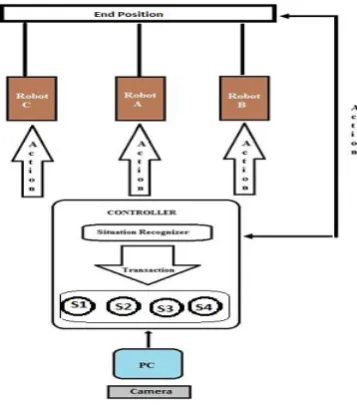
3. There is an obstacle-free path between the box‘s initial location and the goal that is wide enough for the box and robots to pass (i.e., we do not consider negotiating obstacles in a coordinated fashion, only as part of individual low-level control). We use a nomenclature for three robots as RobotA, RobotB and RobotC. Each robot has two wheels for mobility. The controller acts as a situation recognizer which recognizes the workload at a time instant with the help of a controller. Every box has a sticker attached to it. The image of this sticker is captured. The image is read, segmented and finally converted into text. The exact weight of the box is extracted from the text to get the exact weight of the box. This number is then send to the controller through the USB port. The controller reads this number and activates the required number robots to push the box.
Fig. 1 A Control System for dynamic task allocation
B. Threshold Definitions
Lower Threshold (TL): Weight of Box is in between 1-3
Moderate Threshold (TM): Weight of Box is in between 4-6
Higher Threshold (TH): Weight of Box is in between 7-9
We also define states of workload as TL whereworkload is below threshold TM as threshold between lower
threshold and higher threshold and TH as threshold greater than higher threshold.TH describes heavy workload.
In the following, we explain the situations and the suitable behaviours for each of them. The suitable behaviours will be concretely described by IF–THEN rule representation later. We can say that the determined situation is globally correct. In a dynamic environment, we have three robots to execute a task; all the robots need not be idle or working simultaneously. The number of active and inactive robots depends upon the availability of task and workload at a given time. We define workload in terms of the weight of a box to be pushed. We define two thresholds for defining workload i.e. lower threshold and a higher threshold. We define situation S1 as a situation with no workload and all robots are idle i.e. there is no box to be pushed. S2 can be defined as a situation with the availability of a task but a workload below lower threshold i.e. the weight of the box is such that a single robot is capable of transporting it from source location to destination location. Not more than one robot is active in this situation. S3 is defined as a state of environment where workload is moderate i.e. between lower threshold and higher threshold. Here, two robots are must to execute the task. S4 is a state where there is a heavy workload i.e. greater than a higher threshold i.e. the weight or of the box is huge enough that it will need atleast three robots to push it from source to destination. Also, we define states for robot as active and inactive. We describe the state of a RobotA with preposition ‗A‘. A means RobotA is active and A means RobotA is inactive. Similarly, B means RobotB is active and B means RobotB is inactive. C means RobotC and C means RobotC is inactive. In the following, we explain the situations and the suitable behaviours for each of them. The suitable behaviours will be concretely described by IF–THEN rule representation later. We can say that the determined situation is globally correct.
1. S1 = [A B C] ; W=0 2. S2 = [A B C] ; W< TL
3. S3 = [A B C] ; TL<W<TH
© 2014, IJCSMC All Rights Reserved
573
C. Line Following Robot
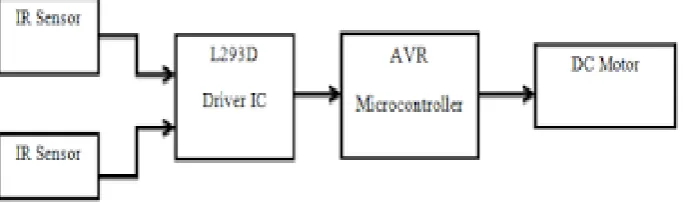
The basic principle involved in this is it captures the line position with IR sensors mounted at front end of the robot. The block diagram of the line follower robot shows that, when the sensor senses the path, output will be 0s or 1s which are then fed to the microcontroller, and then the microcontroller decides the next move according to the program. When both the sensors are indicating low (0) then robot start moving on the black path, for white if it indicates high (1) then it moves along the path. The infrared emitter sends a continuous beam of infrared light that is reflected from the ground back to the infrared detector. Depending on the reflectiveness of the ground colour, the detector receives varying amounts of reflected infrared light. The detector is actually an infrared photo-transistor that uses infrared light to activate the transistor base. The more infrared light that gets to the detector, the more the transistor conducts. We use five IR sensors in a straight line to determine the exact position of the non-reflective line beneath the robot. By adjusting the two drive motors based on the line sensor readings, we can keep the bot cantered on the line as it drives around the track. The track must be a solid colour with no variations. A few pieces of white poster-board work best with black electrician‘s tape for the line. The line provides a contrast of colour that the sensors can differentiate. You can make whatever line shape you want for your bot to follow: it can be twisty, have intersections and loops, or be a simple circle. The neat thing about Linus is that he responds differently each time around the track. Because he responds to his sensors, if there is a split in the track, he might go left the first time around and right the next! It is interesting to watch the decision-making processes of this little machine.
Fig. 2 Block diagram
D. The Arduino Controller
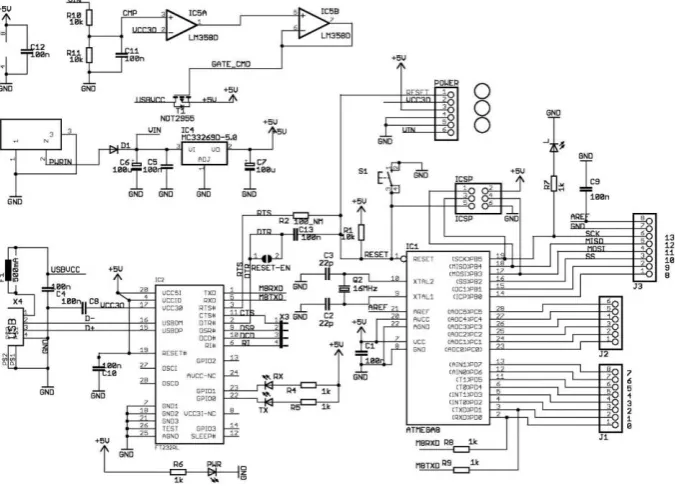
The Arduino Duemilanove is a microcontroller board based on the ATmega328 (refer annexure-I). It has 14 digital input/output pins (of which 6 can be used as PWM outputs), 6 Analog inputs, a 16 MHz crystal oscillator, a USB connection, a power jack, an ICSP header, and a reset button. It contains everything needed to support the microcontroller; simply connect it to a computer with a USB cable or power it with a AC-to-DC adapter or battery to get started. It‘s a heart of Line following robots. All the inputs from IR sensors are read by Arduino controller & according to IR input Motors are activated. The Arduino Duemilanove can be powered via the USB connection or with an external power supply. The power source is selected automatically. External (non-USB) power can come either from an AC-to-DC adapter (wall-wart) or battery. The adapter can be connected by plugging a 2.1mm centre-positive plug into the board's power jack. Leads from a battery can be inserted in the
© 2014, IJCSMC All Rights Reserved
574
Fig. 3 Circuit diagram for line following robotFig. 4 Circuit diagram for Aurduino controller
IV.RESULTS
© 2014, IJCSMC All Rights Reserved
575
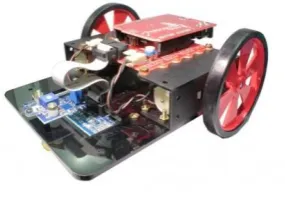
Fig. 5 Line following robotA. Defining situations to describe a dynamic environment
First we check the action of the robots for no workload i.e. W=0.The expected result is that all the robots must remain idle. We find that all the robots remain idle in case there is no workload i.e weight of box = 0.
Fig. 6 No Workload B. Results with workload below Threshold
Second we check for a situation where weight of the box is less than lower threshold .Here we define a lower threshold in between 1-3.Hence, only one robot must be active in this case where the weight of box is in between 1- 3. Now, here if we stick to the decision that only one robot should be active and it is Robot B. Robot B should execute task for weight 1-3.
Fig.7 Workload below threshold C. Results with workload between lower threshold and upper threshold.
© 2014, IJCSMC All Rights Reserved
576
Fig. 8 Two robots completing the taskD. Results with workload greater than upper threshold.
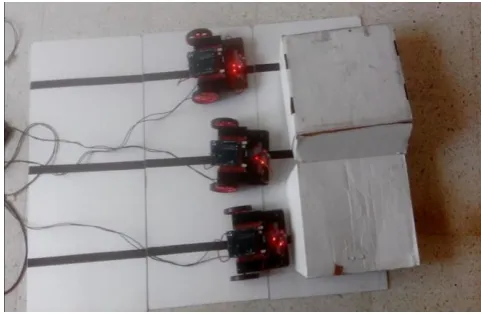
Fig. 9 Three robots pushing the box
Heavy workload may be a full workload. We have defined heavy workload as a workload greater than higher threshold. We set the higher threshold to be seven. Thus, in a scenario when weight of box is greater than seven then all the robots must be active to push the box. Thus, it can be verified that all the three robots operate at full or workload greater than higher threshold. We have defined higher threshold to be greater than five. Thus, we find that all the robots operate at full workloads.
V. CONCLUSIONS
In this work, we have designed a centralized architecture for multi-robot coordination. We have attempted to develop a flexible system that can respond dynamically to the changing environment. The number of active worker depends on the task needs. We deploy appropriate number of robots for box-pushing. The architectural design also contributes in power saving and time saving to a great extent. It can be seen that Multi-robots improve overall task performance than a single robot.
Generally distributed architecture can also be used but we generate a global plan using centralized controller. This architecture can be mainly used in industrial automation such as assembly lines and material handling. Thus, the algorithm can be implemented in other types of homogeneous robot groups also. We can also make the system configurable. The user can set the higher and lower thresholds for the system. The algorithm may be modified and implemented for large scale of applications in automation systems. In case of failure of any robot, other robots may be deployed for execution of the task for uninterrupted workflow. Task wise allocation can also be done in heterogeneous robot systems. Heterogeneous robot team means a team of robots having different architectures or configurations. The algorithm can be modified to accommodate more number of robots.
ACKNOWLEDGMENT
© 2014, IJCSMC All Rights Reserved
577
research work in tuned with the target puts before me. I would like to place on record my deep sense of gratitude to Prof. Dr. Kantilal P. Rane, Head of Department of E&TC Engineering for his generous guidance, help and useful suggestions to improve my work.
REFERENCES
[1] Caloud, P., Choi, W., Latombe, J-C, Le Pape, C, and Yim, M., "Indoor Automation with Many Mobile Robots,"IEEE/RSJ International Conference on Intelligent Robots and Systems, pp.67- 72, 1990.
[2] Jensen, R. M., Veloso, M. M., "OBDD-based Universal Planning: Specifying and SolVing Planning Problems for Synchronized Agents in Non-Deterministic Domains," Lecture Notes in Computer Science, No. 1600, pp. 213248,1999.
[3] Brumitt, B. L., Stentz, A., "Dynamic Mission Planning for Multiple Mobile Robots,"Proceedings of the
IEEE International Conference on Robotics and Automation, No. 3, pp. 2396-2401, 1996.
[4] Chevallier, D., and Payandeh, S., "On Kinematic Geometry of Multi-Agent Manipulating System Based on the Contact Force Information", The 6th International Conference on Intelligent Autonomous Systems
(IAS-6), pp.188-195,2000.
[5] Arkin, R. C, "Cooperation without Communication: Multiagent Schema-Based Robot Navigation,"
Journal of Robotic Systems, Vol. 9, No.3, pp. 351-364, 1992.
[6] Brandt, F., Brauer, W., and WeiB, G., 'Task Assignment in Multiagent Systems based on Vickrey-type Auctioning and Leveled Commitment Contracting," Cooperative Information Agents IV, Lecture Notes in Artificial Intelligence, Volume 1860, pp.95-106, 2000.
[7] H. Asama, A. Matsumoto, and T. Ishida, ―Design of an autonomous and distributed robot system,‖ in Proc.
1989 IEEE Int. Workshop Intelligent Robots Systems, 1989, pp. 283–290.
[8] H. Kimura and Z. D. Wang, ―Huge-object manipulation in space by vehicle-type robots,‖ JSME Int. J. Ser. C, vol. 38, no. 3, pp. 543–551, 1995.
[9] L. Chaimowicz, T. Sugar, V. Kumar, and F. M. Campos, ―An architecture for tightly coupled multi-robot cooperation,‖ in Proc. IEEE Int. Conf. Robotics Automation, 2001, pp. 2992–2997.
[10] N. Miyata et al., ―Cooperative transport with regrasping of torque-limited mobile robots,‖ in Proc. 1996 IEEE/RSJ Int. Conf. Intelligent Robots System, 1996, pp. 304–309.
[11] J. Ota et al., ―Transferring and regrasping a large object by cooperation of multiple mobile robots,‖ in Proc. IEEE/RSJ Int. Conf. Intelligent Robots System, vol. 3, 1995, pp. 543–548.
[12] ―In-hand dexterous manipulation of piecewise-smooth 3-D objects,‖ Int. J. Robot. Res., vol. 18, no. 4, pp. 355–381, Apr. 1999.
[13] ―Optimal behavior of a system of mobile robots executing a common task,‖ in Proc. 1994 IEEE Int. Conf. Robotics Automation, 1994, pp. 58–63.
[14] R. C. Arkin, Behavior Based Robotics. Cambridge, MA: MIT Press,1998.
[15] G. Dudek, M. Jenkin, E. Milios, and D. Wilkes, ―A taxonomy for multiagent robotics,‖ Auton. Robot., vol. 3, no. 4, pp. 375–397, 1996.
[16] H. Sugie et al., ―Placing objects with multiple mobile robots—Mutual help using intention inference,‖ in Proc IEEE Int. Conf. Robot. Automat., 1995, pp. 2181–2186.
[17] N. Miyata et al., ―Cooperative transport with regrasping of torque-limited mobile robots,‖ in Proc IEEE/RSJ Int. Conf. Intell. Robots Syst., 1996, pp. 304–309.
[18] Z. Wang, E. Nakano, and T. Matsukawa, ―Realizing cooperative object manipulation using multiple behavior-based robots,‖ in Proc. IEEE/RSJ Int. Conf. Intell Robots Syst., 1996, pp. 310–317.
[19] K. Kosuge and T. Osumi, ―Decentralized control of multiple robots handling and object,‖ in Proc. IEEE/RSJ Int. Conf. Intell. Robots Syst., 1996, pp. 318–323.
[20] H. Asama, A. Matsumoto, and T. Ishida, ―Design of an autonomous and distributed robot system,‖ in Proc. IEEE/RSJ Int. Workshop Intell.Robots Syst., 1989, pp. 283–290.
[21] L. E. Parker, ―Alliance: An architecture for fault tolerant multirobot cooperation,‖ IEEE Trans. Robot. Automat., vol. 14, pp. 220–240, Apr.1998.
[22] H. Sugie et al., ―Placing objects with multiple mobile robots—Mutual help using intention inference,‖ in
Proc IEEE Int. Conf. Robot. Automat.,1995, pp. 2181–2186.
[23] N. Miyata et al., ―Cooperative transport with regrasping of torque-limited mobile robots,‖ in Proc IEEE/RSJ Int. Conf. Intell. Robots Syst.,1996, pp. 304–309.
[24] Z. Wang, E. Nakano, and T. Matsukawa, ―Realizing cooperative object manipulation using multiple behavior-based robots,‖ in Proc. IEEE/RSJ Int. Conf. Intell. Robots Syst., 1996, pp. 310–317.
[25] D. J. Stilwell and J. S. Bay, ―Toward the development of a material transport system using swarms of ant-like robots,‖ in Proc. IEEE Int. Conf. Robot. Automat., 1995, pp. 766–771.
© 2014, IJCSMC All Rights Reserved
578
[27] M. J. Mataric, M. Nilson, and K. T. Simsarian, ―Cooperative multi-robot box-pushing,‖ in Proc. IEEE/RSJ Int. Conf. Intell. Robots Syst., 1995, pp. 556–561.
[28] M. J. Mataric, ―Learning in multi-robot systems,‖ in Adaption and Learning in Multi-Agent Systems, G. Weiband and S. Sen, Eds. New York: Springer-Verlag, 1996, pp. 152–163.
[29] C. R. Kube and H. Zhang, ―The use of perceptual cues in multi-robot box-pushing,‖ in Proc. IEEE Int. Conf. Robot. Automat., 1996, pp. 2085–2090.
[30] For multi-robot box-pushing,” in Proc. IEEE/RSJ Int. Conf.Intell. Robots Syst., 1999, pp. 1444–1449. [31] M.D. Breed, G.E. Robinson, R.E. Page, ―Division of labour during honey bee colony defense‖,
Behavioral Ecology and Sociobiology 27 (1990) 395–401.
[32] Z.Y. Huang, G.E. Robinson, ―Honeybee colony integration: Worker–worker interactions mediate hormonally regulated plasticity in division of labor”, Proceedings of the National Academy of Sciences
USA pp.89 (1992) 11726–11729.
[33] A. Lenoir, ―Feeding behaviour in young societies of the ant Tapinoma erraticum L.: Trophallaxis and polyethism‖, Insectes Society pp.26 (1979) 19–37.
[34] Tofts C. 1993. ―Algorithms for task allocation in ants (a study of temporal polyethism: theory)‖. Bull. Math. Biol. 55: 891–918
[35] Tofts C, Franks NR. 1992. ―Doing the right thing—ants, honeybees and naked molerats.‖, Trends Ecol. Evol. 7:346–49
[36] Pacala SW, Gordon D, Godfray HCJ. 1996. ―Effects of social group size on information transfer and task allocation‖, Evol. Ecol. 10:127–65