© 2014, IJCSMC All Rights Reserved 409
Available Online atwww.ijcsmc.com
International Journal of Computer Science and Mobile Computing
A Monthly Journal of Computer Science and Information Technology
ISSN 2320–088X
IJCSMC, Vol. 3, Issue. 7, July 2014, pg.409 – 419
RESEARCH ARTICLE
Performance Analysis of Dynamic Rate Based
Borrowing Scheme on Basis of QoS Parameters
Veenu Saini
Department of IT, PGGC, Chandigarh, India
Abstract – With the recent advances in wireless communications, cellular networks are supposed to support the real-time multimedia traffic such as data, video teleconferencing etc. To carry the multimedia traffic these networks must be able to provide quality-of-service (QoS) guarantees to the users. Various schemes have been proposed for QoS provisioning in the multimedia wireless networks. These schemes include call admission control and resource reservation schemes. Call Admission Control schemes are used to decide whether an incoming call should be admitted for network service or not. Channel reservation strategies are designed by either reserving a fixed number of channels or adjusting the reservations dynamically.
In this paper, I presented a scheme that attempts to allocate the desired bandwidth to every multimedia connection originating in a cell or being handed off to the cell. In case of insufficient bandwidth, bandwidth is borrowed on a temporary basis from the existing connections. It is guaranteed that no connection gives up more than its fair share of bandwidth, i.e., the amount of bandwidth borrowed from a connection is proportional to its tolerance to bandwidth loss.
The scheme presented in this paper is then compared with two previous schemes (fixed borrowing scheme & rate based borrowing scheme) on the basis of some specified QoS parameters.
Keywords – QoS, CDP, CBP, Hand-off, CAC.
I. INTRODUCTION
When a mobile user moves into a different cell while a call is in progress, the mobile switching center (MSC) automatically transfers the call to a new channel belonging to the new base station. This handoff operation involves identifying a new base station, assigning a free channel in the new cell to the mobile to change the frequency and transfer the voice circuit to the new base station. Processing handoffs is an important task in any cellular radio system [9].
© 2014, IJCSMC All Rights Reserved 410
checks the received power from the mobile at the different neighboring base stations. Then, the base station that has a power higher than that seen in the serving base station by a specified margin is supposed to be the target cell.
Also in deciding when to handoff, it is important to ensure that the drop in the measured signal level is not due to momentary fading and that the mobile is actually moving away from the serving base station. In order to ensure this, the base station monitors the signal level for a certain period of time before a hand-off is initiated. This measurement of signal strength should be optimized so that unnecessary handoffs are avoided, while ensuring that necessary handoffs are completed before a call is terminated due to poor signal level [1], [2].
Here I analyzed existing schemes (Fixed reservation & Rate based borrowing scheme) with dynamic rate based borrowing scheme on the basis of some QoS parameters (CBP, CDP and Bandwidth Utilization) of system.
II. DYNAMIC RATE BASED BORROWING SCHEME
The scheme for wireless multimedia networks makes use of the fact that multimedia applications can tolerate and gracefully adapt to transient fluctuations in the QoS that they receive from the network. The extra flexibility provided by this ability of multimedia applications is utilized in this paper. This property allows that some bandwidth may be borrowed from the existing connections, if the free bandwidth is not available in the cell [11]. The key to this approach is a resource reservation scheme and a fair borrowing scheme. At call setup time, the connections are expected to specify:-
their desired amount of bandwidth, and
the minimum amount of bandwidth needed to ensure an adequate level of quality.
The scheme attempts to allocate the desired bandwidth to every multimedia connection originating in a cell or being handed off to that cell. The main feature of this scheme is that, in the case of insufficient bandwidth, bandwidth will be borrowed on a temporary basis from existing connections. It is guaranteed that no connection will give up more than its fair share of bandwidth in the sense that the amount of bandwidth borrowed from a connection is proportional to its tolerance to its bandwidth loss. That‟s why the scheme is called rate-based borrowing scheme.
The main aim of this scheme is to reduce the call dropping probability (CDP) to zero, i.e., no on-going connection should be denied service while handing off to some other cell. To reduce this call dropping probability (CDP), we reserve bandwidth in the neighboring cells at the connection setup time itself. To further reduce the (call dropping probability) CDP, the reserved pool of bandwidth is treated very carefully. We do not allow bandwidth from the reserved pool to be allocated to incoming hand-offs unless the bandwidth is needed to meet the minimum bandwidth requirements of the connection. As in previous schemes, this scheme also gives precedence to Class I connections. Class II traffic is not allowed to make use of the reserved bandwidth.
A. Features of the Scheme:
The dynamic rate-based borrowing scheme presented here has the following main features:
First, it is guaranteed that the bandwidth allocated to a real-time connection never drops below the minimum bandwidth requirement specified by the connection at call setup time. This is to ensure that the corresponding application can function at an acceptable level.
© 2014, IJCSMC All Rights Reserved 411
Third, this borrowing scheme is fair in the sense that if bandwidth is borrowed from one connection, it is also borrowed from the existing connections. If borrowing is necessary in order to accommodate a requesting connection, every existing connection will give up bandwidth in proportion to its tolerance to bandwidth loss.
Fourth, the borrowed bandwidth is returned to the connections as soon as possible. Thus, the degradation in the QoS is transient and limited to a minimum.
Finally, at the time of connection admission in any cell, some bandwidth is reserved dynamically in each of the neighboring cells. This reserved pool of bandwidth is used only for the handoff connections. Also, connections belonging to class I only are allowed to use this reserved bandwidth.
While reserving the bandwidth in the neighboring cells, a cap is implemented on the size of the reserved pool. Not more than 15% of total bandwidth can be reserved in a cell.
B. Call Admission Scheme:
When a new call requests admission into the network in a cell operating at level L, the cell first attempts to provide the connection with an amount of bandwidth equal to its desired bandwidth minus L shares of its ABB[7].If the amount of bandwidth exceeds the amount of bandwidth available, the cell checks whether the call could be admitted if the cell progressed to level L + 1. If transition to level L + 1 will provide enough bandwidth to admit the call, the bandwidth is borrowed, the level of the cell is incremented, and the call is admitted; otherwise, the call is blocked. When the cell is operating at level L = λ, no more borrowing is allowed.
Again, this scheme never borrows from CBR connections or from connections that have already lost more than L shares. Every time bandwidth becomes available in a cell due to a connection releasing the bandwidth allocated to it, the cell will attempt to make a transition to the next lower level. As a result, the available bandwidth is returned to the connections that have lost bandwidth due to borrowing. All fluctuations in a connection‟s allocated bandwidth are gradual as only one share can be borrowed or returned at a time. Thus, the connection has enough time to adapt to the transient changes in QoS.
C. Resource Reservation Scheme:
From the user‟s point of view, an initial blocking of a connection attempt is more acceptable than to forcibly terminate an ongoing connection due to lack of resources during hand-off. So, the hand-off connections are given priority over new connections in a congested cell. To make it sure, resources are reserved in cells on behalf of mobile hosts in anticipation of their arrival. This reserved bandwidth will be used by the hand-off connections only. This may lead to slightly higher blocking probability for the new connections originating in the cells. But they are taken care of in the previous section using the borrowing from the existing connections if enough bandwidth is not available [3], [4].
In the scheme presented in this , the bandwidth reservation is done dynamically, i.e., as the connections come, the bandwidth is reserved on their behalf in all the neighboring cells. In some schemes proposed previously, the fixed reservation policy is used where a certain percentage of the available resources in a cell are permanently reserved for hand-off connections. But this policy leads to the wastage of bandwidth as the bandwidth from the reserved pool is used only by hand-off calls. But the mobile user may move to one of the six neighboring cells only, the bandwidth reserved in the remaining five cells is wasted for that much of time.
© 2014, IJCSMC All Rights Reserved 412
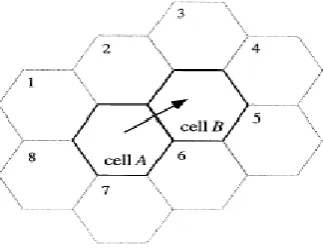
cells, and the reserved bandwidth in the cells which no longer neighbor the new cell is released. This is shown in figure 1. Assume that a mobile user initiates a new Class I connection in cell „A‟. In the proposed scheme, bandwidth is allocated to the connection in the current cell A, and bandwidth is reserved in neighboring cells B, 1, 2, 6, 7, and 8.
Fig. 1 - Example of Bandwidth Reservation Procedure
When the user moves from cell A to cell B, the reserved bandwidth in cell is used to accommodate the handoff connection, and the reserved bandwidth in cells 1, 7, and 8 (i.e., cells which are not adjacent to cell B) is released. At the same time, bandwidth in cells A, 3, 4, and 5 (i.e., new neighboring cells) is reserved.
In the scheme presented, class I connections are given precedence over class II connections. The bandwidth is reserved and utilized only by class I connections because class I connections have more stringent bandwidth requirements than class II type connections. So, before the call is admitted, the class of the call is checked. If the connection belongs to class II, the connection is admitted if the desired bandwidth is available in the cell. But if the connection belongs to class I, then bandwidth will also have to be reserved in all the six neighboring cells on its behalf.
Various algorithms may be used to determine the amount of bandwidth to reserve for Class I connections. A simple approach is to reserve the desired amount of bandwidth of a Class I connection. However, this approach may result in reserving a huge amount of bandwidth. A more efficient approach is to reserve only a fraction of the maximum bandwidth required by the connection. Thus, Class I connections share a common pool of reserved bandwidth.
As a user may move only to one cell out of the six neighboring cells, to utilize the bandwidth optimally, only one sixth of the maximum bandwidth requirement of the connection should be reserved. So in this scheme, 20 percent of the desired bandwidth specified by the user is reserved in all the neighboring cells. That is, bandwidth reserved in each cell, bw_res, is given by
5 M 100
20 M
bw_res
where M is the maximum bandwidth requirement of the connection.
In the presented scheme, a cap is also implemented on the reserved pool of bandwidth so that not much bandwidth is wasted. At the most 15% of the total bandwidth can be reserved in a cell. When the bandwidth reservation process is successful in all the six neighboring cells, only then the connection is accepted in the network. Otherwise the connection is blocked.
D. Handoff Management:
© 2014, IJCSMC All Rights Reserved 413
hand-off, the cell checks to see if the minimum bandwidth requirement can be met with the sum of the available free and reserved bandwidth in the cell. If such is the case, the call is admitted into the cell and given bandwidth from the free bandwidth up to its desired level minus L shares.
The connection is given bandwidth from the reserved bandwidth pool only if it is needed to reach its minimum requirement. If the minimum cannot be met using the free and reserved bandwidth, the cell tests to see if scaling to level L + 1 would free up enough bandwidth to admit the call. If so, the cell scales the other calls in the cell and provides the hand-off call with bandwidth according to the steps described above in the call admission protocol.
On the other hand, Class II traffic will only be dropped if there is no free bandwidth left in the cell at all. The reserved pool is not available to these connections because it is assumed that Class II traffic is able to tolerate a possibly substantial fluctuation in service rather than be disconnected. Calls that have suffered a lowering of bandwidth due to a hand-off will eventually be brought back to a reasonable level as their new cell has free bandwidth to give them. This is in contrast to the schemes presented previously, which have no facility to improve connections that have been degraded due to a hand-off.
III. SIMULATION MODEL
In order to evaluate the performance of the dynamic rate-based borrowing scheme with two other schemes (Fixed Reservation & Rate Based Borrowing scheme), all these three schemes are also simulated for comparison.
First, a simple scheme is simulated that permanently reserves 5 percent of the total bandwidth in each cell for hand-offs. New calls are admitted into the network if their desired bandwidth can be met; otherwise, they are blocked. Class I hand-offs are admitted if at least their minimum bandwidth requirements can be met. If sufficient free bandwidth is not available in the target cell, only then the connections are given bandwidth from the reserved pool. Class II hand-offs are admitted if there is any free bandwidth in the cell.
Then a static borrowing scheme is simulated that reserves some percentage „r‟ of the total bandwidth in each cell for the case of hand-offs. That is, a fixed reservation pool is maintained in each cell for hand-offs. Only class I type traffic is allowed to use the reserved pool of bandwidth. New connections are admitted in the same way as is done in this, i.e., borrowing is done if the sufficient free bandwidth is not available.
The QoS parameters of interest on the basis of which these schemes are compared are: Call Blocking Probability,
Call Dropping Probability, and Bandwidth Utilization
A. Simulation Model:
The simulation model is composed of N cells, each cell keeping contact with its six neighboring cells. Each cell contains a base station, which is responsible for the connection setup and teardown of new connections and handoff connections, as well as the reservation of bandwidth in neighboring cells.
Two types of connections are assumed in the simulation: a new connection, which is initiated by a mobile user, and a hand-off connection, which occurs when a user crosses to another cell during an ongoing connection. The inter arrival times of new connection requests are assumed to follow a geometric distribution with mean 1/μ.
© 2014, IJCSMC All Rights Reserved 414
assumed to decrease exponentially for successive handoffs of the same connection. So, the handoff probability of a connection is equal to ph / 2n, where n is the number of handoffs already experienced by
the connection [5]. The value of the hand-off probability, ph is high for the connections with longer
duration and lower for the connections with shorter duration.
B. Modeling of Cell:
The network is modeled as a grid of size 10 х 10 consisting of 100 cells. Traffic is provided to each cell at the level being measured. If a host moves out of the 10 х 10 grid, the connection is considered to end normally, i.e., hosts do not”bounce” back into the network. Each cell has a maximum bandwidth capacity of „B‟ bits/s. The mobile user is simulated while assuming a random movement pattern, i.e., the user moves to all possible directions with equal probability. When the user hands off to some other cell, the bandwidth reserved on its behalf in the neighboring cells, is also released.
The values of various simulation parameters are summarized in table 1. These values are chosen to closely represent the realistic scenario.
TABLE 1
SIMULATION PARAMETERS
Parameter Value Description
N 100 cells Number of cells in the system.
B 30 Mbps Maximum bandwidth capacity of a cell. 1/μ Variable Mean inter-arrival time of new connections.
ph Variable Hand-off probability.
λ Variable Number of shares that can be borrowed from a connection. f 0.5 Fraction of the BLT that a connection may give up.
C. Traffic Model:
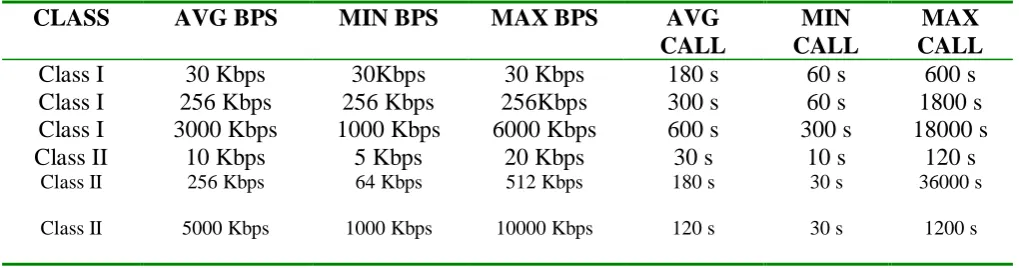
The new call and hand-off arrival processes are modeled as independent processes with a certain mean arrival rate. In order to represent various multimedia applications, six different application groups are assumed based on the connection duration, their bandwidth requirement, and class of service (Class I or Class II). To fairly compare the proposed scheme with the previous ones, the same traffic types and characteristics are used as given in [5], [6] and traffic behavior is modeled just as described in [5], [6].
The different application groups include constant bit rate (CBR), variable bit rate (VBR), and data traffic sources (unspecified bit rate, UBR). Table 2 shows the exact characteristics of the traffic used in the model.
© 2014, IJCSMC All Rights Reserved 415
TABLE 2
TRAFFIC CHARACTERISTICS FOR THE SIMULATION MODEL
CLASS AVG BPS MIN BPS MAX BPS AVG
CALL
MIN CALL
MAX CALL
Class I 30 Kbps 30Kbps 30 Kbps 180 s 60 s 600 s
Class I 256 Kbps 256 Kbps 256Kbps 300 s 60 s 1800 s
Class I 3000 Kbps 1000 Kbps 6000 Kbps 600 s 300 s 18000 s
Class II 10 Kbps 5 Kbps 20 Kbps 30 s 10 s 120 s
Class II 256 Kbps 64 Kbps 512 Kbps 180 s 30 s 36000 s
Class II 5000 Kbps 1000 Kbps 10000 Kbps 120 s 30 s 1200 s
V. COMPARISION ON BASIS OF QOS PARAMETERS
The simulation results are used to evaluate the dynamic rate based borrowing scheme. The simulation results were compared with the corresponding results of two previous schemes. The schemes compared are:
Fixed reservation scheme Rate-based borrowing scheme
The scheme is simulated for various values of „λ‟, to find out the optimum value of „λ‟, i.e., how many times the bandwidth can be borrowed from a connection. After extensive simulations, the best results come out for λ = 7. The value of „f‟ is fixed at 0.5, that is, at most half of a connection‟s bandwidth loss tolerance can be borrowed. To fairly compare the schemes, similar network and traffic parameters are taken for all the three schemes.
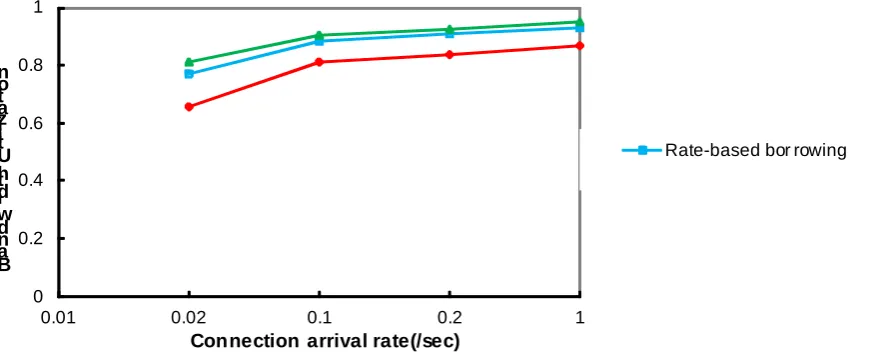
Figure 2 compares the values of bandwidth utilization for the rate-based borrowing scheme in which 5 percent of total bandwidth is reserved in each cell, for a fixed reservation scheme with 5 percent of total bandwidth reserved and for the dynamic rate-based borrowing scheme presented in this . As seen from the figure 2, the value of bandwidth utilization for the dynamic rate-based borrowing scheme is better than the other two schemes. Significantly, at low connection arrival rates, the scheme performs much better because the bandwidth is reserved dynamically and only a percentage of the desired bandwidth is reserved where as in other two schemes, 5 percent of the total bandwidth is reserved permanently.
© 2014, IJCSMC All Rights Reserved 416 0 0.2 0.4 0.6 0.8 1
0.01 0.02 0.1 0.2 1
B a n d w id th U ti li z a ti o n
Connection arrival rate(/sec)
Rate-based bor rowing
Fig. 2 – A comparison of Bandwidth Utilization by the three schemes
Figure 3 and figure 4 shows the call dropping probability (CDP) for class I traffic alone and class I & class II traffic combined. The dynamic rate-borrowing scheme presented here outperforms the other two schemes. In fact, the dropping probability for class I connections is very close to zero. This is because of the favor done towards the class I connections in using the reserved pool of bandwidth. Despite the fact that the class II connections may be dropped during hand-off attempt, Class II traffic fares significantly better under the borrowing scheme presented than under the others.
The CDP decreases when the connection arrival rate increases beyond a certain value of the arrival rate. As the connection arrival rate increases, the average amount of free bandwidth in a cell decreases, and thus, new connections, which require a large amount of bandwidth, are likely to be rejected. Therefore, the average bandwidth allocated to new connections decreases, and when these connections are handed off, they are likely to be accepted since their minimum required bandwidth is likely to be smaller than the desired bandwidth of new calls. This results in a smaller CDP. On the other hand, as the connection arrival rate increases, the number of handoffs also increases, thus, increasing the CDP. Overall, this tradeoff causes a decrease in the CDP after a certain value of the connection arrival rate.
0 0.004 0.008 0.012 0.016 0.02
0.01 0.02 0.1 0.2 1
C a ll D ro p p in g P ro b a b il it y
Connection arrival rate (/sec)
Rate-based borrowing
Fixed 5% reservation
© 2014, IJCSMC All Rights Reserved 417
0 0.01 0.02 0.03 0.04 0.05 0.06 0.07
0.01 0.02 0.1 0.2 1
Cal
l
Dr
op
pi
ng
Prob
a
bi
li
ty
Connection arrival rate(/sec)
Rate-based borrowing
Fixed 5% reservation
Dynamic rate-based borrowing
Fig. 4 – Call Dropping Probabilities (CDP) for Class I & Class II Traffic combined
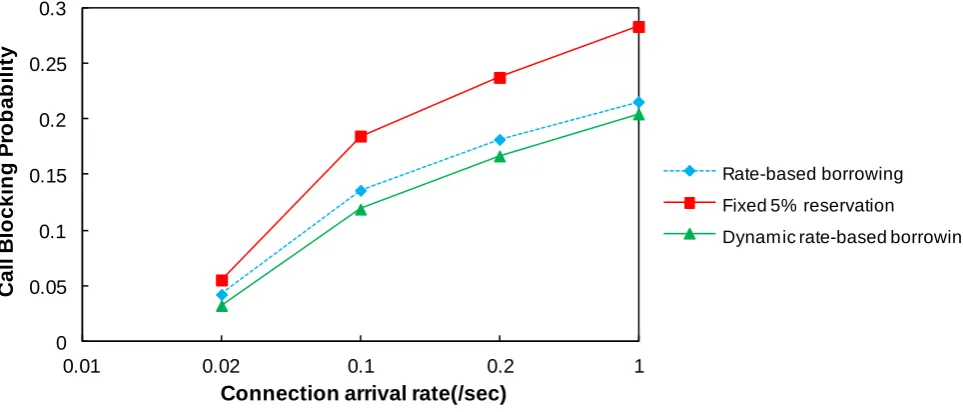
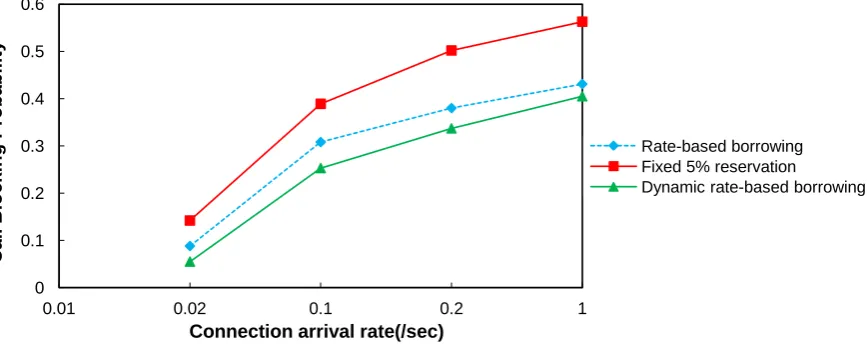
Figure 5 and figure 6 illustrate the call blocking probabilities for Class I traffic alone and for Class I & II traffic combined, respectively. It is clear from the results that the borrowing makes a significant improvement in the call blocking probability (CBP) while also improving the dropping probability. The combined traffic fares worse than Class I traffic alone in terms of CBP. This is due to the characteristics of the traffic being simulated. The Class II traffic requires more bandwidth on average, so there are more chances of the connection being blocked.
But, bandwidth borrowing subject connections to frequent fluctuations in the amount of bandwidth they are provided. It also decreases the probability that calls will always be provided to their desired amount of bandwidth.
0 0.05 0.1 0.15 0.2 0.25 0.3
0.01 0.02 0.1 0.2 1
Ca
ll
Bl
o
c
k
in
g
P
ro
b
a
b
il
it
y
Connection arrival rate(/sec)
Rate-based borrowing Fixed 5% reservation
Dynamic rate-based borrowing
© 2014, IJCSMC All Rights Reserved 418
0 0.1 0.2 0.3 0.4 0.5 0.6
0.01 0.02 0.1 0.2 1
Call
Blo
cking
P
ro
b
abilit
y
Connection arrival rate(/sec)
Rate-based borrowing Fixed 5% reservation
Dynamic rate-based borrowing
Fig. 6 – Call Blocking Probabilities (CBP) for Class I and Class II Traffic combined
VI. CONCLUSION AND FUTURE WORK
In this paper, it has been concluded that extensive simulation results reveal that the dynamic rate based borrowing scheme features very low call dropping probability, low call blocking probability, and good bandwidth utilization. But the improvements in the borrowing scheme come with a price. Bandwidth borrowing subjects the connections to frequent fluctuations in the amount of bandwidth they are provided. It also decreases the probability that the calls will always be provided their desired amount of bandwidth.
Theseresults finally tell us where we are lacking. When the bandwidth is borrowed, it is borrowed gradually in small increments to allow time for application level adaptation. So, a variable „‟ is taken which is the number of shares in which the actual borrowable bandwidth (ABB) is divided. There is another variable „f‟ which tells how much of the ABB is borrowed actually. Further research may be done on how these parameters relate to each other and to the QoS parameters. It can also be tested whether these parameters can be adjusted dynamically to improve the network performance.
While reserving the bandwidth in the neighboring cells, equal bandwidth is reserved homogenously in all the six cells, but the user may move only to one of them. If it can be determined that to which cell the user will be migrating, then a larger amount of bandwidth may be reserved in that cell. This prediction may be made on the basis of the mobility pattern or the previous history of the mobile user. This may further improve the bandwidth utilization.
The amount of reserved bandwidth may also be adjusted based on the current network conditions. This analysis of wireless network schemes shows the performance evaluation of fixed reservation scheme, rate based borrowing scheme & dynamic rate based borrowing scheme and these indications are treated as checkpoints in the future.
REFERENCES
[1] N.D. Tripathi, J.H. Reed and H.F. Vanlandingham, “Handoff in Cellular Systems”, IEEE Personal Communication, pp. 26-
37, Dec 1998.
[2]Andrew S. Tanenbaum, “Computer Networks”, PHI, New Delhi, Fifth Edition,2012.
[3] Harry G. Perros, Khaled M. Elsayed, “Call Admission Control Schemes: A Review”, IEEE Communications Magazine, pp.
© 2014, IJCSMC All Rights Reserved 419
[4] M. Naghshineh and M. Schwartz, “Distributed Call Admission Control in Mobile/ Wireless Networks”, IEEE Journal Selected
Areas in Communications, Vol. 14, pp. 711-717,1996.
[5] Mona El-Kadi, Stephan Olariu, Hussein Abdel-Wahab, “A Rate-Based Borrowing Scheme for QoS Provisioning in Multimedia Wireless Networks”, IEEE Transactions on Parallel and Distributed Systems, Vol. 13, pp. 156-166,Feb. 2002.
[6] C. Oliviera, J. Kim, T. Suda, “An Adaptive Bandwidth Reservation Scheme for High Speed Multimedia Wireless Networks”, IEEE Journal Selected Areas In Communications, Vol. 16, pp. 855-874,1998.
[7] Behrouz Forouzan” Data Communication and Networks”,Tata Mc Graw hill, Fifth Edition, 2013
[8] Nelson Antunes, Antonio Pacheco, Rui Rocha, “An Integrated Traffic Model for Multimedia Wireless Networks”, NH ELSEVIER Computer Networks, pp. 25-41,2002.
[9] D. Levine, I. Akyildiz, and M. Naghshineh, “A Resource Estimation and Call Admission Algorithm for Multimedia Wireless
Networks using Shadow Cluster Concept”, IEEE/ACM Transaction Networking, Vol. 5, pp. 1-12,2010.
[10]M.H. Chiu and M.A. Bassiouni, “Predictive Schemes for Handoff Prioritization in Cellular Networks Based on Mobile
Positioning”, IEEE Journal Selected Areas in Communication, Vol. 158, pp. 510-52,2000