Available Online atwww.ijcsmc.com
International Journal of Computer Science and Mobile Computing
A Monthly Journal of Computer Science and Information Technology
ISSN 2320–088X
IJCSMC, Vol. 3, Issue. 6, June 2014, pg.421 – 425
RESEARCH ARTICLE
Speech Recognisation System Using
Wavelet Transform
Ankita Chugh
Department of Electronics and Communication
PDM college of Engineering for Women, Bahadurgarh, Haryana, India
[email protected]
Poonam Rana
Department of Electronics and Communication
PDM college of Engineering for Women, Bahadurgarh, Haryana, India
[email protected]
Suraj Rana
Department of Electronics and Communication, MRIEM, Rohtak, Haryana, India
[email protected]
ABSTRACT: To develop speech recognition system with low word error rate using wavelet transform through pattern recognition approach. The aim of this paper is to make intelligent system that can recognize the speech signal. This includes also how the feature extracted from the speech signal using Discrete Wavelet Transform and then Dynamic Time Warping is used for pattern matching from the stored database of stored pattern to recognize the test word. Keywords: Speech recognisation, dynamic time warping, discrete wavelets transform
I.
INTRODUCTION
uttered. The template or database consists of signals recorded by the same user that is going to use the system. The second is a speaker independent system. The speech recognition is divided into two stages one is training stage and another is recognition stage. In training stage speech features are extracted and saved to make a reference template. The recognition phase may be divided further into two stages .The first one is the feature extraction stage wherein short time temporal or spectral features are extracted. The second one is the classification stage wherein the derived parameters are compared with stored reference parameters and decisions are made based on some kind of minimum distortion rule. For feature extraction, some kind of transformation is used which can give time-frequency analysis of the speech signal, Short Time Fourier Transform, Linear Predictive Coding are a few of them. Wavelets can also be used in creating a speech recognizer. A wavelet is a wave of finite duration and finite frequency. They have the ability to capture localized features of a signal and act in much the same way as the Fourier transform acts with sine’s and cosine’s. Because of this good localization of features, wavelets can be very useful in speech recognition. The wavelet transform is a technique that processes data at different resolutions and scale. The output of the wavelet transform is a set of approximation coefficients and a set of detail coefficients. By taking the wavelet transform of the previous ones approximation coefficients, more and more octaves can be generated. In this work, Discrete Wavelet Transform is used for feature extraction. Section2 discusses speech recognisation background. Section3 represents literature survey. Section4 details methodology. Section5 presents conclusion.
II.
BACKGROUND
Problems in recognizing speech include noise, speaker variations, and differences between the training and testing environments, such as the microphones used [1]. One way of dealing with this is to adapt the recognition system’s internal model (i.e. Hidden Markov Model weights). Another is to normalize the new speech to conform to the training data. Variations with different speakers mean that speaker dependent systems usually do better than speaker-independent ones, since the former uses the speaker for training. Dynamic Time Warping, or a similar algorithm, is necessary because of the non-uniform patterns of different speech signals. Also, different speakers will more than likely say the same words at different rates. This means that a simple linear time alignment comparison, such as the root square mean error, cannot be
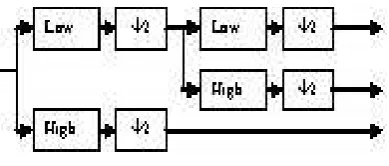
used efficiently. One way to do speech recognition is phoneme-based indexing [2]. A phoneme is a basic sound in a language, and words are made by putting phoneme together. One method is to consider the trip hone, a set of three phonemes where a phoneme is considered with its left and right neighbors [3].Therefore, this method identifies speech based on its component phonemes. We are not trying to match a spoken word to a word list, but rather output the phonemes detected. For example, if the user says the word “pocket”, our system should output “p”, “ah”, “k”, “eh”, and “t”. Our approach includes the wavelet transform, shown in figure 1 [4]. This figure shows that 1-dimensional signals broken into two signals by low-pass and high-pass filters. The down samplers (shown as an arrow next to the number2) eliminate every other sample, so that the two remaining signals are approximately half the size of the original. As this figure shows, the low-pass (approximate) signal can be further Decomposed, giving a second level of resolution (called an octave). The Number of possible octaves is limited by the size of the original signal, though a number of octaves between 3and 6 is common. Wavelets express signals as sums of wavelets and their dilations and translations. They act in a similar way as Fourier analysis but can approximate signals which contain both large and small features, as well as sharp spikes and discontinuities. This is due to the fact that wavelets do not use a fixed time frequency window. The underlying principle of wavelets is to analyze according to scale.
Fig. 1 Discrete Wavelet Transform
III.
LITERATURE SURVEY
wavelet transform, and offergreater flexibility for the detection of oscillatory or periodic behavior. The training features for a feed-forward neural network was obtained using the best-basis paradigm, and a dictionary was chosen for each phoneme by a minimum cost function. Five nodes for the neural network classifier were used after they determined that this was a suitable number. Their method was tested on a few phonemes taken from the same user but uttered in different words.
Gouvea et al. [6], design procedures to improve the accuracy of speech recognition systems in noisy environments, as well as normalizing speech signals to account for different speakers. They used recording from the 1995 ARPA Hub 3 which contained recordings of speech in both clean and noisy environments. The 1995 ARPA Hub 3 task was designed to test speech recognition systems for a variety of recording conditioned. Different environments were used for recording as well as different microphones. Initially, signals were classified as clean or noisy using the difference between the minimum and the maximum values of the zeroth order cepstral coefficient. The minimum value of the zeroth-order cepstral coefficient is a measure of the noise in the signal, and the maximum value of the zeroth-order cepstral coefficient is the measure of signal itself. The difference between these is then a measure of the signal to noise ratio. Cepstral coefficients are a result of using the Fourier transform on the spectral magnitudes of the signal. These coefficients are often used as an input to hidden Markov models. The signal classified as “clean” was processeddifferently from those that were classified as “noisy”. Codebook dependent cepstral normalization was used to attempt to estimate the noise and filter that would best represent the reference static. To help with speaker normalization, a warping function was found by looking the Gaussian mixture models of each speaker compared to a model made for a prototype speaker. An optimal warping function is then found for each speaker using this method
.
Hidden Markov Models were created for a generic speaker based on the optimal warping function. With these techniques, the word recognition rate was lessened, especially for noisy speech.Hauptman [7] proposed a system to recognize speech that would get its information from closed-captioned television. The television data would be used for training a speech recognition system. Recognizing speech typically involves models for acoustics, language, and pronunciations. The acoustic model often uses neural networks (NN) and/ or Hidden Markov Models. These approaches require accurate training data, generated by the laborious process of humans listening to speech and typing the words. This work is challenging, since transcribers sometimes misspell words, insert extra words, and leave out other words, leading to a word error rate (WER) of 17% for prime time news programs. Other problems with analyzing speech are silences and extraneous noise made by the speaker.
Ganapathiraju et al [8] used a syllable-based system for large vocabulary continuous speech recognition. A large vocabulary is typically larger than 1000 words. Continuous speech is like having a normal conversation. There is no stopping after each sound or word but rather a constant utterance by a user. An example of continuous speech would be dictation where complete sentences and ideas are given without pause.
Continuous speech is more difficult to recognize because there are no obvious start and end points of the phoneme or words. The speech recognizer is constantly running, listening for sounds to interpret. A syllable-based system uses a longer time frame, which should model the variations in pronunciations. The performance of this system is compared to using a tri-phone system. The decision to use syllables instead of phonemes is based on the fact that a lot of words tend to run into each other during speech, and a lot of phonemes get deleted when people speak. For example, a sentence starting as “Did you get …” could be heard as the first two words merged into the third word as “jh y u g eh”. Because of this, the syllable may be a more stable unit to work with for speech recognition. The syllable based and tri-phone systems were both based on a standard large vocabulary continuous speech recognition system developed from a commercial package, HTK. HTK stands for Hidden Markov Model Toolkit, and was developed at the Speech Vision and Robotics Group of the Cambridge University Engineering Department. It is portable toolkit for building and manipulating hidden Markov models. This syllable based system did well in recognizing the alphabet but lagged in digit recognition.
IV.
METHODOLOGY
For feature extraction, firstly the input analog signal is converted into digital form by A/D converter. Next the function of the pre-emphasizer is to boost the signal spectrum approximately 20 dB per decade. The Digitized speech signal is put through a low-order digital system, to spectrally flatten the signal and to make it less susceptible to finite precision effects later in the signal processing. The next step in the processing is to windowing each individual frame so as to minimize the signal discontinuities at the beginning and end of each frame and framing. At last step in feature extraction technique, Discrete Wavelet Transform is used to compute the details and approximation coefficients and form the feature vector codebook or pattern database to whom, test pattern is compared. For pattern matching dynamic wrap programming is used to warp the feature vectors of reference speech over the test speech such that there is maximum match.DWT mainly computes the minimum distance between test pattern and stored pattern. Fig 2 explains the above methodology.
Fig.2 Block diagram of DWT based speech recognition
V.
CONCLUSION
Speech recognition is the task of extracting features from a speech signal and using a classifying algorithm on these features. The goal is to accurately distinguish any speech signal from other speech signals. The speech recognition process is divided into two phases: the
A/D Conversion
Pre-emphasis
Framing & Windowing
Wavelet Processing (DWT) Energy
Calculation Speech
Signal
Test Pattern
Distance Measure
Pattern Database
Dynamic Time Warping
Decision Rule
warping for classifying them as a part of pattern recognition approach. Pre-emphasis is done to boost up the voiced section of the speech signals. Experiments are carried out by using different wavelets at different Frame durations. A template of all words is made to carry out experiments on both the speaker dependent as well as speaker independent systems. The experiments also carried out using short time Fourier transform at feature extraction stage and dynamic time warping for comparison.
REFERENCES
[1] Evandro B. Gouva, Pedro J. Moreno, Bhiksha Raj, Thomas M. Sullivan, and Richard M. Stern, “Adaptation and Compensation: Approaches to Microphone and Speaker Independence in Automatic Speech Recognition,”Proc. DARPA Speech Recognition Workshop, February 1996, pages 87-92.
[2] Neal Leavitt, “Let’s Hear It for Audio Mining,” Computer, October 2002, pages 23-25.
[3] P.J. Jang and A. G. Hauptmann, “Learning to Recognize Speech by Watching Television,” IEEE Intelligent Systems, Volume 14, No. 5, 1999, pp. 51-58.
[4] Amara Graps, “An Introduction to Wavelets,” IEEE Computational Science and Engineering, Vol. 2, Num. 2, 1995. [5] C.J. Long, and S.Dutta, “Wavelet based feature extraction for phoneme recognition” Proceedings of the International conference on spoken language processing, volume 1, October 1996, Pages 264-267.
[6] Evandro B. Gouvea, Petro J. Moreno, Bhiksha Raj, Thomas M. Sullivan and Richard M.Stern, “Adaptation & Compensation: Approaches to microphone and speaker independence in Automatic Speech Recognition”, Proceedings of the DefenseAdvanced Research Projects Agency Speech Recognition Workshop, Harriman, NY, February 1996, Pages 87-92.
[7] P.J. Jang, and A.G. Hauptmann, “Learning to recognize speech by watching television”, IEEE Intelligent systems, volume 14, No. 5, 1999, pages 51-58.