(IJARSE) 2012, Vol. No.1, Issue No. 8, August ISSN-2319-8354
ELM-LSTM Based Sentiment Analysis
A.SHAJI GEORGE
1, Dr. K. KRISHNAMOORTHY
21
Research Scholar,Faculty of Computer Science & Engineering, CMJ University, Jorabat, Ri-Bhoi District, Meghalaya, India
2
Professor, Department of Computer Science & Engineering, Sudharsan Engineering College, Pudukkottai,Tamilnadu, India
Abstract
The speed of machine learning has been a concern of the people. The speed of Extreme Learning
Machine (ELM) has been improved very faster than others. However, the speed of Sequential
Extreme Learning Machine is still slow. So, a fast sequence Extreme Learning Machine (Fast
Sequential Extreme Learning Machine, FS-ELM) is present by the use of iterative calculation in
calculation of the output weights at obtaining input weights and hidden bias randomly.
Independent parts of data on the hidden layer are superimposed after acquiring the sequence
training data. Then the output weights are obtained with calculation formula. In the initialization
of the learning phase during training FS-ELM can accept any number of training data without
affecting the accuracy of training and test impact.Supervised learning methods are widely used
in text sentiment classification. To acquire high classification performance, the effective and
precise term weighting scheme plays a prime and necessary role for classification system. The
traditional term weighting schemes often ignore the use of the available labeling information as
the prior knowledge, which results the expressed relationships between features and class labels
are not accurate and adequate enough. Hence, this paper proposes a term weighting scheme
which makes use of class contribution of feature terms, and obtains a scheme which takes into
account the class contribution, local distribution and global distribution of feature terms.
Introduction
With the increase in number of documents on the Web, it has become increasingly
important to reduce the noisy and redundant features which can reduce the training time and
hence increase the performance of the classifier during text classification. Selection of a good
classifier plays a vital role in the text classification process. Many of the traditional classifiers
(IJARSE) 2012, Vol. No.1, Issue No. 8, August ISSN-2319-8354 Learning Machine (ELM) is able to approximate any complex non-linear mappings directly from
the training samples. Hence, ELM has a better universal approximation capability than
conventional neural networks based classifiers.
ELM, a new learning scheme of feed forward neural networks, error surface that impacts
the performance of back propagation learning algorithm is the presence of local minima. Neural
network may be over-trained by using back propagation and obtain worse generalization
performance. Extreme Learning Machine for Regression and Multiclass Classification, ELM
uses multi output nodes, and index of the output node with the highest output value is considered
as the label of input data. ELM and LS-SVM have the same optimization cost function. ELM
method not only has universal approximation capability (of approximating any target continuous
function) but also has classification capability (of classifying any disjoint regions).
“An ELM-based model for affective analogical reasoning” when it comes to interpreting
sentences and extracting useful information for users, their capabilities are still very limited.
Indeed, such scenario has led to the emerging fields of opinion mining and sentiment analysis,
which deal with information retrieval and knowledge discovery from text using data mining and
natural language processing (NLP) techniques to distill knowledge and opinions. Mining
opinions and sentiments from natural language though, an extremely difficult task as it involves
a deep understanding of most of the explicit and implicit, regular and irregular, syntactical and
semantic rules proper of a language. The target spotting module aims to separate one or more
opinion targets, such as people, places, events and ideas, from the input concepts.
ELM have a, quick learning speed, ability to manage huge volume of data, requirement
of less human intervention, good generalization capability, easy implementation etc. are some of
the salient features which make ELM more popular compared to other traditional classifiers.
Recently developed Multilayer ELM which is based on the architecture of deep learning is an
extension of ELM and have more than one hidden In this paper, we propose an approach for
feature selection called Commonality-Rarity Score Computation (CRSC) by means of three
parameters (Alpha (measures weighted commonality), Beta (measures extent of occurrence of a
term) and Gamma (average weight of term per document)), computes the score of a term in order
(IJARSE) 2012, Vol. No.1, Issue No. 8, August ISSN-2319-8354
Literature survey
Jithin et al [1] presented a classification of text that combines two machine learning
techniques, K-Means and extreme learning machines. First the clustering and feature selection is
performed by using K-Means algorithm and then this attribute will be the training set for the
extreme learning machine. First the data is preprocessed in their approach. After that feature was
extracted. The features selection using information gain method then from the reduced data set
chi-square method is used for exact features. Feature selection is necessary for removing features
that are not relevant.
Shah et al [2] addressed a new clustering based feature selection technique that reduces
the feature size. Traditional k-means clustering technique along with TF-IDF and Wordnet helps
to form a quality and reduced feature vector to train the Extreme Learning Machine (ELM) and
Multi-layer ELM (ML-ELM) which has been used as the classifiers for text classification.
TF-IDF scores and finally all these top features are combined together to generate the final reduced
feature vector of a cluster.
Yong et al [3] discussed a technique, namely window-based sentence representation
(WSR), to obtain the features of sentences using pre-trained word vectors. The method is
developed based on the Extreme Learning Machine (ELM). This proposed framework does not
require any prior knowledge and thus can be applied to various document summarization tasks
with different languages, written styles and so on.
Pranav et al [4] addressed a new feature selection technique called CRSC, where three
parameters (Alpha, Beta and Gamma) are computed for each term of a document. Finally, a
score for each term is calculated using these three parameters values. Then the terms are ranked
in each cluster based on the assigned scores and top m% features are selected as the important
features which are used to train the classifiers.
Philip et al [5] described a new algorithm providing regularized training of the extreme
learning machine (ELM) that uses a modified conjugate gradient (CG) method to determine the
network hidden to output weights. The solution is initialized to zero and during the CG
iterations, we monitor the validation set error. When the error begins to rise we terminate the CG
algorithm. The operations per iteration is O(P2), where P is the number of output weights, which
is significantly faster than the O(P3) operations per iteration required by ridge regression
(IJARSE) 2012, Vol. No.1, Issue No. 8, August ISSN-2319-8354
Azreen et al [6] proposed a method is to reduce the size of the Word2Vec feature set for
sentiment analysis. The method constructs cluster of terms centered by a set of opinion words
from a sentiment lexical dictionary. A simple transformation is applied to the negative term
vectors to redistribute the terms in the space based on their polarity. A much smaller matrix of
document vectors is produced based on the set of clusters. In particular, the set of terms in a
vocabulary are clustered around opinion words in order to distribute them based on polarity.
Sathish et al [7] proposed a technique for find out the topics which also available in the
text documents as a group of words and apply a clustering technique using the Singular value
decomposition method. Then opinions are extracted from the comments, collected on a particular
subject of interest like the comments. A novel approach to finding the opinions of the customers
towards specific features of Smartphone using Opinion analysis and clustering technique.
XU YUAN et al [8] discussed a deep hypergraph scheme for online reviews modeling
and sentiment classification. One property of this model is to construct hypergraph to detect
high-order relations among different reviews. Another property of the model is to use an
improved hierarchical clustering algorithm to discover semantic cliques used for detecting
precise semantic units as the supervision information.
Emil et al [9] presented an aspect based opinion mining method that relies on two nature
inspired approaches: an ant based sentence clustering method for discovering the aspects
commented on in product review opinionated sentences, and an unsupervised neural network for
actually classifying the positive/ negative opinion about the aspects discovered by the sentence
clustering step. For an unsupervised classifier, the quality of labeling the opinion polarity is
pretty good, as the classifier does not require annotated training data to be built for the given
semantic domain.
Shuanglu et al [10] proposed an affective visual descriptor method, BoAW, which is able to
bridge the semantic gap between low-level visual features and affective language descriptors.
Second, group of ANPs can be generated by the proposed structured forest. These ANPs can be
integrated with the textual affective descriptors by SSP method. Third, the integrated
representation is able to provide effective sentiment classification on social media posts with
(IJARSE) 2012, Vol. No.1, Issue No. 8, August ISSN-2319-8354
Methodology
The Text classification is an important thing due to the increase in E-documents. The
motive of this paper is to evaluate the performance of ELM-LSTM in the field of text
classification and sentiment analysis. So there are many methods for text classification. Here
introduces a new method which is a combination of two classifiers, ELM and LSTM. Also two
feature selection method make the classification more accurate. K-Means is a simple clustering
method. This produces set of clusters with attributes. This attribute will use to train the ELM.
ELM is a recent machine learning technique
Our work proposes Extreme learning machine and Long Short-Term Memory network
for sentiment analysis of text. The model is able to detect binary sentiment classification of text
context. Results demonstrate that our approach is effective. In our opinion, the affective
sentiment of text context is decided by the interaction of the target feature within the context.
Our model describes the interaction by using attention mechanism with a standard ELM and
LSTM. In the LSTM layer, target information is applied to affect the production of contextual
sentiments. In the attention layer, the target guides capturing the importance of text context.
From the perspective of language model, the RNN with LSTM can be regarded as an
improved model of the conventional RNN language model. They both calculate the error of each
model via putting the text statements as the input sequence. The smaller error indicates higher
degree of confidence of text statement under this model. But generally the RNN model with
LSTM is more effective to overcome the sequence information attenuation problem when the
text sequence information is rather long. So we would apply the RNN with LSTM on the text
sentiment analysis.
ELM, as a single hidden layer feed forward neural network, contains three layers: an
input layer, a hidden layer and output layer. ELM does not need many of the iterative calculation
of network weights corrected. Compared with traditional machine learning methods, Extreme
Learning Machine greatly improves the speed of the network training. This makes ELM been
used to the application in regression and classification successfully. But in most of the
applications, the data is serialized acquisition. This need to wait that all of the training data
collection is completed before training, or that the old training data required for repeated
(IJARSE) 2012, Vol. No.1, Issue No. 8, August ISSN-2319-8354 In the training phase, the training data are divided into several categories, according to
their target features. Then the LSTM models are trained for each category of data, resulting in
several LSTM models, each for the corresponding to the text. To forecast the value of a new
input review, the LSTM models obtained in the training phase are evaluated on the new input
review, giving error values. The model giving the smallest error value is assigned as the
emotional category to the new input review. In order to improve the speed of sequence learning,
a new sequence learning strategies is proposed to improve the speed of sequentially training
ELM model.
In this work, an approach is made to enhance the performance in terms of speed and
accuracy of the model. First, data is collected from Twitter, Facebook posts and other news blogs
using web scraping tools. Preprocessing is performed on collected textual data to remove the
unwanted features. Processed data is then passed to the Recurrent Neural Network (RNN) model
for further processing.
We apply five main steps to perform sentiment analysis. These steps consist of
(i) pre-processing
(ii) feature extraction,
(iii) term weighting
(iv) classification,
(v) Evaluation.
In order to analyze the opinions of the user, first step required is to collect the user-generated
content from web. Web scraping is the process of automatically mining data or collecting
information from the World Wide Web. Data is collected from two social networking sites,
Twitter and Facebook. Twitter Search API is used to collect the tweets from Twitter. Facebook
API is used to collect public posts from Facebook. Using web crawling tool Parsehub, data from
different blogs and News websites is collected.
ELM is a fastest method of classification. Basically it is a single hidden layer feed
forward network. Most of the neural network need tuning for efficient classification. But in ELM
it can achieve the goal without tuning. Hence it become a fastest method among the existing
(IJARSE) 2012, Vol. No.1, Issue No. 8, August ISSN-2319-8354
Pre-processing
Data collected from the web is unstructured, it contains noise and uninformative parts
such as HTML tags, stopwords, scripts and advertisements. The processes of cleaning and
preparing data for sentiment analysis is called preprocessing. On words level, many words in the
text do not have an impact on the general orientation of it.
Since each word in the text is treated as one dimension, keeping irrelevant words
increases the dimensionality of the problem and hence makes the classification more difficult.
The entire pre-processing procedure involves several steps: white space removal, abbreviation
expansion, stemming, stop words removal, negation handling.
In the pre-processing step, we clean the Twitter feeds from the incomprehensible words
and characters. Then, we extract features in two different ways including Bag of Words (BoW)
and ngram. After the feature extraction phase, weights are assigned to features and document
vectors are computed. Then we build a learning system by training a classifier. In the final phase,
we employ this learning system to make polarity classification of the tweets.
As the pre-processing task we apply the following steps to extract meaningful information from
the tweets:
1. Cleaning noise from the tweets by removing the incomprehensible words and meaningless
characters (only in BoW model) such as punctuation marks and digits.
2. Lowercase conversion to remove case sensitivity of features.
3. Applying text normalization to prevent from having high dimensional feature space by
removing the repeating letters and reducing them to one letter.
4. Removing the tweets that have less than one feature (i.e., word or n-gram) by applying
minimum term count filter.
5. Stripping the features, whose length is less than two characters, out from the tweets?
6. Removing the Twitter specific terms (e.g., emoticons, URLs, hashtags, etc.) to make the
classifier learn only from the meaningful textual content.
Sentiment analysis has sparse and high dimensional feature space as it is considered as text
classification task. Especially, the high dimensionality of feature space stems from the traditional
feature extraction models. Therefore, to prevent from having high dimensional feature space we
(IJARSE) 2012, Vol. No.1, Issue No. 8, August ISSN-2319-8354
Stop-words removal, and
Stemming
Stop word removal
Stop word removal is another important task in data preprocessing. It is a process of
eliminating the commonly occurring words existing in a sentence like a, an, the, are etc. Stop
words does not carry any relevant information and are language specific functional words.
We remove the stop-words from the tweets by using the default list in Lucene API. We
also perform word stemming by utilizing the Zemberek that is an open source Turkish NLP tool .
After the completion of the pre-processing steps which are illustrated in Table 2, we tokenize the
tweets and extract features to classify the datasets.
Stemming
Stemming is the process of deleting the suffix of the word and putting it into its basis or
fundamentals. If a text contains the words, connected, connection and connecting, they should
not be treated as different words especially in a sentiment classifier where they have the same
meaning and the same polarity. Stemming them will return to connect and then the words
frequency will be 3, and that is instead of three words with a frequency 1. Purpose of stemming
is to reduce the number of words, to have accurately matching stems, for saving time and
memory space
Porters stemming algorithm is one of the most popular stemming algorithm. It is based on
the idea that the suffixes in the English language are mostly made up of grouping of smaller and
simpler suffixes.
It has five steps, and within each step, rules are applied until one of them passes the
conditions. If a rule is accepted, the suffix is removed consequently, and the next step is
performed. The resultant stem at the end of the fifth step is returned. The rule looks like the
following:
(Condition) (suffix) = (new suffix)
For example,
a rule (v) + (c) EED = EE
Means if the word has at least one vowel and consonant plus EED ending, change the ending to
EE.
(IJARSE) 2012, Vol. No.1, Issue No. 8, August ISSN-2319-8354 If word contains vowel and ends with ED, then remove ED, hence” Plastered”becomes ”Plaster”.
After applying all preprocessing techniques, resulted text is passed to processing module
i.e. recurrent neural network model where text is analyzed for assigning opinion polarity.
Feature Extraction
In Vector Space Model (VSM), the data instances are converted to numerical vectors by
using different methods which have high impact on the accuracy of the classification system
applied. Data instances (i.e., tweets) are represented as numerical vectors by using the extracted
features and assigning weights to these features. In this study, we use two different methods that
are BoW and n-gram (i.e., trigram) to extract features. We apply both methods to the two
datasets, therefore we have 2 different representations for each dataset. We call them according
to the feature extraction method used as DS1BoW, DS1Trigram, DS2BoW, and DS2Trigram respectively.
In BoW model, numerical vector representation of a document is often done by
associating a word with a numerical weight which is generally proportional to its frequency on
the document. Therefore, each word is taken as a feature in BoW model.
The n-gram model, on the other hands, is an alternative feature extraction technique. It
can be applied in two different ways: i) character level, and ii) word level n-grams. In character
level ngram model, the features are formed by taking n consecutive characters in the text
content. For example, the character level ngrams of the string “opinion mining” are obtained as
follows:
2-gram (bigram): |op|, |pi|, |in|, |ni|, |io|, |on|, |n_|, |_m|, |mi|, |in|, |ni|, etc.
3-gram (trigram): |opi|, |pin|, |ini|, |nio|, |ion|, |on_|, |n_m|, |_mi|, |min|, |ini|, |nin|, etc. where „_‟ represents whitespace character, and „|‟ is used to show the n-gram boundary. In word
level n-gram representation, the adjacent n words are taken as a feature. For the same example
above, word level 1-grams and 2-gram are as follows:
1-gram (unigram): |opinion|, |mining|
2-gram (bigram): |opinion mining|
Where, we do not have any 3-gram. Character level n-grams are language independent and they
can handle with misspelling and abbreviations. Therefore, in this study, we use character level
(IJARSE) 2012, Vol. No.1, Issue No. 8, August ISSN-2319-8354
Term Weighting
After all features are extracted from the whole document collection by using either BoW,
or n-gram methods, weight of each feature for each document is computed to form the document
vector. Term weighting is a process to determine the importance of a term for a document. For
this reason, it has an important role in the correct and effective representation of textual data.
The aim of a good feature selection technique is to effectively distinguish between terms that are
relevant and those that are not. For this purpose, the meaning of „relevance‟ needs to be considered clearly. Some methods understand „relevance‟ on the basis of the relation of the term
to a particular class. Other feature selection methods rely on probabilistic or statistical models to
select the appropriate terms. For Commonality Rarity Score Computation (CRSC), a term is
„relevant‟ if it has the following attributes:
It does not appear very frequently in the corpus, as it would then be unsuitable as a
differentiator between documents.
It‟s frequency in the corpus is not very low, as it would then be unsuitable to be used for
grouping similar documents.
iii. In the documents in which the term appears, it should be reasonably frequent.
iv. It needs to be a good discriminator at the document level.
In this paper, we propose an approach for feature selection called Commonality-Rarity
Score Computation (CRSC) by means of three parameters (Alpha (measures weighted
commonality), Beta (measures extent of occurrence of a term) and Gamma (average weight of
term per document)), computes the score of a term in order to rank them based on their
relevance. The top m% features are selected for text classification.
In order to apply these properties to a mathematical definition of relevance, we propose
three parameters, whose combination would provide a score to each term. If the score of a term
would be higher then its relevance is higher. The parameters mentioned above are alpha (α(x)),
beta (β( x )) and gamma (γ(x)), each of which will be considered in detail in the next section.
Alpha
The parameter alpha (α(x)), is a mathematical representation of the weighted commonality of the
term x and is defined as
(IJARSE) 2012, Vol. No.1, Issue No. 8, August ISSN-2319-8354
Where, y = 𝑁𝑑
𝑖𝑑 = 𝑖𝑑(𝑥)
𝑁 𝑁 𝑥
Here‟d‟ represents the number of documents with the term x and N represents total number of
documents in the corpus. The ID of a term indicates the rarity of the term in the corpus.
ID (x) = 1 + 𝑙𝑜𝑔10 𝑁𝑑
The average ID 𝑖𝑑 denotes the average rarity of the corpus.
Since we are weighting y by 1/𝑖𝑑, y can be seen as being weighted by the commonality
constant of the corpus. Therefore the term 1/𝑖𝑑 * y increases the value of α(x) if the term x is
common and the average commonality of the terms in the corpus is high. Similarly, the term
(1-y), which indicates the fraction of documents in the corpus without the term x, is weighted by the
rarity constant 1/idf. Therefore the term 1/idf* (1-y) increases.
The value of α(x) if the term x is rare and the average rarity of the terms in the corpus is
high. Thus, the equation for α(x) provides a method to compute a commonality-rarity of a term
in the corpus. Since id of a term is always greater than 1, therefore, idwill be more than 1. Also,
if a term is very rare, it‟s (1-y) value will be high which makes the value of α(x) for that term as
high. Hence, rare terms tend to have higher values for α(x). This feature is used to filter the
unimportant terms.
Beta
The parameter beta (β(t)), is a mathematical representation of the frequency of
appearance of the term t in the documents and can be given by
β(x)=𝑦1(x)+𝑦22(x)+𝑦33 𝑥 + ⋯
where
𝑦𝑖 𝑡 =𝑑𝑖 𝑁
Where 𝑑𝑖 ← number of documents where frequency of x ≥ i. The term of β(x) therefore
provides information regarding the prevalence of the term x in the corpus by considering the
fraction of documents containing the term t and also taking into account the frequency of
(IJARSE) 2012, Vol. No.1, Issue No. 8, August ISSN-2319-8354 will have a higher beta value. Also, the contribution of yito β(t) decreases with increasing value
of i. Therefore, very high frequency of occurrence of a term t in a particular document does not
significantly increase its β(t). This is done mathematically by giving each yias an exponent i.
Gamma
Gamma (γ(t)) is obtained by summing over all documents d in the corpus of γ(t,d) and can
be written as
𝛾(𝑡, 𝑑)=𝑚𝑎𝑥𝑖𝑚𝑢𝑚 𝑇𝐹 𝑖𝑛 𝑑𝑇𝐹(𝑡,𝑑)
γ(t,d) gives an indication of the relative weight of the term t in the document d, by comparing the
frequency of the term t to the highest frequency term in d. γ(t) quantitatively denotes the average
weighted frequency of the term per document in the corpus.
Score
Finally, using the above three parameters, a total score is assigned to each term in the
corpus as an indication of its relevance.
The score of a term t is given by score
(t) = β(t)∗min(γ(t),1/γ(t))−α(t) (10)
A higher value of score(t) indicates a higher relevance of the term t to the corpus. As
elaborated previously, β(t) indicates the overall frequency of a term in the corpus, and the term
γ(t) indicates the average frequency of the term in each document in the corpus. A high value for β(t) indicates that very frequently t is present in most of the documents, whereas a high value
for γ(t) suggests that the term t is frequent in those documents where it is present, and therefore a
good discriminator for the same.
For a term t to be a good differentiator among documents, not only must it be frequent in
the corpus, but it must also be important for differentiating between documents. For this, γ(t)
should necessarily not be very low for a term, which is to be selected as part of the reduced
feature space to classify the documents. However, a direct product of β(t) and γ(t) can result in
common terms that appear in almost all documents given very high scores, despite them not
being relevant per our earlier definition.
In order to eliminate such terms, we instead use a product of β(t) and the minimum of γ(t)
and 1/γ(t). With this product, terms which are very frequent, and as a result have a high value for
β(t), will result in the β(t) value being divided by their equally large γ(t) value, reducing their
(IJARSE) 2012, Vol. No.1, Issue No. 8, August ISSN-2319-8354 values for rare terms, is subtracted from the previous product to produce the score. This
eliminates those terms that are very rare from being considered as important.
The formula for score therefore eliminates terms that are both very frequent and very rare,
leaving behind only those terms that are moderately rare, sufficiently good document level
discriminators and sufficiently frequent in the documents in which they appear. score (t)
therefore provides an accurate mathematical representation of the definition of relevant stated
earlier, and helps to select relevant terms based on their commonality-rarity both at the document
and corpus level.
Deep learning has gained much attention in recent years, as it yields state-of-the-art
performance in many tasks. Among the techniques available in deep learning, the long
short-term memory (LSTM) recurrent neural network (RNN) is considered extremely suitable for
sequential data such as speech, text and video. As customer product reviews are in the form of
text chunks, we use LSTM RNN for the keyword extraction task.
Recurrent Neural Network (RNN)
A Recurrent Neural Network (RNN) is a class of artificial neural network where
connections between units form a directed cycle. It contains hidden units capable of analyzing
streams of data. The RNN is usually fed with training samples that have strong
interdependencies and a meaningful representation to maintain information about what happened
in all the previous time steps. RNNs can use their internal memory to process arbitrary sequences
of inputs. It contains directed loops which represent the propagation of activations to future
inputs in a sequence.
From the training process, it can be seen that (1) and (2) will be used to calculate and
obtain a new output weights every time acquire new data. But (1) and (2) contains a greater
amount of matrix multiplication. When the amount of data is large, the multiplication needed
more. And in
most cases, every output weights will not always be used during the test. In experiments,
OS-ELM is much slower than OS-ELM algorithm in the amount of data that OS-ELM algorithm can
(IJARSE) 2012, Vol. No.1, Issue No. 8, August ISSN-2319-8354
LSTM Network
The basic elements in an LSTM memory unit are three essential gates and a cell, as
illustrated. All of the information memorized at time t is scored in the memory cell. The state of
the memory cell is bonded with input three gates: the input gate, the output gate and the forget
gate. Each gate‟s input consists of input and a recurrent part. The input gate is used to determine
what new information should be stored in the LSTM cell. The output gate determines the content
of output. The recurrent part is updated by the current status and feeds the information into the
next iteration
LSTM through deliberate design to avoid long-term dependence, in practice, remember
the long term information is the default behavior of LSTM. At present, LSTM network is the
most widely used one, it replaces RNN node in hidden layer with LSTM cell, which is designed
to save the text history information. LSTM uses three gates to control the usage and update of
the text history information, which are input gates, forget gates and output gates respectively.
The memory cell and three gates are designed to enable LSTM to read, save and update
long-distance history information. LSTM network model was established based on the mathematical
theories of the recurrent neural network
To summarize, our contributions lie in the following three points
1) We propose an ELM-LSTM model for sentiment analysis, which use the prior sentiment
information of words as the supplemental information to improve the quality of word
representation.
2) In order to improve the semantic composition ability of LSTMs, we define a new method
to calculate the attention vector in general sentiment analysis with a target and take two special
circumstances as examples.
3) To verify our methods, we conduct experiments on multiple datasets. The results of
experiments show that our methods are effective. Furthermore, we find that LSTMs have strong
ability in handling short text sequences. The attention mechanism that we use only works on the
long text sequences.
The analysis experiments also prove the result.
Following Fig.2 shows general representation of RNN. Unlike any other neural network, RNN
(IJARSE) 2012, Vol. No.1, Issue No. 8, August ISSN-2319-8354 Notations used in it are: xt= input at time step t
st= hidden state at time step t (”memory of the network”)
calculated as st= f(Uxt+ Wst−1)
where, f is the activation function ( tanh,ReLU )
ot= output at step t where, ot= softmax(V st)
Training of RNN can be done using gradient descent approach. It is trained by using
training data, where resultant of given input is already specified. Model calculates the cost by
subtracting actual output from generated output. The rate at which cost changes with respect to
weight or bias is called gradient. RNN suffers from the problem of vanishing gradient. If
gradient is too small then model will train very slowly and as gradient value keeps degrading it
vanishes at the end, hence it becomes difficult to train model. To overcome the problem of
vanishing gradient LSTM or GRU is used.
1) LSTM (Long Short Term Memory): Long short-term memory (LSTM) units are a
building unit for layers of a RNN. An RNN composed of LSTM units is often called an LSTM
network. A common LSTM unit is composed of a cell, an input gate, an output gate and a forget
gate. The cell is responsible for remembering” values over arbitrary time intervals.
The input gate can allow incoming signal to alter the state of the memory cell or block it.
The output gate can allow the state of the memory cell to have an effect on other neurons or
prevent it. Finally, the forget gate can modulate the memory cells self-recurrent connection,
allowing the cell to remember or forget its previous state, as needed.
The following equations describe updation of layer of memory cells every timestep t.
In these equations: xtis the input to the memory cell at time t
Wi,Wf,Wc,Wo,Ui,Uf,Uc,UoandVoare the weight matrices
bi,bf,bcandboare the bias vectors
First, compute the values for it, the input gate, and the candidate value for the states of the
memory cells at time t:
it = σ(Wixt+ Uiht−1 + bi)
Cft= tanh(Wcxt+ Ucht−1+ bc)
Second, compute the value for ft, the activation of the memory cells forget gates at time t:
(IJARSE) 2012, Vol. No.1, Issue No. 8, August ISSN-2319-8354 Given the value of the input gate activation it, the forget gate activation ft and the candidate state
value Cft, the Ct i.e. memory cells new state at time t can be computed:
With the new state of the memory cells, the value of their output gates and, subsequently, their
outputs can be computed: ot= σ(Woxt+ Uoht−1+ VoCt+ bo) ht= ot∗tanh(Ct) Sigmoid function on
last time step tend yˆ= σ(htendU+ b). Final result gives the output of 0 or 1, which denotes the
opinion polarity as positive or negative.
The input of the LSTM model is a series of vectorized texts and the parameters of the LSTM
model. The parameters are propagated through the multilayer network of the LSTM model to
achieve iterative updating, text feature learning, and satisfactory sentiment classification results.
The sequence in which the context input of the features also affects the determination of the
polarity of the product features. Therefore, an improved BiLSTM network is introduced to
improve the feature sentiment polarity judgment. In the BiLSTM neural network, two LSTM
neural networks are introduced when the corpus is first modeled. One models the review texts at
the beginning from left to right, whereas the other models review texts at the end from right to
left and fully utilizes feature context information for sentiment analysis. After multi-layer LSTM
network processing, the models are classified into the softmax layer
In comparison with the simple neural network, the applied LSTM neural network model includes
three gates in the data processing unit part of the network layer, namely, input, forget, and output
gates, in addition to the multilayer network. These gates save and delete context information by
model. The implementation of sentiment analysis for text in the LSTM model depends mainly on
the LSTM cell
3.5 Algorithm
Proposed approach of CRSC is discussed below.
Step 1. Documents pre-processing and vector representation:
classesThedocumentsof a corpusd=are {d1collected,d2,...,dmand} ofpre-all processed by using a pre-processing algorithm. Then, all the documents are converted into vectors using the formal
Vector Space Model (VSM)(Salton et al., 1975).
Step 2. Formation of clusters: Traditional k-means clustering algorithm (Hartigan and Wong,
1979) is run on the corpus to generates k term-document clusters, tdi,i= 1,...,k.
(IJARSE) 2012, Vol. No.1, Issue No. 8, August ISSN-2319-8354 Now, γ(t) are for calculated each term and t ∈then tdi, αthe(t)total, β(t) scoreand using equation 10 is computed.
Step 4. Training ML-ELM and other conventional classifiers:
Based on the total score, all the terms of a cluster are ranked and top m% terms from each cluster
are selected which constitute the training feature vector.
Example
To apply ELM for classification, first of all, features extracted in the pre-processing step
and their computed weight values for each tweet are taken as shown below:
and
where we have 4 tweets and 6 features such that matrix x represents feature weights for
the training dataset such that in each row we have a document vector for each tweet; and t
denotes the class labels of each tweet in matrix x. In the training phase, the matrices for input weights (𝑤) and the biases of hidden neurons (𝑏) are randomly initialized as shown below.
In our example, the number of neurons in the hidden layer is taken as 𝐿 = 4, which
corresponds to the number of tweets in the training set. Therefore, the input weight matrix has 4
(i.e., # of tweets) rows and 6 (i.e., # of features) columns.
After randomly initialization of the input weights and biases, the matrix for the output of the
hidden layer is calculated with the following equation:
(13)
In above equation, represents the activation function. In this example, we use the sigmoid
activation function. Following the calculation of , the output weights could then be calculated
by using equation (4). The matrix and resulting are as follows:
0.87
0.80
0.77
0.73 0.85
0.78
0.83
0.81
(IJARSE) 2012, Vol. No.1, Issue No. 8, August ISSN-2319-8354 66.3809 −569.61 118.394 371.656
𝛽 = [ ]
5.53886 64.7862 0.40749 −68.685
−10.575 −23.298 9.16500 23.6135
After the output weights are computed, the training phase is completed. Then, we can classify a
previously unseen test data (with the same number of hidden neuron and feature space) by using
the computed output weights. In the testing phase, if the following vector x for a tweet with class
label t which is 3 is given to the trained ELM system, 𝑥 = [1 0 0 0 0 0] and𝑡 = [3]
then, the matrix for the test tweet is calculated by applying the same steps as in the training
phase. Therefore, 𝑇𝑒𝑠𝑡 is computed as follows:
After that the class label of the test tweet is predicted by using the equation 𝑌𝑂𝑢𝑡= 𝐻𝑇𝑒𝑠𝑡𝛽 as
shown below:
The resulting 𝑌𝑂𝑢𝑡 shows the prediction of the ELM. As it can be seen from 𝑌𝑂𝑢𝑡 the last value is
the maximum of all values, therefore the predicted class label is equal to last class which is 3
(see matrix in the training phase for all possible classes). This prediction is correct for the given
test instance.
In this study, we also use SVM with linear kernel, which is a kernel-based and robust machine
learning algorithm for sparse data, to make comparison with ELM. It has two types in practice
including linear and non-linear SVM. Linear SVM aims to find a hyperplane that has maximum
margin between classes without increasing dimension of the feature space. Non-linear SVM
transforms the data to a higher dimension by a kernel function (e.g., Radial basis, Sigmoid) and
performs classification in this space. SVM is mainly concerned with solving binary class
problems, however, it can be employed successfully in multiclass classification by different
(IJARSE) 2012, Vol. No.1, Issue No. 8, August ISSN-2319-8354
Result
We take experiments to validate the discriminative bottleneck features. Because ELM is
adopted as the classifier in our method, we also use ELM method in this part. As ELM is a static
classifier, we first perform mean operation to all the segments in each utterance to get
utterance-level features. Then the raw heuristic features with 384 dimensions and the bottleneck features
with 30 dimensions are fed to ELM independently. Table 1 illustrates the F1 score which is a
most common used measure of a test‟s accuracy.
We apply the proposed model to three datasets in different fields. The experiment results
evaluate the effectiveness of ELM-LSTM in target-dependent sentiment classification by
comparing to several baselines. Results in our work show that there is a great improvement when
using bottleneck features. Bottleneck features can enhance the outperformance 3.91% on average
F1 compared with raw heuristic features, especially for neutral class (+14.05%). The results
prove that it is necessity to extract discriminative bottleneck features.
We employ -fold cross validation (CV) approach to validate the predictive model. We
prefer this method especially by considering the ELM. Since the ELM uses random values in the
computations, even if we use the same activation function and the same number of hidden
neurons, the input weights and the hidden layer biases may change. Therefore, the ELM should
be run multiple times. In the n-fold CV, the dataset is randomly divided into disjoint subsets,
then one of these subsets is taken as the test set whereas the rest are used as the training set. This
process is repeated for each subset. The overall success of the classification model is calculated
by taking the average of these iterations. In this study, we perform 10 folds CV.
To perform sentiment analysis, first we apply pre-processing to the datasets by removing
the emoticons, short terms having length less than two characters, and other Twitter specific
terms. In this way, we use only the textual content to train the classifier. Therefore, the size of
the feature space is reduced by 3.95% and 14.15% for DS1 and DS2 respectively as shown in
Table 3. We also remove some samples, which does not have enough number of terms, from the
datasets. After the preprocessing phase, the total number of samples for each datasets is given in
Table 4. Then we extract the features by using BoW and character level trigram methods. As it
can be seen from Table 4, the number of BoW features is less than that of trigram features for
(IJARSE) 2012, Vol. No.1, Issue No. 8, August ISSN-2319-8354 BoW model. In the last step of the preprocessing, we compute term weights. Finally, we perform
the classification to obtain the experimental results.
We evaluate our model on twitter data, all these tweets and data has been tagged by their
author as positive and negative. This corpus consists of 13000 reviews, which has 7000 positive
comments and we shuffled the positive and negative data. In this section, we describe the
validation approach and performance evaluation measures that we use to compare the
classification methods.
Datasets Used in the Experiments
In this section, we describe the datasets used for the evaluation of the ELM. Sentiment
analysis on Twitter is generally performed on two different types of datasets including
subject-dependent and subject-insubject-dependent. Subject-subject-dependent means the dataset is composed of tweets
that related to any topic, whereas subject-independent represents the dataset containing tweets
that does not have relation with any topic. In this study, we use two different Twitter datasets
from which the Dataset1 (DS1) is subject-dependent and the second one (DS2) is subject
independent. The DS1 has manually labeled tweets which are related with a private company in
the telecom sector. It contains totally 3000 tweets in three categories that are positive, negative,
and neutral. The second dataset (DS2) is a subset of another dataset which is automatically
collected and labeled by using emoticons contained in the tweets (i.e., distant supervision) with
the help of Twitter API. This dataset contains 32000 tweets which are equally distributed in
positive and negative categories. However, we use a subset of this dataset to form DS2 as the
size of the original dataset is out of the scope for this paper. The DS2 is composed of 10000
tweets in total which have equal distribution for positive and negative classes.
The classifiers which are used for comparison purpose are Support Vector Machine
(LinearSVC), Decision Tree (DT), SVM linear kernel (LinearSVM), Gaussian Naive Bayes
(GNB), Random Forest (RF), Nearest Centroid (NC), Adaboost, Multinomial Naive-Bayes
(M-NB) and ELM. The algorithm was tested on hidden layer nodes of different size both for ELM
and LSTM-ELM and the best results are obtained when the number of nodes of hidden layer are
more than the nodes in the input layer. In the k-means clustering, k (the number of clusters) was
set as 8 (decided empirically) for both the datasets. The following parameters are used to
(IJARSE) 2012, Vol. No.1, Issue No. 8, August ISSN-2319-8354 Our experiments consist of two phases. First, we conduct the experiments on DS1BoW to
find the best combination of the number of neurons in the hidden layer and the activation
function for ELM. We use five different activation functions and nine different values for the
number of neurons in the hidden layer resulting in a total of 45 combinations. The five different
activation functions are sigmoid, sine, radbas, hardlim, and purelin. The nine different values of
the number of neurons in the hidden layer are 10, 20, 30, 50, 80, 100, 200, 500, and 1000.
According to the results of the first phase, we found that performance of the ELM is not so
sensitive for the number of neurons in the hidden layer. However, the most successful result is
generally obtained when the number of neurons in the hidden layer is selected as 500. We also
observed that the activation function is more effective on the performance of the ELM with
respect to the number of neurons in the hidden layer. The most successful activation function is
LSTM-ELM with one exceptional case. Therefore, we decided to use the LSTM function, and
500 neurons in the hidden layer for ELM in subsequent experiments.
We compare our new LSTM model with the traditional LSTM model for sentiment
analysis. In the experiments, the sentences are segmented. Word vectors are trained by the word
embedding tool in on all product reviews. A python based sequence processing tool Keras is used
to build LSTM models. Three LSTM models (LSTM, LSTM with L2 and Nadam, BLSTM) in
different depths.
We compare the accuracy of the three text sentiment analysis models, including LSTM,
BLSTM and LSTM based on Nadam and L2. In the following figure 3, we show the recognition
accuracy of different model. We can find that the accuracy of BLSTM recognition LSTM is high
and requires only few epoch. Because BLSTM can learn previous and feature information and
can capture stronger dependency between words and phrases than LSTM. LSTM based on
Nadam and L2 models have improved in terms of convergence speed and accuracy, which is
much higher than LSTM. Because the LSTM based on L2 and Nadam has a stronger ability to
prevent over-fitting and improve the model's generalization and convergence speed.
The training process uses BPTT algorithm to train the weights. The number of unfold
state layer would affect the training accuracy. More unfold state layers generally lead to better
results, but also cost higher computational complexity. In the meantime, the congenital
(IJARSE) 2012, Vol. No.1, Issue No. 8, August ISSN-2319-8354 with the conventional RNN. So we set the number of unfold layer in BPTT as 10 in our
experiment.
The following the natural order, from left to right, of the participles in the sentence,
traversal one by one, through the forward calculation of LSTM. The output results are the
probabilities of the word at time t, giving the vocabulary sequence before time t. Finally the error
value of the sentence is measured by the joint distribution probability of all words. Higher joint
distribution probability will result in lower value of text statement error.
The main process of the training phase is shown in the figure 2 below, where the data are
classified into three categories as an illustration: positive, negative and neutral. Compared with
the conventional RNN language model, RNN with LSTM could cover a long sentence
completely, and does perform better in many experiments, especially for structures with
conjunctions, such as „although…but…‟, „not only…but also…‟, „however‟, „what is more‟, „in addition‟ and so on.
We apply both the RNN with LSTM and the conventional RNN on each data set.
Sentiment analysis results are shown in the following tables.
Results are evaluated using a standard machine learning evaluation measure: the F1 score
applied to each class
To compute success rate of the classification models we use precision (P), recall (R),
F-measure (F1), and accuracy (Acc) values that are computed as in equations 14, 15, 16, and 17,
respectively.
P=TP/ (TP+FP) --- (1)
R=TP/ (TP+FN) ---- (2)
𝐹1 = 2 × (𝑃 × 𝑅)/ (𝑃 + 𝑅)
where 𝑁 represents the number of samples in test dataset, TP, TN, FP, and FN values have the
following definitions as shown in Figure 2.
(IJARSE) 2012, Vol. No.1, Issue No. 8, August ISSN-2319-8354
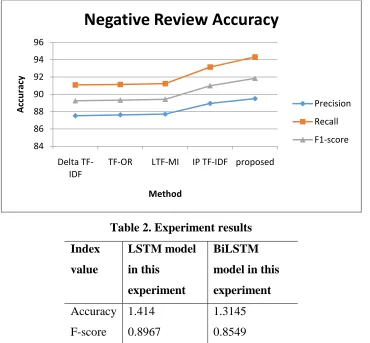
Table -1: precision and recall values of proposed work
weighting scheme
positive negative
Precision Recall F1 Precision Recall F1
Delta TF-IDF 90.75 87.00 88.82 87.52 91.09 89.26
TF-OR 90.82 87.10 88.90 87.62 91.14 89.33
LTF-MI 90.89 87.20 88.99 87.71 91.24 89.43
IP TF-IDF 92.82 88.40 90.55 88.94 93.15 90.99
proposed 93.6 90.2 91.87 89.5 94.32 91.85
82 84 86 88 90 92 94 96
Delta TF-IDF
TF-OR LTF-MI IP TF-IDF proposed
A
cc
u
rac
y
Method
Positive Review Accuracy
Precision
Recall
(IJARSE) 2012, Vol. No.1, Issue No. 8, August ISSN-2319-8354
Table 2. Experiment results
Index
value
LSTM model
in this
experiment
BiLSTM
model in this
experiment
Accuracy 1.414 1.3145
F-score 0.8967 0.8549
The experiment results are compared with those of Tang et al., as shown in Table 3.
Table.3. Result comparison
Index
value
LSTM model BiLSTM model
Present
study
Existing
study
Present
study
Existing
study
Accuracy 1.3653 0.9074 1.1567 0.9089
F-score 0.9843 0.6547 0.7980 0.6770 84
86 88 90 92 94 96
Delta TF-IDF
TF-OR LTF-MI IP TF-IDF proposed
A
cc
u
rac
y
Method
Negative Review Accuracy
Precision
Recall
(IJARSE) 2012, Vol. No.1, Issue No. 8, August ISSN-2319-8354
In this paper, an improved RNN language model is put forward ü LSTM, which
successfully covers all history sequence information and performs better than conventional RNN.
It is applied to achieve multi-classification for text emotional attributes, and identifies text
emotional attributes more accurately than the conventional RNN.
For RNN model, scientists put forward an idea named „Attention‟ which may lead to
better results. This is to make RNN select information from larger information set in each step.
Besides, „Attention‟ is not the only development in RNN area. Scientists have proposed Grid
LSTM which also showed excellent performances in some application scenarios. In future work,
we could try these improvement programs or use different models combination to improve the
performance of text sentiment analysis.
In this paper, in order to verify the performance of our method, a widely used standard
dataset is selected as the experimental dataset. The dataset, ChnSentiCorp_htl_ba_4000. In this
paper, it is called the Chinese hotel dataset. The dataset contains 4000 documents (2000 negative
and 2000 positive).
According to the data comparison in Table 3, the performance of the improved BiLSTM
model in Chinese is better than that of the original LSTM. The use of the BiLSTM to model the
text in two directions slightly influenced the judgment of the emotional polarity of the features.
The reason may be that the LSTM model has a memory function on the context; consequently,
the relative position of the text input has no effect on the model, and its absolute position is the
key factor that affects the model. From the experimental results, the application of the LSTM 0
0.2 0.4 0.6 0.8 1 1.2
LSTM BILSTM SVM model ELM-LSTM
A
cc
u
rac
y
Method
Accuracy
(IJARSE) 2012, Vol. No.1, Issue No. 8, August ISSN-2319-8354 model to the Chinese language achieved good results after a series of modifications to Chinese
characters was made. In comparison with the results of Tang et al. in English, accuracy and
F-scores in Chinese improved, which indicates that the LSTM model is effective in Chinese
fine-grained sentiment analysis. The use of the LSTM network in finefine-grained sentiment analysis of
Chinese customer reviews is feasible and effective. As shown in Figure 7, the performance of the
sentiment analysis of the LSTM model is greatly enhanced, compared with the traditional
learning model, because the use of LSTM networks for sentiment analysis of product features
does not require priori knowledge, such as syntactic parsing or sentiment lexicon. Only the
LSTM model is used to consider the effect of context on feature emotional polarity. The
emotional polarity in product features is judged automatically. Moreover, the LSTM model has
long-term memory to the context of reviews text, which makes up for the disadvantage of the
traditional sentiment ansalysis of neglecting product feature text context, which makes the
judgment of emotional tendency on product features more accurate.
Overall, we achieved a satisfactory accuracy score of 63% using the LSTM-CNN model
compared to a baseline model which used Naïve Bayes as a classifier. The experiment showed
the ability of the CNN to act as powerful feature extractors and LSTM to capture changing
sentiment in a long text.
Conclusion
We propose an improved term weighting scheme in this paper, which combines the
contribution of feature terms to the class, the local distribution in the document, and the global
distribution in the document set. Compared with a series of weighted schemes, experimental
results on a widely used Chinese dataset verify that the proposed scheme is effective and can
significantly improve the classification performance. In the future, we plan to combine our
scheme with other feature selection methods that reflect class distinctions and verify their
effectiveness on more datasets which belong to different domains that aims to gain a better
classification performance. Finally, the performance of the proposed scheme on unbalanced
corpus is also the focus of the followup work.
References
[1] Jithin, “Text Classification Using KM-ELM Classifier “, 2016 International Conference on Circuit,
Power and Computing Technologies [ICCPCT].
[2] Shah, “Clustering Based Feature Selection using Extreme Learning Machines for Text Classification
(IJARSE) 2012, Vol. No.1, Issue No. 8, August ISSN-2319-8354 [3] Yong, “Multi-document Extractive Summarization Using Window-based Sentence Representation “,
2015 IEEE Symposium Series on Computational Intelligence.
[4] Pranav, “A New Feature Selection Technique Combined with ELM Feature Space for Text
Classification “.
[5] Philip, “Regularized Training of the Extreme Learning Machine using the Conjugate Gradient
Method “, School of Electrical and Information Engineering.
[6] Azreen, “Improvement of Sentiment Analysis based on Clustering of Word2Vec Features “, 2017
28th International Workshop on Database and Expert Systems Applications.
[7] Sathish, “Concept detection and Cluster Analysis from Newsfeed- Singular value decomposition
based Approach “, 2016 International Conference on Computational Intelligence and Networks.
[8] XU YUAN, “Semantic Clustering-Based Deep Hypergraph Model for Online Reviews Semantic
Classification in Cyber-Physical-Social Systems “, School of Software, Dalian University of
Technology, Dalian, China.
[9] Emil, “Unsupervised Aspect Level Sentiment Analysis Using Ant Clustering and Self-organizing
Maps “, Technical University of Cluj-Napoca.
[10] Shuanglu, “Integrating Visual and Textual Affective Descriptors for Sentiment Analysis of Social
Media Posts “, 2018 IEEE Conference on Multimedia Information Processing and Retrieval
[11] Tao Wang,” Reasearch on Feature Mapping Based on Labels Information in Multi-label Text
Classification “, Beijing University of Posts and Telecommunications.
[12] Gargi, “Unsupervised Classification of Online Community Input to Advance Transportation Services
“Department of Computer Science.
[13] AsliCelikyilmaz, “An Empirical Investigation of Word Class-Based Features for Natural Language Understanding “, IEEE/ACM Transactions on Audio, Speech, and Language Processing.
[14] Amir Hamzah, “Opinion Classification Using Maximum Entropy and K-Means Clustering “,2016
International Conference on Information, Communication Technology and System (ICTS).
[15] Jyoti, “Text Classification using Semi-supervised Approach for Multi Domain “,2017 International