On the Security Loss of Unique Signatures
Andrew Morgan Cornell University
Rafael Pass∗ Cornell Tech
September 21, 2018
Abstract
We consider the question of whether the security of unique digital signature schemes can be based on game-based cryptographic assumptions usinglinear-preserving black-box security reductions—that is, black-box reductions for which the security loss (i.e., the ratio between “work” of the adversary and the “work” of the reduction) is somea priori bounded polynomial. A seminal result by Coron (Eurocrypt’02) shows limitations of such reductions; however, his impossibility result and its subsequent extensions all suffer from two notable restrictions: (1) they only rule out so-called “simple” reductions, where the reduction is restricted to only sequen-tially invoke “straight-line” instances of the adversary; and (2) they only rule out reductions to non-interactive (two-round) assumptions.
In this work, we present the first full impossibility result: our main result shows that the ex-istence ofany linear-preserving black-box reduction for basing the security of unique signatures on somebounded-round assumption implies that the assumption can be broken in polynomial time.
∗
1
Introduction
Digital signature schemes, whereby a party can “sign” a message in a publicly verifiable yet still adversarially unforgeable way, are one of the most basic and important classes of cryptographic primitives; their security has been studied since the 1970s. While the earliest constructions of digital signatures [RSA78, Rab79, Sha78, DH06] were heuristic in nature, modern constructions have tight proofs of security against all computationally bounded adversaries based on certain underlying assumptions.
Specifically, in a provably secure construction, we have a reduction R, which, given any adver-sary A which breaks the security of a digital signature scheme Π, can break a certain underlying assumption C; hence, if the assumption holds, then the scheme must be secure. In this paper, we restrict our attention to black-box security reductions, whereR only interacts with A as a “black box”.1 As far as we know, all security proofs for digital signatures rely on black-box security reductions.
We are interested in the security loss of such a reduction (a concept originally proposed as “security preservation” in [Lub96]), or intuitively how “inefficient” it is in terms of running time and success probability compared to the adversary it runs. Informally, if, given a security parameter
n,R(including the instances ofAit runs) andArun in timeTimeRA(n) andTimeA(n) respectively,
and have success probabilities ofSuccessRA(n) and SuccessA(n), then the security loss is given by
the maximum over all adversariesA of:
λR(n) =
SuccessA(n)
SuccessRA(n)
TimeRA(n) TimeA(n)
Intuitively, if we define the “work factor” of the adversaryAto be the ratio of its running time to its success probability, or WorkA(n) = SuccessTimeA(n)
A(n) (and respectively forR
A), then we can think
of the security loss as
λR=
WorkRA(n) WorkA(n)
or how much “work” the reduction R needs to do to break the underlying assumption compared to the amount of work that its adversary A does to break the primitive Π. So the higher the security loss, the easier the primitive is to break compared to the underlying assumption. As such, having security reductions with low security loss is essential for proving practical security of cryptographic primitives, since the security loss has a significant effect on the security parameter (i.e., the bit length of a key, size of a large prime for RSA, etc.) which must be used for the underlying assumption to achieve a particular level of security for the primitive.
The most efficient possible reductions are those which have constant security loss λR(n) ≤c;
these are commonly calledtight reductions [BR96]. These reductions prove thatWorkA(n) is always
directly proportional toWorkRA(n), and so increasing the security parameter will always have the
same effect on the security of the primitive as on the security of the underlying assumption. A weaker notion of efficiency—introduced by Luby [Lub96]—is that of a linear-preserving re-duction, where the security loss is required to be bounded by some a priori fixed polynomialp(·) in just the security parameter; that is,λR(n)≤p(n).
For instance, a security reduction that only runs the adversary A a fixed polynomial number of times (independent of A’s running time and success probability) may not be tight, but is still
1We note that Π need not be black-box itself in some underlying primitive; we only require thereductionRto be
linear-preserving.2 While, with a linear-preserving reduction, the concrete security of the primitive Π is only comparable to that of the assumption if we use an increased security parameter for Π, Π still retains the same “asymptotic” security as the underlying assumption: for instance, if Π can be broken in timepoly(n)·(2n/3), then so can the underlying assumption.
Unique Signatures. While the original provably secure construction of digital signatures in [GMR88] was neither tight nor linear-preserving, more recent constructions [BR96, Ber08, AFLT12, HJ12, CW13, CGW17] with tight reductions have been exhibited. However, while these modern constructions are quite efficient, they sacrifice some arguably important features of the original constructions in achieving this. Most notably, the earliest construction in [RSA78] had the property that signatures were unique—that is, for every public key and every message, there exists at most one valid signature for that message. Whereas provably secure constructions of unique signatures ex-ist [MVR99,Lys02], as well as constructions of verifiable random functions [MVR99,BGRV09,Jag15] (which [MVR99] shows imply unique signatures), none of these have linear-preserving, let alone tight, security reductions. And unfortunately, for many recent applications of digital signatures (e.g., the recent applications to blockchains [GHM+17, PS17]), this uniqueness property is in fact necessary.
Can Unique Signatures Have Linear-Preserving Reductions? A natural question, given the fact that no linear-preserving reductions have been discovered, is whether a certain degree of security loss is required when proving the security of unique signatures. This question was first addressed in 2002 by Jean-S´ebastien Coron in his seminal paper [Cor02]. At a high level, Coron’s goal was to demonstrate that any unique signature scheme with a black-box security reduction must have a security loss ofO(`(n)), where`(n) is the number of signing queries made by the adversary. This, in particular, would rule out all linear-preserving reductions for unique signature schemes because `(n) depends on the specific adversaryAand can be an arbitrarily large polynomial.
However, while Coron’s proof rules out many “natural” reductions, it does not fully answer the question. In particular, it applies only to a quite restricted class of “simple” reductions which run the adversary in a “sequential straight-line” fashion—that is, they can run many instances of the adversary, but must run them sequentially (such that each must finish before the next starts) and cannot rewind the adversary. Furthermore, Coron’s result applies only to reductions to the class ofnon-interactive (i.e., two-round) security assumptions (e.g., inverting a one-way function or breaking RSA). This latter restriction is necessary to some extent; if the security assumption may have arbitrarily many rounds, then it becomes trivial to base security on such an assumption (e.g., reducing the security of digital signatures to itself). However, there is still a large gap between non-interactive and “unbounded-round” security assumptions, leaving open the question of whether bounded-round assumptions [Pas11] (that is, security assumptions modeled as security games with ana priori bounded number of communication rounds) can be used to prove the security of unique signatures.
Since Coron’s seminal work, his result has been generalized to a number of related primi-tives [HJK12, BJLS16], improved and simplified [BJLS16, KK12], and extended to rule out other notions of security tightness [WMHT18]. However, despite these extensions, improvements, and
2
The name “linear-preserving” comes from the fact thatWorkRA is still linear in the quantityWorkA(n), although
generalizations, the above restrictions—to simple reductions, and to non-interactive assumptions— have not yet been surmounted, leaving open the question:
Does there exist a linear-preserving security reduction for basing the security of unique digital signatures on some natural hardness assumption?
Main Theorem. In this work, we settle this question, ruling out all linear-preserving reductions from unique signatures toany bounded-round assumption.
Theorem 1. (Informal.) There does not exist a linear-preserving black-box reduction from the security of some unique signature scheme Π to a bounded-round intractability assumptionC, unless C can be broken in polynomial time.
More precisely, we show that, unlessCcan be broken in polynomial time, the security loss of any black-box reduction from the security of some unique signature scheme Π to any bounded-round intractability assumptionCmust be at leastO(p`(n)), where`(n) is the number of signature queries the adversary uses (and thus not a fixed polynomial independent of the adversary). Moreover, we observe (in Appendix C) that our main theorem, with minor alterations, can also be applied to the related notion of rerandomizable signatures, or non-unique signatures with the property that signatures can be efficiently “rerandomized”.
1.1 Proof Outline
In proving our main theorem, we follow the “meta-reduction” paradigm, originally pioneered in [BV98] (see also [BMV08, HRS09, FS10, AGO11, BBF13, BFW16] for related work concerning meta-reductions), though we note that work on black-box separations using other frameworks dates back much farther, to [IR89]. The core idea behind this approach is, given an arbitrary black-box reduction R that breaks the assumption C by using black-box access to some “ideal adversary” A (which itself breaks the security of the primitive Π), to create an efficient adversary B which breaksCwithout using A: Bwill internally runRand, roughly speaking, internally (and efficiently) “emulate” A for R. The implication then is that if such a reduction Rexists and breaks C using the inefficient adversaryA, thenBwould likewise breakC, but in polynomial time, proving thatC is not a secure assumption. See Figure 1 for an illustration of the mechanics of this paradigm.
Of course, we cannot prove complete non-existence (since, indeed, provably secure unique sig-nature schemes exist); instead, we show that, unless R makes many queries to A—which already implies that the security loss is high—then we can efficiently emulate A’s responses with “high” (but not overwhelming) probability, which in turn will imply that B breaks C unless R’s success probability is relatively small (again implying that its security loss is high).
R A
C
? 6
breaks Π inefficient breaksC
R A
C
? 6
(emulated) efficient (run byB)
B (meta-reduction), breaksC
Figure 1: The meta-reduction paradigm. Left: Rbreaks the assumptionCby using the “ideal” but inefficient adversaryA(against the signature scheme Π) as an oracle. Right: the meta-reductionB runs R(forwarding its communication with C) and efficiently emulates Ato break C with slightly less probability than in the left experiment.
pick a random message m∗, rewind the execution of R to before a randomly selected query, and try queryingR form∗ instead of what it sent to Rduring the “main” (i.e., non-rewound) thread. IfRreturns a correct signature form∗ during this “rewinding”, thenBhas succeeded in efficiently extracting a forgery and can return it toR. In this case,Bhas succeeded inperfectly emulatingA; note that this relies on the fact that the signature scheme is unique and thus there exists at most one valid signature onm∗.
Of course, R may not always return a correct response to A’s (or B’s) queries; however, if A receives any incorrect responses in the “main” thread, it may simply return ⊥ to R (as the security game for unique signatures only dictates that A must return a valid forgery when its queries are correctly answered), and so, in that case, B may also do so when emulating A. The only time that B will fail to emulate A is, in fact, when R responds correctly to the original
`(n) queries by B during the “main” execution, but fails to respond to the rewound query of m∗
in any rewinding (and so B can neither return ⊥ or a forgery). Coron, through an elegant (yet complex) probabilistic argument, shows that the probability of this “bad event” is bounded above by O(1)/`(n). Intuitively, the reason this holds is that, unless Rprovides signatures to a fraction
O(1)/`(n) of random messages m∗ (and thus the rewinding succeeds with probability O(1)/`(n)), it is unlikely that R provides correct signatures to all the `(n) signature requests on the “main” thread, and in this caseBdoes not need to provide a forgery to succeed in emulatingA. Of course, formalizing this argument is quite non-trivial, and Coron presents a sophisticated analysis which does so.
This argument rules out all reductions R from the security of unique signatures to a non-interactive security assumption which break the assumption with probability greater than the failure probability ofB—that is,O(1)/`(n)—assumingRruns a single instance of its adversary. IfRruns multiple,M(n), instances of its adversary in a sequential (i.e., non-interleaved) manner, then by the union bound over all instances, the failure probability bound becomesO(M(n))/`(n). Furthermore, in this case we know that TimeRA(n) ≥ M(n)TimeA(n), and so (given SuccessA(n) = 1) Coron’s
argument achieves a bound of
A R
.. .
m1,`(n)
pk2
m2,1
σ2,`(n)
(m∗2, σ2∗)
σ1,`(n)
(m∗1, σ∗1)
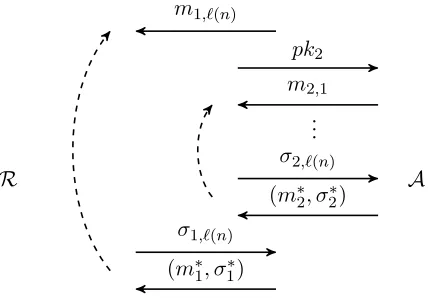
Figure 2: A simple example of nested rewinding byBthat might occur during interaction between R and two concurrent simulated instances ofA. Note that the inner rewinding must occur twice, once before the outer rewinding and once after, as the public key pk2 might change based on the
message m1,`(n). In fact, with m concurrent instances, up to 2m rewindings may occur in this
fashion.
which thus rules out all linear-preserving reductions as there is no a priori polynomial bound on
`(n).
We note that while Coron’s proof relies on a subtle and non-trivial analysis, a very recent and elegant work by Bader et al. [BJLS16] presents a much simpler proof of Coron’s theorem. In their approach, however, they consider a quite different ideal adversary A0, which is even more tailored to simple reductions and non-interactive assumptions.3 Consequently, we focus on Coron’s original approach, which we shall see can be generalized to deal with all reductions and all bounded-round assumptions.
The problem with interactive assumptions and “nesting”. Note that, in the above argu-ment, it is crucial that the security assumption is non-interactive. Otherwise, when we rewind R, Rmay send a new message toC and may require a response before proceeding; if this happens, we can no longer perform the emulation (as we cannot rewind the communication withC).
Additionally, the argument crucially relies on the fact that R talks to A in a “straight-line” fashion, and only considers sequential interactions with (multiple instances) of A. If we did not have that restriction,Rmight simultaneously run multiple instances ofAand “nest” these different executions. For instance, it might be the case thatRreceives a query from a particular instance of A, begins an entirely different instance of A (or perhaps even multiple instances), makes queries, and potentially requests a forgery, all before returning a response to the first query. Rewinding this will be troublesome because, depending on the query, R could respond differently to the nested queries or even follow an entirely different execution pattern. Even more worrying is the fact that, if there are enough levels of nesting, rewinding every query for every instance may take super-polynomial time, which would invalidate the construction ofB(since an inefficient adversary would not contradict the assumption C). See Figure 2 for an example illustrating this.
Interestingly, this problem is also prevalent in research concerning concurrent zero-knowledge
3
[DNS98]. This connection was already noted in the earlier impossibility result for black-box reduc-tions of [Pas11], where a “recursive rewinding strategy” (similar to [RK99, CLP10, DGS09, PV08]) is used to overcome this problem. The core idea behind this technique is to rewindevery relevant query, but to “abort” the rewinding when “too many” nested queries take place during the rewind-ing. The limit on nested queries furthermore decreases by a factor ofnwith each recursive level of nesting, so, since the total number of messages is polynomial, the number of levels will always be bounded by a constant, providing the polynomial bound on running time.
One might be tempted to simply apply this technique directly to the problem at hand; unfor-tunately, due to a fundamental difference between the two results, this is not possible. Specifically, in [Pas11], the result proven is a complete impossibility (and not just a bound on the security loss): more precisely, emulation of A can be shown to succeed with overwhelming probability. In our context, however, the probability that the emulation succeeds is some inverse polynomial (and inherently must be so, or else we would have shown a complete impossibility of black-box security reductions). The problem then with a recursive rewinding strategy is that the failure probabilities may “cascade”. Additionally, we cannot rely on the technique from [Pas11] of repeatedly rewinding until we obtain a correct response, since that would bias the distribution of the message m∗ on which we output a forgery!
A Simple Rewinding Technique. We deal with the problem by using a different (and actually much simpler) rewinding strategy, inspired by a technique for “bounded-concurrent” zero-knowledge arguments originally introduced by Lindell [Lin03]. The key observation is that rewinding is only necessary whenBencounters an “end message” (i.e.,Rrequesting a forgery from an instance ofA). If, during the rewinding to extract a forgery for some instance of A,B avoids queries that contain an end message for a separate instance of A (i.e., those that would cause recursive rewinding), then it becomes straightforward to bound the number of rewindings and show that B will run in polynomial time; as an added advantage, this allows us to treat end messages very similarly to external communication in the analysis of our meta-reduction.
However, while this simulation strategy at first glance may seem fairly straightforward (and, indeed, in the context of bounded-concurrent zero-knowledge, the analysis is simple), our scenario presents multiple major differences that make it quite non-trivial. In particular (as already men-tioned above), unlike for zero-knowledge, we can no longer rewind queries with arbitrary messages; instead, in order to generate a forgery of a uniformly random message, we must choose a single forgery target m∗ and rewind every query only once using this same message m∗ (otherwise, as mentioned above, we would bias the distribution of the messagem∗ on which we output a forgery). Thus, to not bias the distribution of m∗, we must rewind each query with the same message m∗
and consequently, we no longer have any independence between the rewindings, which severely complicates the analysis. (Indeed, recall that even in the simplified setting of Coron, his argument is already quite non-trivial.)
every rewound sequence beginning with a prefix (m1, . . . , mi−1, m∗) will either contain nesting or
external communication during the query form∗, or is such thatRprovides an incorrect signature for m∗. In the latter case, we can conclude as above that A and B, having received an invalid signature, will both accordingly return ⊥ (meaning that in fact B will succeed) if any sequence with that prefix is given in the (non-rewound) execution; thus, any such sequence cannot itself be a “bad” sequence. This, combined with the fact that the amount of nesting and external communication (and hence the possible number of rewound sequences which do not fall into the latter category) is bounded, will allow us to derive an upper bound for the possible number of “bad” sequences of randomness and hence for the probability of one of these sequences occurring (and causing the meta-reduction B to fail). This failure probability bound for B will ultimately allow us to upper-bound the success probability, and hence lower-bound the security loss, of the reduction R. (In Appendix A, as an independent contribution and a warm-up, we sketch how an even simpler randomness-switching approach can be used to provide a simplified proof of a generalization of Coron’s theorem to arbitrary reductions with static scheduling—where the order in which the reductions sends its sends messages is a-priori fixed).
Overview. In Section 2 we present key notation and definitions to be employed in our proof. We present and discuss our main result in Section 3, construct our “ideal” adversaryA in Section 3.1, construct the meta-reduction B in Section 3.2, and complete our analysis and proof of the main theorem in Section 3.3. Lastly, we provide a synopsis of related work in Section 4.
2
Preliminaries and Definitions
2.1 Notation
Let N denote the set of natural numbers (positive integers), and let [n] denote the set of natural
numbers at mostn, or {1,2, . . . , n}. Forn∈N, we denote by 1nthe string ofnones, which will be
used to provide a security parameter as input to an algorithm (this is by convention, so that the input length is bounded below by the security parameter). Given a set S={s1, . . . , sn}of distinct elements, we shall let |S|denote the number of elements nin S, and we refer to the set Πn(S) as the set ofpermutations ofS, which contains any sequence which itself contains, in any order, each element ofS exactly once.
When we say that a statement holds “for all sufficiently largen∈N”, by this we indicate that
there exists an N ∈Nsuch that, for any integern≥N, the statement holds forn.
We recall that a function (·) is negligible if, for any polynomial p(·), (n) < 1/p(n) for all sufficiently largen∈N—that is, if(·) is asymptotically smaller than any inverse polynomial. (For
instance, an inverse exponential such as e−cn is negligible innfor any constantc >0.)
Lastly, we assume a basic level of familiarity with the concepts of probabilistic algorithms and interactive Turing machines [GMR85]. We will let RA(x) denote the probability distribution over the output of an oracle algorithmRgiven oracle access to a probabilisticA. IfAis a (deterministic) interactive algorithm, we instead assumeRhas oracle access to the function that, given the current partial transcript of (i.e., all messages sent up to a certain point in) interaction between RandA, returns A’s next message toR.
inputx(where the common input is also provided to any oracles, e.g., toOifAis an oracle machine given byAO); the view of the respective experiment, or the transcript of all messages sent and all
randomness consumed, shall be denoted as [A ↔ C](x).
2.2 Unique Signatures
First, we define unique signature schemes. Recall that a signature scheme is a means by which a message can be signed with the signer’s secret key and the signature can be verified using a public key. A unique signature scheme, then, is simply a signature scheme for which each message can only have one possible signature:
Definition 1. Aunique signature schemeis a triple (Gen,Sign,Ver) of probabilistic polynomial-time algorithms such that, for every n∈N:
• Gen, on input 1n, produces a pair (pk, sk)
• Sign, on input (sk, m) for anym∈ {0,1}n, produces a signatureσ. (We writeσ ←Sign
sk(m).) • Ver, on input (pk, m, σ), produces either AcceptorReject. (We writeout←Verpk(m, σ).)
and, in addition, the following properties hold:
• Correctness: For everyn∈N andm∈ {0,1}n:
Pr [(pk, sk)←Gen(1n) :Verpk(m,Signsk(m)) =Accept] = 1
• Uniqueness: For everym∈ {0,1}∗, and pk∈ {0,1}∗, there exists at most oneσ ∈ {0,1}∗ for
which Verpk(m, σ) =Accept.
We next turn to discussing what it means for such a scheme to be secure. A natural definition of security is the notion ofexistential unforgeability against adaptive chosen-message attacks [GMR88], which requires that an adversary knowing the public key, even if allowed to adaptively choose a bounded number of messages and observe their signatures, is unable to forge any signature for a message they have not yet queried. We formalize this by allowing the adversary access to an oracle forSign, as follows:
Definition 2. We say that a signature scheme is unforgeable if, for every non-uniform proba-bilistic polynomial-time oracle-aided algorithm A, there is some negligible function (·) such that for all n∈N:
Pr
h
(pk, sk)←Gen(1n); (m, σ)← ASignsk(·)(1n, pk) :Ver
pk(m, σ) =Accept∧Valid
i
≤(n)
whereValidis the event that none ofA’s queries were for the signature of the output messagem. We will define a weaker notion of a signature scheme being `(·)-unforgeable identically to the above, with the exception thatValidis the event that the following two conditions onAare true:
• Ahas queried its oracle at most `(n) times.
The bounded notion of`(·)-unforgeability is primarily useful to prove our concrete security loss bound, whereas our main result applies to the general notion of unforgeability. Furthermore, for the purposes of the impossibility result, we weaken the definition of unforgeability to a worst-case definition, as this will strengthen our main theorem (by showing that basing even this weak notion of security on standard assumptions will incur a security loss):
Definition 3. We say that a signature scheme isweakly unforgeable (respectively, weakly`(· )-unforgeable) if, for every non-uniform probabilistic polynomial-time oracle-aided algorithmA and everyn∈N:
Prh(pk, sk)←Gen(1n); (m, σ)← ASignsk(·)(1n, pk) :Ver
pk(m, σ) =Accept∧Valid i
<1
whereValidis defined as above (and respectively for `(·)-unforgeability). In particular, we say that a non-uniform probabilistic polynomial-time algorithmA breaks weak unforgeability of a signature scheme (Gen,Sign,Ver) if the probability above is equal to 1.
2.3 Intractability Assumptions
Next, we define intractability assumptions in a manner originally proposed in [Nao03]. Formally, we can model an assumption as a “security game” involving an interaction between a probabilistic challenger C and adversary A, after which C will output either Accept or Reject. We say that an adversary Abreaks the assumption if C accepts with probability non-negligibly greater than a certain threshold.
For instance, an assumption that a function f is one-way could be modeled by a two-round interaction where C sends A the image y = f(x) on a uniformly random input x, A sends a message x0 toC, and C accepts if and only iff(x0) =y. In this case,Abreaks the assumption if it invertsf (i.e.,C accepts) with probability non-negligibly greater than zero.
As an example of an assumption that would have a non-zero threshold, an assumption that two distributionsD0 andD1 are indistinguishable could be modeled by the two-round interaction where C picks a random b∈ {0,1}, sendsA a sample from Db, receives b0 from A, and accepts if b=b0. ThenA would only break the assumption ifCaccepts with probability non-negligibly greater than a threshold of 1/2. Formally, we model these assumptions following [Pas11]:
Definition 4. For polynomial r(·), we denote an r(·)-round intractability assumption by a pair (C, t(·)), where t(·) is a function and C is a probabilistic interactive algorithm with input 1n and an a priori bound of r(n) rounds of communication. We say that (C, t(·)) is secure if the following is true:
For any non-uniform probabilistic polynomial-time interactive algorithm A, there exists a neg-ligible function (·) such that, for all n∈N:
Pr [hA,Ci(1n) =Accept]≤t(n) +(n)
Furthermore, we say that a specific A breaks the assumption if the above inequality is not true with respect to thatA; in particular, for some polynomial p(·), we say that Abreaks (C, t(·)) with probability 1/p(·) if, for infinitely many n∈N,
Pr [hA,Ci(1n) =Accept]≥t(n) + 1
We also call a pair (C, t(·)) a bounded-round intractability assumption if there exists some polynomial r(·) such that (C, t(·)) is an r(·)-round intractability assumption.
We note that any standard cryptographic security assumption can be modeled as a pair (C, t(·)) of this form, including our definitions above of the security of signature schemes. (In this case, the threshold t(n) would be zero, and C would haver(n) = 2`(n) + 2 rounds of communication, first generating (pk, sk) and sending pk to A, then signing `(n) messages for A, and finally receiving (m, σ) and outputting the result ofVer, or Rejectif it had already signedm.) In particular, this is why we require an a priori bound on the number of rounds r(·) of the assumption; it will allow us to avoid such trivial reductions as reducing unforgeability to itself (for which we could obviously not prove the impossibility result).
2.4 Black-Box Reductions
Finally, we briefly discuss what it means for one assumption to be based on another assumption. In particular, given two assumptions (C1, t1(·)) and (C2, t2(·)), basing the hardness ofC1 on that of C2 in a black-box way would classically entail, given an arbitrary adversary A2 which can break
(C2, t2(·)) constructing a polynomial-time procedure A1 that breaks (C1, t1(·)) through standard
interactions withA2 (i.e., usingA2 in a black-box manner).
Notably, there is no guarantee thatA1 invokeA2 only once; it could be the case that there are
polynomially many invocations, or even “nested” invocations (e.g., multiple concurrent invocations such that the rounds of communication may be interleaved or dependent on one another), of A2
during the execution ofA1. We can formalize this by imaginingA1 as a polynomial-timereduction Rthat has oracle access to the interactive algorithm A(formerly A2):
Definition 5. We refer to a probabilistic polynomial-time oracle-aided algorithm R as a black-box reduction for basing the hardness of assumption (C1, t1(·)) on that of (C2, t2(·)) if,
given any deterministicAthat breaks (C1, t1(·)),RAbreaks (C2, t2(·)). We refer to such a reduction
asfixed-parameter if, given common input 1n,RA queriesA only on input 1n.
We notably restrict our attention to oracles that are deterministic (or have some fixed random-ness), as this allows us to consider cases where the reduction R can rewind or restart its oracle. We shall also restrict our attention, similarly to [Pas11], to the case of fixed-parameter reductions where Rinvokes its adversary Aonly using a single security parameter (i.e., A must be the same algorithm in each instance); in particular, for security parameter n, we allow Rto run up toM(n) instances of some parameterized adversary A(1n). Lastly, we can also apply the above concept to our definition of weak `(·)-unforgeability (and define a fixed-parameter reduction identically for this case):
Definition 6. We say that a probabilistic polynomial-time oracle-aided algorithmRis ablack-box reduction for basing weak unforgeability of a signature scheme(Gen,Sign,Ver)on the hardness of an assumption (C, t(·)) (resp. for weak`(·)-unforgeability) if, for every deterministic algorithmAthat breaks weak unforgeability of (Gen,Sign,Ver) (i.e., forges a signature with probability 1), there is a polynomial p(·) such that, for infinitely manyn∈N,RA breaks (C, t(·)) with probability 1/p(n).
Definition 7. LetRbe a black-box reduction for basing the hardness of assumption (C1, t1(·)) on
that of (C2, t2(·)). Given any deterministic Aand for each n∈N:
• Let SuccessA(n) = Pr[hA,C1i(1n) = Accept]−t1(n) (that is, the probability with which A
breaks (C1, t1(·)), taken over all randomness ofAand C1).
• LetQueryA(n) denote the maximum, over all randomness ofAandC1, of the possible number of messages sent from C1 toAduring the experiment [A ↔ C1](1n).
• Let SuccessRA(n) = Pr[hRA,C2i(1n) = Accept]−t2(n) (that is, the probability with which
RA breaks (C2, t2(·)) taken over all randomness ofA,C2, and R).
• Let QueryRA(n) denote the maximum, over all randomness of A,C2, and R, of the possible
number of messages sent fromR toAduring the experiment [RA↔ C2](1n).
Then we say that the security loss ofRis given by:
λR(n) = maxA
SuccessA(n)
SuccessRA(n)
QueryRA(n) QueryA(n)
Furthermore, we say that R is linear-preserving if its security loss is bounded above by a fixed polynomial independent ofA—that is, there is a polynomial p(·) for which, for all sufficiently largen∈Nand everyA,λR(n)≤p(n).
We note that, as we consider black-box reductions, we consider the ratio between the commu-nication complexities ofR and A as opposed to the running times when determining the security loss. While many other recent works (e.g., [HJK12, BJLS16]) use a definition which, though similar to the above, measures actual running time rather than rounds of communication, we note that our definition is at least as strong as time-based alternatives, and formally prove this fact in Appendix B.
3
Main Theorem
As our main theorem, we prove the following result:
Theorem 2. Let Π = (Gen,Sign,Ver) be a unique signature scheme, and let (C, t(·)) be somer(· )-round intractability assumption for polynomialr(·). If there exists some fixed-parameter black-box reduction Rfor basing weak unforgeability of Π on the hardness of (C, t(·)), then either:
(1) Ris not a linear-preserving reduction, or
(2) there exists a polynomial-time adversary Bthat breaks the assumption (C, t(·)).
Lemma 1. Let Π = (Gen,Sign,Ver) be a unique signature scheme, and let (C, t(·)) be some r(· )-round intractability assumption for polynomialr(·). If for some polynomial `(·) there exists some fixed-parameter black-box reduction Rfor basing weak `(·)-unforgeability of Π on the hardness of (C, t(·)), then eitherR’s security loss is at least
λR(n)≥
p
`(n)−(r(n) + 1)
for all sufficiently large n ∈ N, or there exists a polynomial-time adversary B that breaks the
assumption (C, t(·)).
First, we show that Lemma 1 implies Theorem 2:
Proof. Given Lemma 1, assume for the sake of contradiction that (C, t(·)) is secure, and that the R described in Theorem 2 is linear-preserving. Then there exists a polynomial p(·) such that λR(n) ≤ p(n) for all sufficiently large n. Because R by assumption is a reduction from
(unbounded) weak unforgeability, it must likewise be a reduction from the strictly more specific definition of weak `(·)-unforgeability for any polynomial `(·), since every weak `(·)-unforgeability adversary will trivially break unbounded weak unforgeability. So, let `(n) , (p(n) +r(n) + 2)2; hence, by Lemma 1, either there exists a polynomial-time adversaryBwhich breaks (C, t(·))—which is false by assumption—or the security loss of Ris no less than
p
`(n)−(r(n) + 1) =p(n) + 1> p(n)
for all sufficiently large n, which is a contradiction and hence proves Theorem 2.
Hence, the remainder of the section is dedicated to proving Lemma 1. Our proof of Lemma 1 follows four major steps, which we shall describe here at a high level before beginning the full argument.
Constructing an Ideal Adversary. First, we describe an “ideal” adversaryAwhich is guaran-teed to break the security of Π while sending`(n) queries, but does so by brute force and hence does not run in polynomial time. Our objective then is to create a meta-reductionBthatalmost always emulates the interactionRAbetweenRandA. If it does so with, say, probability 1−1/p(n), then Bwill break the assumption (C, t(·)) with probability at leastSuccessRA(n)−1/p(n). However, this
means thatRAitself cannot have success probability non-negligibly greater than 1/p(n); otherwise, C would be broken with non-negligible probability by B.
The “ideal”Awill pick `(n) messages (m~) at random and queryRfor the signatures of each of these messages in turn, and will finally brute-force a secret key from the results and use that key to forge a signature for another random messagem∗, which it will return. Crucially, Awill also verify R’s responses to its queries and return⊥instead if not all are correct signatures. By construction A breaks`(·)-weak unforgeability; however, due to the brute-force step, it (and consequently RA) will not run in polynomial time.
provide a forged signature,B will also “rewind” the simulated execution to the start of each query for that instance and try to query R withm∗ instead of the message it would normally query. If Rgives a response to the rewound query, then B has (efficiently) found a forgery form∗, which it can return toRwhen it requests a forgery from the corresponding instance of A.
B, while rewinding, will abort (and try rewinding the next slot instead) if either R would communicate externally withC(whichBof course cannot rewind) orRwould request a forgery for some other simulated instance ofA during the simulated execution of RA (i.e., before responding to the rewound query). In particular, this strategy ensures that recursive rewinding as in [Pas11] will not be required, since B will never attempt to start rewinding some instance while rewinding a different one.
Furthermore, B will “verify” all of R’s responses to its signature queries (in the non-rewound part of the execution) in the same manner asA, likewise returning⊥ from the simulated instance of A if not all responses are valid. So, whenever either R gives a simulated instance one or more incorrect responses or B successfully extracts a forgery (noting that, by the uniqueness property, the forgeries they return must be identical, which is crucial), A and B’s simulations of A will be identically distributed to one another.
Bounding the Failure Probability. So, to bound the probability with which Bdoes not suc-cessfully emulate some instance of A, we must bound the probability that all of B’s queries to R (m~) are correctly answered, yet the rewinding of every one of the queries fails due to either R responding badly to m∗, R communicating externally withC, or a forgery request for another simulated instance of Aoccurring before Rresponds.
We bound this probability by using a counting argument similar to that exhibited in the in-troduction. In particular, we consider the messages m~ and m∗ for a particular instance, fixing the randomness outside of that instance arbitrarily. Then we show that, for any “bad” sequencing of these messages such that the non-rewound execution succeeds but every rewinding fails, many (though not all, because of the possibility for rewindings to fail due to an end message or external communication) of the rewindings of this sequence will correspond to “good” sequences where B returns ⊥due to receiving an incorrect response fromR.
What we intuitively show is that, in every set of`(n) + 1 sequences corresponding to a sequence and its various rewindings, at most M(n) +r(n) + 1 can be bad (since, informally, given a bad sequence, in expectation onlyM(n) +r(n) of its rewindings can fail for reasons besidesR respond-ing incorrectly, i.e., due to nested end messages or external communication), where M(n) is the maximum number of instances of A which R executes (which we show by our construction of A must be no less than the number of successful end messages). Hence we obtain a bound of
M(n) +r(n) + 1
`(n) + 1
on the failure probability for each instance, which by the union bound over allM(n) instances sums to an overall failure probability of less than
M(n)
M(n) +r(n) + 1
`(n)
Bounding the Security Loss. This does not immediately imply a bound on the security loss
security loss by showing that, ifM(n) is large, this requires a large enough running time ofRthat we still obtain a non-trivial lower bound on the security loss. Specifically, recalling that
λR(n)≥
SuccessA(n)
SuccessRA(n)
QueryRA(n) QueryA(n)
we notice first thatQueryRA(n)/QueryA(n)≥M(n), which follows (with some subtleties which we
defer to the main proof) from the fact that Rwill in the worst case runM(n) instances ofA. So, sinceSuccessA(n) = 1 by construction, and since, as we discussed previously,SuccessRA(n) cannot
be non-negligibly larger than the failure probability of B, we have
λR(n)≥
`(n)
M(n) +r(n) + 1
which immediately implies the bound when M(n)<p`(n)−(r(n) + 1) (and so λR(n)>
p
`(n)). On the other hand, we also know that SuccessRA(n) ≤ 1 trivially, and so it is also the case that
λR(n) ≥M(n), which implies the bound when M(n)≥
p
`(n)−(r(n) + 1), completing the proof of Lemma 1 and hence Theorem 2.
3.1 The “Ideal” Adversary
We now proceed to the formal proof of Lemma 1. First, we exhibit an inefficient adversary Athat will break weak`(·)-unforgeability, so that we can later construct an efficientBto simulate it while runningRin order to break the assumption (C, t(·)).
Let Π = (Gen,Sign,Ver) be a unique signature scheme, and let (C, t(·)) be some r(·)-round intractability assumption for polynomial r(·). Assume that there exists some black-box reduction Rfor basing weak`(·)-unforgeability of Π on the hardness of (C, t(·)) which, given an oracle breaking weak unforgeability, will break (C, t(·)) with probability 1/p(·) for some polynomialp(·).
First, for any polynomial `(n), we construct an inefficient but easily emulatable adversary A which sends at most`(n) queries and is guaranteed to break weak unforgeability of Π. Since we will requireAto be deterministic during execution yet generate random messages, we will assume that A is formally given by a deterministic interactive AO which has access to a random oracle O (of
course, O is not needed for our actual constructions, as we shall emulateA), which, as in [Pas11], is given by a random variable which is uniformly distributed over functions {0,1}∗ → {0,1}∞. In particular, this ensures that the queries output by AO are uniformly distributed (i.e., over the
randomness of O), but are still preserved under rewinding.
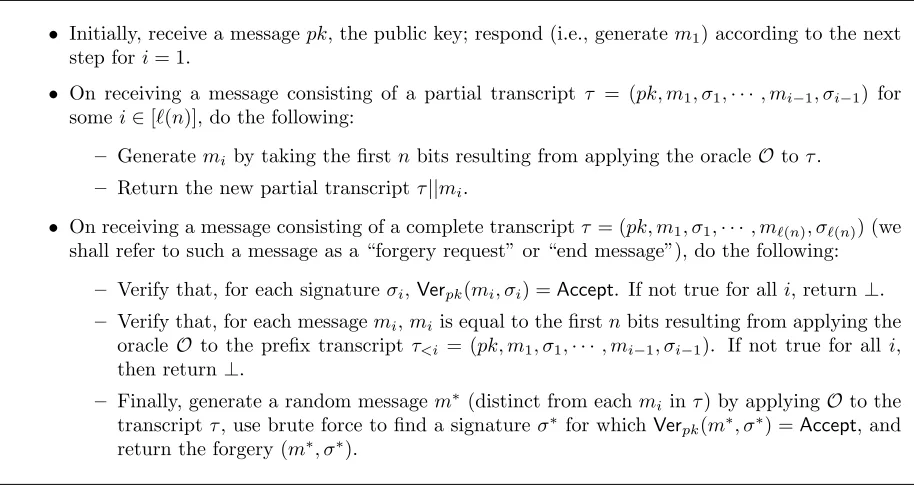
We shall henceforth denote by A the specific adversary AO which, on input 1n, behaves as described in Figure 3. Informally, A makes `(n) signature queries, generating the message for each query by applying O to the current partial transcript. Finally, after receiving responses for each query,A returns a brute-forced forgery, but only if it successfully “verifies” the transcript by ensuring that each query’s response is valid and that each query in the transcript was generated in the correct manner (i.e., by O applied to the prior partial transcript).
• Initially, receive a messagepk, the public key; respond (i.e., generatem1) according to the next step fori= 1.
• On receiving a message consisting of a partial transcript τ = (pk, m1, σ1,· · · , mi−1, σi−1) for some i∈[`(n)], do the following:
– Generate mi by taking the firstnbits resulting from applying the oracleOto τ.
– Return the new partial transcriptτ||mi.
• On receiving a message consisting of a complete transcriptτ = (pk, m1, σ1,· · ·, m`(n), σ`(n)) (we shall refer to such a message as a “forgery request” or “end message”), do the following:
– Verify that, for each signatureσi,Verpk(mi, σi) =Accept. If not true for alli, return⊥.
– Verify that, for each messagemi,miis equal to the firstnbits resulting from applying the
oracle O to the prefix transcriptτ<i= (pk, m1, σ1,· · · , mi−1, σi−1). If not true for all i, then return⊥.
– Finally, generate a random messagem∗ (distinct from eachmi inτ) by applyingO to the
transcript τ, use brute force to find a signatureσ∗ for whichVerpk(m∗, σ∗) =Accept, and
return the forgery (m∗, σ∗).
Figure 3: Formal description of the “ideal” adversaryAO.
However, when interacting with R, which is not bound by the rules of an honest oracle, the transcript verification is necessary to prevent R from “cheating” in certain ways during its inter-action. First, we wish to ensure that Rwill return valid signatures to queries as often as possible. Also, we wish to ensure that R is actually required to answer `(n) signature queries generated randomly by A and cannot, for instance, immediately sendA an end message with an artificially generated transcript; this is done by using the oracleOto generateA’s messages and ensuring that the transcript is consistent with the oracle. Formally, we make the following claim, which will be useful later:
Claim 1. There exists a negligible function ν(·) such that, for all n ∈ N, the probability, over all randomness in the experiment [RAO ↔ C](1n), that some instance of A returns a forgery (i.e., something besides⊥) toRwithout having received`(n) different responses to its signature queries from R, is less thanν(n).
Proof. Assume that A returns a forgery to R after receiving fewer than `(n) responses to its signature queries; we shall demonstrate that the only way this can happen is ifRcorrectly predicts the output of the random oracleO, which can happen with only negligible probability (specifically, no greater thanν(n),`(n)2−n) due to the uniformly random choice of O.
Let i∈ [`(n)−1] (we exclude `(n) because Rby assumption makes a forgery request) be the index of the first signature query “skipped” by R—that is, the first index for which R does not sendA a partial transcriptτ≤i = (pk, m1, σ1,· · ·, mi, σi). Of course, there must exist such aniby the assumption that R sends A fewer than `(n) messages. In order to receive a forgery from A (and not ⊥), Rmust send a complete transcript τ = (pk, m1, σ1,· · ·, m`(n), σ`(n)), notably having
In particular, since by assumption Rdid not sendAany partial transcript τ≤i, it is impossible forRto have received fromA the correct messagemi+1, which can, by construction of A, only be
retrieved by sendingAthe (unique) partial transcriptτ≤i for which allmj are generated according toO and allσj are the (unique) accepting signature for the respectivemj.
By our assumption, then, R will only be able to send the correct messagemi+1 in its forgery
request, and hence receive a forgery from A, with probability 2−n—that is, the chance that the output of the (uniformly distributed) random oracle O matches the sent mi+1 in the first n bits.
And as, by our assumption, Rsends fewer than `(n) messages toA, it cannot attempt to “guess” the correct mi+1 more than `(n) times; thus the probability that A will return a forgery, taken
over the randomly distributed O, is by the union bound no more than ν(n) =`(n)2−n, which as desired is negligible.
Furthermore, this construction of A (using the oracle O) allows us to assume, without loss of generality, that the reductionRwill never rewind an instance ofA—this is without loss of generality because there is a single accepting transcript for each choice of the oracleO. Namely, given an oracle O, ifRalways provides correct signatures, thenA’s messages (including the forgery it returns) and R’s responses are fully determined by O and the uniqueness property of Π. Meanwhile, ifR does not provide correct signatures,A will not return a forgery.
Because A breaks unforgeability, and by the assumed properties of R and the determinism of AO for any fixed oracle O, it must be true that there exists polynomial p(·) such that
PrhhRAO,Ci(1n) =Accepti≥t(n) + 1
p(n)
for any oracleO. As such, by the fact that Ris fixed-parameter, we can observe that, for any n, averaging this probability over all possible oracles O, we likewise have
PrhRA,Ci(1n) =Accept≥t(n) + 1
p(n)
even though Aover a randomly-chosen Ois not deterministic.
Of course, Ais inefficient, so, in order to break the assumption (C, t(·)), we must construct an efficient B that is able to runR while emulating its interactions with Amost of the time. Hence, the remainder of the proof will be dedicated to constructing this meta-reduction and analyzing the probability with which it succeeds in emulating the “ideal”A. Intuitively, ifBsuccessfully emulates A at least 1−1/p0(n) of the time for some functionp0(·), then:
Pr
hRA,Ci(1n) =Accept−Pr [hB,Ci(1n) =Accept]≤
1
p0(n)
Pr [hB,Ci(1n) =Accept]≥t(n) + 1
p(n) − 1
p0(n)
Slots. As a notational aside, we shall for simplicity henceforth refer to the pair of a query made by A (or something, such as B, which emulates A) and its corresponding response by R as aslot (vopen, vclose). Such a slot is determined by two views: the “opening” of the slot, or the view vopen of the execution ofRimmediately beforeA’s query toR, and the “closing” of the slot, or the view
vclose of the execution immediately after R responds to the respective query. (We will also often refer to the view ofRimmediatelyafter the opening query of a messagem, which we shall denote by the concatenationvopen||m.)
3.2 The Meta-Reduction
We next construct the meta-reduction B which will efficiently emulate A. Let B be as described formally in Figure 4; informally,Bwill runRinternally, forwarding communication toCasRwould while also internally simulating instances ofAinteracting withR. The primary difference between Band the “ideal” execution ofAinteracting withRis thatB, being restricted to polynomial time, cannot brute-force forgeries as A does; instead, while simulating each instance of A,B will select at random a message m∗ for which to forge a signature and attempt to rewind each slot for that instance, substitutingm∗ for the original message.4
IfRever returns a valid signatureσ∗ form∗, thenBmay store that signature and finally return (m∗, σ∗) whenRrequests a forgery for that instance. However, if one of the following “bad events” occurs:
• Rfails to return a valid signature ofm∗.
• Rasks for a forgery for another instance before returning a signature.
• R requires external communication with C (which cannot be rewound) before returning a signature.
thenBwill abort and try the next slot. In this way we circumvent the issue of having to recursively rewind nested end messages as in [Pas11].
First, we can show that B, unlikeA, is efficient:
Claim 2. There exists a polynomialt(n) such that, for alln∈N,Real(1n) is guaranteed to run in
time at mostt(n).
Proof. It suffices to show that B sends a polynomial number of simulated messages to R, as R and C run in polynomial time by definition and all other operations performed by B are clearly polynomial-time. To that end, we observe that each instance I contains O(`(n) +r(n)) rounds of communication (including both communication with R and R’s external communication with C). Furthermore, there are at most a polynomial number of instances ofA started byR—call this number M(n)—and so disregarding rewinding we know that there must be O((`(n) +r(n))M(n)) total messages.
B will rewind R as described above; however, we know that there can be at most `(n)M(n) rewound slots (as each slot is rewound once and B will never rewind recursively), each of which might contain O((`(n) + r(n))M(n)) nested messages; hence, the total number of messages is
4
That is, when “rewinding” a slot (vopen, vclose), B will simulate interaction with R starting from the view
• Set initial viewv← ⊥and setk←1. ExecuteR, updating the current viewvaccording to the following rules.
• WhenRbegins a new instance ofAand sends a public keypk, label this instance as instancek. Generate and store `(n) random queries m~k = (mk,1, . . . , mk,`(n)) and a target forgerym
∗
k. (Abort and return Failifm∗k is equal to a message inm~k.a) Also letpkk←pk and initialize the forgeryfk← {}. Lastly, respond withτk∗=pkk||mk,1 and incrementk.
• WhenR attempts to communicate externally withC, forward the message, returnC’s response toR, and updatevaccordingly.
• WhenRsends a transcriptτ = (pk, mI,1, σI,1,· · ·, mI,j, σI,j) to some simulated instanceI ofA, store the signatureσI,j and do the following:
– Ifj=`(n) (i.e., this is an end message), then do the following:
∗ If τ is an inconsistent transcript (i.e., mI,i or σI,i inτ is different from the stored mI,i or
σI,i (respectively) for some i∈ [`(n)], or not allσI,i have been stored) orR’s response to some signature queryjwas invalid (i.e.,VerpkI(mI,i, σI,i) =Rejectfor somei∈[`(n)]), then
return⊥.
∗ Otherwise, iffI is still empty (i.e., not⊥), run the procedureRewinddetailed below for the instanceI.
∗ If, at this point, there is a stored forgeryfI= (m∗I, σ
∗
I), then return it and continue executing Ras above. Otherwise, abort the entire execution ofBand returnFail.
– If the response is an invalid signature (i.e.,VerpkI(mI,j, σI,j) =Reject), then storefI← ⊥.
– Lastly, respond withτ||mI,j+1 and continue the execution ofR.
Rewindprocedure:
• Given instanceI, forj∈[`(n)] let (vj open, v
j
close) denote the slot corresponding to thej
thsignature query
for instanceI.
• For eachj∈[`(n)], “rewind” the slot (vj open, v
j
close) as follows: Letk
0←
k, and begin executingRfrom the viewv0=vopenj ||m∗I as in the main routine, with the following exceptions:
– WhenRbegins a new instance ofA, label this instance as instancek0 and incrementk0. (That is, continue creating new instances, but preserve the counterkin the outer execution for after the rewinding.)
– When Rattempts to communicate externally with C, abort the rewinding and continue to the next j.
– WhenRsends an end message for an instanceI0 6=I ofA, abort the rewinding and continue to the nextj,unless Rhas not sent responses to `(n) signature queries for that instance (in which case respond with⊥).
– If v0 ever contains a message whose transcript contains a responseσI∗to the query form
∗
I, then, if it is the case thatVerpkI(m
∗
I, σ
∗
I) =Accept, storefi←(m∗I, σ
∗
I) and end theRewindprocedure (i.e., return to the outer execution); otherwise, ifVerpkI(m
∗
I, σ∗I) =Reject, store nothing tofIand continue to the next j.
aNote that in the case where this happens, thenBwill fail to output a successful forgery regardless; however,
this can only happen with probability negligible inn, and hence will not affect the bound we show.
bounded byO(`(n)(`(n) +r(n))M(n)2), which is still polynomial. The claim follows from defining
t(n) accordingly.
(Note that, while we assume without loss of generality thatRwill never rewindA, such rewind-ing even if it did occur could at most multiply the runnrewind-ing time by a polynomial factor since Ris restricted to polynomial time.)
Next, to reason about the failure probability of B (and through it the success probability of RA), let us define the following experiments:
• Let Ideal(1n) denote [RA ↔ C](1n)—that is, the experiment where R(1n), using the “ideal” adversaryA(1n) as a black box, communicates with C(1n).
– When we refer to probabilities in the context of this experiment, they are taken over a uniform distribution over random oracles O (which results in uniformly distributed messagesm~I and m∗I) for each instanceI of Astarted byR.
– When we wish to fix the randomness of a particular execution ofIdeal, we will denote this with the notationIdeal{OI}I∈[M(n)],Oext(1
n), or, for more clarity,Ideal
{mI~ ,m∗I}I∈[M(n)],Oext(1 n).
~
mI andm∗Iare the messages and forgery generated for instanceIby each oracleOI given the (deterministic) prefix;Oextis a random variable representing the random coins used byRandC, containing a number of bits equal to the maximum number of coins needed (which must be polynomially many since R and C are polynomial-time). When all m~I and m∗I are fixed, and Oext is fixed, note that the execution ofIdealis deterministic for each instance.
• LetReal(1n) denote [B ↔ C](1n)—that is, the “real” experiment whereB(1n) communicates directly withC(1n) by attempting to simulate the interaction betweenA(1n) andR(1n) while forwarding any external communications.
– When we refer to probabilities in the context of this experiment, they are taken over uniformly distributed messages m~I and m∗I for each simulated instance I of A started by Rin the context ofB.
– When we wish to fix the randomness of a particular execution of Real, we will again denote this with the notation Real{mI,m~ ∗
I}I∈[M(n)],Oext(1
n), where m~
I and m∗I are the messages and forgery for each simulated instance I of A and Oext is again a random variable representing the random coins used byRandC. When allm~I andm∗I are fixed, and Oextis fixed, note that the execution ofRealis deterministic for each instance, just as withIdeal.
– Furthermore, we may opt to isolate a particular simulated instance kby fixing all ran-domness except for that instance’s; we denote this by Real∗{mI,m~ ∗
I}−k,Oext(1
n) and note
that the probability space in this altered experiment is over uniformly distributed m~k and m∗k. Further note that in experiment Real∗ the execution up to the start of the isolated instance kis deterministic, as is the execution for any choice of m~k and m∗k.
• In all experiments, we will denote the result, or output, as either the final output ofC (either
Accept or Reject) if C finishes, or as Fail if C does not finish (i.e., when B aborts returning
Fail). This will be notated by Output, e.g., Output[Real(1n)] =Accept.
3.3 Analyzing the Meta-Reduction
Using this terminology, we wish to show that Real(1n) is identically distributed to Ideal(1n) with high probability. To that end, we make the following claim:
Claim 3. For alln∈N:
|Pr[Output[Real(1n)] =Accept]−Pr[Output[Ideal(1n)] =Accept]| ≤Pr[Output[Real(1n)] =Fail]
Proof. The probability of each possible assignment of the random variables {m~I, mI∗}I∈[M(n)] and Oext occurring is clearly identical between the Real and Ideal experiments due to the choice of uniformly random oracles O for the Ideal experiment. Thus, it suffices to show the following lemma:
Lemma 2. For alln∈Nand for any assignment of {m~I, mI∗}I∈[M(n)] andOextsuch that
Output[Real{mI~ ,m∗I}I∈[M(n)],Oext(1
n)]6=Fail
it holds that:
Ideal{mI,m~ ∗I}I∈[M(n)],Oext(1
n) =Real
{mI~ ,m∗I}I∈[M(n)],Oext(1 n)
and thus
Output[Ideal{mI,m~ ∗I}I∈[M(n)],Oext(1
n)] =Output[Real
{mI,m~ ∗I}I∈[M(n)],Oext(1 n)]
Proof. Intuitively, the lemma follows from the uniqueness property of Π; for any messagem∗, there is only a single possible signatureσ∗. Thus, unless the extraction fails for somem∗, the simulation inB will output the same forgery as in the actual execution ofA.
Formally, denote the experimentsReal{mI,m~ ∗
I}I∈[M(n)],Oext(1
n) andIdeal {mI,m~ ∗
I}I∈[M(n)],Oext(1 n) by
RealandIdealrespectively. BecauseA’s,C’s, andR’s randomness are fixed by assumption, it must be the case that the views of Ideal and Real are identical up to the first forgery request. At this point, ifB inRealdoes not returnFail(indicating thatB either found a valid forgery or will return ⊥due to Rreturning an incorrect signature), the forgeries (m∗I, σI∗) returned byA inIdealand by B in Realmust also be identical. This holds because (1) the situations in which A or B return⊥ are the same, and (2) if, given certain randomness,Adoes not return⊥andBdoes not returnFail, both A and B must return a correct signature of an identical message m∗I, which by uniqueness must also be identical.
From here, we can inductively apply the same logic; if we assume that the first k forgery requests’ responses are identical (i.e. that Bhas not yet failed), then, for each possible assignment of these responses (which must by assumption be equally likely between A and B), the execution with fixed randomness proceeds identically up to the (k+ 1)st forgery request; hence, if B does not returnFail for that request as well, its responses are once again distributed identically inReal
to A’s in Ideal, meaning that the executions up to the (k+ 1)st forgery requests’ responses must
So, if we fix{m~I, m∗I}I∈[M(n)] andOextfor both experiments, and ifBdoes not returnFail, then all messages sent by A toR inIdeal must be identical to the simulated (non-rewound) messages from B to R in Ideal, ensuring that (since R and C are executed identically and with the same randomness in both experiments) the executions will likewise be identical.
Thus, by this lemma, the probability that the outputs of the two experiments differ must be at most the probability that some assignment of the random variables occurs which causes Real(1n) to returnFail(as in all other cases the views and outputs are identical), as desired.
Next, we use this to bound RA’s success probability by bounding the probability that B will
returnFailfor some simulated instance I of A. LetM(n) be the maximum, over all randomness of A,C, andR, of the number of instances ofAthatRruns to completion (i.e., for which it responds to all `(n) queries) during the experimentReal(1n). Then we show the following:
Proposition 1. There exists a negligible function (·) such that, for all n∈N:
Pr[Output[Real(1n)] =Fail]≤M(n)
M(n) +r(n) + 1
`(n) + 1
+(n)
Proof. We first prove the following claim for any executionReal∗{mI,m~ ∗
I}−k,Oext(1
n) (i.e., for any fixed
setting of all randomness aside from m~k and m∗k), and notice that, since it applies to arbitrarily fixed randomness, it must thus apply over all possible randomness of the experiment Real(1n):
Claim 4. There exists a negligibleν(·) such that, given any experimentReal∗{mI~ ,m∗
I}−k,Oext(1 n), the
probability, over the uniformly chosen messages mk,1, . . . , mk,`(n), m∗k, that the simulated instance
kwill returnFailis, for all n∈N, at most
M(n) +r(n) + 1
`(n) + 1 +ν(n)
Proof. Let us begin by assuming that other simulated instances (besides k) ofAin the experiment
Real∗{m~
I,m∗I}−k,Oext(1
n) will never return Fail (i.e., that they will “magically” produce a correct
forgery in the case where they otherwise would return Fail). Clearly, this can only increase the probability that instance kwill returnFailby ensuring that the experiment never aborts early.
Now let us consider the messages m~∗
k,(mk,1, . . . , mk,`(n), m∗k) in instancek; note that by the definition ofReal∗{mI,m~ ∗
I}−k,Oext(1
n) the execution is fully determined bym~∗
k. Let us also define for
i∈[`(n)−1] the “rewound” sequence
ρ(m~∗
k, i),(mk,1, . . . , mk,i−1, m∗k)
that is, the rewinding ofm~k where the message in slotiis replaced bym∗k to attempt to extract a forgery.
In order for Bto return Fail, one of the following “bad events” must occur for eachi∈[`(n)]:
• E2(ρ(m~∗k, i)): During the rewinding of the last slot in the sequence (slot i), R asks for a forgery for another instance k0 6= k before returning a signature for m∗I, or R requires external communication with C (which cannot be rewound) before returning a signature for
m∗I.
In addition, for k to fail, the non-rewound execution of the instance must succeed, in that the event E1(m~k,≤i) (where R fails to return a valid signature) cannot occur for any prefix m~k,≤i = (mk,1, . . . , mk,i), wherei∈[`(n)].
Since, as we have noted, the behavior of k in the execution of Real∗{mI,m~ ∗
I}−k,Oext(1
n) is fully
determined bym~∗k, every sequence m~∗k will deterministically either result in instancek returning something (either a forgery or ⊥) or aborting and returning Fail; we shall refer to the former type of sequence (where k succeeds) as a “good” sequence, and the latter type as a “bad” sequence. To describe the relationship between these “good” and “bad” sequences, we first introduce the following terminology:
For any k >0 and any arbitrary setm~ of kdistinct messages in [2n], let Π
k(m~) denote the set of ordered permutations of the elements ofm~. Given a sequenceπ = (m1, . . . , mk−1, m∗)∈Πk(m~), we let the “rewinding” operator ρ fori∈[k−1] be defined as before—that is:
ρ(π, i),(m1, . . . , mi−1, m∗)
(Note that this is a sequence of length i.) We shall say that a sequence a = (a1, . . . , ak−1, a∗) ∈
Πk(m~) blocks a sequence b= (b1, . . . , bk−1, b∗)∈Πk(m~) with respect to somei∈[k−1] if
ρ(a, i) = (b1, . . . , bi)
that is, if a has a rewinding equivalent to a prefix of b. If we wish to denote that a blocks b
with respect to a particulari, we shall say thatablocks bin slot i. Furthermore, we will say that sequencesa1, a2, . . . ac∈Πk(m~)c-block a sequenceb∈Πk(m~) if there existdistincti1, . . . , ic∈[k−1] such that, for any j∈[c], aj blocks b in sloti
j.
We next formalize the relationship between the “blocking” property and good/bad sequences that will allow us to use this property to bound the number of bad sequences that may occur. Specifically, we prove the following lemma:
Lemma 3. Any sequence that is (M(n) +r(n) + 1)-blocked by bad sequences must be a good sequence.
Proof. Consider a sequencem~0k which is (M(n) +r(n) + 1)-blocked by bad sequences. This means thatm~0
kmust haveM(n) +r(n) + 1 distinct slotsij for whichE1 orE2 occurs in its (non-rewound)
execution, as the execution is at each of those points identical to a rewinding of one of the bad sequences by the fact that the sequence blocks m~0k in slot ij. However, because at most M(n) end messages (to completed instances of A, note that others are answered with ⊥) and at most
r(n) rounds of external communication can occur in any given execution, we observe that E2 can
happen for at mostM(n) +r(n) of these slots, and thus thatE1 must happen for at least one slot.
In this case, we can deduce thatm~0
kmust be agood sequence, because it must contain some slot for whichRfails to return a correct response (meaning thatBcan successfully emulateAby returning ⊥)—that is, the eventE1(m~k,≤i) must occur for that slot, which we have previously stated cannot be the case for bad m~∗
Consider, then, a set S of “bad” sequences m~∗
k which are permutations of any set of `(n) + 1 distinct messages (i.e., an unordered set containingm~k,i andm∗k). The following lemma, combined with Lemma 3, allows us to bound the size of such a set S:
Lemma 4. Let m~ be an arbitrary set of`+ 1 distinct messages in [2n], and letS ⊂Π`+1(m~) be a
set of permutations ofm~. If it is the case that, for some B ∈N, any member of Π`+1(m~) which is
(B+ 1)-blocked by a subset of S cannot itself lie inS, then |S| ≤(B+ 1)`!
Proof. We begin with the following crucial claim:
Subclaim 1. No member of Π`+1(m~) is (B+ 2)-blocked by a subset of S.
Proof. Assume for the sake of contradiction that there exists some π ∈Π`+1(m~), B+ 2 sequences
π1, . . . , πB+2 ∈ S, and B + 2 distinct integers i1, . . . , iB+2 ∈ [`] such that each partial sequence
ρ(πj, ij) is equivalent to the first ij elements of π.
Assume without loss of generality that the integers ij are in strictly ascending order. Consider the last sequence πB+2 = (π1B+2, . . . , π∗B+2); we shall show that πB+2 is (M + 1)-blocked by
se-quences inS, leading to a contradiction because by definition no element ofScan be (M+1)-blocked by other members ofS.
We know that, since by assumption the first iB+2 elements ofπ are equivalent to
ρ(πB+2, iB+2) = (π1B+2, . . . , πiBB+2+2−1, π
B+2
∗ )
then the first iB+2−1 elements of πB+2 and π must be identical. However, notice that, for any
j < B+ 2, we have thatρ(πj, ij) is identical toπ in the firstij elements, which, since by assumption
ij ≤iB+2−1, also indicates that ρ(πj, ij) is identical to πB+2 in the firstij elements.
This in turn implies that πB+2 is (B+ 1)-blocked by the sequences π1, . . . , πB+1 ∈S, contra-dicting thatπB+2 ∈S by the requisite property of S.
So, we know that any member of S can be at most B-blocked by a subset ofS, while any non-member can be at most (B+ 1)-blocked by a subset ofS. We will combine this fact (an effective upper bound on the number of blocked sequences) with the subsequent claim (a respective lower bound) to derive our final bound on |S|.
Subclaim 2. For each i∈[`], there exist |S| distinct sequences blocked in slot iby sequences in
S.
Proof. Beginning with i= 1, we observe that sequences with at least |S|/`! different last elements
m∗ must occur in S (as there are only`! sequences with any given last element). Furthermore, any sequence in S with a certain last element m∗ must block in slot 1 a total of `! different sequences (i.e., anything beginning withm∗), and differentm∗will produce disjoint sets of sequences blocked. Thus, we conclude that the sequences in S will block in slot 1 at least (|S|/`!)`! = |S| distinct sequences.
For the remaining slots i > 1, we can apply the same logic to the distinct arrangements of the elements (m1, ..., mi−1) and m∗ . Among the sequences in S there must be a minimum of |S|/(`+ 1−i)! such arrangements (since, given a fixed (m1, ..., mi−1, m∗), there are (`+ 1−i)!
sequences possible), and sequences with each arrangement will block in slotia total of (`+ 1−i)! distinct sequences (i.e., any sequence beginning with (m1, ..., mi−1, m∗)). Hence, the sequences in