8- BAND HYPER-SPECTRAL IMAGE COMPRESSION
USING EMBEDDED ZERO TREE WAVELET
Harshit Kansal
1, Vikas Kumar
2, Santosh Kumar
31
Department of Electronics & Communication Engineering, BTKIT, Dwarahat-263653(India)
2,3Department of Electronics & Communication Engineering, INVERTIS University, Bareilly (India)
ABSTRACT
Hyperspectral imaging is a powerful technique and has been widely used in a large number of applications,
such as detection and identification of the surface and atmospheric constituents present, analysis of soil type,
monitoring agriculture and forest status, environmental studies, and military surveillance. It consumes a huge
amount of storage. So due to large memory requirements, Hyper-spectral images demand efficient compression.
The Hyper-spectral image which we have taken in this paper is the Moffett field image which is taken by
Airborne Visible Infra Red Imaging Spectrometer (AVIRIS) satellite. In this paper we have presented an
algorithm which adapts EZWfor quantization, Wavelet Transform for decorrelation and Entropy coding is done
by Adaptive Arithmetic Coding. The results obtained show the efficient compression and are comparable to
JPEG 2000 standard.
Keywords: Hyper-Spectral Images, Embedded Zero Tree Wavelet (EZW), Discrete Wavelet
Transform (DWT), Arithmetic Coding
I INTRODUCTION
Hyperspectral images are generated by collecting hundreds of narrow and contiguously spaced spectral bands of
data such that a complete reflectance spectrum can be obtained for the region being viewed by the instrument.
All substances, including living things, have their own spectrum characteristics or diagnostic absorption
features.
However, at the time we gain high resolution spectrum information, we generate massively large image data
sets. Access and transport of these data sets will stress existing processing, storage and transmission capabilities.
As an example, the Airborne Visible Infra Red Imaging Spectrometer (AVIRIS), a typical hyperspectral
imaging system, has 224 sensors. In order to provide sufficient resolution to detect most absorption features,
each sensor has a wavelength sensitive range of approximately 10 nanometers. All sensors together yield
contiguous spectral bands covering the entire range between 380 nm and 2500 nm. If each band is 614 × 512
scans (pixels), with one byte per pixel, the whole data set will be over 70 Mbytes. Actually, AVIRIS instrument
can yield about 16 Gigabytes of data per day. Therefore, efficient compression should be applied to these data
sets before storage and transmission.Obviously, the low compression ratio is not enough to cope with serious
information, we can gain significantly higher compression ratio than that of lossless compression. This is
so-called lossy compression (lossy coding).
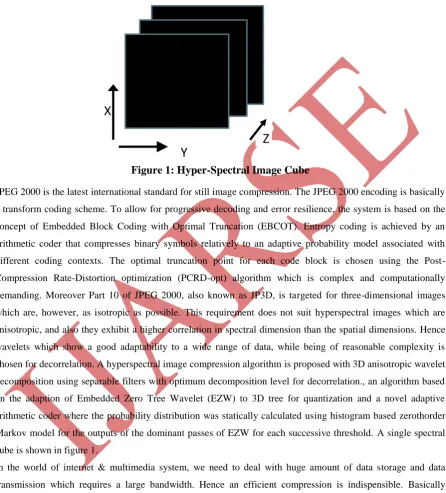
Figure 1: Hyper-Spectral Image Cube
JPEG 2000 is the latest international standard for still image compression. The JPEG 2000 encoding is basically
a transform coding scheme. To allow for progressive decoding and error resilience, the system is based on the
concept of Embedded Block Coding with Optimal Truncation (EBCOT). Entropy coding is achieved by an
arithmetic coder that compresses binary symbols relatively to an adaptive probability model associated with
different coding contexts. The optimal truncation point for each code block is chosen using the
Post-Compression Rate-Distortion optimization (PCRD-opt) algorithm which is complex and computationally
demanding. Moreover Part 10 of JPEG 2000, also known as JP3D, is targeted for three-dimensional images
which are, however, as isotropic as possible. This requirement does not suit hyperspectral images which are
anisotropic, and also they exhibit a higher correlation in spectral dimension than the spatial dimensions. Hence
wavelets which show a good adaptability to a wide range of data, while being of reasonable complexity is
chosen for decorrelation. A hyperspectral image compression algorithm is proposed with 3D anisotropic wavelet
decomposition using separable filters with optimum decomposition level for decorrelation., an algorithm based
on the adaption of Embedded Zero Tree Wavelet (EZW) to 3D tree for quantization and a novel adaptive
arithmetic coder where the probability distribution was statically calculated using histogram based zerothorder
Markov model for the outputs of the dominant passes of EZW for each successive threshold. A single spectral
cube is shown in figure 1.
In the world of internet & multimedia system, we need to deal with huge amount of data storage and data
transmission which requires a large bandwidth. Hence an efficient compression is indispensible. Basically
compression consists of three steps: Decorrelation, Quantization & Entropy coding. Decorrelation is the step to
remove the inter-pixel dependencies in image data.Quantization can be done by EZW or its variants. Entropy
coding removes the redundancies due togrey level distribution in decorrelated image.In this proposed work we
have chosen 3D Wavelet decomposition. For quantization we have used 3D Embedded Zero Tree coding of
Wavelet coefficients. Entropy coding is done by Adaptive Arithmetic coding.
X
Wavelet functions are used to analyze the difference subspaces and are represented as
ψ
r,s(x) = 2
r/2ψ(2
rx-s)
(1)
where r = scaling parameter
s = shift parameter
x = continuous time variable
A Wavelet function can be analyzed by using the summation of shifted versions of scaling functions of next
higher subspace. Mathematically it is represented as
ψ(x) =
𝒉
𝒏 𝜳𝒏 𝟐𝜱(𝟐𝒙 − 𝒏)
(2)
where n = shift parameter
Φ = scaling function
hψ= coefficient
The main advantage of using Wavelet Transform is that it gives us the space frequency localization. i.e. which
frequency is present at which position. It is similar to pin-pointed short time Fourier Transform. Forward
Discrete Wavelet Transform (DWT) is represented as
W
Φ(
𝒋
𝟎,k) =
𝟏𝑴
𝒔 𝒏 𝜱
𝒏 𝒋𝟎,𝒌(𝒏)
(3)
W
ψ( j, k) =
𝟏
𝑴
𝒔 𝒏 𝜱
𝒏 𝒋,𝒌(𝒏)
(4)
Where ( j> j0)
Here
W
Φ(
𝑗
0, k)
=
scaling function coefficientW
ψ( j, k)=
Wavelet function coefficientj = scaling parameter
k = shift parameter
s(n) = Discrete-time signal
for n = 0,1…..M-1.
For reconstruction of signal back from the two coefficient is done by Inverse DWT as shown
S (n) =
𝟏𝑴
𝑾
𝒌 𝜱𝒋
𝟎, 𝒌 𝜱
𝒋𝟎,𝒌𝒏 +
𝟏
𝑴
𝑾
𝒌 𝝍𝒋, 𝒌 𝝍
𝒋,𝒌(𝒏)
∞𝒋=𝒋𝟎
(5)
From above equations it can be analyzed that
W
ϕ(j,k) =
𝒉
𝒌 𝝓𝒎 − 𝟐𝒑 𝑾
𝝓𝒋 + 𝟏, 𝒌
(7)
The above equation shows that DWT uses two filters with impulse responses
ℎ
𝜙 (scaling analysis filter)&
ℎ
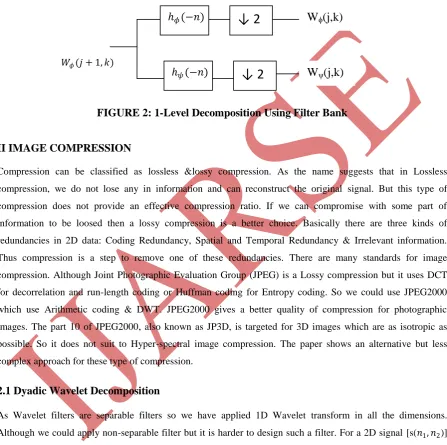
𝜓(Wavelet analysis filter) with input as original signal [𝑊𝜙(𝑗 + 1, 𝑘)]. Figure 2 shows the Block diagram of this filter bank.FIGURE 2: 1-Level Decomposition Using Filter Bank
II IMAGE COMPRESSION
Compression can be classified as lossless &lossy compression. As the name suggests that in Lossless
compression, we do not lose any in information and can reconstruct the original signal. But this type of
compression does not provide an effective compression ratio. If we can compromise with some part of
information to be loosed then a lossy compression is a better choice. Basically there are three kinds of
redundancies in 2D data: Coding Redundancy, Spatial and Temporal Redundancy & Irrelevant information.
Thus compression is a step to remove one of these redundancies. There are many standards for image
compression. Although Joint Photographic Evaluation Group (JPEG) is a Lossy compression but it uses DCT
for decorrelation and run-length coding or Huffman coding for Entropy coding. So we could use JPEG2000
which use Arithmetic coding & DWT. JPEG2000 gives a better quality of compression for photographic
images. The part 10 of JPEG2000, also known as JP3D, is targeted for 3D images which are as isotropic as
possible. So it does not suit to Hyper-spectral image compression. The paper shows an alternative but less
complex approach for these type of compression.
2.1 Dyadic Wavelet Decomposition
As Wavelet filters are separable filters so we have applied 1D Wavelet transform in all the dimensions.
Although we could apply non-separable filter but it is harder to design such a filter. For a 2D signal [s(𝑛1, 𝑛2)] we get a bank of filters responses as below:
ϕ
(𝒏
𝟏, 𝒏
𝟐) = ϕ(
𝒏
𝟏) ϕ(
𝒏
𝟐)
(8)
𝝍
𝑯𝒏
𝟏, 𝒏
𝟐= 𝝍 𝒏
𝟏ϕ(
𝒏
𝟐)
(9)
𝝍
𝒓𝒏
𝟏, 𝒏
𝟐= 𝛟 𝒏
𝟏𝝍 𝒏
𝟐(10)
𝝍
𝑫𝒏
𝟏
, 𝒏
𝟐= 𝝍 𝒏
𝟏𝝍
(
𝒏
𝟐)
(11)
ℎ
𝜙(−𝑛)
ℎ
𝜓(−𝑛)
↓ 2
↓ 2
𝑊𝜙(𝑗 + 1, 𝑘)
W
ϕ(j,k)
Where
ϕ(𝑛1, 𝑛2) represents the signal Low-pass filtered along the row & along the column.[LL]
𝜓𝐻 𝑛
1, 𝑛2 represents the signal High-pass filtered along the row & Low-pass filtered along the column.[HL]
𝜓𝑟 𝑛
1, 𝑛2 represents the signal Low-pass filtered along the row & High-pass filtered along the column.[LH]
𝜓𝐷 𝑛
1, 𝑛2 represents the signal High-pass filtered along the row & along the column. [HH] The individual filter responses can be represented individually as in figure 3.
LL
HL
LH
HH
Figure 3: 1-Level Decomposition Of 2d Signal
The Low-pass filtered signal is very rich in information. So further decomposition on LL sub-band is done. The
2-level decomposition is shown in figure 4.
LL
2HL
2HL
1
LH
2HH
2LH
1
HH
1
Figure 4: 2-Level Decomposition Of 2d Signal
This process of decomposition is known as Dyadic Decomposition. It is to be decided upto which level we
should go.
2.2 Zero Tree Coding Of Wavelet Coefficients
Zero tree provides a multi-resolution representation of Significant Map indicating the position of Significant
coefficients. It allows the successful prediction of insignificant coefficients. Successive approximation provides
the compact representation of significant coefficients & facilitates embedding algorithm. Larger coefficients are
more important than smaller one regardless of their scale. The algorithm runs in recursive manner until the
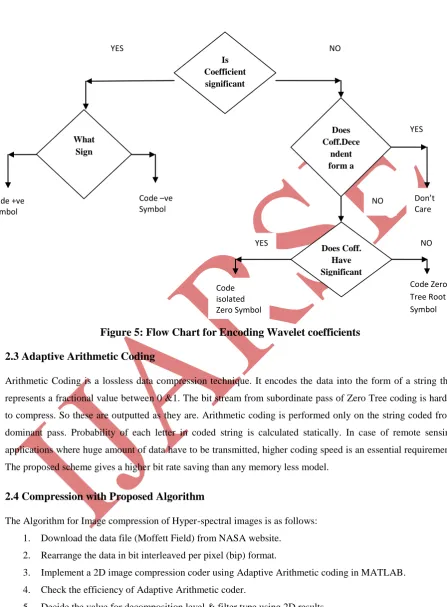
required bit rate is not achieved. Figure 5 shows the flow chart for encoding the Wavelet coefficients in Zero
Figure 5: Flow Chart for Encoding Wavelet coefficients
2.3 Adaptive Arithmetic Coding
Arithmetic Coding is a lossless data compression technique. It encodes the data into the form of a string that
represents a fractional value between 0 &1. The bit stream from subordinate pass of Zero Tree coding is hardly
to compress. So these are outputted as they are. Arithmetic coding is performed only on the string coded from
dominant pass. Probability of each letter in coded string is calculated statically. In case of remote sensing
applications where huge amount of data have to be transmitted, higher coding speed is an essential requirement.
The proposed scheme gives a higher bit rate saving than any memory less model.
2.4 Compression with Proposed Algorithm
The Algorithm for Image compression of Hyper-spectral images is as follows:
1. Download the data file (Moffett Field) from NASA website.
2. Rearrange the data in bit interleaved per pixel (bip) format.
3. Implement a 2D image compression coder using Adaptive Arithmetic coding in MATLAB.
4. Check the efficiency of Adaptive Arithmetic coder.
5. Decide the value for decomposition level & filter type using 2D results.
6. Develop a Hyper-spectral image compression algorithm with Adaptive Arithmetic coding in
7. A file size of 614x512x224x2 is arranged in the size of 512x512 with 8 bands.
8. Design a graph for BPP versus PSNR.
III PERFORMANCE MEASURES
The best way to check any signal with the original one is the difference between two signals. The two popular
measures are squared error measure & absolute difference measure. If the two signals are x(n) & y(n) then
squared error is given by
p(x, y) = (x - y)
2(12)
And the absolute error is given by
q(x, y) = |x – y|
(13)
It is difficult to find the difference between the two on the term basis. So we go for Mean Square error (MSE) &
it is represented by σ2.
σ
2=
𝑵𝟏 𝑵𝒏=𝟏 𝒙𝒏−𝒚𝒏 𝟐(14)
If we are interested in size of error relative to the original signal then we can calculate the ratio of the average
squared value of original signal to the MSE i.e Signal to Noise ratio (SNR).
SNR =
𝝈𝒙𝟐
𝝈𝟐
(15)
Where
𝜎
𝑥2is the average squared value of original signal.SNR is often measured in decibels (dB).SNR (dB) =10
𝐥𝐨𝐠
𝟏𝟎 𝝈𝒙𝟐𝝈𝟐
(16)
Sometimes we are more interested in peak value then we go for Peak Signal to Noise Ratio (PSNR).
PSNR (dB) = 10
𝐥𝐨𝐠
𝟏𝟎 𝝈𝒙𝒑𝒆𝒂𝒌𝟐𝝈𝟐
(17)
IV EXPERIMENTAL RESULTS
An algorithm was developed using 2D wavelet transform for decorrelation, 2D EZW for quantization and
Huffman coding for entropy coding. The decision of filter choice & decomposition level is done by applying 2D
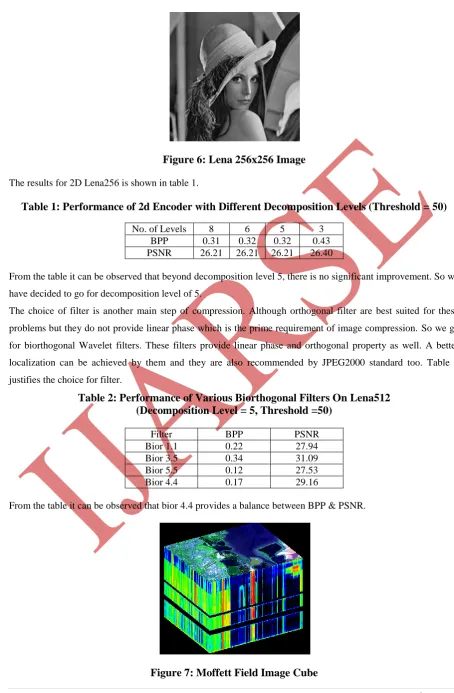
Figure 6: Lena 256x256 Image
The results for 2D Lena256 is shown in table 1.
Table 1: Performance of 2d Encoder with Different Decomposition Levels (Threshold = 50)
No. of Levels 8 6 5 3 BPP 0.31 0.32 0.32 0.43 PSNR 26.21 26.21 26.21 26.40
From the table it can be observed that beyond decomposition level 5, there is no significant improvement. So we
have decided to go for decomposition level of 5.
The choice of filter is another main step of compression. Although orthogonal filter are best suited for these
problems but they do not provide linear phase which is the prime requirement of image compression. So we go
for biorthogonal Wavelet filters. These filters provide linear phase and orthogonal property as well. A better
localization can be achieved by them and they are also recommended by JPEG2000 standard too. Table 2
justifies the choice for filter.
Table 2: Performance of Various Biorthogonal Filters On Lena512
(Decomposition Level = 5, Threshold =50)
Filter BPP PSNR
Bior 1.1 0.22 27.94
Bior 3.5 0.34 31.09
Bior 5.5 0.12 27.53
Bior 4.4 0.17 29.16
From the table it can be observed that bior 4.4 provides a balance between BPP & PSNR.
The objective is to evolve a Hyper-spectral image compression, which is less complex & also provides a better
performance. The test data for 3D image compression is the scene of Moffett field, California, at south end of
San Francisco Bay imaged by AVIRIS. The data is in Bit interleaved per pixel (bip) format. The result obtained
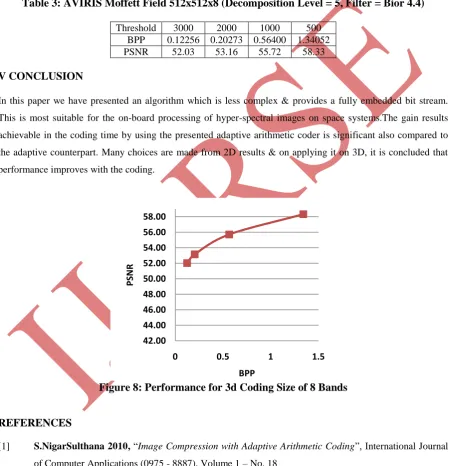
for spatial dimension of 512x512 with band size of 8 is tabulated in Table 3. The graph drawn from the data
shows that as coding size increases performance increases too. So as the Bit per pixel values increases PSNR
also increases.
Table 3: AVIRIS Moffett Field 512x512x8 (Decomposition Level = 5, Filter = Bior 4.4)
Threshold 3000 2000 1000 500 BPP 0.12256 0.20273 0.56400 1.34052 PSNR 52.03 53.16 55.72 58.33
V CONCLUSION
In this paper we have presented an algorithm which is less complex & provides a fully embedded bit stream.
This is most suitable for the on-board processing of hyper-spectral images on space systems.The gain results
achievable in the coding time by using the presented adaptive arithmetic coder is significant also compared to
the adaptive counterpart. Many choices are made from 2D results & on applying it on 3D, it is concluded that
performance improves with the coding.
Figure 8: Performance for 3d Coding Size of 8 Bands
REFERENCES
[1] S.NigarSulthana 2010, “Image Compression with Adaptive Arithmetic Coding”, International Journal
of Computer Applications (0975 - 8887), Volume 1 – No. 18
[2] J.M. Shapiro 1993 “Embedded image coding using zerotrees of wavelet coefficients,” IEEE
Transactions on signal processing, vol.41, no.12, pp.3445-3462
[3] A. Said 2004, “Introduction to Arithmetic Coding-Theory and Practice”, Imaging Systems Laboratory,
HP Laboratories Palo Alto, HPL-2004-76
42.00 44.00 46.00 48.00 50.00 52.00 54.00 56.00 58.00
0 0.5 1 1.5
PS
N
R
[4] E. Christophe 2011, “Hyperspectral Data Compression Tradeoff”, Centre for Remote Imaging,
Sensing and Processing, National University of Singapore, Singapore.
[5] http://aviris.jpl.nasa.gov
[6] E. Christophe, C.Mailhes, and Pierre Duhamel 2008, “Hyperspectral Image Compression: Adapting
SPIHT and EZW to Anisotropic 3-D Wavelet Coding”, IEEE Transactions on Image Processing, vol.
17, no. 12
[7] Alessandro J. S. Dutra 2010, “Successive Approximation Wavelet Coding of AVIRIS Hyperspectral
Images” CIPR Technical Report TR-2010-3
[8] B.E.Usevitch 2001, “A Tutorial on Modern Lossy wavelet image compression: Foundations of JPEG
2000,” IEEE Transactions on signal processing
[9] Barbara Penna 2005, “Embedded lossy to lossless compression of hyperspectral images using JPEG
2000”, Center for Multimedia Radio Communications, IEEE