Fully Deniable Interactive Encryption
Ran Canetti∗ Sunoo Park† Oxana Poburinnaya‡
July 25, 2020
Abstract
Deniable encryption (Canettiet al., Crypto 1996) enhances secret communication over public channels, providing the additional guarantee that the secrecy of communication is protected even if the parties are later coerced (or willingly bribed) to expose their entire internal states: plaintexts, keys and randomness. To date, constructions of deniable encryption — and more generally, interactive deniable communication — only address restricted cases where onlyoneparty is compromised (Sahai and Waters, STOC 2014).
The main question — whether deniable communication is at all possible ifbothparties are coerced at once — has remained open.
We resolve this question in the affirmative, presenting a communication protocol that isfully deniable
under coercion of both parties. Our scheme has three rounds, assumes subexponentially secure indistin-guishability obfuscation and one-way functions, and uses a short global reference string that is generated once at system set-up and suffices for an unbounded number of encryptions and decryptions.
Of independent interest, we introduce a new notion calledoff-the-record deniability, which protects parties even when their claimed internal states are inconsistent (a case not covered by prior definitions). Our scheme satisfies both standard deniability and off-the-record deniability.
∗
Boston University and Tel Aviv University. Email:[email protected] †
MIT and Harvard. Email:[email protected] ‡
Contents
1 Introduction 1
1.1 Our Contributions . . . 2
1.2 Fully Deniable Interactive Encryption: Definition in a Nutshell . . . 3
1.3 A Very Brief Overview of the Construction . . . 4
1.4 Directions for Future Progress . . . 7
1.5 Variants of Deniable Encryption and Other Related Concepts . . . 8
1.6 Prior Work on Deniable Encryption . . . 9
1.7 Organization, and How to Read This Paper . . . 10
2 Towards the Scheme: Technical Overview 11 2.1 A First Attempt . . . 11
2.2 Levels, Comparison-Based Decryption, and the Final Scheme . . . 16
2.3 Outline of security proof in oracle-access model. . . 19
2.4 Changes to the construction due toiO. . . 22
3 Defining Bideniable and Off-the-Record Deniable Encryption 22 3.1 Deniability in the CRS Model . . . 23
3.2 Deniability in The Oracle Access Model . . . 25
4 Deniable Encryption in Oracle-Access model 26 4.1 Construction . . . 27
4.2 Proof of correctness and security. . . 27
5 Preliminaries: IO, DIO, and ACE 42 5.1 Indistinguishability Obfuscation for Circuits . . . 42
5.2 Equivalence ofiOand diO for programs differing on one point . . . 42
5.3 Puncturable Pseudorandom Functions and their variants . . . 49
5.4 Asymmetrically constrained encryption (ACE) and its relaxed variant . . . 50
6 Construction of interactive deniable encryption 54 6.1 Construction . . . 55
6.2 Building blocks and main theorem stating security . . . 56
6.2.1 Level system . . . 56
6.2.2 Primitives required for the main construction, and their parameters . . . 59
6.2.3 Main theorem . . . 61
6.3 Proof overview . . . 65
7 Level System 67 7.1 Definition . . . 68
7.2 Construction . . . 70
7.3 Overview of the proof . . . 71
7.4 List of hybrids . . . 80
7.4.1 Proof of lemma 2 (Switching from`∗0to`∗1). . . 80
7.4.2 Proof of lemma 3 (Changing the upper bound fromT + 1toT). . . 102
7.5 Security reductions . . . 164
7.5.1 Reductions in the proof of lemma 2 (Switching from`∗0to`∗1) . . . 164
7.5.2 Reductions in the proof of lemma 3 (Changing the upper bound fromT+ 1toT) . . 167
7.5.3 Reductions in the proof of lemma 4 (Restoring behavior ofTransform) . . . 169
8 Proof of bideniability of our encryption protocol 177 8.1 List of hybrids . . . 177
8.1.1 Proof of lemma 54 (Indistinguishability of explanation of the sender) . . . 177
8.1.2 Proof of lemma 55 (Indistinguishability of explanation of the receiver) . . . 181
8.1.3 Proof of lemma 56 (Semantic security) . . . 193
8.1.4 Proof of lemma 57 (Indistinguishability of levels) . . . 205
8.2 Detailed proof of security . . . 221
8.2.1 Reductions in the proof of lemma 54 (Indistinguishability of explanation of the sender)221 8.2.2 Reductions in the proof of lemma 55 (Indistinguishability of explanation of the receiver)225 8.2.3 Reductions in the proof of lemma 56 (Semantic Security) . . . 234
8.2.4 Reductions in the proof of lemma 57 (Indistinguishability of Levels) . . . 240
9 Proof of off-the-record deniability of our encryption protocol 247
A On Flexible Deniability: Discussion 259
B On removing layers of obfuscation 261
C Construction of relaxed ACE 262
1
Introduction
The ability to communicate secret information without having any prior shared secrets is a central pillar of modern cryptography [DH76, RSA78, GM84]. However, standard definitions and existing algorithms for secure communication only guarantee security if the parties’ local randomness remains hidden. If the parties’ secret keys or randomness are exposed, say as a result of coercion or bribery, secrecy is no longer guaranteed. Moreover, the transcript in common encryption and key exchange schemes often “commits” the sender to the plaintext, in that each transcript is consistent with only one plaintext and randomness.
To address this issue, Canetti, Dwork, Naor and Ostrovsky [CDNO96] introduced the notion of deniable encryption, which provides a mechanism for preserving the secrecy of communicated plaintexts even in the face of post-communication coercion or bribery.1 Specifically, deniable encryption (or, more generally, deniable interactive communication) introduces additional algorithms, calledfaking algorithms,that are not present in standard secure communication definitions. The faking algorithms allow the communicating parties to present fake internal states (including keys and randomness) that make any communication transcript appear consistent with any plaintext of the parties’ choice. Concretely, an adversary should not be able to tell whether the sender and the receiver gave it the true keys, randomness, and plaintext, or fake ones.
When the communicating parties have a secret key that was shared ahead of time, deniable encryption can be simple. The classic one-time-pad scheme is perfectly deniable: having sentc=k⊕m, the parties can claim that they sent any plaintextm0 by claiming thatk0 =c⊕m0is their true key. However, shared-key deniable schemes fail to address the crucial question of how to deniably agree on a shared key in the first place. Indeed, existing key exchange protocols are “committing” in a way that precludes deniability. For instance, in Diffie-Hellman key exchange, there exists only one key consistent with any given transcript, so it is impossible to equivocate a one-time pad key generated using Diffie-Hellman key exchange. Thus, the core question here is how to deniably transmit a value (or equivalently, to establish a shared key)without any pre-shared secrets.
This setting turns out to be much more challenging. Even the restricted case where only thesenderis coerced (or bribed) was fully resolved only much later, assuming indistinguishability obfuscation, in the breakthrough work of Sahai and Waters [SW14].2 The case where only thereceiveris coerced or bribed follows from the sender-only case via a general transformation, at the cost of an additional message [CDNO96]; hence, the [SW14] scheme implies a3-round receiver-deniable protocol. This transformation can also be extended to handle the case where the adversary may coerce either party,but only one of the two. Furthermore, as demonstrated by Bendlin, Nielsen, Nordholt, and Orlandi [BNNO11], anyreceiver-deniable encryption protocol must take at least three rounds of communication.
Constructingbideniable encryption protocols, namely encryption protocols that guarantee deniability in the unrestricted case where both the sender and the receiver can be simultaneously coerced or bribed, has remained open:
Do there exist bideniable encryption protocols, with any number of rounds?
Bideniability is a significantly stronger property than any of the restricted variants above, where the adversary
1
While our results address both bribery and coercion, bribery might be the better setting to keep in mind. Indeed, protecting against bribery is more challenging in that the parties areincentivizedto disclose all internal state, including all random choices.
2
only learns the internal state of either the sender or the receiver.3Indeed, when both parties are coerced, the adversary obtains a complete transcript of an execution, including all the random choices, inputs and outputs of both parties. This means that the adversary can now fully run this execution, step by step, and compare it against the recorded communication. Even so, as long as the sender and receiver follow the protocol during the actual exchange of messages, bideniability guarantees that any (real or fake) internal state provided by the parties looks just as plausible as any other (real or fake) one.
Off-the-record deniability.When the attacker bribes or coercesbothparties, a new concern emerges: what happens if the plaintext claimed by the sender is different from that claimed by the receiver? This could arise in various scenarios: the parties might simply not have the chance to coordinate a story in advance (e.g., if they are separated and interrogated); or the parties might be incentivized to tell different stories (e.g., to protect themselves or those close to them); or the parties might find themselves incentivized to “defect” on each other as in a prisoner’s dilemma. Still, standard bideniability (as defined by [CDNO96]) provides no guarantees for these cases.
1.1 Our Contributions
Our first contribution is defining a security guarantee, calledoff-the-record deniability, that holds even in the above setting, where the coerced (or bribed) parties’ responses are inconsistent with each other.4 Off-the-record deniability achieves protection akin to an ideal, physically protected communication channel where the communication leaves no trace behind. That is, off-the-record deniability guarantees that the communication transcript does not help the attacker to determine which of the two parties is telling the truth, if any. This holds even if the parties deviate from the protocol — as long as the deviation happens after the actual protocol execution completes. In other words, off-the-record deniability guarantees protection for each partyindependently of the other party’s actions. This contrasts with standard bideniability where, for the security guarantee to hold,both parties must lie, and their claims must be consistent.
Our second and main contribution is the first encryption protocol that is both bideniable and off-the-record deniable. We call such protocolsfully deniable.A fully deniable protocol provides protection akin to an ideal channel, in that after message transmission, each party can claim that the message was any value whatsoever (say, from a pre-specified domain) and the attacker has no way to tell which party, if any, is telling the truth.
We stress that, prior to this work, even the existence of bideniable encryption (without the additional off-the-record property) was an open question.
Theorem 1. Assuming subexponentially secure indistinguishability obfuscation and subexponentially secure one-way functions, there exists a3-message interactive bit encryption scheme that isfully deniable(i.e., both bideniableandoff-the-record-deniable) in the common reference string model. In addition, the receiver’s deniability ispublic(i.e., the true random coins of the receiver are not required to compute fake randomness of the receiver).
Our common reference string (CRS) consists of six obfuscated programs: three for the sender (programsP1
andP3for generating the first and third messages, respectively, and the sender faking programSFake) and three for the receiver (programsP2for generating the second message, the decryption programDec, and the
3We note that a related but different concept,
multi-distributional bideniability, has previously been considered in a setting where both parties are attacked [OPW11]; see Appendix A.
4
Type of deniability Secure against adversaries that may...
I. Sender-deniable coerceSbut notR
II. Receiver-deniable coerceRbut notS
III. Sender-or-receiver deniable coerce eitherSorRbut not both
IV. Bideniable coerce bothS andR, who claim the same plaintext V. Off-the-record deniable coerce bothS andR, who claim two different plaintexts
Table 1: Taxonomy of deniable encryption. In each case, the adversary sees a communication transcript between senderSand receiverR. “Coercion” means the adversary may demand from a party an explanation (internal state) consistent with a plaintextmof the adversary’s choice. Note: I∧II⇔III and IV∨V⇒I∧II∧III.
receiver faking programRFake). The scheme instructs the parties to run the obfuscated programs on their relevant inputs and uniformly chosen random inputs.
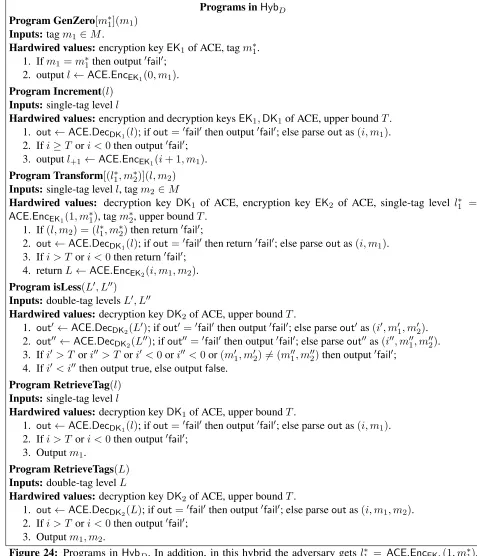
Designing the scheme requires addressing two main classes of challenges. First, the operation of the six programs should follow a certain “internal logic” — which ends up being necessary even in an idealized model where parties only haveoracle accessto the encryption scheme programs. We make this logic explicit by constructing and proving security of a fully deniable encryption scheme in this idealized model. While this construction is not used directly in the full-fledged scheme, it highlights key design difficulties. Interestingly, while many cryptographic primitives are trivial to construct in this idealized model, deniable encryption is still highly non-trivial; indeed,our technical overview (section 2) is fully devoted to building deniable encryption in the idealized model.
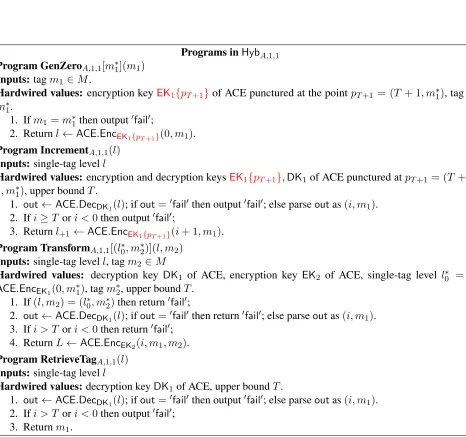
The next challenge lies in translating this idealized protocol to one that is provably secure when the programs are (a) actual programs and (b) protected only by indistinguishability obfuscation (IO), not ideal obfuscation. Here, we use the sophisticated tools developed in [KLW15, CHJV14, BPR15, BPW16] that were developed for dealing with obfuscated programs that are designed to be repeatedly run on inputs that were generated earlier by the program itself. Our situation is however significantly more complex: We have several programs that are designed to take inputs from each other with a specific and context-dependent set of constraints. We thus develop additional tools and abstractions that allow us to deal with this more complicated setting.
We now turn to discussing our definitions and constructions in more detail.
1.2 Fully Deniable Interactive Encryption: Definition in a Nutshell
Deniable interactive encryption is equipped with algorithms to generate protocol messages, to decrypt, and to generate fake randomness. We present the definition for the three-message case, since our protocol has three messages. A scheme consists of six programsP1,P2,P3,Dec,SFake,RFakeas follows.
• ProgramP1, run by the sender, takes as input a messagemand sender random strings, and outputs a first messageµ1.
• ProgramP2, run by the receiver, takes as input a messageµ1and receiver random stringr, and outputs second messageµ2.
• ProgramP3, run by the sender, takes as inputs, m, µ1, µ2and outputs a third messageµ3.
• ProgramDec, run by the receiver, takes as inputr, µ1, µ2, µ3 and outputs plaintextm˜.
sender randomnesss, the messagem, a fake messagem0, and potentially some additional random input
ρS, and outputs a fake random stringsm0 that is intended to explain the transcript as an encryption of
m0.
• ProgramRFaketakes as input the public transcript, the receiver randomnessr, the messagem, a fake messagem0, and potentially some additional random inputρR, and outputs a fake random stringrm0 that is intended to explain the transcript as decrypting tom0.
We definecorrectnessin the natural way: if the sender runsP1,P3with plaintextmand uniformly chosen
s, and the receiver runsP2,Decwith uniformly chosenr, the receiver must decryptm˜ =mexcept with negligible probability.
Bideniabilityrequires that no PPT adversary can distinguish the following two distributions: (1) a protocol transcript for plaintextm0, and both parties’ true random coins for that transcript; and (2) a protocol transcript for plaintextmand fake random coins which make that transcript decrypt tom0. That is,
(tr(s, r, m0), s, r)≈c(tr(s, r, m), sm0, rm0), (1)
where s, r are uniformly random, tr(s, r, m) is the transcript from running the protocol to transmit m
with random inputssfor the sender andrfor the receiver,sm0 =SFake(s, m, m0,tr(s, r, m);ρS), rm0 =
RFake(r, m, m0,tr(s, r, m);ρR), and≈cdenotes computational indistinguishability.
Off-the-record deniability requires that no PPT adversary can distinguish between the following three cases:
• The sender tells the truthandthe receiver lies. That is, the adversary sees a transcript for plaintext
m, the sender’s true random coins, and fake random coins from the receiver consistent withm0.
• The sender liesandthe receiver tells the truth. That is, the adversary sees a transcript for plaintext
m0, fake random coins from the sender consistent withm, and the receiver’s true random coins.
• Both the sender and the receiver lie. That is, the adversary sees a transcript for plaintextm00, fake random coins from the sender consistent withm, and fake random coins from the receiver consistent withm0.
That is,
(tr(s, r, m), s, rm0)≈c(tr(s, r, m0), sm, r)≈c(tr(s, r, m00), sm, rm0), (2)
wheres, r,trare defined as in (1), andsm, rm0 are fake coins produced by running faking algorithms on the corresponding transcript.
Observe that bideniability implies thattr(s, r, m)≈ctr(s, r, m0), so a bideniable scheme is also semantically secure. Similarly, off-the-record deniable schemes are also semantically secure.
Full deniability. A scheme is fully deniable if it is both bideniable and off-the-record deniable. Full deniability provides protection akin to an ideal secure channel in that the parties can freely claim any plaintext was sent or received, and which guarantees protection even when parties’ claims do not match.
1.3 A Very Brief Overview of the Construction
Our starting point is an elegant technique from [SW14] that transforms any randomized algorithmA(with domainXand rangeY) into a “deniable version” using IO. The technique creates two obfuscated programs
(x, y)∈X×Y, outputs randomnessρsuch thatA0(x;ρ) =y. Using this technique, for any protocol, we can equip parties with a way to “explain” any given protocol message sent: that is, to produce fake randomness which makes that protocol message consistent with any plaintext of the parties’ choice.
Based on this, a first attempt at a bideniable scheme might be to apply the [SW14] technique to an arbitrary public-key encryption scheme to create obfuscated programs for encryption, decryption, sender-fake and receiver-fake — and then use the sender-fake and receiver-fake programs to “explain” the protocol messages one by one. However, this does not yield a bideniable encryption scheme: the [SW14] technique is guaranteed to work only when applied to independent algorithm executions, but here the algorithms are run on the same keys and randomness, protocol messages are interrelated, and any convincing overall explanation must consist of a sequence ofconsistentexplanations across the algorithms.5The problem in a nutshell is that although the [SW14] technique could create a deniable version of any single program, applying the technique separately to the key generation, encryption, and decryption programs fails to achieve deniability with respect to the programs’jointbehavior.
More concretely, it is problematic that the adversary can manipulate any given transcript and randomness to generate certain “related” transcripts and randomness, and then try running the decryption algorithm on different combinations of them. Next, we give some intuition as to why this is a problem.
The Accumulating Attack. A faker(i.e., receiver randomness) can be viewed as a string which “encodes” or “remembers”, explicitly or implicitly, an instruction to decrypt a certain transcript to a certain fake plaintext. An adversary can runRFakeiteratively on a givenr(and a series of related transcripts) to successively obtain
r1, r2, . . ., hoping that each new application ofRFakewill add a new (ith) instruction into the “memory”
ofriin addition to all the preceding instructions. Sinceri is a bounded-length string which,
information-theoretically, can carry only a fixed amount of information, sooner or later, one of the instructions will be lost from the “memory” ofri∗ for somei∗. It can be shown that, assumingrwas fake, an adversary running
RFakemany times can obtain someriwhich does not carry the originalr’s instruction, and thus decrypts the
original transcript honestly. (This attack first appeared in [BNNO11] in the two-message setting and was used to demonstrate impossibility of two-message receiver-deniable encryption.)
While the above attack does not carry over to the three-message case generically, it stills remains valid for many protocols: namely, for those protocols where it is easy, given the challenge transcripttr∗, to find transcripts “related” totr∗. Here “related” means that these transcripts can be successfully decrypted using the same true randomnessrthat was used to generatetr∗. (In particular, in the two-message case, it is always easy to generate related transcripts(pk, c)by settingpk =pk∗ and settingcto be a fresh ciphertext with respect topk.)
Therefore our approach, based on the above ideas, involves: (1) designing a protocol that prevents the adversary from computing related transcripts that force receiver randomness to “accumulate” information as described above, and then (2) applying the [SW14] technique to the algorithms for generating each message of this protocol. For the first step, we design such a protocol in theoracle-access model, where everyone (parties and adversaries) has only oracle access to the programs for computing protocol messages. Then, we adapt the construction to the setting where everyone has access to program code, obfuscated under IO.
Step 1 of our plan — designing a protocol resistant to the Accumulating Attack — itself consists of two key steps, further detailed below: (1a) design a “Base Protocol” that resists only some attacks, then (1b) augment the base protocol using the ideas of alevel systemandcomparison-based decryption, to obtain a protocol
secure in the oracle-access model (the “Idealized Protocol”).
STEP1A Base Protocol
Prevents some attacks but ultimately insecure
STEP1B
Idealized Protocol
Fully deniable in oracle-access model
STEP2
Full Protocol(§6)
Fully deniable under subexp.iO& OWF
+ Level system (§7) + Comparison-based
decryption (§2)
+ [SW14] technique + Level system
construction fromiO(§7.2)
Figure 1: The construction, step by step. The second arrow is dashed because whileconceptually the Idealized Protocol is a stepping-stone to the Full Protocol,technicallythe Full Protocol requires very different techniques, and must be proven from scratch rather than “building on” the Idealized Protocol.
STEP1A: We design the Base Protocol in the oracle-access model as follows. The first messageµ1 is a PRF output for input(s, m)wheresis the sender randomnesssandmis the plaintext. The second messageµ2is a PRF output for input(r, µ1)whereris the receiver randomnessr. The third messageµ3is an encryption of
(m, µ1, µ2). All keys for PRFs and encryption are hidden inside these programs (and not known to anyone, including parties). After exchangingµ1, µ2, µ3 with the sender, the receiver runsDec, which decrypts the ciphertextµ3and outputsm. In addition, the programs contain certain consistency checks:Decreturns an output only if it gets the correctr(i.e., consistent withµ2), andP3only returns an output if it gets the correct
s(i.e., consistent withµ1).
The intuition for this design is as follows. The first two messages serve as “hashes” of the parties’ internal state so far, and the next two programs —P3andDec— produce output only if the parties “prove” to the programs (by giving randomness consistent with these “hashes”) that they are continuing to execute the protocol on the same inputs used to generate these hashes. This design aims to prevent the adversary from computing related transcripts (and thus prevent the Accumulating Attack): for instance, an adversary must not be able to reuseµ1, µ2from a transcript(µ1, µ2, µ3)to compute a newµ30 such that(µ1, µ2, µ30)is also a valid transcript with respect to the samer. Section 2 gives more intuition about this.
STEP 1B: Unfortunately, the intuition from Step 1a is only partially correct: it turns out that it is still possible to generate related transcripts, although the design above indeed protects against “most” ways of generating them. Concretely, we describe a methodΩ(detailed in Section 2.1) to compute a series of related transcripts differing only in the third message. Importantly,Ωis generic: it works foranythree-message bideniable encryption scheme.Ωtakes any transcript(µ1, µ2, µ3)and, applied iteratively, produces a “chain” of valid transcriptstr1 = (µ1, µ2, µ3(1)),tr2= (µ1, µ2, µ3(2)),and so on. However, the scheme from Step 1a importantly ensures thatΩis the onlyway to compute valid related transcripts: this is crucial for the security proof.
It remains to ensure that the adversary cannot learn the true plaintext from the chain of related transcripts produced usingΩ(e.g., by performing the Accumulating Attack). To do this, we augment the Base Protocol with alevel system, under which eachµ3(i), generated usingΩ, encodes a number which we call a level, which is set to that transcript’s ownindexi.6Concretely,µ3(i)is an encryption of(m, µ1, µ2, i). Additionally, any fake randomnessri— generated by runningRFakeon(µ1, µ2, µ3(i))— also encodes the leveliof the transcript used to generate thisri. The leveliis encrypted, and so hidden from parties and the adversary, but
the programs can decrypt and learniusing their internal keys. To complete the Idealized Protocol, we modify the decryption algorithm such that any fakeriassociated with levelimay be used to decrypt transcripts with µ3(j)wherej > i(“correctness forward”), but decryption will fail (i.e., output⊥) if attempted with respect
toriandµ3(j)wherej < i(“oblivious past”). We call thiscomparison-based decryption behavior.
tr tr1 . . . tri−1 tri tri+1 tri+2 . . .
ri
Oblivious past:
decrypting withrifails
Correctness forward:
decrypting withrisucceeds
Ω Ω Ω Ω Ω Ω Ω
RFake
Figure 2: Comparison-based decryption behavior
The Idealized Protocol, just described, is fully deniable in the oracle-access model. In particular, it prevents the Accumulating Attack: intuitively, this is because comparison-based decryption ensures that an iteratively fakedr only encodes the most recent faked plaintext, rather than accumulating a sequence of past fake plaintexts.
STEP2: We obtain the Full Protocol by applying the [SW14] technique to the Idealized Protocol, which enables the parties to useobfuscated programs(not oracle access) to compute protocol messages and to generate fake randomness. Proving security of the resulting protocol based on IO presents a number of challenges. To start with, the security argument in the oracle-access model relies heavily on certain outputs of programs being hard to find provided the corresponding inputs are hard to find. To make the analogous argument with respect to IO, we need to show that such inputsdon’t exist(rather than being hard to find). Furthermore, as part of our construction, we introduce and construct a special primitive that could be called “deterministic order-revealing encryption”: a variant of deterministic encryption whereEnc(0)and
Enc(1)must be indistinguishable, even given programs which homomorphically increment ciphertexts (producingEnc(2),Enc(3)and so on up to some superpolynomial bound)andhomomorphically compare them. (Intuitively, homomorphic comparison enables the comparison-based decryption behavior; see section 2). To argue security of this special deterministic encryption, we employ different primitives and techniques from the literature, including the asymmetrically contrained encryption from [CHJV14], and the proof techniques from [BPR15] to argue unreachability of the end of a superpolynomially-long chain.
This concludes the brief overview of our scheme. An in-depth technical overview of the scheme, including the intuition for the construction and the proof, can be found in section 2 (technical overview). Impatient readers may wish to jump ahead to the Idealized Protocol program descriptions in figures 6 and 7 or refer to the complete description of the Full Protocol in section 6.
1.4 Directions for Future Progress
Can we remove obfuscation? Constructing fully deniable communication without IO is a great open problem. Three seemingly unrelated “pieces” of our construction rely on obfuscation, as follows.
(1) We need a mechanism to make each algorithm “explainable” (our scheme uses the [SW14] technique from sender-deniable encryption). Thus, removing obfuscation in3-message bideniable encryption would likely also lead to sender-deniable PKE without obfuscation, which is a great open problem by itself.
level system into a deniable encryption scheme could present additional challenges (e.g., our construction requires both (a) the code of deniable encryption programs to be obfuscated and (b) the level system to be puncturable).
(3) Finally, obfuscation facilitates our use of programs whose functionality depends on the result of the secret checks inside the program, while preventing the adversary from learning which “if” statement of the program was executed. This is crucial both to prevent the adversary from generating related transcripts except by runningΩ, and to ensure that even if it does runΩ, the programs of the scheme can undetectably “exchange information” with each other and thus adhere to comparison-based decryption behavior.
We will be happy to see progress on removing obfuscation from any of these three pieces, which could pave the way for obfuscation-free fully deniable encryption. Based on (1), the right place to start may well be focusing on obfuscation-free sender-deniable PKE.
Structured CRS with secrets.Our construction requires a CRS (consisting of obfuscated programs), where the randomness used to generate the CRS (i.e., the randomness of obfuscation and secret keys inside the programs) must remain hidden from everyone, including the parties to the protocol.
While removing this setup assumption would be desirable, it appears to be out of the reach of current cryptographic techniques. This question is a special case of a very general question in cryptography: it is possible to generate any structured CRS with secrets without knowing those secrets? This in turn is a special case of theinvertible sampling hypothesis (ISH)[IKOS10] which conjectures that for any distribution (potentially dependent on secret information), there is a way to sample from it without learning those secrets (e.g., to sampleN =pqwithout knowingp, q). The ISH is related to several significant questions in cryptography, such as adaptive security and the relationship between PKE and OT (see section 6 in [IKOS10]). However, [IKOS10] shows, albeit under strong assumptions, that the ISH does not hold for certain distributions. While this does not imply that our CRS cannot be generated in such a way, or that deniable encryption is impossible without a CRS, it indicates these questions may be quite hard to answer.
1.5 Variants of Deniable Encryption and Other Related Concepts
Next, we overview some variants of deniable encryption, deniable communication, and surrounding concepts. While they are not directly relevant to this work, clarifying these concepts may prevent confusion.
• Post-execution vs. adaptive coercion. This paper considers coercion that happens after protocol execution. A broader definition,adaptivecoercion, would capture coercion at some (arbitrary) point during the protocol execution (with uncoerced parties possibly unaware of the coercion).
• Private vs. public deniability.The deniability of the sender (or receiver, or both) ispublic[SW14] if the corresponding faking algorithm does not require the true randomness or the true plaintext as input. Our scheme has public receiver deniability (ourRFakehas syntaxRFake(m0,tr;ρR)). This means that anyone, not just the receiver, can produce fake random coins for the receiver. Note that any publicly deniable faking algorithm must be randomized: otherwise, the adversary could easily check if a claimedris fake by comparing it toRFake(m0,tr).
bideniable schemes were not known.
Deniable encryption is related to a number of other cryptographic concepts:
• Incoercible key exchangeis equivalent to deniable encryption. The former can be used to establish deniable one-time-pad keys for encryption. The latter enables a sender to pick a random key and transmit it deniably to a receiver.
• Flexible deniability.[CDNO96] also proposed a weaker deniability notion, variously calledflexible deniability, multi-distributional deniability([OPW11, BNNO11, Dac12, AFL16, CIO16]), or dual-scheme deniability([GKW17]). In a nutshell, this notion considers a setting where the coercer does not know which scheme is actually in use, and the coerced party has the freedom to “lie” in an undetectable way regarding the scheme that was actually used. (Equivalently, this notion assumes that the coercer does not expect to see some of the randomness used by the coerced party.) We note that none of the schemes in [OPW11, BNNO11, Dac12, AFL16, CIO16] are deniable in a setting where the coercer knows the scheme used in full and expects to see all the random coins of the coerced party. Appendix A provides detailed discussion of this notion and its limitations.
• Non-committing (adaptively secure) encryption (NCE, [CFGN96]) is weaker than deniable en-cryption, and designed for a different purpose. NCE requires that a simulator can generate dummy ciphertexts that can later be opened to any plaintext. The differences with deniable encryption are twofold. First, deniable encryption enables faking of real ciphertexts (that carry plaintexts), while NCE ciphertexts caneitherbe faked (if simulated)orcarry a plaintext (if real). Thus, in NCE, parties cannot fake; only the simulator can. Secondly, fake opening on behalf of all parties in NCE is done by the same entity, the simulator, while in deniable encryption the sender and the receiver fake independently of each other.
Bideniable encryption is strictly stronger than NCE: any bideniable encryption is also an NCE [CDNO96], but two-message NCE (e.g., [CDMW09]) is provably not bideniable, due to the three-message lower bound of [BNNO11].
• Deniable authentication.Deniable encryption is incomparable to deniable authentication. Deniable authentication allows the receiver of a message to authenticate the message’s origin and contents, while preventing the receiver from convincing a third party who did not directly witness the communication that the message came from the sender (see, e.g., [DKSW09]). In contrast, in deniable encryption, the third party (adversary) may directly witness the communicated ciphertext and learn whether the parties have communicated with each other. The goal of deniable encryption is not to hidewhethera party participated in a communication, but rather to preserve secrecy of the communicationcontents— even when parties are coerced (separately or jointly) to reveal their internal secrets.
1.6 Prior Work on Deniable Encryption
The definition of deniable encryption was introduced in 1996 by [CDNO96]. However, the techniques of that time fell short of achieving deniability: in fact, [CDNO96] presented a construction where the distinguishing advantage between real and fake opening was inversely proportional to the length of the ciphertext, thus requiring superpolynomially long ciphertexts in order to achieve cryptographic deniability. It was not until 2014 that Sahai and Waters presented the first (and, to date, the only) construction of sender-deniable encryption [SW14]. Their construction is based on indistinguishability obfuscation.
transformation from sender- to receiver-deniable encryption (due to [CDNO96]) at the cost of one additional round, as follows: thereceiverfirst deniably sends a random bitbto thesenderdeniably using the sender-deniable protocol, then the sender sendsb⊕mto the receiver in the final round. Furthermore, if the sender sendsb⊕musing the sender-deniable protocol rather than in the clear, the resulting scheme will be sender-or-receiver-deniable: that is, deniable against adversaries that coerce either one but not both of the parties. This final step incurs no additional rounds if (as in [SW14]) the message needs not be decided until the last round of the sender-deniable protocol. However, all these constructions rely heavily on the fact one of the parties’ internal states remains hidden, and therefore fail to achieve bideniability.
Several prior works have focused on proving lower bounds for deniable encryption. [CDNO96] showed that a certain class of schemes cannot achieve better distinguishing advantage than inverse polynomial. [Dac12] extended this result to a broader class of constructions, showing that the same holds for any
black-box construction of sender-deniable encryption from simulatable encryption. [Nie02] showed that any non-committing encryption, including bideniable encryption, can only reuse its public key ana priori
bounded number of times; and therefore deniable communication must be interactive, even if two messages. Using different techniques, [BNNO11] showed that two-message receiver-deniable schemes, and hence also bideniable schemes, do not exist.
1.7 Organization, and How to Read This Paper
Organization. Section 2 gives an informal yet almost complete description of the scheme, and outlines the main proof steps. Section 3 formally defines bideniable and off-the-record deniable encryption. Section 4 details the Idealized Protocol and security proof in the oracle-access model. Section 5 covers preliminaries: iO, puncturable PRFs, and other cryptographic primitives necessary for our construction. Section 6 gives acomplete description of our deniable encryption schemeand states4main lemmas from which security of the scheme follows. Section 7 formally defines, constructs, and proves security of thelevel systemwhich is an essential building block of our deniable encryption scheme. Finally, Sections 8 and 9 give thefull proofsof bideniability and off-the-record deniability of our Full Protocol.
How to read this paper. For ageneral understandingand the quickest read, we recommend section 2, which describes the scheme almost fully, albeit assuming ideal oracle access to the programs. The rest of the paper focuses on instantiating the ideas from section 2 with concrete IO-friendly primitives, and arguing security. To understandthe details of how the scheme is implemented with IO, we additionally suggest section 2.4, which overviews the changes between the idealized (oracle-access) scheme and the IO-based scheme, and then section 6 for the full construction.7 To understandthe details of the IO-based proof, we suggest the proof overview in section 2.3 (four main proof steps with high-level intuition for the “iO
gymnastics” at each step), then sections 6.3 (formal statements of each proof step) and 8.1 (concise list of hybrids). For those specifically interested in the security proof for the level system primitive, we suggest sections 7.3 (main steps and logic) and 7.4 (concise list of hybrids).
Finally, although the proofs in this paper take a lot of space, they are geared to be readily accessible to readers familiar with IO techniques. There is a clear strategy behind the low-level IO gymnastics, and the proof structure is simply a hybrid argument that breaks down into a handful of modular steps.8 The hybrid
7
Especially section 6.2.1, which gives an overview, motivation and syntax for the level system, and the theorem in section 6.2.3, which explains all the primitives used in the full protocol described in fig. 18 and fig. 19.
8
distributions themselves take a lot of the space: the scheme has six program descriptions, and their code can take up to three pages of a hybrid description; arguing indistinguishability between hybrids takes relatively little space in comparison. Yet most of the changes between hybrids are straightforward (e.g., puncturing keys).9 We chose to make each hybrid self-contained (and hence unavoidably rather repetitive):this makes the proof (much) longer, but for the sake of readability, as describing only the “diffs” between hybrids would make it laborious for the reader to reconstruct exactly what the programs look like in any given hybrid.
2
Towards the Scheme: Technical Overview
This section provides an informal yet almost complete overview of our construction. The primary purpose of this section is to guide the reader through the process of designing the scheme, outlining concrete attacks and corresponding protection mechanisms. This should be helpful for readers who want to gain some intuition about the scheme and its security, but are not willing to read the whole250-page full version [?], and for readers seeking to design a scheme from weaker assumptions (several issues described in this overview inhere in any3-round deniable encryption, and could arise in schemes with more rounds too).
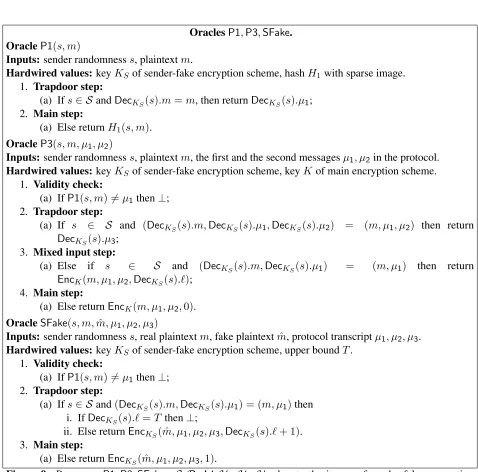
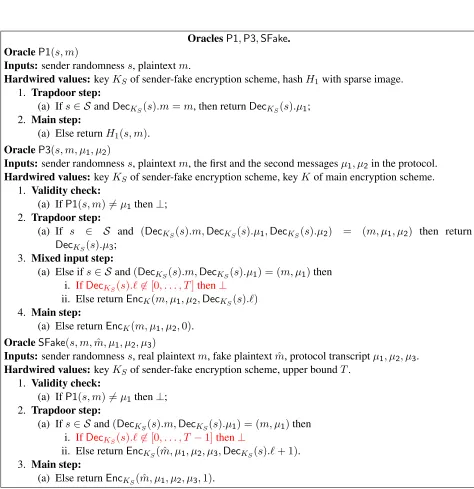
In this overview we describe the scheme in the oracle-access model. That is, we assume that all parties and the adversary have oracle access to programsP1,P2,P3(which generate the three messages of the protocol), decryption programDec, and faking programsSFake,RFake.
We build our scheme in two main steps. As a first attempt, we try to avoid the known attacks on the2-message case by considering a3-message scheme. Next, we discuss some attacks and augment our scheme with levels and comparison-based decryption behavior, which yields our final scheme.
2.1 A First Attempt
Recall the [SW14] technique, mentioned above, that transforms any algorithm into a deniable version using indistinguishability obfuscation. Given this, a natural attempt to build deniable encryption is to take any (2-message) public-key encryption scheme and use the [SW14] technique to make each of its algorithms
Gen,Enc, andDecdeniable. Concretely, the [SW14] technique takes any randomized algorithmA(with domainXand rangeY) and outputs two obfuscated programsA0andF, where:A0is the “deniable version” ofA; andF is a “faking algorithm” that, for any input(x, y) ∈X×Y, outputs randomnessρsuch that
A0(x;ρ) =y. Using this technique, we can take any protocol and equip parties with a way to “explain” any given protocol message they send: that is, to produce fake randomness which makes that protocol message consistent with any plaintext of the parties’ choice.
This approach would allow, for example, the receiver to create a fakesk0 decrypting a given ciphertextcto any plaintext of its choice. Thissk0would even be indistinguishable from the realsk, to an adversary that only sees the purported secret key. But the problem is that the adversary sees other related information: e.g., it has the public key, so can run the encryption algorithm and generate outputs related tosk. The [SW14] technique does not work when applied to multiple programs with interrelated outputs: such asGen,EncandDec.
Let us now outline the result of [BNNO11]: impossibility of bideniable encryption in2messages. This will give us insight on how to construct a 3-message bideniable encryption scheme while “avoiding” the
9
impossibility. Also, the [BNNO11] result yields a concrete attack on the first-attempt scheme outlined above.
Impossibility of the2-message case ([BNNO11]). [BNNO11] shows that even receiver-deniable (as op-posed to bideniable) schemes are impossible with two messages. Their result is unconditional. Their proof shows that any2-message receiver-deniable encryption scheme, even for a single-bit plaintext, can be used to deniably send any polynomial number of plaintexts, simply by reusing the first message (pk) and sending multiple second messagesc1, . . . , cN (whereN is arbitrarily, but polynomially, large); then they show that all
these ciphertexts can be fakedsimultaneouslyusing asinglefake decryption key. This implies a method for compressing an arbitrary string beyond what is information-theoretically possible, as follows. To compress a stringb1, . . . , bNfromN bits (whereNis larger than|sk|) to|sk|bits: (1) prepareNencryptions of0under a
singlepk(call themc1, . . . , cN);10(2) computesk(1) ←RFake(sk, c1, b1),sk(2)←RFake(sk(1), c2, b2),. . . ,
sk(N) ←RFake(sk(N−1), cN, bN). The final stringsk(N) is a compressed description ofb1, . . . , bN, since
it is shorter thanN and since the original string can be recovered by decrypting eachbiasDec(sk(N), ci).
Since most strings cannot be compressed, we have a contradiction.
Stated differently, this impossibility says that a secret key which was faked multiple times to lie about different ciphertexts has to “remember” or store information about each lie; but information-theoretically, it cannot remember more information than its length allows. Thus, at some point, such a secret key has to “forget” previous lies, and then it can be used to decrypt the original ciphertext to its real plaintext. That is, there is always an attack on any2-message scheme, which roughly goes as follows. Assume the adversary sees a ciphertextc, claimed to encrypt plaintextm0, together with a fakesk0that decryptsctom0; but in reality,c
encryptsm. The adversary can generateN >|sk|ciphertextsc1, . . . , cN as above, and runRFakeiteratively
to computesk(N)as above, and then computeDec(sk(N);c) =mto learn the true plaintext.
In summary, the core issue with the2-message schemes is that for a single receiver message (i.e.,pk) it is possible to efficiently generate many different sender messages (i.e., ciphertexts), such that all these ciphertexts are valid ciphertexts with respect to the same receiver key; this, in turn, means we must be able to use a single secret key to fake all the ciphertexts at once, which is information-theoretically impossible.
What would be the analogous argument in the3-message case? Consider a3-message scheme with messages
(µ1, µ2, µ3). If the scheme has the property that, given a receiver messageµ2, one can efficiently generate many different sender messagesµ1(i), µ3(i)yielding valid transcripts(µ1(i), µ2, µ3(i)), then the scheme is subject to the [BNNO11] impossibility. For example, consider a3-message scheme where the third message is a fresh encryption under freshly sampled random coins: this enables generating many third messagesµ3(i) for any givenµ1, µ2, and applying the [BNNO11] argument shows that any fake receiver randomness must remember a lie for eachµ3(i), so this scheme is susceptible to the same attack as two-message schemes.
Base Protocol.Now we present our Base Protocol, which is insecure but will be augmented later to achieve a secure version. The scheme has parties first exchange two PRF values, then has the sender encrypt its plaintextminto a ciphertextµ3using programP3, which the receiver can decrypt using programDec. Before presenting the scheme formally, we give motivation for the design.
With the [BNNO11] impossibility in mind, a natural approach to building a3-message scheme is to ensure that for any given first two messagesµ1, µ2, only one consistent third messageµ3can be efficiently computed. The Base Protocol achieves this using the following ideas.
1. The first messageµ1 “commits” to the sender’s coinssand messagem.
10
2. The third messageµ3is a deterministic, symmetric-key encryption ofmunder a keyKthat is hardwired in programsP3andDecand is unknown to parties.
3. P3(s, m, µ1, µ2)does a validity check before its output: ifµ1is indeed a “commitment” tosandm,
P3outputsµ3; otherwise, it outputs⊥.
In other words, the only way for the sender to generate a validµ3is to “prove” toP3that it is runningP3on the sames, mused to computeµ1. Thus, as long asK remains secret and the ciphertexts are sufficiently sparse, for anyµ1, µ2, there is only one (efficiently computable) consistentµ3.
So far, sinceµ3is computed under the same keyKin each execution and it is not randomized, all executions with the samemyield the sameµ3, which is clearly insecure. To fix this, we letµ3encrypt not onlym, but the first two messagesµ1, µ2as well, forcing different executions to have different third messages.
We have not yet discussed how the second messageµ2should be computed, which actually depends on an extension of the attack based on [BNNO11], described above. Recall that we wanted it to be hard to compute multiple transcripts with the sameµ2: say,(µ1(i), µ2, µ3(i)). In fact, we also want it to be hard to convert a transcript(µ1, µ2, µ3)with receiver randomnessrinto a different transcript(µ10, µ20, µ30)consistent with the samer, since it is possible to extend the attack to this case as well. With this in mind, we design the protocol as follows.
1. The second messageµ2is a pseudorandom function outputPRF(r, µ1), for a PRF key that is hardwired intoP2andDecand not known to the parties.11 The PRF inputs are the receiver randomnessrand the first messageµ1.
2. Dec(r, µ1, µ2, µ3)does a validity check before decryption: ifµ2is the correct PRF output for input
(r, µ1),Decoutputsm; otherwise, it outputs⊥.
Thus, the only way for the receiver to decrypt is to “prove” to Dec that it is running Dec on a validr
(consistent with µ2). This ensures that it is hard to transform a transcript(µ1, µ2, µ3) into a different
(µ10, µ20, µ30)consistent with the same receiver randomnessr, since that would require findingµ10, µ20such thatµ20=PRF(r, µ10), for an unknownrand an unknown PRF key.
We conclude this protocol design with a couple of final notes. First, we instantiate our “commitment” using a PRF as well, with its key hardwired into programsP1,P3and not known to parties (thus, bothµ1 and
µ2are PRF outputs). Secondly, we augment each programP1,P2,P3,Decwith a “trapdoor step” which makes each of these programs separately deniable, in the spirit of the [SW14] technique. Finally, we make the validity check insideDecaccept ifP2(r, µ1) =µ2, rather than ifPRF(r, µ1) =µ2; the difference is that
P2also accepts “fake” values which are not real preimages of the PRF. We make a similar modification to
P3: its validity check verifies thatP1(s, m) =µ1and therefore would also accept fakeswhich is not a real opening of the “commitment”. These changes are necessary because without them, an adversary could use the validity check to test whether a givensis a real (PRF) preimage ofµ1or a fake one.
We present the programsP1,P2,P3,Dec,SFake,RFakeas described so far, in fig. 3. For readability, the program includes comments to explain what the code is doing. Despite the somewhat dense code, the programs are very structured, and in a nutshell they behave as follows.
• Each program has a main step which is triggered when the program is run on uniformly randomsorr
(which is the case during an honest execution);
11
• ProgramsP1,P2,P3,Deceach have a trapdoor step which is triggered when the programs are given fake randomness (which has a special format recognizable to the programs). The set of fake randomness is sufficiently sparse that the trapdoor steps are almost never triggered on uniform sor r. Fake randomness contains an “instruction” of how the program should behave.
• ProgramsP3andDecrun validity checks, as described and motivated above.
• ProgramsSFakeandRFakegenerate fake randomness which can be recognized by other programs.
In particular, during an honest execution with uniformly randomsandrand plaintextm, the parties exchange messagesµ1, µ2, µ3(computed by programsP1,P2,P3, respectively), as follows:µ1 =PRF(s, m),µ2=
PRF(r, µ1), µ3 = EncK(m, µ1, µ2).12 The receiver decrypts(µ1, µ2, µ3) by runningDec(r, µ1, µ2, µ3), which verifies thatPRF(r, µ1) =µ2, then decryptsµ3and outputsm.
Base Protocol programs: first attempt at deniable encryption. ProgramP1(s, m)
1. Trapdoor step: ifDecKS(s) = (m 0, µ
10, µ20, µ30) andm0 = m, then returnµ10 //if sis fake and encodesm, output encodedµ10
2. Main step:Returnµ1 ←PRF(s, m). //otherwise outputPRF(s, m)
ProgramP2(r, µ1)
1. Trapdoor step: ifDecKR(r) = (m 0, µ
10, µ20, µ30)andµ10 =µ1, then returnµ20. //ifr is fake and encodesµ1, output encodedµ20
2. Normal step:else returnPRF(r, µ1).//otherwise outputPRF(r, µ1)
ProgramP3(s, m, µ1, µ2)
1. Validity check:ifP1(s, m)6=µ1, then abort; 2. Trapdoor step: ifDecKS(s) = (m
0, µ
10, µ20, µ30)and(m0, µ10, µ20) = (m, µ1, µ2), then returnµ30. //ifsis fake and encodes correct(m, µ1, µ2), output encodedµ30
3. Normal step:else returnEncK(m, µ1, µ2).//otherwise encryptm
ProgramDec(r, µ1, µ2, µ3)
1. Validity check:ifP2(r, µ1)6=µ2, then abort; 2. Trapdoor step:ifDecKR(r) = (m
0, µ
10, µ20, µ30)and(µ10, µ20, µ30) = (µ1, µ2, µ3), then returnm0. //ifris fake and encodes correct(µ1, µ2, µ3), output encodedm0
3. Normal step:else decrypt(m00, µ100, µ200)←DecK(µ3). If(µ100, µ200 =µ1, µ2)then outputm00, else abort.//otherwise decrypt honestly
ProgramSFake(s, m,m, µˆ 1, µ2, µ3;ρS)
1. Validity check:ifP1(s, m)6=µ1, then abort;
2. Normal step:else returnEncKS( ˆm, µ1, µ2, µ3, ρS)// output fakeswith fake plaintext and the tran-script inside.
ProgramRFake( ˆm, µ1, µ2, µ3;ρR)
1. Normal step:returnEncKR( ˆm, µ1, µ2, µ3, ρR)// output fakerwith fake plaintext and the transcript inside
Figure 3: Base Protocol programs: first attempt at deniable encryption. P1,P2,P3,Decare determinis-tic;14SFake,RFakeare randomized.
12Note thats, m(andr, µ1) are bothinputsto the PRF, not keys; we omit PRF keys for simplicity of notation. 14
If the parties want to claim to a coercing adversary that they transmitted a different plaintextmˆ, they can use
SFake,RFaketo compute fakes0 andr0, which are random-looking strings withmˆ,µ1,µ2, andµ3encrypted inside. If the adversary decrypts the transcript(µ1, µ2, µ3)with faker0 =EncKR( ˆm, µ1, µ2, µ3, ρR), it will
getmˆ as a result (via the trapdoor step of the decryption program). Similarly, the other programs, when given fakes0orr0as input, employ their trapdoor steps as well, making each protocol message appear consistent withmˆ.
The problem with the Base Protocol.We designed our scheme above with specific attacks in mind, but is it secure against all attacks? The answer is “almost”: it is relatively easy to show security of the scheme in an idealized model where parties (and the adversary) have only oracle access to the programs,but only as long as the adversary cannot query theSFakeoracle.Concretely, the adversary can useSFaketo mount a certain attackΩon the scheme, but this turns out to be theonlypossible type of attack. In section 2.2, we describe a special protection mechanism — comparison-based decryption behavior — which, when added to the protocol, prevents this type of attack and yields a scheme that is fully deniable even if the adversary has an access toalloracles includingSFake. (And in the full version [?], we prove this result even when the adversary can seethe codeof all programs, obfuscated under IO).
Let’s unpack why the protocol described so far is insecure. Recall that we wantedµ1 to serve as a “com-mitment”, and we wantedP3to outputµ3only if the sender uses the samesandmin the commitment and as input toP3. This was important to make sure that for anyµ1, µ2, at most one consistentµ3is efficiently computable. Then, however, we said thatP3should perform its validity check with respect to the whole programP1and not just the commitment; in particular, the validity check inP3accepts not only the true opening of the commitment, but also fakes. The problem is thatP1, due to its trapdoor step, is not binding: given anyµ1∗=PRF(s∗, m0)andm1 6=m0, it is easy to generate a differents1that passes the verification
check. In fact,SFakedoes exactly that: given(s∗, m0, m1, µ1∗, µ2, µ3)for someµ2, µ3, it outputss1such
thatP1(s1, m1) =µ1∗.
While this is not yet a concrete attack, it exposes a problem with our initial hope of a committing first message: sender deniability guarantees the first message is easily invertible, potentially with respect to inconsistent plaintextsm, soµ1 cannot be committing. Thus, it is easy to create many fakesiconsistent withµ1, and
therefore many third messagesµ3(1), µ3(2), . . ., all consistent with a given(µ1∗, µ2∗). A procedureΩthat does this is detailed in fig. 4. For our purposes, the key features of the attackΩare as follows.
• To generate such aµ3(i), encrypting somem1 for a given(µ1∗, µ2∗), one has to runP3on certain fake sender randomnesssi.
• P3can recognize when it is being used to generate such aµ3(i). (This is becauseP3will be run on a “mixed input”: that is,P3should be run ons, m, µ1∗, µ2∗, and a fakesi that encodes the sameµ1∗but
differentµ˜26=µ2∗.)
• The only way to generate such fakesiefficiently is to runSFake(on a transcriptdifferentfrom the one
being attacked: specifically, with a different second message).
Since it is easy to generate many third messages, our scheme is subject to the same attack as all2-message schemes: namely, the adversary can generate many ciphertexts µ3(i), fake each of them to compute an
N-times-faked r(N), and then use it to correctly decrypt the original µ3∗. While this attack inheres in all2-message schemes [BNNO11], in the3-message case we can fix it. We do so by introducinglevels
A procedureΩto generate a new third message encryptingm1
and consistent with given first and second messagesµ1, µ2.
Inputs toΩ(µ1∗, µ2∗, µ3∗, s∗, m∗, m1)are: transcript(µ1∗, µ2∗, µ3∗), sender randomnesss∗(which could be real or fake), plaintextm∗, and new desired plaintextm1:
1. Compute an auxiliary transcript tre = (µ1 ∗,µ˜
2,µ˜3) with the same first message µ1∗, but different second messageµ˜2, by choosing fresh receiver randomnessr˜and settingtre ←tr(s∗,˜r, m∗). Note that
the first message of this transcript isP1(s∗, m∗) =µ1∗.
2. Computes1 ←SFake(s∗, m∗, m1, µ1∗,µ˜2,µ˜3). Note thats1 is fake randomness which remembers
m1, µ1∗and a newµ˜26=µ2∗.
3. Computeµ3(1)←P3(s1, m1, µ1∗, µ2∗).
Ωcan now be repeated on inputµ1∗, µ2∗, µ3(1), s1, m1, m2to generateµ3(2), and so on.
Figure 4:ProcedureΩto compute many third messages consistent with givenµ1, µ2.
(µ1∗, µ2∗, µ3∗).
2.2 Levels, Comparison-Based Decryption, and the Final Scheme
Comparison-based decryption behavior.Let(µ1∗, µ2∗, µ3∗)be a challenge transcript. For any superpoly-nomialT andj ∈ {0, . . . , T}, letrj be the output ofRFakeon transcript(µ1∗, µ2∗, µ3(j)), whereµ3(j)is computed byjiterations ofΩ. Letµ3(0) denote the challengeµ3∗. WhenDecis run onrj andµ3(i), for
i, j∈ {0, . . . , T},comparison-based decryption behaviorrequires the following.
1. Oblivious past:Whenj > i,Decoutputs⊥.
2. Correctness forward:Whenj < i,Decdecryptsµ3(i)correctly (as long as consistency checks pass).
3. Whenj=i,Decshould decryptµ3(i)according to the instruction in fakerj.
That is, if an adversary creates fakerjusingµ3(j), thejth in the sequence of ciphertexts, thisrjcan be used
to honestly decrypt ciphertexts “after”µ3(j), but cannot be used to decrypt ciphertexts “before”µ3(j); and naturally,rjdecryptsµ3(j)itself according to the instruction inside fakerj.
tr tr1 . . . tri−1 tri tri+1 tri+2 . . .
ri
Oblivious past:
decrypting withrifails
Correctness forward:
decrypting withrisucceeds
Ω Ω Ω Ω Ω Ω Ω
RFake
Figure 5: Comparison-based decryption behavior
Comparison-based decryption behavior prevents the attack described above, despite the fact thatΩenables the adversary to generate many third messages. Next, we give some intuition as to why. Recall that the attack had the adversary generate a fakerj (by faking a ciphertext sequenceµ3(1), µ3(2), . . .) and then return to the challengeµ3∗and decrypt it. Thus, a natural idea to mitigate this attack is to makeDecoutput⊥whenever fakerjis used to try to decrypt the initialµ3∗=µ3(0).15This simple modification indeed stops the attack,
15
Such a restriction is not possible in the2-message case, in contrast to the3-message case. This relates to the fact that our procedureΩwhich generatesµ3(i)is “one way”, i.e., it is easy to generateµ3(i+1)fromµ3(i), but it could be hard — andishard, in our scheme — to generateµ3(i)
fromµ3(i+1)
but introducing it alone would break security. To maintain security, we need to make sure thatDecon inputs
rj,µ3(i)should output⊥forall j > i, and not justj > i= 0.16In other words, the “oblivious past” rule is the “minimum” modification which prevents fakerj from decryptingµ3∗ =µ3(0)andmaintains security of the scheme.
Finally, the “correctness forward” rulemusthold as well, since it is implied by sender-deniability. As a result, the behavior of the decryption program depends on the comparison of “indices” of the transcript and the receiver randomness; therefore, we call this comparison-based decryption behavior.
Implementing comparison-based decryption behavior: levels.
Next, we consider how to construct our programs such that comparison-based decryption behavior holds. When we run Decon someµ3 and somer, how does it know whetherµ3 is “forward” of r in the chain (meaningDecshould decrypt honestly), or “in the past” with respect tor(meaningDecshould output⊥)?
To this end, we introducelevels. That is, we have all fake sender randomness, all fake receiver randomness, and all third messageµ3(i)also encrypt a number`between0and some superpolynomialT, as follows.
• Fake sender randomness encrypts, among other things, a level ` which is how many times this randomness was faked. (E.g., to compute fake randomness, the sender would normally runSFakeonce, so the level`of the resulting fake randomness is1. If it runsSFakeon the resulting randomness again, its level`will be2, and so on).
• Each potential third messageµ3(i)also encrypts, in addition tomandµ1, µ2, its level, which isits index
iin the chain. Note that the algorithmΩwhich computesµ3(i)outputsµ3(1),µ3(2), . . .sequentially, and therefore their indexiis well defined. In an honest execution, the level ofµ3is always set to0.
• Fake receiver randomness encrypts, among other things, a level`which isthe level of its “parent” transcript(i.e., the transcript which was used as input toRFake). (E.g., to compute fake randomness, the receiver would normally runRFakeon the honest transcript, which has level0, so the resulting fake randomness would have level0too).
We claim that storing this “level” information in fake randomness and third messages is enough for the scheme to maintain the level information accurately and follow comparison-based decryption behavior. For instance,Deccan decide its output behavior by comparing the levels insiderandµ3.RFakecan record the correct level ofrby copying the level of its parent ciphertext. SFakecan maintain the correct number of times something was faked, by reading the level in its inputsand incrementing it.P3, as discussed above, can detect when it is being run withinΩ, and it can put inside its output third message the level it copied from inputs; since generating each newµ3requires once-more fakes, the level ins— i.e., the number of times it was faked — corresponds to the index ofµ3in the chain.
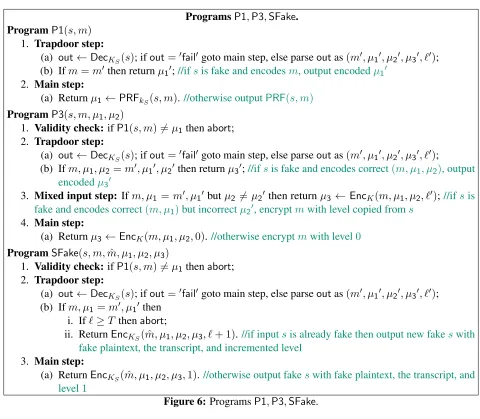
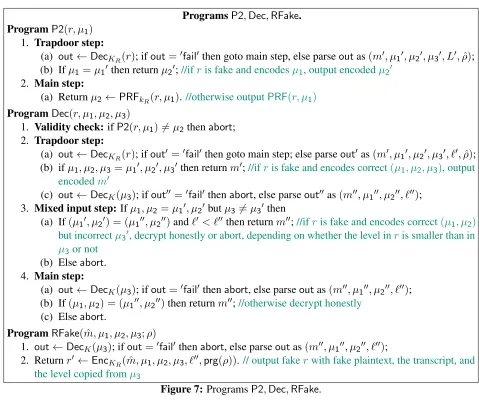
Our final protocol in the oracle-access model. We present our final protocol (albeit still in the oracle model) in figs. 6–7. This scheme is a provably secure deniable encryption scheme in the oracle access model, as we show in section 4.
The structure of the final protocol programs is summarized below.
16To see this, supposeDecoutputs⊥wheneverr
j, j >0is used to decryptµ3∗=µ3(0). Now consider trying to decrypt some µ3(i)
with, say,ri+3.r3does not decryptµ3(0), and the difference between(µ3(0), r3)and(µ3(i), ri+3)is thatµ3(0)was generated
with truly randomswhereasµ3(i)usedsiwhich was fakeditimes. Sender deniability requires these two cases be indistinguishable, soµ3(i)
• Each program has a main step which is triggered when the program is run on uniformly randomsorr, which is the case during an honest execution.
• ProgramsP1,P2,P3, andDecalso have a trapdoor step which is triggered when the programs receive fake randomness (which has a special format recognizable to the programs). The set of fake randomness is sufficiently sparse that the trapdoor step is almost never triggered on uniformly chosensorr. Fake randomness contains an “instruction” of how the program should behave on some particular input.
• ProgramsP3and Dec also have a “mixed input” step which serves to prevent attacks using Ωto generate many third messagesµ3.P3’s mixed input step copies the level from its inputsinto the third messageµ3, ensuringµ3encrypts its own index in the sequence.Dec’s mixed input step implements comparison-based decryption behavior by comparing the levels ofµ3andr.
The mixed input steps are triggered when the programs receive fakes(orr) as input, but the program’s other inputs do not match the inputs in the instruction insides(orr).P3enters its mixed input step when its input and fakescontain the sameµ1but different second messages, andDecenters its mixed input step when its input and fakercontain the sameµ1, µ2but different third messages.
• ProgramsP3andDec’s output behavior depends on validity checks, as in the Base Protocol (and for the same reasons as in the Base Protocol).
• ProgramsSFakeandRFakegenerate fake randomness that is recognizable to the other programs, and maintain accurate level information inside the fake randomness as follows: SFakeincrements the level of sender randomness with respect to its input sender randomness (unless the latter is honest, in which caseSFakesets the level to0); andRFakecopies the level from the parent transcript into fake randomness.
The interesting cases of protocol execution are summarized next.
• Normal protocol execution. Executing the programs on randomly chosens∗, r∗ and plaintextm∗0
triggers the main step, yielding outputs µ1∗ = PRF(s∗, m∗0), µ2∗ = PRF(r∗, µ1∗), and µ3∗ =
EncK(m∗0, µ1∗, µ2∗,0), where the last0 is the level. Dec, given the resulting transcript as input, outputsm∗0via its main step.
• Fake randomness of parties.A sender wishing to claim that it sent plaintextm∗1 6=m∗0can runSFake
to obtain fakes0 encoding(m∗1, µ1∗, µ2∗, µ3∗,1), where the last1is the level. A receiver wishing to claim that it receivedm∗1 6=m∗0 can runRFaketo obtain faker0encoding(m∗1, µ1∗, µ2∗, µ3∗,0), where the last0is the level. Executing programs on fakes0or faker0andm∗1triggers the trapdoor step, so programs will output the values hardwired into the fakes0orr0. Thus,P1will outputµ1∗,P2will outputµ2∗,P3will outputµ3∗, andDecwill outputm∗1via their trapdoor steps, making the transcript,
originally for plaintextm∗0, appear consistent withm∗1.
• Efficiently computable related transcripts.It is only possible to compute related transcripts of the form(µ1∗, µ2∗, µ3), whereµ3 =EncK(m, µ1∗, µ2∗, `),`≥ 1; moreover, the only way of doing so is to use the procedureΩdescribed above (which invokesSFake). Trying to computeµ3 a for such transcript will cause programP3to execute its “mixed input step”, ensuring that suchµ3receives level
ProgramsP1,P3,SFake. ProgramP1(s, m)
1. Trapdoor step:
(a) out←DecKS(s); ifout=
0fail0goto main step, else parseoutas(m0, µ
10, µ20, µ30, `0); (b) Ifm=m0 then returnµ10;//ifsis fake and encodesm, output encodedµ10
2. Main step:
(a) Returnµ1 ←PRFkS(s, m).//otherwise outputPRF(s, m)
ProgramP3(s, m, µ1, µ2)
1. Validity check:ifP1(s, m)6=µ1thenabort; 2. Trapdoor step:
(a) out←DecKS(s); ifout=
0fail0goto main step, else parseoutas(m0, µ
10, µ20, µ30, `0);
(b) Ifm, µ1, µ2=m0, µ10, µ20then returnµ30;//ifsis fake and encodes correct(m, µ1, µ2), output encodedµ30
3. Mixed input step: Ifm, µ1 =m0, µ10butµ2 6=µ20 then returnµ3 ← EncK(m, µ1, µ2, `0);//ifsis fake and encodes correct(m, µ1)but incorrectµ20, encryptmwith level copied froms
4. Main step:
(a) Returnµ3 ←EncK(m, µ1, µ2,0).//otherwise encryptmwith level0
ProgramSFake(s, m,m, µˆ 1, µ2, µ3)
1. Validity check:ifP1(s, m)6=µ1thenabort; 2. Trapdoor step:
(a) out←DecKS(s); ifout=
0fail0goto main step, else parseoutas(m0, µ
10, µ20, µ30, `0); (b) Ifm, µ1 =m0, µ10then
i. If`≥T thenabort;
ii. ReturnEncKS( ˆm, µ1, µ2, µ3, `+ 1).//if inputsis already fake then output new fakeswith fake plaintext, the transcript, and incremented level
3. Main step:
(a) ReturnEncKS( ˆm, µ1, µ2, µ3,1).//otherwise output fakeswith fake plaintext, the transcript, and level1
Figure 6:ProgramsP1,P3,SFake.
from the transcript tor.
2.3 Outline of security proof in oracle-access model.
Since the proof even in this simpler (oracle-access) model is somewhat lengthy, we only outline the main steps here, with intuition for each. The proof proceeds in four main hybrid steps. We start with a real execution corresponding to plaintextm∗0, where the adversary receives real randomnesss∗, r∗.
• Step I: indistinguishability of sender explanations.Instead of giving the adversary reals∗, we give its0 = EncKS(m
∗
0, µ1∗, µ2∗, µ3∗, `= 0)(note that thiss0 contains level0, unlike fake randomness produced bySFakewhich contains level at least1).
Intuitively, the reason why we can switch froms∗tos0indistinguishably is because all programs treat
s∗ands0indistinguishably. That is:
ProgramsP2,Dec,RFake. ProgramP2(r, µ1)
1. Trapdoor step:
(a) out←DecKR(r); ifout=
0fail0 then goto main step, else parseoutas(m0, µ
10, µ20, µ30, L0,ρˆ); (b) Ifµ1=µ10then returnµ20;//ifris fake and encodesµ1, output encodedµ20
2. Main step:
(a) Returnµ2 ←PRFkR(r, µ1).//otherwise outputPRF(r, µ1)
ProgramDec(r, µ1, µ2, µ3)
1. Validity check:ifP2(r, µ1)6=µ2thenabort; 2. Trapdoor step:
(a) out←DecKR(r); ifout
0 =0fail0 then goto main step; else parseout0 as(m0, µ
10, µ20, µ30, `0,ρˆ); (b) ifµ1, µ2, µ3 =µ10, µ20, µ30then returnm0;//ifris fake and encodes correct(µ1, µ2, µ3), output
encodedm0
(c) out←DecK(µ3); ifout00=0fail0thenabort, else parseout00as(m00, µ100, µ200, `00); 3. Mixed input step:Ifµ1, µ2=µ10, µ20butµ36=µ30then
(a) If(µ10, µ20) = (µ100, µ200)and`0 < `00then returnm00;//ifris fake and encodes correct(µ1, µ2) but incorrectµ30, decrypt honestly or abort, depending on whether the level inris smaller than in µ3or not
(b) Elseabort. 4. Main step:
(a) out←DecK(µ3); ifout=0fail0 thenabort, else parseoutas(m00, µ100, µ200, `00); (b) If(µ1, µ2) = (µ100, µ200)then returnm00;//otherwise decrypt honestly
(c) Elseabort.
ProgramRFake( ˆm, µ1, µ2, µ3;ρ)
1. out←DecK(µ3); ifout=0fail0 thenabort, else parseoutas(m00, µ100, µ200, `00); 2. Returnr0 ←EncKR( ˆm, µ1, µ2, µ3, `
00,prg(ρ)).// output fakerwith fake plaintext, the transcript, and
the level copied fromµ3
Figure 7:ProgramsP2,Dec,RFake.
on input(s∗, m∗0)outputsµ1∗via its main step and on input(s0, m∗0)outputsµ1∗via its trapdoor step);
– or the programs execute the same code, possibly outputting different results (e.g.,P1, on input
(s∗, m∗1)or(s0, m∗1), evaluates a PRF on its input and outputs the result).
The above, and the fact thats0is pseudorandom, allow us to changes∗tos0(similarly to the [SW14] proof for sender-deniable encryption).
• Step II: indistinguishability of receiver explanations. Instead of giving the adversary realr∗, we give it fake r0, i.e., r0 = EncKR(m
∗
0, µ1∗, µ2∗, µ3∗, ` = 0, ρR). Unlike in Step I, here there is a
transcript with respect to which the decryption program treatsr∗ andr0distinguishably.