Implications of the TTV-detection of close-in terrestrial planets
around M stars for their origin and dynamical evolution
N. Haghighipour
1& S. Rastegar
21
Institute for Astronomy and NASA Astrobiology Institute, University of
Hawaii, Honolulu, HI 96825, USA [[email protected]]
2
Center for Interdisciplinary Exploration and Research in Astrophysics,
Northwestern University, 2145 Sheridan Rd., Evanston, IL 60208, USA
Abstract.
It has been shown that an Earth-size planet or a super-Earth, in
reso-nance with a transiting Jupiter-like body around an M star, can create detectable
TTV signals (Kirste & Haghighipour, 2011). Given the low masses of M stars
and their circumstellar disks, it is expected that the transiting giant planet to
have formed at large distances and migrated to its close-in orbit. That implies,
the terrestrial planet has to form during the migration of the giant planet, be
captured in resonances, and migrate with the giant body to short-period orbits.
To determine the possibility of this scenario, we have studied the dynamics of a
disk of protoplanetary embryos and the formation of terrestrial planets during the
migration of a Jupiter-like planet around an M star. Results suggest that unless
the terrestrial planet was also formed at large distances and carried to its close-in
resonant orbit by the giant planet, it is unlikely for this object to form in small
orbits. We present the details of our simulations and discuss the implication of the
results for the origin of the terrestrial planet.
1.
Introduction
In searching for potentially habitable planets, M stars present the most promising
tar-gets. Because of their small masses, these stars have the greatest reflex acceleration
due to an orbiting planet. The low surface temperatures of these stars place their
(liq-uid water) habitable zones at distances of approximately 0.1 to 0.2 AU (corresponding
to orbital periods of
∼
20 to 50 days) where the precision radial velocity surveys are
normally at their optimal sensitivity. Given that within the Sun’s immediate
neighbor-hood, more 70% of stars are of spectral type M, it is not surprising that for more than
a decade, these stars have been the subject of research by many authors (Joshi et al.
1997; Segura et al. 2005; Boss 2006; Scalo et al. 2007; Grenfell et al. 2007; Tarter et
al. 2007).
In the past few years, such research has resulted in the detection of 25 extrasolar
planets around 17 M stars. Slightly more than half of these planets are Neptune-mass
or smaller, consistent with the fact that M stars have smaller circumstellar disks and
their planets are less massive compared to those of G stars. Among these planets
are the first Neptune-mass object around the star GJ 436 (Butler et al. 2004), the
first Earth-size planet around the star GJ 876 (Rivera et al. 2005), and the recently
discovered Earth-like planet in the habitable zone of the star GL 581 (Vogt et al. 2010).
© Owned by the authors, published by EDP Sciences, 2011
Although majority of currently known planets around M stars have been detected using the radial velocity technique, these stars have also been targets of transit pho-tometry searches. The MEarth project, a robotically controlled set of eight 40 cm telescopes at Whipple observatory on Mt. Hopkins in Arizona, is a transit photome-try survey that is dedicated to detecting M stars. This program has been successful in discovering a 6.6 Earth-mass planet around M star GJ 1214 (Charbonneau et al. 2009).
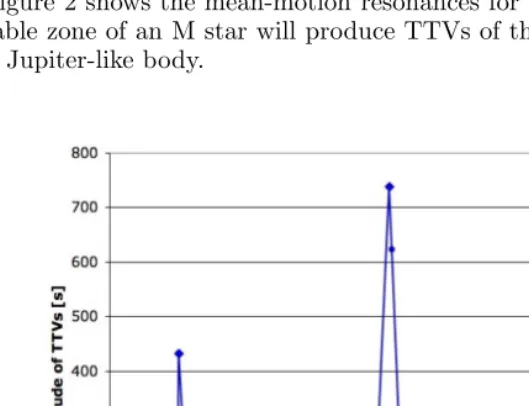
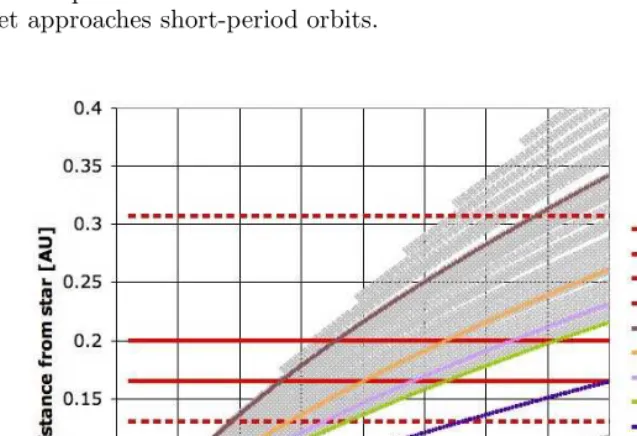
The transit timing variation method has also been considered as a mechanism for detecting small planets around M stars. As shown by Kirste & Haghighipour (2009, 2011), the variations in the transit timing of a transiting giant planet due to the per-turbation of an Earth-size body or a super-Earth can be large enough to match the temporal sensitivity of Kepler space telescope. Figures 1 and 2 show samples of the results by these authors. As shown in figure 1, an Earth-size planet in a 10-day or-bit around a 0.32 solar-mass star produces strong TTVs on a transiting Jupiter-mass planet when the two objects are in (1:2), (2:3), (5:2), and (2:1) mean-motion reso-nances. Figure 2 shows the mean-motion resonances for which an Earth-like planet in the habitable zone of an M star will produce TTVs of the order of 10 s or larger on a transiting Jupiter-like body.
Figure 1.: Transit timing variations of a 1 Jupiter-mass planet around a 0.32 solar-mass M star. The perturber is an Earth-sized planet in a 10-day orbit. The graph shows the values of TTVs for different ratios of the orbital periods of the two planets. As shown here, when the two planets are in (1:2), (2:1), (5:3), and (2:3) resonances, the TTVs have values larger than 100 sec. Figure from Kirste & Haghighipour (2011).
planets, even in orbits as large as that of Jupiter around the Sun (Laughlin et al. 2004). The fact that observational surveys have been able to detected many Jovian-type planets around M dwarfs [e.g. GJ 876 with two Jupiter-like planets and a Uranus-mass body in approximately 30, 60, and 120 days orbits (Rivera et al. 2005, 2010), or HIP 57050 with a Saturn-mass planet in a 42 days orbit (Haghighipour et al. 2010)] suggests that these giant planets were probably formed at larger distances, where the disk contained more material, and migrated to their current short-period orbits. It would therefore be necessary to study how such a migration affects the formation of terrestrial planets around M stars and their final orbital configuration as the giant planet approaches short-period orbits.
Figure 2.: Graph of transit timing variation for different resonances between an Earth--size perturber and a Jupiter-mass transiting planet. The central star is a 0.36 Solar– mass M star. The habitable zone (HZ) and continuous habitable zone (CHZ) of the star are shown. The shaded area corresponds to TTVs larger than 10 sec. A shown here, (1:3), (1:2), and (3:5) resonances produce large TTVs when the perturber is in the continuous habitable zone.
2. Giant Planet Migration and the Accretion of Embryos
If during the migration of the giant planet, substantial amount of gas still exists, the combination of gas drag and dynamical friction may prevent the eccentricities of planetary embryos to reach high values and may facilitate their growth to larger objects. Simulations by these authors have shown that, an Earth-size planet can form around a Sun-like star while a Jupiter-mass body migrates through the disk of planetary embryos and the system is subject to gas drag. At times, the final terrestrial planet was even captured in a mean-motion resonance with the giant body and migrated to close-in orbits (Zhou et al. 2005).
In order to assess the possibility of the existence of planetary systems studied by Kirste & Haghighipour (2009, 2011), similar simulations have to be carried out for a migrating giant planet and a protoplanetary disk around an M stars. We note that in the above-mentioned simulations, the migration of the giant planet was stopped before it reached to very short-period (e.g., 3-day or 4-day) orbits. Such a termination of the migration was necessary to ensure that the terrestrial planets would in fact form, and would not be scattered out or crash into the central star. In the system studied by Kirste & Haghighipour (2009, 2011), the giant planet revolves around the central star in 3-5 day orbits. That suggests, in order to examine the viability of the scenario presented by these authors, simulations of terrestrial planet formation have to be carried out for a migrating giant planet in a disk of planetary embryos while allowing the giant planet to migrate to very close-in orbits.
3. Numerical Simulations and the Results
To simulated the formation of terrestrial planets during the migration of a Jupiter-like body around an M star, we considered a model consisting of a star, a protoplanetary disk, and a Jupiter-size planet. We assumed the central star to be similar to GJ 876 and have a mass of 0.32 solar-masses. The protoplanetary disk was considered to be of two types. Once, similar to Zhou et al. (2005), we randomly distributed 30 planetary embryos, with masses ranging from 0.1 to 0.5 Earth-masses, in a region between 0.05 AU (Terquem & Papaloizou 2007) and 0.5 AU. The mutual separations of embryos were chosen to be no smaller than 10 Hill’s radii. Their eccentricities and inclinations were set to 0.001 and 0.001 deg, respectively. In the second model, we changed the number of protoplanets to 40 and distributed them randomly between 0.1 AU and 0.8 AU. The outer edge of the disk in this model was chosen to be equal to 2.7 times the mass of the central star as suggested by Kennedy & Kenyon (2008). In both disk models, the disk surface density followed anr−1.5 profile.
We integrated the motions of planetary embryos using the N-body integrator MER-CURY (Chambers 1999). We modified MERMER-CURY to include planet migration (Lee & Peale 2002), gas drag (Raymond et al. 2006), tidal force (Mardeling & Lin 2002, 2004), eccentricity damping (Lee & Peale 2002), and general relativity (Saha & Tremaine 1992). Integration were carried out for both disk models and for different values of the rate of the migration of the giant planet. We assumed that the giant planet was initially at 1 AU and radially migrated with rates of 10−5,10−6, and 10−7 AU/years.
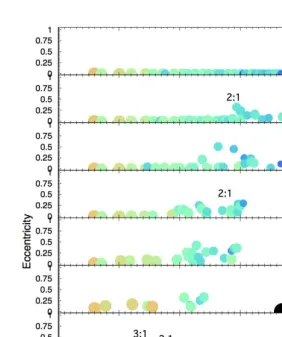
Figure 3 shows the results of one of such simulations. The protoplanetary disk in this simulation is of the second type and the rate of migration is 10−7 AU/year. As shown
Figure 3.: Terrestrial planet formation and resonance capture during the migration of a giant planet (black circle). The disk consists of 40 protoplanets with masses of 0.1 to 0.5 Earth-masses. The continuation of the simulation shows that no terrestrial planet survives when the giant planet reaches the 3-day orbit.
scattering to large distance. We stopped the simulation when the giant planet reached the 3-day orbit. All our simulations showed that no terrestrial planet survived when the giant planet reached short-period orbits.
4. Conclusions
capture probability varies with the migration rate which itself depends on the mass of the protoplanetary disk. The latter suggests that slow migration rates and small proto-planetary disks may in fact facilitate the formation and subsequent resonance capture of a terrestrial planet with a close-in giant planet around M stars.
Acknowledgements. NH acknowledges support from NASA Astrobiology Institute (NAI) under cooperative agreement NNA04CC08A at the Institute for Astronomy, University of Hawaii, NAI central, and the NASA/EXOB grant NNX09AN05G.
References
Boss, A. P. 2006, ApJ, 644, L79
Butler, R. P., Vogt, S. S., Marcy, G. W., Fischer, D. A., Wright, J. T., Henry, G. W., Laughlin, G., & Lissauer, J. J. 2004, ApJ, 617, 580
Chambers, J. E. 1999, MNRAS, 304, 793
Charbonneau, D., Brown, T. M., Latham, D. W., & Mayor, M. 2000, ApJ, 529, L45 Fogg, M. J. & Nelson, R. P. 2005, A&A, 441, 791
Fogg, M. J. & Nelson, R. P. 2006, Inter. J. Astrobio., 5, 199 Fogg, M. J. & Nelson, R. P. 2007a, A&A, 461, 1195
Fogg, M. J. & Nelson, R. P. 2007b, A&A, 472, 1003 Fogg, M. J. & Nelson, R. P. 2009, A&A, 498, 575
Grenfell, J. L., Griessmeier, J-M., Patzer, B., Rauer, H., Segura, A., Stadelmann, A., Stracke, B., Titz, R., & Von Paris, P. 2007, Astrobiology, 7, 208
Haghighipour, N., Vogt, S. S., Butler, R. P., Rivera, E., Laughlin, G., Meschiari, S., & Henry, G. W., 2010, 715, 271
Joshi, M. M., Haberle, R. M., & Reynolds, R. T. 1997, Icarus, 129, 450 Kennedy, G. M., & Kenyon, S. J. 2008, ApJ, 682, 1264
Kirste, S., & Haghighipour, N. 2009, BAAS, 41, 705 Kirste, S., & Haghighipour, N. 2011, to appear in ApJ
Laughlin, G., Bodenheimer, P., & Adams, F. C. 2004, ApJ, 612, L73 Lee, M. H., & Peale, S. J. 2002, ApJ, 567, 596
Mandell, A. M., Raymond, S. N., & Sigurdsson, S. 2007, ApJ, 660, 823 Mardling, R. A., & Lin, D. N. C. 2002, ApJ, 573, 829
Mardling, R. A., & Lin, D. N. C. 2004, ApJ, 614, 955
Raymond, S. N., Mandell, A. M., & Sigurdsson, S. 2006, Science, 313, 1413
Rivera, E. J., Lissauer, J. J., Butler, R. P., Marcy, G. W., Vogt, S. S., Fischer, D. A., Brown,T. M., Laughlin, G., & Henry, G. W. 2005, ApJ, 634, 625
Rivera, E., Laughlin, G., Butler, R. P., Vogt, S. S., Haghighipour, N., & Meschiari, S., 2010, ApJ, 719, 890
Saha, P., & Tremaine, S., 1992, AJ, 104, 1633
Scalo, J., Kaltenegger, L., Segura, A. G., Fridlund, M., Ribas, I., Kulikou, Yu. N., Grenfell, J. L., Rauer, H., Odert, P., Leitzinger, M. S. F., Khodachenko, M. L., Eiroa, C., Kasting, J., & Lammer, H. 2007, Astrobiology, 7, 85
Segura, A., Kasting, J. F., Meadows, V., Cohen, M., Scalo, J., Crisp, D., Butler, R. A. H., & Tinetti, G. 2005, Astrobiology, 5, 706
Tarter, J. C., et al. 2007, Astrobiology, 7, 30
Terquem, C. & Papaloizou, J. C. B. 2007, ApJ, 654, 1110
Vogt, S. S., Butler, R. P., Rivera, E., Haghighipour, N., Henry, G. W., & Williamson, M., 2010, ApJ, 723, 954