Available Online atwww.ijcsmc.com
International Journal of Computer Science and Mobile Computing
A Monthly Journal of Computer Science and Information Technology
ISSN 2320–088X
IJCSMC, Vol. 2, Issue. 11, November 2013, pg.247 – 251
RESEARCH ARTICLE
Multiple Description Coding Based
on Hadamard Transform
S. Radhakrishnan
1, G.Jameena
2, M. Mohamed Sathik
3¹
,²
Kamaraj College of Engineering & Technology & Anna university, India 3Sadakathullah Appa College, M.S. University, India 1
[email protected]; 2 [email protected]; 3 [email protected]
Abstract - Multiple description coding is one of the coding techniques used in the non-prioritized networks to transmit image. In this coding method, the image is split into two or more descriptions and compressed with a controlled level of redundancy. Because of the introduced controlled redundancy the image can be recovered from the other descriptions. Due to this there is a slight degradation in the recovered image. A previous paper used Hadamard transform to compress the image in progressive coding. It is an iterative process in which Hadamard transform is used iteratively to produce the compressed image. By this 25% of the pixels are sent as it is. From the two system parameters M and ∆, the value temp is calculated. 75% of the image is Hadamard transformed, divided by temp and quantized by the system parameter, M. This yields bits per pixel. Thus the compressed file has the size 0.25*8+0.75* . This gives a compression ratio of 8/(0.25*8+0.75* ). By the virtue of the Hadamard transform in this paper 75% of the image has a compression ratio of 8/ . This is further split into two descriptions along with the remaining 25% of the image which is compressed with DCT2 transform and split into two descriptions. A good compression ratio per description and PSNR after decompression is achieved by using this proposed algorithm.
Keywords - Hadamard transform; Multiple Description Coding; Pairwise Correlating Transform; Index Assignment; Progressive Coding
I. INTRODUCTION
Now-a-days the images are very large in size. While transmitting the images it has to be compressed before transmission. There are many methods of compression for image which reduce the size of the image. In this era of mobile communication and non-prioritized networks, there is a possibility that the image packets may be delayed in transmission or permanently lost. In such cases waiting for the full image to reach the destination may be waste of time. Further in such cases the decompression process is delayed. A remedy to this can be related to network and another remedy is multiple description coding.
In multiple description coding the image is compressed into two or more descriptions with the controlled amount of redundancy in them. In this type of compression the descriptions are sent through different routes to the destination. At the destination due to the controlled redundancy the image can be recovered even if one of the descriptions is lost.
made by using the pairwise correlating transform and entropy coding is done. While inverse is taken even if one of the descriptions is lost it can be recovered from the other one and reconstructed. The same author in [2] discusses the multiple description coding based on wavelet transform. [3] discusses multiple description image coding based upon N/2 Discrete Cosine transform.
Progressive coding which is used in this paper is taken from [4]. It is a method which uses Hadamard transform for compression and it has a compression ratio of 8/(0.25*8+0.75* ) where M is a system parameter. The compression is called progressive because iterative decompression is used. A Hybrid method using 2D DCT along with pairwise correlating transform and Hadamard transform along with index assignment [5] is used to compress the image into multiple descriptions.
II. COMPRESSION
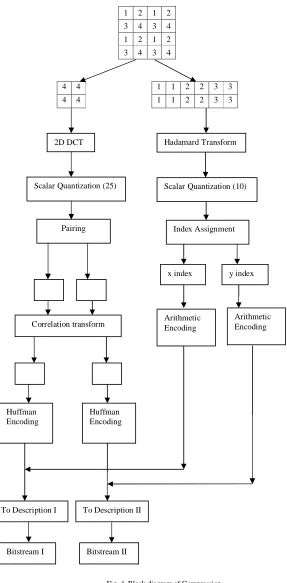
The block diagram of the proposed algorithm is shown in Fig. 4. The proposed algorithm uses DCT, pairwise correlation transform, Hadamard transform for compressing the given image into two descriptions. The image is divided into four subimages. For each 2x2 block, each pixel goes to one of the subimage. Among the four subimages one of the image is treated specially which acts as the backbone for the decompression. For the backbone image first two dimensional DCT is taken as a whole image. Scalar quantization is performed over DCT coefficients (value 25) and then the corresponding pixels in the upper half and the lower half of the coefficients are paired together to which pairwise correlation transform is applied to add the controlled redundancy. Two streams of coefficients obtained are then separately entropy encoded (Huffman Coding) to get the description I and II for the backbone pixels.
The other three subimages are taken as one stream. Hadamard transform is taken and scalar quantization is done.
Temp=∆/M,
∆=60, M=6. (∆ and M are system parameters)
After Hadamard transform is done for the three subimages, a compression ratio of 8: is obtained. These coefficients are split into two dimensional indices by using index assignment.
TABLEI
INDEX ASSIGNMENT FOR HADAMARD TRANSFORMED IMAGE [5] 00 01 10 11
00 1 2 01 3 4 5
10 6 7 8
11 9 10
The x indices and y indices are entropy encoded (Arithmetic Coding) separately to add to the description I and II. x is added to description I and y is added to description II.
The frame format for each description as follows.
Size of DCT bitstream (32 bits)
Huffman bits for Backbone Image
Arithmetic coded bits for other three subimages
Fig. 1 Frame format III.DECOMPRESSION
According to the size of DCT bitstream(32 bit), the DCT coefficient bits are separated from the frame in each description. Huffman decoding for backbone image is performed in both the descriptions. Inverse pairwise correlation transform is performed and the corresponding pixels are fixed in their respective positions. Dequantization is performed to get the DCT coefficients. Inverse DCT transform is performed to complete the reconstruction of backbone image. The image is one fourth the size of the original image. If one of the descriptions is lost, the lost description is obtained by negating the pairwise correlated values in other description. The backbone image is reconstructed by the two descriptions obtained.
For the arithmetic coded bits (rest of the three fourth image), inverse arithmetic coding is performed for both the descriptions, x and y indices are recovered. By these indices and Table 1, the Hadamard coefficients are obtained. If any one of the descriptions is lost, the lost row or column index is taken as the maximum index in the corresponding column or row.
IV.EXPERIMENTAL RESULTS AND CONCLUSION
The proposed algorithm is tested with different standard images like Baboon, Barbara, Lena, Peppers and Girl. The PSNR of the decompressed image is taken for the following three cases. i) When both descriptions are received. ii) When description-I is alone received. iii) When description-II is alone received. The quality of the decompressed image varies from image to image. For images which have high variations like Baboon, the PSNR of the decompressed image is so low. Similarly for images like girl and lena which have low variations, the PSNR of the decompressed images are reasonably high.
TABLEIII
COMPARISON TABLE FOR PSNR IN DIFFERENT CASES Images PSNR (both descriptions
received)
Description-I alone received
Description-II alone received
Baboon.bmp 22.0598 17.3303 17.4801
Barbara.png 24.0852 20.8558 20.9130
Lena.jpg 29.1687 26.0428 26.1324
peppers.png 27.7415 25.3646 25.3434
girl.bmp 30.7868 27.6685 27.7961
The average compression ratio and average bits per pixel per channel of the two descriptions are calculated for each image. From the data obtained, it is concluded that the compression ratio is high for smooth images and low for highly varying images. The bits per pixel per channel is inversely proportional to the compression ratio and it is low for smooth images and high for highly varying images.
TABLEIIIII
TABLE FOR AVERAGE COMPRESSION RATIO &AVERAGE BITS PER PIXEL Images Average Compression Ratio
per channel
Average Bits per pixel per channel
Baboon.bmp 5.15635 1.5524
Barbara.png 5.2589 1.5208
Lena.jpg 5.4956 1.4557
peppers.png 5.5611 1.4383
girl.bmp 5.6239 1.4244
Fig. 2 Sample image (girl.bmp)
1 2 1 2
3 4 3 4
1 2 1 2
3 4 3 4
4 4 1 1 2 2 3 3
4 4 1 1 2 2 3 3
Fig. 4 Block diagram of Compression 2D DCT
Scalar Quantization (25)
Pairing
Correlation transform
Huffman Encoding
To Description I
Bitstream I
Huffman Encoding
To Description II
Bitstream II
Hadamard Transform
Scalar Quantization (10)
Index Assignment
x index y index
Arithmetic Encoding
REFERENCES
[1] Yao Wang, Michael T. Orchard, Vinay Vaishampayan, and Amy R. Reibman, Multiple Description Coding Using Pairwise Correlating Transforms, IEEE Trans. Image Processing, Vol 10, No.3, March 2001. [2] Sergio D. Servetto, Kannan Ramchandran, Vinay Vaishampayan and Klara Nahrstedt, Multiple
Description Wavelet Based Image Coding, IEEE Trans. Image Processing, Vol 9, No.5, May 2000. [3] Mehdi Malboubi, Ahmad Bahai, and Mustafa Ergen, Multiple Description Image Coding : A New
Efficient and Low Complexity Approach for Wireless Applications, 43rd Annual Allerton Conference on Communication, Control and Computing, Connectivity Lab Publications, University of California, Berkeley, September 2005.
[4] Xinpeng Zhang, Lossy Compression and Iterative Reconstruction for Encrypted Image, IEEE Transactions on Information Forensics and Security, Vol. 6, No. 1, March 2011.