DEVELOPING MOBILE APPS FOR IMPROVING THE ORIENTATION
EXPERIENCE OF FIRST YEAR THIRD LEVEL STUDENTS
Nevan Bermingham
1, Mark Prendergast
2, Trevor Boland
1,
Mary O’Rawe
1, Barry Ryan
11Dublin Institute of Technology (Ireland) 2Trinity College Dublin (Ireland)
Abstract
Smartphone usage by students has increased rapidly over the last number of years, and research points to an expectation for increased utilisation of mobile applications in third level educational environments. First year students have particular needs when they transition to third level as they can experience a number of personal, social and cultural difficulties. Orientation is a critical stage for these students and we found that the earlier students have access to important orientation information the less stress the initial stages of college were for them. At the Dublin Institute of Technology (DIT), we designed a bespoke mobile application tailored to the particular orientation and information needs of first year students undertaking programmes in the DIT’s School of Hospitality Management & Tourism. The aim of the mobile app was to engage and orientate the students to their programme before they arrived on campus, and contained key information such as college floor maps and campus locations, contact details, tutorials, reference material and social media links. This mobile app – entitled “DIT GetSmart!” - was released on Apple’s App Store and Google’s Play Store in August 2015 for free download by all new first year students joining the DIT’s School of Hospitality & Tourism undergraduate programmes. Mobile applications of this nature would generally require substantial financial investment and technological expertise. We utilised an online Hybrid App Development Platform that provides low cost development requiring little or no programming know-how to create and deploy quality mobile applications on Android and Apple smartphones and tablets in just a matter of weeks. We evaluated the success of the app through app usage and analytics.
Keywords: Bespoke Mobile Apps, Orientation, Engagement, First Year Experience, Retention
1
INTRODUCTION
Mobile operators have been driving the uptake of mobile data services, or the “mobile internet”, since the mid-1990’s. While mobile operators focused on a mobile version of the internet, Apple changed the eco-system with the release of the first iPhone in 2007, where the user could not only utilise the mobile internet, but could also download small standalone applications – generally referred to as apps – that utilised this connectivity to provide a service to the user. The Apple iPhone was different from its predecessors in that it had a large touch screen and was developed around the users access to the mobile internet [1].
Growth in Apple’s App Store led to Google to enter the market with its Android based phones and tablets. Whereas Apple developed the hardware and the operating software for their iPhones, Google’s strategy was to partner with established handset manufacturers to provide a large range of devices across many price points, and its success has seen an increase in market share and the rise of its own app store, called the Google Play Store [2].
The success of the Apple iPhone lead to the release of the first iPad in 2010, with a similar interface to the iPhone, it had a larger 9.7” screen that could be used as a touch screen or with a stylus, instant “on” and relatively low cost compared to a PC. Its versatility allowed Apple to capture nearly 70% of the tablet market share within one year of its launch [3]. Other manufacturers followed Apple in creating Android and Windows based tablets, and while tablet sales have slowed in 2014, it is still a growth area [4]. Garner reported in 2015 that Android based devices had a market share of 80.7%, Apple iOS 17.7%, and other devices – including Windows and Blackberry – had a 1.5% market share, clearly showing that the smartphone and tablet market is dominated by Apple’s iOS based devices, and Google’s Android OS devices [5]
consumers, the mobile internet has gradually turned into mobile broadband in turn driving increases in the uptake of mobile devices [7]. With this growth in mobile internet speeds and ubiquitous connectivity, mobile apps will become the official channel to drive information content and services to consumers, and users will increasingly interact with mobile apps on their devices [8].
1.1 Hybrid Apps
The range of smartphone devices with their different operating systems poses challenges for developing mobile applications, as they do not utilise a standard development platform [9]. Mobile apps are usually referred to as native apps, apps which are designed and built for one particular platform such as Apple’s iOS or Google’s Android devices. These native apps are built using specific programming languages such as Java to run on one type of mobile platform. Web-based apps are usually built to convey information with web languages such as HTML and CSS, but lack the functionality of native apps, such as access to the phones functions like location services [10]. While native apps have better integration with their device’s operating system, native app development across multiple mobile platforms can not only be time consuming and costly, they also require specific coding skills [9].
Hybrid apps have emerged to address these challenges. Hybrid apps – also known as cloud-mobile hybrids – have the advantage of being platform independent which mean one app can be deployed across many different mobile devices. Hybrid apps allow for the heavy computations to be done on the back end cloud based host system while the mobile device based front-end application presents the information like a native app. These front-end and back-end components are collectively considered as one single application from the point of view of the end-users functionality despite being in effect two independent applications [11].
Many web-based development environments that allow for building hybrid mobile apps have emerged with a low annual cost and have minimal requirement for coding skills. These web-based development environments allow app developers to create mobile applications via an intuitive graphical interface by selecting prebuilt modules that combine together into the app in an ‘à la carte’ fashion [12].
While hybrid apps have limitations, such as functionality is limited to the modules that are available in the development environment, they allow for apps that are easy to create and deployment across multi-platform, that perform well, and have the same feel as a native app [12]. Hybrid app development platforms offer a promising cross-platform development solution for inexpensive building of generic mobile apps which can then be easily deployed to both the app stores of Apple and Google [13].
1.2 Student Adoption of Mobile Technology
Research has shown that higher education is changing to accommodate the high ownership rates of mobile devices among students for whom technology plays an important factor in their lives [14]. The term “Net Generation” [15] has been used in literature to describe students entering third level education, with research indicating that this generation of student is technology savvy and their social networks have been established through the use of technology and the internet. These technology savvy students perceive technology to be a core part of their lives and have created a dependency on using this technology to feel connected to the world around them [16].
Research conducted by the Educause Centre for Analysis and Research reinforces this, and their study of 1.5 million students over 213 institutions across 45 US States found that students perceive the technology they use as embedded into their daily lives. The study also found that these students are generally inclined to have a favourable attitude to technology [17]. The Pew Research Centre’s Internet & American Life Project study suggests that college students are the most likely to be rapid adopters of smartphone and mobile technologies [18].
1.3 First Year Students
Research has indicated that mobile technologies can offer tangible advantages for students transitioning to third level by making it as easy for them to engage on their own terms with information and resources. By fostering new technology innovations third level educational organisations can ensure that the potential for enhanced student support can be fully exploited [20].
2
DEVELOPING BESPOKE HYBRID APPS
This paper will focus on the process for designing and deploying a bespoke hybrid mobile app to meet the information needs of third level first year students in the Dublin Institute of Technology’s (DIT) School of Hospitality Management and Tourism. The mobile app was designed to be freely available to all new students starting their undergraduate courses in this School in September 2015, approximately 410 new first year students. The aim of the authors was to show how such bespoke mobile apps can be developed using affordable online Integrated Development Environments (IDE’s) which can be deployed to the dominant Apple (iPhones, iPads) and Android mobile platforms in a matter of weeks. The key function of the app was to provide important information to the students about their campus and course in advance of their arrival by means of a custom built mobile app.
2.1 Development Platform – Como™
The first phase in the app design was to identify an online development platform and create a design team. The design team consisted of three individuals – the app designer, a graphic designer, and a content researcher. The app designer was the project leader and was responsible for the construction of the app and any technology decisions that need to be made. The graphic designer was responsible for the app aesthetics and branding, as well as providing infographics to be used within the app, such as floor maps. The content researcher’s responsibility was for ascertaining what information was essential for first year students and providing up-to-date relevant information for the app. The inclusion of a graphic designer was considered essential, as there is evidence to suggest that with app design there is a correlation between the aesthetics of the interface and the perceived usability which can positively affect user’s impression of the app itself [21].
An evaluation was conducted of a sample of the various hybrid app Integrated Development Environments (IDE’s) available online, and after a review of their functionality and cost models, Como
(www.como.com) was selected. Como offers an extensive range of modular functionality that can be
easily incorporated into a hybrid app, while allowing for easy deployment to the Apple App Store and Google Play Store. Como did not have the functionality for creating Windows Phone based mobile apps, and while this is viewed as a missed opportunity for some students, the popularity of Windows Phones is much lower compared to Android and Apple devices. Como also allowed for pop-up notification to be sent to the app user’s phone, a feature that was deemed advantageous for connecting with students at the early stages of their orientation in first year. Most online hybrid mobile app IDE’s allow the creator to prototype and test their app’s functionality before deployment to an app store and before any payment is necessary.
2.2 Phase 1 – Design & Scoping
College
Information Staff Directory Floor Plans &Maps Campus LocationMaps
Useful Web
Resources Social Media Links AcademicCalendar OrientationSchedules
Timetables Video Tutorials Course Info Useful CollegeGuides
Fig 1 – Requirements for the “DIT GetSmart!” Mobile App
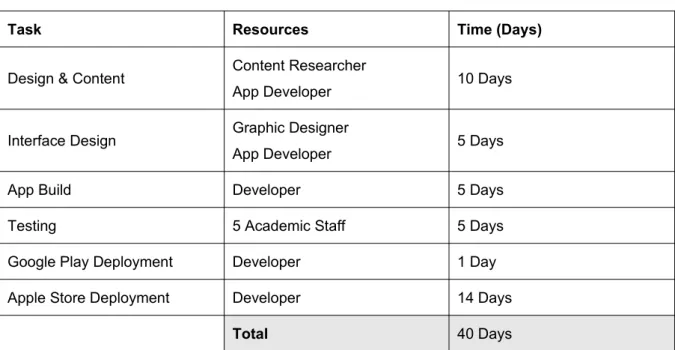
Task Resources Time (Days)
Design & Content Content Researcher
App Developer 10 Days
Interface Design Graphic Designer
App Developer 5 Days
App Build Developer 5 Days
Testing 5 Academic Staff 5 Days
Google Play Deployment Developer 1 Day
Apple Store Deployment Developer 14 Days
Total 40 Days
Fig 2 – High-level Project Plan
2.3 Phase 2 – Development
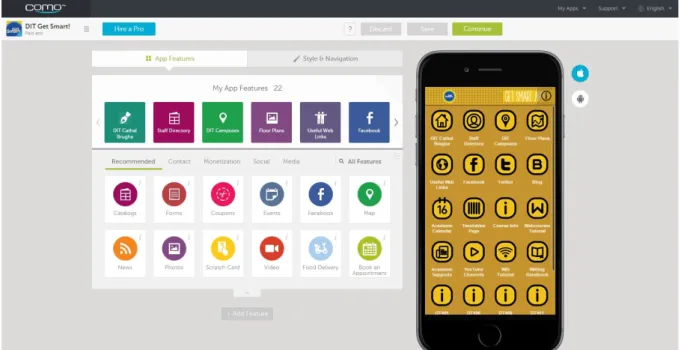
The Como development platform interface provides modular components that encapsulate certain functionality, such as social media, contacts lists, email feedback, map, and each of these modules can be configured and “dropped” into the location on the app preview screen as shown in Fig 3. Each module can be organised in any order required on the app screen and its configuration edited to suit the content needed for that component.
Fig 3 – Como’s App Building Interface
2.4 Phase 3 – “DIT GetSmart!” App Deployment
The Como development environment provides testing functionality in advance of any live deployment via a custom made app provided free by Como, called “MyDemo by Como”. Hence a pre-release prototype version of the “DIT GetSmart!” app could be distributed to the testers. The authors of the app employed five academic staff members within the school to download the app from their respective app stores to allow them to interact with a fully functional version of the app. This allowed for the testers to evaluate the user experience and to feedback on any errors in content or functionality which was then resolved by the app developer and content researcher.
In order to deploy an app to either the Apple App Store or Google Play Store, developer accounts need to be created. This involved setting up a Google Developers Account with a once off registration fee (USD$25.00 as at 22nd July 2015). A separate Apple Developer Program account was needed for deployment to the Apple App Store, including a payment of an annual registration fee (EUR€99.00 as at 22nd July 2015). The deployment process also required the submission of screenshots of the app as well as a detailed description of functionality and an age rating. Fig 4 shows the indicative costs of deploying an app to both app stores.
Item Type Cost (€)
(on the 22nd July 2015)
Como Cost Annual €525
Google Play Store Deployment Once-Off (USD€25) €22
Apple App Store Deployment Annual €99
Total €646
Fig 4 - Costs
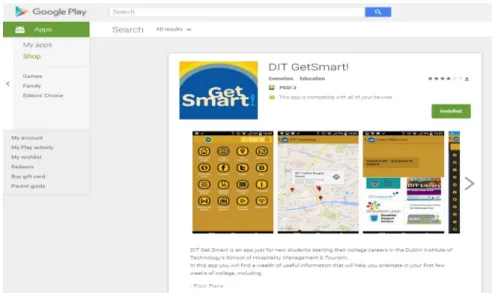
Google’s Play Store. The deployment times for a new app to Google’s live app market can vary, but are typically within a few hours. Deployment through the Apple App Store takes considerably longer due to Apple’s evaluation criteria for new apps, up to 28 days [22]. Como have included the functionality within their IDE to allow deployment of the app to both app stores directly from the Como IDE interface. Fig 5 shows the successfully deployed live “DIT GetSmart!” app on the Google Play Store.
Fig 5 – “DIT GetSmart!” Live App on the Google Play Store
3
EVALUATION
The authors of the app utilised the analytics functionality included in the Como IDE to evaluate the app usage. The limitations of these analytics is as the app is freely available on the Apple and Google App Stores, so its anonymised data includes usage that may not be the target first year third level students in the School it was designed for. However, the analytics provide useful download and usage statistics that can be correlated with student feedback.
Fig 6 shows the download frequency of the app. As expected, the week before and the initial week of the first year orientation, either side of the 26th of September 2015, were peak download times.
Fig 6 – App Downloads by Month
The total number of downloads over the period 1st August 2015 to the 31st December 2015 was 361.
The analytics reported of this number 70% of downloads were on an Apple iOS device (iPhone or iPad) and the remaining 30% on a Google Android device, suggesting Apple devices iPads were more popular with the students.
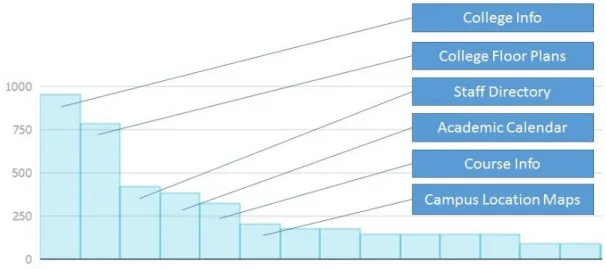
information when the need arises and as often as they need it. Fig 7 shows the breakdown of these page views.
Fig 7 – Page-views by App Feature
4
DISCUSSION
In this paper, the authors have shown that mobile applications are growing in usage, and in particular among the first year third level student demographic. Ownership of smartphones among third level students is high and these students are increasingly using smartphones and mobile devices as part of their everyday lives in college. These students are eager to engage with their third level institutes through their mobile devices, and have an expectation that educational organisations use these technologies to provide them with the relevant information at crucial times in their lives, such as in the transitional stages to third level education.
Hybrid app development platforms offer both academics and educational organisations a cost effective opportunity to easily deploy mobile apps that can provide a rich source of information for first year students to acculturate and prepare them for third level. The design and deployment time of hybrid apps is much shorter than with traditionally coded native apps, hence offer the possibility for the non-technical developer to create an interactive vehicle for information on a mobile device with little difficulty.
By incorporating existing social media functionality into the app with essential orientation information, the student can avail of a feature rich “one-stop-shop” app for all their first year information needs, especially in advance of their arrival on campus.
4.1 Future Work
The process of deploying the “DIT GetSmart!” app for first year students is currently being evaluated through student feedback in the form of focus groups and questionnaires to gauge the app’s effectiveness at improving the orientation experience of first year third level students. This feedback will be used at a later stage to improve the app for the next iteration and for incoming first year students in September 2016. Further research is needed to gauge the performance of the hybrid app model when compared to the native app design approach to understand if the cloud based nature of hybrid apps hinders the user experience.
REFERENCES
[1] J. West, M. Mace, Browsing as the killer app: Explaining the rapid success of Apple’s iPhone, Telecomm. Policy. 34 (2010) 270–286.
trainees, J. Med. Syst. 37 (2013) 1–6.
[4] Gartner Inc., Gartner Says Tablet Sales Continue to Be Slow in 2015, Gart. Press Release. (2015). http://www.gartner.com/newsroom/id/2954317 (accessed April 1, 2016).
[5] Gartner Inc., Gartner Says Worldwide Smartphone Sales Grew 9.7 Percent in Fourth Quarter of 2015, Gart. Press Release. (2016). http://www.gartner.com/newsroom/id/3215217 (accessed April 1, 2016).
[6] J. Edmondson, W. Anderson, J. Gray, J.P. Loyall, K. Schmid, J. White, Next-generation mobile computing, Software, IEEE. 31 (2014) 44–47.
[7] C. Kongaut, E. Bohlin, Investigating mobile broadband adoption and usage: A case of smartphones in Sweden, Telemat. Informatics. 33 (2016) 742–752.
[8] S. Baghdassarian, B. Blau, J. Ekholm, S. Shen, Predicts 2014: Apps, Personal Cloud and Data Analytics Will Drive New Consumer Interactions, 2013.
[9] H. Heitkötter, T.A. Majchrzak, H. Kuchen, Cross-platform model-driven development of mobile applications with md 2, in: Proc. 28th Annu. ACM Symp. Appl. Comput., ACM, 2013: pp. 526– 533.
[10] A. Charland, B. Leroux, Mobile application development: web vs. native, Commun. ACM. 54 (2011) 49–53.
[11] A. Manjunatha, A. Ranabahu, A. Sheth, K. Thirunarayan, Power of clouds in your pocket: An efficient approach for cloud mobile hybrid application development, in: Cloud Comput. Technol. Sci. (CloudCom), 2010 IEEE Second Int. Conf., IEEE, 2010: pp. 496–503.
[12] A.M. Christ, Bridging the mobile app gap, Connect. User Exp. 11 (2011) 27.
[13] S. Pastore, Developing mobile educational apps: development strategies, tools and business models, Adv. Comput. Sci. an Int. J. 3 (2014) 27–36.
[14] M.B.W. Kobus, P. Rietveld, J.N. Van Ommeren, Ownership versus on-campus use of mobile IT devices by university students, Comput. Educ. 68 (2013) 29–41.
[15] W.J. Egnatoff, Tapscott, D.(1998). Growing Up Digital. The Rise of the Net Generation. New York: McGraw Hill. xii+ 338. ISSN 0-07-063361-4. Web site: www. growingupdigital. com, Educ. Inf. Technol. 4 (1999) 203–205.
[16] D. Oblinger, J.L. Oblinger, J.K. Lippincott, Educating the net generation, Boulder, Colo.: EDUCAUSE, c2005. 1 v.(various pagings): illustrations., 2005.
[17] E. Dahlstrom, J.D. Walker, C. Dziuban, ECAR study of undergraduate students and information technology, 2013, 2013.
[18] A. Smith, Smartphone ownership—2013 update, Pew Res. Cent. Washingt. DC. 12 (2013) 2013.
[19] M.E. Smith, Connecting students and families for support during the college transition, in: Proc. Companion Publ. 17th ACM Conf. Comput. Support. Coop. Work Soc. Comput., ACM, 2014: pp. 93–96.
[20] J. Fotheringham, E. Alder, Getting the Message: Supporting Students Transition from Higher National to Degree Level Study and the Role of Mobile Technologies., Electron. J. E-Learning. 10 (2012) 262–272.
[21] N. Tractinsky, Toward the study of aesthetics in information technology, ICIS 2004 Proc. (2004) 62.