Title: Brief interventions are effective in reducing alcohol consumption in opiate dependent methadone maintained patients: results from an implementation study.
Running title: Brief interventions reduce alcohol consumption in methadone patients
Authors: Catherine D Darker, Brion P Sweeney, Haytham O El Hassan, Bobby P Smyth, Jo-Hanna H Ivers, & Joe M Barry
Dr. Catherine D Darker is a Lecturer in Primary Care
Dr. Brion P Sweeney is a Consultant Adult Psychiatrist in Addiction Services Dr. Haytham O El Hassan is a Research Registrar in Addiction Services Dr. Bobby P Smyth is a Consultant Child & Adolescent Psychiatrist Ms. Jo-Hanna H Ivers is a Research Assistant
Professor Joe M Barry is the Chair of Population Health Medicine
This research was carried out within the Department of Public Health & Primary Care, Trinity College Dublin, Ireland and in three Drug Treatment Centres within the Addiction Services of the Heath Service Executive, Dublin North Central Drug Service, Ireland.
Corresponding author: Dr. Catherine Darker
Department of Public Health & Primary Care Trinity College Centre for Health Sciences
Adelaide & Meath Hospital Dublin, Incorporating the National Children’s Hospital Tallaght
Dublin 24, Ireland
Phone: +353 (0)1 8968510 Fax: +353 (0)1 4031212
Abstract
Introduction and Aims An implementation study to test the feasibility and
effectiveness of brief interventions to reduce hazardous and harmful alcohol consumption in opiate dependent methadone maintained patients.
Design and Methods Before and after intervention comparison of Alcohol Use
Disorders Identification Test (AUDIT-C) scores from baseline to three-month follow-up. 710 (82%) of the 863 eligible methadone maintained patients within three urban addiction treatment clinics were screened. A World Health Organization protocol for a clinician delivered single brief intervention (BI) to reduce alcohol consumption was delivered. The full AUDIT questionnaire was used at baseline (T1) to measure
alcohol consumption and related harms; and in part as a screening tool to exclude those who may be alcohol dependent. AUDIT-C was used at three-month follow-up (T2) to assess any changes in alcohol consumption.
Results 160 (23% of overall sample screened) ‘AUDIT positive’ cases were
identified at baseline screening with a mean total full AUDIT score of 13.5 (sd 6.7). There was a statistically significant reduction in AUDIT-C scores from T1 (x =6.74, sd=2.35) to T2 (x =5.74, sd=2.66) for the BI group [z=-3.98, p<0.01].
There was a statistically significant decrease in the proportion of males who were AUDIT positive from T1 to T2 [χ2=8.25, p<0.003].
Discussion and Conclusions It is feasible for a range of clinicians to screen for
problem alcohol use and deliver BI within community methadone clinics. Opiate dependent patients significantly reduced their alcohol consumption as a result of receiving a brief intervention.
Introduction
At present there are more than 8,500 patients receiving methadone maintenance throughout the Irish Republic for opiate dependence syndrome (1). A recent Irish study suggested that the prevalence of problem alcohol use among patients attending primary care for methadone treatment was 35% (2). Most are injecting drug users and this group demonstrates a high prevalence of hepatitis C infection, with an estimated 70-80% carrying the active virus at any one time (3). Both hepatitis C and alcoholism are risk factors for developing liver cirrhosis and, in combination, speed the process towards cirrhosis and decompensated liver failure (4). Chronic liver disease is the second most common cause of death after overdose among opioid dependent people (5).
Twelve randomised controlled trials were reviewed and it was concluded that drinkers receiving a BI were twice as likely to reduce their drinking as those who received no intervention (12). A review of eight randomised controlled studies found that brief interventions could reduce excessive drinking within a general practice population, but questioned the feasibility of clinicians screening the general practice settings (13). A review of 11 trials of BI concluded that, while further research on specific issues is required, the public health impact of brief interventions is potentially enormous (14). In contrast to these results, a recent study found that the evidence was inconclusive for the effectiveness of opportunistic brief interventions for problem drinkers within a general hospital setting (15). A recent Cochrane review also indicated there is little evidence that brief interventions for problem alcohol consumption are effective in women within a primary care setting (16).
patients who participate in a BI will show a reduction in their alcohol consumption post intervention, at three-month follow-up, as assessed by AUDIT-C scores. It was also hypothesised that clinicians would be able to screen and deliver a BI in
conjunction with their normal clinical load.
Methods
Participants
Participants were all opiate dependent and accessing methadone maintenance treatment within one of the three largest clinics in Dublin, Ireland. These sites were selected because they have the largest numbers of patients attending their services and also because they have the greatest numbers of clinicians working within them. In choosing these sites we felt that we would maximise the numbers of patients available to us and we would also get the opportunity to train a large number of clinicians in an internationally recognised skill such as screening for problem alcohol use and
delivering a WHO BI. Participation was on a voluntary basis and no inducements to participate were offered. All patients attending the clinics were eligible to participate (N=863). Patients who were registered, but in prison or not attending the clinic at the time of screening, or patients experiencing an acute psychotic episode as determined by their treatment team, and patients who scored ≥ 20 on the full AUDIT at T1, were all excluded from the study.
conducted both the screening and delivery of the intervention. Structures were put in place during the research phase to ensure that any patient who became upset as a result of either the screening or intervention would be offered further assistance by the in-house treatment team. No patient had to avail of this contingency during the study.
Design
This was an implementation study to determine whether it was feasible for treatment teams to screen patients and to deliver BI where appropriate within their normal clinical setting and with high workloads. It employed a before and after comparison of scores on the AUDIT-C from baseline (T1) to three months follow-up (T2). Power analysis based on a reduction of AUDIT score by two standard deviations indicated a need to recruit and retain 155 participants to receive a BI, giving 80% power to detect a medium effect size of Cohen's d=0.5 with an alpha error level of p < 0.05.
Main outcome
The primary outcome was change in AUDIT-C score from baseline to follow-up. A recent review of studies investigating the psychometric properties and use of Audit-C to measure change has shown it to be as valid and reliable as the full AUDIT (8). AUDIT-C has been used to screen for problem alcohol use in methadone maintained patients (18).
Procedure
World Health Organisation guidelines of evidence-based approaches (9). Each staff member attended a single three-hour training session. Additional training was made available one week after the initial training session. This additional training entailed a repeat of the main points relating to the screening procedure and delivery of the BI. The additional training session was designed to last 30 minutes and only two clinicians availed of this. A researcher (JI) was available in a supportive role
throughout the data collection periods. Each clinician was assigned a list of patients to screen. The clinicians conducted the screening and delivered the BI alongside their typical clinical tasks. No protected time was given specifically to complete the
screening and the BI. Data collection took place between January 2009 and November 2009.
The full AUDIT questionnaire has ten items with a possible range of scores between 0-40. Different screening AUDIT scores have been recommended for men and women (8,7). Scores between 0-5 for women and scores 0-7 for men indicated an AUDIT negative result and therefore no intervention was required. Scores between 6-15 for women and between 8-6-15 for men indicated hazardous drinking; scores
between 16-19 for both men and women indicated harmful drinking. Both hazardous and harmful drinkers received a BI, delivered by the screening clinician, immediately after screening. The full AUDIT was also used in part as a screening tool to exclude those patients with an AUDIT score ≥ 20, suggestive of possible alcohol dependence, and these patients were referred for further follow-up and counselling with the
minutes per patient to deliver. Hazardous and harmful users were re-screened for problem alcohol use at three months follow-up using the AUDIT-C. The AUDIT-C has three items, with scores ranging from 0 to 12 with an optimal screening threshold of ≥4 for women and ≥5 for men (20-22). All patients hazardously or harmfully using alcohol and receiving a BI were re-screened three months later. A different member of the clinical team screened the patients at follow-up (than at baseline screening) to reduce response bias.
Brief interventions
Elements of BI, as outlined by the WHO (7), include the presentation of screening results, the identification of risks and a discussion of associated consequences, the provision of medical advice, the solicitation of a patient’s commitment to change their drinking behaviour, the identification of a goal related to either reduction of alcohol intake or total abstinence from drinking and also the provision of advice and
encouragement. This is achieved using a motivational interviewing style that is non-judgemental and collaborative in nature (23).
Treatment as usual
Currently patients on methadone maintenance in the research sites have a treating doctor as well as access to nursing and other specialist disciplines including liaison psychiatry, drug liaison midwifery, counselling and rehabilitation services. Generally patients see their doctors on a regular basis for management of their treatment
intervene if such substance misuse is ongoing, however generally doctors have not been trained in BI techniques or in regular alcohol AUDIT screening. Interventions usually include increased attendance requirements and ongoing urinalysis. Doctors attempt to enlist patient compliance with the treatment plan and abstinence from substances other than prescribed methadone. Patients can access counselling through self-referral or referral by their doctor. Access to counselling is limited by availability of counsellors and many patients are reluctant to engage with in-depth psychological interventions. Substance misuse is monitored and addressed on an ongoing basis but there is no standard comprehensive package of psychological interventions.
Measures
The AUDIT and the AUDIT-C were utilised within this study. The full AUDIT questionnaire had a Cronbach’s alpha of 0.75 and the AUDIT-C questionnaire had a Cronbach’s alpha of 0.71. The four most recent urine toxicology result samples prior to TI screening date for each patient for opiates, benzodiazepines and cocaine were also gathered, as there is evidence from other studies that concurrent polydrug use can predict alcohol consumption (24,25).
Analysis
consumed on a typical day when drinking, was created and a Wilcoxon rank test was used to evaluate whether there was a change in number of drinks from baseline to follow-up. Multiple linear regression analyses were used to develop models to predict AUDIT-C scores at baseline and follow-up, urine toxicology results (summed total number of urine samples testing positive for opiates, cocaine and benzodiazepines, from last four samples provided by patient immediately before baseline AUDIT screening), time in treatment, sex, age, clinical site and the clinical discipline of the screener.
Results
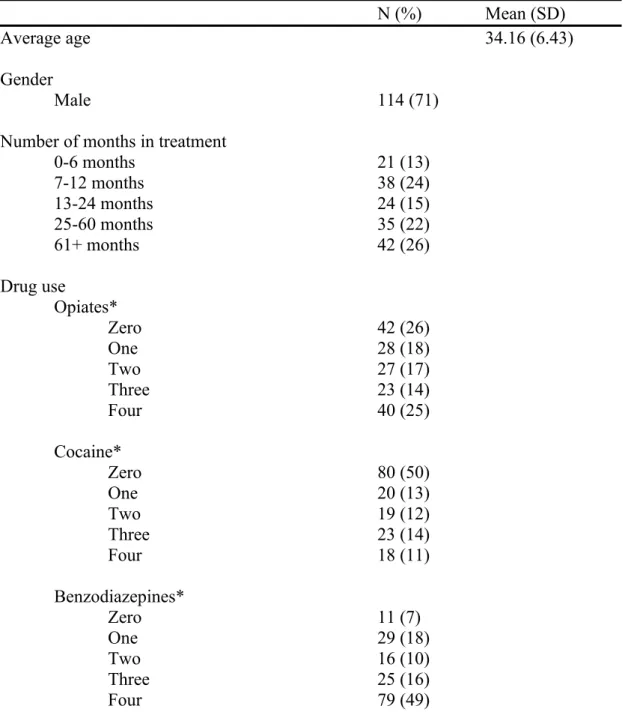
A total of 153/863 (18%) patients were excluded because of imprisonment (27), non-attendance (98) or psychosis (28). A total of 710 patients were screened (82% of the overall eligible population) with 160 (23%) AUDIT positive cases being identified. This meant that an average of one quarter of those screened required a brief intervention to be delivered immediately after screening by the same clinician. The baseline demographics, urine toxicology screening results and time in treatment for the sample are presented in Table 1. This sample was indicative of the overall clinical population within the three clinics at the time of screening and also reflects patients in treatment within Ireland (26) and Europe (27).
(insert Table 1 about here)
(insert Table 2 about here)
The entire sample (N=160) had drunk alcohol in the last year, with 26 patients (16%) drinking alcohol four or more times a week. Thirty-two per cent (51/160) of the sample reported binge drinking (i.e., drinking six or more standard drinks on one occasion) at least weekly or daily.
There was a statistically significant reduction in AUDIT-C scores from T1 (x =6.74, sd=2.35) to T2 (x =5.74, sd=2.66) [z=-3.98, p<0.01]. There was a statistically significant reduction in the typical number of drinks consumed on a typical day when drinking from baseline (x =6.91, sd=2.46) to T2 (x =5.21, sd=2.50) [z=-5.63, p<0.01] to T2 follow-up.
There was a statistically significant decrease in the proportion of males who were AUDIT-C positive from T1 (N=104) to T2 (N=87) [χ2=8.25, p<0.003]. There was no significant decrease for females from T1 (N=46) to T2 (35) [χ2=0.348, p=0.42].
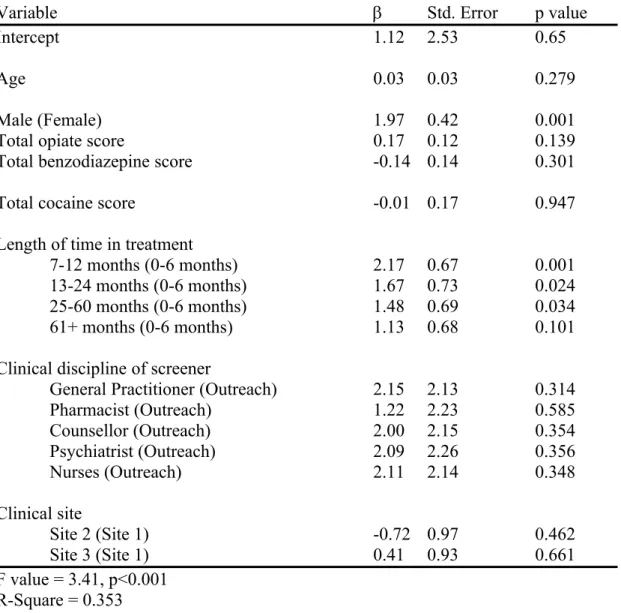
Factors such as age, opiate use, cocaine use, benzodiazepine use, the clinical discipline of the screener and clinical site did not predict alcohol consumption at baseline. Both the sex of the patient and the length of time in treatment did predict AUDIT-C scores at baseline. The eight factor predictor model (see Table 3) was able to account for 25% of the variance in AUDIT-C scores at baseline [F(17, 106) = 3.41, p<0.001].
Factors such as sex, age, time in treatment, opiate use, cocaine use, benzodiazepine use, the clinical discipline of the screener and clinical site did not predict alcohol consumption at follow-up. AUDIT-C scores at baseline did predict AUDIT-C scores at follow-up ( = 0.43, p<0.001). The nine predictor model (see Table 4) was able to account for 11% of the variance in AUDIT-C score at follow-up [F(18, 110) = 1.81, p <0.05].
(insert Table 4 about here)
Discussion
scores for men and women and the more limited scope for change that women have compared to men on the AUDIT scoring system. Of these forty-six women, thirty-five were AUDIT-C positive at follow-up. This finding is suggestive that some women do respond to a BI; however, this was not statistically significant and should be viewed in light of a lack of a control comparison condition.
This study had a number of strengths. Implementation studies are
session as suggested by WHO guidelines. A recent study with drug users within Ireland called for addiction treatment services to consider tertiary prevention strategies that aim to ameliorate risk factors for HCV, such as alcohol misuse, to reduce liver disease progression (23). It is the intention of the treatment clinics included within this study to incorporate the use of the AUDIT and delivery of BI as routine clinical practice. These findings are likely to be of interest to similar addiction treatment services.
collection period (January 2009 to November 2009) of the prevalence of a new emerging phenomenon within Ireland of ‘legal highs’ or psychoactive substances being sold in ‘Head shops’ throughout the country (31). Problem drug users appear to be an especially vulnerable subgroup of new psychoactive substance users and it is
possible that drug substitution was occurring during the data collection period and this
may explain the reduction in alcohol consumption observed in the current study. This study utilised a before and after design and did not randomly assign patients to groups, and the study results should be interpreted with this in mind.
Although research designs are often conceptualised within a hierarchy, with those that maximise internal validity seen as most preferable (32), this view has been challenged in the realm of treatment research (33). Critics of the pre-eminence of RCTs note the frequency with which between-group equivalence is not achieved, often for reasons related to the study design itself (e.g. clients may withdraw following random assignment to a non-preferred treatment). Even when internal validity is not compromised, controls on sample characteristics and treatment delivery may limit external validity, i.e. the ability to generalise study findings to real-world patient populations and treatment programs (34). Thus, the choice of research design needs to be evaluated within the broader context of study goals and data collection circumstances (35). All research designs have strengths and weaknesses; no single study can be definitive, and both clinical practice and theory are advanced by a convergence of results across differing, complementary, methods. Indeed, reviewers comparing RCT results with those from well-designed observational and quasi-experimental studies often report that treatment effects are similar in size and
by both the research question of interest and the state of the existing knowledge base. This current study was a study of how clinicians could implement alcohol screening and BI into their usual clinical routines and we acknowledge the absence of a control group. We wanted to answer a specific research question – does this intervention work in a real life addiction treatment clinic? Also, since there is over a decade of empirical literature supporting the effectiveness of BIs to modify alcohol
consumption, we felt that randomisation was not necessary. This research may inform the basis of a more rigorous controlled intervention study design with a similar cohort in a similar treatment setting. This study incorporated a three-month follow-up; future research is needed to determine whether the effects of the BI are sustained within a longer time frame. It may also be of interest to determine the optimum length of time needed for clinicians to deliver an additional BI to patients so as to maximise the effects of the intervention.
The WHO recently reported on an international randomised controlled trial evaluating the effectiveness of a brief intervention for illicit drug use (36). This trial demonstrated that brief interventions were effective compared with no intervention in assisting members of the general population to reduce their substance use and
Conclusion
This study suggests that a variety of clinicians can help methadone maintained patients to reduce their alcohol use in the short term. Brief interventions can be incorporated into the practices of nurses, general practitioners, counsellors, social workers and outreach workers in drug treatment facilities.
Acknowledgements
References
1. Barry J. Total number of individuals receiving methadone prescribed opiate subsitution treatment. 2010;
2. Ryder N, Cullen W, Barry J, Bury G, Keenan E, Smyth B. Prevalence of problem alcohol use among patients attending primary care for methadone treatment. BMC Family Practice. 2009;10(1):42.
3. Smyth BP, O’Connor JJ, Barry J, Keenan E. Retrospective cohort study examining incidence of HIV and hepatitis C infection among injecting drug users in Dublin. Journal of Epidemiology and Community Health. 2003 Apr;57(4):310-311.
4. Bhattacharya R, Shuhart MC. Hepatitis C and Alcohol: Interactions, Outcomes, and Implications. Journal of Clinical Gastroenterology March 2003.
2003;36(3):242-252.
5. Hser Y-I, Hoffman V, Grella CE, Anglin MD. A 33-Year Follow-up of Narcotics Addicts. Arch Gen Psychiatry. 2001 May 1;58(5):503-508.
6. Babor T, Higgins-Biddle J, Saunders J, Monterio M. AUDIT The alcohol use disorders identification test. Guidelines for use in primary care. (2nd Ed). 2001; 7. Bradley KA, Boyd-Wickizer J, Powell SH, Burman ML. Alcohol screening
questionnaires in women: a critical review. JAMA. 1998 Jul 8;280(2):166-171. 8. Reinert DF, Allen JP. The Alcohol Use Disorders Identification Test: An Update
of Research Findings. Alcoholism: Clinical and Experimental Research. 2007;31(2):185-199.
9. Babor T, Higgins-Biddle J. Brief intervention: For hazardous and harmful drinking. A manual for use in primary care. 2001;
10. Heather N. A long-standing World Health Organization collaborative project on early identification and brief alcohol intervention in primary health care comes to an end. Addiction. 2007;102(5):679-681.
11. Bien TH, Miller WR, Tonigan JS. Brief interventions for alcohol problems: a review. Addiction. 1993;88(3):315-336.
12. Wilk AI, Jensen NM, Havighurst TC. Meta-analysis of Randomized Control Trials Addressing Brief Interventions in Heavy Alcohol Drinkers. J Gen Intern Med. 1997 May;12(5):274-283.
13. Beich A, Thorsen T, Rollnick S. Screening in brief intervention trials targeting excessive drinkers in general practice: systematic review and meta-analysis. BMJ. 2003 Sep 6;327(7414):536-542.
15. Emmen MJ, Schippers GM, Bleijenberg G, Wollersheim H. Effectiveness of opportunistic brief interventions for problem drinking in a general hospital setting: systematic review. BMJ. 2004 Feb 7;328(7435):318.
16. Kaner E, Dickinson H, Beyer F, Campbell F, Schlesinger C, Heather N, et al. Effectiveness of brief alcohol interventions in primary care populations. Cochrane Database of Systematic Reviews (Online). 2007;(2).
17. de Jong ORW, Hopman‐Rock M, Tak ECMP, Klazinga NS. An implementation study of two evidence‐based exercise and health education programmes for older adults with osteoarthritis of the knee and hip. Health Education Research. 2004 Jun 1;19(3):316 -325.
18. Watson B, Conigrave K, Wallace C, Whitfield J, Wurst F, Haber P. Hazardous alcohol consumption and other barriers to antiviral treatment among hepatitis C positive people receiving opioid maintenance treatment. Drug and Alcohol Review. 2007;26:231-239.
19. Saunder JB, Aasland OG, Babor TF, Fuente JR, Grant M. Development of the Alcohol Use Disorders Identification Test (AUDIT): WHO Collaborative Project on Early Detection of Persons with Harmful Alcohol Consumption-II. Addiction. 1993;88(6):791-804.
20. Gual A, Segura L, Contel M, Heather N, Colom J. AUDIT-3 and AUDIT-4: Effectiveness of two short forms of the Alcohol Use Disorders Identification Test. Alcohol Alcohol. 2002 Nov 1;37(6):591-596.
21. Aertgeerts B., Buntinx F., Ansoms S., Fevery J. Screening properties of questionnaires and laboratory tests for the detection of alcohol abuse or
dependence in a general practice population. British Journal of General Practice. 2001 Mar 1;51:206-217.
22. Rumpf H-J, Hapke U, Meyer C, John U. Screening for alcohol use disorders and at-risk drinking in the general population: psychometric performance of three questionnaires. Alcohol Alcohol. 2002 May 1;37(3):261-268.
23. Miller W, Rollnick S. Motivational interviewing: Preparing people for change 2nd ed. 2nd ed. New York: The Guilford Press; 2002.
24. Gossop M, Manning V, Ridge G. Concurrent use of alcohol and cocaine: differences in patterns of use and problems among users of crack cocaine and cocaine powder. Alcohol Alcohol. 2006 Mar 1;41(2):121-125.
25. Mengis M, Maude-Griffin P, Delucchi K, Hall S. Alcohol use affects the outcome of treatment for cocaine abuse. American Journal of Addiction. 2002;11(3):219-227.
27. EMCDDA. 2010 Annual report on the state of the drugs problem in Europe. [Internet]. 2010 Nov;Available from:
http://www.emcdda.europa.eu/publications/annual-report/2010
28. Moher D, Schulz KF, Altman DG. The CONSORT statement: revised recommendations for improving the quality of reports of parallel-group randomised trials. The Lancet. 2001 Apr 14;357(9263):1191-1194.
29. de Jong ORW, Hopman‐Rock M, Tak ECMP, Klazinga NS. An implementation study of two evidence‐based exercise and health education programmes for older adults with osteoarthritis of the knee and hip. Health Education Research. 2004 Jun 1;19(3):316 -325.
30. Babor T, Steinberg K, Anton R, Del Boca F. Talk Is Cheap: Measuring Drinking Outcomes in Clinical Trials - Journal of Studies on Alcohol and Drugs [Internet]. 2000 [cited 2010 Jul 1];Available from:
http://www.jsad.com/jsad/article/Talk_Is_Cheap_Measuring_Drinking_Outcome s_in_Clinical_Trials/720.html
31. Kelleher C, Christie R, Lalor K, Fox J, Bowden M, O’Donnell C. An overview of new psychoactive substances and the outlets supplying them. Dublin: National Advisory Committee on Drugs; 2011.
32. Concato J, Shah N, Horwitz RI. Randomized, controlled trials, observational studies, and the hierarchy of research designs. N. Engl. J. Med. 2000 Jun 22;342(25):1887-1892.
33. Tucker JA, Roth DL. Extending the evidence hierarchy to enhance evidence‐ based practice for substance use disorders. Addiction. 2006 Jul 1;101(7):918-932.
34. Green J. The evolving randomised controlled trial in mental health: studying complexity and treatment process. Adv Psychiatr Treat. 2006 Jul 1;12(4):268-279.
35. Moyer A, Finney JW. Randomized versus nonrandomized studies of alcohol treatment: participants, methodological features and posttreatment functioning. J. Stud. Alcohol. 2002 Sep;63(5):542-550.
Table 1: Baseline demographic characteristics (N=160).
N (%) Mean (SD)
Average age 34.16 (6.43)
Gender
Male 114 (71)
Number of months in treatment
0-6 months 21 (13)
7-12 months 38 (24)
13-24 months 24 (15)
25-60 months 35 (22)
61+ months 42 (26)
Drug use
Opiates*
Zero 42 (26)
One 28 (18)
Two 27 (17)
Three 23 (14)
Four 40 (25)
Cocaine*
Zero 80 (50)
One 20 (13)
Two 19 (12)
Three 23 (14)
Four 18 (11)
Benzodiazepines*
Zero 11 (7)
One 29 (18)
Two 16 (10)
Three 25 (16)
Four 79 (49)
Table 2: Baseline AUDIT scores for all patients screened.
____________________________________________________________________ Total screened AUDIT Positive AUDIT Negative Dependent
(n=710) (n=160) (n=485) (n=65)
10.1 (9.6) 13.5 (6.7) 4.7 (4.5) 28.7 (7.2)
Table 3: Multiple linear regression of which factors predict alcohol consumption at baseline.
Variable Std. Error p value
Intercept 1.12 2.53 0.65
Age 0.03 0.03 0.279
Male (Female) 1.97 0.42 0.001
Total opiate score 0.17 0.12 0.139
Total benzodiazepine score -0.14 0.14 0.301
Total cocaine score -0.01 0.17 0.947
Length of time in treatment
7-12 months (0-6 months) 2.17 0.67 0.001
13-24 months (0-6 months) 1.67 0.73 0.024
25-60 months (0-6 months) 1.48 0.69 0.034
61+ months (0-6 months) 1.13 0.68 0.101
Clinical discipline of screener
General Practitioner (Outreach) 2.15 2.13 0.314
Pharmacist (Outreach) 1.22 2.23 0.585
Counsellor (Outreach) 2.00 2.15 0.354
Psychiatrist (Outreach) 2.09 2.26 0.356
Nurses (Outreach) 2.11 2.14 0.348
Clinical site
Site 2 (Site 1) -0.72 0.97 0.462
Site 3 (Site 1) 0.41 0.93 0.661
F value = 3.41, p<0.001 R-Square = 0.353
Adjusted R-Square = 0.249 () = baseline category
Variable Std. Error p value Intercept
Age 0.02 0.04 0.542
Male (Female) 0.53 0.63 0.397
Total opiate score 0.12 0.16 0.438
Total benzodiazepine score 0.19 0.19 0.313
Total cocaine score 0.13 0.23 0.570
Total Audit C score at baseline 0.43 0.12 0.001
Length of time in treatment
7-12 months (0-6 months) -0.40 0.95 0.669
13-24 months (0-6 months) -0.41 -0.41 0.678
25-60 months (0-6 months) 0.30 0.94 0.745
61+ months (0-6 months) -0.05 0.92 0.954
Clinical discipline of screener
General Practitioner (Outreach) 0.57 2.84 0.841
Pharmacist (Outreach) -0.27 -0.09 0.927
Counsellor (Outreach) 0.51 2.87 0.858
Psychiatrist (Outreach) -0.58 3.01 0.845
Nurses (Outreach) 0.62 2.99 0.876
Clinical site
Site 2 (Site 1) -0.78 1.31 0.550
Site 3 (Site 1) -1.45 1.24 0.246
F value = 1.815 R-Square = 0.246