Intrusion Detection Systems
Matthijs Koot ([email protected])
Definitions, purpose
Past and present
How honeypots work
HoneyD Honeynet, HoneyWall MWCollect: Nepenthes, HoneyTrap and HoneyBow
Limitations and future
Limitations Honeynet Research Alliance Future topics
Summary
Intrusion Detection Systems
Lesson #4: Honey{pots,nets,walls}
Matthijs Koot ([email protected])
Faculteit van Natuurwetenschappen, Wiskunde en Informatica Universiteit van Amsterdam
Intrusion Detection Systems
Matthijs Koot ([email protected])
Definitions, purpose
Past and present
How honeypots work
HoneyD Honeynet, HoneyWall MWCollect: Nepenthes, HoneyTrap and HoneyBow
Limitations and future
Limitations Honeynet Research Alliance Future topics
Summary
Outline
Definitions, purpose
Past and present
How honeypots work
HoneyD
Honeynet, HoneyWall
MWCollect: Nepenthes, HoneyTrap and HoneyBow
Limitations and future
Limitations
Intrusion Detection Systems
Matthijs Koot ([email protected])
Definitions, purpose
Past and present
How honeypots work
HoneyD Honeynet, HoneyWall MWCollect: Nepenthes, HoneyTrap and HoneyBow
Limitations and future
Limitations Honeynet Research Alliance Future topics
Summary
Definitions: ‘honeypot’.
Definition
Intrusion Detection Systems
Matthijs Koot ([email protected])
Definitions, purpose
Past and present
How honeypots work
HoneyD Honeynet, HoneyWall MWCollect: Nepenthes, HoneyTrap and HoneyBow
Limitations and future
Limitations Honeynet Research Alliance Future topics
Summary
Definitions: ‘Honeynet’ and ‘HoneyWall’.
Definition
A honeynet is a network of honeypots.
Definition
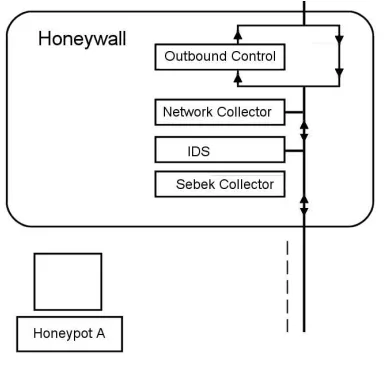
A honeywall is a honeypot or honeynet that is placed in-line between two networks, or between a network and a host, to uni- or bidirectionally capture, control and analyze attacks.
Definition
Intrusion Detection Systems
Matthijs Koot ([email protected])
Definitions, purpose
Past and present
How honeypots work
HoneyD Honeynet, HoneyWall MWCollect: Nepenthes, HoneyTrap and HoneyBow
Limitations and future
Limitations Honeynet Research Alliance Future topics
Summary
Warning.
WARNING
In real life, ‘Honeynet" and “HoneyWall" are used
Intrusion Detection Systems
Matthijs Koot ([email protected])
Definitions, purpose
Past and present
How honeypots work
HoneyD Honeynet, HoneyWall MWCollect: Nepenthes, HoneyTrap and HoneyBow
Limitations and future
Limitations Honeynet Research Alliance Future topics
Summary
Purpose of a honeypot.
The two main purposes of a honeypot:
I Research
I Know your enemy!
I Reveal blackhat tactics, techniques, tools I Reveal motives/intentions?
I Mostly used by universities, governments, ISPs
I Protection
I Deceiving the wiley cracker
Intrusion Detection Systems
Matthijs Koot ([email protected])
Definitions, purpose
Past and present
How honeypots work
HoneyD Honeynet, HoneyWall MWCollect: Nepenthes, HoneyTrap and HoneyBow
Limitations and future
Limitations Honeynet Research Alliance Future topics
Summary
Tactics behind a honeypot.
In its defensive form, a honeypot is designed on deception and intimidation (Fred Cohen, 2001):
I Concealment
I Camouflage
I False/planted information (honeytokens!)
I Feints, lies, et cetera
I E.g. false claims that a facility if being watched by
Intrusion Detection Systems
Matthijs Koot ([email protected])
Definitions, purpose
Past and present
How honeypots work
HoneyD Honeynet, HoneyWall MWCollect: Nepenthes, HoneyTrap and HoneyBow
Limitations and future
Limitations Honeynet Research Alliance Future topics
Summary
Functional requirements of a honeypot.
Functional requirements of a honeypot include:
I Data capture
I Data analysis
Intrusion Detection Systems
Matthijs Koot ([email protected])
Definitions, purpose
Past and present
How honeypots work
HoneyD Honeynet, HoneyWall MWCollect: Nepenthes, HoneyTrap and HoneyBow
Limitations and future
Limitations Honeynet Research Alliance Future topics
Summary
History of honeypots.
I 1990: real systems
I Deploy unpatched systems in default config on
unprotected network (making them ‘low-hanging fruit’)
I Easy to deploy
I High-interaction, high-risk
I Nice reading: “Cuckoo’s Egg” by Clifford Stoll
I 1998: network service simulation
I HoneyD, CyberCop Sting, Deception Toolkit,
KFSensor
I Easy to deploy
I Low-interaction, low-risk
I 1999-now: virtual systems
I Honeynet (next slide), Symantec Decoy Server I Difficult to deploy
Intrusion Detection Systems
Matthijs Koot ([email protected])
Definitions, purpose
Past and present
How honeypots work
HoneyD Honeynet, HoneyWall MWCollect: Nepenthes, HoneyTrap and HoneyBow
Limitations and future
Limitations Honeynet Research Alliance Future topics
Summary
History of The Honeynet Project.
History of The Honeynet Project
I 1999: Lance Spitzer (Sun) founds Honeynet project
I 1999-2001, GenI: PoC, L3+ (modified IP-headers)
I 2001-2003, GenII: GenI + bridging (no TTL, harder to detect)
I 2003-2004, GenIII: GenII + blocking (HoneyWall)
I 2004-current: ‘GenIV’ refers to next-gen analysis capabilities
Intrusion Detection Systems
Matthijs Koot ([email protected])
Definitions, purpose
Past and present
How honeypots work
HoneyD Honeynet, HoneyWall MWCollect: Nepenthes, HoneyTrap and HoneyBow
Limitations and future
Limitations Honeynet Research Alliance Future topics
Summary
Taxonomy of honeypots.
As proposed by Seifert, Welch, Komisarczuk in 2006, honeypots can be differentiated on...
I Level of interactivity (will be discussed shortly)
I Data capture (attacks, events, intrusions, ...)
I Containment (aka ‘data control’)
I Distribution appearance
I Role in N-tier architecture
Intrusion Detection Systems
Matthijs Koot ([email protected])
Definitions, purpose
Past and present
How honeypots work
HoneyD Honeynet, HoneyWall MWCollect: Nepenthes, HoneyTrap and HoneyBow
Limitations and future
Limitations Honeynet Research Alliance Future topics
Summary
Taxonomy of honeypots.
Honeypot
Communication interface
Distribution appearance Role in an N-tier
architecture
Data capture Containment
Interaction level
High Low
Software API Non Network Hardware IF Network IF
Client Server
Defuse
Block Slowdown
None
Intrusions Events Attacks None
Intrusion Detection Systems
Matthijs Koot ([email protected])
Definitions, purpose
Past and present
How honeypots work
HoneyD Honeynet, HoneyWall MWCollect: Nepenthes, HoneyTrap and HoneyBow
Limitations and future
Limitations Honeynet Research Alliance Future topics
Summary
Level of interactivity: low.
Fake daemon
Operating System
Other local resources
hard disk
Intrusion Detection Systems
Matthijs Koot ([email protected])
Definitions, purpose
Past and present
How honeypots work
HoneyD Honeynet, HoneyWall MWCollect: Nepenthes, HoneyTrap and HoneyBow
Limitations and future
Limitations Honeynet Research Alliance Future topics
Summary
Level of interactivity: mid.
Fake daemon
Operating System
Other local resources
hard disk
Intrusion Detection Systems
Matthijs Koot ([email protected])
Definitions, purpose
Past and present
How honeypots work
HoneyD Honeynet, HoneyWall MWCollect: Nepenthes, HoneyTrap and HoneyBow
Limitations and future
Limitations Honeynet Research Alliance Future topics
Summary
Level of interactivity: high.
Fake daemon
Operating System
Other local resources
hard disk
Intrusion Detection Systems
Matthijs Koot ([email protected])
Definitions, purpose
Past and present
How honeypots work
HoneyD Honeynet, HoneyWall MWCollect: Nepenthes, HoneyTrap and HoneyBow
Limitations and future
Limitations Honeynet Research Alliance Future topics
Summary
Outline
Definitions, purpose
Past and present
How honeypots work
HoneyD
Honeynet, HoneyWall
MWCollect: Nepenthes, HoneyTrap and HoneyBow
Limitations and future Limitations
Intrusion Detection Systems
Matthijs Koot ([email protected])
Definitions, purpose
Past and present
How honeypots work
HoneyD Honeynet, HoneyWall MWCollect: Nepenthes, HoneyTrap and HoneyBow
Limitations and future
Limitations Honeynet Research Alliance Future topics
Summary
HoneyD.
HoneyD
I HoneyD is an engine for running virtual IP-stacks in parallel
I Mid-interaction network service simulator
I Simulates SMTP, FTP, HTTP, ...
I Easily extendible through customizable scripts
I First release in 1999, currently maintained by Niels Provos
I TCP/IP fingerprint spoofing through ‘personalities’
I Impersonate Win32 on your favorite UNIX flavor
(which should be MINIX), fooling nmap and xprobe
Intrusion Detection Systems
Matthijs Koot ([email protected])
Definitions, purpose
Past and present
How honeypots work
HoneyD Honeynet, HoneyWall MWCollect: Nepenthes, HoneyTrap and HoneyBow
Limitations and future
Limitations Honeynet Research Alliance Future topics
Summary
HoneyD.
HoneyD architecture
libnet
libpcap
Personality engine
Userland IP-stack
ICMP
UDP
TCP
Service
External program
proxy
HoneyD
Source: http://md.hudora.de/presentations/2005-bh-honeypots-03-honeyd.pdf (reconstructed for
Intrusion Detection Systems
Matthijs Koot ([email protected])
Definitions, purpose
Past and present
How honeypots work
HoneyD Honeynet, HoneyWall MWCollect: Nepenthes, HoneyTrap and HoneyBow
Limitations and future
Limitations Honeynet Research Alliance Future topics
Summary
HoneyD.
Applying the mid-interaction model to HoneyD: HoneyD servicing incoming requests on port TCP/21 by executing fake-ftp.sh.
HoneyD listening
on tcp/21
Operating System
Other local resources
Intrusion Detection Systems
Matthijs Koot ([email protected])
Definitions, purpose
Past and present
How honeypots work
HoneyD Honeynet, HoneyWall MWCollect: Nepenthes, HoneyTrap and HoneyBow
Limitations and future
Limitations Honeynet Research Alliance Future topics
Summary
Outline
Definitions, purpose
Past and present
How honeypots work HoneyD
Honeynet, HoneyWall
MWCollect: Nepenthes, HoneyTrap and HoneyBow
Limitations and future Limitations
Intrusion Detection Systems
Matthijs Koot ([email protected])
Definitions, purpose
Past and present
How honeypots work
HoneyD Honeynet, HoneyWall MWCollect: Nepenthes, HoneyTrap and HoneyBow
Limitations and future
Limitations Honeynet Research Alliance Future topics
Summary
Honeynet, HoneyWall.
The basic idea of a Honeynet/HoneyWall:
17
Theory
Internet
Honeywall
Honeypot Honeypot No Restrictions
Intrusion Detection Systems
Matthijs Koot ([email protected])
Definitions, purpose
Past and present
How honeypots work
HoneyD Honeynet, HoneyWall MWCollect: Nepenthes, HoneyTrap and HoneyBow
Limitations and future
Limitations Honeynet Research Alliance Future topics
Summary
Sebek.
Sebek: spying on your intruder
I From Honeynet.org: “Sebek is a tool designed for data capture, it attempts to capture most of the attackers activity on the honeypot, without the attacker knowing it (hopefully), then sends the recoverd data to a central logging system."
Intrusion Detection Systems
Matthijs Koot ([email protected])
Definitions, purpose
Past and present
How honeypots work
HoneyD Honeynet, HoneyWall MWCollect: Nepenthes, HoneyTrap and HoneyBow
Limitations and future
Limitations Honeynet Research Alliance Future topics
Intrusion Detection Systems Matthijs Koot ([email protected]) Definitions, purpose
Past and present
How honeypots work
HoneyD Honeynet, HoneyWall MWCollect: Nepenthes, HoneyTrap and HoneyBow
Limitations and future Limitations Honeynet Research Alliance Future topics Summary
Sebek in GenII honeynet.
Proceedings of the 2005 IEEE
Workshop on Information Assurance and Security
T1B2 1555 United States Military Academy, West Point, NY, 15 – 17 June
2004
Towards a Third Generation Data Capture Architecture for Honeynets
Edward Balas and Camilo Viecco Advanced Network Management Lab
Indiana University
Abstract— Honeynets have become an important tool for researchers and network operators. However, their eff ec-tiveness has been impeded by a lack of a standard unified honeynet data model which results from having multiple un-related data sources, each with its own access method and format.
In this paper we propose a new data collection architec-ture that addresses the need for both rapid comprehension and detailed analysis by providing two data access methods: a relational model based fast path, and a canonical slow path. We also present a set of tools based on this architec-ture.
I. Introduction
A Honeynet is a network of high interaction honey-pots[1]. High interaction honeypots are quite different from low interaction honeypots such as Honeyd [2] for they pro-vide a full operating system and set of software for an in-truder to interact with. This high level of interactivity is a desired because it allows researchers the ability to observe the behavior of an intruder in a live system, and not a sim-ulation. As a result, high interaction honeypots are well suited to capture new or unanticipated activity. However, high interaction honeypots collect a larger volume detailed data from multiple data sources making it difficult to man-age honeynets and make sense of the collected data.
To help facilitate honeynet deployments and the sharing of information between researchers, The Honeynet Project standardized the GenII honeynet architecture[3]. This ar-chitecture includes a specification of Data Capture proce-dures whose purpose is to“log all of the attacker’s activity”. The GenII Data Capture procedures specify the collection of three types of data: firewall logs, network traffic and system activity. Figure 2 provides a schematic represen-tation of a typical Gen II deployment. This architecture does not provide any guidance on how to store or access the captured data.
In the standardized architecture, firewall logs are used
to provide a summary of the network activity. The
“rc.firewall” script provided by the honeynet project al-lows this by using the Linux IPTables[4] connection track-ing capabilities. We feel this loggtrack-ing is counter-intuitive because firewall logs are typically used for policy auditing and in this case they are being used to provide summary
Fig. 1. GenII Honeynet Data Capture.
accounts of network activity. In addtion, these summaries lack needed detail such as the duration and quantity of network activity
Network traffic and Intrusion Detection System(IDS) events are captured using the Snort IDS system[5]. For Data Capture, two instances of are executed, one to merely record the raw traffic, and the other to examine the net-work traffic looking for events that are indicative of misuse or intrusion.
System activity refers to monitoring activity from the perspective of each high interaction honeypot. This type of monitoring includes two types of data: Syslog and Se-bek. Syslog data is provided by each honeypot’s operating system. Sebek is a tool developed by the Honeynet Project to monitor the behavior of intruder even when the intruder uses session encryption[6]. Sebek operates as hidden ker-nel module which covertly exports log data to the logging system.
The GenII honeynet architecture gathers very detailed
Intrusion Detection Systems Matthijs Koot ([email protected]) Definitions, purpose
Past and present
How honeypots work
HoneyD Honeynet, HoneyWall MWCollect: Nepenthes, HoneyTrap and HoneyBow
Limitations and future Limitations Honeynet Research Alliance Future topics Summary
Hflowd data fusion.
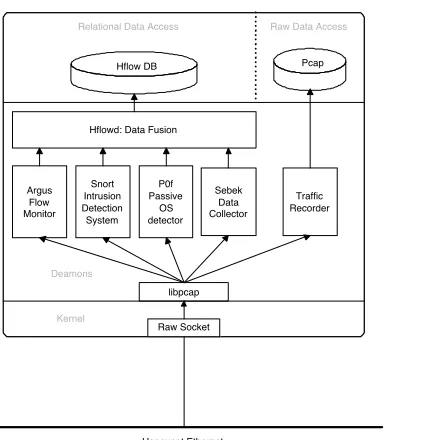
To augment our understanding of the network activ-ity and the hosts at either side of a communication, we added passive operating system fingerprinting capability, provided by the p0f[13] tool. P0f is also a pcap based monitor that provides an estimate of the operating sys-tem(OS) used by host that initiates a TCP connection. This data is useful for two reasons. First, across flows it allows one to see if the apparent host OS is changing for a given IP source providing an indication that the host might be behind a NAT. Second, OS identification can improve the accuracy of IDS events through the process of passive alert verification[14][15]. For instance in a situation where a apache mod ssl exploit[16] is launched against a non-linux host, the system could detect this discrepancy and treat the alert with a lower priority similar to the approach taken by RNA[14]2.
The addition of the Argus and p0f data to the Snort and packet capture data provides a more comprehensive representation of events than provided in the GenII design. Further this new data can be organized around the concept of a network flow. However additional data sources are needed to bridge the relational gap between the network flows and processes on a host.
To bridge this gap we enhanced Sebek [6] to monitor net-work activity from the host’s perspective. Sebek is a kernel based data capture tool designed to be installed on high in-teraction honeypots [1]. Balas modified Sebek to monitor socket, process and file activity [17]. These modifications provided three necessary capabilities.
First, Sebek was enhanced to monitor socket activity. Whenever a honeypot accepts or creates a network con-nection, Sebeck records the IP level attributes as well as the corresponding host, process and inode. This allows us to relate a network flow to the specific open inode and file descriptor used by a process to service the connection. This data is integral to providing a composite view of the incident that transcends flow and host data. Once a net-work connection associated with an intrusion attempt is ob-served, we immediately know which inode and process the intrusion was tied to. Using this data we can quickly iden-tify related information such as the keystrokes captured by Sebek.
Second, Sebek was enhanced to monitor process creation. This monitoring allows us to relate one process to another, rebuilding the process tree. This is important in intru-sion analysis for it allows us to track the intruintru-sion forward from the point of intrusion identifying all processes cre-ated, and any other causally related system activity, such as outbound network connections[8]. The same capability can be used in reverse, if we see an outbound connection on a honeypot, we can back track to identify the point of
2p0f can only estimate the OS of the TCP initiator, in this example
the OS of the host under attack is known by either manually intro-duction of the OS by part of the administrator as with a honeypot or through previous TCP connections initiated by the particular host
Honeynet Ethernet Raw Socket libpcap P0f Passive OS detector Snort Intrusion Detection System Argus Flow Monitor Sebek Data Collector Traffic Recorder Hflowd: Data Fusion
Relational Data Access Raw Data Access
Deamons
Kernel
Hflow DB Pcap
Fig. 3. Data collection and fusion diagram
intrusion.
Lastly, the ability to monitor the opening of files was added. Coupled with the process tree this allows us to iden-tify all files accessed as part of an intrusion. This knowledge can in turn be used to prioritize data analysis efforts. As an example, presume that a specific intruder likes to place his/her files in a unique location in the file system. Once this location is identified, we can quickly search preexisting data for any prior indications of the same intruder’s pres-ence. This capability can also be used to create a crude form of Honeytoken[18] where the act of accessing a cer-tain file might be deemed an interesting event requiring further investigation.
B. Data Fusion
Hflow was developed to combine each of these data sources into a composite relational model. It continually consumes data from each source, fusing it based on iden-tifiable relationships and it then loads this data into a database.
Hflow receives Argus flow, Snort IDS, p0f OS fingerprints and Sebek data. This data once combined is then inserted into a database.
Flow related data, such as Argus and Snort, are corre-lated based on corresponding tuples consisting of the IP protocol number, the source and destination IP addresses and if applicable port numbers which fall within the same
Intrusion Detection Systems
Matthijs Koot ([email protected])
Definitions, purpose
Past and present
How honeypots work
HoneyD Honeynet, HoneyWall MWCollect: Nepenthes, HoneyTrap and HoneyBow
Limitations and future
Limitations Honeynet Research Alliance Future topics
Summary
Outline
Definitions, purpose
Past and present
How honeypots work HoneyD
Honeynet, HoneyWall
MWCollect: Nepenthes, HoneyTrap and HoneyBow
Limitations and future Limitations
Intrusion Detection Systems
Matthijs Koot ([email protected])
Definitions, purpose
Past and present
How honeypots work
HoneyD Honeynet, HoneyWall MWCollect: Nepenthes, HoneyTrap and HoneyBow
Limitations and future
Limitations Honeynet Research Alliance Future topics
Summary
MWCollect: Nepenthes, HoneyTrap and
HoneyBow.
MWCollect
I MWCollect (sort of) is an alliance of malware researchers and software engineers
I ...and less pretty, it is the dead parent process from
which Nepenthes was forked
I Houses Nepenthes, HoneyTrap and HoneyBow
I State-of-art (scientific) research on malware
I Reverse engineering polymorphic shellcodes I Call-flow graph (binary) analysis
Intrusion Detection Systems
Matthijs Koot ([email protected])
Definitions, purpose
Past and present
How honeypots work
HoneyD Honeynet, HoneyWall MWCollect: Nepenthes, HoneyTrap and HoneyBow
Limitations and future
Limitations Honeynet Research Alliance Future topics
Summary
Nepenthes.
Nepenthes architecture
I Low-interaction malware collection honeypot
I Emulates known vulnerabilities and captures the malware trying to exploit them
I E.g. NetDDE, LSASS, DCOM, ASN1, MSSQL,
UPNP, IIS vulns
I Modular arch: vuln-*, shellcode-*, download-*, submit-*
I Extensions are being developed for call-flow graphs and binary shellcode analysis
Intrusion Detection Systems Matthijs Koot ([email protected]) Definitions, purpose
Past and present
How honeypots work
HoneyD Honeynet, HoneyWall MWCollect: Nepenthes, HoneyTrap and HoneyBow
Limitations and future Limitations Honeynet Research Alliance Future topics Summary
Nepenthes.
Nepenthes
tcp/445 tcp/135 tcp/80 tcp/... Nepenthes core geolocation-hostip module-portwatch vuln-lsass vuln-dcom vuln-asn1 vuln-wins ...Intrusion Detection Systems
Matthijs Koot ([email protected])
Definitions, purpose
Past and present
How honeypots work
HoneyD Honeynet, HoneyWall MWCollect: Nepenthes, HoneyTrap and HoneyBow
Limitations and future
Limitations Honeynet Research Alliance Future topics
Summary
HoneyTrap and HoneyBow.
HoneyTrap
I Low-interaction malware collection honeypot
I HoneyTrap handles all incoming request to unbound (!) TCP ports
I Does not simulate vulns or services, although the latter is possible through plug-ins
I Suitable for zerodays (unlike Nepenthes)
HoneyBow (future)
I High-interaction malware collection honeypot
I Fairly new: announced in Dec/2006 by China Honeynet Project (no code yet)
I Modular arch: MwWatcher, MwFetcher, MwSubmitter
Intrusion Detection Systems
Matthijs Koot ([email protected])
Definitions, purpose
Past and present
How honeypots work
HoneyD Honeynet, HoneyWall MWCollect: Nepenthes, HoneyTrap and HoneyBow
Limitations and future
Limitations Honeynet Research Alliance Future topics
Summary
Outline
Definitions, purpose
Past and present
How honeypots work HoneyD
Honeynet, HoneyWall
MWCollect: Nepenthes, HoneyTrap and HoneyBow
Limitations and future
Limitations
Intrusion Detection Systems
Matthijs Koot ([email protected])
Definitions, purpose
Past and present
How honeypots work
HoneyD Honeynet, HoneyWall MWCollect: Nepenthes, HoneyTrap and HoneyBow
Limitations and future
Limitations Honeynet Research Alliance Future topics
Summary
Limitations.
Limitations/caveats to honeypot technology
I Complexity is the enemy of security, and honeynets are complex.
I Bugs in emulators I Privilege escalation
I Known attacks: NoSEBrEaK, Phrack #62/0x07.
I Decoy/false attacks (counter-counter).
I Blackhats exchange and evade IP-ranges of known honeynets
Intrusion Detection Systems
Matthijs Koot ([email protected])
Definitions, purpose
Past and present
How honeypots work
HoneyD Honeynet, HoneyWall MWCollect: Nepenthes, HoneyTrap and HoneyBow
Limitations and future
Limitations Honeynet Research Alliance Future topics
Summary
Outline
Definitions, purpose
Past and present
How honeypots work HoneyD
Honeynet, HoneyWall
MWCollect: Nepenthes, HoneyTrap and HoneyBow
Limitations and future Limitations
Honeynet Research Alliance
Intrusion Detection Systems
Matthijs Koot ([email protected])
Definitions, purpose
Past and present
How honeypots work
HoneyD Honeynet, HoneyWall MWCollect: Nepenthes, HoneyTrap and HoneyBow
Limitations and future
Limitations Honeynet Research Alliance Future topics
Summary
Honeynet Research Alliance.
Honeynet Research Alliance
I “The Honeynet Research Alliance is a trusted forum of other honeypot research organizations. [...] These organizations subscribe to the Alliance for the
Intrusion Detection Systems
Matthijs Koot ([email protected])
Definitions, purpose
Past and present
How honeypots work
HoneyD Honeynet, HoneyWall MWCollect: Nepenthes, HoneyTrap and HoneyBow
Limitations and future
Limitations Honeynet Research Alliance Future topics
Summary
Honeynet Research Alliance (map).
Intrusion Detection Systems
Matthijs Koot ([email protected])
Definitions, purpose
Past and present
How honeypots work
HoneyD Honeynet, HoneyWall MWCollect: Nepenthes, HoneyTrap and HoneyBow
Limitations and future
Limitations Honeynet Research Alliance Future topics
Summary
Outline
Definitions, purpose
Past and present
How honeypots work HoneyD
Honeynet, HoneyWall
MWCollect: Nepenthes, HoneyTrap and HoneyBow
Limitations and future Limitations
Honeynet Research Alliance
Intrusion Detection Systems
Matthijs Koot ([email protected])
Definitions, purpose
Past and present
How honeypots work
HoneyD Honeynet, HoneyWall MWCollect: Nepenthes, HoneyTrap and HoneyBow
Limitations and future
Limitations Honeynet Research Alliance Future topics
Summary
Future topics.
I Honeysnap
I CLI tool for high-level analysis of honeynet data
I Unified Data Analysis Framework (UDAF)
I Library for data acquisition, filtering, fusion, reporting,
et cetera
I Towards visual programming
I Let’s hope it’ll be interoperable with IDMEF / GOTEK
I CWSandbox (Carsten Willems)
I SCADA honeynets
Intrusion Detection Systems
Matthijs Koot ([email protected])
Definitions, purpose
Past and present
How honeypots work
HoneyD Honeynet, HoneyWall MWCollect: Nepenthes, HoneyTrap and HoneyBow
Limitations and future
Limitations Honeynet Research Alliance Future topics
Summary
Summary
Topics that have been discussed
I Definitions and purpose
I Past, present, future
I Most important: HoneyD, Honeynet/HoneyWall, Sebek, Nepenthes
Intrusion Detection Systems
Matthijs Koot ([email protected])
Definitions, purpose
Past and present
How honeypots work
HoneyD Honeynet, HoneyWall MWCollect: Nepenthes, HoneyTrap and HoneyBow
Limitations and future
Limitations Honeynet Research Alliance Future topics
Summary
Feedback!
Question