Volume 2008, Article ID 280346,9pages doi:10.1155/2008/280346
Research Article
Optimization of Sensor Locations and
Sensitivity Analysis for Engine Health Monitoring
Using Minimum Interference Algorithms
Paul Cotae, Sireesha Yalamnchili, C. L. Philip Chen, and Arturo Ayon Department of Electrical and Computer Engineering, Wireless Sensor Network Laboratory,
University of Texas at San Antonio, 6900 North Loop 1604 West, San Antonio, TX 78249-0669, USA
Correspondence should be addressed to Paul Cotae,[email protected]
Received 10 June 2007; Revised 20 August 2007; Accepted 8 October 2007
Recommended by Erchin Serpedin
The global optimization of sensor locations and a sensitivity analysis based on the minimization of interferences due to wireless communications between sensors are studied in the presence of additive white Gaussian noise (AWGN). We used a Gram matrix approach for robust determination of sensor locations by minimizing the interferences (maximizing the signal strength) among sensors for engine health monitoring systems. In order to solve the problem of optimum placement, an iterative algorithm for maximizing the determinant of the Gram matrix is proposed and implemented. The sensitivity criterion proposed in this paper is the spectral number of the Frobenius norm of the Gram matrix associated with sensor readings. We derived the necessary con-ditions under which the number of sensors and the optimal sensor locations will remain unchanged when the data measured for sensitivity analysis is affected by AWGN. Our theoretical results are verified by simulations providing details concerning numerical implementations.
Copyright © 2008 Paul Cotae et al. This is an open access article distributed under the Creative Commons Attribution License, which permits unrestricted use, distribution, and reproduction in any medium, provided the original work is properly cited.
1. INTRODUCTION
The problem of sensor location is crucial for system identi-fication, control, and damage detection which requires ac-curate measurement of the responses of the system [1–8]. The measured data are always inaccurate because of the ex-istence of parameter variation or noise. Taking the cost of sensors into account, it is not economical to install sensors in every part of system. In such cases, a practical question that naturally arises is how to select a set with a minimum number of sensor locations from all possibilities, such that the data collected may provide the greatest opportunities for the detection of failures [9–12]. This problem has been widely investigated in the last decade and many methods such as the minimal energy principle, mode shape indepen-dent principle, Fisher information matrix, effective interfer-ence method, and so forth have been developed for the deter-mination of sensor locations in many publications [5,8,11]. However, these placement optimization criteria focused on maximizing either the controllability or the observability of the system, assuming that the sensor readings are not affected by wireless interferences [13].
In this paper, we address the problem of selecting the op-timal location of sensors, such that the resulting sensor read-ings provide maximum information about the condition of the structure as specified by values of the model parame-ters. We assume that each sensor has wireless communica-tion capabilities, in that each sensor reading is characterized in terms of signal-to-noise ratio. Optimal and effective de-ployment of sensors in health engine monitoring is difficult and critical because the number of sensors is usually lim-ited and their locations are fixed, once installed. We present a methodology for the optimal placement of sensors to be used in the diagnosis of engine failure considering all the interfer-ences from different locations affecting all the sensors in the system [14–16].
Optimal sensor location is a combinatorial problem where one seeks to placeNSsensors out of Mpotential
until a given number of sensors are left. The optimality cri-terion used is the optimization of the determinant of Gram matrixG=DTD[14], where the matrixDis of the
dimen-sionL×N. It is assumed that each sensor reading is a one-dimensional vector of dimensionL≤N < M. The objective of this paper is to find the optimum number of sensorsN out ofMpossible locations and should not be confused with the dimensionality reduction, where the goal is to reduce the value of length of vector observabilityP[9,18,19].
The objective function, the optimization of Gram ma-trix determinant, may have multiple local optima and saddle points, and hence any local search might stagnate at a sub-optimal solution. Following the work in [14], the proposed method is convergent, having a unique global optimum. Pre-vious work, addressing the issue of optimality location of a given number of sensors, has been carried out by several in-vestigators. The criteria used are trace norm [5], determinant norm [20], and extremal eigenvalue of the Fisher informa-tion matrix [7]. The approach based on the Gram matrix was also considered in another context in [16] where a metric re-lated to all interferences in the wireless network was intro-duced, namely, the total weighted squared correlation. This paper is organized as follows. InSection 2, we introduce the system model, and the problem formulation for optimum placement is presented inSection 3. The sensitivity analysis is derived inSection 4. The computational procedure for the optimal sensor placement method is given inSection 5. The numerical results are presented inSection 6and conclusions are drawn inSection 7.
2. SYSTEM MODEL
Consider a wireless sensor network composed ofN sensors distributed at known spatial locations, each datasensor read-ingvector, 1≤i≤N, is in transpose form, having a dimen-sionP×1, andP≤N:
d(i)=d(i)1 ,d (i) 2 ,. . .,d
(i) P
T
, i=1, 2,. . .,N. (1)
The vectorfrom measurementsdenoted byyis composed by data from each of N sensorsy= {y1,y2,. . .,yN}T. The
in-dividual contribution of each sensor is denoted by qi (i =
1, 2,. . .,N) and it is included in the vectorq = {q1,q2,. . ., qN}T. The mathematical model used for sensor
measure-ments vectory1is given by the following matrix equation:
y=q1d(1)+q2d(2)+· · ·+qNd(N)+w=Dq+w, (2)
whereDis aP ×N the matrix having the designated pat-tern vectorsd(i)as columns,w is a vector representing the
measurement noise and all other effects due to the interfer-ences; it is assumed to have a Gaussian distribution with zero mean and the covariance matrixΣ=σ2
WIN, whereINis the
unity matrix of orderN. We assume that sensor readings are
1We will assumey=[y
1,. . .,yP, 0, . . ., 0
N−P
] if no noise.
affected by independent noise with equal variances and the variance of noise in the system can be estimated from mea-surements. Using the Gram matrix G = DTDin the
least-squares method2[21], an estimate ofqin the mathematical
model (2) is obtained as3
q=G−1DTy. (3)
The accuracy of estimation forqmay be evaluated to be the error of estimation which is the expected value of the quan-tity (q−q)(q−q)Tbeing related to the inverse of the Fisher information matrixF[5] as follows:
E q−qq−qT=F−1. (4)
Several scalar performance measures related to the informa-tion matrixFwere studied in the past. The most general one is the following criterion based on the trace of the matrix:
ms=
1 Ntrace
Fs
1/s
, (5)
where the parameterss≤0 andNrepresent the number of sensors. By particularizings, then the following widely used criteria are obtained:
(a) determinant norm: lims→0ms= |F|1/N,
(b) trace normm−1=N/trace(F−1),
(c) extremal eigenvaluem−∞=λmin(F).
Different from previous criteria used so far for optimal sensor location problems, in this paper we will use the Gram matrix approach originally introduced in the context of in-terference avoidance in [14]. The interference metric total weighted squared correlation (TWSC) [16] is expressed in terms of the Frobenius norm associated to the Gram ma-trix, and it is given by the sum of its squared eigenvalues, while the determinant of the Gram matrix is the product of its eigenvalues. By using the arithmetic-geometric mean inequality [22], the superiority of choosing the Gram ma-trix approach becomes evident, since the determinant norm, trace norm, extremal eigenvalues criteria, and (5) are partic-ular cases, and furthermore the Gram matrix approach pro-vides a tighter lower bound. When the arithmetic-geometric
2The least-squares (LS) estimator is asymptotically unbiased. The Cramer
Rao bound (CRB) provides a lower bound on the error variance in es-timating the model parameters for any unbiased estimator of these pa-rameters. Assuming that the observed field is a Gaussian random field, the asymptotic error covariance matrix of the best LS attains the CRB even for the modest dimensions of the observed field and low signal-to-noise ratios. We conjecture that our results hold when the data dimension becomes larger; the number of deployed sensors is larger as in the real applications for wireless sensors networks.
3Two different forms of Gram matrices are associated to the wireless
sen-sor networks. For an overloaded network whereP≤N, and considered here, we will useG=DTDof dimensionN×N. This is in contrast with
underloaded networks (P > N) where the dimensionality of Gram matrix
G=DDTisP×P. Equation (3) is valid only if the inverse of the Gram matrixG=DTDexists. The condition of the inverse ofGis equivalent
mean inequality is applied to the TWSC, the lower bound is again given in terms of the product of its eigenvalues, which in fact is the determinant of Gram matrix.
The Fisher information matrix from (4), by using (3), be-comes
F= 1
σ2 w
DTD= 1
σ2 w
G. (6)
In order to minimize the error of estimation given by (4) we need to maximize the determinant of the Gram matrix given by (6). Suppose now that sensor readingiis decoded using a linear receiver denoted byci.4WritingY=(y1,y2,. . .,yN) as
a vector inRN, then the received signal can be written as
Y=
M
i=1
qid(i)+W, (7)
whereWis an independent and identically distributed (i.i.d.) Gaussian vector with covarianceσ2I
N independent of
sen-sor readings. Based on (7)5the signal-to-interference ratio of
useri(SIRi) is
SIRi=
ci,d(i)
2 qi σ2c
i,ci
+j=i
ci,d(j)
2 qj
. (8)
We say that a set ofMsensors is optimum for placement and reliable communicationif there is a positive set{qi}and
lin-ear receiver structuresci, such that the signal-to-interference
ratio for each user is that SIRi≥β,∀i=1· · ·M. Hereβ >0
is some fixed SIR requirement of each user that has to be met for satisfactory performance. The optimum receiverciis one
that maximizes SIRiassuming that the channel state
infor-mation is known perfectly both at transmitter and receiver. The system model proposed in this paper characterized by (2) and (8) is used for engine health monitoring; no other work is known to the authors focusing on the optimum sen-sor location based on their ability to communicate with each other in the presence of wireless interference.
3. PROBLEM FORMULATION
Fixing the set {qi} and the sensor readings d(i), for each
sensor 1 ≤ i ≤ M, let us consider the matrices D =
[d(1),d(2),. . .,d(M)] and Q = diag(q
1,q2,. . .,qM),
respec-tively, by including all sensors in the system. Now, con-sider the same matrices when the sensor readingiis deleted from the system:D−i=[d(1),. . .,d(i−1),d(i+1),. . .,d(M)] and
Q−i = diag(q1,. . . qi−1,qi+1. . .,qM),6 respectively. Based on
4We assume that each sensor has wireless communication capabilities. 5The difference between (7) and (2) consists not only in terms of
summa-tion. In (2) we have an estimation problem while in (7) we have a mul-tiuser detection problem where the setqiis not necessarily independent. If the linear receiver structures are independent, theDmatrix becomes a full matrix, and thus (3) simply yieldsq=D−1y. In addition, in (2) we
need to solveNequations forNunknownsqi(i=1, 2,. . .,N).
6We will denote the diagonal matrix whose main diagonal entries are the
same as those of the matrixAas diag(A) and the diagonal matrix whose diagonal entries are formed from vectorbas diag(b).
the above matrices let us consider another two matrices de-fined asZ−i=D−iQ−iDT−i+σ2IandZ=DQDT+σ2I. These
two matrices are positive definite having the following eigen-value decomposition [22] for some positive diagonal matri-cesΛiandΛ:Z−i =UiΛiUTi,Z = UΛUT, where U,Uiare
unitary matrices. Then using (8) for each sensori, we obtain the following expression:
max
ci=0 SIRi=maxci=0
ci,d(i)
2 qi
cT iZici
=qimax xi=0
xT
iΛ−i1/2Utid(i)d(i)TUiΛ−i1/2xi
xT ixi
,
xi=Λ−i1/2UTici.
(9)
In the above expression the optimal receiver structure isci=
Z−1d(i). By using the following formula:
A−xyT−1=A−1+ A−1xyTA−1
1−yTA−1x, (10)
whenever the terms exist, from (8) to (9), we have succes-sively
SIRi=d(i)TZ−1d(i)ci
=d(i)TZ−1−cid(i)d(i)TZ−1
d(i)ci
=d(i)T
Z−1− cid(i)d(i)TZ−1ci
1−d(i)TZ−1d(i)c i
d(i)ci
= d(i)TZ−1d(i)ci
1−d(i)TZ−1d(i)c i.
(11)
Hered(i)TZ−1d(i)is strictly less than 1 and thus all the terms
above are well defined.
Mathematically the optimization problem of sensor placement in the presence of the interferences can be for-mulated as follows: given the sensor reading matrix D =
[d(1),d(2),. . .,d(M)], and SIR requirementβ, for∀i,M≥i≥ N, find the Gram matrixGwhose determinant is maximum:
G∈arg max detG
=1−dT i G−−1idi
detG−i such that SIRi≥β.
(12)
Since the Gram matrix is a summation of the contribution of each degree of freedom or sensor location to the mode shape of structural engine health monitoring, maximizing its determinant will lead to the best placement in the pres-ence of interferpres-ences. A formal description of our optimiza-tion problem can be formulated as follows: letG−i=DT−iD−i,
the Gram matrix is obtained by deleting the reading sensor iwhich is most affected by interferences, and its signal-to-noise ratio which is below the admitted level specified by the system. In another words, the sensor reading having the low-est influence on the linear independence of column of the matrixDis deleted.
number of sensorsN. By deleting the potential sensor loca-tion with the smallest contribuloca-tion (maximum interference) the relative change in the determinant of the Gram matrix is the smallest, and so this method does provide a local maxi-mization of the determinant of the Gram matrix.7The first
step in our iteration loop (see alsoSection 5) is to calculate (12) for all sensor locations, and thus the sensor correspond-ing to the lowest value of the determinant 1−dT
iG−−1idiis
moved. The resulting Gram matrix is updated with the re-duced number of the remaining sensors in the system, and the above procedure is repeated until the number of sensors is reduced to the given number of sensorsN.
The motivation for which the sensor locations are deleted in an iterative fashion, and not all at once, is twofold. First reason is due to the nature of interference location in signal space [14]. One might think that deleting more sensors for which the interference is higher is more appropriate. How-ever, if the users are located in signal spaces, which are or-thogonal to each other, then that number of users, which are experiencing higher interference, cannot have a higher con-tribution to the total interference in the system. This state-ment was proved in the context of CDMA systems in [16]. Secondly, in future wireless sensors networks, each sensor will try to adapt to the total interference in the system and will place itself in that region of signal space where there is minimum interference.
4. SENSTIVITY ANALYSIS
A survey of the literature shows that the sensitivity analysis for sensor location for systems identification has been inves-tigated intensively [4,11,23,24]. In [24] the optimal sensor location for parameter identification of linear structural sys-tems discusses the influence of noise on these. In [11] the effect of noise on sensor placement for on-orbital identifi-cation of large structures is studied, and it is suggested that erroneous estimates of the parameters can be ameliorated by placing the sensors at points of maximum sensitivity. How-ever, very few papers have addressed the problems of sensi-tivity analysis for engine health monitoring.
Having identified sensor location, the problem is which criterion, among the combinations of all possible sensor lo-cations, is to be adopted in order to select an optimal set effectively, such that the measured data will give desirable results for achieving a better estimation of structural states. We propose as a criterion the spectral condition number of Gram matrixG−i=DT−iD−idefined below:
λG−i
=G−i G+−i, (13)
where the superscript “+” denotes the pseudoinverse. The criterion is to locate sensors at those positions where the spectral condition numberλ(G−i) reaches its minimum, to
achieve the best control effect. In this way, we determine
7The determinant of Gram matrix can be also expressed in terms of its
eigenvalues. The issue and the convergence of the global maximization of the eigenvalues of the Gram matrix were explored in [14].
the conditions under which the number of sensors will re-main optimal when the data measured and used for sensi-tivity analysis are contaminated by additive noise (the same problem in the presence of colored noise is open and left for future research).
Assume that the measured responses given by (2) are cor-rupted in the presence of perturbation noise in an additive fashion:
y=y+μ, (14)
whereμis the noise perturbation vector from the same Gaus-sian field. Correspondingly, the perturbed Gram matrixG−i
can be expressed as
G−i=G−i+η−i, (15)
whereη−i this time is a noise matrix whose properties re-lated to the number of users communicating in the system are studied in [14]. Similar to [16] we assume in this pa-per that the signals and noises are statistically independent of each other. We can define the spectral condition number for the perturbed Gram matrix asλ(G−i)= G−i G+−i
fol-lowing (13). Using (15) and, based on (13), we obtain for the spectral number of perturbed Gram matrix the following ex-pression:
λ G−i
=G−i G+−i=G−i+η−i G+−i. (16)
Using matrix perturbation theory [25] an upper perturba-tion bound for G+−i is given as
G+
−i≤
1 + αβ 1−α
G+
−i, (17)
when α = G+−i η−i < 1 and β = (1 +
√
5)/2. In or-der to obtain the dependence between the condition number λ(G−i) of the initial Gram matrix in the absence of noise and
the condition numberλ(G−i) of the perturbed Gram matrix,
we have to use the results from [25]. It was proved in [25] that when the rank of Gram matrix before and after perturbation is the same, then we obtain
G−i+η
−i=γλ(G−i), (18)
where 0< γ≤1. Substituting (18) and (17) in (16) we obtain the desired results:
λ G−i
=γ
1 + αβ 1−α
λ(G−i). (19)
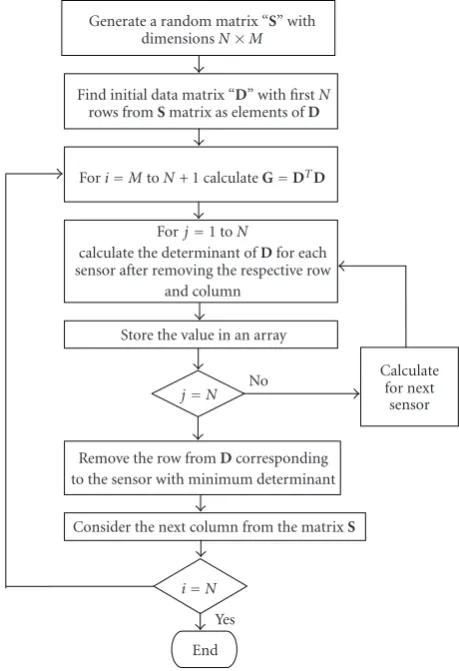
Generate a random matrix “S” with dimensionsN×M
Find initial data matrix “D” with firstN rows fromSmatrix as elements ofD
Fori=MtoN+ 1 calculateG=DTD Forj=1 toN
calculate the determinant ofDfor each sensor after removing the respective row
and column Store the value in an array
No
j=N
Calculate for next sensor Remove the row fromDcorresponding
to the sensor with minimum determinant Consider the next column from the matrixS
i=N
Yes End
Figure1: Overview of the methodology for maximizing the deter-minant of the Gram matrix.
5. COMPUTATIONAL PROCEDURE FOR OPTIMAL SENSOR PLACEMENT METHOD
Maximization of the determinant of the Gram matrix re-sults in minimizing the error covariance matrix given by (4), which produces the best estimate ofqin (3). Hence the sen-sors should be placed in a way that the determinant of the Fisher information matrix obtained as in (6) is maximized. When the procedure starts withMsensor locations, it must be noted that the candidate sensor locations are deleted in an iterative fashion, and not all at once, because as the sen-sor locations which are the most affected by interferences are deleted, then a loss of linear independence is obtained. It is also important to note that when a sensor is deleted from the candidate sensor set, the total interference in the system de-creases. The procedure is implemented using the algorithm described inFigure 1.
The implementation procedure for determining the op-timal placement of sensors consists of the following steps.
(i) Generate first a random matrix S = [d(1),d(2),. . .,
d(M)] with dimensionsN×M. Algorithms to
gener-ate such matrices are given in MATLAB.
(ii) Generate a data matrix D of the designated pattern vectors d(i) with dimension N ×N, where the
ele-80
70
60
50
40
30
20
10
0
All
se
n
so
r
lo
cati
o
n
s
0 5 10 15 20 25 30
Number of sensor
Figure2: Randomly distribution ofM =30 sensors before opti-mization.
ments of this data matrixD corresponds to the first Ncolumns in the matrixS.
(iii) Find the Fisher information matrix associated with this matrix as in (6).
(iv) Calculate the determinant for the Gram matrix for each sensor using (12) for all sensors. This is done by deleting the rows and columns of matrix correspond-ing to the sensor readcorrespond-ing with lowest interference (9), thus providing effective independence for the chosen sensor location.
(v) Remove the sensor which has least determinant from the data matrix by obtaining the matrixD−i.
(vi) Consider the next column i,M−1 ≥ i ≥ N, inD from the matrixSin order to update the Gram matrix Gwith a new sensor.
This procedure is repeated until an optimum matrix is obtained with all optimum sensor location set.
The performance of the above methodology depends on the measurements and, thus, the sensors used for engine health monitoring. Determination of the minimum number of sensors is associated with the cost of processing online, the initial placement of sensors, and other equipment crite-ria which are not considered here. The proposed methodol-ogy could be applied to any number of sensorsN≤i≤M.
6. NUMERICAL RESULTS
The general computational procedure for optimal placement described in the previous section will be exemplified for a number of M = 30 sensors which are contaminated by AWGN with a signal-to-noise ratio of β = 10 dBm, and which are randomly distributed8on a rectangular area as in Figure 2. We consider the “normalized locations” in order to show the scalability of our method. Each sensor is affected
8It is well known that a sensor network can be deployed in two ways:
by interferences from the rest of sensors in the system and is identified by a number between 1 and 30.
6.1. Experiment 1: optimum sensor location
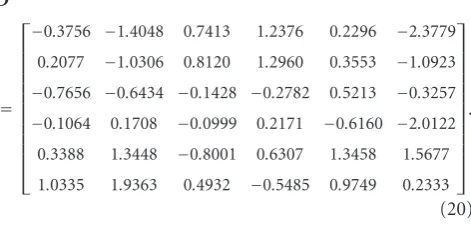
We choseP = 6 and a sample of the random matrixDfor N=6 sensors, given below. The sensor readings are given in dBm and are column vectors of this matrix9:
D
=
⎡ ⎢ ⎢ ⎢ ⎢ ⎢ ⎢ ⎢ ⎢ ⎢ ⎢ ⎢ ⎣
−0.3756 −1.4048 0.7413 1.2376 0.2296 −2.3779 0.2077 −1.0306 0.8120 1.2960 0.3553 −1.0923
−0.7656 −0.6434 −0.1428 −0.2782 0.5213 −0.3257
−0.1064 0.1708 −0.0999 0.2171 −0.6160 −2.0122 0.3388 1.3448 −0.8001 0.6307 1.3458 1.5677
1.0335 1.9363 0.4932 −0.5485 0.9749 0.2333 ⎤ ⎥ ⎥ ⎥ ⎥ ⎥ ⎥ ⎥ ⎥ ⎥ ⎥ ⎥ ⎦ .
(20)
We implemented a program in MATLAB, following the steps described in Section 5, eliminating the least effective sensor in each step of the iteration until 6 sensors were left. In each iterative step we found the corresponding Fisher infor-mation matrix. We eliminated one sensor at a time by delet-ing the corresponddelet-ing row and column, and then optimizdelet-ing the Gram determinant. We removed the sensor which pro-duced the minimum Gram determinant value. The next iter-ation began and we ran the algorithm forN≤i≤M.
The procedure continued until the optimal placement of the final 6 sensors was obtained. After running the compu-tational procedure described inSection 5, the optimal place-ment was obtained as inFigure 3where onlyN =6 sensors are remained, namely, the sensors at locations 1, 2, 3, 16, 22, and 30.
We noticed that the sensors, which are much close to each other, are eliminated from the initial assignment. The expla-nation for this is that the power received is inversely propor-tional to the distance from the transmitter. The remaining sensors experienced this lesser interference.
6.2. Experiment 2: sensitivity analysis
This time we considered a different number of sensors and the same data matrix as inSection 6.1. The optimal sensor placement was different and the results of the sensitivity anal-ysis forM=25,N=6,P=6,σ=1, and sensors placed at locations 4, 6, 9, 16, 19, and 23 are represented inFigure 4.
One can observe that at these locations the condition number based on the Frobenius norm derived inSection 4
is minimum.
9In the context of engine health monitoring, we used real data from direct
measurements. Even the matrixDis generated by simulation; in this ex-periment, the final sensor position is not dependent of realization of this matrix. In other words, the optimized location will remain the same if initial sensor readings are changed.
80
70
60
50
40
30
20
10
0
Op
ti
m
ize
d
se
n
so
r
lo
ca
tio
n
s
0 5 10 15 20 25 30
Number of sensor
Figure 3: The optimum locations obtained with the proposed method.
205
200
195
190
185
180
175
170
No
m
al
iz
at
io
n
N
5 10 15 20 25
Number of sensor
Figure4: Sensitivity analysis for 25 sensors.
6.3. Experiment 3: the influence of the noise on optimal placement
It is sufficient to consider two optimal arbitrary locationsx andy, and the values of the two random estimatesqxandqy,
respectively, along with the random noise vectorw, which are obtained with (2). In order to verify the robustness of the methodology proposed inSection 4, we needed to consider various levels of noise. For our purposes we considered the variance of the noise in (6) given byσ2
w = (σ2qx +σ
2 qy)×α
where the parameterα∈[1, 3].
We started this experiment with the same data matrix D as in Section 6.1 by using the algorithm presented in
Figure 5to calculate the mean variance and the covariance of random variables qx andqy. As an illustrative example,
Fori=1 toN
generate a noise random matrix with mean 0 and variance σw=(σq2x+σq2y)αwhere 0α3
No
Yes
i=N
GenerateMsets of values for the two random matricesQxandQy
Fori=1 toM
calculateyi=Qx(1,i)dx+Qy(1,i)dy+Wi wheredxanddycorrespond toxandyrows
ofDmatrix;Wis the noise vector in (7) Calculateqi=G−1DTyas in (3) and store in an array
No
Yes
i=M
Findq= M
i=1
qi
Find mean:
qx=q(x, 1)/M
qy=q(y, 1)/M
Y A
Calculate variance:
σ2
qx=1/(M−1)
M
j=1
(Q(x, i)−qx)2
σ2
qy=1/(M−1)
M
j=1
(Q(y, j)−qy)2
Calculate the contribution of sensor location
σ2
qx=1/(M−1)
M
j=1
(Q(x,i) −qx)2
σ2
qy=1/(M−1)
M
j=1
(Q(y, j)−qy)2
Calculate covariance: C=σq2
x/(
σq2 x∗
σq2 y)
No
Yes
α=3
End
Figure5: Overview of the diagram to generate the characteristics of the two random variables.
0.45
0.4
0.35
0.3
0.25
0.2
Variance ofq1
0 0.5 1 1.5 2 2.5 3 α
(a) 0.8
0.75
0.7
0.65
0.6
0.55
Variance ofq3
0 0.5 1 1.5 2 2.5 3 α
(b) 0.5
0.45
0.4
0.35
0.3
0.25
0.2
0.15
0.1
0.05
0
Covariance ofq1andq3
0 0.5 1 1.5 2 2.5 3 α
(c)
Q3=[q(1)3 ,q(2)3 ,. . .,q(100)3 ]. The mean ofQ1andQ3was
cal-culated by using the formulae
E Q1
=
100 i=1qi
100 =q1, E Q3
=
100 i=1qi
100 =q3, (21)
the variances ofQ1andQ3were calculated as follows:
Var Q1
=σ2q1 =
1 100−1
100
j=1
q(j)1 −q1
2
,
Var Q3
=σ2 q3=
1 100−1
100
j=1
q(j)3 −q3
2 .
(22)
We used the following formula for their covariance:η13 =
100 j=1q
(j)
1 ·q
(j)
3 /
100 j=1(q
(j)
1 )2
100 j=1(q
(j)
3 )2.
The contribution of each linear receiver,ci, 1 ≤ i ≤ 6
to the total signal-to-noise ratio in the system ofMsensors can be calculated individually as a proportion of the mea-surement data variation. With the values of the variances, the coefficientsq1andq3in (3) or in (8) are calculated using the
formulaeq1 =σ2q1/(σ2q1 +σ2q3) andq3 =σ2q3/(σ2q1 +σ2q3),
re-spectively. Their variances are obtained for varying values of αin the interval 0 ≤α≤3, and are plotted in Figures6(a)
and6(b).
It is verified in this simulation that for these coefficients the sum of variances at these locations is always constant. As the noise level increases, their values increase or decrease to-ward their asymptotic values, 0.34632 and 0.65368, respec-tively. It is useful to analyze the correlation coefficient for these two optimal locations for 0≤α≤3. For a small num-ber of generated samples, the correlation coefficient is not zero (0.0188), as can be observed fromFigure 6(c). However, we should expect, in general, the measurements to be statis-tically independent.
The influence of the noise AWGN for all N = 6 sen-sors in the optimal placement ofSection 6.1is represented inFigure 7. If the level of noise increases, then the values of sensor readings are affected in the same way. However, for the sensor placed at location 30, the value of the sensor reading is not affected, as this sensor is far away from the others. Ac-cording to [14] this sensor is oversized and is the most robust to noise interference.
InFigure 8, we varied the number of sensors and con-sidered the same characteristics of the noise. We noticed that more sensors provided more information, and the proposed method seems to gain robustness with the number of sen-sors. By increasing the number of sensors, which are opti-mally distributed, the readings in the presence of the noise are more robust (stronger signal) and the effect of random noise may be suppressed more effectively.
7. CONCLUSIONS
In this paper, we analyzed the problem of optimal placement of sensors in the presence of AWGN considering the sensor as a system having full communication capabilities and using minimum interference algorithms. We used a Gram matrix
35
30
25
20
15
10
5
0
1 2 3 4 5 6 7
α C2
C3
C16
C22 C1
C30
Variance of the coefficient for each optimal sensor
Figure7: Variation of the sensor readings in the presence of AWGN.
65
60
55
50
45
40
35
30
25
20
1 2 3 4 5 6 7
α 6 sensors
20 sensors
11 sensors
Total variance for different set of sensors
Figure8: Influence of the noise on different number of sensors op-timally distributed.
approach for the sensitivity analysis and our simulations val-idated the mathematical formulation. The proposed method is robust, and the influence of noise is minimized as the num-ber of sensors increases.
The optimization problem presented in this paper was solved considering the same requirement in terms of signal-to-interference ratio for each sensor. We provided detailed numerical examples to support our mathematical formula-tion. Our future research will focus on the extension of our results to different classes of sensors having the same signal-to-interference ratio and in the presence of colored noise.
ACKNOWLEDGMENTS
supported in part by Air Force Office of Scientific Research Agency under Project no. FA9950-04-1-0254 and NSF Grant no. IIP 0733885. This paper was presented in part at the IEEE International Conference on System of Systems Engineering, IEEE SoSE 2007, April 16–18, San Antonio, TX, USA, 2007.
REFERENCES
[1] Q. Rong, D. Ceglarek, and J. Shi, “Dimensional fault diagnosis for compliant beam structure assemblies,”Journal of Manu-facturing Science and Engineering, vol. 122, no. 4, pp. 773–780, 2000.
[2] Y. Ding, P. Kim, D. Ceglarek, and J. Jin, “Optimal sensor dis-tribution for variation diagnosis in multistation assembly pro-cesses,”IEEE Transactions on Robotics and Automation, vol. 19, no. 4, pp. 543–556, 2003.
[3] Y. Wang and S. R. Nagarkar, “Locator and sensor placement for automated coordinate checking fixtures,”Journal of Manu-facturing Science and Engineering, vol. 121, no. 4, pp. 709–719, 1999.
[4] Y. Y. Li and L. H. Yam, “Sensitivity analyses of sensor loca-tions for vibration control and damage detection of thin-plate systems,”Journal of Sound and Vibration, vol. 240, no. 4, pp. 623–636, 2001.
[5] M. Basseville, A. Benveniste, G. V. Moustakides, and A. Rougee, “Optimal sensor location for detecting changes in dy-namical behavior,”IEEE Transactions on Automatic Control, vol. 32, no. 12, pp. 1067–1075, 1987.
[6] A. Arbel, “Sensor placement in optimal filtering and smooth-ing problems,” IEEE Transactions on Automatic Control, vol. 27, no. 1, pp. 94–98, 1982.
[7] R. K. Mehra, “Optimization of measurement schedules and sensor design for linear dynamic systems,”IEEE Transactions on Automatic Control, vol. 21, no. 1, pp. 55–64, 1976. [8] R. Stolkin, L. Vickers, and J. V. Nickerson, “Using
environmen-tal models to optimize sensor placement,”IEEE Sensors Jour-nal, vol. 7, no. 3, pp. 319–320, 2007.
[9] A. Khan, D. Ceglarek, J. Shi, J. Ni, and T. C. Woo, “Sensor optimization for fault diagnosis in single fixture systems: a methodology,”Journal of Manufacturing Science and Engineer-ing, vol. 121, no. 1, pp. 109–117, 1999.
[10] D. Ceglarek and J. Shi, “Fixture failure diagnosis for auto body assembly using pattern recognition,”Journal of Engineering for Industry, vol. 118, pp. 55–66, 1996.
[11] D. C. Kammer, “Optimal sensor placement for modal identifi-cation using system-realization methods,”Journal of Guidance, Control, and Dynamics, vol. 19, no. 3, pp. 729–731, 1996. [12] G. C. Franchi and G. Gallieni, “Genetic-algorithm-based
pro-cedure for pretest analysis,”AIAA Journal, vol. 33, no. 7, pp. 1362–1364, 1995.
[13] H. Y. Guo, L. Zhang, L. L. Zhang, and J. X. Zhou, “Optimal placement of sensors for structural health monitoring using improved genetic algorithms,”Smart Materials and Structures, vol. 13, no. 3, pp. 528–534, 2004.
[14] P. Cotae, “Transmitter adaptation algorithm for multicellular synchronous DS-CDMA systems with multipath,”IEEE Jour-nal on Selected Areas in Communications, vol. 24, no. 1, pp. 94–103, 2006.
[15] P. Cotae, “Multicell spreading sequence design algorithm for overloaded S-CDMA,”IEEE Communications Letters, vol. 9, no. 12, pp. 1028–1030, 2005.
[16] P. Cotae, “On the optimal sequences and total weighted square correlation of synchronous CDMA systems in multipath
chan-nels,”IEEE Transactions on Vehicular Technology, vol. 56, no. 4, pp. 2063–2072, 2007.
[17] L. Yao, A. W. Sethares, and C. D. Kammer, “Sensor placement for on-orbit modal identification via a genetic algorithm,”
AIAA Journal, vol. 31, no. 10, pp. 1922–1928, 1993.
[18] D. Ceglarek and J. Shi, “Dimensional variation reduction for automotive body assembly,” Manufacturing Review, vol. 8, no. 2, pp. 139–154, 1995.
[19] D. Djurdjanovic and J. Ni, “Stream of variation based anal-ysis and synthesis of measurement schemes in multi-station machining systems,” inProceedings of the ASME International Mechanical Engineering Congress and Exposition, vol. 12, pp. 297–304, New York, NY, USA, November 2001.
[20] L. W. Poston and H. R. Tolson, “Maximizing the determi-nant of the information matrix with the effective indepen-dence method,”Journal of Guidance, Control, and Dynamics, vol. 15, no. 6, pp. 1513–1514, 1992.
[21] Q. Rong, D. Ceglarek, and J. Shi, “Adjusted least squares ap-proach for diagnosis of ill-conditioned compliant assemblies,”
Journal of Manufacturing Science and Engineering, vol. 123, no. 3, pp. 453–461, 2001.
[22] G. Strang,Linear Algebra and Its Applications, Harcourt Brace, Orlando, Fla, USA, 3rd edition, 1988.
[23] M. Chang and D. C. Gossard, “Computational method for di-agnosis of variation-related assembly problems,”International Journal of Production Research, vol. 36, no. 11, pp. 2985–2995, 1998.
[24] P. H. Kirkeaard and R. Brincker, “On the optimal location of sensors for parametric identification of linear structural sys-tems,”Mechanical Systems and Signal Processing, vol. 8, no. 4, pp. 639–647, 1994.