Understanding Selectivity and Activity in Z-selective Metathesis with Cyclometallated Ru-based Catalysts
Brendan Liam Quigley
in partial fulfillment of the requirements for the degree of Doctor of Philosophy
Division of Chemistry and Chemical Engineering California Institute of Technology
Pasadena, CA 2016
© 2016
Acknowledgments
I would like to begin by thanking my advisor, Prof. Robert Grubbs. I first joined the Grubbs group in 2009 as a SURF student and I like to joke that I came back for grad school because I forgot to return the key. It was really Bob’s passion for science and the strong sense of teamwork he fosters in the group that brought me back and have kept me going for the last six years. Bob has been an amazing support over my time at Caltech. He gave me the freedom to pursue projects in many different areas of olefin metathesis, allowing me to develop the skills required as an independent scientist. Whenever I needed guidance, Bob was always available and was an invaluable source of advice and direction not only for chemistry but also for life. I would also like to thank my committee, Profs. Linda Hseih-Wilson, Harry Gray and Dennis Dougherty. I very much enjoyed discussing my research and proposals with you over the years and have benefited greatly from the engaging discussions. Your insights and advice have shaped my research and future endeavors.
would also like to acknowledge Steve Gould, Elisa Brink, Silva Virgil, Guillermo Correa and Arthur Larenas for their work.
Weitekamp for valuable discussions over the years.
I would like to thank my friends at Caltech for their support and friendship, including Matthew Van Wingerden, Catrina Pheeney, Chris Daeffler, Kristina Daeffler, Myles Herbert, Ryan Henning, Jonathan Chapman, Samantha Myers, Guy Edouard, Khai Chiong, Allyson Pellissier and Brad Hulse. You’ve made the last six years enjoyable outside the lab! I would also like to thank my friends in Ireland, who always made an effort to see me on one side of the Atlantic or the other. Melanie Pribisko, Nicholas Swisher, Tonia Ahmed, Ben Sveinbjornsson and Pablo Guzman have been great friends over the years and have been invaluable in helping me through the final year of grad school. I am extremely grateful for their support in writing this thesis.
Abstract
With the advent of well-defined highly active catalysts, olefin metathesis has become a powerful tool for the formation of carbon–carbon double bonds in a variety of settings. However, these traditional catalysts preferentially form the E-alkene product. Recent efforts have yielded several families of Z-selective metathesis catalysts, including a family of Ru complexes with cyclometallated NHC ligands developed in our group. The work in this thesis describes efforts to develop an improved understanding of the catalyst features that govern activity and selectivity in the cyclometallated Ru-based catalysts, as well as to expand the scope of reactivity in these systems.
Chapter 1 provides an outline of the key features that govern selectivity in cross metathesis applications.
Chapter 2 describes the application of cyclometallated Ru-based catalysts in Z-selective CM of allylic-substituted olefins. Efficient CM is demonstrated in the case of acrolein acetals providing a new route to access Z-α,β-unsaturated acetals and aldehydes. For a variety of other allylic-substituted olefins, reactivity was lower but could be correlated with the structure of the catalyst and substrate. The implications of the observed reactivity are discussed and contextualized with regard to reactivity of previous metathesis catalysts.
Table of Contents
Acknowledgements iii
Abstract vi
Table of Contents viii
List of Figures x
List of Tables xiii
List of Schemes xv
List of Abbreviations xvii
Chapter 1: Introduction
Olefin Metathesis 2
Selectivity in Cross Metathesis 3
Cis–trans Selectivity in Ru-based Metathesis Catalysts 5
Z-selective Ru-based Metathesis Catalysts 7
References 9
Chapter 2: Z-selective Cross Metathesis of Allylic-Substituted Olefins
Abstract 13
Introduction 14
Z-selective Cross Metathesis of Acrolein Acetals 18
Optimization of Reaction Conditions 20
Substrate Scope: Allylic-substituted Olefin 23
Substrate Scope: Cross Partner 27
Deprotection of Z-α,β-unsaturated Acetals 29
CM of Other Allylic-substituted Olefins 32
Differences in Reactivity and Selectivity between Catalysts 34 CM of Allylic-substituted Olefins with Catalyst 2.1 37
Experimental Section 43
Chapter 3: Synthesis, Characterization and Activity of a Series of Cyclometallated Catalysts with Varying N-aryl Group
Abstract 65
Introduction 66
Synthesis of the Catalyst Series 71
NMR Characterization 85
Dynamics 85
An Unusual C–H····F–C Interaction 89
Reactivity 96
Homodimerization of Allylbenzene 96
Homodimerizations of Methyl-10-undecenoate and 4-Penten-1-ol 102
T.O.N. Experiments 105
Cross Metathesis of Allylic-substituted Olefins 107
Conclusion 110
Experimental Section 113
List of Figures Chapter 1
Figure 1.1. Key ruthenium-based metathesis catalysts. 5 Figure 1.2. Possible orientations for metallacyclobutanes. 6 Figure 1.3. Syn and anti geometries of bottom-bound metallacycles. 7 Figure 1.4. Cyclometallated Ru catalysts that are Z-selective in metathesis. 8 Figure 1.5. Model for Z-selectivity in cyclometallated Ru-based catalysts. 8
Chapter 2
Figure 2.1. Cyclometallated Ru complexes commonly employed for
Z-selective olefin metathesis. 14
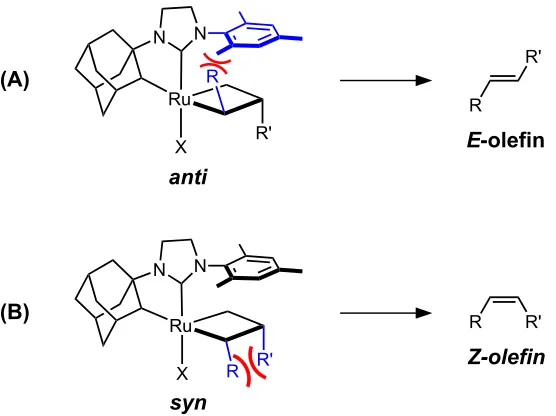
Figure 2.2. Commonly employed metathesis catalysts. 15 Figure 2.3. Key steric interactions governing Z-selectivity in CM reactions
of allylic-substituted olefins. 16
Figure 2.4. Key scenarios representing the expected spectrum of reactivity
for allylic-substituted olefins compared to unhindered olefins. 17 Figure 2.5. Proposed chelated catalyst species responsible for low activity. 30 Figure 2.6. Key scenarios representing reactivity for allylic-substituted
olefins with catalyst 2.2 compared to catalyst 2.1 36
Chapter 3
Figure 3.1. Cyclometallated Ru complexes commonly employed for
Figure 3.2. Previously prepared cyclometallated Ru-based
Z-selective catalysts with various N-aryl groups. 67 Figure 3.3. Targeted series of Z-selective catalysts with varying N-aryl groups. 70 Figure 3.4. Fluoro-aryl catalyst 3.67, which demonstrated
the presence of a F–Ru interaction. 85
Figure 3.5. Benzylidene region of 1
H-NMR spectra of
catalysts 3.1 and 3.10–3.16 in C6D6. 86
Figure 3.6. Solid-state structure of 3.61, with thermal ellipsoids
drawn at 50% probability. 87
Figure 3.7. Rotation about the N-C(aryl) bond of 3.11 88 Figure 3.8. Through-space 1
H–19
F coupling to benzylidene proton
observed in Ru-based metathesis model complex. 89 Figure 3.9. 1
H-NMR spectra of 3.10 illustrating spin–spin coupling
of the benzylidene proton signal with one F signal. 90 Figure 3.10. 1
H-NMR spectra of 3.11 illustrating spin–spin coupling
of downfield benzylidene proton signal with one F signal 91 Figure 3.11. Plot of chemical shift of benzylidene peak coupled to 19F
for each of catalysts 3.10, 3.11 and 3.13 against the σmeta value
for the other N-aryl substituent. 92
Figure 3.12. 1 H–19
F HOESY spectra illustrating almost equal NOE to
both aromatic protons ortho to F. 93
Figure 3.13. 19
F-presaturation experiments for catalyst 3.10, illustrating decrease in intensity of non-irradiated 19
Figure 3.14. Partial 1H-ROESY/EXSY spectrum of catalyst 3.10
indicating exchange of meta aromatic protons. 95 Figure 3.15. A) Plot of conversion vs. time and B) Z-selectivity vs. conversion
in the homodimerization of allylbenzene. 98 Figure 3.16. Plot of conversion vs. time in the homodimerization of allylbenzene, 99 Figure 3.17. Plots of Z-selectivity vs. conversion for
homodimerization of allylbenzene. 100
Figure 3.18. A) Plot of conversion vs. time and B) Z-selectivity
vs. conversion in the homodimerization of methyl-10-undecenoate. 103 Figure 3.19. A) Plot of conversion vs. time and B) Z-selectivity
vs. conversion in the homodimerization of 4-penten-1-ol. 104 Figure 3.20. Yield and Z-selectivity of homodimer 3.71 at 6 h.
in the homodimerization of allylbenzene 106 Figure 3.21. Yield and Z-selectivity of cross product 3.79 at 6 h. 108 Figure 3.22. Yield and Z-selectivity of cross product 3.79 at 6 h. 109 Figure 3.23. Comparison of Z-selectivity observed in formation
of 3.70 (Scheme 3.11) at 1h. compared to Z-selectivity
List of Tables Chapter 2
Table 2.1. Optimization of CM reaction between 2-vinyl-1,3-dioxolane
and 1-dodecene 21
Table 2.2. Varying the olefin in excess in CM of 2-vinyl-1,3-dioxolane
and 1-dodecene. 22
Table 2.3. CM of various acrolein acetals with 1-dodecene. 24 Table 2.4. CM of vinyl pinacol boronate and 2-vinyloxirane with 1-dodecene. 25 Table 2.5. Varying the cross partner in CM of 2-vinyl-1,3-dioxolane. 27 Table 2.6. CM of 2-vinyl-1,3-dioxolane and N-allylaniline derivatives. 29 Table 2.7. Stereoretentive deprotection of Z-α,β-unsaturated acetals 31 Table 2.8. CM of allylic-substituted hydrocarbons with methyl-10-undecenoate. 32 Table 2.9. CM of allylic-substituted secondary alcohols. 33 Table 2.10. Comparison of catalysts in CM of 3-vinyl-1,2-dioxolane
and 1-dodecene. 34
Table 2.11. CM of allylic-substituted hydrocarbons with methyl-10-undecenoate
using catalyst 2.1. 37
Table 2.12. Optimization of CM between vinyl cyclohexane and
methyl-10 undecenoate. 39
Table 2.13. CM of allylic-substituted hydrocarbons with
methyl-10-undecenoate using catalyst 2.1. 40 Table 2.14. CM of protected secondary allylic alcohols with 1-dodecene
Table 2.15. Model for selectivity in CM, expanded to include
cyclometallated Z-selcetive metathesis catalysts. 43 Chapter 3
Table 3.1. Condensation of 2,6-substituted anilines and bromoacetyl chloride. 74 Table 3.2. Substitution of alkyl bromide with 1-adamantylamine. 75
Table 3.3. Reduction of amides with LiAlH4. 76
Table 3.4. Reduction of amides with BH3.THF. 78
Table 3.5. Formation of imidazolinium chlorides from corresponding diamines. 79 Table 3.6. Formation of imidazolinium chlorides from corresponding diamine
dihydrochlorides. 80
Table 3.7. Metallation of NHCs using KOt
Am. 81
Table 3.8. Metallation of NHCs using KHMDS. 82
Table 3.9. C–H activation and anion metathesis to form cyclometallated
List of Schemes Chapter 1
Scheme 1.1. General mechanism for olefin metathesis. 2
Scheme 1.2. Types of olefin metathesis reactions. 3
Scheme 1.3. Products formed in cross metathesis of two terminal olefins. 4 Scheme 1.4. Formation of metallacyclobutanes from phosphonium
alkylidene catalyst 1.4 at low temperature. 7 Chapter 2
Scheme 2.1. CM of 2-vinyl-1,3-dioxolane and 1-dodecene. 20 Scheme 2.2. Unreactive CM substrates with tertiary allylic substitution. 26 Scheme 2.3. CM of allyl pinacol boronate with 2-vinyl-1,3-dioxolane
and conversion to corresponding allylic alcohol. 28 Chapter 3
Scheme 3.1. Decomposition pathway observed for Z-selective
catalysts bearing N-aryl groups with ortho hydrogens. 68 Scheme 3.2. General synthetic scheme for accessing cyclometallated
Z-selective Ru catalysts. 71
Scheme 3.3. Proposed synthetic scheme for N-aryl, N'-1-adamantyl
imidazolinium salts. 72
Scheme 3.4 Preparation of anilines from corresponding carboxylic acids
using DPPA. 73
Scheme 3.6. Attempted reduction of amide 3.31 with LiAlH4. 76
Scheme 3.7. Reduction of amide 3.31 with BH3.THF 77
Scheme 3.8. Attempted reduction of amide 3.34 with LiAlH4. 78 Scheme 3.9. Cyclization of 3.44 to form imidazolinium salt and conversion to
tetrafluoroborate. 81
Scheme 3.10. Metallation of NHC salt 3.44 using LiHMDS. 83 Scheme 3.11. Homodimerization of allylbenzene at 0.1 mol% catalyst loading. 97 Scheme 3.12. Homodimerization of methyl-10-undecenoate
at 0.1 mol% catalyst loading. 102
List of Abbreviations
CM Cross metathesis
Cy Cyclohexyl
DCM Dichloromethane
DFT Density functional theory
DIPP 2,6-diisopropylphenyl
EXSY Exchange spectroscopy
GC Gas chromatography
h. Hours
HMDS Hexamethyldisilazane
HOESY Heteronuclear Overhauser effect spectroscopy
Mes 2,4,6-trimethylphenyl
MIDA N-methyliminodiacetic acid
min. Minutes
NHC N-heterocyclic carbene
NMR Nuclear magnetic resonance
NOESY Nuclear Overhauser effect spectroscopy
RCM Ring-closing metathesis
ROCM Ring-opening cross metathesis
ROESY Rotating-frame Overhauser Spectroscopy
ROMP Ring-opening metathesis polymerization
t
Am Tert-amyl (2-methyl-2-butyl)
TEA Triethylamine
THF Tetrahydrofuran
Chapter 1
Olefin Metathesis
Over the past sixty years, olefin metathesis has transformed from an undesirable side reaction into a powerful and widely used method for the formation of carbon–carbon double bonds.1,2
While early catalysts were ill-defined heterogeneous mixtures, mechanistic experiments identified transition metal (TM) carbenes as the active catalysts in these systems3
, which prompted the development of a wide variety of well-defined TM carbene complexes that were competent olefin metathesis catalysts.4,5
Olefin metathesis proceeds via a [2+2] cycloaddition between a TM carbene and an alkene to form a metallacyclobutane intermediate, which can then collapse to generate a new TM carbene and a new alkene product (Scheme 1.1).
By varying the type(s) of alkene starting materials employed in the reaction, a wide variety of alkene-containing products can be generated and this is used to define various classes of olefin metathesis reaction (Scheme 1.2).
Scheme 1.1. General mechanism for olefin metathesis.
R' [M]
R [2+2]
R'
[M] R
R'
+ R'
R' [M]
R'
Selectivity in Cross Metathesis
Of these reaction classes, initial attention was largely devoted to ring-opening metathesis polymerization (ROMP) and ring-closing metathesis (RCM), both of which have a strong driving force toward product formation. In ROMP reactions, release of ring strain from the cyclic starting material is the driving force for the reaction, whereas for RCM there is an entropic driving force due to the production of two molecules from one (the product and ethylene). Cross metathesis (CM) lacks either of these driving forces, making it a more challenging reaction that also presents several issues with regard to selectivity that are not present in other types of metathesis reactions. Typically, if two distinct terminal olefins (A + B, Scheme 1.3) undergo CM, multiple products result: the homodimers of A and B are formed (A2 + B2, respectively) in addition to the desired cross product (AB). Each of these products is also formed as a mixture of the cis and trans isomers, generating six different products.
Scheme 1.2. Types of olefin metathesis reactions. R'
R
R R'
CM RCM
n ROM
ADMET ROMP
+ –
+
Ethenolysis
–
Achieving selectivity for formation of the desired cross product in preference to the homodimers in CM applications has been facilitated by the development of a model, which classifies olefins based on their reactivity.6
The model divides olefins into four categories of decreasing reactivity: Type I olefins, which homodimerize readily and whose homodimers can readily undergo further reaction; Type II olefins, which homodimerize slowly and whose homodimers are slow to undergo further reactions; Type III olefins, which do not homodimerize and only form cross products with Type I or II olefins; and Type IV olefins, which are spectators to metathesis.
If two terminal olefins of Type I undergo CM, a statistical distribution of products results. Hence, a 1:1 ratio of A:B is expected to yield 25% of each homodimer in addition to 50% of the desired cross product. The yield of the cross product can be increased by employing an excess of one terminal olefin, for example using a 4:1 ratio of A:B increases the potential yield of cross product (AB) to 80%. When two olefins of different types are used, they can undergo selective CM, favoring formation of the cross product over formation of homodimers, leading to yields greater than the statistical product distribution.
R1 R2
R1
R1 R2 R2 R1 R2
R1 R1
R2 R2
R2 R1 [Ru]
+
cis
trans
A B
A2 B2 AB
homodimers cross product
The olefin classification type results from a combination of steric and electronic factors, with increased steric bulk proximal to the double bond and electron-withdrawing substituents generally leading to reduced reactivity. Notably, the “type” is specific to a given metathesis catalyst, which often allows for high selectivity to be achieved in the reaction of two given olefins, through careful choice of catalyst. The remaining major challenge in the field of CM was to achieve precise control over the olefin stereochemistry, allowing the generation of cis and trans olefins with high selectivity.
Cis–trans Selectivity in Ru-based Metathesis Catalysts
Two major families of well-defined TM complexes have enjoyed considerable success as olefin metathesis catalysts: those based on Mo and W complexes, pioneered by Schrock7-10
, and those based on Ru, which have been a major focus of research in our group, as well as others11,12
(Figure 1.1). A focus on catalyst development in tandem with mechanistic studies has provided significant insight into the features that govern the stability and activity in Ru-based olefin metathesis catalysts.13-15
In contrast, the features that govern issues of selectivity, in particular cis–trans selectivity, have proved more challenging to elucidate. A key factor in understanding the cis–trans selectivity of typical
Figure 1.1. Key ruthenium-based metathesis catalysts.
Ru Ph Cl
Cl
PCy3
N N N N
Ru
O Cl
Cl PCy3
Ru Ph Cl
Cl
PCy3
Ru-based metathesis catalysts (such as 1.1-1.3) is the orientation of the metallacyclobutane intermediate with respect to the other ligands on Ru, for which two distinct pathways have been proposed (Figure 1.2).
In the “bottom-bound” pathway, metallacycle formation takes place with an olefin bound trans to the L-type ligand (PCy3 in 1.1, NHC in 1.2 and 1.3), leading to a
metallacycle on the opposite face to the L-type ligand and the two X-type ligands trans to each other. In the alternative “side-bound” pathway, metallacycle formation takes place with an olefin bound cis to the L-type ligand and the resulting metallacycle is oriented in a perpendicular plane to the L-type ligand with the result that the two X-type ligands are cis to each other. Indirect experimental16-20
and computational21-23
investigations have provided evidence for both side-bound and bottom-bound pathways in the case of conventional metathesis catalysts such as 1.1–1.3 The first direct evidence arose when 14-electron metathesis catalyst 1.4 was demonstrated to reactwith terminal olefins at low temperatures forming metallacycles, which could be studied using low-temperature NMR spectroscopy.24-28
These studies have supported the formation of bottom-bound metallacycles, in which the metallacycle lies coincident with the span of the NHC ligand (1.5), for NHC–Ru complexes, such as 1.2 and 1.3, (Scheme 1.4).
Figure 1.2. Possible orientations for metallacyclobutanes. Ru
L
R
R' X
X
bottom-bound
Ru L
X
X R
R'
The substituents of the bottom-bound metallacycle can be in either a syn orientation, which leads to formation of the Z-olefin product, or in an anti orientation, which leads to formation of the E-olefin product (Figure 1.3). Steric repulsion between substituents in the syn metallacycle is believed to be responsible for the kinetic preference for formation of the E-olefin by catalysts such as 1.4 and 1.5.13
Z-selective Ru-based Metathesis Catalysts
Our group has recently developed a series of cyclometallated Ru-based metathesis catalysts that show a kinetic preference for formation of Z-olefin products (Figure 1.4). 1.6 was the first Ru-based catalyst that demonstrated catalyst-driven Z-selectivity, which was discovered after a serendipitous C–H activation in the reaction of 1.3 with silver pivalate.29
Replacement of the cyclometallated substituent by an N-adamantyl group resulted in catalyst 1.7, which displayed both improved activity and Z-Figure 1.3. Syn and anti geometries of bottom-bound metallacycles.
syn anti
L
Ru
R X X
R'
L
Ru
R X X
R'
Scheme 1.4. Formation of metallacyclobutanes from phosphonium alkylidene catalyst 1.4 at low temperature.
Ru
PCy3+ Cl
Cl
N N
BF4
-1.4
Ru R Cl
Cl R
N N
selectivity.29
Replacement of the remaining pivalate ligand by nitrate resulted in catalyst 1.8, which demonstrated significant improvements in stability.30
In contrast to previous Ru-based metathesis catalysts, catalysts 1.6–1.8 are believed to proceed via a side-bound pathway, in which the metallacycle lies under the N-aryl group of the catalyst (Figure 1.5).29-34
Steric repulsion between the metallacyclobutane substituent and the N-aryl group destabilizes the anti metallacycle geometry, with the result that the syn metallacycle geometry is preferred.
Thesis Research
While cyclometallated Ru-based complexes have demonstrated promising results in a number of metathesis reactions, their known scope of reactivity is rather limited in Figure 1.5. Model for Z-selectivity in cyclometallated Ru-based catalysts.
syn anti
Ru N N
X R R'
Ru N N
X R
R'
Figure 1.4. Cyclometallated Ru catalysts that are Z-selective in metathesis reactions.
N N
Ru
O O
N N
Ru
O O
O N O
N N
Ru
O O
O
1.7
1.6 1.8
comparison to more established catalysts, such as 1.1–1.3. The primary focus of this thesis is to develop an improved understanding of the factors that govern reactivity and selectivity in the cyclometallated Z-selective catalysts. Chapter 2 focuses on the application of the cyclometallated catalysts in the Z-selective CM of allylic-substituted olefins. These more challenging substrates allow us to probe the boundaries of reactivity with the cyclometallated catalysts, providing insights into how the reactivity and Z-selectivity are influenced by the structure of both the catalyst and the substrate. Chapter 3 reports the development of a series of cyclometallated catalysts that systematically vary the steric and electronic nature of the N-aryl group. Studies of the reactivity of this catalyst series in a variety of CM applications have allowed further refinement of our understanding of the interplay between catalyst structure, activity and Z-selectivity. In addition, studies of an unusual C–H···F–C interaction observed in a number of these catalysts are described.
References
(1) Handbook of Metathesis; Grubbs, R. H., Ed.; Wiley-VCH Verlag GmbH:
Weinheim, Germany, 2003.
(2) Handbook of Metathesis, 2nd ed.; Grubbs, R. H., Wenzel, A. G., O'Leary, D. J.,
Khosravi, E., Eds.; Wiley-VCH Verlag GmbH & Co. KGaA: Weinheim, Germany, 2015.
(3) Hérisson, J.-L. P.; Chauvin, Y. Makromol. Chem.1971, 141 (1), 161. (4) Murdzek, J. S.; Schrock, R. R. Organometallics1987, 6 (6), 1373.
(5) Schrock, R.; Rocklage, S.; Wengrovius, J.; Rupprecht, G.; Fellmann, J. J. Mol.
Catal.1980, 8 (1-3), 73.
(6) Chatterjee, A.; Choi, T.-L.; Sanders, D. P.; Grubbs, R. H. J. Am. Chem. Soc.
2003, 125 (37), 11360.
(8) Schrock, R. R.; Murdzek, J. S.; Bazan, G. C.; Robbins, J.; Dimare, M.; O'Regan,
M. J. Am. Chem. Soc.1990, 112 (10), 3875.
(9) Schrock, R. R. Tetrahedron1999, 55 (27), 8141. (10) Schrock, R. R. Chem. Rev.2009, 109 (8), 3211.
(11) Trnka, T. M.; Grubbs, R. H. Acc. Chem. Res.2001, 34 (1), 18.
(12) Vougioukalakis, G. C.; Grubbs, R. H. Chem. Rev.2010, 110 (3), 1746.
(13) Ritter, T.; Hejl, A.; Wenzel, A. G.; Funk, T. W.; Grubbs, R. H. Organometallics
2006, 25 (24), 5740.
(14) Dias, E. L.; Nguyen, S. T.; Grubbs, R. H. J. Am. Chem. Soc. 1997, 119 (17), 3887.
(15) Sanford, M. S.; Ulman, M.; Grubbs, R. H. J. Am. Chem. Soc.2001, 123 (4), 749. (16) Tallarico, J. A.; Bonitatebus, P. J.; Snapper, M. L. J. Am. Chem. Soc. 1997, 119
(30), 7157.
(17) Trnka, T. M.; Day, M. W.; Grubbs, R. H. Organometallics2001, 20 (18), 3845. (18) Anderson, D. R.; Hickstein, D. D.; O’Leary, D. J.; Grubbs, R. H. J. Am. Chem.
Soc.2006, 128 (26), 8386.
(19) Anderson, D. R.; O’Leary, D. J.; Grubbs, R. H. Chem. Eur. J. 2008, 14 (25), 7536.
(20) Stewart, I. C.; Benitez, D.; O’Leary, D. J.; Tkatchouk, E.; Day, M. W.; Goddard, W. A., III; Grubbs, R. H. J. Am. Chem. Soc.2009, 131 (5), 1931.
(21) Cavallo, L. J. Am. Chem. Soc.2002, 124 (30), 8965. (22) Straub, B. F. Angew. Chem. Int. Ed.2005, 44 (37), 5974. (23) Adlhart, C.; Chen, P. J. Am. Chem. Soc.2004, 126 (11), 3496. (24) Romero, P. E.; Piers, W. E. J. Am. Chem. Soc.2005, 127 (14), 5032. (25) Romero, P. E.; Piers, W. E. J. Am. Chem. Soc.2007, 129 (6), 1698.
(26) van der Eide, E. F.; Romero, P. E.; Piers, W. E. J. Am. Chem. Soc. 2008, 130
(13), 4485.
(27) Wenzel, A. G.; Blake, G.; VanderVelde, D. G.; Grubbs, R. H. J. Am. Chem. Soc.
2011, 133 (16), 6429.
(28) Wenzel, A. G.; Grubbs, R. H. J. Am. Chem. Soc.2006, 128 (50), 16048. (29) Endo, K.; Grubbs, R. H. J. Am. Chem. Soc.2011, 133 (22), 8525.
(30) Keitz, B. K.; Endo, K.; Patel, P. R.; Herbert, M. B.; Grubbs, R. H. J. Am. Chem. Soc.2012, 134 (1), 693.
(31) Liu, P.; Xu, X.; Dong, X.; Keitz, B. K.; Herbert, M. B.; Grubbs, R. H.; Houk, K.
(32) Dang, Y.; Wang, Z.-X.; Wang, X. Organometallics2012, 31 (20), 7222. (33) Dang, Y.; Wang, Z.-X.; Wang, X. Organometallics2012, 31 (24), 8654.
Chapter 2
Z-selective Cross Metathesis of Allylic-substituted Olefins
Portions of this chapter are adapted/reproduced from:
Quigley, B. L.; Grubbs, R. H. Chem. Sci.2014, 5 (2), 501. licensed under a
Abstract
This chapter describes the application of cyclometallated Ru-based catalysts 2.1
and 2.2 in Z-selective cross metathesis of allylic-substituted olefins. The observed
activity and selectivity of the catalysts are correlated with the catalyst structure by
developing models for catalyst behavior. 2.2 was demonstrated to be an efficient catalyst
for CM of acrolein acetals, providing a new synthetic route to Z-α,β-unsaturated acetals
with excellent stereoselectivity (typically, >95% Z). The reaction conditions were
compatible with a variety of acrolein acetals and terminal olefin cross partners, varying in
functionality and steric profile. In addition, methods for the stereoretentive conversion of
Z-α,β-unsaturated acetals to the corresponding aldehydes are also disclosed. The ability
of catalyst 2.2 to carry out Z-selective CM of a wide variety of other allylic-substituted
olefins was also explored. For a number of olefins that displayed poor reactivity with
catalyst 2.2, significantly improved reactivity was observed with more sterically
accessible catalyst 2.1 under re-optimized conditions. Finally, the implications of the
observed reactivity are discussed, allowing for extension of the “model for selectivity in
Introduction
Previous work in our group demonstrates the utility of the cyclometallated
Ru-based metathesis catalysts, such as 2.1 and 2.2 (Figure 2.1), in a variety of Z-selective
metathesis reactions, including CM1-7
, ethenolysis8
and macrocyclic RCM5,9,10
. These
classes of reaction differ from ROMP11,12
and ROCM13-15
in that they lack the additional
driving force from release of ring strain, Without the “spring-loaded” cyclic starting
material, the other classes of reaction display a higher sensitivity to the steric
environment of the starting olefin. In the case of CM reactions, the reactivity
demonstrated to-date had been limited to relatively unhindered terminal and internal
Z-olefins.1-7
Allylic-substituted olefins were identified as an important substrate class to
explore with the goal of augmenting the scope of reactivity of our Z-selective catalysts.
Olefins with allylic substitution have been explored as CM substrates with
previous generations of Ru-based metathesis catalysts, including catalysts 2.3–2.5
(Figure 2.2).16-18
In these studies, two general trends were noted: allylic-substituted
olefins are less reactive than unhindered olefins in CM applications and they tend to form
cross products with improved selectivity for the E-olefin. This enhanced selectivity for
Figure 2.1. Cyclometallated Ru complexes commonly employed for Z-selective olefin metathesis.
N N
Ru
O O
O N O
N N
Ru
O O
O N O
the E-olefin is attributed to increased steric repulsion between substituents in the syn
metallacyclobutane, further disfavoring formation of the Z-olefin. In many cases, this
allows the E-olefin to be generated with high stereoselectivity, lending the products to
further synthetic applications where the olefin stereochemistry can be exploited. Access
to the complementary Z-olefins via metathesis would provide a useful synthetic tool,
extending the utility of these methods.
In the cyclometallated Z-selective catalysts, 2.1 and 2.2, this increased steric clash
between substituents in the syn metallacycle is expected to play a similar role. DFT
calculations suggest that the rate-limiting step for product formation is either formation or
collapse of the 1,2-disubstituted metallacyclobutane.19-21
The increased steric bulk of the
alkene substituent is expected to result in a larger steric clash in the syn
metallacyclobutane, and hence in the rate-limiting step, increasing the energy required to
form the Z-olefin product (Figure 2.3).
Figure 2.2. Commonly employed metathesis catalysts.
Ru Ph Cl
Cl
PCy3
N N
PCy3
Ru Ph Cl
Cl
PCy3
N N
Ru
O Cl
Cl
Increased steric bulk of the metallacycle substituent(s) may also affect reactivity
due to their interactions with other ligands on the catalyst. In the case of the anti
metallacycle, this may result in a larger steric clash between the substituent and the
N-aryl group. Additionally, there is the possibility for increased steric clashing with either
the adamantyl group or the X-type ligand, which may play a role in destabilizing either or
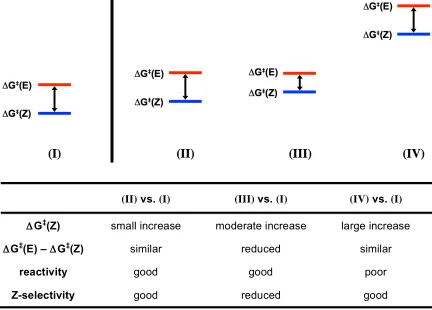
both of these competing pathways. Figure 2.4 presents three possible scenarios for the
expected reactivity of allylic-substituted olefins compared to non-allylic-substituted
olefins, which arise from differences in how the increased steric bulk affects the energy
of the pathways leading to the E-olefin and the Z-olefin.
syn anti
R R'
R R'
Z-olefin E-olefin
Ru N N
X R R'
Ru N N
X
R
R'
(A)
(B)
Scenario (I) represents the case of CM of unhindered terminal olefins and
Scenarios (II-IV) represent different possibilities for the reactivity of allylic-substituted
olefins relative to Scenario (I). In Scenario (II), both pathways increase in energy by a
similar but small amount, resulting in lowered reactivity but maintaining high
Z-selectivity. In Scenario (III), the pathway leading to the Z-olefin increases in energy more
than that of the E-olefin, with the result that the product will still be formed but with
diminished Z-selectivity compared to the case of unhindered olefins. Scenario (IV)
represents a third case where the increased steric clash is large, rendering both pathways
leading to the Z-olefin and the E-olefin high in energy and largely inaccessible, leading to
(II) vs. (I) (III) vs. (I) (IV) vs. (I)
ΔG‡(Z) small increase moderate increase large increase
ΔG‡(E) – ΔG‡(Z) similar reduced similar
reactivity good good poor
Z-selectivity good reduced good
minimal product formation.
A second consideration that may erode the initial Z-selectivity in
allylic-substituted olefins is a difference in the propensity for the E- and Z-olefin products to
undergo secondary metathesis. In the cyclometallated catalysts, secondary metathesis is
believed to occur primarily via the “ethenolysis” pathway4,8
, which, being the reverse of
the Z-selective forward CM reaction, will have a lower transition state for secondary
metathesis of the Z-olefin product compared to the E-olefin product. In addition,
increased steric bulk of alkene substituents is correlated with a larger energy difference in
the stability of the E- and Z-olefin products.22
This typically results in the Z-olefin being
higher in energy than the E-olefin and therefore more likely to undergo side-reactions,
including secondary metathesis processes. As such, the Z-olefin product is both
thermodynamically and kinetically more susceptible to secondary metathesis and,
therefore, will be selectively consumed, leading to erosion of the Z-content of the product
mixture if significant secondary metathesis occurs.
Z-selective Cross Metathesis of Acrolein Acetals
We selected acrolein acetals as the initial substrate class with which to begin cross
metathesis studies of allylic-substituted olefins. Previous studies had demonstrated the
viability of acrolein acetals as cross metathesis substrates with earlier generations of Ru
metathesis catalysts, in particular, with catalyst 2.3, which allowed the synthesis of cross
products with high selectivity for the trans olefin product.17,23
However, Z-selective
metathesis of acrolein acetals had yet to be demonstrated with either Ru-based catalysts
It was envisioned that the Z-α,β-unsaturated acetals formed from Z-selective CM
of acrolein acetals would serve as useful precursors for the corresponding
Z-α,β-unsaturated aldehydes, which are challenging to access via other methods. This would
complement the E-α,β-unsaturated aldehydes that can be accessed either directly from
CM of acrolein or from the corresponding acetals using catalysts 3.2–3.5.17,18,23
Z-α,β-unsaturated aldehydes have significant interest for industry, due to their uses in
fragrances24,25
and as semiochemicals for pest control applications.26,27
They are also
formed as metabolites in various plants and animals and their detection has been used as
a diagnostic for cancer and in food quality assays.28-31
Z-α,β-unsaturated acetals and
aldehydes also serve as useful synthetic intermediates, which have been exploited in the
synthesis of a number of natural products.32-36
In addition, α,β-unsaturated acetals have
been extensively explored as substrates for a number of base- and metal-promoted
rearrangements.37
Despite the significant interest in Z-α,β-unsaturated acetals and aldehydes,
general, broad methods for their synthesis are rare. Reagents have been developed for the
two-carbon homologation of aldehydes to the corresponding α,β-unsaturated compounds;
however, achieving high Z-stereoselectivity is often challenging and unpredictable.38-43
This results in the employment of less efficient, multi-step methods. For example, the
Still–Gennari modification of the Horner–Wadsworth–Emmons reaction affords the
Z-α,β-unsaturated ester, which can then be reduced to the allylic alcohol and oxidized to
afford the aldehyde.44,45
In an alternative strategy, α,β-alkynyl acetals can be accessed
subsequent semi-hydrogenation (typically with Lindlar’s catalyst) and deprotection.37
Z-selective metathesis offers an attractive route to α,β-unsaturated acetals and aldehydes
that avoids several shortcomings associated with the abovementioned strategies.
Alternative methods require the use of strong bases, sensitive organometallic complexes
or redox reagents, necessitating the use of protective groups in complex molecules. In
contrast, Z-selective metathesis is a more direct method with generally good functional
group tolerance, reducing the need for protecting groups. In addition, both starting
materials are readily available/accessible: vinyl acetals can be efficiently prepared from
acrolein46 and cross partners can be sourced from the vast olefin chemical feedstock.
Optimization of Reaction Conditions
Initial studies began with 2-vinyl-1,3-dioxolane (2.6), which has been explored in
CM applications with previous generations of Ru metathesis catalyst, allowing the
generation of cross products with enhanced selectivity for the E-olefin (Scheme 2.1).23
1-Dodecene (2.7) was selected as a cross partner due to its low volatility and in order to
avoid any possible effects due to the presence of other functional groups. Catalyst 2.2
was used, since it had demonstrated improved Z-selectivity over 2.1 in previous CM
applications.5,6
Initial conditions, which employed 5 mol% 2.2 and 6 equivalents of
1-9 O
O
+
2.6 2.7
9 O
O
2.8 [Ru]
a
Yield and Z-selectivity determined by GC using tridecane as an internal standard; average of two experiments. b
Value at 7 hours.
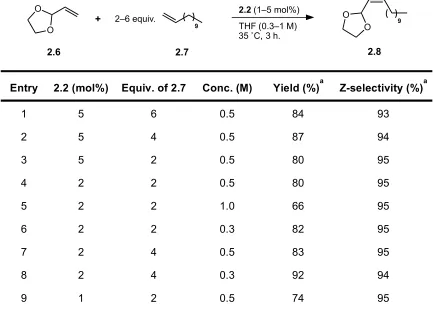
dodecene, were highly promising, yielding the desired cross product (2.8) in 84% yield
and with 93% Z-selectivity at 3 h. (Table 2.1, Entry 1).
A number of reaction conditions were investigated in order to determine if
reduced catalyst loading and/or reduced equivalents of 1-dodecene would be tolerated.
The Z-selectivity was found to be largely independent of catalyst loading, excess of
1-dodecene or reaction concentration, giving a consistent value of 93–95% Z-selectivity
across the various conditions investigated. This is suggestive that secondary metathesis of
2.8 is not occurring to a significant extent under these reactions conditions, the
implications of which will be discussed further (vide infra). A similar yield was obtained Entry 2.2 (mol%) Equiv. of 2.7 Conc. (M) Yield (%)a Z-selectivity (%)a
1 5 6 0.5 84 93
2 5 4 0.5 87 94
3 5 2 0.5 80 95
4 2 2 0.5 80 95
5 2 2 1.0 66 95
6 2 2 0.3 82 95
7 2 4 0.5 83 95
8 2 4 0.3 92 94
9 1 2 0.5 74 95
2.2 (1–5 mol%) THF (0.3–1 M) 35 ˚C, 3 h.
9
O O
+
2.6 2.7
9
O O
2.8 2–6 equiv.
Table 2.1. Optimization of CM reaction between 2-vinyl-1,3-dioxolane and 1-dodecene.
using a lower catalyst loading of 2 mol% 2.2 and 4 equivalents of 1-dodecene. Reducing
the concentration of the reaction to 0.3 M in 2.6 led to an increase in yield, allowing the
product to be generated in 92% yield and 94% Z-selectivity (Entry 8). We then
employed these optimal conditions to investigate whether the reaction could also be
carried out efficiently using the allylic-substituted olefin as the reagent in excess (Table
2.2). A comparable yield of the cross product (2.8) could be achieved using 4 equivalents
of 2.6 and 1 equivalent of 2.7 and only a small reduction in Z-selectivity was noted (91%
vs. 94%), although a longer reaction time of 7 h. was required. If only 2 equivalents of
the olefin in excess were used, regardless of which olefin was used in excess, similar
Z-selectivity was observed but with a reduction in yield of ~10%.
Entry Equiv. of 2.6 Equiv. of 2.7 Yielda (%) Z-selectivitya (%)
1 2 1 63 [84]b 93 [92]b
2 4 1 65 [94]b 91 [91]b
3 1 2 82 95
4 1 4 92 94
Table 2.2. Varying the olefin in excess in CM of 2-vinyl-1,3-dioxolane and 1-dodecene.
a Yield and Z-selectivity determined by GC using tridecane as an internal standard; average of two experiments. bValue at 7 h. in square brackets.
2.2 (2 mol%) THF (0.3 M) 35 ˚C, 3 h. 9
O O
+
2.6 2.7
9 O
O
Substrate Scope: Allylic-substituted Olefin
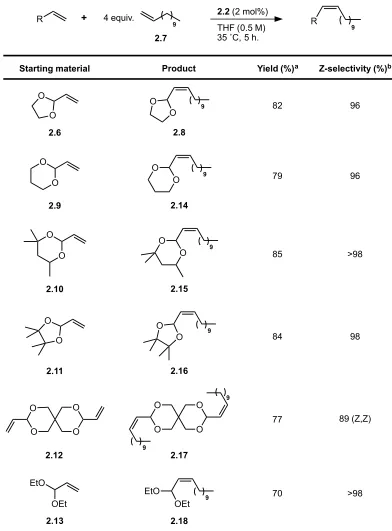
The substrate scope was then investigated on a preparative scale (~0.8–1.0 mmol),
where it was found that increasing the reaction concentration to 0.5 M in the
allylic-substituted olefin and extending reaction time to 5 h. led to conditions that were optimal
for the range of substrates explored (Table 2.3). Under these conditions, cross product
2.8 was isolated in 82% yield and 96% Z-selectivity. The corresponding
vinyl-1,3-dioxane (2.9) performed similarly, yielding cross product 2.14 in 79% yield and 96%
Z-selectivity. Potentially bulkier vinyl acetals derived from hexylene glycol and pinacol
(2.10 and 2.11, respectively) yielded products with marginally higher yield and
Z-selectivity. In the case of a di(acrolein acetal) derived from pentaerythritol, 2.12, the
difunctionalized cross product 2.17 was obtained as a mixture of the Z,Z and E,Z
diastereomers in an 89:11 ratio and 77% combined yield. This is consistent with the
statistical outcome of two independent metathesis events occurring with ~94%
Z-selectivity, as would be expected for the two distal alkenes. The two isomers of 2.17
could be separated by column chromatography on silica gel, allowing the Z,Z isomer to
be isolated in 69% yield and >98% stereoselectivity. The reaction conditions were also
found to be tolerant of acrolein diethyl acetal (2.13), which is known to be less stable
than cyclic acetals.47
The corresponding cross product, 2.18, was obtained with high
Z-selectivity (>98%) but a lower yield (70%) than that observed with the cyclic acetals.
Overall, CM with 1-dodecene could be achieved for a wide variety of acrolein acetals,
allowing the desired products to be isolated in 69–85% yield and with Z-selectivity of
Having had promising results with vinyl acetals, our attention turned to related
Table 2.3. CM of various acrolein acetals with 1-dodecene.
OEt EtO O O O O O O O O O O O O 2.6 2.9 2.13 2.10 2.11 2.12 9 O O 2.8 9 O O 2.14 9 O O 9 O O O O O O 9 9 EtO OEt 9 2.15 2.16 2.17 2.18 82 96 79 96 85 >98 84 98
77 89 (Z,Z)
70 >98
Starting material Product Yield (%)a Z-selectivity (%)b 2.2 (2 mol%)
THF (0.5 M) 35 ˚C, 5 h. 9 R + 2.7 R 9 4 equiv.
types of olefins with tertiary allylic carbons that are also of interest for their synthetic
utility (Table 2.4). α,β-Unsaturated pinacol boronates are useful substrates in Suzuki
cross-coupling reactions, where olefin geometry can be efficiently transferred to the
cross-coupled products.48-50
Previous work has demonstrated that vinyl pinacol boronate
(2.19) is a useful substrate for accessing E-α,β-unsaturated pinacol boronates using
catalysts 3.3–3.5.17,18,51
2.19 was found to undergo CM efficiently with catalyst 2.2,
generating alkenyl boronate 2.21 in comparable yield (81%) to 2.8 and slightly reduced
Z-selectivity (92%). This is complementary to a recent report by Schrock, Hoveyda and
co-workers, where they used vinyl pinacol boronate as the reagent in excess.52 In
addition, 2-vinyl oxirane was investigated as a substrate for Z-selective CM. While
catalyst 2.3 failed yield the desired cross product for 2-vinyl oxirane (2.20), Z-selective
Table 2.4. CM of vinyl pinacol boronate and 2-vinyloxirane with 1-dodecene.
a Isolated yield. b Z-selectivity determined by 1H-NMR spectroscopy. c Z-selectivity determined by 1H-NMR spectroscopy.
B O
O
O
2.19
2.20
B O
O 9
9 O
2.21
2.22
81 92
40c >98
Starting material Product Yield (%)a Z-selectivity (%)b
2.2 (2 mol%) THF (0.5 M) 35 ˚C, 5 h. 9
R +
2.7
R
catalyst 2.2 was able to form the desired cross product, 2.22, with excellent Z-selectivity
but, though metathesis was carried out at room temperature in order to minimize loss of
the volatile substrate, only a modest yield of 2.22 was obtained (40%).
Given the high yields observed in the case of acrolein acetals, we decided to
investigate related substrates bearing quaternary allylic carbons, including ketal 2.23 and
orthoester 2.24 (Scheme 2.2). In both cases, negligible formation of the desired cross
product was observed. Similarly, 2-methyl-2-vinyloxirane 2.25 and vinyl MIDA boronate
2.26 led to only minimal conversion. For these reactions, lack of formation of homodimer
from 2.7 (11-docosene) under the reaction conditions can be used as an indicator of
catalyst sequestration or decomposition. If the hindered olefin is causing either of these
effects, this is expected to impact formation of 11-docosene under the reaction
conditions. Indeed, low conversion of 1-dodecene was noted with substrates 2.24 and
2.25, which is suggestive of either catalyst sequestration or decomposition. In contrast,
appreciable formation of 11-docosene occurred in CM reactions with 2.23 and 2.26. This
is consistent with an inherent low reactivity of the starting material limiting product
formation (cf. Scenario (IV), Figure 2.4) and not catalyst decomposition or sequestration.
Scheme 2.2. Unreactive CM substrates with tertiary allylic substitution.
2.2 (2 mol%)
THF (0.3 M) 35 ˚C, 3 h.
9
R +
2.7
R
9
O O O BN
O
O O
O
O O O
Substrate Scope: Cross Partner
In order to investigate the compatibility of the reaction with various functional
groups, a number of cross partners other than 1-dodecene were screened (Table 2.5).
Table 2.5. Varying the cross partner in CM of 2-vinyl-1,3-dioxolane.
a
Isolated yield. bZ-selectivity determined by 1H-NMR spectroscopy. cReaction stopped at 3h. Product Yield (%)a Z-selectivity (%)b
2.2 (2 mol%) THF (0.5 M) 35 ˚C, 5 h. R + 2.6 R 4 equiv. O O O O 2.7 2.28 2.29 2.30 9 O O 2.8 2.32 2.33 2.34 82 96 84 97 88 97
74c 97
Cross products were generated with similar yield and high Z-selectivity for
methyl-10-undecenoate (2.28) and allylbenzene (2.29). In addition, a primary alcohol (2.30) and
primary alkyl bromide (2.31) were both tolerated under the reaction conditions. Since a
reaction time of 5 h. was found to result in a lower Z-selectivity of product 2.34, reducing
the reaction time to 3 h. allowed the product to be isolated in good yield and with
excellent Z-selectivity. The anomalous degradation of Z-content has been observed in
previous CM reactions with 2.30 and will be discussed further in Chapter 3. In addition,
allyl pinacol boronate (2.37) was also tolerated as a cross partner, demonstrating
excellent Z-selectivity (Scheme 2.3). Due to the instability of cross product 2.38 to
purification, it was converted in situ to the corresponding Z-allylic alcohol (2.39) with
excellent retention of stereochemistry and in good yield over the two steps.
N-allylaniline (2.40) was also investigated as a cross partner and, while cross
product 2.43 was formed with high Z-selectivity, the yield was low (18%) (Table 2.6).
Previously, N-allylaniline has been employed successfully as the limiting reagent in CM
of unhindered olefins with catalyst 2.2.6 Here, when 2.40 is used in excess in combination B
O
O OH
O O O
O
63% yield >98% Z + 4 equiv.
O
O
>98% Z
2.38 2.39
xs. NaOH, H2O2 B
O O
2.6 2.37
2.2 (2 mol%)
THF (0.5 M) 35 ˚C, 5 h.
with a less reactive olefin partner, coordination of the free amine to Ru may become a
significant factor limiting reactivity. Protection of substrate 2.40 as the acetamide
derivative resulted in an even less reactive substrate, 2.41, with minimal conversion to
cross product 2.44 noted. In this case, metathesis of the N-allyl acetamide onto Ru would
produce a species that could form a potentially stable six-membered chelate by
coordination of the O atom to Ru, thereby sequestering the catalyst (Figure 2.5).
Consistent with this theory, low formation of 11-docosene (1-dodecene homodimer) was a Isolated yield. bZ-selectivity determined by 1H-NMR spectroscopy. c Conversion, not yield, determined by 1H-NMR spectroscopy.
Table 2.6. CM of 2-vinyl-1,3-dioxolane and N-allylaniline derivatives.
Product Yield (%)a Z-selectivity (%)b
Starting material
2.2 (2 mol%) THF (0.5 M) 35 ˚C, 5 h. N + 2.6 N 4 equiv. O O O O R R 2.40 2.41 2.42 2.44 2.45 18 94
<5c –
noted under the reaction conditions. Reactivity was restored with the installation of an
N-benzyl protecting group (2.42), allowing isolation of the cross product (2.45) in 72%
yield. The Z-selectivity of the cross product was lower compared to the unprotected
compound, 2.43, (89% vs. 94%), presumably due to the increased steric bulk of 2.42
causing increased repulsion in the syn metallacycle.
Deprotection of Z-α,β-unsaturated Acetals
Much of the interest in formation of Z-α,β-unsaturated acetals is to use them as
precursors to the corresponding Z-α,β-unsaturated aldehydes, which are useful substrates
for a variety of further organic transformations. Methods for the clean deprotection of
Z-α,β-unsaturated acetals without erosion of the olefin stereopurity, however, have been
limited, due to the ease of isomerization from the Z-enal to E-enal.53-55
The use of oxalic
acid adsorbed onto silica had previously been demonstrated for successful deprotection of
Z-vinyl acetals and was found to offer a convenient method for deprotection of products
2.8 and 2.18 with retention of stereochemistry (Table 2.7).56
The corresponding
aldehyde, 2.47, could be simply obtained in quantitative yield by filtration and [Ru]
O NPh
N N DIPP
2.46
concentration of the reaction mixture with complete stereoretention. LiBF4 also could
effect deprotection of the acetal in a 97:3 mixture of MeCN:H2O with excellent
stereoretention and afforded the desired aldehyde in high yield after work-up.57 This
offers a mild method for deprotection, which demonstrates good compatibility with
functional groups that may be sensitive to Brønsted acid.57,58
Table 2.7. Stereoretentive deprotection of Z-α,β-unsaturated acetals
a
Isolated yield. bZ-selectivity determined by 1H-NMR spectroscopy. cSiO2 2.5 g/mmol with 2.8/2.18; 5% aq. oxalic acid 10% w/w with SiO2; DCM (0.05 M); r.t., 10 mins. d 1.3 eq. LiBF4; 97:3 MeCN:H2O (0.1 M); r.t. 10 mins.
Entry Substrate Reagent(s) Yield (%)a
Z-selectivity (%)b
Initial Final
1 2.8 SiO2, oxalic acid c quant. >95 >95
2 2.8 LiBF4 d 95 >95 >95
3 2.18 SiO2, oxalic acid c quant. >95 >95
4 2.18 LiBF4 d 92 >95 >95
9
O
O or EtO OEt 9
conditions
9
O H
Cross Metathesis of Other Allylic-substituted Olefins
Our attention then turned to allylic-substituted hydrocarbon substrates. Here, we
employed methyl-10-undecenoate (2.28) as the cross partner in order to facilitate
separation of the product from the other olefins in the reaction mixture by column
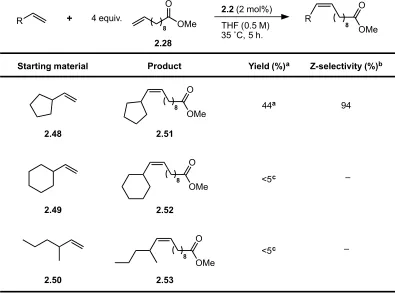
chromatography (Table 2.8). Vinyl cyclopentane (2.48) was found to undergo CM with
good Z-selectivity (94%) but a significantly lower yield of the desired cross product,
2.17, was obtained than in the case of the corresponding 5-membered cyclic acetal (44%
vs. 82%). Vinyl cyclohexane (2.49) was also investigated as a CM substrate under
identical conditions and only minimal cross product formation was noted (<5% conv.).
This was unexpected given the relatively small variation in cross product yield between
Table 2.8. CM of allylic-substituted hydrocarbons with methyl-10-undecenoate.
a Isolated yield. b Z-selectivity determined by 1H-NMR spectroscopy. c Conversion (not yield) determined by 1H-NMR spectroscopy
2.2 (2 mol%) THF (0.5 M) 35 ˚C, 5 h. 8
R +
2.28
R
8
2.48
8 OMe O
2.51
44a 94
OMe O O
OMe
2.49
8 OMe O
2.52
<5c –
2.50
8 OMe O
2.53
<5c –
5- and 6-membered acrolein acetals (2.8 and 2.14). Low reactivity was also observed for
the acyclic olefin, 3-methyl-1-hexene (2.50). This is suggestive that acrolein acetals may
be privileged substrates for CM due an electronic factor, a difference in conformational
preferences compared to the analogous hydrocarbons or both.
In addition, secondary allylic alcohol 2.54 was investigated as a substrate for
Z-selective CM with catalyst 2.2 (Table 2.9). Under the standard conditions, minimal
formation of cross product 2.58 was observed (<5%). Introduction of either a methyl- or
Table 2.9. CM of allylic-substituted secondary alcohols.
a
Conversion determined by GC and/or 1H-NMR spectroscopy.
2.2 (2 mol%)
THF (0.3 M) 35 ˚C, 5 h. 9
+
2.7
9 4 equiv.
R 4 R
4
Product Conversion (%)a
acetyl-protecting group (2.55 and 2.56) led to little improvement in CM under the same
conditions. In the case of the acetyl-protected alcohol, which could potentially form a
stable six-membered chelate similar to 2.46, low formation of 1-dodecene homodimer
was again noted. Poor reactivity was also observed in the case of the corresponding
secondary allylic chloride (2.57).
Differences in Reactivity and Selectivity between Catalysts
In all of the Z-selective CM reactions discussed thus far, catalyst 2.2 has been
used due to its higher Z-selectivity compared to 2.1 in CM of unhindered terminal
olefins.5,6,59
According to our working model, the improved selectivity results from
increased steric repulsion between the bulkier N-aryl group of 2.2 and the metallacycle
substituents, which increases the energy of the anti metallacycle. In the case of CM of
Entry Catalyst Yield (%)a Z-selectivity (%)a
1 2.1 87 76
2 2.2 92 94
3 2.3 96 10
4 2.5 92 5
Table 2.10. Comparison of catalysts in CM of 3-vinyl-1,2-dioxolane and 1-dodecene.
aYield and Z-selectivity determined by GC using tridecane as an internal standard; average of two experiments.
[Ru] (2 mol%) THF (0.3 M) 35 ˚C, 3 h. 9
O O
+
2.6 2.7
9 O
O
unhindered terminal olefins, both 2.1 and 2.2 display relatively high Z-selectivity at low
conversion, with the difference typically being on the order of a few percent.
Z-selective catalyst 2.1 and catalysts 2.3 and 2.5 were compared to catalyst 2.2 in
CM of 2.6 and 2.7 under identical conditions in order to examine how allylic substitution
affects the Z-selectivity of the catalysts (Table 2.10). Here, the difference in Z-selectivity
between 2.1 and 2.2 is considerably more pronounced than in previous examples with
catalyst 2.1 forming cross product 2.8 with 76% Z-selectivity compared to the 94%
achieved by 2.2. Both Z-selective catalysts demonstrate high yields of cross product 2.8,
with 2.2 giving a marginally higher yield. Catalysts 2.3 and 2.5 complement the
Z-selective catalysts, yielding 2.8 with 90% and 95% selectivity for the E-isomer. This
allows both E- and Z-acrolein acetals to be accessed with excellent stereoselectivity and
in high yield using Ru metathesis catalysts.
While both catalysts 2.1 and 2.2 were found to be efficient for CM of 2.6, there
were several examples of substrates for which 2.2 demonstrated extremely low activity.
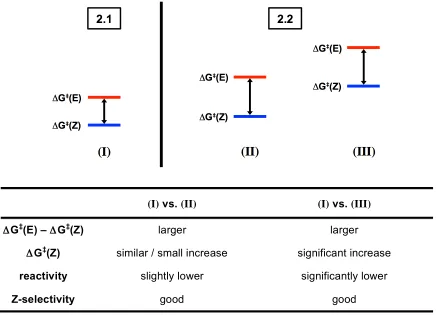
The difference in Z-selectivity between catalyst 2.1 and 2.2 is consistent with a more
significant energy difference between the rate-limiting steps for formation of Z- and
E-olefin products in 2.2 (larger ΔG‡(E)–ΔG‡(Z) in the case of 2.2). This follows directly
from the larger steric profile of the N-aryl group increasing ΔG‡(E) due to increased
steric clash in the anti metallacyclobutane. It is less obvious, however, how the N-aryl
group significantly influences the energy required for formation of the Z-olefin, ΔG‡(Z),
since the substituents of the syn metallacyclobutane are pointed away from the N-aryl
(Figure 2.6). If the N-aryl group has little affect on the Z-olefin pathway (ΔG‡(Z) is
similar for 2.1 and 2.2), then there may be little chance of improved reactivity by
employing catalyst 2.1 in place of 2.2 (Scenario (II)). If, however, ΔG‡(Z) is significantly
higher in energy for 2.2 than for the less bulky catalyst, 2.1 (Scenario (III)), then
improved reactivity may be obtained by employing 2.1. The exact energy differences
between the two catalysts are expected to vary from substrate to substrate with
differences in the bulk of the allylic substituent, which suggests that any improvements in
reactivity may be specific to a given substrate class.
(I) vs. (II) (I) vs. (III)
ΔG‡(E) – ΔG‡(Z) larger larger
ΔG‡(Z) similar / small increase significant increase
reactivity slightly lower significantly lower
Z-selectivity good good
Figure 2.6. Key scenarios representing reactivity for allylic-substituted olefins with catalyst 2.2
CM of Allylic-substituted Olefins with Catalyst 2.1
In order to examine which scenario best fits the observed reactivity, a number of
substrates that demonstrated sub-optimal reactivity with catalyst 2.2 (Table 2.8) were
re-examined using catalyst 2.1 (Table 2.11). In the CM of vinyl cyclopentane and
methyl-10-undecenoate, cross product 2.51 was obtained with an improved yield of 56% and a
relatively modest decrease in Z-selectivity from 94% to 86%. Several additional olefins
that showed negligible conversion with catalyst 2.2 demonstrated improved cross product
formation with 2.1. Using catalyst 2.1, CM of vinyl cyclohexane and
methyl-10-undecenoate demonstrated some conversion to the desired cross product (2.52), which
was formed in 10% yield and 73% Z-selectivity. Improved but modest conversions to the
Table 2.11. CM of allylic-substituted hydrocarbons with methyl-10-undecenoate using catalyst
2.1.
a
Isolated yield. b Yield and Z-selectivity determined by GC using tridecane as an internal standard. c Z-selectivity determined by 1H-NMR spectroscopy.
2.1 (2 mol%)
THF (0.5 M) 35 ˚C, 5 h. 8
R +
2.28
R
8
2.48
8 OMe O
2.51
56a 86c
OMe O O
OMe
2.49
8 OMe O
2.52
10b 73b
Product Yield (%) Z-selectivity (%)
4 equiv.
cross products were also noted for protected secondary allylic alcohols (2.59 and 2.60).
We then attempted to re-optimize conditions for the CM reaction using catalyst
2.1 in order to improve the yield for these more challenging substrates that performed
poorly under the previous conditions. CM of vinyl cyclohexane (2.49) and
methyl-10-undecenoate (2.28) was selected as the model reaction for optimization, using the
previous best conditions in CM of acrolein acetals as the starting point (Table 2.12, Entry
1). Increasing the excess of methyl-10-undecenoate to 6 equivalents or the catalyst
loading from 2 mol% to 5 mol% did not result in a significant improvement in the yield
for catalyst 2.2 (Entries 2–3). Unlike in the previous optimization, employing an excess
of the allylic-substituted olefin (2.49) led to significantly improved yields of 2.52. A
substantial increase in yield was obtained when doubling the equivalents of 2.49 from 2
to 4, with a smaller increase on further increasing the equivalents to 6 (Entries 5–7).
Decreasing the overall concentration of the reaction led to a further increase in yield,
reaching 40% (Entry 9). Subsequently, replacing THF with diglyme, an ethereal solvent
with a higher boiling point, further improved the yield of the desired cross product to
50% (Entry 11). Under identical conditions, 2.2 generated only 16% yield of 2.52 but
with 93% Z-selectivity, which supports the proposed difference in energy for the Z-olefin
pathway in the two catalysts (Figure 2.6). The new conditions represent a ca. five-fold
increase in yield when compared to the former conditions. Similar to the previously
optimized reaction, the Z-selectivity observed for the cross product was largely
unchanged across the various reaction conditions screened, giving a relatively consistent
value of 73–75%. This is consistent with low levels of secondary metathesis occurring