ON
THE DYNAMICS OF COMMUNITY FORMATION
Thesis by
Andrea Robbett
In Partial Fulfillment of the Requirements
for the Degree of
Doctor of Philosophy
California Institute of Technology
Pasadena, California
2011
c
2011
Andrea Robbett
Acknowledgements
I would like to thank:
Charles Plott, for teaching me experimental economics, having enough faith in me to fund
all my zany ideas, and giving me enough freedom to let me learn by occasionally screwing it all up;
Leeat Yariv, for her kindness, toughness, all around awesomeness, and caring about
every-thing more than any human should be capable of;
Rod Kiewiet, Jean-Laurent Rosenthal, Antonio Rangel, John Ledyard, and Iris Bohnet, for
their guidance and advice;
Laurel Auchampaugh, for holding it all together;
my friends in the department: Mo, Dustin, Muruvvet, Sera, Marjan, Ian, Ines, Alex, and
Andrej;
Greg Kimball, for always humoring me, Pia Ghosh, for never doing so, and the two of them
for making me a part of their family in Pasadena;
Eddie Papalia, for his love of economics, his acute appreciation of the absurd, and for letting
me sleep on his floor in Boston for eight months;
Aleks van Geen, for shouldering but never tolerating my tendency toward theatrical fatalism,
and for making me eat my vegetables;
my many close friends on the East Coast who have kept in constant contact and whose humor
and perspective have kept me sane, especially: Oleg Nudelman, Jenny Cleveland, Marni O’Brien,
Cham Sante, Elizabeth Kabak, Cristina Copersino, Paul Litvak, Arianna Sloat, Jamie Klimberg,
Yoel Inbar, Zara Wladawsky, Carla Pisarro, and Sully;
and, most of all, my parents, Jean and Bart Robbett, for their astounding and unwavering
patience and support, for not yet turning my old room into a gymnasium, and for always picking
Abstract
I study the dynamics by which populations with heterogeneous preferences for local public good
provision, or for other local policies, sort themselves into communities. I conduct a series of
laboratory experiments to consider whether the ability to “vote with one’s feet,” by moving between
communities, is sufficient for a population to reach optimal public good allocations and community
compositions, and to assess which institutions may best facilitate efficient self-organization when
residents are able to move freely between locations.
I find that communities allowing residents to make voluntary contributions toward the
provi-sion of a public good are characterized by instability, cyclical fluctuations in local proviprovi-sion, and a
dynamic in which low demanders continually chase high demanders through locations. Institutions
requiring all residents of a community to pay equal taxes enable subjects to sort by type into stable
communities. However, populations can find themselves stuck at one of two types of local,
ineffi-cient equilibria. First, though sorted, residents may fail to attain the level of public good provision
best suited for them, and, in that case, the system dynamics are crucial for determining whether
subjects reach the communities that offer optimally designed expenditure bundles. When residents
are able to vote for local tax policies with their ballots as well as with their feet, the inefficient local
equilibria are eliminated, and I find that each community converges to the most efficient outcome
for its population. Second, populations may sort into an inefficient equilibrium partition of
resi-dents across communities. I find that subjects moving between locations with fixed local policies
segregate by type, even when pooling their resources with similar types is more efficient. Again,
when subjects are able to vote on local policies, they typically succeed in forming communities of
the optimal size and membership composition.
These experimental results suggest that the ability to vote with one’s feet may not be sufficient
for achieving optimal outcomes and that voting, or another mechanism by which residents may
Contents
Acknowledgements iii
Abstract iv
1 Introduction 1
2 Community Dynamics in the Lab:
Congestion, Public Good Provision, and Local Instability 5
2.1 Introduction . . . 5
2.1.1 Related Literature . . . 10
2.2 Experimental Design . . . 12
2.2.1 Setting . . . 12
2.2.2 Experimental Procedure . . . 14
2.3 Provision of the Public Good . . . 15
2.4 Movement in Response to Public Good Provision . . . 18
2.5 The Role of Congestion in Community Stability . . . 25
2.6 Entry Fees . . . 29
2.7 A Note on Subject Pool Differences . . . 31
3 Local Institutions and the Dynamics of Community Sorting 33
3.1 Introduction . . . 33
3.2 Local Public Goods, Community Sorting, and the Tiebout Hypothesis . . . 38
3.3 Environment . . . 40
3.4 Experimental Design . . . 43
3.5 Ultimate Outcomes and Efficiency . . . 47
3.5.1 Efficiency Convergence . . . 47
3.5.2 Sources of Inefficiency . . . 49
3.6 Dynamic Results . . . 50
3.6.1 Voluntary Contributions . . . 51
3.6.2 Fixed Tax and Fixed Quantity . . . 52
3.6.3 Voting . . . 54
3.7 Conclusion . . . 54
4 The Role of Institutions in the Partitioning of Heterogeneous Populations 57 4.1 Introduction . . . 57
4.2 Experimental Design . . . 62
4.2.1 Setting . . . 62
4.2.2 Experimental Procedure . . . 63
4.2.3 Stability . . . 64
4.3 Results: Final Outcomes . . . 66
4.3.1 Efficiency Convergence . . . 66
4.3.2 Group Features . . . 67
4.3.3 Final Partitions . . . 68
4.4 Results: Overall Dynamics . . . 69
4.4.1 Persistence of Unstable and Stable States . . . 69
4.5 Conclusion . . . 75
A Chapter 2 Results for Caltech Subjects Only 77
B Chapter 2 Instructions 82
C Chapter 3 Instructions 86
D Chapter 4 Instructions 96
List of Figures
2.1 Average Contribution over Time . . . 17
2.2 Average Contribution by Community Size . . . 18
2.3 Likelihood that Subjects Are in a Community with Inferior Provision Levels . . . 19
2.4 Probit Estimates of Movement Decision . . . 20
2.5 Probability Movers Enter Highest Provision Community . . . 21
2.6 Features of Communities Entered and Exited . . . 22
2.7 Contribution Vs. Size of Community Joined . . . 24
2.8 Number of Communities Per Period . . . 26
2.9 Per-capita Contributions and Local Provision by Entry Fee . . . 30
3.1 Payoff Functions for the Two Types in Communities of 8 (Pooled) or 4 (Separate) Agents . . . 43
3.2 Experimental Procedure in Each Period under VCM, Fixed Tax, Fixed Quantity, and Voting . . . 46
3.3 Average Efficiency under Each Institution . . . 48
3.4 Sorting by Type in the Final Five Periods . . . 49
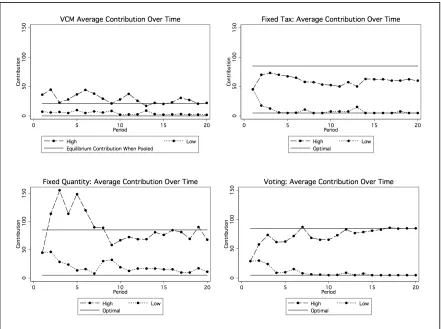
3.5 Average Contributions over Time under Each Institution . . . 51
3.6 The Importance of Community Size in Movement Decisions of the High Types . . . . 54
4.1 Experimental Procedure in Each Period . . . 64
4.3 The Average Efficiency in Each of the Final Five Periods and the Average Payoff for
Each Type . . . 67
4.4 Group Features . . . 68
4.5 Stability and Classification of Final Partitions . . . 70
4.6 Persistence of Unstable and Stable States . . . 71
4.7 Probability of Exit Heatmap and Group Choice . . . 72
4.8 Classifications of System Partition Over Time, by Experimental Session . . . 72
4.9 Frequency Heatmaps of the Likelihood of Subject in a Group of Various Sizes and Policies Different from Ideal . . . 73
A.1 Histogram of Populated Communities . . . 77
A.2 Average Contribution Over Time . . . 78
A.3 Average Contribution by Community Size . . . 78
A.4 Average Contribution and Average Size of Community Entered . . . 79
A.5 Average Size of Communities Entered and Exited . . . 79
A.6 Likelihood Subjects Are in a Community with Inferior Provision Levels . . . 80
A.7 Probability Movers Enter Highest Provision Community . . . 80
A.8 Provision of Communities Entered and Exited . . . 81
A.9 Size of Communities Entered and Exited . . . 81
B.1 Chapter 2 Instructions Page 1 . . . 83
B.2 Chapter 2 Instructions Page 2 . . . 84
B.3 Chapter 2 Instructions: MPCR and Quiz . . . 85
C.1 Chapter 3 VCM Instructions Page 1 . . . 87
C.2 Chapter 3 VCM Instructions Page 2 . . . 88
C.3 Chapter 3 VCM Payoff Table . . . 89
C.5 Chapter 3 Fixed Tax Instructions Page 2 . . . 91
C.6 Chapter 3 Fixed Quantity Instructions Page 1 . . . 92
C.7 Chapter 3 Fixed Quantity Instructions Page 2 . . . 93
C.8 Chapter 3 Voting Instructions Page 1 . . . 94
C.9 Chapter 3 Voting Instructions Page 2 . . . 95
D.1 Chapter 4 Fixed Policy Instructions Page 1 . . . 97
D.2 Chapter 4 Fixed Policy Instructions Page 2 . . . 98
D.3 Chapter 4 Voting Instructions Page 1 . . . 99
List of Tables
2.1 OLS Regressions of Provision on Community Features . . . 16
2.2 Community Composition Dynamics Regressions . . . 25
2.3 Growth of Singleton Commmunities . . . 28
2.4 Fixed Effects Regressions of Public Good Returns on Movement and Features of the New Community . . . 28
2.5 OLS Regression of Total Profits on Number of Moves . . . 29
3.1 Fixed Effects Regressions of Earnings on Movement . . . 52
Chapter 1
Introduction
This dissertation uses laboratory experiments to study the underlying processes of endogenous
group formation and community sorting. Specifically, I study the dynamics by which people with
very different preferences for public good provision, or other local policies, sort themselves into
communities.
Americans are highly mobile – in fact, every year, nearly fifteen percent of us move to a
different location – and a fundamental question is how we choose our communities and, perhaps,
sort ourselves geographically. At the same time, one of the most important roles of our communities
is to provide public goods and services, such as roads, parks, schools, libraries, police and fire
protection, and so forth. Residents typically vary in their demand for these services, and how to
provide them efficiently in light of this heterogeneity is a central problem of public economics.
The canonical model from local public finance is the Tiebout model from the 1950s, which
says that, if households can move freely between jurisdictions, then residents will vote with their
feet and move to the community where the local taxes and public expenditures best suit them. In
this way, they will sort themselves by their preferences for public goods and they can then be taxed
according to their demand. Thus, mobility can lead to an optimal allocation of public goods at the
local, community level.
However, the question remains as to whether populations do indeed sort themselves into
communities so as to achieve efficient public good provision. The inability to measure a household’s
true demand for public goods makes it very difficult to test whether migration patterns in our
communities are in fact driven by these preferences, and direct tests of the Tiebout hypothesis
that make this an ideal problem to study with laboratory experiments. Preferences can be readily
generated in the lab by varying the payoffs that subjects receive from standard public goods games
and we can then observe the dynamics of movement within a controlled setting. This is the approach
taken in this dissertation and, ultimately, the findings reported here suggest that the ability to vote
with one’s feet isnot sufficient for achieving optimal allocations.
I conduct a series of experiments that each follow the same basic setup. Subjects come to
the lab and are randomly assigned different preferences. High Typesreceive very high returns from
public good provision andLow Typesreceive very low returns. There are several available locations
that remain fixed for the duration of the experiment. In each period, each subject simultaneously
chooses a location, they see the number of other people who have chosen the same location, and
they make a contribution to the public good there. They then receive a payoff from the total
contributions made only within their location. Finally, they see the outcomes in all locations,
including the number of people in each and the total contributions made there, before making their
next move. However, they do not receive any information on the identity of the other subjects,
their individual contributions, or the payoffs of the others.
In the first set of experiments, presented in Chapter 2, I consider a voluntary contribution
mechanism, which allows subjects to contribute any amount that they wish. This enables
differ-ent types to contribute differdiffer-ent amounts within a single location. I find that subjects move in
response to both provision and community composition but that the growth and stability of these
communities are dictated by movement costs and crowding. When the public good is congestible,
such that returns are lower for larger populations, communities are characterized by instability,
cyclical fluctuations in local provision, and a dynamic in which Low Types continually chase High
Types through locations. The High Types enter previously empty locations at an immediate cost
to themselves and make substantial contributions. The Low Types enter as soon as this community
surpasses their own, provision declines, and the High Types exit once again. While communities
with high entry fees primarily attract those with high public good returns, segregation is not
suf-ficient for overcoming free-riding. When congestion is eliminated, such that a single populated
community is both efficient and strong Nash stable, agents with different preferences sometimes
co-exist. However, chronic, inefficient movement persists. Less than half of movement appears
to be driven by congestion, and the High Types continue to exit even when the presence of Low
composition of their community and that additional institutional structure on how contributions
are determined may be necessary for community stability.
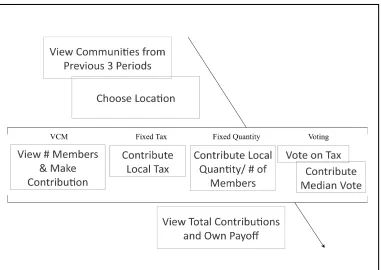
Therefore, in Chapter 3, I compare the voluntary contributions environment with three
different institutions requiring all members of a community to contribute the same amount. How
the subjects’ contributions are determined depends on the institution governing their experimental
session and I consider which institutions may best facilitate efficient self-organization when residents
are able to move freely between locations. Under the first institution, each location is associated
with a different fixed, posted tax that all subjects must pay in each period that they reside there.
Among these locations are those offering the optimal tax rates for each of the two types. Under the
second institution, each location is associated with a fixed, posted total contribution level and all
subjects must contribute an equal share of this amount. Under the final institution, the location’s
current members vote on the tax in each period, the median voter’s preference is implemented,
and all residents are required to contribute this amount. These three institutions generate the
same unique strong Nash equilibrium in which the types separate, consolidate, and consume their
optimal, tax provision pair.
Under all three of the institutions requiring all members of a community to make equal
contributions, subjects separate by type into an optimal partition. When they are able to vote only
with their feet, by moving between communities offering fixed taxes or provision levels, subjects
often become stuck at local, inefficient equilibria such that they under-provide or over-provide
the public good. In other words, though they sort into separate, homogeneous communities, the
subjects often fail to attain the optimal provision within these communities, because they are
unable to coordinate on the location offering the optimal tax-provision bundle for their type. This
is striking because it suggests that, even with fixed local taxes as in the original Tiebout model,
voting with one’s feet may not be sufficient: Existence of communities with optimally designed
policies does not guarantee that they will be entered, and inertia, or the desire to be around others,
can prevent optimality from being reached.
However, under the voting institution, which enables subjects to vote both with their feet and
with ballots, the inefficient local equilibira are eliminated and these communities converge to the
optimal outcome for their populations. Voting with their feet enables subjects to sort by moving
to the community that they like, while voting with their ballots enables them to then adapt the
allows residents to influence community policy without needing to relocate may be necessary for
overcoming coordination failure and achieving optimal allocations.
Chapter 4 builds on the results of Chapter 3 by incorporating a more refined spectrum of
preference types and focusing on the partitioning of agents by type across locations, rather than
the optimal provision of public goods. The experiments in this chapter address the dynamics by
which heterogeneous populations partition themselves into groups when there is a trade-off between
increasing returns to group size and attaining a group policy closest to an ideal point (as is the
case in Chapter 3 when communities provide a public good through mandatory tax rates). Two
experimental conditions are conducted in which subjects can move freely between locations, with
group policy either fixed by location or determined by member vote. The same set of Nash stable
partitions exists in each condition, with the most efficient stable state requiring subjects to form
heterogeneous groups and compromise on policy. I find that subjects who are only able to move
between locations with fixed policies always over-segregate, failing to sustain heterogeneous groups
or build locations with compromise policies. However, when mobility is combined with the ability
to vote on local policy, subjects successfully form heterogeneous groups and most reach the optimal
partition. This suggests that local governance is relevant for determining whether populations will
pool their resources into larger groups, even when voting does not alter the set of stable states, and
that the dynamics, in addition to stability concepts, are important for understanding the effects of
institutional and other environmental factors on group formation.
The experimental results presented here suggest that the ability to vote with one’s feet is
not sufficient for populations to either obtain optimal public goods expenditure bundles or to sort
Chapter 2
Community Dynamics in the Lab:
Congestion, Public Good Provision,
and Local Instability
2.1
Introduction
Local communities often vary greatly in their overall character and culture and, over time, can
ex-perience substantial transformations and changes in population. One defining attribute of
commu-nities is the public goods and services they offer, whether provided by local government through tax
revenue, such as schools, libraries, and recreation areas, or voluntarily by residents, such as
neigh-borhood watch programs, volunteer fire departments, street festivals, resident-built playgrounds,
and community gardens. Residents typically vary in how much they value such amenities. This
chapter uses laboratory experiments to study the dynamics of local community formation,
devel-opment, and stability when agents receive very different returns from a public good.
One common pattern of community transition often described by urbanists is the process
of revitalization, typically thought to be initiated by “urban pioneers.”1 New residents enter
uninhabited commercial districts or (far more controversially) lower-income neighborhoods and
expend considerable effort modifying the location, by making aesthetic improvements, providing
cultural amenities, renewing the housing stock, and making formerly commercial areas habitable.
Conventional wisdom among both urban economists and real estate investors has been that these
pioneers are members of artistic and bohemian populations, who provide a public good in the form
of the cultural, aesthetic, and nightlife amenities that most benefit them and, in doing so, further
attract similar residents.2 Eventually, the efforts of the new residents make the neighborhood
attractive to higher-income populations, sometimes referred to as “settlers.”3 In the final step
of neighborhood shift, the initial pioneers, who had been voluntarily providing a public good,
are typically displaced once the neighborhood becomes popular. This pattern played out most
famously in SoHo in the 1970s, but can also be observed in other New York City neighborhoods
such as TriBeCa and the East Village, as well as those of other cities.4
In this chapter, I use laboratory experiments to study the main forces underlying such
dy-namics. I conduct simple linear public goods experiments in a free-mobility environment to gain
insight into the basic processes of movement, community formation, and the phenomenon of one
type of agent chasing another. Within this setting, I induceheterogeneous preferences for the
pub-lic good and study the dynamics of movement and voluntary local pubpub-lic good provision. Those
subjects who receive high payoffs from public good provision are then analogous to the populations
typically thought to be urban pioneers, while those with weaker preferences resemble the settlers
who later enter the community. To the best of my knowledge, this chapter represents the first
ex-perimental study of the importance of preference heterogeneity in the dynamics of group formation
and movement.
Most local public goods and services are, to some extent,congestible, in that the presence of
more residents diminishes the benefit that each individual may obtain. I analyze the importance
of payoff congestion in public good returns for movement dynamics and stability, by comparing
sessions in which the public good is pure (non-rivalrous) with sessions in which the public good is
congestible.
These experiments are designed to address the following questions: 1) Is movement driven by
agents’ preferences for the public good? 2) Are instability and cyclical movement patterns caused
primarily by congestion? and 3) Can entry fees facilitate sorting and local cooperation?
Communities often face social dilemmas, in which individual incentives diverge from the
interests of the community as a whole, that may hinder the efficient provision of public goods.
Since all members may consume the public good, regardless of whether they contribute to it, they
have an incentive to under-contribute relative to their true demand, and equilibrium behavior
2
Florida and Mellander (2007)
3Hudson (1988) expands the invasion-succession model to include this second wave. 4
results in individual free-riding and a suboptimal allocation of the public good provided in the
community. Efficient provision is even more difficult to achieve when residents have different,
unobservable preferences for public good consumption, since a community cannot require different
contributions or behavior from those who would benefit most. For instance, residents not concerned
with local school quality typically do not pay lower taxes, just as those who care strongly about
the neighborhood’s appearance cannot be required to contribute to its upkeep.
Charles Tiebout (1956) addressed the problem of efficient public good provision with the
insight that many of the public goods and services that we consume are provided by our local
communities and that non-residents may be geographically excluded from consuming them. He
proposed that residents who are able to move freely between local jurisdictions would enter the
community that best satisfied their preferences for the public good along with other local
non-economic features.5 By moving in response to differences in local communities, residents reveal
their true preferences and an efficient public good allocation can be achieved at the local level. The
fundamental premise of Tiebout’s argument has implications far beyond local public finance and
public good provision and Tiebout’s proposal is routinely invoked across disciplines to capture the
idea that if we dislike our current situation we can move elsewhere – somewhere better, where the
people and policies better suit our preferences, and the outcomes are more to our liking.
The experiments reported in this chapter incorporate two fundamental features of Tiebout’s
framework: that public goods are spatially excludable and may be consumed only by local residents,
and that residents are both fully mobile and fully informed of the differences between locations.
One dynamic result emerging from the Tiebout literature is that of the poor chasing the rich, or the
so-called musical suburbs problem (Hamilton, 1975; Wilson, 1998). This is commonly subverted
in practice through the implementation of zoning policies, which lead to uniform tax rates, or,
historically, even through restrictions placed on the mobility of the poor.6 However, as the pattern
of settlers following pioneers in the process of urban revitalization indicates, similar movement
patterns may be found if residents relocate in response to a public good that is provided voluntarily,
rather than through tax revenue.
5For instance, Tiebout specifically references the desire of residents to have “nice” neighbors (Tiebout, 1956,
p.418). 6
I introduce two different types of agents: those who benefit greatly from the public good (High
Types), but may be highly sensitive to congestion, and those who receive very low returns from
the public good but are indifferent to the presence of others (Low Types). Subjects are randomly
assigned different returns from public good provision at the start of the experiment and participate
in a standard linear public goods game, during which they can move between communities.7 There
are six available locations that remain fixed for the duration of the experiment, and the subjects
play a dynamic game that lasts for sixty-five to eighty periods (allowing for ample time to assess
the stability and long-run dynamics).
In each period, the subjects first simultaneously choose a location. They then observe the
number of others who chose the same location, and make a voluntary contribution to the
com-munity’s public good. They receive a payoff that depends on the total contributions made only
within their own location, as well as their assigned marginal return from the public good. Finally,
the subjects learn the outcomes in all locations before making their next move. Consistent with
the difficulty in observing public goods preferences of other households, which is at the root of the
problem of inefficient public good provision, the subjects do not receive any information on the
returns from the public good received by fellow participants.
This chapter also analyzes the extent to which community instability may be driven by payoff
congestion, by directly comparing experimental sessions with a congestible public good to sessions
with a pure public good. When the public good is congestible, High Types receive lower returns
from public good provision in more populated communities. In the absence of congestion, the most
efficient outcome occurs when the population pools its resources into a single community and, in
this case, there is no set of residents who may increase their payoffs by collectively relocating.
Each location is associated with an entry fee. These fees capture the cost that a household
incurs by moving, but also vary between locations, capturing the existence of communities that
are less easily accessible, for instance due to geographical location, higher real estate prices, or
substantial joining fees or requirements for initiation. Movement into three of the six locations
carries a very low cost (equivalent to twenty percent of the subject’s per-period endowment), while
movement into the other three locations carries a much higher cost (equivalent to sixty percent of
the subject’s endowment). Since the Low Types benefit little from public good provision, these
7
entry fees are relatively higher for them, and imply that provision in another community must be
far greater than in their own in order for them to gain by moving. Such fees can therefore serve as
a mechanism that coordinates separation by type and allows the High Types to avoid congestion.
I find, first, that subjects’ behavior varies greatly by their assigned public good preferences.
While the Low Types contribute little and, over time, learn not to contribute anything at all, the
High Types do contribute, and they sustain these contributions for the duration of the experiment.
But, though the High Types tend to contribute consistently, the locations themselves experience
vast, cyclical fluctuations in public good provision. Local provision peaks immediately after the
community is formed and then declines steadily over the life of the community. This is reminiscent
of the pattern of urban revitalization in which the most substantial contributions are made by the
early entrants, making the community attractive to others.
Consistent with the fundamental premise of Tiebout’s model, the subjects do, in fact, move
in response to these differences in local public good provision. Perhaps more importantly, this
movement is greatly shaped by the subjects’ exogenously assigned preferences for the public good.
The High Types are far more responsive to differences in local provision. While neither type
remains in communities with low provision, the High Types have a significantly lower threshold
for movement, and are typically in the community with the highest provision level. Thus, taken
statically, or without consideration of the changes in communities over time, there is some evidence
of sorting by type.
Congestion seems to play an important role in community dynamics. Communities tend
to be highly unstable when the public good is congestible, and there is a clear pattern of the
Low Types chasing the High Types through locations. The High Types frequently exit populated
communities with declining provision levels in favor of previously unoccupied locations and at an
immediate cost to themselves. They make substantial contributions to the public good and are
quickly joined by other High Types. Once their community becomes competitive, they are followed
by the Low Types, provision deteriorates, and the cycle starts once again. Movement is frequent,
with at least one subject typically moving in each period, and never subsides over the course of a
sixty-five period experiment.
Though movement is less frequent in sessions without congestion, the chasing dynamic and
community instability persist. The heterogeneous population of subjects is often able to co-exist
be driven by congestion and the High Types continue to exit even when the presence of Low Types
does not diminish their payoffs. In addition, frequent movement is associated with lower payoffs.
This suggests that the chasing phenomenon is not driven purely by payoff-based incentives, but
that people may also have intrinsic preferences for the composition of their community and that
movement is partially driven by an unwillingness to be around those who do not contribute to the
community.
With respect to entry fees, I find that local fees can facilitate the High Types’ coordinated
avoidance of the Low Types but do not promote long-term community stability. The existence
of locations with differing entry fees allows the High Types to coordinate on a community and to
avoid congestion caused by the Low Types. Locations associated with high fees are entered almost
exclusively by High Types and the subjects contribute more when they are there. However, even
when High Types segregate, provision is not sustained and these communities are ultimately no
more stable than those with low entry fees.
The experimental results described in this chapter show clear patterns of movement driven
by subjects’ assigned preferences for public good provision that strongly resemble those observed in
neighborhood transitions. Those subjects who benefit most from public good provision often enter
previously unoccupied locations and make substantial contributions to the public good. They are
joined, first, by those with similar preferences, and, eventually, by those who benefit little and do
not contribute, before exiting once again. Further, the continual exit of the pioneering subjects
is only partially driven by local crowding, suggesting that community instability may be partially
attributed to an intrinsic unwillingness to provide for those who do not contribute.
2.1.1 Related Literature
Experimental studies have consistently shown that voluntary contributions in fixed-group, linear
public goods games begin midway between optimal and one-shot equilibrium levels but decline with
repetition, typically approaching the theoretical equilibrium unless supported by institutions, such
as sanctions or taxes for those who contribute too little (Ledyard, 1995; Ostrom, 2000).
However, it is rarely the case that individuals are assigned to a fixed community. Instead,
we nearly always enter our communities voluntarily, with some expectations of the group outcome
we disapprove of the behavior of our neighbors. Therefore, a more practical approach is to study the
public goods problem at the local level, where association is voluntary and movement is possible.
Despite the abundance of applications, only recently has experimental research jointly
con-sidered voluntary public goods contributions and endogenous group formation. The results thus
far suggest that mobility in itself is not sufficient to solve the public goods problem without the
implementation of formal boundary rules that restrict group entry. When individuals have
com-plete freedom to move between groups then free-riders will continuously chase contributors between
societies.
Ehrhart and Keser (1999), the first to conduct such experiments, study a congestible linear
public goods game. They find a group-level dynamic in which groups with high contributions
grow, contributions in large groups decline, and groups with declining contributions shrink, and an
individual-level correlation suggesting that higher contributors exit larger groups in favor of smaller
ones. A pair of studies compared treatments in which subjects can freely move between groups,
can enter only with their new group’s consent, or can exit only with their former group’s consent
(Ahn, Isaac, and Salmon, 2008/2009). They find that subjects often vote to deny entry or approve
exit, even in the pure public good treatment when groups benefit from having more members, and
so, while restricted entry serves to increase contributions, earnings are lower for cooperators when
the public good is pure.
Several other experimental studies have found that high contributions can be sustained in
voluntary contribution public goods games when subjects are provided with a mechanism to build
their groups and control membership composition (Page, Putterman, and Unel, 2005; Weber, 2006;
Charness and Yang, 2010).
There is evidence that declining contributions may be explained by conditional cooperation
– the willingness of subjects to cooperate only if their partners do as well – and approximately half
of experimental subjects decrease their contributions if their group members contribute less
(Fis-chbacher, G¨achter, and Fehr, 2001). Faced only with the choice of how much to contribute, subjects
locked into fixed groups have no other means of retaliation against free-riders and quickly learn to
cease attempts at cooperation. Several experimental studies have tested conditional cooperation
by sorting subjects based on the propensity for cooperation that they exhibit in earlier periods or
ever encounter other cooperators.8
Experiments allowing subjects to buy entry into separate games designed to be more
at-tractive to cooperators typically find moderate but incomplete sorting (Bohnet and K¨ubler, 2005;
Brekke, Hauge, Lind, and Nyborg, 2008). Finally, when subjects may “vote with their feet” for
local institutions and choose between groups with or without punishment mechanisms, they
ini-tially separate, with only the most cooperative joining the punishment community. However, the
entire population eventually gathers in the community with punishment and achieves high levels
of efficiency (G¨urerk, Irlenbusch, and Rockenbach, 2006).
Many important aspects of this problem remain unexplored. In addition to having different
preferences for contributing or free-riding, as these studies suggest, individuals in a society
typi-cally obtain varying benefits from public good consumption. These differences are at the core of the
preference revelation problem and the inability of a central government to efficiently provide public
goods. While there have been several fixed-group public goods experiments considering
heteroge-neous preferences, there has not been any experimental work that incorporates such differences into
the local public goods framework, and, to my knowledge, this is the first experimental study on
the dynamics of group formation when agents have heterogeneous preferences.
2.2
Experimental Design
2.2.1 Setting
The experiments in this chapter consider a local, linear public good that is provided by voluntary
contributions from community members. There are nine agents in the population and six available
locations. In each period, agents make the dual choice regarding where to locate and how much to
contribute to their community once they are there. Each agent belongs to exactly one community
in each period, and consumes only the public good provided within his location (there are no
spillovers).
8
All agents have the same per-period endowment of 25 units each and differ only in their
marginal per-capita return (MPCR), which is the increase in profits that the agent receives from
someone in his community contributing an additional unit to the public good. Agents whose
payoffs are sensitive to congestion experience declining MPCR over the number of members in
their community. Let Lit be the location that agent i chooses in period t. In each period, each agentireceives a payoff that depends on his personal contribution,ci, the total contributions made at his location, the total number of members at his location,n(Lit), and any entry fees he may have incurred by selecting a different location than in the previous period,f(Lit).
In each periodt, agenti’s payoff is equal to:
πti= 25−cit+M P CRi(n(Lit))∗ X j|Ljt=Li
t
cjt−f(Lit)∗1Li
t6=Lit−1 (2.1) where MPCR is equal to:
Congestible Public Good Sessions Pure Public Good Sessions
Low Types: M P CR= 0.15 M P CR= 0.15
High Types: M P CR= 1−0.08(n(Li)−1) M P CR= 0.8 if n(Li)>1
M P CR= 1 if n(Li) = 1
Entry fees are the same for all agents and vary by location entered: three of the six locations
have an entry fee of 5 units and the other three locations have an entry fee of 15 units. In each
population of nine agents, there are five “High Types” whose MPCR is very high, such that they
greatly benefit from local public good provision. In the congestible public good sessions, the MPCR
of the High Types declines sharply with the number of other members in their community, thus
making them very sensitive to the presence of free-riders. In the pure public good sessions, their
MPCR remains high regardless of the community size. In both pure public good and congestible
public good sessions, the MPCR is set at 1 when a High Type is in a community by himself, thus
ensuring that between-condition differences are not driven by signaling costs. The remaining four
agents in the population are “Low Types” who have an extremely low marginal per-capita return,
which is constant across the number of members.
When the public good is congestible, the most efficient outcome occurs when all High Types
units each, while avoiding the other two Low Types who locate elsewhere and contribute nothing.
When the public good is pure, the most efficient outcome has all High Types and Low Types in a
single location, contributing their full endowments.
2.2.2 Experimental Procedure
Experiments were conducted using the experimental software z-Tree (Fischbacher, 2007) in the
Lab-oratory for Experimental Economics and Political Science at the California Institute of Technology
and in the Harvard Decision Science Laboratory at the Harvard Kennedy School of Government.
Nine subjects participated in each session, and were paid based on their performance in the game.
There were thirteen sessions in total: six in which the public good was pure (non-rivalrous) and
seven in which the public good was congestible.
In the initial period of each session, the subjects were randomly assigned to three communities
of three members each and chose how to allocate their endowment between private and public
consumption. In subsequent periods, all six locations were available, and the participants made
their decisions in two stages.
First, the subjects chose whether to stay in their current location or to move to a different
location for a fee. While making this choice, they were able to observe the total contributions and
number of community members in all locations, as well as their own contributions and returns, in
each of the previous three periods.9 Movement into one of the three original locations incurred the
low fee (5 units: equivalent to 20 percent of their per-period endowment) while movement into one
of the other three locations incurred a much higher fee (15 units: 60 percent of their endowment).
As shown in Equation 2.1, entry fees were subtracted from their payoffs at the end of the period
and thus did not restrict contributions.
Once they made their location decisions, the subjects then observed how many others were
in their chosen location and made a contribution to that community’s public good. Subjects were
able to observe only the number of people and the total contributions in the locations, and did not
receive any information regarding the location of specific subjects or individual contribution levels.
9Through pilot experiments it was determined that subjects who were provided with the full history never looked
2.3
Provision of the Public Good
I first analyze the voluntary provision of the local public good, before considering movement in
response to local provision, the role of congestion in community stability, and the effect of entry
fees in the subsequent sections. All of the results are presented separately for the congestible public
good (CPG) and pure public good (PPG) sessions. It is worth noting at the outset that many of the
differences observed between the two types of sessions appear to be driven by community instability
and frequency of movement. In particular, there is a clear dichotomy in the pure public goods
sessions. In half of these sessions, movement is very rare (occurring in 4% of opportunities) and
the entire population is nearly always in a single community. In the other half of PPG sessions and
the CPG sessions, movement is common (occurring in 16.9% of opportunities in the PPG sessions
and 18% in the CPG sessions). This will be further discussed in Section 2.5, which specifically
addresses congestion and community stability, but in the meantime I will mention any results that
vary between infrequent movement PPG sessions and frequent movement PPG sessions.
The main insight emerging from the analysis of public good provision is that there is a
pronounced difference in the contribution patterns of the two types. The High Types provide the
local public good. While the Low Types contribute very little, the High Types contribute nearly
half of their endowment and they sustain their contributions for the duration of the experiment.
Finally, the High Types tend to contribute less in larger communities, even in the absence of
congestion, while the Low Types contribute more.
Table 2.1 reports estimates of a regression of community provision on the number of residents
of each type along with the number of periods that the community has been continuously populated
(unpopulated locations are not included). Regressions are run separately for the congestible public
goods and pure public goods sessions and standard errors are given beneath the coefficients.
First, we see that the presence of High Types has a large positive effect on community
provision, while the presence of Low Types does not have a statistically significant effect. This is
the case in both the congestible and pure public goods sessions.
Although contributing nothing is the dominant myopic strategy for both types, the High
Congestible Pure
Number of High Types 9.6*** 12.12***
(.37) (.58)
Number of Low Types .18 .4
(.47) (.75)
Time Populated -.32*** -.06
(.04) (.04)
Intercept 11.13*** 4.0***
(1.02) (.51)
R2 0.43 0.56
Observations 1109 852
** Significant at 5% Level *** Significant at 1% Level
Table 2.1: OLS Regressions of Provision on Community Features
affects contributions.10 There are no differences in average contributions between the pure public
good and congestible public good sessions.
From Table 2.1 we also see that provision declines over the length of time that the community
has been populated. In both the CPG sessions and the frequent movement PPG sessions,
commu-nity provision is highest in the first period in which at least two subjects are in the commucommu-nity,
peaking at approximately 37 and then declining by an average of 3 units in each of the next few
periods.11
To understand the community dynamics we must also consider how the contributions of the
two types change over time and in response to community size. In addition to the differences in
average contributions, the types also exhibit differences in their contributions over time.
Interest-ingly, part of this difference appears to be driven by how frequently the subjects are together in a
single community.
Figure 2.1 shows the average contribution over time for each type. First, we see that the
contributions of Low Types decline significantly over the course of the experiment and, in the CPG
sessions, approach zero.12 In contrast, the contributions of the High Types are sustained for the
duration of the experiment. In fact, when the public good is congestible, approximately half of the
10See for instance: Isaac, McCue, and Plott (1985) and Isaac, Walker, and Thomas (1984). 11
The formation of new communities is rare in the PPG sessions without frequent movement and so there are not enough observations to make meaningful statements about how provision changes in the early periods of the community.
12
High Types actually increase their contributions from the initial periods to the final periods.
There is evidence that this difference in contributions over time may be partially driven by
community instability. If we exclude periods in the PPG sessions in which the entire population
is located in a single community, the contributions over time exhibit the same patterns as in the
CPG sessions. When all subjects are in a single community, the divergence in behavior between
High and Low Types is less stark: Some Low Types continue their contributions to the end of the
session, while most High Types moderately reduce their contributions. This suggests that subjects
are more likely to contribute according to their type when communities are less stable.
Figure 2.1: Average Contribution over Time in Congestible (left) and Pure (right) Sessions
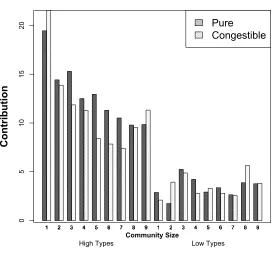
We next look at how subjects’ contributions vary over community size. Figure 2.2 shows the
average contributions of each type over community size in the CPG and PPG sessions.
First, we see that the contributions of High Types decline over community size when the
public good is congestible. This is not surprising, since the High Types in these sessions receive
lower returns from public good provision in larger communities and we have already observed that
the subjects’ contributions are responsive to MPCR.
Communities may also experience behavioral congestion: Collective action problems would
cause both types of agents, in both conditions, to contribute less in larger communities. In fact,
Figure 2.2 shows that High Types’ contributions also decline over community size in the PPG
sessions, when MPCR is constant. High Types’ contributions are negatively correlated with
com-munity size in both types of sessions (significant at the .01 level for each), with the magnitude of
the effect approximately double in the congestion sessions.
Type contributions are weakly positively correlated with community size in both the congestion
and pure public good sessions, and both are significant at the .01 level.
Average Contribution Over Community Size
0
5
10
15
20
1 2 3 4 5 6 7 8 9 1 2 3 4 5 6 7 8 9
1 2 3 4 5 6 7 8 9 1 2 3 4 5 6 7 8 9
1 2 3 4 5 6 7 8 9 1 2 3 4 5 6 7 8 9
1 2 3 4 5 6 7 8 9 1 2 3 4 5 6 7 8 9
1 2 3 4 5 6 7 8 9
High Types Low Types
Community Size
Contribution
Pure Congestible
Figure 2.2: Average Contribution by Community Size
Similarly, community size has a significantly negative effect on the likelihood of the High
Types contributing any non-zero amount in both the congestible and the pure sessions, and a
significantly positive effect on the likelihood that the Low Types contribute.
2.4
Movement in Response to Public Good Provision
I next analyze the extent to which movement is influenced by local public good provision for
each of the two types of agents. While the voluntary contribution mechanism differs from the
environment considered by Tiebout and the incentives for location choice are very different in
this game, movement in response to variation in local provision history does provide support for
Tiebout’s fundamental premise. The results described in this section strongly suggest that subjects
move in response to provision and, further, that this movement is greatly shaped by their returns
First, subjects are most frequently in the community with the highest provision level and
typically move if there is a community with vastly higher public good provision than in their own.
Figure 2.3 presents cumulative distribution functions for subjects of each type in both the CPG
and PPG sessions. The horizontal axis shows the discrepancy between the total contributions in
the subject’s location and those in the location with the highest total contributions.
Figure 2.3: Likelihood that Subjects Are in a Community with Inferior Provision Levels
The likelihood that subjects are in an inferior community clearly depends on the magnitude
of the difference in provision levels. Subjects are in the community with the highest total provision
52% of the time in the congestion sessions and 80% of the time in the no congestion sessions. This
suggests that multiple populated communities can persist only if they offer similar provision levels.
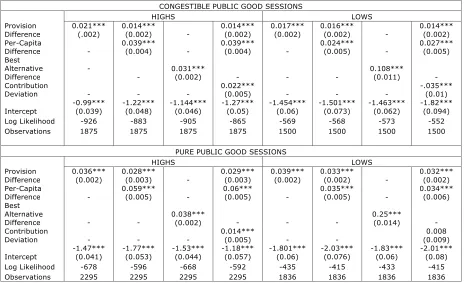
To ascertain the main driving forces behind the movement decision, I estimate a series of
probit models of the subjects’ decisions to move based on several features of their community
in the previous period as well as its performance relative to the other available communities.
Specifically, the explanatory variables considered are: the difference in community provision relative
to the highest provision community (provision difference), the difference in per-capita community
provision relative to the community with the highest per-capita provision (per-capita difference),
the difference in the subject’s payoff in the previous period and the highest payoff he would have
received had he been in a different community making the same contribution (best alternative
the community (contribution deviation). The estimates are presented in Figure 2.4.
First, these estimates show that the probability of exiting a community is significantly driven
by the difference between provision in one’s own community and in the community with the highest
provision. Second, the decision to move is also significantly affected by the difference inper-capita
contributions and, in conjunction, these two variables have more explanatory power than how much
a subject’s payoffs differ from the best he could have done. Finally, High Types are more likely to
exit communities when their personal contribution exceeds that of the community average.
CONGESTIBLE PUBLIC GOOD SESSIONS
HIGHS LOWS Provision
Difference 0.021*** (.002) 0.014*** (0.002) - 0.014*** (0.002) 0.017*** (0.002) 0.016*** (0.002) - 0.014*** (0.002) Per-Capita
Difference - 0.039*** (0.004) - 0.039*** (0.004) - 0.024*** (0.005) - 0.027*** (0.005) Best
Alternative
Difference - - 0.031*** (0.002) - - - 0.108*** (0.011) - Contribution
Deviation - - - 0.022*** (0.005) - - - -.035*** (0.01) Intercept -0.99*** (0.039) -1.22*** (0.048) -1.144*** (0.046) -1.27*** (0.05) -1.454*** (0.06) -1.501*** (0.073) -1.463*** (0.062) -1.82*** (0.094) Log Likelihood -926 -883 -905 -865 -569 -568 -573 -552 Observations 1875 1875 1875 1875 1500 1500 1500 1500
PURE PUBLIC GOOD SESSIONS
HIGHS LOWS Provision
Difference 0.036*** (0.002) 0.028*** (0.003) - 0.029*** (0.003) 0.039*** (0.002) 0.033*** (0.002) - 0.032*** (0.002) Per-Capita
Difference - 0.059*** (0.005) - 0.06*** (0.005) - 0.035*** (0.005) - 0.034*** (0.006) Best
Alternative
Difference - - 0.038*** (0.002) - - - 0.25*** (0.014) - Contribution
Deviation - - - 0.014*** (0.005) - - (0.009) 0.008 Intercept -1.47*** (0.041) -1.77*** (0.053) -1.53*** (0.044) -1.18*** (0.057) -1.801*** (0.06) -2.03*** (0.076) -1.83*** (0.06) -2.01*** (0.08) Log Likelihood -678 -596 -668 -592 -435 -415 -433 -415 Observations 2295 2295 2295 2295 1836 1836 1836 1836
Figure 2.4: Probit Estimates of Movement Decision
When the subjects do move, they typically select the community that performed best in
the previous period, based on either total or per-capita contribution levels, or the community that
would have given them the highest payoff in the previous period. Figure 2.5 shows the likelihood
that the subjects who move make the “best” location choice by entering the community with
the highest average or total contributions, by entering the community in which they would have
received the highest payoff had they been in that community making the same contribution in the
previous period, or by entering a community satisfying at least one of these three criteria. These
myopic best responses and, as we will see later in this section, these subjects exhibit other strategic
differences.
Figure 2.5 shows that the counterfactual tends to best explain which community the subjects
enter in nearly all of the conditions, though there is considerable overlap and the difference is slight.
While Low Types are just as likely to choose their new community based on total contributions or
average contributions, High Types are more attracted to communities with greater per-capita
con-tributions – even when there is no congestion in their payoffs.13 Subjects select the previously best
performing community with a frequency significantly greater than if they were choosing randomly,
either among all of the locations or among all of the low entry fee locations.14 However, neither
are they fully myopically best responding to the previous state.
Figure 2.5: Probability Subjects in Congestible (left) and Pure (right) Sessions Move to Highest Provision Community
I next analyze how movement patterns vary for each of the two types.
High Types have a much lower threshold for exit than Low Types and, though in similarly
sized communities, High Types experience higher provision levels than Low Types. Figure 2.3
clearly shows that High Types are more likely to be in the community with the highest provision
level than the Low Types are, suggesting that the entry fees do generate some sorting.
Figure 2.6 presents the provision levels and sizes of the communities entered and exited
for each preference type and each condition. The darker gray bars show the average provision
and population size in the community exited (not including the subjects themselves or their own
13
These likelihoods are identical for Low Types in the PPG and CPG conditions. High Types are more likely to enter the community with the highest average contributions than they are to enter the community with the highest total contributions and this difference is significant at thep < .001 level in both conditions.
14
personal contributions) and the lighter gray bars show the average provision and population size
in the communityentered (based on the outcomes in the previous period, which is the information
the subjects had while making their movement decisions).
Figure 2.6: Features of Communities Entered and Exited
While both High Types and Low Types tend to exit communities where the others are
contributing little in favor of communities with much higher provision levels, the average provision
in the community entered is much greater for the Low Types. This is shown in the left panel of
Figure 2.6. The first thing to note is that the provision level in the exited community is significantly
lower than in the entered community for both types in both conditions. Second, this difference
is smaller for the High Types, further suggesting that they have a lower threshold for movement.
In the CPG sessions, the High Types who move enter communities with a previous provision of
25.8 while Low Types move into communities with a previous provision of 40.6. This difference is
similar in the PPG sessions: The communities entered by High Types have an average previous
provision of 37.9 while the communities entered by Low Types have an average previous provision
of 49.7.15 This suggests that entry fees do deter Low Types from moving into higher performing
communities unless these communities offer substantially greater provision.
In addition to differing in their responsiveness to public good provision, the two types also
respond very differently to community size and membership. The right panel of Figure 2.6 shows
that the two preference types exhibit opposing patterns of movement based on community size.
While Low Types exit smaller communities in favor of larger ones, High Types actually tend to exit
very large communities and enter small communities. Importantly, this pattern holds in both the
15
congestible and the pure public goods sessions, in which the presence of others does not diminish
the payoffs of the High Types.16
The High Types are also much more likely tofound communities, by moving into previously
empty locations. Seventy of the seventy-eight founders in the congestion sessions are High Types
and forty-two of the fifty-nine founders are High Types in the pure public good sessions. Given
that we observe High Types entering smaller communities than the Low Types do, it is important
to note that this difference in community size is not driving the result that High Types have lower
thresholds for movement (by dragging down the average provision of the community entered). The
pattern depicted in the left panel of Figure 2.6 holds even if we exclude those subjects who move
into previously empty locations or locations with provision lower than in their former community.
When subtypes are classified by contribution level, the differences in contributions among
the High Types are strongly associated with differences in movement patterns in the congestible
public good sessions. The High Types who contribute more also move into smaller communities and
repeatedly found new communities. Figure 2.7 presents the average contribution of each subject
plotted against the average size of the communities he joined, along with linear fits for each type.
When the public good is congestible, there is a very strong negative relation between the size of
communities that High Types join and their average contributions.17 There is no such
across-subject association between size of communities entered and contributions when the public good
is not congestible. This pattern exists only in those PPG sessions with frequent movement. In
addition, the Low Types who found communities: 1) contribute more than other Low Types (both
in the period that they found18 and overall19) but less than High Type founders20; and 2) tend to
exit communities of similar size as those communities exited by High Type founders.
In summary, we have thus far seen that the High Types provide the public good and that
they are more responsive to differences in local provision, but they also respond to differences in
per-capita provision and are willing to exit populated communities in favor of previously empty
locations. When these results are considered together, a clear dynamic emerges in which the Low
16
The difference between size of community entered and size of community exited is significant at the p = 0.01 for High Types and significant for Low Types only in PPG sessions at p = 0.05.
17
Removing contributions to singleton communities – which is a costless signal for High Types – from the average does not alter this result.
18
7.29 vs. 3.5 19
6.04 vs. 3.5
20High Type founders contribute 22 units on average in the period they start a new community, while Low Types
Figure 2.7: Average Contribution Vs. Average Size of Community Joined for Each Subject
Types continually chase the High Types through locations, a pattern that never ceases or slows
over the course of experimental sessions. The High Types enter previously empty locations at an
immediate cost to themselves and contribute once they are there. They are then joined by fellow
High Types and provision peaks. The Low Types follow as soon as this new community surpasses
their own, provision levels decline, and the High Types exit once again.
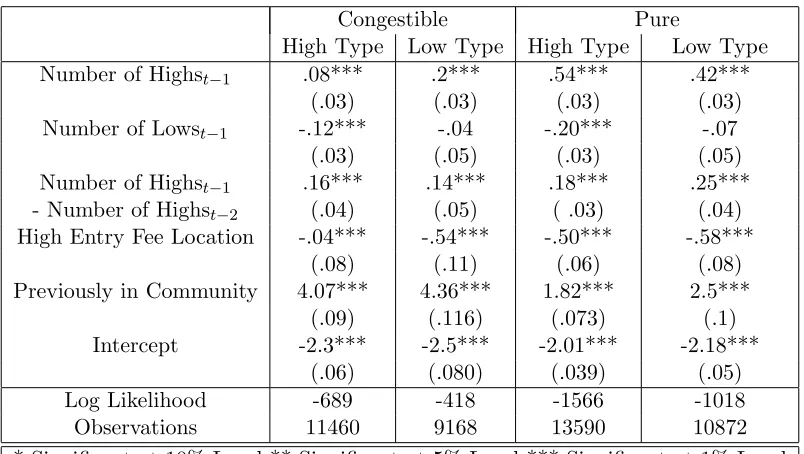
The dynamics of community composition are shown in the probit regressions presented in
Table 2.2. These models estimate the likelihood that a subject resides in a location using the
number of High Types present in the previous period, the number of Low Types present in the
previous period, and the change in the number of High Types in the previous period, along with
dummy variables for whether the subject was in that location in the previous period and whether
the location has a high entry fee. These results show that both High and Low Types are more likely
to be in a community where High Types resided in the previous period, as well as where there was
a previousinflux of High Types. Additionally, the presence of Low Types has a significant negative
effect on the likelihood of High Types being in the community in the subsequent period. These
Congestible Pure
High Type Low Type High Type Low Type
Number of Highst−1 .08*** .2*** .54*** .42***
(.03) (.03) (.03) (.03)
Number of Lowst−1 -.12*** -.04 -.20*** -.07
(.03) (.05) (.03) (.05)
Number of Highst−1 .16*** .14*** .18*** .25***
- Number of Highst−2 (.04) (.05) ( .03) (.04)
High Entry Fee Location -.04*** -.54*** -.50*** -.58***
(.08) (.11) (.06) (.08)
Previously in Community 4.07*** 4.36*** 1.82*** 2.5***
(.09) (.116) (.073) (.1)
Intercept -2.3*** -2.5*** -2.01*** -2.18***
(.06) (.080) (.039) (.05)
Log Likelihood -689 -418 -1566 -1018
Observations 11460 9168 13590 10872
* Significant at 10% Level ** Significant at 5% Level *** Significant at 1% Level
Table 2.2: Community Composition Dynamics: Probit of High or Low Type Currently in Commu-nity on the Previous CommuCommu-nity Composition
2.5
The Role of Congestion in Community Stability
Congestion plays an important role in community stability. Movement is far more frequent when
the public good is congestible, and the subjects are typically dispersed across several locations.
There is a sharp division between sessions when the public good is pure, allowing them to be easily
classified into two categories. In one-half of the pure public goods sessions, community stability is
similar to the congestible sessions. In the other half, movement is rare and the entire population
resides within a single community during most periods.
Movement is frequent in the congestible public good sessions – occurring in over
three-quarters of all periods – and does not cease or slow over the course of the experiment. Overall,
movement is moderately less common when the public good is pure. Subjects move in 18.35% of opportunities in the CPG sessions compared to 10.8% of opportunities in PPG sessions, suggesting that approximately 41% of the movement is driven by congestion. There is considerable variation in
the population dynamics between sessions when the public good is pure. In two sessions, subjects
move more than 18% of the time (equivalent to the congestion sessions), while in other sessions
they move as infrequently as 1% of all opportunities.
the CPG and PPG sessions. This figure shows that there are typically three or more communities
in existence when the public good is congestible. The entire population of subjects resides in a
single community during these sessions in less than 7% of all periods. This contrasts sharply with
the pure public good sessions, during which subjects are most frequently in a single community.
Again, this result varies starkly across pure public good sessions. In the three sessions with
the least movement, all subjects are together in 72.3%, 73.8%, and 93.8% of periods respectively, while in the other three sessions subjects are together only 10%, 26.3%, and 36.3% of periods.
1 2 3 4 5 6
Number of Populated Communities Per Period
0.0
0.1
0.2
0.3
0.4
0.5
Number of Populated Communities
Proportion of Periods
Pure Congestible
Figure 2.8: The Number of Populated Communities Per Period in Pure and Congestible Sessions
There are clearly observable patterns in how these differences arise. At the beginning of each
session, subjects typically attempt to create one all-inclusive community, and most participants
move into the same location by the fifth or sixth period. In the CPG sessions, contributions decline,
this community is soon deserted, and after the fifteenth period there are typically at least three
populated communities in any period. Occasional renewed attempts to establish larger communities
also quickly disintegrate. In PPG sessions not characterized by frequent movement, the all-inclusive
and re-entry is associated with a spike in contributions in the community. The average community
provision level is 50.4 in the final period before the all-inclusive community breaks up and is 74.8 in the first period in which it has been re-formed.21 This suggests that temporary exit may be used
as a tool to sustain provision.
Whether the subjects’ exit is temporary and they will soon rejoin the larger community, or
others instead will join them in defection, depends on the relative provision levels offered in the
old and new communities – though less is needed to entice High Types to follow when the public
good is congestible. If a community founder offers a provision level that rivals that in the original
community, exit becomes not just a temporary threat that increases cooperation, but instead sets
off a cascade of movement to a new location. This, however, can only occur if contributions in the
original community have deteriorated dramatically – so that one subject’s contribution rivals that
of eight – or if a subject founds another community before the others have fully coordinated on a
single other location. The substantial between-session differences appear to be driven both by the
willingness of some subjects to follow a community founder even when the payoffs in their current
community are higher and by the willingness of some subjects to continue founding communities
before the other communities have stabilized.
Table 2.3 shows the number of singleton communities in CPG, frequent movement PPG,
and infrequent movement PPG sessions, along with how often the community is either eventually
joined by others or eventually abandoned by the single member. The fate of singleton communities
appears to capture the between-session differences in community stability. In sessions characterized
by frequent movement, communities with a population of one are typically joined by others. In
both the CPG and the frequent-movement PPG sessions, others eventually enter the community
83% of the time, compared to 38% of the time in the PPG sessions with frequent movement.
Finally, I consider whether movement in the congestible and pure public goods sessions may
be considered a best-response. The results in Section 2.4 suggest that subjects who move tend
to select the community in which they would have done the best in the previous period, but the
question remains whether such movement is, in fact, profitable. Though it is impossible to construct
a perfect counterfactual for their continuation payoffs had they not moved, this question may be
analyzed through a couple of other approaches.
First, I consider the immediate effect of movement on subjects’ earnings. Table 2.4 gives fixed
21