Multiway Filtering Based on Fourth-Order Cumulants
Damien Muti
Groupe GSM, Institut Fresnel (UMR CNRS 6133), EGIM, Universit´e Aix-Marseille III, D.U. de Saint J´erˆome, 13397 Marseille Cedex 20, France
Email:[email protected]
Salah Bourennane
Groupe GSM, Institut Fresnel (UMR CNRS 6133), EGIM, Universit´e Aix-Marseille III, D.U. de Saint J´erˆome, 13397 Marseille Cedex 20, France
Email:[email protected]
Received 31 March 2004; Revised 4 November 2004; Recommended for Publication by Chong-Yung Chi
We propose a new multiway filtering based on fourth-order cumulants for the denoising of noisy data tensor with correlated Gaussian noise. The classical multiway filtering is based on the TUCKALS3 algorithm that computes a lower-rank tensor approx-imation. The presented method relies on the statistics of the analyzed multicomponent signal. We first recall how the well-known lower-rank-(K1,. . .,KN) tensor approximation processed by TUCKALS3 alternating least square algorithm exploits second-order
statistics. Then, we propose to introduce the order statistics in the TUCKALS3-based method. Indeed, the use of fourth-order cumulants enables to remove the Gaussian components of an additive noise. In the presented method the estimation of the
n-mode projector on then-mode signal subspace is built from the eigenvectors associated with the largest eigenvalues of a fourth-order cumulant slice matrix instead of a covariance matrix. Each projector is applied by means of then-mode product operator on then-mode of the data tensor. The qualitative results of the improved multiway TUCKALS3-based filterings are shown for the case of noise reduction in a color image and multicomponent seismic data.
Keywords and phrases:multicomponent signals, tensors, Tucker3 decomposition, HOSVD, cumulant slice matrix, subspace
methods.
1. INTRODUCTION
In many fields so diverse as chemometric, psychology, data analysis, or signal processing, a multidimensional and multi-way modelling can be adopted in which data are represented by higher-order tensors [1]. A tensor of orderNis as a multi-dimensional array whose entries are accessed viaNindices. It is notedA∈RI1×···×IN, where each element isai
1i2···iN, and
Ris the real manifold. Indexinrefers to then-mode of tensor
A.
In signal processing, tensors are built on vector spaces associated with physical quantities such as length, width, height, time, color channel, and so forth. Each mode of the tensor is associated with a physical quantity. For example, in image processing, color images can be modelled as third-order tensors: two dimensions for lines and columns, and one dimension for the color map. In seismic and underwater acoustics, when a linear antenna is used, a three-dimensional modelling of data can be chosen as well: one mode is associ-ated with the spatial sensors of the antenna, one mode with the time, and one mode with the wave polarization compo-nents.
In the classical processing based on algebraic methods, multidimensional and multiway data are split or unfold into observation vectors or matrices in order to apply the classical methods usually based on the covariance matrix. Then, the processed vectors or matrices are merged or rearranged in order to retrieve the size of the initial tensor.
The splitting of multidimensional data may reduce the quantity of information related to the whole tensor as the possibility of studying the relations between components of different slices of data is lost. To overcome this problem, new methods, in which multidimensional data are considered as indivisible whole tensors, have recently been proposed [2,3,4,5]. These methods are based on multilinear alge-bra and on Tucker3 tensor decomposition [6,7] also known as higher-order SVD (HOSVD) and lower-rank-(K1,. . .,KN)
tensor approximation [8, 9]. The Tucker3 decomposition generalizes the matrix singular value decomposition (SVD) [10] to tensors.
Some PARAFAC/CANDECOMP algorithms have been de-veloped [12,13,14] and applied in food industry [15], ar-ray processing [16], and telecommunications [17]. More-over, several studies on lower-rank-one tensor approxima-tion have been proposed [9,18,19], however, so far, no al-gorithm is able to perform an orthogonal canonical decom-position of a tensor [20].
The HOSVD mathematical tool has been recently used in image processing for facial expression analysis on data mod-elled by third-order and fifth-order tensors [21,22].
In [3,4], a new concept of multiway filtering has been proposed, in which eachn-mode of anNth-order data ten-sorAis filtered by a matrixHncalledn-mode filter. Eachn -mode filterHnis applied to the correspondingn-mode vec-tors of data tensorAby means of a multilinear algebraic op-erator called “n-mode product” [8,9], and denoted by×n.
In the framework of multidimensional data denoising, two methods have been recently proposed in order to de-termine the form ofn-mode filtersHn. In these two meth-ods, the multidimensional noise is assumed to be additive, white, and Gaussian. In the first method [4], for everyn -mode, then-mode filterHnis the projector on then-mode
signal subspace. Thesen-mode filters are determined thanks to the lower-rank-(K1,. . .,KN) noisy data tensor approxima-tion, after convergence of TUCKALS3 algorithm [7,8,9]. This method generalizes to tensors the initially developed-in-seismic classical matrix filtering [23,24,25,26,27,28,29]. In the second method [3],n-mode filtersHnare determined
by minimizing the mean square error between the estimated signal and the desired signal. This minimization leads to the so-called estimatedn-mode filters which can be considered as the extension of the well-known Wiener filter in a partic-ular mode.
In both methods then-mode filters can be considered as the projectors on the left singular vectors associated with the largest singular values of then-mode unfolding matrix of the noisy data tensor, or as a weighted version of these projectors. In this study, we first recall how the singular vectors on which the n-mode filters are built can be considered as the eigenvectors associated with the largest eigenvalues of the data n-mode vector covariance matrix. Then, we pro-pose a new method to estimate the basis vectors of the n -mode signal subspace no more based on second-order mo-ments, but on the noisy data tensorn-mode vectors fourth-order cumulants. The goal of this approach is to use the well-known property stating that the higher-order cumu-lants of a random variable that follows a Gaussian den-sity probability law are null, in order to remove the Gaus-sian component of the noise. In order to reduce the com-putational load, and based on the well-known array pro-cessing results [30,31,32], in which the determination of the wave directions of arrival (DOA) is estimated from the fourth-order cumulant slice matrix, we also propose to esti-mate each projector on then-mode signal subspaces thanks to the lower-rank approximation of the fourth-order cu-mulant slice matrix of the data n-mode vectors instead of the fourth-order cumulant tensor lower-rank approxima-tion.
This paper is organized as follows. Section 2 gives the problem statement. Section 3 presents the multiway and multidimensional filtering of a data tensor based on lower-rank-(K1,. . .,KN) tensor approximation (LRTA-(K1,
. . .,KN)). TUCKALS3 alternative least square algorithm that
performs LRTA-(K1,. . .,KN) is presented and an
interpre-tation in terms of multiway principal component analysis (PCA) is given. In Section 4 a modification of the multi-way filtering is proposed by replacing somen-mode vector covariance matrix involved in TUCKALS3 algorithm by the fourth-order cumulant slice matrix of thesen-mode vectors. InSection 5this new multiway filtering method is applied to noise reduction in a color image and multicomponent seis-mic data, in the case where the additive Gaussian noise is cor-related and independent of the signal.
2. PROBLEM STATEMENT
The classical data model is the following. The measurement of a multidimensional and multiway signalXby multicom-ponent sensors with additive white and Gaussian noiseN, statistically independent of the signal, results in data tensor
R=X+N. (1)
Assuming that X andN are Nth-order tensors from
RI1×···×IN, the goal of this study is to estimate the desired signalXthanks to a multidimensional filtering of the data [3,4]:
X=R×1H(1)· · · ×
NH(N), (2) where ×n is then-mode product, whose properties can be
found in [8,9]. Then-mode product between a data tensor
Rand matrixH(n)represents the consecutive matrix prod-ucts between matrixH(n)and then-mode vectors of tensor
Rdefined as theIn-dimensional vectors obtained fromRby
varying indexinand keeping the other indices fixed. Given
A∈RI1×···×IN and a matrixU ∈RJn×In,B =A×nUis a tensor ofRI1×···×In−1×Jn×In+1×···×IN, whose entries are given by
bi1···in−1jnin+1···iN =
In
in=1
ai1···in−1inin+1···iNujnin. (3)
From a signal processing point of view, then-mode prod-uct betweenRandH(n)is ann-mode filtering of data tensor
Rbyn-mode filterH(n). Consequently, for alln= 1 toN,
H(n)is then-mode filter applied to then-mode of the data tensorR.
We defineE(n)then-mode vector space of dimensionI
n,
associated with then-mode of tensorA. By definition,E(n) is generated by the column vectors of then-mode unfold-ing matrix, where then-mode matrix unfoldingAnof tensor
A∈RI1×···×INis a matrix fromRIn×Mn, with
The columns ofAnare theIn-dimensional vectors obtained
fromAby varying index in and keeping the other indices fixed, and represent by definition, and in all the following, then-mode vectors of tensorA.
3. MULTIWAY AND MULTIDIMENSIONAL FILTERING In the tensor signal processing assumptions [2,4,7,9],E(n) is the superposition of two orthogonal subspaces:
(i) the signal subspaceE(1n)of dimensionKn, (ii) and the noise subspaceE(2n)of dimensionIn−Kn,
such thatE(n)=E(n) 1 ⊕E(2n).
Supposing the dimension Kn of the signal subspace is
known for alln=1,. . .,N, one way to estimate the desired signal tensorXfrom the noisy data tensorR=X+N is to orthogonally project everyn-mode vector of tensorRon the
n-mode signal subspaceE1(n), for alln=1,. . .,N. This state-ment is equivalent to replacing in relation (2) filtersH(n)by projectorsP(n)on then-mode signal subspace:
X=R×1P(1)· · · ×
NP(N). (5) This multidimensional and multiway filtering generalizes the classical matrix filtering methods [23,24,25,26,27,28, 29].
In the one-dimensional case, the definition of the projec-tor on the signal subspace is based on the eigenvecprojec-tors asso-ciated with the largest eigenvalues of the observation vector set covariance matrix [28].
In the multidimensional and multiway case, the projec-tors on the n-mode vector spaces are determined by com-puting the lower-rank-(K1,. . .,KN) tensor approximation (LRTA-(K1,. . .,KN)) of noisy data tensorR[2,4], in which
Kn is the n-mode signal subspace dimension for all n =
1,. . .,N.
3.1. Lower-rank-(K1,. . .,KN)tensor approximation The lower-rank-(K1,. . .,KN) approximation of a tensor
de-fined in [8,9] is a concept based on Tucker3 tensor decom-position [6] that generalizes to tensors the singular value de-composition (SVD) [10] and lower-rank approximation of matrices.
The best lower-rank-(K1,. . .,KN) approximation [8,9]
of a given tensor R, named B, is the tensor of rank-(K1,. . .,KN) minimizing the Frobenius quadratic distance:
R−B2
F. (6)
The least mean square solution [7] implies that
B=R×1P(1)· · · ×
NP(N) (7)
with projectors P(n) defined by P(n) = U(n)U(n)T for all
n=1,. . .,N, where the column-wise orthonormal matrices
U(n)∈RKn×Inmaximize the function
gU(1),. . .,U(N)=A×1U(1)T· · · ×
NU(N)T2F. (8)
3.2. ALS algorithm
The maximization of function g with respect to (U(n),
. . .,U(N)), subject toU(n)being a column-wise orthonormal matrix forn=1,. . .,N, is a difficult nonlinear least square problem which is generally solved thanks to TUCKALS3 al-ternative least square algorithm [7] that can be summarized in the following steps.
(1) Initialization, k = 0: for all n = 1,. . .,N, P(0n) =
U(n) 0 U(n)
T
0 .U0(n)is the matrix of theKnleft singular vec-tors associated with theKnlargest singular values of
tensorRn-mode unfolding matrixRn.
(2) ALS loop: repeat until convergence, that is, for exam-ple, whileBk+1−Bk2F>,>0, prior fixed
thresh-old,
(a) forn=1 toN,
(i) B(n),k = R ×1 P(1)
k+1· · · ×n−1 Pk(n+1−1) ×n+1
P(n+1)
k · · · ×NP(kN);
(ii) n-mode unfold tensor B(n),k into matrix
B(n),k
n ;
(iii) compute matrixC(n),k=Bn(n),kRT
n;
(iv) process C(n),k eigenvalue decomposition
(EVD), put the Kn eigenvectors associated
with theKnlargest eigenvalues intoUk(n+1); (v) computePk(n+1) =U(n)
k+1U (n)T
k+1; (b) computeBk+1=R×1P(1)k+1· · ·×NP
(N)
k+1,k←k+ 1. (3) Output:Bkstop=R×1P
(1)
kstop· · ·×NP (N)
kstop, the best lower-rank-(K1,. . .,KN) approximation ofR, wherekstopis the last iteration after convergence of TUCKALS3 al-gorithm.
Note that in steps (2)(a)(iii)-(iv) an improvement of TUCKALS3 algorithm which decreases the computational load by using a fast algorithm for the determination of ma-trixC(n),keigenvectors has been proposed in [8,9], but will not be discussed in this paper.
3.3. LRTA-(K1,. . .,KN)and multiway PCA
In step (2)(a)(i), at TUCKALS3 algorithmkth iteration, and for a givenn-mode, tensorB(n),k represents data tensorR
which is filtered in everym-mode except in then-mode, by projectorsPl(m)in which indexl=k+ 1 form < nand index
l=kform > n.
We give a physical sense to matrix C(n),k from step (2)(a)(iii). We define byb(jn),k,j=1,. . .,Mn, with
Mn=I1,. . .,In−1In+1,. . .,IN, (9) the n-mode vectors of tensor B(n),k, that is, n-mode
un-folding matrix B(nn),k column vectors. We define as well by
r(jn), j =1,. . .,Mn, then-mode vectors of tensorR. Matrix
C(n),k=B(nn),kRT
ncan be written as
C(n),k=b(n),k
1 ,. . .,b (n),k Mn
r(1n),. . .,r(Mn)nT=
Mn
j=1
b(jn),kr(jn)T.
As a consequence, up to the multiplicative factor 1/Mn,
ma-trixC(n),kcan be considered as an estimation of the covari-ance matrix between data tensorRn-mode vectors and ten-sorB(n),kn-mode vectors. Hence, theKneigenvectors
associ-ated with the largest eigenvalues of matrixC(n),kfrom which
projectorP(kn+1) is built at step (2)(a)(v) are the mutual princi-pal components of tensorRand tensorB(n),kn-mode vec-tors. Thanks to projectors Pl(m),l = k+ 1 form < nand
l =kform > n, from the expression of tensorB(n),k(step (2)(a)(i)), these principal components in then-mode depend on the principal components in them-modes, form=n.
Thus the lower-rank-(K1,. . .,KN) tensor approximation
of data tensor R consists of a principal component analy-sis processed alternatingly on every n-mode, where all the
n-mode principal components are interdependent, and are supposed to define the signal subspace entirely.
Consequently, in the context of signal processing, the TUCKALS3 algorithm gradually refines, with respect to it-eration k, the estimation of orthogonal projectors P(kn+1) on associated n-mode signal subspace, for alln = 1,. . .,N. In the next sections the goal of our study is to improve the esti-mation of these orthogonal projectors on then-mode signal subspaces. A proposition of improvement based on higher-order statistics, in the case of an additive correlated Gaussian noise, is presented.
4. MULTIWAY FILTERING USING THE FOURTH-ORDER CUMULANTS
4.1. Second-order moments in TUCKALS3 algorithm
In previousSection 3.3, it is shown that, up to the multiplica-tive factor 1/Mn, matrixC(n),kis an estimation of the covari-ance matrix between data tensorRn-mode vectors and ten-sorB(n),kn-mode vectors. Considering, in relation (10), that
{r(jn), j =1,. . .,Mn}and{b(jn),k, j =1,. . .,Mn}are theMn
realizations of two random vectorsr(n)andb(n),kassociated,
respectively, with then-mode vectors of data tensorsRand
B(n),k, matrix C(n),k can be written as a second-order mo-ment:
C(n),k=Eb(n),kr(n)T , (11)
where E[·] denotes the expectation operator.
Thus, in TUCKALS3 kth iteration, orthogonal projec-tor Pk(n+1) on the n-mode signal subspace is estimated from a second-order moment since it is built from matrix C(n),k eigenvalue decomposition (EVD).
4.2. Proposed TUCKALS3 algorithm based on fourth-order cumulants
In practice, the noise whiteness is not always fulfilled. In the case of additive correlated Gaussian noise, the estimation of orthogonal projector Pk(n+1) on the n-mode signal subspace cannot be achieved correctly with the classical TUCKALS3 algorithm since it is based on the second-order moments.
One way to improve the estimation of the orthogonal projector P(kn+1) on the n-mode signal subspace in the case of additive correlated Gaussian noise is to replace second-order moment matrix C(n),k with higher-order cumulants. Indeed, the use of higher-order statistics consists of a clas-sical means to remove the noise Gaussian components since the higher-order cumulants of a Gaussian random variable are null [33,34].
Then, the goal of the proposed method is to estimate or-thogonal projector Pk(n+1) on then-mode signal subspace no more with second-order moment matrixC(n),k, but with the
higher-order cumulants of the associatedn-mode vectors.
4.2.1. Fourth-order cumulants
As noticed inSection 4.1, matrixC(n),k, at step (2)(a)(iii) and
TUCKALS3 algorithmkth iteration, is defined as a second-order moment. In second-order to remove the noise Gaussian com-ponent, we propose to use the fourth-order cumulant tensor
C(n),k=Cumb(n),k,b(n),kT
,r(n),r(n)T, (12) where Cum(·) denotes the cumulant operator. C(n),k is a fourth-order supersymmetric tensor from RIn×In×In×In, whose generic term at position (i1,i2,j1,j2) is given by
Ci(1n,),i2k,j1,j2=Cumbi(1n),k,bi(2n),k,rj(1n),r(j2n), (13)
whereb(in),kandrj(n)are theith and jth components of ran-dom vectorsb(n),kandr(n)associated, respectively, ton-mode vectors of tensor B(n),k andR. According to [33,35], the generic term ofC(n),kcan be expressed, thanks to the expec-tation operator, and for centered random variables, as
C(i1n,i),2k,j1,j2=E
b(n),k
i1 b (n),k i2 r
(n)
j1 r (n)
j2
−Ebi(1n),kr(j1n)Ebi(2n),kr(j2n) −Ebi(1n),kr(j2n)Ebi(2n),kr(j1n).
(14)
At step (2)(a)(iv), the determination of theKn
eigenvec-tors associated with theKnlargest eigenvalues of covariance matrixC(n),kamounts to compute its best lower-rank-Kn
ap-proximation according to Eckart-Young theorem [36]. One way to generalize matrix C(n),k lower-rank approximation
to fourth-order cumulant tensor C(n),k is to computeC(n),k lower-rank-(Kn,Kn,Kn,Kn) tensor approximation, thanks to TUCKALS3 algorithm [8,37]. Using the fact thatC(n),kis a supersymmetric tensor, we get [8,37]
C(n),k=S(n),k Kn ×1U
(n)
k+1×2U (n)
k+1×3U (n)
k+1×4U (n)
k+1, (15) in whichS(Knn),k ∈ RKn×Kn×Kn×Kn is Tucker3 core tensor [7], and matrixUk(n+1) ∈RIn×Knis a column-wise orthogonal ma-trix.
A good approximation of matrix Uk(n+1) involved in
C(n),klower-rank-(Kn,Kn,Kn,Kn) tensor approximation
matrix Vk(n+1) involved in tensor C(n),k HOSVD, in which matrix Vk(n+1) satisfies relation (15) in the particular case when Kn = In. This process is usually called
rank-(Kn,Kn,Kn,Kn) HOSVD truncation of tensor C(n),k. The
rank-(Kn,Kn,Kn,Kn) HOSVD truncation of tensorC(n),k is
not the best lower-rank-(Kn,Kn,Kn,Kn) tensor approxima-tion of C(n),k [8,9]. Nevertheless, according to [8,9] and confirmed by several experimental simulations [5], the er-ror done at the minimization ofC(n),k−B2
F, withBbeing
a rank-(Kn,Kn,Kn,Kn) tensor (see relation (6)), is low
com-pared to the gain in computational time earned by avoiding the ALS loop of TUCKALS3 algorithm.
However, the main drawback of this method is the high computational time to build every fourth-order cumulant tensor associated to then-mode of the data tensor. This com-putational time depends on the size of data tensorR, that is, the values ofIn, for alln =1. . .,N. One way to reduce the computational load is to use the fourth-order cumulant slice matrix which is extracted from the fourth-order cumulant tensor. This is done in the following subsection.
4.2.2. Fourth-order cumulant slice matrix
In many applications of array processing [32,38], the fourth-order cumulant matrix consisting of all possible permuta-tions of the four indices {i1,i2,j1,j2} is used rather than fourth-order cumulant tensor C(n),k. The cumulant matrix is a matrix representation of the cumulant tensor. In order to reduce the computational time necessary to build and anal-yse the cumulant matrix, a cumulant slice matrix ofC(n),khas
been introduced in [30,31,32].
The cumulant slice matrix associated with the first com-ponent of vector b(n),k is given by the following (In×In )-Hermitian matrix [30,31,32]:
C(1n),k=Cum
b(n),k
1 ,b (n),k
1 ,r(n),r(n) T
. (16)
The generic (i,j)-term of cumulant sliceC(1n),kexpressed
with the expectation operator is
C(1nij),k=Eb1(n),k
2r(n)
i r(jn)
−2 Eb(1n),kr (n)
i
Eb(1n),kr (n)
j
.
(17)
The practical estimation ofC(1n),k uses the Mn
realiza-tions of random vectorsr(n)andb(n),k, whereMnis defined in relation (9). Defining by b(ijn),k andrij(n)the (i,j)-term of
n-mode unfolding matricesB(nn),k andRn, the estimation of
C(1nij),k(i,j)-term is given by
C(1nij),k=M1
n
Mn
p=1
b(n),k
1p
2
r(n)
ip r(j pn)
−M22
n
Mn
p=1
b(n),k 1p rip(n)
Mn
p=1
b(n),k 1p r(j pn)
.
(18)
Relations (17) and (18) can be adapted to noncentered ran-dom variables [33,35].
Initially, the use of the fourth-order cumulant slice ma-trix has been proposed in the array processing field for locat-ing sources [30,31,32]. The results obtained in array pro-cessing state that the use of the fourth-order cumulant slice matrix, instead of the cumulant matrix, gives a good promise between the localisation performances and the com-putational load [38].
In this paper, our aim is to improve the LRTA-(K1,. . .,KN)-based multiway filtering of multicomponent
seismic data and color images, in the case of additive correlated Gaussian noise. As shown in Figures 1 and 2, the performances of the improved fourth-order-cumulant-based LRTA-(K1,. . .,KN) filtering involving, respectively, the fourth-order cumulant tensor and the fourth-order cumu-lant slice matrix are sensibly identical. Thus, according to the results obtained in array processing [30,31,32], and ac-cording to our simulations on multicomponent seismic sig-nal and color image filtering, we have used the cumulant slice matrix in order to reduce the computational load of the im-proved fourth-order cumulant-LRTA-(K1,. . .,KN)-based
fil-tering.
The gain in computational load brought by the use of the fourth-order cumulant slice matrix rather than the cumulant tensor can be explained by at least two reasons.
(1) Firstly, as the fourth-order cumulant tensor in then -mode consists of I4
n elements, the number of
oper-ations required for its construction is squared com-pared to the one required for the construction of the cumulant slice matrix which only consists ofI2
n
ele-ments. Moreover, depending of the data size, the mem-ory space occupied by the fourth-order cumulant ten-sor can become too important for usual computers. (2) Secondly, the estimation of the projector on the n
-mode subspace requires only one EVD when the cu-mulant slice matrix is used where as it requires 4 SVDs multiplied by the number of iterations neces-sary for the convergence of TUCKALS3 algorithm in-volved in the fourth-order cumulant tensor lower-rank-(Kn,Kn,Kn,Kn) tensor approximation. We note
that the determination of the eigenvectors (or singu-lar vectors) associated with the singu-largest eigenvalues (or singular values), involved in the construction of the projector on then-mode subspace, can be accelerated, thanks to fast algorithms such as the power method [10] (for the cumulant slice matrix) or the higher-order power method [8,9] (for the cumulant tensor).
Hence, in the following section, in regard to the filtering simulations treated in this paper, we consider that the eigen-vectors associated with the largest non-zero eigenvalues of fourth-order cumulant slice matrix C(1n),k consist of a good approximation of then-mode signal subspace basis since the fourth-order cumulant tensor of noiseN n-mode vectors is null and since the probability density function of random vectorx(n) associated with signal tensorXn-mode vectors is not Gaussian.
LRTA-(30, 30, 2)
4th-order cumulant slice matrix LRTA-(30, 30, 2) 4th-order cumulant tensor LRTA-(30, 30, 2)
−5 0 5 10 15 20 25 SNR (dB)
0 0.2 0.4 0.6 0.8 1 1.2 1.4 1.6
RQ
E
=|
|
X
−
Xestim
||
2/||
X
||
2
Figure 1: RQE evolution with respect to SNR (dB) for
LRTA-(30, 30, 2)-based (square), fourth-order-cumulant-slice-matrix LRTA-(30, 30, 2)-based (circle), and fourth-order-cumulant-tensor LRTA-(30, 30, 2)-based (asterisk) multiway filterings of Baboon standard image.
4.2.3. Proposed algorithm
The proposed method is based on the classical multiway fil-tering method. In step (2)(a)(ii), and iterationkof TUCK-ALS3 algorithm involved in data tensor R lower-rank-(K1,. . .,KN) tensor approximation, and as far as then-mode is concerned, matrixC(n),k representing the covariance ma-trix between data tensorRand tensorB(n),kn-mode vectors is replaced by the fourth-order cumulant slice matrixC(1n),kof
the samen-mode vectors.C(1n),kis built by using, for
exam-ple, the first component ofb(n),krandom vectors as the
refer-ence element associated with the fourth-order cumulant slice matrix. The practical estimation of its generic term is given in relation (18). Then, in step (2)(a)(v), projectorPk(n+1) rep-resents the projection on theKneigenvectors associated with theKnlargest eigenvalues of fourth-order cumulant slice
ma-trixC(1n),k.
TUCKALS3 algorithm initialization step is also modi-fied by using the fourth-order cumulant slice matrix. For
n = 1,. . .,N, matrixU0(n), with which initial projectorP0(n) is built, is the matrix of the Kn left singular vectors
asso-ciated with the Kn largest singular values of n-mode
un-folding matrix Rn. By definition, U0(n) is the matrix of the
Kn eigenvectors associated with Hermitian matrix RnRTn,
which, according to the remarks made on relation (10), con-sists of an estimation of data tensorR n-mode vector co-variance matrix. In the proposed method, in the initializa-tion step, matrix RnRTn is replaced withC(1n),0, the
fourth-order cumulant slice matrix of data tensorR n-mode vec-tors, which is estimated, thanks to relation (18), by re-placing the element b(1np),k by the element r1(np) for all p =
1,. . .,Mn.
LRTA-(1, 1, 1)
4th-order cumulant slice matrix LRTA-(1, 1, 1) 4th-order cumulant tensor LRTA-(1, 1, 1)
−10 −5 0 5 10
SNR (dB) 0
2 4 6 8 10 12
RQ
E
=|
|
X
−
Xestim
||
2/||
X
||
2
Figure 2: RQE evolution with respect to SNR (dB) for classical
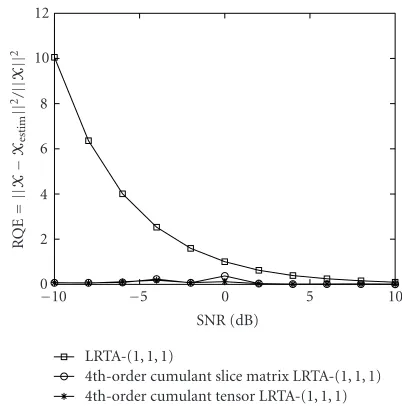
LRTA-(1, 1, 1)-based (square), fourth-order-cumulant-slice-LRTA-(1, 1, 1)-based (circle), and fourth-order-cumulant-tensor-LRTA-(1, 1, 1)-based (asterisk) multiway filterings applied on a multi-component seismic wave with totally correlated Gaussian noise (Figure 5).
The improved fourth-order cumulant-slice-matrix-LRTA-(K1,. . .,KN)-based multiway filtering, for which the
first component of every random vector has been chosen as the reference element for the fourth-order cumulant slice matrix computation, can be summarized as follows.
(1) Initialization, k = 0: for all n = 1,. . .,N, P(0n) =
U(n) 0 U(n)
T
0 . U0(n) is the matrix of theKn eigenvectors associated with theKn largest eigenvalues of
fourth-order cumulant slice matrixC(1n),0of tensorRn-mode vectors.
(2) ALS loop: repeat until convergence, that is, for exam-ple, whileBk+1−Bk2F>,>0, prior fixed
thresh-old,
(a) forn=1 toN,
(i) B(n),k = R ×1 P(1)
k+1· · · ×n−1 Pk(n+1−1) ×n+1
P(n+1)
k · · · ×NP(kN);
(ii) compute cumulant sliceC(1n),kassociated with
the fourth-order cumulant of tensorR and tensorB(n),k n-mode vectors. Every element ofC(1n),kis given by relation (18);
(iii) process matrixC(1n),k eigenvalue
decomposi-tion (EVD) and put theKn eigenvectors
as-sociated with theKn largest eigenvalues into
U(n)
k+1;
(iv) computePk(n+1) =U(n)
k+1U (n)T
k+1; (b) computeBk+1=R×1P(1)k+1· · ·×NP
(N)
k+1,k←k+ 1. (3) Output:X=Bkstop=R×1P
(1)
kstop· · · ×NP (N)
5. SIMULATION RESULTS
In the following simulations, the fourth-order-cumulant-slice-matrix-lower-rank-(K1,. . .,KN
)-tensor-approximation-based and the classical lower-rank-(K1,. . .,KN)
tensor-approximation-based multiway filterings are applied to noise reduction in a color image and a multicomponent seis-mic wave, both of which can be modelled by a third-order tensor fromRI1×I2×I3. In both applications, the efficiency of the denoising is tested in the presence of additive correlated Gaussian noise.
5.1. A quality criterion
According to the previous assumptions, the multidimen-sional and multicomponent noisy data tensor can be mod-elled by R = X+N, in whichX is the signal tensor to estimate andN is the additive noise tensor. Using the tensor Frobenius norm, we define the signal-to-noise ratio (SNR in dB) in the noisy data tensor by
SNR=10 log
X2
F
N2
F
. (19)
The estimated signal tensor is given by
X=R×1P(1)×2P(2)×3P(3), (20)
in which P(n),n ∈ {1, 2, 3}, is the estimated projector on then-mode signal subspace after convergence of the classical LRTA-(K1,K2,K3)-based or the fourth-order-cumulant-slice matrix-LRTA-(K1,K2,K3)-based algorithm.
In order toa posterioriverify the estimated signal tensor quality we propose to use the relative quadratic error crite-rion (RQE) defined by
RQEX=X−X 2
F
X2
F . (21)
The RQE criterion enables a qualitative comparison between the multiway filtering using the lower-rank-(K1,K2,K3) tensor approximation and the proposed fourth-order-cumulant-slice-matrix-LRTA-(K1,K2,K3)-based method. Considering this criterion, we expect the fourth-order-cumulant-slice-matrix-LRTA-(K1,K2,K3)-based method to give better (or at least the same) results than the classical LRTA-(K1,K2,K3)-based multiway and multidimensional filtering.
5.2. Simulations involving correlated Gaussian noise A multidimensional and multiway white Gaussian noiseN can be modelled by
N =α·G, (22)
in which every element ofG ∈ RI1×I2×I3 is an independent realization of a normalized centered Gaussian law, and where
α is a coefficient that enables to set the SNR in noisy data tensorR.
(a) (b)
(c) (d)
Figure3: (a) “Baboon” standard (256×256×3) image. (b)
Im-age with additive correlated Gaussian noise (SNR = −2.1 dB). (c) Classical LRTA-(30, 30, 2)-based multiway filtering of noisy im-age (b). (d) Fourth-order-cumulant-slice-matrix-LRTA-(30, 30, 2)-based multiway filtering of noisy image (b).
A correlated Gaussian noise, named Nc, can be built from previous Gaussian noiseN ∈RI1×I2×I3given in relation (22) by applying on everyn-mode of tensorN a weighting matrixW(n), for alln=1, 2, 3:
Nc=N ×1W(1)×2W(2)×3W(3). (23) Each element of tensorNc, given by
nc i1i2i3=
I1
k1=1
I3
k3=1
I3
k3=1
ni1i2i3w (1)
i1k1w (2)
i2k2w (3)
i3k3, (24)
is a linear mapping of every element of tensorN, which by definition creates the correlation between every n-mode of noiseNc.
In the following subsections, classical LRTA-(K1,K2,K3) filtering and fourth-order-cumulant-slice-matrix-LRTA-(K1,K2,K3)-based filtering are applied to a color image and a multicomponent seismic wave.
5.2.1. Color images
We consider Baboon standard color image represented on Figure 3a, and modelled by third-order tensor X ∈
n=1, 2, 3, are chosen such that the SNR in noisy image rep-resented onFigure 3bis 9 dB, and such that in everyn-mode, noise tensorNcn-mode vectors are totally correlated.
In these simulations, parameters (K1,K2,K3) of lower-rank-(K1,K2,K3) tensor approximation are supposed known and fixed at
K1,K2,K3
=(30, 30, 2). (25)
Experimentally, these parameters can be chosen from parameters (Q1,Q2,Q3) that enable lower-rank-(Q1,Q2,Q3) tensor approximation of initial non noisy color imageXto reconstruct a visually non deformed image. This latter image approximation can be considered as a compression with loss of color imageX, thus some compression quality criterion can be used to determine some suitable (Q1,Q2,Q3) param-eters, but will not be discussed in this paper.
The LRTA-(30, 30, 2) filtering of noisy imageRyields to the image ofFigure 3cand the fourth-order-cumulant-slice-matrix-LRTA-(30, 30, 2)-based multiway filtering of noisy imageRyields to the image ofFigure 3d.
The RQE, defined in relation (21), enables a qualita-tive comparison between the lower-rank-(30, 30, 2)-tensor-approximation-based multiway filtering and the proposed method. Figure 1, that represents the evolution of the RQE with respect to the SNR varying from −3 dB to 23 dB, shows that the proposed order-cumulant-slice-matrix-LRTA-(30, 30, 2)-based (square) and the fourth-order-cumulant-tensor-LRTA-(30, 30, 2)-based (stars) mul-tiway filtering method give sensibly the same results.
However, the principal outcome of this figure is that the proposed fourth-order-cumulant-slice-matrix-LRTA-(30, 30, 2)-based multiway filtering gives better results than the classical LRTA-(30, 30, 2)-based multiway filtering method since, all over the SNR range, the RQE given by the proposed method is lower than the one given by the classical method. This result is confirmed by the good quality of the restored image inFigure 3dcompared to the restored image inFigure 3c.
In conclusion, for this simulation, the fourth-order-cumulant-slice-matrix-LRTA-(30, 30, 2)-based multiway fil-tering gives better results than the classical LRTA-(30, 30, 2)-based multiway filtering with regard to tensor estimation quality and considering the RQE criterion, in the case of ad-ditive and signal-independent correlated Gaussian noise.
5.2.2. Multicomponent seismic signals
In this simulation, a multicomponent seismic wave is re-ceived on a linear antenna composed of 10 sensors. The wave direction of propagation is supposed to be orthogonal to the antenna plane. The three components of the signal wave are called channel 1, channel 2, and channel 3 and are repre-sented on Figures 4a,4b,4c, and on Figures5a,5b,5c. In each seismic slice, the x-axis corresponds to the time sam-pling (200 time samples) and they-axis to the spatial sensors (10 sensors). Each component is represented by a triangular impulse with the same temporal length but different ampli-tude.
Example 1. The multidimensional and multicomponent seismic record is modelled by noisy data tensor R ∈
R10×200×3which is the sum between multicomponent seismic signalXthat we want to estimate and correlated Gaussian noiseNcdefined by relation (23). The three components of noisy signal Rare represented, respectively, on Figures4d, 4e, and4f, in which coefficient α in relation (22) and the elements of weighting matrix W(n)in relation (23), for all
n=1, 2, 3, are chosen such that SNR= −2 dB.
Moreover, in this simulation, each weighting matrix
W(n),n∈ {1, 2, 3}, from relation (23), is chosen as being a random matrix whose elements are the realizations of a nor-malized centered Gaussian density probability law.
Parameters (K1,K2,K3) of lower-rank-(K1,K2,K3) ten-sor approximation are supposed to be known and fixed at (1, 1, 1). The classical LRTA-(1, 1, 1)-based multiway filtering ofRresults in estimated signalX1whose three components are represented, respectively, on Figures4g,4h, and4i.
The fourth-order-cumulant-slice-matrix-LRTA-(1, 1, 1)-based multiway filtering of data tensorRresults in estimated signalX2whose three components are represented, respec-tively, on Figures4j,4k, and4l.
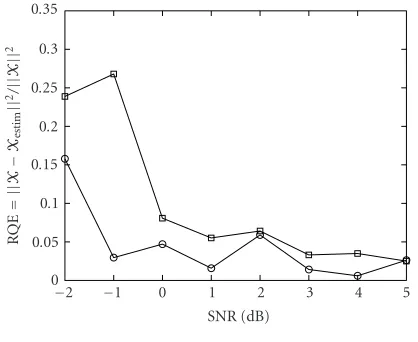
Finally, the evolution of the RQE with respect to the SNR, represented on Figure 6, shows that for the range of SNR going from −2 dB to 5 dB, fourth-order-cumulant-slice-matrix-LRTA-(1, 1, 1)-based multiway filtering gives better results than the classical LRTA-(1, 1, 1)-based multiway filter-ing since, all over the SNR range, the RQE given by the first method is lower than the one given by the second method.
One can also note that in Figure 4, for an SNR = −2 dB, the signals corresponding to the first two chan-nels of the multicomponent seismic wave, estimated by the classical LRTA-(1, 1, 1)-based multiway filtering, are dis-torted compared to the ones estimated by the fourth-order-cumulant-slice-LRTA-(1, 1, 1)-based multiway filtering. In addition, the signal amplitude of each channel is well esti-mated with the fourth-order-cumulant-slice-matrix-LRTA-(1, 1, 1)-based multiway filtering, whereas it is not with the classical LRTA-(1, 1, 1)-based multiway filtering.
Example2. In this simulation, we consider that the noise ten-sorNc 2-mode vectors are totally correlated. We recall that the 2-mode index of tensorR ∈R10×200×3is associated to the time quantity; thus, a given 2-mode vector represents the temporal signal received at a given spatial sensor in a given component.
The three components of noisy signalRare represented, respectively, in Figures5d,5e, and5f, in which coefficientα in relation (22) and the elements of weighting matrixW(n)in relation (23), for alln=1, 2, 3, are chosen such that SNR= −10 dB.
0 10 20 30 40 50 60 70 80 90 100 Time sampling
1 2 3 4 5 6 7 8 9 10 11
Se
nso
rs
(a)
0 10 20 30 40 50 60 70 80 90 100 Time sampling
1 2 3 4 5 6 7 8 9 10 11
Se
nso
rs
(b)
0 10 20 30 40 50 60 70 80 90 100 Time sampling
1 2 3 4 5 6 7 8 9 10 11
Se
nso
rs
(c)
0 10 20 30 40 50 60 70 80 90 100 Time sampling
0 2 4 6 8 10 12
Se
nso
rs
(d)
0 10 20 30 40 50 60 70 80 90 100 Time sampling
0 2 4 6 8 10 12
Se
nso
rs
(e)
0 10 20 30 40 50 60 70 80 90 100 Time sampling
0 2 4 6 8 10 12
Se
nso
rs
(f)
0 10 20 30 40 50 60 70 80 90 100 Time sampling
0 2 4 6 8 10 12
Se
nso
rs
(g)
0 10 20 30 40 50 60 70 80 90 100 Time sampling
0 2 4 6 8 10 12
Se
nso
rs
(h)
0 10 20 30 40 50 60 70 80 90 100 Time sampling
0 2 4 6 8 10 12
Se
nso
rs
(i)
0 10 20 30 40 50 60 70 80 90 100 Time sampling
0 2 4 6 8 10 12
Se
nso
rs
(j)
0 10 20 30 40 50 60 70 80 90 100 Time sampling
0 2 4 6 8 10 12
Se
nso
rs
(k)
0 10 20 30 40 50 60 70 80 90 100 Time sampling
0 2 4 6 8 10 12
Se
nso
rs
(l)
Figure4: Comparison of (g), (h), (i) classical LRTA-(1, 1, 1)-based and (j), (k), (l) fourth-order-cumulant-slice-matrix-LRTA-(1, 1, 1)-based
0 10 20 30 40 50 60 70 80 90 100 Time sampling
1 2 3 4 5 6 7 8 9 10 11
Se
nso
rs
(a)
0 10 20 30 40 50 60 70 80 90 100 Time sampling
1 2 3 4 5 6 7 8 9 10 11
Se
nso
rs
(b)
0 10 20 30 40 50 60 70 80 90 100 Time sampling
1 2 3 4 5 6 7 8 9 10 11
Se
nso
rs
(c)
0 10 20 30 40 50 60 70 80 90 100 Time
−2 0 2 4 6 8 10 12
Spatial
sensors
(d)
0 10 20 30 40 50 60 70 80 90 100 Time
−2 0 2 4 6 8 10 12
Spatial
sensors
(e)
0 10 20 30 40 50 60 70 80 90 100 Time
−2 0 2 4 6 8 10 12
Spatial
sensors
(f)
0 10 20 30 40 50 60 70 80 90 100 Time
−2 0 2 4 6 8 10 12
Spatial
sensors
(g)
0 10 20 30 40 50 60 70 80 90 100 Time
−2 0 2 4 6 8 10 12
Spatial
sensors
(h)
0 10 20 30 40 50 60 70 80 90 100 Time
−2 0 2 4 6 8 10 12
Spatial
sensors
(i)
0 10 20 30 40 50 60 70 80 90 100 Time
0 2 4 6 8 10 12
Spatial
sensors
(j)
0 10 20 30 40 50 60 70 80 90 100 Time
0 2 4 6 8 10 12
Spatial
sensors
(k)
0 10 20 30 40 50 60 70 80 90 100 Time
0 2 4 6 8 10 12
Spatial
sensors
(l)
Figure5: Comparison of classical LRTA-(1, 1, 1)-based and fourth-order-cumulant-slice-LRTA-(1, 1, 1)-based multiway filterings applied to
LRTA-(1, 1, 1) processing
4th-order cumulant slice matrix LRTA-(1, 1, 1)
−2 −1 0 1 2 3 4 5 SNR (dB)
0 0.05 0.1 0.15 0.2 0.25 0.3 0.35
RQ
E
=|
|
X
−
Xestim
||
2/||
X
||
2
Figure 6: RQE evolution with respect to SNR (dB) for
fourth-order-cumulant-slice-matrix-LRTA-(1, 1, 1)-based (circle) and clas-sical LRTA-(1, 1, 1)-based (square) multiway filterings applied to a multicomponent seismic wave with correlated Gaussian noise (Figure 4).
On the contrary, the fourth-order-cumulant-slice-matrix-LRTA-(1, 1, 1)-based multiway filtering of data tensorRis able to retrieve the initial signal tensor. The three components of the corresponding estimated signal X2 are represented, respectively, on Figures5j,5k, and5l.
Finally, the evolution of the RQE with respect to the SNR, represented onFigure 2, shows that for the range of SNR go-ing from−10 dB to 10 dB, the fourth-order-cumulant-slice-matrix-LRTA-(1, 1, 1)-based multiway filtering gives better results than the classical LRTA-(1, 1, 1)-based multiway fil-tering since, all over the SNR range, the RQE given by the proposed method is lower than the one given by the classical method.
We also note that, like in Section 5.2.1 (Figure 1), Fig-ure 2 also presents a comparison between the RQE ob-tained with the slice-matrix-LRTA-(1, 1, 1)-based (circle) and with the fourth-order-cumulant-tensor LRTA-(1, 1, 1)-based (stars) multiway filtering. From these two curves, it appears, like in the color image process-ing case, that the multiway filterprocess-ing of a multicomponent seismic signal based on the cumulant slice matrix and the one based on the corresponding fourth-order cumulant ten-sor give sensibly the same results.
5.3. Further works
Before concluding, we note that the optimal parameters (K1,K2,K3) determination is not the purpose of this paper and needs further investigations which would extend, for ex-ample, to the well-known array processing Akaike informa-tion criterion (AIC) or minimum descripinforma-tion length (MDL) criteria [39,40].
6. CONCLUSION
In this paper, an improvement of the multiway and multidi-mensional filtering of data tensor has been proposed.
The classical method is based on lower-rank-(K1,. . .,KN)
tensor approximation which is commonly performed by the alternative least square process called TUCKALS3 algorithm. This algorithm determines simultaneously eachn-mode pro-jector on the n-mode signal subspace that is applied by means of then-mode product operator on then-mode of the data tensor. The n-mode projectors perform the projection on the eigenvectors associated with the largest eigenvalues of a matrix which can be assimilated as the covariance matrix of the data tensorn-mode vectors defined as the column vectors of the data tensorn-mode unfolding matrix.
The main idea of the proposed method is to replace the covariance matrix involved in TUCKALS3 algorithm with the fourth-order-cumulant-slice matrix of the data tensorn -mode vectors in order to remove the Gaussian components of an additive correlated Gaussian noise.
The good qualitative results of this new multiway filter-ing method are shown for noise reduction in a color image and multicomponent seismic wave in the case of an additive correlated Gaussian noise.
ACKNOWLEDGMENT
The authors would like to thank the anonymous reviewers for their careful reading and their helpful remarks, which have contributed to improving the clarity of the paper.
REFERENCES
[1] P. Comon, “Tensor decompositions,” inMathematics in Signal Processing V, J. G. McWhirter and I. K. Proudler, Eds., pp. 1– 24, Clarendon Press, Oxford, UK, 2002.
[2] N. Le Bihan, Traitement alg´ebrique des signaux vectoriels: Ap-plication `a la s´eparation d’ondes sismiques, Ph.D. thesis, In-stitut National Polytechnique de Grenobl, Grenoble, France, 2001.
[3] D. Muti and S. Bourennane, “Multidimensional estimation based on a tensor decomposition,” inProc. IEEE Workshop on Statistical Signal Processing (SSP ’03), pp. 98–101, St. Louis, Mo, USA, September–October 2003.
[4] D. Muti and S. Bourennane, “Multidimensional signal pro-cessing using lower-rank tensor approximation,” inProc. IEEE International Conference on Acoustics, Speech, and Signal Pro-cessing (ICASSP ’03), vol. 3, pp. 457–460, Hong Kong, China, April 2003.
[5] D. Muti and S. Bourennane, “Traitement multidimensionnel du signal par d´ecomposition tensorielle,” inProc. Colloque GRETSI sur le Traitement du Signal et des Images (GRETSI ’03), Paris, France, September 2003.
[6] L. R. Tucker, “Some mathematical notes on three-mode factor analysis,”Psychometrika, vol. 31, no. 3, pp. 279–311, 1966. [7] P. M. Kroonenberg and J. De Leeuw, “Principal
compo-nent analysis of three-mode data by means of alternating least squares algorithms,”Psychometrika, vol. 45, no. 1, pp. 69–97, 1980.
[9] L. De Lathauwer, B. De Moor, and J. Vandewalle, “On the best rank-1 and rank-(R1,R2,...,RN) approximation of
higher-order tensors,” SIAM J. Matrix Anal. Appl., vol. 21, no. 4, pp. 1324–1342, 2000.
[10] G. H. Golub and C. F. Van Loan, Matrix Computations, The Johns Hopkins University Press, Baltimore, Md, USA, 3rd edi-tion, 1996.
[11] J. B. Kruskal, “Rank, decomposition, and uniqueness for 3-way andN-way arrays,” inMultiway Data Analysis (Rome, 1988), R. Coppi and S. Bolasco, Eds., pp. 7–18, North-Holland Publishing, Amsterdam, The Netherlands, 1989.
[12] J. B. Kruskal, “Three-way arrays: rank and uniqueness of trilinear decomposition, with application to arithmetic com-plexity and statistics,”Linear Algebra and Appl., vol. 18, no. 2, pp. 95–138, 1977.
[13] R. A. Harshman and M. E. Lundy, “The PARAFAC model for three-way factor analysis andmultidimensional scaling,” inResearch Methods for Multimode Data Analysis, H. G. Law, C. W. Snyder Jr., J. A. Hattie, and R. P. McDonald, Eds., pp. 122–215, Praeger, New York, NY, USA, 1970.
[14] N. Sidiropoulos and R. Bro, “On the uniqueness of multilin-ear decomposition ofn-way arrays,” J. Chemom., vol. 14, no. 3, pp. 229–239, 2000.
[15] R. Bro, Multi-way analysis in the food industry, Ph.D. thesis, Royal Veterinary and Agricultural University, Frederiksberg, Denmark, 1998.
[16] N. Sidiropoulos, R. Bro, and G. Giannakis, “Parallel factor analysis in sensor array processing,” IEEE Trans. Signal Pro-cessing, vol. 48, no. 8, pp. 2377–2388, 2000.
[17] N. Sidiropoulos, G. Giannakis, and R. Bro, “Blind PARAFAC receivers for DS-CDMA systems,”IEEE Trans. on Signal Pro-cessing, vol. 48, no. 3, pp. 810–823, 2000.
[18] E. Kofidis and P. A. Regalia, “On the best rank-1 approxima-tion of higher-order supersymmetric tensors,”SIAM J. Matrix Anal. Appl., vol. 23, no. 3, pp. 863–884, 2002.
[19] T. Zhang and G. H. Golub, “Rank-one approximation to high order tensors,”SIAM J. Matrix Anal. Appl., vol. 23, no. 2, pp. 534–550, 2001.
[20] T. G. Kolda, “Orthogonal tensor decomposition,” SIAM J. Matrix Anal. Appl., vol. 23, no. 1, pp. 243–255, 2001. [21] M. A. O. Vasilescu and D. Terzopoulos, “Multilinear image
analysis for facial recognition,” inProc. 16th IEEE Interna-tional Conference on Pattern Recognition (ICPS’ 2002), vol. 2, pp. 511–514, Quebec City, Canada, August 2002.
[22] H. Wang and N. Ahuja, “Facial expression decomposition,” inProc. 9th IEEE International Conference on Computer Vision (ICCV ’03), vol. 2, pp. 958–965, Nice, France, October 2003. [23] S. L. M. Freire and T. J. Ulrych, “Application of singular value
decomposition to vertical seismic profiling,” Geophysics, vol. 53, pp. 778–785, 1988.
[24] M. Hemon and D. Mace, “The use of Karhunen-Loeve trans-form in seismic data prospecting,” Geophysical Prospecting, vol. 26, pp. 600–626, 1978.
[25] K. Hsu, “Wave separation and feature extraction of acous-tic well-logging waveforms using karhunen-loeve transforma-tion,”Geophysics, vol. 55, no. 2, pp. 176–184, 1990.
[26] G. M. Jackson, I. M. Mason, and S. A. Greenhalgh, “Princi-pal component transforms of triaxial recordings by singular value decomposition,”Geophysics, vol. 56, no. 4, pp. 528–533, 1991.
[27] X. Liu, “Ground roll suppression using the Karhunen-Loeve transform,”Geophysics, vol. 64, no. 2, pp. 564–566, 1991. [28] J. Mars, S´eparation d’ondes, Ph.D. thesis, Institut National
Polytechnique de Grenobl, Grenoble, France, 1988.
[29] F. Glangeaud and J.-L. Mari,Wave Separation, Editions Tech-nip, Paris, France, 1994.
[30] S. Bourennane and A. Bendjama, “Locating wide band acous-tic sources using higher order statisacous-tics,” Applied Acoustics, vol. 36, no. 3, pp. 235–251, 2002.
[31] N. Yuen and B. Friedlander, “Asymptotic performance anal-ysis of blind signal copy using fourth-order cumulants,” In-ternat. J. Adapt. Control Signal Process., vol. 48, pp. 239–265, 1996.
[32] N. Yuen and B. Friedlander, “DOA estimation in multipath: an approach using fourth-order cumulants,”IEEE Trans. Sig-nal Processing, vol. 45, no. 5, pp. 1253–1263, 1997.
[33] J. L. Lacoume, P. O. Amblard, and P. Comon, Statistiques d’ordre sup´erieur pour le traitement du signal, Masson, Paris, France, 1997.
[34] J. M. Mendel, “Tutorial on higher-order statistics (spectra) in signal processing and system theory: theoretical results and some applications,” Proc. IEEE, vol. 79, no. 3, pp. 278–305, 1991.
[35] E. Gonen and J. M. Mendel, “Applications of cumulants to ar-ray processing. III. blind beamforming for coherent signals,” IEEE Trans. Signal Processing, vol. 45, no. 9, pp. 2252–2264, 1997.
[36] C. Eckart and G. Young, “The approximation of a matrix by another of lower rank,” Psychometrika, vol. 1, pp. 211–218, 1936.
[37] L. De Lathauwer, B. De Moor, and J. Vandewalle, “A multi-linear singular value decomposition,” SIAM J. Matrix Anal. Appl., vol. 21, no. 4, pp. 1253–1278, 2000.
[38] B. Porat and B. Friedlander, “Direction finding algorithms based on high-order statistics,”IEEE Trans. Signal Processing, vol. 39, no. 9, pp. 2016–2024, 1991.
[39] H. Akaike, “A new look at the statistical model identifica-tion,”IEEE Trans. Automat. Contr., vol. 19, no. 6, pp. 716–723, 1974.
[40] J. Rissanen, “A universal prior for integers and estimation by minimum description length,”Annals of Statistics, vol. 11, no. 2, pp. 416–431, 1983.
Damien Mutigraduated form the National
Superior School of Physics of Marseille (ENSPM) in 2000. He received a research master (DEA) in optics, signal and image processing in 2001 from the same school. Since October 2001, he is working as a Ph.D. student in the Multidimensional Sig-nal Processing Group (GSM), Fresnel In-stitute (CNRS UMR-6133), in Marseille, France. His research interest deals with
ten-sor signal processing, array processing, filtering, with applications on multicomponent images, on polarized seismic signals, and other multicomponent signals that can be modelled by multiway arrays.
Salah Bourennane received his Ph.D.