The
Connection Machine
SystemUsing the CMAX Converter
Version 1.0
July 1993
Thinking Machines Corporation
Cambridge, Massachusetts
First printing, July 1993
The information in this document is subject to change without notice and should not be construed as a commitment by Thinking Machines Corporation. Thinking Machines reserves the right to make changes to any product described herein.
Although the information in this document has been reviewed and is believed to be reliable, Thinking Machines Corporation assumes no liability for errors in this document. Thinking Machines does not assume any liability arising from the application or use of any information or product described herein.
Connection Machine® is a registered trademark of Thinking Machines Corporation.
CM, CM-2, CM-200, CM-5, CM-5 Scale 3, and DataVault are trademarks of Thinking Machines Corporation. CMosr, CMAX, and Prism are trademarks of Thinking Machines Corporation.
C*® is a registered trademark of Thinking Machines Corporation.
Paris, *Lisp, and CM Fortran are trademarks of Thinking Machines Corporation. CMMD, CMSSL, and CMXI1 are trademarks of Thinking Machines Corporation. Scalable Computing (SC) is a trademark of Thinking Machines Corporation. Thinking Machines® is a registered trademark of Thinking Machines Corporation. CONVEX is a trademark of CONVEX Computer Corporation.
Cray is a registered trademark of Cray Research, Inc.
SPARC and SPARCstation are trademarks of SPARC International, Inc. Sun, Sun-4, and Sun Workstation are trademarks of Sun Microsystems, Inc. UNIX is a registered trademark of UNIX System Laboratories, Inc.
The X Window System is a trademark of the Massachusetts Institute of Technology.
Copyright C 1993 by Thinking Machines Corporation. All rights reserved. Thinking Machines Corporation
245 First Street
Contents
About This Manual ... ... . vii
Customer Support ... ix
Chapter 1 Overview ...
1
1.1 Why Use the Converter? ... . 1
1.2 A Simple Conversion ... 3
1.2.1 Invoking the Converter ... . 3
1.2.2 The Converter's Action ... 6
1.2.3 Is BART Typical? ... 7
1.3 Writing Scalable Fortran ... 9
1.4 What Does the Converter Do? ... 19
1.4.1 Array Operations ... 19
1.4.2 Array Homes ... 26
1.4.3 Argument Passing ... 29
Chapter 2 The Conversion Process ...
...
33
2.1 Invoking the Converter ... 33
2.1.1 Quick Forms ... 34
2.1.2 Specifying Options ... 34
2.1.3 Getting Information ... 34
2.1.4 Creating and Manipulating Packages (Without Translation) ... 36
2.1.5 Translating packages ... 36
2.1.6 Removing Package Debris ... 36
2.2 Controlling Conversion Output and Input ... ... 38
2.2.1 Output Decisions ... 38
2.2.2 Getting Conversion Information ... . 39
2.2.3 Input Decisions ... 40
2.3 Approaches to a Conversion Process ... . 41
2.3.1 Performing Conditional Conversion ... . 41
2.3.2 Converting Partial Programs ... 42
2.3.3 Using make Files ... 43
Version 1.0, July 1993
iv Using the CMAXIConvener
2.4 Controlling Conversion Rules with Options ...
2.4.1 Controlling Vectorization on Small Arrays or Loops ... 2.4.2 Controlling Code Restructuring
2.4.3 2.4.4
...
46
Controlling Vectorization Analysis ... Processing Fortran 77 with Array Extensions ... 2.4.5 Accepting CM Fortran Keywords in . f Files ... 2.5 Controlling Conversion with Directives ...
2.5.1 cmAx$ Converter Directives ... 2.5.2 cMF$ Compiler Directives ... 2.6 The Porting Process ...
2.6.1 Where Does the Converter Fit In? ... 2.6.2 Converting a Program Iteratively ...
General Porting Issues ...
3.1 Check the Input Program for Correctness ... 3.2 Standardize the Input Program ...
3.2.1 Some Code-Checking Tools ... 3.2.2 Code-Checking on the CM System ... 3.3 Nonstandard Coding Practices ...
3.3.1 Uninitialized Variables ... 3.3.2 Out-of-Bounds Array References ... 3.3.3 Aliasing from Above ... 3.4 Remove Outmoded "Optimizations" ... 3.5 Conditionalize Machine-Specific Code ... 3.6 Miscellaneous Conversion Hints ...
3.6.1 Revealing Reduction Idioms ... 3.6.2 Include Files ...
3.6.3 SAVs Variables in Procedure Variants ...
Chapter 4 Porting to CM Fortran ...
47 47 48 49 49 52 55 55 58 59 59 60 60 62 62 63 63 65 66 68 70 70 71 72 73 4.1 CM Array Declarations ...
4.1.1 Array Layouts ... 4.1.2 Arrays in comoN ... 4.2 Customizing I/O Operations ...
4.2.1 I/O into a Single Vector ... 4.2.2 Recoding for Parallel File I/O .
...
74
...
74
4.2.3 Block Data Transfers for Serial I/O ...
4.2.4 Vendor-Specific Difference in READNaRITE Behavior ...
75 76 76 76 76 77
Version 1.0, July 1993 Copyright 0 1993 Thinking Machines Corporaion
I
46 46
Chapter 3
I
iv Using the CMAX Converter
...
...
Con't~,
s - 6~'
sft-. ~~~~:
~~s/~
'
'¥
.@./:~,:~i
:s
.
'
:V:i
* '
:ls:i:' :-i
.
: :
:
:
4.3 Avoiding Memory Model Assumptions ... 4.3.1 Coding around EQUIVALENCE ...
4.3.2 Coding for CM Array Argument Passing ... 4.4 Dynamic Array Allocation ...
4.4.1 Simulating Dynamic Allocation in Fortran 77 ... 4.4.2 A CM Fortran Solution ... ... 4.4.3 A Scalable Fortran 77 Solution ... 4.5 Circular Element Shifts ... ... 4.6 Converting to Nodal CM Fortran with Message Passing ...
Appendixes
Appendix A User Interface Reference ...
A.1 The c-ax Command ...A.1.1 Invoking the max Command ... A. 1.2 cmax Translation Options ... A.2 CMAX Converter Directives ...
A.2.1 Directive Syntax ...
A.2.2 Synopsis of Directives ... A.3 The CMAX Library ...
A.3.1 Using the CMAX Library ... A.3.2 The Dynamic Allocation Utility ... A.3.3 The Circular Shift Utility ... A.4 Gnu EMACS Utilities for CMAX (Unsupported) ...
A.4.1 The CMAX Viewer ... A.4.2 Command cmax-subprogram ... A.4.3 Command cmax-buffer ...
Idioms and Transformations ...
Fortran 90 and CM Fortran Language Constructs .B.1.1 Array Syntax ...
B.1.2 WHERE ... B.1.3 FORALL ...
B.2 Fortran 90 and CM Fortran Intrinsic Funtions B.2.1 ALL ...
B.2.2 AN ...
...
119
...
119
...
119
...
122
· 124
· 128
· 128
. 130
Version 1.0, July 1993
Copyright © 1993 Thinking Machines Corporation
vIS fS R y;@$S M W Usng Frethemy CMAqXf Converterff1.'.;U
B.2.3 COUNT ... 132
B.2.4 DOTPRODUCT ... 134
B.2.5 KATMUL ... 135
B.2.6 MAXLOC ... 137
B.2.7 MAXVAL ... 139
B.2.8 MINLOC ... 141
B.2.9 MINVAL ... 143
B.2.10 PRODUCT ... 145
B.2.11 SUM ... 147
B.3 CM Fortran Utility Library Subroutines . ... 149
B.3.1 CMFs_cCAN_ ... 149
B.3.2 CMF_SEND_ ... 154
B.3.3 CMF_FE_ARRAY_TO_CM and CMF_FE_ARRAY_FROM_CM ... 155
Index
Index ...
159Figures
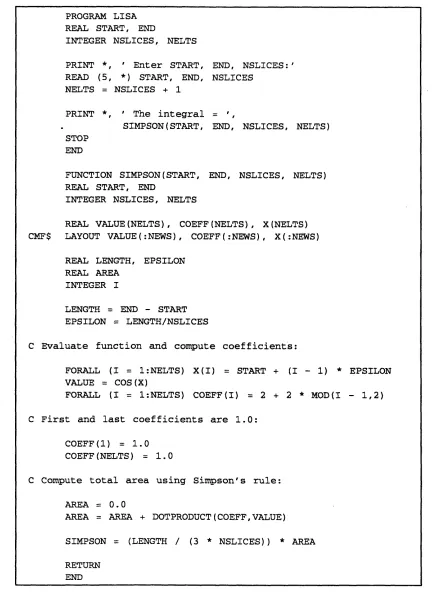
1 The BART program, coded in Fortran 77 with Do loops on arrays ... 42 The BART program, converted to CM Fortran ... 5
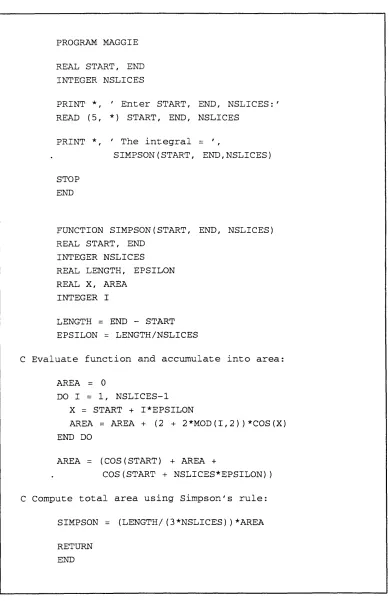
3 The MAGGIE program, coded in Fortran 77 without arrays ... 8
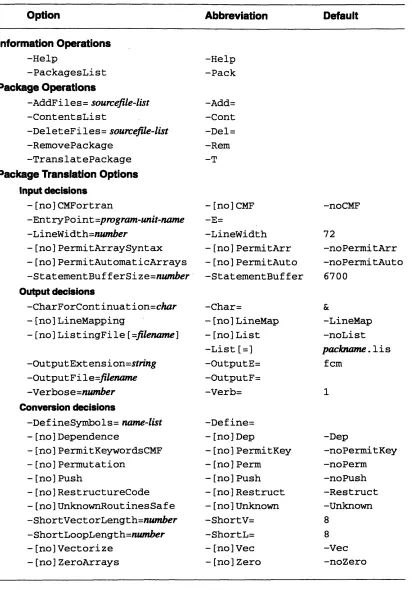
4 caax command options, recommended abbreviations, and default values, if any ... 35
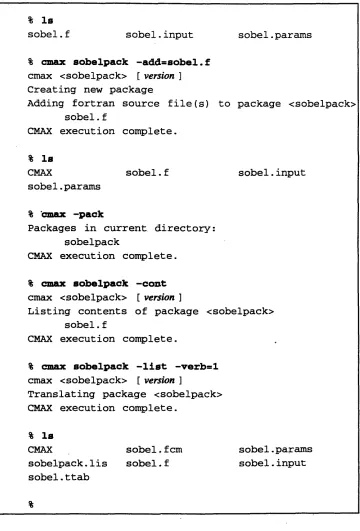
5 Sample package-creation and conversion session ... 37
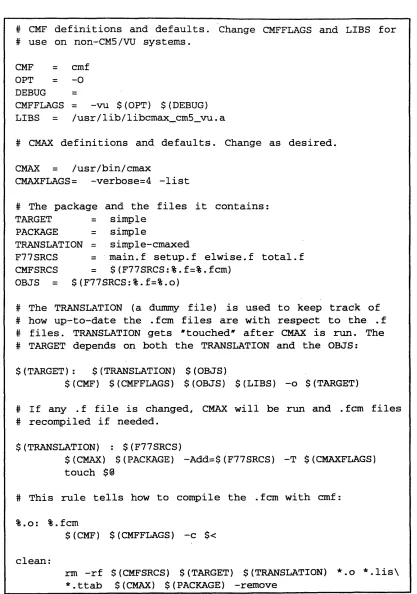
6 Sample make file for CMAX, global program execution model ... 45
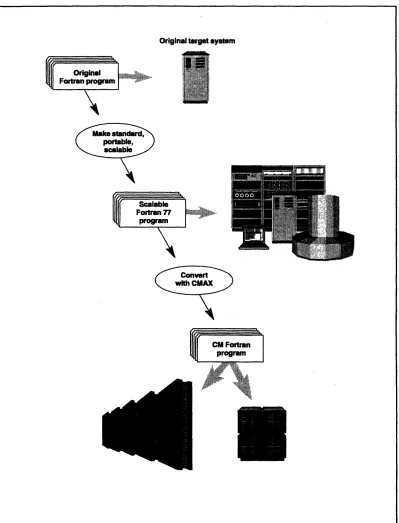
7 The generic porting process, from older Fortran to the CM and other systems ... 54
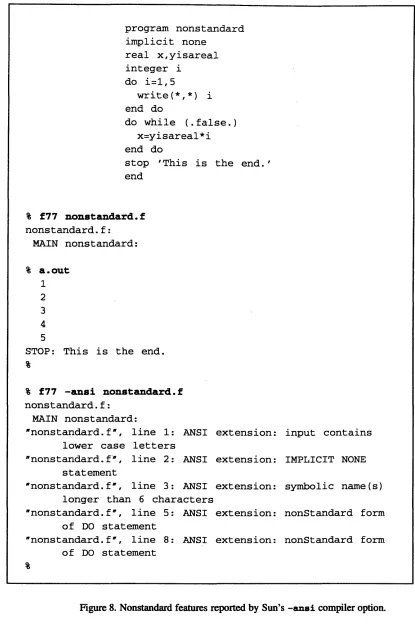
8 Nonstandard features reported by Sun's -ansi compiler option ... 61
9 The HOMER program, coded in Fortran 77 with a common array ... 86
10 The LISA program, coded in CM Fortran with automatic array ... 88
11 The MARGE program, coded in Fortran 77 with the CMAX dynamic allocation utility ... 91 12 cmax command options, recommended abbreviations, and default values, if any .101
Version 1.0, July 1993 Copyright © 1993 Thinking Machines Corporation
About This Manual
a _
~
Objectives of This Manual
This manual describes the CMAX Converter for translating Fortran 77 code into CM Fortran. It also provides hints for preparing portable code. The topics covered are:
* The converter's actions and the mechanics of using it
* Fortran 77 constructions and their CMAX-generated equivalents
* The programming conventions of scalable Fortran 77, which enhance the portability of code performance
* General portability issues and some variations on the porting process
Intended Audience
The reader of this manual is assumed to have a thorough grasp of Fortran 77 programming and some knowledge of CM Fortran (at the level of the CM
Fortran Programming Guide). User-level knowledge of UNIX is also required.
Revision Information
This is a new manual.
Related On-Line Documents
* cax-1 . O.releasenotes
* cmax-1.0.bugupdateThe path is typically /usr/doc on Connection Machine CM-5 systems and /usr/cm/doc on CM-2/200 systems. See your system administrator for the locations if these files have been moved.
Version 1.0, July 1993
Customer Support
·
~~~~
%.~
...
-
.. .·.~
Thinking Machines Customer Support encourages customers to report errors in Connection Machine operation and to suggest improvements in our products. When reporting an error, please provide as much information as possible to help us identify and correct the problem. A code example that failed to execute, a session transcript, the record of a backtrace, or other such information can greatly reduce the time it takes Thinking Machines to respond to the report. If your site has an applications engineer or a local site coordinator, please contact that person directly for support. Otherwise, please contact Thinking Machines' home office customer support staff:
Internet
Electronic Mail:
uucp
Electronic Mail:
U.S. Mail:
Telephone:
ames!think! customer-support
Thinking Machines Corporation Customer Support
245 First Street
Cambridge, Massachusetts 02142-1264
(617) 234-4000
Version 1.0, July 1993
Chapter 1
Overview
~~~ ~~~1
CMAX - the CM Automated Translator - converts Fortran 77 programs into CM Fortran. It greatly simplifies the task of porting serial Fortran programs to the
massively parallel Connection Machine system.
The conversion procedure is the same whether your target is the global data par-allel model of CM Fortran or the nodal model that uses the vector units for parallel processing and explicit message passing for communication.
This chapter provides an overview of the converter: its goals and its capabilities. Later chapters address the larger porting process: preparing the program, using the converter, and customizing code for best performance on the CM system.
1.1 Why Use the Converter?
The CMAX Converter has two basic goals:
It enables developers of new Fortran 77 programs to access the parallel processing resources of the CM system. For programs that follow the few simple conventions of scalable Fortran, conversion is largely automatic.
CMAX Converter
CM Fortran
Compiler
CM Fortran
Version 1.0, July 1993
Copyright © 1993 Thinking Machines Corporation 1
2gUgteMCnr
Users in a heterogeneous computer environment and third-party software developers can use the converter as a "preprocessor" for routine CM For-tran compilation. Since the program is maintained in ForFor-tran 77 for portability to multiple platforms, the converter provides a migration path onto and off from the CM system.
* The converter assists users in porting older Fortran 77 programs to CM Fortran. Nonstandard features and non-scalable programming idioms may not convert automatically, however, so some manual recoding is usually required.
Older
Fortran 77 + recodingCMAX
The amount of recoding depends, naturally, on the size and condition of the input program. It is not a specific goal of the CMAX Converter to con-vert pre-Fortran 77, "dusty deck" programs, although it can be helpful in the later stages of the porting process.
Dusty deck
o o oI
U
Dusty decks must first be brought to conformance with the Fortran 77 standard. From there, any of several paths can be followed, depending on whether the program is to run on several architectures or on the CM only.
Chapter 2 of this manual provides more information on the converter's place within an overall porting process.
Version 1.0, July 1993 Copyright 1993 Thinking Machines Corporation
Chapter 1. Overview 3
1.2
A Simple Conversion
The CMAX Converter's basic actions are:
* to vectorize DO loops on arrays, that is, translate them into CM Fortran array operations
* to indicate the CM home - serial control processor or parallel processing
unit -
of each array
These actions enable the CM Fortran compiler to generate parallel instructions and to allocate arrays on the appropriate part of the system.
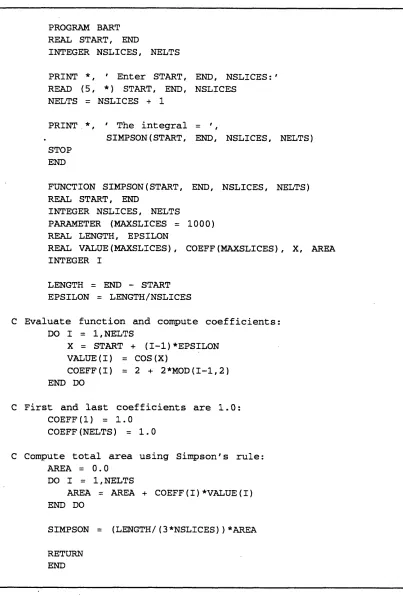
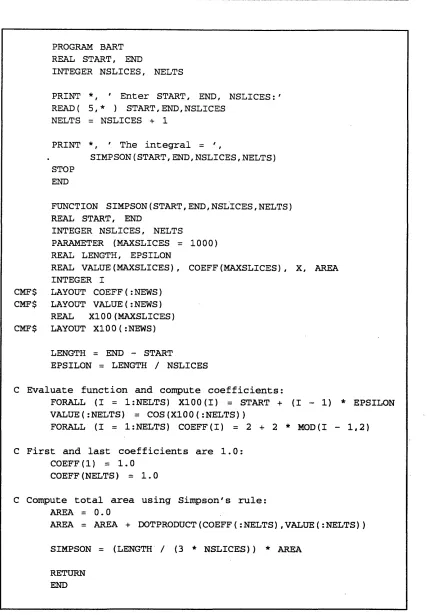
This section illustrates the converter by presenting the straightforward conver-sion of a simple program. Program BART, Figure 1, numerically integrates the cosine function over a given interval using Simpson's rule. The converter auto-matically translates BART into the CM Fortran program shown in Figure 2.
1.2.1 Invoking the Converter
The converter is currently available as a batch tool that can be invoked from any shell prompt. The barebones conversion procedure is the following.
1. Create a package containing the source program. A package is a set of files that the CMAX Converter treats as a complete program.
% cmax bartpack -AddFiles= bart.f
[othersourcefiles]
2. Convert the program in the package to CM Fortran. Each converted .f file is written to a .f cm file.
% cmax bartpack
3. Compile the output file(s) for the CM system of your choice.
% cmf
[cmfswitches
]
-o bart bart. fcm
4. Execute the program on the appropriate CM system. % bart
Chapter 2 of this manual presents more information about the cmax command and the variations in the conversion procedure.
Version 1.0, July 1993
Copyright © 1993 Thinking Machines Corporation
i
PROGRAM BART REAL START, END
INTEGER NSLICES, NELTS
PRINT *, ' Enter START, END, NSLICES:' READ (5, *) START, END, NSLICES
NELTS = NSLICES + 1
PRINT,*, ' The integral = ',
SIMPSON(START, END, NSLICES, NELTS)
STOP END
FUNCTION SIMPSON(START, END, NSLICES, NELTS) REAL START, END
INTEGER NSLICES, NELTS
PARAMETER (MAXSLICES = 1000)
REAL LENGTH, EPSILON
REAL VALUE(MAXSLICES), COEFF(MAXSLICES), X, AREA
INTEGER I
LENGTH = END - START EPSILON = LENGTH/NSLICES
C Evaluate function and compute coefficients:
DO I = 1,NELTS
X = START + (I-1)*EPSILON
VALUE(I) = COS(X)
COEFF(I) = 2 + 2*MOD(I-1,2) END DO
C First and last coefficients are 1.0: COEFF(1) = 1.0
COEFF(NELTS) = 1.0
C Compute total area using Simpson's rule:
AREA = 0.0
DO I = 1,NELTS
AREA = AREA + COEFF(I)*VALUE(I) END DO
SIMPSON = (LENGTH/(3*NSLICES) ) *AREA
RETURN END
Figure 1. The BART program, coded in Fortran 77 with DO loops on arrays.
Version 1.0, July 1993 Copyright © 1993 Thinking Machines Corporation
4 Uskea the CMAX Converter
t 1. Overview `z1Cate t g 5"M
PROGRAM BART REAL START, END
INTEGER NSLICES, NELTS
PRINT *, ' Enter START, END, NSLICES:'
READ( 5,* ) START,END,NSLICES NELTS = NSLICES + 1
PRINT *, ' The integral =
SIMPSON(START,END,NSLICES,NELTS)
STOP END
FUNCTION SIMPSON (START, END, NSLICES, NELTS)
REAL START, END
INTEGER NSLICES, NELTS
PARAMETER (MAXSLICES = 1000)
REAL LENGTH, EPSILON
REAL VALUE(MAXSLICES), COEFF(MAXSLICES), X, AREA
INTEGER I
CMF$ LAYOUT COEFF(:NEWS) CMF$ LAYOUT VALUE(:NEWS)
REAL X100(MAXSLICES)
CMF$ LAYOUT X100(:NEWS)
LENGTH = END - START
EPSILON = LENGTH / NSLICES
C Evaluate function and compute coefficients:
FORALL (I = :NELTS) X100(I) = START + (I - 1) * EPSILON VALUE(:NELTS) = COS(X100(:NELTS))
FORALL (I = 1:NELTS) COEFF(I) = 2 + 2 * MOD(I - 1,2)
C First and last coefficients are 1.0:
COEFF(1) = 1.0 COEFF(NELTS) = 1.0
C Compute total area using Simpson's rule:
AREA = 0.0
AREA = AREA + DOTPRODUCT(COEFF(:NELTS),VALUE(:NELTS))
SIMPSON = (LENGTH / (3 * NSLICES)) * AREA
RETURN END
Figure 2. The BART program, converted to CM Fortran.
Version 1.0, July 1993
Copyright © 1993 Thinking Machines Corporation
Thino the CMAY Cnnvierter
1.2.2 The Converter's Action
Notice what the converter has done to the BART program. It has performed loop conversion to express parallelism, and it has determined where on the CM system each operation will be performed.
This section is a brief introduction only; a more detailed list of the transforma-tions CMAX can perform appears in Appendix B.
Loop Conversion
The converter has translated the two Do loops in the Fortran 77 program into array operations. The loop that operates on each array element independently,
C Evaluate function and compute coefficients:
DO I = 1,NELTS
X = START + (I-1)*EPSILON
VALUE(I) = COS(X)
COEFF(I) = 2 + 2*MOD(I-1,2) END DO
turns into these array assignment statements:
C Evaluate function and compute coefficients:
FORALL. (I=1:NELTS) X100(I) = START+(I-1)*EPSILON
VALUE(:NELTS) = COS(X100(:NELTS))
FORALL (I=1:NELTS) COEFF(I) = 2+2*MOD(I-1,2)
The loop that sums the products of the respective elements of COEFF and VALUE into a scalar,
C Compute total area using Simpson's rule: AREA = 0.0
DO I = 1,NELTS
AREA = AREA + COEFF(I)*VALUE(I)
END DO
turns into this call to the intrinsic function DOTPRODUCT:
C Compute total area using Simpson's rule:
AREA = 0.0
AREA = AREA +
DOTPRODUCT (COEFF(: NELTS),VALUE(:NELTS))
Chapter.. 1. Overview , 7
Array Homes
The converter has also inserted directives that control where on the CM system the operations will occur, guaranteeing that the data to be processed in parallel is allocated in the memory of the parallel processors.
The arrays COEFF and VALUE,
PARAMETER (MAXSLICES = 1000)
REAL VALUE(MAXSLICES), COEFF(MAXSLICES)
become distributed across CM processors in NEWS order:
PARAMETER (MAXSLICES = 1000)
REAL VALUE(MAXSLICES), COEFF(MAXSLICES)
CMF$ LAYOUT COEFF (:NEWS)
CMF$ LAYOUT VALUE(:NEWS)
In addition, the scalar x,
REAL X
is promoted to an array named x100 and distributed, since it will be used in array operations:
REAL X100(MAXSLICES)
CMF$ LAYOUT X100(:NEWS)
1.2.3 Is BART Typical?
BART's conversion is painless not only because the program is simple, but also because it is, to a large extent, scalable. The basic feature of scalable programs is that they operate on arrays of data, which a compiler can split up among multi-ple processors for independent or coordinated processing. Contrast BART with program MAGGIE in Figure 3. MAGGIE is also a Simpson integrator, but this implementation does not use arrays. The CMAX Converter will not produce par-allel code for MAGGIE.
The following section presents the conventions of scalable Fortran 77 program-ming. Although these conventions arose from a desire to use data parallel systems effectively, they turn out to be a convenient strategy for achieving good performance on many other architectures as well.
Version 1.0, July 1993
Copyright 1993 Thinking Machines Corporation
Using the CMAX Converter
PROGRAM MAGGIE
REAL START, END INTEGER NSLICES
PRINT *, ' Enter START, END, NSLICES:'
READ (5, *) START, END, NSLICES
PRINT *, ' The integral = ,
SIMPSON(START, END,NSLICES)
STOP
END
FUNCTION SIMPSON(START, END, NSLICES) REAL START, END
INTEGER NSLICES
REAL LENGTH, EPSILON REAL X, AREA
INTEGER I
LENGTH = END - START EPSILON = LENGTH/NSLICES
C Evaluate function and accumulate into area:
AREA = 0
DO I = 1, NSLICES-1
X = START + I*EPSILON
AREA = AREA + (2 + 2*MOD(I,2))*COS(X)
END DO
AREA = (COS(START) + AREA +
COS(START + NSLICES*EPSILON))
C Compute total area using Simpson's rule:
SIMPSON = (LENGTH/(3*NSLICES))*AREA
RETURN
END
Figure 3. The MAGGIE program, coded in Fortran 77 without arrays.
Version 1.0, July 1993 Copyright © 1993 Thinking Machines Corporation 8
Chapter1 Ouveri e+w SSRS"0 mm
94
1.3 Writing Scalable Fortran
Fortran 77 is available on virtually all platforms and thus assures convenient por-tability. A program's performance, however, is often tuned to the details of a particular architecture, and thus may not port well. With the recent explosion of architectures - vector machines, highly pipelined machines, machines with multiple functional units, massively parallel machines, and machines with com-binations of all these features - the portability of a code's performance is not guaranteed, and must be engineered in.
We define scalability as the portability of a code's performance. In particular, a scalable program is one designed to execute efficiently on any size data set, large or small, using any number of processors, from one to thousands. Modem data parallel languages like Fortran 90 provide constructs conducive to scalable
pro-gramming; for older languages like Fortran 77, one must follow certain
conventions to ensure scalability.The conventions express three basic objectives:
* Make it easy for a compiler to recognize how data and computations may be split up for independent or coordinated processing.
* Avoid constructions that rely on a particular memory organization. * Use data layout directives and library procedures (with some
conditiona-lizing convention) to take advantage of the specific performance
characteristics of the target platforms.This section introduces the conventions of scalable programming in Fortran 77, using fragments from a widely used computational aerodynamics program called FL067T . This program uses a multigrid scheme to simulate the 3-dimensional airflow past a swept wing. It is implemented in about 5000 lines of code.*
NOTE: The conventions are intended as rules of thumb rather than hard-and-fast
requirements. In places where different conventions may conflict, as noted in the illustrations below, the goal being sought should guide the programmer's judg-ment which to follow.
Version 1.0, July 1993
Copyright © 1993 Thinking Machines Corporation
* This section is condensed from "FL067: A Case Study in Scalable Programming," by Skef Wholey, Clif-ford Lasser, and Gyan Bhanot, Thinking Machines Technical Report TMC-213, January 1992. The pro-gram FL067 was developed and is owned by Professor Antony Jameson of the Department of Aerospace Engineering at Princeton University.
10 Using the CMAX Converter
.
: .. :::: :.:. , . ' ... :. :.::
r
. -. -...
iI
"a
4
4
Version 1.0, July 1993 Copyright © 1993 Thinking Machines Corporation
I
Scalable
Fortran 77
I I---m
-i·::-:i:· jLa:
i:4:::·:: 4iaiEi
lig
5il:
.... : .:
P. .
... ...
...
Chapter 1. Overview 11
Rule 1: Scalable programs operate on most or all the data "at once."
In Fortran 77, this convention means looping over as many array axes, and as much of each axis, as possible. The loop below, for example, calculates the air pressure for each cell:
DO 90 K=1,KL
DO 90 J=:L,JL
DO 90 .I=1,IL
QQ = W(I,J,K,2)**2 + W(I,J,K,3)**2 + W(I,J,K,4)**2
QQ = .5*QQ/W(I,J,K,1)
P(I,J,K)=(GAMMA-1.)*DIM(W(I,J,K,5),QQ) 90 CONTINUE
The 4-dimensional array w implements a 3-dimensional array of 5-element record structures; structure components are selected by indexing along the fourth axis. The first structure component is the air density; the second, third, and fourth
components are the momentum densities in the x,
Y,and z directions,
respectively; and the fifth component is the total energy density.NOTE: While data can be distributed across processors along the three spatial dimensions of w, the fourth dimension is better left undistributed (in CM Fortran parlance, it is a serial axis) since operations on it are likely to be inherently sequential. This case illustrates the judgmental quality of scalable programming, since a serial axis warrants different treatment from axes in the data domain.
Rule 2: Scalable programs operate on data elements homoge-neously, performing identical or similar operations on
each.
The programming style encouraged by serial computers (and serial thinking) often violates this convention. The code below computes different values for interior and boundary cells:
DO 10 J=2,M-1 DO 10 I=2,N-1
A(I,J) = A(I,J) + B(I,J) i Interior
10 CONTINUE
DO 20 J=1,M
A (1,J) = C(1,J) ! Edge
A(N,J) = C(N,J) 20 CONTINUE
Version 1.0, July 1993
-- ".L.4. .: I
DO 30 I=2,N-1
A(I,1) = C(I,1) I Edge
A(I,N) = C(I,N)
30 CONTINUE
In addition to violating the first rule - operate on all the data at once - these loops perform different operations for different elements. Rather than coding three loops as above, one could set up a logical variable wxsx which is .TRUE.
for interior elements and . FALSE. for boundary elements. The above
computation could then be expressed in this scalable code:DO 10 J=1,N DO 10 I=1,N
IF (MASK(I,J)) THEN
A(I,J) = A(I,J) + B(I,J) ELSE
A(I,J) = C(I,J) END IF
10 CONTINUE
Rule 3: Scalable programs exhibit locality of reference.
In Fortran 77, this convention means that expressions within loops should reference similarly indexed portions of similarly shaped arrays. Elements at the loop indices or nearby are used in computations; distant elements are not. A sub-routine of FL067 computes each element of array DTL as a function of nearby elements of array RAD:
DO 70 K=1,KL DO 70 J=1,JL
DO 70 I=1,IL
RADA = RAD(I+O,J+0,K+0) + RAD(I+1,J+0,K+0) +
RAD(I+0,J+1,K+0) + RAD(I+1,J+I,K+0) + RAD(I+0,J+0,K+1) + RAD(I+1,J+0,K+l) +
RAD(I+0,J+1,K+1) + RAD(I+l,J+l,K+l)
DTL(I,J,K) =CFL/RADA
70 CONTINUE
In data parallel architectures, this convention allows the compiler to use nearest-neighbor communication instead of the more costly general communication between processors.
Version 1.0, July 1993
Copyright 1993 Thinking Machines Corporation
AV-Chapter 1. Overview 13
Rule 4: Scalable programs exhibit numerical stability.
Some degree of imprecision is unavoidable in floating-point calculations. Since most real numbers cannot be represented exactly in digital form, these numbers are rounded to a representable number. The cumulative round-off error for a series of computations can lead at times to floating-point exceptions or incorrect results.
Scalable programs avoid relying on the correctness of an algorithm or round-off tolerance tuned to a single architecture. This is particularly true of array
summa-tions and other reducsumma-tions, since floating-point reducsumma-tions are especially
sensitive to the order of evaluation. Because they may use a different order of evaluation, vector and parallel machines may produce markedly different results from serial machines, including run-time errors.
For example, if reversing the order of the loop changes the answer in a significant way, then the computation is numerically unstable. Consider this program:
PROGRAM ROUNDABOUT
REAL A(12), X
INTEGER I
A(1) = +1E+8
A(2) = +1E+1
A(3) = +2E+8
A(4) = +2E+1
A(5) = +3E+8
A(6) = +3E+1
A(7) = -3E+1
A(8) = -3E+8
A(9) = -2E+1
A(10) = -2E+8
A(11) = -1E+1 A(12) = -1E+8
C Add up from 1 to 12:
X = 0.0 DO I = 1,12
X = X + A(I)
END DO PRINT , X
Version 1.0, July 1993
14 Usingthe CMAXConverte
C Add up from 12 to 1:
X = 0.0
DO I = 12,1,-1 X = X + A(I) END DO
PRINT *, X
C Add up odd elements, then even:
X = 0.0
DO I = 1,11,2
X = X + A(I) END DO
DO I = 2,12,2
X = X + A(I) END DO
PRINT *, X END
*.
'',;,_
A system using IEEE 32-bit REAL values produces this output:-40.0000
40. 0000
0.Using IEEE 64-bit DOUBLE PRECISION instead of 32-bit REAL, the output is: 0.
0. 0.
Scalable programs maintain numerical stability on all target architectures. This example illustrates two options for achieving this:
* Go to higher-precision representation.
* Change the algorithm. In this example, the numerically stable answer is obtained by summing first the odd elements, then the even elements.
Version 1.0, July 1993 Copyright © 1993 Thinking Machines Corporation
Cha'pterffifg 1. OverviewMME'M '0 M. 15MAK
Rule 5: Scalable programs use easily recognizable idioms to ex-press common, well-structured dependences.
In the loops shown thus far, each iteration can be executed independently of the others; that is, there are no loop-carried data dependences. Most algorithms do have some form of interaction between data items. While code with arbitrary data dependences does not generally execute well on vector or parallel machines, most well-structured data-dependent computations do have efficient low-level algorithms on serial, vector, and parallel machines. Scalable code enables a com-piler to recognize such computations by expressing them with a small set of common idioms. (Appendix B of this manual lists many of these idioms.) Consider this convergence-checking code, from the EULER subroutine of FL067:
NSUP = 0 HRMS = 0
DO 80 K=1,KL DO 80 J=1,JL
DO 80 I=1,IL
V = W(I,J,K,2)*W(I,J,K,2) + W(I,J,K,3)*W(I,J,K,3) + W(I,J,K,4)*W(I,J,K,4)
IF (V1.GE.(GAMMA*P(I,J,K)*W(I,J,K,1)))
NSUP = NSUP + 1I COUNT
V1 = W(I,J,K,5) + P(I,J,K)
Vi = V/W(I,J,K,1) - HO
HRMS = HRMS + V*Vl I SUM
80 CONTINUE
HRMS = SQRT(HRMS/FLOAT((NX-1)*NY*NZ))
The variable NSUP is incremented once for each cell that exceeds a threshold.
An incrementation contained in an IF statement is an idiomatic way of
expressing the reduction operation named COUNT in Fortran 90. The variablemRss
is computed using another reduction operation: the sma of the square ofa value computed for each cell. This operation is also the idiomatic expression
of DOTPRODUCT.
Version 1.0, July 1993
Copyright 1993 Thinking Machines Corporation
6
Using the MAConveneRule 6: Scalable programs do not assume a particular memory model.
Certain features of Fortran 77 - particularly sequence association and storage association - assume a linear model of memory.
* Sequence association is the mapping of a multidimensional object in col-umn-major order to a linear sequence of values.
REAL A(10,10), B(10,10)
CALL SUBA(A, B(5,5))
SUBROUTINE SUBA (C,D)
REAL C(100), D(10)
In this example, the elements of matrices A and B are sequence associated with elements of the dummy vector arguments c and D.
* Storage association occurs when two or more variables (or arrays) share the same storage. This feature is exploited by EQUIVALENCE,
REAL A(2,50) COMPLEX C(100)
EQUIVALENCE (A(1,1),C(1))
and by some uses of COMMON,
SUBROUTINE SUBA
COMMON /BOUNDS/ IBX, IBY, IBZ
SUBROUTINE SUBB
COMMON /BOUNDS/ IBDS(3)
Sequence and storage association are difficult to implement and tend to be ineffi-cient on memory systems that are not linear. These features are included in Fortran 90 for compatibility with Fortran 77, but scalable programs avoid them. New features of Fortran 90, such as allocatable, automatic, and assumed-shape arrays, reduce the need for some uses of sequence and storage association. Other uses can be replaced by alternative Fortran 77 practices, which are both clearer and more scalable (see Chapter 4).
Version 1.0, July 1993 Copyright © 1993 Thinking Machines Corporation
Chapter 1. Overview 17
As general principles of scalable programming, the following are corollaries of Rule 6.
Rule 6a: Multidimensional arrays should be declared as such and be declared consistently throughout a program.
Arrays that change shape, particularly across subroutine boundaries, impose a severe burden on systems with nonlinear memory organization such as the CM system. In addition, performance is greatly affected by the way in which arrays are allocated, and the number and size of dimensions must be made explicit when they are allocated.
The original FL067 code used storage pools from which it allocated different mesh variables. Pointers into these pools were passed to subroutines, which declared their arguments as multidimensional arrays. To enhance scalability, this original code,
DIMENSION W(IDX5),P(IDX),
K1 = 1 KW = 1
NC = (IE+1) * (JE+1) * (KE+1) L1 = K1 + NC
LW = KW + 5*NC
CALL FLO (W(KW),P(K1), ..., W(LW),P(L1), ...)
was recoded as,
DIMENSION W_O(O:IEM,0:JEM,O:KEM,5),P_0(O:IEM,O:JEM,O:KEM)
DIMENSION W_1(0:IEM,O:JEM,0:KEM,5),P_1(0:IEM,O:JEM,O:KEM)
CALL FLO (W_,P_0, ... , W,P, ...)
Rule 6b: Data layout directives should be supplied where necessary and helpful.
Most machines' performance is sensitive to data layout, because of its impact on locality of access. Distributed-memory parallel machines are particularly
sensi-tive, since data layout directly influences the frequency of interprocessor
communication. Scalable programs reflect an awareness of the layoutconven-Version 1.0, July 1993
Copyright © 1993 Thinking Machines Corporation
18..
.A Usn th Convertetions of the target systems and use machine-specific directives to override the default layout where appropriate.
In the FL067 program, the 4-dimensional array w shown under Rule 1
imple-ments a 3-dimensional array of 5-element record structures; the structure
components are selected by indexing along the fourth axis. For the CM system, the fourth dimension is better left undistributed, as specified by the CM Fortran compiler directive LAYOUT:REAL X(O:IE,O:JE,O:KE,5)
CMF$ LAYOUT W(:NEWS, :NEWS, :NEWS, :SERIAL)
A program might also benefit from aligning arrays in distributed memory, by means of the directive ALIGN. These directives can be inserted into the Fortran 77 source program, since they are ignored by other Fortran compilers.
Rule 6c: Arrays should be of appropriate size and declared such that they are easily changeable.
The optimal size for arrays and array dimensions varies among machines. On Cray machines, certain array sizes can degrade performance because of bank conflicts; the CM-2 system rewards power-of-2 array dimensions; other ma-chines may have constraints stemming from page sizes or cache sizes; and so on. Array sizes are easily changed between compilations if they are declared with parameters instead of literal constants and if the PARAMETER statements are easy
to locate. (INCLUDE files are convenient for this purpose.) This convention is also helpful in scaling a Fortran 77 program to different problem sizes.
Rule 7: Scalable programs use machine-specific libraries where available.
A call to a library routine fulfills the scalability goal of specifying the desired operation without dictating its algorithm. Sorting, matrix multiplication, equa-tion solving, and Fourier transforms are examples of operaequa-tions where no single algorithm is universally optimal. Using library procedures, along with some conditionalizing convention in the source program, helps make the code ma-chine-independent and also takes advantage of any machine-specific tuning by the library implementor.
Version 1.0, July 1993 Copyright © 1993 Thinking Machines Corporation
Chapter 1.MEME-11 Overview 19tm
1.4 What Does the Converter Do?
CM Fortran includes all of Fortran 77 plus some extensions that support data par-allel processing. These extensions include:
* Fortran 90 array operations and other language features that CM Fortran provides to express parallelism
* CM Fortran compiler's conventions for laying out data (in linear versus
distributed memory, depending on whether parallel processing is
appropriate)* Fortran 90 method of passing array arguments and the semantics of proce-dure calls
The converter is designed to deal with all these translation issues. By viewing the whole program, it can provide the cmf compiler with code (including directives) that expresses parallelism; that avoids "array home" conflicts by directing that arrays processed in parallel are to be allocated in distributed memory; and that uses correct CM Fortran methods of passing distributed arrays as arguments.
1.4.1 Array Operations
An array operation is a computation that is performed on an array as a single entity, that is, on all the array's elements or a specified subset of them. CM For-tran adopts ForFor-tran 90 array notation to indicate the set of elements. The array reference A is short for A (1 : N:l), indicating all the elements; the reference
A(1:N/2:2) indicates every other element in the first half.
This triplet notation (express or implied) is analogous in function to the control variables in a Do construct, specifying a range of indices for array elements to be processed. But there is an important difference. A Do loop specifies indices in a particular sequential order, and processes one or more entire statements for an index before going on the the next index. An array operation, in contrast, may process indices in any order, but it must perform any given single operation (such as addition, multiplication, or assignment) for all indices before performing the next operation. The net effect is that an array operation can process array
elements in any order without changing the result. The CM system takes
advantage of this feature to process array elements in parallel.Version 1.0, July 1993
Copyright © 1993 Thinking Machines Corporation
20 Using the CMAX Converter
The CMAX Converter analyzes Fortran 77 DO constructs to determine whether they are functionally equivalent to any CM Fortran array operation, and if so, converts the array notation and the loop(s).
This section illustrates the converter's loop-conversion capabilities; output may be simplified to clarify the essential transformation. Verbatim output from loop transformations is shown in Appendix B.
Loops without Dependences
Loop operations in which array elements do not interact vectorize straightfor-wardly into elemental operations:
Fortran 77
DO 10 I=1,N
A(I)=B(I)+C(I) DO 10 J=1,M
P(I,J)=P(I,J)+R(I,J) 10 CONTINUE
CM Fortran
A=B+C P=P+R
In other loop operations, the data elements may interact but there is no depen-dence between loop iterations. The converter's dependepen-dence analysis detects that a step-by-2 smoothing operation can vectorize to an array assignment. (Notice that the converter and CM Fortran accept the END DO statement.)
Fortran 77
DO I=2,N-1,2
A(I)= (A(I-1) +A(I+1))/2
END DO
t-c
CM Fortran
(2 :N-1:2)=(A( :N-2:2)+
A(3:N:2))/2
Version 1.0, July 1993 Copyright © 1993 Thinking Machines Corporation
0
IA1 A2 A3 IA4 A5A6 A7 I I
J
]LLLL
Using the CAX Converter
20
Chapter 1. Overview 21
r"
< C 2Similarly, the apparent dependence in a "mirror" operation is recognized as not a real dependence:
Fortran 77 CM Fortran
1,N/2
= A(N-I+1)
}
(1:N/2) =
A(N:N/2:-1)
I All A2 A31 A4 A5 A6 A7 A8
Loops That Express Common Idioms
Loops with certain well-structured dependences are functionally equivalent to CM Fortran intrinsic functions, Utility Library procedures, or FORALL
state-ments. The converter recognizes the intent of the loop and substitutes the corresponding array operation. For example, consider these idiomatic loop constructions:
Fortran 77 CM Fortran
X = 0.0
DO I = 1,N
X = X + A(I) END DO
DO J = 1,M
Y(J) = 1.0
DO I = 1,N
Y(J) = Y(J) END DO
END DO
}
*B(I,J)
0.0
X + SUM(A)
= Y * PRODUCT(B,DIM=1)
Version 1.0, Juy-1993
Copyright © 1993 Thinking Machines Corporation
9
DO I =
A(I)
22 Using the CMAX Converter
*
~iiiii~:j...
.c~l~i~a~:il .. ... .i:. i:% -.. ::X ;. :: : . ...:.::.: - :. .: .Loops with Embedded Conditionals
Loops with embedded IF statements may convert to a masked array assignment, such as WHERE or FORALL, or a masked intrinsic. For example:
Fortran 77 CM Fortran
DO I = 1,N
IF (A(I) .LT. 0.0) THEN B(I) = -B(I)
ELSE
C(I) = 0.0
ENDIF
END DO
WHERE (A .LT. 0.0) B = -B
ELSEWHERE
C = 0.0
ENDWHERE
Other Vectorization Capabilities
The converter analyzes and may restructure code to facilitate vectorization. For example, it promotes scalar values that are used with arrays into arrays of the appropriate shape, as illustrated above in the conversion of program BART. The array name is derived from the scalar's name, as with x and xio00, and the array is aligned, if necessary, with another CM array to enhance the locality of access of their respective elements.
The converter may also fission loops to isolate vectorizable code from inherently serial operations:
Fortran 77 CM Fortran
DO I = 1,N A(I) = B
PRINT *,
X = X +
END DO
(I) +
D(I) D(I)
C(I)
A = B + C DO I = 1,N
PRINT *, D(I) END DO
X = X + SUM(D)
Version 1.0, July 1993
Copyright © 1993 Thinking Machines Corporation --
The converter may also transform a loop with an embedded subroutine call into a subroutine that contains the loop, thereby making the loop vectorizable. This
loop-pushing transformation can be visualized as follows. Notice that the
dummy variable x becomes an array in the intermediate form, and the loop becomes an array assignment in the CM Fortran version.
Fortran 77
SUBROUTINE PUSHME(A,N) REAL A(N)
DO I = 1,N
CALL PULLYOU(A(I)) END DO
END
SUBROUTINE PULLYOU(X) REAL X
X = X + 1
END
Intermediate Form
SUBROUTINE PUSHME(A,N) REAL A(N)
CALL PULLYOU_V1 (A,N)
END
SUBROUTINE PULLYOU_V1(X,M)
-REAL X(M)
DO I = 1,M
X(I) = X(I) + 1 END DO
END
CM Fortran
SUBROUTINE PUSHME(A,N)
REAL A;(N)
CALL PULLYOU_V1(A,N)
END
SUBROUTINE PULLYOU_V1(X,M)
REAL X(M) X = X + 1
END
Version 1.0, Judy 1993
Copyright © 1993 Thinkng Machines Corporation
Using the CMAX Converter
Limits on Vectorization
If the converter cannot safely vectorize a DO loop, it passes the code through
un-changed. The CM Fortran compiler then treats it as serial code. Some loop constructions that the converter does not translate are the following.
* Loops that contain a STOP or RETURN statement, a computed or assigned
GO TO statement, or a forward or backward branch. In general,
nonstruc-tured constructs cannot convert to array operations.
* Loops containing calls to functions that are passed in as arguments. * Loops that contain certain complicated data dependences. For example,
the converter cannot vectorize the following:
REAL A(10), B(10) DO I=1,7
B(I) = A(I+3) + 10
A(I) = B(I+3) + 1
END DO
IBlIB2 B3 B4 B5 B6 IB7 B8IBIB10I9
Al A2 A3 A4 A A6 A7 A8 A9
lA0I
* Loops for which the converter cannot resolve a question of data depen-dence. For example, the following loop can vectorize only if the index offset M is zero or positive:
Fortran 77 CM Fortran
DO I=5,95{ A(5:95) =
A(I) = 5+A(M:95+M)**B(5:95)
END DO
Where M is negative, the loop must execute serially. If M is a run-time value, the converter cannot resolve this question.
NOTE: The converter provides directives with which the user can assert information that resolves some dependence issues. If the user asserts, in
Version 1.0, July 1993
Copyright @ 1993 Thinking Machines Corporation
Chapter 1. Oveiview . . 25
this case, CKxX$NODEPENDENCE - meaning that M is necessarily zero or positive - the converter can vectorize the loop.
Loops with structured dependences that have no functionally equivalent
parallel operation in CM Fortran. For example, a parallel-prefix (or
"scan") operation along a dimension is vectorizable. A scan along the diagonal of two dimensions, however, cannot (at present) be computed in parallel, and the converter does not vectorize it.DO J=2,N DO I=2,N
A(I,J) = A(I-1,J) + A(I,J-1)
END DO END DO
Version 1.0, July 1993
Copyright 0 1993 Thinking Machines Corporation
1.4.2 Array Homes
Every CM system consists of two processing components with different memory organizations:
* A serial control processor, called the front end on a CM-2 or CM-200 and
the partition manager on the CM-5. This processor has the conventional
linear memory organization.
* A parallel processing unit consisting of some number of processing
ele-ments, called processors (in the abstract) or nodes or vector units
(depending on the CM hardware configuration). The memory of the paral-lel unit is distributed among the processors.Data stored on the control processor, including all scalar data and front-end
ar-rays, is operated upon serially. Other arrays (CM arrays) are laid out across the
parallel processors, one or more elements in the local memory of each processor, and are operated upon in parallel. The processing component on which an array is stored is called its home. The CMAX Converter guides the compiler's array home decisions.
Control Processor
SERIAL Parallel Processors
O PERATIONS
ARRAY OPERATIONS ON
* CM arrays
II II II I
NOTE: The compiler's decomposition of data and code into "serial" versus "par-allel" is the same regardless of whether a CM Fortran program is to run globally or "on a node." In the latter case, each CM-5 node serves as a control processor and the four vector units associated with each node are its dedicated parallel pro-cessing unit. See the CMMD documentation set for more information about executing CM Fortran programs "on a node."
Version 1.0, July 1993 Copyright © 1993 Thinking Machines Corporation
Scalar data
: ·
...
Front-end,
arrays
Captr.vrvew2
The Compiler's Action
The CM Fortran compiler decides the home of each array in a program after at-tempting to determine whether it is to be processed serially or in parallel.
Usually, it goes by whether the array is used in an array operation, although the programmer can control the decision with a compiler directive such as LAYOUT.
One of the chores of CM Fortran programming is to keep array homes consistent across procedures. Since the compiler does not at present perform interprocedu-ral analysis, it may give an array different homes in different procedures. However:
* It is an error to perform an array operation on a front-end array.
* There is a severe performance penalty for performing a serial operation on a CM array.
* It is an error to pass an actual array argument from either home to a dummy argument with the other home.
For example:
9)
PROGRAM FAILUREINTEGER A(100,100)
DATA [initialize A]
CALL SUB(A)
PRINT *, A
STOP END
SUBROUTINE SUB(B) INTEGER B(100,100) B = B**2
RETURN END
The compiler allocates array A on the control processor, since there is nothing in the main program to indicate that
A
is to be processed in parallel. Array B, on the other hand, becomes a CM array by virtue of the array assignment in the subpro-gram. This program fails at run time when the front-end array is passed to the subroutine.Version 1.0, July 1993
Copyright 0 1993 Tiking Machines Corporation
27
28 Using the CMAX Converter
The Converter's Action
The CMAX Converter spares the programmer the problem of controlling array homes by inserting a LAYOUT directive for every array. Since the converter per-forms interprocedural analysis, it can determine whether an array is used in an array operation anywhere in the program and can thus avoid home mismatches across procedure boundaries. It may also create variants of certain subprograms, so that both front-end arrays and CM arrays can be passed to them as arguments. The user can of course override the converter's action by means of in-line direc-tives or converter command-line options. These features, and the situations where they might be useful, are described in Chapter 2 of this manual.
The converter makes array home decisions by the following rules:
* A user-supplied cmf directive LAYOUT or cmax option overrides all
inter-nal rules. CMAX propagates
LAYOUTdirectives across program
boundaries and issues a warning if it encounters inconsistency in their use. • The converter also respects the cmf directive ALIGN within a program
unit, but does not propagate it across program boundaries. (See Chapter 2 for restrictions on ALIGN.)
* All arrays that CM Fortran restricts to the control processor are marked as front-end arrays. These include arrays of CHARACTER type and arrays sub-ject to an EQUIVALENCE statement.
* All arrays whose total size is below a threshhold number of elements are marked as front-end arrays. (The default threshhold size is 8 elements; you can specify a different number with the -ShortVectorLength=nn con-verter switch. See Chapter 2.)
* All arrays in COMMON that change type or shape across program boundaries are marked as front-end arrays.
* All arrays passed as arguments to procedures that define a dummy argu-ment of a different type or shape are marked as front-end arrays, except in those cases where the converter is able to adjust code to meet this CM Fortran restriction.
The last two rules reflect restrictions that CM Fortran imposes on arrays stored in distributed memory. Section 1.4.3 describes the current state of the converter's ability to generate code that meets these restrictions, thereby enabling more arrays to become CM arrays and be subject to array operations.
Version 1.0, July 1993
Cha te 1' :' : g .g,;':S. Overview':.. .. .. 29..
1.4.3 Argument Passing
CM Fortran adopts the Fortran 90 semantics for passing CM array arguments; it retains the Fortran 77 semantics for front-end array arguments. In Fortran 77, where arrays are passed by reference, an array name as an argument indicates the array's first element. In CM Fortran, where CM arrays are passed by descriptor, the reference to the name of a CM array indicates all its elements.
When the argument is a whole array, a procedure call looks the same in both cases:
REAL A(1000)
CALL SUB(A)
However, the A argument in Fortran 77 is short for A (1), whereas in CM Fortran,
the A is short for A (1:1000). The semantic difference becomes apparent when
the procedure is to operate on only part of the array. For instance, in the follow-ing fragment the first subroutine call operates on the first half of the array and second call on the second half:
Fortran 77 and CM Fortran front-end arrays
REAL A(1000)
CALL SUB_1(A)
CALL SUB_2(A(501) )
SUBROUTINE SUB_1(B) REAL B(500)
SUBROUTINE SUB_2(C) REAL C(500)
CM Fortran CM arrays
REAL A(1000)
CALL SUB_1(A(1:500) CALL SUB_2(A(501:1000))
SUBROUTINE SUB_1(B) REAL B(500)
SUBROUTINE SUB_2(C) REAL C(500)
Both the calls on the left fail when A is a CM array because it is an error to change
array size or shape across subroutine boundaries. In fact, the argument to suB_2 is not an array at all, since the expression A(501) indicates a single array ele-ment. Where A is a CM array, this element is transferred to the control processor and passed as a scalar argument.
Version 1.0, July 1993
Copyright © 1993 Thinking Machines Corporation
9
30
Usng te CMA ConerteThe CMAX Converter's interprocedural analysis enables it to generate code that meets the argument-passing requirements for CM arrays in three particular cases.
* Array arguments with a scalar subscript (one-dimensional) * Array arguments with elided axes
* Assumed-size dummy array arguments (without change in rank)
Array Arguments with a Scalar Subscript
"Hidden array" arguments, like A(501) above, violate CM Fortran argument-passing restrictions by argument-passing a scalar argument to a dummy array.
The converter changes the call to pass the whole array, its length, and an integer index into it, and changes the procedure definition accordingly. At present, this action occurs only if both the actual and the dummy arrays are 1-dimensional.
Fortran 77 CM Fortran
REAL A(1000)
CALL SUB_ (A) CALL SUB_2(A(501))
SUBROUTINE SUB_1(B) REAL B(500)
SUBROUTINE SUB_2(C) REAL C(500)
0
REAL A(1000)
CALL SB(A11000)
CALL SUB_2(A,51,1000) CALL SUB_2(A,501,1000)
SUBROUTINE SUB_1(B,OS,LN) INTEGER OS, LN
REAL B(1-OS+1:LN+1-OS)
SUBROUTINE SUB_2(C,OS,LN) INTEGER OS,LN
REAL C(1-OS+1:LN+1-OS)
Array Arguments with Elided Axes
In Fortran 77, one may pass n-minus-k-dimensional contiguous slices of n-di-mensional arrays to subprograms in the following way: all indices in the call
other than rightmost k indices are the lower bound of the corresponding
dimension.Version 1.0, July 1993 Copyright © 1993 Thinking Machines Corporation
31
Chapter 1. Overview
'.
..REAL X(100,200,5)
CALL FOO(X(1,1,3))
SUBROUTINE FOO(Y) REAL Y(100,200)
This type of memory reference violates CM Fortran argument-passing
restric-tions by reshaping an array across program boundaries. However, CMAX
recognizes the intention of axis elision in this situation and transforms the code to pass a 2-dimensional section of the 3-dimensional array. The lower bound indices are turned into colons, indicating the whole dimension. (The user could improve performance of the output by inserting a CM Fortran LAYOUT directiveto designate the rightmost axis of x a serial, or non-distributed, axis.)
REAL X(100,200,5)
CALL FOO(X(:,:,3))
SUBROUTINE FOO(Y) REAL Y(100,200)
CMF$ LAYOUT Y(:NEWS, :NEWS)
Assumed-Size Dummy Array Arguments
CM Fortran does not support assumed-size dummy CM arrays (those with
dimension lists ending in *), since Fortran 77 permits collapsing multiple axes into the * axis. Where CMAX has determined that the actual and dummy argu-ments are in fact of the same rank, and that they meet the other criteria for a CM home and parallel processing, it generates an assumed-shape dummy array. For example, this subroutine:
SUBROUTINE SUB(A,MAXA0,NSL) REAL A(MAXAO, MAXAO, *)
DO IX = 1, MAXAO
DO IY = 1, MAXAO DO ISL = 1, NSL
A(IX, IY, ISL) = A(IX, IY, ISL) * 2 END DO
END DO
Version 1.0, July 1993
32.~
~:R
~~ ::~ .C Usin t ·CMAX'; vtEND DO
END
Is translated to:
SUBROUTINE SUB(A,MAXA0,NSL) REAL A(:,:,:)
CMF$ LAYOUT A(:NEWS,:NEWS,:NEWS)
A(:,:,:NSL) = A(:,:,:NSL) * 2 END
Array Arguments Confined to Front End
The converter confines to the control processor any array arguments that violate CM Fortran argument-passing restrictions in ways that the converter cannot work around. Specifically, it marks as front-end arrays any array arguments that: * Are passed with a scalar index ("hidden array argument") when either or
both the actual and dummy arguments are multidimensional.
* Change type or shape across subprogram boundaries (including array arguments and arrays in comioN) except for recognized cases of axis eli-sion or of scalar indexing into a 1-dimeneli-sional array.
* Are passed to assumed-size arrays when the actual and dummy arguments are of different ranks.
As a result, no loops on these arrays can be vectorized. See Chapter 4 for some ways to work around these restrictions in the Fortran 77 program.
Version 1.0, July 1993 Copyright © 1993 Thinking Machines Corporation
9
Chapter 2
The Conversion Process
*. .
This chapter describes the mechanics of using the CMAX Converter and suggests where the converter might fit into the overall process of porting Fortran 77 pro-grams.
2.1 Invoking the Converter
The CMAX Converter is invoked from a shell prompt with the command cmax. This command creates and operates upon packages. A package is a set of source files that the converter treats as a complete program. All translation is of
pack-ages, not of source files directly, since the converter needs to perform
interprocedural analysis to determine arrays' homes, resolve questions of data dependence, and determine the attributes of actual array arguments.The command operates in one of three modes: · Information only
%
cmax
information-operation* Package operation without translation
% cmax packname package-operation
* Package translation with or without other package operation % cmax packname [ -T ] [ translation-options ]
% cmax packname -Add= sourcefile-list -T [ translation-options ]
Version 1.0, July 1993
34 Usingthe CMAXConverte
p
The arguments:
* packname is a user-supplied name of up to 14 characters, including
alpha-numerics, underscore, hyphen, or period.
* sourcefile-list is a space-delimited list of filenames with the extension . f
or .F. (The extensions .f cm and .FCM are accepted when the translation option -CMFortran is specified.)
The cmax command options are summarized in Figure 4 and described below.
2.1.1 Quick Forms
* To create a package and translate it in one step:
% cmax mypack -Add= *. f -T [ translation options]
* To add file(s) to an existing package and translate it in one step: % cmax mypack -Add=munch. f -T [translation options] * To translate an existing package:
%
cmax mpack
[ translation
options]
2.1.2 Specifying Options
The cmax options are shown in Figure 4 in mixed case for readibility, but case is ignored and any non-ambiguous abbreviation is accepted. For options that take a list of arguments, a space after = is optional. Binary switches are specified with or without a prepended no.
2.1.3 Getting Information
% max information-operation
The information-operation may be: · display a help message: -Help
· display a list of the packages in the current directory: -Pack
Version 1.0, July 1993
Copyright © 1993 Thinking Machines Corporation
Chaper
. Te Cnversion
ProcesWs35
Option Abbreviation Default
Information Operations
-Help
-PackagesList
Package Operations
-AddFiles= sourcefile-list
-ContentsList
-DeleteFiles= sourcefile-list
-RemovePackage
-TranslatePackage
Package Translation Options
Input decisions
-[no]CMFortran -EntryPoint=program-unit-name -LineWidth=number -[no]PermitArraySyntax -[no]PermitAutomaticArrays -StatementBufferSize=number
Output decisions
-CharForContinuation=char
-[no]LineMapping
- [no] ListingFile [=filename]
-OutputExtension=string
-OutputFile=filename
-Verbose=number
Conversion decisions
-DefineSymbols= name-list
- [no] Dependence
- [no]PermitKeywordsCMF
- [no] Permutation
- [no] Push
-[no]RestructureCode -[no]UnknownRoutinesSafe -ShortVectorLength=number -ShortLoopLength=number -[no]Vectorize -[no]ZeroArrays -Help -Pack -Add= -Cont -Del= -Rem -T
- [no] CMF
-E= -LineWidth -[no]PermitArr -[no]PermitAuto -StatementBuffer -Char= -[no]LineMap -[no]List -List[=] -OutputE= -OutputF= -Verb= -Define= -[no]Dep -[no]PermitKey -[no] Perm -[no] Push - [no]Restruct - [no] Unknown
-ShortV= -ShortL= - [no]Vec -[no]Zero -noCMF 72 -noPermitArr -noPermitAuto 6700 & -LineMap -noList
packname.
lis
fcm 1 -Dep -noPermitKey -noPerm -noPush -Restruct -Unknown 8 8 -Vec -noZeroFigure 4. cmax command options, recommended abbreviations, and default values, if any.
Version 1.0, July 1993
Copyright 0 1993 Thinking Machines Corporation
p
36
Using the CMAX Converter2.1.4 Creating and Manipulating Packages
(Without
Translation)
% cmaxpackname package-operation
The package-operation may be:
· create a package with specified source files: -Add= sourcefile-list
*
add files to an existing package: -Add= sourcefile-list*
delete files from a package: -Del= sourcefile-list * display a list of the files in a package: -cont * remove a package: -RemPackages contain pointers to the source files, not copies of the files. Removing a package or deleting files from it does not affect the source files in any way; only the pointers are removed. These pointers enable the converter to get the latest version of any files on which it performs conversion operations.
2.1.5 Translating packages
% cmax packname [ -T] [ translation-options ]
% max packname -Add= sourcefile-list -T [ translation-options]
The translation-options may be any of the options listed under that category in Figure 4. The remainder of this section suggests some uses for various options. The converter writes converted files and other user-visible output files to the cur-rent directory. As shown in Figure 5, it also creates a subdirectory named cxmx under the current directory. This subdirectory holds the converter's internal files and directories, which the user does not access directly. These internal items include packages and the package database files generated during conversion.
2.1.6 Removing Package Debris
If you typically use a "scratch" package during development, get into the habit of removing the package (with the -Remove option) before each session. Otherwise, you may end up with a package that contains multiple main programs or other anomalies. Any time you are in doubt about the state of a package or of the CMAX subdirectory, don't hesitate to remove them and create them anew.
Version 1.0, July 1993 Copyright © 1993 Thinking Machines Corporation
Chapter 2. The Conversion Process 37
Also, note that interrupting CMAX can leave the package in an inconsistent state. Remove and recreate the package to fix the problem.
sobel.input sobel.params
% cmax sobelpack -add=sobel.f
cmax <sobelpack> [ version ]
Creating new package
Adding fortran source file(s) to package <sobelpack>
sobel.f
CMAX execution complete.
% s
CMAX
sobel.params
sobel.f sobel.input
% cmax -pack
Packages in current directory:
sobelpack
![Figure 9. The ]HOMER program, coded in Fortran 77 with a common array.](https://thumb-us.123doks.com/thumbv2/123dok_us/1136346.1142521/95.627.125.538.104.697/figure-homer-program-coded-fortran-common-array.webp)