by Steven Holzner
Physics
FOR
Physics For Dummies® Published by
Wiley Publishing, Inc.
111 River St.
Hoboken, NJ 07030-5774
www.wiley.com
Copyright © 2006 by Wiley Publishing, Inc., Indianapolis, Indiana
Published by Wiley Publishing, Inc., Indianapolis, Indiana
Published simultaneously in Canada
No part of this publication may be reproduced, stored in a retrieval system, or transmitted in any form or by any means, electronic, mechanical, photocopying, recording, scanning, or otherwise, except as permitted under Sections 107 or 108 of the 1976 United States Copyright Act, without either the prior written permission of the Publisher, or authorization through payment of the appropriate per-copy fee to the Copyright Clearance Center, 222 Rosewood Drive, Danvers, MA 01923, 978-750-8400, fax 978-646-8600. Requests to the Publisher for permission should be addressed to the Legal Department, Wiley Publishing, Inc., 10475 Crosspoint Blvd., Indianapolis, IN 46256, 317-572-3447, fax 317-572-4355, or online at http://
www.wiley.com/go/permissions.
Trademarks: Wiley, the Wiley Publishing logo, For Dummies, the Dummies Man logo, A Reference for the Rest of Us!, The Dummies Way, Dummies Daily, The Fun and Easy Way, Dummies.com and related trade dress are trademarks or registered trademarks of John Wiley & Sons, Inc. and/or its affiliates in the United States and other countries, and may not be used without written permission. All other trademarks are the property of their respective owners. Wiley Publishing, Inc., is not associated with any product or vendor mentioned in this book.
LIMIT OF LIABILITY/DISCLAIMER OF WARRANTY: THE PUBLISHER AND THE AUTHOR MAKE NO REP-RESENTATIONS OR WARRANTIES WITH RESPECT TO THE ACCURACY OR COMPLETENESS OF THE CON-TENTS OF THIS WORK AND SPECIFICALLY DISCLAIM ALL WARRANTIES, INCLUDING WITHOUT LIMITATION WARRANTIES OF FITNESS FOR A PARTICULAR PURPOSE. NO WARRANTY MAY BE CRE-ATED OR EXTENDED BY SALES OR PROMOTIONAL MATERIALS. THE ADVICE AND STRATEGIES CON-TAINED HEREIN MAY NOT BE SUITABLE FOR EVERY SITUATION. THIS WORK IS SOLD WITH THE UNDERSTANDING THAT THE PUBLISHER IS NOT ENGAGED IN RENDERING LEGAL, ACCOUNTING, OR OTHER PROFESSIONAL SERVICES. IF PROFESSIONAL ASSISTANCE IS REQUIRED, THE SERVICES OF A COMPETENT PROFESSIONAL PERSON SHOULD BE SOUGHT. NEITHER THE PUBLISHER NOR THE AUTHOR SHALL BE LIABLE FOR DAMAGES ARISING HEREFROM. THE FACT THAT AN ORGANIZATION OR WEBSITE IS REFERRED TO IN THIS WORK AS A CITATION AND/OR A POTENTIAL SOURCE OF FUR-THER INFORMATION DOES NOT MEAN THAT THE AUTHOR OR THE PUBLISHER ENDORSES THE INFOR-MATION THE ORGANIZATION OR WEBSITE MAY PROVIDE OR RECOMMENDATIONS IT MAY MAKE. FURTHER, READERS SHOULD BE AWARE THAT INTERNET WEBSITES LISTED IN THIS WORK MAY HAVE CHANGED OR DISAPPEARED BETWEEN WHEN THIS WORK WAS WRITTEN AND WHEN IT IS READ.
For general information on our other products and services, please contact our Customer Care Department within the U.S. at 800-762-2974, outside the U.S. at 317-572-3993, or fax 317-572-4002.
For technical support, please visit www.wiley.com/techsupport.
Wiley also publishes its books in a variety of electronic formats. Some content that appears in print may not be available in electronic books.
Library of Congress Control Number: 2005933603
ISBN-13: 978-0-7645-5433-9
ISBN-10: 0-7645-5433-6
Manufactured in the United States of America
10 9 8 7 6 5 4 3 2 1
About the Author
Steven Holzner is an award-winning author of 94 books that have sold over two million copies and been translated into 18 languages. He served on the Physics faculty at Cornell University for more than a decade, teaching both Physics 101 and Physics 102. Dr. Holzner received his Ph.D. in physics from Cornell and performed his undergrad work at MIT, where he has also served as a faculty member.
Dedication
To Nancy.
Author’s Acknowledgments
Publisher’s Acknowledgments
We’re proud of this book; please send us your comments through our Dummies online registration form located at www.dummies.com/register/.
Some of the people who helped bring this book to market include the following:
Acquisitions, Editorial, and Media Development
Project Editor: Natalie Faye Harris
Acquisitions Editor: Stacy Kennedy
Copy Editors: Josh Dials, Kristin DeMint
Technical Editor: Joseph L. Breeden
Editorial Manager: Michelle Hacker
Editorial Assistants: Hanna Scott, Nadine Bell, David Lutton
Cover Photos: © Getty Images/Photodisc
Cartoons: Rich Tennant (www.the5thwave.com)
Composition Services
Project Coordinator: Maridee Ennis
Layout and Graphics: Mary J. Gillot, Denny Hager, Erin Zeltner
Proofreaders: Laura Albert, Leeann Harney, Jessica Kramer, Arielle Mennelle, Joe Niesen, Carl William Pierce
Indexer: Joan Griffitts Special Help
Danielle Voirol
Publishing and Editorial for Consumer Dummies
Diane Graves Steele, Vice President and Publisher, Consumer Dummies
Joyce Pepple, Acquisitions Director, Consumer Dummies
Kristin A. Cocks, Product Development Director, Consumer Dummies
Michael Spring, Vice President and Publisher, Travel
Kelly Regan,Editorial Director, Travel
Publishing for Technology Dummies
Andy Cummings,Vice President and Publisher, Dummies Technology/General User
Composition Services
Gerry Fahey,Vice President of Production Services
Contents at a Glance
Introduction ...1
Part I: Putting Physics into Motion ...5
Chapter 1: Using Physics to Understand Your World ...7
Chapter 2: Understanding Physics Fundamentals ...13
Chapter 3: Exploring the Need for Speed ...25
Chapter 4: Following Directions: Which Way Are You Going? ...43
Part II: May the Forces of Physics Be with You...61
Chapter 5: When Push Comes to Shove: Force ...63
Chapter 6: What a Drag: Inclined Planes and Friction ...81
Chapter 7: Circling around Circular Motions and Orbits ...99
Part III: Manifesting the Energy to Work...117
Chapter 8: Getting Some Work out of Physics ...119
Chapter 9: Putting Objects in Motion: Momentum and Impulse...137
Chapter 10: Winding Up with Angular Kinetics ...153
Chapter 11: Round and Round with Rotational Dynamics...173
Chapter 12: Springs-n-Things: Simple Harmonic Motion ...189
Part IV: Laying Down the Laws of Thermodynamics...205
Chapter 13: Turning Up the Heat with Thermodynamics ...207
Chapter 14: Here, Take My Coat: Heat Transfer in Solids and Gases...219
Chapter 15: When Heat and Work Collide: The Laws of Thermodynamics ...235
Part V: Getting a Charge out of Electricity
and Magnetism...251
Chapter 16: Zapping Away with Static Electricity ...253
Chapter 17: Giving Electrons a Push with Circuits ...271
Chapter 18: Magnetism: More than Attraction ...287
Chapter 19: Keeping the Current Going with Voltage ...305
Part VI: The Part of Tens ...339
Chapter 21: Ten Amazing Insights on Relativity...341
Chapter 22: Ten Wild Physics Theories...349
Glossary...355
Table of Contents
Introduction...1
About This Book...1
Conventions Used in This Book ...2
What You’re Not to Read ...2
Foolish Assumptions ...2
How This Book Is Organized...2
Part I: Putting Physics into Motion ...3
Part II: May the Forces of Physics Be with You ...3
Part III: Manifesting the Energy to Work...3
Part IV: Laying Down the Laws of Thermodynamics ...3
Part V: Getting a Charge out of Electricity and Magnetism...3
Part VI: The Part of Tens ...4
Icons Used in This Book...4
Where to Go from Here...4
Part I: Putting Physics into Motion ...5
Chapter 1: Using Physics to Understand Your World . . . .7
What Physics Is All About ...7
Observing Objects in Motion...8
Absorbing the Energy Around You ...9
Feeling Hot but Not Bothered...10
Playing with Charges and Magnets ...10
Preparing for the Wild, Wild Physics Coming Up...11
Chapter 2: Understanding Physics Fundamentals . . . .13
Don’t Be Scared, It’s Only Physics ...14
Measuring the World Around You and Making Predictions...15
Don’t mix and match: Keeping physical units straight...16
From meters to inches and back again: Converting between units...17
Eliminating Some Zeros: Using Scientific Notation...20
Checking the Precision of Measurements...21
Knowing which digits are significant ...21
Estimating accuracy...22
Arming Yourself with Basic Algebra ...23
Chapter 3: Exploring the Need for Speed . . . .25
Dissecting Displacement ...26
Examining axes ...27
Measuring speed ...28
Speed Specifics: What Is Speed, Anyway?...29
Reading the speedometer: Instantaneous speed ...30
Staying steady: Uniform speed ...30
Swerving back and forth: Nonuniform motion ...30
Busting out the stopwatch: Average speed ...31
Pitting average speed versus uniform motion...31
Speeding Up (or Down): Acceleration ...33
Defining acceleration ...33
Determining the units of acceleration ...33
Positive and negative acceleration ...35
Average and instantaneous acceleration ...36
Uniform and nonuniform acceleration ...37
Relating Acceleration, Time, and Displacement ...37
Not-so-distant relations ...38
Equating more speedy scenarios ...39
Linking Speed, Acceleration, and Displacement ...40
Chapter 4: Following Directions: Which Way Are You Going? . . . .43
Conquering Vectors ...43
Asking for directions: Vector basics ...44
Putting directions together: Adding vectors ...45
Taking distance apart: Subtracting vectors ...46
Waxing Numerical on Vectors...47
Breaking Up Vectors into Components ...49
Finding vector components given magnitudes and angles...49
Finding magnitudes and angles given vector components...51
Unmasking the Identities of Vectors ...53
Displacement is a vector ...54
Velocity is another vector ...54
Acceleration: Yep, another vector...55
Sliding Along on Gravity’s Rainbow: A Velocity Exercise...57
Part II: May the Forces of Physics Be with You ...61
Chapter 5: When Push Comes to Shove: Force . . . .63
Forcing the Issue ...63
For His First Trick, Newton’s First Law of Motion ...64
Getting it going: Inertia and mass ...65
Measuring mass ...65
Ladies and Gentlemen, Newton’s Second Law of Motion ...66
Naming units of force...67
Newton’s Grand Finale: The Third Law of Motion ...72
Tension shouldn’t cause stiff necks: Friction in Newton’s third law ...73
Analyzing angles and force in Newton’s third law ...75
Finding equilibrium ...77
Chapter 6: What a Drag: Inclined Planes and Friction . . . .81
Don’t Let It Get You Down: Dealing with Gravity ...81
Leaning Vertical: An Inclined Plane ...82
Figuring out angles the easy way ...83
Playing with acceleration ...84
Getting Sticky with Friction ...85
Calculating friction and the normal force ...86
Conquering the coefficient of friction...86
Understanding static and kinetic friction...87
Handling uphill friction...89
Determining How Gravity Affects Airborne Objects ...94
Going up: Maximum height ...94
Floating on air: Hang time ...95
Going down: Factoring the total time ...95
Firing an object at an angle ...96
Chapter 7: Circling around Circular Motions and Orbits . . . .99
Staying the Course: Uniform Circular Motion ...100
Changing Direction: Centripetal Acceleration...101
Controlling velocity with centripetal acceleration ...101
Finding the magnitude of the centripetal acceleration ...102
Pulling Toward the Center: Centripetal Force ...102
Negotiating Curves and Banks: Centripetal Force through Turns...104
Getting Angular: Displacement, Velocity, and Acceleration ...106
Dropping the Apple: Newton’s Law of Gravitation ...108
Deriving the force of gravity on the earth’s surface ...109
Using the law of gravitation to examine circular orbits ...110
Looping the Loop: Vertical Circular Motion ...113
Part III: Manifesting the Energy to Work ...117
Chapter 8: Getting Some Work out of Physics . . . .119
Work: It Isn’t What You Think ...119
Working on measurement systems ...120
Pushing your weight ...120
Taking a drag...121
Considering Negative Work...122
Getting the Payoff: Kinetic Energy ...123
Breaking down the kinetic energy equation ...125
Putting the kinetic energy equation to use ...126
Energy in the Bank: Potential Energy ...128
Working against gravity ...129
Converting potential energy into kinetic energy...130
Choose Your Path: Conservative versus Nonconservative Forces ...131
Up, Down, and All Around: The Conservation of Mechanical Energy...132
Determining final velocity with mechanical energy...134
Determining final height with mechanical energy...134
Powering Up: The Rate of Doing Work ...135
Common units of power ...135
Alternate calculations of power ...136
Chapter 9: Putting Objects in Motion: Momentum and Impulse . . . .137
Looking at the Impact of Impulse...137
Gathering Momentum...139
The Impulse-Momentum Theorem: Relating Impulse and Momentum ...140
Shooting pool: Finding impulse and momentum...141
Singing in the rain: An impulsive activity...142
When Objects Go Bonk: Conserving Momentum...143
Measuring velocity with the conservation of momentum ...145
Measuring firing velocity with the conservation of momentum...146
When Worlds (or Cars) Collide: Elastic and Inelastic Collisions ...148
When objects bounce: Elastic collisions ...148
When objects don’t bounce: Inelastic collisions...149
Colliding along a line...149
Colliding in two dimensions...151
Chapter 10: Winding Up with Angular Kinetics . . . .153
Going from Linear to Rotational Motion ...153
Understanding Tangential Motion ...154
Finding tangential speed ...154
Finding tangential acceleration ...156
Finding centripetal acceleration...156
Applying Vectors to Rotation ...158
Calculating angular velocity...158
Figuring angular acceleration ...159
Twisting and Shouting: Torque...160
Mapping out the torque equation ...162
Understanding lever arms...162
Figuring out the torque generated ...164
Recognizing that torque is a vector ...165
No Wobbling Allowed: Rotational Equilibrium...166
Hanging a flag: A rotational equilibrium problem ...167
Ladder safety: Introducing friction into rotational equilibrium...168
Chapter 11: Round and Round with Rotational Dynamics . . . .173
Rolling Up Newton’s Second Law into Angular Motion...173
Converting tangential acceleration to angular acceleration ...175
Examining Moments of Inertia...176
CD players and torque: An inertia example ...177
Angular acceleration and torque: Another inertia example ...179
Wrapping Your Head around Rotational Work and Kinetic Energy ...180
Doing some rotational work...180
Tracking down rotational kinetic energy ...182
Measuring rotational kinetic energy on a ramp ...183
Can’t Stop This: Angular Momentum...185
Reviewing the conservation of angular momentum ...186
Satellite orbits: A conservation of angular momentum example ...186
Chapter 12: Springs-n-Things: Simple Harmonic Motion . . . .189
Hooking Up with Hooke’s Law ...189
Keeping springs stretchy...190
Deducing that Hooke’s law is a restoring force ...191
Moving with Simple Harmonic Motion ...191
Examining basic horizontal and vertical simple harmonic motion ...192
Diving deeper into simple harmonic motion ...193
Finding the angular frequency of a mass on a spring ...200
Factoring Energy into Simple Harmonic Motion ...202
Swinging with Pendulums ...203
Part IV: Laying Down the Laws of Thermodynamics ...205
Chapter 13: Turning Up the Heat with Thermodynamics . . . .207
Getting into Hot Water...208
When the thermometer says Fahrenheit...208
When the thermometer says Celsius ...208
When the thermometer says Kelvin ...209
The Heat Is On: Linear Expansion...210
Deconstructing linear expansion ...212
Workin’ on the railroad: A linear expansion example...212
The Heat Continues On: Volume Expansion ...213
Going with the Flow (of Heat)...214
Changing Phases: When Temperatures Don’t Change ...216
Breaking the ice with phase changes...217
Understanding latent heat...218
Chapter 14: Here, Take My Coat: Heat Transfer
in Solids and Gases . . . .219
Boiling Water: Convection...219
Too Hot to Handle: Conduction...220
Examining the properties that affect conduction to find the conduction equation ...221
Emitting and Absorbing Light: Radiation...224
You can’t see radiation, but it’s there ...225
Radiation and blackbodies...226
Crunching Avogadro’s Number ...228
Forging the Ideal Gas Law ...229
Gas pressure: An ideal gas law example...231
Boyle’s Law and Charles’ Law: Alternative expressions of the ideal gas law ...231
Tracking Ideal Gas Molecules ...232
Predicting air molecule speed ...232
Calculating kinetic energy in an ideal gas ...233
Chapter 15: When Heat and Work Collide:
The Laws of Thermodynamics . . . .235
Gaining Thermal Equilibrium: The Zeroth Law of Thermodynamics ...235
Conserving Heat and Energy: The First Law of Thermodynamics ...236
Calculating conservation...237
Examining isobaric, isochoric, isothermal, and adiabatic processes, oh my! ...238
Figuring out specific heat capacities ...245
When Heat Flows: The Second Law of Thermodynamics ...246
Putting heat to work: Heat engines ...246
Evaluating heat’s work: Heat engine efficiency ...247
Carnot says you can’t have it all ...248
Going Cold: The Third (and Absolute Last) Law of Thermodynamics ....250
Part V: Getting a Charge out of Electricity
and Magnetism ...251
Chapter 16: Zapping Away with Static Electricity . . . .253
Plus and Minus: Electron and Proton Charges ...253
Push and Pull: Electric Forces ...254
Charging it to Coulomb’s law ...255
Bringing objects together...255
Calculating the speed of electrons...256
Looking at forces between multiple charges ...256
Influence at a Distance: Electric Fields...258
Coming from all directions: Electric fields from point charges ...259
Charging nice and steady: Electric fields in parallel plate capacitors...261
Electric Potential: Cranking Up the Voltage...262
Calculating electric potential energy ...263
Realizing the potential in voltage ...264
Discovering that electric potential is conserved ...265
Finding the electric potential of point charges ...266
Chapter 17: Giving Electrons a Push with Circuits . . . .271
Electrons on the March: Current...271
Defining current...272
Calculating the current in batteries ...272
Giving You Some Resistance: Ohm’s Law...273
Determining current flow ...273
Examining resistivity...274
Powering Up: Wattage...275
Flowing from One to the Other: Series Circuits ...275
Splitting the Current: Parallel Circuits ...276
Looping Together Electricity with Kirchoff’s Rules ...278
Implementing the loop rule...279
Using multiple-loop circuits ...280
Conquering Capacitors in Parallel and Series Circuits ...283
Capacitors in parallel circuits...283
Capacitors in series circuits ...284
Putting Together Resistors and Capacitors: RC Circuits ...285
Chapter 18: Magnetism: More than Attraction . . . .287
Finding the Source of Attraction ...288
Forcing a Moving Charge...289
Figuring the Quantitative Size of Magnetic Forces ...290
Moving in Orbits: Charged Particles in Magnetic Fields ...292
Magnetic fields do no work . . . ...292
. . . but they still affect moving charged particles ...293
Pushing and Pulling Currents ...295
Forces on currents ...295
Torques on currents...296
Identifying the Magnetic Field from a Wire ...298
Centering on Current Loops ...300
Achieving a Uniform Magnetic Field with Solenoids ...302
Chapter 19: Keeping the Current Going with Voltage . . . .305
Inducing EMF (Electromagnetic Frequency) ...305
Moving a conductor in a magnetic field to cause voltage...306
Inducing voltage over a certain area ...307
Factoring In the Flux with Faraday’s Law...308
Getting the Signs Right with Lenz’s Law ...310
Figuring out Inductance ...312
Examining Alternating Current Circuits ...313
Picturing alternating voltage ...314
Unearthing root mean square current and voltage...314
Leading with capacitors ...315
Lagging with inductors ...318
Chapter 20: Shedding Some Light on Mirrors and Lenses . . . .323
All about Mirrors (srorriM tuoba llA)...323
When Light Gets Bendy ...324
Refracting light with Snell’s Law...324
Examining water at apparent depths...325
All Mirrors and No Smoke ...327
Expanding with concave mirrors ...327
Contracting with convex mirrors ...332
Seeing Clearly with Lenses...333
Expanding with converging lenses...334
Contracting with diverging lenses...337
Part VI: The Part of Tens ...339
Chapter 21: Ten Amazing Insights on Relativity . . . .341
Nature Doesn’t Play Favorites ...341
The Speed of Light Is Constant, No Matter How Fast You Go ...342
Time Dilates at High Speeds ...343
Space Travel Ages You Less...343
Length Contracts at High Speeds...344
E = mc2: The Equivalence of Matter and Energy...345
Matter Plus Antimatter Equals Boom ...345
The Sun Is Radiating Away Mass...346
The Speed of Light Is the Ultimate Speed ...346
Newton Is Still Right...347
Chapter 22: Ten Wild Physics Theories . . . .349
You Can Measure a Smallest Distance ...349
There Might Be a Smallest Time...350
Heisenberg Says You Can’t Be Certain ...350
Black Holes Don’t Let Light Out ...351
Gravity Curves Space ...351
Matter and Antimatter Destroy Each Other ...352
Supernovas Are the Most Powerful Explosions ...353
The Universe Starts with the Big Bang and Ends with the Gnab Gib ....353
Microwave Ovens Are Hot Physics ...353
Physicists May Not Have Physical Absolute Measures...354
Glossary ...355
Introduction
P
hysics is what it’s all about. What what’sall about?Everything. That’s the whole point. Physics is present in every action around you. And because physics has no limits, it gets into some tricky places, which means that it can be hard to follow. It can be even worse when you’re reading some dense textbook that’s hard to follow.
For most people who come into contact with physics, textbooks that land with 1,200-page whumps on desks are their only exposure to this amazingly rich and rewarding field. And what follows are weary struggles as the readers try to scale the awesome bulwarks of the massive tomes. Has no brave soul ever wanted to write a book on physics from the reader’spoint of view? Yes, one soul is up to the task, and here I come with such a book.
About This Book
Physics For Dummiesis all about physics from yourpoint of view. I’ve taught physics to many thousands of students at the university level, and from that experience, I know that most students share one common trait: confusion. As in, “I’m confused as to what I did to deserve such torture.”
Conventions Used in This Book
Some books have a dozen conventions that you need to know before you can start. Not this one. All you need to know is that new terms appear in italics, like this,the first time I discuss them and that vectors — items that have both a magnitude and a direction — appear in bold in Chapter 4, likethis.
What You’re Not to Read
I provide two elements in this book that you don’t have to read at all if you’re not interested in the inner workings of physics — sidebars and paragraphs marked with a Technical Stuff icon.
Sidebars are there to give you a little more insight into what’s going on with a particular topic. They give you a little more of the story, such as how some famous physicist did what he did or an unexpected real-life application of the point under discussion. You can skip these sidebars, if you like, without miss-ing any essential physics.
The Technical Stuff material gives you technical insights into a topic, but you don’t miss any information that you need to do a problem. Your guided tour of the world of physics won’t suffer at all.
Foolish Assumptions
I assume that you have no knowledge of physics when you start to read this book. However, you should have some math prowess. In particular, you should know some algebra. You don’t need to be an algebra pro, but you should know how to move items from one side of an equation to another and how to solve for values. Take a look at Chapter 2 if you want more information on this topic. You also need a little knowledge of trigonometry, but not much. Again, take a look at Chapter 2, where I review all the trig you need to know — a grasp of sines and cosines — in full.
How This Book Is Organized
Part I: Putting Physics into Motion
Part I is where you usually start your physics journey, because describing motion — including acceleration, velocity, and displacement — isn’t very difficult. You have only a few equations to deal with, and you can get them under your belt in no time at all. Examining motion is a great way to under-stand how physics works, both in measuring and predicting what’s going on.
Part II: May the Forces of Physics
Be with You
“For every action, there is an equal and opposite reaction.” Ever heard that one? The law, and its accompanying implications, comes up in this part. Without forces, the motion of objects wouldn’t change at all, which would make for a very boring world. Thanks to Sir Isaac Newton, physics is particu-larly good at explaining what happens when you apply forces.
Part III: Manifesting the Energy to Work
If you apply a force to an object, moving it around and making it go faster, what are you really doing? You’re doing work,and that work becomes the
energyof that object. Together, work and energy explain so much about the whirling world around us, which is why I dedicate Part III to these topics.
Part IV: Laying Down the Laws
of Thermodynamics
What happens when you stick your finger in a candle flame and hold it there? You get a burned finger, that’s what. And you complete an experiment in heat transfer, one of the topics you see in Part IV, a roundup of thermodynamics — the physics of heat and heat flow. You also see how heat-based engines work, how ice melts, and more.
Part V: Getting a Charge out of Electricity
and Magnetism
happen and all the way up to circuits with currents and voltages. Magnetism is a pretty attractive topic, too. When electricity flows, you see magnetism, and you get its story in Part V, including how magnetism and electricity form light.
Part VI: The Part of Tens
Parts of Tens are made up of fast-paced lists of 10 items each, and physics can put together lists like no other science can. You discover all kinds of amazing relativity topics here, such as time dilation and length contraction. And you see some far-out physics — everything from black holes and the Big Bang to wormholes in space and the smallest distance you can divide space into.
Icons Used in This Book
You come across some icons in this book that call attention to certain tidbits of information. Here’s what the icons mean:
This icon marks information to remember, such as an application of a law of physics or a shortcut for a particularly juicy equation.
This icon means that the info is technical, insider stuff. You don’t have to read it if you don’t want to, but if you want to become a physics pro (and who doesn’t?), take a look.
When you run across this icon, be prepared to find a little extra info designed to help you understand a topic better.
Where to Go from Here
Part I
In this part . . .
Chapter 1
Using Physics to Understand
Your World
In This Chapter
Recognizing the physics in your world
Putting the brakes on motion
Handling the force and energy around you
Getting hot under the collar with thermodynamics
Introducing electricity and magnetism
Wrapping your head around some wild physics
P
hysics is the study of your world and the world and universe around you. You may think of physics as a burden — an obligation placed on you in school, mostly to be nasty — but it isn’t like that. Physics is a study that you undertake naturally from the moment you open your eyes.Nothing falls beyond the scope of physics; it’s an all-encompassing science. You can study various aspects of the natural world, and, accordingly, you can study different fields in physics: the physics of objects in motion, of forces, of electricity, of magnetism, of what happens when you start going nearly as fast as the speed of light, and so on. You enjoy the study of all these topics and many more in this book.
Physics has been around as long as people have tried to make sense of their world. The word “physics” is derived from the Greek word “physika,” which means “natural things.”
What Physics Is All About
people are walking and riding bikes, streams are flowing, and so on. When you stop to examine these actions, your natural curiosity gives rise to endless questions:
How can I see?
Why am I hot?
What’s the air I breathe made up of?
Why do I slip when I try to climb that snow bank?
What are those stars all about? Or are they planets? Why do they seem to move?
What’s the nature of this speck of dust?
Are there hidden worlds I can’t see?
What’s light?
Why do blankets make me warm?
What’s the nature of matter?
What happens if I touch that high-tension line? (You know the answer to that one; as you can see, a little knowledge of physics can be a lifesaver.) Physics is an inquiry into the world and the way it works, from the most basic (like coming to terms with the inertia of a dead car that you’re trying to push) to the most exotic (like peering into the very tiniest of worlds inside the smallest of particles to try to make sense of the fundamental building blocks of matter). At root, physics is all about getting conscious about your world.
Observing Objects in Motion
Some of the most fundamental questions you may have about the world deal with objects in motion. Will that boulder rolling toward you slow down? How fast will you have to move to get out of its way? (Hang on just a moment while I get out my calculator . . .) Motion was one of the earliest explorations of physics, and physics has proved great at coming up with answers.
Part I of this book handles objects in motion — from balls to railroad cars and most objects in between. Motion is a fundamental fact of life, and one that most people already know a lot about. You put your foot on the accelera-tor, and the car takes off.
Studying motion is fine, but it’s just the very beginning of the beginning. When you take a look around, you see that the motion of objects changes all the time. You see a motorcycle coming to a halt at the stop sign. You see a leaf falling and then stopping when it hits the ground, only to be picked up again by the wind. You see a pool ball hitting other balls in just the wrong way so that they all move without going where they should.
Motion changes all the time as the result of force, which is what Part II is all about. You may know the basics of force, but sometimes it takes an expert to really know what’s going on in a measurable way. In other words, sometimes it takes a physicist like you.
Absorbing the Energy Around You
You don’t have to look far to find your next piece of physics. You never do. As you exit your house in the morning, for example, you may hear a crash up the street. Two cars have collided at a high speed, and, locked together, they’re sliding your way.
Thanks to physics (and, more specifically, Part III of this book), you can make the necessary measurements and predictions to know exactly how far you have to move to get out of the way. You know that it’s going to take a lot to stop the cars. But a lot of what?
It helps to have the ideas of energy and momentum mastered at such a time. You use these ideas to describe the motion of objects with mass. The energy of motion is called kinetic energy,and when you accelerate a car from 0 to 60 miles per hour in 10 seconds, the car ends up with plenty of kinetic energy. Where does the kinetic energy come from? Not from nowhere — if it did, you wouldn’t have to worry about the price of gas. Using gas, the engine does
workon the car to get it up to speed.
Or say, for example, that you don’t have the luxury of an engine when you’re moving a piano up the stairs of your new place. But there’s always time for a little physics, so you whip out your calculator to calculate how much work you have to do to carry it up the six floors to your new apartment.
After you move up the stairs, your piano will have what’s called potential energy,simply because you put in a lot of work against gravity to get the piano up those six floors.
Next, you calculate the bill for the piano, hand it to your roommate, and go back downstairs to get your drum set.
Feeling Hot but Not Bothered
Heat and cold are parts of your everyday life, so, of course, physics is there with you in summer and winter. Ever take a look at the beads of condensation on a cold glass of water in a warm room? Water vapor in the air is being cooled when it touches the glass, and it condenses into liquid water. The water vapor passes thermal energy to the cold drink, which ends up getting warmer as a result.
Thermodynamicsis what Part IV of this book is all about. Thermodynamics can tell you how much heat you’re radiating away on a cold day, how many bags of ice you need to cool a lava pit, the temperature of the surface of the sun, and anything else that deals with heat energy.
You also discover that physics isn’t limited to our planet. Why is space cold? It’s empty, so how can it be cold? It isn’t cold because you can measure its temperature as cold. In space, you radiate away heat, and very little heat radiates back to you. In a normal environment, you radiate heat to everything around you, and everything around you radiates heat back to you. But in space, your heat just radiates away, so you can freeze.
Radiating heat is just one of the three ways heat can be transferred. You can discover plenty more about the heat happening around you all the time, whether created by a heat source like the sun or by friction, through the topics in this book.
Playing with Charges and Magnets
After you master the visible world of objects hurtling around in motion, you can move on to the invisible world of work and energy. Part V offers more insight into the invisible world by dissecting what goes on with electricity and magnetism.
A great deal of physics involves taking apart the invisible world that sur-rounds you. Matter itself is made up of particles that carry electric charges,
and an incredible number of these charges exist in all people.
When you get concentrations of charges, you get static electricity and such attention-commanding phenomena as lightning. When those charges move, on the other hand, you get normal, wall-socket-brand electricity and magnetism. From lightning to light bulbs, electricity is part of physics, of course. In this book, you see not only that electricity can flow in circuits but also how it does so. You also come to an understanding of the ins and outs of resistors, capacitors, and inductors.
Preparing for the Wild, Wild Physics
Coming Up
Even when you start with the most mundane topics in physics, you quickly get to the most exotic. In Part VI, you discover ten amazing insights into Einstein’s Special Theory of Relativity and ten amazing physics facts. Einstein is one of the most well-known heroes of physics, of course, and an iconic genius. He typifies the lone physics genius for many people, striking out into the universe of the unknown and bringing light to dark areas. But what exactly did Einstein say? What does the famous E = mc2equation
really mean? Does it really say that matter and energy are equivalent — that you can convert matter into energy and energy into matter? Yep, sure does. That’s a pretty wild physics fact, and it’s one you may not think you’ll come across in everyday life. But you do. To radiate as much light as it does, the sun converts about 4.79 million tons of matter into radiant energy every second.
And stranger things happen when matter starts moving near the speed of light, as predicted by your buddy Einstein.
“Watch that spaceship,” you say as a rocket goes past at nearly the speed of light. “It appears compressed along its direction of travel — it’s only half as long as it would be at rest.”
“Time measured on that spaceship goes more slowly than time here on Earth, too. For us, it will take 200 years for the rocket to reach the nearest star. But for the rocket, it will take only 2 years.”
“Are you making this up?” everyone asks.
Chapter 2
Understanding Physics
Fundamentals
In This Chapter
Understanding the concept of physics . . . and why it matters
Mastering measurements (and keeping them straight as you solve equations)
Accounting for significant digits and possible error
Brushing up on basic algebra and trig concepts
T
here you are, working away at a tough, nearly unanswerable physics problem, seeking a crucial breakthrough. The question is tough, and you know that legions of others have struggled with it fruitlessly. Suddenly, illumination strikes, and everything becomes clear.“Of course,” you say. “It’s elementary. The ball will rise 9.8 meters into the air at its highest point.”
Shown the correct solution to the problem, a grateful instructor awards you a nod. You modestly acknowledge the accolade and turn to the next problem. Not bad.
With physics, the glory awaits you, but you have some hard work waiting for you, too. Don’t worry about the work; the satisfaction of success is worth it. And when you finish this book, you’ll be a physics pro, plowing through for-merly difficult problems left and right like nobody’s business.
Don’t Be Scared, It’s Only Physics
Many people are a little on edge when they think about physics. It’s easy to feel intimidated by the subject, thinking it seems like some foreign high-brow topic that pulls numbers and rules out of thin air. But the truth is that physics exists to help you make sense of the world. It’s a human adventure, undertaken on behalf of everyone, into the way the world works.
Although the contrary may seem true, there’s no real mystery about the goals and techniques of physics; physics is simply about modeling the world. The whole idea behind it is to create mental models to describe how the world works: how blocks slide down ramps, how stars form and shine, how black holes trap light so it can’t escape, what happens when cars collide, and so on. When these models are first created, they often have little to do with numbers; they just cover the gist of the situation. For example, a star is made up of this layer and then that layer, and as a result, this reaction takes place, followed by that one. And — pow — you have a star.
As time goes on, those models start getting numeric, which is where physics students sometimes start having problems. Physics class would be a cinch if you could simply say, “That cart is going to roll down that hill, and as it gets toward the bottom, it’s going to roll faster and faster.” But the story is more involved than that — not only can you say that the cart is going to go faster, but in exerting your mastery over the physical world, you can also say how much faster it will go.
The gist of physics is this: You start by making an observation, you create a model to simulate that situation, and then you add some math to fill it out — and voilà! You have the power to predict what will happen in the real world. All this math exists to help you feel more at home in the physical world and to help you see what happens and why, not to alienate you from your surroundings.
Be a genius: Don’t focus on the math
Richard Feynman was a famous Nobel Prizewinner in physics who had a reputation during the 1950s and ’60s as an amazing genius. He later explained his method: He attached the problem at hand to a real-life scenario, creating a mental image, while others got caught in the math. When someone would show him a long derivation that had gone wrong, for example, he’d think of some physical phenomenon that
Always keep in mind that the real world comes first and the math comes later. When you face a physics problem, make sure you don’t get lost in the math; keep a global perspective about what’s going on in the problem, because doing so will help you stay in control. After teaching physics to college students for many years, I’m very familiar with one of the biggest problems they face — getting lost in, and being intimidated by, the math. And now, to address that nagging question plaguing your mind: What are you going to get out of physics? If you want to pursue a career in physics or in an allied field such as engineering, the answer is clear — you’ll need this knowl-edge on an everyday basis. But even if you’re not planning to embark on a physics-related career, you can get a lot out of studying the subject. You can apply much of what you discover in an introductory physics course to real life. But far more important than the application of physics are the problem-solving skills it arms you with for approaching any kind of problem — physics prob-lems train you to stand back, consider your options for attacking the issue, select your method, and then solve the problem in the easiest way possible.
Measuring the World Around You
and Making Predictions
Physics excels at measuring and predicting the physical world — after all, that’s why it exists.Measuring is the starting point — part of observing the world so you can then model and predict it. You have several different mea-suring sticks at your disposal: some for length, some for weight, some for time, and so on. Mastering those measurements is part of mastering physics. To keep like measurements together, physicists and mathematicians have grouped them into measurement systems.The most common measurement systems you see in physics are the centimeter-gram-second (CGS) and meter-kilogram-second (MKS) systems, together called SI (short for Système International d’Unités), but you may also come across the foot-pound-inch (FPI) system. For reference, Table 2-1 shows you the primary units of mea-surement in the CGS system. (Don’t bother memorizing the ones you’re not familiar with now; come back to them later as needed.)
Table 2-1
Units of Measurement in the CGS System
Measurement Unit Abbreviation
Length centimeter cm
Mass gram g
Time second s
Table 2-1
(continued)
Measurement Unit Abbreviation
Force dyne dyne
Energy erg erg
Pressure barye ba
Electric current biot Bi
Magnetism gauss G
Electric charge franklin Fr
Table 2-2 lists the primary units of measurement in the MKS system, along with their abbreviations.
Table 2-2
Units of Measurement in the MKS System
Measurement Unit Abbreviation
Length meter m
Mass kilogram kg
Time second s
Force Newton N
Energy Joule J
Pressure Pascal Pa
Electric current ampere A
Magnetism Tesla T
Electric charge Coulomb C
Don’t mix and match: Keeping physical
units straight
gives you an answer in meters; the CGS system, which yields a depth in cen-timeters; or the less common FPI system, in which case you determine the depth of the water in inches.
Suppose, however, that you want to know the pressure of the water at the bottom of the pool. You can simply use the measurement you find for the depth and input it into the appropriate equation for pressure (see Chapters 14 and 15). When working with equations, however, you must always keep one thing in mind: the measurement system.
Always remember to stick with the same measurement system all the way through the problem. If you start out in the MKS system, stay with it. If you don’t, your answer will be a meaningless hodgepodge, because you’re switch-ing measurswitch-ing sticks for multiple items as you try to arrive at a sswitch-ingle answer. Mixing up the measurements causes problems — imagine baking a cake where the recipe calls for two cups of flour, but you use two liters instead.
Over the years, I’ve seen people mix up the measurement systems over and over and then scratch their heads when their answers come out wrong. Sure, they had noble intentions, and everything about their solutions was great — and sure, they had masterful insights, masterful applications, and masterful egos. But they also had the wrong answers.
Suppose the solution to a test problem is 15 kilogram-meters per second2, but a student comes up with the result 1,500 kilogram-centimeters per second2.
The answer is wrong not because of an error in understanding, but because the answer is in the wrong measurement system.
From meters to inches and back again:
Converting between units
Physicists use various measurement systems to record numbers from their observations. But what happens when you have to convert between those systems? Physics problems sometimes try to trip you up here, giving you the data you need in mixed units: centimeters for this measurement but meters for that measurement — and maybe even mixing in inches as well. Don’t be fooled. You have to converteverythingto the same measurement system before you can proceed. How do you convert in the easiest possible way? You use conversion factors. For an example, consider the following problem. Passing another state line, you note that you’ve gone 4,680 miles in exactly three days. Very impressive. If you went at a constant speed, how fast were you going? As I discuss in Chapter 3, the physics notion of speed is just as you may expect — distance divided by time. So, you calculate your speed as follows:
,
, 3 days 4 680 miles
1 560 miles/day
Your answer, however, isn’t exactly in a standard unit of measure. You want to know the result in a unit you can get your hands on — for example, miles per hour. To get miles per hour, you need to convert units.
To convert between measurements in different measuring systems, you can multiply by a conversion factor. A conversion factoris a ratio that, when multi-plied by the item you’re converting, cancels out the units you don’t want and leaves those that you do. The conversion factor must equal 1.
In the preceding problem, you have a result in miles per day, which is written as miles/day. To calculate miles per hour, you need a conversion factor that knocks days out of the denominator and leaves hours in its place, so you multiply by days per hour and cancel out days:
miles/day ×days/hour = miles/hour
Your conversion factor is days per hour. When you plug in all the numbers, simplify the miles-per-day fraction, and multiply by the conversion factor, your work looks like this:
4,680 miles/3 days = 1,560 miles/1 day = 1,560 miles/day ×1 day/24 hours
Note:Words like “seconds” and “meters” act like the variables xand yin that if they’re present in both the numerator and denominator, they cancel each other out.
When numbers make your head spin,
look at the units
Want an inside trick that teachers and instruc-tors often use to solve physics problems? Pay attention to the units you’re working with. I’ve had thousands of one-on-one problem-solving sessions with students in which we worked on homework problems, and I can tell you that this is a trick instructors use all the time.
As a simple example, say you’re given a dis-tance and a time, and you have to find a speed. You can cut through the wording of the problem immediately, because you know that distance (for example, meters) divided by time (for exam-ple, seconds) gives you speed (meters/second).
As the problems get more complex, however, more items will be involved — say, for example,
a mass, a distance, a time, and so on. You find yourself glancing over the words of a problem to pick out the numeric values and their units. Have to find an amount of energy? As I discuss in Chapter 10, energy is mass times distance squared over time squared, so if you can iden-tify these items in the question, you know how they’re going to fit into the solution, and you won’t get lost in the numbers.
Note that because there are 24 hours in a day, the conversion factor equals exactly 1, as all conversion factors must. So, when you multiply 1,560 miles/ day by this conversion factor, you’re not changing anything — all you’re doing is multiplying by 1.
When you cancel out days and multiply across the fractions, you get the answer you’ve been searching for:
, day 1 560 miles
24 hours 1 day
hour 65 miles
# =
So, your average speed is 65 miles per hour, which is pretty fast considering that this problem assumes you’ve been driving continuously for three days. You don’t haveto use a conversion factor; if you instinctively know that to convert from miles per day to miles per hour you need to divide by 24, so much the better. But if you’re ever in doubt, use a conversion factor and write out the calculations, because taking the long road is far better than making a mistake. I’ve see far too many people get everything in a problem right except for this kind of simple conversion.
Converting between hours and days is pretty easy, because you know that a day consists of 24 hours. However, not all conversions are so obvious; you may not be familiar with the CGS and MKS systems, so Table 2-3 gives you a handy list of conversions for reference (refer to Tables 2-1 and 2-2 for the abbreviations).
Table 2-3
Conversions from the MKS System
to the CGS System
MKS Measurement CGS Measurement
1 m 100 cm
1 km 1,000 m
1 kg 1,000 g
1 N 105dynes
1 J 107ergs
1 Pa 10 ba
1 A 0.1 Bi
1 T 104G
Because the difference between CGS and MKS is almost always a factor of 100, converting between the two systems is easy. For example, if you know that a ball drops 5 meters, but you need the distance in centimeters, you just multiply by 100 centimeters/1 meter to get your answer:
5.0 meters
1 meter
100 centimeters 500 centimeters
# =
However, what if you need to convert to and from the FPI system? No problem. I include all the conversions you need in the front of this book, on the Cheat Sheet. Keep it on hand when reading through this book or when tackling physics problems on your own.
Eliminating Some Zeros:
Using Scientific Notation
Physicists have a way of getting their minds into the darndest places, and those places often involve really big or really small numbers. For example, say you’re dealing with the distance between the sun and Pluto, which is 5,890,000,000,000 meters. You have a lot of meters on your hands, accompa-nied by a lot of zeroes. Physics has a way of dealing with very large and very small numbers; to help reduce clutter and make them easier to digest, it uses scientific notation.In scientific notation, you express zeroes as a power of ten — to get the right power of ten, you count up all the places in front of the decimal point, from right to left, up to the place just to the right of the first digit (you don’t include the first digit because you leave it in front of the decimal point in the result). So you can write the distance between the sun and Pluto as follows:
5,890,000,000,000 meters = 5.89 ×10¹²meters
Scientific notation also works for very small numbers, such as the one that follows, where the power of ten is negative. You count the number of places, moving left to right, from the decimal point to just after the first nonzero digit (again leaving the result with just one digit in front of the decimal):
0.0000000000000000005339 meters = 5.339 ×10⁻¹⁹meters
Checking the Precision of Measurements
Precision is all-important when it comes to making (and analyzing) measure-ments in physics. You can’t imply that your measurement is more precise than you know it to be by adding too many significant digits, and you have to account for the possibility of error in your measurement system by adding a ±when necessary. The following sections delve deeper into the topics of significant digits and accuracy.
Knowing which digits are significant
In a measurement, significant digitsare those that were actually measured. So, for example, if someone tells you that a rocket traveled 10.0 meters in 7.00 seconds, the person is telling you that the measurements are known to three significant digits (the number of digits in both of the measurements). If you want to find the rocket’s speed, you can whip out a calculator and divide 10.0 by 7.00 to come up with 1.428571429 meters per second, which looks like a very precise measurement indeed. But the result is too precise — if you know your measurements to only three significant digits, you can’t say you know the answer to ten significant digits. Claiming as such would be like taking a meter stick, reading down to the nearest millimeter, and then writing down an answer to the nearest ten-millionth of a millimeter.
In the case of the rocket, you have only three significant digits to work with, so the best you can say is that the rocket is traveling at 1.43 meters per second, which is 1.428571429 rounded up to two decimal places. If you include any more digits, you claim an accuracy that you don’t really have and haven’t measured.
When you round a number, look at the digit to the right of the place you’re rounding to. If that right-hand digit is 5 or greater, you should round up. If it’s 4 or less, round down. For example, you should round 1.428 to 1.43 and 1.42 down to 1.4.
What if a passerby told you, however, that the rocket traveled 10.0 meters in 7.0 seconds? One value has three significant digits, and the other has only two. The rules for determining the number of significant digits when you have two different numbers are as follows:
When you multiply or divide numbers,the result has the same number of significant digits as the original number that has the fewest significant digits.
When you add or subtract numbers,line up the decimal points; the last significant digit in the result corresponds to the right-most column where allnumbers still have significant digits.
If you have to add 3.6, 14, and 6.33, you’d write the answer to the nearest whole number — the 14 has no significant digits after the decimal place, so the answer shouldn’t, either. To preserve significant digits, you should round the answer up to 24. You can see what I mean by taking a look for yourself:
3.6 +14 + 6.33
23.93
By convention, zeroes used simply to fill out values down to (or up to) the decimal point aren’t considered significant. For example, the number 3,600 has only two significant digits by default. If you actually measure the value to be 3,600, of course, you’d express it as 3,600.0, with a decimal point; the final decimal point indicates that you mean all the digits are significant.
Estimating accuracy
Physicists don’t always rely on significant digits when recording measure-ments. Sometimes, you see measurements such as
5.36 ±0.05 meters
The ±part (0.05 meters in the preceding example) is the physicist’s estimate of the possible error in the measurement, so the physicist is saying that the actual value is between 5.36 + 0.05 (that is, 5.41) meters and 5.36 – 0.05 (that is, 5.31 meters), inclusive. (It isn’t the amount your measurement differs from the “right” answer as given in books; it’s an indication of how precise your apparatus can measure — in other words, how reliable your results are as a measurement.)
Fathoming the
±
fad
This ±business has become so popular that you see it all over the place now, as in a real-estate ad that announces 35± acres for sale. Sometimes, you even see real-estate ads with numbers such as ±35 acres, which makes you
Arming Yourself with Basic Algebra
Yep, physics deals with plenty of equations, and to be able to handle them, you should know how to move the items in them around. Time to travel back to basic algebra for a quick refresher.
The following equation tells you the distance, s,that an object travels if it starts from rest and accelerates at afor a time t:
s = 1⁄ 2at2
Now suppose the problem actually tells you the time the object was in motion and the distance it traveled and asks you to calculate the object’s acceleration. By rearranging the equation, you can solve for the acceleration:
a = 2s / t2
In this case, you multiply both sides by 2 and divide both sides by t2in order
to isolate the acceleration, a,on one side of the equation.
What if you have to solve for the time, t?By moving the number and variables around, you get the following equation:
t= 2sa
Do you need to memorize all three of these variations on the same equation? Certainly not. You just memorize one equation that relates these three items — distance, acceleration, and time — and then rearrange the equation as needed. (For a handy list of many of the equations you should keep in mind, check out the Cheat Sheet at the front of this book.)
Tackling a Little Trig
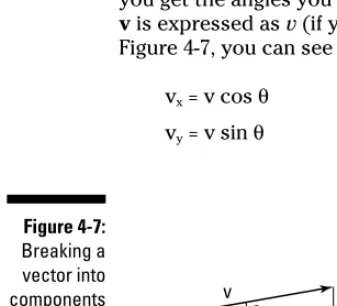
To find the trigonometric values of the triangle in Figure 2-1, you divide one side by another. You need to know the following equations, because as soon as vectors appear in Chapter 4, these equations will come in handy:
sin θ= y/r cos θ= x/r tan θ= y/x
If you’re given the measure of one angle and one side of the triangle, you can find all the others. Here are some examples — they’ll probably become dis-tressingly familiar before you finish any physics course, but you don’tneed to memorize them. If you know the preceding sine, cosine, and tangent equations, you can derive the following ones as needed:
x = r cos θ= y/tan θ y = r sin θ= x tan θ r = y/sin θ= x/cos θ
Remember that you can go backward with the inverse sine, cosine, and tan-gent, which are written as sin-1, cos-1, and tan-1. Basically, if you input the sine
of an angle into the sin-1equation, you end up with the measure of the angle
itself. (If you need a more in-depth refresher, check out Trigonometry For Dummies, by Mary Jane Sterling [Wiley].) Here are the inverses for the triangle in Figure 2-1:
sin-1(y/r) = θ
cos-1(x/r) = θ tan-1(y/x) = θ
h
x
y
θ
Figure 2-1:
Chapter 3
Exploring the Need for Speed
In This Chapter
Getting up to speed on displacement
Dissecting different kinds of speed
Stopping and going with acceleration
Examining the link among acceleration, time, and displacement
Connecting speed, acceleration, and displacement
T
here you are in your Formula 1 racecar, speeding toward glory. You have the speed you need, and the pylons are whipping past on either side. You’re confident that you can win, and coming into the final turn, you’re far ahead. Or at least you think you are. Seems that another racer is also making a big effort, because you see a gleam of silver in your mirror. You get a better look and realize that you need to do something — last year’s winner is gaining on you fast.It’s a good thing you know all about velocity and acceleration. With such knowledge, you know just what to do: You floor the gas pedal, accelerating out of trouble. Your knowledge of velocity lets you handle the final curve with ease. The checkered flag is a blur as you cross the finish line in record time. Not bad. You can thank your understanding of the issues in this chapter: dis-placement, speed, and acceleration.
You already have an intuitive feeling for what I discuss in this chapter, or you wouldn’t be able to drive or even ride a bike. Displacement is all about where you are, speed is all about how fast you’re going, and anyone who’s ever been in a car knows about acceleration. These forces concern people every day, and physics has made an organized study of them. Knowledge of these forces has allowed people to plan roads, build spacecraft, organize traffic patterns, fly, track the motion of planets, predict the weather, and even get mad in slow-moving traffic jams.
Dissecting Displacement
When something moves from point A to point B, displacementtakes place in physics terms. In plain English, displacement is a distance.Say, for example, that you have a fine new golf ball that’s prone to rolling around by itself, shown in Figure 3-1. This particular golf ball likes to roll around on top of a large measuring stick. You place the golf ball at the 0 position on the measur-ing stick, as you see in Figure 3-1, diagram A.
So far, so good. Note, however, that the golf ball rolls over to a new point, 3 meters to the right, as you see in Figure 3-1, diagram B. The golf ball has moved, so displacement has taken place. In this case, the displacement is just 3 meters to the right. Its initial position was 0 meters, and its final posi-tion is at +3 meters.
In physics terms, you often see displacement referred to as the variable s
(don’t ask me why). In this case, sequals 3 meters.
Like any other measurement in physics (except for certain angles), displace-ment always has units — usually centimeters or meters. You may also use kilometers, inches, feet, miles, or even light years(the distance light travels in one year, a whopper of a distance not fit for measuring with a meter stick: 5,865,696,000,000 miles, which is 9,460,800,000,000 kilometers or 9,460,800,000,000,000 meters).
Scientists, being who they are, like to go into even more detail. You often see the term s0, which describes initial position(alternatively referred to as si; the
istands for initial). And you may see the term sfused to describe final
posi-tion.In these terms, moving from diagram A to diagram B in Figure 3-1, s0 is at
the 0-meter mark and sfis at +3 meters. The displacement, s,equals the final
position minus the initial position: s = sf – s0 = +3 – 0 = 3 meters
A
meters
−4 −3 −2 −1 0 1 2 3 4 B
meters
−4 −3 −2 −1 0 1 2 3 4 C
meters
−4 −3 −2 −1 0 1 2 3 4
Figure 3-1:
Displacements don’t have to be positive; they can be zero or negative as well. Take a look at Figure 3-1, diagram C, where the restless golf ball has moved to a new location, measured as –4 meters on the measuring stick. What’s the displacement here? That depends on what starting point you choose, which is always true in physics problems. The starting point is also called the origin
(where the action originates from), and you’re often free to choose the origin yourself. If you choose the 0 position on the meter stick, a common choice (because it’s where the ball started), you get the following displacement:
s = sf – s0 = –4 – 0 = –4 meters
Note that sis negative!
You can also choose origins other than the 0 position. Without seeing Figure 3-1, diagram A, for example, you may decide that the golf ball starts at the +3 meter position in Figure 3-1, diagram B, and when it moves to the –4 meter position in Figure 3-1, diagram C, you get this displacement:
s = sf – s0 = –4 – 3 = –7 meters
Displacement depends on where you set your origin. Usually, your choice becomes pretty clear when you work on a problem. But what happens when the situation isn’t clear and linear?
Examining axes
Motion that takes place in the world isn’t always linear, like the golf ball shown in Figure 3-1. Motion can take place in two or three dimensions. And if you want to examine motion in two dimensions, you need two intersecting meter sticks, called axes.You have a horizontal axis — the X-axis — and a vertical axis — the Y-axis (for three-dimensional problems, watch for a third axis — the Z-axis — sticking straight up out of the paper).
Take a look at Figure 3-2, where a golf ball moves around in two dimensions. It starts at the center of the graph and moves up to the right.
In terms of the axes, the golf ball moves to +4 meters on the X-axis and +3 meters on the Y-axis, which is represented as the point (4, 3); the X measurement comes first, followed by the Y measurement: (x, y).
So what does this mean in terms of displacement? The change in the X posi-tion, ∆x (∆, the Greek letter delta, means “change in”), is equal to the final position minus the initial position. If the golf ball starts at the center of the graph — the origin of the graph, location (0, 0) — you have a change in the X location of
The change in the Y location is
∆y = yf – y0 = +3 – 0 = 3 meters
If you’re more interested in figuring out the magnitude of the displacement than in the change in the X and Y location of the golf ball, that’s a different story. The question now becomes: How far is the golf ball from its starting point at the center of the graph? Using the Pythagorean theorem, you can find the magnitude of the displacement of the golf ball, which is the distance it travels from start to finish. Here’s how to work the equation:
x y
∆ ∆
s 2 2 42 32 16 9 25 5 meters
= + = + = + = =
So, in this case, the magnitude of the golf ball’s displacement is exactly 5 meters.
The Pythagorean theorem states that the sum of the areas of the squares on the legs of a right triangle is equal to the area of the square on the hypotenuse. Visit www.cut-the-knot.org/pythagorus/index.shtml
for more information.
Measuring speed
In the previous sections, you examine the motion of objects across one and two dimensions. But there’s more to the story of motion than just the actual movement. When displacement takes place, it happens in a certain amount of
meters
−4
−4
−3
−2
−1 1 2 3 4
−3 −2 −1 1 2 3 4
Figure 3-2:
time, which means that it happens at a certain speed.How long does it take the ball in Figure 3-1, for example, to move from its initial to its final position? If it takes 12 years, that makes for a long time before the figure was ready for this book. Now, 12 seconds? Sounds more like it.
Measuring how fast displacement happens is what the rest of this chapter is all about. Just as you can measure displacement, you can measure the differ-ence in time from the beginning to the end of the motion, and you usually see it written like this:
∆t = tf– to
Here, tfis the final time, and tois the initial time, and the difference between
these two is the amount of time it takes something to happen, such as a golf ball moving to its final destination. Scientists want to know all about how fast things happen, and that means measuring speed.
Speed Specifics: What Is Speed, Anyway?
You may already have the conventional idea of speed down pat, assuming you speak like a scientist:
speed = distance / time
For example, if you travel distance sin a time t,your speed, v,is v = s / t
The variable vreally stands for velocity(a concept I discuss in Chapter 4), but true velocity also has a direction associated with it, which speed does not. For that reason, velocity is a vector(you usually see the velocity vector represented as v). Vectors have both a magnitude and a direction, so with velocity, you know not only how fast you’re going but also in what direction. Speed is only a magnitude (if you have a certain velocity vector, in fact, the speed is the magnitude of that vector), so you see it represented by the term
v(not in bold). Displacement is also a vector, by the way, and you can read more about that in Chapter 4, too.
Phew, that was easy enough, right? Technically speaking (physicists love to speak technically), speed is the change in position divided by the change in time, so you can also represent it like this, if, say, you’re moving along the X-axis:
v = ∆x / ∆t = (xf– xo) / (tf– to)
Reading the speedometer:
Instantaneous speed
You already have an idea of what speed is; it’s what you measure on your car’s speedometer, right? When you’re tooling along, all you have to do to see your speed is look down at the speedometer. There you have it: 75 miles per hour. Hmm, better slow it down a little — 65 miles per hour now. You’re looking at your speed at this particular moment. In other words, you see your instanta-neous speed.
Instantaneous speed is an important term in understanding the physics of speed, so keep it in mind. If you’re going 65 mph right now, that’s your instan-taneous speed. If you accelerate to 75 mph, that becomes your instaninstan-taneous speed. Instantaneous speed is your speed at a particular instant of time. Two seconds from now, your instantaneous speed may be totally different.
Staying steady: Uniform speed
What if you keep driving 65 miles per hour forever? You achieve uniform speed in physics (also called constant speed), and it may be possible in the western portion of the United States, where the roads stay in straight lines for a long time and you don’t have to change your speed.