Volume 2009, Article ID 574627,7pages doi:10.1155/2009/574627
Research Article
Realization of Ternary Sigma-Delta Modulated Arithmetic
Processing Modules
Amin Z. Sadik and Peter J. O’Shea
School of Engineering Systems, Queensland University of Technology (QUT), 2 George Street, Brisbane, QLD 4000, Australia
Correspondence should be addressed to Peter J. O’Shea,[email protected]
Received 22 May 2008; Revised 5 December 2008; Accepted 11 February 2009
Recommended by Bernhard Wess
Sigma-delta modulated systems have a number of very appealing properties and are, therefore, heavily used in analog to digital converters, amplifiers, and modulators. This paper presents new results which indicate that they may also have significant potential for general purpose arithmetic processing. The paper introduces new arithmetic processing structures for ternary (i.e., +1, 0, or −1) sigma-delta modulated signals. Simulations show that these new structures can be implemented very efficiently and have relatively good accuracy.
Copyright © 2009 A. Z. Sadik and P. J. O’Shea. This is an open access article distributed under the Creative Commons Attribution License, which permits unrestricted use, distribution, and reproduction in any medium, provided the original work is properly cited.
1. Introduction
Oversampled sigma-delta modulation (SDM) signal rep-resentations have several key advantages over traditional Nyquist rate pulse code modulated formats. When signals are put into SDM format, they typically have very short word-lengths (e.g., binary or ternary). This very simple representation creates the potential for reduced hardware complexity, simpler signal bus routing, and resilience against
electronic component inaccuracies [1, 2]. There is yet
another advantage to the use of SDM (or bitstream) systems. If signals are maintained in bitstream form all the way through the processing chain, one does not need format conversions (or the associated interpolation and decimation filters). This is so because within many systems, the “front end” analog to digital converters and “back end” digital to analog converters use SDM bitstream format, but the intermediate processing stages are typically implemented in multibit format. If the intermediate processing stages of a system can be operated in binary or ternary format as well, then the format conversions are unnecessary.
Several works have proposed digital bitstream arithmetic processing using pulse width modulation, particularly in
digital neural networks, for example, [3, 4]. O’Leary and
Maloberti [5] also presented a binary bitstream adder in
which the sum is stored and fed back to the adder to reduce
the truncation error (i.e., the carries of the full-adder).
This same approach has been adopted by [6] to implement
a ternary bitstream adder using 2’s complement format. However, the possibility of compensating the ignored carries is confined to the immediate next sample. The compensation fails when the next sample addition generates a carry as well. Another well-cited work on bitstream arithmetic is that
conducted in [7], where various binary arithmetic circuits
were proposed. However, most of the arithmetic circuits
proposed in [7] suffer from two main drawbacks. First, many
of these structures do not operate fully in the short word-length domain; they partially operate in the multibit domain. In particular, many of these structures use integrators which consist of a recursive multibit adder followed by an SDM requanFtizer. The second major drawback in the
arithmetic units within [7] was the limited accuracy of the
structures.
This paper attempts to address both of the above listed limitations. Ternary quantized SDM processing is the assumed format throughout the paper. Ternary format (i.e.,
+1, 0, −1) is used rather than binary because the extra
zero state reduces quantisation error and so enables greater accuracy. At the same time, the zero state often corresponds to a no hardware operation, and so ternary formats often
xa(k) + + z−1 v(k)
QT(·) y(k)
QT(·): Ternary quantizer 1-bit
Multi-bit
Figure 1: The structure of a first-order ternary sigma-delta
modulator.
In this paper,ternaryarithmetic processing modules are
proposed, and an attempt is made to provide a measure of the accuracy of these systems. This is done by determining the resolution or number of bits in a multibit counterpart with similar accuracy. Both DC and slowly varying input signals are considered in this paper.
2. Basic 1-Trit Ternary Adder/Subtractor
The adder is a critically important component of an arithmetic processor since it is a fundamental building block upon which many other processing operations are built. Therefore, it is highly desirable to create adders with minimal
complexity. Letx(k) andy(k) be two ternary bitstreams. It is
assumed that the inputs to the proposed adder are obtained with ternary sigma-delta modulators (TSDMs) . A sample
first-order TSDM is shown in Figure 1. These modulators
may be well incorporated into analog to digital converter
hardware. The signaly(k) is
y(k)=
⎧ ⎪ ⎪ ⎪ ⎪ ⎪ ⎪ ⎪ ⎨ ⎪ ⎪ ⎪ ⎪ ⎪ ⎪ ⎪ ⎩
+1, forv(k)≥ λ
4,
0, for −λ
4< v(k)< λ
4,
−1, forv(k)≤ −λ
4,
(1)
where [−λ/2, +λ/2] is the allowable range of the input.x(k)
is defined similarly. Assume that the desired output of the
proposed ternary adder iss(k)= x(k) +y(k), such that all
x(k),y(k), ands(k) ∈ {1, 0,−1}. The task of designing the
adder involves a tradeoffbetween implementation
complex-ity and accuracy. One can implement a very simple adder with relatively large quantization by simply truncating any
results greater than±1. The resulting quantization error is
then relatively large. This simple adder would be defined as
s(k)=
⎧ ⎪ ⎨ ⎪ ⎩
(x(k) +y(k))
2 , forx(k)=y(k),
x(k) +y(k), forx(k)=/ y(k).
(2)
The above “basic” ternary adder can be implemented using a traditional ternary half-adder. It is perfectly accurate except when the two input signal values are identical, in which case a carry is generated (and neglected).
The quantization noise at the output of the basic ternary adder has two components: (i) the quantization noise inherent in the two input signals and (ii) the quantization noise due to the truncation operation which occurs when the two inputs have identical values. These two components are quantified below.
(i) If there was a white uniformly distributed quanti-zation noise in each of the inputs, then the power spectral density (PSD) of each input would be
Pn= Δ
2
12fs
, (3)
where fs is the sampling frequency, and Δ is the
quantization step. The quantization noise will not be white, however, because of the noise shaping inherent
in SDM signal formats [9,10]. Assume, say, that
1st-order TSDMs have been used to createx(k) andy(k),
then the power spectral density of the quantization
noise in bothx(k) andy(k) would be
Pq(f)=Pn
2 sin
π f fs
2
= 1
3fs
sin
π f fs
2
.
(4)
It is worth noting that we are dealing here with
the whole oversampled spectrum (from 0 to fsHz)
since the operations are achieved within the ternary domain and there is no decimation process.
(ii) Now, it is necessary to determine an expression for the quantization noise corresponding to the truncation introduced by the ternary adder. We
denote the truncation error signal asp(k). This signal
will only be nonzero whenx(k)= y(k)= ±1. This
condition would be expected to occur on average about two samples out of every nine, assuming that
the probability of obtaining a value of +1,−1, or 0 is
equal to 1/3. The total average power ofp(k) would,
therefore, be about 2/9. The spectral shape of p(k)
depends on the correlation betweenx(k) and y(k).
If x(k) and y(k) are perfectly correlated, then the
spectrum has a delta function at DC. If the signals are uncorrelated, then the spectrum tends to be white.
Then, the expected PSD due to the truncation process is
E Ptrun(f)=Pt(f)=E
|F{p(k)}|2
, (5)
whereE[·] is the expectation operator, andFis the Fourier
transform operator. The total power spectral density at the output of the adder will be the sum of the quantization
noise corresponding to the two input signals (2Pq(f)) and
Ptrun(f). That is, the total quantization power spectrum is
given by
Pt(f)=
2
3fs
sin
π f fs
2
+E|F{p(k)}|2.
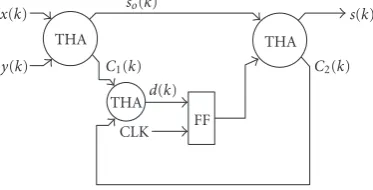
x(k)
y(k) THA
so(k)
C1(k) THAd(k)
FF CLK
THA
s(k)
C2(k)
Figure 2: An improved version of the proposed adder (TA)
constructed using three ternary half-adders (THAs).
The subtraction operation can be easily accomplished by negating one of the ternary bitstreams and using the same proposed adder.
3. Improved Adder
Knowing the source of errors in the ternary adder specified
in (2), one may alleviate this error using a simple technique.
If the lost carries are compensated for whenever possible in the next samples, then in the average sense, the adder would have improved accuracy. This can be done by introducing
a ternary flip-flop d(k) in the adder circuit to store any
carry overflows and propagate this carry information to
subsequent samples.Figure 2shows a block diagram of the
improved ternary adder version. The rationale behind the new adder circuit is that any carry arising from the addition of the current two input samples should be stored in a flip-flop and added to the next output sample. If there is any carry generated from doing this addition to the next output sample, then that resulting carry should also be fed back
and stored. The operation of the circuit in Figure 2can be
described mathematically as
so(k)=sgn[x(k) +y(k)],
s(k)=sgn so(k) +d(k−1)
,
c1(k)=x(k) +y(k)−so(k),
c2(k)=so(k) +d(k−1)−s(k),
d(k)=sgn c1(k) +c2(k).
(7)
The improved adder can be implemented by using three ternary half-adder (THA) modules and one delay element. Each THA performs according to the truth-table shown in Table 1. The ternary adder (TA) defined in (7) can easily be implemented with either conventional digital gates (e.g.,
[11]) or with multiple-valued logic (e.g., [12,13]).
According to (7),d(k) can be re-expressed as
d(k)=
⎧ ⎪ ⎨ ⎪ ⎩
1 2
c1(k) +c2(k)
, forc1(k)=c2(k)=/0,
c1(k) +c2(k), otherwise,
(8)
noting that the conditionc1(k) = c2(k)=/0 corresponds to
the event ofx(k)=y(k)=d(k−1)=/0.
By recombining lines 3 and 4 of (7), one obtains the
following expression fors(k):
s(k)=x(k) +y(k) +d(k−1)− c1(k) +c2(k)
,
error term, ec(k).
(9)
Recalling thatd(k)=sgn[c1(k) +c2(k)]. It should be noted
that the error term is only nonzero when bothc1(k) andc2(k)
are equal and nonzero (or equivalently,x(k)=y(k)=d(k−
1)=/0). Implicitly, this leads to the fact that an error will only
occur whenx(k)=y(k)=x(k−1)=y(k−1)=/0 (i.e., with
two consecutive +1s (−1s)). Then, the errorec(k) is given as
ec(k)=
⎧ ⎨ ⎩
±1, forx(k)=y(k)=x(k−1)=y(k−1)=/0,
0, otherwise.
(10)
Note that if the probability of +1,−1, and 0 is assumed equal
for a trit, then the probability ofx(k)=y(k)=x(k−1)=
y(k−1)=+1 is 1/34and the probability ofx(k)= y(k)=
x(k−1) = y(k−1)= −1 is also 1/34. Therefore, the total
probability thatx(k)= y(k)=x(k−1)= y(k−1)= ±1
would be 2/81.
Now, assuming ergodicity, the average value forec(k) can
be calculated as
c(0)= 1 N
N−1
k=0 e2
c(k), (11)
and the autocorrelation function forec(k) is given by
c(m)= 1 N
N−1
k=0
ec(k)ec(k−m). (12)
The precise form for the autocorrelation function will depend on the nature of the signals and in particular the correlation between them. By taking the Fourier transform
of (12), one can determine the power spectral densityPc(f)
ofec(k) as
Pc(f)=F{c(m)} =
∞
m=0
c(m) cos2πm f / fs
. (13)
Note that in the above equation the discrete Fourier transform uses cosine basis functions rather than complex
exponential ones becausecm is an autocorrelation function
and is, therefore, even.
An alternative approach can be used by recombining lines
3, 4, and 5 of (7), then one obtains the following expression
ford(k):
d(k)=sgn[x(k) +y(k) +d(k−1)−s(k)]
=x(k) +y(k) +d(k−1)−s(k) +q(k), (14)
whereq(k) is the truncation error ind(k) due to
“uncom-pensatable” carries.q(k) is given byq(k)=sgn[x(k) +y(k) +
Table1: Truth-table of the proposed THA.
x y c s
0 0 0 0
1 0 0 1
0 1 0 1
−1 0 0 −1
0 −1 0 −1
1 1 1 1
−1 1 0 0
1 −1 0 0
−1 −1 −1 −1
Rearrangement the above expression ford(k) yields an
expression fors(k)as follows:
s(k)=x(k) +y(k) +d(k−1)−d(k) +q(k). (15)
Taking thez-transform of (15), the output can be expressed
as
S(z)=X(z) +Y(z)−1−z−1D(z) +Q(z). (16)
Examination of the above equation reveals that S(z)
com-prises a true component (X(z) +Y(z)) and an error term
(−(1−z−1)D(z)+Q(z)). The error term is, in turn, comprised
of two components, the first corresponding to carries which
are eventually “compensated” ((−(1−z−1)D(z)) and the
second due to uncompensated or “lost” carries (Q(z)). The
structure of the adder causes the compensated carry error
component to be high-pass filtered, as per the (1−z−1)D(z)
term. This high-pass filtering causes significant attenuation of the error term and accounts for the improvement provided by the adder. The uncompensated carries error term does not get attenuated, but fortunately, it is relatively low in power because it tends to be nonzero in an average probability of
about 2/81.
Because of the high-pass filtering of the error term which is inherent in this adder, a significant reduction in the average quantization error can be achieved. This is illustrated in
simulations inSection 5.
4. Format Conversion via an SDM with
Ternary Integrator
As discussed earlier, ternary arithmetic is significantly more accurate than binary arithmetic, at least for pulse width modulation type signal formats. To implement practical ternary arithmetic, it may sometimes be necessary to convert incoming signals from binary format to ternary format. It is
obviously desirable that this must be done efficiently. This
section proposes an efficient new structure for binary to
ternary format conversion, with this new structure involving an SDM whose internal integrator is formed from the adder proposed in the previous section.
In the short word-length literature, digital integrators have generally been constructed from a multibit subsystem (such as up-down counters) followed by a 1-bit noise shaper
x(k) TA
−
g(k)
TA Integrator
D
s(k)
Figure3: Realization of a first-order SDM using the proposed adder (TA) and the integrator.
to restore the format to the short word-length domain
[7]. This approach is computationally intensive. By using
the ternary adder (TA) from the previous section, a novel integrator is proposed that operates entirely in the ternary
domain (seeFigure 3, inside the box)
Simulation results presented inSection 5show that the
new 1-bit ternary integrator outperforms the traditional
counterpart in [7].
Having devised a digital integrator the next step is to construct an SDM-based format conversion structure. This structure uses both the proposed adder and new integrator
and is shown inFigure 3.
Consider first the leftmost TA inFigure 3. Equation (16)
provides a general expression for the output of an arbitrary TA, and using this result, one can obtain the output for the leftmost TA as follows:
G(z)=X(z)−z−1S(z)−1−z−1D1(z) +Q1(z), (17)
where (1−z−1)D
1(z) andQ1(z) are the errors due to the
compensatedanduncompensatedcarries, respectively, in the leftmost TA. (Note that because of the synchronous clocking
which is used, there is effectively a single sample delay in the
feedback path of the SDM inFigure 3. This effective delay
is not explicitly shown inFigure 3because of convention—
SDMs representations normally do not explicitly show a delay).
Now consider the rightmost TA. Again, using the result
in (16), one can obtain theZ-transform of the output as
S(z)=G(z) +z−1S(z)−1−z−1D
2(z) +Q2(z), (18)
where (1−z−1)D2(z) is the error due to compensated carries,
andQ1(z) is the error due to uncompensated carries in the
rightmost TA. Combining the above two equations yields
S(z)=X(z)−1−z−1 D1(z) +D2(z)+Q1(z) +Q2(z). (19)
The performance of this new format conversion structure is evaluated in the next section.
5. Simulations
Table2: Comparison among bitstream adders.
Technique mse, (×10−5) No. of bits
used in [6] 4.9 6.4
used in [7] 45.2 4.8
proposed 0.72 7.75
multibit domain, the output stream has to be windowed and averaged to determine an equivalent multibit value. The length of the time window should be greater than or equal to the oversampling ratio (OSR) to ensure a fair comparison. The SNR of this averaged output ternary bitstream is then calculated, and an equivalent resolution (equivalent number of bits) can be obtained.
5.1. Simulation Results for the Proposed Adders. Four diff er-ent input signals were considered in this work. The first two were sinusoids corrupted by additive white Gaussian noise with an SNR of about 25 dB. These sinusoids had the forms
xa(k)=0.5 sin(2πk)+ν1(k) andya(k)=0.5 sin(4πk)+ν2(k),
respectively, withν1(k) andν2(k) representing the additive
noise. These two sinusoids were mapped to the symmetrical ternary domain using ternary quantizer sigma-delta
mod-ulators.Figure 4shows the spectra of the bitstreamsxa(k),
ya(k), and the summation of these bitstreams with the adder
is specified in (7). Additional simulations have revealed that
the adder is quite robust to the presence of DC components. That is, spurious tones do not appear when there is a DC component present.
The final two types of input signals considered were the DC signal and the ramp signal. The former is considered to be one of the most challenging signals for SDMs to deal
with—it can easily produce limit cycles [14, 15]. It was
specified by xa = −0.5. The ramp signal was specified by
ya(k)=2−10k, where k = 0, 1, 2,. . ., 210. Figure 5 shows
plots of the sum of xa(k) and ya(k) obtained with (i)
the basic adder defined in (2), (ii) the improved adder
defined in (7), and (iii) a 32 bit precision multibit adder.
As seen inFigure 5, the curves corresponding to the 32 bit
precision adder and the improved ternary adder are almost indistinguishable. The average output signal error power was calculated by subtracting the true signal value from a multibit reconstruction of the ternary signal representation. This reconstruction was achieved by filtering the ternary signal
with anL-point moving average filter. In these simulations,
L = OSR = 128. The mean squared error of the basic
adder (method 1) and the improved adder (method 2) were
8.3×10⁻⁴ and 7.2×10⁻⁶, respectively. This corresponds
to an equivalent multibit resolution of 4.4 and 7.75 bits,
respectively. An improvement of 3.35 bits has, therefore, been
achieved by using the improved adder rather than the basic adder. This result is consistent with the expectation expressed inSection 3.
To compare the resolutions achieved with the proposed
adder versus those of the adding technique presented in [7]
(1-bit adder), [6] (ternary), the same DC and ramp inputs
0.15 0.1
0.05 0
Normalised frequency,f / fs −40
−20 0
Po
w
er
(d
B
) Input ternary,xa
(a)
0.15 0.1
0.05 0
Normalised frequency,f / fs −40
−20 0
Po
w
er
(d
B
) Input ternary,ya
(b)
0.15 0.1
0.05 0
Normalised frequency,f / fs −40
−20 0
Po
w
er
(d
B
) Output ternary stream
(c)
Figure4: The spectra of the input ternary streams and their ternary summation.
1 0.8
0.6 0.4
0.2 0
Input Infinite precision
Proposed method-1 Proposed method-2
−0.8
−0.6
−0.4
−0.2 0 0.2 0.4 0.6
Output
MSE1=8.3e−004 MSE2=7.2e−006
Figure5: A comparison between the proposed ternary adders with
DC ramp input, (red) infinite-precision, (blue) basic (method 1), and (black) improved (method 2).
as above were used. The adder output was averaged over
OSR=128 samples, and the mean squared error (MSE) was
calculated and compared with an equivalentN-bit quantizer
that produced the same value of MSE (for the same dynamic
range (−0.5–0.5)). Table 2 summarizes the outcomes. The
0.05 0
−0.05
Normalised frequency,f / fs −60
−40
−20 0 20
Ense
b
le
av
er
age
p
o
w
er
(dB)
SNRinb=45.7 SNRall= −8.5
(a)
0.05 0
−0.05
Normalised frequency,f / fs −60
−40
−20 0 20
Ense
b
le
av
er
age
p
o
w
er
(dB)
SNRinb=52.4 SNRall= −3.7
(b)
Figure6: Output of the proposed format conversion structure in
Figure 3and output of its traditional counterpart. The oversam-pling ratio is always 128.
5.2. The Proposed Binary to Ternary Format Conversion Structure. It should be noted that as long as we are dealing with short word-length systems (i.e., with no need to go back and forth between decimation/interpolation stages), one must be concerned about the whole range of the frequency
spectrum, that is, [0,fs].
For the simulations in this section, a 16-bit PCM signal
xa(k)) = 0.5 sin(2π fok) +ν1(k) with an SNR of 45 dB was
modulated using an SDM to producex(k) ∈ {1,−1}. For
simulation, this binary bitstream was used as input to the newly proposed SDM format conversion structure (shown in Figure 3. The power spectrum of the output is shown in Figure 6 with the normalized in-band region assumed
to be ±(fo/ fs) = ±0.0078. Also in Figure 6 is shown the
output obtained if the same format conversion structure and inputs are used, but with a traditional integrator (of the
form proposed in [7]) instead of the integrator proposed in
Section 3.
For the traditional and proposed format conversion structures, the ensemble-average (1000 runs) of the in-band
SNRs (SNRinb) was found to be +45.7 dB and +52.2,
respec-tively. While the whole of band SNR (SNRall) was−3.7 dB
for the new integrator and−8.5 dB for the traditional one.
That is, improvements of about 6.5 dB in SNRinband about
5 dB were obtained by using the new integrator within the format converter structure. This improvement is a promising finding as integrators are common structures in many digital electronic circuits. Moreover, the proposed format converter structure not only outperforms its traditional counterpart
but also permits more efficient hardware implementation.
5.3. Realization of Exponential/Trigonometric Functions. This section illustrates the use of the improved adder as a building
1 0.5
0
−0.5
−1
ρ −0.5
0 0.5 1 1.5
ex
p
(
ρ
)
−
1
(a)
200 150
100 50
0
Index,k −1
−0.5 0 0.5 1
co
s(
x
)
−
1,
sin(
x
)
(b)
Figure7: Realization of series expansion ternary bitstream (dotted) functions compared with their 32 bit precision counterparts (red): (a) Exponential function; (b) sine and cosine functions.
block for realising practically important functions such as exponential and trigonometric functions. To create these functions, the improved adder was first used to create a
mul-tiplier according to the model in [7]. That is, the multiplier
in [7] was realized by simply replacing the original adder
components with the new adder introduced in Section 3.
Once the multiplier was constructed, the exponential and trigonometric functions were able to be created by using
two non-DC terms of their series expansions (i.e., ex−1=
x+x2/2! and cos(x)−1=x2/2!−x4/4!).
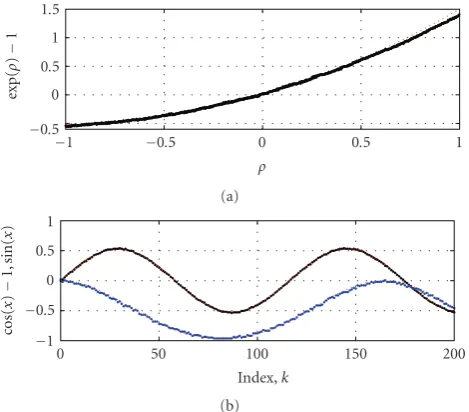
Figure 7(a) shows the averaged (with a 128 sample moving average filter) ternary realization of the function
ex−1 for a ramp DC input (extending between−1 and +1)
compared with its 2-term infinite-precision counterpart. The
input was varied in steps of 2×2−10. A mean squared error of
6×10⁻⁴was obtained for a dynamic range of 2.0234 which
is equivalent to the quantization noise of∼5.6 bit system.
Figure 7(b) shows averaged ternary sine and cosine functions which were created using the same approach as was used for the exponential function. These functions are drawn
versus the indexkof the input signalx(k)=Asin[8πk] so
as to provide a clear visual assessment of the outcome. The
input signalx(k) was varied in steps of = 2×2−9. For a
dynamic range of 1, the mses were 3.29×10⁻⁵for the sine
and 8.4×10⁻⁵ for the cos, with these being equivalent to
6.76 and 5.7 resolutions bits, respectively. The reduction in
accuracy in the cosine function is attributed to the quadruple term implementation in its expansion series.
6. Conclusions
structures are all kept entirely in the ternary domain. The operation of the proposed adder is assessed in terms of the accuracy (expressed as the equivalent number of bits in corresponding multibit system). Simulations show that
both structures are surprisingly efficient and, therefore,
have the potential to realize multiplication, division, and exponential/trigonometric functions.
References
[1] P. M. Aziz, H. V. Sorensen, and J. van der Spiegel, “An overview of sigma-delta converters,”IEEE Signal Processing Magazine, vol. 13, no. 1, pp. 61–84, 1996.
[2] B. Steele and P. J. O’Shea, “Performance estimation for lowpass ternary filters,”EURASIP Journal on Applied Signal Processing, vol. 2003, no. 12, pp. 1250–1256, 2003.
[3] J. E. Tomberg and K. K. K. Kaski, “Pulse-density modulation technique in VLSI implementations of neural network algo-rithms,”IEEE Journal of Solid-State Circuits, vol. 25, no. 5, pp. 1277–1286, 1990.
[4] A. F. Murray and A. V. W. Smith, “Asynchronous VLSI neural networks using pulse-stream arithmetic,” IEEE Journal of Solid-State Circuits, vol. 23, no. 3, pp. 688–697, 1988. [5] P. O’Leary and F. Maloberti, “Bit stream adder for
oversam-pling coded data,”Electronics Letters, vol. 26, no. 20, pp. 1708– 1709, 1990.
[6] C.-W. Ng, N. Wong, and T.-S. Ng, “Bit-stream adders and multipliers for tri-level sigma—delta modulators,”IEEE Transactions on Circuits and Systems II, vol. 54, no. 12, pp. 1082–1086, 2007.
[7] H. Fujisaka, R. Kurata, M. Sakamoto, and M. Morisue, “Bit-stream signal processing and its application to communication systems,”IEE Proceedings: Circuits, Devices and Systems, vol. 149, no. 3, pp. 159–166, 2002.
[8] B. Hayes, “Third base,”American Scientist, vol. 89, no. 6, pp. 490–494, 2001.
[9] R. M. Gray, “Over sampled sigma-delta modulation,”IEEE Transactions on Communications, vol. 35, no. 5, pp. 481–489, 1987.
[10] R. M. Gray, “Quantization noise spectra,”IEEE Transactions on Information Theory, vol. 36, no. 6, pp. 1220–1244, 1990. [11] H. T. Koanantakool, “Implementation of ternary identity cells
using c.m.o.s. integrated circuits,”Electronics Letters, vol. 14, no. 15, pp. 462–464, 1978.
[12] T. Shibata and T. Ohmi, “A functional MOS transistor featuring gate-level weighted sum andthreshold operations,” IEEE Transactions on Electron Devices, vol. 39, no. 6, pp. 1444– 1455, 1992.
[13] H. Gundersen and Y. Berg, “A balanced ternary multiplication circuit using recharged semi-floating gate devices,” in Proceed-ings of the 24th Norchip Conference, pp. 205–208, Linkoping, Sweden, November 2006.
[14] D. Reefman, J. Reiss, E. Janssen, and M. Sandler, “Description of limit cycles in sigma-delta modulators,”IEEE Transactions on Circuits and Systems I, vol. 52, no. 6, pp. 1211–1223, 2005. [15] A. Z. Sadik, Z. M. Hussain, X. Yu, and P. J. O’Shea, “An