The ....
: . Connection·
Macbin~"i"System
\.;
,P'.:.",
VersJo)1
:5'"
.. Ju~e19ti,";'
Thinki~g Macbine~ Corporation .; . Cambri~le, MasAAch,usetts
~t.:.·: .', '_ .. ..1.)
;:).' .,J" ", ,,"; ',: ~iI:,";-~". ,i, t~/f
... ",'t(,f,:' ··: ... ~f f (.,'1. .. .;,.>
The information in this document is sUbject'to change without notice and should not be construed as a commitment by Thinking Machines Corporation. Thinking Machines Corporation 'reserves the right to make changes to' ~fi¥·:.i>a,d!O"t.&i'descirjbed herein to , improve, func~i~ning or design. Althoug~ the inforinati,o~.<~~ document has been
re~~'Ned and is believed to be reliable, Thinking M~c~inJ's 'C~q,Qration does not assume
" .... - ' ~ .. ' . ' • w " . ' • ')l .. ' ! ~ C;f. ." ,!{""l ... " . rf... "
e responsibility or liability for any errors that' may)ippeat ih"this document. Thinking
Machines' Corporation' does 'not assume any liability· ciriSlligilr6tif; the application or use of
any infermation -or pt'oduct. described herein.. " 'I, 1n':J·.r IUmg' .:
\ .
r
.,
, ;q:.··u" .;.< :7". ':1
. i Connection Ma?hine is a registered trademark of T~inr-,irw ~~.<;:,!;ti~~s Co,rporation.
CM-I, CM-2, CM, and DataVault are trademarks ofThm1ung'M'ac'Rihes Corporation. Paris. * Lisp. C*, and CM Fortran are trademarks of Thinking Machines Corporation. VAX and ULTRIX are trademarks of Digital Equipment Corporation.
Sun and Sun-4 are. trademarks. of Sun Microsy~tems, Inc.
'" .; . ("" " t . -; ('
UNIX is a trademark of AT&T Bell Laboratories. "-'
Copyright © 1989 by Thinking Machines CdrPbratib~:' Pitfrigftts~·~eserved ...
,,' Thinking Machines Corporation 245 First Street
Contents
Customer Support .. '. '.' . . . .. xii
About This Manual ...•.. xiii
Par:t] ;,,Getting Started
Chapter!
w..~~~?f.~i
:: .. :: ... , ..
~
...
~:
... :', ':"." ;;.'
?:~,~,::~:
1.1 What Is ClPans ... ' .. . , .:·n:"'Cj!)) ::1rl·r~·> .. · .... ' . . ~ •. ,: ,'- ~""'''.: ,0,; ... " ..A S~br()ut~~J'ibrary ... ~ ... : ... ~' . :. ;'.'~ :,' . ;:,~,,:-.:... 3
,,' ~~~~lI\b~sr-Lik~,~guage .... C,' ... ." •••• ::,";,".:.: ~:~ ,: ;;'ij;'~::J~'r:' 3 1 3 1.2 A Program Template .... ;\ .. ; .... ',.'.".,: .. ' ... ',' .. , . ; .• " •.• '., .• ' .,'" .; .. ,{fl', 4 Chapter 2 A Simple Program ... . 7
2.1 Allocating and Referencing Parallel Data.. .. . .. . . . .. . ... .. . . .. 10
2.2 Setting CM Context ... . .. 11
2.3 Moving Data into Fields ... 12
2.4 Computation on Fields. . . .. 13
2.5 Moving Data to the Front End ... 14
From a Single Processor ... 14
From a Computation across Processors . . . .. 15
'" 'Z:6'
S~mRr.¢~ J~i{Exec,uting
the Program ... 16.)dl ~" , Part II Basic' Concepts a'nd Techniques Chapter ,3 C~t:n.JlM~ing witltin Pr,ocessors ... : . .. 19
3.1 What Is a "Processor"? ... 20
3.2 Arithmetic and Relational Instructions ... :.. 20
Instruction Variants and Names ... ~ ... :. 20
Example of Intraprocessor Computations ... ~ " . . . .. 21
3.3 Data Formats ...•... 25
... ' E~(' 3.4 3.5 Operand Lengths ... : ... ' ... " 25 . .', !:~.';' . Format ConversIons . . . .. . . .. 27
• " . i S~i ';;c~ i',.(; More on FIelds ... ; ... ,. ..•... .. 1.'"':J\;·~"·, 28 28 Using Heap Fields ... : ... :: :" ... .
Using Stack Fields ... :;: .': . . . .. . . .. 29
Storage Management ... '.J..".;.:.,(i: .)1;I-l'L ••• :" ••••••••••.• 30 • • , .::;;, .(LJ.:j()0' Btt-Fteld Operands ... ' .... ' ... 31
.
, " " " , ' .. : .,' "" .... Field-td s and Lengths ... ~ ... 31Using Subfields ...• , .. '~ ... ;'; :; . :\ .'.:.; . . . .. 34
Creating a Parallel Structure. . . .. 37
Chapter4 Context and Control ... : ... J.:'i ...
394.1 The Context Flag ... 40
Unconditional Instructions ... '" ~ . . . .. 41
The Test Flag ... 42
.l 4.2 Conditional Constructs ...• :,~ 7"" • • • • • • • • • • • • • • •• 43 , With a Front-End Condition ...• ",'" , ... 43 " , ' { " . With a Scalar CM Condition . . . .. 44
With a Parallel CM Condition ... ;.- .. ;... 44
With Nesting and Returns ... :~ ... 47
... : 4.3 Iterative Constructs ... _.' ",,,,-:;, . . . .. 48
Iteration and Parallelism ... : .. :0' • • • . • • • • • • • . •. 49 Iteration with Scalar Termination . . . .. 50
Iteration with Parallel Termination ... :... 51
. ".~ r i . , .. .
Chapter 5 Configuring Virtual Processors ... :' ...
555.1 Why Virtual Processors? ... 55
5.2 Overview of Configuration Procedure ... " .. 56
5.3 Creating a Geometry ... 58
Procedure ... 58
Restrictions ... 58
Examples . . . .. 59
Retrieving Attributes ... . . . .. 60
Optimization ... 60
5.4 Creating a Vp-Set ...•... 61
Procedure ... 61
Contents v
Deallocating Geometries ... " 62
Deal10cating Vp-Sets ... 62
5.5 Setting the Current Vp-Set '" . . . .. 63
'Procedure ... 63
Retrieval ... 63
5.6 Allocating Memory .. . . ... 64
Procedure , ... '... 64
Memory Layout. . . .. . . .. 65
5.7 Processor Addresses . . . .. 70
Part III Interprocessor Communications Chapter 6 Communicating in Regular Patterns ... 75
6.1 Grid Coordinates ... 76
Numbering Axes and Processors ... 76
Retrieving Grid Coordinates . . . .. 77
6.2 Nearest-Neighbor Communication ... " 79 Basic NEWS Instructions ... 79
NEWS Accesses and Context ... 80
Example of NEWS Communication ... 81
Border Behavior . . . .. 82
6.3 Remote-Neighbor Communication ... 85
6.4 Front-End Array Transfers. '" ... 87
6.5 Cumulative Communication ... 89
Scan Operations ... 89
Segmented Scan Operations ... 91
Chapter 7 Communicating in Arbitrary Patterns ... 93
7.1 Processor Addresses ... " 93 Computing Self-Addresses ... 94
Computing Send Addresses on the Front End ... 95
Computing Send Addresses on the CM . . . .. 96
Converting Send Addresses to NEWS Coordinates . . . .. 98
7.2 The Basic Send Instruction ... 99
Effect of Context ... 101
Example of a Simple Send ... 102
Example of a Simple Send across Vp-Sets ... 103
7.3 Handling Message Collisions ... 105
7.4 A Word on CM_Qet_1L ...•...•... 107
7.5 Front-End Communications ... o • • • ; \ • • • • • • • • • • • • • • • • • 107 Part IV Commands and Utilities Chapter 8 Compiling and Executing Programs ... 113
8.1 To Compile ... 113
8.2 To Attach ... ~ ... 114
8.3 To Execute in Batch ... 116
In the UNIX Foreground ... 116
In the UNIX Background ... 117
On a Remote Machine ... 117
8.4 To Execute Interactively ... 118
Chapter 9 Programming Utilities ... . 119
9.1 Run-Time Safety ... 119
From within a Program ... 120
From the Shell ... 120
Changing Default Safety Behavior ... 121
9.2 The Debugger dbx ... 121
Invoking the Debugger ... 121
Locating Paris Errors ... 122
Examining CM Data ... , ... 123
9.3 The Paris Timer ... 123
The Timing Functions ... 123
Contents vii
;.;.;.;.;.;.;.:.;.;-;-;.;.;.;.;.;:;.;.;.;.; :;:;:;:;:;:::::::;::;:;:;:::;:;:;:;:;:
Part V Example Programs
Appendix A Game of Life ... 129
Appendix B Include File: Macros and Constants ... 135
Appendix C Transposing an Array ... 137
Appendix D Computing a Histogram ... 143
Appendix E Particle Problem ... 149
Appendix F Lines of Sight ... 159
Appendix G Drawing Lines ... 165
1 Interactions between front end and CM ... 1
2 Allocating a field and returning a field-id ... 11
3 Moving constant values into CM memory fields ... . . . .. 12
4 Returning one processor's result to the front end ... 14
5 Returning a global-reduction result to the front end ... 15
6 Naming convention for C/Paris instructions ... 21
7 Changes in CM state from unsigned-arithmetic. c ... 24
8 State of CM memory at a midpoint in program execution ... 31
9 Field-id and data layout in a 32-bit field. . . .. 32
10 A left shift by one bit position . . . .. 33
11 Fieid-id's in a subdivided field that represents a complex number ... . . .. 35
12 A CM field subdivided to match the layout of a front-end structure ... 37
13 Narrowing the active set of processors. . . .. 41
14 Manipulating context to express a parallel condition ... 45
15 Manipulating context into non-mutually-exclusive active sets ... 47
16 Results of an iterative subdivide-and-initialize operation on a field .. . . .. 50
17 Physical layout of a field in a 32K vp-set ... 65
18 Physical layout of 9 fields in 3 vp-sets . . . .. 67
19 Grid coordinates and axis numbers in a 3-dimensional geometry ... 77
20 Grid coordinates and identity field values in a 2-dimensional geometry. . . .. 78
21 Effect of context on NEWS communication ... 80
22 Deactivating border processors before NEWS communication . . . .. 83
23 Accessing diagonal neighbors in two NEWS operations. . . .. 86
24 Change in CM state from executing CM_send_1L ... 100
25 Effect of context on CM_send_1 L ... 101
26 Change in CM state from executing draw-points.c ... 104
Figures ix
27 A front-end FEBI attached to a CM sequencer ... 114
1 ClParis program template: template.c . . . 4
2 A simple C program: add-scalar-constants. c . . . 7
3 A simple C/Paris program: add-parallel-constants.c . . . ... ... .. .. .. . . . .. . 8
4 5 6 7 8 9 10 11 12 13 14 15 16 17 18 19 20 21 22 23 24 25 26 Computing within processors: unsigned-arithmetic.c ... 22
Using a stack field: swap-signed-integers.c ... 29
Performing unsigned shifts: unsigned-shift.c ... , ... 34
Using subfields: simulate-complex-number.c ... 36
I Creating a parallel structure: create-cm-struct. h ... 38
Simulating nested conditionals and returns: nesting-and-returns.c.fragment .. 48
An iterative C program: add-array-elements. c . . . .. 49
Per-processor iteration with front-end termination: seed-Iocal-arrays.c ... 51
Per-processor iteration with CM termination: log2-of-int.c . ... 52
Creating a vp-set: create-vp-1dim.c.fragment ... 57
Code underlying Figure 18: vp-sets.c.fragment ... 68
Retrieving grid coordinates: identity-matrix. c. fragment ... 79
Accessing two nearest neighbors: neighbor-average.c ... 81
Controlling grid border behavior: neighbor-average-no-wrap.c . . . .. 83
A block data transfer: read-news-array.c ... 88
Addresses and changing geometries: send-addr-to-news.c.fragment ... 98
Sending across vp-sets: draw-points.c ... 103
Sending with a combiner: accumulate-votes.c ... 105
Printing CM values on the front end: cm-print. c ... 108
A program with visible output: count-active-set.c ... 113
Conway's game of life: life.c ... 130
A file included in later examples: macros-and-constants.h ... 135
Transposing an array: transpose.c ... 137
Examples xi
27 Computing a histogram: histogram.c ... 143
28 A Newtonian particle problem: cm-particles.c ... 150
29 Lines of sight: line-of-sight.c ... 160
30 Drawing lines: draw-line.c ... 168
Thinking Machines Customer Support encourages customers to report errors in Connection Machine operation and to suggest improvements in our products.
When reporting an error, please provide as much information as possible to help us identify and correct the problem. A code example that failed to execute, a session transcript, the record of a backtrace, or other such information can greatly reduce the time it takes Thinking Machines to respond to the report ..
To contact Thinking Machines Customer Support:
U.S. Mail:
Internet
Electronic Mail:
Use net
Electronic Mail:
Telephone:
Thinking Machines Corporation Customer Support
245 First Street
Cambridge, Massachusetts 02142-1214
ames!think!customer-support
(617) 876-1111
About This Manual
Objectives
This manual is intended to help new users of C/Paris get started quickly and be able to write simple but complete programs for the CM system.
Intended Audience
Readers are assumed to have a working knowledge of C programming and a very general under-standing of the components of the CM system. Prior knowledge of assembly-level programming is helpful but not required.
Revision Information
This is a new manual. It is a companion volume to the Paris Reference Manual, Version 5.0, and its updates.
Organization
Part I Getting Started
These two chapters introduce C/Paris as an assembly-level subroutine library and provide a step-by-step explanation of a simple program.
Part II Basic Concepts and Techniques
These three chapters introduce the basics of ClParis and data parallel pro-gramming. They describe simultaneous computations within many processors at once, Paris-level memory management, the data parallel techniques of pro-gram control, and the means of configuring sets of virtual processors to ex-press large data sets.
Part III Interprocessor Communications
These two chapters introduce communications among CM virtual processors. Once a program has configured virtual processors to express both the size and the shape of various data sets, the processors can send intermediate results to each other in a variety of patterns, and the program can perform cumulative operations along any of the dimensions of a data set.
Part IV Commands and Utilities
These two chapters outline the procedures for compiling and executing a C/ Paris program and introduce some utilities for debugging, run-time safety checking, and monitoring program execution time.
Part V Examples
The appendixes present six complete example programs.
Associated Documents
• eM
User's Guide: UNIX System Front End, Connection Machine documentation set• Paris Reference Manual, Version 5.0, Connection Machine documentation set
Associated On-Line Directory
• Icm/src/cparis-examples
All the example programs shown in this manual appear in the above directory under the file name given in the example's caption. A Makefile is included. (Check with the site system man-ager if the example directory has been placed in another location.)
Notation Conventions
Convention
boldface
boldface
italics
typewriter
% boldface
typewriter
Meaning
UNIX and CM System Software commands, command op-tions, and file names.
C/Paris and C language elements, such as keywords, opera-tors, and function names, when they appear embedded in text.
Parameter names and placeholders in function and com-mand formats.
Code examples and code fragments.
Part I
Chapter 1
What Is Paris?
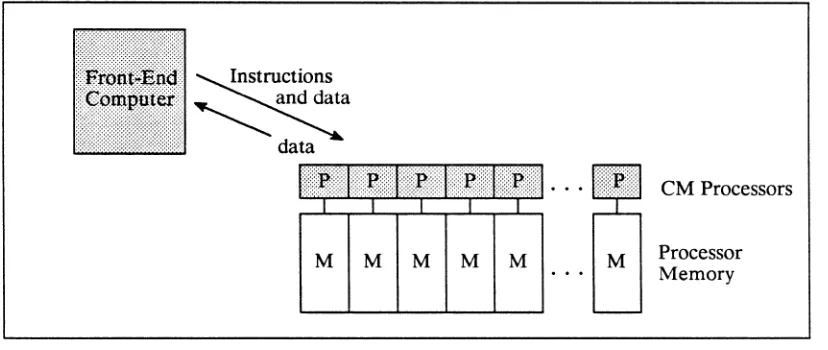
The data parallel programming model assumes an array of small processors, each with some associated memory, all acting under the direction of a distinguished processor called the front end. In the Connection Machine system, the front end is a standard serial computer-a Sun-4 or certain models of V AX-with a bus interface to the proc-essor array within the CM itself.
The essence of the programming model is that each processor stores the information for one data point in its local memory, and then all processors perform the same opera-tion on all the data points at the same time. For instance, a text retrieval program might store articles one-per-processor and then have each processor search its article for a keyword. Similarly, a graphics program might store pixels one-per-processor and then have each processor compute the color value for its pixel.
~~~O~!tl
~~a
data
M M M M M M
Figure 1. Interactions between front end and CM
1
CM Processors
Refinements of the programming model allow the user to direct that only a selected set of processors perform a given operation. In the text retrieval program, for instance, the processors that find the key word might be instructed to search further for another key word, while those that did not find the key word remain idle. Another refinement en-ables processors to pass messages to each other. For instance, color shading in a graphic image requires that each processor obtain surface information from sur-rounding pixels (processors) in order to calculate its result.
The front-end computer runs a serial program that explicitly "parallelizes" certain op-erations by transferring data and instructions over the bus to the CM processor,s. The instructions might include:
• The data parallel equivalent of serial looping operations, as in the text retrieval example just mentioned. These kinds of instructions are similar to the arithme-tic and relational operations of a serial computer, except that they are executed by many processors simultaneously.
• Directions to the CM processors to compute some value that determines whether they are to participate in the next instruction.
• Directions to the CM processors to communicate with each other, as in the color-shading example. These kinds of instructions cause each processor to send (or get) some intermediate result from another processor before proceed-ing to the next instruction.
• Directions to the CM processors to return their results (or some aggregate re-sult) to the front end.
This set of instructions by which the front end directs the actions of the processor ar-ray is Paris, the Connection Machine PARallel Instruction Set.
NOTE on I/O
Chapter 1. What Is Paris? 3
1 .1 What Is C/Paris?
Paris is a low-level protocol in which the user can write data parallel programs for the Connection Machine system. It exists as three interfaces-C/Paris, Lisp/Paris, and Fortran/Paris-which are essentially subroutine libraries in the languages.
A Subroutine Library
ClParis should be seen as a library rather than as a full language-it cannot be used independently of C (or some other language with a suitable interface). A C/Paris pro-gram is written in C, with Paris calls as needed to express parallel operations.
It is important to recognize that a CM program is directing two different computers: the serial front end and the parallel CM.The higher-level CM languages mask this duality somewhat, but at the Paris level it is always explicit:
• C code directs front-end (serial) operations, including the manipulation of se-rial data on the front end and all control flow in the program.
• Paris calls direct only the handling of data by eM processors and the transfer of data between the front end and the CM.
An Assembler-Like Language
Paris is intended primarily as a base upon which to build the higher-level CM lan-guages-C*, CM Fortran, and *Lisp. For instance, the C* compiler generates serial C code with calls to ClParis routines. This output is passed to the front end's C compiler, which proceeds in the normal way to produce an executable load module.
1.2 A Program Template
Every ClParis program must contain two particular lines of code, as shown in this pro-gram template:
Example 1. ClParis program template: template. c
#include <cm/paris.h>
main( )
{
}
/* [Ccode] */
/ *
[Paris function calls occurring within C code]* /
/* [C code] * /The #include directive must occur at the beginning of any ClParis program. The header file paris.h sets up the C/Paris programming environment by declaring the function names and defining data types and certain CM global configuration variables used by Paris.
The C/Paris routine CM_init, which takes no arguments, must appear in the program before any other calls to Paris instructions. It has two effects:
• CM_init initializes the values of the global configuration variables, such as: • CM_physical_processors_limit, determined by the size of the CM that
is executing the program
• CM_maximum_integer_length, determined by implementation re-strictions, if any, in the version of Paris being used
Chapter 1. What Is Paris? 5
• CM_init also warm boots the CM. Warm booting prepares the system for the
upcoming program by clearing the queue for the instruction bus between the front end and the CM, clearing error status indicators, and initializing certain system memory areas in the CM. (The user memory in the CM processors is not affected.)
Warm booting should not be confused with cold booting, a more thorough in-itialization that completely resets the state of the CM hardware and clears user memory. Warm booting is always done from within a C/Paris program; cold booting is done only from the UNIX shell, using procedures described in the volume
eM
Front-End Subsystems.The template shown is in fact a working C/Paris program-the simplest program pos-sible. Its effects, however, are limited to changes in CM state that would not be visible to the programmer.
Chapter 2
A Simple Program
This chapter examines a very simple C/Paris program: one that simply adds two inte-ger constants within each processor. The purpose of the exercise is to illustrate the basic features of parallel instructions and parallel data, ignoring for the moment the details and refinements.
The program is the parallel analogue of this trivial C program:
Example 2. A simple Cprogram: add-scalar-constants. c
#include <stdio.h>
main ()
{
int a, b, sum;
a 2;
b 3;
sum
=
a+b;printf( "\nThe sum of a and b is %d.\n", sum );
}
In this program, a, b, and sum are scalar (single) values that reside on the front end.
Now, consider the same operations in add-parallel-constants.c, where the three vari-ables indicate multiple values in CM processors' memories.
After showing the ClParis program, the remainder of this chapter walks through the program step by step, pointing out some basic features of C/Paris programming and the ways in which it differs from serial C programming.
NOTE
This program, and all complete programs shown in this man-ual, can be found on line in /cm/src/cparis-examples (or an-other location determined by the site system manager).
Example 3. A simple C/Paris program: add-parallel-constants.c
#include <cm/paris.h> #include <stdio.h>
#define LEN 32
main ()
{
/* =======================================================*/
/* 1. Declare variables and warm boot CM */
CM_field_id_t field_a, field_b, field_sum; int single_sum, agg_sum;
/* =======================================================*/
/* 2. Allocate CM memory fields */
Chapter 2. A Simple Program
/* =======================================================*/
/* 3. Specify that all processors participate */
/* =======================================================*/
/* 4. Put values into the two "source" fields */
CM_s_move_constant_1L( field_a, 2, LEN ); CM_s_move_constant_1L( field_b, 3, LEN );
/* =======================================================*/
/* 5. Add the two source fields in each processor and place the result in the "destination" field */
/* =======================================================*/
/* 6. Read the value from the destination field in a single processor and print it. */
single_sum =
CM_s_read_from-9rocessor_1L( 0, field_sum, LEN ); printf( n\nThe sum in processor 0 is %d.\n", single_sum );
/* =======================================================*/
/* 7. Add the destination fields in all processors, return the aggregate value to the front end, and print it */
agg_sum
=
CM_global_s_add_1L( field_sum, LEN );printf( "\nThe sum of all the sums is %d.\n", agg_sum );
/* =======================================================*/
/* 8. Deallocate CM memory fields */
}
CM_deallocate_heap_field( field_a ); CM_deallocate_heap_field( field_b ); CM_deallocate_heap_field( field_sum );
The most immediately obvious difference between this program and its serial C ana-logue is the sheer length of the C/Paris program. Its length is, however, largely a result of its being low-level rather than of being parallel. The higher-level CM languages, such as C*, can express parallel operations nearly as economically as C expresses serial op-erations. This program is an example of the trade-off between convenience and fine-tuned control that we see in comparing any high-level and low-level languages.
2.1 Allocating and Referencing Parallel Data
User data is always stored infields in CM memory. A field is simply one or more
con-tiguous bits that start at the same bit location in every processor. A CM field is roughly
analogous to a C variable in that it is associated with an address in memory. However, there are two significant differences:
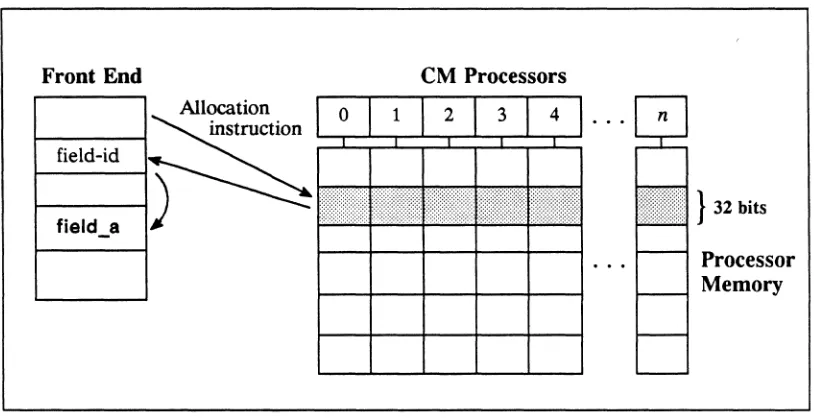
• Unlike a C variable, a CM field must be allocated explicitly. The allocation instructions return a field-id, which contains the address of the allocated field along with other information. The program can (optionally) assign the field-id to a front-end variable of type CM_field_id_t.
• Fields are not associated with types. The length of a field (in bits) is specified when the field is allocated. Later, data of any supported CM type-signed or unsigned integer or floating-point number-can be placed in any field. In the example program, Step 2 allocates fields and assigns them to front-end variables that have been declared in Step 1.
CM_field_id_t field_a;
field_a
=
CM_allocate_heap_field( LEN );/* step 1 */ /* step 2 */
These two steps allocate memory to hold parallel data and provide a front-end variable with which to reference that portion of memory. The "stripe" of memory allocated con-sists of 32 contiguous bits that begin at the same bit location in every processor. All Paris instructions that operate on user data, including those that move data into fields, take one or more field-id's as operands.
Chapter 2. A Simple Program
Front End
field-id
field_8
~
IDStion truction
)
eM
Processors11
} 32 bits
Processor Memory
Figure 2. Allocating a field and returning a field-id
Note that the last step of the program explicitly deallocates the fields.
/* step 8 */
This step is not strictly necessary in the example program, since the fields would be deallocated at program termination in any case. However, as in C, it is generally good practice to free up memory by deallocating items that are no longer needed.
2.2 Setting CM Context
Most CM programs use all the processors for some instructions and a selected subset of them for other instructions. For instance, in the text retrieval example given in the previous chapter, all processors execute the first instruction to search for key-word-i, but only those that met success execute the next instruction to search for key-word-2. The set of processors that are to execute the next instruction is called the selected set or active set. At any given time, the program's context may change to a different selected
set. At the Paris level, context is always set and reset explicitly. Step 3 of the example program is a Paris call that selects all processors; this context is retained throughout the program.
2.3
Moving Data into Fields
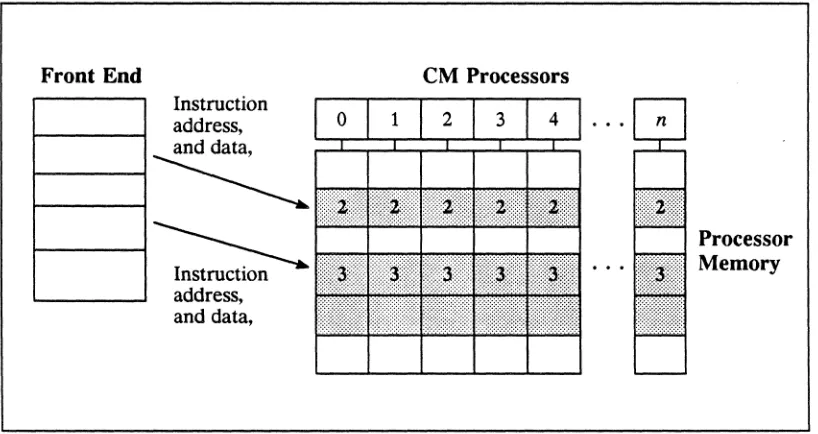
When fields are allocated, they contain no useful data. This program illustrates one of several ways to initialize fields, in this case with signed integer constants. The eM_move family of instructions copy data into a field, either from another field or from the front end. If the front-end data to be moved is a constant or zero, the front end "broadcasts" a copy of the quantity to the specified field in each processor.
CM_s_move_constant_lL( field_a, 2, LEN ); CM_s_move_constant_lL( field_b, 3, LEN );
/* step 4 */
Like all Paris instructions that operate on fields, this instruction takes a field-id as an operand to indicate the bit address at which to begin storing the constant (2 or 3). In addition, when calling any Paris instruction that operates on fields, the program must specify the number of bits (LEN = 32) on which to operate. In this program, the number corresponds to the allocated length of the field. (Chapter 3 shows cases where the number might be smaller than the field.)
Front End
Instruction address,
~----~~
I---I~
address, and data,
eM
ProcessorsFigure 3. Moving constant values into eM memory fields
Processor Memory
Notice that it is the instruction, not the field, that expects a certain type of data. The element _8 in the instruction name indicates that the instruction treats its data
Chapter 2. A Simple Program 13
C/Paris. If the constant provided were 2.0, the instruction would simply take it to be a signed integer and blithely put the wrong value in the specified field.
2.4 Computation on Fields
Given the development of the program so far, the instruction that actually performs the computation is straightforward:
/* step 5 */
The destination field is always specified first in a Paris call, followed by one or more
source fields as appropriate to the instruction. In this case, the instruction adds the values in field_a and field_b, treating them as signed integers, and places the result in field_sum.
Note the element _3 in the instruction name. This element indicates that the instruc-tion takes three field operands: two source fields and a different destinainstruc-tion field. An alternative that Paris provides is CM_s_add_2_1 L, which places the result back into one of the source fields. For instance, the following call increments the value in field_a by the value in field_b:
The last element of the instruction name, _1 L, indicates the number of different lengths of the operands. This example used the _1 L version because the three fields are all of the same length (32 bits) and the program uses the full length of the fields. An alternative is the _3L version, used when the operands are of different lengths. In the _3L version, all the lengths are specified and in the same order as the field operands. For instance:
2.5 Moving Data to the Front End
The results computed by the
eM
processors are of no use to the main program until some result is returned to the front end.The example program shows two of the several ways in which the front end retrieves results from the
eM
processors. In both these cases, the data retrieved is a scalar, not parallel, quantity.From a Single Processor
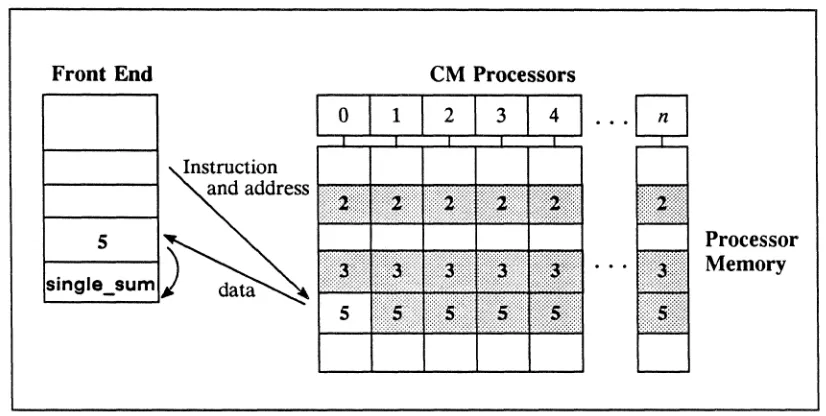
The first method of moving data from
eM
memory to the front end involves reading a field's contents from one specified processor (see Figure 4). The value returned is then assigned to a front-end variable.single_sum
=
/*step 6*/CM_s_read_from-processor_1L( 0, field_sum, LEN );
The first argument is a unique processor-id, or send address. Send addresses are more commonly used when processors send messages to each other. However, the front end can use a send address to access a value from a single
eM
processor.Front End
5
single_sum
eM
ProcessorsInstruction and address :
Figure 4. Returning one processor's result to the front end
Chapter 2. A Simple Program 15
Send addresses, and the means of computing them, are introduced in Chapter 7. Paris does not guarantee that send addresses are consecutive integers, but we can be confi-dent that there will always be a processor numbered O. We can thus check one result of a parallel computation by using CM_type_read_from_processor_1L.
From a Computation across Processors
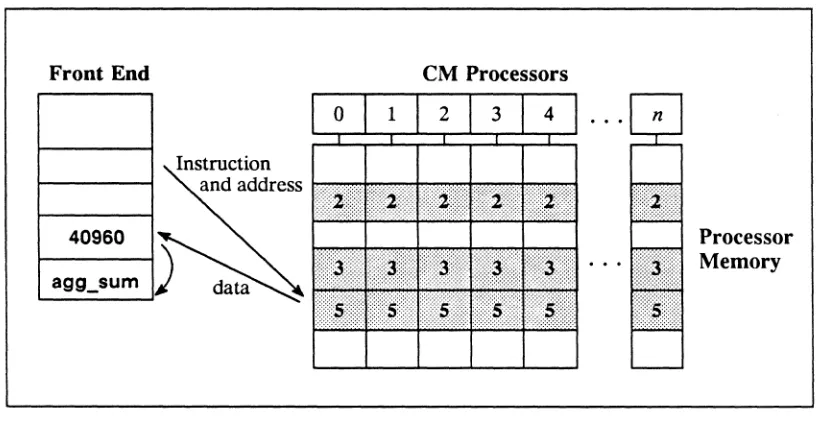
A second method of retrieving scalar data from the CM processors is to perform some combining operation across all the values in the specified field and return the single result to the front end (see Figure 5). Paris provides several such instructions, all with the element _global in their names.
Front End
40960
Instruction and address
eM
ProcessorsProcessor Memory
Figure 5. Returning a global-reduction result to the front end
In the example shown, Step 7 adds the values across field_sum and returns their aggre-gate sum to the front end. The result is then assigned to the front-end variable agg_sum.
/* Step 7 */
The value returned in this example is n X 5, where n is the number of processors
2.6 Compiling and Executing the Program
A C/Paris program is compiled with the front end's C compiler cc and executed with the CM System Software command cmattach. The detailed procedures for compiling and executing a C/Paris program are described in Chapter 8.
Those who have faith can simply type the following command lines:
% cc add-parallel-constants. c -Iparis -1m
% cmattach -wa.out
Attaching the Connection Machine system [name] ... coldbooting ... done.
Attached to 8192 physical processors
The sum in processor 0 is 5.
The sum of all the sums is 40960.
Detaching ... done.
%
NOTE
The command lines just showQ apply to Paris Version 5.0. In
later versions, please consult the current CM documentation to determine whether these command options have changed.
In particular, the means of specifying the Paris library on the
· Part II
Chapter 3
Computing within Processors
The vast majority of Paris instructions cause some computation to occur within each selected processor, independently of the others. Most of these instructions are arith-metic and relational operations that will be familiar to assembly-language program-mers and not surprising to C programprogram-mers.
The major differences between intraprocessor Paris instructions and the analogous C operations arise from the low level of Paris instructions, rather than from parallelism: • The data on which Paris operates, the CM data formats, are unlike C types. • Working with CM memory fields requires more explicit storage management
than working with C variables.
This chapter illustrates intraprocessor Paris instructions, although it does not attempt to give an exhaustive listing of them. Rather, the focus is on using CM data formats and managing CM memory fields in the course of executing intraprocessor instructions.
NOTE
The emphasis in this chapter is on differences from C pro-gramming. Users who are experienced in assembly-language programming can skim quickly over this chapter.
3.1 What Is a "Processor"?
This chapter adopts an artificially constrained programming model: the number of processors is assumed to be equal to the size of the physical CM on which a program executes, and the processors do not exchange data with each other.
In fact, the "processors" referred to in this chapter are not physical CM processors. Paris supports a virtual processing mechanism whereby each physical processor
simu-lates some number of virtual processors. Further, the virtual processors can be logi-cally configured into a variety of shapes of up to 31 dimensions, which facilitates the exchange of data between logical "neighbors." Chapter 5 introduces the virtual proc-essing mechanism, along with the methods for configuring the virtual machine. The programs shown in the present chapter make use of the default virtual processor configuration, which is a 2-dimensional array of processors the same size as the physi-cal machine. The procedures introduced here for intraprocessor computations and storage management are the same in any configuration of virtual processors.
3.2 Arithmetic and Relational Instructions
Paris provides a large selection of arithmetic and relational instructions, analogous to those found in the instruction sets of many serial computers. These include:
• Binary arithmetic, such as add, subtract, multiply, divide, max, min, truncate, round, rem, mod, power, and others.
• Unary arithmetic, such as negate, sqrt, abs, signum, integer-length, logcount, floor, ceiling, truncate, as well as transcendental and trigonometric functions sin, cos, tan, sinh, cosh, tanh, exp, and In.
• Bitwise booleans on two operands, logand, logior, logeqv, lognand, lognor, logandc1, logandc2, logorc1, logorc2, as well as log not for one operand.
Instruction Variants and Names
Each of the intraprocessor instructions takes as operands:
• The field-id's of one or more source fields and a destination field (which may be the same field as one of the source fields)
Chapter 3. Computing within Processors 21
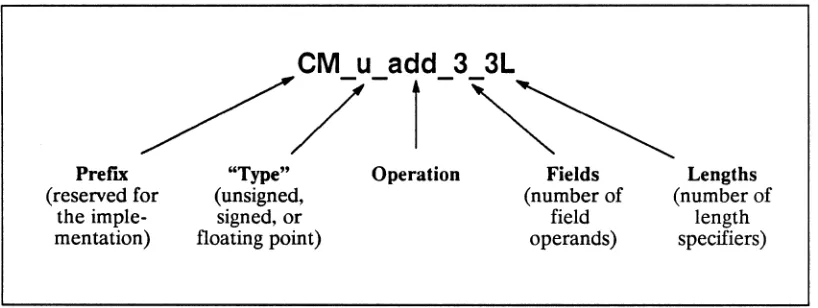
Also, most of the instructions have variants for signed and unsigned integers and for floating-point numbers. A few variants are not provided either because they are non-sensical (there is no unsigned abs, for example) or because they are not generally useful (for instance, the trigonometric functions are provided for floating-point data only). The user can recognize the action of a Paris instruction-and often predict the exis-tence of related instructions-by parsing its name:
eM u add 3 3L
//-l-~~
PrerIX
(reserved for the imple-mentation)
"Type" (unsigned,
signed, or floating point)
Operation Fields (number of
field operands)
Figure 6. Naming convention for C/Paris instructions
Lengths (number of
length specifiers)
At this point, it would be helpful for the new Paris user to scan the early sections of Chapter 5, "Instruction Set Overview," in the Paris Reference Manual, Version 5.0. This chapter lists all Paris instructions by name under various functional categories and identifies the variants of each instruction.
Example of Intra processor Computations
This example also shows some additional methods for getting data into and out of
eM
memory, beyond those shown in earlier examples:• For input, the example uses a move instruction (Step 1), an implicit move in-struction (Step 4), and the unsigned variant of random, which places random integers up to a specified limit into the destination field (Step 1).
• For output, the example uses two _global reduction hlstructions (Steps 7 and 8). These instructions are available as add, multiply, max, and min, each for _u, _s, and _f data, as well as logand, logior, and logxor.
Example 4. Computing within processors: unsigned-arithmetic.c
#include <cm/paris.h> #include <stdio.h>
#define LEN 8
main ()
{
CM_field_id_t a, b, c, d, e, f, g; unsigned int max_value, min_value; char *string;
a
=
CM_allocate_heap_field( LEN ) ;b CM_allocate_heap_field( LEN ) ;
c
=
CM_allocate_heap_field( LEN ) ;d
=
CM_allocate_heap_field( LEN ) ;e
=
CM_allocate_heap_field( LEN ) ;f = CM_allocate_heap_field( LEN ) ;
Chapter 3. Computing within Processors
/* =======================================================*/
/* 1. Initialize fields a and b */
CM_u_random_1L( a, 100, LEN ); CM_u_move_constant_lL( b, 2, LEN );
/* =======================================================*/
/* 2. Compute the max of a and b */
/* =======================================================*/
/* 3. Multiply a by b */
/* =======================================================*/
/* 4. Multiply a by the constant 2 */
/* ==============================================-========*/
/* 5. Divide a by b and round the result toward zero */
/* =======================================================*/
/* 6. Take the integer square root of f */
/* =======================================================*/
/* 7. Find the maximum value in g, return it to the front end, and print it */
max_value
=
CM_global_u_max_lL( g, LEN );/*
=======================================================*/
/* 8. Determine whether any of the values in g is zeroand print that information */
}
min_value
=
CM_global_u_min_1L( g, LEN ); string=
min_value 7 " not" : "";printf( "Field g does%s contain a zero.\n", string );
Note in Step 8 that a
eM
integer of length 8 is assigned to a front-end unsigned Int (which is of length 32 on V AX and Sun). The two numbers need not be of the same length. The only constraint is that the front-end type should be large enough to hold the value retrieved from theeM.
In this example, the returned value would fit comfortably into a char.The changes that occur in
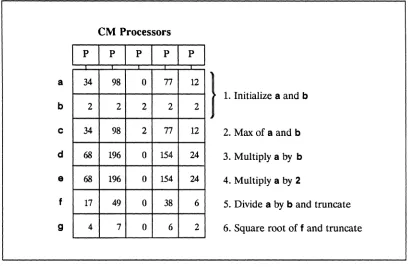
eM
memory from this set of computations are shown in Figure 7, which depicts an arb'itrary set of five processors.a b c d e f g
eM
Processors p p p p34 98 0 77
2 2 2 2
34 98 2 77
68 196 0 154
68 196 0 154
17 49 0 38 4 7 0 6
P 12 2 12 24 24 6 2
} 1. Initialize • and b
2. Max of a and b
3. Multiply a by b
4. Multiply a by 2
5. Divide a by b and truncate
6. Square root of f and truncate
Chapter 3. Computing within Processors 25
3.3 Data Formats
User data on the CM is always stored in bit fields, that is, in sets of contiguous bits that begin at the same memory location in each processor and extend for some arbitrary length. However, many Paris instructions interpret bit fields as being of certain data "types" or storage formats. The currently supported formats are:
• Unsigned integer, represented in straight binary form • Signed integer. represented in two's-complement form
• Floating-point number, represented in three subfields (for significand, expo-nent, and sign) in a format like the IEEE standard
The format of the data in any given field is determined by the instruction that moves data into that field, rather than by any feature of the field itself.
Operand Lengths
Each CM processor is a one-bit serial processor. Since the basic granule of operation is a bit-rather than a byte or a word, as in more complex processors-Paris does not enforce any length or alignment requirements on data formats. In this respect, CM data formats are completely unlike C types.
Any of the CM "types" or formats can be of almost any length:
• Signed integers can be any length from 2 bits up to the value of the CM configu-ration variable CM_maximum_integer_length, which is version-dependent but never less than 128 bits.
• Unsigned integers can be any length up to the value of CM_maximum_inte-ger_length.
• The subfields for floating-point numbers can be:
• Significand: from 1 bit up to the value of the configuration variable CM_maximum_significand_length, which is never less than 96 bits. • Exponent: from 2 bits up to the value of the configuration variable
To correspond with IEEE single- and double-precision floating-point formats, the allocated field should be 32 bits or 64 bits, and the length arguments in procedure calls should be specified as 23,8 or 52, 11, respectively. (The last bit is the sign bit.) Thus:
or,
field_name
=
CM_allocate_heap_field( 32 ); CM_f_random_1L( field_name, 23, 8 );field_name = CM_allocate_stack_field( 64 ); CM_f_random_1L( field_name, 52, 11 );
The choice of length for a field depends primarily on the size of the numbers it is to contain and the degree of precision desired. Specifically, dynamic range increases with field size for integers and floating-point exponents; precision increases with field size for floating-point significands. Other considerations in the choice of field length are:
• Memory usage. Like a C type, a CM field need be no longer than the number of
bits required to represent its largest value. For instance, the program shown in Example 4, unsigned-arithmetic.c, uses 8-bit fields because the largest value to be represented is 198. (The exclusive upper bound of the random number initialization is 100, and the only increase in value is multiplication by 2.)
• Overflow. Shorter lengths run the risk of overflow, where the value moved into
a field is too large to be represented in that field. Most Paris instructions that operate on fields set a state bit called the overflow flag when overflow has
oc-curred. (The means of checking for overflow is described in Chapter 4.) For instance, the following call results in an overflow condition, producing an undefined result and setting the overflow flag as a side effect in each active processor:
CM_s_move_constant_1L( dest_field, 1000000, 8 );
• Execution time. The extra bits needed to guarantee against overflow are not
"free." Since the CM processors act upon one bit at a time in a serial fashion, there is an at least linear increase in processing time as field length increases.
• Use of floating-point hardware. For most data formats, length does not affect
Chapter 3. Computing within Processors 27
an optional 32-bit floating-point accelerator, floating-point operands must be of length 23, 8 to be executed on hardware.
Format Conversions
A very important difference between C and C/Paris is that there is no type checking
and no coercion in ClParis. Paris instructions simply take the values that are passed to
them and treat them as the format they are designed to operate upon. It is entirely the responsibility of the program to ensure the compatibility of operands.
Because Paris has no strong typing, programs are vulnerable to two kinds of errors that do not ordinarily occur in C:
• No type checking. If the operand format is not what an instruction expects, the instruction simply produces incorrect results. For instance:
CM_s_move_constant_1L( field_a, 5, 32 );
CM_f_negate_l_1L( field_a, 23, 8 ); /* wrong results */
After broadcasting an integer constant into field_a, this code negates what it takes to be a floating-point number, obediently breaking it into sub fields and so on. The result is neither the integer value -5 nor the floating-point value
-5.0.
• No coercion. If operands are incompatible with each other, the instruction sim-ply produces incorrect results. For instance:
CM_s_move_constant_1L( field_f, 5, 32 ); CM_f_move_constant_1L( field_g, 5.0, 23, 8 );
CM_s_add_2_1L( field_f, field_g, 32); /* wrong results */
Paris programs must convert operands explicitly to the desired format, using the unary conversion instructions provided. These instructions have two "type" elements in their names, signifying the result format and the operand format, respectively.
CM_f_s_float_2_2L dest source source-len dest-sig-len dest-exp-len
CM_f_u_float_2_2L dest source source-len dest-sig-len dest-exp-len
CM_s_f_floor_2_2L dest source dest-len source-sig-len source-exp-len
Correct versions of the above code fragments might be the following (assuming that all the needed fields have been previously allocated and assigned):
and,
CM_s_move_constant_lL( field_a, 5, 32 );
CM_f_s_float_2_2L( field_b, field_a. 32. 23. 8 );
CM_f_negate_l_lL( field_b, 23. 8 ); /* correct */
CM_s_move_constant_lL( field_f, 5, 32 ); CM_f_move_constant_lL( field_g, 5.0, 23, CM_s_f_floor_2_2L( field_h, field_g, 32, CM_s_add_2_1L( field_f, field_h, 32 );
8 );
23, 8 );
/* correct */
3.4 More on Fields
Paris programs can use two kinds of data storage, heap fields and stack fields. The dis-tinction between the two is analogous to the disdis-tinction between static and automatic variables in C.
In addition, programs can divide a field into subfields by means of an offset instruc-tion, and then treat the subdivided field somewhat like a structured data type.
Using Heap Fields
Heap fields are the "general-purpose" form of CM storage. These fields are intended to be used like C global variables: that is, they have indefinite extent, and they can be used within any lexical scope. Heap fields must be explicitly allocated, and they can be deallocated at any time and in any order.
The commonly used instructions that pertain to heap fields are:
CM_allocate_heap_field length
CM_dealiocate_heap_field field-id
CM_ls_field_ln_heap field-id
Chapter 3. Computing within Processors 29
Using Stack Fields
Stack fields, like C local variables, are intended for use within some bounded lexical scope such as the body of a procedure. However, stack fields do not simply disappear when the procedure is exited. Stack fields must be explicitly deallocated and in the reverse order from which they were allocated. Deallocating a stack field causes all stack fields that were allocated later to be deallocated.
The commonly used instructions that pertain to stack fields are:
CM_allocate_stack_field length
CM_deallocate_stack_through field-id
CM_is_field_in_stack field-id
CM_is_stack_field_newer stack_queryJield stack_baseJield
An example of stack fields in use is the following:
Example 5. Using a stack field: swap-signed-integers;c
#include <cm/paris.h>
swap_signed_integers( a, b, len) CM_field_id_t a, b;
{
}
unsigned int len;
CM_s_move_1L( temp, a, len ); CM_s_move_1L( a, b, len ); CM_s_move_1L( b, temp, len );
same front-end type, CM_field_id_t, is used to store the ID's of both stack fields and heap fields.
Storage Management
The difference in the recommended use between heap fields and stack fields does not arise from differences in extent: both heap fields and stack fields persist until they are deallocated (or until the program terminates). The difference in recommended use arises from the way the system manages the two kinds of memory:
• Heap fields, if explicitly deallocated, can be deallocated in any order without side effects on other heap fields.
• Stack fields should be explicitly deallocated, and they must be deallocated in the reverse order in which they were allocated. If a stack field is not deallocated explicitly, it may be deallocated as a side effect of deallocating an earlier stack field.
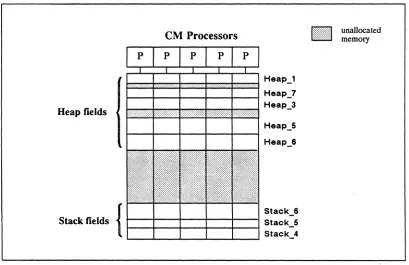
When fields are allocated, storage is reserved for heap fields and stack fields at oppo-site ends of
eM
memory (see Figure 8). The stack is managed with the standard Last In First Out (UFO) stack protocol: new stack fields are always allocated-and always deallocated-at the top of the stack. As a result, the stack remains packed.Heap fields, in contrast, are allocated in the first available space. Early in the program, the space is probably the top of the heap. However, since heap fields can be deallo-cated in any order, gaps tend to form over time and later fields may be placed in these gaps. See Figure 8 for the result: the stack is packed and the fields appear in the order allocated, but the heap is fragmented and the fields are not in the order allocated. The consequences of these features of storage management for system efficiency are:
• Stack storage is always space-efficient, whereas the space efficiency of heap storage tends to deterioriate over time.
• Allocating a stack field is somewhat faster than allocating a heap field, de-pending on the degree of fragmentation of the heap. However, the difference is not as great as between static and automatic variables on a serial machine.
Chapter 3. Computing within Processors
Heap fields
eM
ProcessorsI===.= • • • •
=::q
Heap_'t - - - t - - - t - - t - - t - - - ; HeapJ
tES·::!I:::::II::/!I.:·
EmIEE • • •
·:
:E:::.::S:{::!I.:,::m. Heap_3 Heap_5 ~-~-~~~~-~Heap_6
rtEmrrl
{ Stack_6
Stack fields ~-+---~---"~~--I Stack_5 '--_"'--_"'--_"'--_"'---' Stack_ 4
unallocated
memory
Figure 8. State of
eM
memory at a midpoint in program execution3.5 Bit-Field Operands
31
Paris distinguishes between a data operand and the field that contains it. A field is simply some number of bits that have been allocated and which can therefore be ac-cessed. A data operand, however, is the set of bits specified in a call to a Paris routine. The bit-field operand should fall entirely within an allocated field, but it need not be coterminous with the field.
Field-id's and Lengths
A bit-field operand is specified by:
• A "pointer" to the bit address at which to begin operating in each processor. The field-id indicates the first bit of an allocated field.
NOTE
Although field-id's are associated with CM memory addresses, they are not C pointers and programs should never attempt to use them for indirect addressing. To be precise, in the present implementation of Paris, field-id's are indices into a front-end array of structures, where each structure describes a CM field.
A bit-field operand need not begin at the beginning of an allocated field. The following instruction takes a field-id and an unsigned integer offset and returns a new field-id.
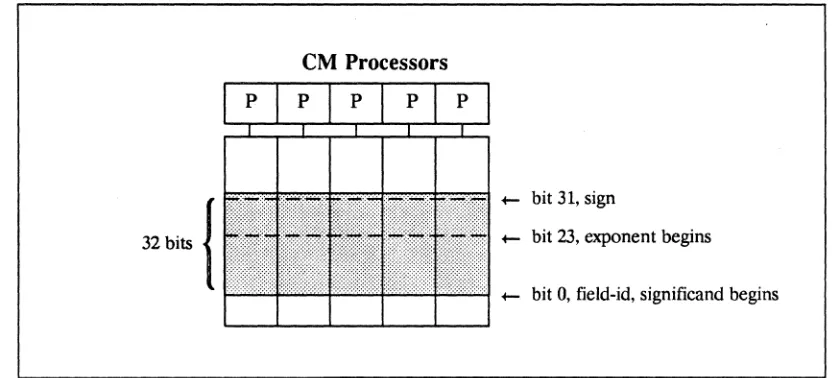
As example layouts, consider a 32-bit field that may contain either an integer or a float-ing-point number. The address indicated by the field's 10 is the first bit of the field (bit 0), as shown in Figure 9. This is the least significant bit of the integer or of the sig-nificand. The number's sign, if any, is stored in the last bit (bit 31). If the length specifiers of the floating-point number were 23 and 8, the exponent begins at bit 23.
eM
Processors~==I +- bit 31, sign
+- bit 23, exponent begins
"""t"""""""f=""'9""" ""'9""""""" +- bit 0, field-id, significand begins
Chapter 3. Computing within Processors 33
By adjusting the starting point and the length, a program can extract the constituent subfields of this 32-bit floating-point number. The following fragment copies the sig-nificand into field b, the exponent into field c, and the sign into field d.
a = CM_allocate_heap_field( 32 ); b = CM_allocate_stack_field( 32 ); c
=
CM_allocate_stack_field( 8 ); d=
CM_allocate_stack_field( 1 );CM_u_move_1L( b, a, 23 );
CM_u_move_1L( c, CM_add_offset_to_field_id( a, 23 ), 8 ); CM_u_move_1L( d, CM_add_offset_to_field_id( a, 31 ), 1 );
Similarly, by adjusting starting points and lengths, programs can use eM_move in-structions to perform bit shifts, as shown in Example 6. These shift routines move specified bits from a source field into a position in the destination field that is offset to the right or left, and then move zeros in to fill the offsets.
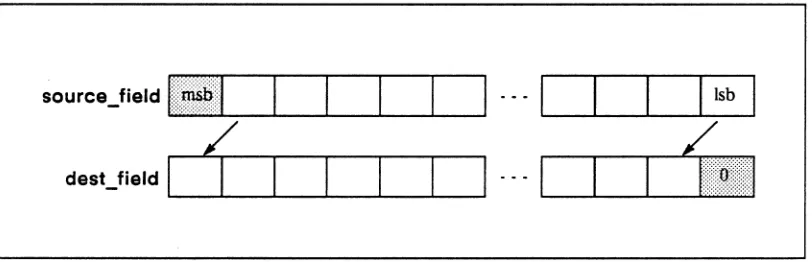
For instance, Figure 10 shows the change that results in each processor from a left ("upward") shift by one bit position. The most significant bit is lost, and a separate operation moves a zero into the least significant bit position. Of course, the same op-eration could be performed in place by specifying the source field as the destination field.
dest_field
I
~--~--~--~--~--~~
Figure 10. A left shift by one bit position
Example 6. Performing unsigned shifts: unsigned-shift.c
#include <cm/paris.h>
shift_Ieft( dest, source, shift_amt, len) CM_field_id_t dest, source;
{
}
int shift_amt, len;
CM_u_move_1L( CM_add_offset_to_field_id( dest, shift_amt ), source,
len - shift_amt ); CM_u_move_zero lL( dest, shift_amt );
shift_right ( dest, source, shift_amt, len) CM_field_id_t dest, source;
{
}
int shift_amt, len;
CM_u_move_1L( dest,
CM_add_offset_to_field_id( source, shift_amt ), len - shift_amt );
CM_u_move_zero_1L( CM_add_offset_to_field_id(dest,
len-shift_amt),
Using Subfields
Although Paris does not provide structured data types, programs can treat a subdi-vided field somewhat like a per-processor array or structure. Instructions can operate either on the entire field or on some or all of its subfields.
The advantages of using subfields are:
Chapter 3. Computing within Processors 35
• More efficient data movement. The time required by the operations that move data between processors (including to and from the front end) is reduced by "packetizing" data items in a single field.
The major disadvantage is:
• Disables safety checking. The run-time safety utility (Chapter 10) checks, among other things, that data operands do not exceed the allocated length of the field that contains them. However, the safety utility has no information on the boundaries of subfields.
A program that treats data both as a whole field and as subfields is shown in Example 7. A complex number is stored in a 64-bit field as two 32-bit subfields, one for the real part and one for the imaginary part:
complex field 1 {
(64 bits)
eM
Processors_ bit 32, field-id Imag_part
- bit 0, field-id's complex_fleld_1
and real_part
Figure 11. Field-id's in a subdivided field that represents a complex number
Example 7. Using subfields: simulate-complex-number.c
#include <cm/paris.h> #include <stdio.h>
#define LEN 32
main ()
{
CM_field_id_t complex_field_1, real-part, imag-part, complex_field_2;
complex_field_1
=
CM_allocate_stack_field( 2*LEN ); real_part = complex_field_1;imag-part
=
CM_add_offset_to_field_id( complex_field_1,LEN );/* Initialize the subfields with 32-bit floating-point numbers */
CM_f_random_1L( real_part, 23, 8 ); CM_f_random_1L( imag-part, 23, 8 );
/* Multiply the complex number by the real value 10.0 */
CM_f_multiply_constant_2_1L( real-part, 10.0, 23, 8 ); CM_f_multiply_constant_2_1L( imag-part, 10.0, 23, 8 );
/* Copy the complex number to another field */
complex_field_2
=
CM_allocate_stack_field( 2*LEN ); CM_u_move_1L( complex_field_2, complex_field_1, 2*LEN );/* Other code */
/* Signal program completion from the front end */
printf( n\nProgram execution completed.\nn );
Chapter 3. Computing within Processors 37
Notice that the last Paris call in this program uses the _u variant of eM_move to copy the field's contents. This variant treats the contents as a straight binary number (the format of an unsigned integer). The _f variant should not be used, since it would take two length specifiers and treat the field's contents as a single floating-point number.
Creating a Parallel Structure
A program can define a front-end structure and then mimic its memory layout within a CM field. The correspondence between the two layouts permits convenient data move-ment between the front end and the CM by means of the instructions that read and write to specifiedCM processors (see Chapter 7).
This section shows a simple case of mimicking a structure in a field, followed by some example macros that users can define to implement the general case.
First, consider an arbitrary front-end structure:
typedef struct {
int a; /* 32 bits */
char b; /* 8 bits */
} new_type;
Front End
b ...
a ...
eM
Processors} 8 bits
+-subfield_b
} 32 hi"
+-subfleld_a
Creating the parallel analogue of this particular layout is straightforward:
my_cm_structure = CM_allocate_stack_field( 40 );
subfield_a = my_cm_structure; /* specify len=32 when using */
subfield_b = CM_add_offset_to_field_id( my_cm_structure, 32 );
/* specify len=8 when using */
More generally, a program can use macros to match a CM field to the layout of any specified front-end structure. Example 8 shows a possible implementation of such macros. These macros use sizeof to find the length in bytes of the front-end structure and then calc_ulate the offsets of the structure's members. These values are multiplied by 8 to convert the lengths to bits for the CM calculations. The macro parameters are:
type
slotname
obj
the type of the front-end structure
the name of a front-end structure member
the field-id of the CM field that mimics the structure
Example 8. Creating a parallel structure: create-cm-struct. h
#define TYPELEN(type) ( 8
*
sizeof( type »#define ALLOCATE_TYPE(type) \
CM_allocate_staak_field( TYPE LEN ( type »
#define SLOT_OFFSET(type,slotname) \
(8
*
(int)&« (
type*
)0 )->slotname »#define CMREF(obj,type,slotname) \
CM_add_offset_to_field_id( (obj), SLOT_OFFSET(type,slotname»
Thus, to mimic the layout of my_fe_structure in a CM field called my_cm_structure:
Chapter 4
Context and Control
Data parallel programming is distinguished from both serial programming and con-trol parallel programming by its single in-line thread of concon-trol. Each processor in the CM processor array contains a different data point, but all execute exactly the same instruction on their data points at the same time. Any processors for which the instruc-tion is not relevant are instructed to sit idle for that time. We say that the context has narrowed to a smaller active set of (virtual) processors.
NOTE
Context relates to subselecting elements of a data set; it does not relate to selecting among data sets. For example, given a program that operates on points and lattices, context manipu-lation serves to subselect certain points or to subselect certain lattices. Context in the sense of choice among data sets-the points versus the lattices-is expressed in Paris through the concept of vp-sets and the cu"ent vp-set (see Chapter 5).
In Paris programming, the flow of control is handled entirely on the front end under the direction of the C code in the program. That is, C statements direct all branching, looping, and recursive operations and all subroutine calls. These actions often deter-mine which Paris instructions are sent to the CM. Once the instructions are sent, how-ever, there is no further variation in the thread of control. The only control-related determination made on the CM is which processors are to participate in the next in-line instruction.
4.1 The Context Flag
Each CM (virtual) processor contains a predefined one-bit entity called the context flag. This flag serves as a processor mask: the processors whose context flag is set to 1 participate in the next instruction; those whose context flag is set to 0 do not. Context is always determined explicitly by the user program. There are no Paris instructions that set the context flag as a side effect.
Although the context flag is like a field, Paris supports no way to reference it. Instead, Paris provides specialized instructions that operate on the context flag; all such in-structions have the element _context in their names. The commonly used instructions for manipulating context are:
CM_set_context
Makes all processors active (sets context flags to 1)
CM_clear_context
Makes all processors inactive (sets context flags to 0)
CM_load_context source
Moves the value from a specified one-bit source field into the context flag in all processors
CM_store_context dest
Moves the value of the context flag into a one-bit destination field in all proces-sors
CM_logand_ context source
Clears the context flag in all processors where the value in the one-bit source field is 0
CM_logior_context source
Sets the context flag in all processors where the value in the one-bit source field is 1
CM_global_ count_context
Returns the number of active processors CM_globaUogior _context
Returns 0 if no processors are active or 1 if any processor is active
in-Chapter 4. Context and Control 41
struction operates on only one bit, the effect is to check the least significant bit in field_8 and clear the context flag if that bit is 0 (that is, if the value is even).
CM_set_context();
CM_u_random_1L( field_a, LEN, 255 );
CM_logand_context( field_a );
CM_u_add_constant_2_1L( field_a, 1, LEN );
All processors active before the initialization instruction:
p p p p P
1 1 1 1 1 context flag
136 17 83 144 3
Active set narrowed before the add instruction:
context flag
+---+---~++~--,
Figure 13. Narrowing the active set of processors
Unconditional Instructions
D
activeI:::::::::::J inactive
Practically all Paris instructions are conditional: they execute only in those processors whose context flag is set to 1. A few instructions are unconditional: they execute in all processors regardless of the state of the context flag. The major categories of uncondi-tional instructions are:
• Instructions whose name contains the element _always. These instructions ig-nore the context flag.
For example, CM_s_move_always_1L is the unconditional variant of
CM_s_move_1 L. The _always instructions are faster than the conditional vari-ants; they are useful when the program is unconcerned with preserving the val-ues in inactive processors.
• Certain specialized communications instructions, identified in the Paris Refer-ence Manual.
Another category of instructions that ignore the context flag are allocation intructions, such as CM_allocate_heap_fleld. Allocation is primarily a front-end operation; it sim-ply earmarks certain CM memory addresses as allocated and associates them with a front-end field-id. No action happens on the CM processors from an allocation in-struction, the context flags are not checked, and the field in question is always allo-cated across all processors.
The Test Flag
A common source of the values used to determine context is another predefined state bit, the test flag.
The test flag is the destination for the Paris comparison instructions: eq, ne, gt, ge, It,
and Ie. These operations are implemented for signed a