Collaborative Partnership Between HE and an Employer: A Case Study Of Workforce Development for Guide Dog Mobility Instructors
Rosalind Foskett, University of Southampton, School of Education
Abstract
The Government is promoting collaborative curriculum innovation as one of the ways in which higher education can widen participation and assist with workforce
development. Policies, such as that which set up foundation degrees, and targeted funding have encouraged higher education institutions to work with employers and other educational providers to develop vocational pathways. These programmes need to be flexible and must meet the needs of students engaged in full time or part-time work for learning opportunities in a mode and at a time appropriate to them. This paper presents the findings of a study of an employer-led curriculum development for a workforce that had hitherto been excluded from higher education.
This case study draws on evidence from documentary analysis, participant
observation and semi-structured interviews of the major stakeholders over a period of two years. It considers the motivation of the partners for engaging in collaborative work both at institutional and individual level. It provides a unique example of curriculum development for the accreditation of a programmes for Guide Dog Mobility Instructors and the emergence of an innovative programme that contributes to the professionalisation of a group of people who previously were without a bespoke route into high education.
Introduction
Like any other area of social activity, education goes through phases of change that fundamentally affect how it operates. Priorities for change may be intrinsic as new and better ways of doing things are sought in response to some perceived need of the practitioners. Alternatively, the priorities may be extrinsic as the stakeholders within society impose content, methods or structures that they perceive will ‘improve’ the education process. This paper looks at one element that is affecting curriculum change in higher education – the extrinsic pressure for institutions to work within
collaborative partnerships to develop appropriate undergraduate curriculum in line with government priorities for change. One of the key policies is the desire to make the sector work more closely with business to assist workforce development and modernisation. This case study of work with an assistance dogs’ charity considers the motivation of HE and employers to involve themselves in collaborative work and the benefits of partnership work on curriculum development.
Background
main policy drivers, the need to tackle social exclusion through partnerships of a very different kind (Clegg and McNulty, 2002). Jones and Bird (2000) describe this as New Labour putting a strong social-ethical inflection on the idea of partnership. Thus partnership today is more a grouping of different agencies which are working together to tackle the major problems (mainly identified in the political agenda). It is not without drawbacks though. As many researchers have observed there is a tension between the individualistic nature of modern society and the need for collaborative working (Jones and Bird, 2000; Boyle and Brown, 2000). Indeed the Prime Minister, Tony Blair, himself has commented on this dilemma:
‘how to create the bonds of a civil society and community in a way compatible with the individualistic nature of modern economic, social and cultural life.’ (Blair, 1997, p2)
He goes on to describe his vision for this new way of working in which government is more facilitative and supportive of what works on the ground. Advocacy for
partnership working is founded on beliefs rather than hard evidence. There is a need to understand why some collaborative developments work and why some fail.
There are many different definitions of collaborative partnerships (see Huxham, 1996; Pratt et al 1998; Tett et al, 2001; Tett et al , 2003). At its simplest form, it is about working jointly together with at least one other person/group. However, the terms and conditions under which the agreement to work together are made can produce very different results and the nature of the overt or covert power relationships that exist can also impact on the relationship. Tett et al (2003) have defined collaboration:
‘…heuristically as a continuum. At a minimum, this means that individuals in one organization are working with other individuals in another organization in order to achieve some form of mutual benefit. At a maximum, it implies many organizations working together in harmony. Collaboration can be said to be taking place when a change in process, product or output takes place that requires contributions from all the organizations involved (Blair et al, 1998). Not all organizations or professionals will contribute equally, but they will be adjusting their decision making to take account of each other.’ (p 39).
There are two pre-requisites that come out of this definition. Firstly, that there is an identified ‘mutual benefit’. This should be overtly stated in terms of the aims of the collaboration, but as we shall see later, the nature of the aims may be obscured or hidden from view. Secondly, there should be ‘a change in process, product or output’
as a result of the contributions made by the partners. Whatever the definition, there is an underpinning assumption that collaborative partnership working is a good thing and that it is a synergistic relationship where the total result is greater than the sum of the parts.
most hard-to-reach and currently excluded sectors of our society. Another element of current policy that does seem to be here to stay and which will play a dominant part is the vocationalism of higher education. There is a growing trend to promote the needs of employers and the workplace in higher education curriculum (called by Saunders and Machell (2000) Higher Education/Work Relations or HEWR for short). This relationship is termed neo-correspondence and it is the coming together of the student experience with the world of work. As in schools, this was once part of the hidden curriculum but now it is becoming part of the ‘explicit curriculum’ (Hickcox and Moore, 1992; Saunders and Machell, 2000). It is clear to see in Government initiatives like foundation degrees which are explicit employer-led curriculum developments, but it is also manifesting itself in other undergraduate and
post-graduate curricula as enterprise, entrepreneurship and business units are embedded in degree courses. It also underlies the skills agenda which is part of the enterprise culture in which we live.
Part of the HEWR debate focuses on the purpose of higher education and how far the curriculum should meet the economic and social needs of the country (Bridges, 2000). In order to promote the ‘joined up thinking’ espoused by government ministers, there has been a trend for collaboration between HE and other stakeholders to be
encouraged in all elements of activity. The curriculum has been one area for this change and, for example, in the prospectus for foundation degree development, phrases such as ‘employer-led curriculum development’ and ‘earn and learn’ courses indicate the desire for a closer alignment between business and higher education (HEFCE, 2000). Another example of this was seen at a meeting at the Institute of Civil Engineers in April 2003, hosted jointly by the Secretary of State for Education, the Secretary of State for Trade and Industry and the Director of the CBI to launch an initiative to promote effective collaborative partnerships for workforce development. This meeting considered collaboration between the sectors in its broadest sense but one element of discussion was how curriculum change could be used to encourage these partnerships. There was discussion of a small survey undertaken by the CBI into collaborative partnerships and one of the factors that had been identified as important for improving collaboration was the provision of relevant courses.
‘Some universities are clearly seeking to respond to business’ requirements for tailored courses. Research by HEFCE shows that in 2000-01, 73% provided short bespoke courses for business on campus and 64% did so on companies’ premises. But it is not clear how many businesses are offered this level of customer service. Even within the sample of larger companies we surveyed, 40% said they would be willing to get involved if universities were more prepared to develop well-defined, bespoke courses that add value to the business.’ (CBI, 2003, p 5)
The case study here is of a collaboration between an HEI and an organisation which, as part of its services to visually impaired people, provides guide dogs. The
organisation has a long history of providing this assistance dogs service and
associated rehabilitation services. Part of the workforce is involved with matching the assistance dogs to the client needs. This role is called the Guide Dog Mobility
engagement with training and the rehabilitation workers had the opportunity to study for a Diploma in Higher Education. The aim of the collaboration was to develop the curriculum provided by the employer to Diploma in HE level, accredit work-based and class-based learning and provide this element of the workforce with access to higher education.
Methodology
This research project, which is part of a much wider study of collaborative curriculum development across the higher education sector, is a case study of one undergraduate course development. It aimed to investigate the perceived benefits of collaborative partnership for undergraduate curriculum development from the perspective of the various participants. This qualitative study draws on evidence from documentary analysis, participant observation and informal interviews of the major stakeholders over a period of two years. The documents analysed included validation and accreditation papers, minutes of meetings, Memoranda of Agreement and
correspondence between partners. Formal and informal evaluations took place during the development phase and after validation. In addition, informal interviews with the major stakeholders have allowed evidence to be collected from different perspectives within the partnership.
The case study approach used here has been defined as ‘ the systematic investigation of a specific instance’ (Nisbet and Watt, 1984, p74). Case study has been an important approach for research for a number of decades and there is a rich literature concerning its use (for example: Yin, 1994; Simons, 1996; Bassey, 1999; Freebody, 2003). The approach has a number of identifiable strengths and weaknesses (for example: Nisbet and Watt, 1984; Adelman et al, 1980; Cohen, Manion and Morrison, 2000; Freebody, 2003). One of its main advantages is that it allows the use of a number of techniques to examine the problem from a variety of perspectives. It focuses on real situations and its ‘embeddedness in social truth…allows attention to the subtleties and
complexities of a case’ (Adelman, et al, 1980, p23). As an approach it cannot claim the full generalisability that quantitative methods can provide but nevertheless it does have relatability (Bassey, 1981). This research project, which is a preliminary to a more extensive analysis of case study data across a number of institutions, focuses on the motivation and benefits of collaboration to each of the stakeholders in this
example. Its relatability is yet to be considered.
Outcomes and Discussion
An analysis of the literature points to a number of commonalities in the benefits and problems associated with partnership work (see Geddes, 1997; Appelbee, 1998; Gilchrist, 1998; Hughes and Carmichael, 1998; Machell, 1999; Jones, 2000; Tett et al, 2001; Clegg and McNulty, 2002; Tett et al, 2003). Collaborative work does bring with it many benefits but there are significant costs too and the participants in the development have to at least perceive that the benefits outweigh the costs. In this paper, the results of two aspects of this balance will be considered in detail. Firstly, the reasons why the different stakeholders in this collaborative curriculum
development engaged in the activity in the first place and the aims that they had will be analysed. Secondly, the paper looks at the benefits that accrue from the
In this study the evidence for the aims comes from an interrogation of the course documentation and records. These include the validated document, the programme board minutes, evaluations and staff and student handbooks. Additional evidence from semi-structured interviews of the main stakeholders has also been drawn upon. The interviewees covered the following roles:
Employer members: Head of Education Programme Leader Programme tutors Administrative Officer University members: Programme Leader
Programme Tutors Outreach Worker Partnership Officer Senior Manager
Motivation for engagement in curriculum development
In this study the motivation of the different players was interrogated both at a personal level and at an institutional level. There are two aspects to motivation in this context: the articulation of the aims and the perceived benefits of the collaboration.
(a) The articulation of aims
At the outset, each of the stakeholders will have a set of aims that they wish to achieve. Other researchers who have studied the nature of collaboration and partnership in curriculum development have found that one of the critical success factors is a clear articulation of the aims of each of the stakeholders taking part in the project and convergence of those aims towards a common purpose (Field, 1995; Jones, 2000; Tett et al, 2001; Clegg and McNulty, 2002). The strategic aims of the programmes are usually agreed and subscribed to by all the partners and are often stated publicly in programme documentation. This clarity of purpose is important for securing commitment of the employers and other stakeholders to provide the staff resource necessary to undertake the curriculum development.
In the development of this Diploma of Higher Education (Canine Assistance Studies) the aim of the employer was to develop their existing in-house training programme for GDMIs into a recognised higher education qualification at a level similar to other professional groups within the organisation. For this, the employer needed to work with an HEI who could provide the accreditation. This was the stated aim of the employer partner and was included in validation documentation. The documentation states:
“[The organisation] has three main aims in this development: To train staff to a high professional and academic level; To involve other canine assistance trainers in developing
international standards;
The HEI also had explicit aims at the outset. It was keen to work in partnership in order to increase its part time student numbers and in particular to attract new groups of students who had hitherto been hard to reach as part of its widening participation strategy. This is described in the validated document:
“This programme development specifically addresses the mission and strategy of [the Faculty]…by providing lifelong learning opportunities, developing part-time provision and working in partnership with employers to address community needs. It is part of the strategy of the University that [the Faculty] should develop partnerships with employers and community-based groups in pursuit of widening participation and lifelong learning.” (Validation
Document, 2000)
These initial aims are related to the mission of the institutions and relate to
government policy in the case of the HEI and workforce development needs in the case of the employer.
However, this is only part of the picture. It is clear from studies of partnerships (Jones, 2000; Trim, 2001; Clegg and McNulty, 2002; Foskett, 2003) that the success or failure of the partnership depends as much on the un-stated aims. These may be emergent aims that are slowly revealed as the project develops and the trust between the partners grows, but which are not stated at the start. As in all relationships, people are more likely to be honest and reveal their true motives to old friends rather than new acquaintances. As Trim (2001) has pointed out, the most successful partnerships occur where institutions have similar value systems. The partnership needs to be ready to recognise these emergent aims and work with them or risk weakening or jeopardising the partnership.
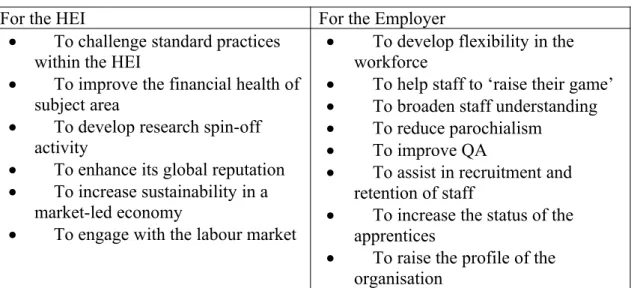
This research has identified a number of emergent aims that were gradually revealed as the development process progressed, and continue to be revealed as the programme is implemented. These are shown in Figure 1. It shows that the reasons for partners getting involved in collaborative work are often very different and may take some time to be made explicit. The emergent aims are not so clearly mission related and tend to reflect development needs of the organisations or underlying business considerations. In the case of the HEI, therefore, emergent aims related to changing attitudes in terms of standard curriculum development practices and making staff more aware of engagement with the market were also important underlying aims. The staff development element was also key in the emergent aims of the employer
organisation. As a senior manager in the employer organisation said:
It is interesting to note that both organisations embarked on a major strategic review and restructuring shortly after the programme was validated. In the interviews, a number of respondents reflected that the need for significant change in the organisation was an important element of their organisation embarking on this curriculum initiative.
Figure 1: Emergent aims for the Canine Assistance Studies programme
For the HEI For the Employer
To challenge standard practices within the HEI
To improve the financial health of subject area
To develop research spin-off activity
To enhance its global reputation
To increase sustainability in a market-led economy
To engage with the labour market
To develop flexibility in the workforce
To help staff to ‘raise their game’
To broaden staff understanding
To reduce parochialism
To improve QA
To assist in recruitment and retention of staff
To increase the status of the apprentices
To raise the profile of the organisation
An examination of the emergent aims of the employer organisation shows that these fall broadly into two main groups: those that relate to changing the staff work practices and those that relate to more business-related aims. The latter group is less in evidence and this may reflect the fact that the organisation has charitable status and its ethos reflects the centrality of people to the organisation’s mission.
In addition to the aims that are revealed, each stakeholder may also have a set of aims that it does not articulate to the other partners at all. These may include issues of financial security, programme viability, institutional resistance to change and other sensitive subjects. For the unwary curriculum developer these unarticulated, hidden and un-stated aims can hijack the process (Foskett, 2003). An essential part of the curriculum development process when working in collaborative partnerships seems to be the development of trust and openness in the working relationship. This is a time-consuming process that cannot be hurried and must therefore be seen by all parties as a long-term relationship (Trim, 2001; Bottery 2003). This would seem to be a critical factor in increasing motivation for collaborative work both at the institutional and at the individual level.
(b) Perceived benefits of the collaboration
As people become experienced in working in a collaborative relationship their motivation can be enhanced by the benefits becoming apparent. In this study, four groups of stakeholders can be identified (the HEI; the employer organisation; the staff involved in the collaborative development; and the student body) and each has its own perception of the value of collaborative working. To some extent this will reflect whether or not each group feels that its aims for the development are being realised. To examine this, the data was interrogated to identify the benefits of
their interviews. Firstly a full list of benefits mentioned by the respondents was collated and this was divided into those benefits which accrued to each of the
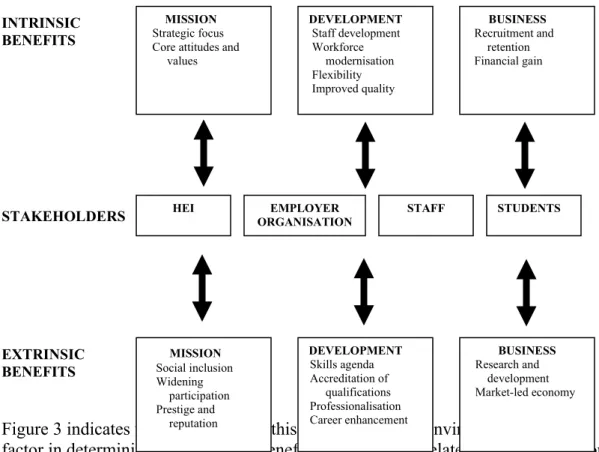
stakeholder groups. In analysing the list, the benefits could be divided into two main groups: those that came from within the organisational environment (intrinsic benefits) and those that came from the external environment (extrinsic benefits). In each case the benefits related to one of three broad categories:
Mission benefits those benefits which relate to the mission of the organisation to provide either higher education (HEI) or services for visually impaired people (Employer organisation)
Developmental benefits those benefits which have a developmental or change management aspect either for the organisation itself or the people who work within it
Business benefits those benefits which relate to the sustainability of the business of the organisation (HEI and Employer Organisation)
Figure 2 shows a generalised model for the perception of benefits for collaborative curriculum development in this case study. Further analysis of the data was
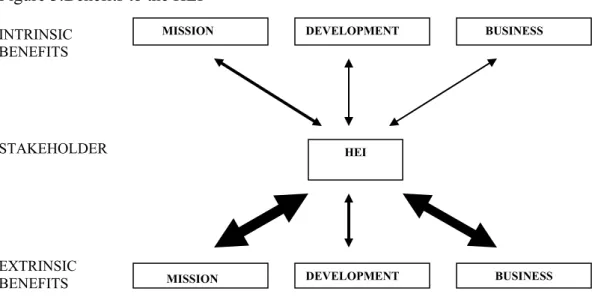
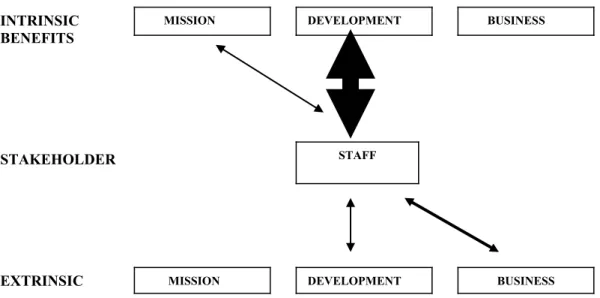
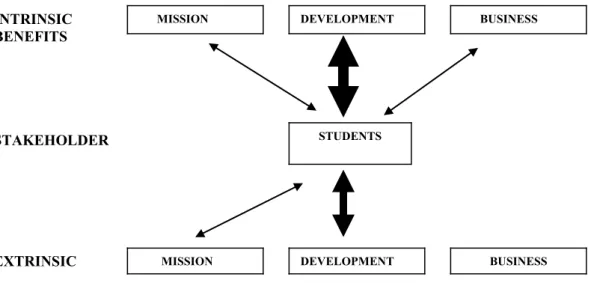
undertaken in relation to each of the stakeholders in turn by looking at the frequency with which each benefit mentioned in the interviews related to that stakeholder and how it could be classified according to the grouping of benefits shown in Figure 2. For each stakeholder group these have been drawn up to show the strength of the relationship by proportional arrows. These arrows are conceptual rather than statistically determined; the larger the arrow, the greater the frequency of being mentioned by respondents within the interviews. These patterns are shown diagrammatically in Figures 3 – 6.
Figure 2: Perceived Benefits of Collaboration
INTRINSIC BENEFITS
STAKEHOLDERS
EXTRINSIC BENEFITS
Figure 3 indicates that for the HEI in this case the external environment was a key factor in determining the perceived benefits and that these related closely to mission
MISSION Strategic focus Core attitudes and
values
MISSION Social inclusion Widening
participation Prestige and
reputation
DEVELOPMENT Staff development Workforce
modernisation Flexibility Improved quality
BUSINESS Recruitment and
retention Financial gain
DEVELOPMENT Skills agenda Accreditation of
qualifications Professionalisation Career enhancement
BUSINESS Research and
development Market-led economy HEI EMPLOYER
and business drivers. In particular, the context in the period of development 2001-2002 was one of institutions trying to address the widening participation and social inclusion agendas set by government and senior managers within the HEI were becoming aware that in order to change the student mix, significant changes had to be made in the nature of the curriculum and access to it. To achieve this, partnership work made good sense.
“You know, the University is a business, it’s not a charity…well it is a charity but it’s not a charity. … it fitted the modus operandi of the time of widening provision which is, or is not, going to be the modus operandi in the future. But widening provision, lifelong learning all of those things, it fitted.” Ashley, University.
For the HEI, there were also important considerations such as the research agenda. In this case, the institution was aiming to be excellent in all areas and to maintain a position nationally in the top ten of HEIs.
“Because the real motivation at the moment is the next RAE and making sure that every part of the University is a 5* rated department.” Simon, University.
Business considerations of R&D opportunities and maintaining a position in the educational market-place to ensure it could attract excellent students globally were also important considerations. Collaborative working which allowed partners to assist in the widening participation, skills enhancement and workforce development agendas of government made good business sense at this time as it was likely to impact on future funding. Prestige, reputation and the University’s good name were key elements of the decision-making processes and the benefits to the University were measured by all stakeholders in those terms.
Figure 3:Benefits to the HEI
INTRINSIC BENEFITS
STAKEHOLDER
EXTRINSIC BENEFITS
Figure 4 shows a very different pattern for the employer organisation. The greatest strength of benefits are related to development drivers. This charitable organisation was in the process of embarking on a major review of its services. It had suffered a
MISSION
MISSION
DEVELOPMENT BUSINESS
financial downturn due to the fall in the value of the Stock Market and it was looking to modernise its business to continue to provide an excellent service to its clients. In order to do this, it was restructuring the service and staff were being asked to take on more flexible roles. This background of workforce modernisation meant that the ability of education to transform attitudes, values and practices through
developmental activities was an essential requirement. Internally the development of the programme was seen to provide benefits in terms of providing a more flexible workforce and enhancing the breadth of the educational experience. The programme was seen to move the organisation from a training and apprenticeship model to being educational, providing the opportunity for staff to examine disability issues in a social context and a greater range of teaching and learning methodology. This is illustrated by the following quote about the pre-existing apprenticeship scheme:
“…being an internal qualification, it tended to lead towards parochial practices. It … was managed locally and although there were centrally run units in later parts of the old apprenticeship as we called it, students spent a long time in their own local team and so in a sense there wasn’t a
consistency, parochial practices developed.” Max, Employer.
Figure 4: Benefits to the Employer Organisation
INTRINSIC BENEFITS
STAKEHOLDER
EXTRINSIC BENEFITS
The aim was for staff to develop their practice both in terms of those staff teaching on the programme and those staff training to be GDMIs. The principal extrinsic benefits were also in the development drivers. The organisation saw the programme as a way of staff becoming more professional and raising the profile of the organisation. There was an opportunity for this programme to become the global benchmark standard for assistance dog trainers and mobility instructors, but as yet this has not been realised.
It is interesting to note that as an employer organisation the business drivers show very weakly as benefits when it might be expected that these would be the dominant drivers. In discussion with the employer stakeholders this seems to be due to the status of the organisation as a charity where the provision of a client service and its people-focused nature is paramount. Also as the organisation was undergoing a period of transition, the importance of education providing a vehicle for change management
MISSION
MISSION
DEVELOPMENT BUSINESS
DEVELOPMENT BUSINESS EMPLOYER
was key. Thirdly, the business advantages from this type of programme development are difficult to quantify in terms of return. The outgoings in terms of money paid to the HEI for validation and accreditation services are more easily determined than the value for money accrued through recruitment, retention and quality of staff.
Figure 5: Benefits to Staff
INTRINSIC BENEFITS
STAKEHOLDER
EXTRINSIC
The perceived benefits to staff involved in managing or teaching the programme are shown in Figure 5. The dominant benefit driver here is in terms of their own
development within the organisation as a whole. In the interviews staff talked about the importance of staff developing their skills, understanding and knowledge. The following quote taken from one of the interviews shows how this allowed staff to ‘raise their game’ and improve their chances of advancement, particularly within the same organisation.
“They got the opportunity to raise their game, a strange expression that. They were operating now with a significant external partner as well as all the internal issues they were dealing with. And that gave them the opportunity to develop new skills, to show themselves in new situations…the team itself has now moved about…, they are moving on to new jobs…but the opportunities to move to new posts has in part come from their experience of working with this programme.” Timothy, Employer.
The staff also benefited from gaining additional HE qualifications themselves. The HEI demanded engagement at higher degree level and/or on teacher training
programmes for those staff acting as tutors. In part this was responsible for raising the confidence levels within the staff and providing them with promotional opportunities. All of the original group of staff involved in the development of the programme have moved on to new roles at a higher level, all within the field of assistance dogs
charities and all but one with the same organisation.
Finally Figure 6 shows the perceived benefits to students. Once again, as would be expected, the development drivers are paramount, however it is interesting to note that for students the perceived benefits are not only intrinsic development benefits in terms
MISSION
MISSION
DEVELOPMENT BUSINESS
of their ability to do the GDMI job and to do it better than under the old style training model but also their extrinsic development drivers in terms of having an externally recognised qualification which has currency should they want to move jobs.
“There was, I think, a … generally held view that there would be a great value in students attaining an externally validated qualification because it would actually shake things up in those areas, but that also it would mean that students themselves would … having spent three years of hard study, they would actually attain a qualification that was transferable. Max, Employer.
Figure 6: Benefits to Students
INTRINSIC BENEFITS
STAKEHOLDER
EXTRINSIC
Conclusions
Each of the stakeholders, therefore, gain from perceived benefits accruing from the collaborative curriculum development. Many of the benefits come from the process of producing a new curriculum and forming a partnership as well as the product or outcome in terms of the new programme. The process of producing a new curriculum in this way is complex, requiring as it does both the validation processes of
developing and quality assuring a new higher education programme and the
accreditation processes associated with the HEI working in partnership with another organisation involved in the programme delivery. It is in working through these processes together that the developmental benefits, identified by the stakeholders as being so important, are accrued. The organisations become more flexible and outward-looking and the staff involved gain new skills. The benefits from
collaborative working, however, come at a price. This is true as much in partnerships formed to undertake curriculum development as for collaboration for any other purpose. As Weaver et al (1987, p2) put it ‘collaboration in curriculum development involves working with friends while cavorting with the enemy’!
Good and productive working relationships, such as the one described in this case study, require trust between the stakeholders (Richards and Horder, 1999; Morgan and Hughes, 1999; Clegg and McNulty, 2002; Milbourne et al, 2003). This is not easy to develop quickly and the long lead-time is partly due to a difference in culture that can exist in the working environments of the different partners. Clegg and McNulty
MISSION
MISSION
DEVELOPMENT BUSINESS
(2002) have shown that the existence of a relationship before a formal partnership is formed provides useful ‘cultural capital’ that can be drawn on during the development process. Trust between organisations rarely exists; it is in reality trust between
individuals that is the cement in the relationship and which will ensure sustainability. This clearly depends on stability of personnel until completion of the job and also depends on the personnel involved having good skills of networking and project management (Geddes, 1997). Collaboration is easier where there is a greater degree of similarity in the organisational structures, purpose and philosophies between the partners (Jones, 2000; Tett et al, 2001). In this study there was no existing formal relationship but the small academic pool of people engaged with animal behaviour and interaction with humans meant that people in both organisations were aware of the work of the other. Mutual respect which came from this knowledge assisted in the development of a trusting relationship which meant that communication was excellent and there was a determination on both sides for success. Luckily during the
development phase the personnel involved stayed stable, although as has already been described, there has been a great deal of staff change since as people have capitalised on this experience for career enhancement.
Results from a number of studies (Pratt et al, 1998; Boyle and Brown, 2000; Wilson and Pirrie, 2000; Jones, 2000; Riddell and Tett, 2001; Tett et al, 2003) indicate that the following factors are important in providing an environment in which partnerships can flourish and achieve success:
The aims and purposes of the need for collaboration are identified at the beginning and should be shared by all partners;
Collaborating organisations are stable and are not going through major organisational changes;
The financial and resource expectations of all partners are made explicit at the start;
Partners agree the degree of independence and interdependence at the start;
Staff at all levels within the collaborating organisations need to be committed to making it work;
Individual participant should have networking and interpersonal skills to help facilitate the partnership – they should not have a particular ‘axe to grind’ (Jones, 2000; Wilson and Pirrie, 2000).
This study has considered the aims, motivation and perception of benefits of
collaborative curriculum development in one case. It has shown that when looking at the aims, three sorts should be considered: the explicit aims stated at the start of the development; the emergent aims which become revealed as the development continues and the un-stated aims which are likely to be present, but which are not revealed to the other partner(s). This case has indicated that organisational change can be a catalyst for partnership and is not necessarily an inhibitor as indicated by other studies. The dynamism of working with a partner can be a strong motivator for staff and the benefits can help develop staff, students and the organisational culture.
the United Kingdom. In the United States, for example, current research is focusing on how universities will need to redesign their organisational structures and
management priorities to foster such links and provide an environment in which collaborative arrangements can flourish (Kezar, 2004). Partnerships are something that have to be nurtured and staff skilled in this work will be a valuable resource.
Address for correspondence:
Ros Foskett, School of Education, University of Southampton, Highfield, Southampton, SO17 1BJ. Email: [email protected].
References
Adelman, C., Kemmis, S. and Jenkins, D., 1980, Rethinking case study; notes from the second Cambridge conference. In H.Simons (ed), Towards a Science of the Singular. Norwich: Centre for Applied Research in Education, UEA, pp 45-61.
Appelbee, E., 1998, Inclusive Learning – A Community Approach. Paper presented to the North of England Education Conference, Bradford, 5-7 January.
Barr, J., 2002, Universities after postmodernism, International Journal of Lifelong Education, Vol. 21(4), pp 321-333.
Bassey, M., 1999, Case Study Research in Educational Settings, Buckingham: Open University Press.
Blair, T., 1997, Speech given at the Aylesbury Estate, Southwark, London, 2 June, posted on the Social Exclusion Unit Homepage, http://www.coi.gov.uk/
Bottery, M., 2003, The Management and Mismanagement of Trust, Educational Management and Administration, 31(3), 245-261.
Boyle, B. and Brown, M., 2000, Holy Grail or Poisoned Chalice? A Case Study of Partnership Collaboration Between a University School of Education and a Private Sector Education Services Company, Westminster Studies in Education, Vol. 23, pp 31- 40.
Bridges, D., 2000, Back to the Future: the higher education curriculum in the 21st
century, Cambridge Journal of Education, Vol 30(1), pp 37-55.
CBI, 2003, Business and Higher Education: Promoting Effective Collaboration, Unpublished Report.
Clegg, S. and McNulty, K., 2002, Partnership working in delivering social inclusion: organizational and gender dynamics, Journal of Education Policy, Vol 17(5), pp587-601.
Cohen, L., Manion, L. and Morrison, K., 2000, Research Methods in Education, 5th
Edition, London: Routledge Falmer.
Field, D., 1995, Local development partnerships and investments in people, Sheffield, LEA Employment Department.
Foskett, R., 2003, Employer and Needs-Led Curriculum Planning in Higher Education: A cross-sector case study of foundation degree development, Paper presented to the British Educational Research Association, Herriot Watt University, Edinburgh, 10-13 September.
Freebody, P., 2003, Qualitative Research in Education: Interaction and Practice, London: Sage Publications.HEFCE, 2000, Foundation Degree Prospectus, Bristol: HEFCE
Gilchrist, A., 1998, A more excellent way: Developing coalitions and consensus through informal networking, Community Development Journal, Vol 33(2), pp100-108.
Hickcox, F. and Moore, R., 1992, Education and post-Fordism: a new
correspondence, in P.Brown and H.Lauder, Education for economic survival, London: Routledge and Keegan Paul.
Hughes, J. and Carmichael, P., 1998, Building partnerships in urban regeneration: A case study from Belfast, Community Development Journal, Vol 33(3), pp205-225. Huxham, C. (ed), 1996, Creating Collaborative Advantage, London: Sage.
Jones, H.M.F., 2000, Partnerships: a common sense approach to inclusion? (1). Paper presented to the SCUTREA, 30th Annual Conference, University of \Huddersfield, 3-5
July.
Jones, K. and Bird, K., 2000, ‘Partnership’ as Strategy: public-private relations in Education Action Zones, British Educational Research Journal, Vol 26(4), pp 491 – 506.
Kezar, A., 2004, Redesigning for Collaboration: An Examination of Model Higher Education Institutions, paper given to the American Educational Research
Association Annual Conference, San Diego, April 2004.
Machell, J., 1999, The Lost Boys or the Great Unwashed: Collaborative Strategies to Address Disaffection. Paper presented to the British Educational Research
Association Annual Conference, University of Sussex, Brighton, 2-5 September. Milbourne, L., Macrae, S. and Maguire, M., 2003, Collaborative solutions or new policy problems: exploring multi-agency partnerships in education and health work,
Journal of Education Policy, Vol 18(1), pp19-35.
Morgan, S. and Hughes, D., 1999, New Start – Paving the Way for the Learning Gateway – an evaluation of second round projects, London: DfEE.
Nisbet, J. and Watt, J., 1984, Case Study, in J.Bell, T.Bush, A.Fox, J.Goodey and S.Goulding (eds) Conducting Small-scale Investigations in Educational Management, London: Harper and Row, 79-92.
Pratt, J., Plamping, D. and Gordon, P., 1998, Partnership: fit for purpose, London: London Health Partnership, Kings Fund.
Richards, G. and Horder, W., 1999, Mental health training; the process of collaboration, Social Work Education, Vol 18(4), pp449-458.
Riddell, S. and Tett, L., 2001, Education, Social Justice and Inter-agency working: joined up or fractured policy?, London: Routledge.
Saunders, M. and Machell, J., 2000, Understanding emerging trends in higher education curricula and work connections, Higher Education Policy, Vol 13, pp 287-302.
Simons, H., 1996, The paradox of case study, Cambridge Journal of Education, 26(2), 225-40.
Tett, L., Crowther, J. and O’Hara, P., 2003, Collaborative partnerships in community education, Journal of Education Policy, Vol 18(1), pp 37-51.
Tett, L., Munn, P., Blair, A., Kay, H., Martin, I., Martin, J., and Ranson, S., 2001, Collaboration between schools and community education agencies in tackling social exclusion, Research Papers in Education, Vol 16(1), PP 1-19.
Weaver, R.A., Koester, R.J., and McIntosh, D., 1987, Collaboration in curriculum development: A case study, Paper presented at the Annual Conference of the American Educational Research Association, Washington, DC.
Wilson, V. and Pirrie, A., 2000, Multidisciplinary Team-working, Beyond the Barriers, Edinburgh: SCRE.
Yin, R.K., 1994, Case Study Research: Design and Methods, (2nd Edition), Beverley