Volume 2006, Article ID 63124, Pages1–19 DOI 10.1155/ASP/2006/63124
Synobins: An Intermediate Level towards Annotation and
Semantic Retrieval
Daniela Stan Raicu1and Ishwar K. Sethi2
1Intelligent Multimedia Processing Laboratory, School of Computer Science, Telecommunications, and Information Systems, DePaul University, Chicago, IL 60604, USA
2IIE Laboratory, Department of Computer Science & Engineering, Oakland University, Rochester, MI 48309-4478, USA Received 1 September 2004; Revised 24 March 2005; Accepted 9 May 2005
To reason about the meaning of an image, useful information should be provided with that image; however, images often contain little to no textual information about the objects they are depicting, which is the precise reason why there is a need for CBIR systems that exploit only the correlations present in the raw pixel data. In this paper, we proposed a new type of image feature, which consists of patterns of colors and intensities that capture the latent associations among images and primitive features in such a way that the noise and redundancy are eliminated. We introduced thesynobin, a new term for content-based image retrieval literature, which is the equivalent of a synonym word from text retrieval, to name the bin that is synonymous with other bins of a color feature, in the sense that they are similarly used across the image database. In a formal definition, a group of synobins is given by the most important bins participating in forming of a useful pattern, that is, the bins having the highest coefficients in the linear combination defining that pattern. Incorporating our feature model into a CBIR system moves the research in image retrieval beyond simple matching of images based on their primitive features and creates a ground for learning image semantics from visual content. A system developed using our proposed feature model will have the capability of learning associations not only between semantic concepts and images, but also between semantic concepts and patterns. We evaluated the performance of our system based on the retrieval accuracy and onthe perceptual similarity orderamong retrieved images. When compared to standard image retrieval methods, our preliminary results show that even if the feature space was reduced to only 3%–5% of the initial space, the accuracy and perceptual similarity for our system remain the same or better depending on the category of images. Copyright © 2006 Hindawi Publishing Corporation. All rights reserved.
1. INTRODUCTION
In the last ten years, the multimedia superhighway has ex-panded exponentially, bringing vast repository of informa-tion to the desktop in a few mouse clicks; therefore, there is an evergrowing demand for tools to locate information by content with greater accuracy and efficiency. In particu-lar, methods for content-based image retrieval (CBIR) have drawn the most attention as many of the underlying tech-niques can be easily applied to other multimedia artifacts with some suitable modifications. A CBIR system can be viewed as two main components: feature extraction and the search for similar images in a feature space.
The first component is meant to provide useful infor-mation in the form of features about the meaning or the content of an image. Features may be extracted either from text coming from different sources (captions, transcripts, text surrounding images on Web, etc.) or directly from raw im-age data (arrays of pixel intensities). Within this component, there are several concerns that might prevail. When images
contain no textual description, there is a need for systems that exploit only the later features, well known as visual or low-level features (color, texture, and shape). Furthermore, the meaning of an image should be derived from the whole structure of the image and not from individual parts [1]. For instance, if the color information is used to extract the fea-tures, an individual color histogram bin carries little infor-mation by itself, but in combination with some other similar bins can contribute to the mood of the image (such as har-mony, happiness) and is a useful clue for the image content description. Finally, the meaning of an image should be de-rived in some context. Let us assume that an image database is organized in a way that preserves the relationships be-tween images with respect to a certain similarity metric. Sim-ilar images are grouped together and the formed clusters can be considered different contexts of the image database. The meaning of an image will be derived from the interpretations of the images of the cluster in which the image appears.
content-based similarity involves two main issues: defining similarity metrics, and defining data structures to facilitate fast search and retrieval. When the image features corre-spond to low-level features, simple similarity metrics such as normalized Euclidean distance may not simulate the human perception of a certain visual concept. Metrics that are more complicated need to be defined to produce similarity results closer to human perception. The complexity of the similarity measures also increases with the high dimensionality of the feature space; furthermore, standard data structure indexing techniques perform poor for dimensions exceeding ten [2]. A possible solution towards solving these problems is to apply a dimension reduction stage before defining a data indexing structure that supports non-Euclidean similarity metrics.
The approach that we are presenting in this paper falls within the first component of a CBIR system. Using latent se-mantic indexing (LSI) technique from information retrieval, we propose a new type of image feature that is meant to cap-ture the hidden associations among visual feacap-ture elements within an image and across the image database. We imple-ment and describe our system using only color information, but any other feature (visual or text-based) can be easily in-corporated in our system since the information contained in LSI is given by the notion of occurrence, and not by nu-meric abstract values [3]. The new image features, named
patterns, are defined as linear combinations of feature ele-ments, in which the combinations’ coefficients weight the el-ements’ importance in forming the corresponding new fea-tures. Following our approach, the meaning or the content of an image will not require recognition of objects present in the image but rather identification of patterns of color and inten-sities in the image. Moreover, the property of LSI to discover hidden associations among images gives our system the capa-bility to create contexts (groups of similar images) in which the meaning of an image would be interpreted. As a result, instead of trying to give all possible meanings to an image, the system interprets an image based on the discovered pat-terns and in the context in which the image appears.
Our system also brings a major contribution to the sec-ond component of a CBIR system. It is a promising approach in solving the high-dimensionality problem since combina-tions modeling only the real patterns and not the peculiari-ties in the database are considered as new features. It provides a new type of retrieval, specificallycolor retrieval in the con-text: an image, even if it is not indexed by the query feature elements, could be retrieved because it shares the same color patterns with another image that is relevant to the query im-age.
2. RELATED WORK AND OUR CONTRIBUTION
Visual feature extraction in the context of content-based im-age retrieval has been studied extensively in the last years. Most of the work concentrates on low-level visual features (such as color, shape, texture) and adopts a feature-based im-age retrieval approach. Examples include the QBIC system [4], the Virage system [5], the RetrievalWare system [6], the VisualSEEk and WebSEEK systems [7], the Mars system [8], and Netra [9].
QBIC (query by image content)was developed by IBM in 1994 and since then the system has gone through con-tinuous development. Currently, it supports queries by ex-amples based on several features such as color, texture, and user-constructed sketches. The QBIC version for stock pho-tos provides additional options for image features such as color histogram, layout, texture, and special hybrid color.
VIR (visual information retrieval) image engine was devel-oped by Virage, Inc., in 1996; the system uses the concept “primitives” to express a given feature’s representation and incorporates, in addition to the general features (color, tex-ture, and shape), domain-specific features tailored for diff er-ent applications (such as satellite imaging).Visual Retrieval-Warewas developed by Excalibur Technologies Corp. and it provides similarity measures for individual or combinations of low-level general features (color content, shape content, texture content, brightness structure, color structure, and as-pect ratio). The techniques of the system are currently incor-porated in the Image Surfer option of Yahoo search engine.
In the academic world, several CBIR systems have also been developed.VisualSEEkandWebSEEKsystems were de-signed at Columbia University and they allow Web queries using keywords and visual features. One system that has been a truly interdisciplinary effort isMARS (multimedia analysis and retrieval system)developed at the University of Illinois at Urbana-Champaign. It attempts to integrate computer and human qualities, using both the CBIR technology and the user feedback at a number of levels in order to make the re-trieval more relevant to the end user.NETRAis a prototype system developed in the Alexandria Digital Library (ADL) Project at the University of California at Santa Barbara, USA. The Netra system uses color texture, shape, and spatial loca-tion informaloca-tion to provide region-based searching based on local image properties instead of just image-based retrieval.
There are many other CBIR systems that focus on dif-ferent research issues with respect to the visual image fea-tures and the interested reader may refer to the CBIR re-port by Eakins and Graham [10]. However, the application of these systems to real-world problems is limited because of the lack of semantic meanings in extracted features; specific low-level image features may provide a solution to image re-trieval in some applications, but may have a problem in han-dling other applications. If at some point, standards can be developed and agreed upon, an integration of visual and tex-tual thesauri or extraction of meaningful visual features may well be the answer for many image collections in the future. Our approach presented in this paper proposes a new type of color features (color patterns) and acts as an intermedi-ate step towards meaningful retrieval. Since the technique of our approach is based on latent semantic indexing, we will focus our discussion on the use of this technique for image retrieval.
a document instead of term-matching retrieval. This is very important since users want to retrieve based on conceptual content and individual terms provide unreliable evidence about the conceptual topic or meaning of a document. Sev-eral attempts were made to exploit the benefits of LSI in the content-based image retrieval (CBIR) field.
In 1998, La Cascia et al. [11] proposed the LSI tech-nique to extract semantic content in the form of keywords from text surrounding the images on the web (alt-tags, ti-tle, near text). Then, the LSI textual representation for an HTML document was associated with each visual tion of the images contained therein. The visual representa-tion was derived using color histogram and dominant orien-tation histogram, and principal component analysis (PCA) technique was used to reduce the dimension of the visual fea-tures. Their experimental results show that the retrieval accu-racy increases when both visual and textual information are used. In 1999, Westerveld et al. [12] proposed an integrated framework, in which first the terms and the visual content are combined and then LSI is applied on the unified vector to capture the associations between images and text. The dif-ference between PCA and singular value decomposition (the underlying technique on which LSI is based) is that PCA is applied on multiple observations while SVD is applicable on single observations [13].
The two approaches assume that some textual informa-tion is provided with the images. However, sometimes there is no textual information available for an image database or is very little (such as for photo galleries on Web). Therefore, there is a need for content-based retrieval systems that ex-ploit the correlations present in the visual content of images, the pixel data. The first attempt to establish a general frame-work,keyblock, capable of capturing the correlations among image blocks by using text retrieval techniques was made by Rao et al. in [14,15]. In their framework, they proposeN -blocks models which are N-gram models in the language modeling to extract comprehensive image features. The rep-resentative blocks, regions, or objects of an image form the keyblocks, the analog of keywords from text retrieval, and the correlations among these keyblocks are explored using theN-blocks models.
In our approach, no segmentation or blocks generation is necessary since we are taking into account only the cor-relations among the pixel values (unigram approach) and not their spatial and neighborhood properties. Furthermore, we propose a new type of image feature that will allow re-trieval and semiautomatic across-image annotation based on groups of image data rather on mere pixels. The idea of grouping image data for semiautomatic across-image label-ing was also used by Minka and Picard in [16]. They used a clustering approach to form within-image groups of image regions; these groups were used either directly for segmenta-tion or for the computasegmenta-tion of across-image groupings used in annotation. However, since clustering deals with only one type of entity (feature or image), the clustering approach had to be applied one more time on the within-image groups in order to derive the across-image groupings. Our approach makes use of LSI capability of dealing with different types of
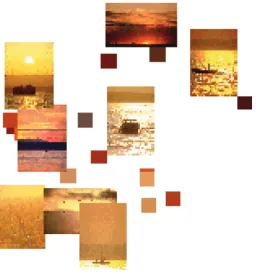
entities at the same time, and thus both low-level feature el-ements and images are considered together as the input. The output is a new feature space in which features and images are expressed as points, and the coordinates of each point derive the importance of the corresponding feature element in forming the new patterns. The highest values of the co-ordinates represent the most important bins participating in forming a useful pattern and they are called synobins. If there are any groups of feature element points or image points in this space, they will producewithin or across contextsfor the image database, respectively. Therefore, in addition to the dimension reduction property of LSI previously used by Niblack et al. in [17] to achieve scalable image retrieval, we exploit the LSI property of creating clusters of co-occurring features having the goal of generating image patterns, the analog of concepts derived from co-occurring terms in text retrieval.Figure 1shows an example of a cluster of color bins and images obtained applying LSI on the color histograms used as images’ visual content representations.
Since the images in the cluster have the semantic mean-ing, the textual characterization “sunset” can also be associ-ated with the color pattern modeled by the cluster’s bins. This association shows how the proposed approach can be used as an important step towards transforming the low-level fea-tures to meaningful high-level feafea-tures.
As a result, instead of looking at an image as a meaning-less pixel matrix and at a database as a sequence of images that make no sense when placed near each other, we create contexts in which meaningful perceptual impressions can be formed about the content and the similarity among images. In our approach, the within-image groupings will not serve for segmentation, but rather for recognition of patterns of color and intensities in the image.
Figure 2shows the placement of LSI method as a com-ponent of a content-based image retrieval system. We briefly described the color pattern extraction in our previous paper [18] and we will emphasize the applicability of the color pat-terns to image retrieval and annotation in this paper.
3. IMAGE LATENT SEMANTIC INDEXING MODEL The use of LSI for text retrieval involves the transformation of the document database into a matrix of terms by docu-ments. Such a matrix is obtained by first doing preprocessing of the documents to filter out the stop words and converting the remaining words to their root form through stemming; then each term-vector representation of a document repre-sents a column in the term-document matrix. An entry in this matrix is the frequency of a given word in a given docu-ment.
3.1. The analogy between textual terms and image color bins
Figure1: Example of a region in the LSI space used for image content interpretation. The small rectangles represent the color bins modeling the real color patterns present in the images from the corresponding region/cluster. The bins depicted produce a within context while the images produce an across context.
structured by Santini and Jain [1], in image databases, the raw material (arrays of pixel intensities) is unstructured and does not have any inherent meaning (Figure 3). To reason about the meaning or the content of an image, useful infor-mation has to be provided with that image. However, images often contain no textual description about the objects that they are depicting. Therefore, there is a need to extract useful information, in the form of low-level features, directly from the raw image data.
The issue of choosing the features to be extracted should be guided by the following concerns. First, the features should carry enough information about the image and should not require any domain-specific knowledge for their extraction. Second, the features should be easy to compute for the approach to be feasible for a large image collection and rapid retrieval. Finally, the features should relate well with the human perceptual characteristics since users will fi-nally determine the suitability of the retrieved images. Be-cause of perception subjectivity, there are multiple represen-tations characterizing a given feature from a different per-spective.
We describe our system using global histograms to rep-resent the color information. The advantages of using global histograms are their robustness to translation and rotation about the viewing axis, slow modification with change in viewpoint and scale, and occlusion [19]. To capture the hu-man perception into the representation, we choose the HSV
space to represent the color information; this space correlates well with the human perception and is commonly used by artists to represent color information present in images [20]. After the color space transformation, three histograms (hue, saturation, and value) are calculated, and thus every image is encoded by anm-dimensional feature vector (m =3×M, 3 represents the number of histograms andMstands for the number of bins of every histogram). At the end of this pro-cess, every image has a structure in the form of a color his-togram and the hishis-togram bins would be the equivalent of the “terms” of a document obtained after filtering out the stop words and stemming. As in the case of documents, an analysis of the importance of the bins within a feature vector representation shows that not all bins are equal for describing image content. To capture this fact, an information-theoretic weighting step can be applied to measure the overall impor-tance of bins in the image database (intersimilarity) and the importance of bins within a particular image (intraimage characterization). Our bin-weighting scheme is the equiva-lent of the most effective term-weighting scheme from in-formation retrieval, which is theterm frequency-inverse doc-ument frequency (TF-IDF)scheme [21].
Low-level features (color) Text-based features (keywords, etc) Feature extraction Arrays of pixel values Text surrounding images Latent relationship extraction
Color patterns Dimensionreduction
Multi-dimensional indexing (clustering) Visual concepts learning and annotation
Evaluation of the results Color retrieval
in the context
Color pattern representation Query
image
Figure2: The diagram of the suggested system. The dashed lines represent unimplemented features that could be incorporated into the system.
However, a global histogram loses the spatial information, and thus the discrimination power of the histogram is sat-urated in the context of very large image databases. To keep up performance, additional low-level features (such as tex-ture and shape) can be incorporated to bring more informa-tion about images from the database. Since latent semantic indexing is based on frequencies and not on actual values, before concatenating their vector value representations, the texture, and shape features will be quantized or clustered into discrete bins (tokens in information retrieval). Then, the ob-tained bins for texture and shape will be concatenated with the bins for color, and the LSI technique will be applied on the concatenated vector representing the three types of fea-tures. The explosion of dimensions of the histogram, pro-duced by the incorporation of additional features, will be overcome by the LSI property of considering the quality of the information along each dimension; LSI reduces the high-dimensional low-level feature space such that noise and re-dundancy are eliminated. Furthermore, the LSI technique will find the latent associations between the color bins,
tex-ture bins, and shape bins, and the semantic meanings of the images present in the database.
3.2. Pattern extraction
Singular value decomposition
After the preprocessing stage, the image database is trans-formed into a matrixW0, which is composed of bins (rows of W0) by images (columns ofW0), and each entry represents the weight of a given bin in a given image:
W0=
Imag1Imag2...Imagn
⎡ ⎢ ⎢ ⎢ ⎢ ⎣
w11 w12 . . . w1n w21 w22 . . . w2n
.. .
wm1 wm2 . . . wmn ⎤ ⎥ ⎥ ⎥ ⎥ ⎦ bin1 bin2 .. . binm ⎫ ⎪ ⎪ ⎪ ⎪ ⎬ ⎪ ⎪ ⎪ ⎪ ⎭ . (1)
Preprocessing (stop words, stemming)
Digitization
Arrays of pixels Documents
It is a nice sunset Mountains and
waterfalls
Feature extraction
Term 1 Term 2
Termm
Bin1 Bin2
Binm
Image feature representation Document representation
Images
Figure3: Document and image vector representation.
Bin2
w2i
Imagei
Bin3
Bin1 w1i
w3i
LSI
m-dimensional bin space,m=3
σ2t
di2
di1 σ1t1
Imagei
k-dimensional pattern space,k=2
Figure4: Mapping from a 3-dimensional low-level feature space to a 2-dimensional pattern space produced by LSI.
Figure5: The first eleven color bins of a color patternj obtained using LSI approach. We choose to illustrate the pattern with the most important bin as the leftmost one and such that the impor-tance decreases as you go from left to right; as described previously, the importance is given by the elements of the vectortj.
definition [22], the SVD of W0 is any factorization of the form
W0=T0×
0
×D0, (2)
whereT0,D0are twom×m(m=number of bins) andn×n (n=number of images) orthonormal matrices, respectively,
and0is anm×ndiagonal matrix,
0
=diagσ1,σ2,. . .,σp
, p=min(m,n), (3)
such as the diagonal elements have the property thatσ1 ≥ σ2 ≥ · · · ≥ σp ≥ 0 and they are the singular values of W0. The main idea behind the SVD technique is that proper choice ofT0 andD0 makes most ofσizero; that is, most of the important information gets concentrated in a few dimen-sions. Letk,k ≤ p, be the number of the first dimensions that contain this information; the remaining smaller singu-lar values are set to zero. Since zeros are introduced into0, the representation can be simplified by deleting the rows and columns of0 to obtain a reducedk×k diagonal matrix
; then, deleting the corresponding columns ofT0andD0, two reduced matricesTandDof dimensionm×kmatrix andk×nmatrix, respectively, are obtained. This result in a reduced model
Figure6: The first three images in which the color pattern fromFigure 5is mostly present; these images are given by the three highest values of the vectordjcorresponding to the chosen pattern.
Same root/color, but used in different contexts Different root/color, but
synonym/synobin
Image domain Doctor, doctorate
Text domain
Doctor, physician
Figure7: Summary of the analogy between synonyms and synobins.
Patternπ(1)
Patternπ(2)
Patternπ(k) Query
formulation
Imageσ(1) Imageσ(2) Imageσ(k)
Figure8: Search by pattern example: the system displays patternπ(1), patternπ(2). . ., in which the chosen color is the most important, and then the system displays the images in which a selected pattern is the most representative (πandσstand for the permutations that order the patterns and images with respect to the preferred color and pattern, resp.).
which gives the rank-k model with the best possible least-squares fit toW0[1]. The columns ofTare the left singular vectors ofWand they form a basis for the space spanned by
W’s columns; the rows ofDare the right singular vectors of
Wand they are a basis for the space spanned byW’s rows.
Color patterns
Let us consider the interpretation and the advantages of LSI, for our image information extraction purposes. It is impor-tant for LSI technique that the derivedW matrix does not reconstruct the original bin by image matrixW0exactly. It rearranges the color bin space to reflect the major color as-sociation patterns in the data and eliminates the noise and
redundancy present in the image data. Since the columnstj, j=1· · ·k, ofTform a basis for the space spanned byW’s columns, they can be considered the axis of the rearranged space. First axis t1 reflects the first major pattern, named pattern1, present in the image database:t11shows the con-tribution ofbin1 in pattern1,t21 shows the contribution of bin2in pattern1and so on up to the lasttm1that shows the contribution ofbinmin the first pattern. Second axis t2 re-flects the second major pattern in the data, named pattern2, and so on up to axistkcorresponding to pattern
Pattern features: linear combinations of
individual bins
Automatic pattern generation using
LSI
Low-level feature: color
Semiautomatic generation of semantic
concepts using clustering
Learned visual concept: ‘sunset’
Figure9: The relationship between low-level features, patterns, and high-level concepts can be visualized using the triangle relationship between data, information, and knowledge: patterns (information) are extracted from low-level features (data) and knowledge (learned visual concepts) is discovered from patterns.
0 100 200 300 400 500 600 700
0 100 200 300 400 500
P
att
er
n
singular
value
Pattern index
Figure10: Scree plot of the singular values.
Let us consider the new image representations in the pat-tern space. Using superscript and subscript to denote the columns and rows of a matrix, respectively, and () to denote the transpose of a matrix, (4) can also be written as
W1W2· · ·Wn=T××D1D2· · ·Dn, (5)
where Wj stands for the weighted bin representation of Imagj,j=1· · ·nand (D)jis thejth column of matrixD. By definition [22], the product between a matrix and a vector is a combination of matrix’s columns. Therefore, everyWjis
a linear combination of the columns ofT×:
Wj= k
l=1 djl
σltl
, j=1· · ·n. (6)
Equation (6) gives the new representation of Imagj, j = 1· · ·n, in whichdj1,dj2· · ·djkindicate the strength of as-sociation of Imagj with the discovered pattern1, pattern2, and patternk, respectively; when images are represented as points in the pattern space, dj1,dj2· · ·djk are the coordi-nates of the point representing Imagj in the pattern space whose axestlare rescaled byσ
l,l=1· · ·k(seeFigure 4). The derived representation captures most of the impor-tant underlying structure in the association of bins and im-ages and at the same time removes the noise and redundancy in the image data. An example of a color pattern composition is presented inFigure 5and the images in which the corre-sponding pattern is mostly present are shown inFigure 6.
We would like to point out that the dimensionkof the new space represents so-called embedded dimension of the visual data in the original feature space [23]. This dimen-sion should be large enough to fit all the real structure in the data, and thus to yield good retrieval performance, but small enough to not fit the unimportant details. Experimen-tal results presented in Section 4show that the embedded dimension is significantly smaller than the original dimen-sion, which exactly correlates with White and Jain’s affi rma-tions [24].
Synobins generation
1 2 3 4 5
6 7 8 9 10
11 12 13 14 15
16 17 18 19 20
21 22 23 24 25
26 27 28 29 30
31 32 33 34 35
36 37 38 39 40
41 42 43 44 45
46 47 48 49 50
51 52 53 54 55
56 57 58 59 60
61 62 63 64 65
Figure11: The most important 65 color patterns that reflect the color composition of the imaged from the database. The number above the patterns represents the pattern rank, 1 being the most important, and 2 being the second most important, and so on. Just for visualization purposes, each pattern is represented by its most 8 representative color bins (i.e., the most dominant colors within those patterns).
1
Figure12: Most representative images for pattern 1.
image retrieval. We coin the term synobin to represent bins that are similarly used across the image database which taken together are the most important ones in defining a pattern. Synobins are directly analogous to synonyms found in text retrieval. The application of LSI in text retrieval allows words synonymous with each other to be near each other in the LSI
2
Figure13: Most representative images for pattern 2.
3
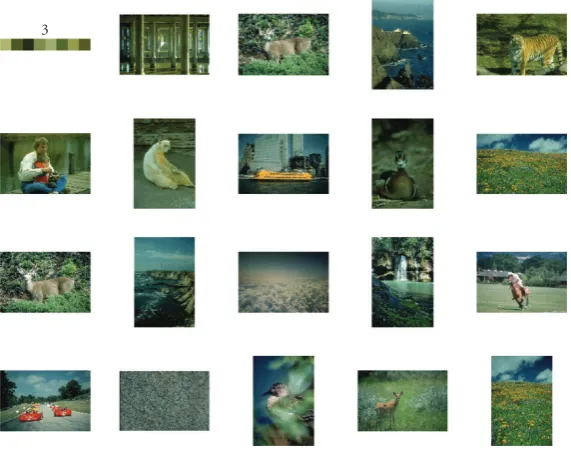
Figure14: Most representative images for pattern 3.
“doctor” or “surgeon” appears even if the “physician” word is not present in those documents. We use the same idea in our image model (Figure 7). Bins representing different col-ors but similarly used across the image database can be con-sidered as synonymous with each other and the pattern that they define is the analogous of a concept from text retrieval, and thus called synobins.
In the previous subsection, we described the pattern space as a mechanism for finding new representations for
images and comparing queries with images. With minor variation, the pattern space can also be used to represent the bins and bin-to-bin comparisons which lead to the discovery of synobins that define interesting patterns.
5
Figure15: Most representative images for pattern 5.
12
Figure16: Most representative images for pattern 12.
eigenvectors ofW×WandW×W, and these eigenvectors correspond to the same set of eigenvalues√σi,i=1· · ·k:
W×W =D× 2
×D,
W×W=T× 2
×T.
(7)
Following the same rationale as for the new image represen-tation, the bin representation for biniin the pattern space will
be given by
Wi= k
l=1 til
σldl
, i=1· · ·m. (8)
The coefficients (ti1), l = 1· · ·k, i = 1· · ·m, can be interpreted in two ways.
30
Figure17: Most representative images for pattern 30.
44
Figure18: Most representative images for pattern 44.
(ii) Wheniis fixed, a descending order forti1,ti2,. . .,tik will reveal the patterns in which biniis mostly present. 4. SYNOBINS AND ACROSS-IMAGE CONTEXTS
FOR IMAGE ANNOTATION
Summarizing the image LSI model, we obtained a common ground for images and features, specifically the lower k -dimensional pattern space. In this space, both images and
52
Figure19: Most representative images for pattern 52.
be associated to the color pattern, and thus to the synobins forming that pattern. To understand better, picture the above ideas for document retrieval. The word “doctor” is present in a group of documents about medical field along with some other words such as “physician” and “surgeon.” From the context in which the word is used, the meaning of the word “doctor” will be associated with a person licensed to prac-tice medicine and not with a person who has been awarded a higher academic degree in any field of knowledge, such as “doctorate.”
There are two scenarios.
(i) Textual information (keywords, labels) is provided for images to describe their visual content. In this case, the most frequent keyword in the corresponding group of image points will be considered the semantic interpretation.
(ii) There is no textual information provided with the im-ages. In this case, our system acts like a semiautomatic tool for annotation: different groups of synobins and similar im-ages are presented to the person who is in charge with the an-notation. The advantage is that the annotator does not have to search the whole database to look for similar images with the image that has to be annotated. The group of images and bins in which the image appears will offer a context in which the image can be interpreted and annotated.
We propose clustering approach to perform the process of grouping bins and images in the pattern space. We do not present the mathematics and advantages of the cluster-ing approach for our system. For details, we refer the reader to [25,26], where we used a hierarchy of clusters to
(i) provide a semiautomatic tool for image annotation; (ii) allow browsing through a large image database, going
from finer to finer details.
In addition to the above advantages, the clustering approach offers an additional functionality to our system. It allows the capability of learning associations between not only seman-tic concepts and images, but also between semanseman-tic concepts and patterns. This is very important when a user does not look for a particular image, but for a pattern of colors that will be present in the image. Think about a web designer who is searching an image database to find a background image to use for a page. He does not have in mind any conceptualiza-tion of the image that he is looking for, what he knows is that the background should have some particular color or combi-nation of colors in it. Our system can prompt the designer to identify which of the different patterns contain the color of interest, and thus it helps the designer to refine the search.
Another significant advantage to having a CBIR sys-tem based on synobins is the improved efficiency of the retrieval process while still yielding excellent semantically related results; based on our experimental results, we found that merely 3% of the original bins are enough to obtain good retrieval results. Furthermore, the clustering approach allows the search space to be reduced to the square root of the original search space; a more complex hierarchical clustering technique could further reduce the search space logarithmi-cally.
5. IMAGE RETRIEVAL IN THE CONTEXT
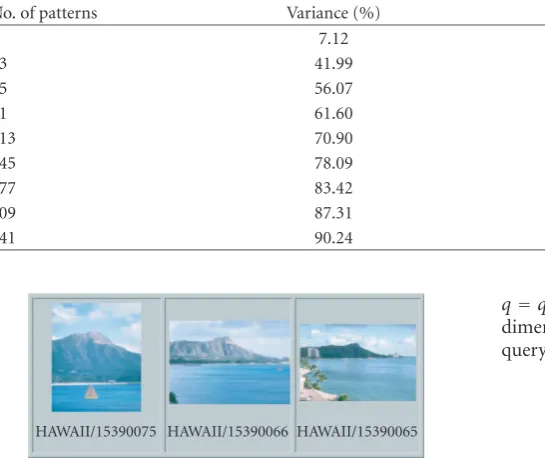
Table1: Percentage of variance captured by the singular values (patterns).
No. of patterns Variance (%) No. of patterns Variance (%)
1 7.12 273 92.59
33 41.99 305 94.52
65 56.07 337 96.13
81 61.60 369 97.47
113 70.90 401 98.56
145 78.09 433 99.39
177 83.42 465 99.90
209 87.31 481 100
241 90.24 768 100
HAWAII/15390075 HAWAII/15390066 HAWAII/15390065
Figure21: The most similar two images with the query image.
retrieval in the context: even if an image is not indexed by the query low-level features, if it shares synobins with an-other image that is relevant to the given query, it is likely to be retrieved.
(ii)Search by pattern example: the most important pat-terns in the database are presented to the user. The user se-lects a pattern of interest, and then the system provides the images in which the pattern is mostly present (Figure 8). Fur-thermore, the user chooses one of interest from these im-ages and the system retrieves most similar imim-ages with the selected one.
The search-by-pattern example moves the CBIR system beyond simple matching of images based on primitive tures. Thinking about patterns as a new type of image fea-ture (Figure 9) situated between the low-level features and the high-level ones (keywords, annotations, etc.), our model provides information about which low-level feature elements are most important and how they should be combined for a given pattern and which patterns are most important for a given annotation.
This makes our CBIR system an important step towards semantic retrieval.
The issue of choosing a similarity metric to measure the similarity between images is outside the scope of this pa-per; however, since measuring meaningful image similarity is based not only on finding the right image features but also on choosing the right metric for the feature space, we will ex-pand on it in future work. As a quick reference, we used co-sine measure and histogram intersection to implement our system. The reason behind choosing cosine measure was that it is the natural measure of similarity between two vectors in the pattern space induced by SVD. Ifq0is a query image and
q=q0×T× −1
is its reduced representation [3] in thek -dimensional pattern space, the cosine similarity between the queryqand an image Imagj,j=1· · ·n, is defined as
simImagj,q=
k l=1
ql∗djl
k l=1q2l
1/2
∗ kl=1d2jl
1/2, (9)
in which (dj1,dj2· · ·djk) representsthereduced image rep-resentation of Imagj.
It is worth to mention here that if one decides to apply the histogram intersection method [19], theL1-form has to be used:
simImagj,q=
1 2∗k
∗
k
l=1
dj,l−ql. (10)
The choice of theL1-form is motivated by the fact that some of the values from the pattern representations might have negative values and for such values, the fast incremental his-togram intersection version does not make too much sense. The presence of negative elements indl j,l=1· · ·k, is not a problem but rather a reflection of the fact that the pat-terns are linear combinations of individual bins; the image database is modeled by the geometric relationships between image vectors and not by individual components of these vectors [27].
6. EXPERIMENTAL RESULTS Image database and color space
HAWAII/15390075 BIRDS/09360026 MILITARY/15610088 HAWAII/15390066 ALASKA/09490052
MT RAINR/15610097 HAWAII/15390066 MEXICO/15390016 ALASKA/09490040 ALASKA/09490066 Figure22: Images retrieved using histogram intersection on global histograms.
HAWAII/15390075 HAWAII/15390066 HAWAII/15390065 CALIFORN/09500014 CANADA/09370009
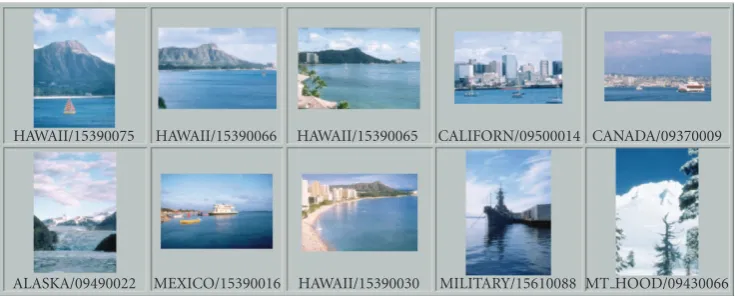
ALASKA/09490022 MEXICO/15390016 HAWAII/15390030 MILITARY/15610088 MT HOOD/09430066 Figure23: Images retrieved when cosine measure is used andk=20.
The matrixtis of size 768×768 (768 patterns which are lin-ear combinations of 768 bins), the matrixsis a diagonal ma-trix of size 768×768 (theith element on the diagonal repre-sents theith singular value for pattern #i), and the matrixdis of size 768×2100 (each of the 2100 documents is represented with respect to the 768 patterns).
Color patterns and Synobins Generation
Looking at the plot (Figure 10) of the 768 singular values cal-culated for the 2100 color image database, we noticed that the first 240 singular values are greater than zero and they also capture more than 90% (Table 1) of the color variance in the database; in other words, by using only 250 color pat-terns instead of 768 bins, one would still be able to capture over 90% of the original color structure present in the im-ages.
Furthermore, the first 481 values are enough to cap-ture the entire color struccap-ture of the database, so the other patterns can be neglected without losing any color informa-tion.Figure 11shows the first 65 patterns from the database that capture over 50% of the color patterns in the image database and it can be used as a starting point for doing
search by pattern as described in Section 5; the user can select any of the patterns presented below and then the system will return the images in which the selected pattern is mostly present. For an illustration of the search-by-pattern
results, we present the most 19 representative images for sev-eral patterns in the database; these patterns were chosen such that we show a variety of color patterns along with their cor-responding images (Figures12,13,14,15,16,17,18, and19). It is also interesting to notice the latent correlation be-tween the new features (color patterns) and the semantic concepts associated with each cluster of images retrieved for each pattern. When most of the images share the same se-mantic concepts, then those sese-mantic concepts can be as-sociated with the patterns and also with the images they represent. For example, pattern #1 and its most representa-tive images can be associated with the concept “landscape,” where landscape is denoted by a combination of the follow-ing terms: sea, sky, grass, mountains, and land; pattern #5 and its images can be associated with either one of the fol-lowing concepts: arid, texture, or sunset.
Retrieval by color patterns
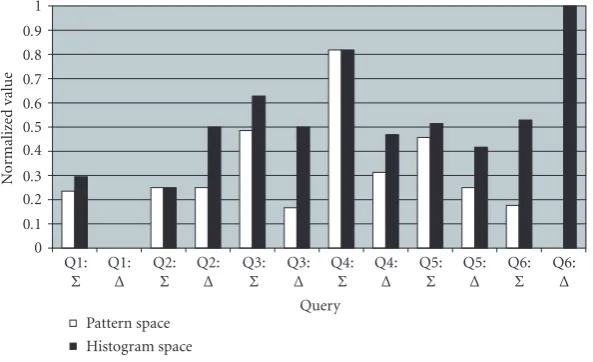
Once the user decides that he is interested in a certain image, then that image becomes an image query and using a simi-larity metric, the system will retrieve the most similar images with the query image based on pattern similarity.Figure 20 shows examples of retrieval results for several query images where only 20 patterns were used to perform the retrieval.
Q1:
Σ Q1:Δ Q2:Σ Q2:Δ Q3:Σ Q3:Δ Q4:Σ Q4:Δ Q5:Σ Q5:Δ Q6:Σ Q6:Δ 0
0.1 0.2 0.3 0.4 0.5 0.6 0.7 0.8 0.9 1 No rm al iz ed va lu e Query Pattern space Histogram space
Figure24: Perceptual accuracy evaluation as calculated with formulas (11) and (12).
not on the used similarity metric since we want to see if bet-ter perceptual similarity of images can be obtained from the different nature of the new feature space itself. Our current results are produced using the cosine similarity measure as being the most-used similarity measure in the vector space and using the histogram intersection as being the most used for color histogram similarity. In a future implementation of our approach, we plan to incorporate other similarity mea-sures that will take into account the human perception in evaluating the retrieval results; one of such measures is the Color-WISE metric that we previously used to build a hierar-chy of clusters for color image databases [25]. Furthermore, in order to evaluate the retrieval performance, as a ground truth, for each query, a set of most similar images is assigned together with a relative ranked order of their similarity.
Evaluation of the retrieval
We present the results for a query image (left image from Figure 21) belonging to a “landscape” image category from the database. We define an image as being “landscape” if it contains sky, water, and land. The image database contains 98 images of this category and the second and third images fromFigure 21represent the ground truth in measuring the retrieval accuracy for the chosen query imageq.
Comparisons between the results of histogram intersec-tion in the original 768-dimensional space (Figure 22) and the results of cosine measure in the pattern space (Figure 23) show that even if the feature space was reduced to only 20 features, the retrieval accuracy is the same as for the original space. Moreover, if the users are asked to evaluate the perfor-mance, the retrieval results fromFigure 23are more percep-tual appealing then those fromFigure 21because the images considered as the ground truth appear closer to the query image inFigure 23than those inFigure 22do.
That is, using color patterns, the images considered as ground truth appear as the first and second best matches (not considering the query image itself), while using global histograms, same images appear as the third and sixth best
matches. This observation is very important in the context of image retrieval where we are interested in displaying only the top few retrieval results. For example, if the system had been designed to display, let us say, only the first two retrieved im-ages, no images from the ground truth would have been dis-played to the user in the case of global histogram.
In order to quantify the perception issue discussed above, letGT(q) be the ground truth ordered with respect to hu-man perception and letR(q)= {N1,. . .,NP}be the set of the nearest neighbors ordered with respect to a defined similarity measure (cosine or histogram intersection). The parameter
σ(q) in formula (11) measures how close the most relevant images with the query image are situated in the listR(q) of the nearest neighbors and a lower value of the parameter in-dicates a better retrieval result:
σ(q)= si∈R(q)GT(q)
rankNi,R(q)
. (11)
The rank(·,·) notation gives the position of an element in a list and is defined as rank(N,R(q))= i, wheneverN = Ni. Moreover, ifσ(q) is the same in pattern space and original space, an additional objective measureΔ(q) defined in for-mula (12) can be considered to quantify the relative positions of the most relevant images and a lower value ofΔ(q) indi-cating a better retrieval:
Δ(q)=
L(q) i=1 Ni∈R(q)GT(q)
i−rankNi,GT(q), (12)
whereL(q) is the cardinality ofGT(q)R(q) andGT(q) is the setGT(q)R(q) ordered with respect to human percep-tion (a subset of the ground truth).
7. SUMMARY AND FUTURE WORK
In this paper, we proposed patterns of colors and intensities as image features, which are meant to capture the latent asso-ciations among images and primitive features in such a way that the noise and redundancy are eliminated. We introduced the synobin, a new term for content-based image retrieval lit-erature, which is the equivalent of a synonym word from text retrieval, to name the bin that is synonymous with other bins of a color feature, in the sense that they are similarly used across the image database. Incorporating our feature model into a CBIR system moves the research in image retrieval be-yond simple matching of images based on their primitive fea-tures and creates a ground for learning image semantics from visual content. Explicitly, it will be useful in developing new CBIR systems having the following characteristics.
(i)Retrieval in the context:images are retrieved based on patterns of colors and intensities present in the images and not by matching individual bins.
(ii)Semiautomatic image and pattern annotation:instead of giving all possible meanings to an image, the system in-terprets an image based on the color patterns and the across-image context in which it appears; if there is a semantic con-cept associated with the across-image context, that concon-cept can be also associated with the corresponding patterns.
We evaluated the performance of our system based on the retrieval accuracy and on the perceptual similarity or-der among retrieved images. When compared to standard image retrieval methods, our preliminary results show that even if the feature space was reduced to 20–30 features (out of 768), the accuracy and perceptual similarity for our sys-tem remain the same or better depending on the category of images. Since the used similarity metrics did not take into ac-count the human perception, we believe that the better per-ceptual similarity of images might come from the different nature of the new feature space.
A complete characterization of the time performance goes beyond this paper, but we make few remarks here. The use of the hierarchy of clusters, which will be a more effi -cient indexing tool, along with a branch-and-bound algo-rithm for a fast calculation of the nearest neighbors, will all speed up the retrieval process. With respect to the time of calculating the new patterns, we will pursue future work in applying faster algorithms to calculate and update the singu-lar value decomposition. Furthermore, we will experiment the integration of color, shape, and structural image in order to produce a unified new feature space using latent semantic indexing; moreover, we will test the new proposed approach over various large image databases used as benchmarks in the image retrieval research community.
REFERENCES
[1] S. Santini and R. Jain, “Similarity is a geometer,”Multimedia Tools and Applications, vol. 5, no. 3, pp. 277–306, 1997. [2] A. Guttman, “R-trees: a dynamic index structure for
spa-tial searching,” inProceedings of ACM SIGMOD International Conference on the Management of Data (SIGMOD ’84), pp. 47– 57, Boston, Mass, USA, June 1984.
[3] S. Deerwester, S. T. Dumais, G. W. Furnas, T. K. Landauer, and R. Harshman, “Indexing by latent semantic analysis,”Journal of American Society for Information Science, vol. 41, no. 6, pp. 391–407, 1990.
[4] M. Flickner, H. Sawhney, W. Niblack, et al., “Query by image and video content: the QBIC system,”IEEE Computer, vol. 28, no. 9, pp. 23–32, 1995.
[5] J. R. Bach, C. Fuller, A. Gupta, et al., “Virage image search en-gine: an open framework for image management,” inStorage and Retrieval for Still Image and Video Databases IV, vol. 2670 ofProceedings of SPIE, pp. 76–87, San Jose, Calif, USA, Febru-ary 1996.
[6] J. Feder, “Towards image content-based retrieval for the world-wide web,”Advanced Imaging, vol. 11, no. 1, pp. 26–29, 1996.
[7] J. R. Smith and S.-F. Chang, “VisualSEEk: a fully automated content-based image query system,” inProceedings of 4th ACM International Multimedia Conference (ACM Multimedia ’96), pp. 87–98, Boston, Mass, USA, November 1996.
[8] M. Ortega, Y. Rui, K. Chakrabarti, S. Mehrotra, and T. S. Huang, “Supporting similarity queries in MARS,” in Proceed-ings of 5th ACM International Multimedia Conference (ACM Multimedia ’97), pp. 403–413, Seattle, Wash, USA, November 1997.
[9] W. Y. Ma and B. S. Manjunath, “NeTra: a toolbox for navigat-ing large image databases,” inProceedings of IEEE International Conference on Image Processing (ICIP ’97), vol. 1, pp. 568–571, Santa Barbara, Calif, USA, October 1997.
[10] J. P. Eakins and M. E. Graham, “Content-based image re-trieval: a report to the JISC technology applications pro-gramme,” Tech. Rep., Institute for Image Data Research, Uni-versity of Northumbria, Newcastle, Tyneside, UK, 1999. [11] M. La Cascia, S. Sethi, and S. Sclaroff, “Combining textual
and visual cues for content-based image retrieval on the World Wide Web,” inProceedings of IEEE Workshop on Content-Based Access of Image and Video Libraries (CBAIVL ’98), pp. 24–28, Santa Barbara, Calif, USA, June 1998.
[12] T. Westerveld, D. Hiemstra, and F. de Jong, “Extracting bi-modal representations for language-based image retrieval,” in Proceedings of Multimedia ’99, Proceedings of the Eurographics Workshop, pp. 33–42, Milano, Italy, September 1999. [13] M. Petrou and P. Bosdogianni,Image Processing: The
Funda-mentals, John Wiley & Sons, New York, NY, USA, 1999. [14] L. Zhiu, A. Rao, and A. Zhang, “Theory of keyblock-based
image retrieval,”ACM Transactions on Information Systems, vol. 20, no. 2, pp. 224–257, 2002.
[15] L. Zhu, A. Rao, and A. Zhang, “Advanced feature extraction for keyblock-based image retrieval,”Information Systems, vol. 27, no. 8, pp. 537–557, 2002.
[16] T. P. Minka and R. W. Picard, “Interactive learning using a so-ciety of models,” Tech. Rep. 349, MIT Media Laboratory Per-ceptual Computing Section, Cambridge, Mass, USA, 1995. [17] C. W. Niblack, R. Barber, W. Equitz, et al., “QBIC project:
querying images by content, using color, texture, and shape,” in Storage and Retrieval for Image and Video Databases, vol. 1908 ofProceedings of SPIE, pp. 173–187, San Jose, Calif, USA, January–February 1993.
[18] D. Stan and I. K. Sethi, “Color patterns for pictorial content description,” in Proceedings of ACM Symposium on Applied Computing (SAC ’02), pp. 693–698, Madrid, Spain, March 2002.
[19] M. J. Swain and D. H. Ballard, “Color indexing,”International Journal of Computer Vision, vol. 7, no. 1, pp. 11–32, 1991. [20] I. K. Sethi, I. L. Coman, B. Day, et al., “Color-WISE: a
Retrieval for Image and Video Databases VI, vol. 3312 of Pro-ceedings of SPIE, pp. 140–149, San Jose, Calif, USA, January 1998.
[21] R. Baezo-Yates and B. Ribeiro-Neto,Modern Information Re-trieval, Addison-Wesley-Longman, Boston, Mass, USA, 1999. [22] L. N. Trefethen and D. Bau III, Numerical Linear Algebra,
SIAM, Philadelphia, Pa, USA, 1997.
[23] Y. Rui, T. S. Huang, and S.-F. Chang, “Image retrieval: past, present, and future,”Journal of Visual Communication and Im-age Representation, vol. 10, pp. 1–23, 1999.
[24] D. A. White and R. Jain, “Similarity indexing: algorithms and performance,” inStorage and Retrieval for Still Image and Video Databases IV, vol. 2670 ofProceedings of SPIE, pp. 62–73, San Jose, Calif, USA, February 1996.
[25] D. Stan and I. K. Sethi, “Image retrieval using a hierarchy of clusters,” inProceedings of 2nd International Conference on Ad-vances in Pattern Recognition (ICAPR ’01), pp. 377–386, Rio de Janeiro, Brazil, March 2001.
[26] D. Stan and I. K. Sethi, “Mapping low-level image features to semantic concepts,” in Storage and Retrieval for Media Databases, vol. 4315 ofProceedings of SPIE, pp. 172–179, San Jose, Calif, USA, January 2001.
[27] M. W. Berry, Z. Drmac, and E. R. Jessup, “Matrices, vector spaces, and information retrieval,”SIAM Review, vol. 41, no. 2, pp. 335–362, 1999.
Daniela Stan Raicuis an Assistant Professor in School of Computer Science, Telecom-munications, and Information Systems at DePaul University in Chicago. She received her B.S. degree in mathematics from Uni-versity of Bucharest, Romania, in 1993, M.A. degree in computer science from Wayne State University, Michigan, in 1999, and her Ph.D. degree in computer sci-ence from Oakland University, Michigan, in
2002. Her research interests include medical imaging, multime-dia indexing and retrieval, pattern recognition, data mining, and knowledge discovery. Daniela has published numerous papers in her research areas, received National Science Foundation (NSF) funding to support medical informatics undergraduate research, and is actively involved in organizing different conferences and workshops. She is a Member of the ACM, IEEE, and SPIE. Prior to joining DePaul University, she worked at Accenture Technology Labs, Ford Motor Company, and the Institute of Mathematics in Bucharest, Romania.
Ishwar K. Sethi received the Ph.D. de-gree from Indian Institute of Technology, Kharagpur, India, in 1978. In 1982, he joined Wayne State University where he was involved in teaching and research in arti-ficial neural networks, pattern recognition, computer vision, and multimedia informa-tion retrieval. Since August 1999, he has been with Oakland University where he is the Chair of Computer Science and
Special Issue on
Search and Retrieval of 3D Content and Associated
Knowledge Extraction and Propagation
Call for Papers
With the general availability of 3D digitizers, scanners, and the technology innovation in 3D graphics and computa-tional equipment, large collections of 3D graphical mod-els can be readily built up for different applications (e.g., in CAD/CAM, games design, computer animations, manu-facturing and molecular biology). For such large databases, the method whereby 3D models are sought merits careful consideration. The simple and efficient query-by-content ap-proach has, up to now, been almost universally adopted in the literature. Any such method, however, must first deal with the proper positioning of the 3D models. The two prevalent-in-the-literature methods for the solution to this problem seek either
• Pose Normalization: Models are first placed into a canonical coordinate frame (normalizing for transla-tion, scaling, and rotation). Then, the best measure of similarity is found by comparing the extracted feature vectors, or
• Descriptor Invariance: Models are described in a transformation invariant manner, so that any trans-formation of a model will be described in the same way, and the best measure of similarity is obtained at any transformation.
The existing 3D retrieval systems allow the user to perform queries by example. The queried 3D model is then processed, low-level geometrical features are extracted, and similar ob-jects are retrieved from a local database. A shortcoming of the methods that have been proposed so far regarding the 3D object retrieval, is that neither is the semantic informa-tion (high-level features) attached to the (low-level) geomet-ric features of the 3D content, nor are the personalization options taken into account, which would significantly im-prove the retrieved results. Moreover, few systems exist so far to take into account annotation andrelevance feedback techniques, which are very popular among the correspond-ing content-based image retrieval systems (CBIR).
Most existing CBIR systems using knowledge either an-notate all the objects in the database (full annotation) or
annotate a subset of the database manually selected (par-tial annotation). As the database becomes larger, full anno-tation is increasingly difficult because of the manual effort needed. Partial annotation is relatively affordable and trims down the heavy manual labor. Once the database is partially annotated, traditional image analysis methods are used to de-rive semantics of the objects not yet annotated. However, it is not clear “how much” annotation is sufficient for a specific database and what the best subset of objects to annotate is. In other words how the knowledgewill be propagated. Such techniques have not been presented so far regarding the 3D case.
Relevance feedback was first proposed as an interactive tool in text-based retrieval. Since then it has been proven to be a powerful tool and has become a major focus of research in the area of content-based search and retrieval. In the tra-ditional computer centric approaches, which have been pro-posed so far, the “best” representations and weights are fixed and they cannot effectively model high-level concepts and user’s perception subjectivity. In order to overcome these limitations of the computer centric approach, techniques based onrelevant feedback, in which the human and com-puter interact to refine high-level queries to representations based on low-level features, should be developed.
The aim of this special issue is to focus on recent devel-opments in this expanding research area. The special issue will focus on novel approaches in 3D object retrieval, trans-forms and methods for efficient geometric feature extrac-tion, annotation and relevance feedback techniques, knowl-edge propagation (e.g., using Bayesian networks), and their combinations so as to produce a single, powerful, and domi-nant solution.
Topics of interest include (but are not limited to):
• 3D content-based search and retrieval methods (volume/surface-based)
• Partial matching of 3D objects
• 3D data and knowledge representation
• Semantic and knowledge propagation over heteroge-neous metadata types
• Annotation and relevance feedback techniques for 3D objects
Authors should follow the EURASIP JASP manuscript format described at http://www.hindawi.com/journals/asp/. Prospective authors should submit an electronic copy of their complete manuscript through the EURASIP JASP man-uscript tracking system at http://www.mstracking.com/asp/, according to the following timetable:
Manuscript Due February 1, 2006
Acceptance Notification June 1, 2006
Final Manuscript Due September 1, 2006
Publication Date 4th Quarter, 2006
GUEST EDITORS:
Petros Daras, Informatics and Telematics Institute, Centre for Research and Technology Hellas, 57001 Thermi, Thessa-loniki, Greece; [email protected]
Ming Ouhyoung, National Taiwan University, Taipei 106,
Taiwan; [email protected]
Tsuhan Chen, Carnegie Mellon University, Pittsburgh, PA
15213, USA; [email protected]
Special Issue on
Robust Speech Recognition
Call for Papers
Robustness can be defined as the ability of a system to main-tain performance or degrade gracefully when exposed to conditions not well represented in the data used to develop the system. In automatic speech recognition (ASR), systems must be robust to many forms of signal degradation, includ-ing speaker characteristics (e.g., dialect and accent), ambient environment (e.g., cellular telephony), transmission channel (e.g., voice over IP), and language (e.g., new words, dialect switching). Robust ASR systems, which have been under de-velopment for the past 35 years, have made great progress over the years closing the gap between performance on pris-tine research tasks and noisy operational data.
However, in recent years, demand is emerging for a new class of systems that tolerate extreme and unpredictable vari-ations in operating conditions. For example, in a cellular telephony environment, there are many nonstationary forms of noise (e.g., multiple speakers) and significant variations in microphone type, position, and placement. Harsh ambi-ent conditions typical in automotive and mobile applications pose similar challenges. Development of systems in a lan-guage or dialect for which there is limited or no training data in a target language has become a critical issue for a new gen-eration of voice mining applications. The existence of mul-tiple conditions in a single stream, a situation common to broadcast news applications, and that often involves unpre-dictable changes in speaker, topic, dialect, or language, is an-other form of robustness that has gained attention in recent years.
Statistical methods have dominated the field since the early 1980s. Such systems tend to excel at learning the characteris-tics of large databases that represent good models of the op-erational conditions and do not generalize well to new envi-ronments.
This special issue will focus on recent developments in this key research area. Topics of interest include (but are not lim-ited to):
• Channel and microphone normalization
• Stationary and nonstationary noise modeling, com-pensation, and/or rejection
• Localization and separation of sound sources (includ-ing speaker segregation)
• Signal processing and feature extraction for applica-tions involving hands-free microphones
• Noise robust speech modeling
• Adaptive training techniques
• Rapid adaptation and learning
• Integration of confidence scoring, metadata, and other alternative information sources
• Audio-visual fusion
• Assessment relative to human performance
• Machine learning algorithms for robustness
• Transmission robustness
• Pronunciation modeling
Authors should follow the EURASIP JASP manuscript format described at http://www.hindawi.com/journals/asp/. Prospective authors should submit an electronic copy of their complete manuscript through the EURASIP JASP man-uscript tracking system at http://www.mstracking.com/asp/, according to the following timetable:
Manuscript Due February 1, 2006 Acceptance Notification June 1, 2006 Final Manuscript Due September 1, 2006 Publication Date 4th Quarter, 2006
GUEST EDITORS:
Herve Bourlard, IDIAP Research Institute, Swiss Federal In-stitute of Technology at Lausanne (EPFL), 1920 Martigny, Switzerland; [email protected]
Mark Gales, Department of Engineering, University of Cambridge, Cambridge CB2 1PZ, UK; [email protected] Maurizio Omologo, ITC-IRST, 38050 Trento, Italy; [email protected]
S. Parthasarathy, AT&T Labs - Research, NJ 07748, USA; [email protected]
Joe Picone, Department of Electrical and Computer Engi-neering, Mississippi State University, MS 39762-9571, USA; [email protected]
Special Issue on
Signal Processing Technologies for Ambient
Intelligence in Home-Care Applications
Call for Papers
The possibility of allowing elderly people with different kinds of disabilities to conduct a normal life at home and achieve a more effective inclusion in the society is attracting more and more interest from both industrial and governmental bodies (hospitals, healthcare institutions, and social institu-tions). Ambient intelligence technologies, supported by ad-equate networks of sensors and actuators, as well as by suit-able processing and communication technologies, could en-able such an ambitious objective.
Recent researches demonstrated the possibility of provid-ing constant monitorprovid-ing of environmental and biomedical parameters, and the possibility to autonomously originate alarms, provide primary healthcare services, activate emer-gency calls, and rescue operations through distributed as-sistance infrastructures. Nevertheless, several technological challenges are still connected with these applications, rang-ing from the development of enablrang-ing technologies (hard-ware and soft(hard-ware), to the standardization of interfaces, the development of intuitive and ergonomic human-machine in-terfaces, and the integration of complex systems in a highly multidisciplinary environment.
The objective of this special issue is to collect the most significant contributions and visions coming from both aca-demic and applied research bodies working in this stimulat-ing research field. This is a highly interdisciplinary field com-prising many areas, such as signal processing, image process-ing, computer vision, sensor fusion, machine learnprocess-ing, pat-tern recognition, biomedical signal processing, multimedia, human-computer interfaces, and networking.
The focus will be primarily on the presentation of origi-nal and unpublished works dealing with ambient intelligence and domotic technologies that can enable the provision of advanced homecare services.
This special issue will focus on recent developments in this key research area. Topics of interest include (but are not lim-ited to):
• Video-based monitoring of domestic environments and users
• Continuous versus event-driven monitoring
• Distributed information processing
• Data fusion techniques for event association and au-tomatic alarm generation
• Modeling, detection, and learning of user habits for automatic detection of anomalous behaviors
• Integration of biomedical and behavioral data
• Posture and gait recognition and classification
• Interactive multimedia communications for remote assistance
• Content-based encoding of medical and behavioral data
• Networking support for remote healthcare
• Intelligent/natural man-machine interaction, person-alization, and user acceptance
Authors should follow the EURASIP JASP manuscript format described at http://www.hindawi.com/journals/asp/. Prospective authors should submit an electronic copy of their complete manuscripts through the EURASIP JASP man-uscript tracking system at http://www.mstracking.com/asp/, according to the following timetable:
Manuscript Due March 1, 2006
Acceptance Notification July 1, 2006
Final Manuscript Due October 1, 2006
Publication Date 1st Quarter, 2007
GUEST EDITORS:
Francesco G. B. De Natale, Department of Information and Communication Technology, University of Trento, Via Sommarive 14, 38050 Trento, Italy; [email protected] Aggelos K. Katsaggelos, Department of Electrical and Computer Engineering, Northwestern University, 2145 Sheridan Road, Evanston, IL 60208-3118, USA; [email protected]
Oscar Mayora, Create-Net Association, Via Solteri 38, 38100 Trento, Italy; [email protected]
Ying Wu, Department of Electrical and Computer Eng-ineering, Northwestern University, 2145 Sheridan Road, Evanston, IL 60208-3118, USA;
Special Issue on
Spatial Sound and Virtual Acoustics
Call for Papers
Spatial sound reproduction has become widespread in the form of multichannel audio, particularly through home the-ater systems. Reproduction systems from binaural (by head-phones) to hundreds of loudspeaker channels (such as wave field synthesis) are entering practical use. The application potential of spatial sound is much wider than multichan-nel sound, however, and research in the field is active. Spa-tial sound covers for example the capturing, analysis, coding, synthesis, reproduction, and perception of spatial aspects in audio and acoustics.
In addition to the topics mentioned above, research in vir-tual acoustics broadens the field. Virvir-tual acoustics includes techniques and methods to create realistic percepts of sound sources and acoustic environments that do not exist natu-rally but are rendered by advanced reproduction systems us-ing loudspeakers or headphones. Augmented acoustic and audio environments contain both real and virtual acoustic components.
Spatial sound and virtual acoustics are among the ma-jor research and application areas in audio signal processing. Topics of active study range from new basic research ideas to improvement of existing applications. Understanding of spa-tial sound perception by humans is also an important area, in fact a prerequisite to advanced forms of spatial sound and virtual acoustics technology.
This special issue will focus on recent developments in this key research area. Topics of interest include (but are not lim-ited to):
• Multichannel reproduction
• Wave field synthesis
• Binaural reproduction
• Format conversion and enhancement of spatial sound
• Spatial sound recording
• Analysis, synthesis, and coding of spatial sound
• Spatial sound perception and auditory modeling
• Simulation and modeling of room acoustics
• Auralization techniques
• Beamforming and sound source localization
• Acoustic and auditory scene analysis
• Augmented reality audio
• Virtual acoustics (sound environments and sources)
• Intelligent audio environments
• Loudspeaker-room interaction and equalization
• Applications
Authors should follow the EURASIP JASP manuscript format described at http://www.hindawi.com/journals/asp/. Prospective authors should submit an electronic copy of their complete manuscript through the EURASIP JASP man-uscript tracking system at http://www.mstracking.com/asp/, according to the