Volume 2006, Article ID 80720, Pages1–9 DOI 10.1155/ASP/2006/80720
Frequency and 2D Angle Estimation Based on
a Sparse Uniform Array of Electromagnetic
Vector Sensors
Fei Ji1and Sam Kwong2
1School of Electronic and Information Engineering, South China University of Technology, Guangzhou 510640, China 2Department of Computer Science, City University of Hong Kong, Tat Chee Avenue, Kowloon, Hong Kong
Received 25 April 2005; Revised 25 January 2006; Accepted 29 January 2006
Recommended for Publication by Joe C. Chen
We present an ESPRIT-based algorithm that yields extended-aperture two-dimensional (2D) arrival angle and carrier frequency estimates with a sparse uniform array of electromagnetic vector sensors. The ESPRIT-based frequency estimates are first achieved by using the temporal invariance structure out of the two time-delayed sets of data collected from vector sensor array. Each incident source’s coarse direction of arrival (DOA) estimation is then obtained through the Poynting vector estimates (using a vector cross-product estimator). The frequency and coarse angle estimate results are used jointly to disambiguate the cyclic phase ambiguities in ESPRIT’s eigenvalues when the intervector sensor spacing exceeds a half wavelength. Monte Carlo simulation results verified the effectiveness of the proposed method.
Copyright © 2006 Hindawi Publishing Corporation. All rights reserved.
1. INTRODUCTION
The localization of source signals using vector sensor data processing has attracted significant attentions lately. Many advantages of using the vector sensor array have been identi-fied and many array data processing techniques for source localization and polarization estimation using vector sen-sors have been developed. Nehorai and Paldi developed the Cram´er-Rao bound (CRB) and the vector cross-product DOA estimator using the vector cross product of the
electric-field and the magnetic-electric-field vector estimates [1,2]. Li [3]
de-veloped ESPRIT-based angle and polarization estimation al-gorithm using an arbitrary array with small loops and short dipoles. Identifiablity and uniqueness study associated with
vector sensors were done by Hochwald and Nehorai [4], Ho
et al.[5] and Tan et al. [6]. Hochwald and Nehorai [7]
stud-ied parameter estimations with application to remote sensing
by vector sensors. Ho et al. [8] developed a high-resolution
ESPRIT-based method for estimating the DOA of partially
polarized sources. Ho et al. [9] further studied the DOA
es-timation with vector sensors for scenarios where completely
and incompletely polarized signals may coexist. Wong [10]
has showed that the vector cross-product DOA estimator re-mains fully applicable for a pair of dipole triad and loop triad spatially displaced by an arbitrary and unknown distance
(rather than being collocated). Uni-vector-sensor ESPRIT is first presented to estimate 2D DOA and the polariza-tion states of multiple monochromatic noncoherent incident sources using a single electromagnetic vector sensor by Wong
and Zoltowski [11]. Nehorai and Tichavsky [12] presented an
adaptive cross-product algorithm for tracking the direction to a moving source using an electromagnetic vector sensor.
Ko et al. [13] proposed a structure for adaptively separating,
enhancing, and tracking up to three uncorrelated broadband
sources with an electromagnetic vector sensor. Wong [14]
proposed an ESPRIT-based adaptive geo-location and blind interference rejection scheme for multiple noncooperative wideband fast frequency-hop signals using one electromag-netic vector sensor. The maximum likelihood (ML) and min-imum variance distortionless response (MVDR) estimators for signal DOA and polarization parameters for correlated
sources are derived by Rahamim et al. [15]. In addition,
a novel preprocessing method based on the polarization smoothing algorithm (PSA) for “decorrelating” the signals
was also presented. Wong and Zoltowski [16] presented a
arrival angles from the estimation of the sources’ polarization parameters. The same authors further developed a closed-form direction-finding algorithm applicable to multiple ar-bitrarily spaced vector sensors at possibly unknown
loca-tions [17]. A sparse uniform array suffers cyclic ambiguity
in its direction-cosine estimates due to the spatial Nyquist sampling theorem. Zoltowski and Wong then further pre-sented another novel ESPRIT-based 2D arrival angle estima-tion scheme to resolve the aforemenestima-tioned ambiguity and achieve aperture extension for a sparse uniform array of vec-tor sensors spaced much further apart than a half wavelength
[18]. An improved version of the disambiguation algorithm
is also presented in [19].
In fact, frequency estimation is a fundamental problem in estimation theory and its applications include radar, ar-ray signal processing, and frequency synchronization. For scalar sensor array, a number of ESPRIT-based angle and fre-quency estimation methods have been proposed. Lemma et al. presented joint angle-frequency estimation method using multidimensional and multiresolution ESPRIT algorithms
[20,21]. Zoltowaki and Mathews discuss ESPRIT-based
real-time angle-frequency estimation algorithm using scalar
sen-sor array [22].
In this paper, we try to combine the ESPRIT-based frequency estimation with Wong’s ESPRIT-based 2D DOA
estimation scheme in [18] to yield extended-aperture
two-dimensional (2D) arrival angle and carrier frequency esti-mates with a sparse uniform array of electromagnetic vector sensors. Most of the works mentioned above have previously proposed direction-finding and polarization estimation al-gorithms using electromagnetic vector sensors; however, this paper is the first in advancing an algorithm for the estimation of both arrival angles and arrival delays.
In the newly proposed algorithm, the ESPRIT-based fre-quency estimates are achieved using the temporal invariance structure out of two time-delayed sets of data collected from vector sensor array. In that each incident source’s direction of arrival (DOA) coarse estimation is obtained through a vector cross-product estimator. Then the frequency estimates and coarse angle estimates results are used jointly to disambiguate the cyclic phase ambiguities in ESPRIT’s eigenvalues when the intervector sensor spacing exceeds a half wavelength.
2. MATHEMATICAL MODEL
Consider the scenario of K uncorrelated monochromatic
completely polarized transverse electromagnetic planewaves
signals with different carrier frequencies, impinging on an
L-shaped array of regularly equally spaced and identical
elec-tromagnetic vector sensors from directions (θk,φk) and
po-larization parameters (γk,ηk) (k = 1,. . .,K). 0 ≤ θk < π
is thekth signal’s elevation angle measured from verticalz
-axis, 0≤φk<2πis azimuth angle, 0≤γk < π/2 is auxiliary
polarization angle, and−π ≤ ηk < πis polarization phase
difference.
The signal source model is given by
sk(n)=Pkej(2π fkn+ϕk), n=1, 2,. . .,N, (1)
where Pk is the kth source’s energy, ϕk is the kth signal’s
uniformly distributed random phase, andN is the number
of independent samples collected by the array. fkis thekth
source’s digital frequency (between−0.5 and 0.5)
normal-ized to the sampling frequencyFswhich satisfies the Nyquist
sampling theorem for all the signals’ frequencies. Here we
normalize toFs=1.
A vector sensor contains three electric and three mag-netic orthogonal sensors. The spatial response in matrix
no-tation of one vector sensor for the kth signal may be
ex-pressed as follows [11]:
gkdef= ⎡ ⎢ ⎢ ⎢ ⎢ ⎢ ⎢ ⎢ ⎢ ⎢ ⎣
exk eyk ezk hxk hyk hzk ⎤ ⎥ ⎥ ⎥ ⎥ ⎥ ⎥ ⎥ ⎥ ⎥ ⎦
def
=
⎡ ⎢ ⎢ ⎢ ⎢ ⎢ ⎢ ⎢ ⎢ ⎢ ⎢ ⎣
sinγkcosθkcosφkejηk−cosγksinφk
sinγkcosθksinφkejηk+ cosγkcosφk
−sinγksinθkejηk
−cosγkcosθkcosφk−sinγksinφkejηk
−cosγkcosθksinφk+ sinγkcosφkejηk
cosγksinθk
⎤ ⎥ ⎥ ⎥ ⎥ ⎥ ⎥ ⎥ ⎥ ⎥ ⎥ ⎦ .
(2)
Note thatgk does not depend on the signal frequency.
ekdef= [exk,eyk,ezk]T andhkdef=[hxk,hyk,hzk]T (where the
su-perscript T denotes the vector transpose operator) are
or-thogonal to each other and the source’s direction of
propaga-tion, that is, the normalized Poynting vectorpk[18],
pk=
⎡ ⎢ ⎣pxkpyk
pzk ⎤ ⎥ ⎦= ek
ek × h∗k
hk =
⎡ ⎢ ⎣ukvk
wk ⎤ ⎥ ⎦=
⎡ ⎢ ⎣
sinθkcosφk
sinθksinφk
cosθk
⎤ ⎥ ⎦,
(3)
where∗denotes complex conjugation anduk,vk,wk,
respec-tively, symbolize the direction cosine along thex-axis,y-axis,
and thez-axis.
The spatial phase factor of thekth signal at themth vector
sensor located (m−1)Δalongx-axis equals
qx
mθk,φkdef=ej2π fkFs(m−1)Δuk/c
=ej2π fkFs(m−1)Δsinθkcosφk/c, m=1, 2,. . .,M,
(4)
wherecis the velocity of light. The spatial phase factor of the
kth signal at thelth vector sensor located (l−1)Δalongy-axis
equals
qlyθk,φk=ej2π fkFs(l−1)Δvk/c
=ej2π fkFs(l−1)Δsinθksinφk/c, l=1, 2,. . .,L. (5)
The 6×1 vector measurement in thenth snapshot is
pro-duced by themth vector sensor alongx-axis and thelth
vec-tor sensor alongy-axis, respectively,
zxm(n)=
K
k=1
gkqxmθk,φkSk(n) +nxm(n),
zly(n)=
K
k=1
gkqlyθk,φkSk(n) +nly(n),
wherenxm(n) andnyl(n), respectively, symbol 6×1
complex-valued zero-mean additive white noise vector innth snapshot
at themth vector sensor alongx-axis and thelth vector sensor
alongy-axis.
Time-delayed data collected from the linear vector sensor
array alongx-axis is
zxmn+n0
=K
k=1
gkqxmθk,φkSkn+n0
+nxmn+n0
=K
k=1
gkqxmθk,φkSk(n)ej2π fkn0+nx
mn+n0
,
(7)
wheren0is the constant sample delay.
We form the following matrices by using (6) and (7):
x1(n)=
zx1(n),zx2(n),. . .,zxM−1(n)T=AS+N1,
y1(n)=
zx2(n),zx3(n),. . .,zxM(n)T =AΦxS+N2,
x2(n)=
zy1(n),zy2(n),. . .,zyL−1(n) T=
BS+N3,
y2(n)=
zy2(n),zy3(n),. . .,zyL(n)T =BΦyS+N4,
y3(n)=
zx1n+n0
,zx2n+n0
,. . .,zxM−1n+n0 T
=AΦtS+N5,
(8)
where
Sdef=
⎡ ⎢ ⎢ ⎣
S1(n) .. .
SK(n) ⎤ ⎥ ⎥
⎦, N1def= ⎡ ⎢ ⎢ ⎣
nx1(n) .. .
nxM−1(n) ⎤ ⎥ ⎥ ⎦, N2 def = ⎡ ⎢ ⎢ ⎣
nx2(n) .. .
nxM(n) ⎤ ⎥ ⎥
⎦, N3 def = ⎡ ⎢ ⎢ ⎣
n1y(n) .. .
nLy−1(n) ⎤ ⎥ ⎥ ⎦,
N4def= ⎡ ⎢ ⎢ ⎣
n2y(n) .. .
nLy(n) ⎤ ⎥ ⎥
⎦, N5def= ⎡ ⎢ ⎢ ⎣
nx1
n+n0
.. .
nxM−1n+n0 ⎤ ⎥ ⎥ ⎦, (9)
A=ax1,. . .,axK
=qxθ1,φ1
⊗g1,. . .,qx
θK,φK⊗gK, (10)
B=ay1,. . .,aKy
=qyθ1,φ1
⊗g1,. . .,qy
θK,φK⊗gK, (11)
qxθk,φkdef=
⎡ ⎢ ⎢ ⎢ ⎢ ⎣ 1
ej2π fkFSΔuk/c
.. .
ej2π fkFS(M−2)Δuk/c
⎤ ⎥ ⎥ ⎥ ⎥ ⎦,
qyθk,φkdef=
⎡ ⎢ ⎢ ⎢ ⎢ ⎣ 1
ej2π fkFSΔvk/c
.. .
ej2π fkFS(L−2)Δvk/c
⎤ ⎥ ⎥ ⎥ ⎥ ⎦. (12)
AandBare the 6(M−1)×Kand 6(L−1)×Kmatrices,
respectively, and⊗denotes Kronecker product.Φx,Φy, and
Φtare diagonalK×Kmatrices and are given by
Φx=diagexp j2π f1FSΔu1
c ,. . ., exp
j2π fKFSΔuK
c
,
Φy=diagexp j2π f1FSΔv1
c ,. . ., exp
j2π fKFSΔvK
c
,
Φt=diagexpj2π f 1n0
,. . ., expj2π fKn0
.
(13)
FromNsnapshots, three data sets are formed as the
follow-ing:
Z1= X1 Y1 =
x1(1) · · · x1(N)
y1(1) · · · y1(N)
,
Z2= X2 Y2 =
x2(1) · · · x2(N)
y2(1) · · · y2(N)
,
Z3= X1 Y3 =
x1(1) · · · x1
N−n0
y3(1) · · · y3
N−n0
.
(14)
The key problem now is how to estimate the digital
fre-quencies {fk}Kk=1 and arrival angles {θk,φk}Kk=1 from the
above data sets.
3. ESPRIT-BASED FREQUENCY AND 2D ANGLE
ESTIMATION ALGORITHM
From (14), we have formed three distinct matrix-pencil
pairs. This first matrix pencilX1andY1has a spatial
invari-ance along thex-axis and can yield estimates of the direction
cosines{uk,k=1,. . .,K}. This second matrix pencilX2and
Y2has a spatial invariance along they-axis and can yield
es-timates of the direction cosines{vk,k=1,. . .,K}. This third
matrix pencilX1andY3has a temporal invariance and can
yield estimates of the frequency{fk,k=1,. . .,K}.
The first step in ESPRIT is to compute the signal-subspace eigenvectors by eigendecomposing the data
corre-lation matricesR1 =Z1Z1H,R2 =Z2Z2H, andR3 =Z3Z3H
(where the superscriptHdenotes the vector conjugate
trans-pose operator). In the protrans-posed algorithm, we basically
mod-ified the algorithm proposed in [18]. Thus, steps 2 to 6 are
similar to and taken out from [18].
(1) Deriving the frequency estimates
LetEtSdenote the 12(M−1)×Ksignal-subspace
eigenvec-tor matrix whoseKcolumns are the 12(M−1)×1
signal-subspace eigenvectors associated with theKlargest
eigenval-ues ofR3=Z3Z3H.
The invariance structure of the matrix-pencil pair
im-pliesEtScan be decomposed into two 6(M−1)×Ksubarrays
such that [23]
EtS=
Et1
Et2
=
ATt AΦtTt
. (15)
Because bothEt1andEt2are full rank, a unique
nonsingu-larK×KmatrixΨtexists such that [11]
Et1Ψt=Et2=⇒ATtΨt=AΦtTt
=⇒Ψt=Tt−1Φt
Ψt can be estimated by the total-least-squares ESPRIT
covariance algorithm (TLS-ESPRIT) [23].
Ψt’s eigenvalues equal{[Φt]kk=ej2π fkn0,k=1,. . .,K},
expj2πfkn 0
=Φt
kk. (17)
If the maximum of the signal digital frequencies is fmax,
n0is chosen as the following:
2π fmaxn0≤π=⇒n0≤ 1
2fmax.
(18)
Then we can get the unambiguous frequency estimates:
fk=arg
Φt
kk
2πn0
, (19)
where arg{z}is principle argument of the complex number
zbetween−πandπ.
(2) Deriving the low-variance but ambiguous estimates ofuk
Similarly, for the matrix pencil pair with spatial
invari-ance along the x-axis, Ψx’s eigenvalues equal {[Φx]kk =
ej2π fkFSΔuk/c, k=1,. . .,K}.
BecauseΔ≥λk(k = 1,. . .,K) and−1 ≤uk ≤1, there
exists a set of cyclically related candidates for the estimation
ofuk[18]:
uknu=μk+ nuc fkFSΔ
,
fkFSΔ
c
−1−μk≤nu≤ fkFSΔ
c
−1−μk,
μk=
argΦxkk·c
2πfkFS Δ ,
(20)
wherexis the smallest integer not less thanx; xis the
largest integer not greater thanx.
(3) Deriving the low-variance but ambiguous estimates ofvk
Similarly, for the matrix pencil pair with spatial
invari-ance along the y-axis, Ψy’s eigenvalues equal {[Φy]kk =
ej2π fkFsΔvk/c,k=1,. . .,K}.
There exists a set of cyclically related candidates for the
estimation ofvk[18]:
vknv=vk+ nvc fkFSΔ,
fkFSΔ
c
−1−vk≤nv≤ fkFSΔ
c
1−vk,
vk=arg
Φy
kk
·c
2πfkFS Δ .
(21)
(4) Deriving the unambiguous coarse reference estimates ofukandvkfrom ESPRIT’s eigenvector
Ψx’s right eigenvectors constitute the columns ofTx. From
[11], we have the following:
A=0.5Ex1Tx−1+Ex2Tx−1Φx−1. (22)
With noise, the above estimation becomes only approxi-mate.
We have the array manifold estimates from (10):
axk=qxθk,φk⊗gk=qxθk,φk⊗
ek
hk
=
⎡ ⎢ ⎢ ⎢ ⎢ ⎢ ⎢ ⎢ ⎣
qx
1
θk,φkek
qx 1
θk,φkhk
.. . qx
M−1
θk,φkek
qx M−1
θk,φkhk ⎤ ⎥ ⎥ ⎥ ⎥ ⎥ ⎥ ⎥ ⎦ .
(23)
Define
bi(k)=qixθk,φkek, ci(k)=qxiθk,φkhk, (24)
i=1, 2,. . .,M−1.
Note that
bi(k)
bi(k) × c∗i (k)
ci(k) =
qx
iθk,φkek qx
i
θk,φkek × qx∗
i θk,φkh∗k qx
iθk,φkhk
= ek
ek
h∗k
hk .
(25)
So we can get the estimate of Ponyting vector:
pxk=M1−
1
M−1
i=1
bi(k) bi(k) ×
c∗i (k)
ci(k) . (26)
Unambiguous but high-variance estimates{px
xk,pxyk,pxzk}
for{uk,vk,wk}have been achieved. This is the so-called
vec-tor cross-product estimavec-tor who is pioneered by Nehorai
and Paldi [1,2] and firstly adapted to ESPRIT by Wong and
Zoltowski [11,24].
Similarly, for the matrix pencil with spatial invariance
along they-axis, we can get another set of unambiguous but
high-variance estimates pky for{uk,vk,wk}. For the matrix
pencil with temporal invariance, we can getptk.
(5) Pairing the direction-cosine estimates and frequency estimates
The orderings of{pt
xi,ptyi,ptzi, i=1, 2,. . .,K},{px jx,pxy j,pxz j,
j=1, 2,. . .,K}and{pxky,pyky ,pzky,k=1, 2,. . .,K}are diff
er-ent and need to be paired.{pt
with{px
x j,pxy j,pz jx}and{pxky,pyky ,pzky}as follows [18]:
j0
1,. . .,jK0
=arg min pt1,. . .,ptK−pxj1,. . .,pxjK ,
k0
1,. . .,kK0
=arg min pt1,. . .,ptK
−pk1y,. . .,pkyK .
(27) The above minimization is with respect to all possible
per-mutations of{k1,. . .,kK}and{j1,. . .,jK}.
Fromptk,pxk,pkywe may form apk:
pk=
⎡ ⎢ ⎣ pxk pyk
pzk
⎤ ⎥
⎦= ptk+pxk+p
y k
3 . (28)
{pt
xi,ptyi,ptzi} are already paired with fi, and {pxx j,pxy j,
px
z j}withμj,{pyxk,pyyk,pzky}withvk. It follows that{f1,. . .,
fK}is to be paired with{μj0
1,. . .,μj0K}and{vk10,. . .,vk0K}[18].
(6) Disambiguation of the low-variance estimates of direction-cosine from ESPRIT’s eigenvalues [18]
The disambiguated estimates are
uknu=μk+ n ◦ uc
fkFSΔ, vk
nv=vk+ n ◦ vc
fkFSΔ, (29)
wheren◦uandn◦vmay be separately estimated as
n◦
u=arg min
nu
pxk−μk− nuc
fkFSΔ ,
n◦
v=arg min
nv
pyk−vk− nvc
fkFSΔ
.
(30)
(7) The 2D arrival angle estimation
We can calculate low-variance 2D arrival angle estimates from direction-cosine estimates out of ESPRIT’s eigenvalues
θk=arcsinu2
k+v2k
,
φk=arctan vk
uk
!
. (31)
Similarly, we can calculate the high-variance 2D arrival angle estimates from direction-cosine estimates out of ES-PRIT’s eigenvectors
θk=arcsin
p2
xk+p2yk
,
φk=arctan pyk
pxk
!
. (32)
Note thatpzkmay be applied to judge the quadrant ofθk.
4. SIMULATIONS
Several simulations are presented to verify the effectiveness of
the proposed ESPRIT-based frequency and 2D angle estima-tion algorithm. In these simulaestima-tions, the total-least-squares
10−5 10−4 10−3 10−2 10−1 100
RMS
standar
d
de
vi
ation
o
f
ang
le
estimat
es
(r
ad)
−10 −5 0 5 10 15 20 25 30
SNR (dB) CRB
From eigenvalue combined with eigenvectors From only eigenvectors
Figure1: The RMS standard deviation of (θk,φk, k=1, 2) versus SNR: the two uncorrelated sources{θ1,θ2} =(30◦, 60◦),{φ1,φ2} = (40◦,−60◦), {γ
1,γ2} = (0◦, 45◦), {η1,η2} = (0◦, 90◦),{f1,f2} = (0.3, 0.4) impinge upon anL-shaped vector sensor, 100 snapshots per experiment, 300 experiments per data point.
10−6 10−5 10−4 10−3 10−2 10−1
RMS
standar
d
de
vi
ation
o
f
fr
eq
u
ency
estimat
es
−10 −5 0 5 10 15 20 25 30
SNR (dB) CRB
Frequency estimates
Figure2: The RMS standard deviation of (fk,k=1, 2) versus SNR,
same settings as anFigure 1.
ESPRIT covariance algorithm (TLS-ESPRIT) [23] is used.
We consider the scenario of the two signals impinging one
uniformL-shaped array andM = 4,L = 4. All the signal
source’s energyPis unity andn0=1. The intersensor
spac-ing is chosen asΔ=10∗λmin/2 (λmin=c/(fmaxFs)) except
for the example in Figures4and5.
Figures1and2give the RMS standard deviations of (θk,
10−7 10−6 10−5 10−4 10−3 10−2 10−1 100
RMS
bias
−10 −5 0 5 10 15 20 25 30
SNR (dB)
Angle estimates from eigenvalue combined with eigenvectors (rad)
Angle estimates from only eigenvectors (rad) Frequency estimates
Figure3: The RMS bias of (θk,φk, k = 1, 2) and (fk, k = 1, 2)
versus SNR, same settings as inFigure 1.
parameters of the two signals are{θ1,θ2} =(30◦, 60◦),{φ1,
φ2} =(40◦,−60◦),{γ1,γ2} =(0◦, 45◦),{η1,η2} =(0◦, 90◦),
{f1,f2} = (0.3, 0.4).Figure 3gives the corresponding RMS bias versus SNR. The proposed algorithm successfully re-solves all the two electromagnetic source parameters
includ-ing frequency and 2D angles. Figures1and3show that the
angle estimates from ESPRIT’s eigenvalues combined with eigenvectors have better performance than angle estimates obtained from only ESPRIT’s eigenvectors at SNR’s above 1 dB. It is observed that the RMS bias of angle estimates is
less than 0.2◦ at SNR’s above 5 dB and 0.1◦ at SNR’s above
10 dB. RMS standard deviation of frequency estimates is less than one order of magnitude greater than the CRB at SNR’s above 0 dB.
Figures4and5, respectively, give the RMS standard
de-viations and bias of (θk,φk, k = 1, 2) versus intersensor
spacing when SNR = 15. The parameters of the two
sig-nals are {θ1,θ2} = (60◦, 30◦), {φ1,φ2} = (40◦,−60◦),
{γ1,γ2} =(0◦, 45◦),{η1,η2} =(0◦, 90◦),{f1,f2} =(0.4, 0.5). Figure 3shows that the standard deviations and bias of an-gle estimates from the eigenvalues combined with
eigenvec-tors decrease as the intersensor spacing increases whenΔ<
60λmin/2. But the performance of angle estimates obtained
from only the eigenvectors remains relatively constant as the
inter-sensor spacing increases. Note that whenΔ≥60λmin/2,
the standard deviations and bias of angle estimates from the eigenvalues combined with eigenvectors begin to increase as the intersensor spacing increases. In fact, this phenomenon
has been explained in [18].
From (29), it can be seen that the performance of
fre-quency estimation may affect the performance of
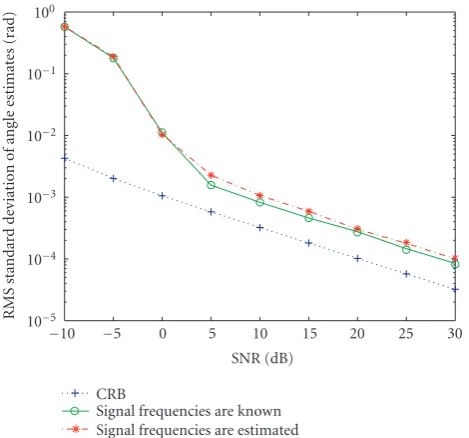
low-var-iance angle estimation.Figure 6gives the RMS standard
devi-ation of (θk,φk,k=1, 2) versus SNR. The signal parameters
10−5 10−4 10−3 10−2 10−1
RMS
standar
d
de
vi
ation
o
f
ang
le
estimat
es
(r
ad)
100 101 102
Intersensor space (λmin/2) CRB
From eigenvalue combined with eigenvectors From only eigenvectors
Figure4: The RMS standard deviation of (θk,φk, k =1, 2) ver-sus intersensor spacing when SNR =15 dB: the two uncorrelated sources{θ1,θ2} = (60◦, 30◦),{φ1,φ2} = (40◦,−60◦),{γ1,γ2} = (0◦, 45◦),{η1,η2} =(0◦, 90◦),{f1,f2} =(0.4, 0.5) impinge upon an
L-shaped vector sensor, 100 snapshots per experiment, 300 experi-ments per data point.
10−5 10−4 10−3 10−2
RMS
bias
of
ang
le
estimat
es
(r
ad)
100 101 102
Intersensor space (λmin/2) From eigenvalue combined with eigenvectors From only eigenvectors
Figure5: The RMS bias of (θk,φk,k=1, 2) versus intersensor
spac-ing when SNR=15 dB, same settings as inFigure 4.
are the same as inFigure 1except that{f1,f2} =(0.35, 0.4).
10−5 10−4 10−3 10−2 10−1 100
RMS
standar
d
de
vi
ation
o
f
ang
le
estimat
es
(r
ad)
−10 −5 0 5 10 15 20 25 30
SNR (dB) CRB
Signal frequencies are known Signal frequencies are estimated
Figure6: The RMS standard deviations of (θk,φk, k =1, 2) ver-sus SNR from low-variance angle estimation, same settings as in
Figure 1except that{f1,f2} =(0.35, 0.4).
just slightly lower than that when signal frequencies are esti-mated. Our simulations also show that RMS bias of the low-variance angle estimates when frequencies are known is al-most the same as that when frequencies are estimated.
Figure 7gives the RMS standard deviation of (θk,φk,k=
1, 2) versus elevation angle of the first signal when SNR =
15 dB. The parameters of the two signals areθ2=45◦,{φ1,
φ2} =(25◦,−30◦),{γ1,γ2} =(0◦, 45◦),{η1,η2} =(0◦, 90◦),
{f1,f2} = (0.3, 0.4). It is observed that the standard
devia-tions of angle estimates from the eigenvalues combined with eigenvectors are greater than angle estimates from ESPRIT
eigenvectors when elevation angle nears 90◦.
Figure 8gives the RMS standard deviation of (θk,φk,k=
1, 2) versus azimuth angle of the first signal when SNR =
15 dB. The signal parameters are the same as inFigure 7
ex-cept that{θ1,θ2} = (30◦, 45◦),φ2 = −30◦. It is shown that
the RMS standard deviation of angle estimates from two esti-mation methods almost does not change as the azimuth an-gle of the first signal is changed.
Figure 9gives the RMS standard deviation of (θk,φk,k=
1, 2) and (fk, k = 1, 2) versus the number of snapshots
when SNR = 15 dB. The parameters of the two signals are
{θ1,θ2} = (60◦, 30◦), {φ1,φ2} = (40◦,−60◦), {γ1,γ2} =
(0◦, 45◦), {η1,η2} = (0◦, 90◦), {f1,f2} = (0.3, 0.4). It is
shown that the RMS standard deviation decreases slowly as the number of snapshots increases for the number of snap-shots exceeding 50.
Figure 10gives the RMS standard deviation and bias of
(fk, k = 1, 2) versus the difference Δf of two signal
fre-quencies when SNR=15 dB. The signal parameters are the
same as inFigure 9 except that{f1,f2} = (0.4−Δf, 0.4).
10−4 10−3 10−2 10−1
RMS
standar
d
de
vi
ation
o
f
ang
le
estimat
es
(r
ad)
0 10 20 30 40 50 60 70 80 90
Elevation angle of the first signal (deg) From eigenvalue combined with eigenvectors From only eigenvectors
Figure7: The RMS standard deviations of (θk,φk, k =1, 2)
ver-sus elevation angle of the first signal when SNR =15 dB. The pa-rameters of the two signals areθ2 =45◦,{φ1,φ2} =(25◦,−30◦), {γ1,γ2} =(0◦, 45◦),{η1,η2} =(0◦, 90◦),{f1,f2} =(0.3, 0.4), 100 snapshots per experiment, 300 experiments per data point.
10−4 10−3 10−2 10−1
RMS
standar
d
de
vi
ation
o
f
ang
le
estimat
es
(r
ad)
0 10 20 30 40 50 60 70 80 90
Azimuth angle of the first signal (deg) From eigenvalue combined with eigenvectors From only eigenvectors
Figure8: The RMS standard deviation of (θk,φk, k=1, 2) versus
azimuth angle of the first signal when SNR=15 dB, same setting as inFigure 7except that{θ1,θ2} =(30◦, 45◦) andφ2= −30◦.
It is observed that whenΔf is 0.004, the RMS bias is about
2.5e-4 and standard deviation is about 1.6e-3, which shows that two signal frequencies can be separated. Note that just 50 snapshots are used here. For discrete Fourier transform when 50 snapshots are used, the frequency discrimination is
10−5 10−4 10−3 10−2 10−1
RMS
standar
d
de
vi
ation
0 100 200 300 400 500 600
Number of snapshots
Angle estimates from eigenvalue combined with eigenvectors (rad)
Angle estimates from only eigenvectors (rad) Frequency estimates
Figure9: The RMS standard deviation of (θk,φk, k = 1, 2) and
(fk, k = 1, 2) versus the number of snapshots when SNR =
15 dB. The parameters of the two signals are{θ1,θ2} =(60◦, 30◦), {φ1,φ2} = (40◦,−60◦),{γ1,γ2} = (0◦, 45◦),{η1,η2} = (0◦, 90◦), {f1,f2} = (0.3, 0.4), 100 snapshots per experiment, 300 experi-ments per data point.
10−6 10−5 10−4 10−3 10−2 10−1 100
10−3 10−2 10−1
Difference of two signal frequencies RMS standard deviation
RMS bias
Figure10: The RMS standard deviations and bias of (fk, k=1, 2)
versus the differenceΔf of two signal frequencies when SNR = 15 dB, same settings as inFigure 9except that {f1,f2} = (0.4−
Δf, 0.4), 50 snapshots per experiment, 300 experiments per data point.
5. CONCLUSION
In this paper, we propose an ESPRIT-based algorithm that yields 2D angle and frequency estimates. This algorithm can
achieve extended-aperture arrival angle estimation even though using a sparse electromagnetic vector sensor array. Good frequency discrimination obtained even though there
are little samples used. Although we only consider the L
-shaped array here, the approach may be implemented using a variety of array geometries.
ACKNOWLEDGMENTS
This work is supported by City University of Hong Kong Strategic Grant 7001697. This work is done when Fei Ji was visiting City University of Hong Kong.
REFERENCES
[1] A. Nehorai and E. Paldi, “Vector sensor processing for electro-magnetic source localization,” inProceedings of the 25th Asilo-mar Conference on Signals, Systems and Computers, vol. 1, pp. 566–572, Pacific Grove, Calif, USA, November 1991.
[2] A. Nehorai and E. Paldi, “Vector-sensor array processing for electromagnetic source localization,”IEEE Transactions on Sig-nal Processing, vol. 42, no. 2, pp. 376–398, 1994.
[3] J. Li, “Direction and polarization estimation using arrays with small loops and short dipoles,”IEEE Transactions on Antennas and Propagation, vol. 41, no. 3, pp. 379–386, 1993.
[4] B. Hochwald and A. Nehorai, “Identifiability in array pro-cessing models with vector-sensor applications,”IEEE Trans-actions on Signal Processing, vol. 44, no. 1, pp. 83–95, 1996. [5] K.-C. Ho, K.-C. Tan, and W. Ser, “Investigation on
num-ber of signals whose directions-of-arrival are uniquely deter-minable with an electromagnetic vector sensor,”Signal Pro-cessing, vol. 47, no. 1, pp. 41–54, 1995.
[6] K.-C. Tan, K.-C. Ho, and A. Nehorai, “Uniqueness study of measurements obtainable with arrays of electromagnetic vec-tor sensors,”IEEE Transactions on Signal Processing, vol. 44, no. 4, pp. 1036–1039, 1996.
[7] B. Hochwald and A. Nehorai, “Polarimetric modeling and pa-rameter estimation with applications to remote sensing,”IEEE Transactions on Signal Processing, vol. 43, no. 8, pp. 1923–1935, 1995.
[8] K.-C. Ho, K.-C. Tan, and B. T. G. Tan, “Efficient method for estimating directions-of-arrival of partially polarized sig-nals with electromagnetic vector sensors,”IEEE Transactions on Signal Processing, vol. 45, no. 10, pp. 2485–2498, 1997. [9] K.-C. Ho, K.-C. Tan, and A. Nehorai, “Estimating directions of
arrival of completely and incompletely polarized signals with electromagnetic vector sensors,”IEEE Transactions on Signal Processing, vol. 47, no. 10, pp. 2845–2852, 1999.
[10] K. T. Wong, “Direction finding/polarization estimation— dipole and/or loop triads,”IEEE Transactions on Aerospace and Electronic Systems, vol. 37, no. 2, pp. 679–684, 2001.
[11] K. T. Wong and M. D. Zoltowski, “Uni-vector-sensor ESPRIT for multisource azimuth, elevation, and polarization estima-tion,”IEEE Transactions on Antennas and Propagation, vol. 45, no. 10, pp. 1467–1474, 1997.
[12] A. Nehorai and P. Tichavsky, “Cross-product algorithms for source tracking using an EM vector sensor,”IEEE Transactions on Signal Processing, vol. 47, no. 10, pp. 2863–2867, 1999. [13] C. C. Ko, J. Zhang, and A. Nehorai, “Separation and
[14] K. T. Wong, “Blind beamforming geolocation for wideband-FFHs with unknown hop-sequences,” IEEE Transactions on Aerospace and Electronic Systems, vol. 37, no. 1, pp. 65–76, 2001.
[15] D. Rahamim, J. Tabrikian, and R. Shavit, “Source localization using vector sensor array in a multipath environment,”IEEE Transactions on Signal Processing, vol. 52, no. 11, pp. 3096– 3103, 2004.
[16] K. T. Wong and M. D. Zoltowski, “Self-Initiating MUSIC-based direction finding and polarization estimation in spatio-polarizational beamspace,”IEEE Transactions on Antennas and Propagation, vol. 48, pp. 1235–1245, 2000.
[17] K. T. Wong and M. D. Zoltowski, “Closed-form direction finding and polarization estimation with arbitrarily spaced electromagnetic vector-sensors at unknown locations,”IEEE Transactions on Antennas and Propagation, vol. 48, no. 5, pp. 671–681, 2000.
[18] M. D. Zoltowski and K. T. Wong, “ESPRIT-based 2-D direc-tion finding with a sparse uniform array of electromagnetic vector sensors,”IEEE Transactions on Signal Processing, vol. 48, no. 8, pp. 2195–2204, 2000.
[19] M. D. Zoltowski and K. T. Wong, “Closed-form eigenstruc-ture-based direction finding using arbitrary but identical sub-arrays on a sparse uniform Cartesian array grid,”IEEE Trans-actions on Signal Processing, vol. 48, no. 8, pp. 2205–2210, 2000.
[20] A. N. Lemma, A. J. Van Der Veen, and E. F. Deprettere, “Anal-ysis of joint angle-frequency estimation using ESPRIT,”IEEE Transactions on Signal Processing, vol. 51, no. 5, pp. 1264–1283, 2003.
[21] A. N. Lemma, A. J. Van Der Veen, and E. F. Deprettere, “Joint angle-frequency estimation using multi-resolution ESPRIT,” inProceedings of IEEE International Conference on Acoustics, Speech and Signal Processing (ICASSP ’98), vol. 4, pp. 1957– 1960, Seattle, Wash, USA, May 1998.
[22] M. D. Zoltowski and C. P. Mathews, “Real-time frequency and 2-D angle estimation with sub-Nyquist spatio-temporal sam-pling,”IEEE Transactions on Signal Processing, vol. 42, no. 10, pp. 2781–2794, 1994.
[23] R. Roy and T. Kailath, “ESPRIT - estimation of signal param-eters via rotational invariance techniques,”IEEE Transactions on Acoustics, Speech, and Signal Processing, vol. 37, no. 7, pp. 984–995, 1989.
[24] K. T. Wong and M. D. Zoltowski, “High accuracy 2D angle es-timation with extended aperture vector sensor arrays,” in Pro-ceedings of IEEE International Conference on Acoustics, Speech and Signal Processing (ICASSP ’96), vol. 5, pp. 2789–2792, At-lanta, Ga, USA, May 1996.
Fei Ji received the B.S. degree from the Northwestern Polytechnical University in 1992 and the M.S. and Ph.D. degrees from South China University of Technol-ogy in 1995 and 1998. Upon graduation, she joined the Department of Electronic Engi-neering, South China University of Tech-nology in 1998 as a Lecturer. She worked in the City University of Hong Kong as a Research Assistant from March 2001 to July
2002 and a Senior Research Associate from January 2005 to March 2005. She is currently an Associate Professor in the School of Elec-tronic and Information Engineering, South China University of Technology.