R E S E A R C H
Open Access
Resolution-enhanced radar/SAR imaging: an
experiment design framework combined with
neural network-adapted variational analysis
regularization
Yuriy Shkvarko
*, Stewart Santos and Jose Tuxpan
Abstract
The convex optimization-based descriptive experiment design regularization (DEDR) method is aggregated with the neural network (NN)-adapted variational analysis (VA) approach for adaptive high-resolution sensing into a unified DEDR -VA-NN framework that puts in a single optimization frame high-resolution radar/SAR image formation in uncertain operational scenarios, adaptive despeckling and dynamic scene image enhancement for a variety of sensing modes. The DEDR -VA-NN method outperforms the existing adaptive radar imaging techniques both in resolution and convergence rate. The simulation examples are incorporated to illustrate the efficiency of the proposed DEDR-VA-related imaging techniques.
Keywords:SAR system, image enhancement, image reconstruction, neural network, remote sensing
1. Introduction
In this article, we consider the problem of enhanced remote sensing (RS) imaging stated and treated as an ill-posed nonlinear inverse problem with model uncer-tainties. The problem at hand is to perform high-resolu-tion reconstruchigh-resolu-tion of the power spatial spectrum pattern (SSP) of the wavefield scattered from the extended remotely sensed scene via space-time adaptive processing of finite recordings of the imaging radar/SAR data distorted in a stochastic uncertain measurement channel. The SSP is defined as a spatial distribution of the power (i.e., the second-order statistics) of the ran-dom wavefield backscattered from the remotely sensed scene observed through the integral transform operator [1,2]. Such an operator is explicitly specified by the employed radar/SAR signal modulation and is tradition-ally referred to as the signal formation operator (SFO) [2,3]. The operational uncertainties are attributed to inevitable random signal perturbations in inhomoge-neous propagation medium with unknown statistics, possible imperfect radar calibration, and uncontrolled
sensor displacements or carrier trajectory deviations in the SAR case. The classical imaging with an array radar or SAR implies application of the method called
“matched spatial filtering (MSF)” to process the
recorded data signals [2,3]. A number of approaches had been proposed to design the constrained regularization techniques for improving the resolution in the SSP obtained by ways different from the MSF, e.g., [1-9] but without aggregating the minimum risk (MR) descriptive estimation strategies with convex projection regulariza-tion. In [7], an approach was proposed to treat the uncertain RS imaging problems that unifies the MR spectral estimation strategy with the worst case statisti-cal performance (WCSP) optimization-based convex regularization resulting in the descriptive experiment design regularization (DEDR) method. Next, the varia-tional analysis (VA) framework has been combined with the DEDR in [2,9] to satisfy the desirable descriptive properties of the reconstructed RS images, namely: (i) convex optimization-based maximization of spatial reso-lution balanced with noise suppression, (ii) consistency, (iii) positivity, (iv) continuity and agreement with the data. In this study, we extend the developments of the DEDR and VA techniques originated in [2,7,9] by * Correspondence: [email protected]
CINVESTAV del IPN, Unidad Guadalajara, Avenida del Bosque # 1145, Colonia El Bajío, Zapopan, Jalisco, C.P. 45015, Guadalajara, Mexico
performing the aggregation of the DEDR and VA para-digms and next putting the RS image enhancement/ reconstruction tasks into the unified neural network (NN)-adapted computational frame addressed as a uni-fied DEDR-VA-NN method. We have designed a family of such significantly speeded-up DEDR-VA-related algo-rithms, and performed the simulations to illustrate the effectiveness of the proposed high-resolution DEDR-VA-NN-based image enhancement/fusion approach.
The rest of the article is organized as follows. In Sec-tion 2, we provide the formalism of the radar/SAR inverse imaging problem at hand with necessary experi-ment design considerations. In Section 3, we adapt the celebrated maximum likelihood (ML) inspired amplitude phase estimation (APES) technique for array sensor/SAR imaging. The unified DEDR-VA framework for high-resolution radar/SAR imaging in uncertain scenarios is conceptualized in Section 4, adapted to the NN-oriented sensor systems/methods fusion mode in Section 5, next, is followed by illustrative simulations in Sections 6 and the conclusion in Section 7.
2. Problem formalism
The general mathematical formalism of the problem at hand is similar in notation and structural framework to that described in [2,7,9] and some crucial elements are repeated for convenience to the reader. Following [1,2,9], we define the model of the observation RS
wavefield u by specifying the stochastic equation of
observation (EO) of an operator form u = Se + n,
wheree=e(r), represents the complex scattering func-tion over the probing surface R∋ r, n is the additive noise, u = u(p), is the observation field, p = (t, r) defines the time (t)-space(r) points in the temporal-spatial observation domainp Î P =T × P (tÎ T, rÎ P) (in the SAR case, r =r(t) specifies the carrier
tra-jectory [7]), and the kernel-type integral
SFO S : E(R) → U(P) defines a mapping of
the source signal space E(R)onto the observation
signal spaceU(P). The metrics structures in the corre-sponding Hilbert signal spacesU(P),E(R)are imposed
by scalar products, [u, u]U =
P
u(p)u ∗(p)dp,
[e,e]E =
R
e(r)e ∗(r)dr,respectively [1]. The
func-tional kernelS(p, r) of the SFO S is referred to as the unit signal [2] determined by the time-space modula-tion employed in a particular RS system. In the case of uncertain operational scenarios, the SFO is randomly perturbed [7], i.e.S˜ =S+S whereS pertains to the random uncontrolled perturbations, usually with unknown statistics. The fields e, n, u. are assumed to be zero-mean complex valued Gaussian random fields
[1,7]. Next, since in all RS applications the regions of high correlation ofe(r) are always small in comparison with the resolution element on the probing scene [1-3], the signals e(r) scattered from different
direc-tions r, r’ Î R of the remotely sensed scene R are
assumed to be uncorrelated with the correlation func-tion Re(r, r’) =〈e(r)e*(r’) 〉=b(r) δ(r-r’);r,r’ÎRwhereb
(r) =〈e(r)e*(r) 〉= 〈|e(r)|2〉; rÎRrepresents the power SSP of the scattered field [1]. The problem of high-resolution RS imaging is to develop a framework and related method(s) that perform optimal estimation of the SSP (referred to as a scene image) from the avail-able radar/SAR data measurements. It is noted that in this study we are going to develop and follow the uni-fied DEDR-VA-NN framework.
The RS radar/SAR system-oriented finite-dimensional (i. e., discrete-form) approximation of the EO is given by [7]
u=Se˜ +n=Se+e+n, (1)
in which the disturbedM×KSFO matrixS˜ =S+Δis the discrete-form approximation of the integral SFO for the uncertain operational scenario, ande,n,urepresent zero-mean vectors composed of the sample (decomposi-tion) coefficients {ek, nm, um; k= 1,...,K; m= 1,...,M},
respectively [1-3]. These vectors are characterized by the correlation matrices:Re=D=D(b) = diag(b) (a diagonal matrix with vectorbat its principal diagonal),Rn, andRu = <SR˜ eS˜+>p(Δ)+Rn, respectively, where <·>p(Δ)defines the
averaging performed over the randomness ofΔ character-ized by the usuallyunknownprobability density functionp (Δ), and superscript“+”stands for Hermitian conjugate. Vectorbcomposed of the elements, {bk=B{ek}= <ekek*>
= <|ek|2>;k= 1,...,K} is referred to as aK-D vector-form
approximation of the SSP, whereBrepresents the second-order statistical ensemble averaging operator [1,2]. The
SSP vector b is associated with the lexicographically
ordered pixel-framed image [1,7]. The corresponding con-ventionalKy×Kxrectangular frame-ordered scene imageB
= {b(kx,ky);kx, = 1,...,Kx;kv, = 1,...,Ky} relates to its
lexico-graphically ordered vector-form representationb=L{B} = {b(k);k= 1,...,K=Ky×Kx} via the standard row-by-row
concatenation (i.e., lexicographical reordering) procedure,
B=L−1{b} [1]. It is noted that in the simple case of
cer-tain operational scenario [2,3], the discrete-form (i.e., matrix-form) SFOSis assumed to be deterministic, i.e., the random perturbation term in (3) is irrelevant,Δ=0.
observed through the perturbed SFO and contaminated with noise; hence, the imaging problem at hand must be qualified and treated as a statistical nonlinear uncertain inverse problem [1,7,9]. The enhanced high-resolution imaging implies solution of such inverse problem in some optimal way. We know that in this article we intend to develop and follow the unified DEDR-VA fra-mework, next adapted to NN-based computational implementation.
3. Adaptation of APES technique for array sensor/ SAR imaging
In this section, we perform an extension of the recently proposed high-resolution ML inspired APES, i.e., the ML-APES method [6], for solving the SSP reconstruc-tion inverse problem via its modificareconstruc-tion adapted to radar imaging of distributed RS scenes. In the consid-ered low snapshot sample case (e.g., one recorded SAR trajectory data signal in a single look SAR sensing mode
[7]), the sample data covariance matrix Y =
(1/J)J j=1u(j)u
+
(j)is rank deficient (rank-1 in the single
radar snapshot and single look SAR sensing modes, J=
1). The convex optimization problem of minimization of the negative likelihood functionlndet{Ru}+ tr{R−u1Y} with respect to the SSP vectorbsubject to the convexity guaranteed non-negativity constraint results in the cele-brated APES estimator [6]
ˆ
bk= s+
kR−
1
u YR−u1sk
(s+
kR−
1
u sk)
2 ; k= 1, ...,K. (2)
In the APES terminology (as well as in the minimum variance distortionless response (MVDR) and other ML-related approaches [1,4,6] etc.), sk represents the
so-called steeringvector in thekth look direction, which in our notational conventions is essentially the kth column
vector of the regular SFO matrix S. The numerical
implementation of the APES algorithm (2) assumes application of an iterative fixed point technique by building the model-based estimate Rˆu=Ru(bˆ[i])of the
unknown covariance Ru from the latest (ith) iterative SSP estimate bˆ[i] with the zero step initialization
ˆ
b[0]=bˆMSF computed applying the conventional MSF
estimator [2].
In the vector form, the algorithm (2) can be expressed as
ˆ bAPES=bˆ
(1)
={F(1)uu+F(1)+}diag= (F(1)u)•(F(1)u)∗,(3)
Where · defines the Schur-Hadamar [1] (element wise) vector/matrix product,FAPES =F(1)=DSˆ
+
R−u1(bˆ) repre-sents the APES matrix-form solution operator (SO), in
which
ˆ
D=D(bˆ) = diag(bˆ) andR−u1(bˆ) = (SDSˆ ++Rn)−1 (4)
where operator {·}diag returns the vector of a principal
diagonal of the embraced matrix. The algorithmic struc-ture of the vector-form nonlinear (i.e., solution-depen-dent) APES estimator (3) guarantees positivity but does not guarantee the consistency. In the real-world uncer-tain (rank deficient) RS operational scenarios, the incon-sistency inevitably results in speckle corrupted images unacceptable for further processing and interpretation. To overcome these limitations, in the next section we extend the unified DEDR-VA framework of [2,9] for the considered here uncertain operational scenarios to
guar-antee consistency and significantly speed-up
convergence.
4. Unified DEDR-VA framework for high-resolution radar/SAR imaging in uncertain scenarios
4.1. DEDR-VA approach
The DEDR-VA-optimal SSP estimatebˆ is to be found as the regularized solution to the nonlinear equation [7]
ˆ
bDEDR=P{FDEDRYF+DEDR}diag=P{D(bˆDEDR)}diag, (5)
whereFDEDRrepresents the adaptive (i.e., dependent
on the SSP estimatebˆ) matrix-form DEDR SO andPis the VA inspired regularizing projector onto convex solu-tion sets (POCS). Two fundamental issues constitute the benchmarks of the modified DEDR-VA estimator (5) that distinguish it from the previously developed kernel SSP reconstruction algorithm [2], the DEDR method [7,9] and the detailed above APES estimator (3). First, we reformulate the strategy for determining the DEDR SOFDEDRin (5) in the MR-inspired WCSP convex
opti-mization setting [1,7], i.e., as the MR-WCSP constrained DEDR convex optimization problem (specified by [7, Equations 8 and 11]) to provide robustness of the SSP vector estimates against possible model uncertainties. The second issue relates to the VA inspired problem-oriented codesign of the POCS regularization operator Pin (5) aimed at satisfying intrinsic and desirable prop-erties of the solution such as positivity, consistency, model agreement (e.g., adaptive despeckling with edge preservation), and rapid convergence [1,8]. The solution to the MR-WCSP conditioned optimization problem [7, Equation 43] yields the DEDR-optimal SO
FDEDR =F(2)=KS+R−1 (6)
with the composite noise powerNΣ =N0+b, the additive
observation noise power N0 augmented by the loading
factorb=gh/a ≥0 adjusted to the regularization para-meter a, the Loewner ordering factorg > 0 of the SFO
S[1] and the uncertainty bound himposed by the
MR-WCSP conditional maximization (see [7,8] for details). It is noted that other feasible adjustments of the pro-cessing-level degrees of freedom {a,NΣ, A} summarized in [7,8] specify the family of relevant POCS-regularized DEDR-related (DEDR-POCS) techniques that we unify here in the following general form
ˆ
b(p)=P{F(p)YF(p)+}
diag=P{K(p)QK(p)+}diag;p= 1, 2, 3,. . .,P (7)
whereQ=S+YS defines the MSF measurement statis-tics matrix independent on the solutionbˆ, and different (sayP) reconstruction operators {K(p);p= 1,...,P} speci-fied forP different feasible assignments to the
proces-sing degrees of freedom {a, NΣ, A} define the
corresponding DEDR-POCS estimators (7) with the rele-vant SO’s {F(p)=K(p)S+;p= 1,...,P}.
4.2. Convergence guarantees
Following the VA regularization formalism [1,7,9], the
POCS regularization operatorP in (7) could be
con-structed as a composition of projectorsPnonto convex
sets Cn; n = 1,...,N with non-empty intersection, in
which case the (7) is guaranteed to converge to a point in the intersection of the sets {Cn} regardless of the
initi-alizationbˆ[0]that is a direct sequence of the
fundamen-tal theorem of POCS (see [7, Part I, Appendix B]). Also, any operator that acts in the same convex set, e.g., ker-nel-type windowing operator (WO) can be incorporated into such composite regularization operatorP to guar-antee the consistency [1]. The RS system-oriented experiment design task is to make the use of the POCS regularization paradigm (5) employing the practical ima-ging radar/SAR-motivated considerations that we per-form in the next section.
4.3. VA-motivated POCS regularization
To approach the superresolution performances in the resulting SSP estimates (5), (7), we propose to follow the VA inspired approach [2,7,9] to specify the compo-site POCS regularizing operator
P=P2P1. (8)
The P2in (8) represents the convergence-guaranteed
projector onto the nonnegative convex solution set (the POCS operator) specified as the positivity operator, P2=P+, that has an effect of clipping off all the
nega-tive values [1], and P1is an anisotropic WO that we
construct here following the VA formalism [2,9] as a metrics inducing operator
P1=M=m(0)I+m(1)∇2 (9)
that specifies the metrics structure in the K-D solu-tion/image spaceB(K)bdefined by the squared norm
[2,9]
|b|2
B(K)=
b,Mb=m(0)
Kx,Ky
kx,ky=1
bkx,ky2
+m(1)
Kx,Ky
kx,ky=1
bkx,ky
−1
4
bkx−1,ky
+bkx+ 1,ky
+bkx,ky−1
+bk,ky+ 1
2
. (10)
The second sum on the right-hand side of (10) is recognized to be a 4-nearest-neighbors difference-form approximation of the Laplacian operator∇2r over the spatial coordinate r, while m(0) and m(1) represent the nonnegative real-valued scalars that control the balance between two metrics measures defined by the first and the second sums at the right-hand side of (10). In the equibalanced case,m(0)=m(1)= 1, the same importance is assigned to the both metrics measures, in which case (9) specifies the discrete-form approximation to the Sobolev metrics inducing operatorM=m(0)I+m(1)∇r2
in the relevant continuous-form solution space
B(R)b(r), where I defines the identity operator [2].
Incorporating in (9)P1=Mfor the continuous model
andP1=Mfor the discrete-form image model,
respec-tively, specifies the consistency-guaranteed anisotropic kernel-type windowing [2,9] because it controls not only the SSP (image) discrepancy measure but also its gradi-ent flow over the scene.
4.4. DEDR-VA-optimal dynamic SSP reconstruction The transformation of (5) into the contractive iterative mapping format yields
ˆ
b[i+1]=bˆ[i]+τP+{Mq−MD[i]bˆ[i]};i= 0, 1, 2,. . . (11)
initialized by the conventional low-resolution MSF image
ˆ
b[0]=q={Q}diag={S+YS}diag (12)
with the relaxation parameter τ and the
solution-depended point spread function (PSF) matrix operator
D=D(bˆ) = (+ND−1(bˆ))•(+ND−1(bˆ))∗(13)
Associating in (11) the iterations i+ 1® t+Δt;i ®t;
scene image q(r) = bˆ(r; 0) and the “ evolutionary"-enhanced SSP estimatebˆ(r;t), respectively, we proceed from (11) to the equivalent asymptotic dynamic scheme [2]
∂bˆ(r;t)
∂t =P+{M{(q(r))} −M{
R
ˆb(r,r’;t)bˆ(r’;t)d2r’}},(14)
wherebˆr,r’;trepresents the kernel PSF in
evolu-tion time t corresponding to the continuous-form
dynamic generalization of the PSF matrixD[i]specified
by (13), andMdefines the metrics inducing operator.
For the adoptedM=m(0)I+m(1)∇2r, the (14) is trans-formed into the VA dynamic process defined by the par-tial differenpar-tial equation (PDE)
∂bˆ(r;t)
∂t =P+{c0[q(r)−
R
(r,r’;t)bˆ(r’;t)dr’]
+c1∇r2{q(r)} −c2∇r2{
R
(r,r’;t)bˆ(r’;t)dr’}}. (15)
For the purpose of generality, instead of relaxation parameterτand balancing coefficientsm(0)andm(1)we incorporated into the PDE (15) three regularizing factors c0, c1, and c2, respectively, to compete between noise
smoothing and edge enhancement [2,9]. These are viewed as additional VA-level user-controlled degrees of freedom.
4.5. Family of numerical DEDR-VA-related techniques for SSP reconstruction
The discrete-form approximation of the PDE (15) in
“iterative time” {i= 0, 1, 2,...} yields the contractive map-ping iterative numerical procedure [2]
b[i+1]=bˆ[i]+P+{c0(q−D[i]bˆ[i]) +c1∇2{q} −c2∇2{D[i]bˆ[i]}}(16)
i= 0,1,2,... with the same MSF initialization (12). Dif-ferent feasible assignments to the user-controlled degrees of freedom (i.e., balancing factors c0,c1,c2) in
(16) specify the family of corresponding DEDR-VA-related SSP reconstruction techniques that produce the relevant RS images. Extending the previous studies on the DEDR-VA topic [2,9] herebeneath we exemplify the following ones.
(i) The simplest case relates to the specifications: c0=
0,c1 = 0,c2= const = -c, c> 0, andF(r,r’;t) =δ(r- r’)
with excluded projector P+. In this case, the PDE (15)
reduces to the isotropic diffusion (so-called heat
diffu-sion) equation ∂bˆ(r;t)
∂t=c∇r2bˆ(r;t). We reject the isotropic diffusion because of its resolution deteriorating nature [1].
(ii) The previous assignments but with the anisotropic conduction factor, -c2 =c(r; t)≥0 specified as a
mono-tonically decreasing function of the magnitude of the image gradient distribution [4], i.e., a function
cr,| ∇rbˆ(r;t)|
≥ 0, transforms the (15) into the
aniso-tropic diffusion (AD) PDE,
∂bˆ(r;t)
∂t=c(r;| ∇rbˆ(r;t)|)∇r2ˆb(r;t), which specifies the celebrated Perona-Malik AD method [4] that shar-pens the edge map on the low-resolution MSF images.
(iii) For the Lebesgue metrics specification c0= 1 with
c1 =c2= 0, the PDE (15) involves only the first term at
the right-hand side resulting in the locally selective robust adaptive spatial filtering(RASF) approach inves-tigated in details in our previous studies [7,9].
(iv) The alternative assignmentsc0 = 0 withc1 =c2=
1 combine the isotropic diffusion with the anisotropic gain controlled by the Laplacian edge map. This approach is addressed as a selective information fusion method [5] that manifests almost the same perfor-mances as the DEDR-related RASF method [7].
(v) The aggregated approach that we address here as the unified DEDR-VA method involves all the three terms at the right-hand side of the PDE (15) with the equibalanced c0 = c1 =c2 = const (one for simplicity),
hence, it combines the isotropic diffusion (specified by the second term at the right-hand side of (16)) with the composite anisotropic gain dependent both on the evo-lution of the synthesized SSP frame and its Laplacian edge map [2]. This produces a balanced compromise between the anisotropic reconstruction-fusion and locally selective image despeckling with adaptive aniso-tropic kernel windowing that preserves and even shar-pen the image edge map [2].
All exemplified above techniques with different feasi-ble specifications of the user-controllafeasi-ble degrees of freedom compose a family of the DEDR-VA-related iterative techniques for SSP reconstruction/enhance-ment. The general-form DEDR-VA framework is shown in Figure 1. It is noted that the progressive contractive mapping procedure (16) can be performed separately along the range (y) and azimuth (x) directions in a par-allel fashion making an optimal use of the PSF sparse-ness properties of the real-world RS imaging systems. These features of the POCS-regularized DEDR-VA-related algorithms generalized by (16) result in the dras-tically decreased algorithmic computational complexity (e.g., up to ~103 times for the typical large-scale 103 × 103SAR pixel image formats [8]).
[10]. We are now ready to proceed with construction of such NN-adapted DEDR-VA-related techniques.
5. Radar/SAR image enhancement via sensor and method fusion
5.1. Fusion problem formulation Consider the set of equations
q(p)=(p)b+ν(p);p= 1,. . .,P, (17)
which model the data {q(p)} acquired by PRS imaging systems that employ the image formation methods from the DEDR-VA-related family specified in the previous section. In (17), b represents the original K-D image vector, {F(p)} are the RS image formation operators referred to as the PSF operators of the corresponding DEDR-VA-related imaging systems (or methods) where we have omitted the sub indexDfor notational simpli-city, and {ν(p)} represent the system noise with further assumption that these are uncorrelated from system to system.
Define the discrepancies between the actually formed images {q(p)} and the true original image b as the l2
squired norms,Jp(b) = ||q(p)- F(p)b||2;p= 1,...,P. Let us
next adopt the VA inspired proposition [10] that the smoothness properties of the desired image are con-trolled by the second-order Tikhonov stabilizer, JP+1(b)
= bTP1b, where P1=M=m(0)I+m(1)∇2 is the
VA-based metrics inducing (regularizing) operator specified previously by (9). We further define the image entropy as
H(b) =−K
k=1bklnbk. (18)
Then, the contrivance for aggregating the imaging sys-tems (methods), when solving the fusion problem, is the formation of the augmented objective (or augmented ME cost) function
E(b|λ) =−H(b) + 1/2 P
p=1λPJP(b) +
1/2λP+1JP+1(b), (19)
and seeking for a fused restored image bˆ that mini-mizes the objective function (19), in whichl= (l1...lP,
lP+1)T represents the vector of weight parameters,
commonly referred to as the fusionregularization para-meters [10]. Hence, in the frame of the aggregate regu-larization approach to decentralized fusion [2,6], the restored image is to be found as a solution of the con-vex optimization problem
ˆ
b= argmin b
E(b|λ) (20)
for the assigned values of the regularization para-metersl. A proper selection oflis next associated with parametrical optimization [10] of such the aggregated fusion process.
5.2. NN-adapted fusion algorithm
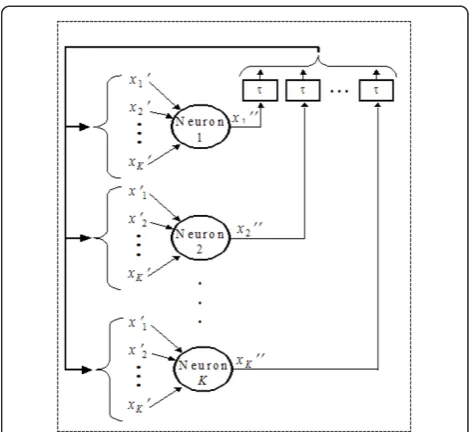
The Hopfield-type dynamical NN, which we propose to employ to solve the fusion problem (20), is an expansion of the maximum entropy NN (MENN) proposed in our previous study [10]. We consider the multistate Hop-field-type (i.e., dynamic) NN [10,11] with the K-D state vectorxand K-D output vector z= sgn(Wx+θ), where
Wandθare the matrix of synaptic weights and the vec-tor of the corresponding bias inputs of the NN, respec-tively. The energy function of such the NN is expressed as [10]
E(x) =E(x;W,θ) =−1/2xTWx−θTx
=−1/2 K
k=1
K
i=1Wkixkxi−
K
k=1θkxk.
(21)
aggregate the corresponding parameters of the RS sys-tems/methods to be fused, i.e.,
Wki=−
P p=1[λˆp
K
j=1 (p)
jk
(p)
ji ]−λP+1Mki, (22)
θk=−ln xk+
P
p=1[λˆp
K
j=1 (p)
jk q
(p)
j ] (23)
∀k, i = 1,...,K, where we redefined {xk = bk } and
ignored the constant termEconstin E(x) that does not
involve the state vectorx. The regularization parameters {lp} in (22), (23) should be specified by an observer o
pre-estimated invoking, for example, the VA inspired resolution-over-noise-suppression balancing method developed in [10, Section 3]. In the latter case, the result of the enhancement-fusion becomes a balanced tradeoff between the gained spatial resolution and noise suppres-sion in the resulting fused enhanced image with the POCS-based regularizing stabilizer.
Next, we propose to find a minimum of the energy function (21) as follows. The states of the network should be updated as x’’ =x’+Δx using the properly designed update rule ℜ(z) for computing a changeΔx of the state vectorx, where the superscripts’and’’ cor-respond to the state values before and after network state updating (at each iteration), respectively. To sim-plify the design of such the state update rule, we assume that all xk > > 1, which enables us to approximate the
change of the energy function due to neuronkupdating as [10]
E≈ −(K
i=1Wkix
i+θk−1)xk−
1/2Wkk(xk)2.(24)
We now redefine the outputs of neurons as {zk= sgn
(K
i=1Wkix
i+θk - 1) ∀k = 1,...,K}. Using these
defini-tions, and adopting the equibalanced fusion regulariza-tion weights, lp= 1 ∀p = 1,...,P, we next, design the
desired state update ruleℜ(z) which guarantees nonpo-sitive values of the energy changesΔEat each updating step as follows,
xk=(zk)=
⎧ ⎨ ⎩
0 ifzk= 0
ifzk>0 −ifzk<0
(25)
whereΔis the pre-assigned step-size parameter. If no changes ofΔE(Δx) are examined while approaching to the stationary point of the network, then the step-size
parameter Δ may be decreased, which enables us to
monitor the updating process as it progresses setting a compromise between the desired accuracy of finding the
NN’s stationary point and computational complexity
[10]. To satisfy the conditionxk> > 1 some constantx0
may be added to the gray level of every original image
pixel and after restoration the same constant should be deducted from the gray level of every restored image pixel, hence, the selection of a particular value of x0 is not critical [10]. Consequently, the restored image bˆ corresponds to the state vector xˆ of the NN in its sta-tionary pointxˆ as,bˆ=xˆ -x01, where1= (1 1...1)TÎ RK
is the K×1 vector composed with units. The
computa-tional structures of such the MENN and its single neu-ron are presented in Figures 2 and 3, respectively.
6. Simulations
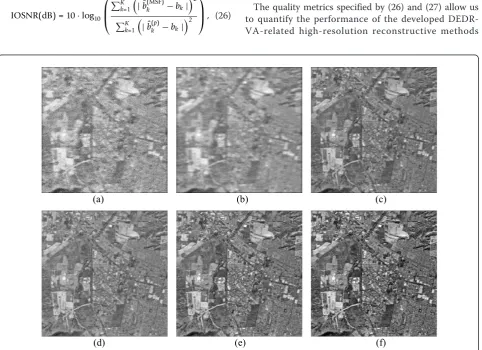
We simulated fractional side-looking imaging SAR oper-ating in uncertain scenario [7]. We adopted a triangular shape of such imaging SAR range ambiguity function (AF) and a Gaussian shape of the corresponding azi-muth AF [2,12]. Simulation results are presented in Fig-ures 4 and 5. The figure captions specify each particular
simulated image formation/enhancement method (p=
1,...,P = 5). Aggregation of the locally selective robust spatial filtering (RSF) technique [5] with the DEDR-VA-optimal algorithm (16) was considered in the simula-tions of the NN-based fused enhancement mode. Next, Figure 6 reports the convergence rates for three most prominent VA-related enhanced RS imaging approaches: the APES [6], the DEDR, and the developed NN-adapted DEDR-VA-optimal method (16) implemented via the MENN technique (20-25).
We employ two quality metrics for performance assessment of the reconstructive methods developed in this article. The traditional quantitative quality metric [7] for RS images is the so-called improvement in the
output signal-to-noise ratio (IOSNR), which provides the metrics for performance gains attained with different employed estimators in dB scale
IOSNR(dB) = 10·log10
⎛ ⎜ ⎝
K k=1
| ˆb(MSF)k −bk| 2
K k=1
| ˆb(kp)−bk| 2
⎞ ⎟ ⎠, (26)
where bk represents the value of the kth element
(pixel) of the original SSP,bˆ(MSF)k represents the value of
the kth element (pixel) of the rough SSP estimate
formed applying the conventional low-resolution MSF technique (12), andˆb(kp)represents the value of thekth element (pixel) of the enhanced SSP estimate formed applying thepth enhanced imaging method (p= 1,...,P), correspondingly. We consider and compare here five (i.
e., P= 5) RS image enhancement/reconstruction
meth-ods, in which case p= 1 corresponds to the Lee’s local statistics-based adaptive despeckling technique [2], p= 2
corresponds to the Perona-Malik AD method [5],p= 3
corresponds to the DEDR-related locally selective RASF
technique [7], p= 4 corresponds to the APES method
[6], and p= 5 corresponds to the NN-fused RSF and
DEDR-VA methods, respectively.
The second employed quality metric is the l1 total
mean absolute error (MAE) metric [13]
MAE = 1
K
K
k=1| ˆb (p)
k −bk|,p= 1, ...,P. (27)
The quality metrics specified by (26) and (27) allow us to quantify the performance of the developed DEDR-VA-related high-resolution reconstructive methods Figure 3Computational structure of a single neuron in the
MENN.
(a) (b) (c)
(d) (e) (f)
Figure 4Simulation results for thefirstuncertain fractional SAR imaging scenario for the large-scale (1024 × 1024 pixels) test scene and 5% random Gaussian perturbations in the SFO, < ||Δ||2>/||S||2= 5 × 10⁻².(a)degraded scene image formed applying the MSF method corrupted by composite noise (fractional SAR parameters: range PSF width (at 1/2 from the peak value)r= 10 pixels, azimuth PSF width (at 1/2 from the peak value)a= 30 pixels, composite SNRμSAR= 10 dB);(b)adaptively despeckled MSF image [8];(c)image reconstructed applying the locally selective RSF method [5] after 30 performed iterations;(d)image reconstructed with the APES method [6] after 30 performed iterations;(e)image reconstructed applying the POCS-regularized RASF technique [7] after seven performed iterations and(f)
(enumerated above byp= 1,...,P = 5) and, also, the NN fusion quality.
The quantitative measures of the image enhancement/ reconstruction performance gains achieved with the par-ticular employed DEDR-RSF method [7], the APES algo-rithm [6], and DEDR-VA-NN technique (16) for different SNRs evaluated with two different quality metrics (26), (27) are reported in Tables 1 and 2, respec-tively. The numerical simulations verify that the MENN implemented DEDR-VA method outperforms the most prominent existing competing high-resolution RS ima-ging techniques [1-7] (both without fusion and in the fused version) in the attainable resolution enhancement as well as in the convergence rates.
7. Concluding remarks
The extended DEDR method combined with the dynamic VA regularization has been adapted to the NN computational framework for perceptually enhanced and considerably speeded up reconstruction of the RS ima-gery acquired with imaging array radar and/or fractional SAR imaging systems operating in an uncertain RS (a) (b) (c)
(d) (e) (f)
Figure 5Simulation results for theseconduncertain fractional SAR imaging scenario for the large-scale (1024 × 1024 pixels) test scene and 5% random Gaussian perturbations in the SFO, < ||Δ||2>/||S||2= 5 × 10⁻².(a)degraded scene image formed applying the MSF method corrupted by composite noise (fractional SAR parameters: range PSF width (at 1/2 from the peak value)r= 7 pixels, azimuth PSF width (at 1/2 from the peak value)a= 20 pixels, composite SNRμSAR= 15 dB);(b)adaptively despeckled MSF image [8];(c)image enhanced using the AD technique [4] after 30 performed iterations;(d)image reconstructed applying the locally selective RSF method [5] after 30 performed iterations;(e)image reconstructed applying the POCS-regularized RASF technique [7] after seven performed iterations and(f)image reconstructed applying the NN-fused RSF [5] and the DEDR-VA technique (16) after 7 performed iterations.
environment. Connections have been drawn between different types of enhanced RS imaging approaches, and it has been established that the convex optimization-based unified DEDR-VA-NN framework provides an indispensable toolbox for high-resolution RS imaging system design offering to observer a possibility to con-trol the order, the type, and the amount of the employed two-level regularization (at the DEDR level and at the VA level, correspondingly). Algorithmically, this task is performed via construction of the proper POCS operators that unify the desirable image metrics properties in the convex image/solution sets with the employed radar/SAR motivated data processing consid-erations. The addressed family of the efficient contrac-tive progressive mapping iteracontrac-tive DEDR-VA-related techniques has particularly been adapted for the NN computing mode with sensor systems/method fusion. The efficiency of the proposed fusion-based enhance-ment of the fractional SAR imagery has been verified for the two method fusion example in the reported simula-tion experiments. Our algorithmic developments and the simulations revealed that with the NN-adapted POCS-regularized DEDR-VA techniques, the overall RS imaging performances are improved if compared with those obtained using separately the most prominent in the literature despeckling, AD or locally selective RS image reconstruction methods that do not unify the DEDR, the VA and the NN-adapted method fusion con-siderations. Therefore, the developed unified DEDR-VA-NN framework puts in a single optimization frame, radar/SAR image formation, speckle reduction, and
adaptive dynamic scene image enhancement/fusion per-formed in the rapidly convergent NN-adapted computa-tional fashion.
Competing interests
The authors declare that they have no competing interests.
Received: 11 May 2011 Accepted: 11 October 2011 Published: 11 October 2011
References
1. HH Barrett, KJ Myers,Foundations of Image Science(Willey, NY, 2004) 2. YV Shkvarko, J Tuxpan, S Santos, Dynamic experiment design regularization
approach to adaptive imaging with array radar/SAR sensor systems. Sensors.
2011(11), 4483–4511 (2011)
3. YV Shkvarko, Unifying regularization and Bayesian estimation methods for enhanced imaging with remotely sensed data–part I: theory–Part II: implementation and performance issues. IEEE Trans Geosci Remote Sens.
42(5), 923–940 (2004)
4. P Perona, J Malik, Scale-space and edge detection using anisotropic diffusion. IEEE Trans Pattern Anal Mach Intell.12(7), 629–639 (1990). doi:10.1109/34.56205
5. S John, MA Vorontsov, Multiframe selective information fusion from robust error theory. IEEE Trans Image Proc.14(5), 577–584 (2005)
6. T Yarbidi, J Li, P Stoica, M Xue, AB Baggeroer, Source localization and sensing: a nonparametric iterative adaptive approach based on weighted least squares. IEEE Trans Aerospace Electron Syst.46(1), 425–443 (2010) 7. Y Shkvarko, Unifying experiment design and convex regularization
techniques for enhanced imaging with uncertain remote sensing data–Part I: theory–Part II: adaptive implementation and performance issues. IEEE Trans Geosci Remote Sens.48(1), 82–111 (2010)
8. A Castillo-Atoche, D Torres-Roman, YV Shkvarko, Experiment design regularization-based hardware/software codesign for real-time enhanced imaging in uncertain remote sensing environment. EURASIP J Adv Signal Process.2010(254040), 1–21 (2010)
9. YV Shkvarko, B Castillo, J Tuxpan, D Castro, inHigh-resolution radar/SAR imaging: an experiment design framework combined with variational analysis regularization IPCV 2011 Proceeding of the 2011 International Conference on
Table 1 IOSNR values provided with three methods,p= 3, 4, 5
SNR (dB) IOSNR(p);p= 3, 4, 5
First scenario:
r= 10;a= 30
Second scenario:
r= 7;a= 20
IOSNR(3) IOSNR(4) IOSNR(5) IOSNR(3) IOSNR(4) IOSNR(5)
5 3.58 6.21 10.36 4.75 7.27 11.74
7 4.37 7.46 12.54 5.69 8.74 12.36
10 5.45 8.27 13.23 5.94 9.57 14.75
15 7.36 8.83 15.27 7.58 10.35 16.27
(3)
DEDR-RSF method [7];(4)
APES method [6];(5)
DEDR-VA-NN technique (16). The results are reported for the both simulated scenarios.
Table 2 MAE values provided with three simulated methods,p= 3, 4, 5
SNR (dB) MAE(p);p= 3, 4, 5
First scenario:
r= 10;a= 30
Second scenario:
r= 7;a= 20
MAE(3) MAE(4) MAE(5) MAE(3) MAE(4) MAE(5)
5 16.46 14.68 11.48 14.87 13.85 11.74
7 14.75 13.84 10.74 13.11 11.32 9.36
10 13.48 12.27 9.66 12.47 10.86 8.75
15 13.04 11.75 9.19 10.75 9.69 7.38
(3)
DEDR-RSF method [7];(4)
APES method [6];(5)
Image Processing, Computer Vision, & Pattern Recognition, vol. II. Las Vegas, USA, pp. 652–658 (2011)
10. YV Shkvarko, YS Shmaliy, R Jaime-Rivas, M Torres-Cisneros, System fusion in passive sensing using a modified Hopfield network. J Franklin Inst.338, 405–427 (2001). doi:10.1016/S0016-0032(00)00084-3
11. FM Henderson, AV Lewis, inPrinciples and Applications of Imaging Radar. Manual of Remote Sensing, vol. 3, 3rd edn. (Wiley, NY, 1998)
12. DR Wehner,High-Resolution Radar, 2nd edn. (Artech House, Boston, MA, 1994)
13. V Ponomaryov, A Rosales, F Gallegos, I Loboda, Adaptive vector directional filters to process multichannel images. IEICE Trans Commun.E90-B, 429–430 (2007). doi:10.1093/ietcom/e90-b.2.429
doi:10.1186/1687-6180-2011-85
Cite this article as:Shkvarkoet al.:Resolution-enhanced radar/SAR imaging: an experiment design framework combined with neural network-adapted variational analysis regularization.EURASIP Journal on Advances in Signal Processing20112011:85.
Submit your manuscript to a
journal and benefi t from:
7Convenient online submission
7Rigorous peer review
7Immediate publication on acceptance
7Open access: articles freely available online
7High visibility within the fi eld
7Retaining the copyright to your article

![Figure 6 Convergence rates evaluated via the IOSNR metric(26) versus the number of iterations evaluated for three mostprominent high-resolution iterative enhanced RS imagingmethods: DEDR-RASF method [7], APES–ML-optimal APESmethod [6], and the developed unified DEDR-VA-NN technique(16).](https://thumb-us.123doks.com/thumbv2/123dok_us/1146099.1143822/9.595.59.540.88.377/convergence-evaluated-iterations-mostprominent-resolution-iterative-imagingmethods-apesmethod.webp)