Volume 2006, Article ID 95360, Pages1–15 DOI 10.1155/ASP/2006/95360
A Systematic Approach to Modified BCJR MAP
Algorithms for Convolutional Codes
Sichun Wang1and Franc¸ois Patenaude2
1Defence Research and Development Canada – Ottawa, Ottawa, ON, Canada K1A 0Z4 2Communications Research Centre Canada, Ottawa, ON, Canada K2H 8S2
Received 19 November 2004; Revised 19 July 2005; Accepted 12 September 2005
Recommended for Publication by Vincent Poor
Since Berrou, Glavieux and Thitimajshima published their landmark paper in 1993, different modified BCJR MAP algorithms have appeared in the literature. The existence of a relatively large number of similar but different modified BCJR MAP algorithms, derived using the Markov chain properties of convolutional codes, naturally leads to the following questions. What is the relation-ship among the different modified BCJR MAP algorithms? What are their relative performance, computational complexities, and memory requirements? In this paper, we answer these questions. We derive systematically four major modified BCJR MAP algo-rithms from the BCJR MAP algorithm using simple mathematical transformations. The connections between the original and the four modified BCJR MAP algorithms are established. A detailed analysis of the different modified BCJR MAP algorithms shows that they have identical computational complexities and memory requirements. Computer simulations demonstrate that the four modified BCJR MAP algorithms all have identical performance to the BCJR MAP algorithm.
Copyright © 2006 S. Wang and F. Patenaude. This is an open access article distributed under the Creative Commons Attribution License, which permits unrestricted use, distribution, and reproduction in any medium, provided the original work is properly cited.
1. INTRODUCTION
In 1993, Berrou et al. [1] introduced new types of codes, called turbo codes, which have demonstrated performance close to the theoretical limit predicted by information the-ory [2]. In the iterative decoding strategy for turbo codes, a soft-input soft-output (SISO) MAP algorithm is used to per-form the decoding operation for the two constituent recur-sive systematic convolutional codes (RSC). The SISO MAP algorithm presented in [1], which is called the BGT MAP al-gorithm in [3], is a modified version of the BCJR MAP al-gorithm proposed in [4]. The BGT MAP algorithm formally appears very complicated. Later, Pietrobon and Barbulescu derived a simpler modified BCJR MAP algorithm [5], which is called the PB MAP algorithm [3]. However, the PB MAP algorithm is not a direct simplification of the BGT MAP al-gorithm, even though they share similar structures. In [3], the BGT MAP algorithm is directly simplified to obtain a new modified BCJR MAP algorithm that keeps the structure of the BGT MAP algorithm but uses simpler recursive pro-cedures. This new modified BCJR MAP algorithm is called the SBGT MAP algorithm in [3]. The main difference
be-tween the SBGT and BGT MAP algorithms lies in the fact
that for the BGT MAP algorithm, the forward and backward recursions (cf. [1, equations (21) and (22)]) are formulated in such a way that redundant divisions are involved, whereas in the SBGT MAP algorithm, these redundant computations are removed.
In [3], it is also shown that the symmetry of the trel-lis diagram of an RSC code can be utilized (albeit implic-itly) to derive another modified BCJR MAP algorithm which possesses a structure that is dual to that of the SBGT MAP algorithm and has the same signal processing and memory requirements. This new modified BCJR MAP algorithm is called the dual SBGT MAP algorithm in [3]. The Dual SBGT MAP algorithm will be called the DSBGT MAP algorithm in this paper.
In this paper, we first derive the BCJR MAP algorithm from first principles for a rate 1/nrecursive systematic con-volutional code, wheren≥2 is any positive integer. We then systematically derive the aforementioned modified BCJR MAP algorithms and a dual version of the PB MAP algo-rithm from the BCJR MAP algoalgo-rithm using simple mathe-matical transformations. By doing this, we succeed in estab-lishing simple connections among these algorithms. In par-ticular, we show that the modified BCJR MAP algorithm of Pietrobon and Barbulescu can be directly derived from the SBGT MAP algorithm via two simple permutations.
A detailed analysis of the BCJR and the four modified BCJR MAP algorithms formulated in this paper shows that they all have identical computational complexities and mem-ory requirements when implemented appropriately. System-atic computer simulations demonstrate that the four modi-fied BCJR MAP algorithms all have identical performance to the BCJR MAP algorithm.
This paper is organized as follows. InSection 2, the now classical BCJR MAP algorithm is revisited and the nota-tion and terminology used in this paper are introduced. In
Section 3, it is shown how the SBGT MAP algorithm can be derived from the BCJR MAP algorithm. InSection 4, a dual version of the SBGT MAP algorithm (the dual SBGT MAP algorithm or the DSBGT MAP algorithm) is derived from the BCJR MAP algorithm. InSection 5, it is shown how the PB MAP algorithm of Pietrobon and Barbulescu can be di-rectly derived from the SBGT MAP algorithm by performing simple permutations on the nodes of the trellis diagram of an RSC code. InSection 6, by performing similar permutations, a new modified BCJR MAP algorithm, called the DPB MAP algorithm in this paper, is derived from the DSBGT MAP al-gorithm. The DPB MAP algorithm can be considered a dual version of the modified BCJR MAP algorithm of Pietrobon and Barbulescu presented in Section 5. In Section 7, a de-tailed comparative analysis of computational complexities and memory requirements is carried out, where the BCJR and the four modified BCJR MAP algorithms are shown to have the same computational complexities and memory requirements. In Section 8, computer simulations are dis-cussed, which were performed for the rate 1/2 and rate 1/3 turbo codes defined in the CDMA2000 standard using the BCJR, SBGT, DSBGT, PB, and DPB MAP algorithms. As ex-pected, under identical simulation conditions, the BCJR and the four modified BCJR MAP algorithms formulated here all have identical BER (bit error rate) and FER (frame error rate) performance. Finally,Section 9concludes this paper.
2. THE BCJR MAP ALGORITHM REVISITED
To characterize the precise relationship between the origi-nal BCJR MAP algorithm and the modified BCJR MAP al-gorithms, we will present a detailed derivation of the origi-nal BCJR MAP algorithm in this section and, in doing so, set up the notation and terminology of this paper. Our deriva-tions show that a proper initialization of theβsequence in the BCJR MAP algorithm in fact does not require any a pri-ori assumptions on the final state of the recursive systematic convolutional code. In other words, no information on the
S0
b(m) S0f(m)
S1
b(m) S1f(m)
m 1
0
1
0
Figure1: Transition diagram of an RSC code.
final encoder state is required in the derivation of the origi-nal BCJR MAP algorithm. This statement also holds true for the modified BCJR MAP algorithms. Note that in [4], it is assumed that the final encoder state is the all-zero state.
Letn ≥ 2,v ≥ 1,τ ≥ 1 be positive integers and con-sider a rate 1/nconstraint lengthv+ 1 binary recursive sys-tematic convolutional (RSC) code. Given an input data bit
iand an encoder statem, the rate 1/nRSC encoder makes a state transition from statemto a unique new stateSand produces ann-bit codewordX. The new encoder stateSwill be denoted bySi
f(m),i=0, 1. Thenbits of the codewordX
consist of the systematic data bitiandn−1 parity check bits. Thesen−1 parity check bits will be denoted, respectively, by
Y1(i,m),Y2(i,m),. . .,Yn−1(i,m). On the other hand, there is
a unique encoder stateT from which the encoder makes a state transition to the statemfor an input biti. The encoder stateTwill be denoted bySi
b(m),i =0, 1. The relationship
among the encoder state mand the encoder states S0 b(m),
S1b(m),S0f(m), andS1f(m) is depicted by the state transition
diagram inFigure 1. It can be verified that each of the four mappingsS0
b:m→S0b(m),S1b:m→S1b(m),S0f :m→S0f(m),
andS1
f : m→ S1f(m) is a one-to-one correspondence from
the set M = {0, 1,. . ., 2v−1}onto itself. In other words,
each of the four mappings S0b,S1b,S0f, andS1f is a
permuta-tion fromM = {0, 1,. . ., 2v−1}onto itself. It can be
ver-ified thatSi
f(Sib(m)) = mandSbi(Sif(m)) = mfori = 0, 1,
m=0, 1,. . ., 2v−1.
Assume the encoder starts at the all-zero stateS0=0 and
encodes a sequence of information data bitsd1,d2,d3,. . .,dτ.
At timet, the input into the encoder isdt, which induces
the encoder state transition from St−1 to St and
gener-ates ann-bit codeword (vector) Xt. The codewords Xt are
BPSK modulated and transmitted through an AWGN chan-nel. The matched filter at the receiver yields a sequence of noisy sample vectorsYt = 2Xt −1+Nt,t = 1, 2, 3,. . .,τ,
where1is then-dimensional vector with all its components equal to 1,Xt is ann-bit codeword consisting of zeros and
ones, andNt is ann-dimensional random vector with i.i.d.
zero-mean Gaussian noise components with varianceσ2>0.
integersm=0, 1, 2,. . ., 2v−1. Let
Y1t=
Y1,. . .,Yt
, 1≤t≤τ,
Yτ
t+1=
Yt+1,. . .,Yτ
, 1≤t≤τ−1,
Yt=
r(1)t ,rt(2),. . .,rt(n)
, 1≤t≤τ,
(1)
wherert(1)is the matched filter output sample generated by
the systematic data bitdt andrt(2),. . .,r(tn) are matched
fil-ter output samples generated by then−1 parity check bits
Y1(dt,St−1),. . .,Yn−1(dt,St−1), respectively. Let
Λdt
=logPr
dt=1|Y1τ
Prdt=0|Y1τ
, 1≤t≤τ, (2)
La
dt
=logPr
dt=1
Prdt=0
, 1≤t≤τ. (3)
Λ(dt) and La(dt) are called, respectively, the a posteriori
probability (APP) sequence and the a priori information se-quence of the input data sese-quencedt. In the first half
itera-tion of the turbo decoder,La(dt) =0, since the input data
sequencedtis assumed i.i.d.
The BCJR MAP algorithm centres around the computa-tion of the following joint probabilities:
λt(m)=Pr
St=m; Y1τ
,
σt(m,m)=Pr
St−1=m;St=m;Y1τ
,
(4)
where 1≤t≤τand 0≤m,m≤2v−1.
To computeλt(m) andσt(m,m), let us define the
prob-ability sequences
αt(m)=Pr
St=m;Y1t
, 1≤t≤τ,
βt(m)=Pr
Yτ
t+1|St=m
, 1≤t≤τ−1,
γt(m,m)=Pr
St=m;Yt|St−1=m
, 1≤t≤τ,
γi
Yt,m,m
=Prdt=i;St=m; Yt|St−1=m
,
i=0, 1, 1≤t≤τ.
(5)
At this stage, it is important to emphasize thatβτ(m) and
α0(m) are not yet defined. In other words, the boundary
con-ditions or initial values for the backward and forward recur-sions are undetermined. The boundary values (initial condi-tions) will be determined shortly from the inherent logical consistency among the computed probabilities.
Now assume that 1≤t≤τ−1. We have
λt(m)=Pr
St=m;Y1τ
=PrSt=m;Y1t;Ytτ+1
=PrSt=m;Y1t
PrYτ
t+1|St=m; Y1t
=PrSt=m;Y1t
PrYtτ+1|St=m
=αt(m)βt(m).
(6)
Here we used the equality
PrYτ
t+1|St=m; Y1t
=PrYτ
t+1|St=m
, (7)
which follows from the Markov chain property that ifSt is
known, events after timetdo not depend onY1t. Similar facts
are used in a number of places in this paper. The reader is re-ferred to [6] for more detailed discussions on Markov chains.
Now lett=τ. We have
λτ(m)=Pr
St=m; Y1τ
=PrSt=m; Y1t
=αt(m)×1=αt(m)βt(m).
(8)
Here for the first time, we have defined βτ(m) = 1,m =
0, 1,. . ., 2v−1. Note thatβ
τ(m) was not defined in (5).
It can be shown thatσt(m,m) can be expressed in terms
of theα,β, andγsequences. In fact, if 2≤t≤τ−1, we have
σt(m,m)=Pr
St−1=m;St=m;Y1τ
=PrSt−1=m;Y1t−1;St=m; Yt;Ytτ+1
=PrSt−1=m;Y1t−1
×PrSt=m;Yt; Ytτ+1|St−1=m;Y1t−1
=αt−1(m)
×PrYτ
t+1|St−1=m;Y1t−1;St=m;Yt
×PrSt=m;Yt|St−1=m;Y1t−1
=αt−1(m) Pr
Yτ
t+1|St=m
×PrSt=m;Yt|St−1=m
=αt−1(m)γt(m,m)βt(m),
(9)
and ift=τ, we obtain
σt(m,m)=Pr
St−1=m;St=m; Y1τ
=PrSt−1=m;Y1τ−1; St=m;Yτ
=PrSt−1=m;Y1t−1;St=m;Yt
=PrSt−1=m;Y1t−1
×PrSt=m; Yt|St−1=m;Y1t−1
=αt−1(m) Pr
St=m; Yt|St−1=m;Y1t−1
=αt−1(m) Pr
St=m; Yt|St−1=m
=αt−1(m)γt(m,m)
=αt−1(m)γt(m,m)βt(m).
(10)
It remains to check the caset=1. Ift=1, we have
σt(m,m)=Pr
St−1=m;St=m;Y1τ
=PrSt−1=m;St=m;Yt; Ytτ+1
=PrSt=m;Yt;Ytτ+1|St−1=m
×PrSt−1=m
=PrYτ
t+1|St=m; Yt;St−1=m
×PrSt=m;Yt|St−1=m
×PrSt−1=m
=PrYτ
t+1|St=m
γt(m,m) Pr
St−1=m
=βt(m)γt(m,m)αt−1(m),
(11)
where we have definedα0(m) =Pr{St−1 =m}. Since it is
assumed that the recursive systematic convolutional (RSC) code always starts from the all-zero stateS0 = 0, we have
α0(0)=1 andα0(m)=0, 1≤m≤2v−1.
To proceed further, we digress here to introduce some no-tation. A directed branch on the trellis diagram of a recursive systematic convolutional (RSC) code is completely charac-terized by the node it emanates from and the node it reaches. In other words, a directed branch on the trellis diagram of an RSC code is identified by an ordered pair of nonnegative integers (m,m), where 0≤m,m≤2v−1. We remark here
that not every ordered pair of integers (m,m) can be used to identify a directed branch. LetBt,0 = {(m,m) : St−1 =
m, dt =0, St =m}andBt,1= {(m,m) :St−1=m, dt =
1, St =m}.Bt,0(resp.,Bt,1) represents the set of all the
di-rected branches on the trellis diagram of an RSC code where thetth input bitdtis 0 (resp., 1).
With the above definitions, we are now in a position to present the forward and backward recursions for theαandβ
sequences and the formula for computing the APP sequence Λ(dt).
In fact, if 2≤t≤τ, we have
αt(m)=Pr
St=m; Y1t
=
2v−1
m=0
PrSt−1=m;Y1t−1; St=m;Yt
=
2v−1
m=0
PrSt−1=m;Y1t−1
×PrSt=m;Yt|St−1=m; Y1t−1
=
2v−1
m=0
PrSt−1=m;Y1t−1
×PrSt=m;Yt|St−1=m
=
2v−1
m=0
αt−1(m)γt(m,m),
(12)
and ift=1, we have
αt(m)=Pr
St=m;Y1t
=PrSt=m;Yt
=
2v−1
m=0
PrSt−1=m;St=m;Yt
=
2v−1
m=0
PrSt−1=m
×PrSt=m;Yt|St−1=m
=
2v−1
m=0
αt−1(m)γt(m,m).
(13)
Similarly, if 1≤t≤τ−2, we have
βt(m)=Pr
Ytτ+1|St=m
=
2v−1
m=0
PrSt+1=m;Yt+1;Ytτ+2|St=m
=
2v−1
m=0
PrYtτ+2|St+1=m;Yt+1; St=m
×PrSt+1=m; Yt+1|St=m
=
2v−1
m=0
PrYtτ+2|St+1=m
×PrSt+1=m; Yt+1|St=m
=
2v−1
m=0
βt+1(m)γt+1(m,m),
(14)
where we used the Markov chain property of the RSC code. Ift=τ−1, we have
βt(m)=Pr
Yτ
t+1|St=m
=PrYt+1|St=m
=
2v−1
m=0
PrSt+1=m;Yt+1|St=m
=
2v−1
m=0
γt+1(m,m)
=
2v−1
m=0
βt+1(m)γt+1(m,m),
(15)
where we used the definition thatβτ(m)=1.
We can also easily verify that fori=0, 1,
Prdt=i|Y1τ
= (m,m)∈Bt,iPr
St−1=m,St=m,Y1τ
PrY1τ
=
(m,m)∈Bt,i
σt(m,m)
PrYτ 1
.
It follows from (2), (9), (10), (11), and (16) that the APP sequenceΛ(dt) is computed by
Λdt
=log (m,m)∈Bt,1(σt(m
,m)/PrYτ 1
)
(m,m)∈Bt,0(σt(m,m)/Pr
Yτ
1
)
=log (m,m)∈Bt,1σt(m ,m)
(m,m)∈Bt,0σt(m,m)
=log (m,m)∈Bt,1αt−1(m )γ
t(m,m)βt(m)
(m,m)∈Bt,0αt−1(m)γt(m,m)βt(m)
, (17)
where 1 ≤ t ≤ τ andαt−1(m) are computed by the
for-ward recursions (12) and (13) andβt(m) are computed by
the backward recursions (14) and (15).
Equations (12), (13), (14), (15), and (17) constitute the well-known BCJR MAP algorithm for recursive systematic convolutional codes.
We can further simplify and reformulate the BCJR MAP algorithm for a binary rate 1/nrecursive systematic convolu-tional code. In fact,
γt(m,m)=Pr
St=m;Yt|St−1=m
=
1
i=0
PrYt;dt=i; St=m|St−1=m
=
1
i=0
γi
Yt,m,m
,
(18)
where
γi
Yt,m,m
=PrYt; dt=i;St=m|St−1=m
=PrYt|dt =i;St=m; St−1=m
×Prdt=i;St=m|St−1=m
=PrYt|dt =i;St=m; St−1=m
×PrSt=m|dt=i;St−1=m
×Prdt=i|St−1=m
=PrYt|dt =i;St−1=m
×PrSt=m|dt=i;St−1=m
×Prdt=i
.
(19)
Substituting (18), (19) into (12) and (13), we obtain
αt(m)=
2v−1
m=0
αt−1(m)γt(m,m)
=
2v−1
m=0
αt−1(m) 1
j=0
γj
Yt,m,m
=
2v−1
m=0
αt−1(m)
×
1
j=0
PrYt|dt=j; St−1=m
×PrSt=m|dt=j;St−1=m
×Prdt= j
=
1
j=0
αt−1
Sbj(m)
Prdt=j
×PrYt|dt=j;St−1=Sbj(m)
.
(20)
Here we used the fact that for any given statem, the proba-bility Pr{St =m|dt = j;St−1=m}is nonzero if and only
ifm =Sbj(m) and Pr{St =m|dt = j; St−1=S j
b(m)} = 1.
ByProposition A.1in the appendix, we have, forj=0, 1,
Prdt=j
= exp
La
dt
j
1 + expLa
dt
. (21)
ByProposition A.2in the appendix, we also have, forj=0, 1, and 0≤m≤2v−1,
PrYt|dt= j;St−1=Sbj(m)
=μtexp
Lcrt(1)j+ n
p=2
Lcr (p) t Yp−1
j,Sbj(m)
, (22)
whereμt >0 is a positive constant independent of j andm
andLc=2/σ2is called the channel reliability coefficient.
Us-ing (21) and (22), the identity (20) can be rewritten as
αt(m)=
1
j=0
αt−1
Sbj(m)Prdt=j
×PrYt|dt=j; St−1=S j b(m)
=δt 1
j=0
αt−1
Sbj(m)
×expjLa
dt
+Lcr(1)t
×exp
n
p=2
Lcrt(p)Yp−1
j,Sbj(m)
=δt 1
j=0
αt−1
Sbj(m)
Γt
j,Sbj(m)
,
whereδt = μt/(1 + exp(La(dt))) and for j = 0, 1 and 0 ≤
m≤2v−1,Γ
t(j,m) is defined by
Γt(j,m)=exp
jLa
dt
+Lcrt(1)
+
n
p=2
Lcr (p)
t Yp−1(j,m)
.
(24)
Similarly, from (14), (15), (18), (19), and using Propositions
A.1andA.2in the appendix, it can be shown that
βt(m)=
2v−1
m=0
βt+1(m)γt+1(m,m)
=
2v−1
m=0
βt+1(m) 1
j=0
γj
Yt+1,m,m
=
1
j=0 2v−1
m=0
βt+1(m) Pr
dt+1=j
×PrYt+1|dt+1=j;St =m
×PrSt+1=m|dt+1= j;St=m
=
1
j=0
βt+1
Sjf(m)
Prdt+1=j
×PrYt+1|dt+1=j; St=m
=δt+1 1
j=0
βt+1
Sjf(m)
×expjLa
dt+1
+Lcrt(1)+1
×exp
n
p=2
Lcrt(+1p)Yp−1(j,m)
=δt+1 1
j=0
βt+1(Sjf(m))Γt+1(j,m),
(25)
whereδt+1=μt+1/(1 + exp(La(dt+1))).
Using mathematical induction, it can be shown that the multiplicative constants δt, δt+1 can be set to 1 without
changing the APP sequenceΛ(dt) (cf.Proposition A.3in the
appendix) and the BCJR MAP algorithm can be finally for-mulated as follows. Let theαsequence be computed by the forward recursion
α0(0)=1,
α0(m)=0, 1≤m≤2v−1,
αt(m)=
1
j=0
αt−1
Sbj(m)
Γt
j,Sbj(m)
,
1≤t≤τ−1, 0≤m≤2v−1,
(26)
and let theβsequence be computed by the backward recur-sion
βτ(m)=1, 0≤m≤2v−1,
βt(m)=
1
j=0
βt+1
Sjf(m)
Γt+1(j,m),
1≤t≤τ−1, 0≤m≤2v−1.
(27)
The APP sequenceΛ(dt) is then computed by
Λdt
=log (m,m)∈Bt,1αt−1(m)γt(m,m )β
t(m)
(m,m)∈Bt,0αt−1(m)γt(m,m)βt(m)
=log
2v−1
m=0αt−1(m)γt
m,S1
f(m)
βt
S1 f(m)
2v−1
m=0αt−1(m)γt
m,S0
f(m)
βt
S0 f(m)
=log
2v−1
m=0αt−1(m)γ1
Yt,m,S1f(m)
βt
S1 f(m)
2v−1
m=0αt−1(m)γ0
Yt,m,S0f(m)
βt
S0 f(m)
=log
2v−1
m=0αt−1(m)Γt(1,m)βt
S1 f(m)
2v−1
m=0αt−1(m)Γt(0,m)βt
S0f(m)
=La
dt
+Lcrt(1)+Λe
dt
,
(28)
whereΛe(dt), the extrinsic information for data bitdt, is
de-fined by
Λe
dt
=log
2v−1
m=0αt−1(m)η1(m)βt
S1 f(m)
2v−1
m=0αt−1(m)η0(m)βt
S0 f(m)
,
ηi(m)=exp
n
p=2
Lcrt(p)Yp−1(i,m), i=0, 1.
(29)
The BCJR MAP algorithm can be reformulated systemat-ically in a number of different ways, resulting in the so-called modified BCJR MAP algorithms. They are discussed in the following sections.
3. THE SBGT MAP ALGORITHM
In this section, we derive the SBGT MAP algorithm from the BCJR MAP algorithm. Fori=0, 1 and 1≤t≤τ, let
αi t(m)=
(m,m)∈Bt,i
αt−1(m)γt(m,m). (30)
Equation (17) can then be rewritten as
Λdt
=log
2v−1
m=0α1t(m)βt(m) 2v−1
m=0α0t(m)βt(m)
since
(m,m)∈Bt,1αt−1(m )γ
t(m,m)βt(m)
(m,m)∈Bt,0αt−1(m)γt(m,m)βt(m)
=
2v−1
m=0βt(m) (m,m)∈Bt,1αt−1(m)γt(m,m) 2v−1
m=0βt(m) (m,m)∈Bt,0αt−1(m)γt(m,m)
=
2v−1
m=0α1t(m)βt(m) 2v−1
m=0α0t(m)βt(m)
.
(32)
Moreover,αi
t(m) admits the probabilistic interpretation:
αit(m)=
(m,m)∈Bt,i
αt−1(m)γt(m,m)
=
(m,m)∈Bt,i
PrSt−1=m; Y1t−1
×PrSt=m;Yt|St−1=m
=
(m,m)∈Bt,i
PrSt−1=m; Y1t−1
×PrSt=m;Yt|St−1=m; Y1t−1
=
(m,m)∈Bt,i
PrSt=m; Y1t;St−1=m
=Prdt=i;St=m;Y1t
.
(33)
It is shown below thatαi
t(m) can be computed by the
follow-ing forward recursions
α00(0)=α10(0)=1,
αi0(m)=0, 1≤m≤2v−1,i=0, 1,
αit(m)= 2v−1
m=0 1
j=0
αtj−1(m)γi
Yt,m,m
,
1≤t≤τ, i=0, 1, 0≤m≤2v−1,
(34)
andβt(m) can be computed by (14), (15), and (18), which
are repeated here for easy reference:
βτ(m)=1, 0≤m≤2v−1,
βt(m)=
2v−1
m=0
1
i=0
βt+1(m)γi
Yt+1,m,m
,
1≤t≤τ−1, 0≤m≤2v−1.
(35)
In fact, from (12) and (13), it follows that for 1≤t≤τ,
αt(m)=
2v−1
m=0
αt−1(m)γt(m,m)
=
1
j=0
(m,m)∈Bt,j
αt−1(m)γt(m,m)
=
1
j=0
αtj(m).
(36)
Substituting (36) into (30), we obtain, for 2≤t≤τ,
αi t(m)=
(m,m)∈Bt,i
αt−1(m)γt(m,m)
=
(m,m)∈Bt,i
1
j=0
αtj−1(m)γt(m,m)
=
(m,m)∈Bt,i
1
j=0
αtj−1(m)
×γi
Yt,m,m
+γ1−i
Yt,m,m
=
(m,m)∈Bt,i
1
j=0
αtj−1(m)γi
Yt,m,m
=
2v−1
m=0
1
j=0
αtj−1(m)γi
Yt,m,m
.
(37)
Here we used (18) and the fact that for anymwith (m,m)∈
Bt,i, γ1−i(Yt,m,m) = 0 (cf. Proposition A.4 in the
ap-pendix). This proves the forward recursions (34) for 2≤t≤
τ. Using (30) and the fact thatα0(0) = 1 andα0(m) = 0,
m=0, it can be verified directly that the forward recursion (37) holds also fort=1 ifαi
0(m) are defined by
α0
0(0)=α10(0)=
1 2,
αi0(m)=0, 1≤m≤2v−1,i=0, 1.
(38)
Using essentially the same argument as the one used in the proof of Proposition A.3in the appendix, it can be shown that the values of αi0(m) can be reinitialized asα
j
0(0) = 1,
α0j(m)=0,j=0, 1 ,m=0. This proves the forward
recur-sions (34) forαi t(m).
Using (19), (A.2), (A.4), and applying a mathematical in-duction argument similar to the one used in the proof of
Proposition A.3in the appendix, the SBGT MAP algorithm can be further simplified and reformulated. Details are omit-ted here due to space limitations and the reader is referred to [3] for similar simplifications. In summary, the APP se-quence Λ(dt) is computed by (31), whereαit(m) are
com-puted by the forward recursions
α00(0)=α10(0)=1,
αi0(m)=0, 1≤m≤2v−1,i=0, 1,
αit(m)=
1
j=0
αtj−1
Sib(m)
Γt
i,Sib(m)
,
1≤t≤τ, i=0, 1, 0≤m≤2v−1,
(39)
andβt(m) are computed by (27) which is repeated here for
easy reference and comparisons:
βτ(m)=1, 0≤m≤2v−1,
βt(m)=
1
j=0
βt+1
Sjf(m)
Γt+1(j,m),
1≤t≤τ−1, 0≤m≤2v−1.
(40)
Note that the branch metricΓt(j,m) is defined in (24).
4. THE DUAL SBGT (DSBGT) MAP ALGORITHM
This section derives from the BCJR MAP algorithm a dual version of the SBGT MAP algorithm. Fori= 0, 1, and 1 ≤
t≤τ, let
βi t(m)=
(m,m)∈Bt,i
γt(m,m)βt(m). (41)
Using this notation, (17) can be rewritten as
Λdt
=log
2v−1
m=0αt−1(m)β1t(m) 2v−1
m=0αt−1(m)β0t(m)
, 1≤t≤τ, (42)
since
(m,m)∈Bt,1αt−1(m)γt(m,m)βt(m)
(m,m)∈Bt,0αt−1(m)γt(m,m)βt(m)
=
2v−1
m=0αt−1(m) (m,m)∈Bt,1γt(m,m)βt(m) 2v−1
m=0αt−1(m) (m,m)∈Bt,0γt(m,m)βt(m)
=
2v−1
m=0αt−1(m)β1t(m) 2v−1
m=0αt−1(m)β0t(m)
, 1≤t≤τ.
(43)
Moreover,βit(m) admits the probabilistic interpretation:
βi t(m)=
(m,m)∈Bt,i
γt(m,m)βt(m)
=
(m,m)∈Bt,i
PrSt=m; Yt|St−1=m
×PrYtτ+1|St=m
=
(m,m)∈Bt,i
PrSt=m; Yt|St−1=m
×PrYτ
t+1|St=m;Yt
=Prdt=i;Ytτ|St−1=m
.
(44)
The sequenceαt(m) is computed recursively by (12), (13),
and (18), which are repeated here for easy reference and com-parisons:
α0(0)=1,
α0(m)=0, 1≤m≤2v−1,
αt(m)=
2v−1
m=0
1
i=0
αt−1(m)γi
Yt,m,m
,
1≤t≤τ, 0≤m≤2v−1.
(45)
The sequenceβti(m) is computed recursively by the following
backward recursions as will be shown next:
βi
τ+1(m)=1, i=0, 1, 0≤m≤2v−1,
βi t(m)=
2v−1
m=0
1
j=0
βtj+1(m)γi
Yt,m,m
,
1≤t≤τ, 0≤m≤2v−1.
(46)
In fact, from (14) and (15), it follows that for 1≤t≤τ−1,
βt(m)=
2v−1
m=0
βt+1(m)γt+1(m,m)
=
1
j=0
(m,m)∈Bt+1,j
βt+1(m)γt+1(m,m)
=
1
j=0
βtj+1(m).
Substituting (47) into (41) and using (18), we obtain, for 1≤
t≤τ−1,
βti(m)=
(m,m)∈Bt,i
γt(m,m)βt(m)
=
(m,m)∈Bt,i
γt(m,m)
1
j=0
βtj+1(m)
=
(m,m)∈Bt,i
γi
Yt,m,m
+γ1−i
Yt,m,m
×
1
j=0
βtj+1(m)
=
(m,m)∈Bt,i
1
j=0
γi
Yt,m,m
βtj+1(m)
=
2v−1
m=0
1
j=0
γi
Yt,m,m
βtj+1(m).
(48)
Here we used the fact that for (m,m)∈Bt,i,γ1−i(Yt,m,m)=
0 (cf.Proposition A.4in the appendix). This proves the back-ward recursions (46) for 1≤t≤τ−1. Using (41) and the fact thatβτ(m)=1, 0≤m≤2v−1, it can also be verified that
(48) holds fort=τifβτj+1(m) is defined byβ j
τ+1(m)=1/2,
0≤m≤2v−1.
As in the derivation of the SBGT MAP algorithm, us-ing a mathematical induction argument similar to the one used in the proof ofProposition A.3in the appendix, it can be shown that the values ofβτj+1(m) can be reinitialized as
βτj+1(m)= 1, j =0, 1,m =0, 1,. . ., 2v−1, without
hav-ing any impact on the final computation ofΛ(dt). This
com-pletes the proof of the backward recursive relations (46) for theβi
t(m) sequence.
Equations (45), (46), and (42) constitute an MAP algo-rithm that is dual in structure to the SBGT MAP algoalgo-rithm. It is thus called the dual SBGT MAP algorithm in [3]. In this paper, the dual SBGT MAP algorithm will be called the DSBGT MAP algorithm (or simply called the DSBGT algo-rithm).
Using (19), (A.2), (A.4), and applying a mathematical in-duction argument similar to the one used in the proof of
Proposition A.3in the appendix, the DSBGT MAP algorithm can be further simplified and reformulated (details are omit-ted). The APP sequence Λ(dt) is computed by (42) where
αt(m) are computed by (26) which is repeated here for easy
reference and comparisons:
α0(0)=1,
α0(m)=0, 1≤m≤2v−1,
αt(m)=
1
j=0
αt−1
Sbj(m)
Γt
j,Sbj(m)
,
1≤t≤τ−1, 0≤m≤2v−1,
(49)
andβit(m) are computed by the backward recursions
βi
τ+1(m)=1, 0≤m≤2v−1,i=0, 1,
βi t(m)=
1
j=0
βtj+1
Sif(m)
Γt(i,m),
1≤t≤τ, 0≤m≤2v−1, i=0, 1.
(50)
5. THE PB MAP ALGORITHM DERIVED FROM
THE SBGT MAP ALGORITHM
In this section, we show that the modified BCJR MAP algo-rithm of Pietrobon and Barbulescu can be derived from the SBGT MAP algorithm via simple permutations.
In fact, since the two mappingsS1
f andS0f are
one-to-one correspondences from the set{0, 1, 2,. . ., 2v−1}onto
itself, from (31) it follows that the APP sequenceΛ(dt) can
be rewritten as
Λdt
=log
2v−1
m=0α1t(m)βt(m) 2v−1
m=0α0t(m)βt(m)
=log
2v−1 m=0α1t
S1 f(m)
βt
S1 f(m)
2v−1 m=0α0t
S0 f(m)
βt
S0 f(m)
.
(51)
Define
ait(m)=αit
Sif(m)
,
bi
t(m)=βt
Si f(m)
.
(52)
Then the APP sequenceΛ(dt) can be computed by
Λdt
=log
2v−1
m=0a1t(m)bt1(m) 2v−1
m=0a0t(m)bt0(m)
. (53)
It can be verified that
ait(m) =αit
Sif(m)
=Prdt=i;St=Sif(m); Y1t
=Prdt=i;St−1=m;Y1t
,
1≤t≤τ, 0≤m≤2v−1,
bi
t(m) =βt
Sif(m)
=PrYtτ+1|St=Sif(m)
=PrYτ
t+1|dt=i;St−1=m
,
1≤t≤τ−1, 0≤m≤2v−1.
(54)
The two equations of (54) show thatait(m) and bit(m) are
exactly the same as theαi
t(m) andβit(m) sequences defined in
[5].
We can immediately derive the forward and backward re-cursions forait(m) andbit(m) from the recursions (34) and
In fact, from the third equation of (34) it follows that for 1≤t≤τ,
ait(m)=αit
Sif(m)
(by definition)
=
2v−1
m=0
1
j=0
αtj−1(m)γi
Yt,m,Sif(m)
(by (34))
=
1
j=0 2v−1
m=0
αtj−1(m)γi
Yt,m,Sif(m)
=
1
j=0 2v−1
m=0
αtj−1
Sjf(m)
γi
Yt,Sjf(m),Sif(m)
=
1
j=0 2v−1
m=0
atj−1(m)γi
Yt,S j
f(m),Sif(m)
=
1
j=0 2v−1
m=0
atj−1(m)γj,i
Yt,m,m
,
(55)
where
γj,i
Yt,m,m
=γi
Yt,S j
f(m),Sif(m)
. (56)
From the first and second equations of (34), it follows that fori=0, 1,
ai
0(m)=1, form=Sib(0),
ai
0(m)=0, form=Sib(0).
(57)
The backward recursions forbi
t(m) are similarly derived. In
fact, from the second equation of (35), it follows that for 1≤
t≤τ−1,
bit(m)=βt
Sif(m)
(by definition)
=
2v−1
m=0
1
j=0
βt+1(m)γj
Yt+1,Sif(m),m
(by (35))
=
1
j=0 2v−1
m=0
βt+1(m)γj
Yt+1,Sif(m),m
=
1
j=0 2v−1
m=0
βt+1
Sjf(m)
γj
Yt+1,Sif(m),S j f(m)
=
1
j=0 2v−1
m=0
btj+1(m)γj
Yt+1,Sif(m),S j f(m)
=
1
j=0 2v−1
m=0
btj+1(m)γi,j
Yt+1,m,m
,
(58)
and from the first equation of (35), it follows that
bi
τ(m)=βτ
Si f(m)
=1, i=0, 1. (59)
Equations (53), (55), (56), (57), (58), and (59) constitute the modified BCJR MAP algorithm of Pietrobon and Bar-bulescu developed in [5]. As mentioned in the introduction, for brevity, this algorithm is also called the PB MAP algo-rithm (or simply called the PB algoalgo-rithm).
Using (19), (A.2), (A.4), and applying a mathematical in-duction argument similar to the one used in the proof of
Proposition A.3in the appendix, the PB MAP algorithm can be further simplified and reformulated as follows. The APP sequenceΛ(dt) is computed by (53), whereait(m) are
com-puted by the forward recursions
ai0(m)=1, m=Sib(0),
ai0(m)=0, m=Sib(0),
ait(m)=
1
j=0
atj−1
Sbj(m)
Γt(i,m),
1≤t≤τ, 0≤m≤2v−1,
(60)
andbi
t(m) are computed by the backward recursions
bi
τ(m)=1, 0≤m≤2v−1,
bti(m)= 1
j=0
btj+1
Sif(m)
Γt+1
j,Sif(m)
,
1≤t≤τ−1, 0≤m≤2v−1.
(61)
6. THE DUAL PB (DPB) MAP ALGORITHM
The dual SBGT (DSBGT) MAP algorithm presented in
Section 4can be reformulated via permutations to obtain a dual version of the PB MAP algorithm.
In fact, since the two mappingsS1
b and S0b are
one-to-one correspondences from the set{0, 1, 2,. . ., 2v−1}onto
itself, from (42) it follows that the APP sequenceΛ(dt) can
be rewritten as
Λdt
=log
2v−1
m=0αt−1(m)β1t(m) 2v−1
m=0αt−1(m)β0t(m)
=log
2v−1 m=0αt−1
S1b(m)
βt1
S1b(m)
2v−1 m=0αt−1
S0 b(m)
β0
t
S0 b(m)
.
(62)
Define
gi
t(m)=αt−1
Si b(m)
,
hit(m)=βit
Sib(m)
.
(63)
Then the APP sequenceΛ(dt) can be computed by
Λdt
=log
2v−1
m=0gt1(m)h1t(m) 2v−1
m=0gt0(m)h0t(m)
. (64)
probabilistic interpretations:
gti(m)=αt−1
Sib(m)
=PrSt−1=Sib(m); Y1t−1
, 2≤t≤τ,
hi
t(m)=βit
Si b(m)
=Prdt=i;Ytτ|St−1=Sib(m)
, 1≤t≤τ.
(65)
From the third equation of (45), it follows that for 2≤t≤τ,
gti(m)=αt−1
Sib(m)
(by definition)
=
1
j=0 2v−1
m=0
αt−2(m)γj
Yt−1,m,Sib(m)
=
1
j=0 2v−1
m=0
αt−2
Sbj(m)
γj
Yt−1,S j
b(m),Sib(m)
=
1
j=0 2v−1
m=0
gtj−1(m)γj
Yt−1,Sbj(m),Sib(m)
,
(66)
and from the first and second equations of (45), we obtain
gi
1(m)=1, ifm=Sif(0),
gi
1(m)=0, ifm=Sif(0).
(67)
Similarly, from the second equation of (46), it follows that for 1≤t≤τ,
hit(m)=βit
Sib(m)
(by definition)
=
1
j=0 2v−1
m=0
βtj+1(m)γi
Yt,Sib(m),m
=
1
j=0 2v−1
m=0
βtj+1
Sbj(m)
γi
Yt,Sib(m),S j b(m)
=
1
j=0 2v−1
m=0
htj+1(m)γi
Yt,Sib(m),S j b(m)
,
(68)
and from the first equation of (46), it follows that
hi
τ+1(m)=1, i=0, 1. (69)
Equations (64), (66), (67), (68), and (69) constitute a dual version of the modified BCJR MAP algorithm of Pietrobon and Barbulescu. For brevity, it is called the dual PB (DPB) MAP algorithm (or simply called the DPB algorithm). The duality that exists between the PB MAP algorithm and the DPB MAP algorithm derives from the fact that the DPB MAP algorithm is obtained by permuting nodes on the trellis dia-gram of the systematic convolutional code from the DSBGT MAP algorithm while the PB MAP algorithm is obtained in a similar way from the SBGT MAP algorithm.
Using (19), (A.2), (A.4), and applying a mathematical in-duction argument similar to the one used in the proof of
Proposition A.3 in the appendix, the DPB MAP algorithm can be further simplified and reformulated as follows. The APP sequence Λ(dt) is computed by (64), wheregti(m) are
computed by the forward recursions
gi
1(m)=1, m=Sif(0),
gi
1(m)=0, m=Sif(0),
gti(m)= 1
j=0
gtj−1
Sib(m)
Γt−1
j,Sbj
Sib(m)
,
2≤t≤τ, 0≤m≤2v−1,
(70)
andhit(m) are computed by the backward recursions
hi
τ+1(m)=1, 0≤m≤2v−1,
hi t(m)=
1
j=0
htj+1
Sjf(m)
Γt
i,Sib(m)
,
1≤t≤τ, 0≤m≤2v−1.
(71)
Note thatΓt(j,m) is defined in (24).
7. COMPLEXITY AND INITIALIZATION ISSUES
7.1. Complexity comparisons in the linear domain
Dualities between the SBGT and DSBGT and between the PB and DPB MAP algorithms immediately imply that the SBGT and DSBGT MAP algorithms have identical computational complexities and memory requirements and so do the PB and DPB MAP algorithms. We next show that the SBGT and PB MAP algorithms have identical computational complexi-ties and memory requirements too. In fact, fori=0, 1, from the second equation of (61), we obtain
bi t(m)=
1
j=0
btj+1
Sif(m)
Γt+1
j,Sif(m)
,
1≤t≤τ−1, 0≤m≤2v−1.
(72)
SinceSib(Sif(m))=Sif(Sib(m))=m, it follows from (72) that
for 1≤t≤τ−1,
b1t−i(m)= 1
j=0
btj+1
S1f−i(m)
Γt+1
j,S1f−i(m)
=
1
j=0
btj+1
Sif
Sib
S1f−i(m)
×Γt+1
j,Si f
Si b
S1−i f (m)
=
1
j=0
btj+1
Sif(m)
Γt+1
j,Sif(m)
=bi
t(m), m=Sib
S1−i f (m)
.
The identity (73) shows that for any given t, 1 ≤ t ≤ τ, the sequencebt0(m), 0≤m≤2v−1, can be obtained from
the sequenceb1
t(m), 0 ≤m ≤2v−1, via the permutation
m =S1
b(S0f(m)). Thus in the PB MAP algorithm, only one
of the two sequencesb1
t(m),b0t(m), 1≤t ≤τ, needs to be
computed in the backward recursion. Comparing (39), (40), (60), (61), we see that the SBGT and PB MAP algorithms have identical computational complexities and memory re-quirements. It follows that the SBGT, DSBGT, PB, and DPB MAP algorithms all have identical computational complex-ities and memory requirements. To compare the BCJR and the modified BCJR MAP algorithms, it suffices to analyze the BCJR and the DSBGT. We will show next that the BCJR and DSBGT MAP algorithms also have identical computational complexities and memory requirements.
First, we note that the branch metricsΓt(i,m) are used in
both the forward and backward recursions for the BCJR and DSBGT MAP algorithms. To minimize the computational load, the branch metricsΓt(i,m) are stored and reused (see
[7]). Let us first compute the number of arithmetic opera-tions required to decode a single bit for the BCJR. The branch metricΓt(j,m), defined by (24), is computed by
Γt(j,m)=exp
jLa
dt
+Lcrt(1)
+
n
p=2
Lcrt(p)Yp−1(j,m)
.
(74)
For each decoded bit, there are a total ofB=min{2v+1, 2n}
different branch metrics to be calculated, each requiringn−1 additions and a single exponentiation. Note that the scaling operation byLc is performed prior to turbo decoding and
therefore should be ignored here. To computeαt(m) in the
forward recursion (26), which is reproduced here,
αt(m)=
1
j=0
αt−1
Sbj(m)
Γt
j,Sbj(m)
, (75)
two multiplications and one addition are needed (assuming that theBbranch metrics are already computed and stored). The branch metrics are reused in the backward recursion (27), which is reproduced here,
βt(m)=
1
j=0
βt+1
Sjf(m)
Γt+1(j,m), (76)
hence only two multiplications and one addition are required to compute a singleβt(m). Finally,Λ(dt), defined in (28), is
computed by
Λdt
=log
2v−1
m=0αt−1(m)Γt(1,m)βt
S1 f(m)
2v−1
m=0αt−1(m)Γt(0,m)βt
S0f(m)
. (77)
We note that the terms
Γt(0,m)βt
S0 f(m)
, Γt(1,m)βt
S1 f(m)
(78)
appear in both the computation of βt−1(m) and that of
Λt(dt). Therefore,βt−1(m) andΛ(dt) should be computed
at the same time, with the terms in (78) computed only once. It follows that to computeΛ(dt), 2M+ 1
multiplica-tions and 2(M −1) additions are required (the single di-vision is considered equivalent to a multiplication, the sin-gle natural logarithm operation is ignored, and M = 2v).
In total, to decode a single bit, there areBexponentiations, 1 + (n−1)B+ 2M+ 2(M−1)=(n−1)B+ 4M−1 additions, and 2M+ 2M+ 2M+ 1=6M+ 1 multiplications. To decode a bit, memory is required forMvalues ofαt(m) andBvalues
of branch metricsΓt(j,m), resulting in a total ofB+Munits
of memory.
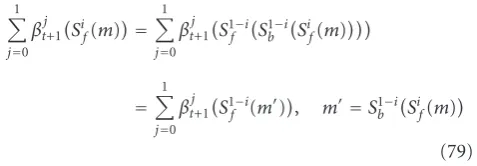
For the DSBGT MAP algorithm, we note that the identity
1
j=0
βtj+1
Sif(m)
=
1
j=0
βtj+1
S1f−i
S1b−i
Sif(m)
=
1
j=0
βtj+1
S1f−i(m)
, m=S1b−i
Sif(m)
(79)
can be used to reduce the number of additions by half in the computation ofβt0(m) andβt1(m) (cf. (50)). An examination
of (42) and the recursions (49) and (50) then shows that to decode a single bit, there areBexponentiations, 1+(n−1)B+ 2M+2(M−1)=(n−1)B+4M−1 additions, and 2M+2M+ 2M+ 1=6M+ 1 multiplications. Memory is required forM
values ofαt(m) andBvalues of branch metricsΓt(j,m) or a
total ofB+Munits.
The preceding calculations show that indeed the BCJR and DSBGT MAP algorithms have identical computational complexities and memory requirements, and therefore the BCJR and the four modified BCJR MAP algorithms all have identical computational complexities and memory require-ments.
7.2. Complexity comparisons in the log domain
In the log domain, exponentiation operations in the linear domain disappear, multiplications are converted into addi-tions, and additions in the recursions are converted into the so-calledEoperation defined in [7, equation (21)] based on the formula
lnex+ey=max(x,y) + ln1 +e−|x−y|, (80)
where the function ln(1 +e−|x−y|) is replaced by a lookup table. Following the same analysis as in the previous sub-section, it can be shown that the BCJR and the four modi-fied BCJR MAP algorithms also have identical computational complexities and memory requirements in the log domain.
7.3. Initialization of the backward recursion